Introduction
In the fifth edition of the Diagnostic and Statistical Manual of Mental Disorders (DSM-5; American Psychiatric Association [APA], 2013), post-traumatic stress disorder (PTSD) is classified as a trauma- and stressor-related disorder. A diagnosis is based on a required number of symptoms across domains of intrusion, avoidance, negative alterations in cognitions and mood, and alterations in arousal and reactivity. Also stipulated in DSM-5 are the criteria required for specifying the dissociative subtype of PTSD (PTSD-DS) where, in addition to first meeting the criteria for PTSD diagnosis, individuals must endorse symptoms of depersonalisation and or derealisation. Depersonalisation involves ‘persistent or recurrent experiences of feeling detached from, and as if one were an outside observer of, one's mental processes or body’, whereas derealisation takes the form of ‘persistent or recurrent experiences of unreality of surroundings’ (DSM-5, 2013, p. 272).
It has been extensively documented that persistent dissociation is linked to post-traumatic symptomology (Carlson, Dalenberg, & McDade-Montez, Reference Carlson, Dalenberg and McDade-Montez2012). The subtype model suggests that PTSD and PTSD-DS are distinct from one another (Dalenberg & Carlson, Reference Dalenberg and Carlson2012), where PTSD-DS presents with its own epidemiological features (Schiavone, Frewen, McKinnon, & Lanius, Reference Schiavone, Frewen, McKinnon and Lanius2018). Recent evidence suggests that there may be an association between PTSD-DS and psychopathological comorbidity and childhood abuse and neglect (Steuwe, Lanius, & Frewen, Reference Steuwe, Lanius and Frewen2012), adult sexual abuse (Wolf et al., Reference Wolf, Miller, Reardon, Ryabchenko, Castillo and Freund2012b), and with depression, suicidal thinking and drug overdoses (Mergler et al., Reference Mergler, Driessen, Lüdecke, Ohlmeier, Chodzinski and Weirich2017), despite there being a large degree of heterogeneity in the literature concerning risk factors for PTSD-DS (Hansen, Ross, & Armour, Reference Hansen, Ross and Armour2017). This indicates that PTSD-DS may reflect a more severe form of PTSD (Zoet, Wagenmans, van Minnen, & de Jongh, Reference Zoet, Wagenmans, van Minnen and de Jongh2018), although this is not directly assessed in this study.
One criticism of the PTSD-DS diagnosis is that the symptoms of dissociation chosen as necessary criteria to achieve a diagnosis in DSM-5 are too narrow, where it is believed that the current criteria should also include other symptoms of dissociation (Ross, Reference Ross2021), following evidence that dissociative amnesia (Wolf et al., Reference Wolf, Mitchel, Sadeh, Hein, Fuhrman, Pietrzak and Miller2017) and flashbacks (Dahal, Kumar, & Thapa, Reference Dahal, Kumar and Thapa2018; Hyland et al., Reference Hyland, Shevlin, Brewin, Cloitre, Downes, Jumbe and Roberts2017) are common in individuals with PTSD. Additionally, memory disturbance, disengagement, time loss and trance (Frewen, Brown, Steuwe, & Lanius, Reference Frewen, Brown, Steuwe and Lanius2015), gaps in awareness, re-experiencing and sensory misperception (Műllerová, Hansen, Contractor, Elhai, & Armour, Reference Műllerová, Hansen, Contractor, Elhai and Armour2016; Ross, Baník, Dědová, Mikulášková, & Armour, Reference Ross, Baník, Dědová, Mikulášková and Armour2018) are associated with PTSD-DS. However, to some extent, these symptoms are already captured by the existing PTSD criteria.
Several methodologies have been used to determine the prevalence of PTSD-DS, with early studies using taxometric (Waelde, Silvern, & Fairbank, Reference Waelde, Silvern and Fairbank2005; Waller & Ross, Reference Waller and Ross1997) and signal detection (Ginzburg et al., Reference Ginzburg, Koopman, Butler, Palesh, Kraemer, Classen and Spiegel2006) analyses. The prevalence of PTSD-DS has also been described in studies where participants were selected primarily due to a specific comorbid difficulty, such as substance abuse disorder and psychosis, using the DSM-5 diagnostic criteria (Gidzgier et al., Reference Gidzgier, Grundmann, Lotzin, Hiller, Schneider, Driessen and Schäfer2019; Mergler et al., Reference Mergler, Driessen, Lüdecke, Ohlmeier, Chodzinski and Weirich2017; van Minnen et al., Reference van Minnen, van der Vleugel, van den Berg, De Bont, de Roos, van der Gaag and De Jongh2016), and in studies that assessed subsyndromal PTSD (Bennett, Modrowski, Kerig, & Chaplo, Reference Bennett, Modrowski, Kerig and Chaplo2015; Kerig et al., Reference Kerig, Charak, Chaplo, Bennett, Armour, Modrowski and McGee2016; Modrowski & Kerig, Reference Modrowski and Kerig2017). Prevalence rates of PTSD-DS have been reported in different ways; some with respect to the total number of participants regardless of whether the sample tested had PTSD, some were only trauma-exposed or from a community sample, whereas other prevalence rates were with respect to those with PTSD. This makes it challenging to make comparisons between studies. Hansen et al.'s (Reference Hansen, Ross and Armour2017) systematic review of latent class and profile analyses (LCA and LPA respectively) indicated that the mean prevalence of PTSD-DS was 20.4%. LCA determines hidden groups based on the means of categorical variables, whereas LPA does the same for continuous variables (Oberski, Reference Oberski2016). Both LCA and LPA are exploratory techniques that determine underlying hidden profiles or groups of individuals from observed data who display similar patterns of symptoms (Muthén, Reference Muthén and Kaplan2004; Oberski, Reference Oberski2016). The ‘best’ number of groups is determined by the most appropriate model fit, and whilst there are many methods for determining the number of classes or profiles, the two most common methods are the Akaike information criterion and Bayesian information criterion (where lower values indicate a better fit). However, the selection of the optimal number of classes or profiles, and the qualitative naming of each group, remains subjective on the part of the researcher, which has implications for valid prevalence estimation (Hansen et al., Reference Hansen, Ross and Armour2017). In addition, Hansen et al. (Reference Hansen, Ross and Armour2017) averaged the prevalence values despite dissociation being defined differently in various studies; some used the DSM-5 criteria stipulating symptoms of either depersonalisation or derealisation, and other studies assessed a wider spectrum of dissociative experiences. Finally, due to methodological constraints, there was no way of breaking down the heterogeneous nature of the population (Hansen et al., Reference Hansen, Ross and Armour2017).
There is a need to comprehensively systematically review studies to attempt to establish some consensus around how prevalent PTSD-DS is in children and adults. This study aimed to conduct a broad meta-analysis of data from studies investigating current PTSD-DS to reach a reliable estimate of prevalence from studies utilising various methods of prevalence estimation, furthering the systematic review of Hansen et al. (Reference Hansen, Ross and Armour2017). The aim was to provide greater insight into the heterogeneity that is common within participants with PTSD. This might lead to the development of risk factors for this particular subtype and help the structuring of efficacious interventions. This review will be, to the authors' knowledge, the first of its kind to meta-analyse the prevalence of PTSD-DS in participants with PTSD, assessing moderators that affect PTSD-DS prevalence, and using studies utilising different methods of prevalence estimation. There is disagreement as to what symptoms of dissociation should be required as necessary criteria to achieve a diagnosis of PTSD-DS, and this review may shed further light on this debate, by comparing the prevalence rates of PTSD-DS when defined by depersonalisation and or derealisation, and when dissociation is defined more broadly (domains other than depersonalisation and or derealisation).
Method
The protocol for this review was pre-registered on PROSPERO (reference: CRD 42021210902) prior to any formal review of searches.
Search strategy
Relevant studies were identified through a systematic search of the following databases: MEDLINE (EBSCO), PsycInfo, CINAHL, Academic Search Complete and PTSDpubs. Studies included were those published from 1 January 1980, when the Diagnostic and Statistical Manual of Mental Disorders first defined PTSD according to DSM-III (APA, 1980), and before 14 February 2021 when the searches were conducted.
The following search terms were used for each database, processing study titles and abstracts only: (posttrauma* OR post-trauma* OR ‘post trauma*’ OR PTSD OR PTSS) AND (dissociat* OR depersonali* OR dereali*). Medical Subject Headings (MeSH) terms, and other equivalent key words for other databases, were used for each search term: ‘post-traumatic stress disorder’, ‘post-traumatic stress’, ‘posttraumatic stress disorder’, ‘posttraumatic stress’ ‘post-traumatic stress disorder in children’, ‘stress disorders, post-traumatic’, ‘complex PTSD’, ‘PTSD’, ‘PTSD (DSM-III)’, ‘PTSD (DSM-III-R)’, ‘PTSD (DSM-IV)’, ‘PTSD (DSM-5)’, ‘PTSD (ICD-9)’, ‘PTSD (ICD-10)’, ‘PTSD (ICD-11)’, ‘dissociation’ and ‘depersonalization’.
The reference sections of relevant systematic reviews and meta-analyses were also searched to ensure studies were not missed.
Inclusion and exclusion criteria
Studies were included in this review if data were presented on the point prevalence of PTSD-DS following a traumatic event. In a bid to take a broad and comprehensive approach, the prevalence of PTSD-DS was defined as the number of participants: who scored above a clinical cut-off on a validated measure or who met DSM diagnostic criteria following a clinical interview or self-report measure, or who were categorised into a distinct class or profile following LCA or LPA. Studies of participants of all ages, any sex and from either community or clinical samples were included. Studies were excluded: if they were not written in English; if participants were selected primarily due to a specific comorbid disorder; if PTSD was assessed acutely within a month of the index trauma; if exclusively lifetime PTSD or PTSD-DS prevalence was reported; if subsyndromal PTSD was assessed only; if dissociation was triggered via experimental manipulation; or if studies used analyses other than LCA, LPA, diagnostic or clinical cut-off to determine the prevalence of PTSD-DS. Qualitative methodology, single case studies, reviews and meta-analyses were also excluded.
Screening, data extraction, coding and synthesis
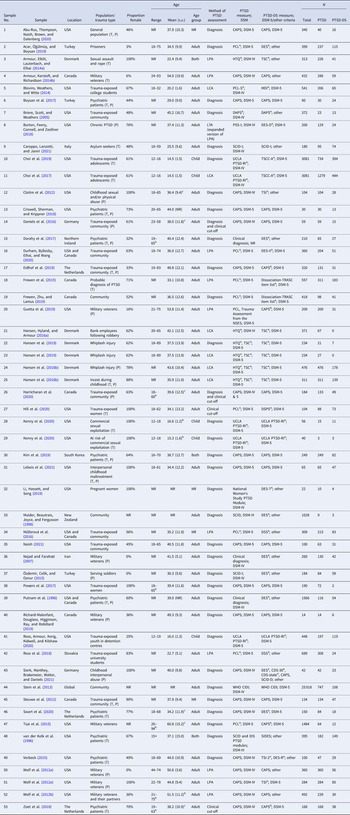
All studies were screened, and the data extracted by the first author (WW) using a database which indexed the information provided in Table 1. The extracted data for all studies were reviewed by an independent researcher (AO), so as to reduce the likelihood of error (Buscemi, Hartling, Vandermeer, Tjosvold, & Klassen, Reference Buscemi, Hartling, Vandermeer, Tjosvold and Klassen2006). Any queries were discussed, and agreement reached between the researchers. Wherever there was continued disagreement, a final decision was made by the senior researcher (RM-S). Where there was missing information, authors were contacted directly.
Included sample characteristics

S.D., standard deviation; T, treatment-seeking inclusion criteria; P, diagnosis of PTSD inclusion criteria; NR, not reported; CAPS, Clinician Administered Post-traumatic Stress Disorder Scale; PCL, Post-traumatic Stress Disorder Checklist; DES, Dissociative Experiences Scale; LPA, latent profile analysis; HTQ, Harvard Trauma Questionnaire; TSC, Trauma Symptom Checklist; LCA, latent class analysis; PCL-S, Post-traumatic Stress Disorder Checklist Specific; MDI, Multiscale Dissociation Inventory; DAPS, Detailed Assessment of Posttraumatic Stress; DES-D, depersonalization/derealisation subscale of the DES; PSS, Post-traumatic Stress Disorder Symptom Scale; PSS-I, PTSD Symptom Scale-Interview; SCID-I, Structured Clinical Interview for the DSM-IV Axis I Disorders; UCLA PTSD-RI, University of California at Los Angeles Posttraumatic Stress Disorder Reaction Index; TSCC-A, Trauma Symptom Checklist for Children-Alternate Version; TSI, Trauma Symptom Inventory; TRASC, trauma-related altered states of consciousness; NSES, National Stressful Events Survey; DES-T, eight-item taxon version of the Dissociative Experiences Scale; SCID, Structured Clinical Interview for DSM; DSPS, Dissociative Subtype of PTSD Scale; DSS, Dissociative Symptoms Scale; CDS, Cambridge Depersonalization Scale; SCID-D, Structured Clinical Interview for DSM-IV Dissociative Disorders; WHO CIDI, World Health Organisation Composite International Diagnostic Interview; DIS, Diagnostic Interview Schedule; SIDES, Structured Interview for Disorders of Extreme Stress; DES-R, Dissociative Experiences Scale – Revised.
a Measure completed via self-report.
b Information acquired via correspondence with study author(s).
c Mean and standard deviation values combined (Higgins & Deeks, Reference Higgins, Deeks, Higgins and Green2008).
d Multiple measures used, however CAPS chosen as the gold standard (Weathers et al. Reference Weathers, Newman, Blake, Nagy, Schnurr, Kaloupek and Keane2004).
During data extraction, several rules were followed to ensure consistency between studies. Articles such as Eidhof et al. (Reference Eidhof, ter Heide, van Der Aa, Schreckenbach, Schmidt, Brand and Vermetten2019), Guetta et al. (Reference Guetta, Wilcox, Stoop, Maniates, Ryabchenko, Miller and Wolf2019) and Zoet et al. (Reference Zoet, Wagenmans, van Minnen and de Jongh2018) used multiple measures for the assessment of PTSD; however, in these cases the Clinician Administered PTSD scale (CAPS) was prioritised as it is regarded as the gold standard for assessing PTSD (Weathers et al., Reference Weathers, Newman, Blake, Nagy, Schnurr, Kaloupek and Keane2004). Other studies assessed multiple populations (Hansen, Műllerová, Elklit, & Armour, Reference Hansen, Műllerová, Elklit and Armour2016b; Kenny, Helpingstine, Long, & Harrington, Reference Kenny, Helpingstine, Long and Harrington2020; Wolf et al., Reference Wolf, Miller, Reardon, Ryabchenko, Castillo and Freund2012b) or used multiple analyses (Choi et al., Reference Choi, Seng, Briggs, Munro-Kramer, Graham-Bermann, Lee and Ford2017, Reference Choi, Ford, Briggs, Munro-Kramer, Graham-Bermann and Seng2019; Hansen, Hyland, Armour, & Andersen, Reference Hansen, Hyland, Armour and Andersen2019), and therefore these were treated separately in this review as individual samples. Care was taken to ensure that no dataset contributed more than one data point in any one meta-analysis (where diagnostic and clinical cut-off samples were prioritised over LCA and LPA samples). Multiple studies investigating the same population were removed, retaining the study with the largest sample size. Many studies (Cloitre, Petkova, Wang, & Lu, Reference Cloitre, Petkova, Wang and Lu2012; Daniels, Frewen, Theberge, & Lanius, Reference Daniels, Frewen, Theberge and Lanius2016; Swart, Wildschut, Draijer, Langeland, & Smit, Reference Swart, Wildschut, Draijer, Langeland and Smit2020; Tsai, Armour, Southwick, & Pietrzak, Reference Tsai, Armour, Southwick and Pietrzak2015) reported means and standard deviations for participant age and sex in aggregated format, rather than for the sample as a whole. For these studies, the means and standard deviations were combined (Higgins & Deeks, Reference Higgins, Deeks, Higgins and Green2008). When absolute frequencies were not reported, these were calculated from the reported percentage prevalence. For the LCA and LPA samples, only those classed as having ‘moderate’ to ‘severe’ symptomology were deemed to meet ‘caseness’ for PTSD and PTSD-DS. The prevalence of PTSD-DS was consistently calculated as a proportion of all participants with PTSD.
Quality assessment and risk of bias
Two authors (WW and AO) assessed the risk-of-bias using a researcher developed tool based on the Assessment Tool for Observational Cohort and Cross-Sectional Studies (National Heart Lung and Blood Institute, 2014), and modified questions from other relevant prevalence and risk factor studies (Hoy et al., Reference Hoy, Brooks, Woolf, Blyth, March, Bain and Buchbinder2012; Munn, Moola, Riitano, & Lisy, Reference Munn, Moola, Riitano and Lisy2014). The quality assessment checklist (see online Supplementary Material) consisted of five items assessing how well the population and index trauma were specified, the rate of participation, and whether objective and standard criteria were used for the assessment of PTSD and PTSD-DS. Each item used a three-point scale (0–2), and the following categorical system was used to rate the total risk-of-bias score: 0–4 high risk/low quality, 5–6 moderate risk/quality, 7–10 low risk/high quality, following the methodology used by Memarzia, Walker, and Meiser-Stedman (Reference Memarzia, Walker and Meiser-Stedman2021). An inter-rater reliability assessment was conducted for all ratings between the two raters (WW and AO) which indicated a good correlation on all items [intraclass correlation = 0.87, 95% confidence intervals (CI) 0.77–0.93].
Meta-analytic method
The meta-analysis was conducted using R (version 4.1.1) which uses the metafor package (version 3.0–2; Viechtbauer, Reference Viechtbauer2010). The extracted point prevalence of PTSD-DS, as a proportion of all PTSD cases, was pooled to provide a weighted estimate of the prevalence of PTSD-DS overall (with 95% CI).
A random-effects model was used given the high degree of variability expected in effect size between samples as it provides a broader and more conservative 95% CI around the estimate of the prevalence.
The estimates of the prevalence underwent an arcsin transformation to ensure that the CIs did not fall below zero for samples where the prevalence estimate was low (Barendregt, Doi, Lee, Norman, & Vos, Reference Barendregt, Doi, Lee, Norman and Vos2013); results were then back transformed for ease of interpretation.
Cochran's Q test (Cochran, Reference Cochran1954) was used to ascertain if heterogeneity within samples was significant. The I 2 statistic (Higgins & Thompson, Reference Higgins and Thompson2002) was used to determine the percentage of total variation in sample estimates that is due to between-study heterogeneity.
Moderator analyses of prevalence estimates were conducted to ascertain if sample characteristics impacted the prevalence estimate. These characteristics included method of PTSD-DS assessment, which DSM criteria was used, participant age group, occupation and the type of trauma suffered. These were included as there were multiple samples that allowed for these comparisons to be made. A sensitivity analysis was used to assess the impact of risk-of-bias on the estimated pooled prevalence. This was achieved by repeating the meta-analysis, excluding those samples that constituted a high risk-of-bias. Any differences in the moderator and sensitivity analyses were tested for clinical significance by meta-analytic regression.
A funnel plot was used to assess for publication bias (Higgins & Altman, Reference Higgins and Altman2008); however, this is less likely to occur in prevalence studies given there is no assessment of clinical significance, and therefore it is less likely that there is a bias in levels of acceptance to journals (Brewin, Andrews, & Valentine, Reference Brewin, Andrews and Valentine2000). The ‘trim-and-fill’ method was used (Duval & Tweedie, Reference Duval and Tweedie2000), where any missing null or weaker studies are estimated to improve the symmetry of the sample distribution.
Results
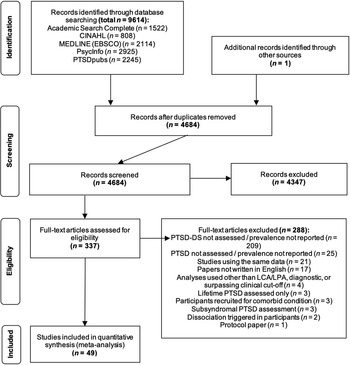
The Preferred Reporting Items for Systematic Reviews and Meta-Analyses (PRISMA) diagram shows that 337 studies met the eligibility criteria following the initial screen of titles and abstracts (Fig. 1). Full-text reviews were conducted again, leading to 49 studies being included in the meta-analysis. Four studies were split into two samples due to different characteristics, index traumas or analyses, leaving 53 samples included in this review (Table 1). Around half the samples were treatment-seeking (k = 23), and PTSD-focussed (a diagnosis of PTSD was an inclusion criterion; k = 22). Nine samples included only female participants, three samples included only males, and the rest were mixed or the sex was not reported. The majority of included samples were adult (k = 41); only five exclusively comprised children. Samples mostly originated from high-income countries (k = 49).
PRISMA diagram showing the process of study identification, screening and inclusion (n = number of studies).

Risk-of-bias assessment
Twelve samples were deemed to be at high risk-of-bias, 16 were moderate risk, whereas 25 were low risk. The proportion of samples rated as low, moderate and high risk across the five quality assessment items can be seen in the online Supplementary Material.
Prevalence
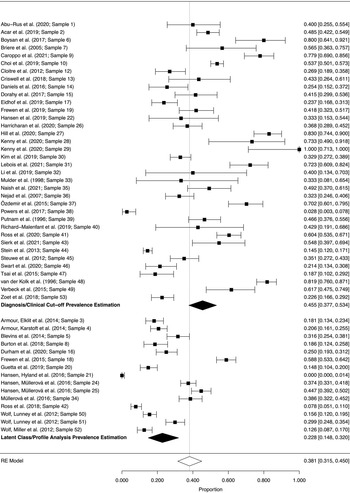
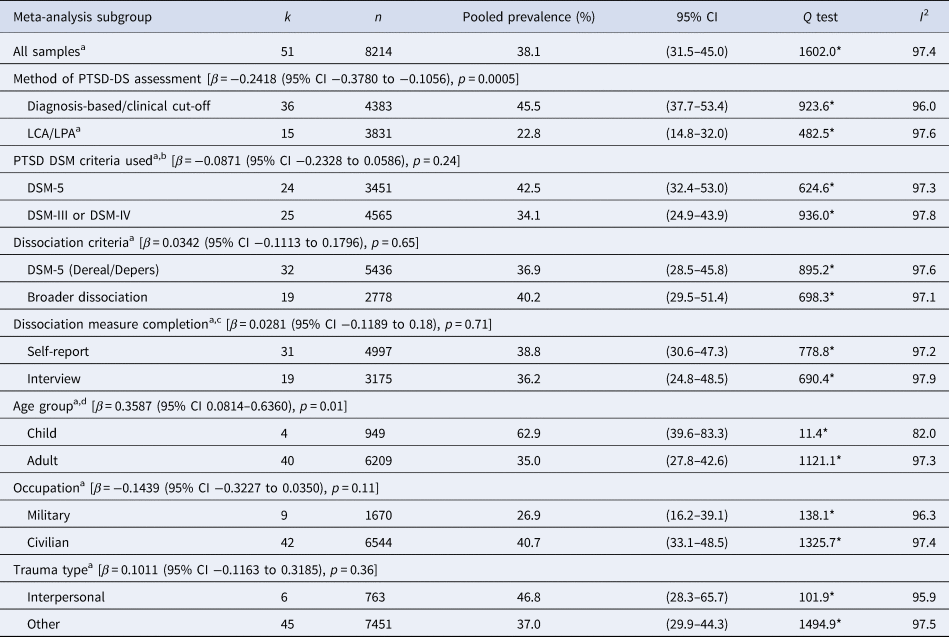
The pooled prevalence of PTSD-DS estimates and heterogeneity statistics for all samples can be seen in Table 2. The overall pooled prevalence was 38.1%. For diagnosis-based and clinical cut-off samples the pooled prevalence was 45.5%, while for latent class and profile samples the estimate was 22.8%. Meta-regression analyses indicated that the prevalence of PTSD-DS in the diagnosis-based or clinical cut-off samples was statistically significantly greater than the LCA or LPA samples (see Fig. 2 for forest plot). The range of prevalence overall was 0–100%, and the degrees of between-sample heterogeneity were extremely high.
Forest plot of PTSD-DS point prevalence estimates grouped by PTSD-DS assessment method (samples 11 and 23 removed to avoid duplication of population samples).

Pooled point prevalence of PTSD-DS as a proportion of those with PTSD for all samples (k = 51)

k, number of samples; n, number of participants; CI, confidence interval; LCA, latent class analysis; LPA, latent profile analysis; Dereal, derealisation; Depers, depersonalisation.
a Samples 11 and 23 removed to avoid duplication of population samples.
b Sample 15 removed as no PTSD DSM criteria reported, sample 26 removed as both DSM-IV and DSM-5 were used when assessing for PTSD.
c Sample 43 removed as a mix of self-report and interview measures were used.
d Several samples were removed due to populations formed of both children and adults, or age group not reported.
*p < 0.0001, where the degrees of freedom (df) = k – 1.
Moderator analyses
All samples
Moderator analyses were conducted for all samples to assess whether the pooled prevalence estimate of PTSD-DS was associated with demographic, trauma or assessment factors (Table 2). Meta-regression analyses confirmed that the prevalence of PTSD-DS in the child samples was statistically significantly greater than the adult samples, although there were only four child samples for comparison. All other comparisons were non-significant; however, several comparisons were likely underpowered.
Diagnostic and clinical cut-off samples
Further subgroup moderator analyses were conducted separately for the diagnostic and clinical cut-off samples (Table 3), regardless of the dissociation criteria used, given the significant difference in pooled prevalence estimates of PTSD-DS between these samples and those using LCA or LPA. Meta-regression analyses confirmed again that the prevalence of PTSD-DS in the child samples was statistically significantly greater than the adult samples, although there were only four child samples for comparison. All other comparisons were non-significant, however several comparisons were likely underpowered.
Pooled point prevalence of PTSD-DS as a proportion of those with PTSD for all diagnostic and clinical cut-off samples (i.e. excluding LCA and LPA samples; k = 36)

k, number of samples; n, number of participants; CI, confidence interval; Dereal, derealisation; Depers, depersonalisation.
a Sample 15 removed as no PTSD DSM criteria reported, sample 26 removed as both DSM-IV and DSM-5 were used when assessing for PTSD.
b Sample 43 removed as a mix of self-report and interview measures were used.
c Several samples were removed due to populations formed of both children and adults, or age group not reported.
*p < 0.0001, where the degrees of freedom (df) = k – 1.
**p < 0.01, where the degrees of freedom (df) = k – 1.
Further moderator analyses were conducted for only those samples utilising DSM-5 criteria for dissociation (depersonalisation and or derealisation; see online Supplementary Material). When only samples using DSM-5 diagnostic and clinical cut-off criteria for the assessment of PTSD and PTSD-DS were pooled, the estimated prevalence of PTSD-DS was 48.2%. This provides the most valid estimate of PTSD-DS prevalence according to the DSM-5 criteria. Meta-regression analyses confirmed again that the prevalence of PTSD-DS in the child samples was statistically significantly greater than the adult samples, although there were only four child samples for comparison. All other comparisons were non-significant, however several comparisons were likely underpowered.
Latent class and profile samples
Moderator analyses were conducted separately for the LCA and LPA samples (see online Supplementary Material), again given the significant difference in pooled prevalence of PTSD-DS estimates between these samples and those using diagnostic and clinical cut-off methods. Meta-regression analyses confirmed that there were no statistically significant differences, however several comparisons were likely underpowered.
Sensitivity analyses
When the 28 samples of low and moderate quality were removed, the estimated prevalence of PTSD-DS was not dissimilar to that for all samples (35.7%, 95% CI 24.8–47.3%) with a similar degree of between-sample heterogeneity [k = 25, Q(24) = 717.8, p < 0.0001, I 2 = 98.5%]. Meta-regression analyses indicated there was not a significant difference between high and low-moderate quality groups [β = 0.0040 (95% CI −0.1384 to 0.1463), p = 0.96]. Therefore, it can be concluded that there was no support for the quality of the samples affecting the prevalence of PTSD-DS estimates.
Given the differences in prevalence in PTSD-DS between child and adult samples, the child samples were removed to assess whether similar results were achieved as in Table 2. Meta-regression analyses confirmed that the only statistically significant difference existed between the estimated prevalence of PTSD-DS for the diagnosis-based or clinical cut-off samples and LCA or LPA samples [β = −0.2159 (95% CI −0.3531 to −0.0787), p = 0.002]. All other comparisons were non-significant (ps = 0.19–0.87), however several comparisons were likely underpowered.
Publication bias
Visual inspection of the funnel plot (see online Supplementary Material) suggests the distribution of samples was asymmetrical, which was confirmed by Egger's test (p = 0.03). However, the study of Kenny et al. (Reference Kenny, Helpingstine, Long and Harrington2020; sample 29) was very small and should be considered an outlier. When this sample was removed, the Egger's test confirmed the symmetry of the distribution (p = 0.30). No null or weaker studies were estimated as missing, indicating little to no publication bias.
Discussion
A comprehensive systematic review and meta-analysis of prevalence data from studies investigating current PTSD-DS utilising various methods of prevalence estimation was completed. The aim was to generate a reliable estimate for the prevalence of PTSD-DS and to provide greater insight into the heterogeneity that is common within participants with PTSD-DS. The estimated pooled prevalence of PTSD-DS was: 38.1% for all samples, 45.5% for all diagnostic and clinical cut-off samples and 22.8% for all LCA and LPA samples. The estimated prevalence of PTSD-DS from the LCA and LPA samples was similar to the mean prevalence found in the Hansen et al. (Reference Hansen, Ross and Armour2017) systematic review (20.4%); this is unsurprising given nine of the 11 studies in the Hansen et al. (Reference Hansen, Ross and Armour2017) review were also included in the present study. When only samples strictly using DSM-5 diagnostic and clinical cut-off criteria for the assessment of PTSD and PTSD-DS were pooled, the estimated prevalence of PTSD-DS was 48.1%. The prevalence of PTSD-DS may therefore be significantly greater than previously suggested.
Impact of diagnostic and clinical cut-off assessment v. LCA and LPA on estimated prevalence of PTSD-DS
The estimated prevalence of PTSD-DS for the diagnostic and clinical cut-off samples was significantly higher than that of the LCA and LPA samples. Use of clinical cut-off measures may overestimate the prevalence of PTSD in adults (Richardson, Frueh, & Acierno, Reference Richardson, Frueh and Acierno2010). Moreover, it may be easier to identify individuals with PTSD who show symptoms of depersonalisation or derealisation in a clinical interview or that surpass a clinical cut-off on a dissociation measure, rather than via LCA and LPA methods. On the other hand, latent class and profile analyses may rely on participants reporting multiple significant dissociative symptoms rather than just one symptom to a significant level. Achterhof, Huntjens, Meewisse, and Kiers (Reference Achterhof, Huntjens, Meewisse and Kiers2019) questioned the use of LCA and LPA to ascertain the prevalence of complex PTSD and highlighted that despite the analyses determining distinct profiles, the symptom profile for groups of participants was very close to one another and even overlapped on occasion. Therefore, it may be questioned whether LCA and LPA reliably and validly estimate subtype prevalence.
Impact of moderators on estimated prevalence of PTSD-DS
There was no significant difference between the estimated prevalence of PTSD-DS when dissociation was assessed by the DSM-5 criteria (presence of either depersonalisation or derealisation) or when defined by a broader spectrum of dissociative symptoms. The aim of the inclusion of the PTSD-DS in DSM-5 was to define a small subgroup of individuals with consistent clinical and epidemiological features (Miller, Wolf, & Keane, Reference Miller, Wolf and Keane2014; Schiavone et al., Reference Schiavone, Frewen, McKinnon and Lanius2018); however, results from the present study suggest a subtype where the prevalence varies very widely across samples (0–100%) and where the heterogeneity cannot be broken down following moderator analyses. Research literature suggests that the symptomology of PTSD is itself heterogeneous (Elhai, Frueh, Davis, Jacobs, & Hamner, Reference Elhai, Frueh, Davis, Jacobs and Hamner2003; Galatzer-Levy & Bryant, Reference Galatzer-Levy and Bryant2013; Naifeh, Richardson, Del Ben, & Elhai, Reference Naifeh, Richardson, Del Ben and Elhai2010), where dissociation is one such symptom that can vary.
The estimated prevalence of PTSD-DS was significantly higher for samples of children compared to adults, although there are limited number of samples investigating exclusively children, and the results were dominated by that of Choi et al. (Reference Choi, Ford, Briggs, Munro-Kramer, Graham-Bermann and Seng2019; sample 10). There was no one trauma type that best categorised the child samples. Research has shown that dissociation is a common experience for children, that later becomes less prevalent with child development and the transition into adulthood (Brunner, Parzer, Schuld, & Resch, Reference Brunner, Parzer, Schuld and Resch2000; Choi et al., Reference Choi, Seng, Briggs, Munro-Kramer, Graham-Bermann, Lee and Ford2017; Coons, Reference Coons, Michelson and Ray1996; Shimizu & Sakamoto, Reference Shimizu and Sakamoto1986). Choi et al. (Reference Choi, Ford, Briggs, Munro-Kramer, Graham-Bermann and Seng2019) reported that 53.7% of children with PTSD had the dissociative subtype; a prevalence much higher than in many other adult samples, and the authors cited the prominence of dissociation as a form of coping in response to maltreatment in childhood (Liotti, Reference Liotti2004). Children may be more susceptible to PTSD-DS because they do not have the same capacity to avoid cues relating to the traumatic event, especially when the trauma was based within the home environment, or with a primary caregiver (Choi et al., Reference Choi, Ford, Briggs, Munro-Kramer, Graham-Bermann and Seng2019). In children, dissociation may offer an alternative method of escape to reduce distress. It might also be considered whether depersonalisation and derealisation are the most appropriate symptoms by which to assess for PTSD-DS in children. The premise of the subtype model is that these dissociative symptoms are rare (Lanius et al., Reference Lanius, Wolf, Miller, Frewen, Vermetten, Brand, Spiegel, Friedman, Keane and Resick2014); however, it may be that dissociative experiences are more common in youth (Carlson, Yates, & Sroufe, Reference Carlson, Yates, Sroufe, Dell and O'Neil2009) and may not even be considered as pathological. Further research is required within this area to determine whether children are more at risk from dissociation in the context of PTSD compared to adults, as the lack of power within the samples of children frustrated the moderator analyses.
Other than age group, all other moderator analyses yielded non-significant results indicating no support for any differences between estimated prevalence of PTSD-DS. This is surprising given the extant research on mediators and risk factors in relation to PTSD-DS (Hansen et al., Reference Hansen, Ross and Armour2017; Schiavone et al., Reference Schiavone, Frewen, McKinnon and Lanius2018 for review), but these non-significant results are likely to reflect the heterogeneity between these samples and the lack of power in some moderator analyses.
It is important to stress that the pooled prevalence estimates were characterised by a high degree of heterogeneity throughout, and inspection of the forest plot (Fig. 2) shows how varied the prevalence of PTSD-DS is across different samples. This is not unexpected given the multiple ways of assessing and conceptualising PTSD-DS; however, subsequent sensitivity and moderation analyses failed to reduce the level of heterogeneity. This therefore limits the generalisability of the findings. The consistently high level of heterogeneity may reflect the difficulty in conceptualising and defining a construct such as dissociation in the context of PTSD. Even when only samples adhering to the strict DSM-5 criteria for PTSD-DS were pooled, a high degree of heterogeneity remained.
Clinical implications and suggestions for future research
This meta-analysis suggests that PTSD-DS is common in children and adults with PTSD, and therefore should be routinely assessed for and formulated. Moreover, the method for determining PTSD-DS was found to have important implications for the estimated prevalence, where samples using diagnostic and clinical cut-off methods reported a higher prevalence than those using LCA and LPA. Future research should also aim to standardise the methodology used to identify and determine PTSD-DS in order to make more valid comparisons between studies.
Additionally, PTSD-DS was found to be more common in children than adults. Clinicians supporting individuals with PTSD should be aware that dissociation is a prevalent and important feature of the overall presentation of PTSD; this may be especially true for children, though this finding was based on only five samples. When the DSM-5 criteria were published it was believed that PTSD-DS cases formed a minority of those with PTSD; however, the finding that nearly half of PTSD cases meet the criteria for PTSD-DS suggests that it may be less of a subtype and that dissociation forms a central component to PTSD symptomology. This should be a consideration for how dissociation is specified in future versions of the DSM. Perhaps the conceptualisation of complex PTSD as defined by the 11th revision of the International Classification of Diseases (World Health Organisation, 2019), where dissociation is stipulated as one of several symptoms seen to be indicative of a more complex form of PTSD, is a more appropriate fit. There is evidence for instance that individuals with complex PTSD have elevated levels of dissociation (Hyland, Shevlin, Fyvie, Cloitre, & Karatzias, Reference Hyland, Shevlin, Fyvie, Cloitre and Karatzias2020).
Despite the DSM-5 criteria stipulating depersonalisation and derealisation as symptoms required for PTSD-DS, findings of this review suggested that when a wider view of dissociation (i.e. drawing on a broader range of dissociation symptoms) is included in the criteria, PTSD-DS prevalence does not change significantly. No conclusions can be drawn as to whether it would be more or less appropriate for a narrower (i.e. solely based on depersonalisation and or derealisation) or a broader definition of dissociation, in the context of this subtype, to be used in future versions of diagnostic criteria. However, it does not seem to matter how dissociation is defined when determining the prevalence of PTSD-DS, which raises questions firstly about the strict nature of the DSM criteria when defining this subtype (Ross, Reference Ross2021), and secondly about the existence of this subtype full stop. Further research is required to establish whether PTSD-DS could be indicative of a distinct form of PTSD that has its own clinical characteristics, and therefore break down the heterogeneity common to populations with the subtype. This would help inform exactly how dissociation should be integrated into future diagnostic criteria of PTSD. Perhaps as Ross (Reference Ross2021) suggests, future diagnostic criteria could stipulate the requirement for the presence of one or more of: depersonalisation, derealisation, dissociative amnesia and dissociative flashbacks. Non-dissociative PTSD may then form the subtype based on a minority of cases, and dissociative PTSD may form the majority of diagnosed cases.
Limitations
There are several limitations that should be considered for this review. Firstly, whilst many more studies were reviewed in comparison to the most recent systematic review (Hansen et al., Reference Hansen, Ross and Armour2017), there was still a considerable degree of heterogeneity between samples, reducing the generalisability of the findings. This raises questions around the validity of the underlying diagnostic subtype. Secondly, most studies were conducted in high-income countries, and all studies were exclusively written in English, therefore indicating that the results are likely not globally generalisable. Thirdly, some moderator analyses lacked power and further planned moderator analyses were not possible due to a lack of identified studies. Understanding the influence of, for instance, sex, time between index trauma and PTSD assessment, single- v. multi-event traumas and individual v. collective trauma could lead to important and interesting findings. Finally, several studies chose to assess PTSD-DS with regard to the most recent trauma that the participant was exposed to, and it is unclear whether other traumas may have taken place, and what impact these may have on the prevalence of PTSD-DS.
Conclusion
This study is the first to meta-analyse data on the prevalence of PTSD-DS. The estimated prevalence of PTSD-DS, with respect to participants diagnosed with PTSD, was 38.1% (95% CI 31.5–45.0%) for all samples, 45.5% (95% CI 37.7–53.4%) for all diagnosis-based and clinical cut-off samples, 22.8% (95% CI 14.8–32.0%) for all LCA and LPA samples and 48.1% (95% CI 35.0–61.3%) for diagnosis-based and clinical cut-off samples which assessed PTSD and PTSD-DS strictly according to the DSM-5 criteria. The prevalence of PTSD-DS was significantly higher for children compared to adults. Factors such as the DSM criteria used for the assessment of both PTSD and dissociation, whether the dissociation assessment was self-report or interview, and participant or trauma characteristics, did not significantly affect the estimated prevalence of PTSD-DS. However, all results were characterised by very high levels of heterogeneity. Further research is required to investigate this construct, and to determine how it should be best conceptualised in future editions of diagnostic criteria.
Supplementary material
The supplementary material for this article can be found at https://doi.org/10.1017/S0033291722001647
Financial support
This research received no specific grant from any funding agency, commercial or not-for-profit sectors. The first author is funded by Health Education England to complete the Doctorate in Clinical Psychology at the University of East Anglia. Although this funding has not implicated this study directly, it has afforded the opportunity to complete this research.
Conflict of interest
None.