


Introduction
Metaphors create a deliberate resemblance between two different things or concepts. The word ‘metaphor’ comes from the Greek metapherein, meaning ‘to carry over’ (Kopp and Craw, Reference Kopp and Craw1998). The sharing or transfer of meaning is from one domain of experience to another, often drawing on our knowledge of objects or experiences in the physical world.
Metaphoric language is common in psychotherapy (Ferrara, Reference Ferrara1994), including in cognitive behaviour therapy (CBT) (Mathieson et al., Reference Mathieson, Jordan, Carter and Stubbe2016). Past studies have demonstrated the extensive degree to which metaphors convey complex cognitive, affective and social messages, along with capturing knowledge of bodily experience. For example, ‘I was a bowl of quivering Jell-O’ provides a vivid, embodied description of the speaker's emotional state. Metaphorical language may convey greater emotional intensity. For example the statement ‘My job is a jail’ arguably communicates a wider range of meanings and images about one's job than does a non-metaphorical expression such as ‘my job is terrible’ (Gibbs and Colston, Reference Gibbs and Colston2012, p. 230).
Recently, there has been increased interest in metaphor use in CBT, with experts advocating its use. In the only book to date on metaphors in CBT, Stott et al. (Reference Stott, Mansell, Salkovskis, Lavender and Cartwright-Hatton2010) provide examples of therapist use of metaphors. They argue that CBT's primary focus is on transforming meaning and belief, and that working with metaphor may help achieve this through providing a conceptual ‘bridge’ from a problematic perspective to a new perspective that can cast experiences in a new light.
Appropriate and well-designed metaphors have been suggested as a particularly effective way of changing clients’ distorted views (Elliott et al., Reference Elliott, Adams and Hodge1992), and as potentially offering a route to access structures of meaning that remain resistant to our traditional therapeutic efforts in CBT (Goncalves and Craine, Reference Goncalves and Craine1990).
Metaphors are further described by Butler et al. (Reference Butler, Fennell and Hackmann2008) as a way of understanding a client's overall perspective, which can be brought into conceptualizations. Similarly, client metaphors have been described as offering rich sources of meaning about how people conceptualize themselves, the world, and other people. They make valuable contributions to case conceptualizations because they are personalized, easy to remember and often offer sources of creative information to facilitate change and as an effective way to distil complex conceptualizations into much simpler ones (Kuyken et al., Reference Kuyken, Padesky and Dudley2009, p. 90 and 317).
Additionally, metaphor has been described as one way of going ‘beyond’ competence in CBT by Newman (Reference Newman2015) Footnote 1 . He described ‘virtuoso’ CBT, likening evidence-based treatment protocols to musical scores in which we must learn to play the notes faithfully, but also use techniques such as metaphor to make the ‘performance’ more emotionally meaningful and memorable (thus assisting retention of learning). He added that the ‘performer’ (the therapist) has to connect and communicate with the ‘audience’ (the client) via a good sense of timing, and an individualized case conceptualization, crafted in words that best suit the client.
Where metaphors are explored and developed, these may become an important shared reference point, allowing client and therapist to ‘speak the same language’. This may enhance the feeling of being understood for the client, thus strengthening the therapeutic bond (Stott et al., Reference Stott, Mansell, Salkovskis, Lavender and Cartwright-Hatton2010). Acceptance and commitment therapy (ACT) has developed a relational networks theory of metaphor, describing metaphors as promoting the deliteralization of psychological content in a way that allows clients to step out of existing language systems, and thus be less susceptible to ‘cognitive fusion’ (Foody et al., Reference Foody, Barnes-Holmes, Barnes-Holmes, Törneke, Luciano, Stewart and McEnteggart2014). ACT proponents Hayes, Strosahl and Wilson (Reference Hayes, Strosahl and Wilson1999) also emphasize the benefits of metaphor use for developing rapport and empathy, suggesting the development of ‘juicy’ metaphors that are rich in associations.
Clearly, assertions have been made about the benefits of metaphor in CBT, including in case conceptualization. However, while there is some empirical literature on metaphor use in psychotherapy (McMullen, Reference McMullen2008; Tay, Reference Tay2013), there is a paucity of empirical research on this topic specific to CBT, probably because it is challenging methodologically. Explicit and rigorous procedures for the identification and analysis of metaphors have been lacking, especially when it comes to authentic conversational data rather than de-contextualized sentences or made-up examples (Semino et al., Reference Semino, Heywood and Short2004).
Our earlier studies found a frequency of 31.5 metaphoric words or phrases per thousand words in CBT sessions, using a recently developed metaphor identification method which we found to have adequate reliability (Mathieson et al., Reference Mathieson, Jordan, Carter and Stubbe2016). Potential therapist responses that occurred during bursts of metaphor exchange were: repetition; rephrasing; agreeing/praising; and clarifying and elaborating client metaphors (Mathieson et al., Reference Mathieson, Jordan, Carter and Stubbe2015).
Aims
This study aims to evaluate the effect of training therapists to enhance CBT with intentional responses to client metaphor use. It tests assertions in the literature that intentionally working to develop shared metaphoric language during case conceptualization is beneficial, looking specifically at the impact on therapeutic alliance. It explores whether working metaphorically suits some client–therapist pairs better than others. More broadly, it aims to add to the literature on process variables in cognitive behaviour therapy.
Research questions:
-
(1) Does intentional use of metaphoric language by CBT therapists in case conceptualization sessions increase client ratings of alliance and external ratings of the quality of therapy?
-
(2) Does working metaphorically suit some therapists and clients better than others? i.e. are therapy sessions that include intentional use of metaphor rated differently by clients on alliance measures depending on (a) therapist or client preference for metaphoric language?; or (b) the degree of congruence in preference for metaphoric language between the clients and therapists?
Method
Methods and procedures
Therapist participants were clinical psychologists, recruited via professional networks. They were included if they had experience of working with adults with depression and a minimum of three years experience of using CBT in secondary mental health, primary care, or private practice settings. Twelve therapists attended two half-day workshops, a fortnight apart, on metaphor-enhanced CBT. The training was delivered by an experienced clinical psychologist and postgraduate CBT trainer (F.M.). The workshops were delivered in April 2015 to eight therapists, and repeated in November 2015 with a further cohort of four therapists.
‘Client’ participants were eleven graduate psychology students recruited from local training programmes. Nine ‘clients’ participated in role plays at the April workshops and five participated in the November workshops. Three of the April workshop ‘clients’ also participated in the November workshop role plays.
During the first workshop, the therapists practised identifying metaphoric language and were asked to attend to their actual clients’ use of metaphoric language and the impact of different responses to this during the fortnight between workshops. At the second workshop they learnt to elicit client metaphors and practised a range of responses to client metaphors, based on the existing psychotherapy literature (Butler et al., Reference Butler, Fennell and Hackmann2008; Kopp and Craw, Reference Kopp and Craw1998; Ronen, Reference Ronen2011; Sims and Whynot, Reference Sims and Whynot1997; Tay, Reference Tay2013), and on the responses identified in our previous study (Mathieson et al., Reference Mathieson, Jordan, Carter and Stubbe2015). Further details of the training are available from F.M. on request.
The therapists role-played a full therapy session with a ‘client’ at the start of the first workshop (before training commenced) and at the end of the second workshop. The role play was of a second therapy session based on a depressed client scenario, which was sent to the therapists and role play ‘clients’ before the workshop. The therapists were instructed to develop a shared conceptualization during the session. At the second workshop, a different depressed client scenario (second therapy session) was provided and the therapists were asked to elicit and develop client metaphors in the shared conceptualization. The therapists also provided demographic data and completed a measure of preference for metaphoric language.
The ‘clients’ participated in the role plays, completed alliance ratings based on this experience, and completed a measure of their preference for metaphoric language. The therapists were paired with different ‘clients’ for each role play.
The role plays were videoed and subsequently rated by an external rater, who was blind as to when the recordings were made (pre- or post-training). The external rater was a clinical psychologist with a PhD and 20 years of CBT experience, and was familiar with the measures. The external rater assessed the therapists’ competence in CBT, along with rating the quality of the case conceptualization.
Ethical approval
Therapists and ‘clients’ provided written, informed consent. Ethical approval was granted by the University of Otago Ethics Committee, category A, no. 15/017.
Measures
Working Alliance Inventory (WAI-SR)
The WAI-SR (Hatcher and Gillaspy, Reference Hatcher and Gillaspy2006) is a 12-item self-report measure of therapeutic alliance based on the Working Alliance Inventory (Horvath and Greenberg, Reference Horvath and Greenberg1986, Reference Horvath and Greenberg1989). It assesses the extent to which the client feels emotionally connected to the therapist in terms of mutual trust, liking and appreciation; and the extent to which the client believes there is a mutual and purposeful agreement on what the tasks and goals are in the therapy (Munder et al., Reference Munder, Wilmers, Leonhart, Linster and Barth2010). Clients rate the alliance in response to 12 statements, from 1 to 5 (seldom to always). The WAI-SR has three factor scores: tasks (agreement on the tasks of therapy); goals (agreement on the goals of therapy) and bond (development of an affective bond). The WAI-SR has demonstrated good psychometric properties in psychotherapy patients in the USA (Hatcher and Gillaspy, Reference Hatcher and Gillaspy2006) and good reliability (α > .80) and convergent validity with another alliance measure (r > 0.64) in German out-patients and in-patients (Munder et al., Reference Munder, Wilmers, Leonhart, Linster and Barth2010). The WAI-SR was completed by the ‘clients’ immediately after each role play.
The Session Rating Scale (SRS)
The SRS (Duncan et al., Reference Duncan, Miller, Sparks, Claud, Reynolds, Brown and Johnson2003) is a brief alliance measure comprising four 10-cm visual analogue scales. The Relationship scale rates the session from: ‘I did not feel heard, understood, and respected’ to ‘I felt heard, understood, and respected’. The Goals and Topics scale rates the session from ‘We did not work on or talk about what I wanted to work on or talk about’ to ‘We worked on or talked about what I wanted to work on or talk about.’ The Approach or Method scale (an indication of a match with the client's theory of change) asks the client to rate the session from ‘The approach is not a good fit for me’ to ‘The approach is a good fit for me.’ The fourth scale asks the client to rate the session ‘Overall’: from ‘There was something missing in the session today’ to ‘Overall, today's session was right for me.’
The SRS is scored by measuring the distance from the left-hand end of the line to the client's score. The Total score is the sum of the client's marks on the four 10-cm lines (i.e. with a maximum score of 40). Scores between 0 and 34 reflect a poor alliance; 35–38 reflects a fair alliance and 39–40 reflects a good alliance. The SRS is usually completed in session and discussed with the therapist, but in this study it was completed by the ‘clients’ immediately after each role play.
The Language Preference Report (LPR)
The LPR is a 50-item measure in which statements are rated on a Likert scale from 1 (strongly disagree) to 7 (strongly agree). It has three factors: Liking to Produce figurative language, Dislike of figurative language, and Liking to Study texts with figurative language. The LPR was found to have internal consistency estimates of .92 to .84 and test–retest reliability estimates ranging from .86 to .69 (Yarbrough, Reference Yarbrough1991). It was administered at the end of the second workshop to both therapists and ‘clients’.
The Revised Cognitive Therapy Scale (CTS-R)
The CTS-R (Blackburn et al., Reference Blackburn, James, Milne, Baker, Standart, Garland and Reichelt2001) is designed to measure therapist competence in CBT across a range of skill areas. Items are rated on a seven point Likert scale ranging from incompetent (0) to expert (6). The CTS-R has 13 items and a total score. It has high internal consistency and adequate average inter-rater reliability. Validity was demonstrated by improved ratings of competence for trainees who saw patients early and later on during the course of training (Blackburn et al., Reference Blackburn, James, Milne, Baker, Standart, Garland and Reichelt2001).
The Collaborative Case Conceptualization Rating Scale (CCC-RS)
The CCC-RS (Padesky et al., Reference Padesky, Kuyken and Dudley2011) measures therapist competence in CBT case conceptualization. It has 14 items, rated 0 (incompetent) to 3 (proficient/expert), with a maximum overall score of 42. Item scores contribute to five main scores: (1) levels of conceptualization; (2) collaboration; (3) empiricism; (4) strengths/resilience focus; and (5) overall. The CCC-RS has excellent internal consistency (α = 0.94), split-half (0.82) and inter-rater reliabilities (ICC = .84). Total scores on the CCC-RS were significantly correlated with scores on the CTS-R (r = .54) and the collaboration subscale of the CCC-RS significantly correlated (r = .44) with the collaboration subscale of the CTS-R. This suggests that the CCC-RS is a reliable measure with adequate face, content and convergent validity (Kuyken et al., Reference Kuyken, Beshai, Dudley, Abel, Görg and Gower2016).
Data analysis
A within-subjects analysis was conducted. Parametric assumptions were checked using Kolmogorov–Smirnov and Shapiro–Wilk tests. As normality assumptions were not met, a Wilcoxon signed ranks test was conducted to assess whether there were any significant differences between pre- and post-training scores on the CCC-RS, CTS-R, WAI-SR and SRS. Total scores were examined, along with hypothesis-relevant subscales.
Effect sizes were calculated using the approach taken by Cohen (Reference Cohen1988) i.e. (z/√N, where N is the number of observations across both time points, N = 24). Effect sizes were based on Pallant (Reference Pallant2010, p. 232): small 0.1, medium 0.3 and large 0.5 for non-parametric data when Wilcoxon signed ranks tests have been used.
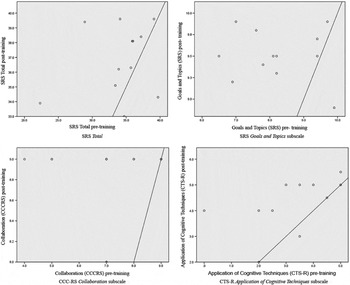
Brinley plots were used to visually display only the significant changes as a result of training. Such plots have the benefit over group mean data of displaying both systematic effects and the full range and variability of individual responses (Blampied, Reference Blampied2007; Brinley, Reference Brinley, Welford and Birren1965); Brinley plots are a form of scatter plot where each participant's pre- and post-training scores are plotted together as co-ordinate pairs. Where the pre- and post-scores are identical or very similar, the resulting data lies on or close to the diagonal line of no change. When pre- and post-scores differ, positive changes show above the line, while negative changes show below the line.
We calculated the following LPR Spearman's correlations: (1) therapist scores on LPR factors Produce and Dislike and their correlations with the other post-training measures (for hypothesis-relevant scales and subscales); (2) ‘client’ scores on LPR factors Produce and Dislike and their correlations with the other post-training measures (for hypothesis-relevant scales and subscales); and (3) the size of the difference between therapist and ‘client’ LPR Produce and Dislike scores and the correlations of these variables with other post-training measures (for hypothesis-relevant subscales).
Internal consistency estimates of the reliability of test scores (Cronbach coefficient alphas) were calculated for two of the three LPR factors previously identified by Yarbrough (Reference Yarbrough1991), using the scores from all therapists and ‘clients’. These are: Produce (Like to produce figurative language); and Dislike (Dislike using figurative language). A third factor, Study (Like to study texts using figurative language), was omitted from the analysis as it was not relevant to the study hypothesis. For three participants with one or more missing item scores, we used the mean score, rather than trying to interpolate the value for the missing item.
Results
Participants
Of the 12 participating therapists, 11 were female and one was male. All therapists had at least Masters level qualifications in clinical psychology. The mean therapist age was 45 years (range 36–60 years). The mean number of years of clinical experience was 13.1 (range 6–24 years).
Role play ‘clients’ included nine postgraduate clinical psychology students who were paid to participate, and two academic colleagues who volunteered, one with a graduate diploma in psychology and one with a PhD in sociolinguistics. Of the total of 11 participating ‘clients’, ten were female and one was male. The mean age of the ‘clients’ was 34 years (range 22–59 years). The mean rating by the ‘clients’ of their knowledge of CBT was 3.3 (range 2–4), rated on a 6-point Likert scale (0: none at all to 5: a great deal).
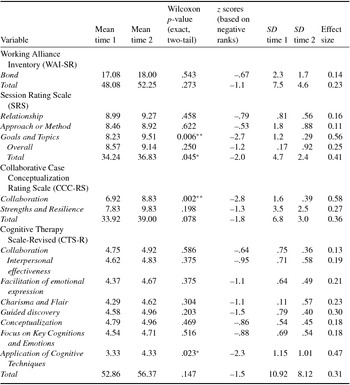
Although the pre–post change following the training programme was in the expected direction for all hypothesis-relevant variables, only three results reached statistical significance (SRS Goals and Topics subscale, SRS Total, CCC-RS Collaboration subscale and CTS-R Application of Cognitive Techniques subscale). There was a trend for improvement on the CCC-RS Total, but this did not reach significance. The non-significant findings could be simply due to the small sample size, especially given that all the hypothesis-relevant measures improved post-training. However, this would need to be investigated in a larger study.
Table 1 shows the means and significance tests for all hypothesis-relevant total scores and subscales, along with the effect sizes. The effect size was large for SRS Goals and Topics and CCC-RS Collaboration, and medium for CCC-RS Total, CTS-R Guided Discovery and CTS-R Application of Cognitive Techniques.
Pre- and post-training means, p-values, z scores, standard deviations and effect sizes for hypothesis-relevant total scores and subscales

*p < .05; **p < .01; SD, standard deviation.
Brinley plots for the SRS Total, SRS Goals and Topics subscale, CCC-RS Collaboration subscale and the CTS-R Application of Cognitive Techniques subscale are shown in Fig. 1. In all four Brinley plots the majority of pre–post data points are above the line, indicating a positive change has occurred by the post-assessment point. The CCC-RS Collaboration subscale plot is notable as all therapists received the maximum score for collaboration following the intervention, as rated by the independent rater.
Brinley plots showing pre- vs post-training scores for the Session Rating Scale Total, Session Rating Scale Goals and Topics subscale, Collaborative Case Conceptualization Rating Scale Collaboration subscale and Revised Cognitive Therapy Scale Application of Cognitive Techniques subscale.

Language Preference Report (LPR) results
The internal consistency estimates (Cronbach's coefficient alphas) for the LPR were: Produce 0.93 and Dislike 0.79.
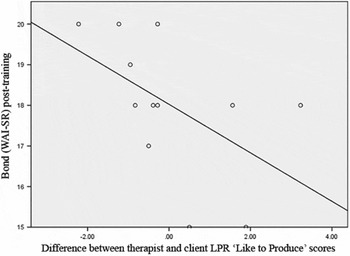
In the Spearman's correlational analysis, only one statistically significant association was found: the ‘Bond’ factor score (‘development of an affective bond’) of the WAI-SR was significantly negatively correlated with size of difference between therapists and ‘clients’ on the factor ‘Produce’ (liking to produce metaphors) on the LPR (Spearman's correlation –0.62; p = 0.031). This means as the discrepancy between therapists and client increased, the WAI-SR rating by the ‘clients’ on the ‘Bond’ factor score decreased. A number of the other correlations, whilst not statistically significant, reached medium to large effect sizes. (For example, the correlation between ‘client’ LPR Produce and WAI-SR Bond was 0.53, p =.08; the correlation between therapist Produce and SRS Overall was –.55, p = .07; and the correlation between the size of the difference between therapists and ‘clients’ and SRS Approach or Method was –.51, p = .09.) The full correlation matrix is available from F.M. Effect sizes are based on Cohen (Reference Cohen1988) effect sizes.
A Brinley plot of the one significant LPR correlation (between the ‘Bond’ factor score of the WAI-SR and the size of difference between therapists and ‘clients’ on the factor ‘Produce’ metaphors on the LPR) is shown in Fig. 2. The negative slant shows the negative correlation.
Brinley plot showing the relationship between the size of the difference in therapist–‘client’ LPR ‘Like to Produce’ scores and post-training scores on ‘Bond’ WAI-SR.

Discussion
Training experienced therapists to attend to and develop client metaphors in role-played CBT conceptualizations had a positive impact on the client's experience of the shared goals and topics discussed as being relevant to them. This is a key aspect of alliance that is thought to be influential on treatment outcome (e.g. Hoffart et al., Reference Hoffart, Borge, Sexton, Clark and Wampold2012; Snippe et al., Reference Snippe, Fleer, Tovote, Sanderman, Emmelkamp and Schroevers2015), but did not significantly alter the ‘clients’ sense of ‘Bond’ on the Working Alliance Inventory. Following training in using metaphors, the sessions were also rated independently as being more collaborative in arriving at a case conceptualization, although not more collaborative in a more general sense.
While the improvements on the Working Alliance Inventory were non-significant, there were statistically significant changes from pre- to post-training on the Session Rating Scale Total score and Goals and Topics subscale and the Collaborative Case Conceptualization Rating Scale Collaboration subscale, indicating improvements in alliance post-training.
The Revised Cognitive Therapy Scale Application of Cognitive Techniques subscale also reached significance (p < 0.05), with a medium effect size. It is possible that the external rater may have scored metaphor as a cognitive technique: as a bridge to unpacking different perspectives or as a technique to enhance therapeutic alliance.
The internal consistency scores for LPR Factor 1 (Produce) and Factor 2 (Dislike) were at a similar good–excellent level as those found by Yarbrough (Reference Yarbrough1991).
The LPR Factor 1 (Produce) difference was significantly negatively correlated with session rating on post-training WAI-SR Bond: the greater the difference between the therapist and ‘client’ in terms of liking to produce metaphorical language, the lower the rating of the session by the ‘clients’ in terms of Bond. This finding provides some tentative guidance as to client (and therapist) suitability for metaphorical work, suggesting that working metaphorically may be most effective when both therapist and client like to speak metaphorically. Whilst only one of the 90 individual correlations was significant, a number had magnitudes of around .50. These may represent Type II errors due to the low power of the small sample.
The SRS Total scores improved from ‘poor’ to ‘fair’. The generally low scores may have been due to self-consciousness by the therapist and ‘clients’ about being filmed (and having their performance rated) and because it was the first full session in which the therapists deliberately brought in metaphor, post-training. Furthermore, as it was a role play of a second therapy session, participants had not had a chance to establish the relationship in the first session before sharing the conceptualization.
The study size (N = 12 therapists) limits the power and generalizability of this study, although we did find some medium to large effect sizes. This study also had the limitation of being an analogue study, with role play ‘clients’ rather than actual therapy sessions, but was still a useful and ethical approach to use at this early investigative stage. The gender imbalance (both therapists and clients being mostly female) may also limit the generalizability of this study. It is possible that despite being instructed to ‘give their honest opinion from their perspective as a client’, the ‘clients’ gave higher ratings on the post-training sessions due to the knowledge that the study was evaluating a training session. While there were advantages to having psychology students as role play ‘clients’ in terms of their knowledge of depression, their knowledge of what is involved in a CBT session may have influenced their ratings, leading to higher scores than might be the case with a real client new to psychotherapy. In addition, attention to the idiosyncratic metaphors of actual clients, which are actually meaningful to the client, may have a different (or stronger) impact than the metaphor provided to the ‘clients’ in the role play (‘the cloak of depression’).
This study found promising trends regarding the impact of metaphor on alliance in an analogue situation. Future research may attempt to replicate the current findings using larger samples (in both analogue situations with non-clinical student ‘clients’, and in real life therapy sessions), and investigate whether attending to client metaphors benefits other parts of sessions such as homework, and goal setting. Future research might also consider whether these findings generalize to client presentations other than depression, whether training in metaphor enhanced CBT has continued impact on alliance over time, and whether the same training effect would be found with inexperienced CBT therapists. Other aspects of metaphor in therapy that warrant further investigation include the degree of phenomenological match between the metaphor target and vehicle, the degree to which the metaphor is generated by the client or therapist, and the vividness of mental imagery. All of these may mediate the impact of metaphoric language. Future studies could also usefully explore the directionality of the mismatch in preference for producing metaphor to lower ratings of bond: is it that the lower rating of bond comes when the therapist uses too much metaphoric language, or when they use too little and the client is talking in metaphor? In other words, does this finding reflect therapists who are being too literal and concrete or too flowery in their language? Or is it that the metaphors used are just not a good fit to the situation?
This preliminary investigation provides empirical support for claims by metaphor experts that attending and responding to metaphoric language and bringing it into case conceptualizations is beneficial for alliance. Links have consistently been found between measures of alliance and therapy outcome (Horvath and Symonds, Reference Horvath and Symonds1991; Martin et al., Reference Martin, Graske and Davis2000), including CBT (Raue and Goldfried, Reference Raue and Goldfried1994). Client metaphors are rich with personal meaning and working to develop them may prove to be beneficial for outcome, possibly through helping people feel fully understood.
Acknowledgements
The authors thank Professor Donald Yarbrough and Dr Rabia Karatoprak from the University of Iowa for their assistance with analysing the LPR; the therapists who participated in the training; the role play clients; Dr Susan Watson for completing the external ratings; Dalice Sim for her statistical assistance and Professor James Bennett-Levy for his input into study design. Thanks also to the anonymous peer reviewers for a number of useful suggestions that have strengthened the article.
Funding: This work was supported by the Oakley Mental Health Research Foundation, a University of Otago PhD Scholarship and a University of Otago PhD Grant-in-aid of research.
Conflicts of interest: There are no conflicts of interest.
Ethical standards: The authors assert that all procedures contributing to this work comply with the ethical standards of the relevant national and institutional committees on human experimentation and with the Helsinki Declaration of 1975, and its most recent revision.



Comments
No Comments have been published for this article.