Introduction
Alzheimer's disease (AD), the most common cause of dementia, is an irreversible and devastating neurodegenerative disorder, first impairing memory and cognition, and progressively impairing overall mental and physical functions, leading to death. As of 2010, there are an estimated 35.6 million patients with dementia worldwide (Alzheimer's Disease International, 2009), and the majority of these will have AD. It is expected that there will be a dramatic rise in these figures in coming years, in parallel with increasing longevity.
Consequently, intensive efforts have been directed to prevent and treat AD (Alzheimer's Disease International, 2009; Qiu et al., Reference Qiu, Kivipelto and Strauss2009). Early diagnoses might offer more chances for slowing down disease progression, and might also provide new clues for possible risk or prognostic factors. Moderate to severe AD stages also deserve intensive investigations. As dementia progresses affected individuals need care with all aspects of daily activities, increasing the burden of patients, caregivers and families, which spoil health status and quality of life for all of them. Advanced AD stages present significant deterioration in mental and physical functions, elevated comorbidities, increased institutionalization, and 2-3 folds rise in care costs (Alzheimer's Disease International, 2009; Qiu et al., Reference Qiu, Kivipelto and Strauss2009).
There is currently no cure for AD, and palliative therapies are of modest effectiveness. Cholinesterase inhibitors (ChEIs) and memantine are the approved AD medications, which influence cognitive and AD-related behavioral and psychological symptoms including measures of function (Beier, Reference Beier2007).
More research studies are required to advance our understanding of AD, such as the role of risk factors in disease development, find prognostic factors to predict disease progression, discover adequate therapies, or identify strategies to improve patients' and caregivers' quality of life. Observational studies of AD patients have been fundamental for expanding our current knowledge of the natural history of the disease. Detailed assessments of the clinical course of AD, as well as the concomitant features, like comorbidities, behavioral and psychological symptoms, functional impairment and treatment effectiveness, will help to improve patients care and also to direct future research.
In this study we present cross-sectional sociodemographic and comprehensive clinical data of patients with moderate-to-severe AD, under routine care in Spain, and the observed 12-month clinical progression by changes in scores of several neuropsychological tests, including clinicians' global impression and caregivers' burden tests. Results from actual clinical practice complement those from randomized trials and might provide a more nuanced description of disease progression.
Methods
Study design
This was a national, multicenter, observational study performed in Spain, with cross-sectional (baseline) and prospective (month 12) evaluations of moderate-to-severe AD patients. The main objectives were: (1) to describe sociodemographic data; (2) to characterize clinical aspects; and (3) to analyze the course and progression of the disease in this population of patients.
The protocol was approved by an accredited Institutional Ethics Committee, and complied with ethical and legal requirements for observational studies. All patients and/or their representatives signed and dated written informed consents. Data were collected in electronic case report forms registering patients by codes to maintain anonymity.
Physicians from various medical specialties with competence to treat AD included patients in the same chronological order as they attended routine clinical visits.
Selection criteria
Subjects of both sexes and any age had to fulfill the following criteria: (a) have dementia under DSM-IV criteria (Diagnostic and Statistical Manual for Mental Disorders, 4th edition; American Psychiatric Association, 1994); (b) have a clinical diagnosis of probable or possible AD under NINCDS-ADRDA criteria (joint working group of the National Institute of Neurological and Communicative Disorders and Stroke and the Alzheimer's Disease and Related Disorders Association; McKhann et al., Reference McKhann, Drachman, Folstein, Katzman, Price and Stadlan1984); (c) their disease stage was moderate or severe, i.e. scored 2–3 on the Hughes Clinical Dementia Rating (CDR) scale (Hughes et al., Reference Hughes, Berg, Danziger, Coben and Martin1982); and (d) have a Mini-mental State Examination (MMSE; Folstein et al., Reference Folstein, Folstein and McHugh1975; Lobo et al., Reference Lobo1999) score lower than 20. Patients were ineligible if they had mild AD, dementia with different etiology than AD, psychiatric disorders unrelated to AD, seriously impaired visual or auditory capabilities interfering with clinical evaluation, or chronic or terminal illnesses impeding whole study follow-up.
Baseline sociodemographic and clinical data and clinical progression
Extensive sociodemographic and clinical data were recorded at baseline. Duration of clinical onset of AD was not recorded because such data would have to be assessed retrospectively (clinical histories and/or information from patients or caregivers) and then early disease symptoms might have not been registered or detected accurately. Instead, time from AD diagnosis was considered to be a more reliable parameter for an approximate estimation of disease duration. Comorbidities and behavioral and psychological symptoms were diagnosed by the participating specialists in their routine practice. Data regarding illnesses requiring the competence of other specialists, or of a chronic or recurrent nature, were supported by the records from patients' medical histories. Previous and current clinical data were collected by a closed dichotomous check list (yes/no for presence/absence) in the electronic case report forms at baseline, using appropriately registered retrospective data and/or direct baseline assessments. Clinical disease progression was assessed by the following neuropsychological tests evaluating relevant aspects reflecting AD status:
(1) Blessed Dementia Scale (BDS), measuring psychological dysfunctions characteristic of demented patients, which are correlated with neuropathological changes (plaque count on cerebral cortex) (Blessed et al., Reference Blessed, Tomlinson and Roth1968). It has proven to be valid for application to AD patients, and is distributed into three modules: BDS1, routine activities, scoring 0–8; BDS2, essential daily tasks (eating, dressing and urinary/fecal incontinence), scoring 0–9; and BDS3, personality and social behaviors disturbances, scoring 0–11; with higher scores reflecting worse impairments (Blessed et al., Reference Blessed, Tomlinson and Roth1968).
(2) CDR (see Statistical analyses section for details of scoring) (Hughes et al., Reference Hughes, Berg, Danziger, Coben and Martin1982).
(3) MMSE, scoring 0–30, with lower scores indicating greater impairment (Folstein et al., Reference Folstein, Folstein and McHugh1975; Lobo et al., Reference Lobo1999).
(4) Clinical Global Impression of Change (CGIC; scoring detailed in the Statistical analyses section) (Schneider and Olin, Reference Schneider and Olin1996).
Additionally, caregiver burden was measured with the Zarit Caregiver Burden Scale (ZCBS) (Zarit et al., Reference Zarit, Reever and Bach-Peterson1980), scoring 0–88 (increasing with higher burden level). A meta-analysis has showed ZCBS reliability in examining psychometric responses across populations of caregivers and patients (Bachner and O'Rourke, Reference Bachner and O'Rourke2007). Neuropsychological tests and ZCBS were performed at baseline and after 12 months. CGIC was assessed by physicians at month 12, using the clinical status at baseline as a reference to evaluate the global change.
Statistical analyses
The sample size had to be at least 1000 patients in order to estimate proportions in a population with an alpha error ≤5%. With 30% of patients per year dropping out, sample size would be 700 at month 12, and thus, in the worst situation (p = 50%) precision would be 3.8%. In the cross-sectional evaluation, considering 10% ineligible patients, a situation of p = 50%, and similar significance level, the precision would be 3.3%. Data from patients recruited before or after the established 7-month inclusion period were not analyzed.
Two populations were evaluated: all included patients who fulfilled selection criteria (the Baseline Analysis Population) and patients who completed the study (Month 12 Analysis Population). Descriptive statistics were used for baseline sociodemographic and clinical data, and a sensitivity analysis checked potential differences between the two analysis populations. Descriptive statistics were also used for BDS1, BDS2, BDS3, MMSE, CDR, and ZCBS scores at baseline and month 12. Disease progression was evaluated by analyzing changes of scores from baseline to month 12 with the Wilcoxon signed-rank test. Standardized response means (SRMs) were calculated by the ratio between mean 12-month score changes (numerator) and standard deviations of the changes (denominator). SRM tests the hypothesis that there was no change in the average response measuring two time points or more, independently of sample size. It estimates the effect size which is standardized relative to the between-patient variability in score changes (Husted et al., Reference Husted, Cook, Farewell and Gladman2000). SRMs changes greater than 0.20, 0.50 and 0.80 have been proposed to represent small, moderate and large effects, respectively (Husted et al., Reference Husted, Cook, Farewell and Gladman2000). In addition, to compute a global CDR score (scoring 0, 0.5, 1, 2 or 3; though at baseline included patients scored 2 or 3), a CDR score sum was obtained, by summing each of the CDR items (sum-of-boxes: CDR-SB), to provide a quantitative data expansion (scoring 18 for maximum impairment, rather than 3). CDR-SB, instead of the qualitative global score, was used in the analysis of score changes. Proportions of patients within each CGIC category or with score changes in CDR global score, from baseline to month 12, were also calculated.
Six multiple linear regression analyses were undertaken using 12-month score changes (for BDS1, BDS2, BDS3, MMSE, CDR-SB, and ZCBS) as dependent continuous variables, and baseline data of the other recorded parameters as independent variables. Only those behavioral and psychological symptoms that are assessed in the Neuropsychiatric Inventory were entered into the regression analyses; though with slight variations, such as additional inclusion of personal hygiene changes, evaluating separately agitation and aggression, and expanding the night-time disturbances into two symptoms (insomnia and altered sleep/awake rhythm). The brief questionnaire form of the Neuropsychiatric Inventory is an instrument suitable for use in clinical practice, evaluating non-cognitive psychopathology in dementia and associated caregiver distress, which has also been validated for AD patients (Kaufer et al., Reference Kaufer2000). In order to further simplify the analyses, these symptoms were grouped into four domains, representing a high level of nosological classification: psychotic symptoms (delusions and hallucinations), mood and anxiety symptoms (apathy, euphoria, depression, anxiety and irritability), behavioral symptoms (agitation, aggression, aberrant motor behaviors, disinhibition, appetite/eating disturbances and personal hygiene changes), and sleep disturbances (insomnia and altered sleep/awake rhythm). This distribution roughly followed a first level approach conceptualization recently recommended by the DMS-V Task Force meant to precede the classification of diagnostic categories for mental disorders (Helzer et al., Reference Helzer, Kraemer, Krueger, Wittchen, Sirovatka and Regier2008). AD patients with these symptoms may not meet the diagnostic criteria for a mental disorder. Moreover, both the heterogeneity of patients with specific diagnostic categories and the overlap across symptoms of diagnostic categories (such as the high rate of diagnostic comorbidity between depression and anxiety) suggest that a categorical conceptualization might not be appropriate for a specific mental illness. On the other hand, depression and anxiety had been rated as symptoms when included into these categorizations but, for those cases diagnosed as disorders, they were analyzed as separate independent variables. Models were reduced based on both mathematical and theoretical grounds. In regression models with many possible independent variables, several of them might have correlated effects that cannot be separately estimated, and mathematical tools like the Mallows' C p statistic are used for an adequate selection of a reduced model, with the best subset that includes only the important predictors of the dependent variable (Mallows, Reference Mallows1973). The residual variance of the model selected in this study was minimized by choosing the lowest Mallows' C p coefficient. Then, the adjacent models with greater coefficients of determination were examined for independent variables with an a priori strong association with the dependent variable (theoretical ground), and were selected instead if they were not included in the more parsimonious model with the minimal C p coefficient. The possible association between 12-month CGIC (clinical worsening, scored 5–7, versus improvement or no change, scored 1–4) and baseline data of the other parameters as independent variables, was evaluated by binary logistic regression analysis conducted in the Month 12 Analysis Population. The same criteria exposed above for multiple linear regression analyses were used to reduce this model, but using approximated C p coefficient for logistic regression (Hosmer and Lemeshow, Reference Hosmer and Lemeshow2000).
SAS version 9 statistical package was used in all analyses and inferences were made at 5% significance level.
Results
General characteristics
Recruitment took place between June and December 2003, with a total of 1235 patients eventually being included in the study. Patients were evaluated at inclusion (baseline) and 12 months later. Investigators (n = 141), from diverse regions of Spain, comprised neurologists (67%), geriatricians (18%), psychiatrists (12%) and physicians from other medical specialties (3%; mostly internal medicine and general practice). Figure 1 shows the distribution of patients throughout the study and causes of premature withdrawals. The methodologies used for AD diagnosis, apart from medical history (100%), were mainly neurological (99%), neuropsychological (94%), and neuroimaging (93%) explorations. Electroencephalograms were performed in 25% of patients, and genetic studies in 3%.
Distribution of patients through the study, and causes of premature withdrawal.

Baseline sociodemographic data
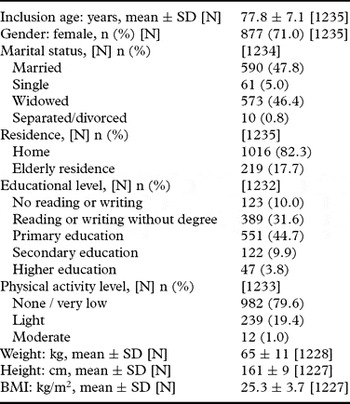
Demographic and anthropometric characteristics of the Baseline Analysis Population are summarized in Table 1. These data were similar to the Month 12 Analysis Population (data not shown). Included patients were aged between 40 and 102 years (median: 78 years; lower-upper quartiles: 73–82 years), and 3.8% were under 65 years. Both the mean and the median age of this early-onset (<65 years) subgroup was 60 years (lower-upper quartiles: 58–63 years), and only two of them were younger than 50 years.
Patients' baseline demographic and anthropometric characteristics (Baseline Analysis Population, N = 1235)

[N] indicates the number of patients providing data for each parameter, i.e. excluding missing data.
BMI = body mass index; SD = standard deviation of the mean.
Most patients were women, married or widowed, living at home with their spouse (48%) or a descendent (i.e. son/daughter, 40%), and their main caregivers were the spouse (41%) or a descendent (49%). Descendents tended to be the main caregivers as patients' age advanced: 66% of patients aged over 80 years were cared for by a descendent compared with 23% cared by their spouse. A higher proportion of patients cared for in nursing homes for the elderly had severe AD (30% CDR = 3 versus 11% CDR = 2).
Most patients had attained only primary levels of education. The predominant prior occupational activities were manual (83%), intellectual (7%) or mixed (10%). Patients generally had very low physical activity levels. There were few alcohol consumers (7%), heavy drinkers (1%) or smokers (11%).
Baseline clinical data
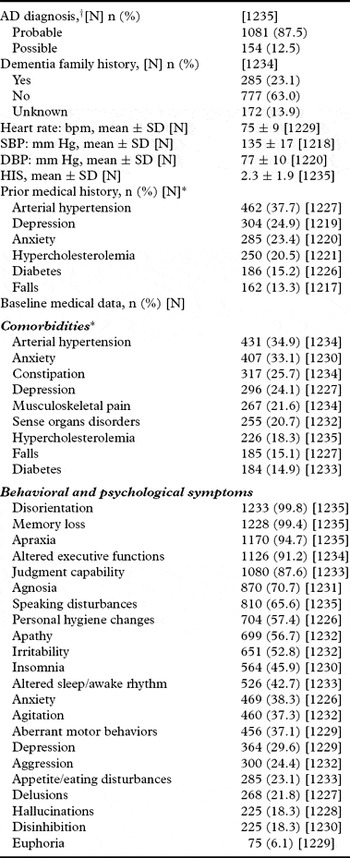
Baseline clinical data are summarized in Table 2. Median time from AD diagnosis at inclusion was 3 years (range: 0–18). Some patients (13%) were diagnosed around inclusion. Mean Hachinski Ischemic Score (HIS) was 2.3, confirming that most patients had AD dementia (cutoff ≤4) (Hachinski et al., Reference Hachinski1975; Moroney et al., Reference Moroney1997). Only 4.3% patients scored ≥7, the proposed cutoff for vascular dementia (VaD) (Moroney et al., Reference Moroney1997); nevertheless, these patients were not excluded from the analyses (further details are provided in the Discussion section). Patients with an HIS ≥7 were older than the total sample average (both mean and median: 78 years, lower-upper quartiles: 75–83).
Patients' baseline clinical data (Baseline Analysis Population, N = 1235)

*Only listed if ≥10%.
†AD diagnosis according to the joint working group of the National Institute of Neurological and Communicative Disorders and Stroke and the Alzheimer's Disease and Related Disorders Association (NINCDS-ADRDA) criteria.
[N] indicates the number of patients providing data for each parameter, i.e. excluding missing data.
bpm = beats per minute; DBP = diastolic blood pressure; HIS = Hachinski Ischemic Score; SBP = systolic blood pressure; SD = standard deviation of the mean.
Patients' medical history mainly showed arterial hypertension, and also depression, anxiety, hypercholesterolemia, diabetes mellitus, and falls. Generally, patients were still suffering several of these conditions at inclusion. The majority of patients (77%) presented with between one and five concomitant disorders, while 9% had six or more, and 14% none. Anxiety, constipation, musculoskeletal pain, sensory organ alteration, and falls were more frequent in patients cared for in elderly care homes; and more patients cared for at home had arterial hypertension. Additionally, patients on average had 11 current behavioral and psychological symptoms. Incontinence, either urinary (49%) or fecal (17%), occurred in 56% of patients. Main neurological exploration findings were alterations of gait (31%) and extrapyramidal signs (17%).
At baseline, the majority of patients (85%) received AD-specific pharmacological treatment: 43% memantine, 27% a ChEI, and 31% memantine plus a ChEI. Fewer patients (31%) were receiving nonpharmacological therapies, mostly those living in elderly residences. The distribution of therapeutic regimens was nearly identical in the Month 12 Analysis Population (data not shown).
Antipsychotics (47%) and antihypertensives (38%) were the most frequently prescribed concomitant medications not specific to AD. Also, some patients received antidepressive (27%), antianxiety (20%), platelet aggregation inhibitors (19%), hypnotics (16%), and anticholesterolemic (15%) agents. Duration of concomitant therapies ranged widely; for instance, 1.8 years (mean, range: 0.1–10) for antipsychotic agents, or 6 years (0.5–30) for angiotensin converting enzyme inhibitors.
AD progression
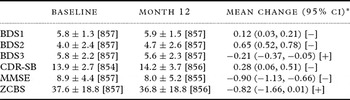
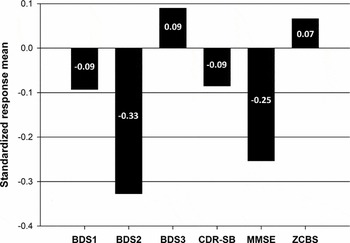
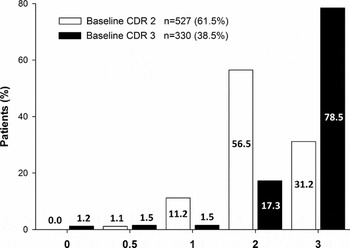
BDS, MMSE, CDR-SB and ZCBS scores (baseline, month 12, and 12-month mean change) are shown in Table 3; and the SRMs of these changes are represented in Figure 2. Baseline mean scores in all neuropsychological measures indicated moderate to severe dementia. All mean 12-month changes were statistically significant, showing deterioration in functional (BDS1 and BDS2) and cognitive (CDR-SB and MMSE) measures, and improvement on behavioral disturbances (BDS3) and caregivers' burden (ZCBS). However, calculated effect sizes were below 0.20 (absolute value), except for BDS2 (0.33) and MMSE (0.25). Baseline scores of all study tests were nearly identical in the two analysis populations (data not shown). Many patients who had a CDR score of 2 at baseline maintained the same score during the study, but a considerable proportion worsened to CDR 3 (Figure 3). Most patients scoring CDR 3 at baseline maintained the same score, although a small proportion improved to CDR 2 by month 12 (Figure 3). CGIC scores showed clinical worsening (especially minimal and moderate) in about half of the patients (53%), or no change (26%), and fewer patients showed clinical improvement (21%).
Scores of various patients' neuropsychological tests and a caregiver's scale (Month 12 Analysis Population, N = 857)

*Wilcoxon signed-rank test: p <0.05 for all the parameters.
Baseline and month 12 values are mean ± SD. The numbers within square brackets indicate the number of patients providing data for each parameter, i.e. excluding missing data. Positive or negative symbols within square brackets denote, respectively, significant improvement or deterioration according to scoring interpretation of each scale changes.
CI = confidence interval; SD = standard deviation of the mean.
BDS = Blessed Dementia Scale [see text for definition of BDS1, BDS2, BDS3]; MMSE = Mini-mental State Examination; CDR-SB = Clinical Dementia Rating scale – sum of boxes; ZCBS = Zarit Caregiver Burden Scale.
Standardized response means (SRMs) for the changes from baseline to month 12 in neuropsychological tests and caregiver scale scores. Month-12 Analysis Population (N = 857). Positive and negative values designate improvement and deterioration, respectively, according to interpretation of each test, rather than an increase or decrease in scores. Definition of the test abbreviations are found in the Methods section of the text.

Proportion of patients with changes from baseline to month 12 in Clinical Dementia Rating (CDR) global scores (Month 12 Analysis Population; N = 857).

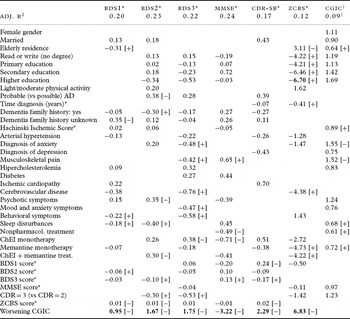
Multivariate analyses did not fit the data well (Table 4). In all models, the coefficients of determination were lower than 0.25 and regression coefficients were of small magnitude, suggesting spurious associations. Although some independent variables showed significant associations, they had very small contributions in quantitative score changes for the corresponding tests (separately evaluated as dependent variables). In the linear models, only two independent variables demonstrated significant association with a change of at least an arbitrary 8% (calculated with respect to the size of the scoring range for each test). Thus, CGIC worsening was significantly associated with deteriorations in BDS1 (increasing 12% score value), BDS2 (19%), BDS3 (16%), MMSE (−11%), CDR-SB (13%) and ZCBS (8%). Furthermore, increased patients' educational level was associated with ZCBS scoring, progressively improving caregiver burden, reaching −8% score value reduction in caregivers of patients with university-level education. Pharmacotherapy with memantine alone or in combination with a ChEI was associated with a reduction in caregiver burden at a magnitude shortly below the aforementioned threshold. Odds ratios obtained from logistic regression analysis were within the range 0.5–2, denoting minor contributions by the independent variables in changing CGIC score values.
Point estimates by multiple linear regressions for the 12-month score changes of various patients' neuropsychological tests (BDS1, BDS2, BDS3, MMSE, CDR score sum) and a caregiver's scale (ZCBS); and by logistic regression for the 12-month Clinical Global Impression of Change (CGIC). (Month 12 Analysis Population, N = 857)

*Continuous variables.
†Maximum rescaled coefficient of determination.
‡Odds ratios.
Reference categories were “no reading or writing” for educational level; “none/very low” for the level of physical activity; and “no” for dementia family history. For the logistic regression, CGIC was categorized as “worsening” (versus the reference of “improvement or no change”). Data of independent variables were recorded at baseline, except CGIC which was assessed at month 12. Positive or negative symbols within square brackets denote, respectively, significant association for improvement or deterioration according to scoring interpretation of each scale changes. Values with no symbols within square brackets did not have a significant association. Values in bold type were associated with at least an 8% change considering the size of the scoring range for each test.
Adj. R2 = adjusted coefficient of determination.
BDS = Blessed Dementia Scale [see text for definition of BDS1, BDS2, BDS3]; MMSE = Mini-mental State Examination; CDR = Clinical Dementia Rating scale; ZCBS = Zarit Caregiver Burden Scale; CGIC = Clinical Global Impression of Change; ChEI = cholinesterase inhibitor.
Safety data
Hospitalization data were available for 1008 patients, which showed that 10.6% of them required hospitalization on one (9.1%) or two occasions (1.5%). Average hospitalization duration was 17 days (range: 1–120). Acute disorders data were available for 1009 patients, of whom 28.6% suffered some acute disorder during the study, mostly resulting from respiratory infections (33.6% of all acute episodes), urinary infections (22.5%), falls (21.8%), and behavioral disorders (15.6%). By month 12, 53 patients had died from various causes, mainly respiratory illnesses (usually due to aspiration pneumonia) and cardiovascular events.
Discussion
A large amount of cross-sectional sociodemographic and clinical data was compiled on this sample of 1235 AD patients in Spain. Overall characteristics were in accordance with those of AD patients from other countries. Indeed, baseline data, including proportions of different comorbidities, were similar to that in the ongoing pan-European longitudinal prospective observational ICTUS study, evaluating patients with mild-to-moderate AD (Reynish et al., Reference Reynish2007). Likewise, worldwide studies consistently report certain factors that increase or reduce AD incidence (Alzheimer's Disease International, 2009; Qiu et al., Reference Qiu, Kivipelto and Strauss2009). Advanced age is the strongest AD risk factor and other factors, like gender or having several comorbidities, also influence disease development. Genetic risks factors (mutations, susceptibility genes, or positive family history) are undoubted, though they do not occur in the majority of patients. In this study, 23% of patients had a family history of dementia, but genetic screenings were not undertaken. Others factors, like physical activity and education, have been shown to be beneficial in delaying the clinical manifestation of AD.
Patients from the ICTUS study with CDR 2–3 had a mean age of 78.1 years (Reynish et al., Reference Reynish2007), and the mean age of the patients from this study was 77.8 years, with 75% being 73 years or older. There is an age-related exponential increase of both prevalence and incidence of AD, nearly doubling after age 65 for every five-year increment in age (Alzheimer's Disease International, 2009; Qiu et al., Reference Qiu, Kivipelto and Strauss2009). Patients with early-onset AD, an uncommon (2%–10%) form of the disease, are diagnosed before the age of 65 years, and about half of them carry an inherited genetic predisposition. The majority are in their 50s or early 60s, and more rarely in their 30s or 40s. Importantly, age ranges of AD epidemiological data refer to the time when symptoms have developed to the degree that clinical diagnostic criteria are met, but the brain neurodegenerative processes have already started at a variable number of years earlier. This suggests that both investigations of risk factors and preventive measures should be started many decades earlier than when the disease is diagnosed. Although nowadays the definitive AD diagnosis has to be via postmortem pathological verification, advances in clinical tests, and in imaging and analytical techniques, are allowing earlier diagnoses (Qiu et al., Reference Qiu, Kivipelto and Strauss2009). In this study only 3.8% patients were younger than 65 years, and most of them (75%) were aged 58 years or older, mirroring the characteristic epidemiological data for early-onset AD. Patients were not stratified by age ranges, but age was included as an independent continuous variable in the regression analyses. However, the age of the patients did not show any association with the course of the disease (as measured by the applied neuropsychological and caregiver burden tests scores), since this variable was excluded from the best reduced model for the regression analyses.
AD prevalence is greater in women, and in the cohort of patients in this study the gender disparity was pronounced. Although partially justified by higher women's longevity, differences persist after age adjustment. A pooled analysis, including a large European population sample of persons aged 65 years and older, found significant gender differences in AD incidence in older subjects (82% in women and 24% in men, 90 years old) (Andersen et al., Reference Andersen1999). Gender differences in dementia risk factors were reported in a review, with higher rates of hypertension, hyperlipidemia, and diabetes in women than men older than 75 years; apolipoprotein E ε4 genotype showed a greater deleterious effect on brain pathology and memory performance in women; and diabetes increased in frequency in women (Azad et al., Reference Azad, Al Bugami and Loy-English2007).
Several comorbidities have also been associated with dementia risk. Disorders affecting brain blood supply, or vascular factors, have provided more solid evidence of contributing significantly to the development and progression of AD, especially hypertension and diabetes. A history of hypertension from midlife is related to higher AD risk at later life, and prevention of hypertension decreases AD risk (Kloppenborg et al., Reference Kloppenborg, Van Den Berg, Kappelle and Biessels2008; Takeda et al., Reference Takeda, Sato, Ogihara and Morishita2008). Certainly, proportions of patients with a history of hypertension (37.7%) or with hypertension at baseline (34.9%) were high in the present study. Among several vascular risk factors examined in a systematic review, later in life Type 2 diabetes conveyed the highest risk for dementia (Kloppenborg et al., Reference Kloppenborg, Van Den Berg, Kappelle and Biessels2008). Risk of dementia appears stronger when diabetes occurs at midlife (onset age <65 years) (Xu et al., Reference Xu, Qiu, Gatz, Pedersen, Johansson and Fratiglioni2009). The ICTUS study reported higher diabetes prevalence together with CDR severity (a 12% diabetes prevalence in the total AD patients’ cohort increased to 18% in those with CDR 2–3) (Reynish et al., Reference Reynish2007). The prevalence of diabetes in this study was similar for those with a history of diabetes (15.2%) and current diabetes (14.9%), suggesting that most patients would have diabetes from midlife.
Depression has also been associated with cognitive decline and AD, and a history of depression increases AD risk (Ownby et al., Reference Ownby, Crocco, Acevedo, John and Loewenstein2006). Depression is one of the most common psychiatric complications in AD patients, and its prevalence (up to 50%) is higher than matched populations without dementia (Lyketsos and Lee, Reference Lyketsos and Lee2004). In this study, 24.9% of patients had a history of depression, and 24.1% had depression at baseline.
Years of education have shown to increase AD prevention odds ratios. Evaluating the years of formal education, significant AD risk reduction was found in patients with six to eight years of education, and even higher risk reduction in those with more than nine years of education, compared with five years or less of education; adjusting for demographic, socioeconomic, vascular, and lifestyle characteristics (Ngandu et al., Reference Ngandu2007). Some hypotheses to explain this association involve pre-morbid cognitive reserve (Paradise et al., Reference Paradise, Cooper and Livingston2009) and cognitively stimulating activities (Wilson et al., Reference Wilson2002). Overall, complex mental activities, especially with a main component of information processing, have proven beneficial for preventing or slowing AD onset (Qiu et al., Reference Qiu, Kivipelto and Strauss2009), and this substantiates the lack of association between AD pathology and its clinical manifestations and outcomes (Paradise et al., Reference Paradise, Cooper and Livingston2009). Subjects with Down's syndrome (i.e. with lifelong intellectual deficits), develop AD neuropathology from the age of 40 years, and some of them also exhibit symptoms of dementia. Interestingly, higher level of cognitive functioning was significantly associated with deferring the onset of dementia in subjects with Down's syndrome; and cognitive functioning was dependent on years of school education (including continuing education such as adult literacy courses), and to a lesser extent on years spent in an institution and employment (competitive work versus sheltering in workshops), but not on recreational activities (Temple et al., Reference Temple, Jozsvai, Konstantareas and Hewitt2001). In the present study, few AD patients had more than six years of formal education (14%) or prior intellectual (7%) or mixed (manual and intellectual, 10%) occupational activities. In support of an association between years of education and AD clinical onset, the percentage of age-matched subjects from the general population in Spain with more than six years of formal education is 27%, i.e. 13% higher than in the population of this study. This figure has been calculated from the Spanish census for 2001, using the average of the subjects in the age range 71–80 years, corresponding to subjects aged 73–82 years (lower-upper quartiles of our sample) in the year 2003 (when this study was performed).
Apart from AD incidence and progression, other aspects influenced by patients’ educational level remain largely unexplored. Remarkably, in this study there was a significant progressive reduction in caregiver burden associated with patients’ higher educational levels. Whereas several studies have measured the impact of caregivers’ educational level on their caring burden, to our knowledge, the relationship between patients’ educational level and caregiver burden had not yet been investigated. Higher caregivers’ educational levels have been associated with reduced burden (Papastavrou et al., Reference Papastavrou, Kalokerinou, Papacostas, Tsangari and Sourtzi2007), lower incidence of caregiver depression (Sansoni et al., Reference Sansoni, Vellone and Piras2004), and fewer reported behavioral and psychological symptoms in their patients (Sink et al., Reference Sink, Covinsky, Barnes, Newcomer and Yaffe2006). Caregivers’ educational level was not recorded in this study. Our results might have various explanations. Caregivers of more educated patients might be used to coping better with stress; or the AD symptoms associated with the burden of caregiving might be less frequent or less severe in patients with more years of education (this has been shown with psychotic symptoms in some studies, as discussed later); or it might be that caregivers of patients with higher education levels themselves also had more years of education.
In this study, caregivers’ distress decreased slightly at the 12-month follow-up, despite a worsening of all AD symptoms except behavior (scored by BDS3) in their patients. An interpretation could be that behavioral symptoms contribute to diminish quality of life and to induce high levels of stress in caregivers. Patients’ behavioral disturbances are one of the strongest factors contributing to caregiver burden (Finkel et al., Reference Finkel, Costa e Silva, Cohen, Miller and Sartorius1996; Germain et al., Reference Germain2009). Furthermore, behavioral symptoms are an important factor in increased institutionalization, an endpoint of great significance for patients and caregivers, not least the considerably increased costs of care.
In connection with the finding that increased patients’ educational level was associated with lower caregiver burden, it is plausible that brain plasticity developed by years of education might help to prevent behavioral disturbances or reduce its severity. This reasoning has proven certain with psychosis in AD because, although not in all the studies, delusions and/or hallucinations have frequently been associated with fewer years of education (Bassiony and Lyketsos, Reference Bassiony and Lyketsos2003; Lopez et al., Reference Lopez2003). This finding is coherent with a mental reserve hypothesis by which more years of education would increase the threshold for expressing psychiatric symptoms associated with the neuropathology of the disease. In fact, in one study psychosis was associated to education only in patients with mild or moderate AD (Lopez et al., Reference Lopez2003). Since patients with severe AD have more extensive brain cortical pathological damage, the protective effect of years of education over mental functioning might not be enough for countering the higher level of neurological dysfunction occurring in the more advances stages of the disease. The protective effect of years of education against clinical expression of mental dysfunction has also been demonstrated during the aging process; explicitly by reducing the incidence of delirium, a sudden and usually reversible disturbance of mental function with high prevalence in hospitalized elders, in patients with more years of education (Jones et al., Reference Jones, Yang, Zhang, Kiely, Marcantonio and Inouye2006). Delusions and hallucinations are known to strongly contribute to additional disability in AD patients and to increase caregivers’ burden (Bassiony and Lyketsos, Reference Bassiony and Lyketsos2003), but the influence of patients’ education on this association has not been assessed yet. The discovered relationship between patients’ educational level and caregivers’ burden in the present study deserves further research. First, to confirm that the same outcome is observed in other studies; and, second, to search for possible mechanisms that would add towards understanding the complicated AD physiopathology, as well as for strategies directed to reduce caregiver burden.
A number of paradoxical findings from other studies help to support the improvement of caregivers’ burden despite the patients’ functional and cognitive decline that we identified in this study. Sherwood et al. (Reference Sherwood, Given, Given and Eye2005) found that as the functional status of elderly patients declines, the burden on their caregivers improves relative to the burden of caregivers of elderly patients without functional limitations. This has been interpreted as being due to increased assistance from secondary caregivers. The presence of cognitive and neuropsychiatric problems, however, unlike functional problems, may be more difficult for secondary caregivers to deal with, diminishing their caring assistance, and thus enhancing primary caregivers’ feelings of abandonment. Moreover, caregivers of elderly patients with a high number of new dependences for daily living activities are more prone to suffer depression than those caring for elderly patients with low new dependences though with similar overall demands as the previous group (Given et al., Reference Given, Given, Stommel and Azzouz1999). Therefore, the long-term burden on caregivers of AD patients might diminish through adaptation to changing demands as the disease progresses. The caregivers in this study had experienced caregiver burden over several years through caring for AD patients at moderate-to-severe stages of the disease, but showed a small improvement after a 12-month period. Nevertheless, accurate measurement of caregiver burden is hampered by contradictory features, like the coexistence of positive (satisfaction from helping a loved person) and negative (increased prevalence of psychological and physical illnesses) aspects experienced by caregivers (Andren and Elmstahl, Reference Andren and Elmstahl2005).
ChEIs (donepezil, rivastigmine and galantamine) and memantine are the approved treatments for symptoms of mild/moderate or moderate/severe AD stages, respectively, as supported by evidence from meta-analyses of randomized controlled trials (Winblad et al., Reference Winblad, Jones, Wirth, Stoffler and Mobius2007; Rodda et al., Reference Rodda, Morgan and Walker2009). Additionally, an Expert Consensus Guideline recommended combining memantine with a ChEI for moderate/severe AD (Alexopoulos et al., Reference Alexopoulos, Jeste, Chung, Carpenter, Ross and Docherty2005). ChEIs might exert positive but modest effects on more or fewer AD symptoms, depending on both the study and ChEI type (Beier, Reference Beier2007; Ames et al., Reference Ames, Kaduszkiewicz, Van Den Bussche, Zimmermann, Birks and Ashby2008; Rodda et al., Reference Rodda, Morgan and Walker2009). Systematic reviews and meta-analyses of randomized controlled trials have reported modest benefits on moderate/severe AD patients treated with memantine, for all symptomatic domains (global status, cognition, function and behavior), although there are also mixed results with less clear effects (Winblad et al., Reference Winblad, Jones, Wirth, Stoffler and Mobius2007). In this study, receiving certain AD-specific treatments (specifically memantine monotherapy and memantine plus a ChEI) was associated with lower caregiver burden. Nonetheless, the contribution of these treatments to a change in ZCBS scoring was low (about 5% score reduction). This finding might imply that these treatments slow or improve AD symptoms that cause relevant caregiver burden; in accordance with data from the above cited literature.
A weakness of this study was the duration of follow-up. Because AD is a long-term progressive neurodegenerative disease, a longer observational period would allow more detailed appreciation of its evolution. Therefore, a 12-month observational period rendered small effect sizes on changes (functional, cognitive and caregiver burden), concealing possible associations between disease features and their clinical evolution. Nonetheless, the observed small changes have provided useful information from actual clinical practice data, helping to detect parameters that could be relevant in guiding disease management. Other limitations of this study, and of all studies with AD patients in general, are inherent in the heterogeneity and complexity of the disease. Patients’ age, duration of the disease (in this study estimated from the time of diagnosis), comorbidities and so many other factors might potentially affect disease evolution, and hence it was necessary to enter a “constellation” of parameters as independent variables for the regression analyses. The results showed no or negligible influence on disease progression from most of the baseline sociodemographic and clinical parameters; data were not fitted well by these analyses, probably as a consequence of the excessive variability among individual patients for the high number of parameters. However, multivariate analyses were required in order to explore the actual AD clinical picture, which cannot be isolated from the multiple comorbidities accompanying aged patients. Speculatively, the low proportion of variance explained by the regression models might have also been influenced by undiscovered circumstances and pathological phenomena, reflecting a current poor understanding of the pathogenic mechanisms of AD. Again, it remains to be determined whether any independent significant effect could have been detected for some of the variables after a longer follow-up period. Nonetheless, even with these drawbacks, regression analysis results demonstrate the relevance of some parameters (patients’ educational levels and AD therapies) on caregiver burden, and also reinforce the validity of physicians’ overall clinical judgment by applying the CGIC scale. In contrast with some controversies regarding the validity of this physician-rated clinical instrument, the latter finding highlights the reliability of its psychometric properties as an outcome measure to assess overall clinical status during AD progression (at least when applied by experienced specialists, as in this study); which is especially significant for defining and evaluating therapeutic strategies (Oremus et al., Reference Oremus, Perrault, Demers and Wolfson2000).
It is proper to provide a reasoning for including in the analyses of this study the data from a low proportion of patients (4.3%) who had an HIS ≥7 despite this being the proposed cutoff for VaD (Moroney et al., Reference Moroney1997). According to the selection criteria of the study protocol, it was assumed that participating physicians correctly completed a differential diagnosis that would exclude cases of VaD (by using complementary diagnostic tools and/or based on the clinical features of the disease recorded in the medical history). Additionally, brains of many of the advanced-age patients with AD would be affected, more or less, by a vascular component, secondary to aging and/or AD pathological damage such as cerebral amyloid angiopathy (Weller et al., Reference Weller, Subash, Preston, Mazanti and Carare2008). Indeed, it has been reported that only a small percentage of subjects older than 80 years have “pure AD” or “pure VaD” (Fotuhi et al., Reference Fotuhi, Hachinski and Whitehouse2009). The majority of patients in this study were of advanced age, and those with an HIS ≥7 were older than the average of the total sample, increasing the chances for mixed AD plus VaD (AD-VaD). Besides, although the cutoffs to differentiate AD and VaD (respectively ≤4 and ≥7) have shown high sensitivity (89.0%) and specificity (89.3%), the good performance of the HIS is not maintained for VaD versus mixed AD-VaD (sensitivity: 93.1%, specificity: 17.2%) or AD versus mixed AD-VaD (sensitivity: 83.8%, specificity: 29.4%) (Moroney et al., Reference Moroney1997). These comparisons would render an elevated percentage of patients being falsely scored whenever a vascular component is present, as is likely to occur with many of the elderly patients in this study suffering moderate to severe AD. Consequently, even though cerebrovascular alterations might affect AD progression or influence its clinical manifestation, the exclusion of these patients from the analyses might also imply an artifactual improvement in disease evolution that would mislead any interpretation of the natural history of the disease. Lastly, the HIS was included as a continuous independent variable in the regression analyses, showing no association with disease progression as related to the 12-month changes of the neuropsychological and caregiver burden ratings. However, an association was found with the physicians’ CGIC assessments in which patients with higher HIS values had a decreased probability of being rated as exhibiting a worsening clinical status. This paradoxical finding might be due to the low HIS specificity whenever patients with a cerebrovascular component (frequent in advanced-age AD patients) are scored. Another possible explanation is that patients with higher HIS received more therapeutic assistance during the 12-month study (e.g. treatment for vascular comorbidities, like hypertension or hypercholesterolemia), thereby resulting in no change or improvement in their global clinical status. Regrettably, this explanation cannot be elucidated with the data from the study because therapies administered during the study were not registered. Moreover, the HIS values were not rated at month 12, allowing the possibility for patients with higher HIS at baseline to have lower scores by month 12.
In conclusion, this research has provided valuable data on sociodemographic and clinical features of moderate-to-severe AD patients in a representative Spanish population sample. Results support prior knowledge regarding characteristic factors that accelerate or slow AD development, namely gender, educational level, and certain comorbidities (hypertension, dyslipidemias, diabetes and depression). The neuropsychological tests applied in this study discriminated variations in the evolution of different symptoms, confirming their reliability for monitoring both disease progression and therapeutic efficacy. Importantly, data from this study confirm that caregiver burden, an outstanding concern in AD management, depends more on patients' behavioral disturbances than on their functional or cognitive declines; in addition, our results indicate that caregiver burden might be lessened if patients have higher educational levels and also, to some extent, if patients are treated with AD-specific medications. Overall, these findings should not only underline the need for longer term future studies on this significant and complex disease, but also raise the awareness of health agencies to intensify the promotion of healthy lifestyles throughout the whole lifespan, including education and other mental stimulating activities. Additionally, the recognition of particular characteristics that increase or reduce caregiver burden might facilitate the early identification of caregivers at higher risk, and help in the development of preventive or corrective strategies.
Conflict of interest
None.
Description of authors' roles
All four main authors participated in the design of the study, interpretation of the findings, and writing and revision of the paper.
Acknowledgments
This study was funded by the Medical Department of Grünenthal Pharma S.A., Madrid. We are indebted to Carlos Rabes-Berendes, from Grünenthal Pharma S.A., Madrid (Spain), without whose constant encouragement and support this study would not have been possible. Our gratitude is also extended to María Dolores Julián and Jesús Villoria for their assistance in writing this paper.
Investigators participating in the 5E study (“Estudio Epidemiológico Evolutivo de la Enfermedad de Alzheimer moderada y grave en España”) are listed alphabetically by province and name: A Coruña: Alfredo Robles Bayón, Guillermo Iglesias, José Marey López, Manuel Arias Gómez, Oscar Taboada Díaz. Álava: Luis Galdós Alcelay. Alicante: Ángel Pérez Sempere, José Manuel López Arlandis, Leandro Piqueras Rodríguez, Vicente Medrano Martínez, Virtudes Lluch. Almería: Teresa García López. Asturias: Carmen Martínez Rodríguez, José Antonio Vidal Sánchez, Valentín Mateos Marcos. Ávila: Felisa Gómez. Badajoz: Carlos Andrés Gahete Jiménez. Baleares: Carlos Pagan Pomar, José Antonio De Antonio. Barcelona: Salvador Piles Galdón, Ana Rodríguez Campello, Antonio Callen Soto, Antonio Carlos Ugarte Elola, Antonio Martínez Yelamos, Belinda Matute Tobias, Bernabé Robles Del Olmo, Carlos Conill Lanfranco, Carme Prat Bravo, Francesc Formiga Pérez, Francesc Pujadas Navinés, Isabel Fort Almiñana, Jaume Roquer González, Jesús Miguel Ruiz Idiago, Joan Prat Rojo, Juan Catena Mir, Juanjo Hernández Regadera, Mariano Huerta Villanueva, Pedro Roy Millán, Pilar Azpiazu, Ramón Cristofol Allue, Raquel Sirvent Martínez, Sebastián Alfonso Marín, Jordi Mascaro. Bizkaia: Fernando Velasco Juanes, Imanol Iriondo Etxenagusia, José Ignacio Mendezona Peña, Juan Carlos Gómez Esteban, Luis Varona Franco, Marian Gómez Beldarrain. Burgos: Miguel Goñi Imizcoz. Cáceres: José Martín Zurdo, Ma José Gómez del Castillo. Cádiz: Guillermo Rubio Esteban, Jesús Acosta Varo. Cantabria: Agustín Oterino, Cinta Ricar Colomé, Mariano Rebollo. Castellón: Carlos Ferreres Bautista, Ma Dolores Martínez Lozano. Ciudad Real: Francisco Javier Navarro Oliveras. Córdoba: Carlos Sánchez Ortiz, Fernando Sánchez López, Martin Pinilla Fernández-Castañón. Gipuzkoa: Javier Olascoaga, Javier Ruiz Martínez. Girona: Secundino López Pousa. Granada: Ángel Gómez Camello, Juan Antonio Almazán, Miguel Orozco Carreras, Rafael González Maldonado. Huesca: Consuelo Ríos Gómez, Jose Ma Errea Abad. Jaén: Jesús Foronda Bengoa, Juan Montes Ruiz-Cabello. Las Palmas: Elisa Corujo, Ma del Carmen Pérez Vieitez. León: Francisco Javier Idoate Gil. Lleida: Begoña Berlanga Moran, Montserrat Pujol Sabaté. Lugo: Robustiano Pego Reigosa. Madrid: Ana Frank, Cristina Hernández Herrero, Diego Sepúlveda Moya, Eloisa Navarro, Jaime Masjuan Vallejo, Javier Olazarán, Jesús Porta, José Luis González Gutiérrez, José Tejeiro, Luis Agüera Ortiz, Luis Ignacio Arroyo Gargallo, Ma Ángeles Ceballos, Manuela Beltrán De la Ascensión, Pedro Gil Gregorio, Pilar Sánchez Alonso, Rinaldo Miguel Nodarse, Roberto Petidier Torregrosa, Teresa Jabbour. Málaga: Hassan Hamad, Ricardo Gómez Huelgas, Tomás Ojea Ortega, Vicente Serrano Castro, Enrique Cabrerizo Comitré, José Carlos López Madrona. Murcia: José Marín Marín. Navarra: Inés Francés Román, Marina Bujanda, Marta Aznar Lafont. Ourense: José Ma Lomba. Pontevedra: José Ramón Lorenzo González, Ma Teresa Olcoz Chiva. Santa Cruz de Tenerife: Francisco Carrillo Padilla, Germán Delgado, José María Flores Galdo. Sevilla: Ángel Moriñigo Domínguez, Antonio Espino Montoro, Carlos Martínez Parra, Félix Viñuela Fernández, Joaquín Vera Vera, Luis Castilla Guerra, Luis Iriarte García-Baquero, Manuel Carballo. Tarragona: Anna Pellsé Guinjoan. Toledo: Carlos Marsal Alonso, Pedro Enrique Jiménez. Valencia: Caridad Valero Merino, Francisco Domínguez Sanz, Javier Catalá, Jerónimo Sancho, Juan Antonio Avellana, María Dolores Alonso Salvador, Macarena Bonet Valls, Miguel Baquero Toledo, Miguel García Escrig, Rafael Blasco Olcina, Samuel Díaz Insa, Valladolid: Antonio Soto Loza. Zaragoza: Eugenia Marta Moreno, Guillermo Pascual Barlés, José Ángel Mauri Llerda, Luis Fernando Pascual.