1. Introduction
When and why developed nations became rich are central questions in economics and history. The process was undoubtedly complex, involving many factors. Differential economic progress around the globe has stimulated a search for fundamental conditions that trigger the process of development.
Many researchers now recognize the importance of institutions that protect property rights for economic development (Acemoglu et al., Reference Acemoglu, Johnson and Robinson2001; Banerjee and Iyer, Reference Banerjee and Iyer2005; Engerman and Sokoloff, Reference Engerman and Sokoloff1997). Economic agents are less willing to invest if others can seize the returns of their investments (Demsetz, Reference Demsetz1967).
Research on the institutional roots of economic development often pays homage to the work of Douglass North and collaborators, who were trying to understand the onset and geographic spread of industrialization within Europe (North and Weingast, Reference North and Weingast1989). They linked England's head start, for example, to the Glorious Revolution of 1688, which limited the confiscatory power of the Crown and strengthened rights in private property.
Studies clarify detailed institutional foundations for economic development: the connection between property rights and land as collateral (Besley and Ghatak Reference Besley and Ghatak2008; de Soto Reference De Soto2000, Reference De Soto2001); the effects of land demarcation on land markets and property disputes (Libecap and Lueck, Reference Libecap and Lueck2011; Libecap et al., Reference Libecap, Lueck and O'Grady2011), legal foundations for property transactions (Arruñada, Reference Arruñada2012); the linkage between property and money (Heinsohn and Steiger, Reference Heinsohn, Steiger and Decker2013); and specific pathways between institutional quality and growth (Acemoglu and Johnson, Reference Acemoglu and Johnson2005).
This paper contributes by clarifying the pathways between property defining institutions and growth, and by incorporating work on a neglected continent, Asia. We divide property rights into two categories: institutions that ‘define’ property rights and those that ‘protect’ property rights. We assess the economic legacy of institutional change imposed by Japan on its Asian colonies. Prior to colonization these countries had complex systems of land tenure that impeded transactions, including multiple ownership, clan or lineage ownership, poorly defined boundaries, and lack of official titles. In an effort to generate tax revenue, Japanese colonial administrators abolished these complex systems in favor of single ownership, official titles, updated land registers, and boundaries established by clear survey maps. The new system made plain who was responsible to pay taxes.
Japan and the Asian tigers (South Korea, Taiwan, Hong Kong, and Singapore) were the only countries to move from less than 20% to more than 60% of contemporary US GDP per capita. If we exclude the two city states, we are left with Japan and two former Japanese colonies. There are no other countries that have developed so successfully. Consequently, the cases of Japan and its ex-colonies are very important (Hodgson, Reference Hodgson2015: 333–5).
The case of Palau – an island country in Micronesia – provides a quasi-experimental setting, which shows that secure private property defining institutions provided a foundation for economic development. Japan controlled Micronesia from 1914 to 1945, and in Palau surveyed and registered private ownership from 1939 to 1941, classifying land into four categories: public, clan, lineage, and individual. In 1941, Japan began to survey other Micronesian countries, but World War II (WWII) interrupted the process. After the war, the U.S. controlled Micronesia, and in Palau, American judges upheld land titles originating from the Japanese land registers. The American judges consistently concluded that clans or lineages did not have any authority over private land. In other Micronesian countries, the American judges lacked legal proof of private ownership and following the tradition of common law, upheld customary ownership rights that allowed village or clan leaders to confiscate or deny land-use rights if a resident neglected customary obligations to the village. As a result, foreigners only invested in private lands that were protected in an absolute way, as in Palau. Although having similar resource endowments in 2007, Palau was three times richer than other Micronesian countries.
The Asian experience suggests that the Japanese land survey was initially motivated by public finance. Generally, it is easier for the government to tax land as opposed to other assets that can be readily hidden from tax collectors. Effective land taxation, however, requires registers and maps to identify parcels, as well as a system linking taxpayers to the registers (Cho, Reference Cho2003). In many countries, land taxes are evaded because the government cannot link registers, maps, and taxpayers. The Japanese land survey and registration system secured land taxation and thus promoted public finance.
The solution of a public finance problem eventually was important for private finance. Our analysis shows that banks accept land as collateral only if secure title and well-defined boundaries were part of a central ownership verification system. The Japanese land registration system was designed to preempt ownership and boundary disputes and was well integrated to the ownership updating system and the citizen identity system.Footnote 1 Thus, it promoted private capital markets. Because land was the most abundant and important asset in these agricultural economies, its collateralization provided a major boost for economic development. Especially, when farmers obtained access to credit, they invested in irrigation systems that increased agricultural productivity.
A review of the history of land reforms shows that establishing a good land tenure system was more difficult than one might expect. First, reforms had to contend with rough boundaries used in the past. Landowners tended to exaggerate the size of their land parcels in private land transactions, thus most plots carried a history of boundary disputes. Second, the core of secure land transactions and collateralization is a centralized ownership verification system, which required not only land registration, but also a citizen identity system and an ownership updating system. Most governments, however, did not fully understand the importance of these components. Finally, land reforms usually change the whole structure of a society, and thus governments potentially face huge costs from socio-economic and political destabilization.
In Asia, secure land tenure systems are found not only in Taiwan, Korea, and Palau, but also in Hong Kong and Singapore. In the latter cases, the British colonial government transferred institutions of land rights. These historical facts enable us to extend the scope of institutional analysis and provide a consistent explanation for the origins of economic growth in Asia.
Hong Kong and Singapore began as British colonies, with British legal and administrative systems. Both are densely populated cities and land is a scarce resource. However, less well known is the fact that the state owns all the land in Hong Kong, and four-fifths of the land in Singapore (Phang, Reference Phang2000). In Hong Kong and Singapore, the government's own and lease property and the leasing contracts provided good property defining institutions for land. In contrast, the British occupied India, Bangladesh, Pakistan, and Sri Lanka for an extended period, but their colonial government failed for some time to transfer the British land tenure system.
Finally, the paper estimates the impact of institutions on economic growth by using two Stage Least Squares (2SLS) and an instrumental variable that is directly related to the property defining institutions. Japan acquired its colonies though wars from the 1890s to the early 1940s, including Taiwan and South Korea. Japan lost all of these colonies after WWII and its land survey was interrupted in some places by the war. We argue that whether Japan conducted and completed a formal land survey is an appropriate instrument for property defining institutions (i.e. land tenure system). Our estimates show that property defining institutions stimulated financial markets that contributed to economic development. Our results are confirmed when using a similar approach with British Colonies in Asia. For British colonies, we use the length of colonial occupation after transitioning to a British land tenure systems.
2. The evolution of property rights in Japan and its colonies
In 1873, Japan modernized its land tenure system. New tax laws provided a uniform land tax, which was payable in money rather than rice and was assessed on the value of land, not the size of the harvest. Thereafter, peasants not only received title to the land, but gained the ability to buy and sell land, grow vegetables or fruit instead of rice as they saw fit, and even abandon their land if they wished (Duus, Reference Duus1976).
Between 1895 and WWII, Japan occupied dozens of countries or territories in Asia. Taiwan was acquired at the conclusion of the Sino-Japanese war in 1895. In 1905, Japan declared Korea as a protectorate, and completed the process of colonization by annexation in 1910. Japan supported the Allies in World War I and was later rewarded with Germany's colonies in the Pacific (Palau, the Northern Mariana Islands, the Marshall Islands, and the Federal States of Micronesia). Japan became increasingly militaristic in the 1930s and 1940s, invading Manchuria in 1931 and occupying the remaining territories in the south, from the Philippines to Indonesia and Indochina, during WWII.
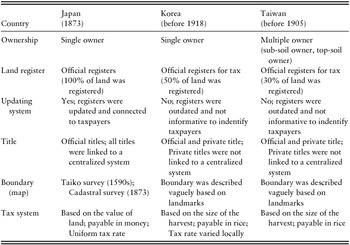
Table 1 summarizes important aspects of pre-colonial land rights in Taiwan and Korea. The first column repeats the salient features of the modern Japanese system: single owner; universal land registration that is updated as transactions occur; titles linked to a central registration system; and cadastral surveys (i.e. official boundary surveys). Other areas that became Japanese colonies might have had single owners (Korea) but much of the land was either unregistered or the registers were outdated, titles were not linked to a central system and surveys were based on landmarks. The systems in Taiwan had similar problems and were even more complex than found in Korea with separate top-soil and sub-soil owners.
A comparison of land tenure systems

Source. Duus (Reference Duus1976); Lin (Reference Lin2008).
Japanese colonial governments completed land surveys in Taiwan (1898–1905) and Korea (1911–1918) by which land ownership was identified and registered. After the survey, the quantity of registered land increased by 215% in Taiwan (Ka, Reference Ka1995) and by 80% in Korea (Kwon, Reference Kwon1989). The main purpose of these land surveys was to facilitate tax collection, which was needed to offset costs of colonial administration. Two years after the completion of the land survey, tax revenue increased more than three fold in Taiwan (Ka, Reference Ka1995) and two fold in Korea (Kwon, Reference Kwon1989).
Japan's early interest in Taiwan, Korea, and Palau had little to do with industrial potential. Taiwan was acquired largely for reasons of honor and prestige from the Sino-Japanese War. In 1895, Taiwan was viewed ‘as unimportant to China and as quite abhorrently un-Chinese’ (Hong and Murray, Reference Hong and Murray2005: 61). In fact, the Chinese general Li Hongzhang, who ceded Taiwan to Japan, informed the Emperor that the loss was trivial because it was a land of brigands, murderers, and pirates (Hong and Murray, Reference Hong and Murray2005). Korea was acquired largely because Japan felt that another power having a military presence on the peninsula would have been detrimental to Japanese national security. At that time, Korea was described as ‘a dagger pointed at the heart of Japan’. Also, it is clear that Japan was not able to predict the division of Korea in 1945 and the consequent poor economic performance of North Korea. Similarly, rapid economic growth of South Korea was not expected at all until the 1970s. Japan occupied Micronesia including The Northern Mariana Islands and Palau because the British requested them to attack the German naval bases in Asia during World War I. Finally, Japan's loss of all colonies after WWII makes the end of occupation an exogenous event in the colonies.
3. A natural experiment in micronesia
In identifying the long-run economic effects of property rights, one must consider the problem of reverse causality, i.e. secure property rights might be a result of economic development.
Reverse causality is not an issue in the case of Palau, a Pacific island that enjoys three times the GDP per capita ($7,600 in 2007) compared to other countries in Micronesia (the Marshall Islands, $2,900 and the Federated States of Micronesia, $2,300 in 2007). The case of Palau is illustrative because the Pacific islands have quite similar initial economic conditions (isolated geographic location and extremely limited land area) and a tradition of clan ownership.
In Micronesia, the Japanese colonial government first identified the boundaries between public lands and private lands from 1923 to 1937. Then, Japan identified owners and boundaries of private lands and made land registers in the Northern Mariana Islands from 1937 to 1939 and in Palau from 1939 to 1941 (Purcell, Reference Purcell1968). However, in the Federated States of Micronesia and the Marshall islands, the Japanese land survey, begun in 1941, was curtailed and eventually stopped by the onset of WWII (Damas, Reference Damas1994; McGrath and Wilson, Reference McGrath, Wilson and Crocombe1971). Consequently, the Federated States of Micronesia and the Marshall islands still operate under the clan ownership system (We exclude the Northern Mariana Islands in our main analysis because it chose to remain under U.S. sovereignty in 1978).
Legal cases in Micronesia clearly show the legacy of the Japanese land registration system. From 1945–1981, Micronesian countries became a Trust Territory of the United States and during this era courts consistently upheld land rights defined by the Japanese land survey in Palau. The American judges consistently concluded that clans or lineages did not have any authority over private land (Orrukem v. Kikuch, Trust Territory Reports (T.T.R.) vol. 2: 533).Footnote 2
In sharp contrast, in the Federated States of Micronesia and the Marshall Islands, American judges were unable to find any basis or evidence of private land ownership and therefore customary land law applied. In Micronesia, land tenure was based on clan, lineage, or group ownership and most customary law allowed the chief to confiscate (customarily assigned) land if an individual violated village traditions. Consequently, the courts allowed (or sometimes enforced) the confiscation of land if a plaintiff provided clear evidence of violation of the customs by, for example, failing to attend important village activities (for example, Amon v. Tobeke T.T.R. vol. 6: 36; Tamaggimed v. Bathin, T.T.R. vol. 2: 499; Phillip v. Carl, T.T.R. vol. 3: 330; Mita v. Piriska, T.T.R. vol. 3: 168). With the exception of Palau, this kind of legal tradition remains in Micronesia. In Yap, Civil Action No. 2008–043 states that ‘Generally, land titles in Yap . . . do not have the same meanings as land titles held elsewhere. . . . the titles are generally subject to various conditions or interests whether or not the conditions or interests are mentioned in the certificates of title’ and the municipal judges can nullify land titles if the land owner violates the traditional customs (Yap state government, Section 7 of Yap State Law 2–38).
Palau did not have favorable economic conditions compared to other Micronesian islands. As a matter of fact, during the German era (1899–1914) the Marshall Islands, which had abundant coconuts, was the economic center of Micronesia. In 1922, the acres of coconut trees numbered 25,583 in the Marshall Islands; 11,000 in Ponape; 8,305 in Truk; 6,855 in Yap; and 1,855 in Palau (Purcell, Reference Purcell1968). In terms of population, Truk (a state of the Federated States of Micronesia) supported the largest population based on favorable fishing conditions. The Germans dug a canal and installed an undersea cable station in Yap (a state of the Federated States of Micronesia next to Palau), but neglected development in Palau. Arguably, it was Ponape (or Pohnpei) that had the most favorable economic conditions for Japan. Unlike other Micronesian islands, Ponape has high mountains and large rainfall. Consequently, Japanese farmers could cultivate their main staple, rice.
After WWII, the United States virtually ignored Micronesia including Palau until the 1980s (Etpison, Reference Etpison2004) and the Trust Territory was poorly developed and could not support itself (Boecker, Reference Boecker1993). Arguably, the United States made the Micronesian countries equally under-developed by forbidding foreign companies from doing business until 1974. Tax revenues show that the Marshall Islands was the economic center as it had been in the German era. In 1975, 48% of tax revenue in Micronesia came from the Marshall Islands (income tax – the Marshall Islands: $1,153,609.23, Palau: $35,655.42, the Federated States of Micronesia: $79,902.89 / business gross receipts tax – the Marshall Islands: $725,742.67, Palau: 156,688.34, the Federated States of Micronesia: $377,378.31). Finally, in 1979 – just before the end of the Trust Territory – more tourists went to the Federated States of Micronesia than Palau, partly because some states of the Federated States of Micronesia were closer to Guam (tourist distribution: the Marshall islands 16%, Palau 21%, the Federated States of Micronesia 61% – Ponape 30%, Truk 24%, Yap 6%, and Kosrae less than 1% (Trust Territory of Pacific Islands, 1979). In short, Palau did not have a leading economic position in Micronesia during the Trust Territory era.
One might suspect that other factors such as education, health, or infrastructure investments that were either unique or relatively more important to Palau led its economic growth. However, from 1945 to 1981, U.S. policy treated these countries as one political entity, the Trust Territory of the Pacific Islands. In fact, Japan and the United States built and repaired roads, harbors, and airfields not only in Palau but also in the Marshall Islands and the Federated States of Micronesia (Close up Foundation, 2000; Boecker, Reference Boecker1993). Moreover, there was a large expansion of American-style education and significant sanitation improvements across Micronesia after 1945. Economic growth, however, was robust only in Palau where Japan transferred its land tenure system completely.
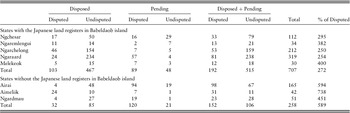
One can also study the relationship between secure land tenure and development within Palau. Three of the 16 states in Palau – Aimeliik, Airai, and Ngardmau – lack the Japanese land registers because they were apparently misplaced in storage or lost in transit to Guam (Trust Territory of the Pacific Islands Office of Land Management, Note on Duplication, 1967). Court records from 2000 to 2010 show that in Babledaob Island, where ten out of sixteen states are located, the three states lacking the Japanese land registers have more disputes (58.9%) in issuing land certificates than other states (27.2%) (see Table 2).
Disputed and undisputed cases in issuing land titles in Babeldaob 2000–2010

Source. Palau land court.
Note. Two states that have fewer than five cases are excluded.
The relationship between the lack of a land register and low development is most clearly observed in the state of Ngardmau, which sank from one of the most to the least developed states in Palau after the land registers were lost.
Records of the Fukushima Mining Company show that geologists were engaged in prospecting the Nagardmau bauxite deposits in 1935. In 1938, mining operations first started in Ngardmau. From 1938 to 1944, the South Seas Aluminum Mining Company shipped a total of 369,227 metric tons of bauxite. The methods of mining were a mixture modern mining and milling practices and of hand labor methods that hired local workers. During the colonial era, the state became relatively prosperous after the Japanese opened bauxite mines (Petrosian-Husa et al., Reference Petrosian-Husa, Miko and Smaserui2002).
After World War II, the U.S. Geological survey evaluated Ngardmau's potential for bauxite mining, concluding that the principle assets remaining were the roads and railway grades, which could be restored and used to good advantage. The water mains, reservoirs, causeway, pier, and also possibly the aerial tramway could be rehabilitated at moderate expense. However, the average alumina content of Nagardmau ore was different from American ore, thus it would require extensive modification of American equipment to extract the aluminum. Therefore, mining of bauxite ceased (Petrosian-Husa et al., Reference Petrosian-Husa, Miko and Smaserui2002).
Nevertheless, from the 1960’s onwards there was again great interest in Palauan bauxite from Japanese companies.Footnote 3 However, the unclear boundary between public and private lands discouraged this. There is the question who was supposed to be paid when selling the bauxite. To what extend would the resident, the municipality of Ngardmau participate in such an enterprise: that is, would any portion of the royalties or any additional fees revert back to them. Vague boundary and the slow process of land titling were the main obstacles to reopening the mines and invigorating economic development (Petrosian-Husa et al., Reference Petrosian-Husa, Miko and Smaserui2002). The case of Ngardmau state suggests that destruction of good institutions discourages economic development.
Considering the natural experiment in Micronesia, we suggest one instrument, the completion of a Japanese land survey, which satisfies exclusion conditions. In Micronesia, the major determinants of Japanese colonization in Micronesia were World War I (the initiation) WWII (the end). WWII also generated exogenous variation within Micronesia. Another instrument that we suggest is distance to Japan, which also satisfies exclusion conditions as invoked in previous studies. It was also one of the major factors in colonizing Korea and Taiwan. However, distance to Japan can be related to other omitted variables that impacted growth. For example, countries that are close to Japan have advantages in trade. In order to check this possibility, we include distance to Japan in ‘the first stage and the second stage as an included instrument’ or ‘only in the second stage as an excluded instrument’.
4. Institutional transfer in british colonies
In Asia, secure land tenure systems are found not only in Taiwan, Korea, and Palau, but also in Hong Kong and Singapore. In the latter cases, the British colonial government transferred institutions of land rights.
In Hong Kong and Singapore, the government owned and leased property. If the leasing contracts provided good property defining institutions for land, then we can apply the analysis of land tenure to these places. The following excerpt from Phang (Reference Phang2000) shows that British colonial leases, in fact were secure.
The British government, on taking over Hong Kong Island in 1841, recognized immediately the importance of controlling land. In 1843, it proclaimed that all land belongs to the Crown and that the government would not allow any private ownership of land. Leases were sold at public auctions or granted directly for the payment of an annual rent. Enforcement powers for land use decisions are found in the Building Ordinance and contractual powers in Crown leases.
In 1826, English statutes in force on November 26, 1826, and the principles of common law and equity were received as part of the law in Singapore. This meant that English doctrines of tenure and estates operated in Singapore.
In contrast, the British occupied India, Bangladesh, Pakistan, and Sri Lanka for an extended period, but their colonial government failed for some time to transfer the British land tenure system. A history of Sri Lanka's cadastral survey clearly shows that the British failed to transfer its land tenure system.
After the occupation of the country by the British, several attempts had been made for the establishment of a cadastre based on cadastral surveys. The proclamation by Governor North in the year 1800 for land owners to appear before the ‘Land raad’ (a judicial official) to produce evidence of title and get their lands surveyed was the first attempt. This failed.
Systematic cadastral surveys commenced in three sub urban villages within the capital Colombo itself based on an Act passed in 1877 for the purpose. However, this activity was abandoned in 1891, after three years of operation, mainly due to the high costs involved. Subsequent attempts in the form of several studies, recommendations and draft acts prepared for the purpose did not borne fruit.
There is at present, what can be described as, a limited cadastre. About eighty percent of the country is covered by village plans prepared by the Surveyor General demarcating State (Crown) land. These plans are [. . .] prepared after 1910.
Source - Cadastral Template, Country report: Sri Lanka (2003)
As the above excerpt shows, the British colonial government attempted to implement a modern land tenure system in Sri Lanka, but it failed in 1800, and failed again in 1891 due to the high cost. Although the British occupied Sri Lanka for 153 years, the British colonial government could not transfer the crucial British institutions (i.e. the land tenure system based on cadastral surveys) for 114 years. Thus, a huge difference existed between Sri Lanka and the two city-states, Hong Kong and Singapore. It is likely that the longer occupation led to greater institutional transfer. The comparison of transfer of land tenure system indicates, however, that the effective levels of institutional transfer were different across the British colonies even if the lengths of British occupation were similar.
Considering this difference, we suggest another instrument – the number of years of British occupation after the successful introduction of the British land tenure system (REVISED LENGTH OF BRITISH OCCUPATION), which is directly related to the transfer of a land registration system and operational experience.
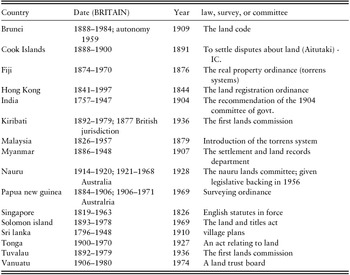
If we count the number of years of British occupation in Sri Lanka after 1910 (when the village plans enabled a limited cadaster), REVISED LENGTH OF BRITISH OCCUPATION for Sri Lanka is 39 years. Since most of the countries clearly recorded when the laws for the land tenure system were enacted, REVISED LENGTH OF BRITISH OCCUPATION can be calculated with less concern about subjectivity (Appendix 1).
Previous studies claim that the length of colonial rule is exogenous. Feyrer and Sacerdote (Reference Feyrer and Sacerdote2009) argue that the beginning of colonial rule is related to exogenous factors such as wind patterns, distance to Europe, and other geographic factors. We accept the argument on the colonial rule and extend it. Within Asia, the end of British occupation is related to WWII, except in Hong Kong. During WWII, Britain requested help from its colonies and promised independence for fighting against Germany. In 1947, the British decision to give independence to India impacted the independence of other British colonies. Profitability is an important factor in deciding to maintain a colony, however the loss of British colonies is directly related to WWII which is exogenous to other factors that impacted growth or economic potential.
Longer colonial rule is likely related to greater institutional transfer. However, previous studies have difficulties in identifying which governmental institutions are critical. The experience of British Asian colonies suggest that the transfer of property defining institutions is critical. In this paper, we use revised length of British occupation which measures the degree of transfer of institutions effectively.
Revised length of British occupation is a good variable because it also captures the transfer of operational experience. Introduction alone is inadequate for the transfer of new institutions; complete transfer also requires experience. Usually, locals have little or no knowledge about the new institutions, and because the change is so large, they cannot manage the system at the outset. Without operational experience, the locals are likely to retreat to their traditional system. Brunei is a case in point. Although the colony attained autonomy from the British, they hired a British adviser to manage their new land tenure system. This example suggests that these locals also realized the importance of operational experience.
5. Comparison of land reforms
Comparing the traditional land tenure system of Taiwan during the Qing period and colonial land tenure system of Taiwan during the Japanese colonial period helps to identify the relationship between secure land tenure and economic development. According to Lin (Reference Lin2008), although the Qing government supported economic development, its system had little success in attracting outside capital and modern technology due to insecure and complex property rights. In southern China and Taiwan, custom recognized top-soil and sub-soil rights. The former were permanent tenancy contracts that the community recognized as a kind of property (the tenant leased the land for 3 or 4 generations). Both top-soil and sub-soil rights could be leased. The dual owner system provided security for tenants, but made land transactions and tax collection very difficult. Only the native Taiwanese could control every aspect of complex property rights: multiple owners and potentially numerous rental contracts (Ka, Reference Ka1995).
From June of 1886 to December of 1889 (10 years before the Japanese occupation), a Chinese general Liu Ming-chuang reformed the land tenure system of Taiwan, an effort that cost 426,635 ounces of silver. Notably, the general did not create an updating system to register land sales, new land reclamation or other changes from that point onward. Consequently, this new system gradually lost its effectiveness, as had happened with earlier reforms. Their priority was to determine which landowner should be taxed under the new system (Lin, Reference Lin2008).
In contrast, the Japanese colonial government introduced the modern, single owner, land tenure system based on accurate cadastral surveys. Its total expenditures in surveying land and making registers were about 4,230,905 ounces of silver (ten times of the expenses of Liu's reform; the original expenditure was 5,357,188 yen; the annual budget of the traditional Taiwanese government was about 1 million yen). More importantly, coupled with a series of land registry regulations, household registry rules, and other administrative measures, the government could now record all changes in land distribution and household composition (Lin, Reference Lin2008). In order to introduce a single ownership system, the Japanese colonial government bought all sub-soil rights and gave legal title to top-soil owners, at a of about 2 million yen (Ka, Reference Ka1995).
After the land reform, land yields and agricultural productivity increased by 81% from 1901 through 1938 (Lin, Reference Lin2008) and Taiwanese landlords who benefited from the land-tax reform continued to save and to invest in commercial enterprises such as sugar and rice processing (Ka, Reference Ka1995). Moreover, a large amount of Japanese capital flowed to Taiwan (Myers and Peattie, Reference Myers and Peattie1984).
The comparison of Japanese and American land reforms in Micronesia also helps to identify the conditions crucial to success. Japan occupied Micronesia from 1919 to 1945 and the U.S. succeeded from 1945 to 1981. After occupation, Japan implemented a citizen identity system that included finger prints, a land reform, and a tax reform, as they had done earlier in Taiwan and Korea. When Japan officially occupied Micronesia in 1919, they conducted a complete census on October 1, 1920. In fact, Japan was so adamant about accuracy, it was made a general rule to carry out the census twice and double-check the results. Japan also introduced a system to register titles and update the register following transactions. When the Japanese colonial government introduced land registration in Micronesia, they compensated or planned to compensate chiefs. Consequently, Japan's land reform in Micronesia was more successful than the one undertaken by Germany (occupied 1899–1914), which surveyed only prosperous areas such as coconut and pineapple plantations, and prohibited land transactions.
In contrast, after occupying Micronesia, the U.S. faced difficulties in implementing an effective citizen identity system and a land tenure system. The Trust Territory government clearly acknowledged the critical roles of ‘land surveying’ and ‘registration and updating’ for secure land tenure. For example, Trust Territory Policy Letter, P-1, clearly states ‘the long range plan includes cadastral survey of all land, registration of titles, and recording of all land transfers’ (Wright, Reference Wright1947: 55). At the planning stage, however, the government did not recognize the importance of citizen identity system. After the initiation of land registration, the American promoters realized that ‘Micronesians as a whole do not appreciate the need for signatures and correct spelling of names’ (Trust Territory of the Pacific Islands, 1971: 23). The first land registration project in Micronesia was abandoned by 1951 (McGrath and Wilson, Reference McGrath, Wilson and Crocombe1971). In the 1970s, the Trust Territory government reinstated a land reform, but its speed was painfully slow (McCutcheon, Reference McCutcheon1981).
The differences between Japanese and other reforms are due to rigorous Japanese research on colonial administration. Before colonization, the Japanese government was able to observe the experience of other European colonizers and intensively investigated European colonization. The case of British colonization and the land survey in Egypt received special attention. The Japanese government concluded that the budget balance of colonial government was a critical factor for stable colonial administration. Effective land taxation was emphasized as a major source for public finance. Unlike other colonial governments, Japan was able to introduce a secure land tenure system with supporting institutional foundations from the beginning of colonial occupation.
6. Land surveys contribute to public and private finance
Effective land taxation requires registers and maps to identify parcels, as well as a system linking taxpayers to the registers (Cho, Reference Cho2003). In many countries, land taxes are evaded because the government cannot link the three together. Governments appoint local authorities to make the links based on local information, giving them a percentage of the tax receipts as payment. This remedy is imperfect, however, because principal-agent problems often lead to corruption.
Traditionally, Asian countries had land registers, but given the lack of surveys and ownership updates, the land registers were not very useful in collecting land taxes directly from the taxpayers. Sng (Reference Sng2006) argues that it was difficult for the central government to increase tax revenues assigned to local authorities because the poor usually shouldered a heavy tax burden. The Japanese land survey linked the registers, maps, and taxpayers. Moreover, the Japanese colonial government also introduced a citizen identity system in Korea and Taiwan as a way to control the population, but this facilitated tax collection by identifying particular individuals as taxpayers. The Japanese colonial governments faced large budget deficits during the land reform, but the new land tax system was cost effective and much more successful than expected. The total cost of land reform in Taiwan was 5.3 million yen, but the annual land tax revenue increased by 2 million yen. In Korea, the Japanese colonial government was able to decrease the land tax rate from 3% (planned) to 1.5% as a result of higher-than-expected revenues.
Interestingly, the solution of a public finance problem eventually was important for private finance. Because land is immovable and everlasting, banks are more willing to accept it as collateral relative to other assets that can be stolen, hidden, or readily destroyed. Tapping land as collateral, however, is more difficult than one might expect. Legally, land ownership is an abstract concept and what the seller of land owns and offers is ‘the right to sell’ (tenants and squatters have the right to use but lack the right to sell). However, ‘the right to sell’ is justified only by the law (Simpson, Reference Simpson1976). In most cultures, traditionally land was considered to be held either directly or indirectly from the King. Therefore, to prove ownership the title had to be traced back to the original Crown grant (or state grant). For example, in the U.S., title insurance links the deed through an unbroken chain to the original state grant. Therefore, a centralized information exchange system such as a record of deeds or registration of title is a very efficient way of proving ownership. Moreover, land ownership has a very special problem, i.e. boundary disputes. Therefore, banks are more willing to accept land as collateral if secure title and well-defined boundaries are part of a central ownership verification system. A land survey clarifies the boundary and makes abstract land ownership more concrete and secure by reducing boundary disputes.
Experiences in Asia suggest that the following are effective links of a chain: land surveys, a citizen identity system, land titles, recording of deeds or registration of titles, and acceptable collateral. First, banks are reluctant to accept land titles as collateral if the document does not clearly specify the boundaries. In developing countries, many land titles vaguely describe the boundaries, often based on landmarks, not a cadastral survey. Thus, if the landmark is destroyed or moved, boundary disputes follow. Without clear boundaries, the size and value of land is vague and consequently using land as collateral becomes risky. For example, in Thailand 55% of land is held under a certificate of utilization, which is a quasi-formal land title having rough boundaries, but banks do not accept this as collateral. In Thailand, only 15% of land has a legal title based on a cadastral survey acceptable to banks (Angus-Leppan and Williamson, Reference Angus-Leppan and Williamson1985).
Second, governments must provide a centralized ownership verification system. Korea's legal history provides a good example. Prior to 1918, there was no official registration system and Koreans could not register titles in land transactions. Before this step, the Japanese colonial government issued a verification letter for land transactions. The law, however, implicitly stated that the letter did not guarantee ownership to a third person (Cho, Reference Cho2003). Foreigners could buy land in Korea after 1905 and the colonial government tried to promote land transactions by verification letters, but ownership was not fully guaranteed. After the land survey, the registration-of-title system started and the law explicitly indicated that the government guaranteed ownership of such land. Consequently, banks began to accept land titles as collateral with more confidence.
Finally, it should be noted that a well-established citizen identity system should be combined with a centralized ownership verification system. In many cultures, people have multiple names for different purposes. For example, in traditional Korea a man was given names at birth, as an adult, an official name for governments, a name for the family history, and a nickname. Thus, the Korean government had difficulty in identifying the owner of land from the name used on the traditional land register. Without a system that identifies a person with a single name, land cannot be used as secure collateral.
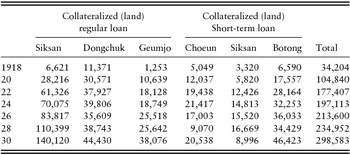
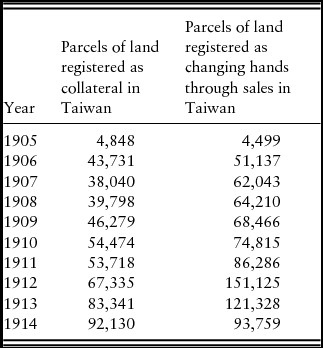
At the time of Japanese conquest, Korea and Taiwan were heavily agricultural and land was the most abundant asset. By accepting land as collateral, banks solved a problem of private finance. The total amount of collateralized loans from banks increased in Korea (Table 3) after 1918 and the total number of collateralized parcels of land increased in Taiwan after 1905 (Table 4) because land titles became reliable.
Total amount of collateralized loan (collateral type: land) in Korea, 1918–1930 (Unit: 1,000 yen)

Source. Hori Reference Hori1983.
Note. (1) Siksan, Dongchuk, Geumjo, Choeun, and Botong are the names of financial institutions. (2) The formal land survey was completed on November 1918.
Land transaction in Taiwan (collateralization/sales)
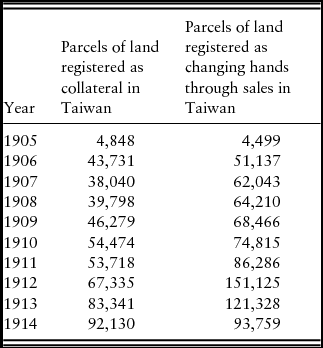
Source. Statistics on Land Registration in Taiwan (Japanese Colonial Government, 1915).
Note. Registration began in July of 1905.
Various features of land tenure explain why land titling might have little impact on credit markets in some cases. Many African countries do not require a clear boundary map in land titling and fail to provide a centralized ownership verification system. It is worth noting that limited impacts on credit markets are reported in land titling for squatters in urban areas (Field and Torero Reference Field and Torero2004, Galiani and Schargrodsky 2006). Land titles issued to squatters are intrinsically less secure because ownership disputes can occur between the original legal owners and squatters who obtained land titles (or ownership can be restored to the original legal owners by political changes). In fact, Galiani and Schargrodsky (2006) report disputes between the original legal owners and the government in the processes of land titling and land expropriation from original legal owners. Thus, it is plausible that banks are less willing to accept recently issued land titles to the squatters in the short run. Additional barriers to credit markets originate from a poor citizen identity system, and lack of an updating system and a reliable centralized ownership verification system.
7. Pathways between property rights and economic growth
Historical evidence suggests that good property defining institutions stimulate land transactions; capital investment; lower interest rates through the development of financial markets; improve the inflow of outside capital; and facilitate the transfer of technology.
On the first point, good property defining institutions facilitate land transactions and mortgaging. A well-established land registration system allows sub-division of land, which helps to match parcel size with collateral needs. This might seem unimportant, except under many customs and laws, all of the collateralized property can be forfeited to the creditor, regardless of the difference between the value of the property and the amount of the debt (Kim, Reference Kim2008). In addition, with effective land transactions, land values tend to rise because the size of the market increases and resources are more likely to flow into their highest valued use (Alston et al., Reference Alston, Libecap and Mueller1999).
Second, the inflow of outside capital is very sensitive to property defining institutions as illustrated by the case of Hawaii. In Hawaii, most land was owned by the government or a small number of landlords. Before 1967, most people leased property for 55 years rather than buying the land and houses (La Croix, Reference La Croix1995). Consequently, mainland Americans were reluctant to invest in Hawaii because the land tenure system was unfamiliar and perhaps subject to arbitrary change. Similarly, Etpison (Reference Etpison2004) explicitly describes that ‘land title disputes scared off legitimate investors, and make high-end hotel development a real challenge [in Micronesia]’.
Finally, transfer of technology is also sensitive to property defining institutions. Observers have suggested, for example, that the collective land tenure system in Africa is an obstacle to adapting Western irrigation technology. Collective ownership of land complicates decision making by creating hold outs and assorted groups with diverse if not adversarial interests. Customary law, therefore, impedes the adoption of this complex and expensive technology (Slabbers, Reference Slabbers1990).
The process of irrigation investment in Korea illustrates a clear pathway from a secure land tenure system to economic development. According to Rhee et al., (Reference Rhee, Jang, Miyajima and Matsumoto1992), irrigation investment was possible because the land survey clearly identified the boundaries and owner of the land. After the land survey, the board for the new irrigation system could use the land register to identify and gain permission from the relevant land owners. Moreover, the board could identify the land owners who needed compensation resulting from making new reservoirs and water distribution ditches.
In other words, efficient irrigation infrastructure requires collective choice. Systematically defined private property rights make clearer the distribution of costs and benefits of such a collective investment. Consequently, it is easier to arrive at an incentive compatible collective choice rule when beneficiaries are easy to identify.
When the permission and compensation processes were finished, the relevant farmers could finance the cost for the new irrigation system by getting loans from banks. Banks founded by Japanese capital accepted land titles as collateral and the farmers received a low interest rate (However, the irrigation investments were such big projects that farmers often paid back their loans over 20 to 30 years).
After the completion of irrigation projects and subsequent adjustments, agricultural productivity in paddy land increased by 67 to 200% in Korea (Rhee et al., Reference Rhee, Jang, Miyajima and Matsumoto1992). On average, there was a drought every eight years and extremely severe drought every 25 years in Korea (Rhee and Cho, Reference Rhee and Cho2005). Thus, it is clear why the farmers invested in the irrigation system when they first obtained access to credit. The irrigation investments in Taiwan doubled the quantity of arable land from 1898 to 1940 (Ka, Reference Ka1995).
The case of Korea shows why the transfer of a western irrigation system is very difficult under conditions faced in many African countries. Even though an irrigation project may be financed by international organizations, the permission, and compensation processes are stymied by the clan ownership system.
These pathways between property rights and economic development suggest that the land survey impacted economic development mainly through institutions. In other words, property defining institutions are not very likely to be related to other potentially omitted variables that impact growth or economic potential such as health, education, or human capital. For example, the economic growth due to better irrigation systems can be considered as one of the channels by which a land survey facilitates economic growth mainly through property defining institutions. Moreover, we maintain that the new property defining institutions persisted. In fact, the current land tenure systems of Taiwan, South Korean, and Palau are based on Japanese land surveys. For example, in South Korea the original Japanese land registers are still in daily use (Gragert, Reference Gragert1994).
8. Empirical estimation: two state least squares
In this section, we estimate the long-term effects of good property defining institutions. We address reverse causality by using instrumental variables that measure the degree of institutional transfer. By using the completion of a Japanese land survey, distance to Japan, and revised length of British occupation as instruments, we can estimate the impact of institutions on economic growth.
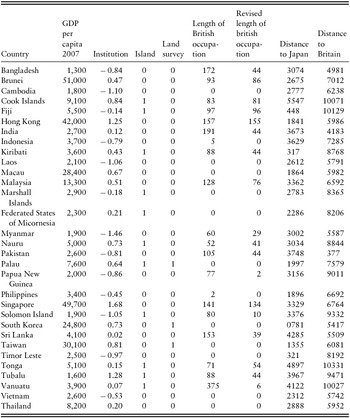
Table 5 contains the basic information on 30 former Japanese and British colonies in Asia. Thailand, which did not experience any colonial occupation, is also included. Data on the log of GDP per capita (PPP) are taken from the CIA World Fact Book (2007), which covers all of the Pacific Islands. The World Bank and IMF's GDP per capita figures, however, are very similar to the CIA World Fact Book estimates.
Former Japanese and British colonies in Asia

We consider various measures of institutional quality from the World Bank (Kaufmann et al., Reference Kaufmann, Kraay and Mastruzzi2007). The World Bank's governance indicators provide annual measures of six institutions, which we averaged over the years 1996–2007. Rule of Law – measuring the quality of contract enforcement, property rights, the police, and the courts, as well as the likelihood of crime and violence – is used as the main measure of institutions. The other measures are used to check for robustness, which is confirmed.
We replicated the methodology of Acemoglu et al., (Reference Acemoglu, Johnson and Robinson2001) who emphasized property protecting institutions, because one of our main purposes is showing that property defining institutions are equally important in the long run. However, we use instruments that are directly related to the property defining institutions (i.e. LAND SURVEY and REVISED LENGTH OF BRITISH OCCUPATION) to avoid pitfalls of weak instruments. Or we use DISTANCE TO JAPAN and REVISED LENGTH OF BRITISH OCCUPATION which satisfy exclusion restrictions (DISTANCE TO BRITAIN is not used because it is a very weak instrument).
The first task is to estimate the relationship between institutions and GDP per capita, for which we use the following specification:
 $$\begin{equation}
{\rm{LGDP}} = {{\rm{a}}_1} + {{\rm{a}}_2}\,{\rm{INSTITUTION}} + {a_3}\,{\rm{PACIFIC}}\,\,{\rm{ISLAND}} + {\rm{e}}
\end{equation}$$
 $$\begin{eqnarray}
{\rm{LGDP}} = {{\rm{a}}_1} + {{\rm{a}}_2}\,{\rm{INSTITUTION}} + {{\rm{a}}_3}\,{\rm{PACIFIC}}\,\,{\rm{ISLAND}}\nonumber\\
&& + {{\rm{a}}_4}\,{\rm{DISTANCE}}\,\,{\rm{TO}}\,\,{\rm{JAPAN}} + {\rm{e ,}}
\end{eqnarray}$$
where LGDP is the log GDP per capita (PPP) of the country, INSTITUTION is the governance indicator of the country (high score denotes secure property rights in the standard normal distribution setting), PACIFIC ISLAND equals one if the country is a Pacific island, zero otherwise, and DISTANCE TO JAPAN is the distance between Tokyo and the capital of a country in thousand miles. We include DISTANCE TO JAPAN in equation (1b) to control some omitted variables that impacts both property rights and economic growth.
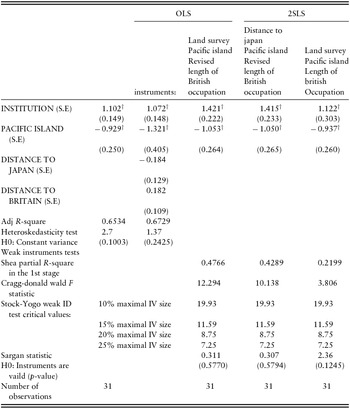
The Ordinary Least Squares (OLS) regressions are given in Table 6. As can be seen, INSTITUTION and PACIFIC ISLAND are significant at the 1% level. Heteroscedasticity tests suggests that heteroscedasticity is not severe when we control institutional quality.
OLS and 2SLS regression dependent variable: LogGDP per capita

Note. *p <0 .05.
† p < 0 .01.
Next, we address the reverse causality and measurement error problems using the completion of a Japanese land survey, distance to Japan, and revised length of British occupation as instruments for estimating the degree of institutional transfer. We also use the length of British occupation for a comparison. The equations for the first stage are as follows:
 $$\begin{eqnarray}
{\rm{INSTITUTION}} = {{\rm{b}}_1} + {{\rm{b}}_2}{\rm{LAND}}\,{\rm{SURVEY}} + {{\rm{b}}_3}{\rm{PACIFIC}}\,{\rm{ISLAND}}\nonumber\\
&& +\, {{\rm{b}}_4}\,{\rm{REVISED}}\,{\rm{LENGTH}}\,{\rm{OF}}\,{\rm{BRITISH}}\,{\rm{OCCUPATION}} + {\rm{u}} \nonumber\\
\end{eqnarray}$$
 $$\begin{eqnarray}
{\rm{INSTITUTION}} = {{\rm{c}}_1} + {{\rm{c}}_2}{\rm{DISTANCE}}\,{\rm{TO}}\,{\rm{JAPAN}} + {{\rm{c}}_3}{\rm{PACIFIC}}\,{\rm{ISLAND}}\nonumber\\
&& +\, {{\rm{c}}_4}\,{\rm{REVISED}}\,{\rm{LENGTH}}\,{\rm{OF}}\,{\rm{BRITISH}}\,{\rm{OCCUPATION}} + {\rm{t}}\nonumber\\ \end{eqnarray}$$
 $$\begin{eqnarray}
{\rm{INSTITUTION}} = {{\rm{d}}_1} + {{\rm{d}}_2}{\rm{LAND}}\,{\rm{SURVEY}} + {{\rm{d}}_3}{\rm{PACIFIC}}\,{\rm{ISLAND}}\nonumber\\
&& +\, {{\rm{d}}_4}\,{\rm{LENGTH}}\,{\rm{OF}}\,{\rm{BRITISH}}\,{\rm{OCCUPATION}} + {\rm{n ,}} \nonumber\\
\end{eqnarray}$$
where LAND SURVEY equals one if the Japanese colonial government completed a land survey in the country, REVISED LENGTH OF BRITISH OCCUPATION is the number of years of British occupation of the country after the successful introduction of the British land tenure system, and LENGTH OF BRITISH OCCUPATATION is the number of years of British occupation.
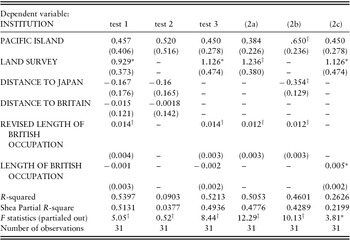
The first stage regression results are given in Table 7. To check the strength of instruments, we use two weak instrument tests and one over-identification test. These tests suggest that LAND SURVEY, DISTANCE TO JAPAN, and REVISED LENGTH OF BRITISH OCCUPATION are valid instruments. Moreover, three test columns in Table 7 check the validity of instruments by adding and subtracting possible instruments. These test columns suggest that LAND SURVEY is more directly related to the institutional quality compared to DISTANCE TO JAPAN, but DISTANCE TO JAPAN is still a very good instrument. The results also suggest that REVISED LENGTH OF BRITISH OCCUPATION is related to the institutional quality, but LENGTH OF BRITISH OCCUPATION and DISTANCE TO BRITAIN are not related closely to institutional quality.
First stage regression

Note. *p < .05.
† p < .01.
As can be seen in Table 6, the effect of institutions is greater in the 2SLS regression if LAND SURVEY (or DISTANCE TO JAPAN) and REVISED LENGTH OF BRITISH OCCUPATION are used as instruments. The coefficient on institutions from the OLS estimates is 1.102 and from the IV estimate is 1.421. A Hausman test confirms that there is a systematic difference between OLS and IV estimates. This indicates that if a country has better institutional quality by one standard deviation in the World Bank measure, the impact of institutions on GDP per capita is about 30% higher. The regression results are robust when DISTANCE TO JAPAN is included in the first stage and the second stage as an included instrument or only in the second stage as an excluded instrument. This empirical result is consistent with the findings of Acemoglu et al., (Reference Acemoglu, Johnson and Robinson2001) who focus on property protecting institutions and shows that property defining institutions were important in Asia.
Our empirical results also indicate that the methodology suggested by Acemoglu et al., (Reference Acemoglu, Johnson and Robinson2001) should be adopted with caution. For example, using LENGTH OF BRITISH OCCUPATION, which is possibly related to property rights institutions may lead to a different conclusion. Our empirical results suggest that the coefficient on LENGTH OF BRITISH OCCUPATION is smaller and less significant. Moreover, it seems to suffer weak instrument problems. The coefficients on INSTITUTIONS in the second stage using LENGTH OF BRITISH OCCUPATION is similar to OLS coefficient. Here, we suggest that focusing on property defining institutions is a better strategy in finding reliable instruments. Recent studies emphasize indicate the importance of legal transplants (Acemoglu et al., Reference Acemoglu, Johnson, Cantoni and Robinson2011). We think the effective degree of institutional transfer can be measured accurately by investigating property defining institutions which is also related to legal transplants. LENGTH OF BRITISH OCCUPATION may not measure the degree of institutional transfer when a colonizer does not focus on institutional transplant.
8. Concluding remarks
The historical record provides an excellent laboratory for study of institutions and development, but existing work tends to exclude Asia and focuses on property protecting institutions.
The Japanese colonial government transferred its land tenure system to Taiwan and Korea – two growth miracles – and Palau – a leading economy in the Pacific. Abundant and reliable data in Asia from the early twentieth century allow us to identify the mechanism linking property defining institutions to economic growth. Instrumental variable estimates suggest that secure property rights stimulated economic growth.
Historical analysis shows that a thorough land tenure system solves a public finance problem by linking land registers, maps, and taxpayers. Moreover, the solution to a public finance problem spills over to private finance. A proper land survey defines boundaries and registration of titles enables banks to readily verify ownership. Because land is the most abundant asset in agricultural economies, its collateralization can provide a major boost for financial markets that nurture economic development. In Asia, a secure land tenure system combined with financial market developments encouraged investment, promoted new technology such as irrigation systems, and consequently increased agricultural productivity.
The identified pathways in Asia suggest that property defining institutions were a major stimulus to economic development. Although property defining institutions and property protecting institutions are closely related, we think the reverse causality problem is less severe in property defining institutions. The motivation of land reform was solving a budget deficit and raising tax revenue. In order to solve the budget problem, the government surveyed available assets such as land and population. The survey and updating system made the economy of country more manageable by the government. Historical and political viewpoints on the emergence of modern nation-states also emphasize increasing the taxation capacity of governments (Besley and Persson, Reference Besley and Persson2009; Ferguson, Reference Ferguson2001; Tilly, Reference Tilly1992).
Our review of the history of land reforms suggests that success requires a clear understanding of the importance of clear boundary lines, the citizen identity system, and the ownership updating system.
Acknowledgements
The authors benefitted from comments or suggestions by Lee Alston, Price Fishback, Sumner La Croix, Gary Libecap, John Wallis, and by seminar participants at the NBER Summer Institute, the University of Michigan, the Social Science History Association meetings, and Ohio State University. We are grateful for financial support from the Presidential Fellowship of Ohio State University and Economic History Association Dissertation fellowship.
British occupation dates and the year of introducing the British land tenure system