I. Introduction: Balancing and its critique
The rise of proportionality in constitutional law is a puzzling phenomenon. On the one hand, the principle enjoys enormous popularity around the world.Footnote 1 Many courts use it as the central doctrinal tool of constitutional review.Footnote 2 The US Supreme Court is probably the only major exception that still resists the explicit acknowledgement of proportionality as an instrument of constitutional review.Footnote 3 On the other hand, proportionality has faced fierce criticism in the scholarly literature across various jurisdictions. This criticism focuses primarily on the last step of the proportionality test, the balancing of the individual right and the competing public interest.Footnote 4 As the balancing exercise often requires the comparison of incommensurable values, some authors claim that balancing is ‘arbitrary’.Footnote 5 They argue that it allows courts to second-guess policy evaluations and thus to overstep the boundary from the legal to the political realm.Footnote 6
Some legal scholars even take the critique one step further. They argue that balancing is a tool for judicial self-empowerment.Footnote 7 It provides them with a doctrinal structure that allows them to veil political decisions behind legal terms.Footnote 8 This paper suggests that the relationship is more complex: Balancing does not necessarily create judicial power; it rather presupposes it. The argument will be developed in two steps. First, the paper will develop a theoretical framework. We will see that a doctrinal structure that is as severely criticized as the doctrine of proportionality is not able to legitimize contested court decisions. A weak court that bases the unconstitutionality of a law on balancing as an argumentation framework would jeopardize its own institutional position.
Second, these theoretical considerations will be confirmed by a case study that analyses the development of balancing as a doctrinal tool in the fundamental rights jurisprudence of the German Federal Constitutional Court. The German Constitutional Court was the first court to use proportionality as an instrument of constitutional review.Footnote 9 For this reason, it has a long history to study and from which to draw lessons. If we look at the development of the proportionality principle in the German jurisprudence, we see that the German court initially was very reluctant to base its decisions on balancing in situations, in which it held that a statute was inconsistent with the constitution. However, this changed after two and a half decades of the Court’s existence. Since the late 1970s, balancing is the central doctrinal tool of the Court when it overturns statutes. This development suggests that the Constitutional Court first had to gain institutional strength before it could use balancing as an argumentation framework when confronting the legislature.
II. Balancing and institutional constraints on constitutional judges
Balancing between flexibility and activism
The popularity of proportionality among courts is easy to explain: Proportionality offers judges a formal argumentation structure to resolve conflicts between individual rights and competing rights or public interests. Courts can avoid expressing abstract preferences for one value over another and thus refrain from establishing hierarchies of competing values.Footnote 10 This non-hierarchical approach has two advantages: On the one hand, it gives courts room for manoeuvre.Footnote 11 They can confine themselves to resolving the case at hand without setting precedents for future situations that are difficult to predict.Footnote 12 On the other hand, it expresses respect for the position of each of the parties.Footnote 13 It does not fundamentally discredit the abstract legitimacy of one of the positions. Instead, the ruling is based on the circumstances of the individual case.Footnote 14
However, the critique of balancing suggests that balancing has a fundamental methodological deficit. A doctrinal instrument that grants judges flexibility may also open the door for judicial activism. That is why many scholars argue that balancing is an instrument of judicial self-empowerment.Footnote 15 But this critique is usually not based on a systematic analysis of the judicial practice. At best, it refers to individual cases as anecdotal evidence. Furthermore, it assumes that the open analytical structure of balancing automatically leads to judicial activism. However, this argument overlooks the fact that courts face not only methodological, but also institutional constraints.Footnote 16
Judicial power and judicial legitimacy
When courts exercise constitutional review, they cannot implement their own judgments.Footnote 17 They have no sword that could force politics to comply with their rulings. It is told that the former US president Andrew Jackson once said after the US Supreme Court had handed down a decision of which he disapproved: ‘John Marshall has made his decision, now let him enforce it.’Footnote 18 Moreover, the refusal to implement a court decision is not the only potential sanction that the political branch has against a court.Footnote 19 Depending on the institutional framework, it can also narrow the court’s competencies, cut the budget or redesign the election rules for judges in order to guarantee that a majority of judges are favourable to the government’s policies.
For this reason, courts are to a certain extent dependent on the cooperation of the political branch when they exercise constitutional review.Footnote 20 On the one hand, they can secure this cooperation by exploiting institutional conflicts within the political branch. Such institutional conflicts occur primarily in federal systems. Here, the state governments and legislatures may see the court as a guarantee against a disproportionate concentration of power on the federal level.Footnote 21 At the same time, the court may equally help the federal institutions to implement their policy goals within the individual states.Footnote 22
On the other hand, courts can also confront the political branches directly. In such a case, their judicial power depends on the legitimacy that they enjoy.Footnote 23 The stronger the public acceptance of a court, the more politicians have to fear losing electoral support if they openly refuse to implement judicial decisions.Footnote 24 If a court enjoys a high degree of legitimacy, non-compliance is usually perceived as a violation of the fundamental rules of democracy.Footnote 25 In contrast, if a court lacks acceptance, politicians who oppose the implementation of judgments do not jeopardize electoral approval. Legitimacy is thus a central source of judicial power.Footnote 26 Only significant public support enables courts to take decisions that are costly for the government and the parliamentary majority.
The legitimacy of courts relies on the perception that courts are neutral arbiters that base their decisions on legal considerations.Footnote 27 One of the principal lines of defending the legitimacy of constitutional review in continental Europe is to stress the different rationality of legal decisions of constitutional courts when compared to political decisions of the legislature.Footnote 28 If a court were perceived as a political actor with its own political agenda, this would undermine its legitimacy and thus weaken its institutional position.Footnote 29
Certainly, one cannot expect the general public to follow the methodological intricacies of the constitutional jurisprudence closely. The daily business of courts usually flies under the radar of public attention. In high-profile cases, public opinion focuses more on the result than on the reasoning. Over time, however, a dubious methodological approach may nevertheless affect the public reputation and thus the general acceptance of a court. The link between the court’s legitimacy and its style of argumentation is provided by the legal academy. If the vast majority of legal academics disapproved the methodological approach of the court and accused the latter of judicial activism, the image of the court as a neutral arbiter would be severely damaged. For this reason, the effectiveness of a specific doctrine presupposes that it is accepted as a legal argument within constitutional law scholarship.
Legitimacy and balancing
Consequently, constitutional courts will be sensitive to the methodological problems of balancing. They have to develop strategies to dissipate the suspicion that they are taking political decisions when they are applying the proportionality test. When analysing the potential harm that balancing may cause to judicial legitimacy, we have to distinguish three situations. If a court wants to confirm a piece of legislation, balancing does not pose any legitimacy issues. Certainly, confirming the constitutionality of a statute can be highly political. But it does not evoke an institutional conflict. The court confirms a legislative decision and thus does not interfere with the political branches. It cannot be accused of being activist or having an independent political agenda. If the court reverses decisions of lower courts without implicitly reviewing the statutory basis of these decisions, there is a conflict between courts. This may also involve a conflict about the scope of the competencies of the competing courts, and there are often political considerations at stake. From an institutional perspective, however, the constitutional court does not transgress the border to the political branches.Footnote 30
If a court wants to strike down legislation as unconstitutional, it comes into conflict with the legislature. If it bases such a decision on the balancing stage of the proportionality test, it has to justify why its valuation of the competing interests at stake is superior to the valuation of the legislature. For this reason, we should expect courts to be particularly guarded about using balancing in such a situation. They will try to base their decisions on alternative arguments or to rationalize the balancing exercise in order to signal that they refrain from making a political judgment.
This does not mean that courts totally refrain from balancing. However, the likelihood of courts recurring to balancing when reviewing legislation depends on two factors. First, a court will balance more often the stronger its institutional position is. If a court enjoys widespread public support, it has less political and methodological constraints. A weak court, in contrast, will try to avoid an argumentation framework that appears to be ‘political’ and that could undermine its legitimacy. Second, the use of balancing considerations depends on the level of acceptance of balancing as a ‘legal’ argument in the legal discourse. The more balancing is accepted as a doctrinal instrument, the more the constitutional court will rely on balancing when reviewing legislative decisions.
III. The historical development of balancing
In this section, I will retrace the historical development of balancing as a legal argumentation framework in the jurisprudence of the German Constitutional Court. The analysis is based on a quantitative assessment of the different arguments on which the Constitutional Court has based the constitutional incompatibility of statutes. In the following, I will first describe the analysed data. In a second step, I will discuss the results of the quantitative analysis, which shows a historical trend in the use of balancing. While the German Constitutional Court was very reluctant to base a decision, in which it overturned a piece of legislation on balancing considerations in the first 25 years of its jurisprudence, balancing developed into the predominant argumentation framework from 1978 onwards. The final two subsections exemplify the characteristics of the jurisprudence of the Court in the pre- and the post-1978 period.
The analysed data
The analysis comprises 238 decisions, the last of which was rendered in December 2012. It includes all decisions in which the German Constitutional Court held that a piece of legislation was incompatible with the German constitution and which were published in the official reports of the Federal Constitutional Court up to volume 132. The study is limited to decisions, in which a law is held to be unconstitutional because these decisions evoke an institutional conflict with the legislature. Decisions, in which the Court confirms a law or reverses the decision of a lower court, may also be highly political. But they do not involve an institutional conflict between judiciary and legislature.
Certainly, the distinction between correcting lower courts and confronting the legislature is not always clear-cut. Notably, the interpretation of a statute according to the values of the constitution (verfassungskonforme Auslegung) may ultimately lead to an interpretation of a statute that contradicts the explicit intention of the legislature.Footnote 31 However, it is assumed that the verfassungskonforme Auslegung is not primarily an instrument to correct the legislature. Functionally, the interpretation according to the values of the constitution was developed as an instrument to discipline lower courts. The German Constitutional Court is no supreme court that can review all legal aspects of a lower court decision. Rather, its standard of review is limited to constitutional issues. The verfassungskonforme Auslegung is thus the only instrument for the Constitutional Court to correct the interpretation of lower courts without invalidating the underlying statute.
Other than focusing on decisions, which overturn a piece of legislation, the case selection has been qualified in two further respects. On the one hand, the analysis focused on the jurisprudence concerning fundamental rights. On the other hand, the German fundamental rights doctrine distinguishes between ‘liberty’ and ‘equality’ rights. The study only focused on the former category of rights. Judgments not related to liberty rights were not examined because the constitutional court does not usually rely on the proportionality test in these cases.
Consequently, five categories of cases were excluded. This concerns, first, all decisions that were taken on formal grounds. Thus, cases in which the Court overturned a statute because the legislature lacked the formal competency or because the decision-making procedure was deficient were not considered. Second, judgments concerning the guarantee of municipal autonomy were not included as these decisions, in principle, concern the distribution of competencies between the German states and the municipalities.
Third, all judgments which were exclusively based on the prohibition of discrimination, as laid out in section 3 of the German Constitution, were excluded. Even though the Court sometimes relies on proportionality considerations in these cases, the doctrine is markedly different from the Court’s approach regarding liberty rights, so that the respective case law merits an independent analysis.Footnote 32 Fourth, decisions concerning the organization of the political process were excluded, as the principle of proportionality does not play a significant role in these cases.Footnote 33 Finally, this is also true for judgments concerning the taxing power of public authorities, which were equally excluded.
In the study, balancing was understood as a residual category.Footnote 34 All decisions that were based on proportionality considerations, but could not be assigned to any of the other three steps of the proportionality test, i.e. the determination of a legitimate purpose, the rational connection or the less-restrictive-means test, were classified as balancing decisions. The coding of the analysed decisions is represented in the table in the annex to this paper.
The historical trend
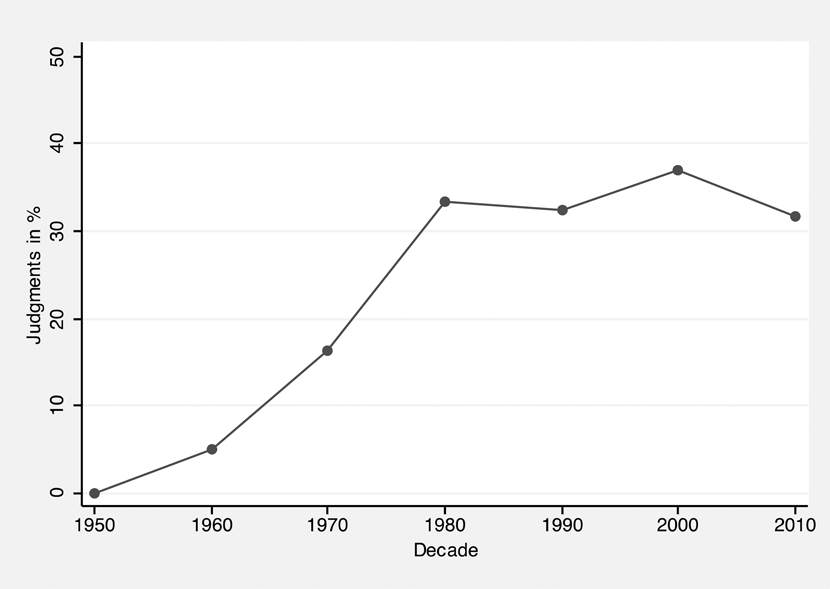
Figure 1 shows the evolution of the balancing argument in the case law of the German constitutional court in cases where the court overturned a piece of legislation. Based on this graph, we can identify a historical trend. For two and a half decades after the foundation of the Court, balancing only played a marginal role when the Court justified the constitutional incompatibility of a statute. From 1951 to 1977, the Court struck down a law only four times because it deemed the law to be disproportionate. If the Court recurred to proportionality arguments, it usually based its decision on the lack of a rational connection between means and end or the existence of a less restrictive means. This picture changes toward the end of the 1970s. In the 35 years from 1978 to 2012, the Court based about one-third of its decisions in which it overturned a piece of legislation on balancing considerations. In relative terms, balancing became the most important argumentation framework from the 1980s onwards.
The evolution of balancing in Germany

The pre-balancing period
Unlike the Canadian Supreme Court or the South African Constitutional Court, the German Constitutional Court has not developed proportionality in one paradigmatic judgment. There is neither an Oakes Footnote 35 nor a Makwanyane Footnote 36 judgment in the German case law. Instead, the development was more gradual. The most important step in this development was the pharmacy judgment,Footnote 37 which the Court handed down in 1958.Footnote 38 In this case, the Court held that a licensing scheme for pharmacies in the state of Bavaria was incompatible with the constitutional freedom of profession. The applicant had intended to open a pharmacy in the Bavarian village of Traunreut. The administrative authority had denied the request because the establishment of a new pharmacy was not in the public interest. The already existing pharmacy was supposed to be sufficient to serve the inhabitants of Traunreut with the necessary medical drugs.
There are two interesting points to note about this case. First, the Constitutional Court had cautiously raised the suspicion that the scheme was actually set up to protect the existing pharmacies against competition. It qualified the licensing scheme as a quantitative access restriction and argued that in such circumstances
[t]here is a significant danger of [the legislative decision] being influenced by illicit motives; in particular, it seems likely that the access restriction is supposed to protect those who are already part of the profession against competition – a motive that, according to common opinion, cannot justify an infringement of the freedom of profession.Footnote 39
The Court did not draw the consequence of checking the motivation of the legislature. Instead, it used this observation to justify a particularly strict standard of scrutiny for the legislative scheme.Footnote 40
Second, while framing the standard of review in the abstract, the Court recurred to balancing rhetoric. It argued that the freedom of profession was supposed to protect individual liberty, while the limitations clause of the provision aimed to protect the public interest.Footnote 41 It continued:
If one tries to accommodate both objectives, which are equally legitimate in a social constitutional democracy, as effectively as possible, the resolution can only be found through a thorough balancing of the importance of the opposite and possibly competing interests.Footnote 42
However, in the further course of the judgment, the Court avoided basing its reasoning on a balancing of the competing interests. Instead, it used a combination of less-restrictive-means and coherency arguments. The Bavarian government had argued that an unrestricted freedom to establish new pharmacies would lead to fierce competition between the pharmacies and compromise their economic soundness.Footnote 43 In such an environment, the pharmacies might be inclined to violate obligations concerning prescriptions, quality control of the medical drugs and training of personnel in order to increase their revenue. Furthermore, an excessive supply of medical drugs might increase the consumption of these drugs and enhance addiction.
The Constitutional Court rejected these arguments. First, it found that the access restriction was not necessary to secure the economic soundness of the pharmacies.Footnote 44 To justify this less-restrictive-means argument, the Court relied on a simple economic consideration: The establishment of a pharmacy required a significant initial investment. For this reason, a pharmacist usually made an economic assessment as to whether the investment would pay off before he established a new pharmacy.Footnote 45 Therefore, an abundant increase of pharmacies was unlikely. Instead, the market already took care of the problem that the licensing scheme was supposed to address. The Court supported these theoretical considerations with a reference to the situation in Switzerland: The Swiss had not restricted the establishment of new pharmacies, and the system was working just fine.Footnote 46
With regard to the argument that pharmacists might violate their professional obligations when faced with fierce competition, the Constitutional Court countered with a coherency argument. If there was a danger of members of the professions not complying with their professional obligations, this danger should occur with equal likelihood in other liberal professions. Nevertheless, the legislature had not deemed it necessary to establish access restrictions for doctors or other comparable professionals.Footnote 47 Furthermore, the Court argued that violation of professional obligations did not only occur in situations of economic need. Mere greed might be a sufficient motivation, and greed could also be observed in a regulated environment.Footnote 48 The Court thus found that strengthening the supervision of pharmacies and decreasing unnecessary administrative burdens for pharmacists would have been a less restrictive and more effective means to pursue the same ends.Footnote 49
In the pharmacy judgment, the German Constitutional Court started to develop a formal argumentation framework to resolve conflicts between individual rights and competing public purposes. The judgment is characteristic for many early decisions in which the Court overturned legislation. The Court used balancing rhetoric, but refrained from a comparison of the value of the competing interests. Instead, it placed an emphasis on the empirical questions underlying the economic regulation. In the end, it overturned the legislation because it had serious doubts about the effectiveness of the chosen regulatory scheme.
In many early decisions of the Court, the argumentation patterns followed the general lines that we have observed in our analysis of the pharmacy judgment. When it applied the principle of proportionality, the Court predominantly used rational-connection and less-restrictive-means arguments.Footnote 50 Moreover, it often relied on consistency and coherency argumentsFootnote 51 or challenged the lack of protection of legitimate expectations.Footnote 52 An example that further illustrates this early approach is the COD ruling, in which the Constitutional Court overturned a law prohibiting the cash-on-delivery shipment of living animals.Footnote 53 The challenged statute aimed to protect animal health. It was supposed to avoid long transport times that could occur if the purchaser refused to accept the delivered animal.
The Court substantially based its verdict on two principal arguments. On the one hand, it found that the legislation was overbroad because it targeted even those shipments that did not involve a considerable danger of harm for the animals.Footnote 54 Furthermore, an empirical assessment of the situation had shown that only a tiny fraction of all shipments had been returned to the sender.Footnote 55 Not all of the shipments had been returned because the purchaser had rejected the animal. Some were due to other reasons, e.g., false mailing addresses or the absence of the addressee.Footnote 56 For these reasons, the Court found that there was no sufficient rational connection between measure and purpose.Footnote 57 On the other hand, the Court made a coherency argument. The legislature had extended the prohibition of cash-on-delivery even to express shipments. At the same time, it had not demanded that all deliveries be expedited. The Court noted that the transport time for non-express shipments often exceeded the total time of returned express deliveries. Therefore, it found the legislation to be inconsistent.Footnote 58
Finally, the Court supported its substantial arguments by an inquiry into the legislative process. It noted that the prohibition of COD shipments had been introduced in the legislation without giving the concerned professions the opportunity to state their views.Footnote 59 Furthermore, it highlighted that some of the reasons that were mentioned in the legislative procedure to justify the prohibition had subsequently proven to be wrong.Footnote 60 For this reason, the legislature could not have considered all relevant factors in the balancing process and had thus been guided by incomplete and inaccurate considerations.Footnote 61
The argumentation structure of the decision is similar to the one that we have observed in the pharmacy judgment. On the one hand, the Court highlighted failures of the legislative procedure. The legislature had not made a sufficient factual inquiry, nor had it considered all relevant factors. On the other hand, it showed how these deficiencies of the legislative process affected the substance of the legislation by pointing out that it was overbroad and inconsistent.
Balancing decisions were very rare in the first twenty-five years of the Court’s jurisprudence. The first decision came in 1962, when the Court overturned a law that extended the limit on shopping hours to vending machines.Footnote 62 These vending machines were only profitable when they operated 24/7. At the same time, a 24-hour operation did not compromise the existence of competing shops. For this reason, the Court held that the law imposed a disproportionate burden on the operators of vending machines.Footnote 63 Before 1978, there were only three more rulings in which the Constitutional Court overturned a law based on balancing considerations.Footnote 64 As in the vending machine case, the stakes for the legislature in these decisions were fairly low. The change of direction came in 1978 and 1979, when the Court used balancing in four judgmentsFootnote 65 – i.e., exactly as many as in the 27 years before.
The second period: balancing as the predominant argumentation framework
From 1978 onwards, balancing has become the predominant argumentation framework. Relatively speaking, the Court has relied on balancing to overturn a law more often than on any other argument.Footnote 66 The confidence of the Constitutional Court in utilizing balancing considerations is particularly evident in a decision on the status of transsexuals from May 2008.Footnote 67 In this decision, the Court balanced even though the case seemed to be a textbook example for the less-restrictive-means test. The applicant, who was born in 1929, had been married since 1952. For a long time, he had felt that he belonged to the female gender. Therefore, he underwent a sex reassignment surgery to transform his sex from male to female in 2002. However, she was denied a respective change of her civil status because the civil status could, according to the law that was applicable at the time, only be changed if she got divorced before.
With this provision, the legislature had intended to prevent the matrimony of same-sex couples. However, in 2001, the legislature had passed a new law that allowed a civil union of same-sex couples. Since then, the legislative purpose could have been attained through a less restrictive means: the transformation of the matrimony into a civil union at the couple’s request. Nevertheless, the Court recurred to balancing in its reasoning. It argued that the divorce requirement imposed a disproportionate burden on the applicant and thus violated her right to privacy.Footnote 68 When the Court discussed the possible consequences, however, it explicitly advised the legislature of the possibility to transform the matrimony into a civil union as one possible option.Footnote 69
Even if balancing has become the predominant argumentation framework in today’s jurisprudence, it is not the only one. In many cases, the German Constitutional Court even combines balancing considerations with other arguments. One example is the telecommunications surveillance judgment from 1999.Footnote 70 In the judgment, the Court reviewed a statute that authorized the German intelligence agency to monitor certain international calls and to pass the obtained data to the public prosecution authority. It acknowledged that the aim to prevent and to prosecute criminal actions was a legitimate goal that was, in principle, suitable to justify an infringement of the right to secrecy of telecommunications, guaranteed by section 10 of the Constitution.Footnote 71
However, the Court found several flaws in the legislation. To identify these flaws, it used different forms of argumentation: It recurred to balancing, consistency and procedural arguments, arguing that the law was, in part, overly indeterminate. The Court used balancing when it examined the conditions for the telecommunications surveillance.Footnote 72 The legislature had established a catalogue of criminal offences as a condition for monitoring calls. The Court held that telecommunications surveillance was only justified when the targeted criminal offence was sufficiently severe.Footnote 73 It found that the offence of counterfeiting did not fulfil this requirement. The degree of severity was significantly lower than that of any of the other offences listed in the catalogue.Footnote 74
The Court also found flaws with regard to the utilization of the data that had been obtained through the monitoring of the calls. First, the statute had provided for an obligation of the intelligence agency to report to the federal government. The Court agreed that such an obligation was necessary, but found that the statute was overly indeterminate. In particular, it did not limit the purposes for which the government could use the data.Footnote 75 Second, the statute authorized the intelligence agency to pass on the data to public prosecution authorities under certain conditions. The Court held that these conditions were insufficient. Passing on data should only be allowed if the severity of the criminal offence outweighed the interest in the protection of the data.Footnote 76 The Court found that the offences listed in the catalogue and the standards for the necessary evidence did not all meet these requirements.Footnote 77 It supported its findings with a coherency argument, referring to a different provision of the German criminal procedure law, which authorized public prosecution authorities to monitor telecommunication, but imposed stricter conditions on the authorities.Footnote 78
Finally, the Constitutional Court required the legislature to impose certain procedural safeguards. It demanded a recording of the data that was passed on to the public prosecution authorities in order to guarantee effective control of the executive action.Footnote 79 Moreover, it postulated more stringent notice requirements. The challenged provision had only required informing the monitored person of the surveillance if the data had been stored for more than three months. The Constitutional Court held that the notice requirement was a fundamental guarantee because it enabled the concerned individual to seek a legal remedy. Therefore, a notice to the monitored person should only be held back in exceptional circumstances.Footnote 80
IV. Balancing and the review of decisions of civil and criminal courts
In the previous section, we have seen that the Constitutional Court was reluctant to use balancing considerations in the first two and a half decades of its existence when it overturned a law. However, that does not mean that the Court totally refrained from balancing in this early period. On the contrary: Even in the time from the 1950s to the late 1970s, we find many decisions in which the Court recurred to balancing. First, the Court balanced when it confirmed the constitutionality of a law.Footnote 81 For two reasons this is not surprising. On the one hand, balancing is a necessary step in the doctrine of the proportionality test when the law has passed the first three steps of the test. On the other hand, we have already seen that balancing does not raise the suspicion of the Court interfering with the political sphere in these cases as the Court confirms the legislative decision.Footnote 82
Second, the Constitutional Court balanced when it reviewed decisions of lower courts.Footnote 83 The seminal case is the Lüth judgment, which was issued in January 1958 – five months before the pharmacy judgment.Footnote 84 The case concerned a statement of Erich Lüth, who, at the time, was the director of the Hamburg press office. Lüth had called for a boycott of the latest film by the director Veit Harlan, who had produced several anti-Semitic movies in Nazi Germany. After the producer and the distributor of Harlan’s film had obtained an injunction against Lüth, which ordered him to refrain from calling for a boycott against the film, Lüth turned to the Constitutional Court. He argued that the injunction violated his freedom of expression.
The judgment is of seminal importance for two reasons. On the one hand, the Court extended its own jurisdiction to the review of decisions of civil courts even if these decisions were not based on an unconstitutional law.Footnote 85 It argued that fundamental rights not only contained obligations for the legislature, but also bound private law courts when they decided on conflicts between individuals.Footnote 86 On the other hand, it recurred to a ‘balancing of the fundamental right contained in section 5 para. 1 sent. 1 of the Constitution [i.e., the freedom of expression] and the rights and values that restrict its exercise’ for the resolution of the conflict between the applicant’s freedom of expression and Harlan’s professional reputation.Footnote 87 On both sides of the equation, it considered the extent to which the competing interests were affected. On the one hand, it analysed the motives of Lüth’s statement, and, on the other, it examined the intensity of the restriction of Harlan’s rights.
The Court found that Lüth had intended to protect the reputation of the German film industry abroad and to fend off any Nazi influences.Footnote 88 It qualified the applicant’s concern for the German reputation as ‘significant’.Footnote 89 Furthermore, it acknowledged that it was necessary to interfere with Harlan’s interests in order to pursue this purpose.Footnote 90 On the other hand, the Court argued that statement did not infringe the core of Harlan’s identity as an artist.Footnote 91 Lüth had exercised neither physical nor legal force, and Harlan was not denied the opportunity to continue working in the film business.Footnote 92 For this reason, the Court held that the injunction violated the applicant’s freedom of expression.
In the Lüth judgment, the Court thus displayed a typical balancing test. It evaluated and compared the importance of the competing interests and the intensity with which they were affected. The Lüth judgment was no exception in the early years.Footnote 93 Moreover, the Court did not only apply balancing considerations while reviewing the decisions of civil courts. Instead, it also overturned several decisions of criminal courts, in which it found measures of criminal procedure to be disproportionate.Footnote 94 In one decision, the Constitutional Court reversed a decision to investigate an accused by means of a pneumoencephalography, an extremely painful procedure that allowed reproducing the structure of the brain on an X-ray image.Footnote 95 As the applicant was accused of a misdemeanour, the Court held that the severity of the bodily harm caused by the measure was disproportionate regarding the severity of the crime.
In a different decision, the Constitutional Court overturned a high court judgment, in which the high court had based a conviction on audio tape recordings as evidence.Footnote 96 The Constitutional Court argued that the high court had not sufficiently justified why it believed that the criminal offence had been so severe that it outweighed the right to privacy of the accused.Footnote 97 These examples show that the Constitutional Court widely used balancing as a doctrinal instrument in some of its early landmark decisions when reviewing lower court decisions, even though it was rather reluctant to use balancing when declaring a law as unconstitutional.
V. Balancing and the institutional strength of the Constitutional Court
These observations confirm the predictions of the theoretical framework, which had hypothesized that the likelihood of a court balancing depended on two factors.Footnote 98 On the one hand, a court is more likely to use balancing considerations the stronger its institutional position is. On the other hand, it will lean on balancing more heavily the more balancing is accepted as a doctrinal argument in the legal community.
The institutional strength of a court is not constant. Instead, it develops over time. Constitutional Courts need to gain the trust of the citizenry in order to increase their public support.Footnote 99 Some studies in political science show that the legitimacy of constitutional courts – all other factors being equal – in principle increases over time, as courts have had more opportunities to attract public support.Footnote 100 Particularly in the first years of their existence, constitutional courts are usually in a rather precarious situation and still have to establish their authority.
The German Constitutional Court is no exception in this respect. In the 1950s, the Court faced severe political pressure from the Adenauer government. When the Court was deciding about the constitutionality of Germany’s participation in the planned European Defense Community, the government feared that the court could be a serious obstacle to their foreign policy agenda. For this reason, Adenauer’s Minister of Justice, Thomas Dehler, repeatedly tried to damage the authority of the court.Footnote 101 Furthermore, the government entertained reform plans that would have given it much greater influence with regard to nominating of judges to the Court.Footnote 102
Even though these plans did not succeed in the end, they show that the position of the Court was much more tenuous in the 1950s than it is today.Footnote 103 By the late 1970s, the Court had consolidated its position. It enjoyed widespread public support,Footnote 104 and its institutional position was much stronger than in the 1950s, when the court developed the proportionality test. Consequently, when the Court started to use balancing as an argumentation framework to overturn legislation more consistently from 1978 onwards, it had gained sufficient institutional strength and self-confidence for such a doctrinal move.
Furthermore, it is no new phenomenon that courts develop doctrinal frameworks in situations where they target less powerful actors, and then turn them against more powerful ones once the doctrine has been accepted in the legal discourse. Barry Friedman and Erin Delaney have shown in a study that the US Supreme Court developed certain doctrinal tools initially when reviewing state measures.Footnote 105 In these cases, the Court backed the Federal government against the states. However, once the doctrines were established and accepted, the Court also turned them against the Federal government.Footnote 106
Similarly, the German Constitutional Court developed the balancing doctrine when reviewing the decisions of lower courts and confirming pieces of legislation. When it confirmed legislation, it confirmed the decision of the political branches. When it reviewed decisions of civil or criminal courts, the review of these decisions was arguably in the interest of the political elites. There had been a deep suspicion against the general judiciary among the delegates of the Parliamentary Council that drafted the German constitution.Footnote 107 The judiciary had played a crucial role in the Third Reich, stabilizing and supporting the regime by interpreting the existing laws through the lens of the Nazi ideology.Footnote 108 This was one of the reasons why the Constitutional Court, which was not part of the traditional judicial hierarchy, was awarded the exclusive competency to overturn laws that it found to be unconstitutional.Footnote 109 Furthermore, among the first judges who had been elected to the Constitutional Court, a considerable number had openly resisted the Nazi regime.Footnote 110
When the Constitutional Court ceased the authority to review decisions of the civil courts by extending the scope of fundamental rights to private relations in Lüth, it dealt with a case that catered to the suspicion against the general judiciary. Lüth was thus ideal for claiming the review authority and to introduce balancing as a doctrinal tool.Footnote 111 The applicant was a prominent state official who had spoken up against a film director with a significant Nazi past. When the civil courts issued an injunction against Lüth, they trivialized Harlan’s role in the Third Reich. The Constitutional Court could thus emphasize its role as the guardian of the fundamental values of post-war Germany. It could also introduce the balancing framework and develop it without undermining its own legitimacy.
In the late 1970s, when the Court extended the use of the doctrine, balancing was predominantly accepted as a doctrinal instrument of fundamental rights review in constitutional law scholarship.Footnote 112 It was so much part of the arsenal of doctrinal instruments in constitutional law that the shift was barely noticed in the legal academy.Footnote 113 The Constitutional Court could thus apply the balancing test to the review of legislation without having to fear a significant critical scrutiny of this move in the legal scholarship.
Certainly, the preceding analysis provides no detailed proof of the causal relationship between balancing and institutional strength. We only observe a correlation, no causality. In particular, the study cannot explain why balancing took off precisely in the late 1970s and not a few years earlier or later. Institutional developments are often caused by a combination of macro- and micro-factors. This paper focused on the institutional framework, the macro-environment. If we want to explain the precise date, we would have to look into the micro-factors as well. One likely explanation might be a change in the composition of the judges. However, a precise assessment of causality would require a more detailed quantitative analysis of the data, which would be beyond the scope of this paper. To bridge the gap between correlation and causality, we have to rely on the plausibility of the theoretical argument. If the theory is correct, the case study suggests that institutional strength was a precondition for even balancing-minded judges to perform the observed doctrinal shift.
VI. Conclusion
Doctrinal argumentation frameworks are not discovered, but constructed. However, contrary to what critics sometimes argue, courts are not unconstrained in the development of their doctrinal tools. Instead, they face institutional constraints. Courts have neither sword nor purse to implement their own decisions. Consequently, they need public support if they want to take decisions that impose costs on government and legislature. Their legitimacy depends on being perceived as neutral arbiters who decide according to legal rather than political considerations. If they are perceived as activist, they jeopardize their legitimacy. Thus, they have to choose the doctrinal tools they use carefully in order to dissipate the suspicion of having a political agenda.
To substantiate this hypothesis, this contribution analysed the development of the proportionality test in the jurisprudence of the German Federal Constitutional Court. In particular, the last step of the test is often severely criticized.Footnote 114 Balancing is seen as an arbitrary exercise that lacks rational standards and is thus suspicious of being a veil for political considerations in legal decision-making. For these reasons, some authors even argue that balancing is an instrument of judicial self-empowerment.Footnote 115
However, the German Constitutional Court was sensitive to the methodological problems of balancing when it developed the proportionality test in the late 1950s. Initially, it was very reluctant to base judgments on balancing considerations when it overturned a piece of legislation. Instead, it recurred to balancing when it overturned decisions of lower courts or when it confirmed legislative decisions. In these cases, referring to balancing did not pose any legitimacy issues because the court did not second-guess political considerations of the legislature.
Starting in the late 1970s, the Court’s approach changed. It increasingly relied on balancing when overturning legislation. This change was due to two reasons. On the one hand, the institutional position of the Constitutional Court in the late 1970s was much stronger than in the 1950s. The Court did not have to fear that an increasing reliance on balancing would immediately undermine the level of legitimacy that it had built up over the previous two and a half decades.
On the other hand, balancing was not a new concept in the Court’s jurisprudence anymore. As the Court had applied balancing considerations in other circumstances, balancing was by then widely accepted as a legal argumentation framework. Consequently, the court did not run into danger to be suspected of hiding political considerations behind legal terms. Certainly, this development does not completely disprove the argument of the critics. Once accepted as a doctrinal tool, balancing could still be used as an instrument of judicial self-empowerment. However, this analysis suggests that the relationship is at least more complex than commonly assumed. Courts cannot simply choose doctrinal tools as they wish. Instead, they gradually need to develop the instruments of judicial review to impose effective constraints on the legislature.
Acknowledgements
I am indebted to Or Bassok, Bruce Cain, Christoph Engel, Stephen Gardbaum, Dieter Grimm, Valéria Guimarães de Lima e Silva, Gianluca Parolin, Pasquale Pasquino, Samuel Issacharoff, Arie Rosen, Re’em Segev, Emanuel Towfigh, Joseph Weiler, and two anonymous reviewers for comments, advice and inspiration.
Annex: The classification of the decisions of the German Federal Constitutional Court
The following table lists all decisions, in which the German Constitutional Court declared a statute as unconstitutional (taking into account the limitations discussed under section III). The column BAL indicates whether the Court based its decision on balancing considerations.