Symptoms of internalizing disorders (especially anxiety and depression) frequently co-occur (Garber & Weersing, Reference Garber and Weersing2010; Hankin et al., Reference Hankin, Snyder, Gulley, Schweizer, Bijttebier, Nelis and Vasey2016) and tend to increase during adolescence (Petersen et al., Reference Petersen, Lindhiem, LeBeau, Bates, Pettit, Lansford and Dodge2018), particularly in girls (Altemus, Sarvaiya, & Epperson, Reference Altemus, Sarvaiya and Epperson2014; Rutter, Caspi, & Moffitt, Reference Rutter, Caspi and Moffitt2003). Importantly, difficulties associated with internalizing symptoms in adolescence, even those that are subclinical, can persist into adulthood (Petersen et al., Reference Petersen, Lindhiem, LeBeau, Bates, Pettit, Lansford and Dodge2018; Winefield, Hammarström, Nygren, & Hägglöf, Reference Winefield, Hammarström, Nygren and Hägglöf2013) and predict poorer physical health (Jamnik & DiLalla, Reference Jamnik and DiLalla2019) and suicidal ideation (Betts et al., Reference Betts, Baker, Alati, McIntosh, Macdonald, Letcher and Olsson2016; Fergusson, Horwood, Ridder, & Beautrais, Reference Fergusson, Horwood, Ridder and Beautrais2005). Studies of the hierarchical structure of mental health problems have consistently identified internalizing problems as a fundamental dimension common across multiple mental health disorders (Kotov et al., Reference Kotov, Krueger, Watson, Achenbach, Althoff, Bagby and Zimmerman2017; Lahey et al., Reference Lahey, Applegate, Waldman, Loft, Hankin and Rick2004, Reference Lahey, Rathouz, Van Hulle, Urbano, Krueger, Applegate and Waldman2008), accounting for the comorbidity of depressive, anxiety and stress disorders in adolescents (Blanco et al., Reference Blanco, Wall, He, Krueger, Olfson, Jin and Merikangas2015) and adults (Carragher, Krueger, Eaton, & Slade, Reference Carragher, Krueger, Eaton and Slade2015). However, internalizing behaviors are inwardly focused and often go unnoticed and untreated (Stein & Fazel, Reference Stein and Fazel2015). Importantly, adolescence is a critical period in which to intervene and halt the progression of long-term mental health difficulties. Identifying biomarkers related to internalizing problems may provide clues about which adolescents show elevated levels of these symptoms or risk for future problems (Strimbu & Tavel, Reference Strimbu and Tavel2010).
Brain connectivity is a promising potential biomarker of internalizing symptoms. Resting-state functional connectivity (RSFC) provides a metric of coordinated activity across regions in the absence of task demands and offers insight into stable neural patterns of socio-emotional processing with individual specificity (Finn et al., Reference Finn, Shen, Scheinost, Rosenberg, Huang, Chun and Constable2015; Gratton et al., Reference Gratton, Laumann, Nielsen, Greene, Gordon, Gilmore and Petersen2018). Studies of RSFC have implicated certain networks (i.e. collections of brain regions with intrinsically coordinated activity) as being particularly relevant to internalizing symptoms. Here, we examined the roles and overall functional neural architecture of the default mode (DMN), limbic ventral affective (VAN), and cognitive control (CCN) networks in relation to internalizing symptoms in adolescents using a biotyping approach. We examined these specific networks based on prior work documenting altered RSFC of the DMN, VAN, and CCN in adolescents with internalizing psychopathologies, such as depression and anxiety (Burkhouse et al., Reference Burkhouse, Stange, Jacobs, Bhaumik, Bessette, Peters and Langenecker2019; Cullen et al., Reference Cullen, Westlund, Klimes-Dougan, Mueller, Houri, Eberly and Lim2014; Roy et al., Reference Roy, Fudge, Kelly, Perry, Daniele, Carlisi and Ernst2013). Given existing evidence, we expected that internalizing symptoms would be related both to aberrant connectivity within the DMN, VAN, and CCN, as well as differential connectivity between the networks.
The DMN comprises a network of regions (e.g. medial prefrontal cortex, posterior cingulate cortex, posterior parietal cortex) involved in self-referential processing and autobiographical memory, such as introspection (Philippi, Tranel, Duff, & Rudrauf, Reference Philippi, Tranel, Duff and Rudrauf2015). Indeed, maladaptive self-referential processes, including rumination and repetitive negative thought (Berman et al., Reference Berman, Peltier, Nee, Kross, Deldin and Jonides2011) are present in internalizing psychopathology (McEvoy et al., Reference McEvoy, Salmon, Hyett, Jose, Gutenbrunner, Bryson and Dewhirst2019). Furthermore, elevated DMN RSFC has been found in adolescents with clinical depression (Ho et al., Reference Ho, Connolly, Henje Blom, LeWinn, Strigo, Paulus and Yang2015) and youth with elevated levels of subclinical anxiety and depression symptoms (Coutinho et al., Reference Coutinho, Fernandesl, Soares, Maia, Gonçalves and Sampaio2016).
The VAN encompasses areas involved in emotion processing and regulation (e.g. amygdala, hippocampus, insula) (Catani, Dell'acqua, & Thiebaut de Schotten, Reference Catani, Dell'acqua and Thiebaut de Schotten2013). Heightened connectivity of this network may underlie the negative mood and aberrant affective processing that characterizes internalizing problems (Ladouceur et al., Reference Ladouceur, Dahl, Williamson, Birmaher, Ryan and Casey2005). Higher VAN connectivity has been found in adolescents and adults diagnosed with depression (Connolly et al., Reference Connolly, Ho, Blom, LeWinn, Sacchet, Tymofiyeva and Yang2017; Tang et al., Reference Tang, Lu, Zhang, Hu, Bu, Li and Huang2018) and anxiety (Liu et al., Reference Liu, Yin, Cheng, Fan, You, Men and Zhang2015; Roy et al., Reference Roy, Fudge, Kelly, Perry, Daniele, Carlisi and Ernst2013) compared to healthy controls. In healthy adolescents, higher RSFC within the salience network (which shares regions with the VAN) is associated with higher levels of rumination, suggesting that connectivity among regions involved in emotion processing may contribute to recurring inwardly-focused negative thoughts (Ordaz et al., Reference Ordaz, LeMoult, Colich, Prasad, Pollak, Popolizio and Gotlib2016).
Finally, the CCN includes regions implicated in goal-directed processes implicated in emotion regulation (e.g. dorsolateral prefrontal cortex; dlPFC, dorsal anterior cingulate cortex; dACC). Lower connectivity of the CCN may contribute to ineffective cognitive regulation of negative thoughts (Goschke, Reference Goschke2014). Lower RSFC of the CCN is found in adolescents with clinical depression (Pannekoek et al., Reference Pannekoek, van der Werff, Meens, van den Bulk, Jolles, Veer and Vermeiren2014), those with familial risk for depression (Clasen, Beevers, Mumford, & Schnyer, Reference Clasen, Beevers, Mumford and Schnyer2014), and those with anxiety (Yang et al., Reference Yang, Fan, Zhai, Lin, Wang, Ma and Dai2018). Additionally, decreased CCN connectivity has been associated with elevated levels of depression symptoms in healthy adults (Schultz et al., Reference Schultz, Ito, Solomyak, Chen, Mill, Anticevic and Cole2018) and adolescents (Strikwerda-Brown et al., Reference Strikwerda-Brown, Davey, Whittle, Allen, Byrne, Schwartz and Harrison2015).
Aberrant between-network connectivity also relates to internalizing symptoms. For example, adolescents with lower RSFC between the amygdala (a region of the VAN) and regions of the CCN exhibited escalating symptoms of depression over time (Scheuer et al., Reference Scheuer, Alarcón, Demeter, Earl, Fair and Nagel2017). Similarly, reduced RSFC between the amygdala and prefrontal areas has been shown in relation to greater trait anxiety (Greening & Mitchell, Reference Greening and Mitchell2015). Additionally, lower RSFC connectivity of a ‘salience and emotion network’ (similar to the VAN) with the CCN from adolescence to adulthood has been found in adolescents with internalizing symptoms (Burkhouse et al., Reference Burkhouse, Stange, Jacobs, Bhaumik, Bessette, Peters and Langenecker2019). Given the role of the VAN in emotion processing, and the role of the CCN in cognitive control, lower coupling between these networks may indicate disrupted emotion regulation. Taken together, RSFC studies suggest that internalizing symptoms, at clinical and nonclinical levels, are associated with alterations in RSFC within and between brain networks.
Recent research suggests that RSFC connectivity patterns track with the emergence of internalizing symptoms. Among adolescents with familial risk for depression, those with lower RSFC within CCN regions (e.g. between the inferior parietal lobule and subgenual ACC, and between the left and right dorsolateral PFC) were more likely to develop depression 3–4 years later (Hirshfeld-Becker et al., Reference Hirshfeld-Becker, Gabrieli, Shapero, Biederman, Whitfield-Gabrieli and Chai2019). Further, task-based functional connectivity among regions of the VAN and CCN (e.g. amygdala and prefrontal areas) while viewing emotional faces predicts changes in internalizing symptoms among nonclinical youth (Gard et al., Reference Gard, Waller, Swartz, Shaw, Forbes and Hyde2018). Although previous work has identified patterns of RSFC that are associated with changes in internalizing problems, no work has evaluated whether RSFC connectivity profiles identified through data-driven approaches naïve to the distribution of internalizing symptoms can be used to prospectively predict internalizing symptoms.
Defining neural profiles, or ‘biotypes’ (Williams, Reference Williams2017), based on patterns of coordinated activity in networks (e.g. within- and between-network RSFC) may provide insight into affective processes that are otherwise masked by the use of group-averaged approaches (e.g. comparing participants with a disorder to healthy volunteers) such as in the case of adolescent depression (Chahal, Gotlib, & Guyer, Reference Chahal, Gotlib and Guyer2020) or by examining relations with a specific symptom or set of symptoms. For example, adults with depression have been differentiated from healthy adults based on the connectivity-based subgroup (i.e. biotype) to which they belong (Price et al., Reference Price, Lane, Gates, Kraynak, Horner, Thase and Siegle2017). Subtypes of depression have also been identified based on individuals’ connectivity-based biotype status (Price, Gates, Kraynak, Thase, & Siegle, Reference Price, Gates, Kraynak, Thase and Siegle2017). Given these findings, parsing individuals into subgroups based on their RSFC patterns may facilitate identification of individuals with heightened affective dysregulation and shared psychosocial impairments.
It remains unknown, however, whether connectivity-based biotypes differentiate youth with elevated v. non-elevated subsyndromal internalizing problems. Additionally, it is unclear whether connectivity-based biotypes reflect only concurrent internalizing problems or a stable pattern of problems throughout adolescence. The novel application of connectivity biotyping to samples of adolescents in longitudinal studies may offer insights to these important inquiries.
The current study sought to test these questions in an undiagnosed adolescent sample whose internalizing problems were measured at age 14, 16, and 18 years and who completed a resting-state functional scan at age 16 years. The Subgroup Group Iterative Multiple Model Estimate (S-GIMME) (Gates, Lane, Varangis, Giovanello, & Guiskewicz, Reference Gates, Lane, Varangis, Giovanello and Guiskewicz2017) approach utilized in previous studies (Price, Gates, Kraynak, Thase, & Siegle., Reference Price, Gates, Kraynak, Thase and Siegle2017; Price et al., Reference Price, Lane, Gates, Kraynak, Horner, Thase and Siegle2017) was applied to adolescents’ neuroimaging data to test for connectivity-based biotypes with distinct RSFC profiles and to examine resulting biotypes in relation to internalizing problems. We hypothesized that (H1) adolescents would be parsed into connectivity-based biotypes based on similarity in RSFC patterns of internalizing symptom-relevant networks (i.e. the DMN, VAN, and CCN) at age 16, (H2) with one biotype displaying RSFC patterns previously reported in relation to internalizing symptoms, e.g. heightened VAN-DMN and/or lower VAN-CCN (Burkhouse et al., Reference Burkhouse, Stange, Jacobs, Bhaumik, Bessette, Peters and Langenecker2019; Geng, Li, Chen, Li, & Gu, Reference Geng, Li, Chen, Li and Gu2016; Price, Gates, Kraynak, Thase, & Siegle, Reference Price, Gates, Kraynak, Thase and Siegle2017; Scheuer et al., Reference Scheuer, Alarcón, Demeter, Earl, Fair and Nagel2017). We further hypothesized that connectivity-based biotype would be a biomarker of internalizing problems throughout adolescence, where (H3) prior symptoms (age 14) would predict biotype status at age 16, (H4) current (age 16) problems would be associated with biotypes, and (H5) biotypes would predict future (age 18) internalizing problems (Prenoveau et al., Reference Prenoveau, Craske, Zinbarg, Mineka, Rose and Griffith2011). In exploratory analyses, we examined sex differences, building on a large literature documenting elevated internalizing problems in girls relative to boys during this period (Altemus et al., Reference Altemus, Sarvaiya and Epperson2014).
Method and materials
Participants
The sample included 73 Mexican-origin adolescents (40 female, M Age = 16.26 years, s.d. = 0.50) enrolled in a neuroimaging sub-study who were recruited from a larger 10-year, longitudinal study of risk for and resilience to substance use problems. Participants in the parent study included 674 families with a child in fifth grade (M Age = 10.85 years, 50% female) who were drawn at random from school rosters during the 2006–2007 and 2007–2008 academic years. Participants were recruited into the neuroimaging sub-study based on data from two measures indicating they had either engaged in (N = 37) or abstained from (N = 36) substance use in the 9th grade (age 14–15). This enriched sample excluded any adolescents taking psychotropic medications. Four participants were excluded from analyses due to excessive movement in the scanner (i.e. 20% of the data were removed by censoring), and one was excluded due to incomplete self-reported data, resulting in a sample of 68 (54.4% female) youths included in the current analyses. Previous work published on this sample has reported on patterns of RSFC in association with years since initial substance use onset (Weissman et al., Reference Weissman, Schriber, Fassbender, Atherton, Krafft, Robins and Guyer2015) and with changes in family income across adolescence (Weissman, Conger, Robins, Hastings, & Guyer, Reference Weissman, Conger, Robins, Hastings and Guyer2018).
Measures
Internalizing problems
Participants completed the Mini Mood and Anxiety Symptom Questionnaire (MASQ) (Watson et al., Reference Watson, Weber, Assenheimer, Clark, Strauss and McCormick1995) at ages 14, 16, and 18. The MASQ provides a reliable and valid assessment of current levels of internalizing problems (Lin et al., Reference Lin, Yung, Wigman, Killackey, Baksheev and Wardenaar2014), and includes four subscales: General Distress (e.g. ‘How much have you felt depressed?’), Anxious Arousal (e.g. ‘Have you felt like you were having trouble swallowing?’), Anhedonic Depression (e.g. ‘How much have you felt like you had a lot to look forward to?’), and Anxiety (e.g. ‘How much have you felt keyed up or on edge?’). Alphas for the full-scale MASQ score ranged from 0.85–0.90 across the three measurement occasions. Following prior research in the larger study of the current sample (Parrish, Atherton, Quintana, Conger, & Robins, Reference Parrish, Atherton, Quintana, Conger and Robins2016), internalizing problems were modeled as latent variables at each measurement occasion. An internalizing problems factor (λs = 0.35–0.93, 0.35–0.96, 0.25–0.97; total ω = 0.92, 0.89, and 0.93 at ages 14, 16, and 18, respectively) was created using indicators of General Distress, Anhedonic Depression, Anxiety, and Anxious Arousal at each wave. Internalizing factor scores were computed using regression; the factor model was created using maximum likelihood estimation in the Lavaan package in R (Rosseel, Reference Rosseel2012).
To reduce the impact of extreme observations on data analyses, a 90% winsorization adjustment was used, such that internalizing problem scores below the 5th percentile were set to the 5th percentile, and scores above the 95th percentile were set to the 95th percentile (online Supplemental Fig. S1). The advantage of the winsorization technique in lessening extreme observations and the estimation of regression coefficients has been described in previous work (Chen, Welse, & Chan, Reference Chen, Welse and Chan2001; Yale & Forsyth, Reference Yale and Forsyth1976).
Other relevant measures
Participants self-reported their pubertal status using the Petersen Physical Development Scale (Petersen, Crockett, Richards, & Boxer, Reference Petersen, Crockett, Richards and Boxer1988) annually from ages 10–15 years. Pubertal timing (i.e. age of pubertal onset) was estimated using separate Gompertz growth models for males and females (Chahal et al., Reference Chahal, Vilgis, Grimm, Hipwell, Forbes, Keenan and Guyer2018). Additionally, at age 16, participants reported on their use of marijuana and alcohol in the past 3 months using the Alcohol, Tobacco, and Other Drugs survey (Elliot, Ageton, & Huizinga, Reference Elliot, Ageton and Huizinga1982). Adolescents completed the Woodcock-Johnson III IQ test (Woodcock, McGrew, & Mather, Reference Woodcock, McGrew and Mather2001) at approximately age 10 when entering the parent study. Major Depressive Disorder and Generalized Anxiety Disorder diagnosis variables were based on the Computerized Diagnostic Interview Schedule for Children [C-DISC; (Blouin, Perez, & Blouin, Reference Blouin, Perez and Blouin1988)] and collected at age 16. The C-DISC is a structured interview covering 36 mental health disorders for children and adolescents using the Diagnostic and Statistical Manual of Mental Disorders, Fourth Edition (DSM-IV) criteria.
Resting-state scan
Functional magnetic resonance imaging (fMRI) data were collected on a Siemens 3 T TIM Trio MRI scanner with a 32-channel head coil. During a resting-state fMRI scan, participants were instructed to lie still with their eyes open and to focus on a white fixation cross on the screen. A series of 223-time points were acquired with an echo-planar imaging T2-weighted sequence: echo time (TE) = 27 ms; repetition time (TR) = 2000 ms, isometric voxel size = 3.5 mm3, slices = 35 (interleaved acquisition), field of view (FOV) = 224 mm, flip angle = 80°. The first three volumes were discarded to ensure magnet stabilization. To register the functional images to anatomical space, a high-resolution T1-weighted scan was acquired using an MPRAGE sequence (TE = 4.33 ms; TR = 2500 ms; isometric voxel size = 0.9 mm3; slice thickness = 0.95 mm; slices = 208; FOV = 243 mm; flip angle = 7°). fMRI data preprocessing procedures are described in the online Supplemental Material.
Data analysis
Regions of interest (ROIs)
The original GIMME algorithm is well-suited for connectivity analyses of 5–15 ROIs (Gates & Molenaar, Reference Gates and Molenaar2012). We selected the same 15 ROIs examined by Price, Lane, et al. (Reference Price, Lane, Gates, Kraynak, Horner, Thase and Siegle2017), given that these regions have been implicated previously in neuroimaging studies of internalizing symptoms (Burkhouse et al., Reference Burkhouse, Stange, Jacobs, Bhaumik, Bessette, Peters and Langenecker2019; Geng et al., Reference Geng, Li, Chen, Li and Gu2016; Scheuer et al., Reference Scheuer, Alarcón, Demeter, Earl, Fair and Nagel2017). Similar to Price, Lane, et al. (Reference Price, Lane, Gates, Kraynak, Horner, Thase and Siegle2017), 8 mm radius spherical masks were applied around peak coordinates of (1) CCN regions including dACC, bilateral posterior parietal cortex (PPC), and left dlPFC; (2) VAN nodes including bilateral nucleus accumbens (Nacc), bilateral anterior insula, bilateral ventrolateral PFC (VLPFC), bilateral amygdala, and subgenual ACC (sgACC); and (3) DMN regions including posterior cingulate cortex (PCC) and perigenual ACC (pgACC) (coordinates for all ROIs are included in Supplemental Material). For each participant, the mean time series across voxels within each ROI was extracted and inputted to the S-GIMME algorithm.
Connectivity-based biotypes
Briefly, GIMME is an unsupervised approach (i.e. no a priori assignment of clustering threshold or grouping variables) that utilizes a structural equation framework (Kim, Zhu, Chang, Bentler, & Ernst, Reference Kim, Zhu, Chang, Bentler and Ernst2007) to arrive at the group and individual connectivity estimates among ROIs. In the structural equation framework, significant paths between ROIs are directed, indicating that one ROI statistically predicts another (i.e. ROI → ROI), rather than representing an undirected association. In validation tests, GIMME reliably estimates group- and individual-level connectivity maps, including specific region-to-region directional paths (Gates & Molenaar, Reference Gates and Molenaar2012). S-GIMME (i.e. subgroup version of GIMME) uses a community detection algorithm to determine whether subgroups exist in individual connectivity maps. This approach has demonstrated strong performance in correctly separating subgroups in Monte Carlo simulations (Gates et al., Reference Gates, Lane, Varangis, Giovanello and Guiskewicz2017). Details about S-GIMME procedures are described in the Supplemental Material. S-GIMME (Gates et al., Reference Gates, Lane, Varangis, Giovanello and Guiskewicz2017) was used to detect connectivity-based biotypes (Hypotheses 1–2), which were then examined in relation to internalizing problems (Hypotheses 3–5).
Connectivity-based biotype associations with internalizing problems
For hypotheses 3–5, three regression models were used to test whether (1) past levels of internalizing problems (age 14) predicted connectivity-based biotype status (age 16), (2) current internalizing problems were associated with biotype, and (3) biotype predicted later internalizing problems (age 18). First, logistic regression was used to test the effect of age 14 internalizing problems and the interaction of internalizing problems and gender on biotype assignment. Second, multiple linear regression was used to test the association between current internalizing problems, biotype, and gender. Multiple linear regression was also used to test the main and interactive effects of biotype and gender on age 18 internalizing problems, controlling for age 16 internalizing problems. All models included covariates of IQ given documented associations between IQ and network connectivity (Suprano et al., Reference Suprano, Delon-Martin, Kocevar, Stamile, Hannoun, Achard and Sappey-Marinier2019), substance use history used for recruitment (engaged in substance use as of age 14–15, yes/no) given our previous findings that substance use is associated with cognitive-reward connectivity (Weissman et al., Reference Weissman, Schriber, Fassbender, Atherton, Krafft, Robins and Guyer2015), and head motion given known effects of motion on connectivity estimates (mean framewise displacement) (Power, Barnes, Snyder, Schlaggar, & Petersen, Reference Power, Barnes, Snyder, Schlaggar and Petersen2012).
Connectivity-based biotype associations with internalizing problems trajectories
In addition to testing associations between biotype and internalizing problems at each time-point, we used longitudinal multilevel modeling to derive per-person empirical Bayesian estimates of intercept and linear slope; we then used multiple linear regression to test the association between longitudinal model trajectory parameter estimates and biotype.
Network paths and internalizing problems
As an exploratory post-hoc analysis, all significant paths present in individual-level connectivity maps (which could have resulted from individual-, subgroup-, or group-level path presence) were tallied (i.e. binarized as present/absent) for each participant to compare between- and within-network functional connectivity across subgroups as in (Price et al., Reference Price, Lane, Gates, Kraynak, Horner, Thase and Siegle2017). Path weights were not compared as they were only estimated if the region-to-region path was included in an individual's model.
Results
The average standardized internalizing problems factor scores were −0.02 (s.d. = 0.53, range = −0.33–1.63), −0.02 (s.d. = 0.18, range = −0.17–0.48), and −0.05 (s.d. = 0.1, range = −0.13–0.26) at ages 14, 16, and 18, respectively. At ages 14 and 16, females exhibited higher internalizing scores (M = 0.11 and 0.03) than males (M = −0.17 and −0.08), t(45.60, 54.88) = 2.35 and 2.74, p = 0.023 and 0.008. Adolescents who had engaged in substance use (based on age 14–15 study recruitment status) showed higher age 14 internalizing scores (M = 0.12) than those who had not engaged in substance use (M = −0.17), t(43.09) = −2.39, p = 0.021.
Hypotheses 1–2: connectivity-based biotypes
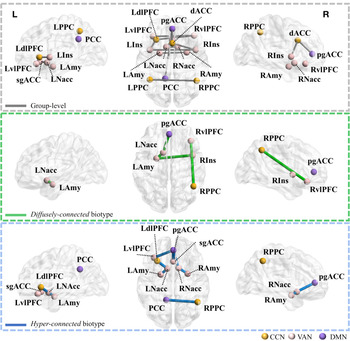
In addition to lagged autocorrelations at every ROI, several paths were significant and present at the group level (Fig. 1), comprising connections between bilateral regions (i.e. right to left amygdala; left to right Nacc; left to right VLPFC), and connections between regions of the VAN, DMN, and CCN networks. Two biotypes emerged from the community detection approach. Biotype 1 (n = 46, 60.86% female) exhibited paths between distal brain regions (i.e. paths were longer and connected regions further in anatomical space), such as between regions of the VAN and the CCN (e.g. right VLPFC and right PPC), and the VAN and the DMN (e.g. the left Nacc and pgACC). Biotype 2 (n = 22, 40.9% female) exhibited paths connecting regions closer in anatomical space, including ventromedial areas, particularly between ipsilateral subcortical areas (e.g. left amygdala and left Nacc; right amygdala and right Nacc) and among prefrontal regions (e.g. left VLPFC and pgACC; pgACC and sgACC). Overall, Biotype 2 showed a greater number of subgroup-specific paths, compared to Biotype 1. All significant contemporaneous paths were accompanied by significant lagged paths; however, we focused on contemporaneous paths as these are more directly interpretable.
Connectivity paths significant in the total sample, the Diffusely-connected biotype, and the Hyper-connected biotype. The Subgroup Group Iterative Multiple Model Estimation program was used to identify biotypes based on similarities in resting-state functional connectivity in adolescents. Two biotypes were found. Connectivity paths present in all participants are depicted in grey, paths unique to the Diffusely-connected biotype are in green, and paths unique to the Hyper-connected biotype are in blue. Nodes of the cognitive control network (CCN) are presented in gold; ventral affective network (VAN) in pink; default mode network (DMN) in purple. L = left; R = right; PPC = posterior parietal cortex; dlPFC = dorsolateral prefrontal cortex; vlPFC = ventrolateral PFC; PCC = posterior cingulate cortex; Ins = insula; Amy = amygdala; Nacc = nucleus accumbens; sgACC = subgenual anterior cingulate cortex (ACC); pgACC = perigenual ACC; dACC = dorsal ACC. (Monochrome): The Subgroup Group Iterative Multiple Model Estimation program was used to identify biotypes based on similarities in resting-state functional connectivity in adolescents. Two biotypes were found. Connectivity paths present in all participants are depicted in the top panel, paths unique to the Diffusely-connected biotype are in the middle panel, and paths unique to the Hyper-connected biotype are in bottom panel. L = left; R = right; PPC = posterior parietal cortex; dlPFC = dorsolateral prefrontal cortex; vlPFC = ventrolateral PFC; PCC = posterior cingulate cortex; Ins = insula; Amy = amygdala; Nacc = nucleus accumbens; sgACC = subgenual anterior cingulate cortex (ACC); pgACC = perigenual ACC; dACC = dorsal ACC.

Based on these RSFC patterns, the two biotypes were labeled Diffusely-connected (i.e. characterized by distal subgroup-specific paths) and Hyper-connected Ventromedial (i.e. characterized by a greater number of subgroup-specific paths overall, specifically short-range ventromedial prefrontal paths), respectively (Fig. 1). Mann–Whitney U tests of tallied subgroup-specific connections between networks (four in the Diffusely-connected and eight in the Hyper-connected group) revealed that individuals in the Hyper-connected group showed greater connectivity of pathways from the DMN to the VAN, from the DMN to the CCN, and from the VAN to the DMN (W = 163, 76, and 183.5 respectively, FDR ps < 0.001) (online Supplemental Table S1, Fig. S2). Biotypes did not differ on the average age at scan, recruitment group status (i.e. substance use at age 14–15), alcohol and/or marijuana use in the past 3 months, pubertal timing (i.e. a longitudinal model-derived estimate of pubertal onset via annual self-reported physical development at ages 10–15), verbal or fluid IQ (age 10), or head motion based on mean framewise displacement (all ps > 0.10; Table 1; online Supplemental Fig. S3).
Sample characteristics

Note: N = 68.
FD, framewise displacement; MDD, Major Depressive Disorder; GAD, Generalized Anxiety Disorder.
Means and standard deviations are presented for numeric variables. Sample proportions are presented for categorical variables. Substance use risk was based on recruitment at age 14-15 (0 = ‘never used, don't plan to’; 1 = ‘have used’).
Hypothesis 3: internalizing (age 14) → connectivity-based biotype (age 16)
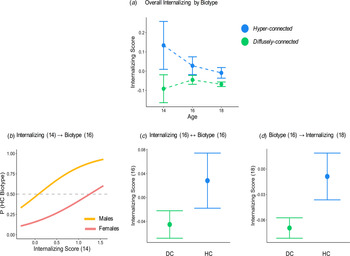
Results of the binary logistic regression indicated that there was a significant association between past internalizing problems (age 14) and connectivity-based biotype status at age 16 (χ2(1) = 5.73, p = 0.017), such that a higher internalizing score at age 14 was associated with a greater likelihood of belonging to the Hyper-connected than the Diffusely-connected biotype. A significant main effect of gender on biotype status was also found (χ2(1) = 5.68, p = 0.017); males were more likely than females to belong to the Hyper-connected biotype (Table 2, Fig. 2b).
Connectivity-based biotype associations with past, current, and future internalizing problems. (a) Connectivity-based biotype differences in internalizing problems throughout adolescence. At all time-points, adolescents in the Hyper-connected biotype exhibited higher internalizing problems than those in the Diffusely-connected biotype. (b) A logistic regression model revealed that adolescents with greater internalizing problems at age 14 showed a higher probability of belonging to the Hyper-connected biotype at age 16. (c) A linear regression model showed that adolescents in the Hyper-connected biotype showed higher internalizing current internalizing problems (age 16). (d) Connectivity-based biotype predicted later internalizing problems (age 18), controlling for current problems (age 16). Adolescents in the Hyper-connected biotype showed greater increases in internalizing problems from age 16 to 18. p = probability (%); Int (Age) = internalizing problems latent variable factor score at different ages of adolescence; Biotype = connectivity-based biotype; HC = Hyper-connected biotype; Green= Diffusely-connected biotype; Blue = Hyper-connected biotype; Circles = females; Triangles = males. All analyses included covariates of IQ, substance use recruitment group and head motion (mean framewise displacement). (Monochrome): (a) Connectivity-based biotype differences in internalizing problems throughout adolescence. At all time-points, adolescents in the Hyper-connected biotype exhibited higher internalizing problems than those in the Diffusely-connected biotype. (b) A logistic regression model revealed that adolescents with greater internalizing problems at age 14 showed a higher probability of belonging to the Hyper-connected biotype at age 16. Solid Line = females; Dashed Line = males; p = probability (%). (c) A linear regression model showed that adolescents in the Hyper-connected biotype showed higher internalizing current internalizing problems (age 16). (d) Connectivity-based biotype predicted later internalizing problems (age 18), controlling for current problems (age 16). Adolescents in the Hyper-connected biotype showed greater increases in internalizing problems from age 16 to 18. Int (Age) = internalizing problems latent variable factor score at different ages; Biotype = connectivity-based biotype; HC = Hyper-connected biotype; DC = Diffusely-connected biotype; Circle = Diffusely-connected biotype; Triangle = Hyper-connected biotype; All analyses included covariates of substance use recruitment group and head motion (mean framewise displacement).

Logistic and linear regression models testing associations between connectivity-based biotype, gender, and internalizing problems in adolescence

Note: N = 68. * and Bold font indicates p < 0.05.
Int (age), internalizing problems latent variable factor score at different ages of adolescence; DC, diffusely-connected biotype; HC, hyper-connected biotype.
A logistic regression was used to test the effect of internalizing problems at age 14 on connectivity-based biotype at age 16. Adolescents with greater internalizing problems at age 14 showed a higher probability of belonging to the Hyper-connected biotype at age 16. Boys were more likely than girls to belong to the Hyper-connected biotype. In model 2, a linear regression was used to test the association between connectivity-based biotype and concurrent internalizing problems (age 16). Adolescents in the Hyper-connected biotype showed higher internalizing problems at age 16. A linear regression model was also used to test the association between connectivity-based biotype and later internalizing problems (age 18), controlling for internalizing problems at age 16. Adolescents in the Hyper-connected biotype showed greater increases in internalizing problems from age 16 to 18. Cohen's d effect sizes are reported for models 2 and 3 and the odds ratios are reported for model. All analyses included covariates of substance use recruitment group and head motion (mean framewise displacement).
Hypothesis 4: internalizing (age 16) ↔ connectivity-based biotype (age 16)
The linear regression revealed that there was a significant association between connectivity-based biotype and concurrent internalizing problems (age 16), F(1, 62) = 2.93, p = 0.004. R 2 = 0.42. Specifically, adolescents in the Hyper-connected biotype showed greater internalizing problems at age 16, compared to those in the Diffusely-connected biotype. The main effect of gender and the interaction between connectivity-based biotype and gender on age 16 internalizing problems were not significant (p = 0.092 and 0.057) (Table 2, Fig. 2c). The interaction between biotype and gender was not significant, but the visualized pattern suggested that the Hyper-connected, relative to the Diffusely-connected, biotype had greater internalizing problems in females only; males showed similar levels of internalizing problems regardless of biotype (online Supplemental Fig. S4).
Hypothesis 5: connectivity-based biotype (age 16) → internalizing (age 18)
Linear regression showed that there was a significant main effect of biotype on age 18 internalizing problems, controlling for age 16 internalizing problems, F(1, 60) = 2.40, p = 0.018, R 2 = 0.38. Membership in the Hyper-connected biotype predicted more internalizing problems at age 18, even accounting for age 16 problems. The main effect of gender and the interaction effect of biotype and gender on age 18 internalizing problems were not significant (p = 0.90 and 0.17) (Table 2, Fig. 2d), however, the visualized pattern suggested that females had greater biotype-related differences in internalizing problems relative to males (online Supplemental Fig. S4).
Connectivity-based biotype associations with internalizing problems trajectories
Tests using linear regression showed a significant effect of biotype on the internalizing problems intercept such that the Hyper-connected biotype showed greater initial internalizing problems at Time 0 (age 14) compared to the Diffusely-connected biotype, F(4, 63) = 2.27, p = 0.027, R 2 = 0.13. Additionally, the Hyper-connected group exhibited a negative slope of change (decrease) in internalizing problems over time, whereas the Diffusely-connected group exhibited, on average, a positive slope (increase) in internalizing problems, F(4, 63) = −2.27, p = 0.027, R 2 = 0.13 (online Supplementary Fig. S5). As can be seen from the plot of average internalizing symptom scores per biotype at each time-point (Fig. 1a), the finding of decreasing internalizing symptoms in the Hyper-connected biotype was due to higher initial scores that, on average, lessened over time, yet remained higher than scores in the Diffusely-connected biotype.
Network paths and internalizing problems
Associations between directed path counts and internalizing scores across time points were measured. Path counts for the three connection types that differed across biotypes (i.e. DMN to the → VAN, DMN → CCN, VAN → DMN) were included in one multivariate analysis of variance model as main effects on internalizing scores (three dependent variables of age 14, 16, and 18), with gender interactions, and motion and recruitment group as covariates. The number of DMN → CCN paths was positively associated with internalizing problems, F(1, 55) = 6.82–8.20, p = 0.01, 0.02, and 0.001 at ages 14, 16, and 18 respectively. Females with higher DMN → VAN connectivity showed higher internalizing problems at age 16, and all participants with higher DMN → VAN connectivity showed higher internalizing problems at age 18, F(1, 55) = 5.02 and 4.17, p = 0.03 and 0.05, respectively. Greater VAN → DMN connections were associated with more internalizing problems at age 18 in females, but not males, F(1, 55) = 8.31, p = 0.001 (online Supplemental Table S2).
Discussion
The current study examined whether connectivity-based biotypes in mid-adolescence were linked with internalizing problems throughout adolescence. Adolescents were parsed into two biotypes based on similarities of RSFC at age 16. The Diffusely-connected biotype had more paths connecting distal regions and the Hyper-connected Ventromedial group had more paths connecting relatively proximal ventromedial and subcortical areas. Youth who reported greater internalizing problems at age 14 were more likely to belong to the Hyper-connected biotype. Youth in the Hyper-connected biotype also exhibited greater internalizing problems at age 16 and showed an increase in internalizing problems from age 16 to 18. The current study is the first to show that connectivity-based biotypes can distinguish levels of internalizing problems throughout adolescence in a community (i.e. nonclinical) sample of youth.
The study is novel in using a community detection approach to parse adolescents into biotypes based on their RSFC patterns involving regions relevant to internalizing problems, independent of self-reported data. The biotypes were associated with past and current internalizing problems and predicted later emotional difficulties. The findings suggest that, even in a nonclinical sample, youth with more v. fewer internalizing symptoms exhibit dissociable neural signatures. It is important to note that the two biotypes shared more similarities in functional neural architecture than differences, as evidenced by the group-level paths (Fig. 1). Individuals within each biotype had similar connectivity patterns that were differentially associated with internalizing symptom measures, yet the two biotypes may not be as ‘categorically’ different as a hard classification method would suggest. Rather, our findings suggest that youth on an internalizing spectrum generally share a number of similarities in connectivity patterns, and biotyping may reveal more detailed neural patterns underlying the presence of affective dysregulation as measured by symptom dimensions at different points in adolescence. Altogether, RSFC patterns in mid-adolescence may transcend diagnostic boundaries and serve as biomarkers of an individual proclivity for internalizing symptoms.
The patterns of RSFC found in the Hyper-connected biotype, including greater DMN-CCN, have also been found in prior studies of adolescents with higher, but subclinical elevated levels of internalizing symptoms (Alarcón, Cservenka, Rudolph, Fair, & Nagel, Reference Alarcón, Cservenka, Rudolph, Fair and Nagel2015; Greening & Mitchell, Reference Greening and Mitchell2015). Given the role of the CCN in executive control and the DMN in self-referential introspective processing (Barrett & Satpute, Reference Barrett and Satpute2013; Buckner, Andrews-Hanna, & Schacter, Reference Buckner, Andrews-Hanna and Schacter2008), these two networks typically show negatively correlated activity (Goulden et al., Reference Goulden, Khusnulina, Davis, Bracewell, Bokde, McNulty and Mullins2014). Elevated DMN-CCN connectivity, therefore, may reflect an inability to disengage from internally focused thoughts in the presence of external task demands (Dwyer et al., Reference Dwyer, Harrison, Yücel, Whittle, Zalesky, Pantelis and Fornito2014). Indeed, prior research shows that adolescents with higher connectivity between the DMN and CCN during a cognitive control task were more likely to engage in co-rumination with peers (Alarcón, Pfeifer, Fair, & Nagel, Reference Alarcón, Pfeifer, Fair and Nagel2018). Although the connectivity biotypes differed on other between-network connectivity values in the present study, greater DMN-CCN connectivity was stably associated with internalizing problems throughout adolescence. Thus, this neural signature may play a crucial role in classifying biotypes that serve as markers of internalizing symptoms.
RSFC patterns in the Hyper-connected biotype were also similar to those found in studies of adolescents with diagnosed depression and/or anxiety (Cullen et al., Reference Cullen, Westlund, Klimes-Dougan, Mueller, Houri, Eberly and Lim2014; Ho et al., Reference Ho, Connolly, Henje Blom, LeWinn, Strigo, Paulus and Yang2015; Roy et al., Reference Roy, Fudge, Kelly, Perry, Daniele, Carlisi and Ernst2013). Increased connectivity of emotion-processing regions, particularly medial prefrontal and subcortical areas, with other affective regions and with self-referential areas is also documented in relation to adolescent depression (Pannekoek et al., Reference Pannekoek, van der Werff, Meens, van den Bulk, Jolles, Veer and Vermeiren2014; Song, Zhang, & Huang, Reference Song, Zhang and Huang2016) and anxiety (Roy et al., Reference Roy, Fudge, Kelly, Perry, Daniele, Carlisi and Ernst2013). Additionally, in the current study, the Hyper-connected biotype showed paths between regions related to reward, stress, and affective processing (RNacc-RAmygdala, LNacc-LAmygdala, LdlPFC-LNacc, and RNacc-pgACC). Aberrant connectivity of the frontal-striatal reward network has been found in adolescent depression (Morgan et al., Reference Morgan, Shaw, Olino, Musselman, Kurapati and Forbes2016) and social anxiety (Jarcho et al., Reference Jarcho, Romer, Shechner, Galvan, Guyer, Leibenluft and Nelson2015), potentially contributing to altered processing of reward in both disorders (Zald & Treadway, Reference Zald and Treadway2017). Finally, elevated connectivity of DMN regions with the CCN has been shown to relate to rumination and severity of symptoms in adolescents with current and remitted MDD (Jacobs et al., Reference Jacobs, Jenkins, Gabriel, Barba, Ryan, Weisenbach and Welsh2014) and adults with high social anxiety as adolescents (Maresh, Allen, & Coan, Reference Maresh, Allen and Coan2014). The shared connectivity features found between the Hyper-connected biotype and prior studies of adolescent depression and anxiety suggest that the neural architecture related to internalizing symptoms is roughly similar to that of clinical internalizing psychopathologies, corroborating the utility of measuring these features dimensionally rather than categorically (Kotov et al., Reference Kotov, Krueger, Watson, Achenbach, Althoff, Bagby and Zimmerman2017).
Compared to females, males with higher internalizing problems at age 14 were more likely to belong to the Hyper-connected biotype at age 16. Probing between-network connectivity measures, however, provided evidence for female-specific neural patterns underlying internalizing problems although this could be due to girls endorsing these problems to a greater degree at ages 14 and 16. Our findings suggest that the biotyping approach was not generally gender-specific, as it allowed for identifying males and females with elevated internalizing problems. Although the Hyper-connected biotype identified in this study may represent both males and females with elevated internalizing problems at age 14, this brain-behavior association may become more female-specific in late adolescence, when females exhibit greater levels of internalizing problems compared to males (Salk, Hyde, & Abramson, Reference Salk, Hyde and Abramson2017). It is also possible that the functional neural architecture related to internalizing problems becomes gender-differentiated in late adolescence, and the connectivity of the ROIs in the current study was more sensitive to females’, rather than males’, concurrent and future internalizing problems. Future work is needed to understand how connectivity-based biotypes may relate to symptoms of other types of psychopathology that have a sex-differentiated occurrence (e.g. externalizing disorders in males).
The current study has some limitations. The S-GIMME data-driven approach is used to characterize directional influences of brain regions and has been shown to outperform traditional subgrouping approaches (Gates et al., Reference Gates, Lane, Varangis, Giovanello and Guiskewicz2017). Although S-GIMME demonstrates robustness for sample sizes as small as 25 (Gates et al., Reference Gates, Lane, Varangis, Giovanello and Guiskewicz2017), subgrouping approaches are inherently affected by those who are included in a sample, and findings may be altered within a larger or more variable (e.g. in ethnicity or age) sample. The current study contained Mexican-origin adolescents with a wide range of internalizing symptoms, but they were not recruited based on having a clinical diagnosis of depression or anxiety. Understanding the generalizability of the current findings and robustness and replicability of the biotypes would be facilitated by future larger studies incorporating youth from various ethnicities and/or clinical profiles. Additionally, the three occasions of internalizing measures allowed for testing prospective predictions although resting-state fMRI data were collected only at one occasion. Multiple waves of neuroimaging data are necessary to (a) examine the stability over time of connectivity-based biotypes, (b) disentangle the direction of effects between network connectivity and internalizing symptoms, and (c) understand how associations with symptoms vary with age, particularly given documented developmental changes of functional connections in adolescence (Baker et al., Reference Baker, Lubman, Yücel, Allen, Whittle, Fulcher and Fornito2015; Dwyer et al., Reference Dwyer, Harrison, Yücel, Whittle, Zalesky, Pantelis and Fornito2014; Larsen & Luna, Reference Larsen and Luna2018).
In conclusion, we used a data-driven approach to characterize, for the first time, connectivity-based biotypes associated with past, current, and later internalizing problems in adolescents. Internalizing problems at age 14, particularly in males, predicted a higher probability of being classified in the Hyper-connected biotype at age 16. The Hyper-connected biotype also showed greater internalizing problems at age 16, concurrent with the fMRI scan. Finally, the Hyper-connected biotype showed greater internalizing problems at age 18, pointing to the predictive utility of the connectivity-based biotyping approach. Greater RSFC between self-referential and cognitive processing regions were found in adolescents with more internalizing problems throughout adolescence, suggesting that this RSFC signature may be informative for differentiating youth based on the dimension of internalizing difficulties. RSFC patterns may be useful biomarkers of affective dysregulation in relatively normative adolescents. Biotyping may aid in identification of affected youth and improve understanding of the functional neural architecture associated with internalizing symptoms.
Supplementary material
The supplementary material for this article can be found at https://doi.org/10.1017/S003329172000149X.
Acknowledgements
This research was supported by a William T. Grant Foundation Scholars Award 180021 (AEG); National Science Foundation grant 1327768 (AEG and PDH); National Institute on Drug Abuse R01-DA017902 (RWR), the University of California, Davis; Interdisciplinary Frontiers of Humanities and the Arts initiative (AEG and PDH); and The University of California, Davis - Imaging Research Center Pilot Program (AEG). The project described was also supported by the National Center for Advancing Translational Sciences, National Institutes of Health, through grant number UL1 TR001860 and linked award TL1 TR001861 (RC). The content is solely the responsibility of the authors and does not necessarily represent the official views of the NIH.
Conflict of interest
The authors report no financial relationships with commercial interests.