For more than half a century the “wheel of retailing” hypothesis has featured prominently in work on long-term retail change. It argues that new retail modes frequently emerge at the bottom end of the price and service spectrum, using low-cost, low-margin, “no-frills” formats to undercut incumbent competitors. However, once well established, such retailers typically upgrade services and facilities, thus raising costs and prices and leaving themselves vulnerable to a new wave of low-cost entrants.
The wheel of retailing is more properly characterized as a hypothesis than a theory. It was first proposed by Malcolm McNair (who undertook extensive research on chain and department store retailers) as early as 1931, though it was not until he restated and elaborated on the model in 1958 that it began to attract widespread attention.Footnote 1 McNair suggested that new types of retailers usually enter the market with an innovation that reduces operating costs, thus enabling them to cut margins. However, over time they upgrade their business models, with consequent increases in expense ratios. This process culminates in their entering a “mature” phase as higher-cost, higher-service retailers, creating space for new retail formats to emerge at the bottom of the market. The enduring appeal of this “theory” is that it describes a frequently (though not universally) observed phenomenon in retail change.Footnote 2 Formats said to be characterized by this process include variety and other chain stores, supermarkets, discount stores, catalog showrooms, warehouse clubs, home-shopping networks, and online auctions.Footnote 3
Conversely, critics have highlighted the lack of any obvious motive for retailers to abandon a profitable business niche in favor of higher-price markets, where they would typically face greater competition from established retail formats. A review by Stanley Hollander of early studies identified various explanations, including the deterioration of managerial acumen and development of a lax attitude toward cost control as retailers acquire status and wealth (the explanation proposed by McNair); market imperfections—such as resale price maintenance, restrictive trade associations, an aversion to price wars—leading to growing emphasis on nonprice competition through services; and improvements in living standards that transform an initially large “no-frills” retail segment into a progressively smaller one (but one still attractive to new entrants).Footnote 4 Stephen Brown, writing over thirty years later, noted that subsequent research had added very few additions to Hollander's inventory of proposed causes.Footnote 5 One of the most interesting further contributions was to conceptualize the wheel process as a lifecycle phenomenon, akin to the product lifecycle. However, the maturity phase was still explained in terms of a dissipation of managerial vitality or extension of the business beyond the capabilities of its managerial team.Footnote 6
The wheel model still lacks any overriding explanatory framework and has thus been portrayed as deterministic, inflexible, and pattern- rather than process-oriented in addition to treating management as essentially powerless in moderating this process.Footnote 7 It has also been criticized for ignoring “system changes”—that is, focusing on institutions in isolation from changes in consumption patterns, government policy, and other environmental factors or from the critical innovations that mark each new retail era.Footnote 8
We examine a classic example of the wheel phenomenon: the abandonment of the five-and-dime format by American variety stores. Five-and-dime chains experienced very rapid growth over the four decades prior to the end of World War I. However, by the 1920s most had overridden their ten-cent price limits (with the notable exception of Woolworths) and by the late 1930s virtually all had raised their price limits to a dollar or more or had no price limit. We ask two questions: What drove the five-and-dime chains to abandon their low price limits? What were the impacts of this move toward higher price limits on net profit margins and overall corporate performance?
Most classic explanations of the wheel phenomenon can be easily dismissed for the variety-store sector. Five-and-dime chains had a vigorous profit-driven management remuneration and promotion culture, making them unlikely candidates for managerial inertia or a lax attitude toward costs. Resale price maintenance was also unimportant in this sector—as retailers sought to take control over their supply chains wherever possible—often dictating product specifications, and sometimes even production methods, to manufacturers.Footnote 9 Furthermore, rather than face declining consumer demand, low-price-ceiling variety stores are shown not only to have remained viable in the 1930s, but to have consistently produced larger profit margins than those chains that adopted higher limits.
We explore the factors that drove five-and-dime stores to move to higher price points, together with the consequences of this policy change, using qualitative sources, including the archives of the two largest chains: Woolworths and S. S. Kresge. We outline the key features of their original business model, the factors that initiated the trend toward higher price points, and how this trend changed their business model and differentiating advantage compared to other retailers. Our analysis indicates that this process was driven primarily by retail format saturation. Five-and-dime chains enjoyed strong interformat competitive advantages, undercutting established retailers on price. However, they had weak intraformat competitive advantages over rival five-and-dime chains and generally avoided head-on within-format competition at the point of sale, as this risked ruinous price wars. Thus, following the onset of format saturation, they preferred to extend their merchandise range into higher-value goods, in competition with other retail formats. However, by doing so, they both took on some of the additional costs of these retail formats and reduced their cost advantage in their traditional lines.
On the basis of this analysis we develop a conceptual model, which predicts that the transition to higher price points will compress variety chains' spread between gross and net margins and, therefore, profit rates. Dollar profit growth may still be substantial (though below the levels achieved prior to retail format saturation), but only if firms are able to meet the new managerial challenges associated with their wider merchandise range and thereby achieve substantial sales growth. These hypotheses are then tested using published and archival data from the Harvard Bureau of Business Research (HBBR) variety-chain surveys.
The Rise of the Five-and-Dime Format
The five-and-dime store is said to have been inspired by a drummer for the New York jobbers Spellman who, in around 1877, successfully launched a “5c counter” in a Michigan store.Footnote 10 F. W. Woolworth's employer, Moore & Smith, copied this format beginning in September 1878. Later corporate histories claim that Woolworth was put in charge of the counter, though a first-hand account by Woolworth merely states that he was “watching this counter very carefully.”Footnote 11 Woolworth also noted that by January 1879, when he approached Mr. Moore with the proposition that he should open a five-cent store, these were already being successfully developed in New York State. Thus, Woolworth was an early pioneer of the five-and-dime format, but not the originator.Footnote 12
Woolworth developed the classic five-and-dime retail model, selling a wide selection of merchandise at low, fixed, clearly marked prices, in large open stores where customers were free to browse. Profit was based on sales volumes rather than high margins, store managers were paid by results, and business was conducted on a cash-only basis.Footnote 13 Woolworths eschewed press advertising, relying on price appeal, strong retail branding (including extensive window displays), and word-of-mouth advertising—a strategy boosted by locating stores on prime sites, with large numbers of passing customers.Footnote 14 Such locations were also necessitated by the character of the merchandise, as people were rarely prepared to make a special journey to buy five-and-dime goods.Footnote 15
By the turn of the century a number of other major variety store chains had emerged, generally founded by “old-stock” Protestants from rural areas and small towns in the northeastern United States.Footnote 16 For example, Sebastian Spering Kresge, founder of America's second-largest five-and-dime chain, was a hardware salesman of Pennsylvania Dutch heritage.Footnote 17 In the course of this work, he became personally acquainted with F. W. Woolworth and another five-and-dime pioneer, J. G. McCrory, for whom he managed and owned a half interest in a store in Memphis, Tennessee, and later also owned a half interest in a store opened in Detroit. In 1899, Kresge parted company with McCrory, taking full ownership in the Detroit store in exchange for his half share of the Memphis store.Footnote 18
Woolworths believed that under its sales formula, goods sold themselves, the sales clerks' duties being limited to wrapping purchases, making change, and keeping counters orderly stocked and price-tagged. As a result Woolworths generally employed young women living with their parents and paid them relatively low wages. In his annual letter of 1892, Woolworth noted, “We must have cheap help or we cannot sell cheap goods. When a sales clerk gets so good she can get better wages elsewhere, let her go—for it does not require skilled and experienced salesladies to sell our goods.”Footnote 19 His views had moderated slightly by 1899, when he acknowledged that a case might be made for paying slightly more to retain good staff.Footnote 20 Yet even in 1933 the average age of Woolworths' saleswomen was just twenty-one, and their duties had changed little.Footnote 21
While the sales clerk's job at Woolworths was simpler than in most stores, the manager's task was more challenging.Footnote 22 In addition to the usual store-management tasks (some of which, such as deterring shoplifting, were accentuated by open displays), they needed to ensure that only the fastest-selling lines for their local markets were stocked, as rapid stockturn was crucial to operating profitably at low price points. Higher managerial positions placed an even greater premium on high-quality recruits. The onus on rapid stockturn involved heavy reliance on successful buyers, whose skill and effort played an important role in the overall success of the chain.Footnote 23 Coordinating the operations of their mushrooming branch networks and optimizing chain stockturn also entailed significant management skill—to collate and interpret the mass of data flowing from the stores to divisional and head offices. For example, when Charlie Griswold became Woolworths' general manager in 1915, he felt it necessary to divide each store into thirty-two merchandise departments, with weekly and sometimes daily reports required of each.Footnote 24
Successful managerial recruitment and incentivization proved a key challenge for the five-and-dime chains.Footnote 25 Woolworths again pioneered the general variety-store model, based on profit sharing, meritocratic promotion, and internal labor markets. Their “pyramid of promotion” system required all executives to start in the stock room as trainees. Promotion was then given by merit—to more senior positions within the store, then to management of progressively larger stores, and potentially to the tiers of territorial and, finally, head office management. Promotion was based on both business success and a detailed code of behavior designed to temper opportunism (prohibiting gambling, financial speculation, and gifts from suppliers) and maintain the store's respectable image. Other variety stores sought broadly similar qualities in managers, though Kresge, Grant, and McCrory placed greater emphasis on trainees having a good education.Footnote 26
Woolworths' store managers each received a percentage of their store's annual profit, plus a drawing account of ten dollars a week, deducted from this commission.Footnote 27 Higher-level managers participated in a share of the profits for their relevant units and, in the case of the most senior, of the entire concern. Five-and-dime chains also sought to foster a strong corporate culture, via frequent letters from headquarters, visits by supervisors (and, occasionally, more senior staff), and managers' conventions.Footnote 28 Variety-store executives were well rewarded. Store managers were sometimes the most highly paid salary men in small communities, while those few fortunate enough to reach the top of the largest chains might become millionaires.Footnote 29
Woolworths and the other early chains evolved broadly similar buying policies, based on direct purchases from suppliers, who were persuaded to accept lower prices in return for bulk orders. New products were typically tested at a number of stores and then made generally available, orders being based on simple optimization rules of achieving target sales per counter foot. Both individual lines and certain colors or sizes within those lines that did not make the target were ruthlessly discarded. These systems collectively provided major savings in inventory management. The weekly “checking list” system provided a perpetual inventory of stock, while rules pertaining to sales per foot of counter space removed problems of slow-selling items. Direct purchases cut out the extra transport, loading, storage, order-processing, and shrinkage costs of wholesaler supply. Moreover, direct purchasing allowed greater control over stock quality and lowered manufacturer's inventory costs by providing a more stable stream of orders.Footnote 30 The development of motor transport enabled variety chains to expand direct-to-store delivery, thus reducing warehousing costs. The 1935 HBBR survey found that typical variety chains had more than 90 percent of merchandise passing direct from the manufacturer to the individual stores.Footnote 31 This was more expensive for stores distant from the main production centers. Woolworths—the only variety chain operating in all U.S. states—addressed this by having a higher (fifteen-cent) price ceiling for stores west of the Missouri River and in Canada (where they also faced higher taxes) and by developing regional warehouses in New York, San Francisco, and Toronto.Footnote 32
Pressures for Higher Price Points
By 1914, Woolworths had 737 stores and sales of $69,619,669; its nearest competitors were S. S. Kresge (118 stores; $16,097,393 sales), S. H. Kress (118 stores; $11,897,989 sales), J. G. McCrory (116 stores; $5,224,692 sales), and W. T. Grant (16 stores; $2,000,908 sales).Footnote 33 Grant was the most recent of what later became known as the “big five” variety store chains, opening its first store in 1906, but becoming the third-largest chain in terms of sales from 1930. W. T. Grant had identified a gap in the market for a variety chain offering merchandise above the dime-store price ceiling, initially adopting a twenty-five-cent price limit (which had already been introduced by Kress in 1901) and later pioneering the “to a dollar” store format.Footnote 34
F. W. Woolworth was adamantly opposed to raising price ceilings. In October 1910, in a general letter on the danger of drifting into higher price points, Woolworth recounted the rise of fixed-price “99c stores” in the early 1870s, which were hugely successful for several years but subsequently declined after adopting higher price limits.Footnote 35 However, ten-cent price ceilings proved difficult to sustain given inflationary pressures during World War I (with retail prices rising by almost 80 percent between 1914 and 1919). Kresge raised the price limit for its “red-front” stores in 1917 to fifteen cents and then, later in the same year, twenty-five cents. In 1920 the limit for its “green-front” stores was raised from fifty cents to one dollar.Footnote 36 Toward the end of the war, some Woolworths directors pressed for higher price ceilings—and were persuaded otherwise only by F. W. Woolworth threatening to resign.Footnote 37 Consequently, Woolworths remained the only large U.S. variety chain with a ten-cent price limit by the 1920s.Footnote 38
Despite a long-term trend of lower prices during the 1920s and 1930s, variety stores continued to raise their price ceilings; by 1927 most had a maximum price of one dollar or more.Footnote 39 The whole concept of price ceilings was also coming under pressure. By 1922, Kresge was selling special millinery at prices up to five dollars in its twenty-five-cents-to-a-dollar stores, while its range of over-a-dollar merchandise subsequently expanded.Footnote 40 Changes in consumer purchasing patterns made higher price points attractive to the variety chains. Real incomes rose over the 1920s, boosting a trend toward working-class purchases of women's ready-to-wear clothing. Such clothing sold on a combination of fashion and price appeal, with even the department stores introducing more price-oriented promotions.Footnote 41 The Depression era witnessed a further trend toward “price consciousness” as a major influence on buying behavior, which suggests that the variety-chain business model might profitably be extended to a much broader range of goods than their traditional niche.Footnote 42
However, the major factor driving the trend toward higher price ceilings was that the five-and-dime store had reached the limits of market format saturation. The major variety chains had generally sought to avoid head-on competition. For example, despite operating some 238 U.S. stores—in twenty-four states plus Washington, D.C.—by the end of 1909 (prior to a 1911 merger with five affiliated chains), Woolworths faced direct competition at only fifty-two locations, including Kresge at eighteen stores and McCrory at ten.Footnote 43 Avoiding head-on competition was a conscious policy choice. For example, Samuel H. Kress, who opened his first store in 1896, in Memphis, chose to focus on the South because that region had no five-and-dimes.Footnote 44 At an early stage he made a deal with Sebastian S. Kresge that both would avoid each other's territories (said to be at least partly on account of potential customer confusion, given their similar names and signage). Subsequently, no Kress and Kresge stores ever appeared on the same main street.Footnote 45 This strategy was facilitated by geographical segmentation of the major chains. Even Woolworths was only active in thirty-seven states at the beginning of 1912. Yet by 1920 there was no town of over eight thousand people in the United States without a Woolworths. For other variety chains, moving into towns above this size would therefore involve taking on Woolworths head-on or outflanking it with a broader range of merchandise.Footnote 46 By the late 1920s, grocery chains also faced format saturation; further expansion entailed invading one another's territories and thus competing their margins away—a strategy described by one analyst as “suicidal.”Footnote 47
Pressures to continue branch expansion subsequently led Woolworths to drop its minimum store-size threshold, a policy Charles Phillips identified as a key factor behind Woolworths' declining profitability trend, evident even prior to the Depression.Footnote 48 Then, in 1932, it finally followed the other variety chains in seeking sales growth through higher price limits. Merchandise priced at twenty cents was successfully tested in seventy-seven stores from March of that year and generally adopted three months later. In November 1935, the Woolworths board agreed to remove any fixed price limit, marking the end of the five-and-dime store era.Footnote 49
Chains responded to market saturation via two related strategies—both of which were assisted by extending their merchandise range into higher-value goods. The first involved moving into smaller towns. Fifteen identical chains surveyed by HBBR between 1932 and 1939 had increased their number of outlets by 23.71 percent during this period in towns with a population under ten thousand, compared to an increase in total store numbers of only 8.32 percent.Footnote 50 Geographical expansion via smaller units raised aggregate sales, but at the cost of reducing average sales per store and, therefore, decreasing productivity.Footnote 51 Extending the product range increased the size of store that any given population could sustain and also helped deter new competitors—who would be reluctant to invest resources in a small community already catered to by a chain serving a broad range of its customers' nonfood needs (a strategy long pursued by the J. C. Penney “junior department store” chain).Footnote 52
An alternative or complementary policy of growth through expanding existing stores (again facilitated by extending the product range) offered greater scale economies, given that they were typically in larger communities. The G.C. Murphy chain rejected developing smaller stores in favor of expanding existing stores and broadening its merchandise selection. This helped Murphy to achieve average sales per store in 1936 above those of Woolworth, Newberry, and McLellan and not far short of sales by Grant, McCrory, and Kresge (all of which Murphy was to overtake, on this measure, by 1940), despite a focus on relatively small towns. A key element of Murphy's strategy was the use of higher price points to expand lines such as clothing, which became increasingly important to its overall business.
Retail format saturation also limited the prospects of managerial recruits, a trend that, industry observers noted, might threaten the chains’ ability to attract the right caliber of trainee.Footnote 53 Kresge responded to the growing intervals between promotion slots becoming available by reducing the minimum age of new trainees in October 1935 from twenty-one to eighteen.Footnote 54 More generally, variety chains were criticized for appointing conformists, whose backgrounds, views, and personality traits were socially acceptable to those in senior positions. They thus typically excluded ethnic minorities, women, and to some extent, ambitious people who sought faster promotion than their “pyramid” system offered. The use of bureaucratic organizational systems to control the chains' extensive branch networks was also said to raise staff motivation problems, by regimenting managers' careers and restricting the scope for innovation.Footnote 55 Moreover, they faced management job–market competition from new chains, especially the well-resourced store networks launched by Sears and Montgomery Ward, in which rapid growth generated rapid promotion opportunities.Footnote 56 However, such criticisms were relevant to most long-established American corporations, and variety chains' profit-based remuneration systems still offered relatively good long-term prospects in a slack job market.
Woolworths' top executives also had to cope with expanding international operations outside mainland North America. Their first and largest subsidiary, in Britain and Ireland, proved highly successful and operated with considerable autonomy from the 1920s (its interwar executive committee minutes show very little evidence of interventions by the U.S. parent).Footnote 57 However, expansions into Cuba, from 1925, and Germany, from 1927, proved more problematic. For example, restrictions on new German store development, starting in 1932, were intensified during the Nazi era, when Woolworths' German stores were targeted by boycotts, protests, and acts of violence (precipitated by the company having bowed to domestic public pressure not to stock German goods).Footnote 58 However, Woolworths was the only variety chain to pursue this strategy and such problems were not unusual for American multinationals at this time.
Impacts of Higher Price Ceilings
Although variety stores fared the Depression much better than did the department stores with which they were increasingly competing, they nevertheless witnessed a pronounced dip in profits. Fifteen identical variety chains analyzed by HBBR saw their aggregate net operating profits fall from 5.93 percent of net sales in 1929 to only 0.31 percent in 1932 and an annual average of 3.88 percent over 1933–1940.Footnote 59 The three largest—Woolworths, Kresge, and Kress—witnessed a fall in their collective market share of the top ten multiple chains from over 70 percent in 1929 to just over 61 percent in 1940.Footnote 60 Some fared much worse; in 1933 both McCrory and McLellan (which in 1929 had been the fifth- and sixth-largest variety chains, respectively) fell into receivership, both being subsequently recapitalized under new management.Footnote 61
Meanwhile, the chains wrestled with the longer-term problem of developing merchandising policies appropriate to both their traditional and new lines. As the 1936 HBBR variety-chain survey noted, “The very nature of the limited price variety chain business makes it inevitable that price policies are also merchandise policies.”Footnote 62 At least some chains recognized that higher-priced lines might impact on their brand image and selling methods in ways detrimental to five-and-dime trade. Kresge initially dealt with this by opening a second chain of green-front stores in 1920, with goods priced from twenty-five cents to a dollar, in addition to their red-front nickel-and-dime stores.Footnote 63 These parallel chains (often located side by side) were controlled jointly from their Detroit head office and came under the same real estate management. However, they had different sets of buyers and personnel managers, reflecting their different labor and merchandise requirements.Footnote 64 Murphy's introduction of a dollar price limit around 1923 was accompanied by a vertical, rather than horizontal, outlet segmentation strategy, with their twenty-five-cent-to-a-dollar and five-and-dime lines being split between separate floors of the same buildings. Each floor had its own staff, store number, and external signage, to prevent damage to Murphy's brand image as a five-and-dime retailer. However, this policy entailed splitting related items in the same product class, a problem that led to the integration of all its stores by 1928.Footnote 65
Kresge's difficulties during the Depression (accentuated by a strong presence in large auto, steel, and other heavy-industry towns) eventually forced it to also abandon a two chain policy. Kresge's green-front stores were particularly hard-hit, as the Depression intensified competition with department and specialty stores. Kresge's share price fell from $57.50 to a low of $5.50 and Kresge responded by broadening its stock, its green-front stores raising their price ceiling to $3.00.Footnote 66 Then, during the mid-1930s, it began combining the green and red fronts into “combination” stores. In 1940 the buying divisions for the two store groups were also integrated.Footnote 67
The downside of this policy was that five-and-dime lines could not operate efficiently alongside higher-value merchandise. Traditional variety-store goods came to be seen as loss leaders to pull in customers, rather than important earners in their own right. For example, in February 1932, Kresge conducted an audit of its twenty-five-cent-to-a-dollar stores, examining goods at each price point in terms of their contribution to selling-floor space, individual transactions, and total sales revenue. While only 20 percent of customers bought items priced above fifty cents in January 1932, these items accounted for 43 percent of sales revenue, while taking up only 38 percent of counter space. Conversely, “up to twenty-five cents” merchandise took up 37 percent of floor space and accounted for 60 percent of individual transactions, but only 32 percent of revenue. A clear trend toward a lower average sale than in the previous January was identified, with 80 percent of customers buying merchandise priced at fifty cents or less. Yet rather than wishing to further boost sales in this price range, staff were urged “to realize the importance of increasing the number of sales on higher priced items. The customers have shown that they favor low prices, and we propose to feature and show low prices to get them into the store, but we can increase the number of sales on higher priced items by sale suggestion and good salesmanship.”Footnote 68
The memorandum went on to note, “Right now we have a great many outstanding $1 items, but with Department Stores and direct competitors playing up low prices, we cannot feature the $1 price. Our opportunity lies in bringing customers into the store with low priced items and then showing and selling higher priced merchandise.”Footnote 69 In other words, Kresge was advocating a strategy similar to that employed by many down-market department stores.
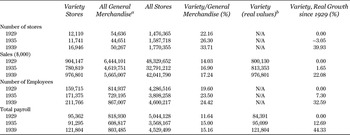
Higher price limits opened up a much larger, but increasingly crowded, market. Competitors included department stores; expanding specialty chains in menswear, women's apparel, millinery, footwear, and hosiery; and drugstores (which were also extending their merchandise range).Footnote 70 Nevertheless, variety chains preferred taking on such competition—where they enjoyed some cost advantage over established retailers, who typically had grander premises and more elaborate services—to battling head-on with other variety stores, principally by bidding down each other's margins. Moreover, given that much consumer expenditure occurred at prices over twenty-five cents, this market appeared to offer greater prospects for long-term growth. Indeed, this strategy proved successful in increasing variety stores' share of general merchandise trade from 14.03 percent in 1929 to 17.24 percent in 1939, as shown in Table 1. This increase was achieved at the cost of a much larger proportional rise in the number of retail units—mainly owing to the expansion into smaller communities, as discussed earlier. Ominously, as Table 1 shows, a 22.08 percent increase in real variety-store sales over this period occurred at the cost of a 44.33 percent rise in payroll expenses and a 32.59 percent rise in their number of employees, implying negative labor productivity.
Variety-Store Growth, Employees, and Labor Costs: Changes over Time and Comparison with Other Retailers, 1929–1939

Source: United States, Bureau of the Census, Seventeenth Census of the United States, 1940, Census of Business, vol. 1, Retail Trade 1939, part 1 (Washington, D.C., 1943), 16.
Notes: a Department stores, variety stores, and dry goods & general merchandise stores; b 1939 = 100, deflated using Bureau of Labor Statistics wholesale price index, Malcolm P. McNair and Eleanor G. May, “The American Department Store, 1920–1960: A Performance Analysis based on the Harvard Reports,” Harvard Bureau of Business Research Bulletin, no. 166 (1963): 16.
Competition in the over-twenty-five-cent market proved more difficult than the variety stores had anticipated. Even the department stores, which had the highest advertising and service costs of any large-scale retail format, managed to increase their share of total retail sales slightly above 1929 levels during the mid- and late 1930s. Given their high sunk costs of expensive premises and accumulated goodwill, most remained in operation even if they failed to cover total costs, while some were prepared to hold on even when revenue did not meet variable costs, in the hope of a return to better times. Department stores collectively generated a positive operating profit for only three years between 1930 and 1939, yet they increased their market share through sale promotions and aggressive price competition to boost turnover and thus offset heavy fixed costs, even where this entailed unattractive margins.Footnote 71
As many new lines, such as women's light clothing, had a significant fashion element, the variety stores began to encounter some of the merchandising problems of department stores. Style goods typically had high original markups, high selling expenses, and high markdowns if not sold quickly.Footnote 72 This created much greater problems of inventory control than for traditional five-and-dime merchandise, which mainly comprised staple household items with slow fashion cycles.Footnote 73 Fashion goods also required more intensive promotion, leading the high-price-limit chains to adopt some of the promotional practices of the department stores, such as advertising and cut-price sales events.Footnote 74 By the late 1930s, Grant was launching big sales two or three times a year, supported by full-page ads, heavy with prices.Footnote 75
Moreover, fashion merchandise required elements of the skilled, personal selling approach that had traditionally sharply demarcated the department and variety-store business models. By 1932, Kresge was strongly advocating a policy of pushing high gross margin items (compared to the average for each department) in their dollar stores, using “suggestive selling.”Footnote 76 These items were indicated by placing red stars on counters, so saleswomen knew which lines to push.Footnote 77 Recommending complementary items required significant sales knowledge and training. As a 1935 note to managers argued,
Knowledge of merchandise . . . is the first essential to successful salesmanship. You should possess this information in order to properly train your salesgirls in the art of increasing each sale. Of equal importance is a thorough understanding of the best methods for presenting your merchandise to the customer in such a manner that interest is aroused and the salesgirls' service appreciated. . . . Verbal suggestions must be followed up by intelligent comment. . . . Few salesgirls are instinctively able to do this. It is your duty to outline to them the various means of making suggestions effective . . . and . . . [to train] them to use the right approach for making each suggestion “strike home.”Footnote 78
A later Kresge letter to stores noted, in June 1936, that “whether or not we are realizing the most from this demand for style items depends to a considerable degree upon how well ‘style’ minded our salesforce has become.”Footnote 79 Sales staff were expected to keep themselves informed regarding the latest styles by studying fashion magazines. Kresge stores ran contests between groups of salesgirls to increase their enthusiasm for direct selling.Footnote 80 G.C. Murphy was also urging its sales clerks to use “related item suggestion” by 1929, assisted by systematic staff training.Footnote 81 W. T. Grant preferred sales staff to physically show customers additional merchandise—known as “additional showing.”Footnote 82
Pushing high-margin items via suggestive selling left variety chains vulnerable to opportunistic behavior by store managers who—in an effort to boost their profit-based commission—raised margins to levels that negated their price advantage. This might raise profits for the individual store, but it damaged the company's overall reputation with both customers and suppliers. As an October 1936 Kresge note to stores warned, “Profiteering is an open invitation to every little store in town to step in and compete with and undersell Kresge's. . . . [T]he truly efficient manager . . . can be glad he is not in the shoes of the profiteer when the truth is uncovered.”Footnote 83 A 1935 investigation of seventeen stores had revealed margins typically higher than those specified by head office. In one case, a manager had requested that prices be raised
to those of the independent hardware dealer, yet the items mentioned figured 41% gross. He wanted 54%. . . . A manufacturer writes in that his item is being sold at a higher price than agreed on in all stores visited. What a reputation the Kresge organization has with this man, and the others that have the experience of seeing their merchandise being sold at a price where they know the most sales resistance lies!Footnote 84
However, evidence reviewed by Alan Raucher suggests that this problem arose from Kresge's target-driven managerial culture. Store managers perceived that profit targets for bonuses and promotion could be achieved only through “profiteering.”Footnote 85
In the 1936 HBBR survey, McNair highlighted the risks associated with the variety chains' move up the retailing wheel. This move entailed foregoing the strong promotional appeal of low fixed price limits and brought new managerial problems in buying, merchandising, and sales promotion. Even if these challenges were overcome, McNair predicted a decline in gross margins—owing to the increased likelihood of markdowns for fashion items and retaliatory price-cutting by established retailers. Firms might gain some reduction in selling costs, which were strongly linked to the number of transactions, though only if this was not offset by the costs of more active and knowledgeable salesmanship.Footnote 86 McNair predicted that the most likely result would be a fall in net margins, increased profits thus relying on the production of sufficient extra sales volume to more than compensate for the decrease.Footnote 87 J. K. Winkler concluded his 1940 biography of F. W. Woolworth on a similar note: “The new prices bring Woolworth into keener competition with important department stores. . . . Indeed, when entering the streamlined, chromiumed emporiums on fashionable metropolitan thoroughfares, the shopper may wonder whether he and his dime have not strayed into the wrong place.”Footnote 88
A Model of Retail Change: The Service Cost–Unit Value Continuum
The evidence reviewed above indicates that the retail lifecycle of variety chains (and, by extension, other low-price retail formats) is broadly inverse to the product lifecycle (PLC). A key feature of the PLC model is that as markets mature, products become increasingly standardized, offering reductions in production costs for large firms that are able to magnify the benefits of cost-reducing process innovations through economies of scale.Footnote 89 While the PLC hypothesis leads to a movement from complexity to cost reduction and standardization, the opposite is the case under the wheel of retailing, where mature firms move from extreme standardization of products and price points to increasingly complex product categories—requiring a growing element of customer service. This in turn creates substantial managerial challenges, regarding growing product/service complexity, greater uncertainty (given the chains' lack of knowledge of the new market and the likely competitive reaction of incumbents), and adverse impacts on established product lines.
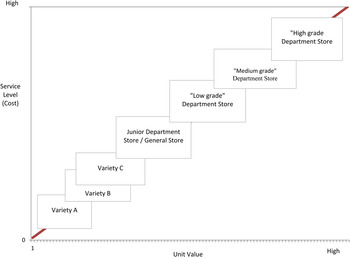
Our model views shifts from low- to higher-value merchandise as being driven by retail format saturation in the low-price niche. No-frills retail formats compete primarily on price. However, for very low-price merchandise, substantial gross margins are necessary to cover high handling cost to price ratios. Price wars between rival stores adopting the same format are thus potentially ruinous. The alternative is to move into higher-value lines, but this necessarily involves adding more services—to meet the minimum expectations of consumers and provide the information and advice they require. The relationship between price and services thus represents a continuum, as shown in Figure 1 (for interwar retailers with a broad product mix of mainly nonfood items). We use the HBBR classification of variety stores into three groups: class A—price range five cents to twenty-five cents, low average sale; class B—price up to one dollar, low average sale; and class C—price up to one dollar, high average sale (see Table 4). The upper merchandise bounds of groups B and C increasingly overlapped with those of “junior department stores”—small department stores selling a limited range of goods at relatively low prices—exemplified by J. C. Penney. Variety store chains also increasingly competed with lower-end line-specialized multiples, with drugstores, and with the staple merchandise of down-market mainstream department stores.
The service cost–unit value continuum for multiproduct retailers with a broad product range in the 1930s. For a discussion of low-, medium-, and high-grade department stores, see Peter Scott and James Walker, “Sales and Advertising Expenditure for Interwar American Department Stores,” Journal of Economic History 71, no. 1 (2011): 32–60.

In practice, given their broad product selection, both unit prices and associated services varied substantially within each store. However, the classification is important, as it determines the level of human and physical capital required to sustain the format, with major implications for costs and price markups. In terms of market segmentation, variety stores were strongly segmented by price and services, yet they attracted customers across a broad social spectrum. High-grade department stores were strongly segmented by both price and the class of customer. Meanwhile, retail formats in the middle of the spectrum served the largest markets—constituting a particularly attractive target for variety stores facing retail format saturation within their price class.
Yet there are risks in upgrading products and associated services, as discussed in the broader literature on product-range extension and corporate performance.Footnote 90 Change is a process that requires substantial managerial time and resources, making established capabilities less relevant and disrupting organizational routines.Footnote 91 The literature predicts that firms that expand their product scope too dramatically may run into rigidities in existing resources and capabilities, hampering effective change due to imperfect learning and/or impediments on resource reconfiguration.Footnote 92 Overambitious extensions of product/service offerings may also produce disproportionate increases in their cost base, even incurring losses in extreme cases.Footnote 93 Moreover, firms sometimes lack the managerial capabilities or organizational structures necessary to efficiently absorb such changes without inefficient and costly adjustment and coordination problems.Footnote 94 For example, variety stores faced extra costs in selling fashion-oriented goods alongside traditional lines, as the selling skills necessary for the fashion items were wasted on five-and-dime merchandise. The potential for cost inflation is also influenced by the changing nature and degree of competition as firms shift to higher market segments, as incumbents may have advantages in services provision (such as strong retail-brand reputations or embeddedness in local communities).
Our model thus implies that moves up the service cost–unit value continuum will be accompanied by a reduction in the spread between gross margins and total expenses. Five-and-dime stores based their competitive advantage on reducing selling tasks to wrapping merchandise and giving change, thus giving them a major cost advantage over other retailers that built a greater service element into the sales task. However, variety chains' transition to higher-value goods involved embracing this more active and (for any given price point) more expensive form of selling, which raised selling costs even for their five-and-dime lines. Net margins would therefore be compressed to levels nearer to (though not necessarily as low as) those of retailers with a business model based on personal selling, such as department stores and line-specialized multiples. Impacts on total profit growth would depend on how successfully each chain responded to the potential problems associated with the broader merchandise range. However, even if they successfully negotiated these challenges, profit growth was likely to slow, relative to their initial phase of growth, when they enjoyed relatively little local within-format competition and could substantially undercut the prices of established formats. The following section examines quantitative evidence regarding these predicted outcomes.
Quantifying the Profit Implications of Moving Up the Service Cost–Unit Value Continuum
HBBR's systematic compilation of variety-chain cost and margin data enables us to analyze whether moving up the service cost–unit price continuum did indeed involve accepting lower profit rates. The first HBBR variety-chain-store survey, for 1931 (with a comparison for 1929), encompassed thirty-three chains operating some 2,565 stores. Conversely, the 1932 survey covered twenty-nine chains, but—with the inclusion of Woolworths—around twice as many stores, including practically all the large firms. From that date onward the surveys, conducted annually, were broadly representative of the sector. It was estimated that during the mid- to late 1930s they captured over 90 percent of total variety-chain volume.Footnote 95 These included the Canadian stores of U.S. variety chains as well as several chains operating entirely in Canada.Footnote 96 The HBBR definition of a variety store was almost identical to that of the Census Bureau; only one large national chain included in the HBBR sample was not so classified by the Census Bureau in 1933.Footnote 97 Most were local or regional chains. Of the thirty chains reporting in 1934, only seven were “national” in scope, though most of these were not represented in all states.Footnote 98
Aggregate time-series data from the surveys show a declining trend of net profit (as well as the expected cyclical variation), but this evidence is not compelling in itself, given the changed retail environment of Depression-era and post-Depression-era America. A more useful approach is to examine the performance of variety stores with different pricing policies at the same points in time. Before examining these data, it is useful to briefly summarize a number of other factors identified in the surveys as influencing the performance of variety chains. As might be expected, larger chains reaped managerial economies of scale for activities conducted centrally.Footnote 99 Their greater purchasing power would also contribute to lower purchase prices, providing higher gross margins at each price point. Average store size was also identified as an important differentiator. Chains of small stores were found to suffer from lower stockturn, higher proportional utility costs (reflecting lower sales per square foot and discounts sometimes offered for higher consumption), and both higher labor costs and lower labor productivity (as larger stores required fewer staff per square foot of selling space).Footnote 100 To reflect these additional factors, data on these variables are included alongside average transaction values in Tables 2, 3, and 4 and in the regression analysis summarized in Table 5.
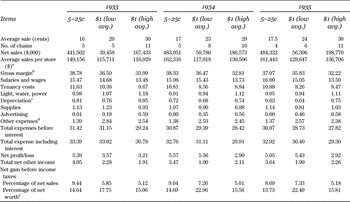
Operating Results for Variety Chains Classified by Average Sale, 1933–1935

Sources: M. P. McNair, “Expenses and Profits of Variety Chains in 1933,” Harvard Bureau of Business Research Bulletin, no. 95 (1934): 19–20; S. F. Teele, “Expenses and Profits of Limited Price Variety Chains in 1934,” Harvard Bureau of Business Research Bulletin, no. 98 (1935): 32–33; S. F. Teele, “Expenses and Profits of Limited Price Variety Chains in 1935,” Harvard Bureau of Business Research Bulletin, no. 103 (1936): 15–16.
Notes: All cost and margin data are shown as a percentage of net sales. a Figures on this item were not reported by all firms in all years; b net of cost of merchandise, plus freight, express, postage, and truckage; c on fixtures and equipment; d insurance (except on real estate), taxes (except on real estate or income), traveling, and miscellaneous; e because of inadequate balance sheet data for a few chains, the net gain figure for five-to-twenty-five-cent retailers is not comprehensive.
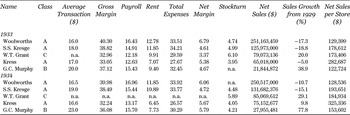
Operating Results for the Five Main Variety Store Chains, 1933 and 1934

Source: Undated worksheets, variety chain studies, Arch E75.A15, case 2, 1933 and 1934 files, Harvard Bureau of Business Research, Bureau of Business Research Records, Baker Library Historical Collections, Harvard Business School.
Notes: Class A = price range five to twenty-five cents, low average sale; B = up to one dollar, low average sale; C = up to one dollar, high average sale. Presumably, Kresge was classified as class A owing to the dominance of its twenty-five-cent stores in its overall business at that time.
Descriptive Statistics for Sixteen Variety Store Chains (1929 and 1931–1934)

Sources: Undated worksheets, variety chain studies, Arch E75.A15, case 2, 1929 and 1931–1934 files, Harvard Bureau of Business Research, Baker Library Historical Collections, Harvard Business School.
Note: Table shows full period means.
Determinants of Variety Store Net Margins (N = 61)

Sources: Undated worksheets, variety chain studies, Arch E75.A15, case 2, 1929 and 1931–1934 files, Harvard Bureau of Business Research, Baker Library Historical Collections, Harvard Business School.
Notes: Class A = variety stores in the five- to twenty-five-cent price range (with a low average sale price); B = price range below one dollar (low average sale price); C = price range below one dollar (high average sale price). Robust t-statistics reported. *** p < 0.01, ** p < 0.05, * p < 0.1.
The surveys identified merchandising policy as a key differentiator of costs and margins. Stores that retained a twenty-five-cent limit, with an “average sale” (i.e., average transaction per customer) of 17.5 cents in 1935, were found to have markedly higher gross margins than “to a dollar” stores, reflecting higher handling cost to price ratios for low unit value merchandise, together with lower rates of markdowns and shortages.Footnote 101 “To a dollar” stores had much higher proportionate apparel and accessories sales (which were particularly prone to markdowns and shortages, in common with other fashion-related goods). These accounted for only 7.49 percent of sales for stores with price limits of twenty-five cents or less in 1933, but 31.75 percent of sales for dollar stores with a low average sale and 44.94 percent for dollar stores with a high average sale.Footnote 102 However, HBBR found that differences in the performance of variety chains could not be explained simply in terms of variations in the proportion of apparel and accessory merchandise, which traditionally had higher price markups than goods of equivalent value, to compensate for markdowns and “shortage” losses.Footnote 103 Pricing policies appear to have a broader impact, not confined to any particular class of merchandise.
Cross-sectional aggregate data from the surveys suggest that five-to-twenty-five-cent stores had significantly higher net profit rates than variety stores with higher price limits. Table 2 shows operating results over 1933, 1934, and 1935, for five-to-twenty-five-cent stores and one-dollar (or more) stores, the latter being disaggregated into stores with low and high average sales. In addition to higher gross margins, stores with lower price points or average sales were found to have higher payroll costs (both reflecting the higher relative handling costs of small transactions). Tenancy costs were also higher; possibly due to the fact that five-and-dime stores required prime sites and passing trade, whereas people were prepared to go out of their way for higher-value purchases.
Overall, despite lower costs in areas such as advertising, twenty-five-cent stores were found to have slightly higher expenses ratios than one-dollar stores, while low-average-sale dollar stores had higher expenses than high-average-sale dollar stores. Yet lower expenses ratios were insufficient to offset the lower margins on higher-ticket goods, resulting in markedly lower trading profits, and total net gain as a proportion of net sales, for stores with higher average unit prices.Footnote 104
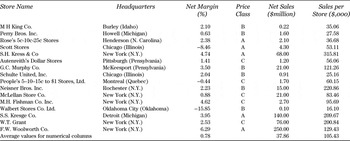
While Table 2 suggests that stores with higher price limits and average sales had lower net margins, such aggregate data still do not provide conclusive evidence. Five-to-twenty-five-cent stores differed significantly from their higher-price counterparts in terms of average sales per firm and per store—two factors shown by the surveys to have important impacts on profitability. To disentangle the influence of average sale, firm size, and store size, analysis is necessary at the level of the individual firm. While no original returns to these surveys have survived, the HBBR archives, at Harvard University's Baker Library, include worksheets providing some firm-level data for 1929 and 1931–1934. Table 3 shows available data for all national chains for 1933 and 1934 (other than McCrory and McLellan, for which no usable data are available, presumably owing to the fact that they were in receivership). The table shows a tendency for chains with higher price limits and average transaction values to have lower net margins. However, as predicted, this is driven by total expenses being higher relative to gross margins. This compression of net margins for firms with higher unit value merchandise is corroborated by longer-term (1929–1938) data on net income to sales ratios.Footnote 105
W. T. Grant (the only chain shown with a high price limit and high average sale policy) had a lower gross margin than the others, which was not compensated for by its expense ratio, thus producing the lowest net margin among the five chains. However, in terms of aggregate profits growth, it was more successful than its twenty-five-cent price limit competitors—as this margin was combined with a 20 percent increase in dollar sales over 1929–1933, while Woolworths, Kresge, and Kress had all experienced falling sales. G.C. Murphy (essentially a large regional chain) also had a higher price limit policy than Woolworths, Kresge, or Kress, but with a lower average sale than Grant. Murphy's achievement of both a respectable net margin and rapid growth reflected its strong focus on small towns with no department or variety stores (as reflected in its low average sales per store). In these it developed a profitable local niche spanning both variety and department store lines, in a manner similar to J. C. Penney.
Grant's success at applying the variety-store formula to high-ticket lines (many with a considerable fashion element) required a high stockturn—to avoid heavy markdowns. The risks associated with dependence on rapid stockturn of fashion goods are illustrated by the case of McLellan, America's sixth-largest variety store chain in 1929. Their high unit price policy provided a 1932 gross margin of only 26.86 percent, some 7.04 percentage points below their total expenses, forcing it into receivership.
McNair's concerns regarding the risks of lower gross margins leading to declining (and potentially negative) net profits in the absence of sufficient extra sales volume thus appear well founded. However, we also need to control for firm-level purchasing and administrative scale economies from high aggregate sales and for store-level technical scale economies, proxied by average sales per store. HBBR archival data sheets enable us to do so for sixteen chains, the descriptive statistics for which are shown in Table 4. These are classified into HBBR's three price ranges, as noted above: class A (five- to twenty-five-cent price range, low average transaction value); class B (dollar price limit, low average transaction value); and class C (dollar price limit, high average transaction value).
Table 5 provides ordinary least squares estimates of firm net margins for this sample.Footnote 106 In specification 1 the price bands are analyzed using the lowest price band, class A, as the reference group. The results indicate that—relative to this class—there are lower net margins, of 6.0 percent and 6.8 percent, respectively, for classes B and C. Our findings thus suggest that moving to dollar price ceilings did indeed sacrifice net margin for growth and, therefore, headline profits. These results are sustained, albeit with higher coefficients, when we incorporate payroll expenditure, in specification 2. In specification 3 we also control for firm-level economies, through total sales volumes, and store-level economies—via average sales per store (factors shown in Tables 3 and 4 to vary significantly between firms). We find that net margins are positively associated with net sales per store, suggesting that technical scale economies are important. However, we do not find that total sales volumes are important—though this may reflect our relatively small sample and the fact that we are already capturing firm-specific fixed effects.
The regression results thus provide strong support for our hypothesis that moving to higher price limits and average transaction values was associated with a substantial decline in net margins and net income to sales ratios, a result corroborated by our analysis of financial data for the largest individual chains. Impacts on sales growth are found to be very variable between firms—though for every major chain, growth was markedly slower than during the dime-store era.Footnote 107 Firms that successfully managed the change process nevertheless achieved significant growth during the 1930s, while others that failed to do so, such as McLellan, faced losses and potential liquidation.
Conclusion
Our findings support McNair's original conception of the wheel of retailing as a process characterized by low-cost retailers eventually finding it necessary to upgrade their business models, thereby reducing the spread between their gross and net margins and thus creating space for new retail formats to emerge at the bottom of the market. However, our findings do not support his more tentative conclusion that this was the result of declining managerial acumen.Footnote 108 Instead, our study identifies the wheel process as a phenomenon of retail format saturation, at a time when there was no obvious new business model that might enable innovative variety chains to undercut their competitors (analogous to the supermarket format, which enabled some grocery chains to reinforce their price advantage during the 1930s).Footnote 109 Variety chains faced an imperative for continued growth, to meet the expectations both of shareholders and of executives whose incomes and promotion prospects were strongly dependent on expanding the promotion pyramid.Footnote 110 Perceiving that within-format competition at the point of sale would be mutually destructive (given their essentially similar systems and reliance on substantial gross margins, given high handling cost to price ratios), the chains chose instead to move into higher-priced merchandise.
This upgrading strategy could be successful, as shown by the examples of Grant and Murphy. Even these firms experienced a marked reduction in net profit rates, but this is hardly surprising given that they moved from a position of clear price advantage (assuming no within-format competition at the point of sale) to one where their business model was less differentiated from that of service-oriented department stores and line-specialized chains. We conclude that, at least in this instance, the wheel phenomenon does not reflect a systematic deterioration of management across the format, or even a decline in performance (relative to market conditions), but a change in those conditions from a situation where their novel format provided an element of local monopoly to one where they were competitors in a crowded market. However, even where successful, upgrading inevitably left space at the bottom of the market for another turn of the wheel, by new retail formats at the start of their lifecycle.