FOCUS POINTS
• Serum BDNF levels reflect the response to mirtazapine treatment.
• The BDNF Val66Met polymorphism in Japanese patients with major depressive disorder is not associated with a particular response to mirtazapine treatment.
• The BDNF Val66Met polymorphism in patients with major depressive disorder is not associated with baseline serum BDNF levels.
• Plasma levels of catecholamine metabolites do not reflect the response to mirtazapine treatment.
• Plasma levels of catecholamine metabolites were associated with neither response to mirtazapine treatment nor the BDNFVal66Met genotype in Japanese patients.
Introduction
Mirtazapine has a unique pharmacological profile that makes it a noradrenergic and specific serotonergic antidepressant. Mirtazapine increases noradrenergic transmission through the blockade of α2-adrenoceptors,Reference De Boer1 and it enhances serotonergic neurotransmission indirectly through the stimulation of α1-adrenoceptors and the blockade of α2-adrenoceptors.Reference De Montigny, Haddjeri and Mongeau2 There is growing evidence that the brain-derived neurotrophic factor (BDNF) may play a crucial role in depression.Reference Duman, Heninger and Nestler3
In a preclinical study, Rogoz etal.Reference Rogoz, Skuza and Legutko4 reported that mirtazapine administration (10 mg/kg) for 14 days significantly increases BDNF mRNA levels in the hippocampus and in the cerebral cortex in rats. Karege etal.Reference Karege, Perret and Bondolfi5 first demonstrated that serum BDNF levels of drug-free depressed patients are lower than those of controls, and Shimizu etal.Reference Shimizu, Hashimoto and Okamura6 also found that serum BDNF levels of treated depressed patients do not differ from those of healthy controls. Aydemir etal.Reference Aydemir, Deveci and Taneli7 reported that serum BDNF levels are lower in depressed patients than in controls, and that treatment with antidepressant drugs for 12 weeks increases serum BDNF levels to those of healthy controls. Gonul etal.Reference Gonul, Akdeniz and Taneli8 also reported that treatment with each of several antidepressant drugs for 8 weeks significantly increases serum BDNF levels to the same as those of control subjects. Such results have suggested that antidepressant drugs increase serum BDNF levels in patients with depression.
To the best of our knowledge, there have been at least three meta-analyses of studies of serum or plasma BDNF levels in patients with depression.Reference Sen, Duman and Sanacora9–Reference Bocchio-Chiavetto, Bagnardi and Zanardini11 The results of previous investigations have generally revealed that serum or plasma BDNF levels are significantly lower in patients with depression than in healthy subjects. Furthermore, treatment with antidepressants, electroconvulsive therapy, or repetitive transcranial magnetic stimulation therapy increases serum or plasma BDNF levels in patients with depression.Reference Sen, Duman and Sanacora9–Reference Bocchio-Chiavetto, Bagnardi and Zanardini11 Taken together, these findings suggest that serum or plasma BDNF levels are a candidate biomarker for major depressive disorder (MDD). Moreover, such results support the notion that the amelioration of this disease might be associated with neuroplastic changes achieved with antidepressant treatment. The BDNF gene is an important candidate for elucidating the mechanisms underlying the actions of antidepressants, because BDNF plays a significant role in the functioning of the serotonin system. The human BDNF gene maps to chromosome 11p13, and it contains a functional 196G/A single-nucleotide polymorphism (rs6265) known to cause an amino acid substitution from valine to methinine in exon I (Val66Met). The BDNF gene encodes a precursor peptide that is proteolytically cleaved to form the mature protein BDNF.Reference Mowla, Pareek and Farhadi12 One report found no association between BDNF Val66Met polymorphism and the response to mirtazapine in Korean patients with MDD.Reference Kang, Chang and Wong13 To the best of our knowledge, no study has investigated the effects of mirtazapine on serum BDNF levels or the correlation between BDNF Val66Met polymorphism and the response to mirtazapine in Japanese patients with depression. We therefore investigated the associations between the BDNF (Val66Met) polymorphism or changes in serum BDNF levels and the response to mirtazapine treatment in Japanese patients with depression. We also investigated mirtazapine's effects on plasma levels of homovanillic acid (HVA), a major metabolite of dopamine, and 3-methoxy-4-hydroxyphenylglycol (MHPG), a major metabolite of noradrenaline in the patients.
Methods
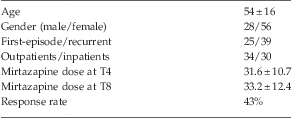
In this study, 84 patients who met the DSM-IV-TR14 criteria for major depressive disorder were enrolled. Of these patients, 28 were male and 56 were female (age range, 22–84 years; mean ± S.D., 54 ± 16). All patients were physically healthy without any abnormality; all were checked by an electrocardiogram; none had comorbidity with axis II psychiatric disorder, as confirmed by the Structured Clinical Interview for DSM-IV (SCID)Reference First, Spitzer, Gibbon and Williams15; and none had taken any psychotropic medication within a month prior to the onset of the study. The patients had never participated in any other previous study. The scores of the 17-item Hamilton Rating Scale for Depression [HAM-D(17)] were 14 or more when enrolled in the study. All participants were restricted by monoamine diet. The patients were treated with only mirtazapine for 8 weeks (T8) at a dose ranging from 7.5 mg/day to 45 mg/day. The dosage varied among patients, and ethical considerations prevented the dose prescribed to individuals from being fixed. The dose of mirtazapine at 4 weeks (T4) and T8 were 31.6 ± 10.7 mg/day and 33.2 ± 12.4 mg/day, respectively. In other words, the psychiatrist of each patient determined the dose of mirtazapine. The patients’ clinical improvement was evaluated by an experienced psychiatrist (A.K.) using HAM-D(17) before (T0) and 4 weeks after the administration of mirtazapine (T4) in a blind situation. We defined the patients whose scores of the HAM-D(17) decreased 50% or more as rapid responders; the remaining patients in the present study who did not exhibit such a decrease in HAM-D(17) scores were considered nonresponders.Reference Umene-Nakano, Yoshimura and Ueda16 Blood samples drawn into plain or EDTA-2Na-containing tubes for collecting serum and plasma, respectively, were obtained between 08:00 and 10:00, before the patients had eaten breakfast (approximately 13–15 hours after ingestion of the most recent dose of the drug). This was performed at T0 and at T4.
The serum samples were quickly separated in a centrifuge and stored at −80°C until assayed. The serum BDNF levels were measured using a BDNF Emax Immunoassay Kit (Promega, Madison, WI, USA) according to the manufacturer's instructions. In short, 96-well microplates were coated with anti-BDNF monoclonal antibody and incubated at 4°C for 18 h. The plates were incubated in a blocking buffer for 1 h at room temperature. The samples were diluted 100-fold with assay buffer, and BDNF standards were kept at room temperature under conditions of horizontal shaking for 2 h, followed by washing with the appropriate washing buffer. The plates were incubated with antihuman BDNF polyclonal antibody at room temperature for 2 h and washed with the washing buffer. They were then incubated with anti-IgY antibody conjugated to horseradish peroxidase for 1 h at room temperature, then incubated again in peroxidase substrate and tetramethylbenzidine solution to induce a color reaction. The reaction was stopped with 1 mol/L hydrochloric acid. Absorbance at 450 nm was measured with an Emax automated microplate reader. Measurements were performed in duplicate. The standard curve was linear from 5 pg/mL to 5000 pg/mL, and the detection limit was 10 pg/mL. Cross-reactivity to related neurotrophins (NT-3, NT-4, NGF) was less than 3%. Intra- and interassay coefficients of variation were 5% and 7%, respectively. The recovery rate of exogenously added BDNF in the measured plasma samples was more than 95%.
Alternatively, plasma concentrations of HVA and MHPG were analyzed by high-performance liquid chromatography with electrochemical detection (HPLC-ECD). The plasma HVA levels were analyzed by HPLC-ECD according to the method of Yeung etal.Reference Yeung, Buckley and Pedder17 with slight modification. In brief, each cyano-bonded solid-phase extraction cartridge was preconditioned with methanol followed by glass-distilled water. To each cartridge, 0.3 mL of plasma sample or standard and 0.1 mL of working internal standard solution (5 ng of 5-hydroxyindolecarboxylic acid in 0.01 M KH2PO4, pH 7.2) were added. The samples were deproteinized with 1 mL of acetonitrile. After mixing by vortex and centrifugation (1760 × g, 4°C for 10 min), an aliquot (5 μL) of supernatant was allowed to pass through the cartridge slowly under a mild vacuum (15 mmHg). The cartridge was washed with 0.2 mL of distilled water and extracted containing 1 mL of ethylacetate, and then an aliquot was evaporated to dryness under nitrogen gas. After dissolution in mobile phase (200 μL), a 10-μL portion of this solution was injected into the HPLC. The detection limit was 0.5 ng/mL, and the calibration curve was linear up to 40 ng/mL. The intra- and interassay coefficients of variation were 6% and 8%, respectively. The recovery rate was more than 80%.
The plasma MHPG levels were also analyzed by HPLC-ECD according to the method of Minegishi and Ishizaki.Reference Minegishi and Ishizaki18 In brief, the plasma was separated by centrifugation at 600 g at 4°C. Extraction was performed under a vacuum using Bond-Elut columns (Varian, Palo Alto, CA, USA) prepacked with 100 mg of C18-bonded silica (40 μm) in a 1-mL capacity disposable syringe. The columns, which were inserted into a vacuum chamber connected to an aspirator, were prepared by washing with 1 mL methanol followed by 1 mL of water. After the addition of 50 μL of a solution of vanillyl alcohol (internal standard equivalent to 5 ng/mL) to 1 mL of plasma, the samples were passed through the columns, followed by 0.75 mL of water to rinse off both residual samples and easily eluted hydrophilic compounds. The adsorbed materials were eluted with 200 μL of methanol to a 0.1 M phosphate buffer (pH 4.8) mixture (40:60, v/v). A 20 μL portion of this solution was injected into the HPLC. The detection limit was 0.5 ng/mL, and the calibration curve was linear up to 40 ng/mL. The intra- and interassay coefficients of variation were 6% and 8%, respectively. The recovery rate was more than 80%.
Of the 84 participants, 64 consented to genotyping for BDNF Val66Met. Genomic DNA was extracted from peripheral leucocytes using a QIAamp DNA Blood Kit (Qiagen, Tokyo, Japan) and was stored at –20 °C until used for analysis. Genotyping for the presence of the BDNF Val66Met polymorphism was performed using direct sequencing in the region.
The protocol of this study was approved by the Ethics Committee of the University of Occupational and Environmental Health. All patients consented to participate after having been informed of the study's purpose.
Statistical
The Kolmogorov–Smirnov method was used to confirm the samples were fitted to normal distribution. Paired and non-paired t-tests were used to compare the serum BDNF levels and mirtazapine dose between two groups. The chi-square test was used to compare the number of patients with BDNF genotype Val/Val and Met carrier. The relationships between the HAM-D(17) scores and serum BDNF levels were examined using Pearson's correlation coefficients. Repeated measures of ANOVA were used to compare the serum BDNF levels and the plasma levels of HVA and MHPG among three groups. We used the last observation carried forward (LOCF) method. A significant level of p < .05 was used. Statistical procedures were performed using the Japanese version of SPSS v. 15.1 (SPSS Japan, Tokyo, Japan).
Findings
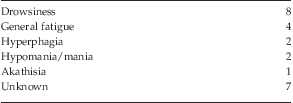
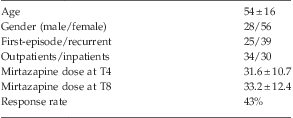
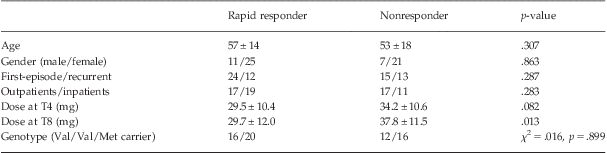
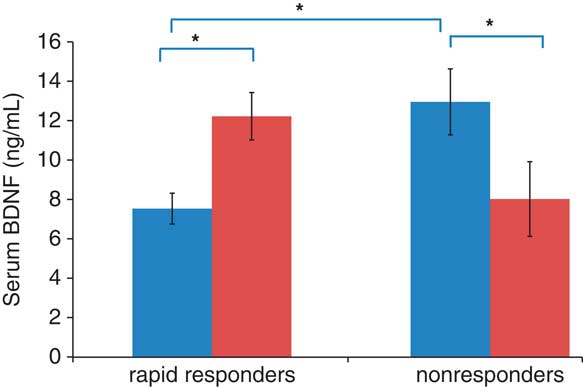
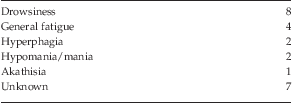
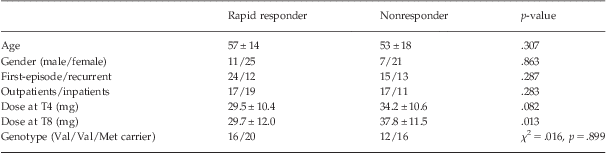
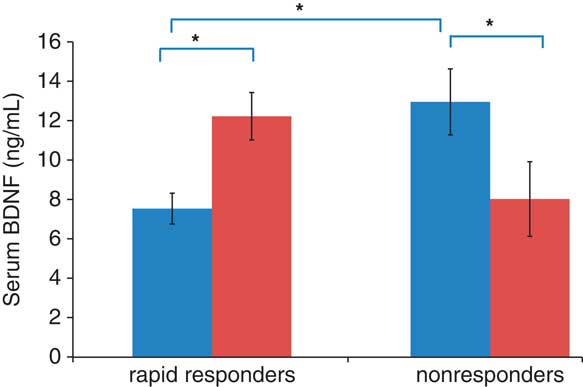
Sixty-four of the 84 participants completed the study. The drop-out rate was 24%. The reasons for dropping out are shown in Table 1. Of the 84 participants, 36 (43%) became responders to mirtazapine at T4 (rapid responders). The demographics of all the patients are shown in Table 2. There were no differences between the rapid responders and nonresponders to mirtazapine in terms of sex, age, first episode or recurrent episode, HAM-D(17) scores at T0, mirtazapine dose at T4, or the allele frequency of the BDNF gene (Table 3). However, serum BDNF levels at T0 were significantly higher in nonresponders than in rapid responders. Treatment with mirtazapine for 4 weeks significantly increased serum BDNF levels in the rapid responders but significantly decreased them in nonresponders (Figure 1). Forty-four of 64 became responders at T8. We defined those as responders. The response rate at T8 was 52%. A significant difference was observed in baseline serum BDNF levels between rapid responders and nonresponders (p = .014).
Reasons for drop-out
Demographics of the patients
Demographics of responders and nonresponders
Serum BDNF levels in rapid responders and nonresponders. Blue column, T0; red column, T4. Vertical bar means standard error, *p < .05.
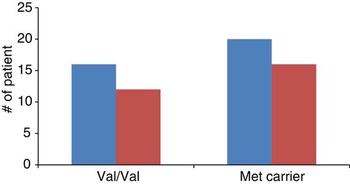
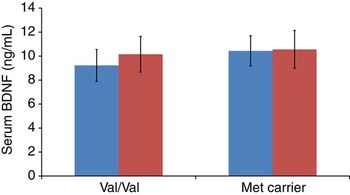
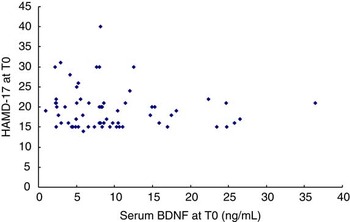
The genotypes of the 64 subjects were as follows: 28, BDNF (Val66Val); 27, Val66Met; and 9, Met66Met. The Val/Metallele frequencies were within the Hardy–Weinberg equilibrium (χ 2 = .085, p = .389). The distributions of genotypes Val66Val, Val66Met, and Met66Met were 44%, 42%, and 14%, respectively. No association was found between the two genotypes (Val/Val vs. Met carriers) and the rapid responders and nonresponders to mirtazapine (Figure 2) or the serum BDNF levels at T0 and at T4 (Figure 3). In addition, no correlation was observed between the two genotypes and the responders (χ 2 = 0.185, p = 0.892). No correlation was observed between the serum BDNF levels at T0 and the HAM-D(17) scores at T0 (r = −.1662, p = .1872) (Figure 4).
Distributions of the patients between Val/Val and Met carrier. Blue column, rapid responders; red column, nonresponders.

Serum BDNF levels between Val/Val and Met carrier. Blue column, rapid responders; red column, nonresponders. Vertical bar means standard error.

There is no correlation between baseline HAM-D(17) scores and baseline serum BDNF levels. Vertical bar means standard error.

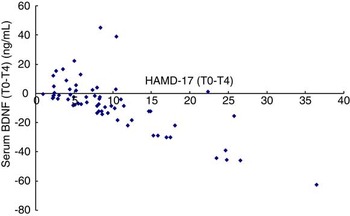
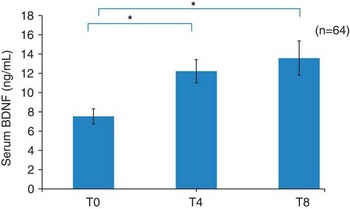
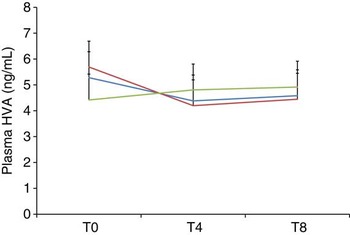
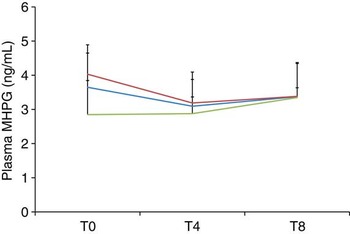
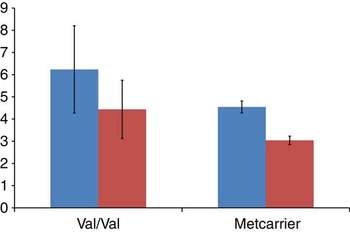
A significant negative correlation was found between the changes in HAM-D(17) scores from T0 to T4 and serum BDNF levels (r = −.2920, p = .0205) (Figure 5). We longitudinally followed the serum BDNF levels in responders at T4 for up to 8 weeks (T8). There was no difference in the serum BDNF levels between T4 and T8 (Figure 6). According to the plasma levels of catecholamine metabolites, no differences were found in plasma levels of HVA (F = 3.995, p = .872) (Figure 7) and MHPG (F = 3.995, p = .321) (Figure 8) at T0, T4, and T8 in responders. No correlations were observed between plasma levels of catecholamine metabolites (HVA and MHPG) at T0 and the two genotypes or response to mirtazapine (Figures 9 and 10).
There is a negative correlation between the change in serum BDNF levels and the change in HAM-D(17) scores. r = −.2920, p = .0205.

Serum BDNF levels at T0, T4, and T8. Vertical bar means standard error, *p < .05.

Plasma HVA levels at T0, T4, and T8. Red line, rapid responders; green line, nonresponders; blue line, total sample. Vertical bar means standard error.

Plasma MHPG levels at T0, T4, and T8. Red line, rapid responders; green line, nonresponders; blue line, total sample. Vertical bar means standard error.

Plasma levels of catecholamine metabolites and Val/Val and Met carrier. Blue column, HVA; red column, MHPG. Vertical bar means standard error.

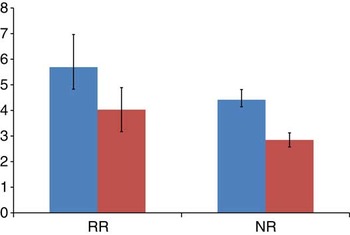
Plasma levels of catecholamine metabolites and rapid responders and nonresponders. Blue column, HVA; red column, MHPG. RR, rapid responders; NR, nonresponders. Vertical bar means standard error.

Discussion
One of the most important findings of the present study was that the baseline serum BDNF levels were significantly lower in rapid responders to mirtazapine than in nonresponders. The result in the present study was basically in accordance with our previous study in sertraline.Reference Umene-Nakano, Yoshimura and Ueda16 These results indicate that baseline serum BDNF levels predict the response to mirtazapine or sertraline. In contrast, Wolkowitz etal.Reference Wolkowitz, Wolf and Shellty19 reported that serum BDNF levels before treatment with escitalopram or sertraline predict the responses to those antidepressants in MDD. In that study, the authors demonstrated that responders to treatment with SSRIs had higher pretreatment serum BDNF levels than did nonresponders. We previously demonstrated that no difference was found in plasma BDNF levels between SSRI- or SNRI-responsive and -refractory patients with depression.Reference Yoshimura, Hori and Ikenouchi-Sugita20 Taking these findings into account, it remains controversial whether pretreatment serum or plasma BDNF level is associated with the response to antidepressants. The serum BDNF levels in responders significantly increased from T0 to T4, whereas those in nonresponders significantly decreased. The reason for the decrease of serum BDNF levels in nonresponders remains unknown. The increase of other neurotrophic factors, such as glia-derived neurotrophic factor, vascular endothelial growth factor, or insulin-like growth factor-1, might be associated with the mechanisms of recovering from a depressive state in patients who are mirtazapine nonresponders. Otherwise, it seems to be coincidental that the serum BDNF levels in nonresponders had decreased. Furthermore, a negative correlation was found between the changes in serum BDNF levels (from T0 to T4) and the HAM-D(17) scores (from T0 and T4). Thus, the results indicate the possibility that the increase in serum BDNF levels is associated with the efficacy of mirtazapine. However, the lack of a correlation in serum BDNF levels at T0 was not in accordance with the results of our previous study.Reference Yoshimura, Mitoma and Sugita21 The reason for the discrepancy might be the small sample size in the present study. A significant association was found between the HAM-D scores or the Montgomery–Åsberg Depression Rating Scale and serum BDNF levels in several reportsReference Karege, Perret and Bondolfi5, Reference Shimizu, Hashimoto and Okamura22, Reference Satomura, Baba and Nakano23; however, this finding was not reported in other research.Reference Jevtovic, Kariovic and Mihaljevic-Peles24, Reference Birkenhager, Geldermans and Van den Broek25 Taken together, the use of serum BDNF levels as a marker of the severity of a depressive state are still controversial.
Rogoz etal.Reference Rogoz, Skuza and Legutko4 reported that mirtazapine administration (10 mg/kg) for 14 days significantly increased BDNF mRNA levels in the hippocampus and in the cerebral cortex in rats. Chronic treatment with mirtazapine recovered frontal and hippocampal BDNF protein levels in chronic unpredictable mildly stressed rats.Reference Zhang, Gu and Chen26 Taken together, the previous and present results suggest that chronic treatment with mirtazapine alleviates BDNF mRNA and protein levels in the brain.
We previously reported that 8 weeks of treatment with paroxetine, an SSRI, and milnacipran, an SNRI, equally increased serum BDNF levels in patients with depression.Reference Yoshimura, Mitoma and Sugita21 The precise mechanisms underlying the increase in serum BDNF levels after 8 weeks of treatment with these antidepressants remain unknown. However, the enhancement of serotonergic and noradrenergic neurons might be associated with the increase in BDNF levels because of the nonspecificity of the drugs. Mirtazapine influences noradrenaline, serotonin, and also dopamine without affecting monoamine transporters. Devoto etal.Reference Devoto, Flore and Pira27 demonstrated that mirtazapine increased noradrenaline and dopamine levels in the prefrontal cortex by inhibiting α2-adrenoceptors. It is interesting that mirtazapine increased serum BDNF levels at 4 weeks. However, it takes at least 8 weeks oparoxetine or milnacipran to increase serum BDNF levels. In other words, both drugs did not increase serum BDNF levels at 4 weeks. The robust and broad influence on monoaminergic neurons might be associated with the rapid increase in serum BDNF levels by mirtazapine. Actually, Delgado etal.Reference Delgado, Moreno and Onate28 reported that the depletion of tryptophan and catecholamines in patients taking mirtazapine worsened their depressive symptoms, and was accompanied by decreased plasma levels of HVA, MHPG, and free tryptophan. These findings confirm that mirtazapine works on the three neurotransmitters. However, in the present study, significant changes in plasma levels of HVA and MHPG were not observed in the responders to mirtazapine at T4 and T8. It is possible mirtazapine may have changed the plasma levels of catecholamine metabolites at an earlier period (i.e., 1 or 2 weeks) and returned to static levels at T4 and T8, which would not contradict the finding that mirtazapine rapidly increases serum BDNF levels. Another possible explanation of the results is that mirtazapine has a weak influence on noradrenaline and dopamine systems.
Another important finding of the present study was the lack of an association between the response to mirtazapine at T4 and the presence of the BDNF Val66Met polymorphism. We previously found no correlation between the BDNF Val66Met polymorphism and the response to SSRIs (paroxetine or sertraline).Reference Yoshimura, Kishi and Suzuki29 In contrast, in a meta-analysis of the putative BDNF Val66Met polymorphism, Zou etal.Reference Zou, Ye and Feng30 demonstrated an association with treatment response to antidepressants in patients with major depressive disorder. The authors of that study also revealed that Val66Met heterozygous patients exhibit a better treatment response rate than do Val66Val homozygote patients, especially in Asian populations. In a more recent study, Zou etal.Reference Zou, Wang and Liu31 also reported that patients with major depression who have the Val66Val genotype responded better to fluoxetine treatment, and had fewer side effects, than did those with the Val66Met or Met66Met genotype. Chi etal.Reference Chi, Chang and Lee32 reported significant changes in HAM-D scores in people with any one of the three genotypes after both 2 and 4 weeks of venlafaxine treatment. These results suggest that the BDNF Val66Met polymorphism may play a major role in the efficacy, as well as in the side effects, of fluoxetine in Chinese patients with depression. The results of the present study were not in accord with the results of the Zou etal.Reference Zou, Wang and Liu31 Although the reason for this discrepancy remains unknown, the difference in antidepressant treatment periods (i.e., 6 weeks in Zou etal.Reference Zou, Wang and Liu31 vs. 4 weeks in the present study) may be the reason. We consider it ideal to use a longer duration to define responders, because more placebo responders were included in the samples when a shorter duration was used to define responders. Also, it is possible that a difference exists in the distribution of BDNF Val66Met genotype among Chinese, Korean, and Japanese populations. Furthermore, in the present study, only two BDNF Val66Met genotype groups were considered, i.e., Val66Val and Met carriers, due to the small number of subjects with the Met66Met genotype. We confirmed the results of our previous study,Reference Yoshimura, Kishi and Suzuki29 which demonstrated that no correlation exists between the BDNF Val66Met polymorphism and serum BDNF at T0. Ozan etal.Reference Ozan, Okur and Eker33 demonstrated that subjects with Met carriage showed greater reductions in serum BDNF levels, regardless of gender or depression. On the other hand, Terracciano etal.Reference Terracciano, Martin and Ansari34 reported that plasma concentrations of BDNF were not associated with the Val66Met variant. Taking these findings into account, we find that the data remain controversial regarding whether or not the BDNF Val66Met polymorphism is indeed associated with serum or plasma BDNF levels. No correlations were observed between plasma levels of catecholamine metabolites (HVA, MHPG) at T0 and the two genotypes or the response to mirtazapine. These results suggest that baseline plasma catecholamine metabolites levels were not related to the response to mirtazapine treatment or the two genotypes.
There are several limitations to the present study. In our analyses of the two groups, we did not control for body mass index or smoking status, which might have influenced the serum BDNF levels. In addition, the cardiovascular conditions of the patients were checked only by an electrocardiogram. Also, since we could not monitor the plasma concentration of mirtazapine, the compliance of the drug administration was not assured. A further study, which controls for BMI, smoking status, and cardiovascular disease, is needed to confirm these preliminary results. More importantly, recent studies have shown that the genetics of depression are different in the elderly than in younger patients.Reference Kendler, Myers and Zisook35
Conclusion
In conclusion, lower baseline BDNF level is a predictive marker for a response to mirtazapine, and mirtazapine treatment significantly increased serum BDNF levels within 4 weeks in responders, whereas it decreased those levels in nonresponders. The BDNF Val66Met polymorphism in Japanese patients with depression is associated with neither a particular response to mirtazapine treatment nor with baseline serum BDNF levels. Moreover plasma levels of HVA and MHPG do not reflect the response to mirtazapine treatment.
Disclosures
Professor Nakamura has received grant support from Astellas Pharma, Janssen Pharmaceutical, Eli Lilly, GlaxoSmithKline, Pfizer, Dainippon Sumitomo Pharma Co. Ltd., Otsuka Pharmaceutical Co. Ltd., and Chugai Pharmaceutical Co. Ltd. The other authors report no financial relationships with commercial interests.