Introduction
Delirium is a clinical syndrome characterized by an acute change in attention, awareness, cognitive function, psychomotor activity, and sleep–wake cycle. Delirium incidence after heart surgery is estimated to be up to 47% (Groen et al., Reference Groen, Banayan, Gupta, Xu and Bhalerao2012). In addition, nearly two-thirds of patients may experience sub-syndromal delirium post-operatively (Tan et al., Reference Tan2008). This high incidence of post-cardiotomy delirium is of particular concern because it portends greater mortality, higher readmission rates, poorer quality of life (Koster et al., Reference Koster, Hensens, Schuurmans and van der Palen2012), post-operative complications including atrial fibrillation, pneumonia, and need for re-intubation (Loponen et al., Reference Loponen2008), and overall functional decline (Rudolph et al., Reference Rudolph2010). Identifying individuals at high risk of delirium after cardiac surgery and developing targeted prevention and intervention strategies would be of great public health significance.
Pre-operative cognitive impairment such as dementia is a well-established predisposing factor for delirium after heart surgery (Kazmierski et al., Reference Kazmierski2006; Veliz-Reissmuller et al., Reference Veliz-Reissmuller, Aguero Torres, van der Linden, Lindblom and Eriksdotter Jonhagen2007; Banach et al., Reference Banach2008; Rudolph et al., Reference Rudolph2009). In general, cognitive impairment in older adults exists on a continuum from intact cognition to neurocognitive impairment, and sub-syndromal presentations of dementia and delirium are clinically meaningful because of their prognostic significance and the subjective distress associated with them. MCI has been characterized as a transitional state between cognitive changes of normal aging and early dementia (Albert et al., Reference Albert2011). Though longitudinal studies have found that a portion of those MCI may return to normal cognition, even those with such cognitive improvement remain at increased risk for future cognitive decline (Koepsell and Monsell, Reference Koepsell and Monsell2012). An estimated one in ten with MCI will progress to dementia each year (Petersen et al., Reference Petersen, Smith, Waring, Ivnik, Tangalos and Kokmen1999; Summers and Saunders, Reference Summers and Saunders2012), but factors such as lifestyle and neuropsychiatric symptoms appear to be modifiable risk factors for the progression of MCI to dementia (Cooper et al., Reference Cooper, Sommerlad, Lyketsos and Livingston2015).
The construct validity of MCI remains a topic of active inquiry (Summers and Saunders, Reference Summers and Saunders2012). In particular, no single definition of MCI is universally accepted (Petersen et al., Reference Petersen, Smith, Waring, Ivnik, Tangalos and Kokmen1999; DeCarli, Reference DeCarli2003; Winblad et al., Reference Winblad2004; Albert et al., Reference Albert2011). Even separate studies that reference the same MCI diagnostic criteria may operationalize them differently – for instance, implementing different tests of memory or cognition and use different thresholds of impairment (Luck et al., Reference Luck, Luppa, Briel and Riedel-Heller2010). In general, MCI requires (1) cognitive impairment, (2) no more than minimal impairment in daily functioning as a result of cognitive impairment, and (3) exclusion of dementia (Albert et al., Reference Albert2011).
The predictive value of MCI, however, is only beginning to be studied (Kazmierski et al., Reference Kazmierski2014). Here we present an interim analysis of the NOAHS study data in which MCI has been defined based on the CDR global score and alternatively based on statistical performance on a neurocognitive battery prior to CABG surgery. We investigate whether MCI definition influences its predictive value for post-CABG delirium (PCD). Additionally, we examine whether pre-operative functional status or performance on individual neurocognitive tests serve as PCD predictors.
Methods
Study design
The NOAHS study is an ongoing, prospective, observational cohort study that enrolls patients who have undergone cardiac catheterization and who are being referred for elective CABG surgery at Yale-New Haven Hospital (YNHH) in New Haven, Connecticut. This study was approved by the Yale University Human Investigation Committee and is registered with the National Institutes of Health (study identifier: NCT01838356).
Eligibility criteria
Participants were eligible if they were English-speaking adults at least 40 years of age and did not have dementia (as defined by CDR ≥ 1). Participants must be able to provide informed consent and be scheduled for CABG surgery at YNHH during the study period. Participants must also have access to a telephone for post-operative follow up and a reliable collateral informant. Exclusion criteria include previous CABG surgery, life expectancy less than one year, severe mental illness, or auditory or visual impairment that would preclude participation. Additionally, patients were excluded for active alcohol or other substance use disorder based on a CAGE-AID score of two or greater.
Baseline/pre-operative data and clinical measures
Pre-operative baseline assessment included the Mini-Mental State Examination (MMSE) and abbreviated digit span test (aDST). Delirium was determined based on the CAM and rated using the DI (McCusker et al., Reference McCusker, Cole, Bellavance and Primeau1998). Mood and anxiety are assessed with the Depression Interview and Structured Hamilton (DISH), 9-item Patient Health Questionnaire (PHQ-9), Geriatric Depression Scale (GDS), and Generalized Anxiety Disorder-7 (GAD-7). Functional status was assessed based on the Lawton instrumental activity of daily living (IADL) scale. Demographics, medical history, laboratory values, and medications were also recorded and Charlson comorbidity index (CCI) calculated for each participant.
Clinical dementia rating scale
Each participant was evaluated using the CDR scale, which involves a semi-structured interview validated to assess for MCI and mild, moderate, or severe dementia (Hughes et al., Reference Hughes, Berg, Danziger, Coben and Martin1982) with good inter-rater reliability (Burke et al., Reference Burke1988). Each CDR-rater in the NOAHS study was certified via the online training available on Washington University's Knight Alzheimer's Disease Research Center website (Knight ADRC). The CDR is composed of six subscales of “box scores” corresponding to the following six domains of function: memory, orientation, judgment/problem solving, community affairs, home/hobbies, and personal care. These domains are scored ordinally as 0, 0.5, 1, 2, or 3. Individual box scores are entered on the Washington University ADRC's website (http://www.biostat.wustl.edu/adrc/cdrpgm/index.html), which uses an algorithm to calculate a global CDR score. The global score of 0 represents normal cognition whereas 0.5 corresponds with MCI and a score of 1–3 correspond with mild, moderate, and severe dementia, respectively (Morris et al., Reference Morris2001).
Baseline neurocognitive battery
Prior to CABG surgery, study personnel also conducted a one-hour neurocognitive battery that consists of memory tests (the Hopkins Verbal Learning Test (HVLT), the Wechsler Memory Scale, Fourth Edition (WMS-IV) and non-memory tests (progressive digit sequencing task, three word-fluency tasks with the letters F, A, and S, Neuropsychological Assessment Battery (NAB) mazes subtest, trail-making test A and B, and digit–symbol substitution). These non-memory tests assess verbal and visual memory, working memory, language and concentration, visuospatial ability, planning and sequencing, and processing speed, respectively.
In addition to CDR-defined MCI (MCI-CDR), participants were alternatively categorized as MCI based on neurocognitive test performance (MCI-NC). Participants were categorized as amnestic MCI-NC (aMCI-NC) if either HVLT recall – average of immediate and delayed – or WMS-IV visual reproductions score – average of immediate and delayed – was 1.5 SD below relevant population means. Participants were considered to have non-amnestic MCI (naMCI-NC) if they scored below 1.5 SD on any of the remaining six neurocognitive tests. Both aMCI-NC and naMCI-NC were further stratified based on the presence of impairment in a single or multiple domains. Additionally, a composite neurocognitive score for each participant was created by standardizing raw scores of five key domains as z-scores and summing these values.
Postoperative evaluation
On post-operative days 2 through discharge, study personnel evaluate participants for incident delirium based on MMSE, aDST, and CAM as before surgery. Delirium severity was rated on DI. Post-operative assessments were discontinued after a patient screens positive for delirium yielding a dichotomous variable for the presence or absence of post-CABG delirium (PCD). The highest post-operative DI score for each patient – including those with subsyndromal delirium – is included as a continuous outcome variable.
Statistical analysis
All NOAHS study data are entered online into REDCap™ software, a secure web application for managing online databases. Statistical calculations were conducted using IBM® SPSS® Statistics, version 21. Descriptive statistics are provided for baseline data, which are further stratified by MCI status – either by CDR or neurocognitive battery – to evaluate for differences in demographic, psychological, neurocognitive, or functional features at baseline. Independent t-tests were used for continuous variables, and χ 2 tests-of-independence were used for categorical data. Raw scores in the neurocognitive battery were converted to z-scores, which are calibrated to have a mean of 0 and a standard deviation of 1, in order to create composite neurocognitive battery scores as above. PCD was the primary outcome of interest for this analysis and is included as a dichotomous variable. Binary regression analysis was used to determine predictors for PCD while adjusting for demographic and other relevant baseline characteristics. Linear regression was used to determine independent predictors of delirium severity. Alpha was set at 0.05.
Results
Participant characteristics
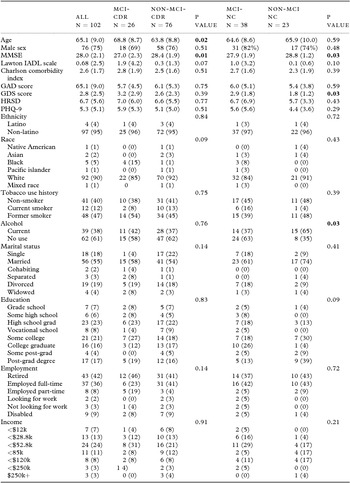
To date, post-operative delirium data are available for 102 participants. These participants’ demographics and baseline features are presented in Table 1 and stratified by both MCI-CDR and MCI-NC status. The average age of study participants is 65.1 years with a higher average age seen among MCI-CDR patients relative to those without (68.8 vs. 63.8, respectively) but an insignificantly lower age in those with MCI-NC (64.6 vs. 65.9). About three-fourths of participants were male independent of MCI-CDR or MCI-NC diagnosis. The average MMSE score was 28 with a significant 1.4-point difference between those with or without MCI-CDR and a significant 1.1-point difference between those with or without MCI-NC. Trends were seen toward more functional impairment among both MCI groups. Medical comorbidity and mean severity of anxiety and depression were roughly equal between the groups with one exception: participants with MCI-NC were more likely than non-MCI-NC participants to report more depressive symptoms on the GDS (2.3 vs. 1.8). Nine out of ten participants were Caucasian and over half married. More than 85% graduated high-school or equivalent. Nearly 80% were either employed or retired.
Demographics and baseline features*

*Continuous variables: reported as mean (standard deviation), analyzed using independent t-test. Categorical variables: reported as n (%), analyzed using chi-square.
Mild cognitive impairment: clinical dementia rating scale
Twenty six (25%) of the NOAHS cohort scored a 0.5 of CDR and were designated MCI-CDR. All of these participants with MCI were amnestic-type (aMCI) in that they scored at least 0.5 on the memory domain of the CDR. Among these, 20 were single-domain aMCI-CDR and the remaining 6 multiple-domain.
Neurocognitive battery
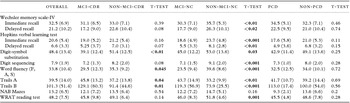
A total 64 participants (63% of sample) completed at least some portion of the neurocognitive battery, 61 participants of whom completed neurocognitive tests of memory before surgery. Raw data from the neurocognitive battery are presented in Table 2 and stratified by both definitions of MCI as well as by PCD diagnosis. Participants with a MCI-CDR performed worse on digit symbol substitution, word fluency, and both trails A and B than participants without MCI-CDR. A global MCI-NC diagnosis was associated with statistically worse performance on every individual test except for mazes. Average neurocognitive performance was not statistically different when stratifying by PCD diagnosis on any of the independent tests. Composite neurocognitive battery z-scores were lower among those who developed PCD: −1.7 (5.0) versus 0.7 (5.3), but insignificantly so (p = 0.39).
Neurocognitive battery raw performance overall and stratified by MCI-CDR, MCI-NC, and PCD

Mild cognitive impairment: neurocognitive battery
The proportion of the NOAHS participants scoring at least 1.5 SD below relevant population means on each test ranged from 3–44%. For comparison, the proportion of participants scoring at least 1 SD below population means ranged from 7–57%. Among the 61 participants for whom memory performance was available, 38 participants (62%) were categorized as MCI-NC as described under Methods. In all, 8 (13%) were single-domain aMCI-NC, 17 (28%) multiple-domain aMCI-NC, 5 (8%) single naMCI-NC, and 8 (13%) multiple naMCI-NC. κ for agreement between MCI based on CDR or neurocognition was 0.11 (p = 0.12).
Delirium outcomes
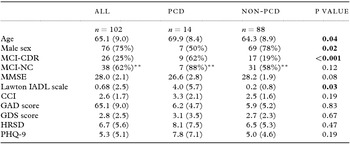
Fourteen (14%) participants developed PCD. Table 3 stratifies baseline characteristics based on PCD and, in addition to Table 1, includes rows for MCI-CDR and MCI-NC diagnosis. Participants who developed PCD were, on average, older (69.9 vs. 63.3) and more functionally impaired (Lawton IADL score 4 vs. 0.2). Women were considerably more represented among participants who developed PCD relative to those who did not (50% vs. 22%). Curiously, none of the participants who developed PCD were single though singles represented 20% of those without PCD.
Demographics and baseline features stratified by post-CABG delirium*

*Continuous variables: reported as mean (standard deviation), analyzed using independent t-test. Categorical variables: reported as n (%), analyzed using chi-square.
**Denominators are: 61, 8, and 53 (respectively).
The rate of PCD among MCI-CDR participants was more than five-times the rate of PCD among non-MCI-CDR participants: 6.8% versus 34.6% (p < 0.001). Seven (18%) of the 38 MCI-NC participants developed PCD whereas only 1 (4%) of those without MCI-NC did (p = 0.12). Both definitions of MCI have high-negative predictive values for incident PCD (93% and 96%, respectively). MCI-CDR has a greater specificity for PCD prediction (81% vs. 42%) but is less sensitive than MCI-NC (64% vs. 88%).
Logistic regression models of PCD predictors
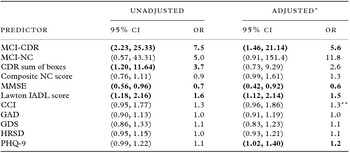
Logistic regression was used to calculate unadjusted 95% confidence intervals and odds ratios (OR) and then adjusted for age, sex, CCI, and years of education (Table 4). MCI-CDR, MMSE, and functional status were each predictive of PCD before and after adjustments. The odds of a participant who developed PCD would have MCI-CDR was more than five-times that of a participant without PCD. For each point lost on baseline MMSE, the odds of PCD increased by 40%. Similarly, for each additional point on the Lawton IADL score, the odds of developing PCD increased by 50%. Together, MCI-CDR status, functional ability, age, gender, CCI, and education account for 18% of the variance of PCD outcome (i.e. Cox & Snell R2). Although the adjusted OR of someone with MCI-NC developing delirium versus a participants without MCI-NC was 11.8, this was not statistically significant, largely as a result of the broad confidence interval. Although CDR sum of boxes predicted PCD using single variable logistic regression, the adjusted OR was statistically insignificant (OR 2.6, 95% CI 0.73, 9.29). Composite neurocognitive score was not found to be predictive of PCD at an α of 0.05 because the 95% CI barely includes 1 (0.99, 1.61). No individual neurocognitive test was found to be a predictor of PCD.
Logistic regression models for post-CABG delirium predictors

*Adjusted for age, sex, CCI, and years of education.
**Adjusted for age, sex, and years of education.
Linear regression models of delirium severity predictors
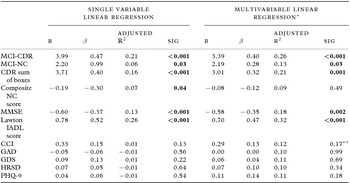
A similar pattern of predictors emerges for delirium severity as measured by DI. MCI-CDR, MCI-NC, CDR sum of boxes, MMSE, and Lawton IADL score each predict post-CABG severity of delirium symptoms after adjusting for age, gender, CCI, and years of education (Table 5). Overall, Lawton IADL accounted for the greatest degree of variance in post-operative DI scores (adjusted R2 of 0.26) with MCI-CDR status accounting for 21%. Global CDR accounted for a greater degree of variance than CDR sum of boxes (16%).
Linear regression models for predictors of post-CABG delirium severity

*Adjusted for age, sex, CCI, and years of education.
**Adjusted for age, sex, and years of education.
Discussion
MCI-CDR, MMSE, and functional status serve as predictors for post-operative delirium among NOAHS study participants. Although MCI-NC was not statistically predictive of PCD, it does predict severity of delirium symptoms on DI after adjusting for relevant baseline characteristics. The discrepancy in predictive value of MCI-CDR and MCI-NC is likely explained by differences in statistical power, particularly in view of the large 95% confidence intervals associated with MCI-NC. Sixty-one participants were included in analyses of MCI-NC whereas calculations for MCI-CDR include data from 102 participants.
Even using the more stringent literature threshold of 1.5 SD (relative to 1 SD as used in certain studies) below population norms on neurocognitive tests (Luck et al., Reference Luck, Luppa, Briel and Riedel-Heller2010), 38 of 61 participants (62%) met criteria for MCI-NC, which is significantly higher than the 26 of 102 participants (25%) with MCI-CDR. This speaks to the significant burden of neurocognitive impairment seen among patients undergoing elective CABG even when psychosocial functioning is broadly intact. The fact that MCI-CDR was more selective in identifying participants as categorically impaired may also account for its refined predictive value.
A review of baseline characteristics subdivided by both MCI definitions reveals select between-group differences, most notably age (Table 1). Participants with MCI-CDR were older than non-MCI-CDR participants whereas this pattern was not seen among those with MCI-NC. Because both logistic and linear models were corrected for age we expect that this distinction unlikely influenced the adjusted models presented. It is unclear whether the slightly increased depressive symptoms on GDS and the lower percent of current alcohol use seen among those with MCI-NC is clinically relevant.
The CDR incorporates reports of real-world functional status whereas a diagnosis of MCI-NC is based solely on neurocognitive functioning. Nevertheless, all MCI-CDR participants were amnestic-type, so one would expect neurocognitive tests to reveal these memory deficits. Put differently, no additional cases of MCI were detected by identifying mild deficits in functional domains independent of memory impairment. MCI-NC serves as a more inclusive definition of MCI in the NOAHS sample. Although the Lawton IADL score was independently predictive of PCD, whether MCI-CDR diagnosis is strengthened by its inclusion of functional domains remains unclear. Stratification by single- versus multiple-domain MCI did not appear to have any unique predictive value because power decreases incrementally with each further subdivision.
Cognitive impairment is a well-established risk factor for delirium after cardiotomy. Functional status using indices such as the Barthel Index or the Pfeffer Functional Assessment Questionnaire, though, has also been found predictive of PCD (Carrasco et al., Reference Carrasco, Villarroel, Andrade, Calderon and Gonzalez2014). Both cognitive and functional impairment attest to a broader construct of frailty that has received increasing attention of late (AGS/Nia Delirium Conference Writing Group, P. C. and Faculty, 2015). Whereas either cognition or functional decline alone serve as predictors of delirium in sufficiently powered studies, assessing both in tandem and understanding their relationship may provide a more powerfully predictive tool and more accurately reflect physiological vulnerability (Royall et al., Reference Royall2015).
Our current findings are consistent with a recent report identifying an association between baseline MCI and an increased risk of post-CABG delirium (OR = 6.33, p = 0.002) (Kazmierski et al., Reference Kazmierski2014). Both the NOAHS study and the study by Kazmierski et al. enrolled patients undergoing CABG, but they differ in several key respects with relation to the assessment of cognition and inclusion criteria. First, MCI diagnosis in the prior study relied heavily on initial screening questions from the CDR rather than incorporate full CDR evaluation by certified study clinicians as in the NOAHS study. Our current findings both replicate and extend these previous results by providing a more robust baseline evaluation. Moreover, the OR associated with MCI-CDR and incident delirium in both studies are remarkably similar: 6.3 versus 5.6. Second, formal CDR evaluation allows for clarifying MCI-CDR subtype; all MCI-CDR participants in the present study are amnestic type. CDR sum of boxes did not appear to add any predictive value beyond global CDR. Third, the NOAHS study includes neurocognitive testing, allowing for comparison of MCI-CDR with MCI-NC. Finally, delirium is included as both a dichotomous and continuous variable in the current study.
Additional features of the NOAHS study sample also deserve attention. The lower-limit age inclusion was set at 40, and the average participant age was 65 meaning that roughly half of the sample is middle-aged. Employed or retired Caucasian men comprise a plurality of the NOAHS study cohort. Overall, the sample is relatively advantaged and high-functioning, which – taken together with the dementia exclusion – suggests that as a whole participants were less vulnerable to delirium than those in many other study populations previously reported (Koster et al., Reference Koster, Hensens, Schuurmans and van der Palen2011). The current delirium incidence of 14% is toward the lower end of reported rates in the literature after cardiotomy despite daily delirium evaluation by study personnel (Koster et al., Reference Koster, Oosterveld, Hensens, Wijma and van der Palen2008).
Delirium straddles several specialties including psychiatry, particularly due to the psychiatric phenomena that accompany it; however, the interface of delirium and both psychiatric and substance use disorders remains largely unexplored. Depression and anxiety symptoms in this cohort with limited psychiatric illness were not predictive of post-operative delirium though, interestingly, PHQ-9 scores were predictive of post-operative delirium symptom severity – the significance of which remains unclear. Patients with psychotic or bipolar disorders were excluded from the NOAHS study as were those with active substance use limiting the generalizability of these results to such populations.
Notable strengths of this study include its prospective design and rigorous definitions of both MCI and delirium. The CDR is a well-validated clinical evaluation tool to diagnose MCI and dementia (Morris, Reference Morris1993). It offers a robust measure of baseline cognitive status because it draws upon an evaluation of both the participant and collateral informants. Formal neurocognitive testing at baseline also allows for juxtaposition of two definitions of MCI and their predictive value for post-operative delirium. Further, we implemented a very sensitive definition of delirium, assessing for delirium both at baseline and daily from post-operative day 2 through discharge. Although the CAM is widely used for delirium detection, it has been validated for use along with a structured neurocognitive screen such as the MMSE as used in this study. The aDST was included as an additional measure of attention because attentional deficits are a core feature of delirium. Apart from the fluctuating nature of delirium and the few post-operative delirium assessments deferred by patients, we believe we identified delirium with high fidelity.
The principal limitation of the NOAHS study lies in its observational, though prospective, design. As such, we are unable to make conclusive statements regarding causality. This is an interim analysis of an ongoing study, and therefore the findings should be considered preliminary. Delirium was included as a neuropsychiatric outcome of interest but is not the primary outcome of the broader NOAHS study; the NOAHS study was not powered to detect the signal of either MCI-CDR or MCI-NC as predictors of PCD. Further, since only 57% of current participants presented in this report completed baseline neurocognitive testing, this necessarily limits the statistical power as a delirium predictor.
Although two measures of delirium are included – both as dichotomous and continuous variables – delirium assessments were discontinued after a patient was found to be delirious. We are unable to comment on delirium duration. Also, it is unclear whether patients who scored CAM-positive for delirium would have had a higher DI score on a subsequent evaluation. We expect, though, that this would only limit the power of linear regression rather than vitiate statistically significant findings. The generalizability of the NOAHS study should also be considered. These findings do not apply to participants with pre-operative dementia, bipolar or psychotic disorders, or active substance abuse. They also do not apply to participants who have had a prior CABG.
Overall, these preliminary findings from the NOAHS study speak to a broader spectrum of cognitive reserve and frailty. Exactly how much impairment is enough to represent a risk factor for delirium remains a topic of active inquiry. To this point, the NOAHS study suggests that a categorical diagnosis of MCI on CDR represents sufficient vulnerability to the syndrome of delirium. Even single points on the MMSE and Lawton IADL score appear to have significant value in predicting post-operative delirium. These findings attest to the predictive value of MCI as a diagnostic construct and highlight the importance of functional status before CABG.
Conflict of interest
None
Description of authors’ roles
M.O. is a co-investigator of the NOAHS study, conducted the present data analysis, and drafted this manuscript. K.H. guided the NOAHS study design, proposed the neurocognitive battery used in this study, and assisted in data analysis. The cardiothoracic surgeons D. Y., M. D., and U. D. are study co-investigators and participate in post-operative study procedures. T.L. was instrumental in data coding and analysis. H. L. is the principal investigator of NOAHS and jointly with M. O. proposed the current analysis as well as guided this manuscript from conception to completion.
Acknowledgments
The study was funded by NIMH R01 (MH085740; PI: Hochang Benjamin Lee). The clinicaltrials.gov identifier is NCT01838356.