


Introduction
Russia’s invasion of Ukraine has become the largest ground war in Europe since World War II. In response to the invasion, not only has Ukraine mobilized its regular army, but many Ukrainians have volunteered to fight as civilian combatants and engage in combat alongside the regular armed forces. As in any armed conflict, adverse effects on mental health appear likely [Reference Chumachenko and Chumachenko1, Reference Ioffe, Abubakar, Issa, Spiegel and Kumar3, Reference Leon, Jdanov, Gerry, Grigoriev, Jasilionis and McKee6]. Consequently, identifying mental health issues and corresponding risk factors is important to enable appropriate evidence-based psychiatric and occupational care both during and after the war. Without basic mental healthcare, combatants may suffer from issues that adversely impact their own and the well-being of others, their effectiveness in combat, and ultimately their lives after the war.
Unfortunately, despite the importance and urgency of the topic, we do not have much scholarly knowledge or evidence that is readily applicable to the situation in Ukraine [Reference Bryant, Schnurr and Pedlar7]. This is the case for three reasons. First, the literature on the mental health of individuals participating in armed conflict generally yields mixed evidence [Reference Markova, Aliieva, Markov, Korop, Lisovaya and Babych8, Reference Pavlova, Zikrach, Mosler, Ortenburger, Góra and Wąsik9]. For instance, research has linked deployment to combat regions, participation in firefights, and witnessing deaths to adverse mental health outcomes [Reference Cesur, Sabia and Tekin10]. Similarly, a case review study indicated disparities in the prevalence of depression among veterans of the Iran-Iraq war, and the aggregate estimated prevalence was higher than it had previously been reported for military personnel [Reference Shahmiri Barzoki, Ebrahimi, Khoshdel, Noorbala, Rahnejat and Avarzamani11]. In the Ukrainian context, even before the Russian invasion, researchers suggested based on qualitative evidence that Ukrainian veterans of the Anti-Terrorist Operation (which fought Russian and separatist forces in eastern Ukraine) exhibited elevated symptoms of psychological stress [Reference Singh, Bogdanov, Doty, Haroz, Girnyk and Chernobrovkina12], including depression, isolation, anxiety, intrusive memories, difficulties with social adaptation, similar to those involved in the Chernobyl accident and veterans of the Afghan war [Reference Loganovsky, Zdanevich, Gresko, Marazziti and Loganovskaja13]. Notably, not all veterans seem to be affected equally. For instance, US war veterans in Vietnam and the Persian Gulf were 2–3 times more likely to suffer from physical and mental health issues than veterans of the Bosnian conflict [Reference Smith, Zamorski, Smith, Riddle, Leardmann and Wells14, Reference Voelker, Saag, Schwartz, Chrischilles, Clarke and Woolson15]. In stark contrast to the previously mentioned findings, some researchers found no effects of deployment on mental health. For example, being deployed to Southwest Asia, Bosnia, or Kosovo between 1998 and 2000 was not found to be linked to mental health issues in US military personnel several years after the conflicts ended [Reference Smith, Zamorski, Smith, Riddle, Leardmann and Wells14]. Similarly, deployment to the Iraq war in 2003 made no difference to the mental health of regular UK military personnel [Reference Hotopf, Hull, Fear, Browne, Horn and Iversen16].
Second, whereas most prior research focused on members of Western armed forces fighting abroad, Ukrainian combatants find themselves in a different situation. They are experiencing an invasion in their own home country, which likely represents a particularly adverse psychological shock. At the same time, they might obtain a sense of purpose by taking action to defend their country, which may serve as a protective mental function to fend off anxiety and guilt [Reference Bryant, Schnurr and Pedlar7]. It is thus likely that prior research does not translate to the situation at hand in Ukraine.
Finally, the psychological consequences of war may differ between regular Ukrainian military personnel and civilian combatants who voluntarily joined territorial defense forces. The latter are likely largely unprepared for war. In particular, the potential lack of training, experience, and self-efficacy needed to effectively fight a much larger enemy army could leave civilian combatants particularly vulnerable to stress reactions and mental health problems [Reference Bryant, Schnurr and Pedlar7]. In fact, volunteer veterans in the aforementioned Anti-Terrorist Operation in Ukraine were found to have more depression and PTSD than professional soldiers [Reference Gavlovsky17]. However, on the other hand, one could assume that voluntary participation in war may reduce the risk of developing neuropsychological consequences from such conflicts [Reference Loganovsky, Zdanevich, Gresko, Marazziti and Loganovskaja13].
Consequently, this study aims to provide early evidence of the prevalence of mental health symptoms and their risk factors among all Ukrainian combatants. In particular, we examine Ukrainian combatants based on their military status as either regular Ukrainian armies or civilian combatants. We hope this research offers preliminary evidence to help military organizations and international aid organizations to identify the mentally vulnerable combatants in Ukraine to provide timely assistance to help them to stay healthy [Reference Luykx5] despite the likely tremendous psychological pressures of the unfolding invasion.
Research in context
Evidence before this study
Using the keywords “Ukraine” and “war,” we searched major medical journals (e.g., Lancet, Lancet Psychiatry, New England Journal of Medicine, JAMA, JAMA Psychiatry, and BMJ). Several opinion pieces have been published to call attention to the crisis in Ukraine during the Russian invasion regarding physical and mental health [1–5]. However, there is no empirical evidence on the mental health of Ukrainian combatants.
Added value of this study
This study adds value by providing the first evidence of Ukrainian combatants’ mental health. It fills several important gaps: (a) there is no prior evidence on mental health in the ongoing war in Ukraine, the largest in Europe since World War II; (b) the broader literature on the mental health of combatants lacks evidence on soldiers fighting to protect their home country, and (c) there is a lack of research on how professional and civilian combatants may differ in their mental health.
Implications of all the available evidence
Our results show that anxiety and depression symptoms are elevated among Ukrainian combatants, suggesting a need for corresponding mental health and psychosocial support. We also identify various demographics as well as military status, location in active-combat or occupied areas, and personal involvement in combat as important predictors of mental health among combatants. These predictors allow military organizations as well as international aid organizations to prioritize mental health assistance for those in greatest need.
Methods
Setting
This study was conducted in the context of the Russian invasion of Ukraine, which began on February 24, 2022. We collected data through an online survey during March 19–31, 2022. We conducted the survey online to allow respondents to participate via mobile devices. The questionnaire was in Ukrainian and contained a cover page that explained the scientific nature of the study. All participants provided informed consent before beginning the survey. Ethical approval for this survey was granted by Lviv State University of Physical Culture (#1228032022). Patients or the public were not involved in the design, conduct, reporting, or dissemination plans for our research.
We targeted adults who were either affiliated with regular Ukrainian armies (reservists or active-duty personnel) or who had joined voluntary territorial defense forces as civilian combatants. Given that Russia commands a much larger and likely militarily superior conventional army, many Ukrainians volunteered to fight as civilian combatants by enlisting in such territorial defense forces. These forces can enlist any Ukrainian citizen irrespective of gender and even without prior military experience or registration with the military commissariat.
The sampling approach utilized the network of Lviv State University of Physical Culture, which provided workshops and training for Ukrainian conscripts and military personnel (including a large number of volunteers). A non-probabilistic sampling technique was used, specifically quota sampling by age, gender, and education. The quota sampling yielded a sample of 1,173 adults and asked all respondents a screening question on whether they had enlisted in regular Ukrainian armies or voluntary territorial defense forces. A total of 185 respondents were enlisted in regular Ukrainian armies (58 reserves, 46 active duty, and 7 inactive) or voluntary territorial defense forces (74). We excluded the 7 inactive respondents since they were not current combatants, and our final sample thus comprised 178 combatants.
Measures
Respondents reported their gender, age, education, marital status, the number of children living in the same household, and the number of elderly living in the same household. They also reported whether their current location was occupied by enemy forces and whether there was active fighting in their areas. We note that our data in this regard had some missing values because some military organizations prohibit their members from disclosing information about their whereabouts. Lastly, participants reported whether they were actively fighting themselves.
Respondents also completed instruments to assess the symptoms of anxiety (GAD-2), depression (PHQ-2), and insomnia (ISI). All scales are well-established in the literature, and have been translated into many languages and successfully used in many countries and contexts as shown in meta-analyses and individual studies [Reference Bastien, Vallières and Morin18–Reference Kroenke, Spitzer, Williams and Löwe20]. We followed the established back-translation procedure to design our survey. Two raters (not authors), who are fluent in English and Ukrainian, independently translated the original English survey into Ukrainian, and two other raters (not authors) independently back-translated the Ukrainian survey into English. We pilot-tested the survey with 10 Ukrainians (not part of the main sample) to receive feedback on the clarity and relevance of the measures to further establish the validity of the translated scales. Cronbach’s alphas were satisfactory for ISI at 0·80 and for PHQ-4 (i.e., GAD-2 and PHQ-2) at 0·75 [Reference Bland and Altman21]. We use the scales’ standard cut-off values to determine clinical levels of mental health symptoms.
Statistical analysis
All analyses were performed in Stata 17 at a significance level of 0·05. To identify the predictors of mental health symptoms of anxiety, depression, and insomnia, we used OLS multiple regression with robust standard errors, and report coefficients, 95% CIs, and p-values.
Results
Descriptive findings
Table 1 presents descriptive findings. Most combatants were male (78·7%), but more than every fifth was female (21·4%). Their average age was 35·4 years (SD = 13·5). About a quarter (25·8%) were on active duty and about a third (32·6%) reserves in the regular army. 42·7% of respondents were part of voluntary territorial defense forces, and thus civilian combatants. Over half of respondents (59·8%) already had experience fighting enemy forces. Mean levels of anxiety and depression were both 2·5 (SD = 1·5), not far below the cut-off (3) for clinical levels of symptoms with the GAD-2 and PHQ-2 instruments. Almost half of the respondents (44·1 and 43·0% respectively) exhibited clinical levels of anxiety and depression symptoms. The mean level of insomnia symptoms was 10·7 (SD = 1·5) as captured by the ISI instrument. 12·3% reached the cut-off value (15) for clinical insomnia. Table 1 also breaks down the prevalence of clinical levels (i.e., caseness) of anxiety, depression, and insomnia by combatants’ military status.
Descriptives for the sample of Ukrainian combatants.

Ukrainian combatants’ anxiety, depression, and insomnia symptoms and their predictors
Table 2 present the regression results on Ukrainian combatants’ anxiety, depression, and insomnia symptoms, and their potential risk factors. Male combatants exhibited overall lower levels of anxiety and insomnia symptoms than their female counterparts. Married individuals had fewer insomnia symptoms that those who were separated or widowed. Education and the number of the elderly in the household were not significantly related to anxiety, depression, or insomnia. Combatants’ number of children was negatively correlated with their anxiety and depression symptoms.
Results of regression analysis to predict anxiety, depression, and insomnia symptoms.
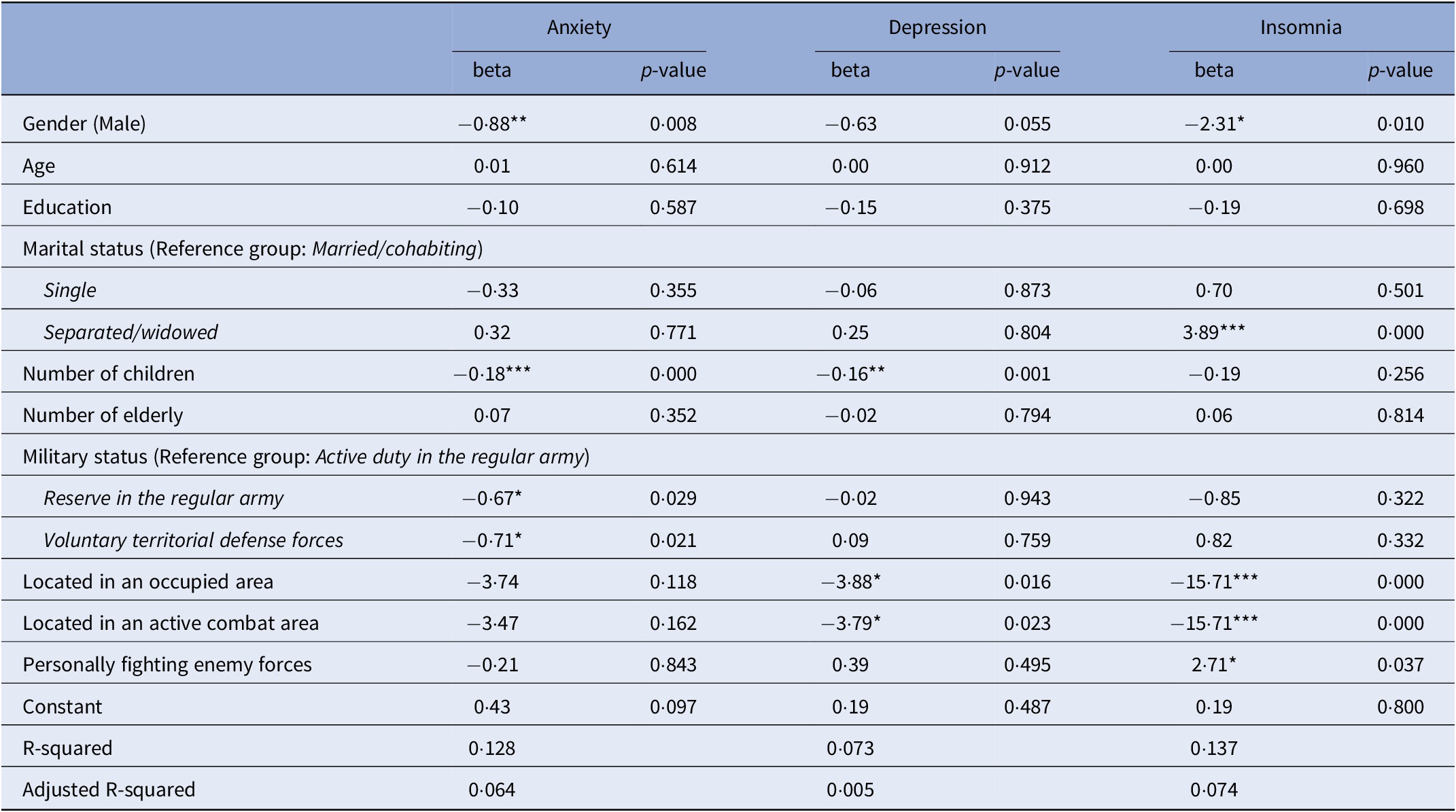
Notes: * p < 0·05, ** p < 0·01, *** p < 0·001.
Due to their low prevalence, we also conducted a robustness test excluding all observations with marital status “separated/widowed”. All results remain fully robust.
In terms of military status, compared with those on active duty in the regular army, the reserves in the regular army had lower levels of anxiety. Similarly, civilian combatants in voluntary territorial defense forces also exhibited lower levels of anxiety than those on active duty in the regular army. Combatants in Russian-occupied areas or in active combat areas had significantly lower depression and insomnia symptoms than those in other areas. Combatants who were actively fighting enemy forces themselves exhibited more insomnia symptoms than those who were not.
We also performed several preliminary additional analyses. First, we examined the relationship between combatants’ military status and mental health symptoms across locations by adding interaction terms. Those in voluntary territorial defense forces had fewer mental health symptoms than those in active duty when they were in non-occupied or non-active combat areas. However, this relationship is reversed for combatants in Russian-occupied or active combat areas, suggesting that enemy presence has a stronger adverse effect on the mental health of civilian combatants than it does on active-duty soldiers from the regular army. We also performed all analyses for the clinical caseness of the three mental health symptoms by their cut-off values using logistic regression, and the results remain fully consistent. All additional analysis results can be requested from the corresponding author.
Discussion
To the best of our knowledge, this study presents the first attempt to document the state of the mental health of Ukrainian combatants (both in the regular army and voluntary territorial defense forces) during the ongoing war. Overall, we found that a large proportion of combatants reached the cut-off values for mental disorder concerns. Our sample showed an elevated prevalence of anxiety and depression (44·1% and 43·0%), significantly higher than the COVID-19 pandemic levels of anxiety and depression using the same PHQ instrument in Ukraine (anxiety = 24%; depression = 32%) as well as meta-analytic results in Eastern Europe (anxiety = 30%; depression = 27%) [Reference Zhang, Miller, Xu, Yin, Chen and Delios22]. The level of mental health symptoms is generally higher than statistics reported in previous studies, including the recent evidence as shown in the analyses from 2020 to 2022 during the COVID-19 pandemic [Reference Chen, Zhang, Yin and Yáñez19, 22–24], highlighting the severe public health consequences of the war in Ukraine. Given that there was no prior evidence of mental health prevalence in the Ukrainian adult population, our study provides a timely and unique contribution to the previous literature.
We further gained insights into the heterogeneity of Ukrainian combatants’ mental health. Over one-fifth of combatants in our sample were female, and females showed higher levels of mental health symptoms, which is consistent with past research [Reference Chaban, Bezsheyko, Khaustova, Burlaka, Ryvak and Kyrylyuk25]. It is hence important to offer targeted mental health assistance to females and identify effective coping strategies for them. Surprising to us, combatants’ number of children was negatively related to anxiety and depression symptoms. It would have been, after all, reasonable to suspect that combatants with children would suffer more due to concerns over their children’s safety and well-being. This would also have been consistent with prior research in a non-military context, which shows that parenthood may undermine parents’ mental health via risk factors such as sleep deprivation [Reference Parfitt and Ayers26]. Yet, our evidence suggests otherwise and instead highlights not only a counter-intuitive risk factor but also an interesting direction for future research.
Regarding military status, those who were on active duty in the regular army had higher anxiety levels than those who were reserves in the regular army or those in voluntary territorial defense forces. Our regression analysis shows sizeable differences in the levels of mental health symptoms. For instance, the level of mental health symptoms is 0·67 and 0·71 points higher for those who are on active duty in the regular army compared to combatants in the other military status groups. These predicted differences are quite large for the anxiety score, larger in fact than the gap between the mean level (2·5) and the cut-off value (3) of the anxiety scale. This finding suggests that military and international aid organizations should prioritize combatants on active duty in the regular army for mental health assistance. Notably, this evidence on the mental health status for different types of active combatants goes beyond prior research, which mainly examined the mental health of veteran soldiers [Reference Gavlovsky17]. However, we note that our further analysis shows the limits of only considering military status because the risk factors of mental health symptoms of combatants may depend on the specific situation. Our additional analysis reveals that civilian combatants’ mental health is even worse when they are in more adverse situations, such as in Russian-occupied or active combat areas. However, these analyses must be considered preliminary given the small sample size of participants in Russian-occupied or active combat areas in the early stage of the war. This evidence thus only highlights a potential direction for future research.
Taken together, our results show that mental health symptoms are highly prevalent among Ukrainian combatants, and that risk factors, in particular military status, can help identify and prioritize aid. This is critical given evidence on the efficacy of coping strategies as early interventions for military personnel [Reference Bryant, Schnurr and Pedlar7] and the limited resources currently available in the Ukrainian medical system [Reference Leon, Jdanov, Gerry, Grigoriev, Jasilionis and McKee6]. Military organizations may thus wish to anticipate their members’ mental vulnerabilities and prepare or manage them to prevent them from becoming serious issues that affect individual and societal outcomes. This is particularly relevant considering the fact that combatants may not actively seek mental health counseling for fear of stigmatization [Reference Heyman, Slep, Parsons, Ellerbeck and McMillan27]. Similarly, international aid organizations may use our first-hand evidence to prioritize their offerings in an evidence-based manner [Reference Chen, Zhang, Yin and Yáñez28].
Limitations and future research
Our study has several limitations. First, our survey was voluntary, and combatants in particularly severe war situations might have been less likely to respond to our survey in the first place. Second, combatants in occupied or active combat areas were probably less likely to report their locations due to military restrictions on information disclosure. As the variables “located in occupied areas” and “located in areas of active fighting” had missing values in such cases, corresponding observations had to be discarded from the analyses and such combatants might thus be underrepresented in our sample. Third, all combatants in our sample were involved in the same war, fighting for the same side. It might thus be important to replicate our findings in other armed conflicts. Fourth, we acknowledge that the explained variance in our dependent variables is fairly limited. This further highlights the need for replications of our study.
Conclusion
It is a brave yet mentally taxing act to defend one’s own country. To the best of our knowledge, this study is the first to assess the prevalence of anxiety, depression, and insomnia symptoms of combatants in Ukraine’s regular army and voluntary resistance groups. Our findings identify several predictors, giving psychiatrists and healthcare organizations evidence and insights to better identify more vulnerable sub-populations and to deploy mental health assistance in a targeted way.
Data Availability Statement
Data are available from the authors upon request.
Author Contributions
Conceptualization: I.P., L. G.-V., S. X. Z.; Data curation: S. X. Z.; Formal analysis: S. X. Z.; Investigation: I.P., L. G.-V., P.P., S.W., S. X. Z.; Methodology: S. X. Z.; Resources: I.P., L. G.-V., P.P., S. X. Z.; Supervision: L. G.-V., S. X. Z.; Writing—original draft: S. X. Z.; Writing—review & editing: I.P., L. G.-V., S.W., S.X.Z.
Conflicts of Interest
The authors declare none.


 Open access


Comments
No Comments have been published for this article.