Encounters between state authority and religious resurgence are an abiding interest in studies across Asia. Despite much productive work and a diversity of scholarly perspectives, I identify certain limitations common in conceptualizations of state authority, especially in discussions of authoritarian regimes. To complement and extend existing work, this paper proposes the notion of “ritual governance” to highlight the significance of interlinked, but flexible, sacred and secular rituals used by state representatives in their interactions with other citizens. The notion of ritual governance extends the usual focus on centralized, formal institutions as definitive of authoritarian states, to encompass the diverse, locally specific practices of state representatives. In doing so, it also addresses a persistent scholarly tendency to separate analyses of sacred and secular domains, especially the realms of religion and development. These conceptual points are highlighted with particular reference to the Southeast Asian literature, and then illustrated through an ethnographic study of ritual practices by government officials working as part of a major development project in rural Laos.
Scholars of religion, culture, and politics in Asia have long examined the production of moral authority through the refashioned use of religious ceremonies and rituals (e.g., Geertz Reference Geertz1980; Pye Reference Pye1985). This interest is currently acute for authoritarian states since they lack the legitimizing tools of democratic regimes. Hence, Schober (Reference Schober and Skidmore2005, 114) highlights the importance of Buddhism in Burma prior to recent reforms, arguing that: “In the absence of secular means of legitimation – for instance, a national constitution, a parliamentary process and independent civic institutions – there is a great need for public legitimation to sanction moral and political authority” (see also Alagappa Reference Alagappa1995; Keyes, Kendall, and Hardacre Reference Keyes, Kendall and Hardacre1994; Willford and George Reference Willford and George2005). Likewise, state authority is often emphasized as crucial to understanding religiosity in studies of socialist Asia, where revolutionary leaders initially sought to move their nations from past religiosity to a future of secular authority, and later sought to control subsequent religious resurgence (e.g., Borchert Reference Borchert2008; DiGregorio and Salemink Reference DiGregorio and Salemink2007; Evans Reference Evans1998; Taylor Reference Taylor2007; Yang Reference Yang2008). Alternatively, some scholars point to the overwhelming significance of the modern neoliberalizing global economy for prompting varied forms of religious resurgence, which national authorities may then attempt to harness. For instance, Rudnyckyj (Reference Rudnyckyj2009, 131) suggests that in the case of Indonesia, “the economy is increasingly defined in transnational rather than domestic terms,” and this economic trend is crucial for understanding modern religious practice more generally.
In contrast to such studies, recent reviews of religious resurgence in Southeast Asia have argued that there has been an overemphasis on top-down political and economic processes with minimal consideration of other more localized, interpersonal dynamics. Hefner (Reference Hefner2010, 1031) thus highlights the divide in explanatory themes between “the macro-narratives of the state, capital, and democratization [that] often give insufficient attention to the micro- and meso-passions of self, family, and neighborhood.” Similarly, in the case of Theravada Buddhist countries of mainland Southeast Asia, McDaniel (Reference McDaniel2010, 657, 659) asserts that “the power of the state . . . [over religious expression] is often over-emphasized” and that there is a “need to temper macro-sociological speculative analysis with explanations and actions of individual agents.”
I argue that both perspectives—those attending to macro processes linked to religious resurgence and their recent critics who emphasize more personalized processes—often coincide, and are limited in their comprehensiveness, by common assumptions about state authority. Quite simply, centralized control and formal institutions are implicitly taken as definitive of the engagement of authoritarian states with religiosity. Thus, “ordinary people” (Hefner Reference Hefner2010, 1043) are seen as possessing localized interests that prompt a wide range of creative religious motivations and practices, but such diversity is rarely discussed in relation to representatives of authoritarian regimes. Central institutions certainly demarcate the bounds of acceptable religious practice under authoritarianism, but government officials in diverse situations often have the capacity and need to improvise in their personal interactions and religious practices. In contrast to the common tacit assumption that state authority represents a macro dynamic, this paper emphasizes more ambivalent and less coherent ritual practices by state representatives in rural Laos. The notion of “ritual governance” is proposed as a means to highlight how state authority is an amalgam of centralized institutions and decentralized practices that can meld the sacred and secular in varied, innovative, and personalized ways.
As an illustration of ritual governance, this paper presents an ethnographic case study of interlinked sacred and secular rituals that are common in state-led development activities in rural Laos: baci ceremonies and village meetings. Despite being very common religious and bureaucratic practices in Laos, these rituals have yet to be recognized as interlinked and mutually reinforcing dimensions of state authority. The case study examines state-sponsored rituals organized by officials working in remote ethnic minority villages as part of a nationally significant development project, the Nam Theun 2 (NT2) hydropower scheme. Before moving to this case study, I discuss in more detail the notion of ritual governance and how it adds to the literature. Most importantly, ritual governance prompts a more rigorous and comprehensive approach to conceptualizations of state authority in discussions of religious resurgence in Asia. This is highlighted in two ways in this paper.
First, I seek to expand on the usual top-down approaches to authoritarian governance by emphasizing the insights gained from micro and meso studies of state representatives working outside capital cities. Standard accounts of authoritarianism from comparative political science emphasize the overriding importance of centralized institutional structures that coordinate the “coercive apparatus” through “elite collective action” (Slater Reference Slater2010, 3–5; see also Scott Reference Scott1998). In Laos, for instance, the central government limits civil society and monitors the public sphere, while citizens express “fearing the government” and regulate their expressions in accordance with state demands (Singh Reference Singh2012; Stuart-Fox Reference Stuart-Fox2004). Similarly, in studies of state religion and other national icons, the notion of “national ritual” is usually taken to entail centralized programmatic planning, coercive control over performances, exclusion of socially marginal groups, and the national spectacle of the “theatre state” (Geertz Reference Geertz1980; see also Bowie Reference Bowie1997; Creak Reference Creak2010; Evans Reference Evans1998; Kong and Yeoh Reference Kong and Yeoh1997; Pye Reference Pye1985; Schober Reference Schober and Skidmore2005; Tappe Reference Tappe2011). Ritual governance adds to such studies by also considering how rituals are used for purposes of government. But, rather than emphasize the ritual structure and content for the purpose of making a nation and national identity, as in the case of national ritual, ritual governance takes the exercise of authority as the focus for analysis. This approach also counters the tendency to take centralized institutional controls alone as definitive of authoritarian governance.
Theoretical works have long highlighted that state authority is more than the sum of centralized, formal institutions (e.g., Abrams Reference Abrams1988), but such insights continue to be under-recognized. Anthropologists suggest that the visibility of authoritarian controls results in these gaining much attention and the consequent eclipse of grounded social relations (e.g., Li Reference Li2005. Scholars of Southeast Asia also recognize this tension between government institutions and practices as continuing to characterize work of authoritarian states in the region (Nishizaki Reference Nishizaki2007; Singh Reference Singh2011, Reference Singh2012). In a recent review of works on the Burmese state, for example, Leider (Reference Leider2012, 369) concluded that “contemporary academic publications . . . share a practice of representing and evaluating the social, cultural, and political realities . . . mostly through the top-down prism of authoritarian political conditions,” and argues for more attention to more socially grounded conditions. Such an approach is particularly important for understanding relations between officials and citizens in rural areas where centralized institutions are limited (such as education, media, and the bureaucracy). Hence, as a complement to the understanding of central institutions, increased attention to the personalized and context-specific practices of officials at various bureaucratic levels is crucial for a fuller understanding of how authoritarian states actually govern. I suggest ritual governance provides a means to achieve this by taking seriously the flexible, creative, and personalized practices of officials in their interactions with other citizens, in addition to the constraints and opportunities presented by central institutions.
Second, ritual governance recognizes that the decentralized practices of state agents can incorporate both the sacred and secular as interlinked domains. While religion is recognized as politically important in countries where national authorities are tightly linked to specific religions, scholars of religion have noted a persistent tendency in the literature to separate analyses of the sacred and secular (Cady and Simon Reference Cady and Simon2007, 7; Rudnyckyj Reference Rudnyckyj2009, 107). This tendency is linked to overly narrow conceptualizations of state authority, which, as outlined above, fail to fully consider how government is achieved on the ground. Here, I focus on the intersections between religious ritual and development projects in rural Laos. While village meetings are a well-recognized ritual in development (e.g., Hinton Reference Hinton, Wijeyewardene and Chapman1993; Singh Reference Singh2009), the baci ritual is more locally specific. Notably for the Lao case study, the baci ritual was politically unacceptable during the early socialist regime, but reemerged as a national ritual as state ideology moved to embrace modern developmentalism (see below). Despite such intersections, religion and development are nearly always studied separately—religious scholars study monks, Buddhist institutions, and ethnic minority traditions, while development scholars study poverty alleviation projects and the rural poor. Such disciplinary focuses are understandable, but result in a lack of attention to how religiosity and development intersect in the production of state authority.
Significantly in Laos and elsewhere in Asia, economic development frequently provides the material and discursive means for representatives of authoritarian states to engage with the populace and construct the institutions and the idea of the state. Development has dominated national agendas of varied political regimes, providing a rationale for authority, linking with historically enduring concerns about progress and civilization, and encouraging social mobilization through “the nationalist incitement to development” (Woo-Cumings Reference Woo-Cumings1999, 4; see also Li Reference Li2007; Tennekoon Reference Tennekoon1988). These trends have supported the emergence of the “developmental state,” where state authority is intimately linked to modern forms of economic development. In Laos and its socialist neighbors, the narrative of development through revolutionary struggle, communist solidarity, and a centralized economy has been supplanted since the 1980s by a narrative of development through economic growth and market liberalization to combat poverty (Stuart-Fox Reference Stuart-Fox2004).
Development could readily be taken as another tool in the arsenal of authoritarian states. This is a persuasive view in studies of ethnic minorities in Southeast Asia (e.g., Duncan Reference Duncan2008, 7) and finds support in Laos with the marked social divides between state representatives and ethnic minority villagers (see below). Yet, “prosperity” (chaleun) is also a potent social ideal in Laos, which emphasizes the alluring possibilities of modern development and stands in stark contrast to past socialist appeals to austerity and communalism. The ideal of prosperity often motivates rural villagers to seek greater engagement with state authorities despite the failure to achieve participatory forms of development, as in the case of NT2 (Singh Reference Singh2009), and marginalized officials often remain committed to the Lao state though they echo villagers in their private criticisms (Singh Reference Singh2011, Reference Singh2014). In this context, the Lao state not only produces authoritarian institutions, it also offers promises for prosperity and benevolent patronage through personal interactions of citizens with state representatives. Significantly, prosperity is not a purely secular notion linked to development, it is an ideal also tightly linked to religiosity (e.g., Kitiarsa Reference Kitiarsa2005). Hence, a fuller understanding of state authority, in Laos and elsewhere in Asia, requires more sustained attention to the varied interweaving of the sacred and secular, including religion and development.
I suggest the notion of ritual governance provides a means to take state authority as comprised of centralized institutions and the personalized deployment of more nebulous, but hugely significant ideals like prosperity through the use of religious and bureaucratic rituals. In doing so, ritual governance challenges us to examine more explicitly about how power is exercised by authoritarian states. My case study from Laos also entails a disruption of common assumptions of “periphery” and “center” as sites of “traditional” and “national” rituals as I consider unpublicized rituals organized by Lao officials in a remote village for an audience of ethnic minority villagers. Rather than take such practices as an exception that deviates from centrally planned norms, I consider these to be crucial to understanding the modern Lao state and its relations with religiosity. These arguments are relevant not only for other Theravada Buddhist countries, but also to other authoritarian regimes in Asia where religion has been variously entangled with state authority. The following sections examine: first, the baci ritual and its changing acceptability in Laos; and second, the political and social dynamics revealed when a baci featured alongside a village meeting during the visit of senior officials to a remote ethnic minority village in the Nakai–Nam Theun National Protected Area (NPA) as part of the NT2 project.Footnote 1
Baci Rituals in Post-Socialist Laos
This section outlines the flexibility of the baci ritual, its relations to Buddhism, and its shifting social and political acceptability in Laos. My aim is to contextualize the subsequent discussion of the contemporary use of baci rituals as part of development projects by Lao government officials.
The baci ritual is an important ritual of various ethnic groups in mainland Southeast Asia that draws on spirit propitiation. In Laos, the baci is also called the “invitation to the souls,” su khwan, or more simply “tying the arm,” phuk khaen; in Thailand, it is known as riak khwan or tham khwan. Hayashi (Reference Hayashi2003, 111, 155) describes how “the main purpose of the ritual is to strengthen people's khwan” and “invoke spirits and blessings.” A human body is thought to harbor thirty-two khwan, and only when all are present will an individual have well-being. The concept of khwan has been variously rendered as “spirit essence” (Tambiah Reference Tambiah1970, 223), “soul” (Ngaosyvathn Reference Ngaosyvathn1990, 285), “vital essences,” and “a metaphor for one's vitality and energy in this life” (Hayashi Reference Hayashi2003, 111, 156). Khwan are not “spirits” (phi), but they do shape one's relations with spirits (Eberhardt Reference Eberhardt2006; Hayashi Reference Hayashi2003, 156). By supporting one's khwan through a baci, recipients hope to achieve “a happy state of mind, prosperity and good health” (Tambiah Reference Tambiah1970, 228).
In Laos today, baci may be performed in a huge range of styles and social settings, including: state events (e.g., Vaenkeo Reference Vaenkeo2010); development projects (for example, villagers, officials, and foreign consultants often celebrate the start and end of a project); annual festivals (for example, Lao New Year); and family-oriented life events (for example, marriage, illness, a journey, or graduation). As Evans (Reference Evans1998, 78) remarks, the baci demonstrates a “[striking] mediating role . . . between several realms of belief and across ethnic boundaries.” Generally, at a baci ceremony, an elder invites khwan of all to return if they are wandering, bestow well-being and prosperity on their hosts, and share in a feast. Offerings of food and alcohol are presented on a tray with a centerpiece made of folded banana leaves decorated with flowers. Auspicious white cotton thread that adorns the centerpiece is used to tie wrists and thereby strengthens the binding of khwan to the individual. Family and friends gather together and take turns tying threads around the wrists of recipients while wishing them blessings. Recipients then reciprocate, and participants also tie the wrists of each other. The baci ritual demonstrates how material and spiritual well-being is seen to derive from one's social relationships (Tambiah Reference Tambiah1970, 230).
In Laos, the baci ritual is now officially presented as a vital part of Buddhist practice where Buddhism is definitive of Lao culture and tradition. For instance, the sixth congress of the Lao People's Revolutionary Party (hereafter, “the Party”) declared in 1996: “Buddhism is the institution which preserves and maintains customs and traditions that constitute the identity and priceless cultural heritage of the nation” (Khaosan Pasason Lao 1996, 30). And the baci ritual is seen as “an integral part of Lao culture” (Ngaosyvathn Reference Ngaosyvathn1990, 283). Yet, the baci derives from and incorporates spirit beliefs that predate the arrival of Buddhist doctrine in mainland Southeast Asia (Kitiarsa Reference Kitiarsa2005, 472). Throughout Laos's history, unification of Buddhism and beliefs about spirits has occurred alongside attempts to eradicate spirit cults, as well as periods of spirit cult revival (Grabowsky Reference Grabowsky and Harris2007; Halpern Reference Halpern1958). After the 1975 revolution, the early socialist state “urged” monks “to purge Buddhism of . . . superstitions” (Stuart-Fox Reference Stuart-Fox1996, 78). Despite such attempts, religious practices and beliefs in Laos exist as an interweaving of Buddhism and spiritualism that often cannot be clearly separated (e.g., Grabowsky Reference Grabowsky and Harris2007; Holt Reference Holt2009).
This means that the recent political fortunes of the baci ritual reflect that of Buddhism more generally. In the years immediately following the revolution, there was “a reorientation of state ritual away from religion towards purely state-based secular rituals” (Evans Reference Evans1998, 57; see also Stuart-Fox Reference Stuart-Fox1996). As in neighboring socialist states, Lao authorities sought to suppress religious expression in a quest for secular, socialist progress. The undesirable connotations of baci rituals, in addition to ideas about spirits, included associations with royalty and ostentatious public consumption (Evans Reference Evans1998, 58). High-ranking government officials, for example, formerly showed their loyalty to the Luang Phabang royalty in annual baci ceremonies (Ngaosyvathn Reference Ngaosyvathn1990, 291). The socialist Lao state was not to be defined by such rituals. The persistence of baci during the early socialist period, argued Mayoury Ngaosyvathn (Reference Ngaosyvathn1990, 299), was due to its exclusion from national politics and confinement “to familial or domestic and local community levels.” In retrospect, strict restrictions on Buddhist religious expression were transient in Laos. Evans (Reference Evans1998, 64, 78, 67) describes the gradual changes, from the separation of political and religious funerals for leading political figures in 1978, to an indirect legitimization of baci rituals in 1980 by Lao newspapers reporting about senior officials attending such a ceremony, and finally, a public reintegration of state and Buddhism after the fall of communism in the former Soviet Union. Reflecting the institutional and personalized dimensions of authoritarian engagements with religiosity, religious revival in Laos has been attributed to improved socioeconomic conditions as well as the “accumulating existential crisis within the Lao leadership” (Evans Reference Evans1998, 63).
Despite easing restrictions and the establishment of constitutional rights to religious freedom in 1991, religious discourse and practice in Laos remain strongly influenced by state ideology. This was apparent when an ethnic Lao resident in the Nakai District center told me: “In the past, maybe 150 years ago, then there was spirit religion [satsana phi], now there is only Buddhism and respecting parents' spirits.” Similarly, an article in a state-owned newspaper quoted officials' plans to “eradicate old and out-of-date culture such as when villagers are sick and turn to the spirits; now they will turn to hospitals” (Pongkhao Reference Pongkhao2005). This is a statement of what ought to be in the state's view rather than what actually is—evident in the fact that the baci is a very common response to illness in Laos. In addition, religious ritual like the baci can rouse criticisms of extravagance and profligacy. Though especially strident during the early socialist years when austerity was valorized, current state discourses target ritual wastefulness as a cause of poverty. For instance, another newspaper article, accompanied by a line drawing of a baci, asserted that “frequent ceremonies are a main cause of poverty among Lao people, [but] no one has done anything to stop them” (Khammaloavong Reference Khammaloavong2003). This is even though state leaders regularly hold baci rituals for nationally significant occasions (e.g., Vaenkeo Reference Vaenkeo2010). Such statements reflect state rhetoric that targets the “backward,” “superstitious,” and “wasteful” spirit beliefs of ethnic minorities, in contrast to the idealization of the state religion of Buddhism as national tradition (Evans Reference Evans1998; Evrard and Goudineau Reference Evrard and Goudineau2004; Pholsena Reference Pholsena2006; Sprenger Reference Sprenger2009; World Bank 2003).
The diverse and contradictory religious, social, and political values associated with the baci highlight the considerable flexibility of this ritual as well as the historical vagaries of state ideology as socialism gave way to modern developmentalism. I suggest that the contemporary resurgence of baci rituals as an integral part of state practice in Laos presents an ideal opportunity to consider the salience of ritual governance. Significantly, while scholars recognize that all state-sponsored ritual is political, there has been little scholarly discussion of how religious practice in Laos intersects with the state's now-dominant ideology of development.
Developing the State in the Rural Periphery
Here, I consider the significance of certain religious and bureaucratic rituals that Lao officials organized as part of their work with ethnic minority villagers on the NT2 hydropower project. Despite the voluminous documentation on NT2, there is no attention to the role of state-sponsored ritual, especially for rural governance. I suggest that an interrogation of these rituals in necessary to gain a more complete understanding of the Lao state, its links to religious resurgence, and what authoritarian governance looks like in practice.
In Laos, Nakai District is synonymous with the US$1.45 billion, World Bank-supported NT2 hydropower project. Formerly, Nakai was part of the Ho Chi Minh Trail, site of a reeducation camp and central in the nation's largest state-owned forestry enterprise. This district was to be transformed from an upland site of backwardness and poverty to deliver prosperity to the entire nation (Singh Reference Singh2011, Reference Singh2012). Although officially commencing in March 2005, NT2 was at the forefront of the Lao state's development aspirations for over two decades as well as being emblematic of highly politicized development. The latter requires some explanation, since two international dynamics influenced interactions between Lao government officials and ethnic minority villagers in the Nakai–Nam Theun NPA during my fieldwork.
First, NT2 was promoted internationally by the World Bank as a model of responsible large-scale infrastructure development. The Nakai–Nam Theun NPA, which covers much of Nakai District, was especially important for the mitigation of environmental impacts (WMPA 2005). The World Bank consequently required the Lao government to fulfill a range of conditions pertaining to the environmental and social management of the NPA.Footnote 2 This entailed an emphasis on local participation that is unusual for hydropower projects in Laos (Singh Reference Singh2009). Additionally, the World Bank required a new government agency to be established to manage the Nakai–Nam Theun NPA—the Watershed Management and Protection Authority (WMPA). Though the WMPA was legally declared in 2001, its activities in Nakai started after the formal commencement of NT2 in 2005 when it gained substantial financial resources (US$1 million annually for thirty-one years).
Second, management of the Nakai–Nam Theun NPA was politicized by its location adjoining the Vietnamese border. Laos has been a close socialist ally of Vietnam since their revolutions in 1975. Yet, WMPA officials privately expressed concerns about the large numbers of Vietnamese entering the Nakai–Nam Theun NPA for trade with villagers and illegal resource harvesting. The WMPA was also concerned about some villagers choosing to move out of the NPA to more accessible areas in Nakai and the effects this could have in exacerbating the illegal cross-border exploitation of extremely valuable natural resources. Thus, one senior WMPA official told me, “I always tell my staff that they must participate with villagers, like what the Vietnamese do. . . . If there are no villagers then Vietnamese will take everything!” This situation prompted the WMPA to focus on building personal relationships and delivering development to remote villages inside the Nakai–Nam Theun NPA (see also Singh Reference Singh2014).Footnote 3
Thus, the establishment of the WMPA to manage the Nakai–Nam Theun NPA was a requirement of the World Bank for NT2, and the WMPA's approach to development in the NPA was strongly influenced by concerns over illegal resource harvesting by Vietnamese people. These international dynamics prompted a locally significant visit by two senior district officials to a village in the NPA in late 2006, which is examined in the following section. Below, I describe the social divides between villagers and officials, and the sacred and secular rituals that were performed during the visit. The village I refer to pseudonymously as “Dao Village” had about sixty households of the Brou (Mon-Khmer) ethnic minority. As part of the official visit, a baci ritual and a village meeting were held in Dao Village, both events being organized by district officials. While the village meeting constituted the formal purpose of the visit and was marked by hierarchy and coercion, the baci ritual provided a remarkable contrast where interactions between senior district officials and ethnic minority villagers were marked by unity and persuasion. Officials practiced a baci ceremony alongside a village meeting as a means to manage stark social divides and the politics of the NT2 project, and thereby illustrate the significance of ritual governance for the developmental Lao state.
Social Divides between Officials and Villagers
The following outlines the considerable social divides between government officials and ethnic minority villagers in Nakai, which not surprisingly persisted despite the World Bank promoting NT2 as a model of participatory development (Singh Reference Singh2009). While the personal visit made by senior officials to remote villages signified a meaningful commitment to engaging with villagers, the divides between these social groups were at the forefront of all interactions and provide a context in which ritual governance assumes particular importance.
The two senior officials stayed for a single night in Dao Village as part of a three-day trip, spending one night in each of the NPA's three administrative “zones” (khet). One of these senior officials was the Nakai District governor who was always referred to by his position, chao muang. The second was the director of the Nakai office of the WMPA, who was referred to with his name and the prefix hua-na, meaning “boss.” I refer to them as the district governor and the WMPA director respectively. The WMPA director was unknown to villagers who did not know of the existence of the newly functional WMPA and its jurisdiction over the NPA in which their village was located. The district governor was a widely recognized authority, and hence he had come to personally introduce the WMPA.
Neither of the honored guests had previously visited Dao Village, despite being in their respective positions for over three years. Like most government officials in Nakai, the district governor and WMPA director were ethnic Lao who had their families and homes in lowland areas and only came to Nakai for their work (Singh Reference Singh2011). The WMPA director told me he had previously visited a couple of villages in the NPA, but that was by helicopter with World Bank delegations during the planning stages of NT2. During the village meeting, the district governor mentioned a similar experience. Although Dao Village was relatively accessible compared to other villages in the NPA, it still took a day of traveling by boat and walking to reach the village from the Nakai District center. So, this visit represented an unusual situation of senior district officials visiting a remote rural area for their first time. The district governor later explained to me the significance of their visit: “I am very busy, but it is good for villagers to see the elites [phu nyai]. Then they know it is important.”
When the visit of the district governor and WMPA director was confirmed by shortwave radio two days before their arrival, there was a palpable sense of excitement among other officials who were already in Dao Village. Furthermore, not only were the district governor and WMPA director coming to Dao Village, over forty district officials had stayed in or passed through the village on their way to conduct surveys and establish village committees that would liaise with the WMPA in the future. The sense of anticipation that state-led development was coming to this remote area was strongly evident. Yet, the discourse of national development and shared desires for prosperity in Laos suggests a unity that is questioned by an array of social, political, and economic inequalities. For instance, ethnic Lao residents in the Nakai District center often dismissed spirit beliefs and asserted the dominance of Buddhism (see above), whereas a villager in Dao Village explained that about half the village residents were Buddhists and half followed “spirit religion.” Similarly, in awareness-raising activities, officials often told participants in Dao Village to speak their own language if they wanted, in line with training they had received and donor-influenced WMPA policies. But when I talked with the district governor about language issues for villagers in the NPA, he said sternly: “Everyone understands Lao! They are Lao people, they must know Lao language.”
Relations between villagers and government officials in Laos have long been characterized as ambivalent and often marked by distrust and contempt (Halpern Reference Halpern1958, 90, 120–30). These tensions were very apparent in Nakai, where the vast majority of government officials are ethnic Lao from the lowlands while villagers are mostly Mon–Khmer ethnic groups.Footnote 4 Nakai was seen by government officials as an undeveloped upland area carrying all the undesirable social connotations of backwardness associated with the rural countryside (Singh Reference Singh2011). Furthermore, project reports suggested that villagers in the NPA were quite suspicious of outsiders, seeing them “as a potential source of trouble or danger for the village” (Culas Reference Culas2001, 19). This suspicion arose in part because of historical experiences with deportation by Siamese armies in the nineteenth century and the effects of the Indochina wars in the twentieth century. Additionally, villagers' recent experiences with a largely ineffectual World Bank-funded project were far from positive. The chief technical adviser admitted that “target villagers considered the Project as a threat to their traditional means of subsistence” (World Bank 2003, 1). Thus, a range of historical and contemporary experiences with wars, social marginalization, and failed development projects contribute to villagers' mistrust of officials.
The social divides between villagers and officials were enacted physically and socially in Dao Village. The earlier World Bank-funded project built a small primary school and health station about 100 meters away from the housing area of the village and, next to that, a dormitory building for government officials that was referred to by them as the “camp.” A fence between the two areas clearly demarcated a physical separation between the space of the village and the space of the state. During the week I stayed in Dao Village, villagers rarely came to the camp unless they wanted to sell forest products to officials or were being organized as porters, and officials rarely went into the village when their work was finished unless they wanted to buy foodstuffs from villagers. Though there were no pronounced distinctions in housing quality between the camp and the village, there was an implication of inferiority associated with camping out in a remote village compared to officials' homes. I was fortunate to work with a WMPA official who was an exception in that he regularly ate with villagers and slept in their homes, and it was because of him that I could do the same during my stay. Most officials, however, restricted their socializing to other officials.
The divides between villagers and officials were very much apparent in the social interactions during the visit of the two senior district officials. While the visit of the district governor and WMPA director to villages in the Nakai–Nam Theun NPA was a significant occasion, these senior officials spent most of their time in the camp with their subordinates, so there was actually little opportunity for interaction between them and villagers. When the district governor and WMPA director first arrived in Dao Village, villagers were organized by village leaders as porters to collect gear and supplies from the boats, including impressive piles of new mattresses, pillows, and blankets for the guests. After setting up at the camp, a few senior district officials went with the district governor and WMPA director to show them the village. They returned just fifteen minutes later. The senior officials then sat on the small veranda of the camp dormitory looking out to Dao Village while their subordinates sat looking up at them from their seats on the ground, listening to their conversation and laughing at their jokes. Junior officials then prepared the dinner at the camp, to which only one villager was invited. Not surprisingly, he had the closest connections to the Lao state as the head of the nine villages in the zone (hua-na khet) and the zone Party secretary (lekha phak), and his son was the village headman (nai-ban) of Dao Village.
Together, all these personal dynamics confirm that the visit by senior officials was not about completely removing social divides, but rather about managing existing hierarchies. The stark social distinctions between villagers and officials underpinned the two forms of ritual interactions that took place later in Dao Village—the baci and the village meeting.
A Baci Ritual and a Village Meeting
The baci and village meeting in Dao Village vividly illustrate how different rituals were used by officials to enact different political and social ideals in their work with villagers. Given the social divides outlined above, such widely recognized sacred and secular rituals offered an effective means for officials to manage their interactions with villagers while they undertook the personal village visit that was necessary to advance their own governance objectives.
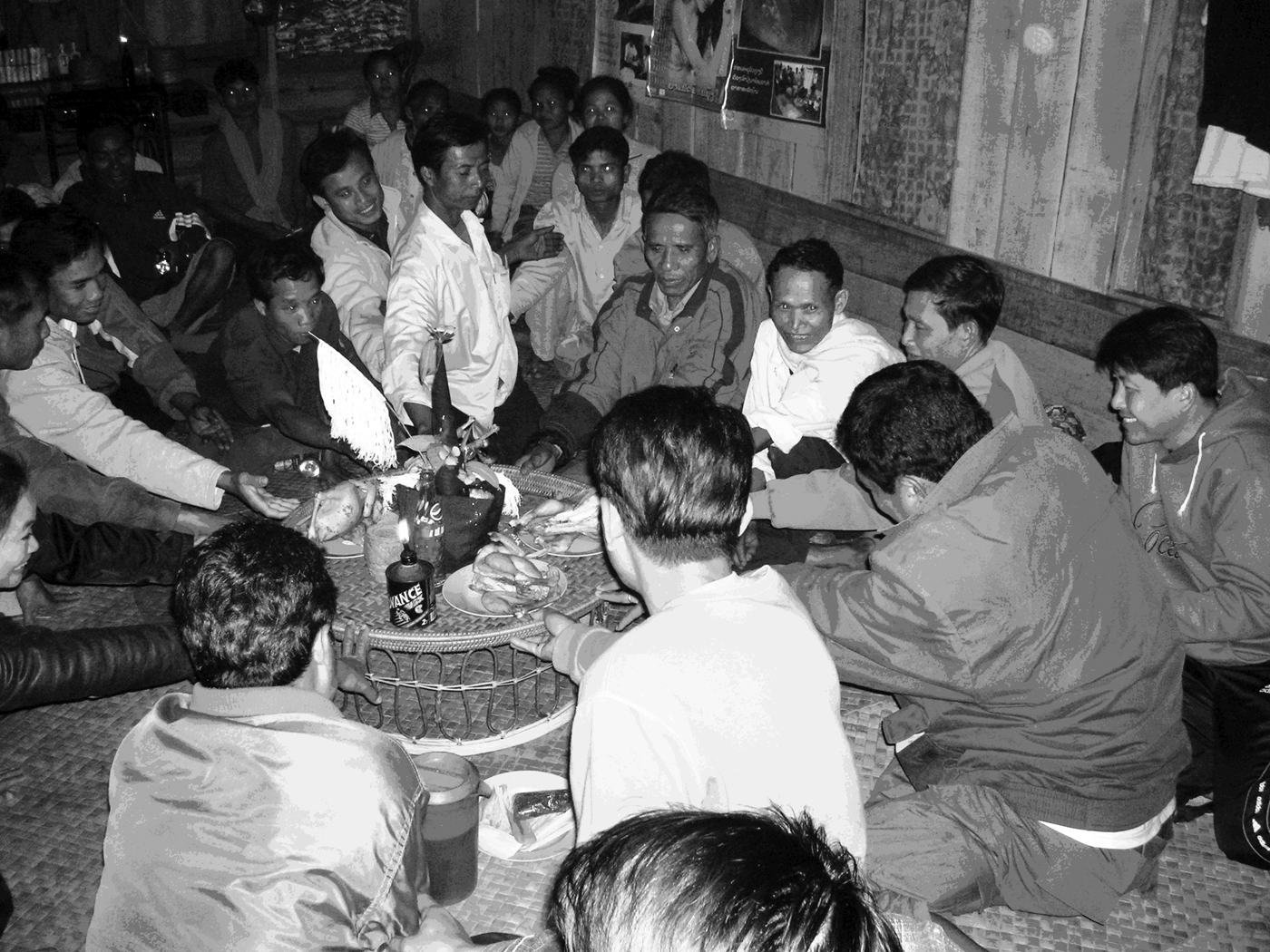
Preparations for the baci started a few hours before the event. The baci was held in the largest house in Dao Village, which was owned by the village's main trading family, so that all the guests could be comfortably seated. I went with a WMPA official in the early evening, with a couple of officials arriving soon after, most sitting together on the floor in the main room of the house, while a few village women cooked food in the kitchen. Officials watched the arrangements in the main room and at times gave advice. For instance, a couple of officials advised on how to rest the banana leaf centerpiece, and another commented on the little adorned arrangement and the lack of a baci “teacher” (achan su khwan) in the village. Another official then instructed the head of the zone in practicing the names of the district governor and WMPA director so they could be welcomed appropriately. More villagers and officials gradually arrived. And finally, after some time of waiting, the district governor and WMPA director arrived with their entourage of subordinates. The honored guests were seated at one end of the room, with most villagers at the opposite end, and in between were lower-ranking officials and village elders. Villagers were very curious about these important guests, but also relatively relaxed. Thus, one elderly villager could not restrain his humorous, though somewhat impolite, exclamation loudly in Lao language over the thinness of the WMPA director that was in distinct contrast to the large belly of the district governor, which was followed by laughter of some other villages. Officials studiously ignored this joking, indicating their tolerance of the ritual's informality.
An elderly woman who was the village representative of the Lao Women's Union offered the first greeting while both the district governor and WMPA director smiled at all the villagers facing them, bowing with their hands in prayer position (nop). This was followed by the head of the zone's welcome. Unfortunately, the name of the director and his agency, the WMPA, were too difficult for him to remember. A ripple of laughter ran across the room when he struggled with the introduction. The head of the zone then continued: “I want to introduce the village history. Our village is a poor village, the people are poor. We heard that the district governor might come but we did not know if or when. We know that he is very busy so we are very happy that he was able to come.”
The district governor then said his thanks and also that there had been “projects” (kongkan) in the village before but they had been short. He continued: “This project [NT2 and the WMPA] will be here for thirty years; it will really do management activities properly.” The WMPA director then voiced his thanks and explained that his work would look at how to make it possible in the future for everyone to have a “permanent house” (huan thawon), like the one that we were in. Their thanks was reciprocated by the “deputy head of the zone” (hong hua-na khet) and followed by clapping by all. The final contribution was from a “deputy village headman.” In a serious voice, he enumerated the villagers' expenses for organizing the baci, reading from a list by torchlight the individual costs for alcohol, chickens, cigarettes, and white cotton strings for the wrist tying. A total of about US$17 was announced to the room of attentive listeners, which was later repaid by officials. After this, everyone reached in to touch the offering tray or the arm of someone sitting closer to the tray and called out “eeeer, yu di mi haeng der,” meaning “please have well-being” (see figure 1).
Baci ritual in Dao Village with the two honored guests—the district governor and WMPA director—to the bottom right. Photograph by author.

The village elders who had state-linked positions and had made the greetings were the first to tie the wrists of the district governor and the WMPA director. After this came a bustle of activity as villagers and officials moved about the room tying threads around the wrists of the guests of honor, and also of friends. The district governor and the WMPA director were mainly recipients, but they did tie the wrists of the village leaders who had welcomed them. After the thread was all used, everyone faced the offering tray and made a final gesture of respect, bowing with hands in prayer position across the offering tray. People then settled into small groups of conversation while women started arranging the meal of chicken soup, sticky rice, and drinks of rice whisky. During this time, two elder village leaders—the head of the zone and his deputy—talked in an open and enthusiastic manner with the district governor and the director. The guests of honor asked about livelihood issues in the village, especially forms of agricultural production like paddy, livestock raising, and cash cropping as alternatives to swidden.Footnote 5 The suggestions of the senior officials were eagerly listened to by the village elders but were all rejected as unfeasible for various reasons. Both the district governor and the WMPA director then said they needed to study the options that are possible for Dao Village in the future. This brief conversation was the only instance of open dialogue I observed where senior district officials engaged with and responded to the concerns of villagers.
Then a meal was served by village women. The visiting guests were seated together with other senior officials, villagers watching intently to ensure that the guests of honor had enough food and were eating. Soon after their small second dinner, the district governor and WMPA director left to go back to the camp, followed by most officials. Alcohol and conversation flowed more freely, with mostly village men remaining. The village headman spoke to me positively about the way that “villagers” (sao-ban) and the “government” (lataban) work together. He spoke enthusiastically about how “the villagers are very happy” because the district governor had never stayed in Dao Village before. The visit of the district governor and WMPA director was seen as a strong sign of their commitment to improving the well-being of villagers, and the baci ritual was an important means to reconfirm this relationship at a personal level. When I asked officials about the baci ritual specifically, most explained it simply as being “Lao tradition” (phapheni Lao) that can be done to welcome guests. One WMPA official later explained somewhat more: “It is wonderful that the district governor and director came! Now the villagers are interested. The people will respect us.” The baci ritual can thus be an ad hoc form of government that is useful for Lao officials to promote themselves, their work, and the Lao state as a source of benevolent patronage.
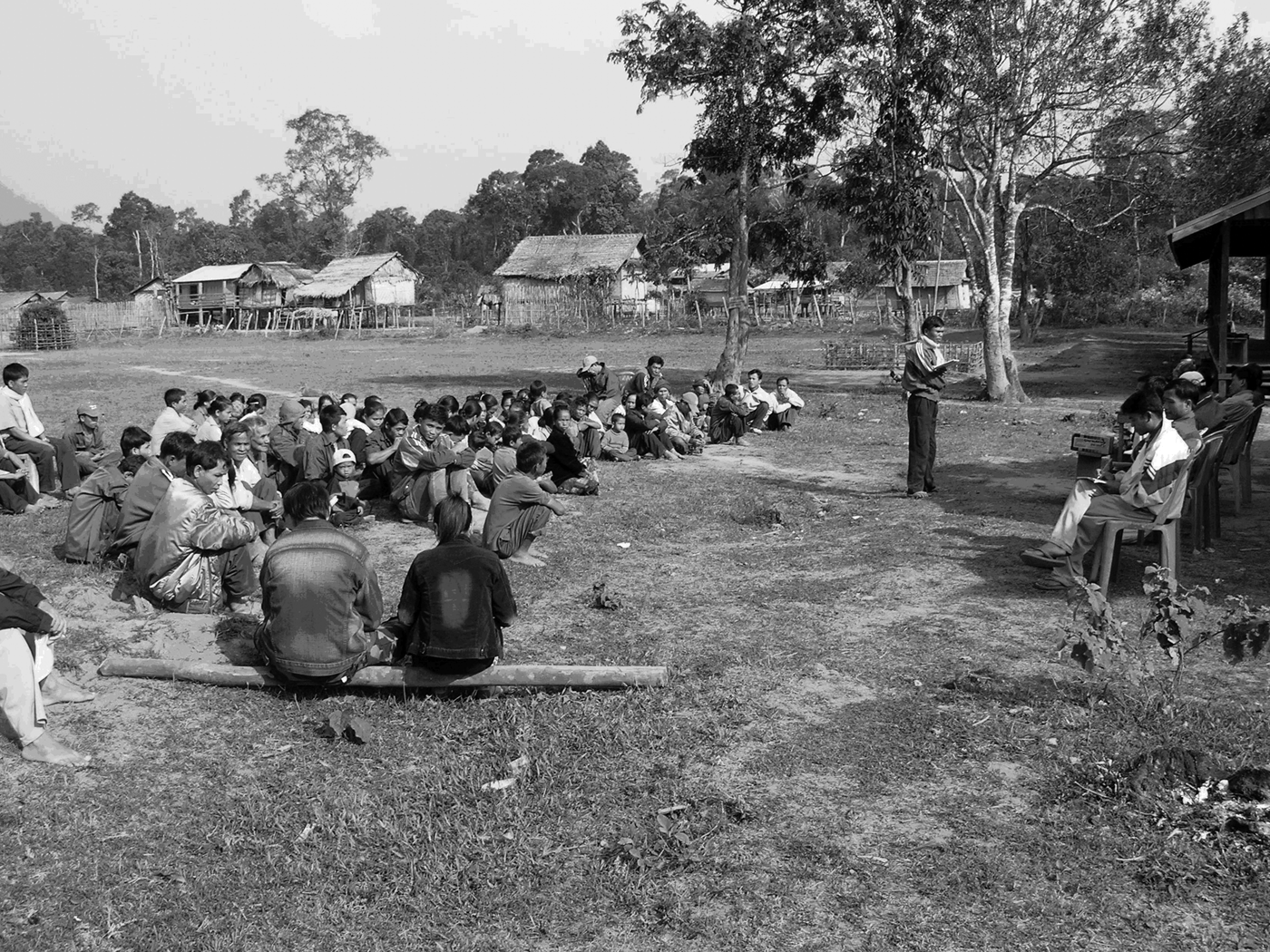
The morning after the baci ceremony, a meeting was held outside the camp dormitory, attended by about forty-five villagers from Dao Village and two neighboring villages. At the start, an official outlined the aims of the meeting: first, to introduce the WMPA and its objectives; second, listen to the suggestions of villagers; and third, to be an occasion to meet and discuss with villagers. Despite such rhetoric of engagement and participation, the village meeting was a very different affair to the baci ritual.
The district governor and WMPA director were seated on chairs behind a table borrowed from the village school, with the village headmen seated on either side of them. Junior officials and villagers took off their thongs to sit on them as they sat on the ground facing the elites. The head of the zone then stood and faced the seated government officials with his back to the villagers to explain that there had been a number of projects in their village because the area has a lot of forests, but it still does not have “cleanliness” (khwam sa-at) and there are still lots of “swidden fields” (hai). Indeed, the school grounds had seen a flurry of activity earlier in the morning when the village teacher had put up a new flag pole in front of the school and organized pupils to sweep up leaves and burn the piles of this “rubbish” to make the area “clean” for the important visit. Subsequently, the three village headmen made statements similar to that of the head of the zone. Notable in all their speeches were their careful attempts to reiterate government policy in relation to swidden—including a commitment to “rotational swidden” (hai mun wian) rather than the more castigated “pioneer swidden” (hai lun loi) (WMPA 2005)—which they had been instructed in by officials prior to the arrival of the district governor and WMPA director (see figure 2).
Meeting in Dao Village with villagers and junior officials sitting on the ground to the left, senior district officials seated at tables to the right, and one village headman standing in between during his presentation. Photograph by author.
The following speech of the WMPA director was focused on persuasion and less critical of villagers, reflecting the influence of the World Bank on the WMPA, his own extensive work with donor-funded projects, and his attempt to establish relationships. He asserted that:
We want people to have abundance, to be well-off, to have prosperity [chaleun], good health, and make sure that the poverty of everybody is reduced. . . . I will be coming often, so please remember my face. It is most important to work in unity [samakhi], for the work of the government and for development. Our organization does not want to do the same as before. . . . If people are still poor then we are not doing correctly. But can the district governor or the WMPA do development alone? . . . The work of our organization is the work of every single person, the government and the people, with consensus.
Despite this tone of engagement, when officials repeatedly asked during the meeting if there were any other issues to be raised, no villager commented or asked any questions. When the WMPA director asked if villagers had any other issues to raise, many villagers replied aloud in unison as they thought it was expected: “[Life] has improved already.” The head of the zone was the only one to quickly add, “But people are still poor!”
The district governor then took his turn, remaining seated on his chair behind his table. In contrast to the WMPA director, he emphasized the need for development and also highlighted what was wrong with Nakai, with an implication that villagers were to blame for their poverty, health problems, and social backwardness:
The work of the government is to do development; this is the work in every province of Laos. . . . Nakai is not a wealthy district. Nakai and Bulapha are the poorest districts in Khammouane, and are among the forty-seven poorest districts in Laos [identified by the national poverty reduction strategy]. . . . If there are villages with less than twenty households, then they may be moved to join with other villages. This is the policy of the government. . . . You do not have to do swidden to have rice. It is a problem if children are not going to school because they go to the swidden fields with their parents. This area does not have much paddy so people do swidden, but then you do not have enough rice. We need to solve this problem. You can raise livestock and have many animals, and sell these to buy rice. Villagers should not sell livestock to buy alcohol. For our country to become prosperous, you cannot do that, you can only drink moderate amounts. Villagers should drink boiled water. You have to protect yourselves; if you go to hospital then it wastes money. There must be cleanliness.
Towards the conclusion of the meeting, some sports equipment was given for villagers and officials to use together, as the district governor said they are “relatives” (phi-nong). This equipment was handed over by a senior official to a junior official who then took it back to the camp dormitory, where it was used by officials the next day.
Later, a villager privately told me of her own problems with the village health clinic. She then explained that she did not want to say anything during the meeting because she was “scared it would be wrong” (yan bo thuk). Her reticence was despite her personal familiarity with officials, as she was a daughter of the head of the zone and a member of the village committee. Other concerns villagers commonly mentioned in less formal contexts, like the difficult access to the Nakai District center and the limited education with only two grades in the village school, were also unmentioned. Thus, most villagers limited their contributions in the village meeting to affirming state-led improvements and avoiding any possible implication of criticism.
Immediately after the speeches, the meeting dispersed with most villagers returning home and officials staying around the camp. After lunch, the district governor and WMPA director left to visit the other two administrative zones in the NPA. Despite some differences between the two senior district officials owing to their different personal backgrounds, in the village meeting villagers were generally told they were poor because they were backward and needed to change—rather than accord much, if any, responsibility to the state. Village leaders reiterated this rhetoric in their roles as representatives of the state, and other villagers did not publicly question these statements.
The strictures of the village meeting thus made the baci ritual useful as a complementary form of interaction between district officials and ethnic minority villagers in Nakai. The village meeting was a hierarchical and directive public display held outside the village in the state-designated space of the camp. There was no dialogue or personal interaction between the senior district officials and the villagers. In contrast, social divides were eased during the baci, as it took place inside the village in a more personalized context. Officials left their camp at night to go to the homes of villagers, eat a shared meal, and talk in a more relaxed manner with everyone sitting on the floor together. Social engagement and promises for development took central place rather than criticism of villagers for their poverty-causing practices.
Baci rituals are certainly not always successful in surmounting social divides, and the past suppression of the baci by the early socialist state indicates the historical contingency in officials' ritual practices. Yet, the malleability of the baci did allow its persistence and subsequent resurgence. Thus, the baci is eminently suited to be employed by district officials in their work with rural villagers according to local needs, drawing on widely recognized and, once more, politically acceptable ritual forms.
Significantly however, the baci ritual did not stand alone in the ritual interactions between Lao officials and ethnic minority villagers. Indeed, the efficacy of the baci as a social bridge was an outcome of the rigidity of the village meeting that emphasized and reinforced the divides between these social groups. By organizing the baci and village meeting together, Lao officials offer contrasting images of state authority as both persuasive and coercive. While international concerns were influential in shaping government work priorities in the Nakai–Nam Theun NPA (see above), the actual ritual practices of officials can only be understood in the context of Lao social particularities. I argue that the religious and bureaucratic practices of Lao officials in Nakai exemplify the significance of ritual governance, as they make creative use of resurgent religious repertoires to meld the sacred and secular in their personalized negotiations that underpin state consolidation in rural Laos.
Conclusion
In Laos, as elsewhere across Asia, religious practices are flourishing despite predictions of their decline with secularization, economic globalization, and constraints imposed by authoritarian states. While much productive work has sought to examine the causes of religious resurgence, recent reviews of these trends in Southeast Asia suggest that much attention has been paid to “macro” political and economic processes and insufficient attention granted to the “micro” and “meso-passions.” In contrast, I argue that the conflation of the state with “macro” institutional processes in discussions of religious resurgence has meant that insufficient attention has been directed to the grounded “micro” and “meso” dynamics within the state.
This inattention is due to a range of academic trends. Notably, studies of authoritarianism are often by political scientists who focus on macro dynamics, including centralized institutions, top-down controls, and national-level events. Other scholars, including anthropologists, consider the significance of micro ritual practices, but usually relegate officials to the sidelines of village life. Consequently, state-sponsored rituals in rural locales are often ignored, as they are taken as either politically irrelevant or culturally inauthentic. While grounded work on governance has expanded understanding of the social processes that constitute states across Asia, this understanding has yet to be well integrated with studies of religious resurgence. This in turn perpetuates the assumption of centralized control as typifying authoritarian engagements with religiosity, as well as the continued divide between analyses of sacred and secular ritual in government practice. These limitations are both reflected in the minimal dialogue between studies of religion and development (see below). Furthermore, religious resurgence is usually studied by religious scholars who focus on state authority as a causal factor explaining religious practice, with little attention granted to how religious resurgence prompts innovative forms of governance.
To address these issues, this paper proposes the notion of ritual governance. In particular, I argue that studies of religious resurgence in Asia need to challenge the assumption that central institutions are definitive of authoritarian regimes and grant more sustained attention to decentralized practices, and also to challenge the persistent divide between the sacred and secular in scholarly analyses. In conclusion, I outline the main findings from the Lao case study and their broader relevance for the Asian region.
My ethnographic case study from the NT2 project demonstrates the importance of ritual governance, focusing on how officials interacted with rural citizens and the importance of state-sponsored ritual for the developmental Lao state. While the baci ritual was previously suppressed by the socialist state, it is now a ubiquitous part of government work across the country. I suggest that the contemporary appeal of the baci for Lao officials is due to national trends of religious resurgence as well as the congruence between baci blessings and state discourses on national development—both express aspirations for prosperity, and can be used to suggest that the Lao state offers the means to achieve these personal and societal aspirations. Crucially though, the baci ritual was not used in isolation when Lao officials worked with ethnic minority villagers. While the baci presented a persuasive promise of prosperity, it was combined with the village meeting that presented the coercive force of the Lao state and the obedience expected from marginal citizens. Ritual governance is thus a complex practical response to varied political pressures that enables officials to manage the social divides they personally encounter in their work with rural citizens, while attempting to advance their own governance objectives.
Significantly, the contemporary political utility of the baci for Lao officials is shaped by national conditions of post-socialist religious resurgence, but it is not a coordinated strategy emanating from the capital to promote ritual practices in government. The baci is a seemingly innocuous ritual that officials usually explain simply as a Lao national tradition.Footnote 6 Likewise, while village meetings are a widely recognized aspect of government work throughout rural Laos, their use alongside the baci is not part of any centrally organized campaign and is largely undocumented and unpublicized. Instead, district authorities who have the most personal contact with the rural populace, at times, find it expedient to employ different ritual strategies to engage with villagers. This case study illustrates how officials working with rural citizens are responsive to societal expectations that the Lao state demonstrates its legitimacy as a benevolent patron, as well as illustrating the close interweaving of sacred and secular rituals in government work. This challenges common assumptions about authoritarianism by demonstrating the complexity that becomes apparent when the personalized improvisation of ritual repertoires is taken as a serious aspect of government. My approach to ritual governance acknowledges the importance of macro social, political, and economic processes, but also asserts that a locally grounded perspective is also needed for a fuller account for how governance is achieved by authoritarian states.
Finally, I suggest that more attention is needed to consider the diverse encounters between religiosity and economic development, especially in rural areas of Asia. Despite the widespread use of state-sponsored ritual in development projects, there is little attention to the links between development and religiosity. Development offers a generalized promise of personal and national improvement, but this shared purpose needs to be conveyed in a socially specific manner, including resurgent religious ritual. While some research on national rituals partly addresses these issues (e.g., Tennekoon Reference Tennekoon1988), the focus is usually on national authorities and their organization of centralized and highly visible events. Consequently, the “micro” ritual practices of lower-ranking state representatives remain largely unexplored. I suggest that grounded approaches to the study of development show a way to strengthen conceptualizations of state authority in discussions of religious resurgence. In doing so, religious studies could also enhance development scholars' awareness of the political significance of the sacred. Ritual governance is one contribution to advance interdisciplinary studies of extemporized forms of governance, and thereby promote a fuller understanding of the diverse intersections between religiosity and authoritarianism across Asia.
Acknowledgments
This paper was enabled by my work as a consultant though the Wildlife Conservation Society (WCS) Lao Program with the WMPA. I appreciate the support and generosity of many officials and villagers in Nakai as well as from WCS. This paper draws on prior fieldwork in Nakai that was supported by the Australian National University, as well as later support as an Adjunct Research Fellow in Anthropology at James Cook University. I appreciate much helpful feedback from Michael Fabinyi and on early drafts from Andrew Walker, and also from four anonymous reviewers.