INTRODUCTION
The sheep ked Melophagus ovinus Linnaeus, 1758 is an ectoparasite of sheep that has been largely eradicated in the UK as a consequence of the widespread use of pesticides (Small, Reference Small2005). However, it persists in the feral Soay sheep population of Hirta, St Kilda in the Outer Hebrides off the north-west coast of Scotland (Craig et al. Reference Craig, Tempest, Pilkington and Pemberton2008). The parasite fauna of these sheep has been monitored over the past 2 decades during an annual capture of study sheep each August and several nematode species, the tapeworm Moniezia expansa and the protists Eimeria spp., Giardia duodenalis and Cryptosporidium parvum have been recorded (Craig et al. Reference Craig, Pilkington and Pemberton2006, Reference Craig, Pilkington, Kruuk and Pemberton2007, Reference Craig, Tempest, Pilkington and Pemberton2008).
Sheep keds are wingless dipteran flies of the family Hippoboscidae that feed on host blood via their piercing mouthparts. The relationship with the host is intimate and obligatory, with the whole reproductive cycle taking place in the fleece of the host; the female ked produces a single full-grown larva periodically, which becomes firmly attached to the wool and forms a puparium in situ (Small, Reference Small2005). Transfer from sheep to sheep is by direct contact, typically from ewe to lamb (Small, Reference Small2005). The blood-feeding habit and intimate relationship with the host make keds suitable vectors for blood-borne parasites and the sheep ked is known to transmit the protist, Trypanosoma (Megatrypanum) melophagium (Hoare, Reference Hoare1972).
At first there was controversy whether T. melophagium Flu, 1908 was a parasitic flagellate of the sheep ked, M. ovinus, rather than the sheep, because the trypanosomes were easy to find in the insect host whereas infection in the mammal was cryptic. The development of methods for culture of the trypanosomes direct from sheep blood, coupled with the meticulous description of the developmental stages in the ked, revealed the true life cycle of this digenetic parasite (Hoare, Reference Hoare1923). Transmission was demonstrated to occur when infective metacyclic trypanosomes from the hindgut were applied to the mucous membranes of the sheep's mouth; this would be achieved naturally by sheep removing infected keds from the fleece during grooming and chewing them in the mouth (Hoare, Reference Hoare1923). T. melophagium is regarded as non-pathogenic to the sheep host (Hoare, Reference Hoare1972), although heavy infestation with keds causes irritation and damage to the fleece and hide, potentially leading to economic losses (Small, Reference Small2005). Before the widespread use of pesticides eliminated keds from most of the UK flock, T. melophagium was commonly found in sheep; for example, diagnosis by blood culture demonstrated 80% prevalence in English sheep (Hoare, Reference Hoare1923). In other countries where sheep keds are common, T. melophagium is also found; for example, a recent study in Turkey demonstrated 7·8% prevalence of T. melophagium in sheep by blood culture (Nalbantoglu and Karear, Reference Nalbantoglu and Karear2008).
The high prevalence of keds recorded for the St Kilda sheep, particularly lambs (Craig et al. Reference Craig, Tempest, Pilkington and Pemberton2008), suggested that T. melophagium might also be present. Trypanosomes had not been detected in stained blood smears, but as parasitaemias are typically extremely low for T. melophagium, this is not surprising. Here, examination of keds removed from individual sheep during the annual catch-up was used to demonstrate infection of the sheep with trypanosomes and obtain an isolate of T. melophagium for molecular phylogenetic analysis.
MATERIALS AND METHODS
Collection of keds from sheep
Keds were removed from lambs, yearlings and adult sheep during February–March 2005 or during the annual catch-up in August 2008. When sampled in February–March, lambs, yearlings and adult sheep were approximately 10, 22 and ⩾34 months old respectively. When sampled in August, lambs, yearlings and adult sheep were 4, 16 and ⩾28 months old respectively. In 2005 insects were placed directly in alcohol to kill and preserve them before dispatch to Bristol, where they were stored at 4°C until use. In 2008, keds were sent as live specimens on sheep's wool in individual tubes or were dissected in the field, the gut placed on a microscope slide and allowed to air dry before dispatch to Bristol.
Preparation of DNA
Preserved keds were removed from the alcohol and briefly air-dried in a Petri dish before extracting DNA using the method described by Hamilton et al. (Reference Hamilton, Stevens, Gidley, Holz and Gibson2005). Briefly, the abdomen was removed and chopped into small pieces using a clean scalpel blade and placed in 200 μl of insect digestion buffer (100 mm Tris-HCl, pH 8; 80 mm EDTA, pH 8; 160 mm sucrose; 1% w/v SDS) containing 50 μg proteinase K. After macerating the abdomen with a pipette tip, the tube was incubated at 37°C for 72 h, adding a further 20 μg proteinase K every 24 h and mixing the contents. Following phenol-chloroform extraction and alcohol precipitation, the purified DNA was resuspended in 100 μl of H2O and frozen until use. DNA from trypanosomes grown in culture was purified using a DNA spin column kit (Qiagen).
PCR
PCR amplification of the small subunit ribosomal RNA (SSU rRNA) gene was carried out using primers complementary to conserved regions of the gene in genus Trypanosoma (Maslov et al. Reference Maslov, Lukes, Jirku and Simpson1996). To check the similarity of the primer sequences in trypanosomes and insects, SSU rRNA gene sequences of T. theileri (Accession no. AJ009164) and of the hippoboscids, Lipoptena cervi (Accession no. AF322426) and Ornithoica vicina (Accession no. AF073888), were aligned. Two of the primer sequences [C (S-713) 5′ CCGCGGTAATTCCAGCTCC; H (S-714) 5′ CGTCAATTTCTTTAAGTTTC] were well conserved (95% identity) in the insect SSU rRNA genes, and were used to amplify an approximately 600 bp fragment of the gene from the sheep ked. The other primer sequences showed much lower levels of conservation and could be used to specifically amplify trypanosome DNA from infected keds [B (S-823-F) 5′ CGAACAACTGCCCTATCAGC, 75% identity between trypanosome and insect sequences; D (S-825) 5′ ACCGTTTCGGCTTTTGTTGG and its complement, J (S-826) 5′ CCAACAAAAGCCGAAACGGT, 35% identity between trypanosome and insect sequences].
DNA sequence analysis
The SSU rRNA gene was PCR amplified from purified T. melophagium DNA as previously described (Maslov et al. Reference Maslov, Lukes, Jirku and Simpson1996). Four to six individual PCR reactions were pooled to yield sufficient DNA for automated DNA sequencing. After agarose gel electrophoresis, amplified bands were excised from the gel and the DNA purified before sequencing. The overlapping fragments were assembled into a single continuous sequence. An initial BLAST search was used to identify best matches with sequences held on database, and detailed alignments were performed using DNAMAN version 4.15 (Lynnon Biosoft). A 600 bp fragment of the SSU rRNA gene from uninfected ked DNA was obtained in a similar way. The gene for the spliced leader (SL; miniexon) was amplified by PCR from purified trypanosome DNA as described previously (Gibson et al. Reference Gibson, Bingle, Blendeman, Brown, Wood and Stevens2000). The whole SL repeat unit was amplified using overlapping conserved primers within the SL itself (MED1: 5′-GGGAAGCTTCTGTACTATATTGGTA; MED2: 5′-GGGAATTCAATATAGTACAGAAACTG) as described by Murthy et al. (Reference Murthy, Dibbern and Campbell1992). The amplified fragment was sequenced directly as described above, and also after cloning into a plasmid vector to obtain sequence close to the PCR primers.
Dissection and culture
Live keds were decapitated and dissected by opening the abdomen; the gut was removed and placed in a drop of PBS for viewing as a wet mount by light microscopy. Live flagellates were transferred to Cunningham's medium (Cunningham, Reference Cunningham1977) supplemented with 10% (v/v) heat-inactivated foetal calf serum, 5 μg ml−1 haemin and 100 μg ml−1 gentamycin (CM) and incubated at 30°C as recommended by Hoare (Reference Hoare1923). Trypanosomes were transferred to a co-culture system with insect cells (Anopheles gambiae) in a 1:1 mixture of CM and Schneider's Insect medium (Sigma) with 10% (v/v) heat-inactivated foetal calf serum, gradually reducing the concentration of gentamycin to 10 μg ml−1 as medium was replenished. After 2 weeks in culture, flagellates were transferred to a feeder layer co-culture system designed for growth of bloodstream forms of T. brucei (Brun et al. Reference Brun, Jenni, Schonenberger and Schell1981), comprising Microtus montanus embryo fibroblast-like cells in HEPES-buffered Minimal Essential Medium with Earle's salts supplemented with 20% (v/v) normal horse or lamb serum and 10 μg ml−1 gentamycin. Cultures were maintained at 37°C, 5% CO2 for 2 months; every 2–3 weeks, approximately half the medium was exchanged for fresh medium. For morphological examination, flagellates were spread on microscope slides, air dried, briefly fixed in methanol and stained with Giemsa. Stained specimens were examined with a 100× oil immersion objective by light microscopy.
RESULTS
Prevalence of trypanosomes in keds
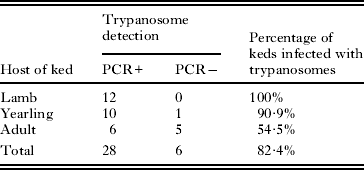
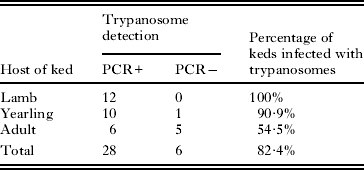
DNA was extracted from a total of 34 alcohol-preserved keds collected in 2005 and trypanosome DNA was identified by PCR of the SSU rRNA gene using trypanosome-specific primers B and J in 28 (82·4%). All keds removed from lambs were infected, with a lower prevalence in yearlings of 90·9% and adults of 54·5% (Table 1). Thus, trypanosome infection of the keds decreased as the age of the sheep host increased.
PCR detection of trypanosome DNA in keds removed from St Kilda sheep
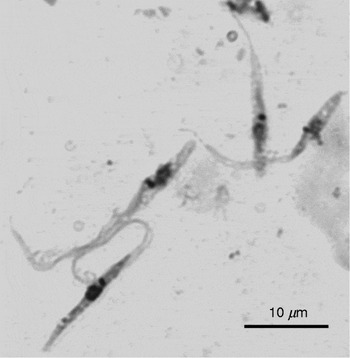
In view of the observed high prevalence of trypanosomes in keds from young animals, to obtain specimens of the trypanosome, keds were collected from lambs in 2008. Few keds (<10%) remained alive after removal from the host and storage at ambient temperature for 1 week. Of 4 surviving keds that were dissected, 3 had swarming infections of flagellates (Fig. 1). These infections were used to establish in vitro cultures. Trypanosomes were identified in all 9 stained smears of ked guts dissected in the field. These results, together with the results of PCR analysis of keds collected in 2005, demonstrate that most keds from sheep on St Kilda are infected with trypanosomes and that the prevalence of infection in keds removed from lambs (aged 4 or 10 months) was particularly high.
Giemsa-stained trypanosomes (epimastigotes) from a dissected ked gut.

Culture of trypanosomes from keds
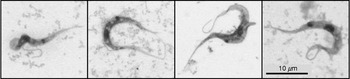
The live trypanosomes from dissected ked guts were transferred to in vitro culture at 30°C and continued to proliferate. After 2 weeks, trypanosomes were transferred to a Microtus embryo fibroblast (MEF) feeder layer at 37°C. Most of the trypanosomes disappeared within a day or two, but small numbers persisted for 2 months in medium supplemented with either 20% normal horse or lamb serum. The morphology of these cells was uniform and agrees with published descriptions and measurements of T. melophagium from the ovine bloodstream: mean length 39·3 μm, distance from posterior end to kinetoplast 14·7 μm and from kinetoplast to centre of nucleus 5·1 μm (Buscher and Friedhoff, Reference Buscher and Friedhoff1984); length range 52·0–60·5 μm, distance from posterior end to kinetoplast 13·5–21·7 μm and from kinetoplast to centre of nucleus 4·0–5·0 μm (Hoare, Reference Hoare1923). The trypanosomes were large (approximately 40 μm in length) with a long, pointed posterior and large kinetoplast closer to the nucleus than the posterior end of the trypanosome (Fig. 2).
Giemsa-stained trypanosomes (trypomastigotes) from a fibroblast co-culture incubated at 37°C.

The finding of trypanosomes in large numbers in the sheep ked, coupled with the morphological characteristics of the bloodstream forms, are sufficient to identify this trypanosome unequivocally as T. melophagium.
Sequence analysis
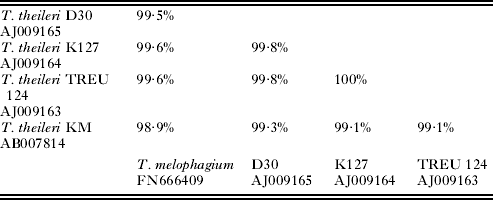
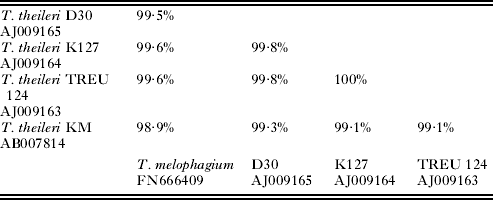
DNA from cultured trypanosomes was used as a template to amplify the SSU rRNA and spliced leader genes of T. melophagium. For the SSU rRNA gene, 1762 bp of sequence was obtained (Accession no. FN666409), which matched sequences from T. theileri almost perfectly (isolate TREU 124, Accession no. AJ009163; isolate K127, AJ009164; isolate D30, AJ009165; isolate KM, AB007814). The average within-group identity was 99·4% with closest similarity (99·6%) to sequences from T. theileri TREU 124 and K127 (Table 2).
Similarity (%) of SSU rRNA gene sequences (1762 bp) from Trypanosoma melophagium and T. theileri
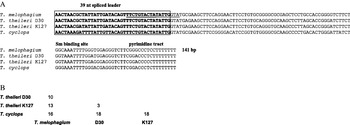
The spliced leader (SL) transcript from T. melophagium was partially sequenced excluding primers used to amplify the fragment (109 bp; Accession no. FN666410) and the closest matches were obtained by BLAST search against sequences on database. The SL transcript has the conserved 39 nt SL at its 5′ end, which is spliced onto the 5′ end of every messenger RNA (mRNA) in trypanosomes. The remainder of the transcript is highly variable both in length and sequence, so that it is only possible to align SL transcripts from closely related trypanosome isolates or species (Gibson et al. Reference Gibson, Bingle, Blendeman, Brown, Wood and Stevens2000). The closest matches were SL sequences derived from T. theileri (isolate D30, Accession no. AJ250747; isolate K127, AJ250748), and T. cyclops, a primate trypanosome from Asia (Accession no. AJ250743) (Fig. 3). It can be seen from Fig. 3B that the SL transcripts of T. melophagium and T. theileri D30 show the highest level of similarity, differing at 10 positions excluding the pyrimidine tract, while the SL transcripts of T. theileri isolates D30 and K127 differ at only 3 positions; these 2 are the only SL transcript sequences available for T. theileri. The SL transcript of T. cyclops aligns convincingly with this group of 3 sequences, but is the most distant (Fig. 3B). These results confirm the close relationship of T. melophagium and T. theileri evident from the SSU rRNA sequence comparison.
Comparison of spliced leader (SL) transcripts. (A) Alignment of SL transcripts from Trypanosoma melophagium, Accession no. FN666410; T. theileri isolate D30, Accession no. AJ250747; T. theileri isolate K127, Accession no. AJ250748; T. cyclops, Accession no. AJ250743. The 39 nt SL is boxed; primer MED1 is underlined; neither of these sequences were directly sequenced in T. melophagium. The positions of the Sm binding site (consensus sequence RAT4GG) and the pyrimidine tract that terminates the SL transcript are indicated. (B) Distance matrix showing numbers of nucleotide differences excluding the pyrimidine tract.

DNA from uninfected sheep keds was used as template to amplify an approximately 600 bp fragment of the SSU rRNA gene using primers C and H, which were well conserved in other hippoboscid flies. Two independently derived fragments were sequenced in both directions yielding a consensus sequence of 616 bp excluding primers used to amplify the fragment (FN666411). Comparison with SSU rRNA gene sequences from 2 other hippoboscids showed 98·9% similarity to that of the deer ked, Lipoptena cervi (Accession no. AF322426) and 97·2% similarity to that of Ornithoica vicina (Accession no. AF073888), a biting fly of birds.
DISCUSSION
We have isolated and characterized a trypanosome found in sheep keds collected from feral sheep on St Kilda and identified it as T. melophagium. Most keds collected were infected with this trypanosome and the live specimens dissected had abundant trypanosomes in the gut, confirming that they are the intermediate hosts of this trypanosome. Among sheep on St Kilda, keds were previously found to be most abundant on lambs, with a prevalence of 82% recorded from the underbelly; the prevalence fell to 28% in yearlings and 12% in adults (Craig et al. Reference Craig, Tempest, Pilkington and Pemberton2008). Here, all but 1 of the keds taken from lambs were positive for trypanosome infection by PCR or dissection, and a lower prevalence was evident in keds removed from yearlings and adults. Thus it seems likely that the lambs on St Kilda are more susceptible to trypanosome infection than older animals and thus harbour the greatest proportion of infected keds.
According to Hoare (Reference Hoare1923, Reference Hoare1972), there is no lasting immunity to T. melophagium and sheep can be readily re-infected by exposure to infected keds after an aparasitaemic period of several months. The duration of infection with T. melophagium in experimental sheep is usually about 3 months, sometimes much shorter, and after this trypanosomes can no longer be demonstrated in the blood (Hoare, Reference Hoare1923, Reference Hoare1972). However, it should be borne in mind that these data were derived from observations and experiments on English lowland sheep and resistance to trypanosome infection may vary in other sheep breeds such as the Soay of St Kilda. The level of transmission may also vary, as infection is dependent on the sheep grooming keds from its fleece and squashing them in its mouth, which must in turn depend on the number of keds, their accessibility by mouth grooming and the amount of irritation they cause. While numbers of keds on the St Kilda sheep are probably at their lowest during the summer when the sheep have just cast their winter fleeces, the lack of cover might also render the keds more susceptible to being eaten during grooming. This might paradoxically lead to a higher trypanosome infection rate in the summer despite lower ked numbers.
The phylogenetic relationships of T. melophagium with other trypanosomes were assessed by DNA sequence comparisons of the SSU rRNA and SL genes. The closest relative was found to be T. theileri, a non-pathogenic trypanosome found ubiquitously in bovines throughout the world and transmitted by biting flies such as tabanids via the contaminative route (Boese et al. Reference Boese, Friedhoff, Olbrich, Buescher and Domeyer1987b; Bose and Heister, Reference Bose and Heister1993; Hoare, Reference Hoare1972). T. theileri is the type species of subgenus Megatrypanum, a group of non-pathogenic mammalian trypanosomes of large size, already acknowledged to be heterogeneous (Hoare, Reference Hoare1972) and recently confirmed to be markedly polyphyletic by molecular phylogenetic studies (Stevens et al. Reference Stevens, Noyes, Schofield and Gibson2001). T. theileri and T. melophagium share a similar developmental route in the insect vector, with infective metacyclics produced in the hindgut (Bose and Heister, Reference Bose and Heister1993; Hoare, Reference Hoare1923). In both cases, metacyclics have been demonstrated to infect via the mucosal surfaces of the mouth (Boese et al. 1987Reference Boese, Friedhoff and Olbricha, Reference Boese, Friedhoff, Olbrich, Buescher and Domeyerb; Hoare, Reference Hoare1923), and in nature, transmission is effected by ingestion of the whole insect or its faeces during grooming (Hoare, Reference Hoare1972).
Phylogenetic analysis of the D7-D8 region of the SSU rRNA gene of isolates of T. theileri from cattle, buffalo, wild antelope and tabanids from South America, Africa and Europe demonstrated only minor levels of sequence divergence and all isolates were considered to belong to the single species T. theileri (Hamilton et al. Reference Hamilton, Adams, Njiokou, Gibson, Cuny and Herder2009). T. melophagium fits comfortably within this group, with 99·4% sequence identity over the 1762 bp region of the SSU rRNA gene sequenced here. The close genetic similarity of T. melophagium and T. theileri suggests that T. melophagium represents a lineage of T. theileri that adapted to transmission by sheep keds and hence became a specific parasite of sheep. Its mammalian host specificity was therefore driven by the intimate association of the vector with the mammalian host. Likewise, it is probable that T. theodori, a non-pathogenic goat trypanosome, is another lineage of T. theileri that adapted to transmission by the goat ked Lipoptena caprioli, as its developmental cycle parallels that of T. melophagium in the sheep ked (Hoare, Reference Hoare1972). The divergence of these trypanosome lineages from T. theileri would have been driven by increasing dependency on the ked vector, so that they eventually became locked into a separate transmission cycle featuring particular host species. This predicts much greater levels of diversity among T. theileri and related trypanosomes, where numerous different tabanid vectors are responsible for transmission to a broad range of large mammals in many different countries throughout the world.
ACKNOWLEDGEMENTS
We thank members of the Soay sheep catch team in August 2008 and undergraduate project students Jessica Hardiman and Sining Meng (University of Bristol) for analysing the keds collected in 2005. We also thank the National Trust for Scotland and Scottish Natural Heritage for permission to work on St Kilda and the MOD, QinetiQ, Amey and ESS staff on St Kilda and Benbecula for logistical support.
FINANCIAL SUPPORT
Fieldwork on St Kilda was funded by the Natural Environment Research Council.