At 12.51pm on February 22, 2011, a major earthquake of 6.3 magnitude struck Christchurch, New Zealand. Due to its shallowness (5 km deep), proximity to the city (9.9 km from the city center), and peak ground accelerations among the highest ever recorded worldwide, the damage was severe and extensive.Reference McColl and Burkle1 Although New Zealand was aware that its position on the Southern Alpine Fault line was vulnerable to major earthquakes, Christchurch was generally considered the least likely city in New Zealand to suffer such an event,Reference Lyneham and Byrne2 so it was unique, unprecedented, and unexpected.
A total of 182 people lost their lives immediately in the quake, and thousands more inundated hospitals in Christchurch.Reference McColl and Burkle1 Damage to buildings was extensive both from the shake and from liquefaction—a process in which saturated, unconsolidated soil rapidly converts into a suspension, causing the soil to flow like a liquid and then flood or loose stability, leading to building collapse.Reference McColl and Burkle1
Elderly residential care facilities (RCFs) were among the buildings damaged by the earthquake, liquefaction, and flooding. Seven were closed and fully evacuated and 2 were partially evacuated. In total, 516 elderly people were evacuated. The majority of evacuations took place in the first 4 days, and could not be delayed further due to the severity of the situation, with associated damage to buildings, loss of infrastructure, and concerns for client safety and wellbeing. Evacuees were sent to other homes in Christchurch and centers throughout New Zealand either by bus or New Zealand defense force airplane. Journeys were lengthy (8 hours or more). Owing to problems with the coordination of the disaster response, many evacuations took place overnight.
Reports of the impact of natural disasters on older people have been conflicting. In 1 study of veterans after the Northridge earthquake,Reference Dobalian, Stein and Heslin3 high levels of emotional distress were found; the authors concluded that veterans would have benefited from postdisaster intervention. They found that older veterans were more resilient, but that people with predisaster functional limitations and health conditions were more likely to suffer adverse outcomes. Several authorsReference Pekovic, Seff and Rothman4–Reference Rothman and Brown6 reported on the increased vulnerability of older people in disasters, particularly greater mortality, physical health, functional decline, cognitive decline, emotional distress, and loss of social supports. In a review by Bartels and VanRooyen,Reference Bartels and VanRooyen7 increased depression, anxiety, and posttraumatic stress disorder (PTSD) were reported.
However, other studies have found that older people cope well or better after natural disasters.Reference Norris, Friedman, Watson, Byrne, Diaz and Kaniasty8, Reference Levin9 In their study of evacuations after Hurricane Katrina, Castle and EngbergReference Castle and Engberg10 found no difference in depression, activity of daily living (ADL) scores, falls, and mobility between evacuees and nonevacuees. Bolin and KlenowReference Bolin and Klenow11 found no significant difference in emotional recovery 1 year after tornado disaster. In his editorial, BurkleReference Burkle12 reported that the elderly can be “model examples of resilience and recovery.”
Stroud etalReference Stroud, Altevogt and Goldfrank13 described the work of the Institute of Medicine Forum on Medical and Public Health Preparedness, which calls for dialogue and collaboration among stakeholders in the preparedness field. The emergency and unplanned evacuations of Christchurch RCFs were unique events, and they gave us the opportunity to assess the impact of such events on frail older people. We believed that by examining the events and outcomes more closely we can contribute to future disaster preparedness.
Methods
The Canterbury District Health Board (CDHB) maintained a database of all older people evacuated from RCFs and their destination. Details of each evacuee included their unique national health identification number, original home, current home, and level of care. Outcomes for older people were followed up for 12 months after the earthquake. Mortality data were collected and will be reported elsewhere. As the earthquake was an unanticipated emergent event, predisaster data were not available, so this study was deliberately designed as a descriptive, qualitative study.
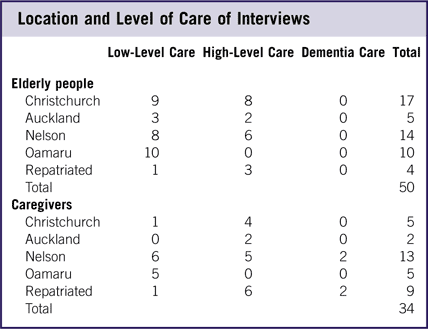
Three centers that received large numbers of evacuees were chosen for this study to provide a representative sample of different facilities (Table 1). The centers were in Auckland, a major urban center; Nelson, a midsized city; and Oamaru, a regional town. As a major urban center, Auckland had additional medical facilities such as dialysis, so a number of more complex cases were evacuated there. Nelson and Oamaru received a mixture of evacuees requiring different levels of care.
Location and Level of Care of Interviews

All of the receiving RCFs in these centers were visited by the principle investigator. Evacuees were purposively sampled to obtain a range of age, gender, and care needs. Interviews were also conducted in Christchurch both with evacuees within the city and with those who had been evacuated and subsequently repatriated. Informal caregivers were identified by older people and residential care notes. A representative sample was also approached and interviewed.
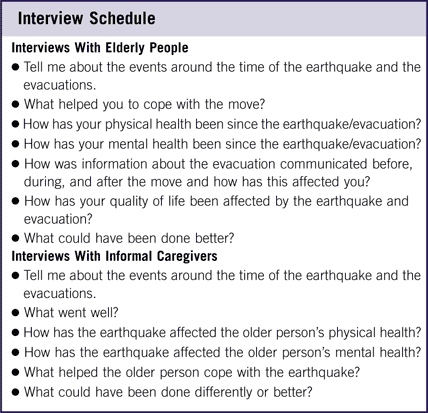
Semistructured, in-depth interviews were conducted between 4 and 6 months after the earthquake. Table 2 shows the interview schedule. Due to the pressure of time, the questions were not piloted, as we wished to conduct the interviews as close to the event as possible. However, the same interviewer, who had had previous training and experience in qualitative research, conducted all the interviews to ensure consistency and reliability. A general inductive method was used: predetermined, open-ended questions were asked, and the interviewee was encouraged to speak freely to answer the questions. Detailed field notes were taken, and the interview was reconstructed on the same day for maximum recollection of details.
Interview Schedule
Interviews were read and re-read multiple times, and key themes were developed using comparative sorting and cross-checking. Themes were entered into a spreadsheet, and responses for each theme were grouped. Conclusions and recommendations were developed from these themes.
This study had the approval of the regional human ethics committee. All participants gave written informed consent to the interviews. The CDHB commissioned the research and funded the lead researcher.
Results
A total of 516 older people were evacuated from RCFs within Christchurch after the earthquake. The mean age was 83 years (range, 42-102 years). Of these, 298 were evacuated from Christchurch to other centers, 194 people were evacuated within Christchurch to less damaged facilities, and 18 were brought home by relatives. In addition, 1 died immediately in Christchurch hospital and 5 were lost to follow-up. Of those evacuated, 50 older people and 34 informal caregivers were interviewed. Thirteen of the elderly evacuees were diagnosed with some degree of dementia and were excluded from participating, as they had to be able to answer questions independently.
Resilience
The overwhelming finding of the evacuees’ interviews was resilience in the face of disaster; 41 elderly people made positive comments about resilience. Many were happy to get away from the damage and ongoing aftershocks and saw the evacuations as a positive step. Personal attitude played a big role, for example, 1 man said, “it is no good being worried, it is not going to help, it is not going to stop the earthquakes.” Another said “it is individual's personality which made the difference. You've just got to relax and go with it.” Older people also reflected on previous life experiences, such as living through bombings in a war or growing up with hard work on a farm as contributing to their resilience.
Social supports were also key: CDHB offered a travel subsidy for caregivers, which allowed them to visit and support older people, and this strategy was widely praised. For example, 1 caregiver reported, “The DHB paid for the airfares, that was very important so we could go and visit her. We actually spent more quality time with Mum than before.” Receiving facilities also organized community supports in their new homes, for example 1 center organized an “adopt a granny” scheme, in which local volunteers were paired with an evacuee and helped with visiting and practical supports such as providing clothing or toiletries. One evacuee said, “people were great, especially the church people. They made us welcome. I like having visitors and that people come and see me.” Another comment on quality of life was, “in a way it has improved, I am well looked after. I have even had my sister come and visit (from Melbourne). They have all kept in touch so it has been good that way.”
Adverse Responses
A concern in the aftermath of disaster and evacuations is the mental and cognitive health of older people. In spite of the apparent resilience, this feature was a problem in our cohort. Of the 50 older people interviewed, 21 (36%) reported some feelings of anxiety. Some overlap was observed; people reported anxiety but also reflected on how they were coping with it, which was coded as resilience. Comments included, “The earthquakes and the aftershocks shot my nerves to bits. Moving on top of that was not the best” and “I feel helpless…I am completely dependent on other people which I find very frightening.”
Few older people reported cognitive impairment, but 11 caregivers, of 34 interviewed (32.4%), found that the older people seemed more confused in the immediate aftermath of the evacuations. For example, 1 said, “it is her short-term memory which is a problem, she has to be reminded where she is and that she can't go home.” Caregivers however praised the efforts of staff, for example, “being reassured by staff, they spent time to sit and talk with Dad, it gave him good understanding.” Confusion was not helped by the many overnight evacuations that made older people more disorientated.
Communication
Communication at several levels was difficult in the aftermath of the earthquake. Due to the emergency circumstances, evacuations had to take place quickly. Older people criticized the lack of information they were given about what was happening or where they were going. One man said, “we should have been told when and where we were going. We were just bundled into a van during the night so we couldn't see where we were going.”
Telephone lines were down; electricity was out so computer records and e-mail could not be accessed; and cell phone networks were overloaded. For confidentiality reasons, the facility staff could not leave messages on answer machines or give information to anyone other than the nominated next-of-kin. Facilities also found that many of their records for next-of-kin were incorrect. Consequently, it was very difficult to keep caregivers informed, and many caregivers found their loved one had been moved before they could be contacted. These circumstances were distressing for caregivers who criticized the communication.
Another aspect of communication concerned patient information records being passed to new RCFs. In some homes, the degree of damage, flooding, or liquefaction meant that paper records could not be retrieved and clinical information could not accompany the older people. This situation was very difficult for the receiving facilities, which had to deal with many older people who were distressed, anxious, or confused and arriving simultaneously, without background information.
Discussion
The Christchurch earthquake and subsequent evacuations of elderly residential care facilities was an unexpected, unplanned, and unique event from which it is important to learn lessons to improve future disaster preparedness. To our knowledge, this report is the first to describe interviews with older people exploring the evacuation process.
In spite of concerns about moving such frail and vulnerable people, the evacuations for many were a positive step, allowing them to move away from damage, loss of services such as toilets or running water, and aftershocks. One overwhelming finding was the resilience of older people. This quality was helped by personal attitudes and experience, and also by social supports being put in place. CDHB offered a travel subsidy to caregivers to visit the evacuees, and this was clearly beneficial for the elderly. Facilities also mobilized local community supports, which also helped the older people to settle into their new environment and cope with the changes.
Previous studies have found contrasting results on the impact of disasters on the frail elderly.Reference Pekovic, Seff and Rothman4–Reference Rothman and Brown6, Reference Norris, Friedman, Watson, Byrne, Diaz and Kaniasty8–Reference Bolin and Klenow11 The present study supports the findings that the elderly are a resilient group and makes some practical suggestions about supporting resilience. Anxiety was 1 negative finding in the cohort of older people. Anxiety and PTSD have been previously reported following major disasters,Reference Dobalian, Stein and Heslin3, Reference Pekovic, Seff and Rothman4, Reference Bartels and VanRooyen7 and we also agree that strategies aimed at managing anxiety would be beneficial. Caregivers reported noticing cognitive decline in the older evacuees, although this was not reported by the older people themselves. BrownReference Brown14 found that up to 70% of nursing home residents have some degree of cognitive impairment, which places them at particular risk of being unable to understand the evacuation process and coping less well with environmental changes.Reference Pekovic, Seff and Rothman4 Because little has been written about the cognitive impact of major disasters and evacuations, or ways of managing cognitively impaired residents in the setting of emergency evacuations, this area would be an important one for future research.
Communication is a key area that was problematic in the Christchurch experience, and which needs to be addressed during disaster planning. One possible way to address the loss of records would be to have waterproofed summary cards available close to emergency exits. Contact details for key caregivers could also be stored in this manner, and it would be important to ask caregivers to keep details up-to-date. In the Christchurch experience, the damage to telephone lines and cell phone networks as well as outdated contact details made contacting caregivers very difficult. It was impossible to delay evacuations until caregivers had been contacted, so in many cases they were carried out without notification. This procedure would likely occur again in future major disasters. Planning for such an event may include educating older people and their caregivers in advance of the potential need for emergency evacuations in a disaster, and how they would be carried out, if necessary, without contacting caregivers.
Conclusions
Our study described the experiences of elderly people in RCFs and their caregivers at the time of emergency mass evacuations following the 2011 Christchurch earthquake. In general, older people were very resilient to these extreme events. Resilience could be promoted by supporting family involvement and arranging input from local communities. Anxiety was an area of concern, and should be given consideration in future events by making support strategies available. Caregivers also reported increased cognitive difficulties. Little evidence has been available on how to manage older people with cognitive problems in the setting of emergency evacuations, and would be an area for further research.
Communication problems were a major issue, and disaster planning should include education for older people and caregivers about the possibility of emergency evacuations in the event of major disaster. Disaster preparedness should also incorporate keeping up-to-date medical and nursing records and caregiver contact details in an easily accessible system.
Funding and Support
This research was funded by Canterbury District Health Board, which paid the salary of the lead researcher (C.H.) and travel costs to visit centers outside Christchurch to conduct interviews.
Acknowledgments
The Canterbury District Health Board Vulnerable Persons Team conducted their work during the disaster in extremely difficult circumstances. All of the elderly people and their caretakers in the residential care facilities who participated in the interviews provided help and support in this study. The Canterbury District Health Board provided salary and traveling expenses necessary to conduct the interviews.