Introduction
Working memory (WM) as the ability to simultaneously store and manipulate information in mind (Baddeley, Reference Baddeley1997) is a key foundation of human cognition (Daneman and Carpenter, Reference Daneman and Carpenter1980; Kyllonen and Christal, Reference Kyllonen and Christal1990). Trainings of WM have become increasingly popular during the last decade with older adults being one of the main target groups for cognitive interventions. Several studies in older adults reported transfer after WM training not only on untrained WM measures, but also on other cognitive functions such as inhibition (e.g. Borella et al., Reference Borella, Carretti, Riboldi and De Beni2010), gF (e.g. Carretti et al., Reference Carretti, Borella, Fostinelli and Zavagnin2013a; Zinke et al., Reference Zinke, Zeintl, Rose, Putzmann, Pydde and Kliegel2014), or language comprehension (Carretti et al., Reference Carretti, Borella, Zavagnin and de Beni2013b). Although these results seem promising, the reported transfer effects are inconsistent (see e.g. Shipstead et al., Reference Shipstead, Redick and Engle2010; Melby-Lervåg and Hulme, Reference Melby-Lervåg and Hulme2013; Redick et al., Reference Redick2013). Even more importantly, the mechanisms that underlie successful training or transfer still remain unclear (e.g. Jolles and Crone, Reference Jolles and Crone2012; Melby-Lervåg and Hulme, Reference Melby-Lervåg and Hulme2013). Recent studies showed that properties of the training regimen might influence training success (e.g. performance-adaptive vs. non-adaptive training tasks, see e.g. Klingberg et al., Reference Klingberg2005, or the duration of the intervention, see Jaeggi et al., Reference Jaeggi, Buschkuehl, Jonides and Perrig2008). Also characteristics of the participants might influence improvements in training or transfer tasks, such as age (Wass et al., Reference Wass, Scerif and Johnson2012; Borella et al., Reference Borella, Carretti, Cantarella, Riboldi, Zavagnin and De Beni2014), baseline performance and gain in the training tasks (Zinke et al., Reference Zinke, Zeintl, Rose, Putzmann, Pydde and Kliegel2014) or individual differences in motivational factors or personality traits (see Studer-Luethi et al., Reference Studer-Luethi, Jaeggi, Buschkuehl and Perrig2012; Jaeggi et al., Reference Jaeggi, Buschkuehl, Shah and Jonides2014). But as of yet, only little is known about cognitive processes underlying successful WM training and transfer.
Here, we aimed to investigate the relationship between WM training and the ability to resist PI – a process that has repeatedly been shown to account for a substantial portion of inter-individual variation in WM capacity (Mecklinger et al., Reference Mecklinger, Weber, Gunter and Engle2003; Jonides and Nee, Reference Jonides and Nee2006). PI refers to a reduced recall accuracy and prolonged reaction time (RT) due to previously relevant but now irrelevant WM contents (Postle et al., Reference Postle, Brush and Nick2004). PI can occur in all sorts of WM tasks, i.e. not only in simple and complex span tasks (May et al., Reference May, Hasher and Kane1999; Rowe et al., Reference Rowe, Hasher and Turcotte2008) that are based on free recall but also in n-back (e.g. Burgess et al., Reference Burgess, Gray, Conway and Braver2011) or recent-probes tasks (Jonides and Nee, Reference Jonides and Nee2006) that are based on recognition. Building on the significance of PI resistance for the reliability of WM operations, Persson and Reuter-Lorenz (Reference Persson and Reuter-Lorenz2008) investigated if resistance to PI can be trained and to which extent a potential improvement would transfer. To this end, two groups of young adults were compared that followed almost identical training regimens with the only difference that the WM tasks of the experimental group included trials with PI, while the tasks of the active control group contained less or no such trials. In the study of Persson and Reuter-Lorenz (Reference Persson and Reuter-Lorenz2008), there were actually three different training groups: An experimental group, which trained on the WM tasks with high interference, a control group 1, which trained on the same WM tasks, however with no or low interference demands, and a control group 2, which trained on similar tasks with no demands on interference resolution and only minimal demands on WM. As there was no difference between both control groups before or after training, they were put together for the analyses (Persson and Reuter-Lorenz, Reference Persson and Reuter-Lorenz2008). Results revealed considerable improvements and transfer following training with increased demands on PI resistance but had to be retracted due to experimenter error (Persson and Reuter-Lorenz, Reference Persson and Reuter-Lorenz2011). In their comment accompanying the retraction, Persson and Reuter-Lorenz (Reference Persson and Reuter-Lorenz2011) noted that after their research was publicized, they detected a mistake in the programming of the training tasks. Further, they stated that in a separate replication that used randomized, novel sequences, they could not replicate the findings of the first report. In another study with young participants that manipulated interference control in an n-back task, transfer to non-trained PI-tasks was not investigated, and only partial transfer was reported to a cued version of a flanker task, while transfer to a complex span task and to matrix reasoning did not differ from a passive control group (Oelhafen et al., Reference Oelhafen, Nikolaidis, Padovani, Blaser, Koenig and Perrig2013). Further, Bomyea and Amir (Reference Bomyea and Amir2011) conducted an intervention that consisted only of a single training session with a complex WM span task. The authors report more transfer to an untrained complex span task for the group with higher PI-demands in the training task, compared to a control group with lower PI-demands. Further, the training group with more PI in the training task experienced fewer intrusions in an untrained thought-monitoring task than the control group (Bomyea and Amir, Reference Bomyea and Amir2011). As the study did not focus on the specific processes underlying WM training and transfer, the authors did not report whether PI was actually reduced in the training tasks at the end of the training. Taken together, there is still little evidence on whether resistance to PI can actually be improved by a specific WM training, and, as of yet, there is no study investigating this issue in older adults as a main target population for cognitive interventions.
Despite the retraction of the study of Persson and Reuter-Lorenz (Reference Persson and Reuter-Lorenz2008), the idea to manipulate demands on PI resistance within WM training remains intriguing. Furthermore, to our knowledge, no previous attempts exist to train resistance to PI in older adults, although an improvement of this ability and a possible generalization to other tasks would have significant implications for treatments in healthy and pathological aging. In particular, older adults have been found to be more susceptible to PI in different WM tasks compared to younger adults (cf. May et al., Reference May, Hasher and Kane1999; Jonides et al., Reference Jonides, Marshuetz, Smith, Reuter-Lorenz, Koeppe and Hartley2000; Schmiedek et al., Reference Schmiedek, Li and Lindenberger2009; Loosli et al., Reference Loosli, Rahm, Weiller, Unterrainer and Kaller2014). Hasher et al. (Reference Hasher, Chung, May and Foong2002) showed that compared to young adults, older adults are less able to delete no longer relevant items from WM due to deficient inhibition processes, which results in the inability to differ between relevant and irrelevant items and therefore in more intrusion errors, i.e. more PI.
In the present study, we adapted the design of Persson and Reuter-Lorenz (Reference Persson and Reuter-Lorenz2008) and trained two groups of old adults with a recent-probes task and an n-back task over the course of two weeks. Both tasks have been previously used to measure resistance to PI within WM in the elderly (Loosli et al., Reference Loosli, Rahm, Weiller, Unterrainer and Kaller2014). As in the original training study of Persson and Reuter-Lorenz (Reference Persson and Reuter-Lorenz2008), the only difference between the two training groups was the amount of PI-trials in the training tasks (high vs. low PI). The training tasks of the high-PI group contained recent trials that were closer to the probe than those in the low-PI group, and should therefore elicit more PI. The low-PI group was expected to show less or no PI, as their recent trials were at more distant positions (see also Hartshorne, Reference Hartshorne2008; McCabe and Hartman, Reference McCabe and Hartman2008). We further investigated near transfer, which is defined as transfer to tasks that involve similar cognitive processes in the outcome measures as the trained tasks, i.e. interference resolution. As in the study of Persson and Reuter-Lorenz (Reference Persson and Reuter-Lorenz2008), we used a verb generation and a paired-associates task, and further added a Stroop task to measure transfer to prepotent response inhibition. Performance in this task has also been shown to be related to WM capacity (Kane and Engle, Reference Kane and Engle2003) and to be improved in older adults following a WM training (Borella et al., Reference Borella, Carretti, Riboldi and De Beni2010). Moreover, we extended the original study by adding measures of far transfer that is defined as an improvement in processes that are conceptually not directly related to trained tasks such as gF. Although gF is related to WM capacity (e.g. Kyllonen and Christal, Reference Kyllonen and Christal1990), results regarding transfer effects on gF after WM training are contradictory (cf. Melby-Lervåg and Hulme, Reference Melby-Lervåg and Hulme2013; Redick et al., Reference Redick2013). However, gF is also related to resistance to PI (Gray et al., Reference Gray, Chabris and Braver2003; Bunting, Reference Bunting2006; but see also Emery et al., Reference Emery, Hale and Myerson2008), and behavioral and neural correlates of PI were even found to explain a significant proportion of common variance between WM span and gF (Burgess et al., Reference Burgess, Gray, Conway and Braver2011). Furthermore, interference resolution has been suggested to be an important cognitive process behind transfer effects on gF following WM training with n-back tasks (Jaeggi et al., Reference Jaeggi, Buschkuehl, Shah and Jonides2014). It is hence of high interest whether a WM training varying the amount of PI would lead to differential improvement in gF.
Taken together, we addressed the following three major research questions:
-
(i) Can resistance to PI be trained in older adults by a WM training with increased PI demands? We hypothesized that the group with the high-PI condition in the training would show more improvement regarding resistance to PI from the first to the last training day in both training tasks compared to the group with low-PI demands.
-
(ii) Does a possible improvement in resistance to PI generalize to other interference tasks (near transfer) and will this improvement be larger than a possible transfer of a WM training with less PI-demands? Given that all near-transfer tasks required interference resolution processes (Thompson-Schill et al., Reference Thompson-Schill, D’Esposito, Aguirre and Farah1997; Milham et al., Reference Milham2001; Henson et al., Reference Henson, Shallice, Josephs and Dolan2002) and an improvement of PI resistance in the training tasks was expected, we postulated that this improvement would generalize and lead to an improvement in the interference measures of the near-transfer tasks. This improvement was expected to be higher in the high-PI group compared to the low-PI group, as it was specifically trained.
-
(iii) Will a WM training with higher PI-demands lead to more far transfer to gF and processing speed than a WM training with less PI? Regarding gF, we hypothesized that training with high-PI demands will lead to more improvement than an identical training with low-PI demands, as resistance to PI has been shown to mediate the relationship between WM and gF (Burgess et al., Reference Burgess, Gray, Conway and Braver2011). Concerning processing speed, we expected that both groups would show identical improvement, that is, we expected both groups to have shorter RTs after training. Therefore, this task served, besides measuring far transfer, as a control variable.
To obtain valid data, we controlled for potential confounds using the following approach: First, by including an active control group with low PI-demands, we controlled for effects that might also lead to an improvement, e.g. expectancy effects or effects of meeting in a group on a daily basis. Second, to reduce any pre-existing differences in cognitive functions or other individual characteristics, we matched the participants before assigning them randomly to the training conditions (quasi-random design). Third, the study was conducted double-blind, i.e. neither the participants nor the experimenters knew a participants’ assignment to a specific experimental condition.
Methods
Participants
Participants were recruited from the lab's participant database as well as with flyers at public places. Inclusion criteria were age of sixty years or older and availability in terms of time to take part (i) in five daily training sessions per week for two consecutive weeks as well as (ii) in the pre-, post- and follow-up assessments. During training, participants were allowed to be absent two days at maximum, but not on Day 1 or Day 10. Exclusion criteria were (i) psychiatric or neurological disorders or the use of psychotropic medication. After data acquisition, (ii) an incomplete data set due to technical or motivational reasons, or (iii) extreme outliers in the data would also lead to exclusion. All participants gave written informed consent prior to participation. The study protocol was approved by the local ethics committee. Participants who finished the study received 50€, those who quit before the follow-up assessment received proportionate compensation.
A total of 39 participants were enrolled for participation. Exclusion criteria and the process of inclusion and exclusion are described in the supplementary material (available as supplementary material attached to the electronic version of this paper at www.journals.cambridge.org/10.1017/S1041610215001519). The final sample consisted of 25 participants: 14 participants in the high-PI training group (mean age = 68.9 years, SD = 5.5, 9 women) and 11 in the low-PI group (mean age = 68.6 years, SD = 5.7, 9 women). Groups did not differ significantly regarding age (t(23) = 0.17, p = 0.867). Participants completed on average 14.8 years of education (SD = 4.3, no difference between groups, p = 0.564). Additionally, the short form of the Geriatric Depression Scale (GDS; Yesavage and Sheikh, Reference Yesavage and Sheikh1986) was completed as screening instrument for depression. All included participants scored in the normal or low borderline range at the pre-test and follow-up session, respectively (score range from 0 to 6). Groups did not differ significantly at pre- (t(23) = 0.62, p = 0.544) or follow-up session (t(23) = 0.70, p = 0.489). See also online supplementary material, Section S1, for a more detailed description of the sample.
Experimental tasks and design
Training tasks
Recent-probes task:
The recent-probes task (cf. Monsell, Reference Monsell1978) has previously been used to assess PI-processes within WM (see Jonides and Nee, Reference Jonides and Nee2006; Unsworth, Reference Unsworth2010) and was adapted from Loosli et al. (Reference Loosli, Rahm, Weiller, Unterrainer and Kaller2014). Twelve animal pictures (non-colored line drawings) from the Snodgrass and Vanderwart object collection (Snodgrass and Vanderwart, Reference Snodgrass and Vanderwart1980) were used as stimuli (see Figure 1A). In each trial, four pictures were displayed simultaneously as a target for 2,000 ms in a 2 × 2 array on a computer screen. These pictures had to be encoded and then maintained over a delay of 2,500 ms during which a fixation cross was shown. Then, a single animal was presented centrally as a probe for 1,500 ms and the task was to evaluate whether this probe matched one of the targets presented before or not (yes/no). If the probe was part of the target set in the present trial, the left button of a computer mouse had to be pressed (positive trial) and if not, the right button had to be pressed (negative trial). Participants were instructed to answer as quickly and accurately as possible. The task was set up in the Python programming language (http://www.python.org/).
Training tasks. In the recent-probes (A), a target set of four animals had to be encoded, to be held in mind, and when a probe with a single animal appeared, participants had to decide whether it was part of the four animals shown before (left mouse button) or not (right button). There were four conditions, the recent-negative condition elicited PI (cf. Loosli et al., Reference Loosli, Rahm, Weiller, Unterrainer and Kaller2014). In the n-back (B), participants had to press the left button if the present object was the same as two positions before; else, the right button had to be pressed. There were three conditions: targets, lures (PI) and nones (cf. Loosli et al., Reference Loosli, Rahm, Weiller, Unterrainer and Kaller2014). On Days 1 and 10, both training groups trained with the high-PI conditions as displayed here. On Days 2 to 9, the high-PI training group used the same tasks, while the low-PI group had identical tasks with less (recent-probes) or no (n-back) PI.

The task comprised a 2 × 2 design: The factor recency reflected whether the probe was part of the target set in the previous trial (recent) or not (non-recent); the factor probe type indicated the kind of response that had to be given (positive or negative; i.e. whether the probe matched one of the items in the target set in the current trial or not). Recent-negative trials should elicit PI, and participants with lower resistance to PI were expected to erroneously respond with “yes” instead of “no” more often (i.e. they were expected to show more false-positives) and to take longer for this decision. Participants were not aware of the manipulation of the factor recency. In total, there were 64 trials in each run. Accuracy and RTs were recorded and PI was calculated as the difference between recent and non-recent negative trials.
As in the original study of Persson and Reuter-Lorenz (Reference Persson and Reuter-Lorenz2008), two different versions of this task were used: The high-PI training group was trained and assessed with the task as described above (PI came from the most recent trial, i.e. one trial back). The low-PI group was assessed with the high-PI training task on Days 1 and 10 (so as to compare PI susceptibility between groups), whereas a low-PI version was applied on Days 2 to 9. In the low-PI version, PI came from the target set two trials back and therefore was expected to elicit substantially smaller PI effects. In this respect, it was previously shown that the further back the recent probe occurred as target, the less PI was caused in the current trial (Hartshorne, Reference Hartshorne2008).
N-back task:
The visual two-back task was adapted from Loosli et al. (Reference Loosli, Rahm, Weiller, Unterrainer and Kaller2014). Twelve pictures of daily objects (non-colored line-drawings, from Cycowicz et al., Reference Cycowicz, Friedman, Rothstein and Snodgrass1997; see also Snodgrass and Vanderwart, Reference Snodgrass and Vanderwart1980) were used as stimuli (see Figure 1B). Pictures were presented serially for 2,000 ms each, one at a time, on the computer screen. Picture presentations constituted individual trials that were separated by the presentation of a fixation cross for 2,500 ms. Participants had to indicate whether the object in the current trial matched the one presented two trials before. If this was the case, the left button of a computer mouse had to be pressed (positive); else, the right button had to be pressed (negative). Participants were instructed to answer as quickly and accurately as possible. The task was set up in Python (see also above).
There were three different conditions: Targets, which were the same stimuli as two trials before, they required a “yes” answer. Lure trials comprised stimuli already presented three trials before and required a “no” answer. In trials with nones, the object was presented longer than six trials before hence requiring a “no” answer. Lure trials should elicit PI, and participants with lower resistance to PI were expected to erroneously respond with “yes” instead of “no” more often and to take longer for this decision. Participants were not aware that there were lure trials. In total, the n-back consisted of 100 trials, 20 of which were targets (20%) and 20 were lures (20%). As in the recent-probes task, accuracy and RTs were recorded and PI was calculated as difference between lures and nones.
Again, two different versions of this task were used. The high-PI training group trained with the task as described above, i.e. with three different conditions. The low-PI group was assessed on this task on Days 1 and 10, whereas a low-PI version without lures (hence consisting of 20 targets and 80 nones) was applied on Days 2 to 9. It was previously shown in a 2-back task that 3-back lures were answered with significantly more errors than nones and also significantly worse than 4-, 5-, or 6-back lures (McCabe and Hartman, Reference McCabe and Hartman2008).
Pre- and post-test tasks on near and far transfer
For assessing near transfer, we used a verb-generation and a paired-associates task, as in the original study of Persson and Reuter-Lorenz (Reference Persson and Reuter-Lorenz2008), but further added a Stroop task. In these three tasks, resolution of interference is required by selecting a correct response among different competing alternatives (Thompson-Schill et al., Reference Thompson-Schill, D’Esposito, Aguirre and Farah1997; Milham et al., Reference Milham2001; Henson et al., Reference Henson, Shallice, Josephs and Dolan2002; Persson et al., Reference Persson, Welsh, Jonides and Reuter-Lorenz2007). For assessing far transfer, a digit-symbol substitution test was used to investigate unspecific transfer to processing speed and a matrix reasoning test was used as a measure of gF. More detailed information can be found in the online supplementary material, Section S2.
General procedure
Enrolled participants were matched regarding age and sex, and, if available from a previous study of our lab in which some of the participants took part (Köstering et al., Reference Köstering, Stahl, Leonhart, Weiller and Kaller2014), WM performance (n-back and recent-probes task), speed, and gF. After matching, they were assigned to the high- or low-PI training condition. The study design was double-blind, i.e. experimenters were not aware of the group membership of the participants, and participants neither knew that there were two different training conditions nor which group they belonged to. The training was conducted in a quiet computer lab in groups. There were ten training days (two weeks, Mondays to Fridays). On Day 1 and Day 10, all participants accomplished a high-PI version of the tasks, as these days served as test sessions for the training tasks. On Days 2 to 9, participants received either the high- or the low-PI versions, dependent on their group membership. Task difficulty was constant during all runs. The total amount of time spent on the training tasks was about 32 min per day. Further information about the matching process and the training can be found in the supplementary material, Section S3.
Pre-test sessions were conducted on the weekend before the training started; post-tests on the weekend directly after the second week of training. The follow-up session, which tested for possible long-term transfer, was conducted eight to nine weeks after the post-test session (M = 8.51 weeks, SD = 0.29, range = 8.14–9.29 weeks).
Data and outlier analysis
In both training tasks, trials without responses were discarded. Additionally, the first two trials of the n-back were excluded, as no picture had appeared two positions back for these trials. RTs were aggregated across all included trials. However, to control for extreme outliers in the RT data, RTs for single trials were z-transformed, the reference for this transformation was the individual participant, training run, task, and condition. Trials with z > 3 or < −3 were excluded from further processing. In the recent-probes task, 3.5% of all trials were excluded at Day 1 and 1.5% at Day 10. In the n-back, 5.4% and 2.8% were excluded on the first or the last day of training, respectively. The remaining trials were then aggregated, and median RT and mean accuracy were calculated for each condition and participant.
For both training tasks, sensitivity (d′) was calculated according to Stanislaw and Todorov (Reference Stanislaw and Todorov1999) as a measure of WM performance. Sensitivity was used, as the proportion of corrects can be biased by tendencies towards “yes” or “no” answers. A higher value in d′ reflects better ability to discriminate between positive and negative trials (Stanislaw and Todorov, Reference Stanislaw and Todorov1999). These calculations were based on non-recent trials (recent-probes) or on targets and nones (n-back). Interference scores for the training tasks were calculated as the difference between interference and non-interference trials (only from negative trials).
On the participant level, d′ and PI-scores of the training tasks on Day 1, and data of the transfer tasks at pre-test were again checked for outliers (z <> ± 3 SD). However, as the performance of all participants was within this range, no data were excluded.
For information on outlier analysis in the transfer tasks, see online supplementary material, Section S4.
Data were analyzed with IBM SPSS Statistics, release 20.0.0 (IBM Corp., Chicago, IL). Statistic tests were based on a significance level of α = 0.05. Training and transfer effects were analyzed with repeated-measurements analyses of variance (ANOVAs). Cohen's d and η p 2 were calculated as measures of effect size (Cohen, Reference Cohen1988; see also Durlak, Reference Durlak2009). As the commonly used formula may overestimate effects in small samples (Durlak, Reference Durlak2009), Cohen's d was corrected for small sample sizes (Hedges and Olkin, Reference Hedges and Olkin1985). According to Cohen (Reference Cohen1988), d > 0.2 represents a small effect, d > 0.5 a medium effect and d > 0.8 a large effect.
Results
Two-sample t-tests showed that there were neither significant differences between both training groups regarding pre-test scores of the transfer measures for near (all p > 0.181) and far transfer (all p > 0.606) nor regarding PI-scores or WM performance (d′) in the training tasks on the first training day (all p > 0.284).
In terms of a manipulation check, paired-sample t-tests were used to verify the presence of interference effects in both training tasks as well as in the near-transfer tasks in the overall sample before training. In the recent-probes task, recent negatives were answered less accurate, t(24) = −5.34, p < 0.001, and more slowly, t(24) = 3.89, p < 0.001, than non-recent negatives. In the n-back task, similarly, accuracy was lower in lures than in nones, t(24) = −11.50, p < 0.001, and lures were answered slower than nones, t(24) = 4.57, p < 0.001. Therefore, PI-effects were present in accuracy and RT in both tasks, which was a pre-condition for this training of resistance to PI.
Training effects
Training of wm performance
Accuracy:
Improvement of WM performance irrespective of the PI-manipulation was analyzed with univariate ANOVAs (two for global improvement of WM performance (d′) in both tasks, and two for global improvements in RTs in both tasks). Only non-recent trials were included in this analysis in order to prevent an interference bias from recent trials.
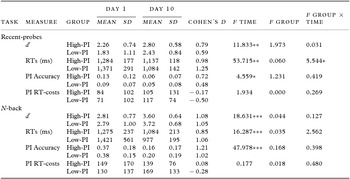
As displayed in Table 1, there were significant main effects of time in both tasks (recent-probes: F(1, 23) = 11.83, p < 0.01, η p 2 = 0.34; n-back: F(1, 23) = 18.63, p < 0.001, η p 2 = 0.45), indicating that WM performance increased from Day 1 to Day 10. However, the increase was similar for both training groups and thus independent of particular demands on PI resistance (i.e. no main effects of group, recent-probes: F(1, 23) = 1.97, p = 0.174, η p 2 = 0.08; n-back: F(1, 23) = 0.04, p = 836, η p 2 = 0.00, and no interactions between time and group, recent-probes: F(1, 23) = 0.03, p = 0.863, η p 2 = 0.00; n-back: F(1, 23) = 0.13, p = 724, η p 2 = 0.01).
Descriptives, effect sizes and F-values for performance changes in the training tasks

Note: SD = standard deviation; d′ = d-prime; RT = reaction time; ms = milliseconds; PI = proactive interference; d′ and RTs comprised only trials without proactive interference and non-recent trials. * p < 0.05, ** p < 0.01, *** p < 0.001.
RT:
We further tested whether there was a global decrement regarding RTs of the non-recent trials. In the recent-probes task, both groups were faster on Day 10 than on Day 1 (main effect of time, F(1, 23) = 53.72, p < 0.001, η p 2 = 0.70), and this effect was stronger in the low-PI group than in the high-PI group (Time × Group interaction, F(1, 23) = 5.54, p < 0.05, η p 2 = 0.19). There was no main effect of group, F(1, 23) = 0.06, p = 0.808, η p 2 = 0.00. Regarding the n-back task, both groups improved identically in terms of RT, as there was a main effect of time, F(1, 23) = 16.29, p < 0.001, η p 2 = 0.42, but no interaction, F(1, 23) = 2.56, p = 0.123, η p 2 = 0.10 and also no main effect of group, F(1, 23) = 0.04, p = 0.854, η p 2 = 0.00.
To summarize, WM performance improved in both tasks in the course of the training, and the amount of improvement was similar for both groups. RTs were faster in both tasks and both groups after training, this improvement was slightly stronger for the low-PI group. An overview on the descriptive and inferential statistics is provided in Table 1.
Training of resistance to pi
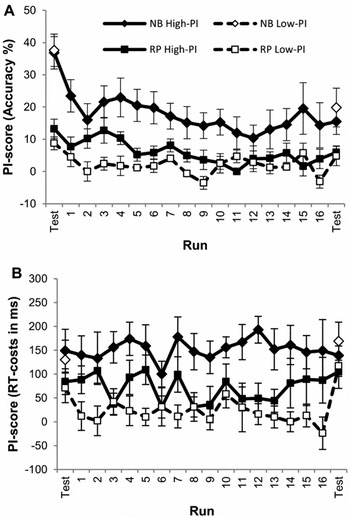
Improvement of resistance to PI was analyzed with univariate ANOVAs for accuracy and RTs separately in both tasks. Descriptives for Days 1 and 10 are reported in Table 1. Performance in PI-measures across all training runs from Days 1 to 10 is displayed in Figure 2, the respective changes in PI-scores are displayed in Figure 3. As is evident from Figure 2, the low-PI training group showed across Days 2 to 9 almost constantly less PI in the recent-probes task than the high-PI group, as PI came not from the most recent trial, but from two trials back, and therefore was expected to be substantially weaker. This difference (average PI-effect from Day 2 to Day 9) was statistically significant for errors (t(18.96) = 3.019, p < 0.01) and for PI-related RT-costs (t(23) = 2.83, p < 0.05).
Change in proactive interference (PI) across training runs. Mean and standard errors of PI-scores (difference between interference and non-interference negative trials) for both tasks and groups regarding accuracy (2A) and reaction-time (RT) costs (2B). Displayed are individual training runs, which might not necessarily have occurred on the same day for all participants, as some were absent on some days (at maximum two days missing were allowed). Under these circumstances, the N for the earlier runs is higher than the N in the later runs. The n-back for Days 2 to 9 for the low-PI group contained no PI, therefore, only values for Days 1 and 10 are displayed for this group. NB = n-back, RP = recent-probes.

Proactive interference (PI) scores on the first and last training day. Mean and standard errors of the PI-scores for accuracy (A–B) and reaction times (RT, C–D) for both training groups on the first and last training day.

Accuracy:
Univariate ANOVAs showed that PI-scores decreased over time in both tasks (recent-probes: F(1, 23) = 4.56, p < 0.05, η p 2 = 0.17; n-back: F(1, 23) = 47.98, p < 0.001, η p 2 = 0.68, see also Figure 2 and Table 1). However, there were no differential effects regarding this improvement, as there were no significant Time × Group interactions (recent-probes: F(1, 23) = 0.42, p = 0.524, η p 2 = 0.02; n-back: F(1, 23) = 0.40, p = 0.535, η p 2 = 0.02) as well as no main effects of group (recent-probes: F(1, 23) = 1.23, p = 0.279, η p 2 = 0.05; n-back: F(1, 23) = 0.17, p = 0.685, η p 2 = 0.01).
RT:
Univariate ANOVAs regarding both tasks indicated no improvement in PI-related RT-costs (recent-probes: F(1, 23) = 1.93, p = 0.178, η p 2 = 0.08; n-back: F(1, 23) = 0.18, p = 678, η p 2 = 0.01). As can be seen in Figure 2B, PI-related RT-costs were fluctuating +/− 50ms around the mean and did not decrease across training runs. Further, there were no main effects of group (recent-probes: F(1, 23) = 0.00, p = 0.989, η p 2 = 0.00; n-back: F(1, 23) = 0.18, p = 895, η p 2 = 0.01) and no interactions (recent-probes: F(1, 23) = 0.27, p = 0.609, η p 2 = 0.01; n-back: F(1, 23) = 0.48, p = 495, η p 2 = 0.02).
In sum, both training groups could improve resistance to PI in both tasks in terms of accuracy, however, there was no difference between both groups’ improvement. There was no reduction in PI-related RT-costs in either of the groups or tasks.
Immediate and long-term effects of near and far transfer
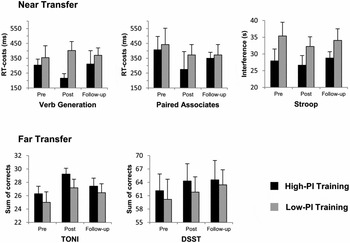
Before training, high-interference conditions were answered more slowly than low-interference conditions in all near-transfer tasks (verb generation: t(24) = 7.45, p < 0.001; paired associates: t(22) = 6.15, p < 0.001; Stroop test: t(24) = 11.41, p < 0.001). Performance in the transfer tasks at pre-test, post-test and follow-up sessions for both groups is displayed in Figure 4 and reported in Table S1 in the supplementary material.
Short- and long-term changes in transfer measures. Mean and standard errors of performance for both training groups. RT = reaction time, PI = proactive interference, TONI = Test of Nonverbal Intelligence, DSST = Digit Symbol Substitution Test.

Separate repeated-measurements ANOVAs with training group (high- vs. low-PI) as between-participants factor and time (pre-test vs. post-test) as within-participant factor were conducted for the three near-transfer tasks as well as for the two far-transfer tasks. There were no differential near- or far-transfer effects, neither directly after the training nor eight weeks later (Time × Group interactions all p ≥ 0.335). Results of the ANOVAs can be found in the supplementary material (Sections S5 and S6).
Discussion
The overall aim of the present study was to investigate whether resistance to PI can be effectively improved by a WM training. Two groups of older adults were trained with identical WM tasks over the course of two weeks, with the only difference that PI demands were experimentally varied between groups (high vs. low PI). Another main objective was to investigate whether a potential improvement in resistance to PI would transfer to other interference tasks (near transfer) or to gF and processing speed (far transfer). In the next sections, the results will be discussed.
Training effects
Results revealed a global improvement in WM performance in both the recent-probes and the n-back task that was similarly pronounced in both training groups (see Table 1). Such training effects have already been shown in other studies with older adults (e.g. Li et al., Reference Li, Schmiedek, Huxhold, Röcke, Smith and Lindenberger2008; Dahlin et al., Reference Dahlin, Stigsdotter Neely, Larsson, Bäckman and Nyberg2008b) and demonstrate still existing cognitive plasticity in this age group.
In addition, PI-related errors were reduced not only in the high-PI but also in the low-PI group (see Table 1 and Figures 2 and 3). To our knowledge, this is the first study demonstrating generally reduced PI-susceptibility following WM training in old adults. But contrary to our expectations, the improvement was not larger in the high-PI group. Thus, the WM training itself and the resulting higher WM performance at the end of the training in both groups might have led to better resistance to PI, regardless whether resistance to PI was explicitly trained or not. As a reciprocal relationship between resistance to PI and WM capacity can be assumed (see e.g. May et al., Reference May, Hasher and Kane1999; Kane and Engle, Reference Kane and Engle2000; Mecklinger et al., Reference Mecklinger, Weber, Gunter and Engle2003), both functions could possibly influence each other. But improved resistance to PI was only found in terms of a decrement in PI-related errors, whereas a similar decrease in PI-related RT-costs was not observed in either of the groups (see Table 1 and Figures 2 and 3). Individual differences in gain on WM performance or resistance to PI were barely related to cognitive performance as assessed previous to the intervention. Further, the training effects should be interpreted with caution, as no passive control was used. Unspecific effects such as re-testing, expectancy effects or meeting in a group on a daily-basis (cf. Willis, Reference Willis, Birren and Schaie2001) could also be a source of this general improvement.
The question remains why the high-PI training group could not show stronger benefits in PI resistance than the low-PI group. Although the relevant interaction effects for corroborating a differential improvement were not significant, effect sizes regarding the improvement in PI-related errors were higher in the high-PI group than in the low-PI group (see Table 1). As the N in our study was rather small, one could argue that low power might be responsible for the non-significant interactions. However, effect-sizes for the interactions were only small (see Result section), and sample sizes of 80 (n-back PI-accuracy) or about 200 (other PI-measures, see Table S2 in Section S7 in the online supplementary material) would have been required to obtain significant differential effects. That is, even if potentially rendered significant in a larger sample, potential effects of a differentially improved PI resistance following a specific PI training are likely to be too small to become practically relevant.
Another methodological aspect may concern the non-adaptivity of the applied WM training tasks. That is, the difficulty of the tasks in terms of WM load and the amount of PI remained constant across the training and were not adaptively adjusted to the participants’ performance. Some participants were on ceiling level already in the first days of the training, whereas others struggled with the demands imposed by the tasks until the end of the second training week. It may hence be speculated that the gain in PI resistance could have been larger using an adaptive training approach or by solely focusing on participants with a compromised WM performance and/or PI susceptibility.
Near transfer
Neither differential nor global short- or long-term improvement in non-trained tasks was observed. From a theoretical perspective it can be argued that, as there was no differential improvement in the training tasks regarding PI, no differential improvement in the transfer tasks could have been expected (see Willis, Reference Willis, Birren and Schaie2001). But as both groups showed improved PI-accuracy scores and also ameliorated WM performance, the absence of a general improvement in the interference scores of the near-transfer tasks remains to be clarified.
Several approaches have previously been discussed to explain transfer from trained to non-trained tasks, e.g. structural similarities between training and transfer tasks (Salomon and Perkins, Reference Salomon and Perkins1989), overlapping cognitive processes between tasks (Dahlin et al., Reference Dahlin, Stigsdotter Neely, Larsson, Bäckman and Nyberg2008b; Shipstead et al., Reference Shipstead, Redick and Engle2010), or overlapping neural correlates of the tasks (Dahlin et al., Reference Dahlin, Stigsdotter Neely, Larsson, Bäckman and Nyberg2008b). From a perspective emphasizing structural similarities between tasks as a prerequisite for transfer, one could argue that training and near-transfer tasks were not directly comparable. The paired-associates task is structurally the most similar transfer task when compared to the training tasks, as it also involves encoding and maintenance of information. However, compared to the training tasks, larger amounts of information had to be encoded and maintained in long-term rather than short-term memory. In addition, assessment of memory performance (and interference effects) was based on free recall and not on recognition as in the applied WM training tasks. That is, similarity of task structure was only given on a superficial level. The task structure of the other near-transfer tasks was completely different from the WM training tasks. Further, while the WM training tasks consisted of visual stimuli, verbal material was used in the near-transfer tasks. Taken together, it may hence be possible that there was no near transfer because of the lacking structural similarities of training and transfer tasks.
However, with respect to underlying cognitive processes and neural correlates, all near-transfer tasks as well as the training tasks required selecting a correct answer among competing alternatives, and therefore the resolution of interference (e.g. Thompson Schill et al., Reference Thompson-Schill, D’Esposito, Aguirre and Farah1997; Milham et al., Reference Milham2001; Henson et al., Reference Henson, Shallice, Josephs and Dolan2002). Resolution of PI in the recent-probes task, in verb generation and in paired associates has previously been associated with activations in the prefrontal cortex, namely in the left inferior frontal gyrus (LIFG, Thompson-Schill et al., Reference Thompson-Schill, D’Esposito, Aguirre and Farah1997; Henson et al., Reference Henson, Shallice, Josephs and Dolan2002; Nelson et al., Reference Nelson, Reuter-Lorenz, Persson, Sylvester and Jonides2009). It is hence plausible to assume that training-related improvements in one task might spill over to a performance improvement in other tasks that recruit the same brain areas, but were not trained (see e.g. Dahlin et al., Reference Dahlin, Stigsdotter Neely, Larsson, Bäckman and Nyberg2008b). Persson et al. (Reference Persson, Welsh, Jonides and Reuter-Lorenz2007; Reference Persson, Larsson and Reuter-Lorenz2013) even showed negative transfer on interference resolution (verb generation and paired associates) after a very short (single-session) training with a letter recent-probes task in young adults. That is, a short, intensive training reduced the ability to resolve interference in tasks which, compared to the training tasks, required comparable processes or involved overlapping neural correlates (Persson et al., Reference Persson, Welsh, Jonides and Reuter-Lorenz2007). These results were explained as process-specific fatigue effects between interference tasks that share similar processes and neural correlates. Taken together, neuroimaging studies and studies on negative transfer indicate a relationship between several interference-resolution tasks that were also used in our training study.
However, the similarities in underlying cognitive processes and neural correlates may have been overridden by the differences between tasks and may hence have been too weak to serve as basis for effective transfer. For example, interference in terms of actual PI only occurred in the paired associates and not in verb generation or in the Stroop task, but was the critical process to be trained. Further, we are not aware of previous training studies using the verb generation and the paired-associates task as transfer task – besides the two studies on negative transfer cited above (Persson et al., Reference Persson, Welsh, Jonides and Reuter-Lorenz2007; Reference Persson, Larsson and Reuter-Lorenz2013) – so the present results cannot be compared with other work directly. However, WM training studies that used the Stroop task as transfer measure revealed mixed results, although a meta-analysis showed an overall small to moderate effect (Melby-Lervåg and Hulme, Reference Melby-Lervåg and Hulme2013). Likewise, Borella et al. (Reference Borella, Carretti, Riboldi and De Beni2010) were able to show transfer to the Stroop task after WM training in older adults. Their training used an adaptive procedure and a greater variation of task demands than the present study, which might possibly have been more advantageous to achieve transfer. Other methodological reasons that could account for the absence of near-transfer effects and more importantly, also for the total absence of global improvement in these tasks despite that all participants received a training of WM, could be on the one hand the relative shortness of the present intervention compared to other training studies in the elderly (see Richmond et al., Reference Richmond, Morrison, Chein and Olson2011, who list five training studies with training durations between 675 and 6,060 min; in contrast, our participants only trained for 32 min a day for two weeks). On the other hand, small power due to small sample size might provide an explanation for the lacking global and differential transfer effects. As shown in Table S2 in the online supplementary material, more than 100 participants would have been needed to obtain significant interaction effects in the near-transfer tasks, again questioning the practical relevance.
Far transfer
The matrix reasoning task used in this study shares neither structural similarities with one of the WM training tasks (i.e. similarities between task structure, task presentation or task conduction) nor conceptual similarities, as the training tasks and the gF task rely on different theoretical constructs and represent different cognitive functions. The absence of these similarities is indeed a criterion for defining far transfer tasks, but gF has nonetheless been shown to be related to PI (Bunting, Reference Bunting2006; Burgess et al., Reference Burgess, Gray, Conway and Braver2011; but see also Borella et al., Reference Borella, Carretti and Mammarella2006; Emery et al., Reference Emery, Hale and Myerson2008). Both WM capacity and gF seem to share interference resolution as common underlying process, although the tasks differ considerably in their appearance. However, in our study, the high-PI training group did not show significantly larger improvement regarding gF when compared to the low-PI group, although the estimated effect size was considerably larger in the high-PI training group than in the low-PI training group (see Table S1 in the online supplementary material). Nonetheless, the strength of the interaction effect was small, as also confirmed by post-hoc power-analyses (see Table S2 in the online supplementary material). More than a hundred participants would have been needed to obtain a significant interaction effect regarding gF (see Table S2), which is considerably more than the usual sample size in training studies (see e.g. Melby-Lervåg and Hulme, Reference Melby-Lervåg and Hulme2013, for an overview) and beyond any practical relevance. Nevertheless, there was a global improvement in the gF task, independent of group assignment, which was still marginally significant at the follow-up session eight weeks after the training. This outcome replicates findings from previous WM training studies that also showed improvements in gF after WM training in older adults (e.g. Borella et al., Reference Borella, Carretti, Riboldi and De Beni2010; Carretti et al., Reference Carretti, Borella, Zavagnin and de Beni2013b; Zinke et al., Reference Zinke, Zeintl, Rose, Putzmann, Pydde and Kliegel2014). However, whether this unspecific effect is a consequence of the WM training or whether it is only a re-test effect cannot be determined for the present data, as no passive control was used. Oelhafen et al. (Reference Oelhafen, Nikolaidis, Padovani, Blaser, Koenig and Perrig2013) also found an unspecific effect on gF after a WM training with differing interference control demands in young adults, however, when compared against a passive control group, the interaction effect did not reach significance. There is an ongoing debate in the literature regarding whether gF can be improved after WM training. A recent meta-analysis showed that effects of WM training on non-verbal ability were small (Melby-Lervåg and Hulme, Reference Melby-Lervåg and Hulme2013; for a more thorough discussion of transfer to gF after WM training, see also Harrison et al., Reference Harrison, Shipstead, Hicks, Hambrick, Redick and Engle2013; Redick et al., Reference Redick2013; Jaeggi et al., Reference Jaeggi, Buschkuehl, Shah and Jonides2014). Also in older adults, transfer to gF has not consistently been found (e.g. Richmond et al., Reference Richmond, Morrison, Chein and Olson2011; von Bastian et al., Reference Von Bastian, Langer, Jäncke and Oberauer2013).
There was no transfer on processing speed directly after training, but there was a marginal effect from pre-test to follow-up measurements. The large general decrements in RTs in both WM training tasks (see Table S1 in the online supplementary material) might have led to a general improvement in processing speed in both groups, even though the improvement was not significant directly after training. Dahlin et al. (Reference Dahlin, Nyberg, Bäckman and Stigsdotter Neely2008a) similarly found marginally improved performance on the DSST in older adults after a computerized updating training compared to a passive control group. However, performance decreased below pre-test level at the follow-up measurement in their participants. In the present study, although there was a global effect, there was no differential transfer, although the low-PI group improved more in global RTs in the training tasks. As in the other measures, the result of the general improvement should not be over-interpreted, as no passive control was used.
Conclusions
Implementing increased PI-demands in WM training tasks did not improve resistance to PI more effectively than a WM training with less PI in older adults, which might have numerous reasons, as discussed above. But irrespective of the unspecificity of the experimental PI manipulation, the present results demonstrate for the first time that resistance to PI can be reduced in older adults by a short, repetitive WM training as such. This result may be explained by the reciprocal relationship between WM and PI, i.e. better resistance to PI might hinder information that is no more relevant from entering WM, and therefore in turn might enhance its capacity (May et al., Reference May, Hasher and Kane1999). Conversely, higher WM capacity is associated with increased resistance to PI, as attention control seems to be more effective (Rosen and Engle, Reference Rosen and Engle1998; Kane and Engle, Reference Kane and Engle2000; Mecklinger et al., Reference Mecklinger, Weber, Gunter and Engle2003). Thus, not the direct training of resistance to PI, but the higher WM performance in both tasks and both groups at the end of the training might have led to better resistance to PI, although this improvement did not spill over to other tasks that measure inhibition or resistance to interference. The outcomes of our study and the resultant assumptions should be replicated with a passive control to exclude re-test and expectancy effects. As the sample size of this study was rather small, generalization of the results may be limited and further research is needed on how mechanisms of cognitive control may underlie WM training and transfer in older adults.
The present study on WM training and PI is one among few that did not only investigate the scope of training and transfer effects, but also attempted to shed light on the cognitive processes that might underlie training and transfer. Understanding if and how WM training works is important before applying it as an intervention method to clinical populations such as neurological patients, e.g. after stroke, or to patients with mild cognitive impairment (MCI), or to psychiatric patients with WM deficits. Our results suggest that PI-demands in the training task might not be a relevant factor when developing more efficient trainings regarding WM performance and resistance to PI, but that resistance to PI can possibly be improved as a side-effect of WM training, even when it contains only low PI-demands.
Conflict of interests
None.
Description of author's roles
Study concept and design: SVL, RF, JMU, CW, BR, CPK. Development of study tasks: CPK. Data collection: SVL, RF. Data analysis: SVL, RF, CPK. Data interpretation: SVL, RF, JMU, CW, BR, CPK. Writing of the manuscript: SVL. Critical review of the manuscript: SVL, RF, JMU, CW, BR, CPK.
Acknowledgments
The authors thank Jendrik Seipp for programming of the training tasks. This research was partly supported by grants of the German Federal Ministry of Education and Research (BMBF; grant number 01GW0710), the Freiburg University Scientific Society (“Wissenschaftliche Gesellschaft Freiburg i. Br.”), and the BrainLinks-BrainTools Cluster of Excellence funded by the German Research Foundation (DFG; grant number EXC 1086).
Supplementary Material
To view supplementary material for this paper, please visit http://dx.doi.org/10.1017/S1041610215001519