Introduction
Suicidality, ranging from suicidal ideation to completed suicide, is the second leading cause of death among young people (Patton et al., Reference Patton, Coffey, Sawyer, Viner, Haller, Bose, Vos, Ferguson and Mathers2009). Suicidality is higher among sexual minority (lesbian, gay and bisexual) relative to heterosexual youth (Plöderl and Tremblay, Reference Plöderl and Tremblay2015). Sexual minority youth are approximately twice as likely to have suicidal ideation (Jackman et al., Reference Jackman, Honig and Bockting2016) or have attempted suicide (King et al., Reference King, Semlyen, Tai, Killaspy, Osborn, Popelyuk and Nazareth2008; Marshal et al., Reference Marshal, Dietz, Friedman, Stall, Smith, McGinley, Thoma, Murray, D'Augelli and Brent2011; Miranda-Mendizábal et al., Reference Miranda-Mendizábal, Castellví, Parés-Badell, Almenara, Alonso, Blasco, Cebrià, Gabilondo, Gili, Lagares, Piqueras, Roca, Rodríguez-Marín, Rodríguez-Jiménez, Soto-Sanz, Vilagut and Alonso2017; Salway et al., Reference Salway, Ross, Fehr, Burley, Asadi, Hawkins and Tarasoff2018). Rates of deliberate self-harm are about three times higher in sexual minority youth (Jackman et al., Reference Jackman, Honig and Bockting2016). It has been suggested that higher rates of suicidality and self-harm may be due to sexual minority stress (Meyer, Reference Meyer1995), however existing evidence is largely cross-sectional. A meta-analysis of sexual orientation disparities in youth suicidal behaviour identified only 14 longitudinal studies (Miranda-Mendizábal et al., Reference Miranda-Mendizábal, Castellví, Parés-Badell, Almenara, Alonso, Blasco, Cebrià, Gabilondo, Gili, Lagares, Piqueras, Roca, Rodríguez-Marín, Rodríguez-Jiménez, Soto-Sanz, Vilagut and Alonso2017).
Depression is one of the strongest risk factors for suicidality (Bernal et al., Reference Bernal, Haro, Bernert, Brugha, de Graaf, Bruffaerts, Lépine, de Girolamo, Vilagut, Gasquet, Torres, Kovess, Heider, Neeleman, Kessler and Alonso2007) and self-harm in the general population (Mars et al., Reference Mars, Heron, Crane, Hawton, Kidger, Lewis, Macleod, Tilling and Gunnell2014). Depression rates are elevated in sexual minority youth (Marshal et al., Reference Marshal, Dietz, Friedman, Stall, Smith, McGinley, Thoma, Murray, D'Augelli and Brent2011; Plöderl and Tremblay, Reference Plöderl and Tremblay2015) and there is evidence of associations between depression, suicidal ideation and self-harm in this group. However, no studies have investigated whether depression mediates the relationship between sexual orientation and suicidality or self-harm in a longitudinal design.
There is increasing focus on how resilience factors may help protect sexual minority youth against the increased risk of adverse mental health outcomes (Russell and Fish, Reference Russell and Fish2016). In general population studies, higher self-esteem is a resilience factor associated with lower suicidal ideation and self-harm (Jang et al., Reference Jang, Park, Oh, Lee, Kim, Yoon, Ko, Cho and Chung2014). While low self-esteem can be a symptom of depression, a meta-analysis of longitudinal studies gave stronger evidence for a protective effect of high self-esteem against depression rather than vice versa (Sowislo and Orth, Reference Sowislo and Orth2013). Self-esteem is lower among sexual minority compared with heterosexual youth (Coulter et al., Reference Coulter, Herrick, Friedman and Stall2016), possibly reflecting minority stress effects. However, to the authors’ knowledge, no previous longitudinal studies have investigated self-esteem as a mediator in the relationships between sexual orientation and depression, suicidal ideation and self-harm.
These proposed mediation relationships may be moderated by other factors. For example, in general population studies, compared with boys, adolescent girls have lower self-esteem (Bleidorn et al., Reference Bleidorn, Arslan, Denissen, Rentfrow, Gebauer, Potter and Gosling2016), greater depression, suicidal ideation and self-harm (Mars et al., Reference Mars, Heron, Crane, Hawton, Kidger, Lewis, Macleod, Tilling and Gunnell2014). However, discrepancies in depression and self-harm between sexual minority youth relative to heterosexual youth are greater among males than females (Plöderl and Tremblay, Reference Plöderl and Tremblay2015), while discrepancies in self-esteem are greater in females (Yean et al., Reference Yean, Benau, Dakanalis, Hormes, Perone and Timko2013). Therefore, sex may moderate the potential relationships between self-esteem, depression and suicidality in sexual minority populations.
Another possible moderator is childhood gender nonconformity (CGN), which is longitudinally associated with increased rates of subsequent minority sexual orientation (Li et al., Reference Li, Kung and Hines2017). Gender nonconformity is also associated with higher rates of adverse mental health outcomes including suicidality (Plöderl and Fartacek, Reference Plöderl and Fartacek2009; Roberts et al., Reference Roberts, Rosario, Slopen, Calzo and Austin2013). There is some evidence that sexual minority individuals who had higher CGN have increased rates of mental illness than sexual minority adults who were less gender nonconforming (Alanko et al., Reference Alanko, Santtila, Witting, Varjonen, Jern, Johansson, von der Pahlen and Sandnabba2009). This suggests that CGN may serve as another moderator of the relationship between sexual orientation and mental illness. However, considering that most studies of CGN have used retrospective assessments, which are open to biases; future research is required where CGN is assessed prospectively.
A more thorough understanding of the interplay of resilience and risk factors in explaining the increased suicidality among sexual minority youth is important to inform preventive and therapeutic efforts. The objectives of this study were to use a longitudinal design in a population cohort to investigate whether minority sexual orientation reported at 15 years was associated with higher rates of past-year suicidal ideation or self-harm (SISH) at 20 years. This study tested mediation models in which (a) self-esteem at 17 years mediates the relationships between sexual orientation and depressive symptoms at 18 years, and SISH at 20 years and (b) depressive symptoms mediate the relationships between sexual orientation and self-esteem, and SISH at 20 years; and investigated prospectively assessed childhood gender-nonconformity and sex as moderators of the mediation relationships.
Methods
Participants
The study sample was derived from the Avon Longitudinal Study of Parents and Children (ALSPAC) cohort in which participants were enrolled in-utero and during childhood. All pregnant women in the former County of Avon in South West England with expected delivery dates ranging between 1 April 1991 and 31 December 1992 were eligible to participate. The total sample size was derived from 15 247 pregnancies, which resulted in 15 458 foetuses. Of this total sample, 14 775 were live births and 14 701 were alive at 1 year of age. The sex distribution of the cohort was similar to the general population; however, attrition was associated with male sex, non-white ethnicity and lower household income (Boyd et al., Reference Boyd, Golding, Macleod, Lawlor, Fraser, Henderson, Molloy, Ness, Ring and Smith2012). The analyses presented involve 4274 individuals who completed questions on suicidal thoughts or self-harm at 20 years. The study website contains details of the data that is available through a fully searchable data dictionary: http://www.bris.ac.uk/alspac/researchers/data-access/data-dictionary/
Procedure
Ethical approval for this study was obtained from the ALSPAC Ethics and Law Committee (see http://www.alspac.bris.ac.uk) and King's College Research Ethics Committee (Ref. PN/14/15-67). Informed written consent was initially obtained from pregnant mothers; informed assent was gained from children at subsequent clinic assessments. After age 18 years, written informed consent was obtained. Questionnaires were administered to the children's mothers to elicit socio-demographic information such as socioeconomic status and ethnicity, and CGN. Questionnaires were subsequently completed by the children as they grew older. Data were collected every 1–2 years (Boyd et al., Reference Boyd, Golding, Macleod, Lawlor, Fraser, Henderson, Molloy, Ness, Ring and Smith2012).
Predictor variable
Sexual orientation was assessed at age 15 years through a single question asking participants to describe their sexuality with a choice of responses. Responses ranged from 1 (100% heterosexual), through 2 (mostly heterosexual, but also attracted to own sex), 3 (bisexual), 4 (mostly homosexual, but also attracted to opposite sex), to 5 (100% homosexual). Based on the 2886 completed responses to this question, 2551 (88.4%) identified as 100% heterosexual, 270 (9.4%) as mostly heterosexual, 47 (1.6%) as bisexual, 10 (0.3%) as mostly homosexual and 8 (0.3%) as 100% homosexual. Fifty-four participants who were not sure of their sexual orientation or were not attracted to either sex, were excluded from analyses because we had no a priori predictions about the relationships between these sexual orientations and the other variables in this study. Missingness was 32.5%. Due to the small sample size, participants were categorised into heterosexual (100% heterosexual) and sexual minority (responses other than 100% heterosexual) groups.
Outcome variable
The outcome variable was a composite past-year SISH variable at age 20 years. Past-year suicidal ideation and past-year self-harm were assessed using questions derived from the Child and Adolescent Self-harm in Europe (CASE) study (Madge et al., Reference Madge, Hewitt, Hawton, de Wilde, Corcoran, Fekete, van Heeringen, De Leo and Ystgaard2008). Participants with suicidal ideation were those who either had wished they were ‘dead and away from it all’ or who had ‘thought of killing themselves even if they would not do it’ within the previous year. Participants who reported having hurt themselves on purpose within the past year were categorised as having past-year self-harm. Participants who reported either suicidal ideation or self-harm were categorised as having SISH and were coded as ‘1’ while those who reported neither suicidal ideation nor self-harm were coded as ‘0’. Suicidal ideation and self-harm were combined to simplify the analytic model following preliminary analyses showing that the direct and indirect effects were similar for both variables as individual outcomes (see online Supplementary Appendix 3). Creating a composite variable is also consistent with the conceptualisation of self-harm and suicidality as being on a spectrum of self-injurious thoughts and behaviours based on the consistent association between suicidality and self-harm and their shared risk factors (Hamza et al., Reference Hamza, Stewart and Willoughby2012).
Mediator variables
Self-esteem was assessed at 17 years using the Bachman revision of the Rosenberg's Self-Esteem Scale which was revised for adolescents (Bachman, Reference Bachman1970). This 10-item self-report scale is scored on a four-point Likert scale ranging from 0 (strongly disagree) to 3 (strongly agree). Higher scores indicate higher self-esteem. It has a good internal consistency (Cronbach's α = 0.80) (Ranzijn et al., Reference Ranzijn, Keeves, Luszcz and Feather1998). Missingness was 34.4%.
Depressive symptoms were assessed at 18 years using the 13-item Short Mood and Feelings questionnaire (SMFQ) (Angold et al., Reference Angold, Costello, Messer and Pickles1995). The questions were scored on a Likert scale ranging from 0 (not true), through 1 (somewhat true), to 2 (true). It has been validated for adolescents with an internal consistency of 0.87 (Kuo et al., Reference Kuo, Stoep and Stewart2005). Missingness was 42.0%.
Moderators
Sex of the child was reported by the mother or healthcare providers. CGN was assessed three times by maternal report when the child was aged 30, 42 and 57 months using the Pre-School Activities Inventory (PSAI) (Golombrok and Rust, Reference Golombrok and Rust1993). The PSAI consists of 24 items describing stereotypical gender-specific play, activities and other child characteristics. Twelve items each indicated female- and male-typical behaviours, respectively. Responses were scored on a five-point Likert scale ranging from 1 (never) to 5 (very often). Responses were scored and transformed as recommended by the authors. An average of the three PSAI scores was derived, and this average was standardised so that the means for girls and boys were both 0. The male standardised scores were multiplied by −1, so that higher scores for both male and female participants indicated higher CGN. Missingness was 12.4%.
Covariates
Socioeconomic status was assessed via two questions about the mothers’ occupation and the highest level of education at gestational ages of 18 and 32 weeks, respectively. Missingness rates were 17.2% and 6.9%, respectively. Occupations were categorised into skilled/managerial/professional jobs; and partly skilled/unskilled (Dale and Marsh, Reference Dale and Marsh1993). Ethnicity of participants was assessed via a question about the race or ethnic group of the participants’ parents at 32 weeks’ gestation. Responses were categorised into White (both parents) v. non-White (one or both parents) due to the small number of non-White participants. Missingness was 8.3%. Earlier assessments of self-esteem, depressive symptoms and SISH were also included as covariates. Self-esteem at 13 years was measured using the Self-Image Profile for Children (Butler, Reference Butler2001), which consists of 25 items each rated on a five-point Likert scale; missingness was 19.7%. Depressive symptoms and SISH were assessed at 16 years using instruments previously described; missingness rates were 25.0% and 23.9%, respectively.
Statistical analysis
Analyses were conducted using STATA version 14.0 (StataCorp, 2015). Univariate logistic regression analyses were carried out to examine the respective associations between sexual orientation and SISH, and all other variables.
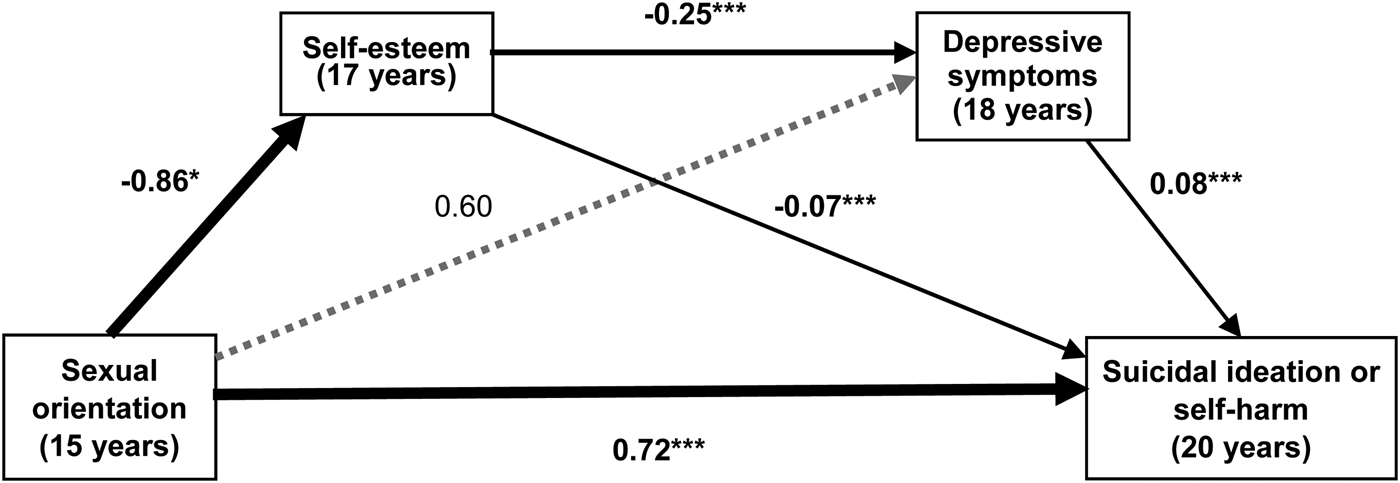
An initial structural equation model was executed with SISH as the outcome variable, adjusting for socioeconomic status and ethnicity (Fig. 1). A second model was run in which adjustments were made for earlier measures of self-esteem, depression and SISH. In a third model, CGN was then included as a moderator. A fourth model was run as model 2 but with sex included as a moderator. The proportion of the total effect of sexual orientation on the combined self-harm/suicidal ideation outcome mediated in each model was derived as a ratio of indirect to total effect, expressed as a percentage. Indirect effects were derived as the difference between the total and direct effects. One thousand bootstrap cycles were carried out to derive standard errors and bias-corrected 95% confidence intervals and to determine the statistical significance of the indirect effects and the proportions mediated. Bootstrapping was carried out after imputation as recommended by Schomaker and Heumann (Reference Schomaker and Heumann2018).
Unstandardised coefficients for paths in structural equation models for past-year SISH at 20 years. Model adjusted for sociodemographic variables and earlier measures of mediator and outcome variables (model 2). Solid lines indicate significant paths while broken lines indicate non-significant paths; weight of the lines corresponds to size of the path coefficients. *p significant at <0.05, **p significant at <0.01, ***p significant at <0.001.

Imputation
Imputation of missing data was necessary due to attrition, a recognised difficulty with longitudinal data. This was carried out using multiple imputation by chained equations (MICE). Seventy imputations were carried out as determined by the proportion of missing data. Preliminary analyses revealed the pattern of missingness to be missing at random (MAR) which is a required assumption for MICE (White et al., Reference White, Royston and Wood2011). Covariates (maternal education, maternal occupation, ethnicity and earlier measures of self-esteem, depressive symptoms, SISH) were included in the imputation model to enhance the likelihood of the MAR assumption and facilitate the estimation of missing data (White et al., Reference White, Royston and Wood2011). Following imputation, cases with imputed SISH at 20 years were excluded; and inferential analyses were based on the 4274 cases with non-missing outcomes.
Results reported are for analyses carried out on imputed data and reported estimates were derived from each of the 70 imputations by applying Rubin's rules (Little and Rubin, Reference Little and Rubin2002). The same analyses were repeated on complete-case (non-imputed) data and findings were similar. The Monte Carlo error of each estimate derived from analyses was <0.1 of the standard error of the corresponding estimate. These indicate that the imputation was adequate.
Results
Description of the study sample
The majority (83.45%) of the study participants’ mothers had skilled, managerial or professional occupations, and 80.0% of mothers had at least one academic qualification taken at age 16 years. Four percent of the young people were non-White and 11.8% were categorised as sexual minority. The mean self-esteem score at age 13 years was 87.0 (s.d. = 9.54). The mean self-esteem score at age 17 years was 28.3 (s.d. = 7.85). The mean depressive symptoms score at 16 years was 5.9 (s.d. = 6.54); while at 18 years, it was 6.8 (s.d. = 6.54). At ages 16 and 20 years respectively, 20.2% and 18.7% of the participants reported past-year SISH.
Direct associations with sexual orientation
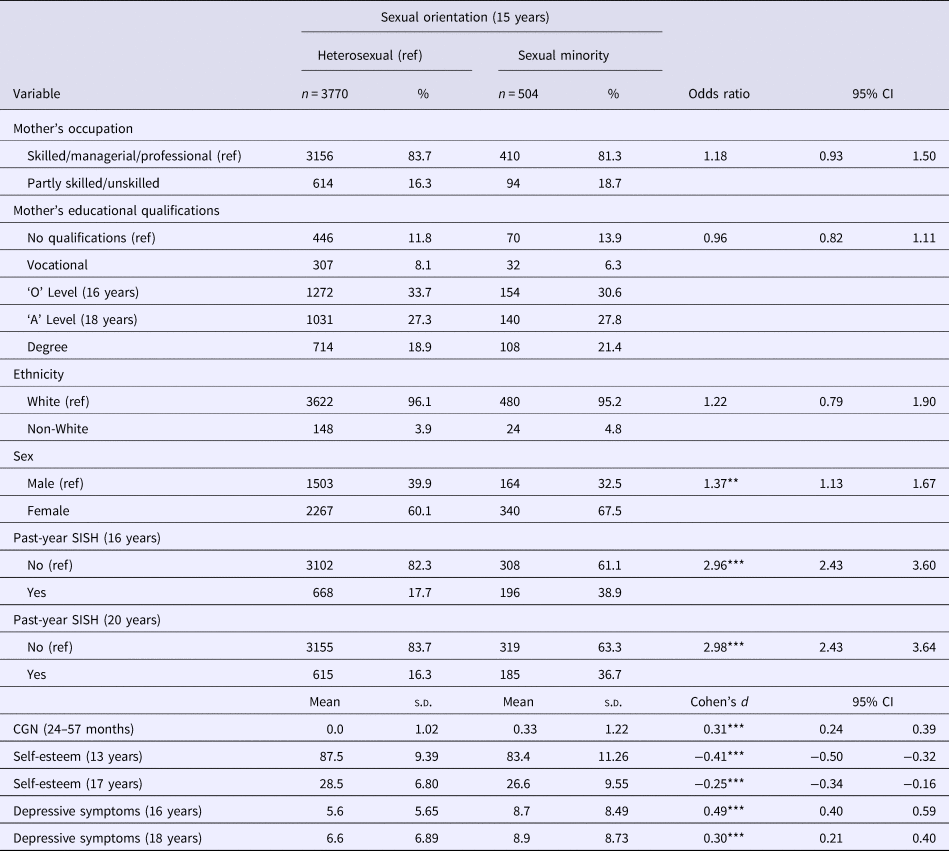
Associations between sexual orientation and the study variables are shown in Table 1. Female participants were more likely to report sexual minority status, but there were no significant relationships between sexual orientation and the other socio-demographic variables. Sexual minority participants had significantly higher standardised mean CGN scores compared with heterosexual participants. Sexual minority youth also reported significantly lower self-esteem scores at ages 13 and 17 years; and significantly higher scores for depressive symptoms at ages 16 and 18 years. Sexual minority status was also significantly associated with increased risk of past-year SISH at 16 and 20 years.
Univariate associations between sexual orientation and other study variables (covariates, mediators, moderators and outcome)

ref, reference category.
*Significant at p < 0.05; **significant at p < 0.01; ***significant at p < 0.001.
Associations between predictor, mediator, moderator and confounding variables with past-year SISH at 20 years
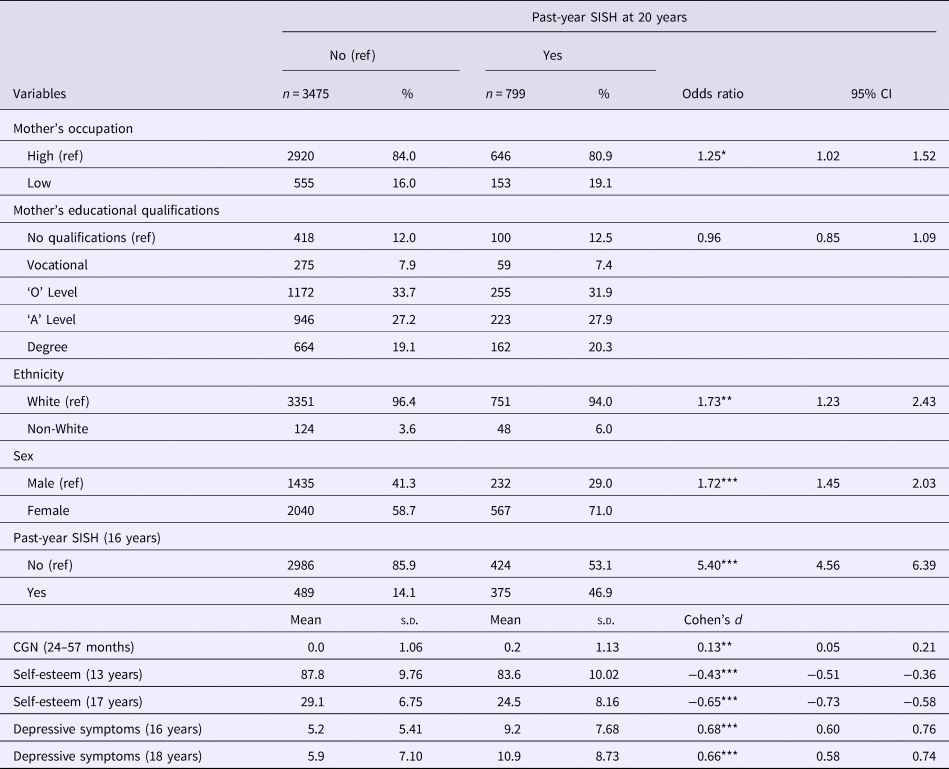
Univariate associations between predictor, mediator, moderator and confounder variables with SISH are shown in Table 2. Female participants were significantly more likely to report SISH at 20 years. Participants whose mothers had unskilled/partly skilled jobs and those who were ethnic minority were also significantly more likely to report past-year SISH at 20 years. Past-year SISH at 20 years was also significantly associated with prior past-year SISH at 16 years, higher gender nonconformity scores in childhood, lower self-esteem scores at 13 and 17 years, and higher depression scores at 16 and 18 years.
Univariate associations between past-year SISH and predictor, mediator and confounding variables

ref, reference category.
*Significant at p < 0.05; **significant at p < 0.01; ***significant at p < 0.001
Mediation pathways for past-year SISH at 20 years
Model 1: In the first structural equation model, adjusted for maternal education, maternal occupation and ethnicity, all the mediation pathways were statistically significant (see online Supplementary Appendix 2). Three mediation pathways were identified: (i) a single mediator pathway in which lower self-esteem mediated the relationship between sexual minority status and the increased likelihood of later SISH; (ii) a single mediator pathway in which higher depressive symptomatology mediated the relationship between sexual minority status and the increased likelihood of later SISH and (iii) a multiple mediated pathway in which minority sexual orientation was associated with lower self-esteem at 17 years; lower self-esteem was associated with more depressive symptomatology at 18 years which was in turn was associated with increased rates of SISH at 20 years. The proportion of the effect of sexual orientation on SISH mediated in the first model was 19.3% and was statistically significant (Table 3).
Total, direct and indirect effects of sexual orientation on past-year SISH at age 20 (outcome) through self-esteem at 17 and depression at age 18 (mediators)

Model 1 – Adjusted for maternal education, maternal occupation and ethnicity.
Model 2 – As in model 1, but also adjusted for earlier measures of self-esteem, depression and suicidal ideation.
Model 3 – As in model 2, but also adjusted for interaction with CGN.
Model 4 – As in model 2, but also adjusted for interaction with sex.
a Indirect effect was computed as total effect minus direct effect.
b Effect proportion mediated was computed as the ratio of the indirect effect to the total effect expressed as a percentage.
*Significant at p < 0.05; **significant at p < 0.01; ***significant at p < 0.001.
Model 2: When earlier measures of self-esteem, depressive symptoms and suicidal ideation were adjusted for in the second model (Fig. 1), the single mediation pathway involving depressive symptoms was no longer statistically significant. The proportion mediated reduced to 10.4% but remained statistically significant.
Model 3: None of the pathways were significantly moderated by CGN (see online Supplementary Appendix 2), however, the proportion mediated increased to 13.1%.
Model 4: The proportion mediated reduced to 4.6% and was no longer statistically significant, however, the pathway between self-esteem and depressive symptoms was significantly moderated by sex such that the relationship between low self-esteem and depressive symptoms was stronger in female participants (see online Supplementary Appendix 2).
Discussion
Associations between sexual orientation and adverse outcomes
The current findings extend previous research by providing longitudinal evidence from a population-based birth cohort study for higher rates of adverse mental health outcomes across a key developmental period in sexual minority youth. Sexual minority youth reported significantly lower levels of self-esteem at 13 and 17 years, higher levels of depressive symptomatology at 16 and 18 years and higher levels of past-year SISH at 16 and 20 years. These findings are in keeping with research involving mainly non-UK samples (Wichstrøm and Hegna, Reference Wichstrøm and Hegna2003; King et al., Reference King, Semlyen, Tai, Killaspy, Osborn, Popelyuk and Nazareth2008; Yean et al., Reference Yean, Benau, Dakanalis, Hormes, Perone and Timko2013; Plöderl and Tremblay, Reference Plöderl and Tremblay2015; Coulter et al., Reference Coulter, Herrick, Friedman and Stall2016; Jackman et al., Reference Jackman, Honig and Bockting2016). The presence of self-esteem disparities at age 13 years raises the possibility that precursors to later self-harm and suicidality may start even earlier in childhood (La Roi et al., Reference La Roi, Kretschmer, Dijkstra, Veenstra and Oldehinkel2016) and prevention strategies may need to begin at younger ages.
These findings indicate that elevated rates of depression, self-harm and suicidality in young people continue despite the increasing societal acceptance of same-sex attraction. The ongoing disparities may partly reflect the fact that young people are coming out at earlier ages (Russell and Fish, Reference Russell and Fish2016). Thus, they may be exposed earlier to stigma and victimisation, which although decreasing at the population-level, may continue to affect at-risk individuals or influence mental health in an age-dependent manner (Russell and Fish, Reference Russell and Fish2016). Some individuals are likely to experience challenging peer dynamics and familial stigma against minority sexualities despite wider social or structural changes.
The proportion of participants identifying as sexual minorities is higher than previous studies (e.g. Coulter et al., Reference Coulter, Herrick, Friedman and Stall2016) and this is due to 9% identifying as ‘mostly heterosexual’. This may reflect the increasing societal tolerance for same-sex attractions (Russell and Fish, Reference Russell and Fish2016), and the instability of sexual identity during adolescence (Savin-Williams and Ream, Reference Savin-Williams and Ream2007).
Mediation of the relationship between sexual minority status and SISH
Importantly, this study indicates possible mechanisms for increased suicidal ideation and self-harm among sexual minority youth. In the first pathway, lower self-esteem mediated the relationship between sexual minority status and the increased likelihood of SISH. This contrasts with previous negative findings (Wichstrøm and Hegna, Reference Wichstrøm and Hegna2003; Rosario et al., Reference Rosario, Schrimshaw and Hunter2005), which may be due to the smaller sample sizes utilised and shorter duration of follow-up (Rosario et al., Reference Rosario, Schrimshaw and Hunter2005).
The second pathway was a multiple mediated pathway in which sexual minority status was initially associated with lower self-esteem at 17 years, which was associated with increased depression at 18 years, and which was in turn associated with increased SISH at 20 years. This finding is in keeping with previous evidence of significant associations between self-esteem and depression (Sowislo and Orth, Reference Sowislo and Orth2013), depression and suicidal ideation (Bernal et al., Reference Bernal, Haro, Bernert, Brugha, de Graaf, Bruffaerts, Lépine, de Girolamo, Vilagut, Gasquet, Torres, Kovess, Heider, Neeleman, Kessler and Alonso2007), and depression and self-harm (Jackman et al., Reference Jackman, Honig and Bockting2016) in both general and sexual minority samples. Our finding extends research by demonstrating how mediation relationships between a protective factor (self-esteem) and a risk factor (depression) partly explain increased SISH among sexual minority youth. Although low self-esteem can be a symptom of depression, this mediation pathway remained significant after controlling for earlier measures of self-esteem and depression. This suggests that the risk associated with low self-esteem is not entirely resulting from depression. Controlling for earlier measures of self-esteem, depressive symptoms and SISH attenuated the proportion mediated by the later assessments. This indicates that while earlier-onset mental health disparities have sustained effects in increasing the risk for later suicidality and self-harm, ongoing mental health problems are independently associated with increased risk for suicidality and self-harm in sexual minority youth. This highlights the need to recognise the mental health needs of sexual minority youth at different stages of development.
The finding that self-esteem mediated suicidal ideation and self-harm, both on its own and via depressive symptomatology, highlights the importance of considering this factor as a possible mediator for other mental health disparities between sexual minority and heterosexual youth. This is consistent with minority stress theory (Meyer, Reference Meyer1995) which suggests that one mechanism by which societal stigma against sexual minorities negatively impacts on mental health is by internalisation of negative attitudes resulting in lower self-esteem.
Sex differences
Consistent with previous research (Wichstrøm and Hegna, Reference Wichstrøm and Hegna2003; Fox et al., Reference Fox, Franklin, Ribeiro, Kleiman, Bentley and Nock2015), females had higher rates of SISH. Our findings extend the results from a cross-sectional study (Grossman and Kerner, Reference Grossman and Kerner1998) by providing longitudinal evidence for a stronger relationship between depression and self-esteem in female sexual minority youth. However, introducing sex as a moderator of the mediation framework led to loss of significance in the mediation pathways and a substantial reduction in the proportion mediated. Moderation by sex divides the sample into male and female, meaning that it is possible the loss in significance is due to less statistical power to detect the moderation effects of sex in this multivariable mediation framework. Future studies may benefit from utilising even larger samples to investigate these effects. More studies are needed to investigate sex differences in the risk for suicidality and self-harm among sexual minority youth.
Effects of CGN
Consistent with previous findings (Plöderl and Fartacek, Reference Plöderl and Fartacek2009; Roberts et al., Reference Roberts, Rosario, Slopen, Calzo and Austin2013; Jones et al., Reference Jones, Robinson, Oginni, Rahman and Rimes2017), the current study found that CGN was prospectively associated with later depression and low self-esteem in adolescence and suicidal ideation and self-harm in early adulthood. This is the first study to demonstrate these relationships longitudinally. These associations may indicate the effects of earlier minority stress factors such as bullying. Considering the associations between CGN and later sexual minority status and later adverse mental health sequelae demonstrated in this study, CGN may represent an even earlier indicator of suicidality and self-harm in sexual minority youth. However, it did not significantly moderate the mediation pathways between sexual orientation and SISH. While the proportion mediated increased when CGN was included as a moderator in the mediation model, this negative finding may also indicate the need for a larger sample size to increase the power to detect significant moderated mediation effects. The prospective assessment of CGN in the current study also meant that it was not affected by possible biases introduced by recall during adulthood including the effects of low mood, knowledge of psychopathology experiences and sexual orientation-related factors.
Strengths and limitations
The strengths of this study include its large sample size, longitudinal design and the inclusion of a risk and a protective factor in the analytic framework. The prospective and repeated assessments of CGN improved accuracy and avoided recall bias. However, the following limitations need to be considered. Although a longitudinal design was utilised, the significant relationships found in this study do not prove causation. More longitudinal and intervention studies are required to further investigate mechanisms including other minority stress factors and coping responses such as rumination (Timmins et al., Reference Timmins, Rimes and Rahman2018). The birth cohort was recruited from one county in the UK and may not be representative of youth in other geographical regions. It is also possible that some sexual minority participants concealed their sexual orientation, which may result in under-estimating the magnitude of the effects of sexual minority status. Alternatively, some heterosexual participants may also mischievously indicate a sexual minority identity. This misclassification bias may be potentially worsened by the instability of self-reported sexual orientation during adolescence (Savin-Williams and Ream, Reference Savin-Williams and Ream2007). Participants who were uncertain about their sexual orientation were not included and future studies among sexual minority adolescents would be enhanced by repeated assessments of sexual orientation. Asexual participants were also excluded and these individuals need further research in their own right. The aggregation of separate sexual minority groups due to sample size considerations in this study may mask differing mediation pathways for each group. Recent evidence suggests that bisexual and ‘mostly heterosexual’ youth may have distinct risk profiles for adverse mental health outcomes and require investigation as separate groups (Salway et al., Reference Salway, Ross, Fehr, Burley, Asadi, Hawkins and Tarasoff2018).
Implications
Suicide and self-harm risk assessments should include consideration of sexual orientation. A meta-analysis found a significant association between communication of suicidal intent and subsequent suicide (Pompili et al., Reference Pompili, Murri, Patti, Innamorati, Lester, Girardi and Amore2016), suggesting that expressions of suicidal thoughts should be further explored to ascertain the extent of risk. Those working with sexual minority youth should be aware that low self-esteem and depressive symptoms may be risk indicators for both suicidal ideation and self-harm in this group, especially females, and may indicate individuals who should be targeted for preventive interventions. The roles of peers and teachers are particularly important in light of evidence that lower social support and inadequate teacher responses to sexual minority stigma are associated with increased suicidality in sexual minority youth (Plöderl et al., Reference Plöderl, Faistauer and Fartacek2010; Rimes et al., Reference Rimes, Ussher, Baker, Rahman and West2018). Our findings reinforce pilot interventions aimed at increasing self-esteem in sexual minority youth (Craig et al., Reference Craig, McInroy, Austin, Smith and Engle2012). Targeting self-esteem may reduce the likelihood of suicidal ideation and self-harm directly, and indirectly by attenuating the likelihood of mediating factors such as depression. Our findings also suggest early identification and treatment of depression in sexual minority youth as preventive interventions against both outcomes. The direct relationships between CGN and depression, low self-esteem, suicidal ideation and self-harm also identify this characteristic as an early indicator of risk for adverse mental health outcomes later in life. In addition to individual-level interventions, the societal stigma that is likely to be contributing to lower self-esteem and greater depression in sexual minority people needs to be addressed at a wider level. For example, protective legislation and healthcare, educational and workplace policies regarding discrimination and bullying should be enforced (Hatzenbuehler and Keyes, Reference Hatzenbuehler and Keyes2013).
Conclusions
Understanding the factors contributing to the elevated rates of suicidal ideation and self-harm in sexual minority youth is crucial to reducing these inequalities. Our findings provide prospective evidence that low self-esteem and depressive symptoms mediate part of the increased risk and future research should investigate the impact of targeting these factors. Gender nonconformity in early childhood was associated with later suicidality and self-harm, indicating that gender nonconforming children may require extra support.
Supplementary material
The supplementary material for this article can be found at https://doi.org/10.1017/S003329171800346X.
Acknowledgements
We thank the anonymous reviewers for their feedback. The authors are extremely grateful to all the families who took part in this study, the midwives for their help in recruiting them; and the whole ALSPAC team, which includes interviewers, computer and laboratory technicians, clerical workers, research scientists, volunteers, managers, receptionists and nurses. The UK Medical Research Council and the Wellcome Trust (Grant ref: 102215/2/13/2) and the University of Bristol provide core support for ALSPAC. OAO was supported by Chevening Scholarships, the UK government's global scholarship programme, funded by the Foreign and Commonwealth Office (FCO) and partner organisations.
Author ORCIDs
O. A. Oginni 0000-0002-2340-9429, E. Robinson 0000-0002-6692-5415, A. Jones 0000-0002-4301-6454, Q. Rahman 0000-0001-8346-4529, K. A. Rimes 0000-0003-2634-455X.
Financial support
This research received no specific grant from any funding agency, commercial or not-for-profit sectors.
Conflict of interest
None.
Ethical standards
The authors assert that all procedures contributing to this work comply with the ethical standards of the relevant national and institutional committees on human experimentation and with the Helsinki Declaration of 1975, as revised in 2008.