INTRODUCTION
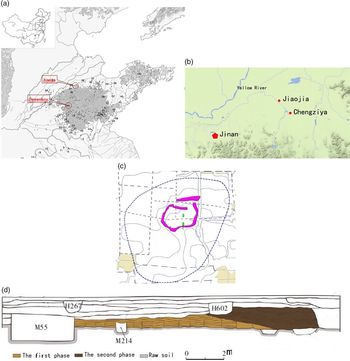
The site of Jiaojia is located 35 km northeast of Jinan city, Shandong province, China (Figure 1). It was discovered in the 1980s and the first excavation was carried out in the 1990s (Ning and Qu Reference Ning and Qu1998). In 2016 and 2017, one systematic excavation project at the site was performed. Due to the discovery of a rammed-earth wall, a ditch around it and many high-ranking burials, it is believed that the Jiaojia site is the earliest city of Dawenkou Culture so far discovered in the Haidai area of China (Lu et al. Reference Lu, Wang and Tang2018).
Map showing the study region and the archaeological sites in the text, northeast of Jinan city, China: (a) sites of Dawenkou culture in Shandong province 4600 years ago; (b) location of Jiaojia site; (c) rammed-earth wall at Jiaojia site; (d) earthen layers of the rammed-earth wall.

Around the area of the Jiaojia site, there are Xihe, Xiaojingshan and other Holi cultural sites dating back to 8000 years ago, as well as Zhangguan, Dongdong and other early Beixin-Dawenkou cultural sites 7000~5500 years ago. Especially, till to the middle and late Dawenkou culture 4600 years ago, the number of sites increased rapidly (Luan and Wagner Reference Luan, Wagner, Wagner, Luan and Tarasov2009). At that time, the Jiaojia site was located in this core area with an ancient cultural heritage. In terms of geographical location, the Jiaojia site is only 5 km away from the famous Longshan culture city site—Chengziya site (Lu et al. Reference Lu, Wang and Tang2018). Chengziya is a very famous place in China where the naming of Longshan culture originated. Our interest is how the central settlement of this cultural district changed from Dawenkou culture to Longshan culture, as shown at the Jiaojia site and the Chengziya site. The transfer between different cultural sites will provide an ideal case for further investigation of regional settlement. Therefore, it is very important to understand the settlement structure of Jiaojia site, and the first question is to determine its age.
SAMPLE COLLETION
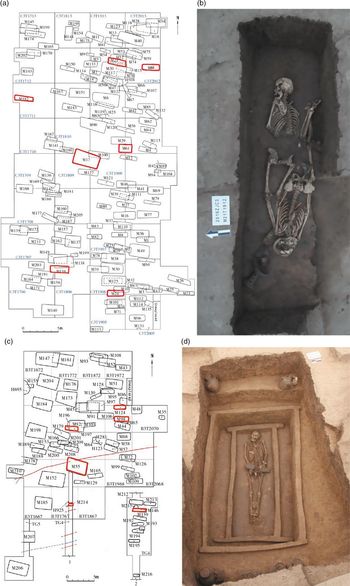
To more accurately determine the beginning and end of the Jiaojia site, 13 bone samples from the human burials were sent to the Beta Analytic radiocarbon dating laboratory. In the two-year excavation, a total of 215 tombs were found in north and south regions, including smaller normal burials and larger noble burials. Thus, the samples of radiocarbon dating were carefully selected including seven bones from north excavation region (i.e. M17, M21, M182, M88, M61, M158, and M24) and six bones from the south excavation region (i.e. M55, M98, M124, M197, M146, and M214) (Figure 2). All the burials in north region of the Jiaojia site have one coffin and different numbers of artifacts including jades or pottery wares (Figure 2b); they can be considered as normal burials containing one coffin in the tomb. A few burials in the south region contain two coffins and more exquisite pottery wares (Figure 2d), and they are assumed to represent the burials of the nobles.
Map of the burials and the selected bone samples: (a) and (c) represent the map of burials in the north region and south region of excavation, respectively; (b) the selected normal burial M21, including one coffin in the tomb and a pottery bean; and (d) the selected noble burial M55 including jade, jade bracelet, bone carving tube, pottery cup, white pottery gui, white pottery back pot, white pottery cups, pottery, etc.

METHODS
For 13 thigh bones, the conventional collagen extraction techniques were used in the Beta labs. Firstly, physical pretreatment was done on the bone samples. Rootlets were removed using a pair of tweezers or forceps, and a surgical scalpel or a dental grill was used to scrape off contaminated exterior layers of bone samples. After initial removal of visible contaminants, the bone samples were crushed with a mortar and pestle. Size reduction was done to increase the surface area of the sample during succeeding pretreatment methods.
Then, chemical pretreatment was continued on the bone samples. The crushed bone samples were washed with dilute, cold hydrochloric acid (HCl) repeatedly until hydroxyapatite was eliminated and the collagen was isolated. Rootlets, if present, were further removed from the collagen. To ensure the complete removal of organic acids, collagen was washed with an alkali solution, sodium hydroxide (NaOH). The final remaining collagens were stored in the desiccators until they were sent for AMS analysis.
Finally, the gelation collagen was analyzed for stable isotopes by using EA-IRMS system consisting an elemental analyzer (EA) and an isotope-ratio mass spectrometer (IRMS) in the Beta lab. The uncertainty of each measurement is estimated at 0.1‰ for δ13C and δ15N values comparing with the internal standard materials, and the carbon and nitrogen contents were measured at the same time. An accelerator mass spectrometer (AMS) has been used to determine the isotopic abundance ratio of 14C and 12C in the sample, combing the half-life of 14C, the absolute dating of sample can be calculated. AMS measurement is done on graphite produced by hydrogen reduction of the CO2 sample over a cobalt catalyst, and the CO2 is obtained from the combustion of the collagens at 800ºC and under 100% oxygen atmosphere. The AMS samples also include modern and known-age standards prepared by Beta Analytic’s laboratory (Beta Analytic 2020), to provide reference measurements for the age calculations and verifications.
In measurement data, the carbon and nitrogen percentage yields and C:N atomic ratios was used to determine collagen preservation. The samples containing the lower limits of 13% for carbon and 4.8% for nitrogen were removed, and the sample with C:N atomic ratios of the 2.8–3.6 range were accepted for further analysis (Ambrose Reference Ambrose1990).
All the dating dates were calibrated with the OxCal 4.3 program using the IntCal13 northern hemisphere calibration curve. The results of calibration data were calibrated to calendar years (cal BC/AD) and the calibrated radiocarbon years (cal BP) using the IntCal13 atmospheric curve (Bronk Ramsey Reference Bronk Ramsey2009; Reimer et al. Reference Reimer, Bard, Bayliss, Beck, Blackwell, Bronk Ramsey, Buck, Cheng, Edwards, Friedrich, Grootes, Guilderson, Haflidason, Hajdas, Hatté, Heaton, Hoffmann, Hogg, Hughen, Kaiser, Kromer, Manning, Niu, Reimer, Richards, Scott, Southon, Staff, Turney and van der Plicht2013). To obtain the duration time of the Jiaojia site, Bayesian analysis was performed to get the beginning and end of Jiaojia site using OxCal 4.3 program.
RESULTS AND DISCUSSION
Carbon and Nitrogen Stable Isotope Results
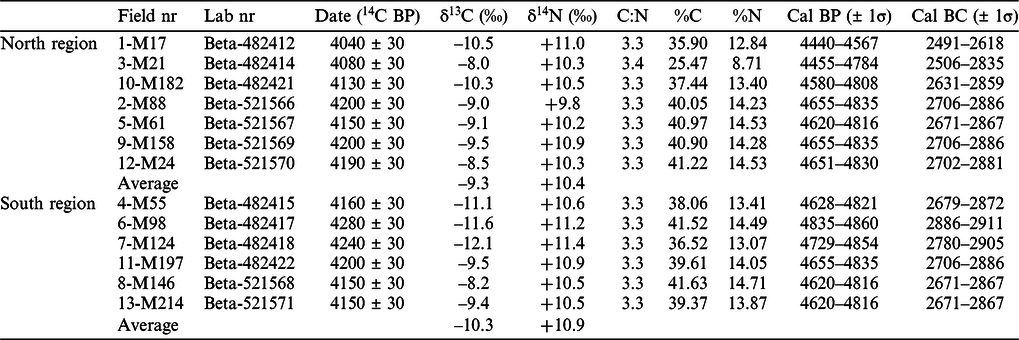
The data showed that the C:N atomic ratios of all thirteen samples are within the range of 2.8~3.6 and the percentage content of C and N in collagen are in the appropriate levels (Table 1). These samples are therefore appropriate for radiocarbon dating and can be used for further analysis.
AMS 14C dates and stable isotope data of bone collagen samples for the Jiaojia site.

One important application of carbon and nitrogen stable isotope is the human diet. The proteins from human bones may reflect the protein composition of the human diet. It indicates that stable isotope from the bones could record the protein composition of an individual’s diet. Consequently, carbon stable isotopic analysis can differentiate the C3 (temperate plants such as vegetables, fruit and wheat) and the C4 (tropical or dry plants such as millet, maize and sugar cane) plant ecosystems (Pate Reference Pate1995) or marine and terrestrial ecosystem (Chishom et al. Reference Chishom, Nelson and Schwarcz1982). Nitrogen stable isotopic analysis can determine the nutritional level of organisms in a food chain (Minagawa and Wada Reference Minagawa and Wada1984).
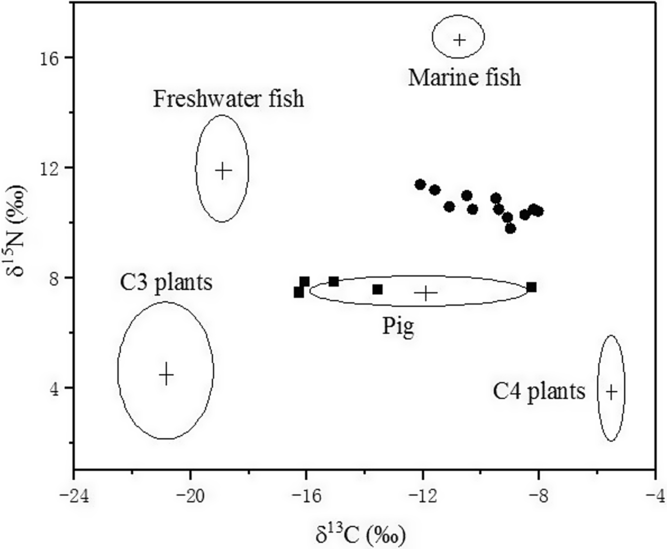
As shown in Table 1, the δ13C values for all human bones range between –8.0‰ and –12.1‰, and the δ15N values vary between +9.8‰ and +11.4‰. Since ancient humans and other food resources (such as the domesticated plants or animals) represent the different organism in the food chains, and since the isotopic ratios in collagen of senior consumer (such as ancient humans) is enriched 4.5‰ for the δ13C value from the primary producer (such as plants) or primary consumer (such as fish or domesticated animal) and 3.5‰ for the δ15N value (Ambrose Reference Ambrose and Sandford1993), in order to show the different organism in the same δ13C and δ15N figure, the values of 4.5‰ for the δ13C value and 3.5‰ for the δ15N value of the primary producer and consumer should be added in Figure 3. Thus, Figure 3 showed the relationship between the reconstructed ratios in consumed protein of ancient humans and the typical isotopic ratios in nutritional groups such as plants, fish or animals. It indicates that the diets of these humans depended primarily on C4-based plants, with possibly slight C3-based resource, and some domesticated animals (Figure 3), not including marine resources. During our two-year excavation, many carbonized seeds of foxtail millet (setaria italica) and broomcorn millet (Panicum miliaceum), some domesticated pig bones, and few fish bones including freshwater or marine fish were founded (Lu et al. Reference Lu, Wang and Tang2018). In the Neolithic age of north China, the domesticated millet was common (Dong et al. Reference Dong, Morgan, Chinenov, Zhou, Fan, Ma and Pechenkina2017), therefore, the C4-based plant in the diet is more likely millet. The main meat resource in the diet is more likely pig (wild or carnivorous pig) or other terrestrial animals. Considering the measurement uncertainty, the small different of average δ15N values between the human bones of south region (+10.9‰) and that of north region (+10.4‰ in Table 1) showed that the nobles in south burials had more access to meat resources than the common people in north burials.
Comparison of δ13C and δ15N isotope values in human bone samples and possible food resources from the Jiaojia site. The circle is the deviation range of food resources, including C3 plants (Yoneda et al. Reference Yoneda, Suzuki and Shibta2004), C4 plants ((Yoneda et al. Reference Yoneda, Suzuki and Shibta2004), freshwater fish (Kusaka et al. Reference Kusaka, Hyodo and Yumoto2010), marine fish (Kusaka et al. Reference Kusaka, Hyodo and Yumoto2010), and pig (wild or domestic). Note, the values of possible food resources were added 4.5‰ for the δ13C value and 3.5‰ for the δ15N value.

Another application of carbon stable isotope is to assess marine or freshwater reservoir effects about the 14C dating. Reservoir effects can influence the accuracy of 14C dating when the human beings consumed more aquatic foods because these diet resources incorporate marine- or terrestrial-derived carbon (Ascough et al. Reference Ascough, Gook and Dugmore2005). This aquatic food should be referred to the plants or mammals in a large aquatic ecosystem, such as ocean or lake ecosystem. In the long-term water accumulation, seawater or lakewater would affect carbon deposition of aquatic animals or plants. Although the Jiaojia site is far from the ocean (at least 150 km) (Wang Reference Wang2000), and although aquatic fish in the river around the Jiaojia site contribute to nitrogen isotopes in human bones as a meat resource, the marine or freshwater reservoir effect of carbon isotope can not be excluded. According to the 2-yr excavation, almost no marine fish bone or shellfish were found, however, a few freshwater fish bones were observed. Therefore, we think that freshwater resources may have contributed a small amount to the diet. However, more systematic AMS dating of the key archaeological sequences for other samples (for example plant remains) is necessary for verification the dating of the site in the future.
Neolithic Dating of the Site
The measured 14C ages and calibrated ages of 13 samples are presented in Table 1. The calibrated ages are within 1σ. In Table 1, 14C measurements of these several samples reveal preliminary age information of the Jiaojia site, all of which are about the Dawenkou Culture (4100–2600 BC) (Luan and Wagner Reference Luan, Wagner, Wagner, Luan and Tarasov2009). For the 13 samples, M17 was dated to 4040 ± 30 BP on the bone collagen, about 2618–2491 BC (±1σ), representing the latest archaeological time. The earliest date is represented by M98 with an age of 4280 ± 30 BP, about 2886–2911 BC (±1σ).
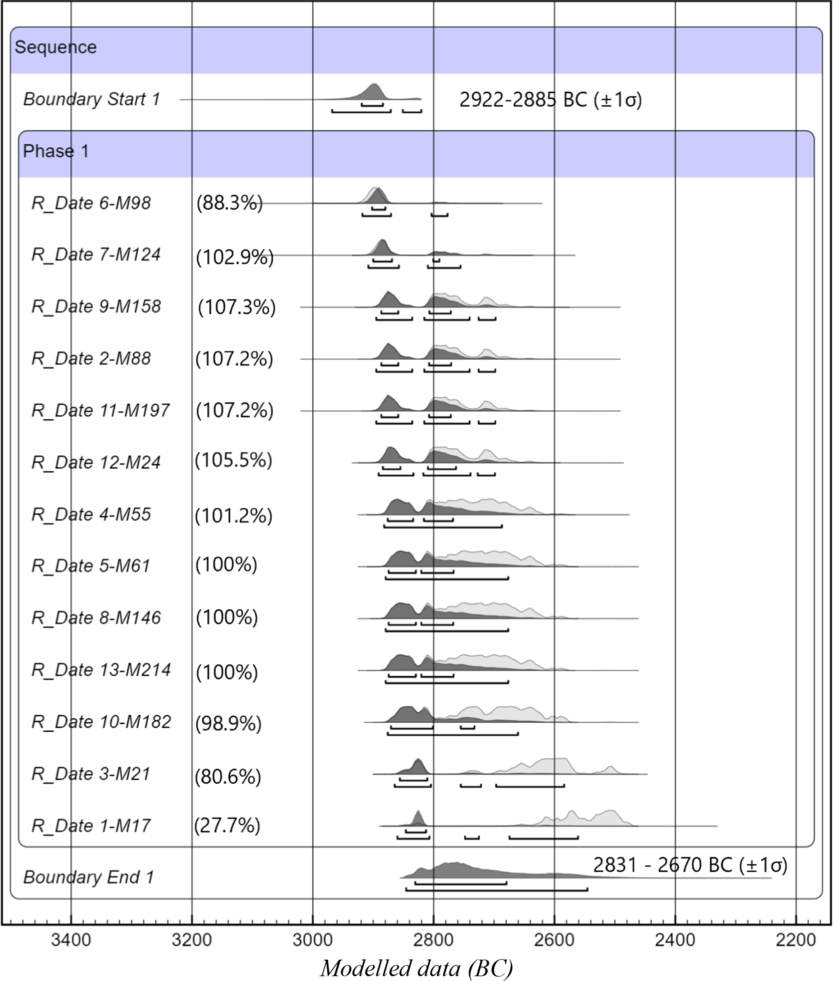
To obtain the statistics data for the dating of the Jiaojia site, Bayesian analysis was performed using OxCal 4.3 to identify the beginning and end of Jiaojia site. The modeling result showed that the beginning of the site is not earlier than 2920 BC, and the end of the site is not later than 2670 BC for 68.4% confidence interval, and the time is from 2970 BC to 2540 BC for 95.4% (Figure 4). This modeling time interval is similar to the calculations above. Therefore, we think the Jiaojia site represents the latest phase of the Dawenkou Culture, and it should last about several hundred years.
Probability distributions for the calibrated dates for the 13 samples from the Jiaojia site. Note, the data of last sample (R_Date 1-M17) has the poor agreement (27.7%). If the data of this sample was canceled, the Bayesian analysis gave that the beginning of the site is about 2927–2882 BC and the end is about 2847–2676 BC for a 68.4% confidence interval.

CONCLUSION
A rammed-earth wall, a ditch surrounding the wall, and a large number of high-grade tombs indicate that the Jiaojia site was a political, economic, and cultural center in the middle and late phases of the Dawenkou culture, and can be considered as the earliest city site in the Haidai area of old China so far discovered. Based on the statistics data of the dating by the Bayesian analysis, the Jiaojia site should be appeared before 2900 BC, and lasted several hundred years. At that time, the diet of humans depended mainly on C4-based millet, as well as some domestic pig or other terrestrial animals.
ACKNOWLEDGMENTS
We gratefully acknowledge the help of the Beta Analytic radiocarbon dating lab. Anonymous referees’ comments helped to improve this paper. This study was supported by the National Social Science Fund of China (18ZDA227) and the Youth Innovation Group of Shandong University (2020QNQT018).