Implications
Methionine is an amino acid (AA) that is often included in swine diets and is commonly supplemented by using anhydrous dl-methionine (DLM, 99% purity) or liquid dl-methionine-hydroxy analogue free acid (liquid MHA-FA). There is an ongoing controversial discussion about the bioavailability of these two sources of methionine. Our data derived using the indicator AA oxidation (IAAO) method in a slope-ratio approach showed a bioavailability for MHA-FA of 74.4% on an equimolar basis or 65.7% on a product (wt/wt) basis, relative to DLM in growing pigs. These data can be used when considering supplementation of methionine as either MHA-FA or DLM.
Introduction
Methionine (Met) is one of the limiting amino acids (AA) in swine diets and is commonly supplemented by using anhydrous dl-methionine (DLM, 99% purity) or liquid dl-methionine-hydroxy analogue free acid (liquid MHA-FA) containing 88% of a mixture of mono-, di- and oligomers of 2-hydroxy-4-(methylthio) butanoic acid molecules. MHA-FA is a source of Met in feeds, which differs from DLM in that the molecule has a hydroxy group rather than an amino group. There is an ongoing controversial discussion about the bioavailability of these two sources of Met. Some studies in growing pigs that examined the efficacy of liquid MHA-FA relative to DLM have found bioavailability between 63% and 78% (Roth and Kirchgessner, Reference Roth and Kirchgessner1986; Walz and Pallauf, Reference Walz and Pallauf1996). In a review, Jansman et al. (Reference Jansman, Kan and Wiebenga2003) concluded that the bioefficacy of MHA-FA was 72.2% on a weight basis or 82% (72.2%/0.88) on an equimolar basis compared to DLM in growing pigs. The lower estimated bioavailability of MHA-FA for swine, compared to DLM, may partly be due to the polymeric forms of MHA-FA. Liquid MHA-FA is 12% water and 88% MHA-FA molecules of which, 65% is in a monomeric form and the remaining 23% in dimers and oligomers, which have been described as ‘not useful as feed components’ (Nufer, Reference Nufer1955). The slope-ratio assay for protein deposition is considered the best approach to assess the bioavailability of AA (Batterham, Reference Batterham1992). The indicator AA oxidation technique (IAAO; Moehn et al., Reference Moehn, Bertolo, Pencharz and Ball2005) can be used in slope-ratio assays and can be accomplished much more rapidly than a conventional slope-ratio assay which uses the outcome parameters of both protein and fat deposition, as measured in growth studies. The IAAO technique reflects the change in protein synthesis of animals with increasing AA intake; as protein synthesis increases, the oxidation of the indicator AA (phenylalanine (Phe)) decreases proportionately (Ball and Bayley, Reference Ball and Bayley1986; Zello et al., Reference Zello, Wykes, Pencharz and Ball1995; Elango et al., Reference Elango, Ball and Pencharz2008). Application of the slope-ratio assay using IAAO also means that the same pig can be fed different AA intakes in rapid succession with oxidation measurements every 2 days (Moehn et al., Reference Moehn, Bertolo, Pencharz and Ball2004). The objective of this experiment was to test the null hypothesis that the slopes of change in indicator oxidation with supplementation of DLM or MHA-FA to diets for growing pigs were not different.
Material and methods
Animals and study protocol
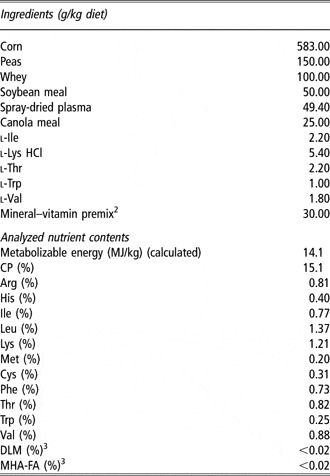
All procedures were approved by the Faculty of Agriculture, Forestry and Home Economics’ Animal Policy and Welfare Committee at the University of Alberta. Six Genex Manor hybrid F1 barrows (Genex Swine Group, Regina, Saskatchewan) (average initial BW = 13 kg) were initially kept for 7 days in pairs to minimize stress and aid adaptation to experimental conditions. Pigs were separated and housed individually after the initial acclimatization period. Pigs were adapted to the basal diets (BD; Table 1), but with adequate Met (0.35%) for a 6-day period. Feed was offered at 95 g/kg BW0.75 to ensure complete consumption. Each of the six pigs received all seven experimental diets in a random order. Forty-eight hours after receiving the first experimental diet, an IAAO study was conducted. At the end of each IAAO study, the pigs received another test diet and adapted again for 2 days before the subsequent IAAO study was conducted, until all pigs had received every diet. Moehn et al. (Reference Moehn, Bertolo, Pencharz and Ball2004) previously showed that 2 days of adaptation to a new diet was adequate because there was no difference in IAAO following 2 days compared to 10-days adaptation. The total duration of the study was 21 days. At the end of the experiment, the pigs were euthanized by a pentobarbital sodium injection (Euthansol, 340 g/l; Schering Canada, Pointe Claire, PQ, Canada).
Ingredient composition and analyzed nutrient contents of the basal diet (as-fed)Footnote 1

DLM=dl-methionine; MHA-FA=dl-methionine-hydroxy analogue free acid.
1 The test diets were derived from the base diet by inclusion of 0.25, 0.50 or 0.75 g/kg DLM or 0.38, 0.77 or 1.15 g/kg MHA-FA.
2 Provided per kg of diet: 6.45 g calcium; 2.52 g phosphorus; 1.44 g sodium; 300 mg magnesium; 18 mg copper; 210 mg iron; 48 mg manganese; 222 μg selenium; 104 mg zinc; 297 μg iodine; 180 μg biotin; 390 mg choline; 2400 μg folacin; 28.5 mg niacin; 18.75 mg pantothenic acid; 5.25 mg riboflavin; 26.4 μg vitamin B12; 46.5 IU vitamin E; 9000 IU vitamin A; 1050 IU vitamin D3; 1230 μg vitamin K (Consultant Feeds, Calmar, Alberta, Canada).
3 Levels of DLM and MHA-FA were non-detectable in the base diet.
Diets and feeding
Pigs were fed twice daily, except during the IAAO study days, when they received half the daily ration divided into 16 half-hourly meals starting one half-hour prior to commencing the IAAO study. This protocol is used because it ensures a steady state in oxidation, i.e. slope not different from zero during the time period of the oxidation measurement. The remaining half of the daily ration was fed in the evening, as on other days. Water was available ad libitum at all times. Feed quantity was allocated based on the pig’s BW that was measured on the morning of the IAAO study days. Any feed not eaten was collected, dried and weighed to obtain net feed intake.
The BD was based on corn, peas, whey, spray-dried plasma, soybean meal and canola meal with additional supplemental AA (Table 1). The BD contained 0.20% Met. Diets were formulated to contain an additional 0.025%, 0.050% and 0.075% bioavailable Met and were derived from the BD by the addition of either DLM or MHA-FA. DLM was assumed to have a Met bioavailability of 99% as fed and MHA-FA was assumed to have a Met bioavailability of 65% as fed based upon the most recent available research (Zimmermann et al., Reference Zimmermann, Mosenthin, Rademacher, Lynch and Esteve-Garcia2005; Kim et al., Reference Kim, Lindemann, Rademacher, Brennan and Cromwell2006). However, because the design and analysis of the experiment used the linear regression slope-ratio approach with actual Met intakes (intake × analyzed content of DLM or MHA-FA), assumptions about availability of Met do not affect the estimate of actual bioavailability.
Dietary AA concentrations were determined by ion-exchange chromatography with postcolumn derivatization with ninhydrin. Amino acids were oxidized with performic acid, which was neutralized with sodium metabisulfite (Llames and Fontaine, Reference Llames and Fontaine1994; Commission Directive, 1998). Amino acids were liberated from the protein by hydrolysis with 6N HCL for 24 h at 110°C and were quantified with the internal standard method by measuring the absorption of reaction products with ninhydrin at 570 nm. Tryptophan was determined by HPLC with fluorescence detection (extinction 280 nm, emission 356 nm) after alkaline hydrolysis with barium hydroxide octahydrate for 20 h at 110°C (Commission Directive, 2000). Tyrosine was not determined. Supplemented AA were determined after extraction with 0.1N HCL (Commission Directive, 1998). Supplemented MHA-FA was analyzed using the method described by VDLUFA (1997). Analyzed protein, Met and MHA-FA contents in the diets are reported in Table 2.
Analyzed CP, Met, dl-methionine and dl-methionine-hydroxy analogue free acid contents of dietsFootnote 1

Met = methionine; DLM=dl-methionine; MHA-FA=dl-methionine-hydroxy analogue free acid.
1 Test diets were derived from one batch of basal diet containing 0.20% Met and 0.32% Cys.
2 Free DLM, analyzed after extraction with 0.1N HCl. These values were used in the calculation of bioavailability.
3 Methionine-hydroxy analogue free acid, including water (88% dry matter). Provided on carrier substance (Sipernate).
4 Not detected.
Tracer infusion and breath collection
Pigs were offered half-hourly meals after placement in the oxidation chambers. Equilibration of chamber CO2 concentration occurred within 30 min. Background 14CO2 expiration was determined during the following two consecutive 30-min periods. Then the next meal was mixed with tracer, containing a priming dose of 3.5 times the half-hourly dose of l-[1-14C]Phe (American Radiolabeled Chemicals, St Louis, MO, USA) and the first of eight half-hourly doses of tracer. Half-hourly doses were 258.7 kBq (s.e. 2.6). Expired CO2 was sampled from a measured fraction of total airflow through the chambers in half-hour intervals. The equipment used and the procedures for analysis of 14CO2 samples were described in detail by Bertolo et al. (Reference Bertolo, Moehn, Pencharz and Ball2005).
Calculations
Oxidation rates were expressed as a percent of dose. Plateaus in oxidation were determined in those collection periods, where the slope of the regression of oxidation rate on collection period was not significantly (P > 0.1) different from zero and where the CV during the plateau was less than 10%. Plateau in oxidation was typically observed following the third feeding of tracer, resulting in a minimum of five points for determination of plateau oxidation rates.
Methionine intakes were expressed as intake (g/day) in excess of the BD (Littell et al., Reference Littell, Lewis and Henry1995), which was calculated as the difference in analyzed DLM (Table 2) between the BD and experimental diets, multiplied by the actual feed intake of the pig during each individual IAAO determination. For diets containing MHA-FA, MHA-FA intake was calculated based on the analyzed values for MHA-FA (Table 2) multiplied by the feed intake of the pig during each individual IAAO determination. Methionine intake above BD was also expressed and compared on a molar basis for both DLM (149.21 mg/mmol) and MHA-FA (150.25 mg/mmol).
Bioavailability of MHA-FA, on both a product (wt : wt) and a molar basis, was taken as the slope for MHA-FA divided by the slope for DLM.
Statistical analyses
Data were tested for outliers within DLM and MHA-FA levels using the option for analysis of residuals in the procedure ‘Reg’ (SAS Institute Inc., Cary, NC). No outliers were identified. The responses to DLM addition and MHA-FA addition were tested for linearity and were confirmed to be linear using the procedure ‘Rsreg’. Group means were compared using the ‘pdiff’ option in the LSmeans statement in mixed model analysis (SAS Institute, Cary, NC), using ‘pig’ as a random variable. Data were tested for compliance with the criteria necessary to apply slope-ratio calculations, which were level and type of Met source and the interaction (Littell et al., Reference Littell, Lewis and Henry1995), using ‘Proc Mixed’ (SAS Institute, Cary, NC). Slopes of IAAO for DLM and MHA-FA were determined simultaneously using ‘Proc mixed’. For both DLM and MHA-FA regression responses, oxidation rate (% of administered dose) was the dependent variable, DLM or MHA-FA intake above BD was the main independent variable and ‘pig’ was included as a random effect. The data were tested for co-variables using both the linear and non-linear mixed model procedure (SAS Institute Inc., Cary, NC). Covariates tested for inclusion in the model were BW, feed intake, Phe intake, tracer dose, background 14CO2 and oxidation chamber. Covariates were retained in the model if P < 0.05 and are stated with the results when used. Significance was taken at P < 0.05.
Results
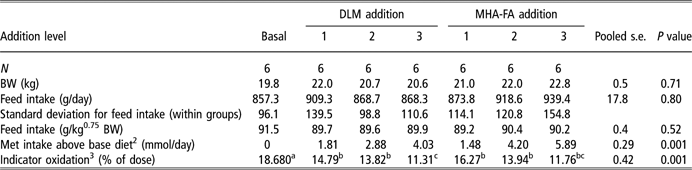
Group means for BW (P = 0.71), feed intake (P = 0.80) and feed intake/kg BW0.75 (P = 0.52) were not different among dietary levels of either MHA-FA or DLM (Table 3). The overall mean pig BW (±s.e.) during the study was 21.1 ± 0.5 kg and ranged from 15.0 to 29.2 kg as a result of the multiple measurements per animal. Mean feed intake was 886.6 ± 16.3 g/day (±s.e.) and ranged from 687.6 to 1125.2 g/day as a result of increasing BW during the experiment. The mean BW and feed energy (ME) intake in this experiment indicated a total Met requirement of 0.28% according to the National Research Council (NRC) (1998) program. Met intake was below calculated NRC (1998) requirement for all studies. The actual mean feed intake per kg BW0.75 of 90.3 ± 0.3 g/day fell slightly short of the target feed intake of 95 g/kg BW0.75. Mean daily gain was 498 ± 30 g/day and mean gain to feed ratio was 0.555 ± 0.092.
Means for BW, feed intake and rate of indicator amino acid oxidation method of growing pigs fed graded levels of dl-methionine or dl-methionine-hydroxy analogue free acidFootnote 1
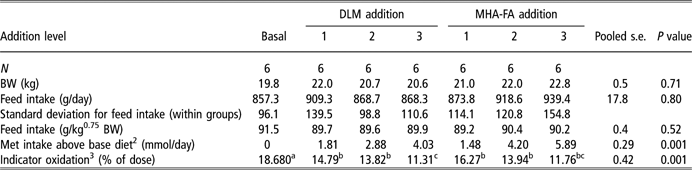
Met = methionine; DLM=dl-methionine; MHA-FA=dl-methionine-hydroxy analogue free acid.
1 Observations from six pigs, each of which was fed all diets in random order.
2 Calculated as feed intake multiplied by analyzed DLM or MHA-FA content above base diet.
3 Least square means, derived from the model: oxidation = Met intake above base diet, nested within Met source, Phe intake, chamber.
a,b,c Means within the same row with different superscript differ significantly (P < 0.05).
Plateaus in oxidation were maintained for 5.5 ± 0.5 collection periods. Phenylalanine oxidation was between 8.2% and 23.5% (mean of 14.9 ± 0.5%) of the infused dose at steady state, depending upon Met intake, with decreasing oxidation occurring with increasing intake. Oxidation during plateaus showed a CV of 9.1 ± 0.7%.
Individual pig’s IAAO was affected by level and type of Met source and their interaction. The covariates Phe intake (P = 0.008) and chamber (P = 0.004) were significant, and were therefore included in the calculation of oxidation response.
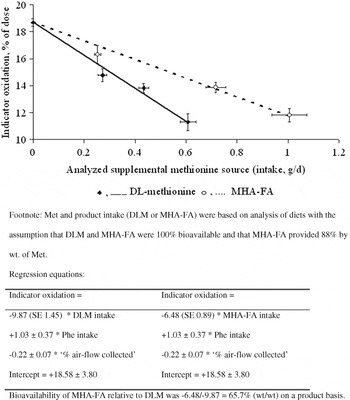
The variances for oxidation rate were not different (P > 0.1) for MHA-FA compared to DLM. Indicator oxidation was highest for the BD because it was most deficient in Met (Table 3); additional intake of DLM or MHA-FA decreased indicator oxidation (P < 0.05). The linear model, including covariates (Figure 1), explained 75% of the variation in IAAO. Introduction of quadratic term for ‘additional Met intake nested within source’ explained a further 7% of the variation of IAAO. The quadratic term was non-significant for DLM (P = 0.82) and significant for MHA-FA (P = 0.001).
Indicator amino acid oxidation (% of dose) response to incremental increases in dl-methionine and methionine-hydroxy analogue free acid.

The required condition of a common intercept for the slope-ratio assay (Littell et al., Reference Littell, Lewis and Henry1995) was achieved (y = 18.3 ± 4.2, Figure 1). The interaction between ‘additional Met intake’ and ‘type of Met addition (i.e. DLM or MHA-FA)’ was also significant (P = 0.014), indicating that IAAO responded differently to DLM v. MHA-FA treatments. On a product basis (MHA-FA at 88% dry matter, DLM at 99% purity), IAAO decreased by 9.870 ± 1.426% units for each g/day DLM intake above BD and by 6.481 ± 0.888% units for each g/day MHA-FA intake above BD (Figure 1). These slopes for DLM and MHA-FA (Figure 1) were different (P = 0.004) and the ratio of these slopes, i.e. −6.481/−9.870, indicated a bioavailability of 65.7% (wt/wt) on a product basis for MHA-FA compared to DLM. Indicator AA oxidation decreased by 1.488 ± 0.215% units for each mmol/day of Met from DLM intake above basal diet, and by 1.107 ± 0.152% units for each mmol/day of Met from MHA-FA intake above BD. The ratio of these slopes, i.e. −1.107/−1.488, indicated a bioavailability of MHA-FA relative to DLM of 74.4% on an equimolar Met basis.
Discussion
The objective of this experiment was to test the null hypothesis that the bioavailability of DLM and MHA-FA were not different for growing pigs, using the indicator AA oxidation method in a slope-ratio assay. The Met intake at the highest level of DLM and MHA-FA addition were below the Met requirement determined by the mean BW and energy intake (NRC, 1998) in this experiment. Although the highest inclusion rate of MHA-FA (as-fed) provided more total Met equivalents than the highest addition of DLM, it was still insufficient to satisfy the pigs’ requirement for available Met, showed by the fact that the highest level of MHA-FA resulted in indicator oxidation greater than the highest level of DLM inclusion, and a similar oxidation rate to the intermediate level of DLM. The Met intake provided by the intermediate level of DLM was clearly below the pigs’ requirement, and therefore the available Met provided by the highest MHA-FA supplementation was also below the pigs’ requirement. Therefore, all test Met intakes met the criteria of being below requirement and linear incremental responses to increasing Met intake were achieved. Furthermore, the required conditions of a common intercept and response to added test nutrients (Littell et al., Reference Littell, Lewis and Henry1995) were achieved; therefore, the results could be evaluated as a linear slope-ratio assay. Although MHA-FA addition also showed a quadratic relationship, the linear response explained 75% of the variation and addition of the quadratic term to the model only increased the overall R 2 by 0.07 and, therefore, the linear slope was used to calculate bioavailability.
The bioavailability of MHA-FA in 21 kg barrows was lower (74.4%), compared to DLM, on an equimolar Met basis. This estimate is similar to the relative bioavailability value proposed by Kim et al. (Reference Kim, Lindemann, Rademacher, Brennan and Cromwell2006) at 73%, relative to DLM on an equimolar Met basis in growing pigs. It is important to note that cysteine was provided in excess of its estimated physiological requirements (0.30%), similar to Kim et al. (Reference Kim, Lindemann, Rademacher, Brennan and Cromwell2006). When cysteine is not the first limiting amino acid, the estimate of the bioefficacy of MHA-FA tends to be lower than when pigs are fed cysteine-deficient diets (Dilger and Baker, Reference Dilger and Baker2008).
One of the reasons for the substantial differences in bioavailability between DLM and liquid MHA-FA found in this study may be that these two products are chemically different. Unlike DLM (99% purity), liquid MHA-FA is 12% water and 88% MHA-FA molecules of which, 23% is present in dimers and oligomers (Nufer, Reference Nufer1955). The oligomers of liquid MHA-FA are poorly absorbed (Saunderson, Reference Saunderson1991) and of a lower bioavailability in poultry compared to the commercial product mix of mono-, di- and oligomers (Van Weerden et al., Reference van Weerden, Schutte and Bertram1992). Maenz and Engele-Schaan (Reference Maenz and Engele-Schaan1996b) also reported that in broilers there was conversion of L-MHA into non-absorbable by-products during its passage through the gastro-intestinal tract. Additionally, Malik et al. (Reference Malik, Hoehler, Rademacher, Drew and Van Kessel2006) showed that liquid MHA was, in fact, more slowly absorbed throughout the digestive tract of pigs than l-Met, which agrees with Drew et al. (Reference Drew, van Kessel and Maenz2003) who observed similar results in broiler chickens. Because liquid MHA-FA is more slowly absorbed in the digestive tract, it has more exposure to microbial degradation in the small intestine and may not be fully available for absorption.
Another reason for the lower bioavailability of liquid MHA-FA may be related to the metabolic pathways of MHA-FA compared with DLM. To be utilized for protein synthesis, both the d- and l-isomers of liquid MHA-FA must be converted to l-Met via transamination (Saunderson, Reference Saunderson1991), whereas only the d-isomer of DLM must be transformed. Furthermore, the uptakes of DLM and MHA-FA across the brush border membrane are different. Maenz and Engele-Schaan (Reference Maenz and Engele-Schaan1996a) reported that, in poultry, Met and MHA-FA are transported across the intestinal brush border membrane by two different active transport mechanisms: Met is transported by the system B amino acid transporter and its uptake is more efficient than that of MHA-FA, while MHA-FA is transported via a +H-dependent non-stereospecific system.
There is wide disagreement over the bioavailability of MHA-FA compared to DLM. Some publications have proposed an equal bioavailability for MHA-FA compared to DLM (Reifsnyder et al., Reference Reifsnyder, Young and Jones1984; Knight et al., Reference Knight, Atwell, Wuelling, Ivey and Dibner1998; Römer and Abel, Reference Römer and Abel1999; Gaines et al., Reference Gaines, Yi, Ratcliff, Srichana, Kendall, Allee, Knight and Perryman2005; Yi et al., Reference Yi, Gaines, Ratliff, Srichana, Allee, Perryman and Knight2006), whereas others have proposed a significantly lower bioavailability for MHA-FA, compared to DLM, on an equimolar or a product basis (Roth and Kirchgessner, Reference Roth and Kirchgessner1986; Zimmermann et al., Reference Zimmermann, Mosenthin, Rademacher, Lynch and Esteve-Garcia2005; Kim et al., Reference Kim, Lindemann, Rademacher, Brennan and Cromwell2006; Dilger and Baker, Reference Dilger and Baker2008). In some of these experiments, Met was not showed to be limiting in all the diets or a diminishing incremental response to graded increases in Met intake was found. In experiments where the response to the test nutrient is not linear, it is not appropriate to use linear regressions to determine bioavailability. Slope-ratio assays may be evaluated using non-linear models only if certain conditions are satisfied, such as convergence to meaningful values of the nutrition constant and identification of an asymptotic value of the response when intake is large (Littell et al., Reference Littell, Henry, Lewis and Ammerman1997). Fewer than three data points should only be used in slope-ratio assays ‘in the presence of high confidence that the assumptions are valid’ (Littell et al., Reference Littell, Lewis and Henry1995), i.e. linearity of response and experiments utilizing less than three data points do not produce a robust response to the nutrient in question. In our experiment, IAAO was determined for BD and three graded intakes of DLM and MHA-FA, which provided four points for calculation of each slope. Finally, the potential for interactions among feed ingredients, environmental factors and genetic lines of pigs on bioavailability of polymeric forms of MHA-FA should also be investigated because these may also be contributing to the disagreements in the published literature.
Conclusion
In conclusion, our data derived using the IAAO method in a slope-ratio approach demonstrated a bioavailability for MHA-FA of 74.4% on an equimolar basis or 65.7% on a product (wt/wt) basis, relative to DLM in growing pigs. If used solely as a DLM replacement to support growth, a greater amount of MHA-FA must be utilized to meet the total sulphur AA requirement for growing pigs. Further investigation into the differences in dose response between DLM and MHA-FA in pigs is required to gain a better understanding of the metabolism of MHA-FA.
Acknowledgement
This study was funded by Alberta Pork, the Alberta Agricultural Research Institute and Evonik Degussa.