





Introduction
New Zealand has played an important role in Antarctic exploration since the Heroic Age, serving as the departure point for Captain Robert Scott’s Discovery (1901–1904) and Terra Nova (1910–1913) expeditions and Ernest Shackleton’s Nimrod expedition (1907–1909). A number of New Zealanders participated in expeditions during the Heroic Age, deepening New Zealand’s interest in the Antarctic frontier. This interest probably stemmed from geographical proximity, imperial connections, scientific curiosity, economic and geopolitical interests and a sense of national identity and pride. The Antarctic represented a pursuit of exploration, a scientific frontier and a natural extension of New Zealanders research interests across the Southern Ocean.
Today, space exploration represents a new frontier for national contributions to science, exploration, economic and geopolitical interests. The early Antarctic expeditions typically lasted 2–4 years, involving prolonged isolation, limited resources and extremely high risks. These characteristics parallel the challenges anticipated for early Mars missions, which are expected to last 2–4 years, dictated by 26 month Earth-Mars launch windows. In many ways, these early Antarctic expeditions offer historical precedent for the challenges and resilience required for pioneering human missions to Mars. Additionally, Antarctica is the closest Earth analogue to Mars in terms of climate, isolation and logistical constraints, making it a valuable model for designing human exploration programmes for Mars.
The expeditions of the Heroic Age paved the way for the establishment of research stations in the 1950s. Founded in 1957, during the Commonwealth Trans-Antarctic Expedition led by Sir Vivian Fuchs, with the New Zealand component led by Sir Edmund Hillary, New Zealand’s Scott Base has evolved from a remote outpost into a modern scientific hub embedded within a complex international logistics and governance system. The New Zealand Antarctic programme, managed by Antarctica New Zealand (ANZ), maintains Scott Base on Ross Island as a permanently staffed research station and supports more than 300 personnel at Scott Base annually.
Scott Base is located at Pram Point on Ross Island and has a mean annual temperature of approximately -19.8°C, and precipitation is less than 20 cm of water equivalent annually (Campbell & Claridge Reference Campbell and Claridge1987). It is located ~3 km from McMurdo Station, the US Antarctic Program’s main station, and 80 km from the McMurdo Dry Valleys, one of the best terrestrial analogues for conditions on Mars (Fig. 1). These analogues are critical for space exploration, enabling risk mitigation through testing of technologies, operations and human factors before committing to Mars missions. With the increasing interest and motivation and the lowering of costs regarding Mars exploration efforts, such as the SpaceX Starship programme and NASA’s Moon to Mars architecture, Scott Base offers operational and scientific lessons for a small research base that are relevant to Mars exploration.
Map of McMurdo Sound and the McMurdo Dry Valleys region showing locations mentioned in the text. Symbols show the locations of Scott Base (green triangle), McMurdo Station (blue circle) and the former Vanda Station (red circle).

Figure 1. Long description
A satellite map with an inset in the top right showing the location of the region on the Antarctic continent at 77 degrees 30 minutes South. The main map covers an area from 160 degrees East to 165 degrees East.
* In the West, the McMurdo Dry Valleys are visible as dark, ice-free mountainous terrain. From North to South, these are Victoria Valley, Wright Valley containing Lake Vanda marked with a red circle, and Taylor Valley.
* In the Center, the frozen expanse of McMurdo Sound dominates the view.
* In the East, Ross Island is situated North of the Ross Ice Shelf. On the southern tip of Ross Island, two research stations are marked: McMurdo Station U S with a blue circle and Scott Base N Z with a green triangle.
* A scale bar in the bottom right indicates 0 to 20 kilometers.
This Perspective article examines how science and operational strategies from Scott Base offer practical lessons for future Mars exploration programmes. Drawing on Antarctic research experiences (Andersen et al. Reference Andersen, McKay, Wharton and Rummel1990), Case for Mars studies (McKay Reference McKay and McKay1985) and proposed Mars mission architecture (Heldmann et al. Reference Heldmann, Marinova, Lim, Wilson, Carrato and Kennedy2022), this study evaluates how experience from the New Zealand Antarctic programme may offer practical insights that are transferable to the design of sustainable Mars exploration efforts.
Present issues
Prior to the establishment of the Antarctic Treaty, New Zealand was one of seven nations that had an initial territorial claim in Antarctica. The Ross Dependency, formally declared in 1923, covers the sector between 160°E and 150°W, extending from the South Pole to 60°S. This area includes Ross Island, where Scott Base and McMurdo Station are located, the Ross Ice Shelf and the McMurdo Dry Valleys. Although the claim remains recognized under New Zealand law, its practical enforcement was effectively suspended by the Antarctic Treaty (1959), which set aside all sovereignty disputes while the Treaty is in force.
The Antarctic Treaty states that the Antarctic continent shall be used for peaceful and scientific purposes only (Antarctic Treaty 1959, Article I). It also promotes freedom of scientific investigation and international cooperation (Article II). New Zealand was one of the 12 original signatories in 1959. Currently, there are 56 nations that operate under the Antarctic Treaty System, making it one of the world’s most successful examples of international governance dedicated to peace and science.
National bases in Antarctica operate independently; however, when located in close proximity, they often share resources (e.g. the USA and New Zealand on Ross Island and Russia and India at Schirmacher Oasis). This differs from the International Space Station (ISS) partnership, where international crews share the same habitat and geopolitical rivals collaborate on operations despite tensions. The only international station in Antarctica is Concordia Station, operated jointly by France and Italy, and in partnership with the European Space Agency (ESA) at Dome C. Humans have not yet landed on Mars, and therefore no operational governance comparable to Antarctica currently exists. Instead, activities in space are governed by the Outer Space Treaty (1967), which prohibits national appropriation and mandates peaceful use, providing a foundation (United Nations 1967). However, as Mars and lunar mission architectures become more technically viable, the absence of a mature governance framework comparable to the Antarctic Treaty System raises important questions about how scientific research, environmental stewardship, resource utilization, commercial activities and geopolitical competition will be balanced.
The Antarctic Treaty, alongside the governance model of the ISS, demonstrates that science and diplomacy can transcend geopolitical competition. Both frameworks show how nations with diverse political interests can sustain long-term, peaceful collaboration in extreme environments. This durability rests on several reinforcing principles. Firstly, both systems decouple scientific cooperation from territorial sovereignty. By removing territorial competition or ownership, these frameworks reduce incentives for conflict. Secondly, operating in extreme environments creates practical incentives for collaboration such as shared logistics and infrastructure. However, international space cooperation can also function as a diplomatic instrument, with decisions to cooperate - or to withdraw cooperation - reflecting and shaping broader geopolitical relationships. For example, the Shuttle-Mir programme emerged during a period of improving US-Russian relations following the Cold War, while subsequent deterioration in relations, particularly after Russia’s invasion of Ukraine, has constrained areas of space cooperation. Antarctic governance models provide a template that could also be applied for Mars exploration. Collaboration in Antarctica illustrates that sustained human activity in extreme environments depends on shared infrastructure, distributed risk and collective governance. For smaller nations, such as New Zealand, participation through specialized contributions such as science, engineering or governance expertise may provide meaningful contributions without the full burden of mission architecture. A Mars exploration programme structured around multinational participation would similarly foster technological exchange, shared logistics, financial cost and operational risk. The Antarctic template, therefore, suggests that a collaborative Mars exploration framework is structurally advantageous for a more sustainable and scientifically valuable model. There are two possible collaborative models for early Mars exploration. The first model could initially have separate nations cooperating at a shared station, like the ISS. The second model could be a national station or stations from the start, like McMurdo Station and Scott Base.
The New Zealand Antarctic programme
Operations
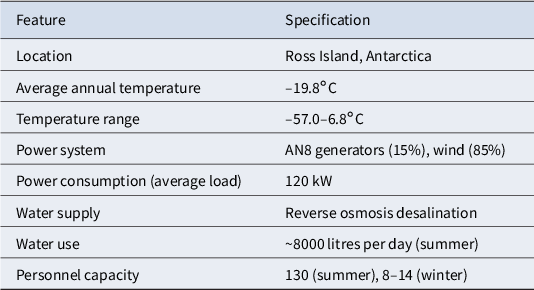
The New Zealand Antarctic programme is operated by ANZ, a Crown Entity overseen by the Ministry of Foreign Affairs and Trade (MFAT). The programme operates on an annual operating budget of ~21 million NZD (Antarctica New Zealand 2025a). Scott Base is New Zealand’s only Antarctic station, and it operates year-round (Table I). During the austral summer (October–February), the station supports up to 130 personnel at any given time, while a core winter team of ~8–14 people maintain operations over winter. Scott Base has a wind farm for renewable energy, which provides ~1 MW of power. While this significantly reduces the use of AN8, an aviation kerosene and the primary fuel at Scott Base and McMurdo Station, both bases still rely primarily on AN8 fuel generators for continuous power, especially during winter or periods of low wind.
Some statistics of the physical plant and personnel at Scott Base.

Table I. Long description
The table consists of two columns: Feature and Specification.
* Location: Ross Island, Antarctica.
* Average annual temperature: minus 19.8 degrees Celsius.
* Temperature range: minus 57.0 to 6.8 degrees Celsius.
* Power system: A N 8 generators (15 percent), wind (85 percent).
* Power consumption (average load): 120 k W.
* Water supply: Reverse osmosis desalination.
* Water use: approximately 8000 litres per day (summer).
* Personnel capacity: 130 (summer), 8 to 14 (winter).
A major redevelopment of Scott Base is currently underway and is planned for completion by 2030, and it will incorporate modern modular architecture and renewable energy systems, including a wind farm and battery storage system contributing more than 90% of the new base’s electrical demand (Antarctica New Zealand 2025b).
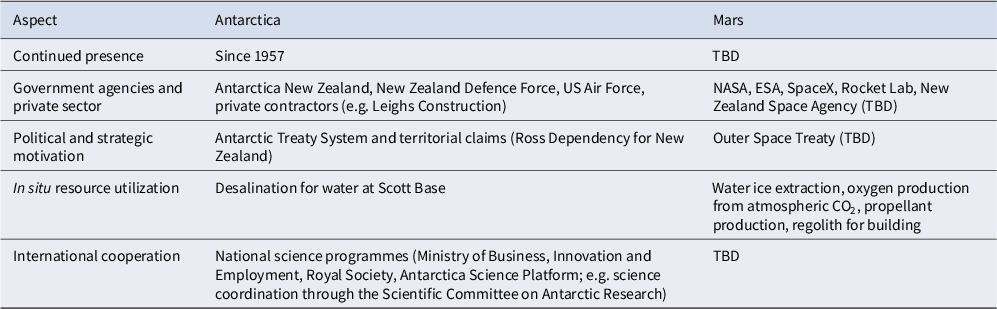
Scott Base is supplied by cargo ship and ice breaker via McMurdo Sound during summer and by US and New Zealand aircraft. The small, isolated crews at Scott Base provide an established prototype for Mars exploration teams, where logistics constraints, social dynamics, well-being and operational continuity are critical. Former NASA astronaut Dr Dan Barry visited Scott Base in 2017 and described the station as the culture and environment required to go to Mars (Barry Reference Barry2017). The structure of the New Zealand Antarctic programme, therefore, provides many useful analogues for a Mars exploration programme, spanning the scientific operations, national policy, geopolitical drivers and administrative frameworks (Table II). These parallels are increasingly relevant for future missions led by NASA, ESA or public-private partnerships such as SpaceX and NASA.
Summary of the aspects of the New Zealand Antarctic programme that may be relevant to a Mars programme.

Table II. Long description
The table consists of three columns: Aspect, Antarctica, and Mars.
* Continued presence: Antarctica has had a presence since 1957. Mars is T B D.
* Government agencies and private sector: Antarctica involves Antarctica New Zealand, New Zealand Defence Force, U S Air Force, and private contractors like Leighs Construction. Mars involves N A S A, E S A, SpaceX, Rocket Lab, and the New Zealand Space Agency T B D.
* Political and strategic motivation: Antarctica is governed by the Antarctic Treaty System and territorial claims like the Ross Dependency. Mars is governed by the Outer Space Treaty T B D.
* In situ resource utilization: Antarctica uses desalination for water at Scott Base. Mars involves water ice extraction, oxygen production from atmospheric C O sub 2, propellant production, and regolith for building.
* International cooperation: Antarctica involves national science programmes like M B I E, Royal Society, and Antarctica Science Platform, with coordination through S C A R. Mars is T B D.
A footer notes that T B D equals to be determined.
TBD = to be determined.
Continued presence
Scott Base has had continuous year-round operations since 1957. However, individuals at Scott Base rarely spend more than 13 consecutive months at the station due to physical health risks, psychological strain, social dynamics and operational policy. The operational policy is designed to mitigate the risk of cumulative degradation in human performance and safety, ensuring that base operations are not compromised by the physical and psychological toll of extreme environmental isolation. Although a large proportion of personnel are seasonal, ANZ maintains continuity through institutional protocols, rigorous knowledge transfer and overlapping team rotations to ensure operational stability. This model enables long-term strategic planning despite summer or annual individual deployments.
Early crewed Mars missions may initially adopt a similar model of temporary but extended habitation, with mission durations of 2–4 years. Over time, missions may transition towards a semi-permanent or permanent, self-sustaining human presence once in situ resource utilization (ISRU) technologies reduce dependence on Earth resupply (Heldmann et al. Reference Heldmann, Marinova, Lim, Wilson, Carrato and Kennedy2022, Hoffman et al. Reference Hoffman, Hecht, Rapp, Hartvigsen, SooHoo and Aboobaker2022). Sustained ISRU would enable crews to survive on Mars using local resources for water, oxygen, fuel and perhaps food production, thereby eliminating the reliance on Earth and reducing the risk and cost of human and robotic exploration programmes (Steinhoff Reference Steinhoff1963, Sanders et al. Reference Sanders, Paz, Araghi, Muscatello and Linne2015, Zubrin Reference Zubrin and James2018, Heldmann et al. Reference Heldmann, Marinova, Lim, Wilson, Carrato and Kennedy2022).
Lessons from Antarctic operations, including crew rotation strategies, social cohesion and continuity of institutional knowledge, are directly applicable to Mars exploration. Maintaining continuity across rotations is essential to ensuring robust knowledge transfer, safeguarding operational reliability and preventing the loss of experiential expertise that cannot be fully captured in procedural documentation. In isolated, high-risk environments like Antarctica, Mars or the Moon, preservation of tacit knowledge may be as critical to mission success as technological capabilities. A continuous human presence on Mars has been suggested as a more sustainable and scientifically valuable model than periodic ‘flags and footprints’ missions (McKay Reference McKay and McKay1985). Establishing a permanent, partially self-sustaining or fully self-sustaining settlement would lower long-term costs and increase scientific productivity, similar to the way in which Antarctic research stations evolved from temporary camps to permanent scientific infrastructure.
Resource dependence and in situ resource utilization
At Scott Base, the only ISRU is freshwater via desalination, obtained using a reverse osmosis plant to convert saltwater into freshwater. All other resources such as food, fuel and medical supplies are brought in. This dependence provides an operational analogue for early Mars missions, where water ice would be extracted locally, but other resources would have to be brought from Earth or manufactured on site. However, unlike Antarctica, ISRU capabilities on Mars are expected to grow significantly through emerging technologies including:
-
• Water ice extraction from shallow subsurface deposits, informed by precursor missions such as the NASA VIPER (Volatiles Investigating Polar Exploration Rover) Moon mission (Colaprete et al. Reference Colaprete, Andrews, Bluethman, Bussey, Captain and Elphic2019). The VIPER mission will map and characterize volatiles such as ice on the South Pole region of the Moon. These advances in volatile prospecting and extraction strategies will directly inform future strategies for volatile mapping and extraction on the Moon and Mars.
-
• Oxygen production from atmospheric CO2 using systems like NASA’s MOXIE (Mars Oxygen In-Situ Resource Utilization Experiment), which has already produced 6–8 g/h of oxygen on Mars (Hoffman et al. Reference Hoffman, Hecht, Rapp, Hartvigsen, SooHoo and Aboobaker2022). To support human exploration on Mars, this technology needs to be scaled up several hundred times (2–3 kg/h) and operate continuously to meet the demands of a larger-scale production system (Hoffman et al. Reference Hoffman, Hecht, Rapp, Hartvigsen, SooHoo and Aboobaker2022).
-
• Regolith-based 3D printing to manufacture landing pads, radiation shielding and habitat components (Coleine et al. Reference Coleine, Delgado-Baquerizo, Rosado and Zerboni2025).
-
• Bioreactor systems for food production and to process waste, recycle nutrients and produce biomaterials (Nangle et al. Reference Nangle, Wolfson, Hartsough, Ma, Mason and Merighi2020, Berliner et al. Reference Berliner, Hilzinger, Abel, McNulty, Makrygiorgos and Averesch2021, Coleine et al. Reference Coleine, Delgado-Baquerizo, Rosado and Zerboni2025, Wordsworth et al. Reference Wordsworth, Quayum, Kocharian, Pearson, Portillo and Yang2025, Martin et al. Reference Martin, Schubert, Greene, Pedersen, Hicks and Mancuso2026, Stork et al. Reference Stork, Greene, Nattermann, Pedersen, Hicks and Schubert2026).
These technologies could gradually reduce reliance on Earth-based resupply. A key goal for future Mars exploration should be to determine the practicality of these emerging technologies in habitats similar to Mars, like Antarctica.
Civilian, military and private-sector involvement
The New Zealand Antarctic programme shares joint logistics with the US Antarctic Program under a long-standing partnership known as the Joint Logistics Pool, and it relies on the New Zealand Defence Force, US Air National Guard and US Coast Guard for transport and shipping of cargo. ANZ also contracts private engineering and construction firms for building and infrastructure projects such as the Scott Base Redevelopment Project, demonstrating a public-private operational model for specialized tasks. A similar public-private model is likely to be established for Mars exploration. This model is already utilized for transportation services to low Earth orbit. For example, NASA contracts commercial partners to develop crew and cargo delivery services. SpaceX’s Starship is designed to deliver up to 100 metric tons of cargo to Mars in a fully reusable configuration, enabling bulk logistics for surface infrastructure (SpaceX 2025). Prior to human missions, medium-lift vehicles such as Rocket Lab’s Neutron may deliver smaller payloads (up to 1.5 tons), such as relay satellites for communication or Mars Sample Return architecture (Rocket Lab 2025). Under NASA’s Artemis campaign, a Commercial Lunar Payload Services contract tasks Blue Origin with delivering the VIPER rover to the Moon using the Blue Moon Mark 1 lander, launched on New Glenn.
Just as many Antarctic operations are internationally coordinated, Mars development will require international and multi-agency collaboration. Governance and logistics models between the USA and New Zealand in Antarctica offer proven templates for scalable infrastructure, shared transport assets and coordinated science operations that could also be applied beyond Earth. By sharing and distributing responsibilities and resources through international partnerships, similar to existing coordination between the USA and New Zealand in Antarctica, missions may achieve a level of programmatic redundancy and operational flexibility that safeguards against shifting national priorities, political tensions or even periods of hostility between participating states. However, unlike Antarctica, where evacuation and reinforcement remain comparatively straightforward, Mars crews and infrastructure would be effectively isolated from Earth during certain phases of a mission. This increases the importance of redundancy and distributed responsibilities, as disruptions to international cooperation on Earth could directly affect the continuity and operational resilience of Mars missions.
Antarctic science
Scientific activities
The primary objective of Scott Base is to facilitate New Zealand-led scientific research in the Ross Sea region, including physical and biological studies on the Antarctic continent, ice sheets, Ross Ice Shelf, sea ice, Ross Sea and the Southern Ocean. Within the framework of the Antarctic Treaty System, this scientific output serves as a critical instrument of science diplomacy and international governance (Chown et al. Reference Chown, Bastmeijer, Brooks, Gilbert, Phillips and Shibata2024), where scientific research translates directly into geopolitical presence and national influence. By maintaining robust research programmes, nations assert their interest in the region, attract world-class researchers and contribute to global climate and environmental knowledge.
Antarctic research as a Mars analogue
Many Antarctic research programmes use Antarctica as a Mars analogue because it contains some of the closest terrestrial equivalents to Martian surface and near-surface environments. Key analogue research areas include limits to habitability in permafrost (Goordial et al. Reference Goordial, Davila, Lacelle, Pollard, Marinova and Greer2016, Anderson et al. Reference Anderson, Marshall, Richards-Babbage, McDonald, Wilson and Abramov2025b), perchlorate concentrations (Kounaves et al. Reference Kounaves, Stroble, Anderson, Moore, Catling and Douglas2010, Tamppari et al. Reference Tamppari, Anderson, Archer, Douglas, Kounaves and McKay2012), cold-based glacial geomorphology (Atkins Reference Atkins2013), geomorphic and permafrost processes (Marchant & Head Reference Marchant and Head2007, Levy et al. Reference Levy, Marchant and Head2010, McKay et al. Reference McKay, Andersen and Davila2017, Anderson et al. Reference Anderson, Fujioka, Fink, Hidy, Wilson and Wilcken2023) and microbial ecosystems in Dry Valleys lake and groundwater systems (Mikucki et al. Reference Mikucki, Lyons, Hawes, Lanoil, Doran, Doran, Lyons and McKnight2010, Reference Mikucki, Auken, Tulaczyk, Virginia, Schamper and Sørensen2015).
The McMurdo Dry Valleys are a hyper-arid polar desert, characterized by extremely low precipitation of ~50 mm water equivalent (Fountain et al. Reference Fountain, Nylen, Monaghan, Basagic and Bromwich2010), mean annual air temperatures between -15°C and -30°C on the valley floors (Obryk et al. Reference Obryk, Doran, Fountain, Myers and McKay2020) and widespread permafrost deposits. At high elevations, the lack of liquid water, extremely low erosion rates and preservation of geomorphic features, permafrost and ground ice are directly comparable to the northern mid- and high latitudes of Mars (Marchant & Head, Reference Marchant and Head2007, Levy et al. Reference Levy, Marchant and Head2010, Mellon et al. Reference Mellon, McKay and Heldmann2014, Anderson et al. Reference Anderson, Fink, Fujioka, Hidy, Wilson and Abramov2025a). Dry permafrost as observed at high elevations in the McMurdo Dry Valleys is rare on Earth (Bockheim & Tarnocai Reference Bockheim and Tarnocai1998, Bockheim et al. Reference Bockheim, Campbell and McLeod2007, Goordial et al. Reference Goordial, Davila, Lacelle, Pollard, Marinova and Greer2016, Marinova et al. Reference Marinova, McKay, Heldmann, Goordial, Lacelle, Pollard and Davila2022) but is widespread on Mars (Mellon & Jakosky Reference Mellon and Jakosky1993, Mellon et al. Reference Mellon, Arvidson, Sizemore, Searls, Blaney and Cull2009, Smith et al. Reference Smith, Tamppari, Arvidson, Bass, Blaney and Boynton2009, Mellon & Sizemore Reference Mellon2022). Characterizing the temperature and water activity of ice-cemented ground under dry permafrost in Antarctica, therefore, offers critical insights into near-surface permafrost processes and habitability studies on Mars (Marinova et al. Reference Marinova, McKay, Heldmann, Goordial, Lacelle, Pollard and Davila2022). Additionally, research on ultra-low-biomass communities and limits to habitability, such as those found in the McMurdo Dry Valleys, is also of special interest to understanding microbial diversity in harsh, hyper-arid, polar climates. As such, these environments represent the best analogues on Earth to test and understand the potential for habitability of Martian permafrost (Goordial et al. Reference Goordial, Davila, Lacelle, Pollard, Marinova and Greer2016, Anderson et al. Reference Anderson, Marshall, Richards-Babbage, McDonald, Wilson and Abramov2025b).
The New Zealand Antarctic programme includes remote field camps and huts across the Ross Embayment to support a wide range of scientific investigations. The former Vanda Station was situated in Wright Valley of the McMurdo Dry Valleys and operated from 1969 to 1991 (Fig. 2). The station had five-person winter teams in 1969, 1970 and 1974. Astronaut David Scott, Commander of Apollo 15, visited Vanda Station to assess the environmental conditions as preparation for the Apollo 15 moon mission (Fig. 3; NASA 1970). During the summer, the station was occupied until 1991. It served as a remote, temporary field station supporting research on microclimatology, permafrost, limnology, ecology, geology and geomorphology, particularly focused on Lake Vanda hydrology and meteorology (Chinn Reference Chinn, Green and Friedmann1993, Chinn & Mason Reference Chinn and Mason2016). Because the station was established before the Protocol on Environmental Protection (Madrid Protocol 1991), the site experienced greywater waste including urine, battery acid, domestic wastewater and used photo-chemicals (Waterhouse Reference Waterhouse1993). The station was removed when rising lake levels threatened to flood the station site (Waterhouse Reference Waterhouse, Lyons, Howard-Williams and Hawes1997). After its closure, the contaminated site was restored through a deconstruction and remediation programme between 1992 and 1995 (Hawes et al. Reference Hawes, Howard-Williams, Webster-Brown and Poirot2025). This effort included the removal of many tonnes of contaminated soil and groundwater, along with post-remediation monitoring (Hawes et al. Reference Hawes, Howard-Williams, Webster-Brown and Poirot2025). Following the closure, field operations were replaced by smaller, temporary field camps to minimize environmental impact under the Antarctic Treaty’s environmental protection protocols. This restoration provides critical lessons for Mars planetary protection protocols, low-impact outpost establishment and environmental monitoring.
Vanda Station and Lake Vanda in Wright Valley. Photo by Chris Rudge. ©Antarctica New Zealand Pictorial Collection (1987/1988).

Figure 2. Long description
The photo shows the layout of Vanda Station in Wright Valley. In the foreground, a cluster of five light green, rectangular modular buildings is arranged on a dark, rocky ground. A tall, metal lattice wind turbine stands centrally among the buildings. To the left, a small tractor and various equipment are parked near the largest structure. Moving toward the background, the terrain slopes down to the edge of Lake Vanda, which appears mostly frozen with a smooth, white surface. The valley is enclosed by steep, barren mountains with patches of snow on the higher peaks under an overcast sky. The perspective is from an elevated position looking North-East across the station toward the lake.
Photograph of astronaut David Scott (left), Commander of Apollo 15, at Vanda Station in 1970. Before driving the Lunar Roving Vehicle on the Moon in 1971, Scott visited Vanda Station and trialled a three-wheeled Gnat. Photo by George Lewis. ©Antarctica New Zealand Pictorial Collection (1970).

Studies have highlighted strong parallels between Antarctic permafrost environments and Martian mid-latitude terrains. Mellon et al. (Reference Mellon, McKay and Heldmann2014) and Levy et al. (Reference Levy, Marchant and Head2010) demonstrated that polygonal ground, ice-cemented soils and sublimation features in the McMurdo Dry Valleys closely resemble landforms observed in the northern plains of Mars. Marchant et al. (Reference Marchant, Lewis, Phillips, Moore, Souchez and Denton2002) showed that long-term cold desert processes in Antarctica can preserve periglacial features over millions of years, offering a valuable analogue for the stability of Martian ground ice. Recent work by Luzzi et al. (Reference Luzzi, Heldmann, Williams, Nodjoumi, Deutsch and Sehlke2025) has identified Arcadia Planitia and northern Amazonis Planitia as prime candidates for future Mars exploration due to each region having shallow subsurface ice, patterned ground and thermokarst-like depressions, geomorphic characteristics that are directly comparable to Antarctic permafrost landscapes (Marchant et al. Reference Marchant, Lewis, Phillips, Moore, Souchez and Denton2002, Bockheim et al. Reference Bockheim, Kurz, Adam Soule and Burke2009, Kowalewski et al. Reference Kowalewski, Marchant, Head and Jackson2012, Mellon et al. Reference Mellon, McKay and Heldmann2014). The proposed sites contain a wide range of ice-related morphologies that suggest abundant near-surface ice, which will be accessible for ISRU (Luzzi et al. Reference Luzzi, Heldmann, Williams, Nodjoumi, Deutsch and Sehlke2025). For these reasons, the Arcadia Planitia region in the northern mid-latitudes of Mars has been identified as a likely candidate site for the landing of vehicles such as Starship (Golombek et al. Reference Golombek, Williams, Wooster, McEwen, Putzig and Bramson2021, Mellon et al. Reference Mellon, Sizemore, Heldmann, McKay and Stoker2024, Luzzi et al. Reference Luzzi, Heldmann, Williams, Nodjoumi, Deutsch and Sehlke2025).
Implications for Mars science
Science on Mars could operate in a similar manner to Antarctic research, searching for biosignatures and evidence of past life, microbiology in extreme environments, biological tolerance limits, cryosphere and permafrost evolution, geology, climate science, reconstruction of past climate and habitability and resource mapping for ISRU (e.g. water, ice, minerals).
Antarctica is protected by strict environmental protocols under the Protocol on Environmental Protection to the Antarctic Treaty (Madrid Protocol 1991), which prohibits mineral extraction and mandates environmental impact assessments. These policies provide a direct analogue to planetary protection frameworks for Mars, where forward contamination (life or other contaminants from Earth) must be prevented to preserve potential Martian ecosystems, and backward contamination (introduction of extraterrestrial microorganisms or hazardous material from Mars) must be managed to protect Earth (De Vincenzi Reference De Vincenzi1992, Spry et al. Reference Spry, Siegel, Bakermans, Beaty, Bell and Benardini2024). In areas of Mars where temperature and water activity could allow terrestrial microorganisms to survive and replicate under present Martian environmental conditions, a set of Special Regions has been defined under planetary protection guidelines (Beaty et al. Reference Beaty, Buxbaum, Meyer, Barlow, Boynton and Clark2006, Rummel et al. Reference Rummel, Beaty, Jones, Bakermans, Barlow and Boston2014). These regions may contain transient liquid water or subsurface environments potentially capable of supporting microbial activity, making them particularly vulnerable to forward contamination by Earth-based organisms. The identification of Special Regions has important implications for future human exploration. Many of these environments may coincide with locations of scientific interest or potential resources, such as shallow subsurface ice deposits that could support ISRU. Balancing the scientific value, resource potential and planetary protection requirements of these regions will therefore be a key challenge for Mars exploration planning, potentially requiring restricted-access zones, stringent contamination control protocols and governance frameworks similar to protected areas established under the Antarctic Treaty System.
The Antarctic Treaty System requires strict environmental protocols and rigorous contamination management to minimize the impact of human activity in Antarctica, particularly in low-biomass and fragile environments like the McMurdo Dry Valleys. Despite these efforts, and leaving nothing behind after field operations, human impacts can still be detected. Recent work quantifying human impact identified a marker targeting a human MT-CYB gene region as the best marker for detecting and predicting human traces up to 1 km from a highly occupied site in the McMurdo Dry Valleys (Wakerley Reference Wakerley2024). In addition, a DNA longevity experiment demonstrated that intracellular and extracellular DNA remained detectable in the environment for at least 2 years (Wakerley Reference Wakerley2024). These findings illustrate the potential for long-term consequences of Mars exploration. If human genetic material can remain detectable for years in Antarctica, the risk of forward contamination and the potential for ‘false positives’ in the search for signs of life on Mars require stringent environmental protocols to mitigate the impact of human activities. The PRIM (Propagation Restricted, Inert on Mars) framework proposed by Nattermann et al. (Reference Nattermann, Stork, Pedersen, Hicks, Mancuso and Isaev2026) extends the forward-contamination discussion beyond the traditional focus on sterilized spacecraft to living organisms intentionally introduced, such as human crew, agriculture and biological ISRU. Their framework highlights the need to consider not only how organisms are transported to Mars, but also whether those organisms could establish and persist under Martian conditions. This provides a potential pathway for enabling biological ISRU while maintaining demonstrably low forward-contamination risk.
Risk assessment and logistics
Human factors
All personnel at Scott Base receive Antarctic field training (AFT) upon arrival for several days to learn survival and emergency protocols. For scientific research groups that spend time away from Scott Base, the AFT includes testing of field and scientific equipment before deploying into the field to prevent any unforeseen issues before leaving Scott Base. The acceptable level of risk in Antarctica is significantly lower than that of future Mars exploration programmes. This risk profile in Antarctica contrasts with the much higher risks of Mars missions, where there is no emergency evacuation capability. High radiation, lack of oxygen and lower gravity also add complexities (Table III). Scott Base receives weekly resupply flights in summer and few flights between March and September, compared with Mars’s 26 month resupply cycle, highlighting the need for robust ISRU, self-contained medical systems and autonomous systems on Mars.
The success of prolonged missions in extreme isolation relies heavily on human factors such as maintaining interpersonal relationships and group cohesion (Contractor & DeChurch Reference Contractor and DeChurch2025) alongside subject matter expertise (Stuster et al. Reference Stuster, Adolf, Byrne and Greene2019). While psychosocial elements of Mars missions are not easily comparable with other human experiences, some aspects such as long-duration winter-over stays in remote Antarctic research stations are regarded as the best analogues for studying physiological and psychosocial changes (Palinkas Reference Palinkas2001, Manzey Reference Manzey2004, Osetskiy et al. Reference Osetskiy, Manko, Artamonov, Ilyin and Orlov2024).
Recent commercial spaceflight missions by SpaceX and Blue Origin have demonstrated that civilians with targeted training can operate effectively and safely in space. This suggests that future Mars missions may also include not just experts but a broad range of personnel, much like visitors to Antarctica today. However, drawing from previous spaceflight experience, Mars mission crews should train together for several years prior to departure to ensure sufficient time for addressing cultural differences and fostering long-term interpersonal stability (Hoffman & Kaplan Reference Hoffman and Kaplan1997, Allen et al. Reference Allen, Burnett, Charles, Cucinotta, Fullerton and Goodman2003).
Political and strategic motivation
The New Zealand Antarctic programme is an important and successful example of both Antarctic research and diplomacy. With New Zealand being situated between the south-west Pacific and Southern Ocean, it has a long history with and an obvious political interest in the Antarctic and Southern Ocean. This interest is perhaps clearer than an interest in Mars or lunar exploration. However, with New Zealand’s rapid growth in space technology and policy, including commercial companies such as Rocket Lab, and participation in the Artemis Accords, New Zealand is becoming a significant nation in space exploration. The same principles of peaceful cooperation, environmental stewardship, science leadership and contributing to global understanding used in Antarctica could underpin the role of small nations like New Zealand contributing to Mars exploration, policy and ethics.
International collaboration
The close proximity of Scott Base and McMurdo Station (USA) enables a high degree of US-New Zealand collaboration, including shared logistics, aviation operations, search-and-rescue support and scientific research. Antarctic operations are often too complex and costly for most nations to operate alone, leading to collaborative international programmes. For example, ANDRILL (Antarctic Geological Drilling Programme) was a multinational collaboration between the USA, New Zealand, Italy and Germany that produced direct evidence of West Antarctic Ice Sheet collapse and open waters in the Ross Embayment during the Pliocene, when global temperatures were up to ~3°C warmer than present and atmospheric CO2 concentrations were as high as ~400 ppm (Naish et al. Reference Naish, Powell, Levy, Wilson, Scherer and Talarico2009). ANDRILL was a 30 million USD project that ran between 2001 and 2007 and serves as a model of shared funding, shared infrastructure and shared science access. This level of cooperation is directly applicable to Mars, where no single nation is likely to establish permanent presence and undertake complex scientific research alone. Just as the Antarctic Treaty promotes science, a similar Mars governance framework could encourage scientific collaboration with healthy competition, enabling peaceful exploration of Mars. However, the Antarctic analogy has important limitations. Unlike Antarctica, Mars may contain resources that could become economically or strategically significant, creating competing national or commercial interests. Future Mars governance will therefore need to consider not only scientific cooperation but also the regulation of resource access, ownership and environmental management to help manage potential conflicts arising from access to local resources.
Comparative lunar analogue
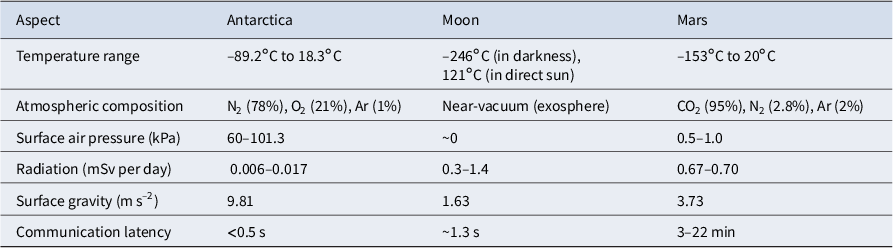
While the primary focus of this Perspective article is on Mars, Antarctica also provides a valuable analogue for sustained lunar surface operations, especially within the context of NASA’s Moon to Mars strategy and recent plans to establish a Moon base near the lunar south pole (NASA 2026). Many of the operational, logistical, governance and human-factors lessons discussed (e.g. remote operations, dependence on surface infrastructure, multinational coordination, limited evacuation capability and incremental development of ISRU) apply directly to the Moon as well as to Mars. While neither Mars nor the Moon is an exact analogue for Antarctica, both share extreme cold, isolation and constrained resources. While Antarctica serves as a valuable operational analogue for the Moon and Mars, the orders-of-magnitude differences in physical environment and conditions highlight both the lessons and limitations of Antarctic analogue studies (Table III).
Comparative features of Antarctica, the Moon and Mars.

Table III. Long description
The table consists of four columns: Aspect, Antarctica, Moon, and Mars.
* Temperature range: Antarctica is minus 89.2 degrees Celsius to 18.3 degrees Celsius. Moon is minus 246 degrees Celsius in darkness to 121 degrees Celsius in direct sun. Mars is minus 153 degrees Celsius to 20 degrees Celsius.
* Atmospheric composition: Antarctica is N sub 2 78 percent, O sub 2 21 percent, and Ar 1 percent. Moon is a near-vacuum exosphere. Mars is C O sub 2 95 percent, N sub 2 2.8 percent, and Ar 2 percent.
* Surface air pressure in k P a: Antarctica is 60 to 101.3. Moon is approximately 0. Mars is 0.5 to 1.0.
* Radiation in m Sv per day: Antarctica is 0.006 to 0.017. Moon is 0.3 to 1.4. Mars is 0.67 to 0.70.
* Surface gravity in m s super minus 2: Antarctica is 9.81. Moon is 1.63. Mars is 3.73.
* Communication latency: Antarctica is less than 0.5 s. Moon is approximately 1.3 s. Mars is 3 to 22 min.
Discussion
The New Zealand Antarctic programme provides a proven and practical framework for future Mars exploration, encompassing station size, infrastructure, habitability, governance and science. The operational structures that support Scott Base, including overlapping crew rotations, mixed national-military-private logistics, robust environmental governance and international scientific cooperation, offer a practical template for developing early human exploration strategies on Mars.
While key differences exist between Mars and Antarctica (i.e. temperature, oxygen, surface air pressure, radiation, gravity and planetary protection requirements), Antarctica remains the best full-spectrum analogue of isolation, harsh conditions, governance and multinational science operations relevant for sustained presence beyond Earth. Continued Antarctic science, policy and logistical experience will provide valuable foundations for Mars exploration, especially as programmes that are government-led potentially become multinational or private-public partnerships.
A central distinction between Antarctic and Martian operations concerns resource independence. At Scott Base, freshwater is the only resource generated locally via a reverse osmosis desalination plant. All other resources are transported to Scott Base. During the austral summer (October–February), Scott Base is resupplied by aircraft regularly, weather permitting, and by annual cargo ship through McMurdo Sound. In contrast, Mars exploration architectures will require substantial use of ISRU, with water-ice extraction, oxygen production and regolith manufacturing and processing systems, reducing the dependency on Earth. Antarctica, therefore, provides a critical baseline for understanding ISRU mission vulnerability and illustrates how logistical constraints influence risk, infrastructure design and science planning.
The Antarctic Treaty System shows how science, environmental stewardship and diplomacy can provide long-term international cooperation in extreme environments. As Mars exploration strategies get developed, a comparable framework that balances scientific research, planetary protection and geopolitical interests will be essential. Antarctic Specially Protected Areas, environmental impact assessment procedures and multinational research programmes such as ANDRILL offer valuable examples of how collaborative governance can function effectively on Mars.
Conclusions
The New Zealand Antarctic programme demonstrates how a small nation can leverage scientific excellence and diplomacy to contribute to global research and policy agendas. Although New Zealand’s motivation for Antarctic engagement is intuitively linked to geographical proximity and Southern Ocean stewardship, the New Zealand Antarctic programme, alongside the emerging New Zealand space sector and participation in the Artemis Accords, offers practical and policy-relevant lessons for future space exploration.
Antarctica remains an unparalleled proving ground for Mars exploration, and Scott Base offers a functional model of sustained human activity in a remote and challenging environment, built on decades of operational refinement, institutional memory and international partnership. The small, isolated size of personnel at Scott Base makes an appropriate comparison to a group of early Mars explorers and therefore provides valuable lessons for Mars exploration efforts. Furthermore, lessons from Antarctica also provide a valuable analogue for sustained lunar surface operations, especially within the context of NASA’s Moon to Mars strategy. By leveraging examples from operations in Antarctica, such insights provide targeted recommendations for programme designers and policymakers seeking cooperative, sustainable approaches to a human presence on Mars.
Acknowledgements
The author thanks Chris McKay for helpful discussions and the many Antarctic personnel whose insights and experience helped shape the ideas in the manuscript. The author also thanks the journal reviewers for their constructive comments.
Competing interests
The author declares none.




 Open access

