Introduction: the Song of Songs in Chinese Bibles
The Song of Songs is a distinctive contribution to the canon of the Bible. Often viewed as a love poem featuring rich, sophisticated, and sexually daring imagery, it is in form and content a challenging text that both resists and invites a multiplicity of interpretations. The work thus was one of the most commented-upon biblical works in ancient, medieval, and early modern Judaism and Christianity.Footnote 1 In the context of Chinese translations, the vernacular rendition of this biblical book, titled ‘Yage 雅歌’ (The Refined Song) in the 1919 Mandarin Chinese Union Version presented a model of clear and simple lyricism during a time at which the literary landscape in China was undergoing a significant transformation from tradition to modernity.Footnote 2 Scholars such as Marián Gálik,Footnote 3 Li Panpan,Footnote 4 and Ma YueranFootnote 5 have noted its significant influence on the artistic expressions of Chinese poets, dramatists, and fiction writers in modern Chinese literature.
The history of the Chinese translation of the Song of Songs and its encounter with Chinese readers dates back much further. The earliest Chinese version appeared in 1822 in the complete Bible translated by Protestant missionaries Joannes Lassar and Joshua Marshman,Footnote 6 titled ‘Suoluomen zhi shige 所羅們之詩歌’ (The Poem of Solomon). A second version, ‘Suoluomen zhi ge 所羅門之歌’ (The Song of Songs of Solomon), followed in 1823 and was included in the Chinese Bible translated by Robert Morrison (1782–1834) and William Milne (1785–1822). Despite the pioneering nature of these efforts, these early translations were often critiqued for their overly literal approach and foreignisation, resulting in styles that were perceived as unidiomatic and barbaric.Footnote 7 The third version of the Song of Songs, Geshi 歌詩 (Song Poem), was included in the Old Testament by Karl Gützlaff (1803–1851) in 1838. While intended as an improvement, this rendition also failed to achieve significant stylistic advancement compared with its predecessors. Recognised for its rich imagery and complex themes of love, this biblical text poses unique challenges when translated into Chinese. Its direct and sensually charged portrayal of romantic love starkly contrasts with the more delicate and allusive style found in traditional Chinese poetry. Additionally, its celebration of passionate and divine love challenges a cultural context that emphasises adherence to established social norms regarding relationships.
A significant advancement was made by the Delegates’ Version, with its New Testament released in 1852 and Old Testament in 1854. The latter was produced solely by British delegates W. J. Medhurst, J. Stronach, and W. C. Milne, along with their Chinese assistants.Footnote 8 The completion of this work can be largely attributed to the ‘energy and zeal’ of Medhurst,Footnote 9 who sought to create a more refined classical version that mirrored the style of traditional Chinese literature—a Bible that ‘could be regarded as a work of Chinese literature’.Footnote 10 Medhurst described his stylistic approach as a ‘scholar-like style’ that was not only palatable to the literati, but also intelligible to the broader populace with some familiarity with written language.Footnote 11 He placed exceptional trust in the judgment of his Chinese assistants, particularly Wang Tao (王韜 1828–1897), who ‘stamped his style on the Delegates’ Version’.Footnote 12 Wang, a xiucai 秀才 (talented scholar)Footnote 13 in the late Qing Dynasty, was well versed in Confucian texts and classical Chinese literature. He played a crucial role in refining the latter portion of the New Testament and drafting translations for the entire Old Testament. According to Medhurst, the chaste and easy style present throughout the translation is indebted to Wang Tao.Footnote 14
The Song of Songs in the Delegates’ Version, the Yage 雅歌 (The Refined Song),Footnote 15 exemplifies a sophisticated literary style that resonates with well-educated Chinese scholars. This translation not only adheres to Chinese prose standards, characterised by brevity and the skilful use of measured sentences, but also reflects a deliberate effort to bridge two distinct literary traditions. Specifically, the Yage showcases a rich interplay between the Bible and Chinese classics—particularly the Shijing 詩經 (book of songs). As the first anthology of Chinese poetry and one of the ‘Wujing 五經’ (five classics), the Shijing has held great reverence as a Confucian classic since the Han Dynasty. It features numerous poems—especially those from the ‘Feng’ 風 (airs of the states), which explores the joys and sorrows of love and courtship. Comparative studies of the Shijing and the Song of Songs have been instrumental in revealing both their similarities and differences. For example, Gálik analyzes their lyrical qualities, describing the Song of Songs as ‘extroverted’ and the Shijing as ‘introverted’ with a greater emphasis on restrained ethical values.Footnote 16 Additionally, he notes a connection between the Chinese name ‘Yage 雅歌’ and the second division of the Shijing, ‘Ya 雅’,Footnote 17 although he does not elaborate on this point. Zhang argues that traditional Chinese scholars’ interpretive methods regarding the Shijing closely resemble the allegorical interpretations applied to the Song of Songs.Footnote 18
This article argues that the Yage achieves a more restrained lyricism through its integration of phrases and verses from classical Chinese literature—particularly the Shijing. It will examine the reimagining of the protagonists in the Yage, the adaptation of its imagery, and the incorporation of Chinese literary elements into the biblical text. The ensuing analysis will also focus on the intertextual relationship established between the Shijing and the Yage, asserting that this connection invites an allegorical interpretation of the Yage that is similar to the interpretive traditions of the Shijing. By examining these aspects, this article highlights the artistic achievements and complexities of early Chinese Bible translators in their quest to create a version of the Holy Scripture that tries to be more genuinely Chinese.
Images of lovers: love song transposed onto a Chinese canvas
In the Yage, the dialogue is delineated through notations that provide clarity to the characters’ interactions. The man is identified as ‘liangren 良人’ (the good man or virtuous man),Footnote 19 while the woman is referred to as ‘xinfu 新婦’ (the bride). The daughters of Jerusalem are labelled as ‘bi 婢’ (maids). Dialogue tags such as ‘xinfu yue 新婦曰’ (the bride says), ‘liangren yue 良人曰’ (the good man says), and ‘zhu bi yue 諸婢曰’ (all the maidservants say), along with ‘wei qi bi yue 謂其婢曰’ (say to her maids) are added to clarify the speakers. The endearment used of the woman ‘ra’·yā·ṯî’ (my love)Footnote 20—an appellation often with explicit expressions of her beauty—is rendered as ‘aifei 愛妃’ (my beloved consort). Terms used for the man, such as ‘dôḏî’ (my beloved), ‘rēʿî’ (my friend), and ‘še ʾāhăb̲āh ap̲šî’ (whom my soul loves), are consistently translated as ‘fuzi 夫子’ (master) and in one instance as ‘liangren 良人’ (good man) in verse 1:7.
These notations and terms of endearment reflect a dramatic interpretation of the Song of Songs, influenced by Origen (circa 185–circa 253)’s characterisation of the poem as an epithalamium in the form of a drama. In this framework, the central figures are ‘the Bridegroom’ and ‘the Bride’, who interact with their respective companions: the ‘maidens’ (or ‘Daughters of Jerusalem’) and the ‘friends’ of the groom.Footnote 21 In essence, the address ‘aifei 愛妃’ (my beloved consort) throughout the poem situates the narrative of love within an imperial context, while terms such as ‘fuzi 夫子’ and ‘liangren 良人’ have profound implications for prescribed gender roles within Chinese cultural framework. The title ‘fuzi 夫子’ (master) is as a respectful title used by wives to address their husbands in ancient China, conveying the reverence and respect expected from women towards their husbands. The address ‘liangren 良人’ (good man) for one’s husband traces back to the Shijing, as shown in the verse ‘yanyan liangren, zhizhi deyin 厭厭良人, 秩秩德音’ (serene is my good man, pure is his fame) in ‘Xiaorong 小戎’ (The Small War Carriage, a song in Qinfeng 秦風).Footnote 22 This term of address connotes that a husband is regarded not only as a beloved partner, but also an esteemed figure whose character and actions are worthy of admiration.
In addition to the culturally specific terms that situate the Yage within Chinese cultural norms, the depiction of its protagonists demonstrates a sophisticated integration of the vivid metaphorical imagery found in the Hebrew original with traditional Chinese cultural ideals and literary practices. For instance, the portrayal of the man in the Yage blends the extravagant praising of the physical charms with traditional Chinese ideals of male excellence. A general compliment in verse 1:16, using the synonyms ‘yā·p̄eh’ (fair) and ‘nā’îm’ (pleasant), is translated as ‘fuzi fengcai shendu 夫子丰采甚都’ (fuzi’s demeanour is very appealing), adding the term ‘fengcai 丰采’ (demeanour or bearing) to highlight qualities such as style and manner. The Chinese translation of the man’s physical allure in verses 5:10–16 is another example that exemplifies this blending. The waṣfFootnote 23 about the man in verses 5:10–16 (KJV) reads:
My beloved is white and ruddy, the chiefest among ten thousand. His head is as the most fine gold, his locks are bushy, and black as a raven. His eyes are as the eyes of doves by the rivers of waters, washed with milk, and fitly set. His cheeks are as a bed of spices, as sweet flowers: his lips like lilies, dropping sweet smelling myrrh. His hands are as gold rings set with the beryl: his belly is as bright ivory overlaid with sapphires. His legs are as pillars of marble, set upon sockets of fine gold: his countenance is as Lebanon, excellent as the cedars. His mouth is most sweet: yea, he is altogether lovely. This is my beloved, and this is my friend, O daughters of Jerusalem.
In the Yage, the woman’s rhapsody of her beloved is rendered as follows:
5:10 我之夫子, 色白而紅, 為萬人之冠 (My fuzi, with fair and rosy complexion, is the head among ten thousand people);
5:11 首若兼金, 長髮依稀垂柳, 黑鬢彷佛堆鴉 (His head is like pure gold, his long hair is like weeping willow, his black locks are like stacks of ravens);
5:12 目若溪濱之鴿, 以乳洗滌, 行列甚整 (His eyes are like doves beside streams, washed in milk, and the arrangement is very neat);
5:13 玉頰芬芳, 有如香草, 栽於園囿, 絳唇若玉薽之嫣媚, 吐氣若沒藥之滴瀝 (His jade-like cheeks are fragrant, like sweetgrass planted in a garden; his vermilion lips are as charming as attractive lilies, his breath as fragrant as drops of myrrh);
5:14 手帶金釧, 嵌以黃玉, 身若象齒, 其色光潤, 鑲以青玉 (His hands are adorned with gold bracelets set with yellow jade, his body like ivory, bright and smooth, inlaid with turquoise);
5:15 足若花石柱, 置於金座, 儀容英爽, 森森然如利巴嫩之柏香木 (His legs are like sculpted stone pillars, placed on a golden base. His countenance is as Lebanon, excellent as the cedars. His countenance is magnificent and vigorous, towering as cedars in Lebanon);
5:16 吹氣若蘭, 洵可愛也, 耶路撒冷女乎, 我之夫子若此 (His breath is as fragrant as an orchid flower. He is truly lovely. Daughters of Jerusalem, my fuzi is like this).
In the translation, the descriptive praise of the man’s physique is enriched with distinctly Chinese characteristics through allusions to classical Chinese literature. In verse 5:11, the original Hebrew term describing the hair, ‘taltallîm’ (locks), is translated as ‘chuiliu 垂柳’ (weeping willow)—a highly symbolic expression in Chinese literary tradition. This rendition creates an image of a man with long, flowing hair that is reminiscent of the graceful branches of a weeping willow. The phrase ‘heibin fangfu duiya 黑鬢彷佛堆鴉’ (black hair like stacks of ravens) adopts ‘duiya 堆鴉’ (stacks of raven) to render ʿôrēb̲ (raven). ‘Duiya 堆鴉’ originates from Cheng Ju (程俱1078–1144)’s line ‘geyan yaoxiang bin duiya 歌筵遙想鬢堆鴉’ (amidst singing and feasting, I fondly recall hair as stacks of ravens), which symbolises the vigour and charm of youth, creating an impression of vitality and beauty. Similarly, in verse 5:15, the man’s form is likened to the majestic cedars of Lebanon, which highlights his distinction among men.Footnote 24 The translation ‘yirong yingshuang, sensen ran ru libanen zhi baixiang mu 儀容英爽, 森森然如利巴嫩之柏香木’ (his countenance is magnificent and vigorous, towering as cedars in Lebanon) clarifies this metaphorical depiction through adjectives ‘yingshuang 英爽’ (magnificent and vigorous) and ‘sensen ran 森森然’ (towering). The term ‘yingshuang 英爽’ (magnificent and vigorous) is known for praising men with commanding and bold presences. Meanwhile, ‘sensen ran ru libanen zhi baixiang mu 森森然如利巴嫩之柏香木’ (towering as cedars in Lebanon) alludes to ‘sensen ru qianzhang song 森森如千丈松’ (towering as pine trees of a thousand zhangFootnote 25) from the ‘Shangyu 賞譽’ (‘Appreciation and praise’) chapter of Shishuoxinyu 世說新語 (A New Account of the Tales of the World),Footnote 26 which describes someone as tall and majestic. These allusions enhance the poetic expressions in the translation, ensuring that the theme of male beauty is accessible and meaningful to a Chinese readership.
Furthermore, the Chinese translation transforms the motif of fragrance, often associated with erotic sensuality, into symbols of virtue and refined character. In verse 5:13, the Hebrew original depicts the man’s cheeks as garden beds of spices and his lips as lilies dripping with flowing myrrh, evoking a sense of rich fragrance linked to sensuality and desire. The translation enhances both images and referents by rendering ‘ləḥāyāw’ (his cheeks) as ‘yujia 玉頰’ (jade-like cheeks) and ‘śipt̲ôt̲āyw’ (his lips) as ‘jiangchun 絳唇’ (vermilion lips). These expressions draw upon classical Chinese literature to underscore the charm and grace of the facial features being depicted. More importantly, the imagery of spices (bō·śem) and aromatics (mer·qāḥîm) is transformed into ‘xiangcao 香草’ (sweetgrass), alluding to Qu Yuan’s (屈原 circa 340–278 BCE) ‘Lisao 離騷’ (Encountering Sorrow) from the anthology Chuci 楚辭 (Songs of Chu). In Qu Yuan’s poetry, ‘xiangcao 香草’ (sweetgrass) symbolises noble character, while ‘meiren 美人’ (the beauty) represents an emperor endowed with virtue and wisdom. Consequently, the phrase ‘Xiangcao meiren 香草美人’ (sweetgrass and beauty) evolves into a literary archetype representing the pursuit of virtue and nobility—a theme that resonates throughout traditional Chinese literature. In verse 5:16, the Chinese translation introduces the phrase ‘chuiqi ruo lan 吹氣若蘭’ (his breath is like an orchid flower) to describe the man’s mouth, where the original Hebrew term ‘maḥămaddîm’ (lovely) subtly alludes to kissing. This added phrase ‘chuiqi ruo lan 吹氣若蘭’ (his breath like an orchid flower) echoes ‘changxiao qi ruo lan 長嘯氣若蘭’ (her long, gentle exhalation is like the fragrance of an orchid) from Meinu Pian 美女篇 (On Beauty) by Cao Zhi (曹植, 192–232). In Cao’s poem, the beauty is employed as a metaphor for a man of virtue and talent. Altogether, through these allusions from classical Chinese literature, the character’s beauty is elevated from mere physical attraction to a profound embodiment of beauty and virtue.
The portrayal of woman’s beauty presents a more complex metaphoric picture in the source text with more imaginative and sensuous imagery. The translation adeptly incorporates allusions to enrich her image with cultural resonance. For example, in the man’s first song of admiration (verses 1:9–11), the woman is pictured wearing all the ornaments of a queen: tōrîm and ḥărûzîm.Footnote 27 The translation ‘er rong shen mei, shimao yi zhenzhu, chuixiang yi meigui 爾容甚美, 飾貌以珍珠, 垂項以玫瑰’ (your countenance is truly beautiful, adorned with pearls on your face and a necklace of beautiful stones around your neck) highlights her visage with culturally resonant adornments. ‘Zhenzhu 珍珠’ (pearls) and ‘meigui 玫瑰’ (beautiful stones) resonate with ‘zhui yi zhuyu, shi yi meigui 綴以珠玉, 飾以玫瑰’ (adorned with pearls and decorated with beautiful stones) from the ‘Wai chushuo zuo shang 外儲說左上’ (Outer congeries of sayings, the upper left series) chapter of Hanfeizi 韓非子—an ancient Chinese classic attributed to Han Fei (韓非, circa 280–233 BCE). In verse 4:11, ‘the smell of thy garments is like the smell of Lebanon’ is translated into ‘yixiang xiren, ruo libanen zhi mu 衣香襲人, 若利巴嫩之木’ (the fragrance from your attire envelops me, like the trees of Lebanon). The added term ‘xi ren 襲人’ (enveloping a person) draws from the line ‘huaqi xi ren zhi zhou nuan 花氣襲人知晝暖’ (the fragrance of flowers envelops you, revealing the warmth of daylight) in ‘Cunju Shu Xi 村居書喜’ (Joyful Writings on Village Life) by the Song Dynasty poet Lu You (陸遊, 1125–1210).
While the above allusions serve to create a visual resonance that deeply connects with Chinese readers, some Chinese idioms are integrated to enhance clarity of the original imagery. For instance, in verse 2:14, the man longs for the voice and form of his beloved, referring to her as ‘my dove’ (yônāt̲î) hidden in the clefts of the rocks. The English version (KJV) reads: ‘O my dove, that art in the clefts of the rock, in the secret places of the stairs.’ This depiction of the man summoning the woman portrays her as inaccessible.Footnote 28 The Chinese translation reads: ‘wu shi er ruo ge, ni yu panshi, cang yu yanxue, jin jian yi ban 吾視爾若鴿, 匿于磐石, 藏於岩穴, 僅見一斑’ (I regard you as a dove, concealed among the boulders, hidden in rocky caves, offering mere a glimpse). Given that the endearing term ‘my dove’ is relatively remote from the Chinese mentality, the translation commences with a metaphor that likens the woman to a dove. Subsequently, the idiom ‘僅見一斑’ (offering only a glimpse) is added to clarify this imagery of the beloved concealed in an inaccessible rocky crevice. Derived from ‘guan zhong kui bao, shi jian yi ban 管中窺豹, 時見一斑’ (looking at a leopard through a tube, one can only see a spot at a time) in the ‘Fangzheng 方正’ (The square and the proper) chapter of Shishuoxinyu 世說新語 (A New Account of the Tales of the World), this idiom emphasises that the man can only see a small part of his beloved, suggesting both beauty and elusiveness. Another example occurs in verse 7:7, where the woman’s stature (qômāt̲ēk̲) is likened to a date palm (ləṯāmār): ‘thy stature is like a palm tree.’ The date palm holds significant cultural and religious importance in the ancient Near East, and this comparison may also relate to the common Hebrew feminine name, Tamar (palm).Footnote 29 To make this imagery meaningful in Chinese, the translation ‘erti pingting, you zhi zao shu 爾體娉婷, 猶之棗樹’ (your figure is graceful, like that of a date palm tree) adds the phrase ‘pinting 娉婷’ (graceful) to clarify this comparison—a term often used to depict a woman’s elegance and beautiful demeanour.
Additionally, the translation presents the woman as an idealised figure of feminine virtue. The Hebrew epithet ‘ṯammāṯî’ (my undefiled) in verses 5:2 and 6:9, which primarily emphasises her flawless physical beauty,Footnote 30 is translated as ‘de wu bu bei 德無不備’ (possessing all virtues). This idiom portrays her as a woman of exemplary character, embodying ideals of traditional feminine virtues such as filial piety, loyalty, and modesty.
Altogether, the portrayal of the protagonists in the Yage effectively situates the narrative of love within a Chinese cultural context. By meticulously embedding culturally resonant imagery, allusions, and idiomatic expressions, the Yage seamlessly blends the eroticism and passion of the Hebrew original with the refined elegance and moralistic undertones of Chinese literary tradition. This approach infuses the portrayal of lovers with qualities that resonate with traditional Chinese ideals of beauty and virtue, relocating a Hebrew love song onto a Chinese canvas.
Nature of love: love through the lens of Chinese literary tradition
The expression of passionate and divine love that the Song of Songs has been celebrated for undergoes a profound transformation in the Yage, with the concept of love recontextualised to reflect values inherent in Chinese culture.
One notable aspect of this transformation is how the translation reflects the prevailing gender roles of the time through the translation of the concept of love. The woman’s expression of passionate love is often tempered by the term ‘jingai 敬愛’ (respect and love). This linguistic choice underscores the hierarchical nature of traditional Chinese relationships, in which women were expected to exhibit deference and respect toward men. Additionally, the Yage presents a nurturing and emotionally steadfast understanding of love. The Hebrew terms ‘dôḏ’ (love) and ‘ʾahăb̲āh’ (love) are typically rendered as ‘juan ai 眷愛’ (caring love), which captures the nurturing and caring essence of love as valued in Chinese culture. For instance, in verse 4:10, the phrase ‘er juanai zhi qing, shen wei duzhi 爾眷愛之情, 甚為篤摯’ (your caring love is deeply earnest) is used to translate the original ‘dôḏ’, shifting the emphasis from desire and romantic affection to a profound emotional connection characterised by earnestness and steadfastness. A similar approach is evident in verse 8:7, where ‘qing shen duzhi 情甚篤摯’ (my emotion for you is profound and steadfast) is used to translate ‘ʾahăb̲āh’ (love). And the phrase ‘juanai qing shen 眷愛情深’ (my love and emotion for you is deep and tender) is included in verses 6:12 and 8:5, reinforcing the notion of love as a deep emotional bond.
This contextualisation of love becomes particularly evident in the translation of verses 8:6–7, often referred to as the ‘grand credo’ of the Song of Songs.Footnote 31 In these verses, the woman not only speaks about her affection for her lover, but also reflects on the very concept of love itself. The English translation reads:
8:6 Set me as a seal upon thine heart, as a seal upon thine arm: for love is strong as death; jealousy is cruel as the grave: the coals thereof are coals of fire, which hath a most vehement flame.
8:7 Many waters cannot quench love, neither can the floods drown it: if a man would give all the substance of his house for love, it would utterly be contemned.
In verse 8:6, the reference to the ancient Near Eastern practice of wearing seals on cords around the neck, which signifies possession or ownership, suggests that the woman desires an intimate bind with the man’s identity.Footnote 32 These two verses equate love’s intensity with the inexorable force of death, further amplified by allusions to cosmic powers such as Sheol, flames of Yah, and cosmic waters. This cosmic framing of love holds profound hermeneutic significance, implying that the varied dimensions of human love described in the Song of Songs—the joy of presence, the pain of absence, yearning for intimate partnership, and even erotic desire—can be understood as reflective of God’s love.Footnote 33
The Chinese translation renders it as follows:
8:6 新婦曰, 願爾心懷我, 手抱我, 心心相印, 若合符節, 我愛汝甚切, 至死不渝, 如有他婦奪寵, 我銜憾實深, 雖入土猶不已, 我必忿怒, 烈若火焰 (The bride says, may you cherish me in your heart and hold me in your arms. Impress your mind on my mind, like matching halves of a tally. I love you deeply and will remain steadfast until I die. If another woman should dare to steal your affections from me, then I shall bear a deep and abiding grudge, which shall not be quenched even when I am buried. I shall be furious, and my anger shall be fierce and burn like unto a great flame).
8:7 我眷愛爾, 情甚篤摯, 河水氾濫, 亦不能滅, 雖傾家以博愛, 亦不可得 (I love you, and my emotion for you is profound and steadfast. Though the rivers rage and overflow the banks, they shall not be able to extinguish it. Even if a man would give all that he possesses to obtain my love, yet it would be unattainable).
This translation diverges significantly from the Hebrew original in several key aspects. Notably, the seal imagery, originally associated with ownership, has been reinterpreted to symbolise profound emotional connection. The Chinese translation employs the idioms ‘xinxin xiang yin 心心相印’ (impressing the mind on the mind) and ‘ruo he fujie 若合符節’ (like matching halves of a tally) to render the image of ‘ḥôṯām’ (seal). The idiom ‘xinxin xiang yin 心心相印’, deriving from Zen Buddhist thought on the transmission of enlightenment through mind in the line ‘yi xin yin xin, xinxin bu yi 以心印心, 心心不異’ (impress the mind on the mind, so the two minds are not different) in Chuanxin fayao 傳心法要 (Essentials of the Transmission of Mind), indicates a deep understanding or empathy between lovers. ‘Fujie 符節’ (tally)—a traditional Chinese method of authorisation requiring matching halves of a split object—implies that, just as the two halves of a tally must perfectly align to form a complete whole, so too do kindred spirits find seamless harmony and mutual understanding. Together, these idioms shift the emphasis from the focus of possessiveness to that of mutual understanding and mental unity within the relationship.
Moreover, the translation shifts the notion of love as a powerful force to a concrete expression of individual devotion. While the original verses illustrate the strength of love itself by comparing it to death and its intensity through metaphors of fire and overwhelming waters, the translation centres on an intimate personal narrative. To begin with, the statement ‘love is strong as death’ is transformed into ‘wo ai ru shen qie, zhi si bu yu 我愛汝甚切, 至死不渝’ (I love you deeply and will remain steadfast until I die), which recontextualises the discussion from the concept of love (ʾahăb̲āh) itself and the personified notion of death (māwet̲) to a heartfelt declaration of personal feelings and commitments. Alongside this, the treatment of the parallel word for love, ‘jealousy’ (qinʾāh), reflects a similar transformation. It is reinterpreted through the woman’s lens, who asserts that, if another woman should dare to steal her lover’s affections, then she would bear a ‘deep and abiding grudge’. It personalises the discussion of jealousy and transforms it into a narrative connected to personal infidelity. Furthermore, the evocative imagery conveying love’s endurance in the original, grave (šʾôl) and flame (rišpê), is reframed as the woman’s personal vows and threats: ‘sui ru tu 雖入土’ (even when I am buried) and ‘wo bi fennu, lie ruo huoyan 我必忿怒, 烈若火焰’ (I shall be furious, and my anger shall burn fiercely like a great flame). Likewise, the assertion in verse 8:7, ‘wo juanai er, qing shen duzhi 我眷愛爾, 情甚篤摯’ (I love you, and my emotion for you is sincere and earnest), indicates that the love that cannot be extinguished or replaced by material wealth, as mentioned in the subsequent verses, is the woman’s love for the man. Her love becomes the implied object in the following lines: ‘heshui fanlan, yi buneng mie 河水氾濫, 亦不能滅’ (though the rivers rage and overflow their banks, they shall not be able to extinguish it) and ‘qing jia yi bo ai 傾家以博愛’ (even if a man were to give all that he possesses to obtain love). In conclusion, these divergences result in a shift from universal themes of love to personal expressions of commitment. The affirmation of love as strong as death—a concept meticulously built throughout the Song of Songs and everything in the Song of Songs converges upon and serves to illustrateFootnote 34—transitions into the woman’s personal confession of love.
While this transformation may be perceived as a divergence from the original text, it also reflects how the nature of love is understood in Chinese literary traditions. This shift illustrates how intimate relationships are perceived and expressed in the Chinese literary tradition. The Hebrew original celebrates the power of love by comparing it to enduring forces, suggesting a transcendent and divine quality. In contrast, the Chinese translation presents a human-centred interpretation that diminishes the divine aspects of love. Chinese classics, while acknowledging love, typically present it within a framework of restraint and social propriety. For instance, love songs in the Shijing are normally interpreted through the lens of Confucian propriety, particularly those in the ‘Feng 風’ (Airs of the states) section, which depict scenes of passionate longing and trials of separation. A notable example is the reading of ‘Guanju 關雎’ (‘The Osprey’, a song in 周南 Zhounan), which is the first and perhaps the best-known song in the Shijing—literally a love song and possibly an epithalamium. Confucius commented that ‘there is joy without wantonness, and sorrow without self-injury’Footnote 35 in ‘Guanju 關雎’, suggesting that the emotions expressed in ‘Guanju 關雎’ are proper and restrained, under good control and conformable to decorum. This inherently moral and didactic interpretation of love songs held considerable sway over traditional Chinese discourse on love, which values love as an integral part of maintaining social order and familial bonds, but lacks any discernible connection with the notion of divine force. Within the Confucian framework, love is seen as a part of ethics and of social rites—a part of human emotions expected to align with xing 性 (human nature) guided by reason and held confined within proper boundaries. The overwhelming power of love described in the Song of Songs—one that can defy social conventions—‘could be only incomprehensible and even dangerous’ to Confucianists.Footnote 36
Thus, the adaptation of the narrative focus from the grand themes of divine love to the expressions of personal commitment reflects a literary context that prioritises the exploration of love within structured societal frameworks. This shift provides a foundational backdrop for understanding the integration of verses from the Shijing in the Yage, which will be explored in the next section.
Poetic resonance: the Song of Songs enriched by the Shijing
The Yage stands as a testament to the effort to bridge biblical and Chinese literary traditions by melding the profound themes of love found in the Song of Songs with Chinese cultural ideals and values. In addition, the poetic quality of the Yage is further enhanced through the careful incorporation of references from the Shijing.
The Shijing—a collection of polished folk songs, sophisticated occasional pieces, and solemn dynastic hymns—is the most uniformly ancient compilation included in the Five Classics—and the first to be recognised as a canon.Footnote 37 It has significantly influenced Chinese literary and cultural traditions. By drawing on the established motifs and verses present in the Shijing, the Yage creates a narrative that resonates deeply with Chinese readers. To start with, the portrayal of the woman’s beauty is enhanced through allusions to the Shijing. In verse 4:9, the woman’s captivating eyes, described as ‘one of thine eyes’, are rendered into ‘meimu song pan 美目送盼’ (your beautiful eyes glance). This phrase directly echoes the iconic line ‘meimu pan xi 美目盼兮’ (her beautiful eyes are well-defined black and white)Footnote 38 from ‘Shuo Ren 碩人’ (‘A Person of Outstanding Beauty’, a song in ‘Weifeng 衛風’). The line ‘meimu pan xi 美目盼兮’ encapsulates the ideal of female beauty celebrated throughout Chinese history, as Fang Yurun (方玉潤, 1811–1883), a scholar in the Qing Dynasty, commented that no subsequent words have surpassed the poetic brilliance of this line in capturing the essence of feminine beauty.Footnote 39 Similarly, in verse 7:5, the woman’s hair is likened to the majestic Carmel and flowing clouds. The Chinese translation ‘juanfa ru yun 卷髮如雲’ (your curly hair is like clouds) alludes to ‘zhenfa ru yun 鬒發如雲’ (the black hair is like a cloud)Footnote 40 found in ‘Junzi xie lao 君子偕老’ (‘To Grow Old Together with the Lord’, a song in Yongfeng 鄘風). These allusions not only enhance the woman’s beauty, but also root the Yage within the rich tapestry of Chinese poetic tradition.
Furthermore, the allusions to the Shijing also enrich the portrayal of love by allowing readers to connect familiar motifs and emotions across both works. For example, in verses 1:6–7, the woman explains her darkened complexion as being a result of labouring in the vineyards and subsequently expresses her longing for her lover. The English reads:
1:6 Look not upon me, because I am black, because the sun hath looked upon me: my mother’s children were angry with me; they made me the keeper of the vineyards; but mine own vineyard have I not kept.
1:7 Tell me, O thou whom my soul loveth, where thou feedest, where thou makest thy flock to rest at noon: for why should I be as one that turneth aside by the flocks of thy companions?
In these verses, the woman expresses concern about being found wandering among other shepherds. The KJV adopts the reading of the Syriac, Vulgate, and Symmachus, reflecting ‘ṭŏʿâyāh’ (a wanderer), with metathesis of the first two consonants of the Masoretic Text (ʿṭyh). The Chinese translation reads:
1:6 昔兄弟憾予, 使予守園, 不顧己身, 遂暴於日, 容色微紫, 爾曹婢女勿藐視予 (My brothers was angry with me, and sent me to guard the garden. Disregarding myself, I was exposed to the sun. And my face turned slightly purple. You maidservants should not look down on me).
1:7 維我良人, 予所敬愛, 予不欲與爾同儔為伍, 以遨以遊, 惟欲詣爾牧地, 爾牧羊何所, 至於日中, 羊伏蔭下, 又在何方, 請以告我 (My good man, who I respect and love, I don’t want to associate with your companions, wandering and sauntering about. I only desire to visit your pasture. Where you pasture your sheep, at noon, where your sheep lie in the shade. Please tell me.)
The translation borrows the verse ‘yi ao yi you 以敖以遊’ (wandering and sauntering about) to render ‘ṭŏʿâyāh’ (a wanderer), a verse from ‘Bozhou 柏舟’ (‘Cypress-wood boat’, a song in Beifeng 邶風). The stanza from ‘Bozhou 柏舟’ reads:
微我無酒, 以敖以遊, 我心匪鑒, 不可以茹, 亦有兄弟, 不可以據, 薄言往愬, 逢彼之怒 (It is not because I have no wine. And that I might not wander and saunter about. My mind is not a mirror; It cannot equally receive all impressions. I in-deed, have brothers, but I cannot depend on them. If I go and complain to them, I meet with their anger).Footnote 41
‘Bozhou 柏舟’ is interpreted as a confession of a woman who struggles to win her husband’s affection and finds no solace from her angry brothers. Her solitary state is likened to a drifting cypress boat, which cannot be alleviated merely by wandering about.Footnote 42 The direct reference to ‘yi ao yi you 以敖以遊’ (wandering and sauntering about) meaningfully complements the idea of ‘wanderer’, capturing a sense of aimlessness and displacement. This intertextuality links the emotional and thematic elements of the Yage and the Shijing by creating a sense of déjà vu for Chinese readers.
In verses 2:3–5, the woman discourses on the apple tree as metaphor for her lover and fancies being brought to the house of wine, where the lovers dwell in their mutual intoxication.Footnote 43 This imagined encounter leaves the woman overwhelmed in a state of lovesickness. The English version reads:
2:3 As the apple tree among the trees of the wood, so is my beloved among the sons. I sat down under his shadow with great delight, and his fruit was sweet to my taste.
2:4 He brought me to the banqueting house, and his banner over me was love.
2:5 Stay me with flagons, comfort me with apples: for I am sick of love.
The Chinese translation is as follows:
2:3 新婦曰, 夫子我所眷愛, 若林樹之間有蘋果焉, 我喜坐其蔭, 甘其果實 (the bride said, my fuzi, whom I love, is like an apple tree among the trees of the forest; I was happy to sit in its shade, and ate its sweet fruit),
2:4 引我至宴所, 被我以恩寵 (He led me to the banqueting house; covered me with his favor covered),
2:5 心乎愛矣, 令我消魂, 畀我以蘋果, 食我以葡萄乾, 以補我力 (In my heart I love you. You’ve captivated my soul. Give me apples, feed me with raisins to restore my strength.)
The Chinese describes the woman’s lovesickness in verse 2:5 with ‘xin hu ai yi, ling wo xiaohun 心乎愛矣, 令我消魂’ (in my heart I love you, you’ve captivated my soul), a line found in ‘Xisang 隰桑’ (‘Mulberry Trees of the Lowlands’, a song in 小雅 Xiaoya in the Shijing). In this poem, a young girl’s imaginative encounter with her beloved beneath a serene grove of mulberry trees leaves her heart overflowing with profound lovesickness, articulated in the lines:
隰桑有阿, 其葉有幽. 既見君子, 德音孔膠 (The mulberry trees of the lowlands are beautiful, their leaves are dark, when I have seen my Lord, his fine reputation closely unites us).
心乎愛矣, 遐不謂矣. 中心藏之, 何日忘之 (In my heart I love him, why should I not tell it? In the core of my heart I treasure him, when shall I forget him).Footnote 44
The field with mulberry trees is comparable to the garden in the Song of Songs. And the woman’s anticipation and enjoyment of love in the Song of Songs are in many ways similar to the sentiment expressed in ‘Xisang 隰桑’. The inclusion of the line ‘xin hu ai yi 心乎愛矣’ in the Yage effectively connects the emotions depicted in both works by bridging the two texts, and thus enhancing the relatability of the biblical narrative. This intertextual connection ties the biblical poem to the broader Chinese literary tradition, making it more accessible and impactful.
Another notable example of this thematic connection can be found in verses 3:1–2, which describe the woman’s nocturnal search for her lover. The motif of searching and eventually finding serves as a central theme in the Song of Songs, revisited with variations in 5:6–6:3. The English version reads:
By night on my bed I sought him whom my soul loveth: I sought him, but I found him not. I will rise now, and go about the city in the streets, and in the broad ways I will seek him whom my soul loveth: I sought him, but I found him not.
In the Chinese translation, the line ‘qiu zhi bu de 求之不得’ (sought but did not find) from ‘Guanju 關雎’ is intertwined with the verse, resulting in the following rendering:
夜寢於床, 恍惚入夢, 求我夫子而不得. 我即興, 遊於邑衢, 遍行大道, 求我夫子, 求之不得 (By night sleeping on my bed, I dazed into a dream, where I sought my master but didn’t find him. I rose immediately, wandering through the city streets, traveling all the main roads. I sought him but did not find him).
‘Guanju 關雎’ depicts a young noble who seeks the maiden day and night, enduring restless nights, cherishing her memory amidst being frustrated in his attempts. The lines read:
窈窕淑女, 寤寐求之, 求之不得, 寤寐思服, 悠哉悠哉, 輾轉反側 (The beautiful and good girl, waking and sleeping he (sought her) wished for her; he wished for her but did not get her, waking and sleeping he thought of her; longing, longing, he tossed and fidgeted).Footnote 45
Both texts evoke strong emotions related to longing and the frustration of unfulfilled wishes. Thus, the incorporation of the verse ‘qiu zhi bu de 求之不得’ allows readers to draw parallels between the woman’s search in the Song of Songs and the young noble’s quest in ‘Guanju’, aligning the Yage with the rich tradition of lyricism in Chinese poetry.
Additionally, the mutual devotion and exclusiveness of the lovers’ bond depicted in the original are also tempered with Chinese poetic elements. In verse 2:16, the woman asserts: ‘My beloved is mine, and I am his: he feedeth among the lilies.’ This declaration highlights the mutual devotion and exclusiveness of the lovers’ bond. The Chinese translation states: 夫子倡之, 我必和之, 夫子屬我, 我屬夫子, 其味若百合花 (when fuzi sings before, I will join in. Fuzi is mine, and I am his. His fragrance is like that of a lily). The addition ‘fuzi chang zhi, wo bi he zhi 夫子倡之, 我必和之’ (When fuzi sings before, I will join in) draws from ‘shu xi bo xi, chang yu he ru 叔兮伯兮, 倡予和女’ (Oh ye uncles, give us the first note, and we will join in with you) in ‘Tuoxi 蘀兮’ (‘Withered Leaves’, a song in Zhengfeng 鄭風).Footnote 46 A literal interpretation of the poem suggests that a young woman encourages young men to join in the singing, depicting a scene in which young men and women come together to revel in the joy of music.Footnote 47 The expressions ‘chang 倡’ (to lead in singing) and ‘he 和’ (to join in) convey harmonious interplay and mutual engagement within a love relationship. This addition contextualises the woman’s declaration ‘he is mine and I am his’ by echoing familiar Chinese expressions, thus grounding the poem in the larger framework of Chinese literature.
This intertextual connection not only aligns the Yage with the poetic traditions of Chinese literature, but also establishes a common ground for interpretation. It invites an allegorical interpretation of the Yage, in line with the approach traditionally applied to the Shijing. Historical interpretations of the Shijing have often leaned toward moralistic and utilitarian perspectives, viewing it as a means of cultivating moral perfection and social propriety—a role that is naturally expected of 經 Jing (a classic or canonical book) in Chinese culture. Confucius encapsulated the essence of the Shijing with one phrase: ‘swerving not from the right path.’Footnote 48 This suggests that the songs in the Shijing display a moral orthodoxy. Within this interpretive framework, love in the Shijing is often reframed through a moral and ethical lens. Many of the love songs that appear deceptively simple at first glance have also undergone extensive commentary, acquiring complex layers of didactic meaning. For instance, interpretations of ‘Guanju 關雎’ have expanded upon Confucius’s notion of emotional restraint, evolving into complex layers of moral and political commentary. This poem has been variously interpreted as a critique of King Kang (eleventh century BCE) and his queen’s improper behaviour or as a celebration of King Wen’s (1027 BCE) virtuous wife. Commentators from the Han Dynasty, such as Mao Heng (毛亨) and Zheng Xuan (鄭玄, 127–200), solidified these moralistic interpretations, reading ‘Guanju 關雎’ as a poem extolling the queen’s virtue and as a representation of proper conduct between men and women. Kong Yingda (孔穎達, 574–648) of the Tang Dynasty further elaborates on this interpretation, suggesting that it depicts the queen’s joy in finding virtuous and talented women for her Lord.Footnote 49 This enduring interpretative tradition persisted well into the Song Dynasty. Despite his assertion of allowing the poems to speak for themselves, Zhu Xi (朱熹, 1126–1271) was not immune to this inclination and annotated ‘Guanju 關雎’ as reflecting the noble character of King Wen of Zhou and the virtuous nature of his consort, the Lady of the Si clan.Footnote 50
The hermeneutic tradition of reading the Shijing as a morally edifying text bears similarities to the way in which the Song of Songs has been interpreted since the earliest recorded commentaries. Arthur Waley, in his 1937 translation of the Shijing, notes these ‘similar lines’ of allegorical interpretation applied to the Song of Songs and the Shijing.Footnote 51 In the Song of Songs, the lovers are reckless, and they admire and desire each other’s body, wishing for kisses, caresses and sexual union. To reconcile this explicit sensuality, it has long been interpreted allegorically, with a notable suppression of its literal or natural reading. Often read during Passover, the Song of Songs has been interpreted as a representation of the divine love between God and Israel in the Jewish tradition. The early Christian community, emerging from its Jewish roots, naturally gravitated towards this allegorical method, interpreting it as a symbol of the love between Christ and the Church. Origen described the Song of Songs as an epithalamium, or ‘wedding song’, but quickly shifted this interpretation to a spiritual one, identifying the ‘bridegroom’ and the ‘bride’ as Jesus Christ and the Church, respectively.Footnote 52 This allegorical approach was furthered popularised in the Western Church by Jerome (331–420), who translated the Latin Vulgate Bible and significantly influenced Christian theology and biblical interpretation. Jerome described the Song of Songs as ‘written in fleshly words’, characterising it as a marriage song with a spiritual bridal meaning.Footnote 53
For many centuries, allegory dominated, often exclusively, the interpretation of the Song of Songs within Christian circles. This allegorical tradition continued to prevail in Christian teaching and preaching throughout the nineteenth century. In Chinese Reference Bibles, such as the 1927 Easy Wenli Bible (Schereschewsky’s Version) published by the American Bible SocietyFootnote 54 and the 1912 Mandarin Bible (Peking Version) by the British and Foreign Bible Society,Footnote 55 the subject heading of the Song of Songs states: ‘ci ge zhi yi aomi, suo yan zhi liangyou jiaren, xi anzhi jiuzhu yu jiaohui 此歌之義奧秘, 所言之良友佳人, 係暗指救主與教會’ (the meaning of this song is profound, and the lover and the beloved in this song allude to the Savior and the Church). This allegorical interpretation permeates the headings of the Song of Songs, directing readers toward a spiritual understanding that transcends the text itself. For example, the heading for verses 3:1–5 states: ‘jiaohui yu hunye zhong shou shilian, xun zhu zhong bi de yu 教會於昏夜中受試煉, 尋主終必得遇’ (the Church is tested in the dark night, but those who seek the Lord will surely find Him). This heading indicates the narrative of the woman searching for her lover as a metaphor for the Church’s trials and its ultimate union with Christ.
The above discussion elucidates how the Shijing and the Song of Songs have historically been approached through allegorical interpretations. Commentators from different eras have layered complex moral meanings onto both works. By alluding to the Shijing, the Yage is positioned alongside the Shijing as a doctrinally sound canon, inviting Chinese readers, who are familiar to the allegorical interpretation of the love songs in the Shijing, to see beyond the literal love narrative and explore deeper dimensions in the Yage.
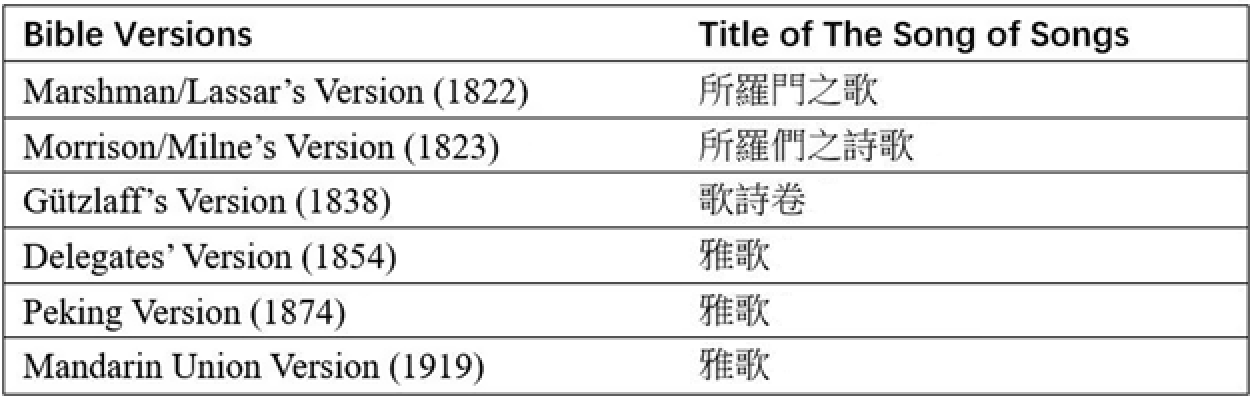
The title ‘Yage 雅歌’, literally translated as ‘refined song’, may also suggest a connection to the poetic lineage of the Shijing. The Hebrew superscription ‘šîr haššîrîm’ (song of songs), which comprises the same noun in singular and plural forms—a typical expression of the superlative in HebrewFootnote 56—literally denotes ‘the very best song’, suggesting a song without equal or a song that stands above all others.Footnote 57 It does not explicitly convey the notions of refinement and elegance inherent in the Chinese character ‘Ya 雅’ (refinement). Therefore, the Chinese title may convey a different meaning. Some commentators propose that the Chinese title ‘Yage 雅歌’ may derive from the Shijing, which consists of three sections: Feng 風 (Airs of the States), Ya 雅 (Odes of the Kingdom), and Song 頌 (Temple Hymns). The Chinese Study Bible, Shengjing Qidao Ben 聖經啟導本, acknowledges that, while this idea is speculative—as the early Bible translators did not provide supporting materials—it remains a compelling connection.Footnote 58 To support this guess, it should be noted that the title ‘Yage 雅歌’ originated from the Delegates’ Version and later became widely accepted. Table 1 lists translations of the book title ‘Song of Songs’ in different Chinese Bible versions. Besides, the Delegates’ Version’s 雅歌 Yage organises most of its verses into four-character lines, reflecting a poetic style that is reminiscent of the Shijing. More importantly, the titles ‘Ya 雅’ (Odes of the Kingdom) and ‘šîr haššîrîm’ (song of songs) share an overlapping meaning that suggests a superior status of the poem. In the Shijing, the ‘Ya 雅’ section is further organised into Xiaoya 小雅 (Minor Odes) and ‘Daya 大雅’ (Major Odes). Xiaoya 小雅 focuses on the lives of the Zhou Dynasty nobility, while Daya 大雅 offers praises for rulers and their governance. These odes served as ceremonial pieces performed during Zhou rituals to evoke the grandeur of the dynasty’s founding era. The term ‘er ya 二雅’ (two odes) signifies the music or songs of the Zhou royal court, often referred to as ‘Zhoushi 周詩’ (Poems of the Zhou) in the pre-Qin classical texts. Therefore, these songs in the capital city of the Zhou Dynasty embodied the highest standards of propriety and correctness. The ‘Daxu 大序’ (Great Preface) to the Shijing supports this interpretation by stating that ‘Ya 雅’ means ‘the standard’.Footnote 59 In contrast, the term ‘風 feng’ was applied to songs from other states to denote their regional variations and deviations from the standard musicality of the Zhou area.Footnote 60 This distinction underscores the elevated status of the Ya 雅 odes as exemplars of musicality. Meanwhile, the superlative designation in ‘šîr haššîrîm’ (song of songs) presents the poem as the best or perhaps most beautiful, or, according to Fox, as referring to the most musical or harmonious of songs.Footnote 61 As both 雅 (ya) and ‘šîr haššîrîm’ (song of songs) convey an elevated status of the work, coupled with the careful incorporation of verses from the Shijing discussed in this section, it is reasonable to suggest that the title ‘Yage 雅歌’ is connected to the Shijing.
Chinese translations of the title Song of Songs in different Bible versions. Source: Compiled by the author.

In summary, the artful integration of verses from the Shijing into the Yage creates a profound resonance with the Chinese poetic tradition, fostering a meaningful dialogue between these two canonical works. It enriches the Yage with the cultural weight of one of China’s most esteemed classics, inviting a more profound and nuanced engagement with the text among Chinese readers. The intertextual connection highlights the translators’ intention to elevate the Yage to a status comparable to that of the Shijing, encouraging a deeper exploration of the Yage’s spiritual dimensions.
Conclusions
The classic beauty and style of the Delegates’ Version were greatly admired by both missionaries and Chinese scholars, who acclaimed ‘its supreme excellence as a literary work, its outstanding scholarship, and its successful adaptation to the native culture’.Footnote 62 The examination of the Yage in this article reveals the translators’ sophisticated and deliberate effort to create a Chinese version of the Song of Songs that would resonate deeply with Chinese cultural and literary sensibilities. The reimagining of the protagonists, the adaptation of imagery, and the integration of Chinese literary motifs in the Yage demonstrate a meticulous endeavour to harmonise the biblical verses with the aesthetic and moral values of the Chinese audience. Particularly, by engaging in an intertextual dialogue with the Shijing, the Yage is imbued with layers of meaning that not only enhance its poetic beauty, but also provide a familiar framework through which Chinese readers can interpret and appreciate the Song of Songs.
This article highlights the interplay of culture in the translation of the Song of Songs, showcasing the translators’ efforts to harmonise the biblical love song with the rich tapestry of Chinese literary traditions. Through an in-depth analysis of the Yage, it affirms Schereschewsky’s insights into the creation of the Wen-li versions of the Chinese Bible. As he observed, this style, meticulously crafted by missionaries, ‘strives after classicality and uses ready-made phrases and expressions culled from poetical and rhetorical compositions’.Footnote 63 The profound influence of Chinese classics is evident in the stylistic and lexical choices of the Yage, which extend beyond its immediate readership and leave an enduring imprint on the very fabric of biblical concepts. This is exemplified by acculturated expressions in the Yage, such as ‘liangren 良人 (the good man) and ‘xinfu 新婦’ (the bride), and the title ‘Yage 雅歌’, which were adopted by the Peking Version and later went into the Mandarin Chinese Union Version—a Chinese Bible of enduring popularity and significance. These terms have been re-inscribed and recontextualised within the Chinese Christian community, becoming integral to the conceptual framework of biblical understanding. As Yeo notes, the cycles of translation over time have woven strands of Chinese culture into subsequent enriched translations.Footnote 64 This dynamic interplay between the biblical text and Chinese literary traditions underscores a profound truth: the Bible not only shapes the spiritual life of the faith community, but is itself shaped by the cultural and linguistic context in which it is translated.
Acknowledgements
This article was supported by the Zhejiang Provincial Philosophy and Social Sciences Planning Project (24SSHZ120YB) and the Key Research Project of Zhejiang University of Finance and Economics Dongfang College (2024dfyzd007).
Conflicts of interest
None.