INTRODUCTION
While the objects and ‘spheres’ of knowledge have become astoundingly diverse, they still look to be finite, and it would be an act of sheer intellectual impertinence, irresponsibility or flippancy to treat them as separate spoors floating around in some semi-vacuum, or disjecta membra bearing no genuine connection to each other. However formalistic, even arbitrary they can be, and in constant need of revision if not occasional reconceptualization, attempts to classify the sciences at the very least acknowledge the societal nature of learning, that explorers of the universe are all in it together, in something more than a series of isolated exercises to benefit small coteries of like-minded experts, and that scholarly findings may well need sharing across preconceived ‘boundaries’, with lessened arrogation of some occupations over others. In what follows then, those minds are taken seriously that have sought to put overall meaning or interrelatedness into the world of multiple disciplines, whether through evoking some sense of ultimate purpose, defending a defining principle, or framing a collaborative scheme of things to solve major human problems. A history of the ideas of classifying knowledge reveals that the very complementariness of disciplines has been typically cherished, significant points of overlap admitted and the usefulness of interdisciplinary work acknowledged, whether to broaden scholars’ visions or provide necessary collaboration to avert disasters. If securing the environmental future urgently demands interaction between research fields, an historical assessment of attempts to catalogue and synthesize the corpus of human knowledge will be crucial, to reveal what has been done, for what reasons, and whether with any implications for crossdisciplinary work on the environment.
FAMOUS 19TH CENTURY CLASSIFICATIONS OF SCIENCE
Between 1854 and 1869, during which time he was conceiving the grand notion of a Synthetic Philosophy, the English evolutionary philosopher Herbert Spencer (1820–1903) published two watershed articles about classifying the sciences. To my knowledge, the first of these pieces was the only essay on the subject ever to be circulated for popular reading (Spencer Reference Spencer1891, pp. 1–117). Alas, the subject now seems dry-as-dust, too complex for public consumption, and the nomenclatures for important areas of specialized research are multiplying so fast that even scholars shy clear today of listing and relating the extraordinary range of disciplines and sub-disciplines. If Spencer (Reference Spencer1891) specifically highlighted that ‘the classification of the sciences’ already required two fold-out diagrams, how large the format or tiny the print would now be necessary to convey the panorama of learned disciplines and their possible linkages (see for example Hicks et al. Reference Hicks, Fitzsimmons and Polunin2010).
When his Synthetic Philosophy was mature in his mind, the governing rubric for Spencer (Reference Spencer1890–1904, Volume 1) was evolution. This was what endowed all scientific endeavour with a unifying principle and determined the logic of the division of subject-matter into the ‘inorganic’, ‘organic’ and ‘super-organic’ (expressions of evolution), which followed each other in cosmic time, with each great component beginning from simple unities (atoms, amoebae and families) and developing toward an ever greater heterogeneity. Thus sidereal and planetary astronomy, meteorology, mineralogy, geology and what Spencer calls a ‘pure chemistry’ are rated inorganic and covered by the science of ‘general mechanics’, the phrase used of physics broadly conceived by the theorist Whewell (Reference Whewell1847, p. 117). Biology, physiology and psychology, and by implication most branches of medicine, belonged to the organic domain, biology being taken as primary here and the best term for overall relevant coverage. Sociology is Spencer's innovative choice for social science in general (which has appended to it his naturalistic ethics). The whole massive project (Spencer Reference Spencer1890–1904) was prefaced by his First Principles (Spencer Reference Spencer1890–1904, Volume 1), where he philosophized about the unity of all phenomena as increasingly susceptible to logico-mathematical generalization and reflective of cosmic evolution, while engaging in aesthetics and a surrogate theology, wondering at the awesome beauty of the universe and pondering the unknowable ‘Force’ behind it all (Trompf Reference Trompf2005a, pp. 6–12).
Spencer's classificatory procedures (Spencer Reference Spencer1891, pp. 9–18) were in response to prior schematizations by the French theorist of positivism Comte (1798–1857), the Bavarian natural historian Oken (1779–1851), and the Prussian idealist philosopher of ‘development’ (Entwicklung) Hegel (1770–1831). Spencer abandoned Comte's paradigm of three branches of ‘Physics’, namely inorganique (astronomy, earth science and chemistry), organique (biology, physiology and psychology) and sociale (‘social physics’) (Comte Reference Comte1830–1842), because as a Darwinist he took biological ‘mechanisms’ to be intrinsically different from physical ones. He did not like Comte's temporal serialization of the sciences, as if they should be ordered according to their historical appearances and thus taught to the modern individual in ‘general conformity’ to the stages of knowledge (theological, metaphysical and scientifico-positivist) undergone by the ‘whole human race’ (Comte Reference Comte1830–1842; Trompf Reference Trompf1969). Spencer realized a prevenient or a priori frame of reference can introduce arbitrariness into the classificatory method, and worries that even the image of a ‘trunk’ of knowledge, though conceptually attractive and incorporative, might interfere with the task (Spencer Reference Spencer1891, p. 28). As for the unfinished and already unpopular attempts of Ampère (Reference Ampère1834–1843) simply to take any major science (such as physics) and then to keep subdividing twins of special branches of it in series, Spencer would have found them forced, poorly correlated and overtaxing comprehension.
Toward the Germans, Spencer brandished his English empiricism, putting patient observation and Baconian induction before guiding principles. Thus, he avoided Hegel's essentially Germanic philosophical point (blatant in Kant, Fichte and Schelling as well) that a great gulf exists between the necessity of Natur (nature) and the Freiheit (freedom) of humanness (Hegel Reference Hegel1905 [1830]). Hegel decisively split the study of the life of the mind, both as Geistesphilosophie (philosophy of spirit/mind, involving general philosophy, religion and art; shared morality or Sittlichkeit, ethics and law; or psychology, phenomenology of mind/spirit and anthropology) and as Logik (the study of ideas, concepts, subject/object, quantity or ‘realness’), from ‘natural philosophy’ (of organic life, physics and mechanics) (Cohen & Wartofsky Reference Cohen and Wartofsky1984). For the German idealist, nature could not escape inexorability and repeatability: what had always to take priority was the historical placement of the mind in any science or ‘branch of knowledge’ (Wissenschaft), because the doing of science and the way nature was viewed would reflect the time-context and consciousness-state of the scientist. This made for an interesting difference from Spencer, because there was little interiority or introspection about Spencer's classification: everything was ‘out there’ and the external operations of nature determined everything. Both Hegel and Spencer were philosophers of cosmic ‘development’, but whereas the German conceived the process as one by which the ‘Divine’ realized itself in the world, more especially in humanity's discovery of true freedom and self-(= God-)consciousness vis-à-vis captive nature, Spencer replaced God by external nature (or the ‘Force’ behind it) so that ‘the natural’ became the arbiter as to how the world should be viewed and even how mankind ought to behave. Perhaps the least self-reflective of the great philosophers, the logical end of Spencer's vision of the sciences was that ‘what is natural’ (the evolution of things) is ‘what is right’, even as ethical guide. Science, in comprehending evolution, attained its own ‘apotheosis’, while for Hegel the sciences were always geistig activities, and the material never allowed to dominate truly human frames of reference. The human mind/spirit was free to work out solutions dialectically (dialektisch) and was constantly searching for a synthesis between opposing views.
Thus Spencer could never understand why Hegel put the mystical theosophist ‘Boehme on a par with [Francis] Bacon’ (Spencer Reference Spencer1891, p. 12), little knowing that of these two early 17th century thinkers, it was Boehme's evocative vision of creation unfolding in stages from the divine matrix that laid the foundations of process thought and led to the first enunciation of a general principle of evolution in biology. The Swiss naturalist Bonnet (Reference Bonnet1764) envisioned a great chain of ascending being from malleable- through semi-metals to crystalline salts, to plants, insects, shellfish, reptiles [sic], fish, birds, quadrupeds and on to humanity (Anderson Reference Anderson1982; Crombie Reference Crombie1994, Volume 3, pp. 1706–07). Oken, the third great classifier of sciences in Spencer's sights and a distinctly Romantic thinker, adopted an approach that was again very Boehmian, positing a system of ‘correspondences’ in nature (expressed in terms of the abstract skeletal outline of things) that allowed all ontology (or known existences), especially ‘the earth element’ (close to the current ‘earth sciences’) and ‘the organic’ (basically Biologie), to be expressed mathematically (and thus unified by ‘mathesis’, a reflection of divine order). Oken was continually searching for governing patterns. While famously refining animal classification (into invertebrates, fish, reptiles, birds and mammals) to correct Bonnet, Oken interpreted living structures ‘homologically’, contending that trunks were ‘repeated’ by the head, just as the study of human behaviour (Psychologie) also showed the head to perfect and then govern the body. Correspondingly, the study of ‘Kosmogenie’ disclosed the mind of God ruling over the whole of being (Oken Reference Oken1833–1842). This style of thinking affected Goethe, with his model that the heavens, geologic formations, life forms and human history all conform to a spiral development, according to the golden section or Fibonacci series (for example shells and leaves) (Richards Reference Richards2002; see also Rupke Reference Rupke2009 on Richard Owen).
The 19th century classifiers wanted to encompass the whole universe as a field of study, a vision already signified by the term universitas (and thus university). They all share the ‘general classificatory’ view that the intelligible universe falls into three great arenas: ‘the non-living’, ‘living things’, and ‘the social’, but with the accompanying recognition that investigative activity (mind, logic and principles) belongs to a special realm for consideration on its own. The basic triadic framework was hardly new. It looked positively Newtonian, considering Isaac Newton's later gumption to sum up what underlay the material world as ‘gravity’, the biological order as ‘instinct’ and the rational realm as ‘perfectly free’ (Stukeley Reference Stukeley and White1836, p. 71). Under this earlier Enlightenment purview, however, the study of inert and living nature belongs under ‘natural philosophy’, while philosophia embraced reflection upon free human mental achievements, including history, beliefs, morals and social forms (Trompf Reference Trompf and Gaukroger1991). Newton's summation was closer to Hegel and the Germans than Spencer in distinguishing between natural laws and free will. Together, they also retain powerful organizing conceptions that had a theological base; the world was to be studied as a divine order, even though there were emerging secular aspects (Wagar Reference Wagar1982). In this light, Spencer (with Comte stirring him) appears to be a watershed figure, reducing the whole scientific arena to broadly conceived nature. This move, even if a tendency in thought that could not determine what happened to the history of scholarly investigations, sat as an index to what would happen as scholarly disciplines emerged in their respective places in the contemporary world. But the tendency, like an external collision, had to make an impression on a large edifice of knowledge already built; this paper reviews how disciplines and branches of knowledge came to be prior fixtures and aims to gauge how resilient they would be against the ‘ultra-naturalistic impact’.
EARLIER CLASSIFICATION
From antiquity to medieval times
The story of classifying knowledge should be taken at least as far as the famous statement of the ideal educational curriculum in Plato's Republic, to a quaternary of related studies deriving from the Pythagoreans. In the Socratico-Platonic defence of them (385–347 BCE), these key four subjects were: (1) arithmetic, which as ‘calculation’ might be used for business trickery, but must be ‘prescribed by law’ for a city-state's leaders, for use in war and the elevating ‘contemplation of pure thought’ as number, because society's ‘guardian is soldier and philosopher as one’; (2) geometry, not only for spacing things practically (as in military strategy) but for the ‘knowledge of the eternally existence’, as implied in ‘diagrams’ (mathêseis) used by brilliant craftsmen, such as Daedalus; (3) astronomy, not just for seasonal agriculture, navigation and military manoeuvres, but ‘to compel the soul to look upwards’ and ‘use the blazonry of the heavens as patterns (paradeigmata) for studying Reality’ (the planets being for Plato ‘moving images of Eternity’); and (4) music or harmony, not just for our hearing's sake, because musicians can ‘vex and torture their strings’, but for the same pursuit of concordance (sumphônia) found in numbers, geometric figures and the celestial spheres (Republic Book 7, sections 525b–531c) (see Plato Reference Plato2011 for all dialogues in translation).
All these fields were related together (in the first known act of interdisciplinarity) by a clarifying argumentative process called dialectic that passed through hypotheses to reach the highest principles (or cosmic intelligibilities seen with the ‘eye of the soul’) (Republic Book 7 532a–534a), setting a priority of things to last for centuries, that the final object of all learning was the contemplation of what came to be called ‘eternal verities’, a priority still being honoured through Hegel's Dialektik.
What Plato first established in his Academy was modified and supplemented in the course of educational history. By Hellenistic times, when Greek learning reached beyond traditional Greek-speaking borders, particularly in Asia Minor (later Turkey), the new priority was writing and speaking Greek effectively, hence dialectics (as logic) was supplemented by grammar and rhetoric (and poetics) (Jaeger Reference Jaeger1986, Volume 3, pp. 144–155), the last thought to merit a whole treatise by Plato's pupil Aristotle. These alterations were to lay the basis for medieval curricula of higher learning. Maintained in the Byzantine tradition (see Katsiampoura Reference Katsiampoura2010) and often in different formats in Islam (Makdisi Reference Makdisi1989), the ‘seven liberal arts’ (namely arithmetic, geometry, astronomy, music, logic, grammar and rhetoric) were eventually mediated into Western university arrangements and became the core subjects for Arts faculties. The Trivium of logic, grammar and rhetoric would lay the basis for deeper learning of the Quadrivium of arithmetic, geometry, astronomy (or astrology) and music in Arts degree structures (as still reflected in the Oxonian distinction between ‘Mods’ and ‘Greats’ to this day), before students proceeded to higher studia generalia in philosophy or astrology or to more decidedly ‘professional’ courses in medicine, law and theology. How the sciences were to be classified in these medieval times did not now only depend on Plato's basic framework, or all developments of it, from Isocrates, Capella, Boethius, Alcuin and others in the background story of the Arts module (Trompf Reference Trompf1973, pp. 12–20). For, although the West was long without access to most of Aristotle's works, crucial translations filtered out from the more scientifically advanced Islamic world during the twelfth and 13th centuries (Rashdall Reference Rashdall, Powicke and Emden1987 [1936], Volume 1, pp. 4–12), and the individual subjects of these writings carried within them the momentum for a more complex classification of scientiae (knowing skills).
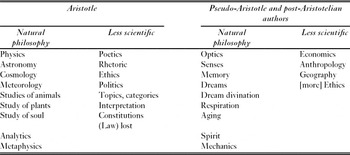
Aristotle (384–322 BCE) produced many treatises that both complemented and added to subject-fields considered by his teacher Plato. At the opening of his Meteorologica (Book I, sections 338a–339a) he explains how he intended to categorize his materials. His Physics was to cover the first causes of nature (phusis), and then all natural motion (kinêsis); his work On the Heavens considered the ordered movement of the heavenly bodies (or astronomy), and then the origins, changes and dissipation of the basic constituents of the cosmos. This last subject was given even wider scope in his book on Generation and Corruption’, while meteorology was then treated as a special subdivisional study of all the above cosmic changes (metabolai), because, on the borders between the heavens and earth, the changes involved were irregular (such as weather, earthquakes and meteorites), even if still ‘natural’ (phusikos) and ‘recurrent’ (enkuklios). What was meant to follow were his ‘zoological’ books, inter alia on plants (lost), animal parts, and the generation of animals, even De Anima, which did not limit ‘soul’ (psychê) to humans (see Aristotle Reference Aristotle2011 for all his works in translation). With the incipience of biological and psychological studies found here, all these subjects can described as ‘a philosophy of nature’ or indeed as ‘natural philosophy’ (Ross Reference Ross1995[1923], pp. 65–66), since Plato had already offhandedly described such subjects this way (in his dialogue Phaedo 95d–97e). Aristotle's followers subsequently treated all the above works, including those on logic and argument (thus his Analytics and Metaphysics [or theology]) as more scientific (for dealing with regularities), while the other works on poetry, oratory, ethics and politics, major elements in traditional Greek and Roman education, were not so, because uncertainties abounded (Tanner Reference Tanner2002, p. 81). This arrangement foreshadowed the distinction between the natural sciences and human studies. For some schools, perhaps, such a dichotomy threatened the unity of knowledge; hence attempts to lock even ethics into cosmic eternal recurrence (the Stoics) or into an atomistic patterning (the Epicureans), so, as the Latin Lucretius had it, humans and their beliefs would be situated within the whole rerum natura (nature of things) (Trompf Reference Trompf1979–2011). Yet, in spite of their relative unpopularity, the (Peripatetic) Aristotelians went ahead developing their system (Table 1).
Late antique Aristotelian classification of knowledge: basic outline (see Aristotle 2011 for all his works in translation). Works on subject areas ascribed to Aristotle are certain except for Topics, Categories and Interpretation. Other subjects expatiated in his name are found in the (Anonymous) Problemata (on Optics), Parva Naturalia (from Senses to Aging), and the books De Spiritu (spirit), Oeconomica (economics) and De causis (on ‘pure good’). Later Aristotelians addressed the optics of colours (Theophrastus), mechanics (Straton), anthropology (Dicaearchus), and geography (Strabo, Ptolemy). Aristotle circumvented medicine (his father being a doctor), yet see its coverage in Plato, Timaeus 69a-92c (Plato 2011 for all Dialogues) and reflections of it in Parva Naturalis.

However, when Aristoteliana was injected into Muslim and Christian curricula of higher learning during the Middle Ages, the ancient arrangements were not taken up so simply. For a start, Aristotle's opus seeped unevenly into educational centres, via Sunni and Sabaean-Hermetic copying schools in Baghdad and Harran, respectively, after the decline of Alexandria (O'Leary Reference O'Leary2001; Sorabji Reference Sorabji2005). It came to sit among pre-existing didactics, and in centres upholding monotheism it was always going to be pressed into the service of theology. If any trivium-like core existed for Islamic learning, moreover, language, law and ethics would best summarize it (Lowry et al. Reference Lowry, Stewart and Toorawa2004, p. 166–72), while the distinctly ‘scientific’ specializations (with the well-known Islamic originations of algebra, chemistry and mineralogy, and achievements in mathematics, astronomy, mechanics and even medicine) needed defending as pursuits relevant to the major concerns of the Muslim faith community. Thus there was bound to be a debate, for example, about whether psychology should be considered ‘part of the natural sciences’, following Aristotle, with Al-Fârâbi and Avicenna concurring, or as ‘intermediate between the material and the spiritual world’, as Al-Kindi argued, using Plato as a foil (Walzer Reference Walzer1962, p. 201; compare Bakar Reference Bakar1998). Much of Muslim chemistry depended on a system of pre-ordained correspondences (between names, numbers and substances) and was thus ‘alchemy’ as now understood, and much astronomy was astrological reading (for political affairs), both tendencies massively affecting the medieval West.
When considering one contextually interesting Western medieval classification, framed at the transit between a great monastic school and the emergence of universities by Hugh of St Victor at Paris (c. 1138), the Aristotelian categorizations clearly did not make the perfect fit, and the Platonic Trivium had to be accommodated. Arrestingly, Hugh rated Philosophia as the ‘art of all the arts, . . . the discipline of all disciplines’ for investigating ‘into the probable causes of all things human and divine’ (Didascalion Book 2, chapter 1, in Wieruszowski Reference Wieruszowski1966, pp. 127–28), in a passage quintessentially foreshadowing all PhDs to come. Philosophy carried four divisions of study: theory, practice, mechanics and logic, and from these all other scientiae derive. Theory includes theologia (which, concerned with ‘invisible causes’, is actually the alternative Aristotelian term for metaphysics) plus physics (or astronomy) and mathematics. Mathematics is subdivided into arithmetic, music and geometry; the classes of Plato and Aristotle seem made to complement each other, and they form the least mundane disciplines, pointing to higher wisdom and certitude, when compared to the other ‘sciences’. In Aristotelian vein, the ‘practical’ division concerns ethics, economy and politics, which are for the sake of solitary, private and public virtue; while the ‘mechanical’ bears a more distinctive air, falling into the areas of weaving, arms, navigation, agriculture, hunting, medicine and theatre. The ‘logical ‘returns to the basic medieval system of education, dividing into grammar and reasoning (ratio), with the latter possessing the threefold goal of demonstration, probability and persuasion (Didascalion Book 2, Chapter 1; Book 3 Chapter 1, in Wieruszowski Reference Wieruszowski1966, pp. 127–128). This arrangement significantly marks something of a half-way house between monastic schools and the high-medieval ‘scholastic’ tradition (Hunt Reference Hunt and Martin Miscellanea1948, p. 99). The disciplinae were disengaged and thus mentally freed from the life of devotion (as philosophy), yet they remain held together in an implicit act of interdisciplinarity for all being ways of serving and worshipping the divine (that have their sublime apex in monastic contemplatio). Moreover, not only the traditionally ‘worthy’ (or ‘liberal’) arts were allowed in the scientific arena, but also those that were considered ‘vulgar’ or ‘servile’ (by Cicero, for example (De Oratore Book I, chapter xivi, section 72, see Cicero Reference Cicero2011 for his dialogues in translation).
This earlier flexibility toward the great variety of practical skills was also a hallmark of Chinese learning, its modes involving those such as soil science, hydraulic engineering, herbology and pharmacy, chemical technology, ceramics and library classification (Needham Reference Needham1954–2008); the same openness also contributed to management and expansion of Muslim trading societies. In the West, however, a mark of the universities’ triumphal march into the 13th century and beyond was that the practical arts (or artes mechanicae), the ‘technologies’ for which the medievals have acquired much admiration over the last two centuries (Thorndike Reference Thorndike1934–1954), were increasingly squeezed out as inappropriate to scholarly life, when they had once been grist to the mill of monastic existence. Thus part of the problem of university ‘scholasticism’, as it has often been dubbed, was that it became increasingly theoretical and technically philosophical. In the processes of secularizing that began in the 14th century, mechanics and techniques became increasingly non-university pursuits, cultivated by guilds and special fraternities (and some of them acquired association with secrecy, unorthodox views, magic and, in the case of pharmacopoeia or non-theoretical ‘non-Galenic’ medicine, witchcraft; Noble Reference Noble1997). Additionally, the unity of knowledge that was supposed to be capped by post graduate studies (such as medicine, law or theology) was not immune to fragmentation. Each of these higher faculties could lay claim to be ‘queen of the sciences’ (see for example Robert d'Anjou in Jansen et al. Reference Jansen, Drell and Andrews2009, p. 500, on law), especially theology, a University of Paris demarcation ruling in the Arts faculty even preventing philosophers from discussing God (see Evans Reference Evans1980). What remained though, and is inherited from the original universities to this day, was the common philosophic procedures of distinguishing ‘rule and exception, . . . accident and design’, and assigning ‘phenomena to a general law, qualities to a subject, acts to a principle, and effects to a cause’, as Newman was to epitomize it in the last great traditionalist defence of the scope and nature of university education (Newman Reference Newman1859 [1852], p. 66). How interesting it is that, with this great heritage behind him, and still theologically oriented, Newman seems to have stolen the march on Spencer in giving perhaps the best general definition of scientia.
Medieval philosophers and theologians alike, moreover, could always set up models in which all components of creation were seen as parts of a whole, in a typically hierarchical ranking (often irrespective of the disciplines normally treating them). Thus there appear versions of trees of ‘life’ and ‘omniscience’ (a preferable translation of ‘the knowledge of good and evil’), images going back beyond the Graeco-Roman classics to the biblical Genesis (2: 9, 17), if not further (von Rad Reference Von Rad1963, pp. 79–80). Although inspired by the quest for correspondences pregnant with symbolic import, some of these trunk-and-branch pictures set the tone for the general organization of study materials for centuries ahead. Majorcan Lull's Arbor Scientiae (Science Tree) of 1295, for example, was rooted in substantia (being), proceeding to body (both inanimate and animate), to the living, to animals, and then humanity (Walker Reference Walker1996), presenting the same sequence (earth/life/biological/human sciences) taken by Spencer (force, inorganic, organic, biological, and the psychological, sociological and ethical fields pertaining to humans), with the modern Englishman realizing how hard it was to get the trunk prototype out of his system (Spencer Reference Spencer1891, p. 71). For medievals such a tree was meant to complement the accepted the structure of the universe that placed God above, then celestial and angelic beings, with humanity in the central stratum (‘a little lower than the angels’, Psalms 8:5; Hebrews 2:7), and animals, insects, plants, rocks, and cavernous monsters and demons below (see for example Linzey Reference Linzey2007). Anthropocentric though this looks, and stressing divine transcendence over the immanence of nature, such efforts at mathesis or the scaffolding of knowledge were nonetheless the first systematic and corporate (i.e. ‘university’) expressions of the interrelationship between the intensifying works of humanity, nature doing what is intrinsic to itself (Natura naturans) and the divine embrace of a unified creation (a combination already supposed to be realized practically in monastic utopias). Ecology was in embryo (Glacken Reference Glacken1979, pp. 176–351). Besides, a mature medieval distinction between higher studies in philosophia and scientia naturalis and the (pre-)professional subjects law, medicine and theology (see for example Lull Reference Lull and Peers1986 [1283], p. 215) would stand most university research arrangements in reasonable stead for ages, even beyond the time when young Immanuel Kant, later protagonist for the Enlightenment, chose to avoid professional subjects and ‘immersed himself . . . in natural science and philosophy’ at Königsburg (Sedgwick Reference Sedgwick2008, p. 2).
From the Renaissance to the Enlightenment
Now, granting again the over-theorizing tendency of later medieval higher learning, there were to be two great reactions to Scholasticism that saw readjustments to the classification of knowledge. The first arose at the hands of the Renaissance humanists, with the revival of the studia humanores (human studies) to match the preponderance of divinity; the recovery of original ancient texts to refine grammar and rhetoric rather than labouring theological dialectics; critical classical and biblical Studies, with a mastery of Greek and Hebrew, not just Latin; the development of historical study (which had been weak in the medieval West beside the projects of such Islamic giants as Al-Tabari or Ibn Khaldûn); and a favouring of Platonic philosophy for its dashes of Orphic and Pythagorean mysticism, poesis, ‘sensibility’ and visual sensuousness to counter dry-as-dust, logic-chopping Aristotle (Weiss Reference Weiss and Jacob1960). Not only was polymathy admired, the vastly inventive agenda of Leonardo being testament to the new ideal of cross-technical activity, but there were new concessions around the borders. Particularly through access to the Corpus Hermeticum (Hellenistic texts wrongly attributed great antiquity) and to mystical Jewish Cabbalistic sources, ideas circulated that there was a prisca theologia (an original ‘ancient theology’) or deep well of all wisdom (fons sapientiae) that was the source and binding factor in all knowledge. In the process ‘natural magic’, alchemy, astrology and systems of sympathetic relations, correspondences and analogies in nature (‘as above, so below’) were back in force. And it was more openly conceded that the philosophic wisdom of all nations, starting with Hermes in Egypt in Moses’ time, was developing providentially and independently while the Biblical history unfolded (see Walker Reference Walker1972; Merkel & Debus Reference Merkel and Debus1988).
The second great reaction against Scholasticism came with refined observation and experimentalism, especially from the 17th century onward. Classifications of knowledge in the first stage of this reaction, when religious and scientific ferment were at high pitches together and the Reformation struggles ran conterminously with the Later Renaissance (from Copernicus to Newton; Bacon to Boyle; Vesalius to Harvey; Bodin to Vico; Boehme to Kircher), had results that are a good index to transitional times. The paradigm of natural philosophy came into its own; Bacon (1561–1626), in a somewhat disorganized classification of ‘learning’ that refined the late-medieval university range of subjects, gave ‘natural’ precedence over ‘human philosophy’ because the latter was really ‘but a portion’ of the former (Bacon Reference Bacon and Robertson1905 [1605], pp. 79–101). The disciplines for the study of Nature now also had the potential for a greater variety of fields than for human affairs, especially if inventions in measurement, navigation, mining and military devices were considered, and subsequent reassessments of the corpus of knowledge exemplified the shift.
Consider John Webster (1610–1682), an Anglican steadily leaning to radical Puritan ideals, who, along with Milton and others, called for university educational reform during Oliver Cromwell's Interregnum. Webster (Reference Webster1654) stressed the new importance of mathematics and astronomy (including optics), but deplored the lack of teaching in practical applications (as in architecture, and barometric ‘pneumatics’). He recognized the importance of ‘chymistry’, yet had no hesitation about students soiling their hands by relating it to agriculture and mechanics. Biological studies attracted him (such as Lawson's ornithology and ichthyology, and particularly the better cultivation of food plants), as of course did medicine (‘physic’). Thus some kind of return to pre-scholastic technological interests was in evidence, and significantly at the time when patents for novel instruments and technics pertaining to different fields now required listing (McLeod Reference McLeod2002, pp. 10–19). Webster refined the humane disciplines in a more recognizably modern way: languages; philosophy, logic and ethics; literature; history; music; and religious knowledge (Greaves Reference Greaves1969, pp. 63–125). Yet, when addressing certain ‘natural’ subjects such as cosmography (which for him included subjects such as geography and hydrography, but not yet geology), Webster was unable to imagine teaching these subjects without attention to the ‘mutual correspondence’ between the earth and heavens, and thus to these disciplines’ ‘homological application’ (as Bacon had advised), and he included in his curriculum ‘noble’ astrology, alchemy and the ‘almost divine science of natural magick’ (Webster Reference Webster1654, pp. 50–51, 68–70).
These last-mentioned ingredients were characteristic of later Renaissance thought, and during the generations of Webster, Milton, Boyle and Newton, they also signalled a transitional paradigm about the unity of knowledge as grounded in divine wisdom. Present in revolutionary England were Eastern Europeans Hartlib and Comenius (the latter later crucial for Dutch educational reform), who encapsulated all knowledge as pan-Sophic, or in Boehme's terms theosophic. Accompanying Hermeticism was a revival of Stoicism in European thought, so that the universe was replete with divine interdependent energies held together by what the polymathic Jesuit Kircher (1602–1680) called Centrosophia. Atomism was ‘baptized’ for Christian scientists, as it were, Newton now convinced that it derived from Pythagoras, not atheists, and his friend and Cabbalist More was earliest to imagine the ‘internet’ as a band of spiritual forces around Earth, potential with good and evil (Trompf Reference Trompf2005b, Reference Trompf and Fletcher2011). The beginnings of modern process thinking were afoot, as if the criss-crossing of influences., divine, celestial and terrestrial, could be expressed as ordained general laws, and as a second Bible. But there were immediate and adverse reactions to this kind of agenda. On the one hand, Protestant purists were alarmed at the residue of magical (for them tainted Catholic) thinking threatening ‘true religion’, and before long the German Pietists were excising magic, astrology and alchemy from the range of ‘legimate’ theological and philosophical disciplines (Lehmann-Brauns Reference Lehmann-Brauns2004). On the other hand, there was a rationalist response, championed by Hobbes (1588–1679), a royalist bent on social control, whose classification of the ‘several subjects of knowledge’ (Hobbes Reference Hobbes and Oakeshott1966 [1651], pp. 69–71) was built on the assumption that ‘Philosophy is . . . knowledge acquired by reasoning’ alone. His philosophical tree split straightaway into natural and political philosophy, the former showing no suspect subjects except astrology, and even within the latter there was no theology, only ‘the science of just and unjust’.
Quests for natural laws were rampant, but considering the human being was both within and set apart from nature, it was unthinkable that the unifying principle of knowledge was going to be nature itself. The unity issue, as before, would revolve around the conception of God. Hartlib, on the one side, named the ‘the great intelligencer of Europe’, advocate of patents, anticipator of the Royal Society, friend of both philosophers and farmers, and bent on recording all knowledge to provide for a universal education, clearly conceived of God as immanent through all things (Greenleaf et al. Reference Greenleaf, Leslie and Raylor1994). When the Royal Society did form (1660), however, a compromise between potentially clashing outlooks had to be reached and the members were to ‘meddle no otherwise with Divine things, than onely as the Power, and Wisdom, and Goodness of the Creator, is display'd in the admirable order and workmanship of the Creatures’ (Sprat Reference Sprat1667, p. 82). The view favoured ‘high’ natural philosophy rather than grassroots practitioners or even social theorists, and appeared to place God transcendentally above and beyond the explorable universe; it nonetheless grounded the scientific enterprise in values belonging outside the arena of purely scientific pursuits. This was one of the fundamental moves that would help invent ‘science’ (natural knowledge) as it is popularly now known, free it for more distinctly rationalistic and naturalistic investigation, yet curb its claims by a pre-existing consensus of what was right.
The Hermetic or pan-Sophic trajectory did not then die off quickly. Certainly the combination of polymathy and a unitary vision of study was now going to be harder. Someone like the irrepressible Kircher, the ‘incredible German’ Jesuit who probed so many areas of study, seemed too fantastic and Baroque a character by the 1740s, even though inter alia he was founder-figure of geology (certainly vulcanology), epidemiology, museumology, musicology and moving pictures (Trompf Reference Trompf and Fletcher2011). Yet unsurprisingly notions of a ‘living unity’ of things lasted longer in the bio- and physiological fields. It is evident in the tripartite paradigm of animal, vegetable and mineral selected by the Swede Carolus Linnaeus (1707–1778), and in his taxonomy of plant morphology as the titular founder of botany, for he undeniably combined empiricism with Hermetic analogical modelling (Minelli et al. Reference Minelli, Bonato and Fusco2008, p. 127–33), as did the Swiss Abrecht von Haller in his pioneering pharmacology, and comparable approaches govern ‘the naturalists’, ‘natural history’ and ‘physico-theology’ in the 18th century (Brooke Reference Brooke1991, pp. 192–274).
It was in this volatile context that a virtually unnoticed academic development occurred. Far to the south, though in a culturally scintillating Baroque Naples, the obscure Italian scholar of jurisprudence, Vico (1668–1744) proffered what he called ‘the new science’ (la scienza nuova). It turned out not to be natural philosophy but a new approach to social knowledge, an innovative science of the natural principles of the nations, through which all the previous classical and medieval disciplines, and the Renaissance studia humanores could be re-examined. To summarize the hermeneutics of this most difficult of all European thinkers, Vico (Reference Vico and Rossi1959 [1744], pp. 741–72) showed how all language, poesis, belief, collective action, law and wisdom could be placed in their appropriate layers of consciousness, as peoples slowly passed from an intense primal apprehension of the divine on toward the ‘Human Age’, when thinking became more abstract, governing principles were arrived at and bodies of knowledge classified. By comprehending such processes, Vico believed he had also achieved ‘a rational civil theology’ and not only unlocked the past, but also disclosed ‘the history of ideas’ to be the real ‘queen of the sciences’, because by it all philosophies, theologies and intellectual endeavours, and all natural philosophies, could be located and interpreted in their appropriate contexts (Trompf Reference Trompf1994). Reacting against Descartes’ rationalistic method, Vico warned against the new scientific tendency to approach nature as if imagining God's mind (in a sense playing God), when all human investigation was strictly human and must always presume the social conditions of the time. Humans could only demonstrate human truth (Vico's verum factum).
A secularizing, modernizing die was cast within much 18th-century European thought, however, cutting off continuity with the past from medieval ‘superstitious’ sensibilities or supposedly ‘superior’ ancients. The German Lutheran classifier of philosophic ideas, Brucker (1696–1770), gave the cue, his work capped off by a multi-volume work (1766–1767) that delimited normative, rationally-defensible theological and philosophical ideas, and depreciated everything else left over as a questionable mish-mash (Brucker Reference Brucker1742–1767). Without granting Brucker due recognition, it was easy for the French encyclopaedists Didérot and d'Alembert (Reference Didérot and d'Alembert1751–1772) to incorporate his learning as they proceeded to prune off as much theological content from the corpus scientiae as their scepticism demanded. Bacon was paradoxically extolled in their enterprise, as having advised scholars into ‘the registering of doubts’ to save ‘philosophy from errors and falsehoods’, including an overdone search for correspondences (between the human being and the heavenly Zodiacal man in the heavens, for example), and for defending practical arts and crafts alongside academic theory (Bacon Reference Bacon and Robertson1905 [1605], pp. 99–103, 115–18). For the encyclopaedists, every endeavour of science and skill was only worthy of their concern when it was rational, conformed to natural law and benefited humanity by operating effectively. The driving principle of unity and interdisciplinarity was la raison, with the divine left marginalized in the theatre as a shadowy backcloth (Yeo Reference Yeo2001).
RETURN TO THE 19TH CENTURY
Methodological tensions, and the idea of social science
Spencer handled Comte, and the Frenchman had developed the Enlightenment encyclopaedist tradition to the point that the world history of ideas was journeying toward Positivism, to the very victory of science and the deserved worship of its creators, humanity. By contrast, Spencer's other choices for critique, Oken and Hegel, were part of an arresting reaction against Enlightenment rationalism, namely Romanticism. They revived theosophic lines of thought so as to accentuate organicist and ‘vitalistic’ over mechanistic paradigms, feeling and wonder as integral to reason, panentheism over deism, even new findings about Indian (Upanishadic and Buddhist) philosophies of cosmic interpenetration to protect synthesis from overanalysis (Holmes Reference Holmes2009). Two great paradigmatically different lines of thought, one trying to hold knowledge together by rational ordering and the other by dynamic process, were at loggerheads, and still are. Spencer apparently believed the covering principle of evolution could mediate between the two, or resolve the problem finally (Spencer Reference Spencer1890, pp. 48–67). This was at the very time the whole question of what to with the study of the human being and human affairs vis-à-vis burgeoning modern science was wide open for debate. On this critical matter, Spencer leant towards positivism: he was committed to a science of society.
Spencer was not alone in what he perceived as the ‘human end’ of the scientific spectrum. During the 19th century, many theorists were to concern themselves with a complex inheritance received from Plato's Academy, through the medieval university of Paris, to tinkering with tertiary curricula from the early scientific revolution onwards. Hume was reminding readers in the 1740s that the proper role of philosophy was to be ‘the science of man’. Perhaps, with the improvement of critical methods, to establish ‘what actually happened’, as von Ranke idealized, history might have been the better candidate, as the study of every event humanly known to have occurred. But it was precisely because history was typically about singularities that Spencer railed against the teaching of it as an arid remembering of monarchs and dates. By the 1840s, many alternatives were floated. If Hegel posited philosophical history as the answer, being heir to mediations of Vico into the Romantic Age (via Goethe and Herder for example), most other suggestions were for a ‘general science of society’, to disclose how in principle the ‘laws of man and society’ followed ‘fixed and predictable operations’ like those of natural science. Hegel, in Platonic fashion, believed a dialectical method should be applied to historical dynamics to avoid a mere relating of affairs; Marx inverted his idealism to proclaim that history had its own inner dialectics, with transforming modes of material production, and Marx's ‘scientific socialism’ was acclaimed as doing for history what Darwin did for the dialectics of nature. Thus began half the world being expected to commit to a ‘programme based entirely on the scientific, and moreover the materialist, world outlook’, as Lenin announced, unaffected by postulations of Geist or ‘religious humbugging’. The Marxists depreciated emergent political economy to interpret the complexities of industrializing society, but was it not also a contender as the comprehensive social science? Competitively, furthermore, in the opinions of Ritter and Alexander von Humboldt, did not geography cover everything, including humanity within the total environment? When they appeared, why would ethnology or anthropology or Völkerspsychologie or even a new science of education be less circumscribed? Indeed, if experimentalists like Johann Müller earlier dreamt of fixing the laws of human ‘neuro-psychology’, by 1900 ‘the powerful vocabulary of psychoanalysis’ was ready for use ‘as the primary tool for the social scientist’, applied to everyone's conduct, dead or alive, primitive or modern, great or small (see Trompf Reference Trompf1977 for coverage of the above developments; along with Passmore Reference Passmore and French1966; Marx et al. Reference Marx, Engels and Lenin1972, pp. 413–14).
What happened? In short, none of these contenders became a victor of interdisciplinarity in social knowledge except the Marxian theory of historical materialism (which acted as the unitary vision in most Communist educational systems). By the 20th century, the others all simply had their chance to become separate subjects in university curricula through the rest of the world. In the Western modelling of things, the vision of an all-encompassing social science stalled, and the scramble for staff numbers in a multiplicity of departments inevitably followed. In the West, Marxism was always only one possible political economy, or one school of thought covered in the separating departments of economics and political science. History held its own: an old Renaissance humanist insistence that civic should be kept apart from ecclesiastical history now looked tame beside all possible subdivisions: constitutional and economic history coming quickest, then political, national, regional, religious, cultural, feminist, and the history of art, science and ideas. With extraordinary excavations possible during imperial times, scientific archaeology now burgeoned, shedding all association with mere antiquarianism. Departments of language and literature congealed, even if comparative philology and eventually linguistics appeared as newer fixtures. The sciences of language and (comparative) religion, as Max Müller defended them (Trompf Reference Trompf2005a: p. 35–48), were always going to be less prehensile or imperialist in their purview for being about aspects of human existence, yet for that very reason they called for polymethodic and interdisciplinary effort. In propelling all cultures and civilizations, religious life (including ‘ideologies’ or ‘theologies’) intriguingly returned as a vehicle for providing the basis for an expanded view of the dimensions of human knowledge, because debates about key issues from cosmology to sexuality involved contesting belief systems, and also notions of ‘forbidden knowledge’ (Sharpe 1985; Shattuck Reference Shattuck1996). However, the splintering continued. If the so-called ‘wandering scholars’ of medieval Europe went from city to city in search of specialization, the quest for a social science resulted in a torrid sea of colliding specialties. Academic claims to be more scientific were used to privilege new fixtures above the old, especially from the 1920s when schools generated by the more positivist Durkheim in France and the more organicist Weber in Germany were influential. Eventually, by an osmotic-looking process of university decision-making, human studies bifurcated into the social sciences and the humanities, as to this day, with some disciplines, particularly history and law, caught in the middle. Modern library classification, especially the Dewey system (Miksa Reference Miksa1998), reflected these developments in an ever-growing number of libraries from the 1880s. Interdisciplinarity was only cherished when one facet or operating space of human existence could be studied from different viewpoints.
The story of increasing specialization in the natural sciences runs side-by-side with that of the human sciences but presents in different configurations. Interestingly, even before Spencer was stressing the distinction between inorganic and organic evolution, the polymathic Scot Somerville (1780–1872) had been at work translating and introducing Laplace's Mécanique céleste to Britons, and consequently framed the core matter addressed by ‘the physical sciences’ (Somerville Reference Somerville1877 [1834]) typical in today's university curricula (Fara Reference Fara2004, pp. 101–02). Facetiously dubbed ‘queen of science’ herself, Somerville explored the ‘connexions’ between the form and motions of great bodies in space (astronomy), mass, gravity, light and velocity (pure physics), light, electricity and magnetism (electromagnetism), the nature of atoms and molecules (molecular physics and inorganic chemistry), together with the physical effects of all these factors on the earth (atmospheric physics, meteorology, climatology, oceanography and physical geography). While geophysics is ubiquitously implicit, geology was barely covered. In France, earth scientist Cuvier, Laplace's friend, was just a natural history professor, but, in the UK, geology was forging a place of its own (with Lyell as professor in the subject, 1832–1833), even if, given concerns with the fossil record, its fortunes came to be intimately bound up with biology. Histoire naturelle, at the hands of the encyclopaedic Buffon (Reference Buffon1785–1790) was the prototype for the ‘life’ (as against physical) sciences as we now know them (basically geology and vulcanology, hydrology, meteorology, mineralogy, soil and crop sciences, botany and zoology). In the UK, by contrast, where state-sponsored laboratories were few, and natural historians included so many non-professionals doing fieldwork (Knight Reference Knight1988), strong efforts had to be made to professionalize biology. Given that Darwin could study theology at Cambridge, not biology, this was high on the agenda of his so-called ‘bulldog’ Huxley (White Reference White2003). Yet biology had to compete with pre-existing disciplines (especially botany and zoology, and the special disciplines of systematics, morphology, genetics and palaeontology) before commonly encompassing them in university aspirations with a purview over the complete ‘tree of life’ (Bowler Reference Bowler1996, pp. 6–96).
The Darwinian revolution had at two synthetic implications for understanding scientific knowledge: one was the Spencerian vision of evolution as a binding motive for investigation, which lent itself to a surrogate religion or ‘true doctrine’, as if science, not God, would save mankind by all its future possibilities. The other was an enormous surge of naturalism with which any metaphysical implications, or sense of overall cosmic purpose were expunged from the laboratory, so that natural causes became the only causes, self-sufficient in their explanatory power to make Newton and his Royal Society colleagues turn in their graves. For Germany, this entailed a dramatic conflict: in a country where evolutionism was very easily accommodated because of development ideologies, an ‘ultra-naturalism’ now fought against the organicist ideology. Haeckel (1834–1919) went so far as to conclude that matter had internal causes of its own (a view still very Germanic for lending itself to nature worship), so that it became a penchant for German positivists to sell the new naturalism as more modern, using Kant, Darwin and Haeckel rather than Hegel to achieve a unity (Zusammenheit) of all knowledge, both Natur and Mensch being read as a developing ‘continuity of an entire natural process’ (Vetter Reference Vetter1906, pp. 26–41). In contrast, ideas of the spiritual unity of nature (or of nature and humanity together) were suffering after Darwin. Symbolizing the dilemma, the co-discover of the principle of natural selection, Wallace (1823–1913), finally resorted to a hierarchic system of cosmic correspondences (Wallace Reference Wallace1903), derived from the esoterist polymath Swedenborg (who posited the expanding universe before Kant). The hierarchical, homological and vitalistic classifiers of life were not going to be easily dismissed (Hall Reference Hall1994).
20TH CENTURY DEVELOPMENTS
When American philosopher Peirce (1839–1914) framed his Detailed Classification of the Sciences in 1902, he mediated between the tensions of the time by distinguishing so-called ‘epistemy’ (the big philosophical subjects of logic, metaphysics, aesthetics, ethics) from the two main types of sciences, the physical (physics, chemistry and biology) and the psychical (psychology, linguistics, ethnology, history and ‘criticism’ in literature and art). Philosophy had to remain in a role as the means of grasping what went on in trying to know at all, because he rightly realized that preconceived values are inevitably brought into any research (Peirce Reference Peirce1931 [1905]). His other demarcations could not be satisfied even by practice in his own time however, because of developing borderlands within and between the two remaining blocks. Chemistry, for a start, would increasingly intrude on both physics and biology, while the interface between the physical and psychical was a constant zone of exploration, traditionally by physiologists, medical researchers, sexologists and psychologists, but later on by ethologists, human geographers, demographers and ecologists. After Peirce, in any case, the task of classification looked arduous and unattractive.
The clash of pre-conceptual visions in the non-communist world came to a head before World War I. After their brilliant collaboration over logic and mathematics, Britons Russell and Whitehead went their own ways (in 1913), the former into positivism (or an empirical rationalism) and the latter into a process philosophy allowing theological insights. Meanwhile the very revised classical physics of Einstein had to be squared with quantum mechanics, as if a more tuned rationality was defied by ‘the more than merely rational’ all over again, with a unifying ‘theory of everything’ proving elusive. As for perceptions about the whole scope of human knowing, the promise that the Second Industrial Revolution (1880s on) held for technological marvels and military successes, together with communist materialist-oriented educational agendas, made it plain that the traditional universities had poorly serviced the huge arena of ars technica (art of technology) since the height of medieval monasticism. Agriculture, architecture, engineering, forestry, veterinary science, even the art and design so long used to illustrate scientific discoveries, had been placed outside the ivory towers, and yet, considering the 1914 American classification of patents, for example, they comprised a vast complex of interrelated knowledge. The Soviets responded strongly with universities designed for workers as against bourgeois civilization; in the West, key isolated organizations such as MIT spearheaded change, setting in albeit slow motion the spread of new technologically-oriented tertiary faculties and the eventual elevation of many scattered polytechnical institutions to university status. Outside Warsaw, epitomizing the transformations, now grows the remarkable University of Agro-Technology (SGGW), incorporating even a separate Department of Furniture. After communism's 1990 mass haemorrhage, economics departments everywhere were expected to take in droves of management and accountancy undergraduates as fodder for big business.
What happened between 1911 and 2011 must be set against the backdrop of unprecedented change: two World Wars, the clash of ideological blocs, the globalization of industrial capital and modernization, and a succession of recognizably planetary crises, social, medical and environmental. The applications of expertise during this century were astoundingly feverish. The increasing involvement of practical disciplines in the academy meant that graduates could be directed to research institutes and international organizations, but they could also be sucked into high-tech defence industries and into profit-driven laboratories that brought all the achievements and drawbacks of last century's ‘chemical revolution’. The discourse of ‘hard sciences’ from the 1950s carried the dual implication of greater precision and tougher impact, even if it was softened by also recognizing the cluster called ‘life sciences’. In the mixture of great triumphs and new anxieties, various sciences, both natural and social, were looked to as providers of answers to enormous problems. At the dawn of the third millennium, one social science won out as a widely touted panacea: economics. Daily news broadcasts cannot do without its reassurances and warnings. The medical (and bio-genetic) sciences aside, threats to the intricacies of life on planet Earth brought one natural, newly-born life science to the fore: ecology, which was actually emblematic of environmental sciences more generally, and stood for a sustaining of the threatened biosphere or environmentalism (Polunin & Burnett Reference Polunin and Burnett1993). Never could two ‘saviour sciences’ be more polarized, the one typically standing for continuing growth and the other for ‘treading more softly’ (Princen Reference Princen2010). Of the two, the latter, initiated by aging American conservationist academic (and son of a businessman) Leopold (1887–1948), opened a genuine ethical dimension, a conscience towards all life in its extraordinary diversity that straightaway beckoned a bridging of disciplines and a weaving of multiple research interests. With planetary survival at stake, ‘ecology’, as epitomizing the recovery of sustainability, had the kind of potential for bringing coherent purpose to knowledge that philosophy and theology once offered, bearing with it an aura of ‘vitalism’ to challenge ‘economic rationalism’, of harmony against struggle, ‘holism’ (Smuts Reference Smuts1926) against fragmentation, and a rapprochement between the spiritual and environmental against hyperrational fundamentalisms (De Santa Ana Reference De Santa Ana1998).
Disturbingly, harsh reality currently dictates that academic specialization has entered a phase of critical overload. The number of academic disciplines, sub-disciplines and related techniques (from rocket science to nanotechnology) constituting the whole corpus of human scientific research could be written on a great scroll and rolled out down the length of a lecture hall. Academia is basically a morass. Systems analysis and information technology might seem to have arrived just in time to make a sense of it, but too many subtleties and overlaps require imagination to defeat artificial borders and too many values compete over right order and rank. Traditional classification began to look modern, so post-moderns Deleuze and Guattari (Reference Deleuze and Guattari2004, pp. 3–82) recoiled against all branches and trees, or ‘arbolic’ evolutionist-affected models, and put in a word for the humble subsoil rhizome, suggesting a non-hierarchical creative and social network underlying ‘a thousand plateaus’ of learning. With Marxism in retreat, eco-anarchist Murray Bookchin wrote of first and second natures, ‘sub-atomic particles’ being raised through evolution's course ‘to those conscious, self-reflective life forms called human beings’, who began without hierarchy and will attain a decisively non-hierarchical way of being and thinking in the end (Eckersley Reference Eckersley1992, pp. 154–60). Today some dispense with nature altogether as a false construct, while others believe all of Gaia is alive. Chaos reigns.
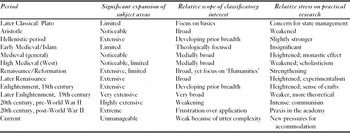
The macrohistory of the ideas I have outlined reveals the daunting task of unravelling current complexities when compared with the more manageable circumstances of yesteryear (Table 2).
European classifications of knowledge from antiquity to the present: outline of basic tendencies.

Environmental scientists are heirs to this rich heritage, and the question now is what to with it and with the various debates about it both past and current. There is the twin danger of discarding much of it as irrelevant, simply for being outmoded when an almost apocalyptically charged present has to be faced, or of arrogating environmental science to be the new unitary science that covers everything, the superterrestrial, the biospheric and humanity in totality, and thus the evaluative coping-stone of all research. To counter false steps requires common sense, sound perspective and clear-sighted analyses.
BIOSPHERIC CRISIS AND THE PRESSURE FOR INTERDISCIPLINARY ACTION
The social and ideational structures for learning still remain, and nothing covered in this article has been in vain if it shows how the present university of knowledge came to be, and on what it has depended. Needham (Reference Needham1955, pp. 252–261) asked how parts relate to wholes, and how mastering one facet or subject might lay bare a whole system. Knowledge seemed to him like a giant cake; it would kill individual investigators to consume it all, but taking even one slice provides flavours of the whole and together researchers can report on the taste. Unfortunately, so much specialization impresses itself on researchers that they will naturally be suspicious of interdisciplinarians, who seem to have bitten off more than their fair share. Even though interdisciplinarity is sorely needed to solve complex problems, and by now a small academic industry is devoted to it (Weingart & Stehr Reference Weingart and Stehr2000), a likely future holds that solutions will have to come with collaborations of specialists; and even then such collaborators, wherever they are, will have to operate between the competing pressures of the academy, politics, industry and independent activists (Cromwell & Levine Reference Cromwell and Levene2007).
Some institutional shifts confront ‘biospheric stress’ directly, as with the new University of Natural Resources and Environment in Papua New Guinea; others are slowed by infighting or financial limitations. Most proactive interdisciplinary research comes from informal networking because investigators need outside specialist help in providing data beyond their ken or in solving problems that necessitate specific collaborative effort. Important ongoing ties can be congealed, even institutionalized, in consequence. By comparison, interdisciplinarity can frequently be forced on research centres when high-level, often political knee-jerk reactions to actual or potential disasters require concerted action; but such compulsion can incur ill-considered, often self-interested partnerships (when there is a scramble for financial opportunity) and can also be disruptive and inimical to free enquiry. Environmental scientists always need to take stock of the sociopolitical contexts in which interdisciplinary action takes place: there is often a likelihood that some (possible vital) participants in a project will be left out (for lack of funds, or perhaps because their work does not suit the case researchers are expected to make). Reflective self-contextualization and sufficient education to appreciate the wide range of research pursuits both become crucial here.
One key issue, moreover, remains unresolved: the source of the values underlying envisioned ways of organizing and using knowledge, let alone quests for its unity and for an extensive nurturing of crossdisciplinary scholarship. Do the values governing our choices best derive from within nature itself (from Spencer's evolution, Dawkins’ natural selection or Leopold's ecosystem), or are we supposed to be also looking past external laws, whether to our introspective ourselves or even beyond to traditional higher wisdom? These are hoary questions. On the one hand, voices will warn against deducing that what is supposed to work itself out naturally is what is meant to be as the ethical standard. Everyone should well aware that all sorts are evils and ignominies are harder to contain when they are justified as natural. On the other hand, unlike theories in physics, moral theories (including naturalistic ones) do not offer experimenta crucis whereby their truth and falsehood may be tested. If this exercise in the history of ideas teaches anything at all, it will be that that vital lessons about values will be learned from pools of wisdom outside the realms of the physical and life sciences, and that the sense of the unity of all disciplines, bridging the gap between ‘two cultures’, as C.P. Snow testily called them, will best emerge by as constant and as lively an interaction between researchers of all fields. If no effective collaboration can be achieved anywhere without mutual respect, neither will any recapturing of a shared collective educative vision, or a better grasp of how all the students of the universe arrived where they are now, of what drives human pursuits, and about who society serves.
CONCLUSIONS AND RECOMMENDATIONS
In order to ensure global environmental durability, collaboration between researchers from varied yet pertinent disciplines is now urgently needed. The history of how the whole field of human knowledge has been envisioned and classified provides insights into the historical conditioning that affects the chances of effective interdisciplinary activity occurring. Although interdisciplinary per se has become a new object of investigation and hope, and although some disciplines are by nature more polymethodic and multidisciplinary than others (including environmental science[s]), the quest for engaging in the crosscurrents of learning devolves around how knowledge is understood or ordered. The persisting idea of the classifiable interrelatedness of scientiae remains important first of all in affirming the value of a collective intellectual pursuit within a shared universitas or broad collegial bond, yet above all in inspiring the pressing need for collaboration across disciplines and research interests. Humankind shares with the Earth a general ‘global burden’ (Drexler Reference Drexler2008, pp. 8–11) and increasing collaboration will be needed to ease the strain.
I dare to tender five main recommendations: (1) Treasure all the knowledge that humanity has inherited, and apprehend as much as possible what bodies of it humanity possesses. It is not the overabundance of knowledge that is the problem, but its misuses, irresponsible distribution and the cynical encouragement of its fragmentation. (2) Recognize that questions of interdisciplinarity and a unitary vision of knowledge are not exhausted within the sphere of environmental science, but belong to a broader but nonetheless pressing need in all tertiary studies to comprehend, value, conserve and disseminate sound scholarship, to cultivate a sense of common vision, and to work against the distortions, misuses, compromises and arrant politicization of research. (3) While respecting the whole range of disciplines and their interdisciplinary possibilities, environmental scientists should intelligently earmark (preferably through teamwork) those specializations that are fundamental for biospheric sustainability. (4) While classifying and conceptually unifying knowledge are contested activities, never cease in the quest to understand the values that underpin all exercises of learning and to discern which of these loom as final arbiters of human (including academic) behaviour (such as unconquerable goodwill, peace with justice, honest commitment to truth and basic personal freedoms), fearlessly deploying them against agents of environmental despoliation. (5) Strike as near as proper a balance over ‘hard’ security questions, such as research necessary to prevent wilful terrorism against the environment, or to announce and arrange mass mobilization in disaster situations.
ACKNOWLEDGEMENTS
Thanks for special points to Professors John Gascoigne, Wouter Hanegraaff, Constant Mews, Brikha Nasoraia and Richard Yeo, and Drs Christina Alt and Friedegard Tomasetti, Carla Avolio and Ania Szafjanska.