CHD is a common birth defect affecting approximately six to nine in 1000 live births each yearReference Hoffman and Kaplan 1 , Reference Botto, Correa and Erickson 2 with roughly 25% of those infants being born with critical CHD.Reference Oster, Lee, Honein, Riehle-Colarusso, Shin and Correa 3
In July of 2015, Arizona implemented mandatory pulse-oximetry screening of newborns based on the 2011 recommendations put forth by the United States Secretary of Health and Human Services to include newborn screening for critical CHD.Reference Kemper, Mahle and Martin 4 As of May, 2016, 36 states required newborn screening for critical CHD, whereas 11 states had enacted screening guidance. 5 Reviews of individual state implementation have been reported for only a few states, including Wisconsin,Reference Beissel, Goetz and Hokanson 6 Georgia, 7 Minnesota,Reference Kochilas, Lohr and Bruhn 8 and Washington.Reference McDermott, Vernon and Schultz 9
Fetal echocardiography is the gold standard for diagnosing critical CHD prenatally. In a review of screening practices at Boston Children’s Hospital, the pulse-oximetry programme discovered no new diagnoses of critical CHD that had not been diagnosed through fetal echocardiographyReference Johnson, Lieberman, O’Leary and Geggel 10 ; however, in rural settings where echocardiography is less likely to be available because of high costs and limited access to paediatric cardiologists, pulse oximetry may effectively detect undiagnosed critical CHD in newborns.
In Arizona, advanced neonatal care (level III) nurseries are only found in the metropolitan areas of Phoenix and Tucson. In rural areas, access to consistent prenatal care is lacking. Because of the variation in geography, with a quarter of Arizonans living in rural areas, newborn pulse-oximetry screening at all treating facilities could greatly reduce time to diagnosis and morbidity in children with critical CHD.Reference Pinto, Lasa, Dominguez, Wernovsky, Tabbutt and Cohen 11 – Reference Good, Canale, Goodman and Yeager 14 Implementation of screening, however, must be balanced with the economic burden of false-positive screens, which may more heavily affect rural birth centres because of the high costs of neonatal transport.
This study aims to analyse the distribution of where infants with critical CHD were born and treated in Arizona. In addition, we aim to assess the current use of pulse-oximetry screening, prevalence of modified screening protocols for altitude, and capacities to deliver follow-up management in Arizona, including access to paediatric echocardiographies, prostaglandin, and paediatric cardiologists.
Methods
Birth defects monitoring programme data
Case selection
Birth defect data were obtained from the Arizona Department of Health Services with the most recent data reported from 2012 and 2013. The Hospital Discharge Database and the Arizona Birth Defects Monitoring Program were queried for a list of patients bearing one or more selected ICD-9-CM diagnostic codes for CHD: specifically, 746.01, 745.0, 745.10, 746.7, 745.2, 747.41, 746.1, 746.3, 746.2, 746.02, and 745.6. Criteria for critical CHD included seven primary targets as identified by the American Academy of Pediatrics: hypoplastic left heart syndrome, pulmonary valve atresia, tetralogy of Fallot, total anomalous pulmonary venous return, transposition of the great arteries, tricuspid valve atresia, and truncus arteriosus. Also included were secondary targets of coarctation of the aorta, Ebstein’s anomaly, critical aortic stenosis, and critical pulmonary valve stenosis. Critical pulmonary stenosis and critical aortic stenosis were defined as requiring intervention in less than 30 days. Children who had a diagnosis that did not meet criteria for a critical CHD were excluded.
Procedures
Medical records were reviewed for those children who were seen at Phoenix Children’s Hospital at any point in their care: for example, exams, diagnostics. Of 272 children, 32 did not receive care at this hospital. Information such as admission and discharge dates, zip code of mother’s residence, birth and treating facility, whether the child was diagnosed prenatally – yes or no – or whether the child was deceased was abstracted from the charts. The child’s echocardiogram was reviewed by a paediatric cardiologist, A.S., to determine the final diagnosis. Mortality was defined as whether the child passed away within 60 days of life: yes or no. The time period of 60 days was used to include infants who presented late. Mortality was reported using chart review.
Survey of birth centres
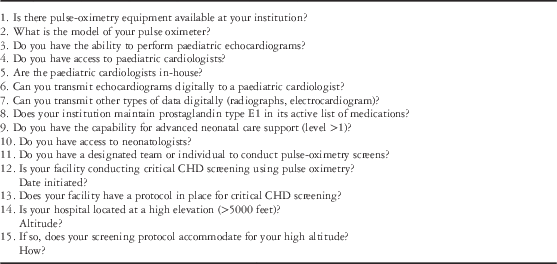
A 15-question online survey was created based on the birth-centre questionnaire used by Kochilas et al.Reference Kochilas, Lohr and Bruhn 8 A list of active birth centres and contacts were provided by the Arizona Department of Health Services. A link to the survey was sent by e-mail to all birth centres in Arizona that reported births to the Arizona Department of Health Services in 2012 (n=50). The centres were surveyed with follow-up telephone interviews conducted with nurse managers of newborn units between September 2015 and March 2016. The questions assessed the current implementation of critical CHD screening, use of a protocol, adjustment of protocol for elevation, model of pulse oximeter used, designation of staff for screening, ability to perform and transmit paediatric imaging, access to paediatric cardiologists, supply of prostaglandins, and access to neonatologists (see Table 1).
Birth centre survey.

Data analysis
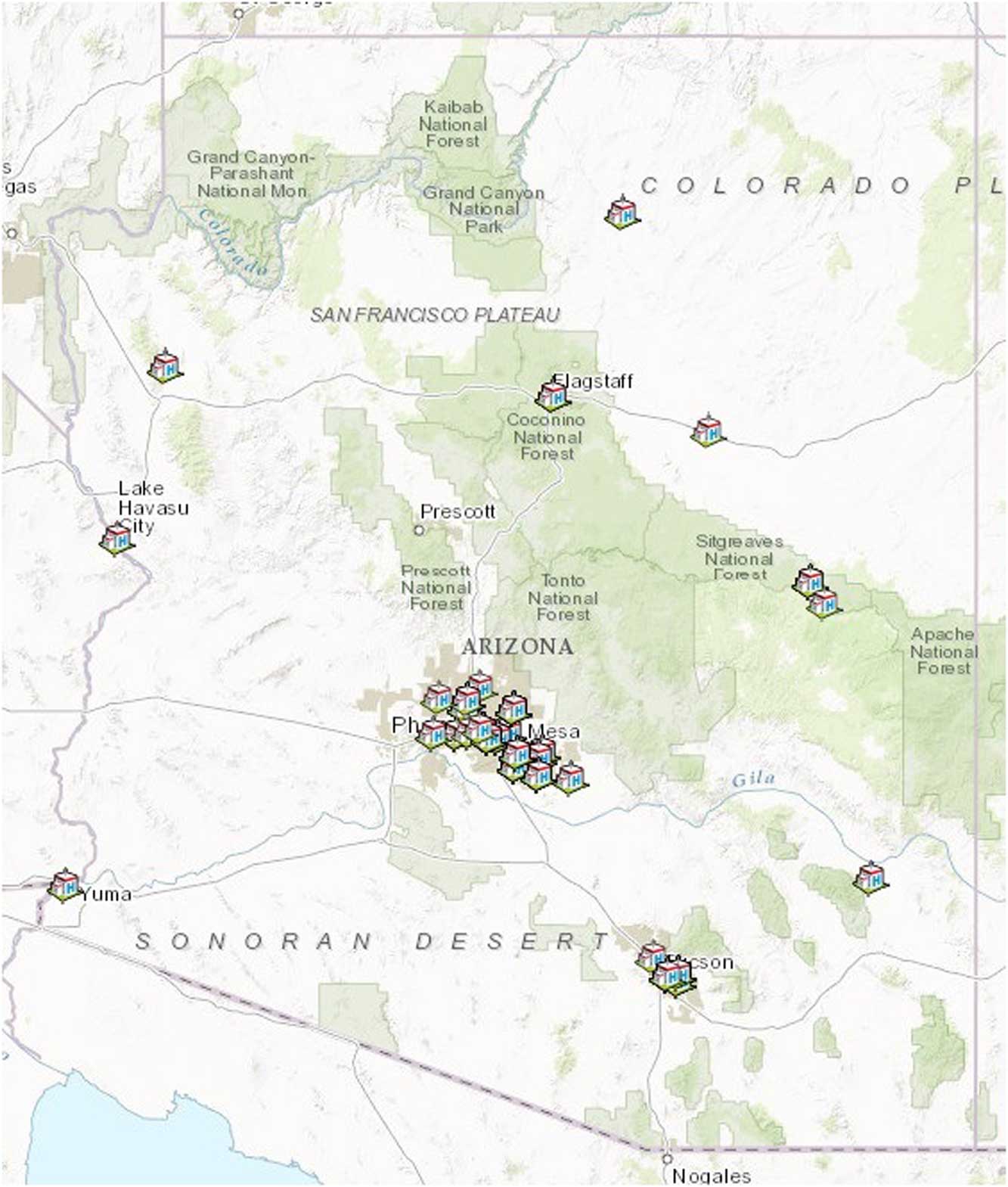
IBM SPSS Statistics version 23, 2014 (IBM Corporation, Armonk, New York, United States of America) was used for statistical analysis. Descriptive statistics were used to describe the frequencies of the cardiac diagnoses, frequency of children born in 2012 versus 2013, and number of children living above or below 5000 feet in elevation. Fisher’s exact test was performed to evaluate the relationship between prenatal diagnosis and mortality. A logistic regression model was used to evaluate the degree to which elevation predicted mortality as well as the relationship between mortality and the distance between the mother’s residence and the treating facility. Geographic information system software (ArcGIS) was utilised to produce a map to visualise the distribution of birth centres by zip code (Fig 1). Data are presented as mean±standard deviation or as frequencies and proportions.
Births with critical CHD in 2012 and 2013.

Results
Birth defects monitoring programme data
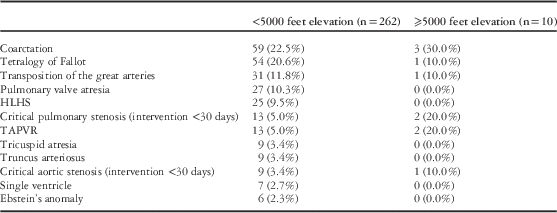
A total of 487 births with a possible critical CHD diagnosis in 2012 and 2013 were identified through the Arizona Birth Defects Monitoring Program and Hospital Discharge Database. After a verification process involving medical chart review, a total of 272 children were included in this study, of whom 132 were born in 2012 and 140 were born in 2013. Arizona Birth Defects Monitoring Program staff confirmed the diagnoses for cases born in 2012, and cases from 2013 were obtained through the Hospital Discharge Database data; diagnoses were verified by the Arizona Birth Defects Monitoring Program and/or the study researchers. Charts were unavailable to study researchers for the patients who were treated in Tucson. Patients (n=215) were excluded because the diagnosis was not verifiable via medical record or because there were duplicate entries (n=45, 2012; n=57, 2013) or the child did not have a diagnosis of critical CHD (n=10, 2012; n=103, 2013). It should be noted because Arizona Birth Defects Monitoring Program staff verified diagnosis for cases from 2012 before data were shared with study researchers, fewer cases from 2012 were later excluded because of a lack of diagnosis of critical CHD. The frequencies of critical CHD diagnoses are listed in Table 2.
Critical CHD diagnoses following medical chart verification and elevation.

HLHS=hypoplastic left heart syndrome; TAPVR=total anomalous pulmonary venous return
A total of 10 children lived above an elevation of 5000 feet (Table 2). Of the 272 patients, 142 (52%) were diagnosed prenatally. Of the total infants born with a verified diagnosis of critical CHD, 86% were delivered in metro birth centres, and 88% were treated at one metro treating facility. There was a 55.1-mile average distance between the mother’s residence and the treating facility. A total of 16 children (5.9%) expired within the first 60 days of life. Mortality was not related to whether the child lived below or above 5000 feet (β=0.00, 95% CI 0.99 to 1.00, p=0.82). In addition, mortality was not related to whether the child received a prenatal diagnosis (p=0.30), or to the distance travelled from the mother’s residence to the treating facility (β=−0.002, 95% CI −0.01 to 0.006, p=0.68).
Survey of birth centres
A total of 50 birth centres in Arizona were surveyed, of which 33 (66%) responded. All 33 centres had a protocol in place for critical CHD screening. In all, three (9%) centres reported their location to be at an elevation greater than 5000 feet; one of these centres adjusted its screening protocol to accommodate for high elevation. A total of 25 (76%) centres reported the ability to perform paediatric echocardiographies; yet, only 21 (64%) had the ability to digitally transmit echocardiograms. In all, 28 (85%) centres reported access to paediatric cardiologists; two of these centres worked with in-house paediatric cardiologists. Of the 26 centres without access to an in-house cardiologist, 20 centres had the ability to send echocardiograms digitally.
Among 27 birth centres, five different models of pulse oximeters were available with nine centres using both a bedside and a handheld oximeter. A total of 27 (82%) centres had one designated team or individual to conduct pulse-oximetry screens; however, this was often reported as “general nursing”. In all, 24 (73%) birth centres maintained prostaglandin in the centre’s active list of medications. A total of 26 (78%) birth centres reported having the capability for advanced neonatal care (level >1), whereas all centres reported access to neonatologists.
Discussion
To our knowledge, this is the first study to assess birth centres in Arizona and demonstrate the level of postnatal care that children with critical CHD are receiving. The most commonly reported critical CHD in our population was coarctation of the aorta, followed closely by tetralogy of Fallot. Coarctation of the aorta is often missed, in part, because evaluation of the aortic arch is not part of routine obstetric ultrasound screening; however, it may also be missed on routine pulse-oximetry screening.Reference Carvalho and Allan 15 , Reference Lannering, Bartos and Mellander 16
Prenatal detection rates of critical CHD vary from 3.3 to 60% with differences accounted for by families’ access to care and level of echocardiography training for professionals.Reference Kemper, Mahle and Martin 4 , Reference Ewer, Middleton and Furmston 17 – Reference Friedberg, Silverman and Moon-Grady 19 In the United States of America, an analysis of over 31,000 patients from 47 states across 6 years demonstrated an average prenatal diagnosis of 34% with significant variability in defect type and geographic variation.Reference Quartermain, Pasquali and Hill 20 Our study showed that the prenatal diagnosis rate was found to be approximately half in 2012–2013, which was before the implementation of standard pulse-oximetry screening in Arizona. We speculate this rate was because of inconsistency in accessing prenatal care due to variability in geography and socio-economic status. We anticipate the rate of prenatal diagnosis to increase with improvements in utilisation and quality of fetal echocardiography.Reference Liberman, Getz and Lin 21 Although data were not yet available from Arizona Department of Health Services regarding infants diagnosed after state-wide implementation of pulse-oximetry screening (e.g. ⩾2013), future studies should look at current rates of prenatal diagnosis, barriers to prenatal diagnosis, and rates of positive pulse-oximetry screens.
Our study showed that the majority of infants born with critical CHD were born to mothers who resided in metropolitan areas; however, we also found that families were required to travel long distances for paediatric cardiology services that were regionalised to two tertiary-care facilities. Regionalisation to high-volume facilities has been shown to improve early outcomes for infants with CHD, especially if undergoing complex surgical care.Reference Chang and Klitzner 22 – Reference Jenkins, Newburger, Lock, Davis, Coffman and Iezzoni 24 Although access to paediatric cardiologists is limited to these high-volume facilities, availability of echocardiography is critical for state-wide implementation of pulse-oximetry screening; however, without the ability to transmit echocardiograms for review by a paediatric cardiologist, images may only be reviewed by an echocardiography technician, adult cardiologist, or by a radiologist.
Increasing the availability of digital transmission of echocardiograms or performing telemedicine with live echocardiography can bridge this gap. Telemedicine reduces transport to a tertiary-care facility, mean time to diagnosis, mean length of stay, and length of ICU stay.Reference Webb, Waugh and Grigsby 25 In addition, paediatric cardiologists benefit from an average of 4.2 person-hours per week saved in travel and consultation time.Reference Sable, Roca, Gold, Gutierrez, Gulotta and Culpepper 26 Widespread implementation of telemedicine has been limited because of poor insurance coverage of telemedicine and different regulations in each state. 27 Overall, 47 states, including Arizona, have some form of reimbursement in their public healthcare programmes for telemedicine services. Haley et alReference Haley, Klewer and Barber 28 validated the accuracy of tele-echocardiography between Tucson and Yuma demonstrating only one major discrepancy when comparing tele-echocardiography to a recorded echocardiogram and significant quality improvement from 2006 to 2010.
Mortality was not related to the distance travelled from the mother’s residence to the treating facility. The results of our study agree with previous findings of no significant difference in mortality for infants born at a distance from the tertiary-care facility.Reference Pinto, Lasa, Dominguez, Wernovsky, Tabbutt and Cohen 11 Further, our study found that mortality was not related to whether the infant had a prenatal diagnosis. Infants with left ventricle outflow obstruction and hypoplastic left heart syndrome have been shown to benefit from antenatal referral to a tertiary centre.Reference Hellström-Westas, Hanséus, Jögi, Lundström and Svenningsen 29 , Reference Morris, Ethen and Penny 30 The impact of prenatal diagnosis on critical CHD remains controversial.Reference Moffett, Garrison and Hang 31 , Reference Holland, Myers and Woods 32 Morris et alReference Morris, Ethen and Penny 30 showed that both infants prenatally diagnosed with hypoplastic left heart syndrome and those delivered close to a surgical centre had lower mortality rates. Lang et alReference Lang, Brun, Kaaresen and Klingenberg 33 found mortality as high as 35% for children requiring transport for surgical care of congenital cardiac anomalies. In addition, prenatal diagnosis has been shown to reduce neonatal morbidity and postnatal outcomes for various forms of critical CHD.Reference Tworetzky, McElhinney and Reddy 34 , Reference Bonnet, Coltri and Butera 35 Further studies are needed to evaluate mortality in newborns requiring immediate surgery.
Our study demonstrated that mortality was not related to whether the birth centre was located at a higher elevation. Elevation has been known to affect pulse-oximetry results in infants. Ravert et alReference Ravert, Detwiler and Dickinson 36 reported baseline oxygen saturations above 95% at an elevation of 4498 feet, but for neonates born at or above 6800 feet, normal oxygen saturation levels varied between 91 and 96%. In Vail, Colorado (8150 feet), newborns had a mean saturation of 94.5%. Wright et alReference Wright, Kohn, Niermeyer and Rausch 37 found that infants born at >35 weeks gestation had higher failure rates when tested at moderate elevation (Aurora, Colorado 5557 ft) compared with sea-level altitude. In Arizona, elevation varies greatly depending on the region. Flagstaff Medical Center, at an elevation of 7016 feet, delivered an estimated 1300 babies annually. 38 In Tucson, Arizona, at an elevation of 2643 feet, there were 1089 infants born. To the west, Yuma Regional Medical Center, at 200 feet, reported over 3000 births annually; 39 however, only a small percentage of the centres surveyed in our study adjusted their screening protocol for elevation. The literature suggests that pulse-oximetry-screening cut-off values may need to be altered for hospitals located at significant altitudes, though further studies are warranted.
Although pulse-oximetry screening is being carried out in a majority of centres state wide, nearly one-quarter of birth centres are unable to perform follow-up echocardiography or management. Access to paediatric cardiologists is regionalised to three major centres in Phoenix and Tucson. Across the state, hospitals are using a variety of pulse oximeters and staff to conduct screens, which may make detection and false-positive rates variable across institutions.Reference de-Wahl Granelli, Wennergren and Sandberg 18 This task usually falls on “nursing” but it is unknown whether this means every nurse is trained to perform screening or whether hospitals are using designated individuals. Although 76% of birth centres were able to perform paediatric echocardiographies, the training of echocardiography technicians may be variable. In addition, once a paediatric echocardiogram is obtained following a failed screen, only two-thirds of hospitals can transmit this data to a paediatric cardiologist to evaluate the images for a final diagnosis. Real-time echocardiography increases the accuracy and timeliness of patient evaluations.Reference Sable, Roca, Gold, Gutierrez, Gulotta and Culpepper 26 , Reference Justo, Smith and Williams 40 , Reference Sable, Cummings and Pearson 41 It is likely that infants who failed a screen in the remaining one-third of hospitals would need to be transported for further evaluation. This can lead to significant transportation cost as the minimum base rate for ambulance transport ranges from $479 to $1797 and the minimum base rate for medical air transport ranges from $8400 to $21,500 in Arizona alone. 42 , 43 This can be a significant cost to the system when failing a pulse-oximetry screen will yield a diagnosis of critical CHD in only 25% of cases.Reference Johnson, Lieberman, O’Leary and Geggel 10 , Reference Singh, Rasiah and Ewer 44
Our study was limited by the participation of only 66% of the birth centres in Arizona. Although all the centres received the cross-sectional survey by e-mail, followed by reminder e-mails and resident phone calls, participation was still incomplete. Over several months, one of the greatest obstacles to communication with the birth centres appeared to be due to the frequent turnover in nurse manager positions. In addition, within Arizona, five birth centres are affiliated with Indian Health Services. Through telephone interviews, concern for interagency approval for participation in this study was raised, which likely resulted in limited communication and participation. Inclusion of birth centres in the Indian Health Services system would be valuable given the predominantly rural setting of Indian Health Services centres. In addition, a small number of patients received their care exclusively in Tucson, where charts were not accessible for review. Because of consideration for institutional anonymity, we were unable to identify the location of the birth centres that did not participate in the survey. As such, we were not able to identify which hospitals did not have access to prostaglandin E1.
From our birth data, only information regarding infants born with critical CHD was obtained. We did not have access to information regarding all births that occurred in 2012–2013; thus, we are unable to speculate on the number of newborns delivered at each centre in total. We were further limited by the hospital coding used for diagnoses of critical CHD. As a single example, no code exists to differentiate between pulmonary valve stenosis versus atresia. In addition, to allow time to identify patients with delayed diagnosis and treatment, there is a 2-year lag time in collection of data by the Arizona Birth Defects Monitoring Program, thus limiting access to current data. Future studies should include data from additional years of post-pulse-oximetry-screening implementation to evaluate pre- and post-outcomes in this population.
Conclusion
Pulse-oximetry screening in newborns is currently implemented in the majority of centres in Arizona. This study identifies barriers to diagnosis and found utilisation of pulse-oximetry screening, prenatal echocardiography, and increasing ability for transmission of echocardiograms as ways to improve the care of newborns diagnosed with critical CHD in Arizona. Although most birth centres could perform initial management steps following a positive screen, access to paediatric cardiology services is limited. Patients with critical CHD sometimes travel a great distance to treating facilities with paediatric cardiologists. Digital transmission of echocardiograms or use of tele-echocardiography would reduce the distance travelled for management of a positive screen, decrease the financial burden of transportation, and expedite care to critically ill neonates.
Acknowledgements
None.
Financial Support
This research received no specific grant from any funding agency, commercial or not-for-profit sectors.
Conflicts of Interest
None.
Ethical Standards
The authors assert that all procedures contributing to this work comply with the ethical standards of the relevant national guidelines on human experimentation by the FDA and HHS and with the Helsinki Declaration of 1975, as revised in 2008, and has been approved by the institutional committee of Phoenix Children’s Hospital.