Introduction
While some research reported that the majority of students adjust and cope well with the transition to boarding school (Martin, Papworth, Ginns, & Liem, Reference Martin, Papworth, Ginns and Liem2014), other research suggested this is not universal (Rossiter, Clarke, & Shields, Reference Rossiter, Clarke and Shields2018; Schaverien, Reference Schaverien2004, Reference Schaverien2011). For example, Australian longitudinal research by Mander and Lester (Reference Mander and Lester2017) investigated indicators of mental ill health as reported by boarding and non-boarding students over a 2-year period from the end of grade 7 to the end of grade 9. They found all students reported significant increases in symptomatology associated with depression and anxiety and a decrease in prosocial behaviour over time. By the end of grade 8, boarding students reported significantly higher levels of anxiousness and stress compared to non-boarding students. Furthermore, at the beginning of grade 8 and end of grade 9, boarding students also reported significantly higher symptoms associated with a negative emotional state (e.g., feeling unhappy, downhearted, nervous, fearful, worried, experiences headaches) compared to non-boarding students (Mander & Lester, Reference Mander and Lester2017).
Research suggests that boarding students who reported higher levels of anxiousness and stress were found to be associated with a greater risk of bullying victimisation at the beginning of grade 8 (Lester & Mander, Reference Lester and Mander2015). Conversely, boarding students experiencing symptoms associated with conduct problems and emotional difficulties were more likely to engage in frequent bullying perpetration (Lester & Mander, Reference Lester and Mander2015). These findings are not trivial. The recent Royal Commission into Institutional Responses to Child Sexual Abuse, for example, explicitly emphasised how a high tolerance for bullying behaviour in Australian boarding schools adversely impacted boarding students’ sense of safety and wellbeing (Commonwealth of Australia, 2017).
It is well established that a poor transition to secondary schooling impedes students’ academic performance (Akos, Queen, Lineberry, Reference Akos, Queen and Lineberry2005; Uvaas & McKevitt, Reference Uvaas and McKevitt2013), sense of belonging (Osterman, Reference Osterman2000) and connectedness with school (Lester, Waters, & Cross, Reference Lester, Waters and Cross2013), as well as increases the risk of school absenteeism and dropout (Waters, Lester, & Cross, Reference Waters, Lester and Cross2014a, Reference Waters, Lester and Cross2014b; Waters, Lester, Wenden, & Cross, Reference Waters, Lester, Wenden and Cross2012). In addition, a poor transition experience to secondary school can have further negative implications on young people’s sense of identity and self-worth (Benner, Reference Benner2011; Topping, Reference Topping2011), vulnerability to anxiety, depression, loneliness and capacity to benefit from the protective factors associated with education (Downs, 2001, Reference Downs2003; Riglin, Frederickson, Shelton, & Rice, Reference Riglin, Frederickson, Shelton and Rice2013; Riglin, Petrides, Frederickson, & Rice, Reference Riglin, Petrides, Frederickson and Rice2014).
From a developmental perspective, an important aspect of the transition experience to boarding school in Australia is that it typically coincides with early adolescence when young people are aged 11–13 years. There is broad agreement that the early to mid-adolescence period is a time when symptoms associated with mental ill health are most likely to emerge (Dustin & Steinberg, Reference Dustin and Steinberg2011; Lawrence et al., Reference Lawrence, Johnson, Hafekost, Boterhoven De Hann, Sawyer, Ainley and Zubrick2015; Rutter, Reference Rutter2007). Hence, adolescence is often thought of as a key inflection point to invest in forging healthy human development across the lifespan (United Nations Children’s Fund, n.d; World Health Organisation, n.d).
Research has emphasised that during early and subsequent mid-adolescent years, a cascade of neurobiological processes and social reorientation takes place for young people (Dahl, Allen, Wilbrecht, & Ballonoff Suleiman, Reference Dahl, Allen, Wilbrecht and Ballonoff Suleiman2018). Foremost among these are the onset of puberty (e.g., on average by age 10 in females and age 12 in males), sexual maturation and pronounced metabolic and physical changes. An increased motivation and sensitivity towards social connectedness with peers, social roles and intimate relationships, status and prestige is also common. From a psychological perspective, a shift from concrete to pre-abstract to abstract thinking skills is apparent (Dahl et al., Reference Dahl, Allen, Wilbrecht and Ballonoff Suleiman2018). So does the adolescent desire to fulfil certain other innate psychological needs in preparation for adulthood – in particular, the desire for: (1) competence (e.g., the need to control one’s own outcomes and to experience mastery), (2) autonomy (e.g., the need to be casual agents on one’s own life) and (3) relatedness (e.g., the need to connect with and form relationships with others) (Niemiec & Ryan, Reference Niemiec and Ryan2009; Ryan & Deci, Reference Ryan and Deci2000).
Several studies have asserted that staff in Australian boarding schools need to be more than just mindful of the immediate challenges faced by new students when transitioning into a new boarding school environment (Hodge, Sheffield, & Ralph, Reference Hodges, Sheffield and Ralph2013; Whyte & Boylan, Reference Whyte and Boylan2008). Yet a gap exists in comprehensive ongoing training regarding the unique neurobiological, cognitive, social and behavioural changes that occur during the early to mid-adolescence period (Lester & Mander, Reference Lester and Mander2015; Mander & Lester, Reference Mander and Lester2017). Peak bodies such as the Australian Boarding Schools Association (ABSA), for example, have taken steps to address this gap and the need for the prioritisation of boarding students’ wellbeing through the development of training resources such as Duty of Care, which is now in its third edition (e.g., https://www.boarding.org.au). In spite of this, a shortcoming of this resource and other similar training options currently available in Australia to boarding staff (e.g., http://boardingtrainingaustralia.com.au) is that these only offer a cursory insight into the early to mid-adolescence developmental period and often overlook the pre-transition experience for boarding students.
Current approaches to pre-transition support
On average over 21,000 secondary boarding students in grades 4–12 attend 178 boarding schools across Australia (ABSA, 2016). While each individual boarding school determines its own specific content and nuanced approach to the delivery of pre-transition support programming, there are several commonalities. For example, it is common for boarding schools in Western Australia (WA) to arrange for staff to conduct home visits or make telephone contact with students prior to arrival, and some even offer students sleepover experiences, with or without parents, prior to starting (Hadwen, Reference Hadwen2015). However, beyond this, the pre-transition experience for the majority of new boarding students in Australia tends to only involve three key aspects: (1) the provision of parents with an information package about a boarding school; (2) touring a boarding school with their parents, sometimes years before actually starting as a student; and (3) participation in a one-off orientation day just prior to commencing enrolment, usually towards the end of grade 6.
Once at boarding school, the Head of Boarding has ultimate responsibility for facilitating a positive transition experience and monitoring the wellbeing of all new boarding students (Hadwen, Reference Hadwen2015). It is conventional for a team of allocated staff, including boarding house supervisors, homeroom teachers and pastoral care staff, as well as older boarding students (e.g., peer mentors), to support new students with the adjustment to life at boarding school. An expectation held within many boarding schools is for older students, but in particular school prefects and boarding house seniors, to make a conscientious effort to forge supportive relationships with new younger boarding students (Hadwen, Reference Hadwen2015). For the most part though, new students invariably commence life at boarding school with knowledge and skills sourced through family and friends, as well as utilising self-regulatory capacities attained during childhood and primary school years.
The Connect Programme at S1
The Connect Programme is located at a large-sized, independent, Catholic day and boarding school (e.g., kindergarten to grade 12) located in Perth, WA – herein referred to as S1. The majority of students at S1 are day students (e.g., 1100) with a smaller boarding student population (e.g., 200). The Connect Programme provides transition support to new incoming grade 7 and 8 boarding students during the 6-month period prior to arriving at S1 (e.g., still at primary school and in grade 6), as well as in-school support for the first 6 months post-transition (e.g., when at S1 and in grade 7). The Connect Programme is a direct outcome of S1’s 2014–2017 Strategic Overview and was first piloted as a programme in 2015. Its development coincides with the recent building of a residential facility purposely designed to accommodate thirty grade 7 boarding students. The Connect Programme is coordinated by a lead teacher who works directly with new incoming students and their families and in close collaboration with key stakeholders at S1. See Appendix A for an overview of the Connect Programme.
Why investigate the pre-transition experience?
At a time of pronounced neurobiological development and change, the transition literature emphasises that there is a paucity in Australian research that investigates the psychological wellbeing of young people as they transition to secondary boarding school (Mander & Lester, Reference Mander and Lester2017; Rossiter et al., Reference Rossiter, Clarke and Shields2018). Hence, for schools wanting to enhance the pre-transition experience they offer, identifying what supports young people perceive as beneficial and prompting a sense of readiness prior to going to a secondary boarding school is crucial (Akos et al., Reference Akos, Queen and Lineberry2005; Benner, Reference Benner2011; Coffey, Reference Coffey2013; Hanewald, Reference Hanewald2013; Lester et al., Reference Lester, Waters and Cross2013; Mackenzie, McMaugh, & O’Sullivan, Reference Mackenzie, McMaugh and O’Sullivan2012; Maguire & Yu, Reference Maguire and Yu2015; Tobbell & O’Donnell, Reference Tobbell and O’Donnell2013; van Rens et al., Reference van Rens, Haelermans, Groot and van den Brink2018; Waters et al., Reference Waters, Lester and Cross2014a, Reference Waters, Lester and Cross2014b).
Aim of present study
This research investigates the self-reported perceptions, readiness and psychological wellbeing of young people prior to transitioning to a secondary boarding school using both quantitative and qualitative data collection methods.
Methodology
A mixed-method quantitative (online questionnaire) and qualitative (semi-structured focus group) design was used to investigate the perceptions and pre-transition experience of new incoming grade 7 students (while still in grade 6) prior to their impending transition to S1.
Participants
All participants were recruited from S1 and had participated in the Connect Programme since 1 July 2017. A total of 15 male participants in grade 6 were recruited and aged 11 (n = 7) and 12 (n = 8) years. Most participants resided in country towns (n = 11; 73%), with several indicating they were from more remote locations in WA (n = 4; 27%). An information seminar was held at S1 on 28 October 2017 with all new incoming boarding students and parents. Participation was then sought through the mailing out of a follow-up research information package and an opt-out process. This package contained both a parent and student information letter, a parent opt-out consent form and a reply-paid envelop. For those families that preferred an electronic version, a PDF of this package was emailed to them. At all times it was explained to parents and students that participation was voluntary and consent could be withdrawn at any point without explanation, penalty or question.
Procedure
Data in this paper represent one part of a larger longitudinal investigation, which follows the whole grade 7 cohort (both day and boarding students) as they transition into S1 from primary school. Data collection took place on 2 December 2017 when participants were in grade 6 and still attending their respective primary schools. A small number of randomly selected participants were further invited to take part in a pre-transition focus group. Informed written consent to participate in the focus group was actively sought from both parents and students. All participants were informed that participation was voluntary and they could withdraw at any point without explanation, penalty or question. This study received approval from the Human Ethics Office at The University of Western Australia (Reference No. RA/4/20/4055) and the Headmaster of S1.
Measures
Pre-transition online questionnaire
The pre-transition online questionnaire contained several well-recognised and empirically established self-rating instruments commonly used with adolescent populations. However, it was necessary to make minor modifications to the wording of a few instrument questions in the online questionnaire so that they aligned with the pre-transition and boarding school focus.
Academic self-perception, motivation and self-regulation
The academic self-perception scale is derived from the School Attitudes Assessment Survey (SAAS; McCoach, Reference McCoach2002) and consisted of five questions measured on a seven-point Likert scale (1 = strongly disagree to 7 = strongly agree) (alpha = 0.86). Questions included “I am confident in my academic ability” and “I do well in school”. The motivation and self-regulation scale is also derived from the SAAS (McCoach, Reference McCoach2002) and consisted of four questions measured on a seven-point Likert scale (1 = strongly disagree to 7 = strongly agree) (alpha = 0.76).
Transition to secondary school
This checklist asks participants what things they are looking forward to (16 questions) and are concerned about (22 questions) when preparing for the transition to secondary school. This checklist was adapted from Akos (Reference Akos2002) to the unique situation of boarding school and schooling away from home and family. Questions concerning being away from family, being away from home town and living in a boarding house were added to the checklist.
Connect activities
Participants were asked how helpful Connect activities were in preparing the students for boarding school. The list of 13 activities included touring the school and boarding houses, attending orientation day and reading the information package. Helpfulness was measured using a five-point Likert scale (1 = I did not take part in the activity, 2 = not helpful, 3 = not sure, 4 = helpful, 5 = very helpful).
Resilience
Resilience was measured using the Resilience and Youth Development Module (RYDM) – California Health Kids Survey (California Department of Education, 2014; Hanson & Austin, Reference Hanson and Austin2003; Hanson & Kim, Reference Hanson and Kim2007). The RYDM uses a four-point Likert scale (1 = not at all to 4 = very much true) to explore five aspects of resilience, including internal protective factors (e.g., 12 questions offering four subscales: self-efficacy (alpha = 0.60), empathy (alpha = 0.67), problem solving (alpha = 0.51) and self-awareness (alpha = 0.64)); peer protective factors (e.g., six questions offering two subscales: caring relationships (alpha = 0.82) and prosocial friends (alpha = 0.76)); school protective factors (e.g., 14 questions offering three subscales: school connectedness (alpha = 0.84), teacher connectedness (alpha = 0.82) and school interest (alpha = 0.67)); home protective factors (e.g., nine questions offering two subscales: home support (alpha = 0.79) and meaningful participation at home (alpha = 0.62)); and community protective factors (e.g., six questions (alpha = 0.86)).
Strengths and difficulties
Strengths and difficulties were measured using the Strengths and Difficulties Questionnaire (SDQ) (Goodman, Reference Goodman1997). This is a self-rating 25-item screening tool appropriate for use with 4–17-year-olds and uses a three-point scale (0 = not true, 1 = somewhat true, 2 = certainly true). The SDQ measures strengths (10 items) and difficulties (15 items) over the last month and comprises five subscales (e.g., emotional symptoms (alpha = 0.43), conduct problems (alpha = 0.56), hyperactivity (alpha = 0.60), peer problems (alpha = 0.61), prosocial behaviour (alpha = 0.61)). An overall total difficulties score is calculated as per the authors’ instructions.
Distress
The Kessler Psychological Distress Scale (K-6; Kessler et al., Reference Kessler, Andrews, Colpe, Hiripi, Mroczek, Normand, Walters and Zaslavsky2002) is a self-rating, six-item screener that uses a six-point Likert scale (1 = none of the time to 5 = all of the time) to measure symptoms associated with non-specific psychological distress (alpha = 0.60).
Life satisfaction
The Students’ Life Satisfaction Scale is designed to measure global life satisfaction in children (Huebner, Reference Huebner1991). The seven-item measure uses a six-point Likert scale (1 = strongly disagree to 6 = strongly agree) (alpha = 0.91).
Pre-transition focus group
Five randomly selected participants were invited to take part in a pre-transition focus group on 2 December 2017. To generate conversation about aspects of the pre-transition experience, the following four questions used by Mackenzie et al. (Reference Mackenzie, McMaugh and O’Sullivan2012) were adapted to a boarding school context:
(1) How do you feel about going to a boarding school?
(2) What do you look forward to most about going to a boarding school?
(3) Do you think that you are well prepared for life at a boarding school?
(4) What concerns do you have about going to a boarding school?
The focus group took approximately 60 min, and all data collected were audiotape-recorded, transcribed verbatim and systematically de-identified.
Analysis
Quantitative analysis
SPSS v. 23 was used to analyse the data. Frequencies were used to determine what participants were most looking forward to and what they were worried about, and the number of activities and their helpfulness in preparing participants for boarding. Academic, resilience scale and emotional and mental wellbeing means and proportions were compared to published norms to determine the pre-transition wellbeing of participants. Cronbach’s alpha was calculated on the sample of participants to determine scale reliability.
Qualitative analysis
Thematic analysis was used to analyse the data collected from the focus group and has been described as a general but widely used strategy to identify, order and analyse patterns of meaning within qualitative datasets (Braun & Clarke, Reference Braun and Clarke2006). A list of initial codes was generated systematically, and each emergent subtheme reiteratively compared and contrasted across the focus group transcripts. Possible major themes were then discussed with the lead teacher of the Connect Programme, as well as with participants to ensure accurate interpretation of data. A description of each subtheme and major theme was generated and exemplars selected from the focus group transcript to convey meaning in respect to the research aims (Braun & Clarke, Reference Braun and Clarke2006).
Results
Quantitative data
Transition
While all participants (n = 15; 100%) were looking forward to making new friends, the majority were also looking forward to participating in sports and clubs (n = 12; 80%), being at a larger school (n = 10; 67%), living in a boarding house (n = 10; 67%), sharing a dormitory (room) with other students (n = 9; 60%), more school activities (n = 9; 60%) and having new teachers (n = 8; 53%). The majority of participants were worried or concerned about getting lost (n = 11; 71%), the amount of homework (n = 10; 64%) and being away from their family (n = 8; 53%).
Connect Programme
On average, participants reported completing 10.5 Connect Programme activities (SD = 1.7). Of these, the majority found the following activities “very” helpful: touring the school (n = 11; 73%); touring the boarding houses (n = 11; 73%); attending orientation day (n = 11; 73%); participating in the Connect Programme before arriving at the college (n = 11; 73%); meeting current students (n = 10; 67%); and meeting current staff (n = 8; 53%).
Academic factors
Participants scored below the norm in academic self-perception (mean = 5.9, SD = 0.4; norm mean = 6.2, SD = 0.6), and above the norm for academic motivation and self-regulation (mean = 6.1, SD = 0.6; norm mean = 5.4, SD = 0.9) (McCoach, Reference McCoach2002).
Resilience factors
Participants reported similar internal protective factor scores to the norm: self-efficacy (mean = 13.4, SD = 1.9; norm mean = 13.7, SD = 2.6); empathy (mean = 9.2, SD = 1.5; norm mean = 9.6, SD = 2.5); problem solving (mean = 5.4, SD = 1.7; norm mean = 5.7, SD = 2.0); and self-awareness (mean = 10.4, SD = 1.4; norm mean = 10.2, SD = 2.3) (California Department of Education, 2014; Hanson & Austin, Reference Hanson and Austin2003; Hanson & Kim, Reference Hanson and Kim2007). Participants reported school and community protective factors greater than the norm: school connectedness (mean = 21.9, SD = 3.7; norm mean = 18.0, SD = 4.2); teacher connectedness (mean = 20.6, SD = 3.2; norm mean = 18.4, SD = 4.3); school interest (mean = 8.7, SD = 2.5; norm mean = 7.0, SD = 2.5); and community support (mean = 3.6, SD = 0.5; norm mean = 3.2, SD = 0.9). Participants reported the home protective factors greater than the norm, including home support (mean = 3.8, SD = 0.2; norm mean = 3.5, SD = 0.7) and meaningful participation at home (mean = 3.3, SD = 0.5; norm mean = 2.8, SD = 0.9). Participants reported peer protective factors less than the norm, including caring relationships (mean = 2.8, SD = 0.9; norm mean = 3.1, SD = 0.9) and prosocial friends (mean = 2.4, SD = 0.6; norm mean = 3.0, SD = 0.9) (California Department of Education, 2014; Hanson & Austin, Reference Hanson and Austin2003; Hanson & Kim, Reference Hanson and Kim2007).
Emotional and mental wellbeing
Participants scored above the norm and highly on life satisfaction (mean = 5.0, SD = 0.7; norm mean = 4.2, SD = 1.1) (Huebner, Reference Huebner1991). On average, participants reported low levels of distress (mean = 11.6, SD = 3.2) (Kessler et al., Reference Kessler, Andrews, Colpe, Hiripi, Mroczek, Normand, Walters and Zaslavsky2002) and within the normal range of emotional problems (mean = 1.3, SD = 1.4), conduct problems (mean = 1.6, SD = 1.2), hyperactivity (mean = 4.1, SD = 2.0), peer problems (mean = 1.9, SD = 1.1), prosocial (mean = 7.9, SD = 1.9) and total difficulties (mean = 8.8, SD = 3.4) (Goodman, Reference Goodman1997).
Qualitative data
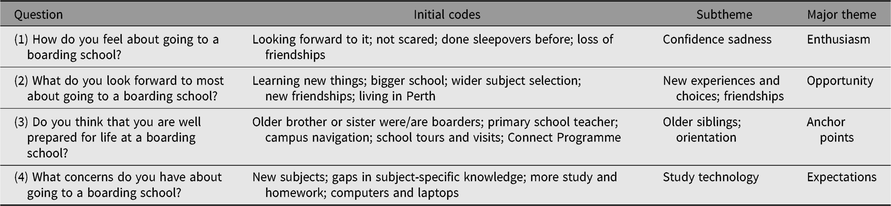
Four major themes and eight subthemes emerged from the qualitative data collected; see Table 1. In the following section, a description of each major theme and subtheme is provided along with evidence for each through the provision of exemplars selected from the focus group transcript to reflect the voice and experiences of participants (examples presented in italics).
Major themes and related subthemes

Enthusiasm – confidence and sadness
Enthusiasm
Congruent with the quantitative data, when asked how they felt pre-transition about going to boarding school, participants described an overarching feeling of enthusiasm. As one student explained, “[I’m] feeling more enthusiastic because I’ve already met quite a few kids through this the Connect Programme, which has really helped me to get to know a lot of other kids better.” When prompted further, participants mentioned looking forward to two key aspects of going to S1. First, the chance to meet new people and make new friends; and second, accessing a greater range of co-curricular options in comparison to that offered at their primary school. As another participant succinctly put it, “I’m looking forward to meeting lots of new people and trying out new sports and just trying new things.”
Confidence
It emerged from the focus group that participants were not daunted by the prospect of schooling away from home and family. Rather, as one participant asserted, “I’m feeling pretty confident about going to boarding school and not that scared, really.” When asked further about this shared sense of confidence, another participant explained, “I know what it feels like sleeping away from home because I’ve done sleepovers a lot.” Students conceiving life at boarding school as a big sleepover with friends has been reported before by post-transition research (Downs, Reference Downs2001). Here, however, it is worth differentiating that this pre-transition appraisal of life at boarding school is based on the only analogous experience available to participants (sleeping over at a friend’s house) rather than through the lived experience of sleeping in a boarding house prior to commencement.
Sadness
In contrast with the quantitative data, the focus group discussion did not converge on missing family, being away from home, or even the prospect of experiencing homesickness. Yet, it emerged that an aspect of participants’ enthusiasm about going to boarding school was that they experienced a co-occurring sense of sadness about the impact that schooling away would have on existing primary school friendships. Several were particularly concerned that boarding school would disrupt the continuity, shared history and close-knit relationships they had forged with primary school friends. As one participant explained, “I will feel sad because I won’t get to see my friends that I’ve made here at [name of primary school].” Consistent with the findings of others (Mackenzie et al., Reference Mackenzie, McMaugh and O’Sullivan2012), the looming rupture to established and trusted friendships caused several participants to further reflect on the challenge of achieving social acceptance with a new peer group and their own ability to fit in with others once at S1.
Opportunity – new experiences and choice, friendships
Opportunity
Participants foremost described the impending transition to S1 as an opportunity. Consistent with the quantitative data, participants reported looking forward to the challenge of new experiences such as camps, excursions and living away from home; meeting new people and forging more friendships; and gaining access to a wider breadth of subject choices and co-curricular options such as music and sports. The unanimity of this finding reflected the perception that going to S1 was the best possible secondary education pathway given their geographical circumstance (e.g., living outside of Perth). Indeed, it was evident that participants had started to envisage themselves taking up new opportunities and benefiting from various experiences offered at S1. As one participant said, “In a little country town like here [his home town], you don’t really have as many opportunities as you do in Perth where you get help with your education. It’s a lot better than down here [home town]. You get a lot better sport and that.”
New experiences and choice
Congruent with other research (Mackenzie et al., Reference Mackenzie, McMaugh and O’Sullivan2012), participants looked forward to trying new learning experiences and being taught new things at S1. Participants also alluded to perceived longer-term benefits of gaining access to a wider range of subject choices and, in turn, looked forward to pursuing personal learning goals and priorities. One participant explained, “I’ll have a lot more opportunities and education because at my school, I don’t really get as much opportunities with maths and that. It’s not the best maths school in the district. So, it’ll be a lot better with education and I will get through life.” It is perhaps not surprising that for several participants an inherent curiosity beyond just educational benefits of boarding school was also evident. One participant outlined how going to S1 would allow him to explore an urban lifestyle as well as try new and unfamiliar cuisine, he shared, “I’m looking forward to the dinners and that. I don’t know why. I’ll try out new foods and that.”
Friendships
Consistent with the quantitative data and findings of other studies (Maguire & Yu, Reference Maguire and Yu2015; Rossiter et al., Reference Rossiter, Clarke and Shields2018), the opportunity to extend and explore new friendship networks heavily influenced participant’s positive perception of the impending transition. For example, one participant shared, “I’ll like have friends and I’ll have others friends and we will make one big group of friends and you’ll be able to stick with the rest of the boarding students.” Similarly, another commented, “I know a few other boys who are going to S1, for like hockey and football and other stuff. So, it’s going to be good living with a few of my friends. And I’m sure I’ll meet a heap more.” In contrast to other transition research (Topping, Reference Topping2011; Waters et al., Reference Waters, Lester and Cross2014a, Reference Waters, Lester and Cross2014b), while forging new friendships was on the mind of participants, no concern was raised by participants about potential problematic aspects such as feeling socially isolated, bullying or schooling with older and larger students at S1.
Anchor points – older siblings and orientation
Anchor points
Primary school students often only have minimal access to accurate information about life at boarding school (Hadwen, Reference Hadwen2015). Hence, it is perhaps not surprising then that in preparation for the impending transition to S1 it was evident that participants made significant effort to identify reliable sources of information and knowledge about life at boarding school. Anchor points have been described as any source of information and knowledge (e.g., family, friends, siblings) or program and service (e.g., teacher and school personnel) available in a young person’s life that they feel will help them in a new school context (Koizumi, Reference Koizumi2000). Indeed, a distinguishing characteristic of an anchor point is that they are typically valued by a young person as an asset (Akos et al., Reference Akos, Queen and Lineberry2005). Participants in this study indicated that older siblings and orientation day activities were key anchor points that helped them to prepare for the adjustment to boarding school.
Older siblings
Having an older sibling that had been to boarding school or at S1 was perceived as increasing the likelihood of experiencing a smoother transition. Indeed, simply observing the experiences of an older sibling enabled participants to build a sense of preparedness through forming familiarity with the campus layout, boarding house staff and routines at S1 (e.g., sharing a dorm room and eating in a dining hall). For example, one participant revealed, “I feel very prepared because I’ve been to [boarding school] heaps to pick up and drop off my brother.” Consistent with others (Jindal-Snape & Foggie, Reference Jindal-Snape and Foggie2008; Mackenzie et al., Reference Mackenzie, McMaugh and O’Sullivan2012; van Rens et al., Reference van Rens, Haelermans, Groot and van den Brink2018), older siblings were associated with helping participants to learn about informal aspects of the impending transition experience and, in turn, enabling them to avoid peer rejection. Fitting in with behavioural codes, interpersonal and social expectations when living with older boarding students was a particular concern for participants, as one explained, “I’m a bit more prepared because I’ve already had a brother go to [S1] and he has taught me how to act and behave there to fit in.” Indeed, this participant further shared how his older brother had advised him, “Oh, well, you don’t go up to the Year 12 students and be a little smart aleck.”
Orientation
Consistent with the quantitative data, taking part in formal orientation day activities and the opportunity to form a friendship network online through the Connect Programme prior to arriving was seen by participants as helping them to prepare for life as a boarding student at S1. Congruent with other research (Akos et al., Reference Akos, Queen and Lineberry2005; Uvass & McKevitt, 2013; van Rens et al., Reference van Rens, Haelermans, Groot and van den Brink2018), orientation day activities offered participants substantive information about procedural aspects of their future school environment such as campus layout and classrooms. One participant explained, “It showed me where all the buildings were and how easy it is to get around from one place to the other. I thought it was going to be a big maze but it wasn’t really.” In contrast to the quantitative data findings, the opportunity to connect online with peers and form a friendship network through the Connect Programme prior to the impending transition was highly valued by the focus group. Participants emphasised this online space as an important source of pre-transition peer support; one participant explained, “We interact with each other and help each other out, so it can help us when we get to S1.”
Expectations – study and technology
While participants reported feeling motivated by the opportunity to undertake new learning experiences and taught new things, congruent with the quantitative data, it emerged that all held reservations about the academic expectations at S1 and their academic preparedness to meet these. Participants were alert to the prospect of encountering more challenging and difficult coursework, having potential gaps in subject-specific knowledge, and having to adapt to different teachers, teaching styles and grading methods. In tackling these adjustments, participants took reassurance from their involvement with the Connect Programme. However, two ubiquitous but specific perceptions seemed to underpin a sense of apprehension about their academic preparedness. Consistent with the quantitative data, they would have to dedicate significantly more time completing homework and studying; and second, being concerned about their experience with unfamiliar learning devices and software programs and their ability to meet computing expectations once at S1.
Study
Congruent with the quantitative data, a desire and willingness existed across the focus group to meet the perceived academic expectations of S1, and participants endorsed the exertion of personal effort to meet the challenge of an increased workload. However, consistent with the quantitative data and other pre-transition research (Mackenzie et al., Reference Mackenzie, McMaugh and O’Sullivan2012), a source of deep concern for participants was their self-appraised competence to cope with and meet the anticipated homework standards and study requirements at S1. Participants anticipated that the impending transition would necessitate more intensive individual responsibility for homework completion and focus on studying. Yet, it was equally evident that they felt gaps existed in their familiarity with practical study skills and homework strategies and were unsure how to bridge this gap in knowledge. One participant shared, “I’m sort of worried about homework because I’m not one of those people who likes to do homework, but I’m sure I’ll get it done, I hope.”
Technology
A notable concern voiced by the focus group was the need to adjust and cope with the integration of new Apple learning devices (e.g., Macbook Air and iPad) and different software programs (e.g., Pages, Numbers, Keynote) once at S1. While not diminishing their enthusiasm towards the prospect of accessing and trying new subjects, this self-appraised gap in day-to-day familiarity and fluency with new software and technologies was seen as adding a layer of difficulty to the academic component of the impending transition. As one participant said, “I’m not very good on a computer and you’ll have to do a lot of things on there [the computer].” Indeed, for some, the prospect of getting good grades and experiencing academic success at S1 was perceived as a function of their ability to rapidly overcome this paucity in knowledge.
Discussion
This study investigated the self-reported perceptions, readiness and psychological wellbeing of young people prior to transitioning to a secondary boarding school. While the number of participants recruited makes it challenging to make recommendations, this research offers a number of valuable insights into the pre-transition perceptions of young people going to boarding school. The findings here indicated that while participants reported apprehensions about expectations, study and technology, all viewed the impending transition to S1 as a positive opportunity in their lives. Ryan and Deci (Reference Ryan and Deci2000) argue that early to mid-adolescence is synonymous with a growing desire to explore new contexts, exercise autonomy and self-determination, as well as building competence beyond parental monitoring. Given this, the positive appraisal and perception of the impending transition to boarding school by participants in the current study should perhaps not come as a surprise. Rather, it reflects young people striving for mastery through seeking experiences that gradually become more challenging and which equally provide meaning and purpose in life (Ryan & Deci, Reference Ryan and Deci2000), particularly since all participants in this study revealed a personal aspiration to select from a greater breadth of curricular and co-curricular interests beyond that available at their local secondary school, as well as showed a higher motivation to meet new people and extend their social connectedness with peers.
Congruent with other research (Jindal-Snape & Foggie, Reference Jindal-Snape and Miller2008; Mackenzie et al., Reference Mackenzie, McMaugh and O’Sullivan2012), formal school tours, orientation day activities and involvement in the Connect Programme were perceived as helpful by participants. However, it was also evident that participants were equally keen, if not more, to source further information about the informal aspects and social conventions of life at boarding school. This finding arguably suggests that extending pre-transition practices and programming to include multiple informal social learning opportunities offers enormous potential in supporting new incoming students with the transition to boarding school. Indeed, the creation of positive informal social learning experiences led by valued peers (e.g., existing boarding students and siblings) and leveraging the growing adolescent desire for relatedness through social connectedness with others honours multiple developmental needs (Dahl et al., Reference Dahl, Allen, Wilbrecht and Ballonoff Suleiman2018). Informal social learning experiences led by valued peers not only promotes an early sense of belonging (Osterman, Reference Osterman2000) and connectedness with schooling (Lester, Waters, & Cross, Reference Lester, Waters and Cross2013) but also, in turn, could help reduce the risk of school absenteeism and dropout.
Waters and colleagues (Reference Waters, Lester and Cross2014a, Reference Waters, Lester and Cross2014b) asserted that the continuity of perceived peer support is pivotal to a successful transition experience. It is well established that peers can positively and negatively influence the appraisal held by young people about an impending transition, as well as their actions, attitudes and behaviours once in a new school environment (Akos et al., Reference Akos, Queen and Lineberry2005; Coffey, Reference Coffey2013; Tobbell & O’Donnell, Reference Tobbell and O’Donnell2013). Participants here emphasised how pre-transition online social networking facilitated by the Connect Programme forums enabled them not only to connect with and learn about others preparing to embark the same educational journey, but also to pull together and form an alternative source of informal peer support. Adolescence is typified by an intensification of motivational salience and reorientation of attention towards peer relationships, and especially in relation to exploring positive social connection (Dahl et al., Reference Dahl, Allen, Wilbrecht and Ballonoff Suleiman2018). Findings here suggest that while participants were apprehensive about adjusting to new devices and software once at S1, congruent with the assertions of other adolescent research (Dahl et al., Reference Dahl, Allen, Wilbrecht and Ballonoff Suleiman2018), they were quick adopters of social networking platforms and digital technologies as a way to connect with other students preparing for the impending transition to boarding school.
It is important to acknowledge that when compared to norms, participants in this study reported low levels of psychological distress. Research suggests that young people experiencing high levels of psychological distress prior to transition are at an elevated risk of having a difficult and stressful adjustment to secondary schooling (Riglin et al., Reference Riglin, Frederickson, Shelton and Rice2013, Reference Riglin, Petrides, Frederickson and Rice2014). However, the current research found symptoms associated with emotional problems, conduct problems, hyperactivity, peer problems, prosocial behaviour and overall total difficulties were all within the normal range. In contrast with prior research (Lester & Mander, Reference Lester and Mander2015), participants raised no concern about exposure to potential bullying by same-aged or older peers. Rather, it emerged that participants reported a positive sense of overall life satisfaction that was higher than equivalent norms. For internal, school and community, as well as home protective factors associated with resilience, participants reported scores either similar to or higher than the normal range. The only aspect of resilience that was found to be less than the norm was for protective factors associated with peers (e.g., access to caring relationships and prosocial friends). This finding corresponds with research that asserted that even adolescents who report few concerns in their life still perceive that the most daunting aspect of the primary to secondary school transition is securing social acceptance with peers and establishing a new friendship circle (Mackenzie et al., Reference Mackenzie, McMaugh and O’Sullivan2012; Maguire & Yu, Reference Maguire and Yu2015; van Rens et al., Reference van Rens, Haelermans, Groot and van den Brink2018; Waters et al., Reference Waters, Lester and Cross2014a, Reference Waters, Lester and Cross2014b).
Research suggests that students who perceive they have low academic competence or no control over their academic achievement at school are at a greater level of vulnerability to experiencing a difficult transition and are more likely to report stress once at their new school (Riglin et al., Reference Riglin, Frederickson, Shelton and Rice2013, Reference Riglin, Petrides, Frederickson and Rice2014; Rossiter et al., Reference Rossiter, Clarke and Shields2018). While motivated to do well at S1 and looking forward to the challenge of new learning experiences and being taught new things, both questionnaire data and focus group feedback indicated that participants’ academic self-perception was low. This finding suggests it would be important for boarding schools to consider pre-transition practices and programming that facilitates a connection between new incoming students and those key staff that will be teaching them (Akos et al., Reference Akos, Queen and Lineberry2005; Coffey, Reference Coffey2013; Downs, 2001, Reference Downs2003; Tobbell & O’Donnell, Reference Tobbell and O’Donnell2013; Uvass & McKevitt, 2013; Whyte & Boylan, Reference Whyte and Boylan2008). Indeed, participants in this study reported highly valued importance placed by the Connect Programme at S1 on investing time to understand their personal aspirations and goals for their secondary schooling.
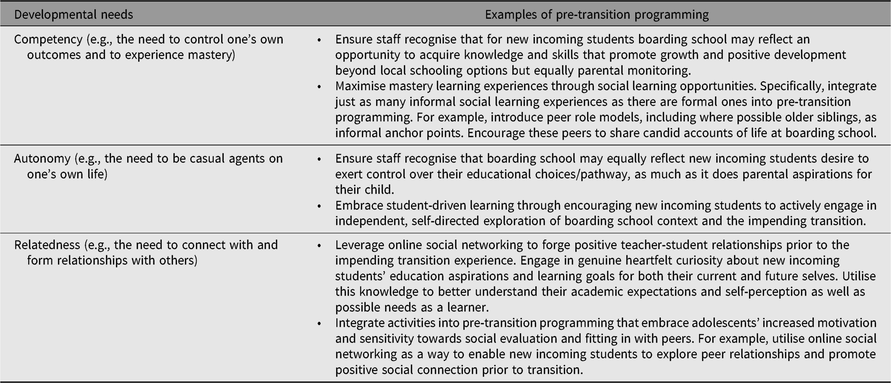
Table 2 presents some further examples of potential opportunities for boarding schools to match pre-transition practices and/or programming with the developmental needs of competency, autonomy and relatedness during the early to mid-adolescence period (Niemiec & Ryan, Reference Niemiec and Ryan2009; Ryan & Deci, Reference Ryan and Deci2000).
Examples of matching pre-transition programming to developmental needs during early to mid-adolescence

In sum, participants looked at the impending transition to boarding school positively and as a window for both educational and personal growth, as well as an opportunity to meet different people and make new friendships. This study suggests that meaningful pre-transition involvement with new incoming students seems a pertinent aspect of policy and practice for boarding schools to consider. Strategic investment in both online and offline pre-transition programming, arguably, extends to incoming students not only a sense of belonging and connectedness, but crucially sets the foundation for forging positive student–teacher relationships while enabling staff in boarding schools to identify those students who may require additional academic support with regard to self-perception as a learner. This study highlights the significant value and importance that new incoming students place on positive informal social learning experiences. Indeed, findings here suggest that there is a compelling argument for matching pre-transition practices and programming to developmental changes during the early to mid-adolescence period and co-occurring innate psychological needs such as the growing desire for competence, autonomy and relatedness (Ryan & Deci, Reference Ryan and Deci2000), as it could contribute to the facilitation of smoother transition experiences to boarding school for new incoming students.
Strengths and limitations
Congruent with calls for further research in the literature (Mackenzie, et al., Reference Mackenzie, McMaugh and O’Sullivan2012; Mander & Lester, Reference Mander and Lester2017; Rossiter et al., Reference Rossiter, Clarke and Shields2018; van Rens et al., Reference van Rens, Haelermans, Groot and van den Brink2018), this study used a mixed-method approach to investigate perceptions, readiness and the psychological wellbeing of young people prior to transitioning from primary to a secondary boarding school. A mixed-method approach was used as it increases the validity of the findings, and allows the researchers to gain a deeper and broader understanding of participants’ experiences compared to utilising a single approach (Hurmerinta-Peltomäki & Nummela, Reference Hurmerinta-Peltomäki and Nummela2006; O’Cathain, Murphy & Nicholl, Reference O’Cathain, Murphy and Nicholl2010). It also offers a greater confidence in results obtained and conclusions made (Coyle & Williams, Reference Coyle and Williams2000; Morse & Chung, Reference Morse and Chung2003). This study utilised age- and group-based means as well as consensus to draw conclusions about the average experience of participants prior to the transition to one boarding school. Yet, adolescents are a heterogeneous group, with different trajectories of brain development, pubertal and physiological maturation patterns. Hence, to advance the field beyond a one-size-fits-all approach, it seems crucial to explore individual differences alongside the pursuit of more broad domains. Other limitations to this study include the small number of students, restriction to males, and the reliability of some of the resilience and strengths and difficulties measures.
Acknowledgements
The authors would like to acknowledge and sincerely thank all the staff and students of S1, but particularly Miss Teneeka Hill for her significant support to this research.
Financial Support
This research received funding of $10,000 from S1. This paper represents one part of a larger longitudinal investigation that follows the whole grade 7 cohort (both day and boarding students) as they transition into S1 from primary school (grade 6).