Introduction
Mass-gathering events (MGEs) present unique challenges to medical incident commanders (ICs) in providing routine and disaster care in unknown environments.Reference Cook, Zhao, Lee and Yim1 Generally, MGEs are characterized by the concentration of people at a specific location for a specific purpose over a set time, which has the potential to strain the resources of the community.2,Reference Serwylo, Arbon and Rumantir3, Although mass gatherings consist of mostly healthy people, they are more hazardous, generating a higher number of casualties when compared to the general population in a non-crowded state.Reference Revello, Marzio and Pugliese4 On-site care at these events is important to provide rapid access to triage of casualties should a mass-casualty incident (MCI) occur, stabilization, transport of ill patients, and treat minor complaints.2 An MCI is defined as an event that overwhelms the local health care system where the number of casualties exceeds the local resources.Reference Jain, Sibley, Stryhn and Hubloue5,Reference Jain, Sibley, Stryhn and Hubloue6, Crowd risk behavior directly impacts the health and safety of the mass-gathering population. Knowledge of scene variables is helpful in predicting medical workload at mass gatherings and providing increased situational awareness.Reference Revello, Marzio and Pugliese4,Reference Hutton, Zeitz, Brown and Arbon7,
It has been suggested that unmanned aerial vehicle (UAV) technology has the potential to fundamentally change the practice of civilian Emergency Medical Services (EMS), improving the situational awareness of ICs.Reference Jain, Sibley, Stryhn and Hubloue6 Ideally, UAVs can enhance and provide ICs with situational awareness, enhanced mass-gathering monitoring capabilities, and provide early warning of danger.Reference Jain, Sibley, Stryhn and Hubloue6-Reference Sibley, Jain and Butler11, They are easy and fast to deploy, and are flexible, efficient, and customizable based on the requirements of the employing agency’s needs. The humanitarian community has been using UAVs for several years in areas of disaster mapping, information gathering, community capacity building, logistics, and transportation of goods.Reference Boccardo, Chiabrando, Dutto, Tonolo and Lingua12-Reference Fornace, Drakeley, William, Espino and Cox14, One potential use of UAVs is for mass-gathering scene assessment. Despite a proliferation of UAV technology, the authors of this study were unable to find any studies that compared UAV technology to standard practice (SP) in this context. The aim of this study was to explore the feasibility of using UAV technology and compare it to SP of scene assessment by paramedic students at an MGE. The measured outcomes are the number of features of the MGE identified by the study participants.
Methods
Study Design
This was a randomized comparison of standard scene assessment versus UAV scene assessment at an MGE. The use of video prevented contamination of the scene should numerous study participants enter the MGE itself. This study was conducted in two phases. Phase One consisted of validation of the data collection tool. Phase Two was a randomized controlled comparison of the scene assessment systems. The ethics committee for applied research at Holland College, Charlottetown, Prince Edward Island, Canada approved this study.
Study Setting and Sample
The MGE studied was the Cavendish Beach Music Festival, Cavendish Beach, Prince Edward Island, held July 7-9, 2017. This yearly music festival attracts up to 30,000 people. The scene assessment videos were recorded on July 9 at 1:00pm with the ground portion video being 20 minutes in length and the UAV video 11 minutes in length.
Phase One: Validation of the Data Collection Tool
Phase One was completed by 11 experienced paramedics from a provincial EMS service who agreed to participate in this phase of the study. They completed the data collection tool (Appendix 1; available online only) after viewing both videos. The data collection tool was based on previous published risk assessment matrix with augmentation of variables considered important by the study authors.Reference Revello, Marzio and Pugliese4 In addition, the participants were asked to complete a survey asking if they understood the questions, if the language was appropriate, and what variables should be added or subtracted.
Phase Two: Comparative Trial
A convenience sample of paramedic students, comprising 28 first year primary care paramedic (PCP) students and 19 second year PCP students, volunteered to participate in Phase Two of the study. Inclusion criteria included students who were 18 years or older and in good academic standing. Prior to the trial, consent was obtained from all students. They were provided with a 15-minute lecture on MGE variables and presented with the study. The students were then randomly assigned to the UAV or SP groups. The study groups were then assigned separate classrooms and given the data collection tool. Each group viewed their respective video, concurrently filling out the data collection tool, with a study adjudicator present in each room to answer questions. After the study groups completed their data collection tool, they were collected for analysis.
Unmanned Aerial Vehicle Technology
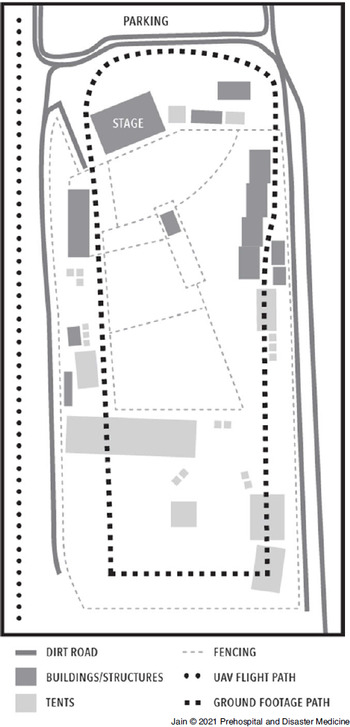
A Royal Canadian Mounted Police (RCMP; Ottawa, Ontario, Canada) piloted the DJI Inspire 1 version 2.0 (SZ DJI Technology CO, Ltd; Shenzhen, Guangdong, China) UAV platform utilized. The UAV had a flight time of 18 minutes, a range of 2000m, a takeoff weight of 3060g, and a maximum height of 4500m. The ground station was based on an android operating system consisting of flight control, cameral control, and a large 40in digital display. The UAV flew in an “I” shape pattern at 120ft from the south and east portion of the event (Figure 1). This flight and video recording were conducting while a subject matter expert (SME) simultaneously walked the ground of the MGE in a horseshoe pattern. The ground SME was wearing a Go Pro (Go Pro Inc.; San Mateo, California USA) camera on their head to record the footage simulating spontaneous scanning of the MGE environment.
Diagram of the Event Site.
Abbreviation: UAV, unmanned aerial vehicle.

Measurements
The primary outcome measures were the features and characteristics of the scene identified by the study participants when viewing the videos. These were sub-divided into variables of primary and secondary importance by experts in Disaster Medicine based on their relevance. Primary variables were those that were considered important to know as the event progressed. Secondary variables were those of interest, but not part of the active monitoring of the event. The validation phase included only primary variables, for which the proportions of answers in the most common category were examined. The purpose was to identify questions which could not be assessed reliably from the videos. In Phase Two, the distribution of answers to each of the questions was compared statistically between the UAV and SP groups by a Fisher’s exact test with a two tailed alternative. The significance level was set at P <.05 (Stata software 2013; StataCorp LP; College Station, Texas USA).
Results
The Phase One validation showed good consensus in the answers to most questions (average 79%; range 55%-100%), and the two questions with low consensus (presence of fire fighters and density in vendor area) were considered acceptable to keep in the survey due to their importance with regards to scene safety.
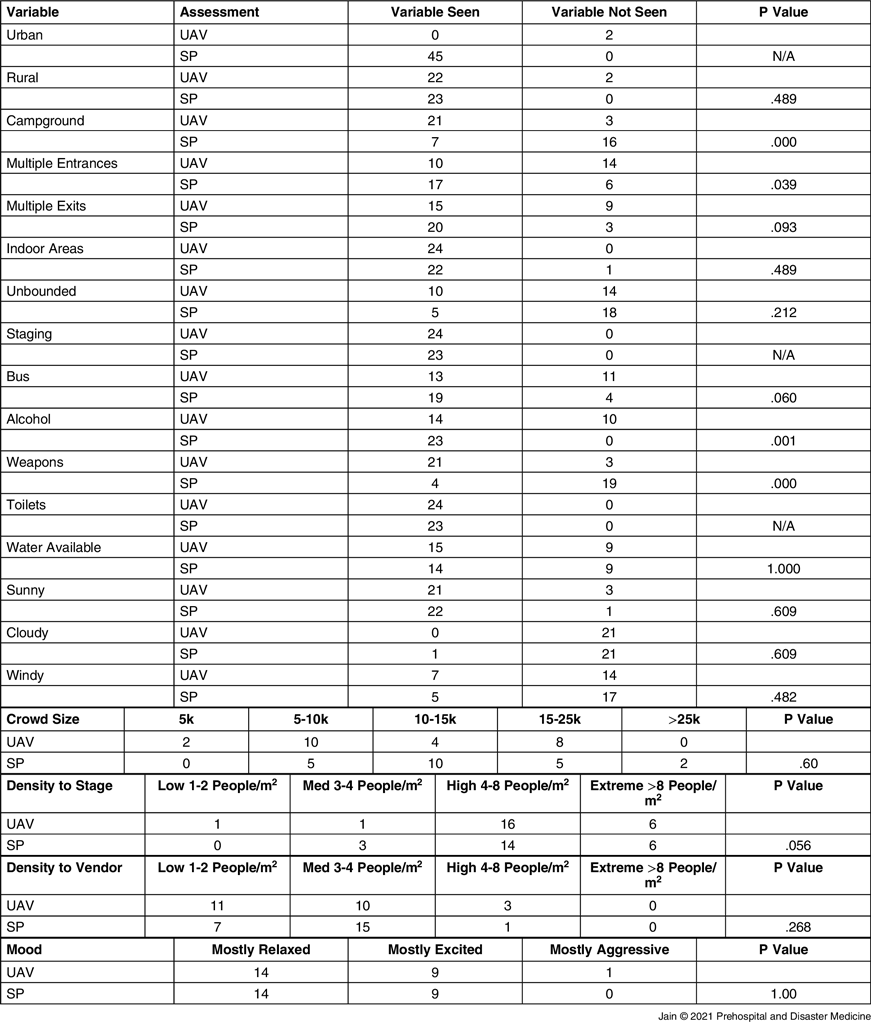
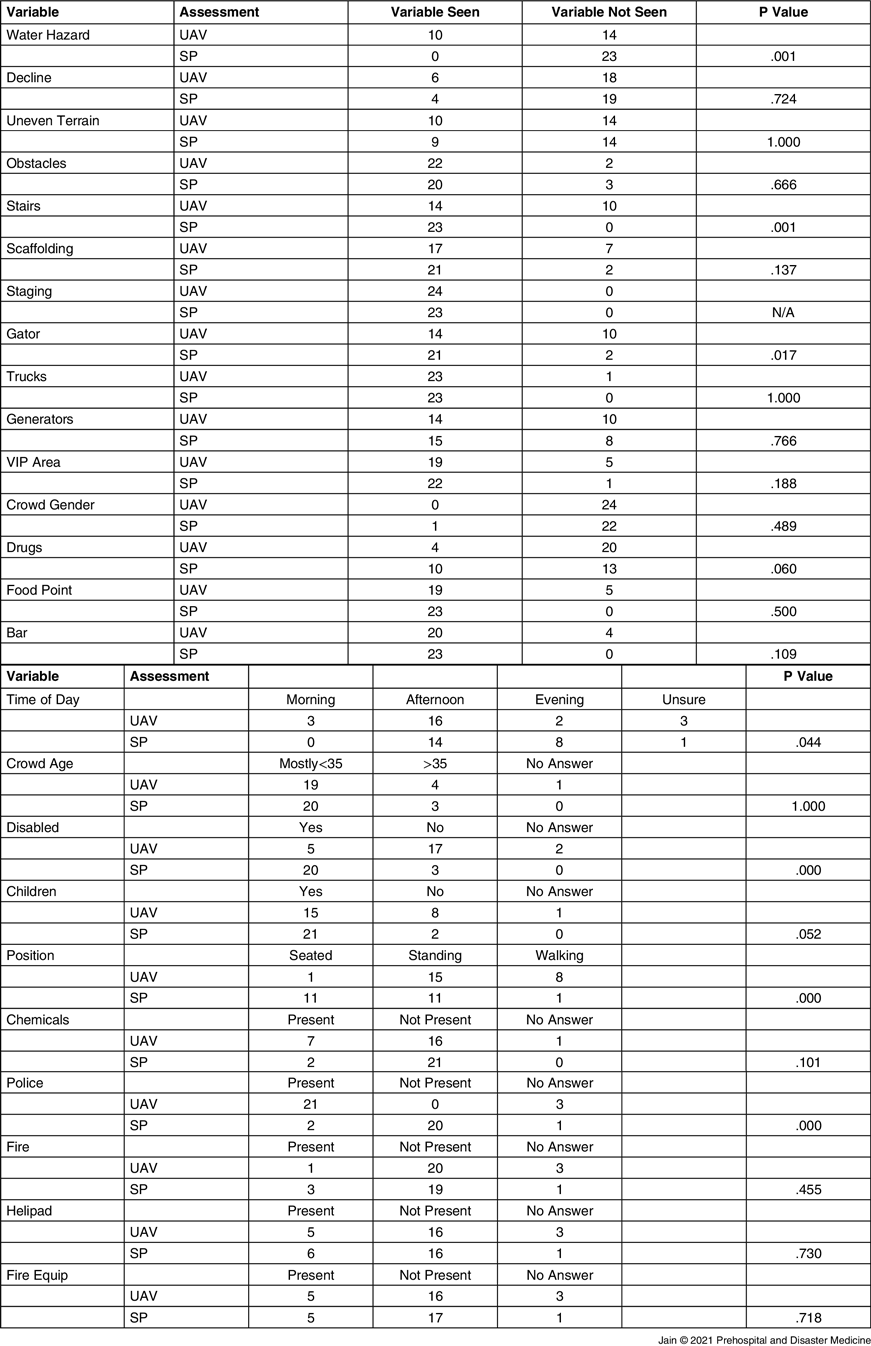
A total of 47 paramedic students out of 50 volunteered to participate in the trial (Phase Two). Approximately one-half of the participants had attended the Cavendish Beach Music Festival in the past. Demographic variables were very similar between the two study groups. Phase Two answers showed a significant difference between the SP and UAV groups in four of the 20 primary variables, with a strong (P <.001) difference for the sighting of campground, alcohol, and weapons (Table 1). Additionally, significant differences were found for seven out of the 25 secondary variables (Table 2).
Fisher’s Exact Test for Variables of Primary Importance for ICs at an MGE

Note: n = 47; no observed difference in 80%; where N/A is seen, this indicates that all answers were in the same category.
Abbreviations: IC, incident commander; MGE, mass-gathering event; SP, standard practice; UAV, unmanned aerial vehicle.
Fisher’s Exact Test for Variables of Secondary Importance for ICs at an MGE

Note: n = 47; no observed difference in 72%; where N/A is seen, this indicates that all answers were in the same category.
Abbreviations: IC, incident commander; MGE, mass-gathering event; SP, standard practice; UAV, unmanned aerial vehicle.
Discussion
Although UAVs have been used in the Disaster Medicine context, there are limited studies on the use of this technology in scene assessment of an MGE.Reference Wesson and Humphreys15-17, The authors of this study wanted to examine the effect of this technology on primary and secondary variables considered important in an MGE scene assessment. Previous studies have demonstrated the ability of UAVs to detect hazards and perform initial triage during MCIs.9-Reference Sibley, Jain and Butler11, During an MGE, the medical IC needs to be able to have real-time situational awareness of the event, allowing an appropriate use of resources should an emergency occur. Using the UAV’s bird’s eye view, ICs experience enhanced real-time situational awareness, gaining information of environmental factors that assist in planning an immediate response to an MGE disaster.Reference Cook, Zhao, Lee and Yim1 Having the ability to have real-time situational awareness during the event provides a unique capability that could benefit victims at an MGE.
This study demonstrated no observed difference in 80% of the primary variables. Primary variables were those considered having importance to the medical IC in providing situational awareness of the MGE. The variables that were noted to be visibly different included campground, multiple entrances, alcohol, and weapons. The campground was not visible by the majority of test subject who were viewing the ground footage as it was behind a tree line and not located in the event itself. Alcohol consumption was not seen by some of the UAV test subjects. This was due to the height and the location of the UAV since it needed to follow Transport Canada (Ottawa, Ontario, Canada) guidelines flying at a safe altitude and was unable to fly over the crowd. When the UAV was taking off from its launch point, its camera captured the gun holsters of the police team flying and manning the UAV, hence the reason for this difference when noting weapons at this MGE. Due to the flight pattern of the UAV, only one major entrance was visible and captured by its footage. All of these above-mentioned variables would already have been known by the IC prior to the event during the planning phase. Therefore, the authors do not believe these observed differences are of any operational significance.
This study also observed no difference in 72% of the secondary variables. Differences in secondary important variables were noted in the water hazards, stairs, gator, time of day, disabled persons, crowd position, and police categories. The water hazard noted was outside the bounded area of the event itself. Stairs, gator (vehicle), and disabled persons were more visible with SP. Delineation of crowd position was better with SP where police were more visible with the UAV due to its starting position and launch point. The authors do not believe that differences in these secondary variables adversely affected situation awareness of medical ICs, and overall, could be considered negligible since these would not be of importance during active monitoring of the event. However, the nature of the crowd including crowd density, size, and mood are more indicative of the potential medical workload and would be operationally relevant during the event and were delineated by the UAV.
According to these results, a majority of primary and secondary variables that would be of interest to a medical IC would be able to be seen by using the UAV. A UAV system could be utilized at an MGE and provide the IC real-time situational awareness, allowing them to make informed decisions regarding response, mitigation, as well as resource utilization should an MCI or disaster occur.Reference Leduc8,Reference Wesson and Humphreys15-17 A UAV can see the whole scene at once, as opposed to select portions of the scene that occurs in SP. This study is one of the first to conduct a randomized comparison using UAV technology versus SP when assessing an MGE scene. This study not only demonstrated the feasibility of using this technology, but its significant benefit in scene assessment.
Limitations
There are design and technical limitations when considering the results. Generally, UAVs are subject to performance limitations impacting their utilization. Although the police service was able to fly UAVs close to crowds for policing-related activities, they must follow regulations that prevent its full utilization. The authors also employed a convenience sample of paramedic students and did not apply a power calculation to determine a minimum sample size. A repeat of this study with more participants may reveal a difference that went undetected in the study. Finally, this was a simulation environment that is different from the actual clinical setting, which may have distractors and other factors that are not being represented.
Conclusion
This study demonstrated the accurate, safe, and feasible use of UAV technology in scene assessment by paramedic students at an MGE. No observed statistical difference was noted in a majority of both primary and secondary variables of importance. This study was limited by a sample of convenience and the research question merits further evaluation by employing a larger sample size to verify results.
Conflicts of interest/funding
Authors declare no financial interest or benefit from application of this research.
Supplementary Materials
To view supplementary material for this article, please visit https://doi.org/10.1017/S1049023X2100114X