The selective pressures of both inpatient and outpatient antibiotic use have contributed to the evolution of increasingly drug-resistant bacteria. The Centers for Disease Control and Prevention (CDC) recognizes multidrug-resistant organisms and infections, such as Clostridium difficile infection (CDI) and carbapenem-resistant Enterobacteriaceae (CRE), as urgent threats to the US healthcare system. 1 It is estimated that the CDI alone causes 2,500,000 infections, 14,000 deaths, and $1 billon in excess medical costs per year. Furthermore, the first pan-resistant CRE isolate in the United States, mcr-1, was recently identified, ushering us into the “post-antibiotic era.”Reference McGann, Snesrud and Maybank 2 Truly, more responsible management of antibiotic utilization is urgently needed to limit the development of antibiotic resistance.
Significant scrutiny has been placed on antibiotic utilization in hospitals. The CDC has proposed comparing and monitoring antibiotic utilization among hospitals using the standardized antimicrobial administration ratio. 3 Furthermore, the Centers for Medicare and Medicaid Services has proposed a rule requiring all acute-care hospitals to have formal antibiotic stewardship programs to reduce inappropriate antibiotic use. 4
Despite aggressive national action on inpatient antibiotic use, outpatient antibiotic utilization rates and appropriateness remains poorly studied. Conservative estimates suggest that up to 30% of outpatient antibiotic use among medical providers may be inappropriate.Reference Fleming-Dutra, Hersh and Shapiro 5 Mistreatment of viral respiratory tract conditions with antibiotics is particular concerning. For example, in one study, >70% of adult patients with pharyngitis were given an antibiotic prescription, while only 18% met treatment criteria for streptococcal pharyngitis.Reference Fleming-Dutra, Hersh and Shapiro 5 Sinusitis, also often a viral condition, was the number 1 medical condition associated with antibiotic prescriptions in a large national data set.Reference Fleming-Dutra, Hersh and Shapiro 5 Furthermore, children receive excessive antibiotics when influenza is circulating in the community.Reference Neuzil, Mellen, Wright, Mitchel and Griffin 6 The objective of our study was to evaluate outpatient antibiotic prescription patterns over time, and in particular, to assess the presence of seasonal variation in use of common antibiotics. We hypothesize that the annual antibiotic prescription rate has declined annually and that the most common antibiotics will exhibit seasonal variation, with higher antibiotic prescription rates during the winter months corresponding to the distribution of upper respiratory viral illnesses, particularly influenza.
METHODS
Study Design and Data Source
This study is an ecological and temporal trend study involving retrospective analysis of outpatient antibiotic prescriptions from deidentified administrative claims data for the period between January 1, 2013, and December 31, 2015. Outpatient antibiotic prescription data were obtained for a sample of insured members whose pharmacy benefits were managed by a large pharmacy benefit management company, Express Scripts Holding Company.
Study Variables
Antibiotic utilization was initially evaluated on an annual basis for the 3-year period from 2013 to 2015. All systemic outpatient antibiotics were summed per calendar year. Eligibility was not controlled for during the study period. Hence, prescription rates per 1,000 beneficiaries were calculated using midpoint values of beneficiaries for each calendar year. Antibiotic costs were calculated by summing individual members’ health insurance plan costs and out-of-pocket expenses. Costs per prescription were extracted and summed per calendar year and calculated as costs per 1,000 beneficiaries.
Data included total number of prescriptions, total number of prescribers, antibiotic name, number of antibiotic pills prescribed, date of prescription, cost of antibiotic prescription, and geographic location of prescriber by state. Prescription claims for members with missing or duplicate information were removed. In addition, reversed (unfilled) prescription claims were excluded from the analysis.
Analysis
Monthly prescription rates for all antibiotics were plotted for each of the 3 years examined in this study to visualize the seasonal variation. The 5 most commonly prescribed antibiotics in the database were plotted and assessed in a similar fashion. A seasonal pattern in health outcomes is often referred to events that happen with some regularity at fixed times or dates, or in distinct climatic periods; however, seasonality may not be specifically regular in its amplitude, timing, or shape.Reference Barnett and Dobson 7
Seasonal variations in prescription counts were assessed by fitting log-linear Poisson regression models to monthly data. The magnitude of seasonal variations was quantified by peak-to-trough ratio (PTTR), which is interpreted as a relative risk with the trough month as the reference level.Reference Christensen, Lundbye-Christensen and Dethlefsen 8 Unlike the estimators based on geometrical models that assume a single peak 6 months subsequent to a trough, the estimator based on unadjusted Poisson regression provides flexibility in the pattern of seasonal variation and can adjust for the secular trend bias.
Overall temporal trends in antibiotics prescriptions were quantified and expressed as annual percent change through fitting linear regression models with autoregressive integrated moving average (ARIMA) errors to the natural logarithm of monthly rates.Reference Hankey, Ries and Kosary 9 This allows accounting for the correlation of model errors over time (ie, autocorrelation) during the study period.Reference Hyndman and Athanasopoulos 10 Analyses for seasonality and trends were performed in R version 3.2.4 (R Foundation for Statistical Computing, Vienna, Austria). All other statistics including descriptive analyses were computed using SAS version 9.4 (SAS Institute, Cary, NC). The Washington University Office of Human Research Protection approved this study.
RESULTS
Annual Antibiotic Prescription Trend
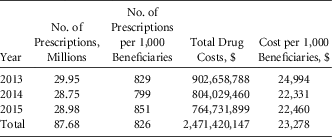
Approximately 98 million antibiotic prescriptions were filled during the 3-year study period from a sample of nearly 39 million insured members (Table 1). The mean number of prescriptions per 1,000 beneficiaries was 826 between 2013 and 2015, and this number ranged from 830 to 849 annually. There was a decrease in the antibiotic prescription rate between 2013 and 2014, followed by an increase in 2015. Although the average individual antibiotic costs per beneficiary were modest ($23 dollars per year), the overall costs in the cohort were enormous in our cohort, representing 840 million to nearly $1 billion annually.
Numbers and Rates of Outpatient Antibiotic Prescriptions Within the Express Scripts Database, 2013 to 2015.

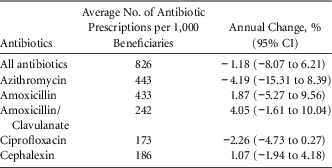
The 5 most commonly prescribed antibiotics were azithromycin, amoxicillin, amoxicillin/clavulanate, ciprofloxacin, and cephalexin (Table 2). Linear regression estimates of temporal trends expressed as annual percent change in prescriptions demonstrated no statistically significant changes in prescribing rates during the 36-month study period for all antibiotics as well as the top 5 most commonly prescribed antibiotics (Table 2).
Estimates of Average Antibiotic Use Annual Percent Change for Common Antibiotic Prescriptions Within the Express Scripts Database, 2013 to 2015.

Seasonal Variation in Antibiotic Prescriptions
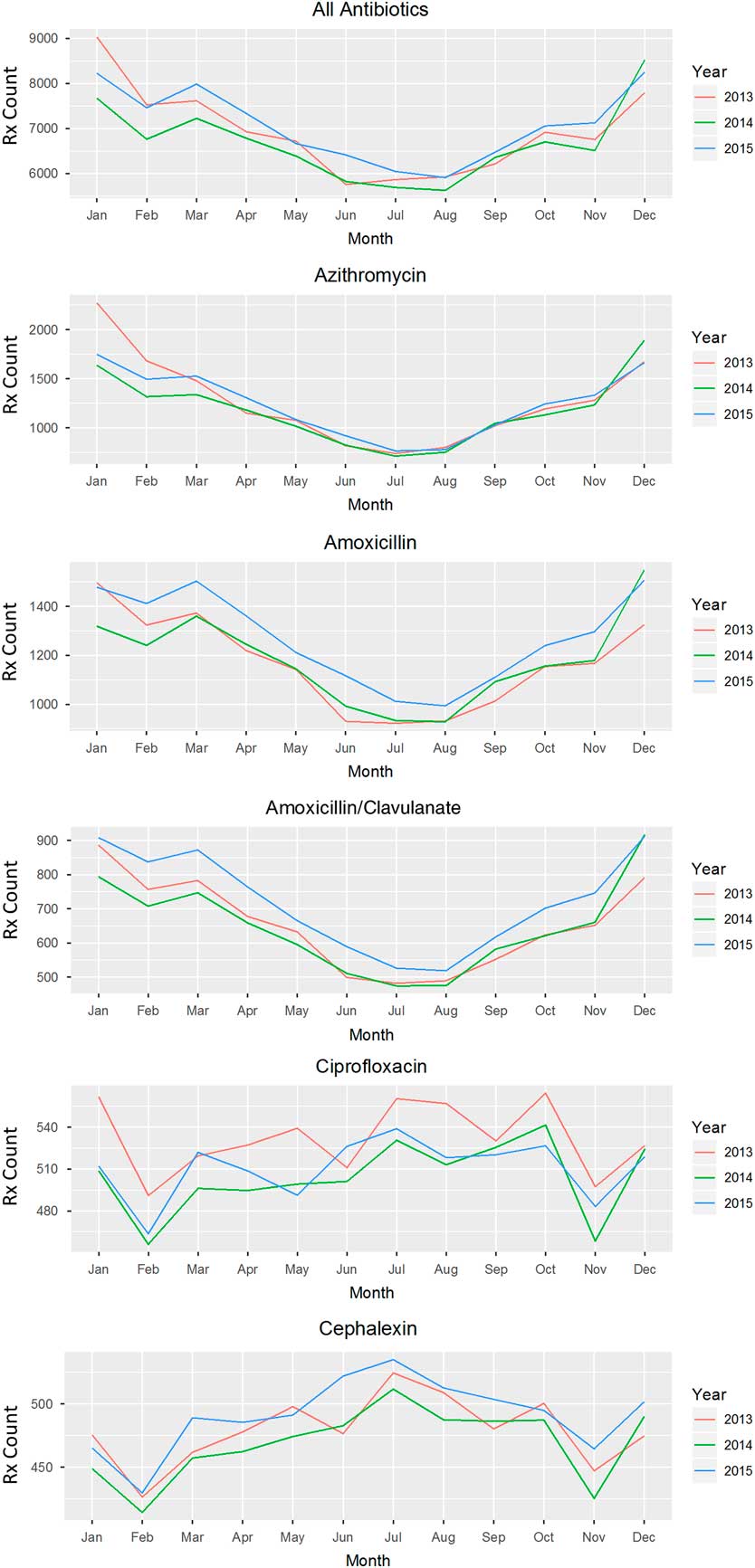
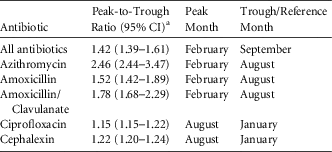
The overall antibiotic prescription rate varied significantly by month (Figure 1) with a seasonal peak observed in February that was 42% higher than the trough in September (PTTR, 1.42; 95% confidence interval [CI], 1.39–1.61). The top 3 antibiotics prescribed (azithromycin, amoxicillin, and amoxicillin/clavulanate) had similar winter-peaking trends (Table 3 and Figure 1). For example, usage of azithromycin, the most commonly prescribed medication in this study, increased by 146% in February compared to August (Table 3). Seasonal trends for the less commonly prescribed antibiotic medications, ciprofloxacin, and cephalexin, however, were reversed, with the highest prescribing month in the summer and the lowest prescribing month in the winter (Table 3 and Figure 1). Furthermore, the seasonal variation in the usage of ciprofloxacin and cephalexin was less pronounced; these medications had 15% and 22% increases in the peak month of August compared to the trough month of January, respectively (Table 3 and Figure 1).
Monthly variation of rate of outpatient antibiotic use overall and stratified by the top 5 antibiotics. NOTE. Rx, prescription.

Estimates of Seasonal Variation in Antibiotic Prescriptions Within the Express Scripts Database Expressed as Peak-to-Trough Ratios, 2013 to 2015.

a Confidence interval does not include 1. Estimated peak and trough months were calculated via regression models and slightly vary from actual antibiotic prescription count data.
DISCUSSION
Annual antibiotic prescribing rates remained unchanged over the course of our 3-year cohort study of more than 30 million insured members. These findings are surprising given the increasing pressure from multiple professional societies to reduce inappropriate prescribing practices. Since the beginning of our study in 2013, the American Board of Internal Medicine (ABIM) Foundation, in conjunction with a number of medical professional societies, has released practical recommendations in their “Choosing Wisely” campaign to reduce inappropriate antibiotic prescribing practices for the following conditions: asymptomatic bacteriuria, suspected viral upper respiratory tract infections, stasis dermatitis for lower extremities, antibiotic prophylaxis for mitral valve prolapse, antibiotics for uncomplicated skin and soft-tissue infections after successful incision and drainage, inflamed epidermal cysts, uncomplicated acute tympanostomy tube otorrhea, and uncomplicated acute external otitis. 11 The Center for Disease Control and Prevention (CDC) also provides educational resources for healthcare professionals, policy makers, and the public to reduce inappropriate antibiotic use through the longstanding “Get Smart: Know When Antibiotics Work” program. 12
The lack of any apparent change in utilization over the course of this study may support the findings of other studies suggesting that professional guidelines may not be the most effective form of influencing provider actions. Suda et al demonstrated a modest 2.6% decline in antibiotic prescriptions nationally in the United States between 2006 and 2010; however, only stratified statistical analyses were performed to evaluate this trend.Reference Suda, Hicks, Roberts, Hunkler and Taylor 13 Longer longitudinal data of primary care providers from the United Kingdom between 1995 and 2011 have shown mixed results from best practice guidelines alone. During this period, prescriptions for sore throats declined from 77% to 62% and prescriptions for otitis media increasing from 77% in to 85%.Reference Hawker, Smith and Smith 14 Similar findings have been observed for cesarean sections,Reference Lomas, Anderson, Domnick-Pierre, Vayda, Enkin and Hannah 15 management of pediatric femoral fractures,Reference Oetgen, Blatz and Matthews 16 and thrombophilia screening.Reference Kwon, Roshal and DeSancho 17 Clearly, we need more effective methods to disseminate and implement evidence-based guidelines for healthcare providers.
Several outpatient antimicrobial stewardship interventions have led to improved antibiotic utilization. Interventions as simple as posters placed in a patient waiting rooms can reduce antibiotic prescribing for acute respiratory tract infections.Reference Meeker, Knight and Friedberg 18 Some examples of more detailed interventions include antibiotic prescription benchmarking, audit and feedback, and education sessions.Reference Meeker, Linder and Fox 19 , Reference Gerber, Prasad and Fiks 20
Seasonal variation in antibiotic prescribing has been previously reported in the United States,Reference Suda, Hicks, Roberts, Hunkler and Taylor 13 , Reference Sun, Klein and Laxminarayan 21 Europe,Reference Elseviers, Ferech, Vander Stichele and Goossens 22 , Reference Achermann, Suter and Kronenberg 23 Canada,Reference Patrick, Marra, Hutchinson, Monnet, Ng and Bowie 24 and Israel.Reference Dagan, Barkai and Givon-Lavi 25 In each of these studies, overall antibiotic use was higher during the winter months. The rate of increase ranged between 21% and 42%, with our study at the top of the range. The higher rate of macrolide antibiotic prescribing during the winter months has been linked to inappropriate antibiotic prescribing for viral infections.Reference Achermann, Suter and Kronenberg 23 – Reference Dagan, Barkai and Givon-Lavi 25 Previous investigators have suggested that spikes in antibiotic prescriptions during winter months may represent inappropriate treatment for viral conditions, which tend to occur more frequently during winter months.Reference Suda, Hicks, Roberts, Hunkler and Taylor 13 , Reference Sun, Klein and Laxminarayan 21 , Reference Steinman, Gonzales, Linder and Landefeld 26 – Reference Grijalva, Nuorti and Griffin 28
Many common bacterial infections also exhibit seasonal variation. For example, bloodstream infections,Reference Anderson, Richet and Chen 29 , Reference Eber, Shardell, Schweizer, Laxminarayan and Perencevich 30 urinary tract infections,Reference Falagas, Peppas, Matthaiou, Karageorgopoulos, Karalis and Theocharis 31 peritoneal dialysis infections,Reference Cho, Badve and Hawley 32 skin and soft-tissue infections,Reference Wang, Towers, Panchanathan and Chowell 33 and surgical site infectionsReference Durkin, Dicks and Baker 34 – Reference Gruskay, Smith and Kepler 36 are all more common during the summer months. However, Streptococcus pneumoniae, community-acquired pneumonia, and methicillin-resistant Staphylococcus aureus pneumonia tend to be more common during the winter months.Reference Gradel, Nielsen and Pedersen 37 – Reference Dowell, Whitney, Wright, Rose and Schuchat 40 Therefore, at least some of the peak in antibiotic prescribing is likely related to appropriate treatment of bacterial conditions. Not surprisingly, ciprofloxacin and cephalexin, common antibiotics used for urinary tract infections and skin and soft-tissue infections, were associated with higher antibiotic use during the summer months in our study. These findings are novel and have not been described previously in the literature. Furthermore, these findings also highlight that precautions must be taken not to overgeneralize when analyzing antibiotic use. For example, moxifloxacin and ciprofloxacin are both fluoroquinolone antibiotics; however, moxifloxacin is more frequently used for respiratory tract infections, while ciprofloxacin is used primarily for urinary tract infections. Classifying these 2 agents together could misrepresent the different seasonal patterns in the prescriptions of these medications and the infections they are used to treat.
This study has several limitations. First, this cohort represents only insured patients, so the results may not be generalizable to the entire US population, including uninsured individuals. However, our results were similar to those of larger studies estimating antibiotic prescribing for the entire United States.Reference Suda, Hicks, Roberts, Hunkler and Taylor 13 Second, medications are captured only when the claims are processed, so prescription claims that are not processed (eg, during instances when individuals chose to pay for inexpensive antibiotics out-of-pocket without using their insurance) were not captured. Therefore, our data likely underestimates overall antibiotic utilization in our cohort. Third, our analysis does not include any microbiology or medical claims data; thus, we were unable to adequately assess the appropriateness of each antibiotic prescribed or the comorbidities of patients who received antibiotics. For example, some antibiotic prescriptions written during the winter months were likely appropriate for conditions like Streptococcal and Staphylococcal pneumonia, which are more common during winter months as well. Fourth, the data set that we used did not contain information at an individual patient level, so we were unable to determine whether our data contained a large number of antibiotic prescriptions for a few patients or a few antibiotics for a large number of patients. Similarly, because our analysis was limited to prescription counts, we did not evaluate differences in antibiotic prescription dose or duration of therapy in this analysis. Sixth, we did not compare influenza-like illness and antiviral prescription rates in our study. Although this would have been a nice additional evaluation, these are typically evaluated weekly (rather than monthly) and span calendar years, making comparisons using our data challenging. Additional analyses should be performed to more rigorously evaluate the relationships among antiviral prescriptions, influenza-like illnesses, and antibiotic prescriptions.
In conclusion, there were no appreciable changes in overall antibiotic use over the 3-year study period in our cohort of more than 30 million privately insured individuals in the United States, despite the concurrent release of a number of guideline-based best practices designed to reduce inappropriate antibiotic consumption. Furthermore, we identified significant seasonal variation in antibiotic prescribing. Certain agents frequently associated with inappropriate management of upper respiratory tract infections, such as azithromycin, were prescribed at a higher rate during the winter months. Additional work is needed to better link antibiotic prescriptions to indications to better quantify and trend inappropriate antibiotic prescribing practices. However, in our opinion, additional interventions, beyond guidelines and educational materials, will be required to substantially improve antibiotic prescribing at a national level.
ACKNOWLEDGMENTS
The content is solely the responsibility of the authors and does not necessarily represent the official views of the Centers for Disease Control and Prevention or the National Institutes of Health.
Financial support: Research reported in this publication was supported by the Centers for Disease Control and Prevention epicenters program (grant no. U54CK000482) and the National Center for Advancing Translational Sciences of the National Institutes of Health (grant no. KL2TR00236).
Potential conflicts of interest: M.J.D. has created continuing educational materials for Medscape. Funding for those materials was provided to Medscape through an unrestricted educational grant from Merck. V.J.F. owns stock in Express Scripts Holding Company. K.D.M. and R.R.H. are employed by Express Scripts Holding Company and hold stocks in the company. All other authors report no conflicts of interest.