INTRODUCTION
Radiographers often confirm consent to treatment during the patient’s ‘first day chat’; the primary information sharing meeting with the patient, their care givers and the radiographer. Radiographers need to provide information as part of a flexible process to facilitate meaningful decision making by patients and have a duty of care to inform them of the nature and purpose of procedures, and benefits and risks involved. 1 This process must use evidence-based information, derived from clinical research.Reference Cowan 2
Cancer patients report fatigue as one of the most common issues affecting quality of life (QoL) greater than pain, sexual dysfunction (SD) and other symptoms.Reference Jereczek-Fossa, Marsiglia and Orrechia 3 High fatigue levels during or after cancer treatment are reported by 60–96% of patientsReference Wagner and Cella 4 and 40% of radiotherapy patients at 1 year follow-up.Reference Noal, Levy and Hardouin 5 Cancer-related fatigue (CRF) is defined as ‘a distressing, persistent, subjective sense of physical, emotional and/or cognitive tiredness or exhaustion related to cancer or cancer-related treatment that is not proportional to recent activity and interferes with usual functioning’. 6 Fatigue is subjective and complex, associated symptoms including nausea, anaemia, insomnia, pain, depression, psychological distress and adverse effects of treatment.Reference Dilhuydy, Dilhuydy, Ouhtatou, Laporte, Nguyen and Vendrely 7
One of the key aims of the National Cancer Survivorship Initiative ‘Living With and Beyond Cancer’ 8 should be promoting physical activity, supported by many studies valuing exercise in the management of CRF. 6 – Reference Kuchinski, Reading and Lash 10 Health care professionals are well placed to promote good QoL, 11 with literature stressing the importance of utilising the experience and support of the multi-disciplinary team (MDT).Reference Eddy 12
Radiographers practising in the United Kingdom must be registered with the Health and Care Professions Council, who demand exacting practice standards for continuous professional development (CPD). 13 Although Higher Education Institutions (HEIs) have a responsibility to ensure learning is current and evidence based, and integration of theory and practice is central to learning, 14 radiographers must develop themselves to keep pace and deliver high quality care. However, the introduction of mandatory CPD in the United Kingdom has not significantly impacted on radiographer attitude towards CPD, radiographers remaining apathetic.Reference Henwood and Flinton 15
Therapeutic radiographers remain in a uniquely privileged position of seeing patients daily, to advise, review and support, but need to develop competence to practice confidently within the field of CRF. 9
A review of literature highlights that no research has been published to date looking at radiographer proficiency in the area of CRF management.
AIM OF THE PROJECT
The primary aim of this project is to establish whether a targeted fatigue management educational intervention impacts on radiographers’ attitude towards the provision of CRF management in supporting patients during their course of radiotherapy.
As a consequence it may be possible to determine whether there is a perceived or real lack of knowledge or confidence; also whether clinical experience gives radiographers confidence and knowledge to support patients with CRF, or whether supplementary CRF educational intervention is now a requirement for radiographers’ CPD.
DESIGN AND METHODS
A mixed method approach has been applied to this pre/post-test study.Reference Mackenzie and Knipe 16
In 2011, Griffiths and HodgsonReference Griffiths and Hodgson 17 performed a study relating to radiographer attitude to supporting SD in patients with prostate cancer. With no designated validated questionnaire to assess this, they amended the Magnan, Reynolds and Galvin (2005) Sexual Attitudes and Beliefs’ QuestionnaireReference Magnan, Reynolds and Galvin 18 to good effect. Their questionnaire included a general section for demographic information and a second section for radiographer attitude.
This research was not looking at radiographer attitude alone so some of the questions were not applicable. Equally, to elicit perceived competence and confidence of radiographers, additional questions were needed. Some questions were asked twice, using a mixture of both positively and negatively worded items to minimise the danger of acquiescent response bias,Reference Rattray and Jones 19 and some were expanded on to assess understanding of the education package. To allow respondents to expand upon answers and provide more in-depth responses, a limited number of free text response questions were included as suggested by Rattray and Jones.Reference Rattray and Jones 19
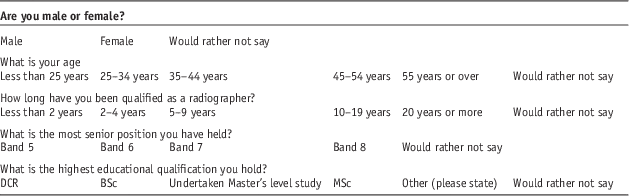
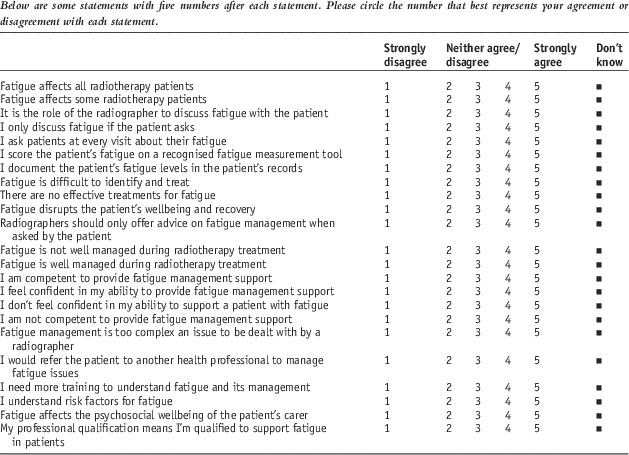
So using Griffiths and Hodgson’s questionnaire as a base, questions were amended to elicit information regarding CRF rather than SD (Appendix 1).
The educational intervention was an electronic, self-directed fatigue education package delivered via Microsoft PowerPoint©, providing information on professional responsibilities, practice standards e.g., confirming consent 1 and CPD, 9 possible causes, risk factors, treatment and support. It included tasks encouraging self-reflection, taking ~3 hours to complete. The education pack was reviewed by the Radiotherapy Lead Clinician who has a professional interest in CRF and has undertaken research in this field.
Service users, including patient representatives, were invited to comment on the study design.
PILOT STUDY
A pilot study was performed using two student therapeutic radiographers during their 12-week placement at the study site (11% of study size).Reference Connelly 20 Students were felt to be a reasonable radiographer surrogate (undergoing current radiotherapy education and supporting patients within the study centre alongside qualified staff) while allowing the largest sample size to be maintained for the parent study. No issues were raised regarding comprehension or formatting of the presentation. For pre/post-test questionnaires a Likert scale (1–5) was used to measure respondents’ attitudes, asking the extent to which they agree or disagree with a statement, a higher response indicating a positive affinity. Post-test questionnaire scores were altered for both students indicating that the education package impacted positively on their perceived competence and confidence supporting CRF.
Participants were recruited from one radiotherapy department. Convenience sampling was utilised, with all 18 registered therapeutic radiographers deemed eligible.
A priori power calculation was conducted as part of the research design, determining a population sample size of 17 was required to give a confidence level of 95%, and confidence interval of 5. 21 A similar study looking at radiographers’ confidence to support SD detected an effect using this strategy.Reference Griffiths and Hodgson 17
Information was given and consent sought in writing; those agreeing to participate being sent the pre-test questionnaire. A Likert scale (1–5) was used to measure respondents’ attitudes, asking the extent to which they agree or disagree with a statement, a higher response indicating a positive affinity. Over a 1-month period participants were given access to the education package. Once participants completed the package, they were asked to repeat the same questionnaire (post-test). Radiographers then participated in one-to-one semi-structured interviews to gain insight into their previous CRF education and perceived barriers to supporting fatigue. Set questions were asked, with free dialogue encouraged allowing for non-scripted development of the interview (Appendix 2). Participants were offered support from the radiotherapy service manager in case the process caused unexpected distress.
ETHICAL CONSIDERATIONS
This study involving National Health Service (NHS) staff was approved by NHS Research and Development Department of the research site. Research Ethics Committee approval was not required. 22
Data analysis
Quantitative data were analysed to determine whether radiographers’ perceived competence and confidence were improved following the intervention. A paired t-test was used to compare before and after results for the group using Microsoft Excel 2013©.
Initial ‘descriptive’ statistics were used to quantify and report on collated results from questionnaires. Qualitative data from semi-structured interviews supplemented findings and triangulated the data. Interviews were facilitated and recorded by the researcher (line manager to participants and trained and experienced in employment interviewing) with all interviews lasting <1 hour. Primary analysis was carried out by the researcher, coding common, recurrent or emergent themes. Member checking was performed by the study participants, who checked the researcher’s transcript of the interview and the researcher’s interpretation of the interview to ensure comments were not misinterpreted. All identifying information was removed to maintain participant confidentiality and anonymity.
RESULTS
One member of staff left for maternity leave before the study recruiting. All 17 remaining radiographers consented to participate.
Questionnaire responses
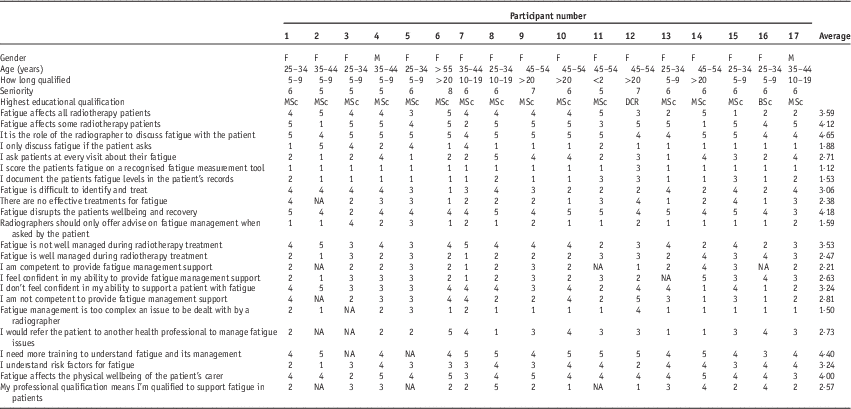
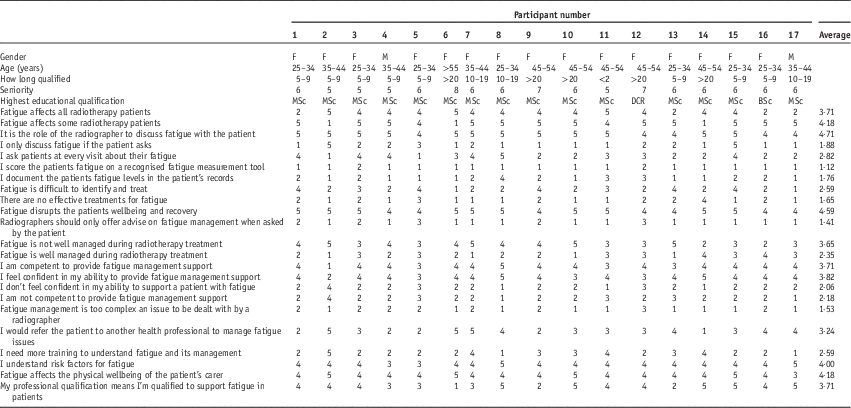
Tables 1–5 reflect the questionnaire responses. For those questions where radiographer attitude was sought, a Likert scale (1–5) was used to measure respondents’ attitudes, asking the extent to which they agree or disagree with a statement, a higher response indicating a positive affinity.
Participant response before intervention

Abbreviations: F, female; M, male.
Participant response after intervention

Abbreviations: F, female; M, male.
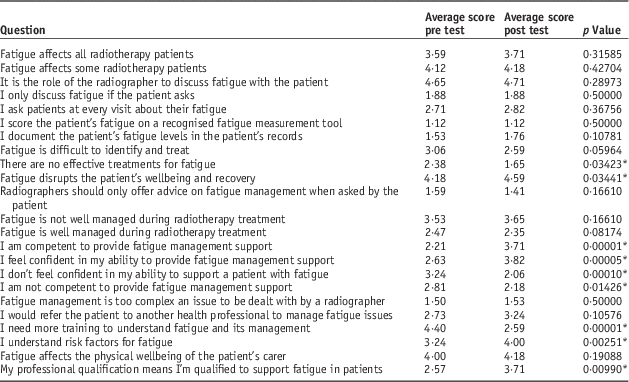
t-Test and p value for pre- and post-response comparison

Note: *Statistical significance (p≤0·05).
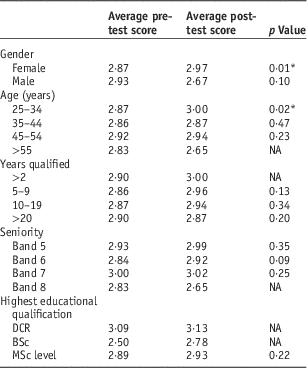
Participant characteristics

t-Test and p value for pre- and post-test comparison by participant characteristics

Note: *Statistical significance (p≤0·05)
Average (mean) responses before (Table 1) and after (Table 2) were compared, and the p-value results of the paired t-test were used to indicate significance (Table 3). Participant characteristics (Table 4) were considered alongside their average pre/post-test responses to assess whether particular groups were significantly affected by the intervention (Table 5).
Results from the initial questionnaires
Mean scores from radiographers rated their competence to provide support as 2·2, indicating disagreement that they were competent. They scored their confidence to provide support as 2·6, indicating slight disagreement that they were confident. Radiographers did not think that their qualification meant they could support patients (2·6), but they were slightly in agreement that they understood risk factors of CRF (3·2). Radiographers strongly indicated that training in CRF was needed (4·4). Participants agreed that fatigue disrupts patients’ wellbeing and recovery (4·2), and disagreed that there are no effective treatments (2·4).
Results from questionnaires repeated post-education package
Radiographer attitude/competence
The improvement on perceived competence to provide fatigue support was significant, average response increasing to 3·7 on the answer scale [range −4 to 0 (p=0·0001)]. In all, 15 participants (88%) changed their score from disagreeing that they were competent, to stating they were competent, corroborated by the reverse statement ‘I am not competent’, mean scores changing from 2·8 to 2·2 [range −4 to 3 (p=0·014)].
In all, 14 participants (82%) felt more confident in their ability to provide support after the education package, mean changing to 3·8 [range −4 to 0 (p=0·0005)] and corroborated by the reverse statement of ‘I don’t feel confident’ with a score difference of 3·2 to 2·1 [range −1 to 3 (p=0·0001)].
Radiographers were significantly more in agreement that their professional qualification meant they were qualified to support patients’ fatigue [3·8, range −4 to 1 (p=0·0099)] and that they better understood risk factors associated with CRF [4·0, range −3 to 1 (p=0·0025)].
Where there was a strong indication that radiographers wanted more training to understand fatigue and its management before the education, this was not indicated after the intervention [2·6, range −2 to 4 (p=0·00001)].
Seven participants (41%) altered their rating for ‘fatigue disrupts patients’ wellbeing and recovery’, changing the mean to 4·6 (range −3 to +1), showing stronger agreement (p=0·034). ‘There are no effective treatments’ changed in 12 cases (71%), changing mean to 1·6 (range −2 to +3) showing stronger disagreement (p=0·034).
Significant changes in overall average scores were seen in the ‘female’ group [2·87 changing to 2·97 (p=0·01)] and ‘aged 25–34’ group [2·87 changing to 3·00 (p=0·02)].
Patient care
Radiographers maintained similar ratings before and after intervention that fatigue affects some patients (4·1 changed to 4·2) and their care givers (4·0 changed to 4·2), and it is the radiographer’s role to discuss fatigue (4·6 changed to 4·7). There was general disagreement that fatigue is only discussed if the patient raises it (1·9) and radiographers should only offer advice when asked (1·6 changed to 1·4). But mostly fatigue is not being discussed at every visit (2·7 changed to 2·8), being formally scored (1·1) or being documented in the patients’ notes (1·5 changed to 1·7).
After completing the education package, participants felt less strongly that fatigue is difficult to identify and treat (3·1 changed to 2·6); however, this was not statistically significant. Respondents slightly agreed that fatigue is not well managed (3·5 changed to 3·6) and slightly disagreed that fatigue is well managed (2·5 changed to 2·4). They did not agree that fatigue is too complex to manage (1·5).
Thematic analysis
Thematic analysis was carried out on interview responses,Reference Braun and Clarke 23 drawing themes relating to participants’ personal experience, radiographer practice, fatigue incidence, CRF management and barriers.
Personal experience
When asked about their activity levels, responses were evenly split between very active (29%), active (35%) and not very active (35%). None had personal experience of chronic fatigue but some knew someone with chronic fatigue: ‘I saw the effect it had on her life and her family and work… it did change my opinion about fatigue’.
Only one participant had received specialist CRF training in the form of a presentation by an Occupational Therapist. Commonly, participants reported they had built their knowledge through on-the-job experience.
An example of the HEI providing good education in CRF during training was ‘A university project on M.E. [which] was really valuable at raising awareness of chronic fatigue’. However, more commonly radiographers said what they had been offered was limited or that their HEI had never offered any CRF education: ‘When I was training I think fatigue was just expected’.
Fatigue incidence
Many participants felt that fatigue incidence had not changed during their career, but radiographer awareness and perception of fatigue had: ‘I think now we’re beginning to realise you shouldn’t have to expect to be tired. There are things we can do’. Radiographers felt patients were less stoical, more ready to ask for help.
Contrary to this, those that felt incidence had increased fell in the ‘qualified for >20 years’ category. They suggested more people now work through their treatment due to younger patients picked up through screening or increasing retirement age, ‘a lot of people now have more pressured lives. You’re expected to do more; there’ve been cuts in welfare’.
Changes in fatigue management practice
Although some felt practice had not changed significantly in their career, those that thought it had changed noted having more experience to draw upon. Changes mentioned included encouraging patients to keep active and well hydrated, and that there is more research and awareness of CRF. Some felt nowadays they were more open with patients.
Commonly, participants thought services available to patients had changed, including free exercise programmes for cancer patients, fatigue management referrals, survivorship workshops and better patient signposting to resources. The role of charities has improved awareness and practice, with Macmillan-adopted radiographers having access to courses and the hospital piloting holistic needs assessments. 24
Radiographers’ role
Primarily, participants consider their role is to give basic advice, assess patients and tell them what will happen, confirm consent, make aware of services, refer if needed, identify and score fatigue, reassure, support, give encouragement and information. However, participants also thought radiographers could not offer advice, as they do not have enough knowledge to discuss fatigue management properly. One said ‘I don’t think we’re trained to know exactly what to advise at the moment’.
Barriers to providing support
The patient themselves were identified as a common barrier. This was thought to be mainly through lack of willingness to exercise, especially with perceived lack of time or poor weather conditions. It was also said that patients’ expectations of fatigue were such that, they have been told they will feel tired, resign themselves to it and then do not mention it when it occurs. Other acute onset side effects such as diarrhoea or urinary symptoms may override feelings of fatigue and take priority for patients.
Moreover, radiographer competence is seen as a barrier, that is, having no formal fatigue measurement tool or process to follow to ask the right questions.
Time constraints within treatment environments were highlighted as another barrier. One participant explained, ‘[there’s] not enough time per patient and staff to slip one aside in a room and sit down and talk about it properly…and that’s frustrating’. Another said that ‘in that 12 minute period it’s very difficult to manage psychosocial problems…when you’ve got a machine with time restraints it’s difficult to get a patient to open up sometimes’.
Services are varied across the country from radiographers’ experiences in other centres. ‘I’ve worked in lots of places- they are different from place to place’. With a multi-disciplinary approach to care, radiographers do not always know who is picking up on fatigue management. One explained their experience as ‘here you’ve got CNS input for certain sites and not other…sites, whereas another department I worked in, the nurse was reviewing everybody, another department I worked in the doctors were reviewing the majority of people, or the radiographers were concurrently reviewing them, so it’s…that mix of multi-disciplinary, so you don’t really know who’s picking up what in terms of fatigue’.
Competence and confidence
On the whole radiographers said they were competent to advise on fatigue management, many qualifying they were ‘competent up to a point’, or they would refer to someone who knew more if needed as ‘Radiographers are not fatigue experts’.
Some felt extra training or signposting would be beneficial.
Most said they were confident to advise on fatigue management, many adding that they were ‘confident to an extent’ and ‘within their role’, but they could always learn more. One clarified this, saying they could not produce a formal management plan. The lone respondent who said they were not confident highlighted lack of training.
DISCUSSION
Overall, the study has shown that a targeted fatigue management educational intervention impacts on radiographers’ attitude towards the provision of CRF management in supporting patients during their course of radiotherapy, improving significantly both perceived competence and confidence in addressing fatigue in cancer patients, knowledge of effective treatments and knowledge of the disruption of fatigue on patients’ wellbeing and recovery.
The fact that targeted education produced a measureable effect on radiographers’ perceived competence and confidence may not be surprising when looking at the paucity of training radiographers remember receiving in this area. HEIs do not appear to provide memorable CRF education in spite of fatigue’s prevalence and their responsibility to ensure learning is current and evidence based. 14 Also, post-qualification there seems to be a lack of access to CRF training. Maybe training was given then forgotten, disputing that CPD is being undertaken for CRF, or highlighting that radiographers lack willingness to undertake CPD.
The majority of participants said their knowledge came through ‘on-the-job’ experience. Although in principle a useful way of gaining knowledge from peers and seeing what works in clinical practice, it relies entirely on trust that shared knowledge is accurate, evidence based and current. This study suggests that clinical experience alone is not sufficient to ensure radiographers’ confidence and knowledge in supporting patients with CRF, although participants continue to discuss fatigue with patients and give unprompted advice, with no formal mechanism to record and monitor this practice.
Results relating to training needs of radiographers were interesting. Questionnaires showed that the education package had a positive impact on perceived competence and competence of staff and their need for further training when assessing questionnaire responses alone, implying radiographers had their educational needs met and were competent. Interview results however were more complex; radiographers were uncomfortable to say they were ‘fully competent’ supporting CRF, many putting limits on what they would be happy to do in practice. It is possible this ‘reining in’ occurred because of the time lapse between completion of the education and interviews which allowed further contemplation by participants, or simply that knowledge gained from the package ignited a genuine increased interest in CRF and desire for more information. The package itself was limited by design, requiring considerable further reading by radiographers, in its simplest form acting as an aide memoire and signposting mechanism. Radiographers were clear they needed more experiential training, emphasising inadequacies with theoretical knowledge alone and suggesting that supplementary CRF educational intervention is now a requirement for radiographers’ CPD.
Although radiographers recognise that patient fatigue is common (corroborating documented findings of Noal et al.Reference Noal, Levy and Hardouin 5 and Wagner and CellaReference Wagner and Cella 4 ) and acknowledge fatigue in practice, offering ad hoc support, no formal monitoring devices or systems are in place at the host department meaning it is difficult to assess whether radiographers affect the severity of fatigue experienced by their patients. Provision of written information can increase exercise compliance and reduce mean fatigue scoresReference Windsor, Nicol and Potter 25 ; however, without frameworks in place, audit of practice cannot take place. National implementation of holistic needs assessments 24 may bridge this gap, allowing comparisons to be drawn inter-departmentally.
Information sharing with patients must be evidence basedReference Cowan 2 and this appears to be the case, with most radiographers advising continued or increased activity, possibly due to recent increased professional awareness, disputing Velthuis et al.’sReference Velthuis, Agasi-Idenburg, Aufdemkampe and Wittink 26 findings that patients are often being told to reduce activities. Clearly, radiographers are not competent to provide individualised exercise programmes such as Kuchinski et al.Reference Kuchinski, Reading and Lash 10 recommend but many happily acknowledged initiatives being offered within local gyms, even though representatives from these services had not visited the radiotherapy department or vice versa. Representative visits may improve public and staff awareness of available provisions, securing referral pathways.
With perceived barriers to CRF management including patient willingness, radiographer competence and treatment environment, practice within the host site is not dissimilar to experiences highlighted by Berger et al.Reference Berger, Mitchell, Jacobsen and Pirl 27 who discuss that although evidence-based recommendations for fatigue exist for clinicians, barriers remain at patient, provider and system levels that hinder adoption in clinical practice. This suggests that improved radiographer CPD alone may not be enough to better support patients with CRF.
Borneman et al.Reference Borneman, Koczywas, Sun, Piper, Uman and Ferrell 28 report that clinicians are not always confident with CRF management so do not actively screen for fatigue. Radiographer on-treatment review clinics may provide a solution, study participants suggesting the lack of such clinics was a barrier. Reviews could allow for regular monitoring with targeted questioning by specialist radiographers, away from the treatment environment. LeesReference Lees 29 reiterates that regular review appointments are in the patient’s best interest, allowing treatment-related problems to be effectively considered.
Study limitations
This study looked at one cancer centre. Larger, multi-centred studies may elicit different attitudes or alternative services; however, the education was designed with a single centre in mind, with available resources signposted within its geographical area. This may have influenced the benefits perceived by participants, making the education feel relevant to them.
The interviewer was known to the participants whom may have introduced bias or participant fear factor; however, the recruitment rate was excellent which may indicate that staff supported the opportunity to participate rather than feared it. By taping interviews the researcher was able to concentrate fully on discussions and transcribe interviews later; however, it is possible the taping limited participant comfort and compliance. On reflection it may have been beneficial to provide the participants with a list of questions before interview, allowing them more time to consider their answers.
As this study forms part of an MSc dissertation, the study design was time limited. By using an additional time point for a repeat of the questionnaire, further changes in radiographer attitude and practice may have been elicited.
CONCLUSION
Fatigue management education impacts positively on radiographers’ perceived competence and confidence in supporting patients during their course of radiotherapy, knowledge of effective treatment options and risk factors, understanding of the effect of fatigue on the patient and agreement that the radiographer’s professional qualification means they are qualified to support patients with fatigue.
Barriers to good fatigue support remain, including the radiographers’ lack of practical CRF management training and lack of rigorous systems to monitor patient fatigue over a course of radiotherapy, including unclear referral pathways within the MDT.
Radiographers are acquiring CRF knowledge through day-to-day practice and ad hoc support days, rather than provision via HEIs.
Regular radiographer on-treatment review clinics should be considered to allow for patient assessment with standardised tools outside of the treatment room setting. In-house training for staff and patients by local providers of exercise support for patients may strengthen radiographer knowledge and confidence to provide support within their role. Regular practical sessions held with fatigue experts such as those providing psychosocial support could raise CRF awareness for patients and improve compliance for staff referring patients for additional targeted support.
The study shows that education improves competence and confidence, but continuing education is required to ensure radiographers provide evidence-based information on CRF.
Acknowledgements
The authors thank the staff at Royal United Hospitals Bath NHS Foundation Trust and Sheffield Hallam University for supporting this work.
Financial support
This work formed part of MSc dissertation, funded by Royal United Hospitals Bath NHS Foundation Trust CPD fund.
Conflicts of Interest
None.
APPENDIX 1: QUESTIONNAIRE
Questionnaire to be completed pre- and post-education package


Please use the space below to add any comments.
………………………………………………………………………………………………………………………………………………………………………………………………………………………………………………………………………………………………………………………………………………………………………………………………………………………………………………………………………………………………………………………………………
Please use the space below to make any comments specifically about the education package when you have completed it.
………………………………………………………………………………………………………………………………………………………………………………………………………………………………………………………………………………………………………………………………………………………………………………………………………………………………………………………………………………………………………………………………………
APPENDIX 2: INTERVIEW SCHEDULE
-
(1) Where have you built up your knowledge about cancer-related fatigue?
-
(2) Have you ever received any specialist training in fatigue management?
-
(3) Have you attended any postgraduate courses, workshops or talks about cancer-related fatigue?
-
(4) Do you think the incidence of fatigue has changed in your career?
-
(5) Do you think your practice has changed significantly since you’ve qualified regarding CRF?
-
(6) Have services available to patients changed in your experience?
-
(7) What do you think the radiographers’ role is regarding fatigue management?
-
(8) Do you feel competent to advise on fatigue and it’s management?
-
(9) Do you feel confident to advise on fatigue and it’s management?
-
(10) Do you consider there to be barriers to supporting patients with fatigue?
-
(11) Do you have any personal experience of chronic fatigue?
-
(12) How active are you in your free time?