On Sunday, February 15, 2004, a group of approximately 2,000 Muslim women gathered in the streets of Paris to protest the recent passage of a law banning the wearing of the hijab (a religious headscarf) in French public schools. A few thousand more rallied in the southern city of Lyon. It was expected that this new French law would generate controversy. However, in a country with 4.5 million Muslims, it was surprising that so few turned out to protest the law, despite the widely held belief (whether accurate or not) that it directly targeted Islamic immigrants. Nonetheless, this episode is more symptomatic of a general phenomenon regarding Muslims in Europe despite their increasing presence throughout the region, Muslims have had a difficult time collectively organizing to assert (or defend) their interests in the political arena. European governments seek, as they have historically with other major religions, to find in their European Muslim communities a single, broad-based representative (peak) organization with which to negotiate and plan.1
They have met with little success: Muslims are fragmented into a myriad of organizations.2 Meanwhile, states keep trying to facilitate peak organizations. Why, regardless of strong incentives to organize collectively and despite direct attempts by governments to facilitate collective organizations, have Muslims remained an organizationally disparate political constituency throughout Western Europe?This is not to say they have not affected policy and politics, and certainly there are fears in the U.S. and the E.U. that Muslims have the potential for mass mobilization and to undertake large-scale political action. Approximately 15 million Muslims live in Europe, and some of them have advocated creating an Islamic state there.3
Tessler 1994; Arian 1985; Lustick and Rubin 1991; Shindler 1995; Sprinzak 1991; Kepel 1997, 126–144; Economist, July 10, 2004, 50.
Pipes 2003, 21.
Leiken 2005, 120.
Taspinar 2003, 76–7; Timothy Garton Ash, “How the West can be one” New York Times April 27, 2003.
Yet in the face of Western wars against the predominantly Muslim countries of Afghanistan and Iraq, the continuing Israeli-Palestinian conflict, bans on religious symbols, and continued social and economic discrimination, Europe's Muslims have remained organizationally fragmented. While there is no question that they have had a political impact in Europe, it is legitimate to ask why this has not also taken place through large interest groups. Muslim immigrants have not formed their own encompassing organizations as Muslims to gain representation in the democratic policy process. In no Western European country has a dominant Islamic organization emerged that speaks with authority for the Muslim community, nor is there any successful pan-European Islamic organization. Despite fears of a “clash of civilizations” on European soil, religion has failed to be the unifying focal point of Muslims in Western Europe.7
The well-known phrase is from Huntington 1993, 22–49. Some scholars have noted that Islam has become a “marker” for immigrants in Europe, just as language (Spanish) is in the U.S. See Zolberg and Woon 1999, 5–38.
Why?
We argue that the structure of Islam impedes collective action by Muslims. The general lack of broad organizations results primarily from the decentralized institutional structure of the Islamic faith.8
This factor is exacerbated by the diversity of national origins found among European Muslims. When the structural features of Islam are combined with the obstacle of overcoming entrenched national identities, the possibilities for broad-based collective action on religious grounds are limited.9To European scholars, this may not be a surprise. However, the social science community in the U.S., and the mainstream political science literature in particular, has not recognized this, and Cesari notes that in Europe, there has been a tendency to see Islam and Muslims as monolithic entities. We are not arguing against concerns of Islamic-related terrorism in Europe and we recognize that terrorist groups have been affiliated with political parties. Due to the structure of Islam in Europe, an Islamist party which can significantly influence the domestic or foreign policy of a European state is unlikely to arise. For a European view of Muslim immigrants, see Cesari 2003, 252. On terrorists and parties, see Weinberg and Pedahzur 2003.
Again, that does not preclude Muslims from having influence in Europe through other means, as the Madrid bombings and the murder of Theo Van Gogh have shown. Some Muslims have run for political office, others have rejected standard political channels. The fact that Muslims have difficulty organizing large representative groups to participate in the political and policy process, and have no hierarchy to define the religion for all adherents, may be one factor fueling the more extremist views and actions of those who lack standard channels of participation and are politically impotent. Given the importance of Muslims to Western politics today, it is crucial to understand their capacity for political organization on the basis of their religion. Surprisingly little attention has been given to the political impact of the institutional features of organized religions, even though it is widely acknowledged in political science that “institutions matter”. This paper explores that proposition in the context of Islam in contemporary Europe.
Catholicism and then Protestantism have long been an organizing feature of political and social activity in Europe. That has led, many times in the past, to difficult if not bellicose relations with non-Christian faiths and with secularizing states. Although there have been small Muslim communities in Europe in the past, a significant change has occurred, largely through voluntary migration, in just the last quarter of the twentieth century: in terms of nominal adherents, Islam now ranks as the third largest religion (after Catholicism and Protestantism) in Western Europe. It lags far behind these two in gaining political and social legitimacy and public policy support, as well as in being a unifying factor for Muslim political participation. In Germany, even though the state proclaims its willingness to recognize and fund an Islamic peak organization, the Muslim community remains divided into at least a hundred different organizations. Although the Muslim Association of Britain claims to speak for all 1.2 million British Muslims, the Muslim Council of Britain disputes this claim and asserts overarching control over 250 separate Islamic organizations, a claim that is equally disputed. In the Netherlands, Turkish and Moroccan Muslims refuse to send their children to the same Islamic school. In 1990, the French government set up a peak organization for Muslims; it fell apart within two years of formation. Subsequently, in 1993, the French government attempted to establish another umbrella group, but it too collapsed in three months. Remaining committed to the same governance strategy of negotiating with a single religious entity, French officials tried the same approach nine years later, but their efforts were immediately repudiated by prominent Muslims within the country. The council which emerged has been riven with disputes and plagued by resignations of participating organizations. In light of general expectations of the power of religion as a tool of mobilization and in light of Europe's own history with organized religions, the fragmentation is puzzling.
The peculiarity of this is evident even in a brief contrast with the Catholic Church. When Europe became something of a hostile territory for the Catholic Church during the era of democratic revolutions, Catholics mobilized and the Church in almost every country organized a large Catholic interest group and eventually supported a Catholic political party.10
The Protestant Churches followed suit. Both denominations used that strategy to counter the anti-clerical policies of various governments, and to obtain parliamentary representation. Muslims in several European countries are now struggling to gain the same kind of policy concessions which the Christian Churches sought and often obtained. It is of course not inevitable that someone who is nominally Muslim will become active in a religious-based organization. What is of interest is that even when Muslims do interact with the political system in order to achieve various goals related to their religion, they remain fragmented. Islam, in contrast to the Catholic and Protestant Churches, finds itself politically and socially represented by an incredibly diverse set of groups, and has almost no links to, or influence in, existing political parties. To understand why, we must add an understanding of the structure of the religion and the ethnic divisions of its adherents to more standard accounts.Alternative Explanations
De jure exclusion from the political process
Before exploring the structural features and problems of national identity that we consider important barriers to successful political mobilization among European Muslims, we must first address a number of other hypotheses that suggest themselves. Perhaps the most immediate explanation for the lack of national political organizations among Muslims is that most of them are not citizens of the countries they reside in and hence cannot participate in the political process. Consequently, there is little incentive to bear the costs of creating large interest groups. The percentage of Muslims entitled to vote is relatively small, hence political parties regard them as negligible assets at best.11
Nielsen 1992a, 121.
Klausen 2005, 25.
Ireland 1994, 52.
While providing some leverage in explaining the lack of organization among Muslims, this first-order explanation is somewhat misleading. Many Muslims, especially in France, are citizens and do have the right to vote.14
Klausen 2005, 21.
See Doomernik 1995, 57.
See also Soysal 1994.
Low religiosity
A second plausible answer to why Muslims haven't organized effectively is that only a minority of Europe's Muslims are intensely devout, and thus most are uninterested in organizing around a broad Islamic political identity. Instead, facing racism and economic marginalization, they organize on the basis of class, ethnicity, or national origin.17
Such attempts have had limited and uneven success.18 Moreover, Islam can still present itself as a mobilizing identity regardless of one's personal religiosity. Political adherence to an ethnic, religious or linguistic identity is often disconnected from the actual practice of it; for example, many Scots and Welsh identify as such and support their respective nationalist parties though they do not speak Gaelic or Welsh. Jews in Europe and the United States have similar affiliations with a variety of broad political organizations (e.g., the Anti-Defamation League) despite wide variation in religious practice. Similarly, many Muslims identify as such without being intensely devout. But while recent surveys indicate that religious identification and participation are waning among Western Europeans, they show that Muslim residents of the region attach a stronger subjective importance to religion than non-Muslims.19Inglehart et al. 2002.
Constraints of existing institutions and resources
A third answer emphasizes the structure of institutions. It has been widely documented that state structures and traditions affect the behavior of interest groups, including Muslim immigrants' organizational strategies.21
See Baumgartner and Leech 1998; Hall 1986; Tarrow, 1998; Brubaker, 1992; Ireland 1994; Kastoryano 1991, 51–64; Soysal 1994; Kepel 1997; Leveau 1990, 41–53; and Jones-Correa 1998, 326ff.
Another group of scholars has argued that some of the most important obstacles to political participation of Muslim immigrants are the constitutional and other legal provisions of the individual European states. States with a clear separation of church and state (e.g., France) have numerous laws and traditions that are quite different from those of a polity which does not have the same legal separation (e.g., Germany). Also, as Rogers Brubaker has suggested, differences in citizenship laws can potentially become a significant factor in both the willingness and ability of immigrants to become political participants on (legally) equal footing with host society citizens.24
Rath, Groenendijk and Penninx 1991, 101–114.
Werbner 1991
State policy
Following on this is another point, often mentioned in the literature, about how differing conceptions of political participation among the European states affect organizational capacities and strategies.26
These differing conceptions shape the policies of host states.27 These policies, in turn, structure the opportunities and obstacles Muslims face, as well as their organizing strategies. Specifically, French political culture expects and promotes participation at the individual level, and has traditionally either deliberately rooted out or actively discouraged “community” representation or political activity.28 Muslims in France face a Jacobin state and society that have policy barriers, and a political culture hostile to organizing on the basis of a shared religious identity.29Kastoryano 1991, 40–3, 99–102.
Ibid., 43–5, 117–9; Fetzer and Soper 2005.
There is a tendency in all of the above arguments to see immigrants as a passive and generally homogeneous lot, one which is more likely to absorb host traditions and pressures than to exert any itself. Immigrants, however, come with their own prior cultural views and socio-political interests that will refract and deflect, to varying degrees, the deliberate or unintended efforts of host societies to mold them. European Islamic communities are more fragmented than state administrative structures, policies and traditions appear to warrant. For instance, Denmark and Sweden have provisions for independent (“free”) schools and churches, based on a minimum size. These minimum thresholds have not prompted the aggregation of Islamic groups. Rather, Muslims have created a vast and highly decentralized variety of schools and places of worship.32
Nielsen 1992a, 123.
Ireland 1994, 63–64.
The structure of Islam and the ‘structure’ of Muslim immigrants in Europe
By contrast to the above explanations for the failure of Muslims in Europe to effectively organize, we argue that the structure and ideology of Islam itself is responsible for a considerable degree of the fragmentation of Muslims' social and political representation. Islam is not conducive to large-scale, sustained collective action in the European context.
Islam is a decentralized, non-hierarchical religion with multiple and often competing schools of law and social requirements. The exception is minor for its effects in Europe: one relatively small branch of Islam, the Shi'a, adherents of which are scarce in Europe, is centralized and hierarchical. Furthermore, in contrast to Catholicism, Islamic religious leaders have no enforcement mechanisms to obtain obedience from their adherents; there are no sacraments in Islam which can be withheld from Muslims in order to obtain compliance with the wishes of imams or other ‘clerics’ regarding policy decisions which they may support or condone. This is also the case for the Shi'a version of Islam. In Sunni Islam there is no established or universally recognized procedure or mechanism for the removal of specific imams in a local mosque. Islam's decentralized structure prevents Islamic organizations from making credible commitments about their actions to others.34
Kalyvas 2000, 379–398.
See Roy 2004, 151–5; on collective action, see Olson 1965, 48; Hechter, Friedman and Appelbaum 1982; Sandler 1992.
Add to this the fact that Islam manifests itself differently across and within cultures and societies, and the result is another major barrier to large-scale collective action. Islam allows for numerous theological and political stances and disputes, including about what the goals and activities of Muslims in non-Islamic countries should be. There simply is no unifying ideology or, contrary to popular imagery, even a single Islamic doctrine with which all Muslims from a particular country or ethnicity can identify.
The structure of Islam, whether of the Sunni, Shi'a, or some other persuasion, cannot be discussed without reference to the country of origin and the ethnic identification of its adherents. One must take into consideration the inter-relationship of the various “brands” of Islam with the country of origin and ethnicity of its members, i.e., the “structure” of the immigrants themselves.36
Much has been written about the purported fluidity of immigrant/Muslim “identities”. While this article recognizes that identities are malleable, it stresses that, despite the theorized fluidity, Muslims' organizing behavior is strongly affected by their country of origin/descent and ties to homeland ethnicities.
This argument shares with some of its rival explanations the view that structure and ideology (also called cultural traditions) have important systemic effects. There is also a shared assumption that individuals, including those believing in a religion, will behave rationally when attempting to achieve their goals.37
Where this argument differs is in its highlighting the structure of religion and how it affects the organizational capacity of Muslim immigrants, rather than, for instance, stressing the administrative structure of the host state.The remainder of this paper explores the structure of Islam through a comparison of Muslim organizations and organizing strategies in contemporary Germany and France. For definitional purposes, we consider ideology and theology to be parts of a religion's structure. Germany and France are good cases because they are host to a large number of Muslims, to significant organizing activity by Muslims, and to an immigrant population disproportionately drawn from one ethnic group—Turks and Arabs respectively. Presumably, that population could serve as the focal point of Muslim organizational activity. Further, both Germany and France have tried to facilitate the creation and success of one umbrella group which could speak for their Islamic population.38
Conditions would seem to be propitious for the rival hypotheses enunciated above.The article proceeds as follows: first, we provide a survey of the European reception of Islam, and then a brief outline of the structure of the Islamic religion. Next, the article analyzes the structure and organizational strategies of Muslim immigrants in Germany and France. In the conclusion we suggest that the very structure of Islam may be what maintains it as a vibrant religion for its believers at the same time that it prevents its adherents from creating effective groups for representation in public policy. Consequently, no one organization speaks for Muslims or Islam, in any European state. Indeed, Muslims are fractured, fractious and divided along a large number of ethnic, national and sectarian cleavages, making it highly unlikely that they will create a united bloc to influence policy in any serious way.
The International Context of Islam in Europe
Islam—as a culture, a civilization, and a perceived menace to the culture, civilization and political systems of Europe—has threatened Europe on three separate occasions. The first of these instances was in the eighth century A.D., when the Iberian Peninsula and much of France and later, even parts of Switzerland and Italy, fell to the invading armies of the Islamic Empire. This Muslim presence was slowly pushed back in the eighth to fifteenth centuries, though the last Muslims in Western Europe as a result of this incursion were not eliminated or deported until early in the seventeenth century. The second—in the fifteenth to the seventeenth centuries—was when the Ottoman Empire brought Islam into Eastern Europe, specifically the Balkans, and eventually to the gates of Vienna. The remnant Muslim populations of this incursion are found in Bosnia, Yugoslavia, Albania, Bulgaria, and even Greece.39
Lewis 1982; Lewis 1993; Hodgson 1974; Goody 2004; Watt 1972; Lewis 1965; Miller 1996; Wittek 1938; Inalcik 1994.
The recent mass immigration of Muslims into Europe could be seen as the third Muslim incursion, i.e., the entry into several European states of literally millions of Muslims, beginning in the 1960s. This time, however, the Muslims have not been entering as part of an organized military force. Rather, they have come as asylum seekers, as immigrant workers, and as illegal aliens. Most came as individual “guest workers” to supply the manual labor many European countries had lost as a result of World War II: Germany worked out explicit agreements with Turkey, France relied on its ties to Algeria and other former (primarily North African) colonies.41
A variety of other European nationalities, most notably Portuguese and Greeks, also constituted part of the “guest-worker” population. The origins and development of this immigrant stream is well-documented in various studies, but see especially Noiriel 1988; King 1993; and Nielsen 1992a.
Conversely, Europe has similarly significantly impacted the heartland of Islam on two separate occasions. Christian Europe invaded the Muslim lands for the first time in the 10th to the twelfth centuries—the era known as the Crusades; the butchery and barbarian behavior associated with this incursion continues to have a dramatic impact on the view of many Muslims with respect to Europe and the West.42
Madden 1999.
Muslims in Europe, throughout the centuries of the relationship, have nearly always perceived themselves as being in hostile territory. Traditionally commanded by Islam to add all the Earth to the realm of Islam (dar al-Islam), the historic (i.e., prior to the present era) Muslim incursions into Europe were generally seen as part of the destiny of Islam. Post-World War II Muslims in Europe, on the other hand, entered to improve their economic status and to escape authoritarian regimes; most did not, at least at the outset, think they would stay permanently.
Large-scale emigration from former European colonies and Turkey to Europe did not begin until the 1960s; at that time, there was little attention paid to the possible long-term consequences.43
In 1961, there were only 6,700 Turks in Germany; see Peach and Glebe 1995, 35.
Doomernik 1995, 48.
Doing so has not been easy in Europe. Muslims have faced barriers to all aspects of their religious practices. Why have Muslim immigrants not responded to the obvious benefits of collective organization? Why, despite their sizeable numbers in Europe, have they not responded by establishing peak organizations to negotiate with the host states? Why have state efforts to foster such organizations failed? An examination of Muslims' actions in the German and French contexts shows that one part of the answer stems from the structure of their religion.
The structure of Sunni and Shi'a Islam
Islam is a universalist religion, that is, it claims its teachings are meant to apply to all humans in all places at all times. Rather like the Catholic Church until Vatican II (1962–1966), Islam makes no theoretical distinction between religion and any set of political institutions. In the Muslim conception, religious prescriptions and requirements logically entail political activity, for the purpose of instituting and enforcing God's commands concerning the moral and ethical behavior of Muslims.
Soon, however, it was obvious to many within the Islamic community that ignoring the distinction was an untenable position, as evidenced by the division of authority between the sultan (temporal leader) and the caliph (religious leader of the Islamic community) not long after Muhammad's death. Nevertheless, the vision of the ideal Islamic community (under Muhammad's direction) in which this distinction was not made, continued and continues to exercise considerable influence over many Muslims of various political leanings. When, for example, the modern Turkish state, under Kemal Atatürk, first introduced the distinction in specific legal language, it caused considerable uproar and confusion among Muslims, since its predecessor, the Ottoman Empire and its sultan claimed both roles for all of Islam.45
In fact, this distinction was often made, including by such respected Islamic scholars as Ibn Taymiyya. Furthermore, compare the role and responsibilities of the caliph versus the sultan in the Islamic Empire at various times and in various places. Nevertheless, this distinction is not clearly understood nor recognized by many contemporary Muslims, not to mention many Western scholars.
The next important distinction to be made is between Sunni and Shi'a Islam; these divisions in the Islamic faith produce important consequences for organization and institutionalization, though too often Western observers of Islam have been guilty of either exaggerating the distinction, or of misunderstanding the consequences thereof. Sunni Islam, which is the dominant version of Islam in the Middle East among Turks and Arabs, and in much of Southeast Asia, does not, strictly speaking, have any theological organization which is analogous to that of the major institutionalized forms of Christianity. There are, of course, mosques (the equivalent of parish churches) throughout the Sunni Muslim world; these are not, however, arranged in any hierarchy, and the individuals who lead the prayers and deliver the sermons at Friday services need not be and often are not clerics. There is, on the other hand, in every Sunni Muslim country, a body known as the ulama, the national collection of religious scholars and theologians who are, ultimately, responsible for the content and direction of Islam within that state. The point, however, is that they are not responsible for, nor do they have any legal position in, the Islamic system of any other Muslim state. Furthermore, there are four “schools” of law in Sunni Islam; though each has areas of the Islamic world where it is dominant, they co-exist in many places and practice mutual acceptance of judicial verdicts. In other words, the Egyptian ulama does not have any official position in, does not decide issues of Islamic law, and does not make nor enforce any legal matters in, say, Morocco.46
The major Islamic university in the world, al-Azhar, located in Egypt, through its graduates who become members of various ulama, has influence beyond the borders of Egypt.
Shi'a Islam, which characterizes Iran, as well as areas of Iraq, southern Lebanon, some of the Persian Gulf states, and Yemen, and from which only a very small part of the immigrant population of Western Europe originates, has a very pronounced hierarchical structure; in the most influential version, the Ja'afari, the structure may be roughly compared to that of the Catholic Church, i.e., mullahs/priests, hojat-ul-Islams/bishops, ayatullahs/archbishops, grand ayatullahs/cardinals. This hierarchical system is also somewhat similar to that of the Catholic Church in that on matters of faith and morals, authority and policy flow from the top down.47
There are, in fact, three major types of Shi'as; they have very different conceptions of the state, “clergy”, and dramatically different views of some elements of the faith. The summary and commentary in the text applies to the Ja'afari (Twelver) Shi'as—the most numerous and influential grouping.
Indeed, such organizations often further fragment Muslim immigrants. Some of these organizations evolved in the “homelands” in response to European colonial dominance.48
Their primary purpose appears to be to either gain or retain governmental influence over at least a portion of their emigrant Muslim population. They have primarily used their funds to build mosques, schools, etc., or to provide libraries and other facilities for Muslims. These organizations have been described as “indirect instruments of foreign governments trying to exercise control over their (former) subjects living abroad.”49Shadid and van Koningsveld 2002, 46.
The Rushdie Affair is a prime case in point. Iran tried to appropriate the (non-existent) authority to speak for all Muslims in condemning Salman Rushdie, a Muslim author residing in Great Britain, to death and offering a reward for his murder (for allegedly defaming Muhammad). While a number of Islamic organizations were outraged by the book The Satanic Verses, they seemed equally inflamed that the Shi'as of Iran would try to tell them how to react. Halliday 1992, 71.
The structure of the Islamic religion, namely the divisions within Islam and its lack of hierarchy, is a significant variable accounting for the generally ineffective efforts of the Muslim immigrants to create a cohesive organization speaking for them in matters of policy towards Islam. To demonstrate this argument's plausibility, we compare it to the competing explanations discussed above. There are many types of (Islamic) organizations which have sought, or currently seek, to involve Muslims in some aspect of the public life of the contemporary European state. The purposes of such organizations, their membership, their techniques and methods of participation, and the extent to which they have adopted or used European models varies considerably across the spectrum of European states. We review how Germany and France treat religion and how they deal with immigrants, and then we analyze Islamic organizational activity to see the extent it can be explained by the (European state) structural variable and to what extent by the structure of religion and the nationality of its adherents.
The Legal Status of Islam and Islamic Political Action in Germany
Islamic interests in Germany
In Germany there are dozens of Muslim organizations, not hierarchically nor even horizontally linked to each other. This situation was aptly summarized by sociologist Thomas Vernske: “One of the major weaknesses of the Muslim groups in Germany is the lack of an effective umbrella organization and generally accepted leaders”.51
Quoted in Peach and Glebe 1995, 37.
Zolberg and Woon 1999.
Benefits of organizing
The German constitution (the “Basic Law”) guarantees religious freedom, including freedom to create religious communities which may then organize their internal and external affairs. Such communities have the right to decide their own internal structure and decision-making, etc., as well as the right to participate in the political life of the country. However, in order to enjoy all of the associated “rights” implied by these statements, the religions have to register as “public law corporations.” When they achieve this status, they are entitled to receive a share of the religious tax revenues collected by the state from their members, to operate as a civil service employer, to exercise disciplinary power, and issue documents. They obtain a variety of other benefits, including the right to be consulted on matters of public policy which are thought to be within their field of interest. To be able to register as a religion, it must “be an established church,” “have a hierarchic organization,” and have its clergy “appointed independently.”53
Peach and Glebe 1995, 37.
Education is always a sensitive issue for religious organizations and institutions. In Germany, the state runs most schools, but permits others based on religious principles to also operate. Typically, only the officially recognized religions can set up their own schools. Since Islam does not have that status, legally it is not possible for there to be Islamic primary schools, which is a pre-eminent demand of the Muslim population no matter its other orientations.54
Karakasoglu and Nonneman, 1996, 241–267.
Doomernik 1995, 58.
Instruction in Islam is often provided by representatives specifically provided by the homeland countries (usually Turkey). In at least one case, a German state (North Rhine-Westphalia) took the initiative in developing supplementary curricula for children of Turkish origins, using special teaching materials; all participation in the program is voluntary.
Germany would appear to be the most likely place for a unified Islamic movement to form: the incentives for becoming a recognizable, registered corporate group are strong, and, in contrast to France, there are financial advantages to groups which form on the basis of religious identity.
Characteristics of Muslims in Germany
Despite the preponderance of “Turks”, the Muslim population in Germany is made up of diverse groups which in turn are often divided on their practice of Islam.56
Amiraux 1996.
Numbers of Muslims in Germany (2001 estimate), by Category

These distinctions are politically important; for example, the Alevis, though technically Shi'a (but not of the Ja'afari School) are by far the most accommodationist, integrationist group of Muslims in Germany (and some other European states); the Kurds, on the other hand, as a minority in Turkey which has consistently been discriminated against and sought to redefine its position within the Turkish state, overwhelmingly do not affiliate with or associate themselves with ethnic Turks; moreover, the majority of Kurds tend to be integrationist, and they tend to belong to organizations that cater exclusively to Kurdish interests and concerns (at least in Germany).
Characterizing the Muslim organizations in Germany
Muslims in Germany are divided, but not just or even along the lines suggested by the administrative structure of Germany. Although Germany is federally structured with sixteen states (the Länder), Muslims are divided less by that structure than by their differing ideologies and lack of a centralizing hierarchy. The divisions between the Islamic organizations seeking recognition of Islam as a culture as well as a faith within contemporary Germany generally reflect the divisions found within the Islamic world; after ethnicity (i.e., Kurd, Turk, Arab, Afghani), the most obvious and important is between what might be called the exclusivists or separatists, and the integrationists, i.e., between those who wish to create and maintain an exclusively Islamic culture and civilization within Europe (to the extent of creating an Islamic ghetto), and those who wish to accommodate and integrate themselves into the social and political fabric of European society. These divisions are themselves partly based on conflicting interpretations of Islam, something the structure of the religion allows for. These very different conceptions of their place in European society in general, and in Germany in particular, provide a formidable barrier to the cohesion of Islamic groups, preventing them from presenting a united front to the German state in their efforts to obtain the goals which they seek.57
It is difficult to obtain accurate data on the membership of the various organizations, not to mention on the level of commitment to various ideological orientations. Some scholars estimate that only about 20 percent of Germany's Turkish Muslims are members of any institutionalized Muslim organization or group (260); this number has been disputed by others—some place the number far lower (around 10 percent), while some alarmists have suggested that the correct figure is around 45 percent. Accurate data on this topic would be extremely useful, most especially if we were able to detect trends, i.e., whether the Turkish population has moved from accommodation and integration to segregation and assertiveness, or vice-versa. There are, at the moment, multiple conflicting reports and arguments—from writers such as Stolz, on the one hand, who see a major Islamic threat to German institutions and processes, to Nonneman and others on the other hand, who see a slow (but detectable) process of accommodation and integration among Turkish Muslims of the second generation. Stolz 1994; Nonneman et al. 1996.
There are four major separatist organizations, defined as organizations which do not accept the institutions of the German state, and which attempt either to segregate themselves into Islamic enclaves, or to promote the Islamicization of Europe in general, and Germany in particular. The first among these is the Avrupa Millî Görüs Teskilâtlari, or AMGT (Union of the New World Vision in Europe, or, in German, Islamische Gemeinschaft Millî Görüs), which represents the followers of Necmettin Erbakan, the prime minister of Turkey from July 1996 to June 1997, and the head of the (Islamic) Welfare Party. Politically, it wants to be recognized as an Islamic “church”, and it asks that Muslims in Germany be officially exempted from the secular politico-legal order and be allowed to follow the dictates of the Shari'a instead. It considers any form of integration to be a betrayal of Islam. Its headquarters are in Cologne, and its primary ideologue is Emine Erbakan, Necmettin Erbakan's sister-in-law. It is alleged to have ties to a number of other Islamic organizations in Europe. It does not have the backing of the Turkish state.58
Abdullah 1995, 67–77, here at 71. Ostergaard-Nielsen 2003, 56–8; Pedersen, 1999, 56–107; Stolz 1994, 240, 249; see also Karakasoglu and Nonneman 1996, 257; Boston 2002; Van Bruinessen 2004, 53.
A second is the Federation of Islamic Organizations and Communities (FIOC, or Islam Cemiyetler ve Cemaatler Birli[u]gi, CCB), which split from the AMGT over the latter's refusal to recognize Ayatullah Khomeini as the imam of all believers. The FIOC was founded by Cemaleddin Kaplan, the former mufti (an Islamic legal title) of Adana (Turkey), who became a politico-religious refugee in Germany after the 1980 military take-over in Turkey. The organization accepts neither (secular) socio-political “pluralism nor ‘ugly democracy.’”59
Taz—Die Tageszeitung, September 19, 2001.
The FIOC's activities were and are not restricted to Germany: it is an example of an organization which uses the openness of European political systems as a base from which to seek change in the Islamic world—in this instance, Turkey. Abdullah 1995, 75, 71–72; Stolz, 1994, 241; Karakasoglu and Nonneman 1996, 268; taz—Die Tageszeitung, September 19, 2001; Eva Ostergaard-Nielsen 2003, 57.
Another similarly oriented group are the Süleymanlis, an off-shoot of several Islamic mystical orders, the most famous of which is the Naqshbandi. They oppose the secular Turkish state, but are not affiliated with the Diyanet; instead they have created their own organization, the Verband der Islamischen Kulturzentren (known in Turkish as the Avrupa Islam Kültür Merkezleri Birligi or AIKMB), with headquarters in Cologne. Associated for a time with the Zentralrat, an organization rather more open to dialogue with the Germany state, it seceded in 2000, and appears to have returned to its earlier, more separatist views under its leader Ahmet Arif Denizoglun (who was once a Turkish MP and member the Welfare Party).61
This secretive and arch-conservative organization had its origins in the days of Kemal Ataturk. It was originally linked to Adnan Menderes, then to the Motherland Party, and eventually to the Nationalist Action Party of Alparslan Turkes; it was a generally militant and nationalist party which attracted a number of smaller religious groupings in Turkey and Germany. It was the home of the Gray Wolves, the extraordinarily militant youth organization which expanded its activities from Turkey into Germany. Stolz 1994, 243; Karakasoglu and Nonneman 1996, 258; taz—Die Tageszeitung, September 19, 2001; Pedersen 1999, 31.
The Föderation der Türkisch-Demokratischen Idealistenvereine in Europa e.V. (ADÜTDF), or Turkish Federation (Türkische Föderation), began as the foreign branch of a Turkish nationalist group, the Turkish Partei der Nationalistischen Bewegung (MHP). In the 1970s, it began promoting a synthesis of what it called a “Turkish body and Islamic soul.” The Türkische Föderation claims to have 200 associations and 10,000 members. It has avoided interaction with other religious and ethnic groups, and shows no interest in integration with German culture.62
Troll 2003, 9, 17.
A fourth group of separatist organizations are those associated with several specific mosques and their imams. For example, there is the Ali Mosque in Hamburg—the only significant Shi'a center in Germany, which promotes the goals and policies of the Iranian Islamic Revolution. It is connected to the Twelver Shiite Muslims, who run the Islamische Zentrum Hamburg (IZH), which has branches in other German cities. Shiites from Turkey have formed their own association and forged a link to the IZH. The IZH opposes democratic pluralism, and also argues that Western civilization is corrupt, anti-Islamic, and needs to be superseded by an Islamic political system. There is also the al-Kuds (al-Quds) mosque, similarly in Hamburg, which was the center of al-Qa'ida operations, and whose imam (al-Fazazi) was a major influence in the radicalization of the various Sunni Arabs who supported, participated in and carried out the attacks of September 11, 2001.63
Tiemann 2002; “Hamburger Imam im Visier de Terrorfahnder” Associated Press Worldstream, July 16, 2002; Denso 2002; Troll, 9.
See taz-Die Tageszeitung, September 19, 2001; Abdullah 1995, 71; Karakasoglu and Nonneman 1996, 258–259; Stolz 1994, 242; Duran 2000, 1–5.
There are several other smaller organizations whose names perhaps bear noting briefly: the Islamic Harakat (Islamic Movement), which split from the ICCB, and may be characterized as the Sunni Turkish associate of the Hizbullah organization. An interesting case is the Nurculuk Movement (Nurculuk, or “divine light”), which traces its roots to Said Nursi, a dedicated opponent of Turkish secularism; it claimed to want to reconcile Islam with modern technology and science, and that the Quran/Islam could be a rational guide for technological societies. In Germany, it concentrated its efforts in the field of education, providing instructors and establishing schools for Muslim youth, and was therefore included in among “integrationist” organizations. But, then it was unveiled as secretly supporting and promoting the Islamicization of Turkey under its current leader, Fethullah Gülen, who fled to the United States in 1999. Last, there are the German-based associates of such well-known groups as the Front Islamique de Salvation (FIS) of Algeria, the Jihad Islami (associated with Egyptian Islamist organizations), the Islamic Front for Palestine (associated with the Muslim Brotherhood), and many others. Even the separatists cannot agree on how to separate, much less organize, to do this.
Muslims are also split across “integrationist” organizations, defined as those institutions and organizations that seek some form of accommodation, reconciliation between a modern version of Islam with Western culture, civilization (technology) and values (especially the political ones of pluralism, democracy, and participation). The most significant are part of DITIB, the Diyanet's umbrella organization in Germany—today the largest and most influential (among Turks) of the Islamic organizations, with nearly 750 mosque associations having declared their affiliation. Opened in 1984 in Cologne, it has sought to provide economic, spiritual, political, and religious support for the various Turkish Muslim communities in Europe, and represents the efforts of the Turkish government to retain some influence (if not control) over its emigrant population. Its priorities and personnel have reflected the vagaries of the influence of Islam within Turkey itself, i.e., rather more conservative and activist under the regime of Necmettin Erbakan; rather more detached and apolitical under other prime ministers (e.g., Tansu Çiller, Bülent Ecevit).65
Karakasoglu and Nonneman, 1996, 257; Stolz 1994, 241; Abdullah 1995, 70; Ostergaard-Nielsen 2003, 56–58.
The Muslim World Congress (Mu'tamr al-'Alam al-Islami) is also an integrationist organization, the name of which implies unity but whose existence indicates diversity. Launched in 1984, it appears to be associated (intellectually and politically) with the Salafiyya Movement, an association of intellectuals concerned with the reform and revitalization of Islam in the modern world. It accepts the constitution of Germany and its politico-legal system, and has argued that Germany's Muslims should become fully integrated members of the society in which they find themselves.66
Shahin 1995, 463–468.
Some scholars have argued that the localized nature of Muslim organizations shows that the Muslims are merely reflecting the administrative structure of the European states. There are, of course, many local German and immigrant associations concerned with issues such as housing, jobs, education, and discrimination against Muslims.67
It is usually the local authorities who distribute resources, and, in some cases, have the authority to make policy decisions in those areas. Yet these issues can also be handled at the national level, and if those are the primary concerns of Muslim immigrants, they would do well to follow the example of other German interest groups (including the established Churches) in creating a “peak” organization to negotiate with the national level authorities. The structure of the German state does not provide the necessary explanatory leverage. For instance, some Turkish Muslims in Hamburg organized a “Union of Migrants from Turkey” to act as an umbrella group pursuing “minority rights”, “multicultural policies”, and pressuring for dual citizenship. Indeed, many of the larger cities have established a committee (Ausländerbeirat) in which all foreign residents are represented by proportional representation. In general, however, these organizations are not particularly influential or powerful. The fact that Muslims organize at the grassroots level and fail to connect locally created bodies into an umbrella group is an inevitable by-product of the lack of structural unity in the Islamic religion, particularly as expressed by the immigrant population in Germany.68In addition, Turkish émigrés have been the targets of the political agendas of a variety of Islamic groups operating in Turkey which thus divide them socially and politically.69
Such recruitment was also undertaken by Ja'afari Iranian as well as other Sunni organizations. On Turkish immigrants, see Ostergaard-Nielsen 2003.
Ostergaard-Nielsen 2003, 46.
Recent events test the argument. There have been at least two serious efforts to create a peak organization for German Muslims. The first of these is the Islamrat (Islamic Council). Formed in 1986 by the AIKMB (the Süleymancilar) and the Jama'at Un-Nur, its current leader is Hasan Oezdurgan, originally from Turkey. The Millî Görüs federation also belongs. The Islamrat has seen considerable internal conflict and fissions: for instance, the AIKMB left in a dispute about the political orientation of the Millî Görüs. The Islamrat claims it has thirty member organizations and 500 mosques (a more conservative estimate is 23 organizations).71
Ostergaard-Nielsen 2003.
The second of the current major efforts to create a peak organization is the Zentralrat der Muslime in Deutschland (ZMD), or Central Council of Muslims in Germany, founded in 1994 by Nadeem Elyas, originally from Saudi Arabia and still its current leader. Made up of nineteen member organizations, it claims to have 500 of Germany's more than 2,400 mosques as members (though this figure is challenged by some German political analysts, who claim the number is no more than 200). The ZMD is viewed by German analysts as a conservative Islamic organization and its full acceptance of the civil and human rights espoused in the German constitution has been questioned. The leader sits on the board of the Islamic Center of Aachen (the Bilal Mosque), which is affiliated with the Muslim Brotherhood of Syria. Likewise, the Islamic Center of Munich, which is affiliated with the Muslim Brotherhood, is a member of the ZMD. The ZMD's leader claims that Islamic law and its criminal code are only applicable in “an intact Islamic state”, and thus not applicable in Germany. However, his organization has, in the past, said its goal was to have Shari'a law applied to Muslims in Germany.72
“‘Es muss einen Islam deutscher Prägung geben’ Islamserie (Teil 4 und Ende): Der schwierige Dialog zwischen Christen und Muslimen.” Süddeutsche Zeitung December 11, 2001.
Every effort to unite the Islamrat and the ZMD, or even to get them into a discussion for a possible merger, has failed.73
Frankfurter Allgemeine Zeitung, December 1, 1994, December 8, 1998, and October 26, 2001.
Nabil Chebib, “Muslims in Germany: New Charter, New Prospects” http://www.IslamOnLine.net/English/Views/2002/03/article13.shtml, March 20, 2002.
Bürgin 2004.
The Legal Status of Islam and Islamic Political Action in France
Ever since the Separation Laws of 1905, religion and the state have been separated legally in France.76
There is no state religion, and no state support of any religion. The operating principle of the French Republic is that “we are a secular state, and we damned well intend to keep things that way”.77French Labor Minister Jean Auroux, in 1983; cited in Ireland 1994, 72.
Commission de Reflexion sur l'application du principe de laïcité dans la République. Rapport au Président de la République. December 11, 2003 (http://lesrapports.ladocumentationfrancaise.fr/BRP/034000725/0000.pdf).
In the mid-1980s, experts on European politics began to suggest that Islam would serve as the “symbolic element” for the collective identity of the immigrants.79
Kastoryano 2002.
Benefits of organizing
Freedom of religion in France is guaranteed under Article 10 of the Declaration of the Rights of Man and of the Citizen of 1789, the fifth line of the preamble to the 1946 constitution, and Article 2 of the 1958 (Fifth Republic) constitution. It is also guaranteed by many international conventions to which France is a party. All spiritual movements enjoy the liberty to assemble, guaranteed by a law of June 30, 1881, and in Article 2 of the 1901 Law of Association. These liberties may be exercised within certain limits. The first is respect of public order, which is broadly defined as public tranquility, security, salubrity, and morality. French law, and also recently the European Court of Human Rights, has upheld numerous cases in which the French restricted religious activity on the grounds of its being a threat to the public order. The history of the “headscarf law” is a case in point. The second limit on the exercise of religious freedom derives, basically, from Mill's negative freedom, i.e., one may not do anything which restricts the freedom of others. This is enshrined in Article 4 of the Declaration of the Rights of Man and of the Citizen.
Sects and organized religions may choose to organize themselves as a “non-declared association”, or as a “declared association.” These procedures and categories were established by the Law of Association of 1901. The hurdle to becoming a “declared association” is low: one must make a declaration to the relevant, easily accessible government authority, which includes the title and goal of the association, its headquarters and its establishments, and the names, professions, nationalities and residences of those who are in charge of the administration or management of the association. It must submit its statutes, and put a notice in the public Journal officiel (sort of the equivalent of the Congressional Record only much more detailed). Having done this, an association may own real estate and other property, and receive whatever subventions are available from all levels of government; be paid for services rendered, be a party in judicial cases. The drawback is that a declared association can be audited and can be inspected for working conditions. Many sects in France are “declared associations;” interestingly, most Muslim groups are not. The exception are the 25 recently established Regional Councils of French Muslims (Conseil Regional du Culte Musulman, or CRCM).
Characteristics of Muslims in France
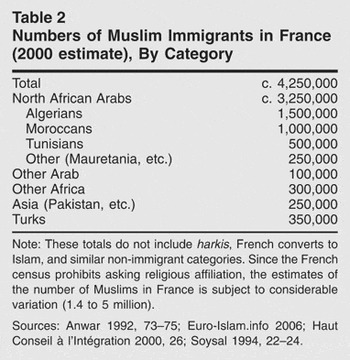
As in Germany, Muslims are divided by nationality or ethnicity; since Islam in the various countries of immigrant origin is different, country-specific Islamic organizations have emerged. In addition, as in Germany, Muslims in France are divided by adherence to particular schools of Islam.80
Dassetto 1995, 179–239.
The organizational consequences of ethnic differences among Muslims in France deserves additional research in the future, especially since these differences have led to some serious disagreements on some major issues affecting Muslims, e.g., on education and labor matters.
Numbers of Muslim Immigrants in France (2000 estimate), By Category

For most Muslim guest-workers and Algerian émigrés, the Communist-led trade union, CGT, was the first point of contact with organized politics. The CGT saw the immigrants as “visible victims of world capitalist exploitation”.82
Ireland 1994, 108.
Blatt 1995, 156–177, here at 163.
Kettani 1996, 14–35, here at 24–25.
However, when some “guest” workers decided to stay in France, and were joined by their families, their view of themselves often changed: no longer just workers, many now saw themselves as heads of Muslim households with new responsibilities and concerns.85
Nielsen 1992a, 116.
Characterizing Muslim organizations in France
The first point to note is that racism proved a weak point for organizational unity. In the early 1980s, young beurs, the second generation of Maghrebians (North Africans), launched a number of different organizations aimed at combating racism and at highlighting the “specific injustices and hardships they encountered as immigrant youth.” These organizations were strongly supported by the Mitterrand government, which “channeled considerable funding to immigrant associations, and incorporated some immigrant activists directly into the political process.”86
Quotes in paragraph from Blatt 1995, 164.
Being first channeled into a trade union and later into anti-racist groups clearly did not prevent the formation of a variety of Islamic groups; indeed, the variety of groups and goals probably not only increased, but also provided more attractive and meaningful alternatives.
President Mitterrand's tenure in office (1981–1995) effected several striking changes in Muslim immigrant and descendant activity; for example, his government facilitated the formation and recognition of immigrant associations on any basis, including religious.87
The main obstacle in the past had been that foreign organizations “needed to have a minimum number of French citizens in their leadership.” Nielsen 1992a, 120.
A telling contrast is that at the same time, the Spanish Catholic Church sponsored the grouping of Spanish immigrant parents' organizations into one umbrella group, APFEEF (Associación de Padres de Familia Españoles Emigrados en Francia). Ireland 1994, 66.
From 131 in 1976 to over 300 in 1979, to 600 in 1984, to 1500 by 1991. Ireland 1994, 71; Kettani 1996, 19. Mosque counting is not a precise business; the number of mosques is estimated to be in the mid-1000s, but many of these are acknowledged to be, essentially, prayer rooms or even gathering places in individual homes, rather than mosques in the full architectural sense.
The efforts of the French government to develop mechanisms and organizations to channel the political inclinations of the Muslim population were met by the founding of civic and similar associations by the governments of the sending states. For example, since 1962 the Algerian government has sponsored a civic association for Algerians in Europe, l'Amicale des Algériens en Europe (AAE),91
Hargreaves 1990, 301.
Officially the title is “l'Institut musulman de la mosquée de Paris”. The mosque is sometimes called “la grande mosquée.” Kepel 1987, 64–94.
The failure of immigrant groups to form a unified Islamic group is often blamed on the influence of the French “Republican ideal,” with its emphasis on universalist values and rights, and its Jacobin rejection of particularist communities. Many of the anti-racist groups formed by immigrants were displaced by the founding of SOS-Racisme (by young left-wing non-immigrant French). Its declared goal has been to counter racism and discrimination against all minorities, and it has rejected communitarian-based politics. Many beur organizations contend it has failed to represent them adequately, and has diluted or downplayed the real and specific problems the immigrants face.94
Author interview with Mamadou Gaye, SOS Racisme, Paris, November. 26, 2003; Blatt 1995, 165, 169.
The extent of the differences in beliefs of Muslims in France is illustrated by the fact that at least one Maghrebian organization, France-Plus, even supported the expulsion from school of Muslim girls wearing head scarves.95
Blatt 1995, 172.
Philippe 1999.
The Catholic Church in various European states faced similar biases at an earlier time, yet it had a degree of success in organizing to fight against anti-clerical policies and for what it regarded as its prerogatives. Even in anti-clerical France, the Catholic Church created an organization to speak and act in policy debates on its behalf.97
Warner 2000, 97–134.
Another important group of Muslims in France is Faith and Practice (Foi et Pratique), the French expression of Jama'at al-Tabligh. The Tablighi, as they are often called, originated in Pakistan and consider themselves Islamic missionaries. Faith and Practice tries to avoid taking any political stance, refusing to be incorporated into the Islamic councils which the French state has sponsored. It does not advocate separation, nor full integration, as the latter, in the French context, threatens the religiosity of the movement. It has had internal divisions. Given that there is little agreement in France's Islamic community over what it wants and how its goals should be met, none of the Islamic groups has been successful in controlling or representing that community.
The lack of cohesion cannot be blamed only on differences between ethnic groups: the divisiveness persists within each Muslim ethnic group. This is because what further divides the population is, as in Germany, the playing out of homeland religio-political conflicts in the host country. Algerians constitute the largest percentage of Muslim immigrants in France, and they are among the most divided. The Algerian war for independence from France had already put a wedge between Algerians, with some fighting as French soldiers for France (the harkis), and some fighting in the independence movement. More recently, conflicts between the Algerian military government and several Islamic fundamentalist groups, such as the Islamic Salvation Front (FIS) and Armed Islamic Group (GIA), have spilled into France, fragmenting the Algerian immigrants on such questions as nature of the state (secular versus Islamic), on the appropriateness of the politicization of Islam, on the means to achieve ends, and on particular interpretations of Islam.100
There have been several incidents in France which might have been the basis for unifying Muslim organizations; perhaps the most well-known is the so-called affaire de foulard of France's bicentennial year, 1989, in which three Moroccan-descent school-girls were expelled from school for wearing head scarves in class.101
Kepel 1995, 29–41.
While the Islamic community in France could not present a united front to the government, the affair prompted then-Minister of the Interior, Pierre Joxe, to create a special working group on Islam in France. Set up in 1990, Comité de reflexion pour l'Islam de France (CORIF), as it was called, had fifteen members representing some of the strands of Islam in France. Predictably, several prominent groups refused to become involved, including the FNMF, and the UOIF, and the Tabligh. The FNMF leader claimed CORIF was “a post-colonial institution which will sanction all anti-Islamic standpoints for reasons of state.”102
Kepel 1997, 190.
Haddam later quit his Algerian post, but it was too late for the CORIF. Kepel 1997, 177–9, 192–4; Tincq 1992.
Hussain 2003, 225–6.
The latest evidence for the argument of this article was provided in December 2002. The French state made another attempt to create a “French Council for Islam”, on the model of the peak organizations which represent the Catholics, Protestants and the Jews (the Bishops Conference for the Catholic Church, Reformed Protestant Federation, and the Central Council, respectively). It has been named the Conseil Français du Culte Musulman (CFCM). Together with Dalil Boubakeur, the head of the Mosque of Paris and the presumptive leader of the Muslims in this proposed partnership with the French government, French Interior Minister Nicolas Sarkozy called a two-day meeting to create the new body; it was termed an “historic day” by Boubakeur. The Union of Islamic Organizations in France, the Mosque of Paris, and the National Federation of Muslims in France were to work out the rules and procedures of the new body, in conjunction with the Ministry of the Interior.
Yet many Muslims immigrants from the states where these three organizations have their roots (Egypt, Algeria, and Morocco respectively) immediately opposed the proposed organization. The Mufti of Marseille, Soheib Bencheikh, asked: “Why is the government forcing Muslims against their will into a ‘representative council’”? Abderrahmane Dahmane, President of Coordinated Muslims, said that the new organization was an “affront to all democratic and republican-oriented Muslims, because it includes a large group of fundamentalists and Muslim extremists”; he was also quoted as saying that the proposed organization was being put into the hands of “fascist Muslims and their foreign supporters.” Other Muslim leaders feared that the Interior Ministry was trying to bring all Muslims under state control. Even before any of the details of the proposed institution were made public, there was tremendous unrest and doubts about the new Council. In fact, 30–40 percent of all French Muslims felt left out of the discussions, because they belonged to organizations which Sarkozy did not consult.105
BBC News, December 20, 2002; ArabicNews.com, December 21, 2002, and Der Tagesanzeiger, December 21, 2002; Le Monde, “Tous les participants à la consultation devaient avaliser l'accord,” December 23, 2002.
The election statutes are in Association pour l'Organisation des Elections au Conseil Français du Culte Musulman, Annexe aux statuts. Règlement électoral: Art. 4 des statuts, section 2.2. An updated version, for the 2005 elections, is at http://www.crcm-ra.org/reglement-electoral.php. Le Monde, “Accord sur la composition du futur Conseil du culte musulman” December 21, 2002. On representation, Gaye, author interview, November 26, 2003, Paris; Dalil Boubakeur, quoted in Deloire 2004; Laurence 2001; [http://www.brook.edu/printme.wbs?page≠fp/cusf/analysis/islam.htm]
“Fouad Aloui démissionne du bureau exécutif du Conseil français du culte musulman” Le Monde, May 6, 2005. New elections held in June resulted in further fragmenting Aloui's was preceded by other resignations, including by the representative of the Mosque of Lyon, who cited extensive disagreements. Ternisien 2004.
Even the imposition of a ban on the wearing of religious symbols in public schools has prompted diverse reactions amongst Muslim minorities. The head of the Mosque of Paris, Dalil Boubakeur, supported the ban, the UOIF opposed it. Other organizations were similarly divided on that issue. France has tried to impose uniform boundaries between secular and sacred, religion and the public realm, but the complexity and variety within the Muslim immigrant population has consistently challenged that project.
Conclusion
Relations between Europe and the Islamic world have often been antagonistic and unfriendly, or what Samuel Huntington, in another context, somewhat exaggeratedly labeled a “clash of civilizations”.108
Huntington 1992; it should be added that there were also occasions characterized by mutually beneficial economic, scientific, and cultural relations. For example, Europe gained significantly in various disciplines from its encounters with Islam in Spain and Sicily.
The contemporary arrival in Europe of different peoples from the developing areas, but most especially from Islamic states, has ignited a number of dire predictions concerning the future of (secular) European political and social systems, ranging from observers such as Omer Taspinar and Daniel Pipes to novelist Jean Raspail to journalist Oriana Fallaci to politicians such as Jean-Marie Le Pen and Jörg Haider.109
Taspinar 2003, 76–7; Pipes, 2003, 21–3; Raspail 1978; Fallaci 2004; see also Fortuyn 1997; Gurfinkiel 1997; http://www.meforum.org/article/337, 1–13.
The European states with large Muslim populations do exercise a modicum of care in their foreign policies towards Turkey, Algeria, and the other regions of the world from which their Muslim immigrants have come. They do not, however, allow it to determine their foreign policy, and they need not: Muslim opinion about “homeland” politics is, as we have shown, divided. Britain went to war in Iraq in 2003 despite its Muslim community; France did not, partly due to its earlier ties with Iraq and to the Muslim populations in France, but also due to its belief that war was not the way to resolve the Saddam question. Germany's refusal to go to war in 2003 had more to do with the German population's preferences than with those of its (largely disenfranchised) Muslim community. When considerations of power and threat come into play, the views of a divided, strategically weak community are not generally considered.
We are well aware that certain aspects of the domestic and foreign policy of the European states have changed in the aftermath of September 11, 2001. Without attempting a thorough analysis of Europe's relations with the Islamic states, a topic far beyond the confines and purposes of this article, it should be noted that the European states have not made any effort to accommodate or accept the more extreme Islamist goals of certain international movements which claim Islam as the basis for their ideology and goals (e.g., al-Qa'ida), and therefore our primary point remains valid.
Muslims also have other disadvantages to organizing: Islam cannot claim to be a “natural” resident and institution of Western and Central Europe; Muslims therefore face a substantial hurdle to attaining acceptance and legitimacy. Many Muslims arrived as guest workers, whom most in Europe (at least originally) thought would return to their countries of origin. Further, Muslims have often faced strident racism; their homes have been fire-bombed, individuals have been drowned in rivers by Neo-Nazis, and occasionally brutally murdered.110
While the original liberals, i.e., those who advocated a clear separation of church and state, thought Catholics could and should be educated out of their religious beliefs, they did not think that Catholics would or should go to some other continent.
Muslims, on the other hand, face occasional efforts by Christians to prevent the spread of Islam. In Spain, where some local governments tried to transfer control of abandoned mosques to the (new) Muslim communities, the Catholic Church protested. While the objection was (the unbelievable and offensive claim) that doing so would reduce Christians to the “backward” level of Muslims, it was clear that the hierarchy feared competition from Islam. See Shadid and van Koningsveld 2002, 34.
Perhaps symbolically representative of the problem: the various Muslim organizations could not even agree on the day for the beginning of Ramadhan in 2000 and 2004.
While European governments try to channel Muslims into representative peak organizations, the broader European context facilitates the multiplication of Islamic groups, rather than their consolidation or unification. With their civil liberties and constitutional guarantees of freedom of religion, European states allow the expression of multiple varieties of Islam. This has enabled multiple competing schools and sub-schools of Islam to go public and work to attract supporters, producing a variety of orientations and organizations much broader than that available in most if not all of the “exporting” countries. As one migrant from Turkey said, “Here [Germany] I've gotten to know religious communities that are outlawed in Turkey”.113
Schiffauer 1998, 155.
The Catholic Church in many European countries became part of a state-sanctioned religious cartel seeking to eliminate competitors and impose its views on society.114
Warner 2000, passsim.
We lack data on this question, although there is some evidence that those immigrants who remain adherents of the faith practice it more intensely in the (comparatively) inhospitable European environment. Schiffauer 1988, 146–158.
Muslim residents of the region attach a stronger subjective importance to religion than non-Muslims (religion being “important” or “very important”; 85.5 percent: 46.6 percent), attend religious services more frequently (monthly attendance 48.4 percent : 31.4 percent), and are more active in religious organizations (71.5 percent: 31.8 percent). Inglehart et al., World Values Survey, 1999–2001, http://search.icpsr.umich.edu/ICPSR/access/index.html # 3975; Anon., “The Number of Muslims is Rising Steadily in Germany”. http://www.pastornet.net.au/jmm/articles/488.htm, September 28, 2002.
It may be counterintuitive, but Islam in Europe, a religion which is not protected by state laws and subsidies, may be the one which is more vibrant and responsive to its followers and potential followers. Because of its decentralized structure and lack of hierarchy, Sunni Islam may be even more likely to serve the (Sunni) Muslim immigrant communities in Europe. Its current diversity of organizations, structures and goals more accurately represents and caters to the variations in religiosity and socio-political orientations of the European Muslims than do the highly structured, monopolistic Christian churches serve their Christian constituencies. The political consequence is that the lack of a single hierarchical organization means comparatively less political power. This means that Muslims as a bloc will not have significant influence over European foreign and domestic policies, contrary to the fears of some commentators. But one serious consequence of ineffectual political representation and interaction is that it facilitates the development of radicalized groups reacting to their sense of exclusion. Further, due to the absence of an authoritative, controlling hierarchy, it is easier for such Islamic groups to develop. As Europe is seeing, a handful of such groups may seek to exercise political influence in other ways.