Implications
As a consequence of global warming, drier and hotter summers are expected for Central Europe. Here we discuss multiple interactions between climate change and dairy production in Central Europe in its full complexity, starting from fodder resources to breeding impacts and farm economy. Under current conditions, the impact of climate change on the farm economy is estimated to be neutral if some form of adaptation is integrated. Thus, establishing mitigation and adaptation strategies covering available tools from management, nutrition, health and plant and animal breeding to cope with the future consequences of climate change on dairy farming are essential.
Introduction
Increases in global average air and ocean temperatures, widespread melting of snow and ice as well as rising global average sea level indicate that global warming is unequivocally inevitable (Intergovernmental Panel on Climate change (IPCC), 2007). Therefore, future consequences of climate change on livestock production systems should be investigated. Agricultural production systems depend on environmental factors and the management practices adopted. Both have multiple and complex interactions. Climate change may alter main characteristics of production systems. In climate change research, numerous studies have analysed agricultural systems (especially dairy and meat production) as sources of greenhouse gas emissions (Food and Agriculture Organization (FAO), 2006). Recent data indicate that dairy and beef sectors account for more than 70% of total greenhouse gas emissions from livestock production in the EU-27 (Lesschen et al., Reference Lesschen, van den Berg, Westhoek, Witzke and Oenema2011). However, comparably little is known about the sensitivity and vulnerability of the production systems themselves to climate warming. Other than indoor production systems, dairy production is not only indirectly affected by the surrounding climate but also directly because of pasture use and open barn husbandry systems.
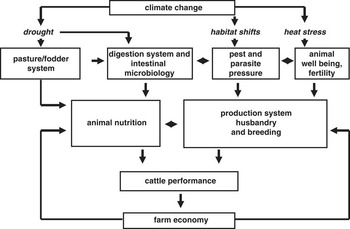
One major concern when discussing agricultural responses to climate change is that changes are quite uncertain on a local or regional scale. For Central Europe, summers are expected to become hotter and drier. In northern Germany, a typical area of dairy production under the influence of a temperate oceanic climate, experts expect a reduction in the average rainfall during the summer months by 15% and an increase in the annual mean temperatures by 2°C in 2050. Furthermore, the number of hot days (above 30°C) will slightly increase (DWD, 2011). These estimates are more or less similar for the other regions of Central Europe. The main direct consequences of climate change that has adverse effects on animal physiology, welfare, health and reproduction are rising temperature and weather extremes. The number of heat stress causing days, that is, days with a temperature humidity index (THI) value above 68, has increased by 4.1% from 1973 to 2008 in certain parts of Central Europe (Solymosi et al., Reference Solymosi, Torma, Kern, Maróti-Agóts, Barcza, Könyves, Berke and Reiczigel2010). Recent data indicate that there are already 80 to 86 hot days in this region (Broucek et al., Reference Broucek, Ryba, Mihina, Uhrincat and Kisac2007; Novak et al., Reference Novak, Vokralova and Broucek2009). It can be expected that the value chain of milk production will be impaired by these changes at several stages from fodder production to reproduction (Figure 1).
Scheme of effects from climate change on environmental factors and farm-related factors concerning the performance of cattle.

Grassland production is considered as the basis for cost-effective dairy production (Dillon, Reference Dillon2006). According to the agricultural statistics of the EU, permanent grassland covers 33% of the utilized agricultural land and is the dominant agricultural land-use form (EU-27). An additional 11% of the utilized agricultural land is grass leys and forage maize on arable land (Osterburg et al., Reference Osterburg, Isermeyer, Lassen and Röder2010). As an expression of global warming, the duration and frequency of droughts as well as the overall allocation of rain on regional scales are expected to have deep impacts on grassland and fodder production systems. Changes in grass sward composition and plant growth are expected to influence digestibility for ruminants (Perring et al., Reference Perring, Cullen, Johnson and Hovenden2010), which are themselves also being exposed to the effects of a changing climate.
Most of the available publications have separately discussed potential or already measurable effects of climate change on each of the different components of dairy systems. This review brings different aspects, from rumen physiology to the economics of dairy cow production in Central Europe, into focus with a holistic approach to emphasize potential future consequences and challenges arising from climate change. Each of the following eight sections reports an updated current understanding of the evaluated points and provides potential adaptation measures to deal with the consequences of climate change. It provides three sections concerning fodder quality, ruminal fermentation and nutrition strategies in relation to heat and heat stress. Another section deals with a description of the predominant dairy cow production systems in Germany and discusses possibilities for the use of available management tools that may alleviate direct effects of heat stress on dairy cow welfare. Heat stress-related impairments in the ability of sperm and embryonic development are covered in another section. As reviewed earlier (van Dijk et al., Reference Van Dijk, Sargison and Kenyon2010), a significant impact of climate change is expected to have effects on prevalence and distribution of gastrointestinal parasites. Changes in the patterns of certain parasitic infections that are recently spreading in Europe are discussed in a section, which also provides an overview of the present status of the current research interest in this area. Possibilities for including heat stress tolerance as a functional trait in breeding programmes and major concerns in relation to appropriate stress indicators, as well as interpretation of the heat stress-related genetic parameters are discussed in another section. The last section provides an overview on the impact of climate change on the economy of dairy farming.
Impacts on quantity and quality of fodder production
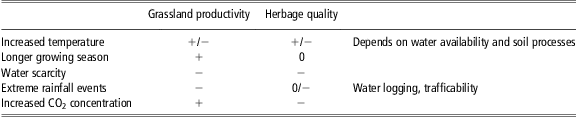
Grassland production is regarded as the basis for cost-effective dairy production (Dillon, Reference Dillon2006). As summarized in Table 1, climate change has important implications for the nutritional basis of dairy production, namely fodder quantity and quality. The main influences of climate change on plant growth and thus fodder quantity are prolonged periods of seasonal production, increased air temperatures, changed precipitation patterns leading to extreme rainfall events and droughts and effects of increased atmospheric carbon dioxide (CO2) concentrations (Myneni et al., Reference Myneni, Keeling, Tucker, Asrar and Nemani1997; Morison and Lawlor, Reference Morison and Lawlor1999; Ciais et al., Reference Ciais, Reichstein, Viovy, Granier, Ogee, Allard, Aubinet, Buchmann, Bernhofer, Carrara, Chevallier, De Noblet, Friend, Friedlingstein, Grunwald, Heinesch, Keronen, Knohl, Krinner, Loustau, Manca, Matteucci, Miglietta, Ourcival, Papale, Pilegaard, Rambal, Seufert, Soussana, Sanz, Schulze, Vesala and Valentini2005).
Effects of elements of climate change on grassland productivity and herbage quality in Central Europe
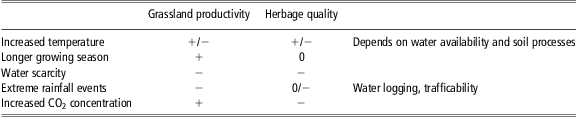
CO2 = carbon dioxide.
A prolonged growing season may be beneficial especially for perennial vegetation such as grassland (Topp et al., Reference Topp, Wreford, Tolkamp, Wu and Moran2010), as it permits a longer grazing season and more cuts. Increasing temperatures may also lead to quicker plant development and growth (Cleland et al., Reference Cleland, Chiariello, Loarie, Mooney and Field2006; Bloor et al., Reference Bloor, Pichon, Falcimagne, Leadley and Soussana2010). However, above the optimal temperatures for growth, plant physiological processes become impaired, growth is limited and plants mature quicker (De Boeck et al., Reference De Boeck, Lemmens, Zavalloni, Gielen, Malchair, Carnol, Merckx, Van den Berge, Ceulemans and Nijs2008). For Central European grasslands where swards consist of C3 plants only, optimal temperatures for growth will be exceeded at temperatures from 25°C to 30°C. For forage maize, a C4 plant, optimal growth would be reached at a higher temperature. Thus, higher ambient temperatures because of climate change would have a more beneficial effect on maize compared with grass. In contrast, increasing ambient CO2 concentrations have only a small effect on herbage growth of maize because of the C4 pathway of this species (Olesen and Bindi, Reference Olesen and Bindi2002). Maturation of plants is associated with increasing concentrations of lignin, which is considered as an anti-quality component in forages, as it interferes with the digestion of cell wall polysaccharides, thus lowering nutritional availability of fibre (Moore and Jung, Reference Moore and Jung2001). High temperatures appear to induce a favourable effect on lignification procedures in the plant cells. Wilson et al. (Reference Wilson, Deinum and Engels1991) showed that high temperatures increase intensity of lignification of existing lignified cells rather than increasing the proportion of cells becoming lignified.
A prerequisite for increased growth with warmer temperatures is the availability of sufficient water. Generally, grassland needs more water per unit of biomass production than most arable crops (Ehlers and Goss, Reference Ehlers and Goss2003). Owing to the usually lower sward height, grazed grasslands (pastures) use less water than cut ones (meadows; Misztal and Zarzycki, Reference Misztal and Zarzycki2010). Availability of sufficient water could become limiting in parts of Central Europe where the probability of summer droughts is greater (IPCC, 2007; Schindler et al., Reference Schindler, Steidl, Müller, Eulenstein and Thiere2007). Furthermore, extreme rainfall events may impair the trafficability of grassland, lead to more severe effects of treading and directly damage taller vegetation. Increased CO2 concentrations in the atmosphere may have a growth-enhancing effect and at the same time may lead to improved water-use efficiency (Owensby et al., Reference Owensby, Coyne, Ham, Auen and Knapp1993; Soussana and Lüscher, Reference Soussana and Lüscher2007). Recent data indicate that grass vegetation can physiologically adjust to elevated atmospheric CO2 concentrations as an adaptive response to the changing climate (Köhler et al., Reference Köhler, Poulton, Auerswald and Schnyder2010). However, stimulated growth because of enhanced uptake of CO2 may lead to nutrient imbalances, affecting both herbage productivity and quality (Soussana and Lüscher, Reference Soussana and Lüscher2007).
Herbage quality is influenced by water scarcity and increased CO2 concentrations (Soussana and Lüscher, Reference Soussana and Lüscher2007). As discussed above, water scarcity leads to quicker plant maturation, which in grassland means lower dry matter digestibility than in physiologically younger swards (Wilson and Ng, Reference Wilson and Ng1975). This could be alleviated by earlier cutting. Increasing CO2 concentrations have been shown to increase nitrogen limitation of grass production (Lüscher et al., Reference Lüscher, Fuhrer and Newton2005). This would be beneficial for the competitiveness and growth of legumes in grass–legume mixtures. In pure grass stands, nitrogen fertilizer additions would be more effective in terms of productivity. At the same time, increased temperatures may accelerate soil processes such as mineralization, leading to a more rapid supply of nutrients from decomposing organic material if sufficient water is available, but potentially also larger leaching losses of mobile nutrients (Ineson et al., Reference Ineson, Benham, Poskitt, Harrison, Taylor and Woods1998a and Reference Ineson, Taylor, Harrison, Poskitt, Benham, Tipping and Woof1998b; Niklaus et al., Reference Niklaus, Wardle and Tate2006; Sardans et al., Reference Sardans, Peñuelas and Estiarte2006). Increased CO2 atmospheric concentrations together with nitrogen fertilization have been found to accelerate flowering in forbs, but delay in that of grasses, decreasing phenological complementarity (Cleland et al., Reference Cleland, Chiariello, Loarie, Mooney and Field2006).
Different options are available for dealing with the effects of climate change on grassland production. First of all, the use of legumes is one option to supply the sward with sufficient nitrogen if phosphorus is available. However, white clover, the currently preferred legume in European agricultural grasslands, needs a lot of water (Frame et al., Reference Frame, Charlton and Laidlaw1998). The use of legume species with deeper rooting growth habit may offer higher potential under changed conditions. Legumes such as Medicago sativa (lucerne) species or Lotus corniculatus (bird's foot trefoil) could be considered in this respect. The botanical composition of swards should be adapted to changing conditions. Deep-rooting plants such as chicory can reach water that is otherwise unavailable. A combination of species in a diverse sward has been suggested to improve the water-use efficiency of grassland (Caldeira et al., Reference Caldeira, Ryel, Lawton and Pereira2001; Tsialtas et al., Reference Tsialtas, Handley, Kassioumi, Veresoglou and Gagianas2001; Chen et al., Reference Chen, Bai, Lin, Huang and Han2007).
With the current understanding of effects of climate change on grassland production, it can be inferred that fodder quantity may be influenced positively through prolonged growth periods by slight increases in ambient air temperature and CO2 concentration, whereas both quantity and quality will depend on water availability and soil characteristics, which will simultaneously be affected by climate change. The botanical composition of grassland should include species that are able to withstand the changing conditions. Recent research has shown considerable differences in growth and digestibility among grass species under drought (Hayes et al., Reference Hayes, Dear, Li, Virgona, Conyers, Hackney and Tidd2010). However, more research is necessary as to which species and genotypes are best suited for permanent grassland in Central Europe managed for high yielding dairy cows. Another necessary reaction to climate change is the adaptation of management, most importantly the time of cutting, length of grazing and fertilizer application to changed growth and quality of the sward (e.g. Holden et al., Reference Holden, Brereton and Fitzgerald2008). Irrigation would also have a potential for yield increases under drought. However, under the given cost relations the gains of irrigation would hardly cover the additional cost.
Effects of climate change on ruminal fermentation and structural diversity of rumen microbial communities
Elevated environmental temperature is a likely consequence of future climate change. The reactions of ruminants to increased heat load have been studied repeatedly. It is commonly accepted that heat-stressed ruminants decrease their dry matter intake to reduce metabolic heat production to maintain a constant body temperature (Beede and Collier, Reference Beede and Collier1986; Schneider et al., Reference Schneider, Beede and Wilcox1988; Lu, Reference Lu1989; Beatty et al., Reference Beatty, Barnes, Taylor, Pethick, McCarthy and Maloney2006; Collier et al., Reference Collier, Dahl and Van Baale2006; Beatty et al., Reference Beatty, Barnes, Taylor and Maloney2008; Bernabucci et al., Reference Bernabucci, Lacetera, Danieli, Bani, Nardone and Ronchi2009; O'Brien et al., Reference O'Brien, Rhoads, Sanders, Duff and Baumgard2010). Moreover, animals shift their feeding activity to times of day with lower temperature (Schneider et al., Reference Schneider, Beede and Wilcox1988). In addition, the preference to consume concentrate instead of roughage was noted (McDowell et al., Reference McDowell, Moody, Van Soest, Lehmann and Ford1969; Lu, Reference Lu1989; Bernabucci et al., Reference Bernabucci, Bani, Ronchi, Lacetera and Nardone1999; Bernabucci et al., Reference Bernabucci, Lacetera, Danieli, Bani, Nardone and Ronchi2009; Uyeno et al., Reference Uyeno, Sekiguchi, Tajima, Takenaka, Kurihara and Kamagata2010). It was suggested that the preference of concentrate was because of a lower metabolic heat production compared with the heat released by fermentation of forage (Lu, Reference Lu1989). High-concentrate proportions in the diet can influence rumen fermentation in many aspects. A problem connected with the higher concentrate and reduced forage intake is an increased risk of rumen acidosis (Collier et al., Reference Collier, Dahl and Van Baale2006). In their trial, Grubb and Dehority (Reference Grubb and Dehority1975) changed an all-hay diet abruptly to a 60% concentrate and 40% hay ration, ensuring equal dry matter intake. The rumen dry matter turnover was decreased, whereas dry matter digestibility was increased. Analyses of the rumen fluid showed increasing production of short-chain fatty acids (SCFA) with lower acetate and higher propionate molar percentages along with decreasing counts of cellulose-digesting bacteria. From numerous studies, it was shown that the molar ratios of SCFA differ depending on the consumed diet (Bergman et al., Reference Bergman, Reid, Murray, Brockway and Whitelaw1965). Feed quality may be influenced by elevated environmental temperature. Lu (Reference Lu1989) stated that high environmental temperature can influence plant growth and composition, such as increased stem to leaf ratio and a higher cell wall content, which might result in decreased digestibility of dry matter (Van Soest, Reference Van Soest1965).
Many in vivo experiments were carried out feeding ruminants in standardized environments to test the influence of elevated temperature on parameters of rumen digestibility, rumen motility and SCFA production. While water intake increased and feed intake decreased (Schneider et al., Reference Schneider, Beede and Wilcox1988; Lu, Reference Lu1989; Beatty et al., Reference Beatty, Barnes, Taylor, Pethick, McCarthy and Maloney2006; Beatty et al., Reference Beatty, Barnes, Taylor and Maloney2008; Bernabucci et al., Reference Bernabucci, Lacetera, Danieli, Bani, Nardone and Ronchi2009; O'Brien et al., Reference O'Brien, Rhoads, Sanders, Duff and Baumgard2010), digestibility increased in hot environments (McDowell et al., Reference McDowell, Moody, Van Soest, Lehmann and Ford1969; Martz et al., Reference Martz, Payna, Matches, Belyea and Warren1990; Tajima et al., Reference Tajima, Nonaka, Higuchi, Takusari, Kurihara, Takenaka, Mitsumori, Kajikawa and Aminov2007). It has been stated that a decrease in dry matter intake causes lower passage rates from the rumen (Christopherson and Kennedy, Reference Christopherson and Kennedy1983; Martz et al., Reference Martz, Payna, Matches, Belyea and Warren1990; Bernabucci et al., Reference Bernabucci, Bani, Ronchi, Lacetera and Nardone1999; Bernabucci et al., Reference Bernabucci, Lacetera, Danieli, Bani, Nardone and Ronchi2009), and thus the mean retention time increases (McDowell et al., Reference McDowell, Moody, Van Soest, Lehmann and Ford1969; Schneider et al., Reference Schneider, Beede and Wilcox1988). With increased mean retention time of forage the digesting time increases, which may enhance digestibility of structural carbohydrates (Silanikove, Reference Silanikove1992). The total concentrations of rumen SCFA decreased in most experiments conducted in hot environments (Weldy et al., Reference Weldy, Mcdowell, Van Soest and Bond1964; Schneider et al., Reference Schneider, Beede and Wilcox1988; Martz et al., Reference Martz, Payna, Matches, Belyea and Warren1990; Tajima et al., Reference Tajima, Nonaka, Higuchi, Takusari, Kurihara, Takenaka, Mitsumori, Kajikawa and Aminov2007). The authors explained the lower concentrations by reduced dry matter intake. However, as observed in heat-stressed cows, an additional dilution effect in SCFA concentrations may be caused by the increased water intake (Schneider et al., Reference Schneider, Beede and Wilcox1988).
To eliminate the variance of dry matter intake on the influence of high environmental temperature on rumen digestibility, rumen motility and SCFA production experiments have been conducted with controlled feed intake. One possibility to maintain stable feed intake is forced feeding via rumen cannulae (Kelley et al., Reference Kelley, Martz and Johnson1967; Attebery and Johnson, Reference Attebery and Johnson1969; Lippke, Reference Lippke1975; Miaron and Christopherson, Reference Miaron and Christopherson1992). Another way is to implement pair-fed procedure (O'Brien et al., Reference O'Brien, Rhoads, Sanders, Duff and Baumgard2010). In the experiments of Attebery and Johnson (Reference Attebery and Johnson1969) and Miaron and Christopherson (Reference Miaron and Christopherson1992), heat-stressed cattle showed decreased rumen motility and lower passage rates. Warren et al. (Reference Warren, Martz, Asay, Hilderbrand, Payne and Vogt1974) and Lippke (Reference Lippke1975) observed increased mean retention times of forage and increased digestibility of structural carbohydrates in the rumen of heat-stressed steers. The production of SCFA decreased in most experiments with decreased acetate and increased propionate molar percentages (Kelley et al., Reference Kelley, Martz and Johnson1967; Gengler et al., Reference Gengler, Martz, Johnson, Krause and Hahn1970; Tajima et al., Reference Tajima, Nonaka, Higuchi, Takusari, Kurihara, Takenaka, Mitsumori, Kajikawa and Aminov2007). Concentrations of butyric acid as well as acetate–propionate ratios are inconsistent between the experiments. This discrepancy was explained by differences in the basal ration and feeding procedures (Weldy et al., Reference Weldy, Mcdowell, Van Soest and Bond1964; Kelley et al., Reference Kelley, Martz and Johnson1967). In contrast to the results above, in one part of the experiment, Gengler et al. (Reference Gengler, Martz, Johnson, Krause and Hahn1970) tested the effect of elevated rumen temperature independent of an environmental heat load, accomplished by heating the ruminal contents of fistulated Holstein cows directly with an intraruminal heating coil. Dry matter intake decreased, but concentrations of ruminal SCFA were unaffected. It was concluded that a lower ruminal SCFA concentration could not be explained by changes in rumen temperature.
Uyeno et al. (Reference Uyeno, Sekiguchi, Tajima, Takenaka, Kurihara and Kamagata2010) found in the rumen of heat-stressed heifers with decreased dry matter intake and decreased concentrations of SCFA (Tajima et al., Reference Tajima, Nonaka, Higuchi, Takusari, Kurihara, Takenaka, Mitsumori, Kajikawa and Aminov2007) decreasing fibrolytic and increasing saccharolytic bacteria. Bernabucci et al. (Reference Bernabucci, Lacetera, Danieli, Bani, Nardone and Ronchi2009) observed a decrease in rumen cellulolytic and amylolytic bacteria counts in heat-stressed ewes. Brody et al. (Reference Brody, Dale and Steward1955) hypothesized that ambient temperature may affect the rumen microorganisms directly. In their set of DNA-based experiments, establishing rDNA libraries, Tajima et al. (Reference Tajima, Nonaka, Higuchi, Takusari, Kurihara, Takenaka, Mitsumori, Kajikawa and Aminov2007) observed no obvious tendency for changes in rumen bacterial composition because of heat stress. Using real-time PCR, they found a decreased quantity of uncultured Cluster E bacteria attributed to the Clostridium botulinum group (classified by Leser et al., Reference Leser, Amenuvor, Jensen, Lindecrona, Boye and Møller2002) in response to elevated environmental temperature. Although the quantity of rumen bacteria changed, the diversity indices remained constant. Previous studies showed a fluctuation in the quantity of the Cluster E bacteria depending on the presence or absence of protozoa in Holstein cows. Tajima et al. (Reference Tajima, Nonaka, Higuchi, Takusari, Kurihara, Takenaka, Mitsumori, Kajikawa and Aminov2007) concluded that Cluster E bacteria are responsive to alterations of rumen conditions. The effect of elevated temperature on protozoa was not analysed, but a decrease in quantity may be assumed. Hungate (Reference Hungate1966) noted that protozoa cannot withstand a prolonged exposure to 40°C, and Beatty et al. (Reference Beatty, Barnes, Taylor and Maloney2008) found a mean maximal rumen temperature of 42.3°C in heat-stressed cattle.
Uyeno et al. (Reference Uyeno, Sekiguchi, Tajima, Takenaka, Kurihara and Kamagata2010) analysed samples taken during the experiment published by Tajima et al. (Reference Tajima, Nonaka, Higuchi, Takusari, Kurihara, Takenaka, Mitsumori, Kajikawa and Aminov2007), but studied changes due to heat stress in the bacterial community composition in the rumen of Holstein heifers by applying a rRNA-based method. The relative population of major fibrolytic bacteria decreased, whereas the relative population of major saccharolytic bacteria increased in their experiments. The authors concluded that the shift in quantities of specific bacteria may be caused indirectly by heat stress via induction of altered feeding behaviour. The reduction in forage intake was more pronounced compared with decrease in concentrate consumption. Overall bacterial diversity (richness) was maintained even under heat stress conditions (Uyeno et al., Reference Uyeno, Sekiguchi, Tajima, Takenaka, Kurihara and Kamagata2010).
In summary, rising heat loads influence rumen physiology in different ways. As a consequence of heat stress, the dry matter intake, rumen motility, passage rates and SCFA production decrease, whereas mean retention time, gut fill and digestibility of dry matter increase. The decrease in dry matter intake of concentrate is less pronounced compared with decreased forage consumption. The ruminal bacterial community maintains stable with regard to diversity indices, but the quantity of specific groups differs. Decreasing quantities of fibrolytic and increasing amounts of saccharolytic bacteria may be caused by higher concentrate of hay ratios in the diet because of altered feeding behaviour induced by heat stress. The changes in composition of the microbiota are linked to altered ruminal fermentation pattern. Independent of decreased dry matter intake, the effects of elevated environmental temperature on rumen motility, passage rate, gut fill and digestibility are reproducible. Further research is necessary to define the effect of high temperature on microbial diversity without interference of altered dry matter intake.
Climate change and dairy cow nutrition
Altering climatic parameters such as rising ambient temperature, modified precipitation patterns and increasing atmospheric CO2 concentration have the potential to affect animal performance either directly by augmented metabolic stress induced by heat or indirectly via changing the composition and quality of feedstuffs because of varying cultivation conditions and altered ruminal fermentation patterns, as reviewed in the previous sections. Several nutritional strategies are conceivable to counteract potentially descending animal performance and economic profitability due to impacts of climate change.
Lactating dairy cows generate considerable (31% of intake energy) metabolic heat (Coppock, Reference Coppock1985) and accumulate additional heat from radiant energy (West, Reference West2003). High yielding cows are particularly at risk of suffering from heat stress. The proportion of heat produced through the metabolic processes of milk production can exceed 50% of total heat generation in high yielding cows (Coppock, Reference Coppock1985). The elevated heat load can cause disturbances in thermoregulation, which might result in increasing body temperatures and a general thermal stress.
Rising ambient temperatures and high relative humidity may limit the dissipation of heat and can be combined by the calculation of a THI (see the section ‘Husbandry systems, management and climate change’ for details). Cows respond, inter alia, with reduced dry matter intake followed by declining milk yield. West et al. (Reference West, Mullinix and Bernard2003) reported the mean THI measured 2 days earlier has the greatest effect on milk yield. This indicates a lag time between environmental impacts and the full physiological response concerning animal productivity, possibly conveyed by the duration of digestion processes.
One counter-measure against the consequences of reduced dry matter intake is the provision of diets with elevated concentrations of metabolizable energy (ME) to maintain milk yield level. Increasing the ME concentration of rations often implies the replacement of roughage ingredients by concentrate and a concomitant decrease of diet cell wall content up to a physiologically acceptable amount. The digestion of plant cell walls in ruminants is generally characterized by considerable energy losses because of fermentation. For dairy cows, the mean energy loss via methane, a by-product of fermentation, accounts for 5.2% of consumed gross energy and feeding increased proportions of concentrate may reduce methane production per kg of consumed dry matter (Holter and Young, Reference Holter and Young1992).
Chilled drinking water may contribute to the alleviation of heat stress in dairy cows. Milam et al. (Reference Milam, Coppock, West, Lanham, Nave, Labore, Stermer and Brasington1986) reported reduced tympanic membrane temperatures, increased dry matter intake and higher milk yield of heat-stressed Holstein cows because of the cooling of supplied drinking water to 10°C in comparison to a drinking water temperature of 28°C. Accordingly, Purwanto et al. (Reference Purwanto, Harada and Yamamoto1996) found a decrease in respiration rate (17 to 21 breaths per minute (bpm)), mean skin-surface temperature (0.8°C to 1.1°C) and rectal temperature (RT; 0.3°C to 0.5°C) during thermal stress induced by decreased drinking water temperatures from 30°C to 10°C. Meyer et al. (Reference Meyer, Everinghoff, Gadeken and Flachowsky2004 and Reference Meyer, Stahl and Flachowsky2006) reported a daily rise in water intake of 1.52 kg for dairy cows (628 kg) and 0.5 kg for growing bulls (380 kg) for each degree Celsius of increase in ambient temperature. Hence, the total cooling capability induced by drinking water rises with elevated heat stress because of increasing water consumption.
Nicotinic acid (niacin), frequently used as a drug, induces a strong cutaneous vasodilatation called flushing in humans (Benyo et al., Reference Benyo, Andreas, Clare, Clausen and Offermanns2006). Niacin has been tested for its potential to reduce heat stress in dairy cows. In experiments conducted by Zimbelman et al. (Reference Zimbelman, Baumgard and Collier2010), cows fed 12 g encapsulated niacin per day showed decreased rectal and vaginal temperatures compared with controls during moderate thermal stress (THI >72 for 12 h/day). Similar results have been reported by Di Costanzo et al. (Reference Di Costanzo, Spain and Spiers1997). Under severe heat stress conditions (THI = 79.6) considerably exceeding the threshold of THI = 71 that was suggested to indicate the onset of heat stress (Armstrong, Reference Armstrong1994), the skin temperature at the tail and the rump of lactating cows were decreased (−0.3°C to −0.4°C) by niacin supplementation (Di Costanzo et al., Reference Di Costanzo, Spain and Spiers1997). Another measure to moderate the negative effects of heat stress is the supplementation of conjugated linoleic acids (CLA) to dairy cow diets. In a study conducted by Liu et al. (Reference Liu, Chen, Li, Lin, Wang, Zhu and Yang2008), a daily intake of 100 g CLA supplement (70% CLA) per cow reduced mean RT (CLA: 39.1°C; basal diet: 39.8°C) and respiration rates (CLA: 76; basal diet: 80 counts per min) significantly. However, the cause for these effects needs to be elucidated, and the authors suggested a decrease in sensitivity or responsiveness of cows during heat stress.
Besides strategies concerning diet formulation and feed additives, a rather technical adaptation such as an altered feeding management can help to control impacts of heat stress and maintain dry matter intake and therefore animal performance. A reduced feed supply during warmer daylight hours combined with enhanced feeding during cooler periods in the evening, night and early morning may shift the major heat increment because of feeding to times in which metabolic heat dissipation is facilitated by lower ambient temperature and less radiation (Aharoni et al., Reference Aharoni, Brosh and Harari2005; Nikkhah et al., Reference Nikkhah, Furedi, Kennedy, Scott, Wittenberg, Crow and Plaizier2011). However, the time of feeding does not necessarily affect vaginal temperature, dry matter intake and milk production of heat-stressed dairy cows (Ominski et al., Reference Ominski, Kennedy, Wittenberg and Nia2002).
Though promising nutritional strategies to reduce both potentially negative impacts of climate change on dairy cow nutrition and performance and methane production were pointed out, the adjustment of feeding and drinking regime, diet composition and additive supplementation can merely contribute to the maintenance of adequate dairy cow feeding and performance. Substantial effects of changing climatic parameters on the nutrient concentration of forage plants used in dairy cow feeding are to be expected and have to be taken into account in future diet formulation. A combination of adaptation measures in the fields of plant and animal breeding, husbandry and nutrition as well as plant cultivation will be necessary to sustain an efficient dairy production in a world facing changing climate with increasing human population and food demand.
Husbandry systems, management and climate change
This part aims at describing characteristics of the dominating dairy cattle production systems and discusses possibilities for the use of available management tools that may alleviate direct effects of heat stress on dairy cow performance and welfare.
Changes in the present EU dairy production systems are likely to yield reliable information concerning how the dairy production will be in the future. Overall EU dairy production continues to follow a trend towards increased intensification on a smaller number of larger, more specialized production units. Despite that dairying is one of the most profitable sectors of the EU agriculture, the number of dairy cows has decreased across the EU, whereas the average herd size in all countries has increased (van Arendonk and Liinamo, Reference Van Arendonk and Liinamo2003). In the EU-27, Germany has the highest number of dairy cows accounting for 16.8% of the total dairy cow population in 2007 (Atadie-Dias et al., Reference Atadie-Dias, Mahon and Dore2008). More than 83% of the EU dairy cows are kept in ‘high input : high output’ production systems. These systems are characterized by having relatively large average herd size and higher replacement rates with the high yielding breed Holstein Friesian accounting for almost 95% of the herd animals, and the cows are housed indoors during the winter and may be housed overnight in autumn and spring (van Arendonk and Liinamo, Reference Van Arendonk and Liinamo2003). Loose housing systems are increasingly preferred to reduce labour input and to meet animal welfare requirements (Zähner et al., Reference Zähner, Schrader, Hauser, Langhans and Wechsler2004).
It is likely that industrialization of the dairy sector will continue in the future. Improved genetics and nutrition have resulted in a 2% to 3% increase in milk production per cow and year; however, this increased production puts extra demands on the cow, likely leading to an increased incidence of disease and higher rates of culling (von Keyserlingk et al., Reference Von Keyserlingk, Rushen, de Passille and Weary2009). Climate change, in particular global warming, and associated effects on the performance, welfare and health of the dairy cows kept in the so-called high input : high output production systems are therefore considered to be a challenging research area. Lactating dairy cows prefer ambient temperatures within the thermoneutral zone, that is, temperatures between 5°C and 25°C, which is considered as the zone of minimal heat production at normal RT (Kadzere et al., Reference Kadzere, Murphy, Silanikove and Maltz2002). As ambient temperature and humidity are interrelated, the magnitude of their combined effects should be considered together (West, Reference West1999), and the impact of heat stress on dairy cows is often quantified in the THI (Bouraoui et al., Reference Bouraoui, Lahmar, Majdoub, Djemali and and Belyea2002; Dikmen and Hansen, Reference Dikmen and Hansen2009), a single value representing the combined effects of air temperature and humidity associated with the level of thermal stress (Bohmanova et al., Reference Bohmanova, Misztal and Cole2007). Although indices combining other variables, for example wind speed, thermal radiation received by the animal and so on, have also been proposed, because of the availability of such data their use is limited (Bohmanova et al., Reference Bohmanova, Misztal and Cole2007). Similarly, there are several equations used to calculate THI (Bohmanova et al., Reference Bohmanova, Misztal and Cole2007; Dikmen and Hansen, Reference Dikmen and Hansen2009), but their ability to detect heat stress under different climate conditions differ (Bohmanova et al., Reference Bohmanova, Misztal and Cole2007; for further details see the section ‘Options for tolerance to heat stress from new strategies in dairy cattle breeding’).
The critical upper ambient temperature (25°C to 26°C) or the critical upper limit of the THI (THI: 72, corresponds to 25°C and 50% relative humidity) at which dairy cows can still maintain stability of body temperature (Berman, Reference Berman2006; Legrand et al., Reference Legrand, von Keyserlingk and Weary2009), are already in the observed temperature ranges in the Central Europe. Increases in the number of hot days with temperatures above the upper critical THI levels and higher frequency of warm spells of weather will surely worsen effects of heat stress. As reviewed by Nardone et al. (Reference Nardone, Ronchi, Lacetera, Ranieri and Bernabucci2010), the overall impact of direct and indirect effects of global warming on animal performance, welfare and health are expected to result in different consequences on a world wide scale.
Nevertheless, some indications of the impact of global warming in Central Europe may be gained from considering experiences that are established in already warmer parts of the World. Experiences in alleviating the effects of heat stress on dairy cows in the warmer regions of the World provide the best examples. Thus, structural and management alterations/adaptations in the dairy production systems, as responses to the changing climatic conditions, are expected to play important roles in future husbandry and management practices. Structural alterations/adaptations may include using different cooling techniques, whereas functional changes may focus on the management of feeding (as described earlier), grazing and reproduction to alleviate heat stress in dairy cows.
To mitigate the negative effects on milk production, reproductive efficiency, health and cow comfort, different management techniques exist. These include cooling through shade, evaporative cooling, ventilation and combinations of them (Armstrong, Reference Armstrong1994; West, Reference West2003; Smith et al., Reference Smith, Chapa, Willard, Herndon, Williams, Crouch, Riley and Pogue2006a and Reference Smith, Chapa, Willard, Herndon, Williams, Crouch, Riley and Pogue2006b). Dairy cattle with access to pasture are perceived as experiencing higher welfare because the animals have freedom to express natural behaviours such as grazing and exploration (von Keyserlingk et al., Reference Von Keyserlingk, Rushen, de Passille and Weary2009). However, high temperatures and humidity have adverse effects on the grazing preferences of dairy cattle. Legrand et al. (Reference Legrand, von Keyserlingk and Weary2009) reported that cows allowed free-choice access, either to an indoor free stall or to pasture next to the stall, showed a strong preference for access to pasture at night and for access to indoor during the day when temperature and humidity increased. As shown by the studies of pasture-based systems, the provision of shade can be an effective method to reduce heat stress. Brown-Brandl et al. (Reference Brown-Brandl, Eigenberg, Nienaber and Hahn2005) reported that shade lowered respiration rate and core body temperature when temperatures peaked during the day. Furthermore, shade reduced the mean vaginal temperature and increased daily milk yield (Kendall et al., Reference Kendall, Nielsen, Webster, Verkerk, Littlejohn and Matthews2006). Shade is not as efficient as sprinklers in terms of decreasing body surface temperature and respiration rate of dairy cows after exposure to heat load through walking in pasture-based systems during summer. However, despite the lower efficiency of shade, most of the cows (65%) preferred shade over sprinklers (Schütz et al., Reference Schütz, Rogers, Cox, Webster and Tucker2011). The use of shade by cattle is not solely related to higher temperatures, but more pronouncedly with solar radiation. Tucker et al. (Reference Tucker, Rogers and Schütz2008) reported that cows provided with different levels of shade to protect against solar radiation used shade longer and had lower minimum body temperature as the level of protection increased.
Evaporative cooling reduces air temperature and at the same time increases humidity. In the study by Smith et al. (Reference Smith, Chapa, Willard, Herndon, Williams, Crouch, Riley and Pogue2006a), evaporative cooling increased humidity by 22%. Thus, this method is most appropriate for dry climates (Berman, Reference Berman2006). When compared with no cooling, evaporative cooling lowered RT and respiration rate (Khongdee et al., Reference Khongdee, Chaiyabutr, Hinch, Markvichitr and Vajrabukka2006) and increased milk and milk protein yield (Brouček et al., Reference Brouček, Mihina, Ryba, Tongel, Kišac, Uhrinčať and Hanus2006). Kendall et al. (Reference Kendall, Verkerk, Webster and Tucker2007) studied the reduction of the heat load by the use of three cooling systems: shade, sprinklers and combination of shade and sprinklers. Shade reduced respiration rate by 30% compared with the non-cooled control group, whereas sprinklers and the combination of both reduced respiration rate by 60% and 67%, respectively.
Meyer et al. (Reference Meyer, Smith, Harner, Shirley, Titgemeyer and Brouk2002) compared three ventilation systems. Milk production was highest in the pen with a row of 0.9 m fans over the free stalls and the feed line (40.1 kg/day) than in the pens with poly-tube longitudinal cooling (37.6 kg/day) or with 1.4 m ceiling fans (37.1 kg/day). A single row of 0.9 m fans system also resulted in lower respiration rates (75.3 bpm) compared with 1.4 m ceiling fans system (83.5 bpm) and poly-tube longitudinal cooling (82.3 bpm).
Combinations of different cooling systems have been studied extensively. In a study from Israel, an automated system with sprinkling (30 s) followed by forced ventilation (4.5 min) for 30-min periods was used (Her et al., Reference Her, Wolfenson, Flamenbaum, Folman, Kaim and Berman1988; Wolfenson et al., Reference Wolfenson, Flamenbaum and Berman1988). The results demonstrated this cooling system to be effective in order to alleviate heat stress in dairy cattle and to improve their thermal balance, as well as their productive and reproductive performance (body temperature, milk production, oestrous behaviour, conception and pregnancy rate). Studies in the United States indicated the potential of evaporative tunnel cooling, a combination of tunnel ventilation and evaporative cooling, to reduce heat stress and improve milk production of lactating dairy cattle during the summer season (Smith et al., Reference Smith, Chapa, Willard, Herndon, Williams, Crouch, Riley and Pogue2006b). In comparison with traditional cooling technologies (2001: cooling by fans and sprinklers; 2003: cooling by shade and fans), evaporative tunnel ventilation decreased exposure to conditions of moderate heat stress by 84%. The respiration rate and the RT of cows cooled by evaporative tunnel ventilation was reduced (Smith et al., Reference Smith, Chapa, Willard, Herndon, Williams, Crouch, Riley and Pogue2006a). Furthermore, evaporative tunnel ventilation positively affected feed intake (+12% in 2001 and+11% in 2003), milk yield (+2.6 ± 0.27 and 2.8 ± 0.19 kg/cow per day in 2001 and 2003) and somatic cell count, whereas milk composition remained unaffected (Smith et al., Reference Smith, Chapa, Willard, Herndon, Williams, Crouch, Riley and Pogue2006b). Regarding the time of cooling RT and respiration rate of cattle cooled during day time were lower when compared with cattle cooled during night time (Gaughan et al., Reference Gaughan, Mader and Holt2008).
In the EU dairy production, calving tends to be year around; however, slightly shifted calving periods with an aim to match the peak production with the perception of higher milk prices in certain seasons can also be observed (van Arendonk and Liinamo, Reference Van Arendonk and Liinamo2003). The effects of heat stress on thermoregulatory responses of dry and lactating cows as well as between cows at different lactation stage and numbers differ (Zähner et al., Reference Zähner, Schrader, Hauser, Langhans and Wechsler2004; Novak et al., Reference Novak, Vokralova and Broucek2009; Nardone et al., Reference Nardone, Ronchi, Lacetera, Ranieri and Bernabucci2010). As shown by Novak et al. (Reference Novak, Vokralova and Broucek2009), dairy cows at higher parities are affected by high ambient temperatures more than first-lactation heifers. Mid-lactating dairy cows are the most heat sensitive animals when compared with their early and late-lactating counterparts, and heat stress-induced milk losses (−38%) are highest in these animals (Nardone et al., Reference Nardone, Ronchi, Lacetera, Ranieri and Bernabucci2010). At the early stage of lactation, dairy cows are in negative energy balance, and increase their feed intake to sustain milk production and to compensate for the mobilized body energy reserves (Coppock, Reference Coppock1985; Sutter and Beever, Reference Sutter and Beever2000). Body heat production associated with milk yield, however, increases as metabolic processes, feed intake and digestive requirements increase with yield (West, Reference West2003). This may imply an additional source of heat load at the early stage of lactation. Therefore, management of the calving season, so that the cow spends the late lactation period or the dry period in the hottest season, may be considered as an effective tool to reduce losses in milk production associated with heat stress. However, under extreme hot conditions, post-partum productivity and reproductive performance may be impaired. Avendano-Reyes et al. (Reference Avendano-Reyes, Alvarez-Valenzuela, Correa-Calderon, Saucedo-Quintero, Robinson and Fadel2006) revealed that the use of effective cooling systems, that is, fans with water spray operated from 10.00 to 18.00 h, compared with no cooling can improve milk production, milk fat content, calf weight and reproductive performance of cooled dairy cows exposed to heat stress during the dry period (60 days).
As listed above, there is a wide range of available management tools that may alleviate direct effects of heat stress on dairy cow welfare. Providing shade, cooling through different techniques and certain management factors have the potential to lower the impact of heat stress. However, heat stress is not the only factor that will threaten the welfare and health of the animals. Indirect effects of global warming on the health and welfare of animals seem to be more complicated and thus are less predictable. Apart from heat stress-related discomfort and indirectly induced metabolic disorders, climate change has the potential to affect the occurrence and distribution of diseases (Gale et al., Reference Gale, Drew, Phipps, David and Wooldridge2009) and to increase the transmission intensity of highly pathogenic, ubiquitous parasites to levels uncontrollable by current management strategies (van Dijk et al., Reference Van Dijk, Sargison and Kenyon2010).
Health risks from parasites and pasture borne diseases
Dairy cattle and their offspring are ubiquitously exposed to pasture-borne helminth infections in all geographical regions of Europe. Infections with gastrointestinal nematodes (GIN) and the trematode Fasciola hepatica are considered to be the two major factors causing considerable production losses in ruminants as reported by a recent EU project, DISCONTOOLS (http://www.discontools.eu/home/index). Helminth infections in dairy farms are highly prevalent and represent severe health threats as well as causing economically important risks (Charlier et al., Reference Charlier, Demeler, Höglund, von Samson-Himmelstjerna, Dorny and Vercruysse2009 and Reference Charlier, Höglund, von Samson-Himmelstjerna, Dorny and Vercruysse2010). The epidemiologies of GIN and liver fluke (F. hepatica) infections are mainly influenced through the specific environmental conditions to which their respective free living (both GIN and liver fluke) and intermediate host (only liver fluke) developmental stages are exposed. Key environmental factors, upon which the success rates of larval development in these helminths depend, are temperature and humidity. Accordingly, changes in rainfall patterns, rising temperatures and altered seasonal variability contribute to shifts in parasite development, amplification (liver fluke) and spatial distribution (Polley and Thompson, Reference Polley and Thompson2009). Despite the description of potential effects of climate on developmental stages of GIN and liver fluke in few publications (Kao et al., Reference Kao, Leathwick, Roberts and Sutherland2000; Mas-Coma et al., Reference Mas-Coma, Bargues and Valero2005 and Reference Mas-Coma, Bargues and Valero2007; O'Connor et al., Reference O'Connor, Walkden-Brown and Kahn2006; Kenyon et al., Reference Kenyon, Sargison, Skuce and Jackson2009), the current knowledge on the respective consequences for GIN epidemiology and dairy production is still very scarce. However, recent evidence from a retrospective study in the United Kingdom demonstrates that both the spatial and seasonal patterns of GIN of ruminants changed during the past 5 to 10 years and the most probable cause for these alterations is climate change (van Dijk et al., Reference Van Dijk, David, Baird and Morgan2008). Similarly, recent outbreaks of liver fluke in fluke-free regions of Scotland have been attributed to climatic change (Kenyon et al., Reference Kenyon, Sargison, Skuce and Jackson2009). These findings demonstrate that there is an urgent need for an improved understanding of the current and potential future epidemiological, clinical and economical consequences of climate change-driven alterations of pasture-borne helminth infections.
As a response to the need in the research area, an evaluation of recent work indicates that there is growing interest in investigating relations between climate change and disease dynamics, particularly in an interdisciplinary way (van Dijk et al., Reference Van Dijk, Sargison and Kenyon2010), to determine long-range prognoses for health risks and to develop pest control strategies. New approaches include the combination of threshold and tolerance range of parasites as well as (where applicable) their intermediate hosts determined in laboratory studies (Yang et al., Reference Yang, Utzinger, Sun, Hong, Vounatsou, Tanner and Zhou2007). Geographical and climate databases (Malone et al., Reference Malone, Gommes, Hansen, Yilma, Slingenberg, Snijders, Nachtergaele and Ataman1998), together with the distribution of parasites obtained from field studies including seasonal patterns (Waller et al., Reference Waller, Rudby-Martin, Ljungström and Rydzik2004; Altizer et al., Reference Altizer, Dobson, Hosseini, Hudson, Pascual and Rohani2006) provide a broader picture of changes in the patterns of helminth infections. Retrospective interpretation of available data such as natural phenomena and linked cases (van Dijk et al., Reference Van Dijk, David, Baird and Morgan2008; Wu et al., Reference Wu, Zhang, Xu, Huang, Steinmann, Utzinger, Wang, Xu, Zheng and Zhou2008) or creation of climate model predictions (Rausch et al., Reference Rausch, George and Brower2007; Zhou et al., Reference Zhou, Yang, Yang, Wang, Hong, Sun, Malone, Kristensen, Bergquist and Utzinger2008; Fox et al., Reference Fox, White, McClean, Marion, Evans and Hutchings2011) are further promising approaches being applied.
To achieve more precise epidemiological forecasts, risk maps, extended long-term data sets and improved statistical approaches connecting different information, for example thresholds or tolerances of parasite developmental stages to real environmental conditions, are needed (Weaver et al., Reference Weaver, Hawdon and Hoberg2010). Furthermore, it is necessary to define adequate spatial dimensions for the evaluation of seasonal patterns (Pascual and Dobson, Reference Pascual and Dobson2005) and, in addition, there is the question which environmental drivers are really relevant for any potential changes in disease risk and which factors affect them (Altizer et al., Reference Altizer, Dobson, Hosseini, Hudson, Pascual and Rohani2006). Geographical Information System-based approaches appear to be useful for the investigation of the impact of climate change on parasite epidemiology (Dutra et al., Reference Dutra, Molento, Naumann, Biondo, Fortes, Savio and Malone2009; Zhou et al., Reference Zhou, Lv, Yang, Kristensen, Bergquist, Utzinger and Malone2009).
As discussed above, certain GIN and liver fluke seem to benefit from climate change as their epidemiology is favourably influenced by the increased temperature and humidity. To what extent the pattern and distribution of gastrointestinal parasites will be affected by climate change is mainly unknown. Nevertheless, optimal mitigation strategies to deal with parasitic infections will be highly system specific and depend on the management practices adopted (Morgan and Wall, Reference Morgan and Wall2009). Therefore, further research should also include immunity to parasites, breeding opportunities for resistant/resilient individuals, nutrition and grazing management of the host animals under influences of climate change. Hudson et al. (Reference Hudson, Cattadori, Boag and Dobson2006) predicted that climate warming will lead to increased frequency and intensity of parasitic infections, which are not regulated by acquired immunity. As also emphasized by Morgan and Wall (Reference Morgan and Wall2009), host immunity to parasites under changing climate is of key importance, and should be considered as an effective biological control mechanism that may significantly contribute to mitigate the overall impact of parasites. Similarly, many other quantitative traits of farm animals, genetic selection, taking advantage of the natural variation in host resistance/resilience to parasites, may provide an important long-term strategy for combating parasites under changing climate conditions in the future. As reported by Morris (Reference Morris2007), heritability estimates for faecal egg counts (FEC) in calves after weaning range from 0.29 to 0.60. Although selection of potentially resistant/resilient individuals is possible in sheep, FEC in calves are highly variable and not repeatable, leading to advice against using FEC in genetic selection in cattle. As the resistance status of the host animal is profoundly influenced by nutrition (Coop and Kyriazakis, Reference Coop and Kyriazakis1999; Kyriazakis and Houdijk, Reference Kyriazakis and Houdijk2006), it may be expected that climate change will also have adverse effects on the immune status of the host, mainly through heat stress-associated decrease in feed intake (West, Reference West2003). Global warming may provide favourable conditions for infective parasitic stages, that is, eggs or free-living stages on pasture (Hudson et al., Reference Hudson, Cattadori, Boag and Dobson2006; Morgan and Wall, Reference Morgan and Wall2009). As cattle are able to reduce intake of infective parasitic stages by selective grazing during the day (Michel, Reference Michel1955), changes in the grazing preferences of the animals, for example, more intense night grazing during warmer periods (Legrand et al., Reference Legrand, von Keyserlingk and Weary2009), may also increase exposure levels of the host to the parasitic stages during grazing.
Effects of hyperthermia on DNA integrity and embryonic development
It is well accepted that elevated temperatures impair the reproductive performance of dairy cows (Erb et al., Reference Erb, Wilbur and Hilton1940; Royal et al., Reference Royal, Darwash, Flint, Webb, Woolliams and Lamming2000). Initially, it was assumed that heat stress only occurs under high temperatures. However, it was shown that a moderate temperature increase (25°C to 26°C) already caused heat stress in high yielding dairy cows (Berman et al., Reference Berman, Folman, Kaim, Mamen, Herz, Wolfenson, Arieli and Graber1985). Until now, the effects of heat stress were mainly investigated in cows (de la Sota et al., Reference De la Sota, Burke, Risco, Moreira, DeLorenzo and Thatcher1998; Chebel et al., Reference Chebel, Santos, Reynolds, Cerri, Juchem and Overton2004). However, studies have also been undertaken to analyse the effects of hyperthermia on bulls (Setchell, Reference Setchell1998). Ejaculates from bulls exposed to high ambient temperature had lower motile and higher morphologically abnormal percentages of sperm (Cassady et al., Reference Cassady, Myers and Legates1953; Skinner and Louw, Reference Skinner and Louw1966). Furthermore, Bos indicus bulls were much less affected by heat stress compared with Bos taurus bulls (Skinner and Louw, Reference Skinner and Louw1966).
The effects of testicular hyperthermia artificially induced by scrotal insulation have been examined on sperm quality (Wildeus and Entwistle, Reference Wildeus and Entwistle1983; Vogler et al., Reference Vogler, Saacke, Bame, Dejarnette and McGilliard1991; Karabinus et al., Reference Karabinus, Vogler, Saacke and Evenson1997). In all the studies, adverse effects on conventional sperm parameters and DNA integrity were documented (Karabinus et al., Reference Karabinus, Vogler, Saacke and Evenson1997). There is evidence that sperm with an impaired DNA integrity is capable of fertilizing oocytes, but the subsequent embryonic development is impaired (Sakkas et al., Reference Sakkas, Urner, Bizzaro, Manicardi, Bianchi, Shoukir and Campana1998; Larson et al., Reference Larson, DeJonge, Barnes, Jost and Evenson2000). Setchell (Reference Setchell1998) reported a decrease in fertilization rate of sheep ova obtained from abattoir and fertilized with sperm from scrotal-insulated rams. The murine model has been used to study the effects of whole body heating (Yaeram et al., Reference Yaeram, Setchell and Maddocks2006) and scrotal insulation (Jannes et al., Reference Jannes, Spiessens, Van der Auwera, D'Hooghe, Verhoeven and Vanderschueren1998; Paul et al., Reference Paul, Murray, Spears and Saunders2008) on developmental ability of embryos. In all cases, blastocyst rates were reduced – even resulting in no blastocyst formation at all (Paul et al., Reference Paul, Murray, Spears and Saunders2008) – if heat-stressed semen was used for fertilization in vitro. Similar results have been reported for the bovine species (Walters et al., Reference Walters, Eyestone, Saacke, Pearson and Gwazdauskas2004 and Reference Walters, Eyestone, Saacke, Pearson and Gwazdauskas2005a). Cleavage rates, though, seemed hardly affected when using sperm from ejaculates collected in the first 20 days after hyperthermia (Fernandes et al., Reference Fernandes, Dode, Pereira and Silva2008). First effects on blastocyst formation could be detected as early as 2 weeks after scrotal insulation. However, deleterious effects on fertilization were already described as soon as 18 h after scrotal insulation (Walters et al., Reference Walters, Saacke, Pearson and Gwazdauskas2006). It was possible to relate differences in cleavage and blastocyst rates to various sperm parameters such as nuclear vacuoles, head defects and abnormal chromatin structure (Fernandes et al., Reference Fernandes, Dode, Pereira and Silva2008). Furthermore, the success of in vitro fertilization seems dependent on individual bull resistance to testicular hyperthermia (Walters et al., Reference Walters, Saacke, Pearson and Gwazdauskas2005b and Reference Walters, Saacke, Pearson and Gwazdauskas2006).
Previous studies reported a genetic variation in fertility of heat-stressed murine males (Cammack et al., Reference Cammack, Mesa and Lamberson2006). A total of 225 genes were differentially expressed in heat stress resistant and susceptible males (Cammack et al., Reference Cammack, Antoniou, Hearne and Lamberson2009). Hansen (Reference Hansen2007) postulated that identification of the genes that are responsible for heat tolerance in cattle could diminish the risk of embryonic mortality, which is currently the leading cause of fertility problems in high yielding dairy cows (Diskin and Morris, Reference Diskin and Morris2008). Data comparing non-return rates at day 45 after artificial insemination (AI) in Holstein/Friesian cows in different states of the United States showed that resistance to heat stress varies possibly because of a genetic variability in heat tolerance within the breed (Ravagnolo and Misztal, Reference Ravagnolo and Misztal2002). Unravelling the underlying mechanisms by which heat stress impairs male fertility may help to alleviate the effects on sperm quality and subsequent embryo development.
Direct effects of heat stress on sperm quality can be mitigated by nutritional and management strategies, as mentioned in earlier sections. As almost all dairy farms in the main dairy production areas of Europe routinely practice AI (van Arendonk and Liinamo, Reference Van Arendonk and Liinamo2003), use of sperm from bulls with high genetic merit including heat tolerance components will play an important role to deal with the effects of climate change in a sustainable way.
Options for tolerance to heat stress from new strategies in dairy cattle breeding
This section discusses possibilities to include heat stress tolerance as a functional trait in breeding programmes and addresses two major points concerning appropriate stress indicators and interpretation of genetic parameters. Most studies have focussed on investigating the impact of heat stress in terms of temperature, humidity, or a combination of both components on production traits, overall welfare, health and reproduction (see above). The amounts of these losses are also valid for temperate climates, and depend on breed, region, production level and diverse heat dissipation mechanisms (Kadzere et al., Reference Kadzere, Murphy, Silanikove and Maltz2002; Nardone et al., Reference Nardone, Ronchi, Lacetera and Bernabucci2006).
Even though functional traits have been brought into focus in recent years, selection for heat tolerance within breeds has been ignored. As an alternative, imported Holsteins have been crossed with locally adapted breeds to increase their low ability to withstand heat stress (Boonkum et al., Reference Boonkum, Misztal, Duangjinda, Pattarajinda, Tumwasorn and Sanpote2011; Molee et al., Reference Molee, Bundasak, Kuadsantiat and Mernkrathoke2011). Dikmen et al. (Reference Dikmen, Martins, Pontes and Hansen2009) focussed on the cow's physiology, and showed effects of genotypes and heterosis on regulation of body temperature. Those findings were associated with single genes.
The slick hair gene, as found in local breeds in Central and South America, is responsible for producing a very short, sleek hair coat (Olson et al., Reference Olson, Lucena, Chase and Hammond2003). Slick-haired crossbred calves of Carora (Brown Swiss × Venezuelan Criollo breed) and Holstein had lower RT compared with normal-haired contemporaries (0.18°C to 0.4°C). Liu et al. (Reference Liu, Zhou, Li, Cui and Wang2010) investigated an ATP1A1 gene polymorphism in six genotypes. The heterozygous AC genotype showed the highest heat tolerance coefficient and lowest respiration rate, and therefore was the most favourable at the ATP1A1-P14 locus for the anti-heat stress trait in the population. However, considerable loss of production traits was found in the crossbreds. To have a proper local breed for crossbreeding, Hoffmann (Reference Hoffmann2010) suggested the implementation of breeding programmes for the conservation and improvement of locally adapted breeds.
From the genetic point of view, another way for the improvement of heat tolerance is to select within breeds by including correlated traits such as RT or panting score into selection indices. Collecting these new traits might be concentrated on a system of contract herds, which have the technical prerequisites for collecting the additional innovative traits (Schierenbeck et al., Reference Schierenbeck, Reinhardt, Reents, Simianer and König2010).
The most important tasks when modelling the effect of heat stress are the identification of an appropriate heat stress indicator and the availability of a heat stress function with detailed information regarding the stress threshold. The most widespread indicator for heat stress is the THI (see the section ‘Husbandry systems, management and climate change’). Most genetic studies have used the formula provided by the National Research Council (NRC) (1971) for calculating THI. For example, Bohmanova et al. (Reference Bohmanova, Misztal, Tsuruta, Norman and Lawlor2005) estimated breeding values for heat tolerance in a national genetic evaluation in the United States, using THI 72 for the onset of heat stress, as this was the threshold identified by Ravagnolo et al. (Reference Ravagnolo, Misztal and Hoogenboom2000). In addition, in Europe under more temperate climates, this threshold is used in heat stress studies, regardless of whether the THI calculation is based on maximum daily temperatures or averages. Criteria to choose the right index are coefficient of determination, sum of squares, residual sum of square (Ravagnolo et al., Reference Ravagnolo, Misztal and Hoogenboom2000) and rate of milk decline (Bohmanova et al., Reference Bohmanova, Misztal and Cole2007). Novak et al. (Reference Novak, Vokralova and Broucek2009) found 86 days with a THI above 72 from May to September in the Czech Republic in the years 2002 to 2004. Similarly, Broucek et al. (Reference Broucek, Ryba, Mihina, Uhrincat and Kisac2007) recorded 80 days with a THI higher than 72 in the southern part of Slovakia in 2003. Solymosi et al. (Reference Solymosi, Torma, Kern, Maróti-Agóts, Barcza, Könyves, Berke and Reiczigel2010) applied a THI threshold of 68 for defining heat stress following Reiczigel et al. (Reference Reiczigel, Solymosi, Könyves, Maróti-Agóts, Kern and Bartyik2009). In Hungary, Reiczigel et al. (Reference Reiczigel, Solymosi, Könyves, Maróti-Agóts, Kern and Bartyik2009) observed that two of the six indices were able to indicate milk production losses (1.5 to 2 kg/cow per day) due to heat stress. Generally, a threshold of 68 would fit better to European conditions than 72. Differing thresholds for the onset of heat stress to be used in genetic studies were determined on German data (Brügemann et al., Reference Brügemann, Gernand, König v. Borstel and König2012): based on random regression analysis the thresholds for three different production systems were 62, 62 and 60 for THI calculated with average temperatures (no records available above THI 70) and 74, 73 and 67, if maximum temperatures were used (16% to 30% of the records above THI 70). In addition, Bohmanova et al. (Reference Bohmanova, Misztal and Cole2007) found differences in optimal thresholds between 68 and 79 for Athens, Georgia, USA, and between 73 and 83 in Phoenix, Arizona, USA, by applying regression models. Dikmen and Hansen (Reference Dikmen and Hansen2009) explained the differences in THI thresholds in different regions with more adapted cows or special housing features. Assuming a RT of 38.5°C above which hyperthermia is experienced, the authors (Dikmen and Hansen, Reference Dikmen and Hansen2009) found an average ambient temperature of 28.4°C that is associated with this RT. In contrast, Berman et al. (Reference Berman, Folman, Kaim, Mamen, Herz, Wolfenson, Arieli and Graber1985) measured upper critical ambient temperatures from 25°C to 26°C in Israel. The antagonistic effect of heat (−0.38 kg milk/°C and −0.01 kg protein/°C) and photoperiod (1.2 kg milk and 0.02 kg protein/1 h longer daily light) has been calculated by Barash et al. (Reference Barash, Silanikove, Shamay and Ezra2001) in Israeli Holstein cows. The estimates of Berman (Reference Berman2005) on Israeli Holstein cows showed that higher-yielding dairy cows are more sensitive to heat stress. Increasing daily milk production from 35 to 45 kg decreased the heat stress relief threshold by 5°C.
Studies on the genetic components of heat stress tolerance modelled heritability as a function of THI, or included as a slope of decline in milk production per THI for a chosen threshold in the statistical models. A large quantity of these studies has been conducted in the United States, but until now none in Europe. Ravagnolo and Misztal (Reference Ravagnolo and Misztal2000) found increasing heritabilities for protein yield with increasing THI, but some of these reactions might be artefacts of random regression models. The genetic correlation between production and heat tolerance was −0.3. Such a negative value implies that a decreasing heat tolerance will be the consequence of continual selection for production without accounting for heat tolerance. Aguilar et al. (Reference Aguilar, Misztal and Tsuruta2009) found that heritability estimates for milk yield were lower at the beginning of lactation but increased with days in milk and THI. Aguilar et al. (Reference Aguilar, Tsuruta and Misztal2010) estimated genetic trends for milk yield without heat stress of 0.140 kg/year, 0.172 kg/year and 0.168 kg/year for first, second and third lactation, respectively. When including a heat stress component, genetic trends were negative. Hammami et al. (Reference Hammami, Rekik, Bastin, Soyeurt, Bastin, Stoll and Gengler2008) studied genotype by environment interactions for milk yield between Luxembourg and Tunisian Holsteins within different management levels. Heritabilities were lower in production systems in Tunisia reflecting differences in milk production levels. Low genetic correlations of 0.60 for 305-day milk yield between countries indicated re-ranking of sires. Bohmanova et al. (Reference Bohmanova, Misztal, Tsuruta, Norman and Lawlor2008) analysed genotype by environment interaction due to heat stress. The correlation between estimated breeding values (EBV) only increased by 0.01 when heat stress was considered in the model. The correlations of heat stress EBV between two regions of the United States for sires with ⩾100, ⩾300 and ⩾700 daughters were 0.58, 0.72 and 0.81, respectively. For 17 countries, Zwald et al. (Reference Zwald, Weigel, Fikse and Rekaya2003) examined genotype by environment interactions between production systems characterized by 13 descriptive variables related to genetics, farm management and climatic conditions. The genetic correlation between groups of herds from cold climates and hot climates was only 0.66. Such low correlation suggests an international dairy sire evaluation for distinct production systems instead of using country borders.
The economics of dairy farming under climate change
Given that climate change influences dairy farming in multiple ways (directly, e.g. the performance and well-being of cows, or indirectly, e.g. via fodder crops), it is surprising that relatively few studies have explored cost and benefits arising from climate change for dairy farming in monetary terms. This is particularly important, as climate will become a relatively more important determinant with regard to the economics of dairy farming, given the process of liberalization in the (EU) dairy sector and the accompanying withdrawal of policy interventions. Empirical findings in Germany indicate that, as quotas are tradable within national borders, they move towards pasture-based locations – for instance, to the northern coastal areas (Lassen and Busch, Reference Lassen and Busch2009; Bäurle and Windhorst, Reference Bäurle and Windhorst2010). Thus, it can be expected that the liberalization of the (EU) dairy industry and the abolition of milk quotas will further weight climatic and other site-specific conditions.
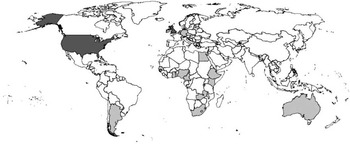
A recent literature review by Martinsohn and Hansen (Reference Martinsohn and Hansen2012) in the field of climate change impacts on the economics of dairy farming reveals that, worldwide, only a narrow range of geographical and climatic zones has been considered: three EU countries, the United States of America, Australia and Argentina (Figure 2). Countries with a rapidly increasing dairy industry (e.g. China, India, Brazil) and those that are supposed to suffer or benefit heavily from climate change (e.g. South America, Africa, Scandinavia, northern parts of Russia) are not well represented so far. The majority of studies dealing with climate change and dairy farming analyses either direct or indirect impacts. It is striking that economic consequences can differ significantly for one region depending on which and how many of these impacts are integrated. This is due to the fact that there are often both positive and negative impacts at the regional (and even farm) level, which may counterbalance each other. Furthermore, it can be assumed that some crucial impacts are still omitted in most of the studies on climate change and the economics of dairy farming, owing to a lack of knowledge and research. The interaction of pathogens and climate change, for example, is so complex (Gale et al., Reference Gale, Drew, Phipps, David and Wooldridge2009; Van Dijk et al., Reference Van Dijk, Sargison and Kenyon2010) that potential economic consequences are hardly measurable in this field. However, the incidence of new or more dangerous pathogens in the course of climate change can have significant indirect impacts on dairy farming.
Countries where Climate Change Impact Assessment (CCIA) on dairy farming has been carried out; white: no study, light grey: one study, dark grey: two and more studies. Source: own illustration based on Martinsohn and Hansen (Reference Martinsohn and Hansen2012).

Methodologically, two different approaches can be distinguished with regard to an analysis of climate change and the economics of dairy farming. On the one hand, physiological, chemical or physical functions and relations are applied to model the responses of plants and animals to adjustments in climatic variables. The resulting gains or losses, respectively, in milk yield or growth of fodder crops are then evaluated economically. On the other hand, only two studies have, to our knowledge, used an econometric approach to project the future impact of climate change on the economics of dairy farming. Mayer et al. (Reference Mayer, Davison, McGowan, Young, Matschoss, Hall, Goodwin, Jonsson and Gaughan1999) used time series data from Australia in order to derive expected changes in milk yield due to future climate change. Seo and Mendelsohn (Reference Seo and Mendelsohn2008) assessed cross-sectional data of animal farmers over several climatic zones in Africa and showed the impacts of climate change on the economics of livestock farming.
Owing to the large variety of different methods (experimental and empirical methods), regions analysed (Europe, Northern America, etc.), reference unit (kg per cow, $ per farm, etc.) and assumptions (emission scenarios, time horizon, etc.), it is hardly possible to compare (concrete financial) results directly. Yet, it is possible to generalize main tendencies. Most regions with already hot climate today are likely to suffer major milk yield losses from heat stress (Mayer et al., Reference Mayer, Davison, McGowan, Young, Matschoss, Hall, Goodwin, Jonsson and Gaughan1999; St-Pierre et al., Reference St-Pierre, Cobanov and Schnitkey2003). However, mitigation measures can reach a reduction of these negative impacts of over 70% (Mayer et al., Reference Mayer, Davison, McGowan, Young, Matschoss, Hall, Goodwin, Jonsson and Gaughan1999), so that heat stress is a manageable threat, at least for indoor housed dairy cows in a dry climate (see West, Reference West2003). Temperate regions such as Great Britain, Ireland, Germany and the northern part of the United States will be able to mitigate potential negative impacts by (cost-effective) adaptation measures (Hossel, Reference Hossel2002; St-Pierre et al., Reference St-Pierre, Cobanov and Schnitkey2003; Fitzgerald et al., Reference Fitzgerald, Brereton and Holden2009; Mader et al., Reference Mader, Frank, Harrington and Hahn2009, USA; Moran et al., Reference Moran, Topp, Wall and Wreford2009; Walter and Löpmeier, Reference Walter and Löpmeier2010).
It is generally acknowledged in the field of climate change impact assessment that potential adaptation to the expected climate change impacts must be considered. However, there is little knowledge on how farmers perceive climate change and the associated challenges. Ignoring practitioners’ realities and attitudes, however, can mean missing important impacts as well as adaptation measures. Studies providing data on the role of adaptation to the climate change indicate that the economic impact tend to be neutral or even positive if adaptation is included (Parsons et al., Reference Parsons, Armstrong, Turnpenny, Matthews, Cooper and Clark2001; Hossel, Reference Hossel2002; Fitzgerald et al., Reference Fitzgerald, Brereton and Holden2009), whereas the impact is negative when no adaptation is included (Leva et al., Reference Leva, Valtorta and Fornasero1996; Mader et al., Reference Mader, Frank, Harrington and Hahn2009; Moran et al., Reference Moran, Topp, Wall and Wreford2009; Walter and Löpmeier, Reference Walter and Löpmeier2010). Similar results can be observed in cropping studies (Kaiser et al., Reference Kaiser, Riha and Wilks1993; Segerson and Dixon, Reference Segerson and Dixon1999). As concerned stakeholders like farmers will very likely react to climate change, assuming no adaptation would cause biased results. By reviewing the relevant literature it becomes clear that often neutral or even positive economic impacts are identified if adaptation is included.
Conclusions
Under current conditions, climate change associated economic impacts are estimated to be neutral if some form of adaptation is integrated. Therefore, it is essential to establish future mitigation and adaptation-oriented strategies covering available tools from management, nutrition, health as well as plant and animal breeding to cope with the future consequences of climate change on dairy farming. With the current understanding of the effects of climate change, it is expected that fodder quantity will be influenced positively, whereas quality will mainly depend on water availability and soil characteristics, which will simultaneously be affected by climate change. Thus, the botanical composition of future grassland should include species that are able to withstand the changing conditions. In this context, legume species (e.g. lucerne or bird's foot trefoil) and deep-rooting plants such as chicory may offer high potential. Substantial effects of changing climatic parameters on the nutrient concentration of plants are also to be expected and have to be taken into account in future diet formulation. Changes in nutrient concentration of forage plants and rising heat loads may influence rumen physiology, mainly due to altered feeding pattern by consuming more concentrate in relation to roughage, which results in lower total concentrations of SCFA and changes composition of the microbiota in the rumen. Several promising nutritional strategies are available to reduce the negative impacts of climate change on dairy cow nutrition and performance. The adjustment of feeding and drinking regimes, diet composition and additive supplementation can merely contribute to the maintenance of adequate dairy cow feeding and performance. Providing shade and cooling through different techniques have the potential to lower the impact of direct effects of heat stress. As estimated genetic parameters are promising, heat stress tolerance as a functional trait may be included into breeding programmes. Use of sperm from bulls with high genetic merit including heat tolerance components will play important roles to deal with the effects of climate change in a sustainable way. Indirect effects of global warming on the health and welfare of animals seem to be more complicated and thus are less predictable. Parasites are one of the pathogens that should be followed closely regarding climate change, as certain GIN and liver fluke seem to benefit from it as their epidemiology is influenced favourably by the changing temperature and humidity.
Acknowledgement
The study was supported by the Ministry for Science and Culture of Lower Saxony within the network KLIFF – climate impact and adaptation research in Lower Saxony.