Traumatic experiences such as childhood abuse and neglect (sexual, physical, and emotional abuse and physical, emotional neglect) are considered as a substantial risk factor for later adult mental health problems (Buckingham & Daniolos, Reference Buckingham and Daniolos2013; Carr, Martins, Stingel, Lemgruber, & Juruena, Reference Carr, Martins, Stingel, Lemgruber and Juruena2013; Molnar, Buka, & Kessler, Reference Molnar, Buka and Kessler2001). Compared to single traumatic experiences, these intentionally inflicted events (type II trauma) seem to have a greater impact on psychopathological mental health outcomes in adulthood (Amstadter & Vernon, Reference Amstadter and Vernon2008; Price, Higa-McMillan, Kim, & Frueh, Reference Price, Higa-McMillan, Kim and Frueh2013; Terr, Reference Terr1991). In particular, such experiences were found to be associated with a wide range of negative affective consequences (Hathaway, Boals, & Banks, Reference Hathaway, Boals and Banks2010; Holmes, Grey, & Young, Reference Holmes, Grey and Young2005). A recent study of a representative sample with experience of interpersonal violence revealed a high prevalence of persistent negative emotional states (Badour, Resnick, & Kilpatrick, Reference Badour, Resnick and Kilpatrick2015).
However, on closer examination, little is known about the specific quality and intensity of emotional responses after the experience of childhood abuse and neglect. Recent findings suggest a sharp increase of negative emotions from peri- to posttraumatic time points with the frequent experience of negative emotions (Bradley et al., Reference Bradley, DeFife, Guarnaccia, Phifer, Fani and Ressler2011; Dalgleish & Power, Reference Dalgleish and Power2004; Glaser, va Os, Portegijs, & Myin-Germeys, Reference Glaser, van Os, Portegijs and Myin-Germeys2006). Negative emotions are characterized as the individual's subjective experience of a negative affective valence (Gross, Reference Gross2007). In particular, the experience of shame and sadness were found to increase after the traumatic event (Amstadter & Vernon, Reference Amstadter and Vernon2008). In addition, compared to the negative emotions fear or anger, both shame and sadness are less well understood in the context of interpersonal trauma (Badour et al., Reference Badour, Resnick and Kilpatrick2015).
The experience of shame is assumed to be critical after traumatic events (Budden, Reference Budden2009; Negrao, Bonanno, Noll, Putnam, & Trickett, Reference Negrao, Bonanno, Noll, Putnam and Trickett2005). In this regard, research has shown a positive relationship between experiencing childhood abuse and neglect and higher levels of shame (Andrews, Reference Andrews1995). Further, shame is supposed to be more salient for individuals after experience of childhood abuse and neglect relative to other negative emotions (Dorahy & Clearwater, Reference Dorahy and Clearwater2012; Feiring & Taska, Reference Feiring and Taska2005; Feiring, Taska, & Chen, Reference Feiring, Taska and Chen2002; Feiring, Taska, & Lewis, Reference Feiring, Taska and Lewis2002; Fowke, Ross, & Ashcroft, Reference Fowke, Ross and Ashcroft2012). Shame is conceptualized as a negative emotion (Tracy & Robins, Reference Tracy and Robins2004) that emerges after the trauma when the individual attempts to understand the meaning of the event through attributional processes (Lee, Scragg, & Turner, Reference Lee, Scragg and Turner2001), whereby the focus of the negative evaluation is the individual itself (Tangney, Reference Tangney1991). This is in contrast to guilt where the negative evaluation focused on the person's behavior (Tangney & Dearing, Reference Tangney and Dearing2004). Consequently, shame contains a sense of exposure and describes a threat of self-worth (Tangney, Reference Tangney1991). For instance, it has been reported that victims of interpersonal traumas blame themselves for the event (Feiring, Taska, & Chen, Reference Feiring, Taska and Chen2002).
In contrast, shame has been linked to several adverse outcomes (Feiring & Taska, Reference Feiring and Taska2005; Gilbert & Gerlsma, Reference Gilbert and Gerlsma1999; Gilbert et al., Reference Gilbert, McEwan, Irons, Bhundia, Christie and Broomhead2010). As such, the perception of shame has negative consequences for the self-image (Brans & Verduyn, Reference Brans and Verduyn2014). Furthermore, shame contributes to the subsequent course of posttraumatic symptoms and might act as a mediator between childhood abuse and adult psychopathology (Andrews, Reference Andrews1995; Andrews, Brewin, Rose, & Kirk, Reference Andrews, Brewin, Rose and Kirk2000). In one study, shame was found to be the only emotion that predicted posttraumatic stress disorder (PTSD) symptoms past the 1-month diagnostic threshold in victims of violent crime (Andrews et al., Reference Andrews, Brewin, Rose and Kirk2000).
Sadness is also a relevant emotion in the context of childhood abuse and neglect (Rizvi, Kaysen, Gutner, Griffin, & Resick, Reference Rizvi, Kaysen, Gutner, Griffin and Resick2008). It is a commonly experienced negative emotion, is suggested to be heightened posttrauma, and to emerge as a consequence of the traumatic event (Scherer & Wallbott, Reference Scherer and Wallbott1994). As such, sadness can be seen as an emotional response to the appraisal of loss, particularly in the context of interpersonal traumatic events, to the loss of childhood, and trust (Ratcliffe, Ruddell, & Smith, Reference Ratcliffe, Ruddell and Smith2014).
Like shame, the perception of sadness is also linked to several negative outcomes (Ottowitz et al., Reference Ottowitz, Dougherty, Sirota, Niaura, Rauch and Brown2004; Sudheimer et al., Reference Sudheimer, Abelson, Taylor, Martis, Welsh and Warner2013). It is related to depressive disorders (Coyle, Karatzia, Summers, & Power, Reference Coyle, Karatzias, Summers and Power2014) and requires a high regulatory effort (Brans & Verduyn, Reference Brans and Verduyn2014). Although data regarding the association of trauma and sadness are limited (Amstadter & Vernon, Reference Amstadter and Vernon2008), previous research indicates that sadness contributes to PTSD-related symptomatology (Coyle et al., Reference Coyle, Karatzias, Summers and Power2014).
Furthermore, substance use disorders show a positive association with early interpersonal traumatic experiences (De Bellis, Reference De Bellis2002; Fetzner, McMillan, Sareen, & Asmundson, Reference Fetzner, McMillan, Sareen and Asmundson2011; Kendler et al., Reference Kendler, Bulik, Silberg, Hettema, Myers and Prescott2000; Wu, Schaier, Dellor, & Grella, Reference Wu, Schairer, Dellor and Grella2010). Potential explanations for the link between trauma and the development and maintenance of substance use disorders are provided from the drinking to cope model (Ullman, Filipas, Townsend, & Starzynski, Reference Ullman, Filipas, Townsend and Starzynski2005; Ullman, Peter-Hagene, & Relyea, Reference Ullman, Peter-Hagene and Relyea2014). In this conceptualization, substance use is considered as a dysfunctional emotion regulation strategy that can be used to cope with negative emotions (Dvorak, Pearson, & Day, Reference Dvorak, Pearson and Day2014). According to Gross (Reference Gross1998), emotion regulation “refers to the processes by which individuals influence which emotions they have, when they have them, and how they experience and express these emotions” (p. 275). Thus, based on the assumption of the drinking to cope model, the implementation of substance use as a maladaptive emotion regulation strategy in individuals exposed to traumatic events might increase the risk to develop substance use disorders (Ullman, Relyea, Peter-Hagene, & Vasquez, Reference Ullman, Relyea, Peter-Hagene and Vasquez2013). In line with this assumption, findings indicated that emotion regulation deficits are associated with traumatic experiences (Choi, Choi, Gim, Park, & Park, Reference Choi, Choi, Gim, Park and Park2014; Cook et al., Reference Cook, Spinazzola, Ford, Lanktree, Blaustein and Cloitre2005; Goldsmith, Chesney, Heath, & Barlow, Reference Goldsmith, Chesney, Heath and Barlow2013; Kim-Spoon, Cicchetti, & Rogosch, Reference Kim-Spoon, Cicchetti and Rogosch2013). Simultaneously, dysregulated affect increases the propensity to develop psychopathology especially substance use disorders (Dvir, Ford, Hill, & Frazier, Reference Dvir, Ford, Hill and Frazier2014; Tangney & Dearing, Reference Tangney and Dearing2004).
There is a well-grounded literature examining the relationships in both directions between substance use and negative emotions (Cooper, Frone, Russell, & Mudar, Reference Cooper, Frone, Russell and Mudar1995; Khantzian, Reference Khantzian1985). The negative mood–alcohol use cycle describes a relevant pathway to heightened substance use: the experience of negative emotions predicts greater substance use, which in turn predicts more negative emotions (Hussong, Reference Hussong2007). Recent longitudinal daily process studies found that negative affect predicted substance use over time (Harder, Ayer, Rose, Naylor, & Helzer, Reference Harder, Ayer, Rose, Naylor and Helzer2014; Mason, Hitch, & Spoth, Reference Mason, Hitch and Spoth2009). In particular, sadness was found to be a significant mediator of stress-related drinking (Dermody, Cheong, & Manuck, Reference Dermody, Cheong and Manuck2013) and shame was suggested to contribute to the development and maintenance of substance us related problems (Wiechelt, Reference Wiechelt2007). Furthermore, the experience of shame in the context of interpersonal trauma might involve a higher risk for substance use because of the trauma association and therefore the potential trauma-triggering effects (Wilson, Drozdek, & Turkovic, Reference Wilson, Drozdek and Turkovic2006).
To understand the role of substance use as an emotion regulation strategy in the association between childhood abuse and neglect and substance use disorders, it is important to examine individuals with substance use disorders after experience of childhood abuse and neglect (Banducci, Hoffman, Lejuez, & Koenen, Reference Banducci, Hoffman, Lejuez and Koenen2014b; Corrigan, Fisher, & Nutt, Reference Corrigan, Fisher and Nutt2011). Similarly, research on emotion regulation of healthy individuals with childhood abuse and neglect (and without PTSD or any other form of psychopathology) is limited. A high rate of healthy individuals with childhood abuse and neglect experience substance use disorders or PTSD symptoms on a subsyndromal level and without fulfilling the complete clinical picture (Klanecky & McChargue, Reference Klanecky and McChargue2009). Previous studies that assessed emotion regulation in clinical samples only (i.e., patients with PTSD and comorbid substance use disorders) cannot be generalized to normal populations (Bailey, Webster, Baker, & Kavanagh, Reference Bailey, Webster, Baker and Kavanagh2012; Ehring & Quack, Reference Ehring and Quack2010; Farrugia et al., Reference Farrugia, Mills, Barrett, Back, Teesson and Baker2011; Kendler et al., Reference Kendler, Bulik, Silberg, Hettema, Myers and Prescott2000; Price & Herting, Reference Price and Herting2013; Weiss, Tull, Anetis, & Gratz, Reference Weiss, Tull, Anestis and Gratz2013). Consequently, it remains unclear how trauma-relevant emotions are associated with substance use as an emotion regulation strategy and in turn how this emotion regulation strategy is associated to mental health. Hence, there is a strong need to assess the differential impact of childhood abuse and neglect on emotion regulation in a clinical substance use disorders as well as a healthy sample.
Moreover, most studies are limited to retrospective and cross-sectional designs with self-report questionnaires for assessment of the typical use of emotion regulation strategies (Cloitre, Stovall-McClough, Zorbas, & Charuvastra, Reference Cloitre, Stovall-McClough, Zorbas and Charuvastra2008; Kashdan, Uswatte, Steger, & Julian, Reference Kashdan, Uswatte, Steger and Julian2006; Tull, Barrett, McMillan, & Roemer, Reference Tull, Barrett, McMillan and Roemer2007; Weiss, Tull, Lavender, & Gratz, Reference Weiss, Tull, Lavender and Gratz2013). This study used ecological momentary assessment (EMA), which is the state-of-the-art method for real-time assessment of emotion regulation processes in the individual's natural surrounding (Trull & Ebner-Priemer, Reference Trull and Ebner-Priemer2013). The key element of EMA is real-time collection of data about participant's momentary states in the natural environment, with multiple repeated assessments over time (Stone, Reference Stone2007). Thus, participants are not disrupted in their regular day, which supports enhancement of ecological validity (Dorn, Spinder, Kullik, Patermann, & Barnow, Reference Dorn, Spindler, Kullik, Petermann and Barnow2013).
Understanding the mechanism of the drinking to cope model in the context of trauma in more detail requires considering the regulation of the trauma-relevant emotions shame and sadness. Integrating the previously specified findings into the assumption of the drinking to cope model, we assume that individuals are at high risk of developing substance use disorders after experiencing childhood abuse and neglect (Buckingham & Daniolos, Reference Buckingham and Daniolos2013; Faulkner, Goldstein, & Wekerle, Reference Faulkner, Goldstein and Wekerle2014; Kilpatrick et al., Reference Kilpatrick, Acierno, Saunders, Resnick, Best and Schnurr2000; Min, Farkas, Minnes, & Singer, Reference Min, Farkas, Minnes and Singer2007; Reed, Anthony, & Breslau, Reference Reed, Anthony and Breslau2007). Specifically, substance use may be a maladaptive emotion regulation strategy to cope with shame and sadness, which are experienced more frequently by individuals with childhood abuse and neglect (Dalgleish & Power, Reference Dalgleish and Power2004; Dvorak et al., Reference Dvorak, Pearson and Day2014). In addition, emotion regulation of shame may be more demanding than emotion regulation of sadness because shame might play a more salient role after traumatic events (Lee et al., Reference Lee, Scragg and Turner2001; Wilson et al., Reference Wilson, Drozdek and Turkovic2006). Consequently, the risk of developing substance use disorders may be higher as response to shame than sadness for individuals with childhood abuse and neglect (Wiechelt, Reference Wiechelt2007).
The present study used real-time assessment of intensity of two trauma-relevant negative emotions (shame and sadness) and substance use as an emotion regulation strategy in participants' daily life. The major aim of the present study was to determine the intensity and interrelations of shame, sadness, and substance use as an emotion regulation strategy in three groups: individuals with history of childhood abuse and neglect and substance use disorders (traumaSUD group), healthy controls with history of childhood abuse and neglect and without any present or lifetime form of psychopathology (traumaHC group), and healthy controls without history of childhood abuse and neglect and without psychopathology (nontraumaHC group). First, we examined the subjective intensity of shame and of sadness across groups. We expected that the traumaSUD and traumaHC groups show higher levels of intensity of shame and sadness compared to nontraumaHC group because of the trauma relatedness of both negative emotions. Second, we investigated substance use as an emotion regulation strategy to cope with these negative emotions. We expected a differential effect of shame compared to sadness on substance use for the traumaSUD and traumaHC groups because shame seems to play a more salient role for individuals after experience of childhood abuse and neglect relative to other trauma-related negative emotions.
Method
Participants and procedure
The current investigation is part of a multicenter study on childhood abuse and neglect and substance use disorders, the Childhood Abuse and Neglect as a Cause and Consequence of Substance Abuse—Understanding Risks and Improving Services (CANSAS) study funded by the German Federal Ministry of Education and Research (BMBF 01KR1203B). The principal research objective was the investigation of risk and protective factors for substance use disorders after experience of childhood abuse and neglect. General inclusion criteria for the whole sample were age between 18 and 65 years, and sufficient German language skills. General exclusion criteria were current psychotic disorder, acute suicidality, neurological disorders, severe cognitive impairment, and current substance misuse.
Participants of the traumaSUD group (N = 55, mean age = 40.40, SD = 10.21, range = 20–58) were recruited by trained clinical psychologists in detoxification and rehabilitation centers in two German cities. An additional inclusion criterion for this group was the lifetime diagnosis of substance use disorders (alcohol, illegal substances, or medication). All participants in this group met the critical number of DSM-IV criteria for alcohol or substance dependence (American Psychiatric Association, 2000). Furthermore, they were included if they had participated in detoxification in an authorized setting within the last 12 months at least 2 weeks before the study participation. All participants were abstinent at time of study enrollment. A further inclusion criterion was the experience of childhood abuse and neglect at a moderate to severe level in terms of emotional, physical, and sexual abuse and/or emotional, physical neglect.
Healthy controls with (N = 53, mean age = 36.19, SD = 14.14, range = 19–65) and without childhood abuse and neglect (N = 43, mean age = 31.98, SD = 14.04, range = 18–64) were recruited via advertisements in daily newspapers, bulletins, public institutions, and distribution frames of corporations. The main inclusion criterion for the traumaHC and nontraumaHC groups was the absence of any mental disorder. None of these participants met DSM-IV criteria for Axis I disorder (present or lifetime). A further criterion for the traumaHC group was the experience of childhood abuse and neglect (see main inclusion criteria of traumaSUD group). Accordingly, the inclusion criterion for the nontraumaHC group was the absence of childhood abuse and neglect or any other trauma experience.
Data were collected via an interview and questionnaire section and a cell phone-based EMA assessment. A total number of N = 190 participants were enrolled in the study. After exclusion of 8 EMA data sets of the traumaHC group, 15 EMA data sets of the nontraumaHC group, and 16 EMA data sets of the traumaSUD group because of incomplete EMA data sets (at least 50% data necessary), the final sample resulted in 151 participants (traumaSUD group: N = 55; traumaHC group: N = 53; nontraumaHC group: N = 43). The study was approved by the Ethics Committee of Ruprecht-Karls-University Heidelberg. Written informed consent was obtained from all participants prior to the study protocol, and participants were compensated.
Outcome measures
Psychiatric disorders
The research version of the Structured Clinical Interview for DSM-IV Axis I Disorders was conducted to assess current or lifetime Axis I disorder in order to select the study sample. The Structured Clinical Interview for DSM-IV Axis I Disorders is a semistructured interview for the major DSM-IV Axis I diagnosis with sufficient psychometrical properties (First, Spitzer, Gibbon, & Williams, Reference First, Spitzer, Gibbon and Williams2002). Clinical psychologists (BS and MS) were trained to conduct the twofold elaborate screening procedure and the standardized face-to-face assessment in a 2-day course.
Traumatic childhood experiences
The German short form of the Childhood Trauma Questionnaire (CTQ; Bernstein & Fink, Reference Bernstein and Fink1998) is a reliable, valid, economic and internationally accepted self-report inventory to retrospectively assess the severity of traumatic childhood experiences (Wingenfeld et al., Reference Wingenfeld, Spitzer, Mensebach, Grabe, Hill and Gast2010). The CTQ consists of 28 items reflecting five subscales (emotional, physical, and sexual abuse and emotional and physical neglect) and a 3-item minimization/denial validity scale to detect the underreporting of maltreatment (Bernstein & Fink, Reference Bernstein and Fink1998). A 5-point Likert scale is used for the responses (1 = never true, 5 = very often true). A higher overall score or scores of each subscale indicate a greater degree of maltreatment. Cutoff values were set according to the original authors (Bernstein & Fink, Reference Bernstein and Fink1998).
Emotion regulation
In this study, an EMA design was used as a method to measure subjective self-reports about intensity of emotions and emotion regulation in participants' daily life. The structure of the EMA protocol was used in previous studies of our research group (Aldinger et al., Reference Aldinger, Stopsack, Ulrich, Appel, Reinelt and Wolff2014; Spindler, Stopsack, Aldinger, Grabe, & Barnow, Reference Spindler, Stopsack, Aldinger, Grabe and Barnow2015). It relies on a time-based sampling schema that is appropriate to monitor continuous phenomena with variation in intensity (Stone, Reference Stone2007). Using the software SmartQ (company Telesage) participants received randomly triggered cell phone calls for a period of 14 days, every second day, three times per day (in the morning, at midday, and in the evening) resulting in a total number of 21 phone calls per participant. The randomized distribution of the EMA protocol was performed. Regular cell phones serve as instruments of measurement via prerecorded standardized questions, and participants answer via telephone keypad with a mean duration of 10 min. Each responded phone call is a measurement point. Participants were informed about the period of time of the EMA assessment, but have been unaware of the exact time of day of the phone calls. Hence, phone calls were unpredictable, and participants got “surprised” by the calls during their daily lives. This randomly scheduled assessment strategy supports unbiased and representative estimation of the participant's daily emotional experiences (Stone, Reference Stone2007). Participants were asked to monitor the most intense emotion within the past 2 hr with standardized questions (“Please think about the most intense emotion within the past 2 hours”). The time frame within the previous 2 hr is of methodological relevance to support the real-time assessment of the actual emotion regulation processes. First, this implies a higher likelihood that within the past 2 hr, one does experience relevant emotions. Second, the experiences of these actual emotions are assumed as still ongoing vivid impressions (as material in the short-term memory) and not already descended as processed material in the long-term memory. They rated the subjective perception of intensity of emotions in two separate items (“How intense did you feel shame in that moment?” and “How intense did you feel sadness in that moment?”) on a 7-point Likert scale (0 = not at all, 6 = very intense). Besides shame and sadness, participants were also asked to rate a variety of emotions (joy, disgust, fear, nervosity, and rage and anger, guilt, emotional numbing, and helplessness). Moreover, participants subsequently reported their use of specific emotion regulation strategies to regulate the most intense emotion (“How did you deal with your most intense emotion?” and “Below you were given several statements. Please indicate how appropriate they are: I drank alcohol or took other drugs or medication.”) on a 7-point Likert-scale (0 = agree not at all, 6 = totally agree). Besides substance use (alcohol, illegal drugs, or medication), participants were asked to rate different other behavior-related as well as cognitive-related emotion regulation strategies such as acceptance, suppression, problem solving, reappraisal, rumination, social support, distraction, enjoy, and catastrophizing. Overall, participants responded to 83.3% (in particular, traumaSUD group: 83.5%; traumaHC group: 97.4%; and nontraumaHC group: 69.1%) of the phone calls for a total of 2,642 momentary assessments. The number of the phone calls is identical for each participant, but according to participants' compliance or motivational status, the number of answered phone calls might vary for each subject, and therefore, complete data sets might differ between the participants as well as the groups.
Statistical analysis
Data analysis was performed with IBM SPSS Statistics Version 20 and focused, according to the rationale of the study, on the negative emotions shame and sadness and substance use as an emotion regulation strategy. Group comparisons in sociodemographic characteristics (age and gender) and trauma severity variables were conducted using independent-samples t tests, general linear models (analyses of variance), and chi-square tests. The association between intensity of shame and sadness and substance use was analyzed by using a mixed-effect model with maximum likelihood and estimation (Singer & Willett, Reference Singer and Willett2003). Modular linear mixed models (LMM) serve as the gold standard for the analysis of longitudinal designs (Stone, Reference Stone2007) and are increasingly used for the analysis of EMA data (Hedeker, Mermelstein, Berbaum, & Campbell, Reference Hedeker, Mermelstein, Berbaum and Campbell2009). LMM provide the opportunity to investigate within-person and between-person effects and assess intraindividual and interindividual differences in change over time (Singer & Willett, Reference Singer and Willett2003). The intraindividual medians of the intensity of shame and of sadness were calculated to separate these two emotional experiences into low-intense and high-intense shame and sadness experiences. Then, separate LMM were performed to test the presence of substance use in low and high intensity of shame and of sadness for the whole study sample and to compare the differences of substance use between the several study groups. Interindividual differences in growth may be found in the individual parameters, such as intercepts (initial status) and slopes (steep or flat; Raudenbush & Bryk, Reference Raudenbush and Bryk2002). Each participant had an individual intercept and slope randomly deviating from the mean intercept for each study group. The traumaSUD group serves as reference group. For all analyses, the significance level was set at p < .05 (two tailed).
Results
EMA and sample characteristics
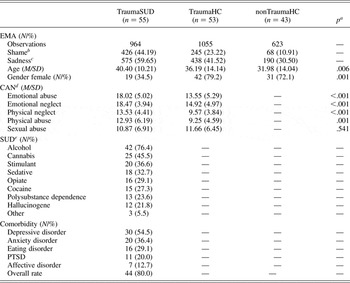
Descriptive statistics can be seen in Table 1. All three study groups experienced more EMA observations of sadness (1,203) than shame (739). Almost 80% of both trauma samples experienced at least two different forms of childhood abuse and neglect. Comorbid psychiatric disorders within the traumaSUD group were widespread, with a mean comorbidity rate of 80%.
EMA and demographic sample characteristics

Note: EMA, Ecological momentary assessment; TraumaSUD, individuals with history of childhood abuse and neglect and substance use disorders; TraumaHC, healthy controls with history of childhood abuse and neglect and without any present or lifetime form of psychopathology; NontraumaHC, healthy controls without history of childhood abuse and neglect and without psychopathology; CAN, child abuse and neglect; SUD, substance use disorder; PTSD, posttraumatic stress disorder.
a The criterion for significance was p < .05 (two tailed).
b Observations of shame ≥ 1: perception of strongest emotion from 0 = not at all to 6 = very strong.
c Observations of sadness ≥ 1: perception of strongest emotion from 0 = not at all to 6 = very strong.
d CAN was assessed with the Childhood Trauma Questionnaire: severity at least moderate to severe, multiple answers are possible.
e SUDs (including abuse and dependence): alcohol, illegal drugs, medication.
Participants of the nontraumaHC and traumaSUD groups differed significantly regarding age, t (96) = 3.437, p < .001. There was a significant gender difference between the three study groups, χ2 (2) = 25.80, p < .001, with more female participants in the traumaHC and nontraumaHC groups. Both trauma groups differed significantly in all scores of CTQ scales except for sexual abuse. Most common forms were emotional abuse and emotional and physical neglect. One of the main inclusion criteria for the nontraumaHC group was the absence of childhood abuse and neglect or any other trauma experience. Consequently, the participants of the nontraumaHC group have a score of 0 for the CTQ.
Intensity of shame and of sadness
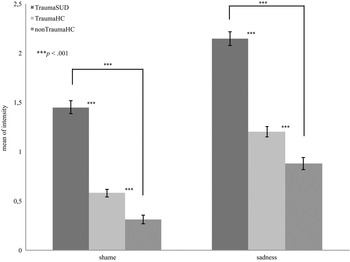
All three study groups differed significantly in their mean value of intensity of shame and sadness, with the traumaSUD group reporting the highest levels (shame: 1.45; sadness: 2.15) and the nontraumaHC group the lowest levels of intensity of shame and sadness (shame: 0.31; sadness: 0.88). The mean values of the intensity of shame (0.58) and of sadness (1.20) of the traumaHC group were also significantly different from the other two groups (Figure 1).
Intensity of shame and sadness compared by group.

Multilevel model of substance use
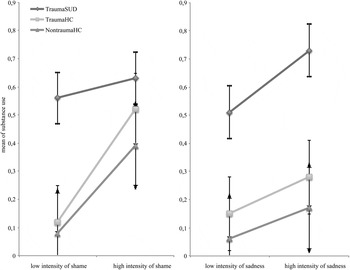
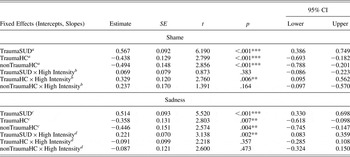
The model estimates of fixed effects and statistic results are presented in Table 2 and Figure 2. The fixed intercept value represents the mean value of substance use in situations of low intensity of shame for the traumaSUD group. The intercept for the traumaHC group (0.129) was significantly lower than for the traumaSUD group (t = –3.391, p < .001). Similarly, the nontraumaHC group had a lower intercept (0.073) compared to the traumaSUD group (t = –3.334, p < .001). The coefficient of increase of substance use from low to high intensity of shame of 0.069 represents the average gain of the mean value of substance use for each subsequent observation for the traumaSUD group (as reference). The interaction estimates tell the slope difference for the other study groups compared to the traumaSUD group. We found an increase for the traumaHC group (0.398) and for the nontraumaHC group (0.306). For all study groups, substance use increased from low to high intensity of shame. The increases differed significantly between the traumaHC group and the traumaSUD group (p = .006). Thus, an almost fourfold increase of substance use from low- to high-intensity situations of shame was found for the traumaHC group compared to the traumaSUD group. The increase of substance use from low- to high-intensity situations of shame did not differ between the traumaSUD group and the nontraumaHC group (p = .164).
Substance use in low and high intensity of shame and sadness compared by group.

Parameter estimates of fixed effects for LMM: Substance use in low and high intensity situations of shame and sadness

Note: N = 151 participants for 7 days with 739 observations for shame and 1,203 observations for sadness. As a statistical control, the linear mixed model (LMM) was rerun with the intraindividual mean of intensity of shame and of sadness as alternative predictor; and equal findings were found compared to LMM with the intraindividual median of intensity of shame and sadness as predictor for substance use. Similiar effects were found when analyzing LMM with shame and sadness as continous parameter (7-point Likert scale from 0 to 6). TraumaSUD, Individuals with history of childhood abuse and neglect and substance use disorders; TraumaHC, healthy controls with history of childhood abuse and neglect and without any present or lifetime form of psychopathology; NontraumaHC, healthy controls without history of childhood abuse and neglect and without psychopathology.
a Substance use in low intensity situations of shame.
b Substance use in high intensity situations of shame.
c Substance use in low intensity situations of sadness.
d Substance use in high intensity situations of sadness.
**p < .01. ***p < .001.
The LMM of substance use in low and high intensity of sadness showed partially different effects. Comparable to shame, the fixed intercept values of substance use for the traumaHC group (0.146; t = –2.946, p < .001) and the nontraumaHC group (0.068; t = –2.271, p < .007) were significantly lower than for the traumaSUD group. We also found an increase of substance use from low- to high-intensity situations of sadness for all study groups. This increase differed significantly between the traumaSUD group and both other healthy study groups. Further, we computed both linear models with the covariates age and gender. Results remained unchanged after controlling for these factors.
Discussion
To gain insight into substance use as a potential emotion regulation strategy, the current study investigated the intensity and interrelations of shame, sadness, and substance use in three different groups (individuals with childhood abuse and neglect and substance use disorders and healthy individuals with and without childhood abuse and neglect).
According to our hypotheses, the three study groups differed in the subjective intensity of shame and sadness with participants of the traumaSUD and traumaHC groups experiencing higher intensities of both emotions relative to the nontraumaHC group. This is in line with previous studies that report higher levels of intensity of negative emotions in individuals with trauma experience (Amstadter & Vernon, Reference Amstadter and Vernon2008). In addition, we found a positive linear relationship between intensity of shame and sadness and substance use for the whole sample. The higher the intensity of the experience of shame and sadness was, the more substances were consumed, even in non-SUD groups. These findings correspond to studies showing that stronger intensity of emotions requires greater effort for emotional recovery and is associated with behavioral dysfunction (Verduyn, Van Mechelen, Kross, Chezzi, & Van Bever, Reference Verduyn, Van Mechelen, Kross, Chezzi and Van Bever2012) and maladaptive coping strategies (Tangney, Wagner, & Gramzow, Reference Tangney, Wagner and Gramzow1992). Moreover, these findings reveal empirical evidence for the affect regulation model drinking to cope conceptualizing substance use as an emotion regulation strategy to cope with negative emotions. Hence, substance use is negative mood motivated, and individuals use substances to cope with negative emotions because of the internal motivation to ameliorate negative mood. A recent EMA study found that the more negative mood experienced, the higher were the rates of drinking to cope, and the more alcohol was used among both men and women (Dvorak et al., Reference Dvorak, Pearson and Day2014).
Because individuals with childhood abuse and neglect experience more intense feelings of shame and sadness, they require a higher regulatory effort (in this case emotion regulation via substance use) and thus are at increased risk for developing substance use disorders. Although the data do not allow for causal interpretation, it is possible that higher levels of intensity of shame and sadness might put traumatized individuals at risk for substance use disorders. However, it must be noted that our results point to the great challenges individuals with substance use disorders and childhood abuse and neglect need to face in order to maintain abstinence because participants of the traumaSUD group reported substance use (alcohol, drugs, or medication) although they were abstinent at time point of study enrollment. This is in line with studies showing that individuals with lifetime substance use disorders and childhood abuse and neglect represent a more severe clinical profile and are more likely to lapse or relapse (Banducci, Hoffman, Lejuez, & Koenen, Reference Banducci, Hoffman, Lejuez and Koenen2014a; Farrugia et al., Reference Farrugia, Mills, Barrett, Back, Teesson and Baker2011; Gil-Rivas, Prause, & Grella, Reference Gil-Rivas, Prause and Grella2009).
When we looked at the associations between type and intensity of negative emotions and substance use more closely, differential patterns for the three study groups emerged: participants of the traumaSUD group reported substance use in low as well as in high intensity of shame and sadness, whereas participants of the traumaHC and nontraumaHC groups reported lower levels of substance use in low-intense situations of both negative emotions. Hence, participants of the traumaSUD group use substances regardless of different emotional intensities (either high- or low-intense) or different types of emotions (shame or sadness). Our findings point to the possible low distress tolerance in individuals with SUD (Leyro, Zvolensky, & Bernstein, Reference Leyro, Zvolensky and Bernstein2010). Distress intolerance is a decreased ability to tolerate negative emotional states and has been linked to substance misuse (Brown, Lejeuz, Kahler, & Strong, Reference Brown, Lejuez, Kahler and Strong2002). It could be argued that a low distress tolerance is associated with maladaptive behaviors (e.g., alcohol and drug use) that aim to reduce feelings of distress (Kaiser, Millch, Lynam, & Charnigo, Reference Kaiser, Milich, Lynam and Charnigo2012). In addition, it seems once a trauma group has a substance use disorder, shame and sadness do not play a role in the continuation of substance use. Neurobiological models of addiction identified differences in brain structure and functioning that predict relapse, craving, and negative affect among individuals with substance use disorders (Goodman, Reference Goodman2008; Witkiewitz, Lustyk, & Bowen, Reference Witkiewitz, Lustyk and Bowen2013). Repeated substance use is associated with dysfunction of neuronal networks (dopaminergic, glutamatergic, and opiodergic neurotransmission) in the brain reward system (ventral striatum) that in turn can process craving vulnerability without external emotional input (Heinz, Beck, Grüsser, Grace, & Wrase, Reference Heinz, Beck, Grüsser, Grace and Wrase2009). Hence, independent from strong negative affectivity, substance use can happen.
Looking further into the regulation of intense sadness, we found a greater increase of substance use for the traumaSUD group relative to both non-SUD groups, even though the traumaHC and the nontraumaHC groups showed an increase of substance use from low to high intensity of sadness. Regarding the regulation of intense shame, the traumaHC group showed a sharper increase in substance use relative to the traumaSUD and the nontraumaHC groups. The increased risk of substance use to regulate intense negative emotions in nontraumatized individuals can be explained with the emotion regulation choice effect (Sheppes et al., Reference Sheppes, Scheibe, Suri, Radu, Blechert and Gross2014). The flexible choice between emotion regulation strategies for healthy adaptation relies on differing situational demands. As such, the regulation of intense negative emotions is associated with low cognitive load demanding emotion regulation strategies, like distraction, whereas the regulation of low-intense negative emotions is related to emotion regulation strategies, like reappraisal, that require high cognitive load (Sheppes, Scheibe, Suri, & Gross, Reference Sheppes, Scheibe, Suri and Gross2011). Hence, healthy control participants with and without traumatic experiences might use substances to regulate high-intense negative situations because of reduced cognitive capacities.
In addition, the regulation of high-intense shame warrants special attention because we found a greater increase in the risk of substance use in the traumaHC group relative to the traumaSUD and nontraumaHC groups. That means that individuals with traumatic experiences and without substance use disorders seem to be able to tolerate shame to a certain degree. However, when the emotional experience becomes too strong, they also use substances to cope with their feelings of shame. It could be argued that the participants of the traumaHC group are in need for more quickly effective emotion regulation strategies beyond a specific threshold of shame intensity. Hence, the experience of intense shame appears to be particularly difficult to tolerate even for healthy, resilient individuals after experience of traumatic events. Although research suggests that both, shame and sadness, are associated with posttraumatic stress reactions (Amstadter & Vernon, Reference Amstadter and Vernon2008; Andrews et al., Reference Andrews, Brewin, Rose and Kirk2000), this emotion regulation mechanism was only seen for shame in our study. This differential effect of intense shame for healthy individuals with experience of childhood abuse and neglect can be explained by the cognitive–affective process model of posttraumatic shame (Wilson et al., Reference Wilson, Drozdek and Turkovic2006). According to this model, the perception of shame may automatically trigger trauma-associated memories that are often accompanied by intrusions and flashbacks in individuals who experienced childhood abuse and neglect, and this may contribute to the development and maintenance of substance use (Wiechelt, Reference Wiechelt2007). Against the background of the recorded emotional experiences, our results suggest that the association between childhood abuse and neglect and substance use disorders can be explained through emotion regulation processes of specific intense negative, trauma-related emotions. As such, feelings of intense posttraumatic shame may lead to heightened substance use as an emotion regulation strategy for individuals with childhood abuse and neglect.
Then the question arises, why the participants of the traumaHC group did not develop substance use disorders so far. The participants overall reported relatively low ratings of the intensity of shame and of sadness and similarly a low mean of substance use. More in detail, we found that the participants of the traumaHC group experienced lower intense feelings of shame relative to the traumaSUD group and in turn require the use of substances to a lesser extent, although their levels of shame were higher than those of the nontraumaHC group. Alternatively, the participants of the traumaHC group may provide a broader range of different emotion regulation strategies and therefore are only in urgent cases in need of using substances. These questions should be addressed in future studies.
Although the present study provides valuable insights into substance use as an emotion regulation mechanism following childhood abuse and neglect, it is not without limitations. First, one may review the operationalization of trauma-related shame and sadness. We assessed each emotion via two separate items (“Did you feel shame/sadness?”). This low-threshold and careful operationalization of posttraumatic shame and sadness was chosen to minimize danger of retraumatization (Bell, Busch, & DiNitto, Reference Bell, Busch and DiNitto2006). Second, more EMA data sets from the traumaSUD group had to be excluded compared to both other study groups because of incomplete EMA data sets (at least 50% data necessary). This group-dependent data dropout might imply a systematic bias to the findings. Consequently, the estimate of the association between exposure and outcome may be artificially increased, reduced, or even reversed (Gerhard, Reference Gerhard2008). However, EMA research of addiction is associated with some limitations, including problems with the participants' acceptability and compliance (Beckjord & Shiffman, Reference Beckjord and Shiffman2014; Wray, Merrill, & Monti, Reference Wray, Merrill and Monti2014). Consequently, the poor data outcome of this severe population compared to a healthy control population is not surprising. Third, we should be careful drawing conclusions from the observed relationship between the intensity of shame/sadness and substance use, because we cannot assume causation. Episodes of substance use itself can lead to subsequent elevated negative emotions like shame and sadness, and that may lead to continuated substance use to cope with these negative emotions (Hussong, Hicks, Levy, & Curran, Reference Hussong, Hicks, Levy and Curran2001). To test the causality of the relationship between the emotions shame and sadness and substance use, the analysis of dynamic interactions and situational influences of such relationships over time is the most critical contribution of EMA (Shiffman, Stone, & Hufford, Reference Shiffman, Stone and Hufford2008). However, the influence of other variables, such as context, cannot be ruled out. For example, in future EMA designs, actual circumstances should be considered, such as time of day (morning vs. evening), day of week (weekend vs. weekday), and concurrent activities. However, considering these variables requires an extended period of the EMA assessment. This could involve danger of burdensome EMA protocol, lower compatibility for regular daily life for participants, and resulting in less compliance with the danger of incomplete data sets. We chose a rather low burdensome EMA design in contrast to others with random signal-continent designs (Dennis, Scott, Funk, & Nicholson, Reference Dennis, Scott, Funk and Nicholson2015; Epstein & Preston, Reference Epstein and Preston2010; Holt, Litt, & Cooney, Reference Holt, Litt and Cooney2012) in order to overcome these above-mentioned limitations. The mean completion rate of 83.3% reflects compliance with our EMA design and is in line with average compliance in other EMA studies that vary from 80% to 90% (Stone, Reference Stone2007). Fourth, we cannot preclude whether all participants used other emotion regulation strategies instead of, or in addition to, substance use to cope with both trauma-relevant negative emotions shame and sadness. Furthermore, participants in the clinical sample do not have a current substance use disorder at the time point of assessment and consequently could have learned to use alternative behavior in the previous treatment. Nevertheless, our findings of heightened substance use in low as well as in high intensity of both trauma-relevant emotions in the traumaSUD group compared to both other study groups could reveal a preferred emotion regulation strategy but has to be interpreted under this limitation. Furthermore, this particular research question needs to be addressed in future research. Fifth, using EMA does not eliminate all difficulties that go along with limits of self-report data. EMA has several advantages over cross-sectional and experimental designs (Bolger & Laurenceau, Reference Bolger and Laurenceau2013). Traditional methods such as questionnaires assess the typical emotion regulation with the risk of a possible retrospective recall bias (Stone & Shiffman, Reference Stone and Shiffman2002). Recalled emotion regulation of a specific emotional state can be biased by the current emotional state and the current emotion regulation (Shiffman et al., Reference Shiffman, Stone and Hufford2008). Hence, both states are not necessarily identical. Multiple assessments of the intensity of actual emotions and their regulation in the actual emotional state as it is done in EMA bear higher ecological validity. Hence, recall bias is minimized, but other factors can still undermine the validity of self-report, such as participants may lie about their emotional state or may have limited access (Stone, Reference Stone2007). Furthermore, retrospective self-rating measurement of childhood abuse and neglect in adulthood is associated with problems of recalled childhood experiences like forgetfulness or systematic memory bias (Ebner-Priemer & Trull, Reference Ebner-Priemer and Trull2009; Shiffman et al., Reference Shiffman, Stone and Hufford2008; Stone & Broderick, Reference Stone and Broderick2007). Despite these limitations, this is the first study that investigated via real-time assessment substance use as a potential emotion regulation strategy of negative, trauma-related emotions in traumatized individuals with and without substance use disorders and healthy individuals without childhood abuse and neglect.
To sum up, our findings provide implications for the prevention of substance use disorders following the experience of childhood abuse and neglect. Substance use was found to serve as an emotion regulation strategy to cope with negative, trauma-related emotions in individuals with and without childhood abuse and neglect. Especially shame appeared to become significant after experience of childhood abuse and neglect. Hence, it seems reasonable to address emotion regulation of shame in early stages after childhood abuse and neglect to prevent development of posttraumatic shame and the further risk for substance abuse and substance use disorders (Lee et al., Reference Lee, Scragg and Turner2001; Melville, Kellogg, Perez, & Lukefahr, Reference Melville, Kellogg, Perez and Lukefahr2014). Furthermore, our findings show indirectly lapse or relapse of the traumaSUD group. Hence, the implementation of an emotion-based ecological momentary intervention (e.g., mobile phone app) as an adjunctive treatment tool could be worthwhile for relapse prevention (Shiffman, Reference Shiffman2009). A growing body of research demonstrates that ecological momentary intervention can support smoking cessation, for instance (Baskerville et al., Reference Baskerville, Struik, Hammond, Guindon, Norman and Whittaker2015; Ubh, Michie, Kotz, Wong, & West, Reference Ubhi, Michie, Kotz, Wong and West2015). Adaptation for relapse prevention of substance use disorders can reach patients after discharge cost-effectively to help them sustain abstinence (Giroux, Bacon, King, Dulin, & Gonzalez, Reference Giroux, Bacon, King, Dulin and Gonzalez2014). The unique benefit could be that individuals are able to access these interventions flexibly anytime and in everyday settings, so assistance is immediately available when needed (e.g., dealing with negative emotions; Baskerville et al., Reference Baskerville, Struik, Hammond, Guindon, Norman and Whittaker2015). Moreover, skills training for functional emotion regulation of negative emotions could support the often underserved and vulnerable patients with substance use disorders after inpatient treatment (Zheng, Cleveland, Molenaar, & Harris, Reference Zheng, Cleveland, Molenaar and Harris2015). Our research group developed a group intervention program that focuses on teaching systematically specific emotion regulation strategies to expand the ability to use emotion regulation strategies flexible by changing the use of dysfunctional strategies to more functional ones (“Gefühle im Griff” or “managing emotions”; Barnow, Reference Barnow2014). First evaluations show great promise for increase of reappraisal and acceptance, reduction of rumination, and symptom reduction post training (Barnow, Löw, Dodek, & Stopsack, Reference Barnow, Löw, Dodek and Stopsack2014). Finally, our findings support the integration of elements of trauma therapy into standardized treatment programs of substance use disorders for patients with substance use disorders and experience childhood abuse and neglect, especially treatment of trauma-related emotions (shame) and trauma triggering events (intrusions or flash-backs). Seeking safety is an integrated treatment approach for substance use and trauma-related problems for comorbid PTSD and substance use disorders (Najavits, Reference Najavits2002). A review of treatment studies shows efficacy of seeking safety with consistent improvements even among highly complex and severe patients (Najavits & Hien, Reference Najavits and Hien2013).
To conclude, our findings highlight the relationship between childhood trauma and emotion regulation processes. The differential effect of intense posttraumatic shame might emphasize its potential role in the development of substance use disorders following childhood abuse and neglect. Therefore, training skills and techniques for functional emotion regulation of shame might be meaningful to prevent development of substance use disorders in individuals with childhood abuse and neglect.