INTRODUCTION
Estuaries are highly productive ecosystems that provide and support diverse species (McLusky & Elliott, Reference McLusky and Elliott2004; Scharf et al., Reference Scharf, Manderson, Fabrizio, Pessutti, Rosendale, Chant and Bejda2004; Dolbeth et al., Reference Dolbeth, Cardoso, Ferreira, Verdelhos, Raffaelli and Pardal2007). The distribution of these organisms is a function of their recruitment history and the environmental variables and when combined with anthropogenic pressures (e.g. dredging activities, heavy metals discharge, organic pollution and eutrophication) can seriously compromise the integrity of these systems. As the physicochemical conditions are highly variable, environmental factors are among the main forces that structure these communities (Attrill & Power, Reference Attrill and Power2000).
Global climate change is altering the geographical range, behaviour, composition and function of terrestrial, freshwater and marine species. A possible increase in the frequency and magnitude of extreme climate events will likely impact aquatic species worldwide though effects of these changes are poorly understood (Richmond et al., Reference Richmond, Wethey and Woodin2007). Studies focusing on communities and population dynamics are necessary for a holistic view of any ecosystem response to such extreme climatic events. In estuaries, events such as severe droughts and floods are stochastic phenomena that could alter the entire community, changing species' abundances, the timing of reproduction, and potentially resetting time series population trends (Cardoso et al., Reference Cardoso, Bankovic, Raffaelli and Pardal2007). Long-term monitoring of population dynamics provides the best chance to observe the extreme events and their impacts (Cardoso et al., Reference Cardoso, Brandã, Pardal, Raffaelli and Marques2005; Aronson et al., Reference Aronson, Thatje, Clarke, Peck, Blake Wilga and Seibel2007; Richmond et al., Reference Richmond, Wethey and Woodin2007; Thibault & Brown, Reference Thibault and Brown2008).
In estuarine communities, only a few species of decapods are present, but usually they are very abundant (Raffaelli et al., Reference Raffaelli, Conacher, McLachlan and Emes1989; Maes et al., Reference Maes, Taillieu, Van Damme, Cottenie and Ollevier1998; Lazzari, Reference Lazzari2002; Neves et al., Reference Neves, Cabral and Gordo2006). One of the most abundant decapods inhabiting European estuaries is the green crab Carcinus maenas (Linnaeus, 1758), which can be found across a wide range of sheltered habitats with very different environmental conditions. The green crab has a complex life cycle comprising a benthic and a pelagic larval phase (Anger, Reference Anger2006), with a reproductive cycle highly adaptive to a wide range of temperature and salinities. This species occurs on both hard and soft bottom types, in intertidal and shallow subtidal habitats in north-western Europe. The large eco-physiological plasticity allowed the species invasion of South Africa, Australia and the north-east Pacific in the last century (Cohen et al., Reference Cohen, Carlton and Fountain1995). It is now assumed that this species can have significant impacts, both ecologically and economically (Grosholz & Ruiz, Reference Grosholz and Ruiz1995) in very different geographical areas of our planet.
In this study we investigate the population dynamics of C. maenas in the Mondego estuary (western coast of Portugal) over a period of four years. We relate its temporal and spatial patterns to changes in environmental conditions. In addition, we assess the effect of an extreme climate event—a severe drought—on the population dynamics of this species.
MATERIALS AND METHODS
Study site
The Mondego River estuary is a small, warm-temperate, intertidal system located on the western coast of Portugal (Figure 1). It consists of two arms with very different hydrological features, separated by the Murraceira Island. The northern arm is deeper (5–10 m during high tide, tidal range 0.5–3.5 m), constituting the main navigation channel and the location of the Figueira da Foz harbour. The southern arm is shallower (2–4 m during high tide), and is characterized by large areas of intertidal flats exposed during low tide. Until 1998, the southern arm was almost silted up in the innermost areas, and the Mondego River outflow occurred mainly via the northern arm. Water circulation in the southern arm was mostly dependent on the tides and on the freshwater input from the Pranto River, a small tributary system, regulated by a sluice according to irrigation needs in the surrounding rice fields of the Mondego valley (Pardal et al., Reference Pardal, Marques, Metelo, Lillebø and Flindt2000). This freshwater input represented an important source of nutrients into the southern arm leading to the occurrence of macroalgae blooms (Marques et al., Reference Marques, Pardal, Nielsen and Jørgensen1997, Reference Marques, Nielsen, Pardal and Jørgensen2003) and a concomitant reduction of the seagrass Zostera noltii beds (Marques et al., Reference Marques, Nielsen, Pardal and Jørgensen2003; Pardal et al., Reference Pardal, Cardoso, Sousa, Marques and Raffaelli2004; Cardoso et al., Reference Cardoso, Brandã, Pardal, Raffaelli and Marques2005, Reference Cardoso, Raffaelli, Lillebø, Verdelhos and Pardal2008). Mitigation measures were undertaken in order to reduce the nutrient loading in the southern arm and the system seems to be gradually recovering (Dolbeth et al., Reference Dolbeth, Cardoso, Ferreira, Verdelhos, Raffaelli and Pardal2007; Patrício et al., Reference Patrício, Neto, Teixeira, Salas and Marques2009).
The Mondego River estuary: location of the 4 sampling stations. (A) mouth; (B) south arm; (C) Pranto; (D) north arm.

The whole estuary has been examined intensively over a number of years in order to understand the responses of different species to the physical and environmental conditions (Marques et al., Reference Marques, Martins, Teles-Ferreira and Cruz1994, 2007; Lillebø et al., Reference Lillebø, Pardal and Marques1999; Pardal et al., Reference Pardal, Marques, Metelo, Lillebø and Flindt2000; Baeta et al., Reference Baeta, Cabral, Neto, Marques and Pardal2005; Martinho et al., Reference Martinho, Leitão, Viegas, Dolbeth, Neto, Cabral and Pardal2007; Dolbeth et al., Reference Dolbeth, Martinho, Viegas, Cabral and Pardal2008).
Sampling programme and hydrological data
Samples of C. maenas were collected monthly, from June 2003 to September 2007 (except in September–November 2004 due to technical constraints) at four stations (Figure 1). The sampling programme took place during the night at high water of spring tides, using a 2-m beam trawl with one tickler chain and 5 mm mesh size in the cod end. Each survey consisted of three hauls towed for an average of 5 minutes each at all stations, covering at least 500 m2, each haul. During the study a total of 18,656 crabs were caught.
Temperature, salinity, pH, and dissolved oxygen were measured for water collected near the bottom, and depth was registered for all sampling stations. The sediment of the sampling areas was characterized based on samples collected by a Van Veen grab in the summer and autumn of 2003, and the winter and spring of 2004.
Data on monthly precipitation were obtained from the nearby city of Coimbra from IM, Portuguese Weather Institute (available at www.meteo.pt) (Instituto de Meteorologia, Coimbra forecast station).
Laboratory procedures
After sorting, the algae collected together with the crabs in beam trawl samples were weighed (total wet weight). All crabs sampled were counted, measured (carapace width (CW) to the nearest mm), sexed (by observing the presence/absence of the copulatory pleopods), and the reproductive condition (presence of eggs on females), colour morphotype (‘green’ and ‘red’; according to McGaw & Naylor, Reference McGaw and Naylor1992), and the presence of crabs in moult condition were marked. Juvenile crabs were sexed by observing the presence/absence of the copulatory pleopods in individuals larger than 4.3 mm (the smallest male where copulatory pleopods were visible). Biomass was calculated by using the regression equations made for this species by Baeta et al. (Reference Baeta, Cabral, Neto, Marques and Pardal2005) that provided a regression equation for females and males respectively (AFDW = 0.00005CW2.8586, N = 90, r = 0.99; AFDW = 0.00005CW2.885, N = 98, r = 0.99).
Organisms presenting signs of being infected (externa-scars) by Sacculina carcini were marked. Dried sediment samples were incinerated at 450°C for 8 hours to estimate the percentage of organic matter, and the different particle fractions were subsequently sorted through a set of sieves and weighed for sediment granulometry.
Data analysis
The population structure of C. maenas was defined by size–frequency distributions and studied through modal analysis on successive sample dates. Computations were performed with ANAMOD software (Nogueira, Reference Nogueira1992), based on the probability paper method performed by Cassie (Reference Cassie1963), which provides the mode, standard deviation and checks the reliability of this method by employing the Chi-square and G tests (P ≤ 0.05). The relationships between crab densities and environmental variables were defined using a canonical correspondence analysis (CCA), performed with CANOCO software (version 4.5) (Ter Braak & Smilauer, Reference Ter Braak and Smilauer1998). Species data (densities) were separated by sex, age-classes and colour forms and temperature, salinity, dissolved oxygen, type of sediment, algae biomass and mean depth were computed as environmental data. Density data were averaged by sampling stations (A, B and C) and seasons (summer, autumn, winter and spring).
Annual average subtidal secondary production was estimated according to the size–frequency method modified by Benke (Reference Benke1979) for the four-year study period:

where  is the mean density in size-class j (ind m−2);
 the mean individual weight in size-class j (mg AFDW); CPI the cohort production interval, i.e. mean length of crab's life (days); and j and j+1 the consecutive size-classes (j = 1, 2, …, a).
RESULTS
Environmental background
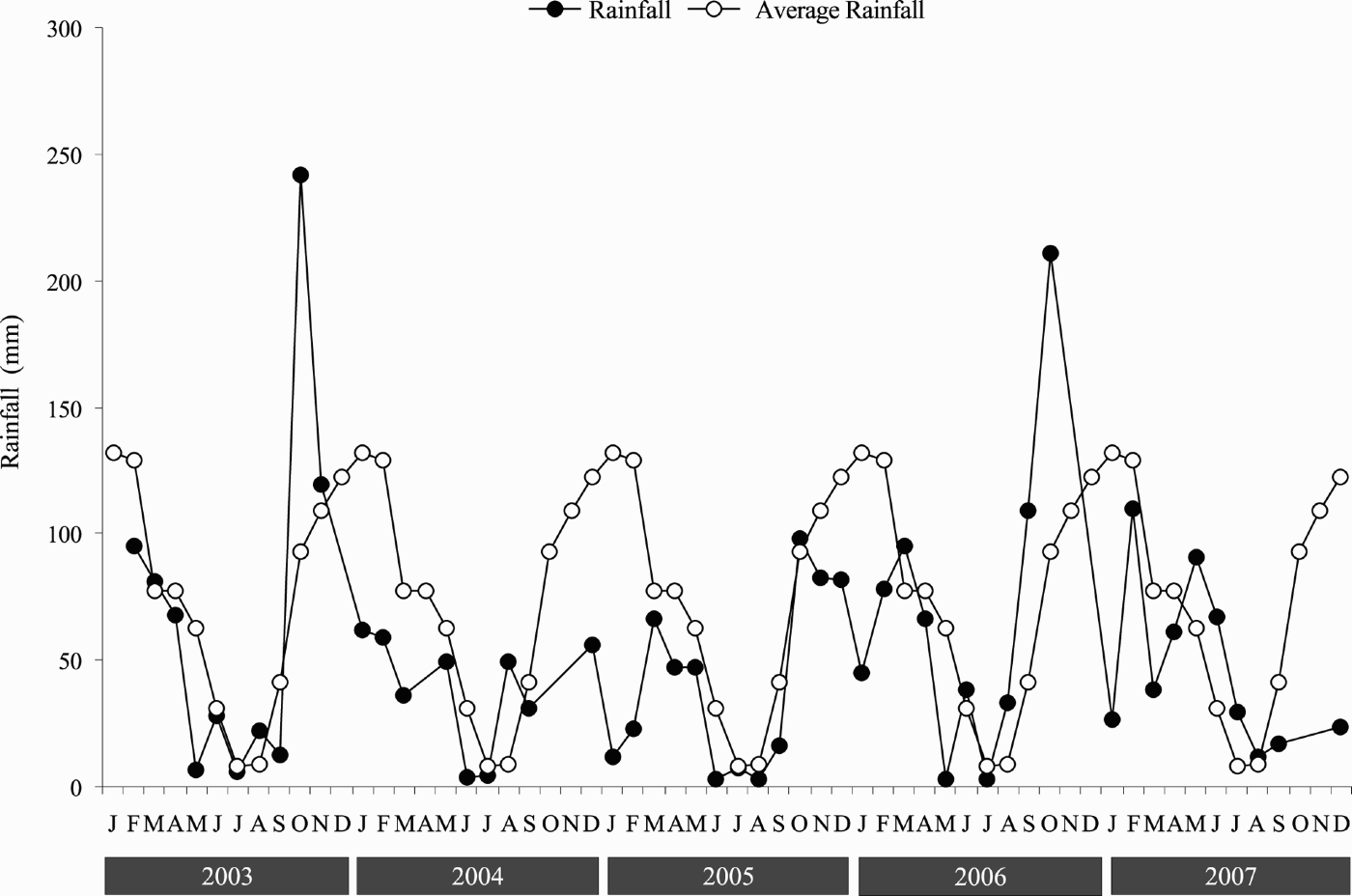
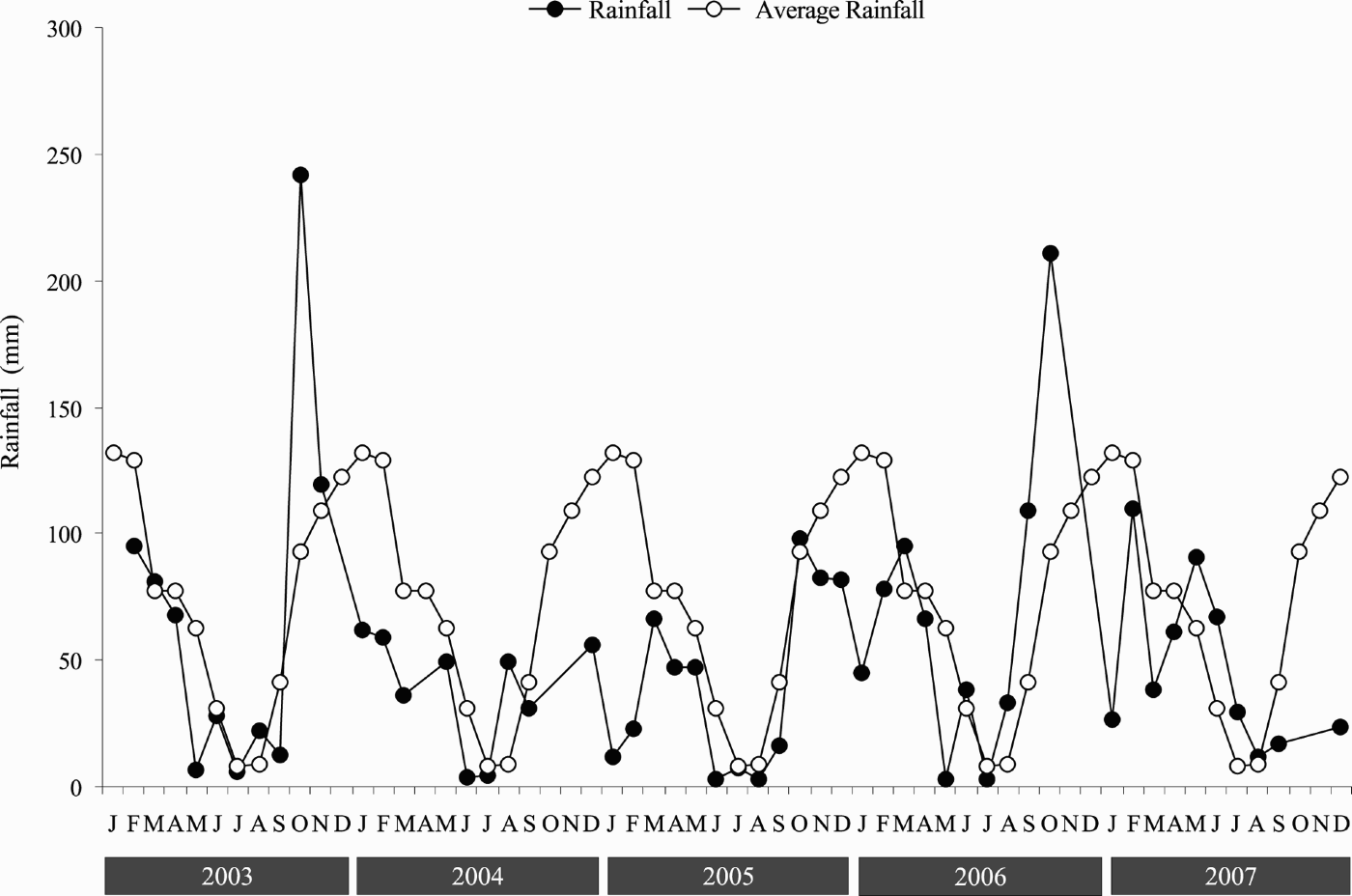
Weather varied substantially during the sampling period (Figure 2). Precipitation varied according to the season, ranging from about 3.1 mm in the spring of 2005 (extreme drought year) to about 242.1 mm in the winter of 2003. In addition, during the study period, considerable deviation from the estuary average conditions was observed. In fact, during 2004 and 2005 Portugal experienced a severe decrease in precipitation, as compared to average long-term values (Figure 2), which according to the Portuguese Weather Institute caused the most important drought event in 35 years (experienced throughout Southern Europe). The freshwater flow from the Mondego River basin suffered a considerable reduction, and consequently salinity increased during this period (Figure 3).
Monthly precipitation from 2003 to 2007 compared to the normal (1961–1990) for the centre of Portugal.
Average seasonal variation of bottom salinity (A), pH (B), temperature (°C) (C) and, the amount of oxygen (mg · l −1) (D) for the four sampling stations, during the study period.

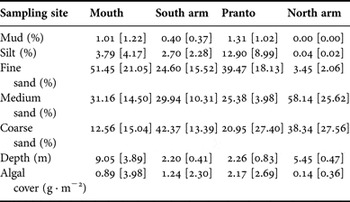
In spatial terms, most of the environmental variables recorded in the sampling areas yielded a recognizable estuarine gradient, from upstream to downstream sections (Figure 3; Table 1). Salinity showed clear variations between sampling sites: average values at the mouth, south arm, Pranto and north arm were 30.3, 29.9, 24.6 and 21.4, respectively. Water temperature showed a clear seasonal trend, which is the typical pattern found in temperate regions (Figure 3), and pH showed no significant variations in time or space (8.0±0.2) (Figure 3).
Mean environmental characteristics (standard deviation) of the sediment, depth and algae cover for the 4 sampling areas.

The maximum depth was found at the mouth station (Table 1). Sediment in the upstream section consisted mostly of coarse and medium sand, while in the other sampling areas there was a predominance of fine sand and silt (Table 1).
Distribution and seasonal abundance patterns
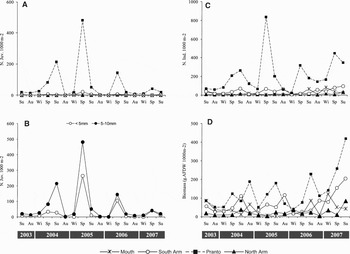
Benthic juvenile Carcinus maenas (<10 mm) recruitment was continuous through years, with a high proportion of young recruits being recorded in spring, probably as a function of higher reproductive activity in the winter. Higher juvenile abundances were mainly recorded at the Pranto station (Figure 4A) with a maximum in spring 2005 (483 ind.1000 m−2). In order to evaluate the continuous pattern of recruitment, the density of individuals less than 5 mm CW present at the Pranto station is presented in Figure 4B. A regular seasonal pattern of variation in C. maenas density was apparent along the estuary, being the highest values recorded in spring/summer. The highest density peaks occurred in 2005 at the Pranto station (836 ind.1000 m−2) (Figure 4C), with a predominance of juveniles smaller than 10 mm width. The lowest densities were found in the north arm of the estuary (8 ind.1000 m−2 on average, with a maximum of 62 ind.1000 m−2 in the summer of 2007). Despite the fact that the highest densities occurred in the spring of 2005 at the Pranto station, the highest biomass values (418 g AFDW 1000 m−2) (Figure 4D) were recorded in the summer of 2007, when the young recruits became adults. During this study, a total of 127 ovigerous females were sampled, primarily in downstream areas (47.2%, 33.9% and 16.5% at the mouth station, south arm and north arm respectively and 2.4% at the Pranto station), with a maximum in the winter of 2007 (N = 42).
Seasonal variation of the number of individuals per 1000 m2. (A) Abundance of juveniles less than 10 mm carapace width; (B) abundance of juveniles between 5 and 10 mm and below 5 mm carapace width, just in Pranto station; (C) total abundance of the population; (D) total biomass of the population. Su, summer; Au, autumn; Wi, winter; Sp, spring.

Colour morphotype variability, moulting and presence of parasites
Ninety-three per cent of all crabs caught were green morphotype and the rest were red. The proportion of this morphotype over the red clearly increased from the mouth to upstream areas (72% and 85% at the mouth and north arm, respectively, and 98% in the south arm). Only 4% of males were red, compared with 10% of the female crabs, sampled primarily at the mouth station in the summer of 2007. Of the ovigerous females recorded (mainly at the downstream areas), nearly 60% demonstrated the red morphotypes and were found in the summer of 2007.
The proportion of crabs actually in moult was also higher in downstream areas, where they represented 5% of the total caught. Throughout the whole study period, crabs parasitized by the endoparasitic barnacle Sacculina carcini were found mostly at the mouth station. A total of 314 individuals (1.68% of the total) of both sexes were found to be infected.
Population size-structure
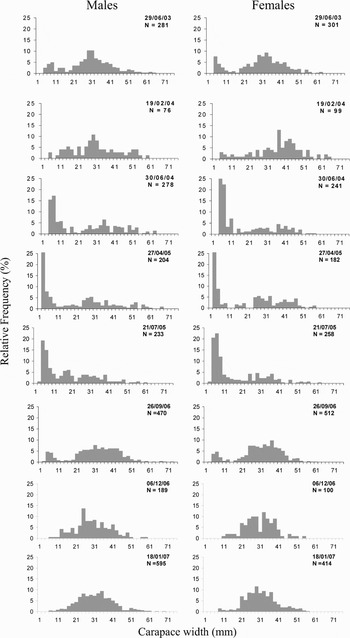
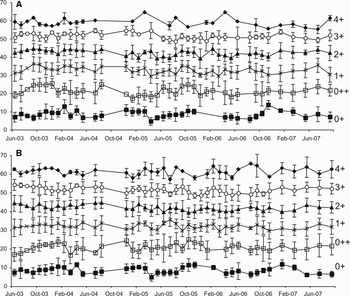
A total of 18,656 crabs were collected during the study period, of which 67% were caught at the Pranto station. The largest individual was a female of 75 mm CW sampled in January 2006, although approximately 77% of the individuals larger than 60 mm CW were males. The average CW of ovigerous females was 40 mm, from a size-range of 22 mm–56 mm. The population structure was characterized by a unimodal size–frequency distribution (Figures 5 & 6), and both sexes were represented in all size-classes (Figure 5) during the whole study period, which is consistent with continuous recruitment. For both males and females, modal analysis led to the detection of six age-classes: 0+ and 0++ corresponded to juveniles, while individuals from all the other classes were considered adults. The crab attains adulthood when their CW is approximately 30–35 mm. The average CW size for each age-class was 8, 21, 33, 42, 52 and 59 mm for females, and 8, 21, 32, 42, 51 and 61 mm for males, corresponding to individuals 0+, 0+ +, 1, 2, 3 and 4 years old, respectively.
Size–frequency distribution of males and females. Sampling dates are indicated. N, number of measured individuals.

Variation of age-classes of males (A) and females (B) of Carcinus maenas.

Spatial distribution
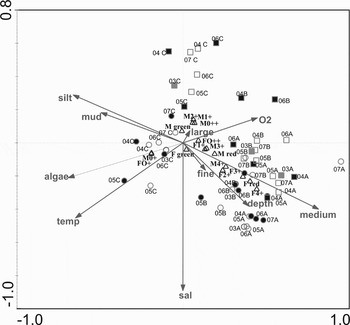
The ordination plot (Figure 7) illustrates the relationships between C. maenas spatial and temporal patterns of abundance, and environmental conditions in the Mondego estuary. The first two axes of the CCA account for 72.8% of the total variance and 84.2% of the variance due to age-classes and colour morphotypes in relation to environmental relations. Juveniles M0+ and F0+ (on the left side of the plot) appear strongly related to high temperature, corresponding to warmer seasons and also found in the Pranto station. These age-classes were positively correlated with mud, silt and algal cover.
Ordination diagram for the first two canonical axes of the correspondence analysis (F0+, F0+ +, F1+, F2+, F3+, F4+ —females; M0+, M0+ +, M1+, M2+, M3+, M4+ —males; F green, females green; F red, females red; M green, males green; M red, males red); A, mouth; B, south arm; C, Pranto; temp, temperature; sal, salinity; O2, dissolved oxygen; mud, mud; silt, silt; fine, fine sand; medium, medium sand; coarse, coarse sand; depth, depth; algae, algae biomass. □ winter ■ autumn ○ summer • spring

Males 0+ +, 1+, 2+ and females 0+ +, F1+ were associated with high dissolved oxygen and coarse sand, and increased in number from the Pranto station towards downstream areas. Females 2+, 3+, 4+ and males 4+ were found at the mouth (A), the station with bigger depths. Red females and males were distributed mainly at the mouth and associated with larger depths and higher dissolved oxygen. These results clearly suggest a migration downwards to the mouth of the estuary as individuals become older.
The crab populations have been shown to synchronize their life cycle to various seasonal patterns. The CCA illustrated spatial variability linked to the migratory behaviour known for this species. Benthic recruitment is visible at upstream areas mainly in the spring/summer seasons, and during the drought event in 2004/2005 an intense recruitment was associated with higher salinity values in this area.
Production estimates
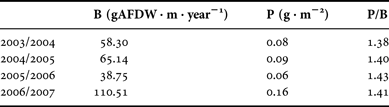
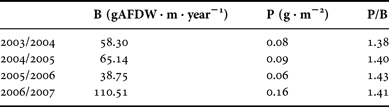
Calculations were made excluding the north arm station, where the population was extremely sparse compared to the other sampling areas. The average annual growth production (P) of the subtidal population of C. maenas was estimated at 0.08 g m−2 y−1 AFDW in 2003/2004, 0.09 g m−2 y−1 AFDW in 2004/2005, 0.07 g m−2 y−1 AFDW in 2005/2006, and 0.14 g m−2 y−1 AFDW in 2006/2007 (Table 2). Production and annual average biomass showed a maximum in 2006/2007, when the largest adult densities were attained, while the lowest values were recorded in 2005/2006, in association with higher abundance of juveniles smaller than 5 mm CW and much lower individual biomass. Despite this variation, annual P/B ratios were similar along the whole study period (Table 2).
Carcinus maenas production estimates for the study.
DISCUSSION
Population dynamics and secondary production
In a highly dynamic system such as the Mondego estuary, the Carcinus maenas population exhibited clear seasonal variations and a differential spatial distribution, which has been also observed in several other studies along a latitudinal cline (Berrill, Reference Berrill1982; Moksnes, Reference Moksnes, Phil and Montfrans1998; Sprung, Reference Sprung2001; Almeida & Queiroga, Reference Almeida and Queiroga2003; Baeta et al., Reference Baeta, Cabral, Neto, Marques and Pardal2005; Audet et al., Reference Audet, Miron and Moriyasu2008). Nevertheless, some differences were observed in the Mondego with regard to the reproductive pattern (see below). A novel aspect of the present study is that it focused on the subtidal population; in contrast most of the available literature concerning C. maenas addresses intertidal populations (e.g. Crothers, Reference Crothers1968; Styrishave et al., Reference Styrishave, Andersen and Depledge2003). This aspect is important since C. maenas' displacement patterns in the subtidal zone are likely to differ from those in the intertidal area (Lynch & Rochette, Reference Lynch and Rochette2007) due to differences in environmental processes. In the Mondego, the C. maenas recruited throughout the year, mainly at the Pranto station. This is in agreement with findings by Baeta et al. (Reference Baeta, Cabral, Neto, Marques and Pardal2005), and is probably due to favourable environmental conditions to the latest larval stage (megalopa) to settle. Carcinus maenas populations in other European estuaries spawn in late winter and spring (Neves et al., Reference Neves, Cabral and Gordo2006), which causes an increase in the number of recruits in these periods. On the Swedish coast, for example, recruitment starts only between August and September and in the Dutch Wadden Sea after mild winters. In these systems, recruit abundance can be extremely high (600 ind. m−2 and 200 ind. m−2, respectively). By contrast, on the Atlantic American coast, close to the northern limit of the distribution, the recruitment period occurs only in November although breeding and moulting can be observed throughout the year (Audet et al., Reference Audet, Miron and Moriyasu2008).
The availability of spatial refuges is particularly important to this species during their early benthic phases, when they benefit from protection in highly structured habitats (Thiel & Dernedde, Reference Thiel and Dernedde1994). This may explain why, in the Mondego, following recruitment, juvenile crabs tend to migrate to downstream areas as they become older, reaching sexual maturity closer to the mouth station. Although this species may breed all year round, ovigerous females were more abundant during the winter, as seen in Scandinavia and in the Gibraltar Strait (Van der Meeren, Reference Van der Meeren1992). It is known that ovigerous females prefer more saline waters (Reid et al., Reference Reid, Abelló, Kaiser and Warman1997), which may explain why we found relatively few individuals and when found, they were almost always at the mouth of the estuary. Between years, no differences in the proportion of ovigerous females have been seen.
Carcinus maenas demonstrate a range of colours from green to deep red. This physical change in coloration is due to photo-denaturation of the pigment astaxanthin (i.e. turning red when denatured) in the carapace over a long inter-moult (Reid et al., Reference Reid, Abelló, Kaiser and Warman1997). It has been demonstrated that variations in behaviour and physiology are correlated with carapace colour and moult cycle pattern (McGaw & Naylor, Reference McGaw and Naylor1992; Reid et al., Reference Reid, Abelló, Kaiser and Warman1997; Styrishave, Reference Styrishave2004). Crabs of the green morphotype have been shown to be more tolerant to salinity fluctuations and aerial exposure, and consequently are found more frequently in the intertidal zone. The red morphotype has lower tolerance to low salinities and low oxygen availability, and therefore occurs more abundantly in open shore subtidal habitats. This illustrates the type of constraints that highly variable habitats such as estuaries impose on red morphs. Therefore, the high proportion of crabs of the green morphotype in the Mondego is consistent with the environmental variability observed in this estuary.
It has been seen that there is no variation in the proportion of crabs' morphotypes between years related to the drought event.
Moulting crabs were found at any time during the study period, as is seen around Great Britain and in the English Channel (Broekhuysen, Reference Broekhuysen1936; Naylor, Reference Naylor1962) and during the drought period any changes in the proportion of crabs in moult state have been recorded.
Throughout the Carcinus maenas original distributional range, it is common to find some individuals with atypical behaviour and morphology due to the presence of a common parasite, the barnacle Sacculina carcini. With respect to this, in the Mondego, C. maenas often exhibits symptoms of increased fouling, which is a signal of parasites' presence. With time, the sacculinized host becomes a parasite genotype with a crab phenotype (Thresher et al., Reference Thresher, Werner, Høeg, Svane, Glenner, Murphy and Wittwer2000; Goddard et al., Reference Goddard, Torchin, Kuris and Lafferty2005). Parasitized crabs were found throughout the years and the drought event did not produce any changes on it.
With respect to production, values estimated presented some inter-annual variation due to differences in population density and size–frequency distribution. Nevertheless, P/B ratios were similar throughout the study period (see Table 2). The P/B ratio estimated in this study is considered low as compared to other European sites. For instance, Moknes et al. (1998) estimated a P/B ratio of 2.8 and Sprung (Reference Sprung2001) of 6.4. However, it is important to note that in all previous studies the P/B ratio was estimated for intertidal populations, which are usually characterized by higher densities.
Extreme drought events and its impacts on the C. maenas population
Climate change associated with several anthropogenic stressors may interact and produce some impacts on ecosystems and their residents (Harley et al., Reference Harley, Hughes, Hultgren, Miner, Sorte, Thornber, Rodriguez, Tomanek and Williams2006; Cardoso et al., Reference Cardoso, Bankovic, Raffaelli and Pardal2007, Reference Cardoso, Raffaelli, Lillebø, Verdelhos and Pardal2008; Dolbeth et al., Reference Dolbeth, Martinho, Viegas, Cabral and Pardal2008). Due to the occurrence of two consecutive extreme dry years (2004 and 2005), several changes took place in the Mondego River basin (for detailed information see Marques et al., Reference Marques, Azeiteiro, Martinho and Pardal2007; Martinho et al., Reference Martinho, Leitão, Viegas, Dolbeth, Neto, Cabral and Pardal2007). A decreased freshwater flow resulted in the incursion of saline waters into the estuary, with a consequential increase in salinity throughout the system. During the drought period (spring), green crab catches were higher, due to significant recruitment (Figure 4A). Salinity is among the main factors influencing reproduction, recruitment and dispersal of marine and estuarine organisms (Anger et al., 2006). The adult green crab C. maenas is considered a euryhaline species and Nagaraj (Reference Nagaraj1993) reported its ability to live in habitats with salinities ranging from 9 to 35. In contrast, larval development of this species requires higher salinities (Nagaraj, Reference Nagaraj1993; Cieluch et al., Reference Cieluch, Anger, Aujoulat, Buchholz, Charmantier-Daures and Charmantier2004). Therefore, the fact that higher salinities were observed in the whole estuary during the drought period (Figure 3), and the increase of new recruits at the Pranto station (the innermost one) confirms the osmoregulatory ability for the megalopa stage to develop in such systems (Queiroga et al., Reference Queiroga, Costlow and Moreira1994). The highest values of the biomass in 2007 (Figure 4D) also confirms the intense recruitment during the drought period; after two years the young recruits become adults.
Attrill & Power (Reference Attrill and Power2000) also pointed to the influence of an extreme drought for the invertebrates' populations in the Thames estuary being the catches of C. maenas significantly larger in both winter and summer in this study.
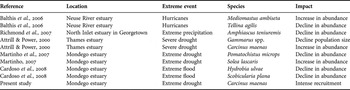
Other studies illustrated the impact of this drought on the Mondego estuarine communities (Table 3). An increase in salinity resulted in the observation of marine adventitious fish species such as Buglossidium luteum, Solea lascaris and Trisopterus luscus which had never been captured in the estuary before the drought event (Martinho et al., Reference Martinho, Leitão, Viegas, Dolbeth, Neto, Cabral and Pardal2007). On the other hand, observations of estuarine resident species such as Pomatoschistus microps and Pomatoschistus minutus declined, possibly due to the influence of both salinity and to an increase in predation (Martinho et al., Reference Martinho, Leitão, Viegas, Dolbeth, Neto, Cabral and Pardal2007; Dolbeth et al., Reference Dolbeth, Martinho, Viegas, Cabral and Pardal2008). In an opposite situation, Cardoso et al. (Reference Cardoso, Raffaelli, Lillebø, Verdelhos and Pardal2008) demonstrated that an extreme flood produces significant effects on the macrobenthic assemblage, namely a decline in total biomass and species richness. A large decline of economically important species such as the bivalves Cerastoderma edule and Scrobicularia plana occurred after the floods.
Comparative summary of several extreme events and their impacts on different species in several locations.

The current study shows that C. maenas is a euryecious species, capable of persisting across an array of different environmental conditions, including periods of extreme drought.
The drought event reported here allows a detailed evaluation of the effects induced on the C. maenas population, comparing the population fluctuation before and after the extreme event. The frequency and intensity of these events can change the abundances of coastal populations elsewhere.
Any changes in the population of C. maenas resulting from these extreme events could have significant implications for other species of the estuarine food web, since these crustaceans act as both predators and prey for a wide range of estuarine species (Raffaelli et al., Reference Raffaelli, Conacher, McLachlan and Emes1989; Attrill & Power, Reference Attrill and Power2000). If this species is resilient in the face of extreme environmental events, it might contribute to its capacity to colonize other systems around the world.
Further studies would undoubtedly be needed for evaluating communities' integrity in the long-term and the cumulative effects of extreme climatic scenarios on estuaries. It is now a sound conclusion that different populations and communities may respond differently to extreme climatic events, depending on the ecology and physiology of each species and their habitats. Furthermore, evaluating their impacts on natural populations seems a major challenge for future studies.
ACKNOWLEDGEMENTS
The preparation of this manuscript was partially supported by the project RECONNECT (PTDC/MAR/64627/2006) through a grant awarded to Filipa Bessa, and directly by FCT, through a PhD grant awarded to Alexandra Baeta. The authors are indebted to all colleagues involved in the field work.