





Introduction
Effective weed control in cropping systems is essential for preventing yield losses caused by weed interference. Since the 1960s, herbicides have been the predominant and the most economically viable method of weed management (Gianessi and Reigner Reference Gianessi and Reigner2007). Currently, >95% of the corn (Zea mays L.) and soybean production areas in the U.S. Midwest is treated with herbicides (USDA-NASS 2022, 2024). Despite technological and regulatory progress, concerns over herbicide off-target movement and environmental contamination remain (Damalas and Eleftherohorinos Reference Damalas and Eleftherohorinos2011; Sishodia et al. Reference Sishodia, Ray and Singh2020). Optimizing herbicide application efficacy while minimizing environmental impact remains a major focus for researchers and technology manufacturers.
Targeted herbicide application technologies (THAT; also described in the literature as smart sprayers, targeted sprayers, optical sprayers, intelligent sprayers, spot-sprayers, or precision sprayers) have been developed and refined since the early 1990s, initially focused on fallow, preplanting, or after planting before crop emergence (“green-on-brown”) applications using systems such as WeedSeeker (PTx Trimble, Westminster, CO) and WEED-IT (Rometron, Steenderen, The Netherlands) (Azghadi et al. Reference Azghadi, Olsen, Wood, Saleh, Calvert, Granshaw, Fillols and Philippa2024; Wolf Reference Wolf2026). These early technologies relied on optical sensors that detect chlorophyll reflectance, which distinguishes green vegetation from bare soil and triggers spray application only when living plant material is detected (Brown et al. Reference Brown, Giles, Oliver and Klassen2008; Giles and Slaughter Reference Giles and Slaughter1997; Slaughter et al. Reference Slaughter, Giles and Downey2008). Recent advancements in ground-based THAT integrate cameras mounted along the sprayer boom with artificial intelligence algorithms and high-performance computing units housed upon the sprayer (Avent et al. Reference Avent, Norsworthy, Zimmer, Young, Contreras, Everman, Hager, Patzoldt, Schwartz-Lazaro, Houston and Butts2025; Barnhart et al. Reference Barnhart, Proctor, Werle, Miller, Lancaster, Roozeboom and Dille2025; Partel et al. Reference Partel, Kakarla and Ampatzidis2019, Reference Partel, Kim, Costa, Pardalos and Ampatzidis2020; Vijayakumar et al. Reference Vijayakumar, Ampatzidis, Schueller and Burks2023). This setup enables real-time weed detection in established crops (“green-on-green” applications) and image processing within milliseconds, activating only the necessary nozzles to apply herbicides precisely where weeds are detected (Blue River Reference River2024; Partel et al. Reference Partel, Kakarla and Ampatzidis2019, Reference Partel, Kim, Costa, Pardalos and Ampatzidis2020; Vijayakumar et al. Reference Vijayakumar, Ampatzidis, Schueller and Burks2023). By applying herbicides only where needed, these systems can substantially reduce total herbicide use and reduce herbicide off-target movement (Avent et al. Reference Avent, Norsworthy, Patzoldt, Schwartz-Lazaro, Houston, Butts and Vazquez2024; Barnhart et al. Reference Barnhart, Proctor, Werle, Miller, Lancaster, Roozeboom and Dille2025; Spaeth et al. Reference Spaeth, Sökefeld, Schwaderer, Gauer, Sturm and Delatrée2024). In addition, some THAT platforms are equipped with dual-tank and dual-boom configurations, allowing simultaneous broadcast application (e.g., residual herbicides) and targeted application of foliar herbicides, thereby integrating foundational and site-specific weed management strategies within a single pass (Avent et al. Reference Avent, Norsworthy, Zimmer, Young, Contreras, Everman, Hager, Patzoldt, Schwartz-Lazaro, Houston and Butts2025; Barnhart et al. Reference Barnhart, Proctor, Werle, Miller, Lancaster, Roozeboom and Dille2025). Moreover, THAT can generate high-resolution geo-referenced herbicide as-applied and weed infestation maps with the machine’s linked software (e.g., FIELD MANAGER; Xarvio Digital Farming Solutions, Cologne, Germany) as soon as applications are completed. These maps can provide valuable insight into weed infestation levels across the fields, helping end-users make informed management decisions in future growing seasons.
Among the commercially available green-on-green systems, ONE SMART SPRAY (a joint venture of Bosch [Gerlingen, Germany] and BASF Corporation [Research Triangle Park, NC]) serves as a representative example of how these advanced detection and application capabilities are implemented in practice. The weed detection system of the ONE SMART SPRAY uses digital image processing and artificial intelligence algorithms to differentiate weeds from established crops in real time (green-on-green) (Barnhart et al. Reference Barnhart, Proctor, Werle, Miller, Lancaster, Roozeboom and Dille2025; Spaeth et al. Reference Spaeth, Sökefeld, Schwaderer, Gauer, Sturm and Delatrée2024). One camera and two lighting modules (red and near-infrared light-emitting diode; LEDs) are mounted at 1-m intervals along the boom. The cameras that sense red, green, and blue (RGB) are equipped with red and near infrared filters, enabling reliable weed detection in unfavorable weather conditions such as cloudy days. Both the cameras and LED arrays are mounted at a 25° forward angle relative to the ground to optimize image acquisition under field conditions. The system can detect weeds as small as 36 mm2 in an area (Barnhart et al. Reference Barnhart, Proctor, Werle, Miller, Lancaster, Roozeboom and Dille2025; Spaeth et al. Reference Spaeth, Sökefeld, Schwaderer, Gauer, Sturm and Delatrée2024).
Research has demonstrated that THATs can provide weed control levels comparable to conventional broadcast spraying across multiple crops, including corn (Barnhart et al. Reference Barnhart, Proctor, Werle, Miller, Lancaster, Roozeboom and Dille2025; Leise et al. Reference Leise, Singh, La Menza, Knezevic and Jhala2025; Spaeth et al. Reference Spaeth, Sökefeld, Schwaderer, Gauer, Sturm and Delatrée2024), soybean (Barnhart et al. Reference Barnhart, Proctor, Werle, Miller, Lancaster, Roozeboom and Dille2025; Lesile et al. Reference Leise, Singh, La Menza, Knezevic and Jhala2025), cotton (Gossypium hirsutum L.) (Avent et al. Reference Avent, Norsworthy, Patzoldt, Schwartz-Lazaro, Houston, Butts and Vazquez2024), sunflower (Helianthus annuus L.), and sugar beet (Beta vulgaris L.) (Spaeth et al. Reference Spaeth, Sökefeld, Schwaderer, Gauer, Sturm and Delatrée2024). A recent survey on THAT in corn and soybean in the U.S. Midwest showed that >65% of stakeholders are aware of this technology, but 19% would likely integrate THAT into their production system in the near future and 48% need more information to support their decision (Ugljic et al. Reference Ugljic, Mobli, Oliveira, Proctor, Dille and Werle2025). Survey results showed that two-pass herbicide applications; that is, preemergence followed by postemergence, is the predominant chemical weed control approach in corn and soybean production in the U.S. Midwest. The use of preemergence soil-applied residual herbicides is critical for reducing early season weed density and size; thereby delaying the need for subsequent postemergence applications (Parker et al. Reference Parker, York and Jordan2006). In addition, by limiting weed size and density at the time of postemergence, effective preemergence herbicide applications improve the efficacy of postemergence treatments (Oliveira et al. Reference Oliveira, Feist, Eskelsen, Scott and Knezevic2017; Whitaker et al. Reference Whitaker, York, Jordan, Culpepper and Sosnoskie2011). The THAT has been primarily evaluated for postemergence applications and herbicide savings, and recent studies have evaluated their integration with layered residual herbicide applications (Avent et al. Reference Avent, Norsworthy, Patzoldt, Schwartz-Lazaro, Houston, Butts and Vazquez2024; Barnhart et al. Reference Barnhart, Proctor, Werle, Miller, Lancaster, Roozeboom and Dille2025; Dodde et al. Reference Dodde, Norsworthy, Barber, Steckel, Young, Everman, Flessner, Houston, Henry and Avent2026). However, the influence of application timing, weed density, and residual herbicide placement on the consistency and value of these programs within targeted application systems requires further investigation. A layered residual herbicide program, which consists of applying a preemergence herbicide followed by an additional residual herbicide with the postemergence application, can provide better control of later emerging weeds, and has become a standard recommendation for troublesome Amaranthus species with extended emergence window such as waterhemp and Palmer amaranth (Amaranthus palmeri S. Watson) (Norsworthy et al. Reference Norsworthy, Ward, Shaw, Llewellyn, Nichols, Webster, Bradley, Frisvold, Powles, Burgos and Witt2012; Sarangi and Jhala Reference Sarangi and Jhala2019; Striegel et al. Reference Striegel, Oliveira, DeWerff, Stoltenberg, Conley and Werle2021). In addition, postemergence application time strongly influences the effectiveness of herbicides. Earlier postemergence applications coincide with fewer and smaller weeds and a less developed crop canopy, which can enhance detection accuracy and minimize the area treated with THAT (Armstrong et al. Reference Armstrong, Dirks and Gibson2007; Vijayakumar et al. Reference Vijayakumar, Ampatzidis, Schueller and Burks2023). However, early applications also increase the likelihood of subsequent weed emergence later in the season. In contrast, later postemergence applications may target larger weeds and higher weed densities that occur under a more developed crop canopy, but can reduce detection accuracy (especially for the weeds that emerge close to the crop rows), providing effective weed control but reducing the potential herbicide savings associated with targeted spraying systems due to greater weed coverage and potential increased detection uncertainty due to greater crop canopy coverage (Spaeth et al. Reference Spaeth, Sökefeld, Schwaderer, Gauer, Sturm and Delatrée2024; Vijayakumar et al. Reference Vijayakumar, Ampatzidis, Schueller and Burks2023). Therefore, the objective of this study was to evaluate the effects of postemergence application modality (targeted versus broadcast), application time (early versus standard), and inclusion of layered residual herbicide on area treated and waterhemp control in soybean production systems.
Materials and Methods
General Procedure
Field experiments were conducted at the BASF Midwestern Research Station near Seymour, Illinois, in 2023 and 2024 (two locations, 2024A and 2024B), and at the Rock County Farm in Janesville, Wisconsin, in 2024, for a total of 4 site-years, to evaluate area treated and waterhemp control using THAT compared to traditional broadcast postemergence herbicide application to a soybean crop (Table 1). The experiment was designed as a randomized complete block with four replications. For clarity, Seymour 2024A and Seymour 2024B were planted and treated on the same dates due to equipment and personnel availability, and therefore had similar environmental conditions. However, the trials were established in separate fields with independent randomization and are thus treated as separate studies.
Site-year information, soybean variety, planting date, postemergence application dates, and soil properties.a–c

Table 1. Long description
The table presents data from field experiments conducted at different site-years, detailing the variety of soybean, planting date, early and standard postemergence application dates, and soil properties. The table has 4 rows and 7 columns. The columns are labeled as Site-year, Variety, Planting date, Early POST application date, Standard POST application date, Soil OM, and Soil pH. The rows are as follows: Row 1: Site-year, Seymour 2023; Variety, XO 3651E; Planting date, July 3; Early POST application date, July 21; Standard POST application date, August 2; Soil OM, 3.2 percent; Soil pH, 6.5. Row 2: Site-year, Seymour 2024A; Variety, XO 3651E; Planting date, July 1; Early POST application date, July 18; Standard POST application date, August 5; Soil OM, 3.2 percent; Soil pH, 6.5. Row 3: Site-year, Seymour 2024B; Variety, XO 3651E; Planting date, July 1; Early POST application date, July 18; Standard POST application date, August 5; Soil OM, 3.2 percent; Soil pH, 6.5. Row 4: Site-year, Janesville 2024; Variety, P9998Q; Planting date, June 3; Early POST application date, June 27; Standard POST application date, July 1; Soil OM, 3.3 percent; Soil pH, 6.7.
a Abbreviations: OM, organic matter; POST, postemergence.
b The soybean seeding rate was 345,800 seeds ha⁻1 in all site-years.
c The soil texture was Plano silt loam at Janesville, Wisconsin, and Drummer silty clay loam and Elburn silt loam at Seymour, Illinois.
Treatments were arranged in a S × T factorial design where S represented three spray modalities including broadcast, targeted application, or dual-tank and dual-boom (broadcast application of layered residual herbicide and postemergence targeted application) with application of glufosinate (656 g ai ha−1, Liberty 280 SL; BASF) + glyphosate (1,261g ae ha−1, Roundup PowerMAX 3; Bayer CropScience, St Louis, MO) with the inclusion or not of a layered residual herbicide applied postemergence (dimethenamid-P, 736 g ai ha−1; Outlook, BASF) for a total of five treatment combinations: broadcast foliar postemergence without layered residual (single-tank spray modality; hereafter referred to as broadcast without residual), broadcast foliar postemergence with layered residual (single-tank spray modality; broadcast with residual), targeted foliar postemergence without layered residual (single-tank; targeted without residual), targeted foliar postemergence with layered residual (single tank spray modality; layered residual only applied where weeds were detected; targeted with residual), and targeted foliar postemergence + broadcast layered residual (dual-tank spray modality; targeted + broadcast residual). Thus, the layered residual postemergence herbicide was applied as a tank mixture in the single-tank broadcast or targeted application modalities and delivered separately in the dual-tank dual-boom treatment. The second factor, T, represented two postemergence application times, early (V1 to V2 soybean growth stage) or standard (V3 to V4 soybean growth stage; DeWerff and Werle Reference DeWerff and Werle2025). Two nontreated control (NTC) postemergence treatments were included, one for each application time, for a total of 12 treatments.
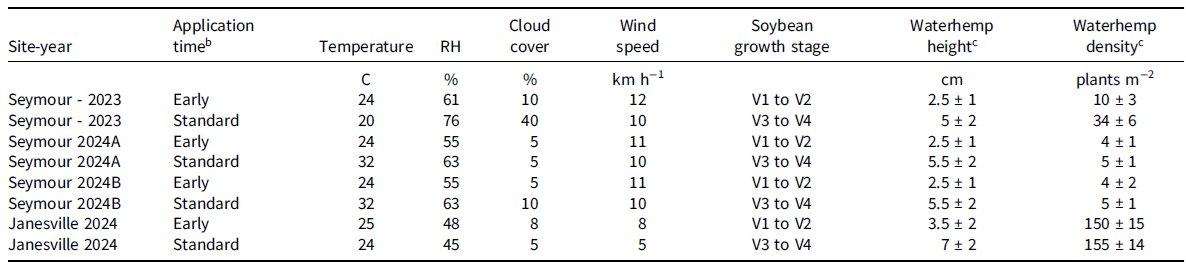
Experimental plots consisted of four soybean rows (76-cm row spacing, 3 m wide) and 30-m-long planted in freshly tilled fields. Environmental conditions, crop growth stages, and weed demographic information at each application time are summarized in Table 2, while precipitation data are presented in Supplementary Figure S1. The entire experimental area (all 12 treatments) received a preemergence broadcast application of saflufenacil (24 g ai ha−1)/dimethenamid-P (219 g ai ha−1) (Verdict; BASF) within a day of soybean planting, which represents a common practice in soybean production systems (Ugljic et al. Reference Ugljic, Mobli, Oliveira, Proctor, Dille and Werle2025). Waterhemp was the predominant weed species across all site-years because research locations were intentionally selected based on established waterhemp infestations. This species was targeted due to its widespread prevalence, strong competitive ability, and status as one of the most problematic herbicide-resistant weeds in soybean production systems throughout the U.S. Midwest (Tranel Reference Tranel2021; Yadav et al. Reference Yadav, Jha, Hartzler and Liebman2023). Consequently, visual control ratings and biomass collections were conducted specifically for waterhemp to evaluate the effectiveness of targeted herbicide application technologies on its management.
Application information, soybean growth stage, waterhemp height, and waterhemp density at the time of postemergence herbicide application.a

Table 2. Long description
The table presents data on environmental conditions, soybean growth stages, and waterhemp characteristics at various application times across different site-years. It includes columns for application time, temperature in degrees Celsius, relative humidity (RH) in percent, cloud cover in percent, wind speed in kilometers per hour, soybean growth stage, waterhemp height in centimeters, and waterhemp density in plants per square meter. The table has 8 rows and 8 columns. Row 1: Seymour - 2023, Early, 24, 61, 10, 12, V1 to V2, 2.5 ± 1, 10 ± 3. Row 2: Seymour - 2023, Standard, 20, 76, 40, 10, V3 to V4, 5 ± 2, 34 ± 6. Row 3: Seymour 2024A, Early, 24, 55, 5, 11, V1 to V2, 2.5 ± 1, 4 ± 1. Row 4: Seymour 2024A, Standard, 32, 63, 5, 10, V3 to V4, 5.5 ± 2, 5 ± 1. Row 5: Seymour 2024B, Early, 24, 55, 5, 11, V1 to V2, 2.5 ± 1, 4 ± 2. Row 6: Seymour 2024B, Standard, 32, 63, 10, 10, V3 to V4, 5.5 ± 2, 5 ± 1. Row 7: Janesville 2024, Early, 25, 48, 8, 8, V1 to V2, 3.5 ± 2, 150 ± 15. Row 8: Janesville 2024, Standard, 24, 45, 5, 5, V3 to V4, 7 ± 2, 155 ± 14.
a Abbreviations: POST, postemergence; RH, relative humidity; SE, standard error.
b Early application timing refers to POST application at the V1 to V2 soybean growth stage, and standard application timing refers to POST application at the V3 to V4 soybean growth stage.
c Waterhemp was the target weed species across all site-years. Waterhemp density was collected in nontreated control plots. Waterhemp height and density values are presented as means ± SE.
Targeted Sprayer Characteristics
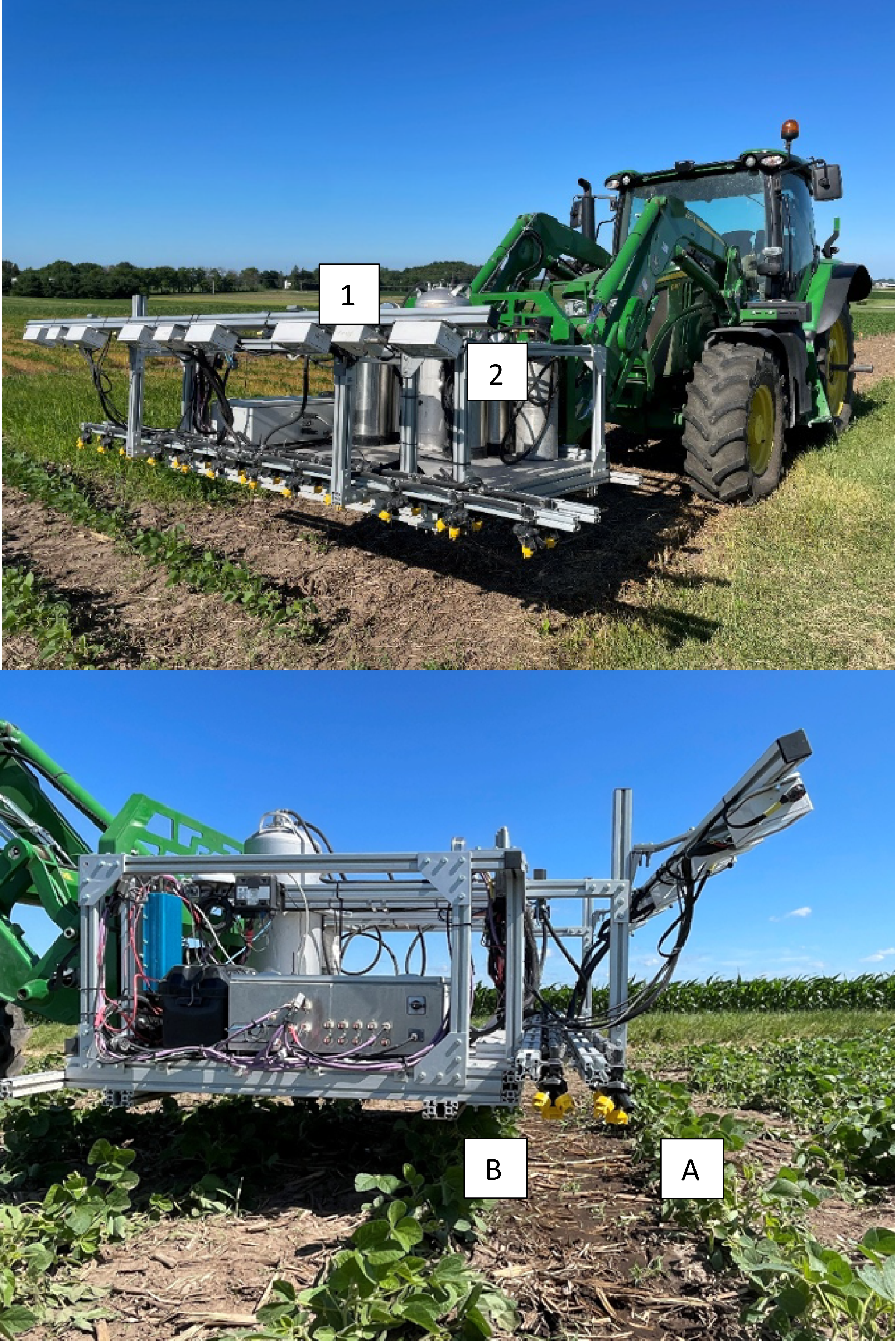
A ONE SMART SPRAY small-plot research unit was used to apply postemergence herbicides (Figure 1). The same research sprayer configuration was previously described and used by Barnhart et al. (Reference Barnhart, Proctor, Werle, Miller, Lancaster, Roozeboom and Dille2025). The sprayer was mounted on an aluminum frame attached to the front of a John Deere (Waterloo, IA) 6125R tractor and was equipped with two booms: a front boom for broadcast applications and a rear boom for targeted spraying (Figure 1). The front and rear boom nozzles were spaced at 25 cm with both booms delivering a spray swath width of 3 m. Boom height was set at 53 cm from the target. The prototype used two CO2-pressurized tanks mounted at the front of the sprayer. Tank pressure was manually set before each application to achieve the desired spray output, and the system was connected to 18.9-L tanks to facilitate switching between herbicide treatments. The prototype sprayer had an in-cab spraying control system (TeeJet Technologies, Glendale Heights, IL) and an in-cab computer to collect and extract spraying data (i.e., area treated) that were used for generating as applied maps. For these studies, the sensitivity level was set to the most sensitive. Sensitivity refers to the detection threshold of the system, with higher sensitivity enabling the sensors to detect smaller weed targets. Herbicides were applied through the targeted boom (in both targeted and broadcast modes for the single-tank single-boom treatments) using TeeJet TP4002E (even flat-fan) nozzles. The broadcast boom used in dual-tank dual-boom treatments was equipped with TeeJet DG8002 (overlapping flat-fan) nozzles. The system was calibrated to deliver 140 L ha−1 at a travel speed of 12.8 km h−1.
The ONE SMART SPRAY small-plot research unit was equipped with near infrared/infrared cameras (1) for real-time weed detection and light units (2) to enhance detection accuracy and incorporated a dual-tank dual-boom system that enabled simultaneous application of targeted postemergence herbicides (rear boom, B) and broadcast residual herbicides (front boom, A).

Data Collection
Visual waterhemp control assessment on the scale 0 (no control) to 100% (complete control) was compared with control in NTC plots 28 d after standard (V3 to V4 soybean growth stage) application time (DASAT). Waterhemp biomass samples were collected at the same time as visual assessments of control, where three subsamples were collected between rows two and three of each plot using 0.25-m2 quadrats. Waterhemp biomass within each quadrat was collected by clipping aboveground vegetation at the soil surface. Samples were dried in a forced-air oven at 54 C for 1 wk, or until a constant weight was observed, and dry biomass was subsequently recorded. Weed biomass data were converted to percentage biomass reduction relative to the NTC.
Applied Maps Processing
As-applied maps were generated after each postemergence application to evaluate the area of each plot sprayed by the THAT, following the methodology described by Barnhart et al. (Reference Barnhart, Proctor, Werle, Miller, Lancaster, Roozeboom and Dille2025). The ONE SMART SPRAY prototype unit collected geospatial data points for each nozzle on the targeted boom and automatically labeled each GPS point as TRUE when a nozzle was open or FALSE when a nozzle was closed. Data were collected at a density of approximately 10 points m−2. Data were geotagged with GPS coordinates and stored as a CSV (comma-separated values) file within the machine. After each application, raw data files were imported into Jupyter Lab (Kluyver et al. Reference Kluyver, Ragan-Kelley, Pérez, Granger, Bussonnier, Frederic and Kelley2016), and as-applied spray maps were generated using the Python 3.9 (Python Software Foundation 2023) packages Geopandas (Jordahl et al. Reference Jordahl, Van den Bossche, Wasserman, McBride, Fleischmann, Gerard, Tratner, Perry, Farmer, Hjelle and Gillies2021), Shapely (Gillies et al. Reference Gillies, van der Wel, Van den Bossche, Taves, Arnott and Ward2024), and SciPy (Virtanen et al. Reference Virtanen, Gommers, Oliphant, Haberland, Reddy, Cournapeau, Burovski, Peterson, Weckesser, Bright, van der Walt, Brett, Wilson, Millman and Mayorov2020). A grid of cells measuring 0.2 m by 0.2 m was overlaid across each experimental location to ensure high resolution within the resulting map (Barnhart et al. Reference Barnhart, Proctor, Werle, Miller, Lancaster, Roozeboom and Dille2025). A nearest neighbor interpolation (SciPy docs Virtanen et al. Reference Virtanen, Gommers, Oliphant, Haberland, Reddy, Cournapeau, Burovski, Peterson, Weckesser, Bright, van der Walt, Brett, Wilson, Millman and Mayorov2020) was used to generate the as-applied map. A nearest neighbor interpolation assigns the value nearest to a corresponding grid cell to be the estimated value (Varella et al. Reference Varella, Gleriani, Santos, Santos, Borém and Caldas2015), with the goal of producing a binary map of 0 and 1 indicating when each nozzle was not spraying or spraying, respectively. With the high density of data points collected by the machine, the nearest neighbor interpolation method requires considerably less computational power than alternative methods such as kriging (van Stein et al. Reference van Stein, Wang, Kowalczyk, Emmerich and Bäck2020). Maps were exported to QGIS software (v. 3.22.7; QGIS Development Team 2023), where the percentage of area treated within each subplot was quantified following the method described by Barnhart et al. (Reference Barnhart, Proctor, Werle, Miller, Lancaster, Roozeboom and Dille2025). This proportion was used as an estimate of area treated and to quantify herbicide savings, with lower values for area treated corresponding to greater herbicide savings compared to broadcast applications. Area treated (%) was calculated for each plot and averaged across targeted application treatments. Crop yield data were not collected from these experiments.
Data Analysis
Data were analyzed using R statistical software (v. 2025.09.1; RStudio Team 2020). Because waterhemp pressure varied drastically across site-years (Table 2) and differences were detected among site-years for area treated, visual assessments of waterhemp control, and waterhemp biomass reduction (P < 0.05; data not shown), these response variables were analyzed separately for each site-year. The area treated at postemergence application time data were analyzed without transformation using normal distribution because normality assumptions were met (stats package; R Core Team 2013). For each application time, observations were pooled across all targeted spray treatments with and without layered residual herbicide because area treated was determined at the time of postemergence application by the ONE SMART SPRAY prototype machine.
The area treated data were analyzed as a function of application time as a fixed effect, whereas block was included as a random effect in the model. Area treated data were subjected to ANOVA using a generalized linear mixed-effects model (glmmTMB package; Brooks et al. Reference Brooks, Kristensen, van Benthem, Magnusson, Berg, Nielsen, Skaug, Maechler and Bolker2017). Treatment means were separated using a Tukey HSD test at α = 0.05 with the emmeans package (Lenth Reference Lenth2020). Visual assessments of waterhemp control and waterhemp biomass reduction data collected 28 DASAT were analyzed using a beta distribution with a logit link function, scaled between 0 and 1 (glmmTMB package; Brooks et al. Reference Brooks, Kristensen, van Benthem, Magnusson, Berg, Nielsen, Skaug, Maechler and Bolker2017). Spray modality (S) and application time (T) were treated as fixed effects, whereas block was included as a random effect in the models. Visual assessments of waterhemp control and waterhemp biomass reduction data were subjected to ANOVA using a generalized linear mixed-effects model (glmmTMB package; Brooks et al. Reference Brooks, Kristensen, van Benthem, Magnusson, Berg, Nielsen, Skaug, Maechler and Bolker2017). Means were back-transformed for the response variables that were transformed for ease of interpretation (Striegel et al. Reference Striegel, Oliveira, DeWerff, Stoltenberg, Conley and Werle2021). Treatment means were separated using a Tukey HSD test at α = 0.05 with the emmeans package (Lenth Reference Lenth2020).
Results and Discussion
Seymour 2023
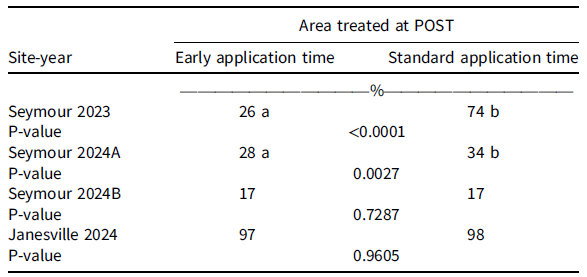
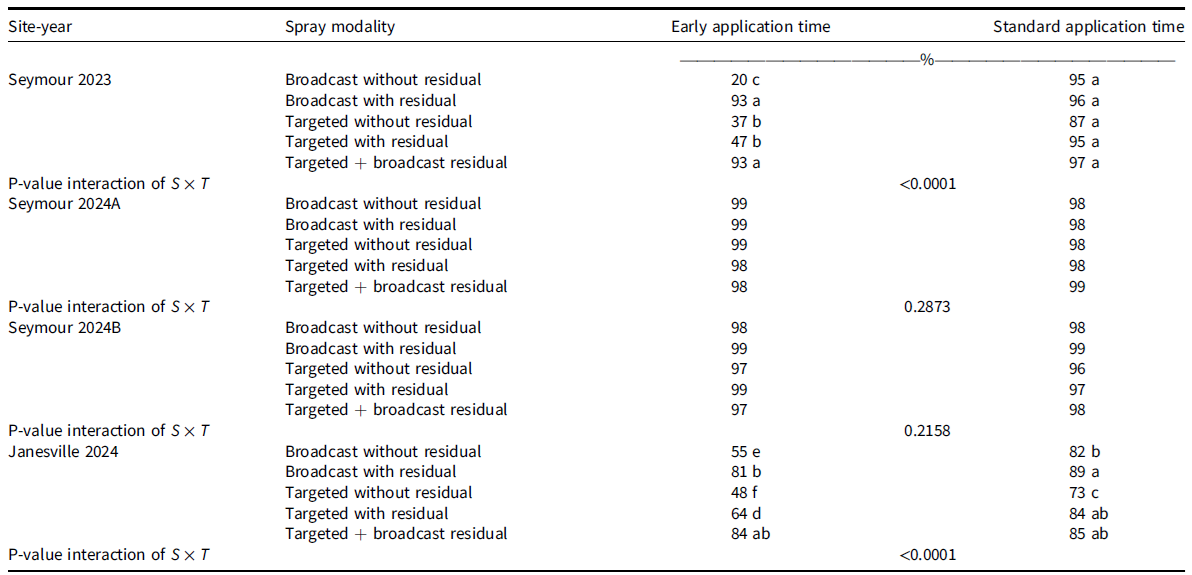
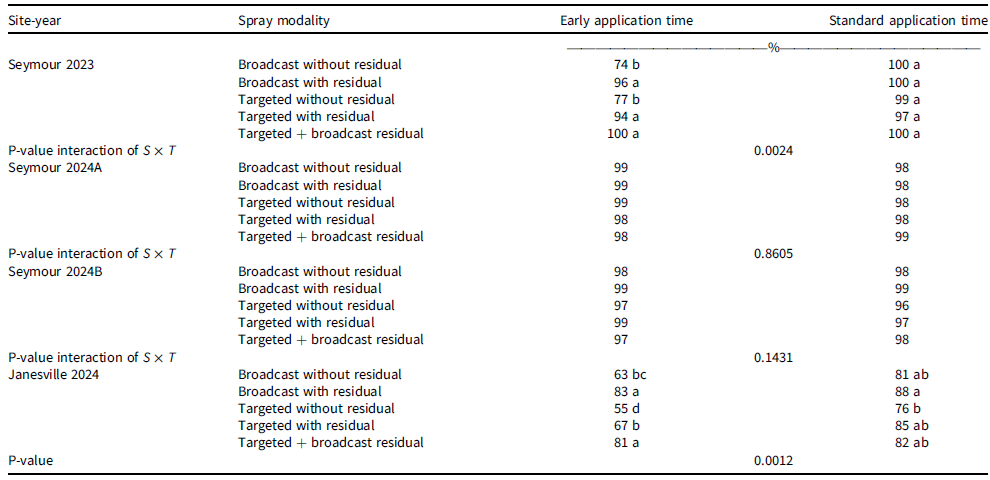
Waterhemp was present at intermediate (10 ± 3 plants m−2 at early application time) to high (34 ± 6 plants m−2 at standard application time) density in the NTC plots at the time of postemergence application (Table 2). Early application time resulted in least area treated (26%) compared with standard application time (74%) in Seymour 2023 (Table 3). The interaction between application modality and application time were significant (P < 0.05) for both response variables evaluated herein, visual assessment of waterhemp control and waterhemp biomass reduction (Tables 4 and 5; Supplementary Material 2). The broadcast treatment without residual herbicide at early application time provided the lowest level of waterhemp control (20% at 28 DASAT) among evaluated treatments. In contrast, the broadcast residual herbicide (93%) and the dual-tank dual-boom at early application time (93%), and all application modalities at the standard application time achieved the greatest waterhemp control (87% to 97%) at 28 DASAT. Similarly, the broadcast without residual herbicide (74%) and targeted application without residual herbicide (77%) at early application time resulted in the least waterhemp biomass reduction (Table 5). Treatments that included a residual herbicide at early application time, as well as all modalities at standard application time, provided 94% to 100% waterhemp biomass reduction. The present study showed a novel finding: including a residual herbicide in the postemergence tank mixture and delivering it through a targeted application at the early application time slightly improved waterhemp control at 28 DASAT compared with targeted applications without layered residual herbicide at the early application time when waterhemp pressure was 7 to 13 plants m−2. That was not observed at the standard application time.

Table 3. Long description
A table comparing the percentage of area treated at early and standard application times across different site-years. The table has four rows and three columns. The columns are labeled ‘Site-year’, ‘Early application time’, and ‘Standard application time’. The rows are labeled with different site-years and include P-values. Row 1: Seymour 2023, Early application time: 26, Standard application time: 74, P-value: <0.0001. Row 2: Seymour 2024A, Early application time: 28, Standard application time: 34, P-value: 0.0027. Row 3: Seymour 2024B, Early application time: 17, Standard application time: 17, P-value: 0.7287. Row 4: Janesville 2024, Early application time: 97, Standard application time: 98, P-value: 0.9605.
a Abbreviation: POST, postemergence.
b Early application timing refers to POST application at the V1 to V2 soybean growth stage, and standard application timing refers to POST application at the V3 to V4 soybean growth stage.
c Waterhemp was the target weed species across all site-years. The area treated was calculated for each plot, averaged within each targeted application treatment, and presented as treatment means. Within each site-year, different lowercase letters indicate significant differences in area treated between application timings according to a Tukey HSD test at α = 0.05. Absence of letters indicates no significant difference between application timings within that site-year.

Table 4. Long description
The table presents data on waterhemp control percentages across different spray modalities and application times. It has 5 rows and 4 columns. The columns are labeled ‘Site-year’, ‘Spray modality’, ‘Early application time’, and ‘Standard application time’. The rows are labeled with different site-years and spray modalities. Each cell contains the percentage of waterhemp control for the corresponding site-year, spray modality, and application time. Notable trends include varying levels of waterhemp control depending on the spray modality and application time. For example, in Seymour 2023, the broadcast without residual at early application time shows the lowest control percentage (20 percent), while the broadcast with residual and targeted plus broadcast residual at standard application time show the highest control percentages (97 percent). The table also includes P-values for the interaction of spray modality and application time for each site-year.
a Abbreviations: DASAT, days after standard application time; POST, postemergence; S × T = spray modality by application time interaction.
b Early application time refers to POST application at the V1 to V2 soybean growth stage, and standard application time refers to POST application at the V3 to V4 soybean growth stage.
c Residual indicates inclusion of dimethenamid-P applied POST. Broadcast means whole-plot herbicide application; targeted means herbicide application only where weeds were detected; targeted + broadcast residual means targeted POST herbicide application combined with broadcast residual herbicide application using a dual-tank dual-boom system.
d Waterhemp was the target weed species across all site-years.
e Within each site-year, lowercase letters compare visual assessment of waterhemp control means among treatment combinations across early and standard application times. Means followed by different lowercase letters are significantly different according to Tukey’s honest significant difference test at α = 0.05. When letters are not shown, visual assessment of waterhemp control did not differ among treatments within that site-year.
Waterhemp biomass reduction relative to the nontreated control assessed 28 d after standard application time.a–e

Table 5. Long description
A table comparing waterhemp biomass reduction methods and their effectiveness. The table has 5 rows and 4 columns. Column headers are Site-year, Spray modality, Early application time, and Standard application time. Row labels include Seymour 2023, Seymour 2024A, Seymour 2024B, and Janesville 2024. Each row provides data on different spray modalities and their effectiveness at early and standard application times. Notable trends include varying effectiveness of different spray modalities and application times across different sites and years.
a Abbreviations: POST, postemergence; S × T = spray modality by application time interaction.
b Early and standard application times refer to POST applications made at the V1 to V2 and V3 to V4 soybean growth stages, respectively.
c Residual indicates inclusion of dimethenamid-P applied POST. Broadcast means whole-plot herbicide application; targeted means herbicide application only where weeds were detected; targeted + broadcast residual means targeted POST herbicide application combined with broadcast residual herbicide application using a dual-tank dual-boom system.
d Waterhemp was the target weed species across all site-years.
e Within each site-year, lowercase letters compare biomass reduction means among treatment combinations across early and standard application times. Means followed by different lowercase letters are significantly different according to a Tukey HSD test at α = 0.05. When letters are not shown, biomass reduction did not differ among treatments within that site-year.
Seymour 2024A
Waterhemp was present at low densities (4 ± 1 plants m−2 at early application time; 5 ± 1 plants m−2 at standard application time) in the NTC plots at the time of postemergence application (Table 2). Targeted early application resulted in the lowest area treated (28%) compared with the standard application time (34%) (Table 3). Application modality and application time did not influence visual assessment of waterhemp control and waterhemp biomass reduction 28 DASAT, with treatments having >98% control and >98% biomass reduction compared with the NTC (Table 4).
Seymour 2024B
Waterhemp was present at low (4 ± 2 at early application; 5±1 at standard application time) density at this site-year in the NTC plots at the time of postemergence application (Table 2). No differences in area treated were detected between early and standard application times after targeted application treatments (17% for both times; Table 3). Application modality and application time did not influence area treated, visual assessment of waterhemp control, or waterhemp biomass reduction, with treatments having >96% control and >98% biomass reduction, compared to the NTC (Table 3 and Table 4).
Janesville 2024
Waterhemp was present at a very high density (150 ± 15 at early application; 155 ± 14 at standard application time) in the NTC plots at the time of postemergence application (Table 2). No differences in area treated were observed among treatments between early and standard application times (97% to 98%; Table 3). None of the treatments provided >90% waterhemp control and biomass reduction by 28 DASAT. Targeted application without residual herbicide at early application resulted in the lowest waterhemp control (48%) and biomass reduction (55%) compared with the NTC (Tables 4 and 5). Early applications with a dual-tank dual-boom (84%) and at the standard application time (85%), broadcast with residual herbicide at standard application time (89%), and targeted application with residual herbicide at standard application time (84%) provided the greatest waterhemp control compared with NTC plots (Table 4). Broadcast with residual herbicide at early application and all treatments at the standard application time, except targeted application without residual herbicide, provided 81% to 88% waterhemp biomass reduction (Table 5). Corroborating the Seymour 2023 data, the Janesville 2024 site-year data also provide preliminary evidence that inclusion of a layered residual herbicide in postemergence tank-mixtures delivered through targeted application can slightly improve waterhemp control relative to targeted applications without a residual component, particularly when applied early.
Consistent with previous reports, our results demonstrate that under low weed densities, THAT can reduce foliar herbicide use while maintaining weed control comparable to broadcast applications (Avent et al. Reference Avent, Norsworthy, Zimmer, Young, Contreras, Everman, Hager, Patzoldt, Schwartz-Lazaro, Houston and Butts2025; Barnhart et al. Reference Barnhart, Proctor, Werle, Miller, Lancaster, Roozeboom and Dille2025; Leise et al. Reference Leise, Singh, La Menza, Knezevic and Jhala2025; Spaeth et al. Reference Spaeth, Sökefeld, Schwaderer, Gauer, Sturm and Delatrée2024). In Seymour 2024A and Seymour 2024B, where waterhemp densities were ≤5 plants m−2 at early and standard application times, preemergence followed by postemergence herbicide applications provided >96% waterhemp control and >98% biomass reduction, regardless of postemergence application modality or application time. These outcomes indicate that when early season weed density is minimized, postemergence efficacy can be preserved across application strategies while allowing targeted applications to reduce the proportion of area treated. These findings should be interpreted within the context of late-planted soybean (Seymour 2023, Seymour 2024A, and Seymour 2024B; Table 1) environments evaluated in this study. Recent surveys indicate that two-pass herbicide programs, consisting of preemergence followed by postemergence applications, remain commonly used for managing troublesome weeds in Midwest corn and soybean crops (Mobli et al. Reference Mobli, DeWerff, Arneson, Smith and Werle2025; Ugljic et al. Reference Ugljic, Mobli, Oliveira, Proctor, Dille and Werle2025). Therefore, targeted postemergence applications may be most useful when they are integrated into existing preemergence followed by postemergence weed management programs that reduce weed density before postemergence application. Targeted applications reduced the area treated by 2% to 83% relative to broadcast application, with the greatest reductions occurring when measured waterhemp densities were low. These results indicate that when weed density at the time of postemergence application is low, THAT can reduce the area treated without compromising weed control. Similarly, Leise et al. (Reference Leise, Singh, La Menza, Knezevic and Jhala2025) reported that when weed densities are low, THAT provided >93% Palmer amaranth control at 21 d after treatment while achieving 87% to 94% reduction in foliar applied herbicides, whereas herbicide reductions declined sharply to only 1% to 5% when weed densities were high. When weeds are few and spatially dispersed, real-time detection systems selectively treat infested areas, resulting in less area being treated, and lower input costs. These conditions represent the optimal operating environment for THAT within integrated weed management programs.
Across weed density scenarios, the inclusion of a postemergence residual herbicide and applying it early resulted in slightly better waterhemp control outcomes, particularly in Seymour – 2023 and Janesville 2024, where higher waterhemp densities were present. Treatments combining THAT with a broadcast-applied residual herbicide using a dual-tank dual-boom system, resulted in greater and more consistent waterhemp control and greater biomass reduction compared with programs without a residual herbicide. This effect was most evident in Seymour 2023, where waterhemp densities increased from 10 plants m−2 at early application time to 34 plants m−2 at standard application time. In Seymour 2023, early application treatments without residual herbicide resulted in greater waterhemp biomass 28 DASAT, contributing to reduced waterhemp control and increased area treated.
These findings are consistent with those reported by Barnhart et al. (Reference Barnhart, Proctor, Werle, Miller, Lancaster, Roozeboom and Dille2025), who demonstrated that overlapping residual strategies reduced late-season waterhemp escapes and improved season-long waterhemp control compared with targeted or broadcast applications without a residual herbicide. Collectively, these results emphasize that layered residual herbicide applied postemergence at an early time remains a critical component of THAT-based programs to sustain grower-acceptable levels of weed control in two-pass systems, preemergence followed by postemergence applications (Barnhart et al. Reference Barnhart, Proctor, Werle, Miller, Lancaster, Roozeboom and Dille2025; Bell et al. Reference Bell, Norsworthy and Scott2015; Nunes et al. Reference Nunes, Lorenset, Gubiani and Santos2018; Nurse et al. Reference Nurse, Swanton, Tardif and Sikkema2006). Similar trends were reported by Singh et al. (Reference Singh, Miller, Peters, Naeve and Sarangi2025), who applied postemergence herbicide treatments at the V3 soybean growth stage and observed ≥90% waterhemp control 28 d after treatment regardless of residual herbicide inclusion, indicating limited benefits of layered residual herbicides when applied with postemergence herbicides delivered at the V3 soybean growth stage and beyond. When applying at the standard application time with high waterhemp pressure (e.g., Janesville 2024), these findings suggest that a layering of residual herbicides applied postemergence improved waterhemp control. The lack of differences observed at the other 3 site-years at the standard application timing could be influenced by herbicide selection and application rates, crop canopy development, and environmental conditions (e.g., rain) affecting residual herbicide activation and availability in soil solution.
Under high waterhemp densities, THAT effectively functioned as broadcast applications, as increased waterhemp density triggered multiple nozzle activation, reducing spatial selectivity and resulting in more area treated. In Janesville 2024, early treatments without residual herbicide exhibited lower waterhemp control and biomass reduction, reflecting continued waterhemp emergence later in the season. In such scenarios, THAT alone is insufficient, and additional weed management strategies such as a second postemergence application or integration of nonchemical practices (e.g., cover crops) are required to achieve >90% waterhemp control. Similar conclusions were reported by Leise et al. (Reference Leise, Singh, La Menza, Knezevic and Jhala2025) and Soltani et al. (Reference Soltani, Shropshire and Sikkema2023), emphasizing that integrated weed management should be implemented proactively across all weed infestation levels to prevent the development of high-density weed populations. However, its importance becomes particularly evident with heavy infestations of Amaranthus species, where reliance on herbicides alone is often insufficient to maintain acceptable levels of weed control.
In environments characterized by high weed densities and troublesome species, establishing a strong foundation through robust preemergence herbicide programs complemented by cultural practices such as cover crops, is essential for reducing early season weed pressure and limiting weed density at the time of postemergence application (Oliveira et al. Reference Oliveira, Feist, Eskelsen, Scott and Knezevic2017; Whitaker et al. Reference Whitaker, York, Jordan, Culpepper and Sosnoskie2011). By lowering weed density and size prior to postemergence, these approaches improve the consistency and effectiveness of postemergence herbicide applications and create conditions under which THAT can operate more efficiently. However, under very high weed densities, even well-managed preemergence-based systems may not fully prevent later-emerging cohorts, and sequential postemergence applications are often required to maintain season-long control of Amaranthus species (Norsworthy et al. Reference Norsworthy, Ward, Shaw, Llewellyn, Nichols, Webster, Bradley, Frisvold, Powles, Burgos and Witt2012; Sarangi and Jhala Reference Sarangi and Jhala2019). Similar observations have been reported by Zimmer et al. (Reference Zimmer, Young, Lazaro, Butts and Johnson2024) that reduced weed density, resulting from the combined effect of an effective preemergence herbicide and high cover crop biomass, improved spray selectivity and reduced the treated area in targeted application systems.
Consequently, THAT is best suited for well-managed fields with low to moderate levels of weed infestation, where smaller treated areas can sustain effective weed control while maximizing herbicide savings. In contrast, when weed densities are high, frequent nozzle activation would cause THAT to function similarly to broadcast applications, reducing herbicide savings and necessitating additional postemergence interventions to achieve acceptable weed control. The magnitude of area treated is also influenced by the system’s application configuration because each detected weed triggers a minimum spray footprint, which is determined by the number of nozzles activated, spray pattern width and spray length, travel speed, and controller response time. Thus, repeated detections under high or spatially dispersed weed infestations can substantially reduce potential herbicide savings. In addition, the high-resolution weed infestation and as-applied maps generated by THAT provide a framework for future approaches that integrate weed emergence patterns or predictive models to guide site-rate-specific placement of soil residual herbicides. Importantly, the as-applied maps in tandem with soil characteristic maps, can inform variable-rate residual herbicide applications in subsequent growing seasons based on soil characteristics by identifying and deploying higher optimized rates in field zones with consistently high weed pressure (Gundy and Dille Reference Gundy and Dille2022). Such strategies may enable more precise soil residual herbicide placement, thereby reducing overall postemergence herbicide use, decreasing selection pressure on postemergence herbicides, and enhancing the long-term sustainability of weed management programs. This consideration is especially relevant for Amaranthus species for which postemergence control options are limited and preserving the efficacy of existing chemical formulations is critical for resistance management.
Moreover, the present study provides preliminary evidence for addressing a question frequently raised by stakeholders regarding the inclusion of layered residual herbicide in postemergence tank mixtures applied using a single-tank, single-boom targeted system. In 2 site-years (Seymour 2023 and Janesville 2024), the inclusion of a layered residual herbicide at early application time was associated with slightly improved waterhemp control compared with targeted applications without a residual herbicide. These observations suggest that combining foliar and residual herbicides within a single targeted application may provide benefits under specific conditions. However, the magnitude and consistency of this response were limited, and potential trade-offs related to herbicide selection, rate allocation, crop and weed growth stage at application, and environmental conditions should be considered. Given the limited data available, further research is needed to better define the role of this approach within targeted herbicide application systems.
These results represent one of the first evaluations of site-specific delivery of residual herbicides, and this strategy shows promise for managing weed patches while limiting whole-field herbicide exposure. However, the effectiveness of this approach may depend on the underlying spatial distribution of weeds within the field. From a spatial ecology perspective, weed populations may occur in clustered, random, or uniform patterns, which can influence the suitability of site-specific residual herbicide placement (Backes and Jacobi Reference Backes and Jacobi2006; Heijting et al. Reference Heijting, Van der Werf, Stein and Kropff2007; Zanin et al. Reference Zanin, Berti and Riello1998). For example, in fields where weeds are spatially aggregated, applying residual herbicides in targeted areas may improve control of neighboring individuals within patches. In contrast, under more uniform or random distributions, this type of application may result in uneven herbicide coverage and expose some individual weeds to sublethal doses. Such variability in herbicide exposure could reduce control efficacy and potentially contribute to the selection of herbicide-resistant individuals. Therefore, further research is needed to better understand weed spatial patterns so as to optimize the use of layered residual herbicides within targeted application systems.
Practical implications
THAT can provide waterhemp control comparable to conventional broadcast applications to soybean crops while substantially reducing herbicide inputs, particularly in fields with low weed density. This study demonstrates that weed density at the time of postemergence application is a major factor influencing the magnitude of area treated achieved with THAT. By reducing the proportion of the field receiving a postemergence herbicide, THAT may increase herbicide savings and reduce total herbicide load, thereby potentially lowering the risk of off-target movement and environmental contamination. The inclusion of a layered residual herbicide at early postemergence was beneficial for maintaining season-long waterhemp control and minimizing late-season escapes at 3 out of 4 experimental site-years, whereas its value at standard postemergence time was reduced. Collectively, findings from this study provide practical information to growers, their decision influencers, the crop protection industry, and THAT developers on when and how targeted spraying can be successfully planned and deployed to maximize herbicide savings while maintaining season-long waterhemp control in soybean cropping systems. End-of-season waterhemp escapes and crop yield were not quantified in this study. Future studies should include late-season waterhemp assessments and crop yield to better quantify the agronomic and economic value of THAT across different waterhemp infestation scenarios.
Supplementary material
To view supplementary material for this article, please visit https://doi.org/10.1017/wet.2026.10140
Acknowledgments
We gratefully acknowledge the University of Wisconsin–Madison Cropping Systems Weed Science Program for supporting this research. We also thank Bruno Canella Vieira and Maxwel Coura Oliveira, and staff members at the Rock County Farm, in Janesville, Wisconsin; BASF Midwestern Research Farm in Seymour, Illinois; and the Xarvio Digital Ag team in Germany for their technical support and collaboration. Jed Colquhoun and Yi Wang provided constructive feedback and editorial contributions to the manuscript.
Funding
This project was funded by BASF Xarvio Digital Farming Solutions (Grant MSN258155), which also supported Zaim Ugljic’s graduate research assistantship. Additional funding was provided by the North Central Soybean Research Program (Grants MSN266309 and MSN280182) and the National Corn Growers Association (Grant MSN254842).
Competing interests
This study evaluated the ONE SMART SPRAY system, a targeted herbicide application technology associated with Bosch BASF Smart Farming. The research included collaboration with BASF personnel, was conducted in part at the BASF Midwestern Research Station in Seymour, Illinois, and received funding support from BASF. Co-author Kalvin Miller is employed by BASF Corporation. These relationships are disclosed in the interest of transparency. The authors state that the study design, data collection, statistical analyses, interpretation of results, and manuscript preparation were conducted according to scientific standards, and all authors approved the final manuscript.



 Open access

