Implications
The results from this study demonstrate that meat from lambs grazing autumn/winter pastures has a favourably low ratio of n-6 : n-3 polyunsaturated fatty acids (PUFAs) and does not benefit from fish oil supplementation. However, when lambs are finished indoors on concentrate-based diets, low levels of fish oil supplementation can be used to increase the eicosapentaenoic acid and docosahexaenoic acid (DHA) content of the meat, which may benefit human health. In both systems, fish oil had no effects on animal performance. Subcutaneous administration of barium selenate is a rapid and effective means of improving the Se status of Se-deficient lambs, especially within extensive sheep systems with zero concentrate inputs. However, Se supplementation after weaning did not benefit lamb performance during the 70-day finishing period. When lambs are fed concentrates containing Se mineral on a daily basis, treating lambs with barium selenate has no additional benefits for their Se status.
Introduction
It is now widely accepted that humans living in the developed world should reduce their intake of fat. In addition to this, the UK Department of Health in 1994 recommended that, to reduce the risk of coronary heart disease, intake of polyunsaturated fatty acids (PUFAs) of the omega-6 (n-6) series, such as linoleic acid (LA, 18:2n-6), should be maintained, whereas that of long-chain (LC) PUFAs of the n-3 series should increase. More recently, the Scientific Advisory Committee on Nutrition (SACN)/Committee on Toxicity (COT) (2004) proposed that the average consumption of n-3 LCPUFA should increase from ∼0.2 to 0.45 g/day, that is, ∼450 mg/day of eicosapentaenoic acid (EPA, 20:5n-3) and docosahexaenoic acid (DHA, 22:6n-3).
Sheep meat typically has a higher fat content than most other meats and contains lower levels of PUFA compared with pork or fish (reviewed by Sinclair, Reference Sinclair2007), although there is some variation depending on diet. Finishing lambs on concentrate-based diets, a rich source of 18:2n-6, produces meat with a higher and less favourable n-6 : n-3 ratio compared with those finished off on grass, a rich source of α-linolenic acid (ALA, 18:3n-3; Fisher et al., Reference Fisher, Enser, Richardson, Wood, Nute, Kurt, Sinclair and Wilkinson2000). However, the ALA content of grass is influenced by a number of factors including stage of maturity and the degree of shading (reviewed by Dewhurst et al., Reference Dewhurst, Shingfield, Lee and Scollan2006). In the United Kingdom, almost 40% lambs are slaughtered between October and January (Department of Food and Rural Affairs, 2010) when the short day length could reduce the ALA content and health benefits of grass-fed lamb. Studies in lambs fed concentrate-based diets have shown that there is some scope to increase the n-3 PUFA content of lamb meat by including linseed or fish oil in lamb finishing diets (Wachira et al., Reference Wachira, Sinclair, Wilkinson, Enser, Wood and Fisher2002; Demirel et al., Reference Demirel, Wachira, Sinclair, Wilkinson, Wood and Enser2004). However, there is a paucity of information on supplementation strategies to improve the fatty acid profile of grass-fed lamb. Therefore, the aim of this study was to compare the effects of fish oil supplementation on the fatty acid profile of meat from lambs finished on grass-based and concentrate-based diets, and to examine the associated effects on lamb performance and carcass characteristics, which are of greatest economic importance.
Selenium (Se) is an essential micronutrient for ruminant livestock and plays a key role in several metabolic pathways essential for growth and development. Primarily, Se is a component of the glutathione peroxidase (GPx) family of enzymes that occur in most cell types and assists in the breakdown of peroxides, preventing oxidative damage, and maintaining the integrity of cellular membranes (reviewed by Rooke et al., Reference Rooke, Robinson and Arthur2004). GPx activity is therefore under nutritional control through the intake of Se. Although symptoms of clinical Se deficiency are uncommon, Se inadequacy is widely reported throughout the United Kingdom and Ireland (Wang et al., Reference Wang, Van Dorst and Thornton1987; Mee et al., Reference Mee, O'Farrell and Rogers1994). Studies in sheep have reported increased live weight gain in lambs following Se supplementation both directly (Blaxter, Reference Blaxter1963) and indirectly via their dams (Muñoz et al., Reference Muñoz, Carson, McCoy, Dawson, O'Connell and Gordon2008 and Reference Muñoz, Carson, McCoy, Dawson, Irwin, Gordon and Kilpatrick2009). Feeding high PUFA diets can lead to increased oxidative stress in lambs; however, there is some evidence that feeding supranutritional levels of vitamin E help protect against lipid peroxidation, resulting in increased PUFA levels in the meat (Demirel et al., Reference Demirel, Wachira, Sinclair, Wilkinson, Wood and Enser2004). With GPx having a similar antioxidant role to vitamin E, the Se status and level of Se supplementation may also influence performance and meat quality of lambs fed high PUFA diets. However, Se supplementation strategies for lambs are poorly understood. A second objective of this study was to investigate the benefits of supplementing lambs of low or marginal Se status with a long-acting Se supplement across a range of diet types.
Material and methods
Animals
This study was undertaken between September and December 2006 using 180 entire male lambs sourced from six hill farms (20 to 34 lambs per farm). All of these farms were involved in an earlier study to investigate the effects of pre-mating selenium supplementation on the fertility of hill ewes (Muñoz et al., Reference Muñoz, Carson, McCoy, Dawson, Irwin, Gordon and Kilpatrick2009) and were known to have a deficient or marginal Se status. Lambs were the progeny of Scottish Blackface, Swaledale × Blackface, North Country Cheviot × Blackface, Lleyn × Blackface and Texel × Blackface dams mated to a range of sire breeds (Belclare, Charolais, Dorset, Lleyn, Suffolk, Texel). All lamb sires were from United Kingdom and Irish genetic improvement programmes and represented the top 25% of recorded sires for each breed.
Lambs within a target weight range of 25 to 30 kg were pre-selected for the study approximately 1 month before weaning. After weaning at 131 ± 10.1 days, lambs were moved to the Agri-Food and Biosciences Institute, Hillsborough, where they were housed in slatted pens and offered grass pellets ad libitum during a 3-week acclimatisation period. During this period, the lambs were walked through a zinc sulphate footbath for 3 consecutive days, given a clostridial vaccine (Heptavac-P Plus, Intervet UK Ltd., Milton Keynes, UK), and treated with an injectable ivermectin (Cydectin, Fort Dodge Animal Health, Southampton, UK) to control internal and external parasites. Lambs had a mean (±s.d.) live weight and age of 35 ± 5.8 kg and 170 ± 10.8 days, respectively, before commencing their nutritional treatments.
Treatments
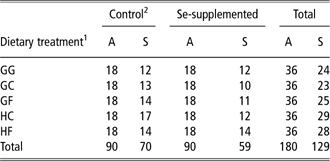
Lambs were allocated to five groups (n = 36), balanced for live weight, farm of origin, maternal selenium treatment and, as far as possible, dam breed and sire breed. Within each group, half of the lambs were allocated to receive by subcutaneous injection 1 ml of a long-acting inorganic selenium supplement containing 175 mg/ml barium selenate and supplying 50 mg/ml selenium (Deposel Multidose, Novartis Animal Health, Litlington, UK), giving a total of 10 treatments. Finally, within each treatment, lambs were randomly allocated for slaughter at 42 or 50 kg live weight so that each treatment was equally represented at each slaughter weight. Details of the number of lambs within each treatment are presented in Table 1.
Number of lambs allocated to the study (A) and included in the statistical analysis (S)
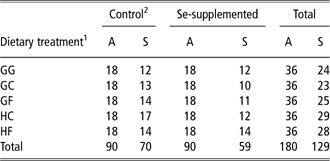
1Lambs fed grazed grass only (GG), GG +0.4 kg/day of a cereal-based concentrate (GC), GG +0.4 kg/day of a fish oil-enriched concentrate (GF), ad libitum cereal-based concentrate indoors (HC) and ad libitum fish oil-enriched concentrate indoors (HF).
2Lambs either left untreated (Se-supplemented) or given 175 mg barium selenate by subcutaneous injection (Se).
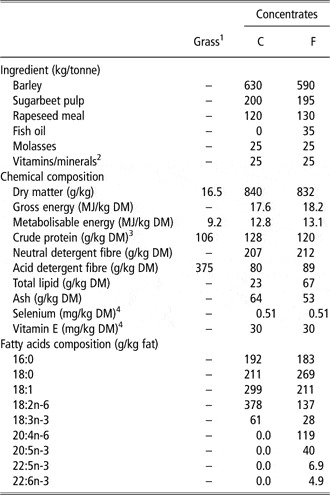
Of the five groups, three were finished outdoors using the following dietary treatments: grazed grass without concentrates (GG), grazed grass +0.4 kg/day of a cereal-based concentrate (GC) and grazed grass +0.4 kg/day of a cereal-based concentrate enriched with fish oil (GF). The two remaining groups were housed in groups and fed the cereal-based concentrate (HC) or fish oil-enriched concentrate (HF) on an ad libitum basis (10% refusal rate). The ingredient and chemical composition of the concentrates are described in Table 2. The fish oil used in the concentrates originated from white fish species (mainly herring and mackerel) caught in the North Atlantic (United Fish Industries Ltd, Killybegs, Co., Donegal, Ireland). A commercial vitamin and mineral supplement (VMC 232, Trouw Nutrition, Belfast, UK) was also added to the concentrate mixtures, providing 0.51 mg Se/kg dry matter (DM) and 30 mg vitamin E per kg concentrate DM.
Ingredient and chemical composition of the grass and concentrates

DM = dry matter; C = cereal-based concentrate; F = cereal-based concentrate enriched with fish oil.
1Determined by near infrared reflectance spectroscopy.
2Supplying sodium (205 g/kg), calcium (121 g/kg), phosphorus (3 g/kg), selenium (17 mg/kg), vitamin A (400 000 IU/kg), vitamin D3 (66 667 IU/kg) and vitamin E (1000 mg/kg).
3Total nitrogen × 6.25.
4Supplied from the vitamin and mineral supplement only.
Lambs finished outdoors were grazed in two adjacent fields of grass silage aftermaths measuring 4.25 ha (Field 1) and 3.43 ha (Field 2). The swards contained a mixture of perennial ryegrass (Lolium perenne) and Italian ryegrass (Lolium multiflorum), which had received an application of 30 m3/ha cattle slurry ∼1 month earlier. Before grazing, each field was divided into three equal-sized paddocks (one per treatment). Grazing commenced in Field 1 (initial sward height: 7.9 cm) on 5 October at a stocking rate of 25.2 lambs/ha. When the mean sward height per paddock fell below 4.0 cm on 4 December, all remaining lambs were moved to Field 2 (initial sward height: 12.6 cm) at a stocking rate of 16.3 lambs/ha (56 lambs, 3.43 ha) and remained here for the duration of the study. Indoor lambs were housed in groups of 5 to 6 lambs per pen, with lambs of similar live weight from the same farm penned together to minimise competition for food supplies. Within each pen, at least 2 lambs from each selenium treatment and slaughter weight group were represented. In addition to the concentrates, housed lambs were also offered 25 g/head per day chopped straw to reduce the risk of ruminal acidosis.
Measurements
Representative samples of fresh grass, harvested at ground level using a pair of hand shears, were obtained fortnightly for prediction of oven DM, crude protein (CP), water-soluble carbohydrate (WSC), acid detergent fibre (ADF) and metabolisable energy (ME) concentrations. Concentrate intake of housed lambs was recorded daily for each pen throughout the study and used to estimate individual feed intake. Representative samples of fresh concentrates were bulked daily and analysed weekly for oven DM, total lipid and fatty acid concentrations. Dried concentrate samples were milled through a 1 mm screen and analysed for gross energy (GE), total nitrogen, neutral detergent fibre (NDF), ADF and ash concentrations. ME supplied by the concentrates was estimated from the absorption of gross energy in four castrated male sheep (66 ± 3.6 kg) fed at maintenance energy level (Steen, Reference Steen1986) using the method described by Annett et al. (Reference Annett, Carson, Dawson and Kilpatrick2011).
Before commencement of the study and at 3 to 4 week intervals thereafter, jugular blood samples were obtained using heparinised vacutainers from 60 lambs (6 per treatment), balanced between treatments for live weight, farm of origin and maternal selenium treatment. Whole blood samples were analysed for GPx activity, then centrifuged and the plasma was analysed for selenium (Se) concentration.
Lambs were weighed fortnightly (to the nearest 0.5 kg) throughout the study and were slaughtered at a local abattoir within 24 h of reaching their allocated slaughter weight (±1 kg). Lambs were stunned, eviscerated and skinned, and the carcasses were graded for conformation, using the EUROP lamb carcass classification system (E = excellent, P = poor conformation) and fat cover (1 = low, 5 = very high-fat cover; Commission Regulation (EC) Nos. 2137/92 and 461/93). Carcasses were then chilled at 4°C for 48 h. Following chilling, cold carcass weight was recorded and expressed relative to the pre-slaughter live weight to determine carcass dressing proportion. Linear measurements of carcass length, depth of chest, shoulder width, buttocks width and buttocks circumference were recorded to the nearest millimetre using the methods described by Fisher and de Boer (Reference Fisher and de Boer1994). Carcasses were then split into three sections by making two cuts in a transverse plane (i) separating the leg from the loin and (ii) between the 12th and 13th ribs, separating the bracelet from the loin (United States Department of Agriculture, 1996). Subcutaneous fat and tissue depth measurements were recorded to the nearest 0.01 mm using a digital vernier caliper (Sealey, Bury St Edmunds, UK). Subcutaneous fat depth was measured at the bracelet–loin separation and perpendicular to the carcass outer surface (i) above the eye muscle (Longissimus dorsi), 50 mm from the mid-dorsal line and (ii) immediately lateral to the Iliocostalis thoracis muscle. Fat depth was also recorded at the loin–leg separation and perpendicular to the carcass outer surface (i) above the Gluteus medius muscle, 35 mm from the mid-dorsal line, and (ii) at the dorsal edge of the Obliquus internus abdominis muscle. Total tissue depth over the 12th and 13th rib, 110 mm from the mid-dorsal line, was also measured. Perinephric and retroperitoneal (PR) fat was also removed and weighed.
Loin chops (L. dorsi) adjacent to the 13th rib were removed from the carcasses of 40 lambs (n = 8 per diet) pre-selected at the start of the trial and balanced for initial live weight, slaughter weight, maternal Se treatment and sire breed. The chops were then chilled for up to 48 h, dissected into lean and adipose tissues, and the total lipid content and fatty acids concentrations of each tissue were determined.
Chemical analysis
DM, CP, WSC, ADF and ME concentrations of fresh grass samples were predicted by near infrared reflectance spectrometry. Samples were scanned at 2 nm wavelength intervals across the spectral range 400 to 2500 nm using a scanning spectrophotometer (FOSS NIRSystems 6500, FOSS UK Ltd, Warrington, Cheshire, UK) and the constituent concentrations were predicted using the methods described by Park et al. (Reference Park, Agnew, Gordon and Steen1998) adapted for fresh grass. GE, total nitrogen and ash concentrations in urine, faeces and concentrate samples were measured using the methods described by Speijers et al. (Reference Speijers, Carson, Dawson and Gordon2009), with total N expressed as CP (6.25 × total nitrogen). Levels of NDF and ADF in concentrate samples were determined using the methods of Van Soest et al. (Reference Van Soest, Robertson and Lewis1991). All NDF analyses were carried out using both alpha amylase and sodium sulphite in the assay (ISO 16472:2006) and values are expressed exclusive of residual ash. Total lipid concentration and fatty acid composition of concentrate samples were measured using the methods described by Annett et al. (Reference Annett, Carson, Dawson and Kilpatrick2011). Total lipid concentration and fatty acid composition of lean and adipose tissues were determined according to the method described by Dawson et al. (Reference Dawson, Fearon, Moss and Woods2010). Whole blood GPx and plasma Se concentration were determined using the methods of Muñoz et al. (Reference Muñoz, Carson, McCoy, Dawson, Irwin, Gordon and Kilpatrick2009).
Statistical analysis
Excessive rainfall forced the study to end prematurely on 18 December 2006 when all lambs remaining on the three outdoor treatments were housed. Consequently, all feed intake and carcass data from the 51 remaining lambs (12, 13, 11, 8 and 7 from treatments GG, GC, GF, HC and HF, respectively) were treated as missing values. Details of the number of animals included in the final analysis are presented in Table 1. Daily live weight gain (LWG) was determined by linear regression of the individual live weight data from the start of the experiment until slaughter or termination of the study, whichever came first. Initial carcass weight was estimated using breed-specific dressing proportion data taken from the pre-experimental slaughter group described by Annett et al. (Reference Annett, Carson, Dawson and Kilpatrick2011), which had been sourced from the same farms and had a similar mean age (172 ± 15.1 days) and live weight (33 ± 6.0 kg) to the lambs used in the current study. Carcass weight gain (CWG) was then estimated by difference. For statistical analysis, conformation grade and fat class were converted to numerical values using a 5-point scoring system for conformation (E = 5, U = 4, R = 3, O = 2, P = 1) and a 6-point scoring system for fat (1 = 1, 2 = 2, 3 = 3, 4L = 4, 4H = 4.5 and 5 = 5).
All data were analysed using Genstat (2009). Means were predicted for lambs slaughtered at 20 kg cold carcass weight and fat score 3 to represent the different criteria used commercially to select lambs for slaughter. Owing to the unbalanced nature of the design, Residual Maximum Likelihood (REML) Analysis was used to analyse linear mixed models for continuous variables. Feed intake, feed efficiency, live weight gain, CWG, cold carcass weight, conformation score, fat score, dressing proportion, carcass linear measurements, fat depth and fatty acids data were analysed using a fixed model for Farm of origin + Dam breed + Sire breed + Maternal Se treatment + Cold carcass weight (or Fat score, depending on the endpoint) + Selenium + Diet + Selenium × Diet, and included Farm of origin × Pen as the random model. Data on days to slaughter were analysed by REML using the same models outlined above but included initial live weight as an additional covariate. Where overall treatment effects were significant (P < 0.05), pairs of means were compared using the least significant difference (LSD). Effects of concentrate feed level and composition were investigated using contrasts.
Multinomial traits (carcass conformation grade and fat classification) were analysed using a generalised linear model, assuming a multinomial distribution with a logit-link function, to estimate the proportion of animals achieving each conformation grade/fat class. The models included fitted fixed effects for Farm of origin + Dam breed + Sire breed + Maternal Se treatment + Cold carcass weight (or Fat score, depending on the endpoint) + Selenium + Diet + Selenium × Diet. Whole blood GPx activity and plasma Se concentration were analysed using REML analysis with repeated measures to take account of correlations between observations on the same animal. Data were adjusted for the Se/GPx level at the start of the trial using the following fixed model: Farm of origin + Dam breed + Sire breed + Maternal Se treatment + Level on day 0 + Time + Diet + Selenium + Time × Diet + Time × Selenium + Diet × Selenium + Time × Diet × Selenium.
Results
Feed composition
Grass swards had a low nutritional value, as shown by the low ME (9.2 MJ/kg DM) and CP (106 g/kg DM) concentrations and high ADF content (375 g/kg DM) of the grass (Table 2). Inclusion of fish oil in the concentrate increased levels of ME (+0.3 MJ/kg DM) and total lipid (+44 g/kg DM) but led to a small reduction in CP concentration (−8 g/kg DM). Fish oil increased dietary levels of 20:4n-6, 20:5n-3, 22:5n-3 and 22:6n-6 but reduced the levels of 18:1, 18:2n-6 and 18:3n-3.
Feed intake and animal performance
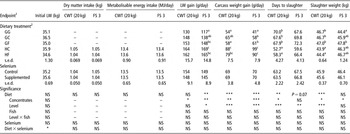
All lambs remained on their respective dietary treatments for at least 39 days before slaughter. Fish oil inclusion and selenium supplementation had no significant effects on DM intake or ME intake of housed lambs but significant feeding system effects on animal performance were observed at both endpoints (Table 3). At a constant carcass weight, lambs supplemented with concentrates achieved higher CWG (+19 g/day, P < 0.01) and were slaughtered on average 8.3 days earlier (P < 0.05) and at 1.2 kg lower (P < 0.05) live weights than GG lambs. Increasing the level of concentrate supplementation had no effect on LWG but increased CWG (+22 g/day, P < 0.001), reduced days to slaughter (−12.3 days, P < 0.001) and decreased slaughter weight (−2.7 kg, P < 0.001). Similar responses were observed when means were adjusted to a fat score 3 endpoint. Fish oil and selenium had no significant effects on lamb performance at either endpoints.
Effects of treatment diet and selenium supplementation (as barium selenate) on lamb performance

LW= live weight; CWT = carcass weight; FS = fat score.
Pairs of means within the same column sharing the same letter in their superscript are not significantly different (P > 0.05).
1Endpoint taken at a 20 kg cold CWT and FS 3.
2Lambs fed grazed grass only (GG), GG +0.4 kg/day of a cereal-based concentrate (GC), GG +0.4 kg/day of a fish oil-enriched concentrate (GF), ad libitum cereal-based concentrate indoors (HC) and ad libitum fish oil-enriched concentrate indoors (HF).
GPx and selenium status
At the start of the trial, whole blood GPx activity ranged from 39 to 1077 U/g Hb with a mean value (±s.d.) of 215 ± 180 U/g Hb. The proportion of lambs with marginal (<280 U/g Hb; Puls, Reference Puls1994) or deficient (<127 U/g Hb) GPx activity were 0.73 and 0.43, respectively. Plasma Se concentration on day 0 ranged from 0.08 to 1.29 μmol/l with a mean (±s.d.) of 0.47 ± 0.27 μmol/l. Overall, the proportion of lambs with a marginal (<0.76 μmol/l; Puls, Reference Puls1994) or deficient (<0.38 μmol/l) plasma Se status was 0.84 and 0.39, respectively.
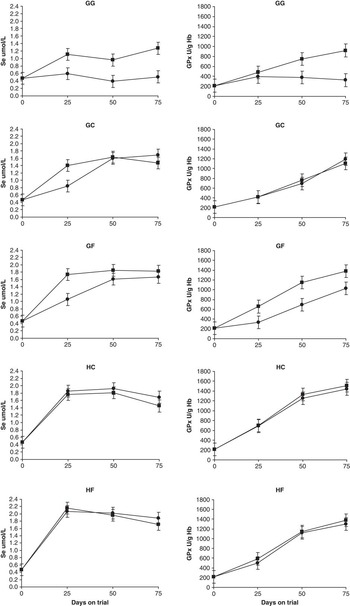
Significant Time × Diet × Selenium interactions were observed for GPx activity (P < 0.05) and Se concentration (P < 0.01), and are illustrated in Figure 1. GPx activity increased (P < 0.001) with time for all dietary treatments except GG, with lambs on treatments HC and HF achieving higher (P < 0.001) GPx levels compared with treatments GC and GF. Supplementation with barium selenate increased (P < 0.01) GPx activity in GG and GF lambs on days 50 and 75 but had no effect on GPx activity in lambs fed diets GC, HC or HF. Consequently, a significant interaction of concentrate feed level × fish oil was observed for GPx activity (P < 0.05). Between days 0 and 25, plasma Se concentration increased (P < 0.001) for all diets except GG. Lambs fed concentrates ad libitum (treatments HC and HF) had higher (P < 0.001) Se levels than those given a fixed level of concentrates (treatments GC and GF). Within diet GG, lambs treated with barium selenate had higher (P < 0.01) plasma Se levels than control lambs throughout the study. However, GC and GF lambs treated with barium selenate had higher (P < 0.01) Se levels than control lambs on day 25 only. Supplementation with barium selenate had no effect on plasma Se in HC or HF lambs. After day 25, plasma Se remained constant for the remainder of the study, except for control lambs on treatments GC and GF diets where plasma Se increased (P < 0.01) between days 25 and 50. Averaged across both control and Se-supplemented groups, lambs consuming fish oil had a higher mean plasma Se concentration than non-fish oil-supplemented lambs (1.80 v. 1.60 μmol/l, P < 0.01).
Effects of dietary treatment and supplementation with barium selenate on mean (±s.e.d.) plasma selenium concentration and whole blood glutathione peroxidase activity of control (●) and supplemented (▪) lambs (see Table 1 for description of dietary treatments).

Lamb carcass characteristics
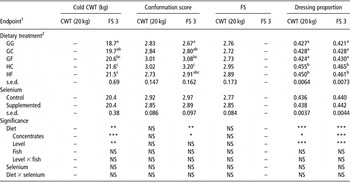
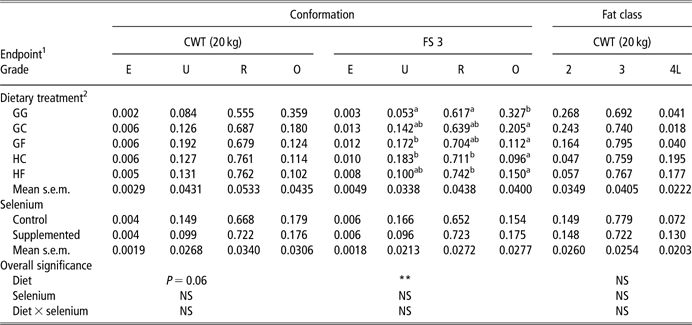
When adjusted to a fat score 3 endpoint, lambs fed concentrates achieved a higher (P < 0.05) carcass conformation score than those fed GG because of their heavier carcass weights (+2.2 kg, P < 0.001; Table 4). In practice, this was associated with a higher (P < 0.01) proportion of O grade carcasses from GG lambs (Table 5). Treatments GF and HC achieved a higher (P < 0.01) proportion of U grades than GG, whereas HC and HF achieved a higher (P < 0.01) proportion of R grades than GG. Dietary effects on conformation score were not significant when the data were adjusted to a constant carcass weight, although there was a tendency (P = 0.06) for GG lambs to achieve a higher proportion of O grades than the other diets. Increasing concentrate feed level from 0.4 kg/day to ad libitum increased (P < 0.01) carcass weight by 1.4 kg when adjusted to a fat score 3 endpoint but had no effect on carcass conformation (Table 4). At both endpoints, HC and HF achieved a higher (P < 0.001) dressing proportion than those finished on grass-based diets. Finishing diet had no effect on carcass fat score or the proportion of carcasses achieving each fat score when adjusted to a constant carcass weight. Supplementation with fish oil or selenium had no effects on lamb carcass characteristics.
Effects of treatment diet and selenium supplementation (as barium selenate) on CWT, conformation score, FS and dressing proportion

CWT = carcass weight; FS = fat score.
Pairs of means within the same column sharing the same letter in their superscript are not significantly different (P > 0.05).
1Endpoint taken at a 20 kg cold CWT and FS 3.
2Lambs fed grazed grass only (GG), GG +0.4 kg/day of a cereal-based concentrate (GC), GG +0.4 kg/day of a fish oil-enriched concentrate (GF), ad libitum cereal-based concentrate indoors (HC) and ad libitum fish oil-enriched concentrate indoors (HF).
Effects of treatment diet and selenium supplementation (as barium selenate) on the proportion of carcasses attaining each conformation grade (EUROP) and fat class
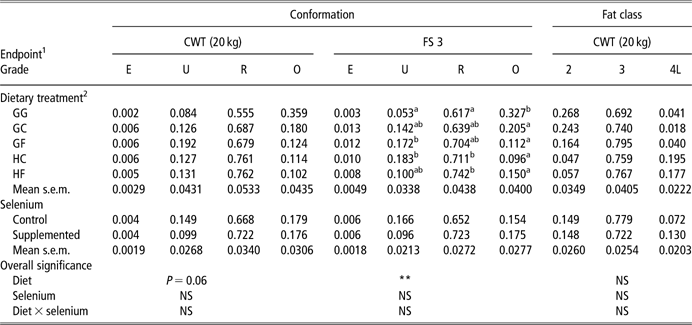
CWT = carcass weight; FS = fat score.
1Endpoint taken at a 20 kg cold CWT and FS 3.
2Lambs fed grazed grass only (GG), GG +0.4 kg/day of a cereal-based concentrate (GC), GG +0.4 kg/day of a fish oil-enriched concentrate (GF), ad libitum cereal-based concentrate indoors (HC) and ad libitum fish oil-enriched concentrate indoors (HF).
Carcass linear traits and fat depth measurements
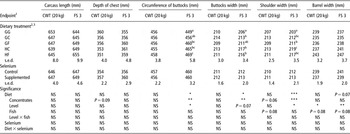
Carcass length and depth of chest were not affected by diet or selenium supplementation (Table 6). When adjusted to a fat score 3 endpoint, carcasses from concentrate-fed lambs had a greater shoulder width (P < 0.001), buttocks width (P < 0.01) and buttocks circumference (P < 0.01) compared with GG. Increasing the level of concentrate supplementation increased shoulder width (P < 0.05), buttocks circumference (P < 0.05) and tended (P = 0.07) to increase buttock width. However, these effects were not significant when the data were adjusted to a constant carcass weight. At both endpoints, increasing concentrate feed level led to an increased barrel width (P < 0.05). There was a tendency (P = 0.08) for fish oil-supplemented lambs to have a narrower shoulder width and greater barrel width compared with non-supplemented lambs when adjusted to a constant carcass weight. Selenium supplementation had no effect on carcass linear traits.
Effects of treatment diet and selenium supplementation (as barium selenate) on carcass linear traits

CWT = carcass weight gain; FS = fat score.
Pairs of means within the same column sharing the same letter in their superscript are not significantly different (P > 0.05).
1Endpoint taken at a 20 kg cold CWT and FS 3.
2Lambs fed grazed grass only (GG), GG +0.4 kg/day of a cereal-based concentrate (GC), GG +0.4 kg/day of a fish oil-enriched concentrate (GF), ad libitum cereal-based concentrate indoors (HC) and ad libitum fish oil-enriched concentrate indoors (HF).
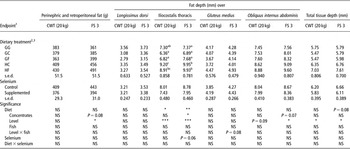
There were no significant effects of diet or selenium supplementation on fat depth over the L. dorsi or G. medius (Table 7). Concentrate feeding per se had no effects on carcass fat or tissue depth when the data were adjusted to a constant weight. However, when adjusted to a constant fat score, those fed concentrates had a greater (P < 0.05) depth of fat over the I. thoracis compared with GG, and tended to have a greater fat depth over the O. internus abdominis (P = 0.07) and higher levels of PR fat (P = 0.08). Increasing the concentrate feed level produced higher (P < 0.05) levels of PR fat, increased fat depth over the I. thoracis (P < 0.001) and O. internus abdominis (P < 0.05), and increased (P < 0.05) total tissue depth. When adjusted to a constant carcass weight, only fat depth over the I. thoracis (P < 0.001) and total tissue depth were higher for treatments HC and HF. Fish oil had no effects on carcass fat and tissue depth but there was a tendency (P = 0.06) for selenium supplementation to reduce fat depth over the I. thoracis.
Effects of treatment diet and selenium supplementation (as barium selenate) on carcass fat and tissue depth

CWT = carcass weight; FS = fat score.
Pairs of means within the same column sharing the same letter in their superscript are not significantly different (P > 0.05).
1Endpoint taken at a 20 kg cold CWT and FS 3.
2Lambs fed grazed grass only (GG), GG +0.4 kg/day of a cereal-based concentrate (GC), GG +0.4 kg/day of a fish oil-enriched concentrate (GF), ad libitum cereal-based concentrate indoors (HC) and ad libitum fish oil-enriched concentrate indoors (HF).
Fatty acid composition
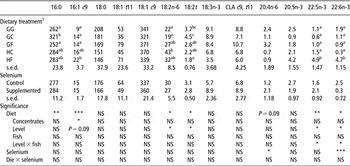
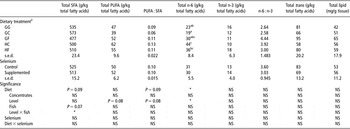
The principle LC fatty acids present in the L. dorsi muscle of lambs are presented in Table 8, adjusted to a constant fat score. There were no significant dietary effects on the levels of 18:0, 18:1t11, 18:3n-3, 20:5n-3 or CLAc9,t11. Lambs fed GC had higher (P < 0.01) levels of 16:0 than GG or GF, and higher levels of 18:2t compared with GF, HC or HF. Treatment HF produced higher levels of 16:1c9 (P < 0.001) and 22:5n-3 (P < 0.01) than GG, GC or GF, whereas HC had higher (P < 0.05) levels of 18:2n-6 than GG or GC. Concentrate supplementation increased (P < 0.05) the level of 16:1c9 in the meat, whereas meat from lambs fed ad libitum concentrates contained more (P < 0.05) 18:2n-6 and less 18:2t compared with grass-fed lambs. Lambs on treatment HF had higher (P < 0.05) levels of 22:5n-3 and 22:6n-3 than all other treatment diets. Overall, HC lambs had a higher (P < 0.05) total n-6 PUFA content compared with GG or GC (Table 9). Fish oil reduced the total saturated fatty acid (SFA) content of meat from lambs fed grass-based diets but not concentrate-based diets. Lambs fed concentrate-based diets had a higher (P < 0.05) total n-6 content and tended (P = 0.08) to have a higher total PUFA content and PUFA : SFA ratio compared with grass-fed lambs. There were no significant dietary effects on total n-3 PUFA content, total trans-FA content, n-6 : n-3 ratio or the fat content of the meat. Se supplementation increased (P < 0.05) the level of 20:4n-6 in lamb meat but resulted in lower (P < 0.001) levels of 22:6n-3 (Table 8). However, Se had no effects on any of the health attributes of lamb meat (Table 9).
Effects of treatment diet and selenium supplementation (as barium selenate) on the primary long-chain fatty acids (g/kg total fatty acids) in the Longissumus dorsi muscle of lambs (FS 3 endpoint)

FS = fat score; CLA = conjugated linoleic acid.
Pairs of means within the same column sharing the same letter in their superscript are not significantly different (P > 0.05).
1Lambs fed grazed grass only (GG), GG +0.4 kg/day of a cereal-based concentrate (GC), GG +0.4 kg/day of a fish oil-enriched concentrate (GF), ad libitum cereal-based concentrate indoors (HC) and ad libitum fish oil-enriched concentrate indoors (HF).
Effects of treatment diet and selenium supplementation (as barium selenate) on nutritional indicesFootnote 1 of the Longissumus dorsi muscle of lambs (FS 3 endpoint)

FS = fat score; SFA = saturated fatty acids; PUFA = polyunsaturated fatty acids.
Pairs of means within the same column sharing the same letter in their superscript are not significantly different (P > 0.05).
1 Nutritional indices include short-chain fatty acids as well as the minor (<2.0 g/kg total fatty acids) long-chain fatty acids not presented in Table 9.
2 Lambs fed grazed grass only (GG), GG +0.4 kg/day of a cereal-based concentrate (GC), GG +0.4 kg/day of a fish oil-enriched concentrate (GF), ad libitum cereal-based concentrate indoors (HC) and ad libitum fish oil-enriched concentrate indoors (HF).
Discussion
Fish oil supplementation
Fish oil has been demonstrated to reduce feed intake by up to 0.30 in both adult ewes (Annett et al., Reference Annett, Carson and Dawson2008) and finishing lambs (Wachira et al., Reference Wachira, Sinclair, Wilkinson, Enser, Wood and Fisher2002; Annett et al., Reference Annett, Carson, Dawson and Kilpatrick2011). This intake depression has been attributed to impaired digestion of dietary fibre (Wachira et al., Reference Wachira, Sinclair, Wilkinson, Hallett, Enser and Wood2000), as well as the bio-hydrogenation of long-chain PUFAs within the rumen (Kitessa et al., Reference Kitessa, Gulati, Ashes, Fleck, Scott and Nichols2001). In an earlier study by Annett et al. (Reference Annett, Carson, Dawson and Kilpatrick2011), inclusion of 50 g/kg fish oil was shown to reduce LWG of finishing lambs by 50 g/day and led to a high proportion (0.65) of lambs with excessive levels of subcutaneous fat in their carcasses. In order to limit these negative effects, the level of fish oil inclusion in the concentrate was reduced to 35 g/kg in the current study. Although this strategy diminished the beneficial effects of fish oil for dietary ME concentration, it was largely successful in eliminating the negative effects on feed intake and animal performance. Although there was some evidence of increased subcutaneous fat depth over the leg area in HF lamb, these effects were small and are unlikely to influence consumer choice when purchasing meat. The absence of a depression in feed intake and animal performance due to fish oil is also likely to be influenced by diet type. The cereal-based concentrates offered in the current study contained less than 100 g ADF/kg DM, and thus the potential for fish oil to impair fibre digestion was low. In contrast, Wachira et al. (Reference Wachira, Sinclair, Wilkinson, Enser, Wood and Fisher2002) reported a 0.30 decline in dry matter intake of lambs fed high-fibre grass-based diets supplying 36 g/kg fish oil.
Sheep meat is regarded as high-fat meat (Sinclair, Reference Sinclair2007) and it is now widely accepted that humans should reduce their fat intake. As a result of using early-maturing hill breed types in this study, fat content of the L. dorsi (range 42 to 65 mg/g tissue) was higher than levels previously reported in lambs (Wachira et al., Reference Wachira, Sinclair, Wilkinson, Enser, Wood and Fisher2002; Cooper et al., Reference Cooper, Sinclair, Wilkinson, Hallett, Enser and Wood2004). Significant breed effects on the fatty acid composition of lamb meat have also been reported (Fisher et al., Reference Fisher, Enser, Richardson, Wood, Nute, Kurt, Sinclair and Wilkinson2000; Demirel et al., Reference Demirel, Wachira, Sinclair, Wilkinson, Wood and Enser2004) and could explain the lower PUFA : SFA ratios (0.06 to 0.13) and higher n-6 : n-3 ratios (2.58 to 4.44) observed here. Despite the low inclusion level and extensive bio-hydrogenation of long-chain PUFA in sheep (>0.87; Sinclair et al., Reference Sinclair, Coooper, Chikunya, Wilkinson, Hallett, Enser and Wood2005), including fish oil in the diets of housed lambs led to a 3.2-fold increase in docosapentaenoic acid content and a 15.6-fold increase in DHA content of lamb meat. However, because of the low prevalence of these fatty acids in the lamb meat, fish oil had no significant effects on total n-3 content, PUFA : SFA ratio or the n-6 : n-3 ratio of the meat, which contrasts with earlier reports by Wachira et al. (Reference Wachira, Sinclair, Wilkinson, Enser, Wood and Fisher2002) and Cooper et al. (Reference Cooper, Sinclair, Wilkinson, Hallett, Enser and Wood2004). Intake of fish oil by GF lambs was proportionately 0.32 of the level for HF lambs because of restricted feeding of concentrates. Although further research is required to investigate these responses at higher inclusion levels, these data would indicate that such a low intake of fish oil (14 g/lamb per day) is insufficient to improve the health attributes of meat from lambs finished off autumn/winter grass swards.
Selenium supplementation
Consistent with the low Se status of their dams (Muñoz et al., Reference Muñoz, Carson, McCoy, Dawson, Irwin, Gordon and Kilpatrick2009), the majority of lambs used in this study had inadequate Se status before commencing the study, with 0.39 to 0.43 considered Se-deficient (Puls, Reference Puls1994) and a further 0.30 to 0.45 considered marginal, depending on whether erythrocyte GPx activity or plasma Se concentration is used as an indicator of Se status. Surveys of forage Se levels in Ireland have reported levels similar to (Rogers and Murphy, Reference Rogers and Murphy2000) or below (McMurray and Rice, Reference McMurray and Rice1982) the recommended level to prevent nutritional myopathy (0.1 mg/kg; National Research Council (NRC), 2007). Herbage Se levels were not measured in the study, whereas plasma Se levels within the GG control group remained close to day 0 levels throughout the study, which would indicate that herbage was also Se deficient. Supplementation of marginal or deficient sheep with Se has been reported to improve reproductive performance of ewes (Muñoz et al., Reference Muñoz, Carson, McCoy, Dawson, Irwin, Gordon and Kilpatrick2009) and pre-weaning LWG of lambs (Blaxter, Reference Blaxter1963). However, there is a paucity of published information on responses to Se supplementation in finishing lambs. In addition to the barium selenate administered experimentally, it should be noted that lambs fed concentrates indoors and at pasture consumed ∼0.53 and 0.21 mg/day Se (as sodium selenite), respectively from the concentrates, which is equivalent to 2.30 and 0.47 of their estimated daily requirements for Se (NRC, 2007).
Plasma Se increased rapidly between day 0 and day 25 in lambs receiving concentrates, especially in treatments HC and HF, which had the highest intake of dietary Se. Thereafter, Se levels reached a plateau between 1.70 and 2.40 μmol/l, well within the ‘adequate’ range for healthy sheep (0.76 to 6.33 μmol/l; Puls, Reference Puls1994). These observations would suggest that Se absorption from the duodenum and uptake into body tissues had reached equilibrium at this level and could explain why additional supplementation with barium selenate did not benefit plasma Se levels of housed lambs. Plasma Se of GC and GF lambs increased more gradually and reached a lower plateau (∼1.67 μmol/l) than those fed ad libitum concentrates, reflecting their lower Se intake. Within these treatments, lambs treated with barium selenate reached their peak plasma Se level at least 25 days earlier than control lambs, although the ultimate level by day 50 was similar for both groups. Supplementation of GG lambs with barium selenate reduced the proportion of lambs with inadequate Se status to 0.17 by day 25 and zero at day 50, although plasma Se levels were consistently lower (∼1.12 μmol/l) than those receiving concentrates.
Erythrocyte GPx activity is a good indicator of long-term Se status of sheep (Rooke et al., Reference Rooke, Robinson and Arthur2004). In contrast to the rapid increase in plasma Se following supplementation, erythrocyte GPx activity increased linearly for the entire duration of the study and in all treatment groups except GG-control lambs. This more gradual increase in GPx activity combined with the short duration of the trial could explain why supplementation with barium selenate had no significant effect on any aspect of lamb performance, despite the increased peroxide challenge in lambs fed high lipid diets. Vitamin E status of the lambs is also important because of its synergism with GPx in preventing oxidative damage (Rooke et al., Reference Rooke, Robinson and Arthur2004). Vitamin E, as α-tocopherol, is widely distributed in the green plants (Brown, Reference Brown1953), and thus pasture-fed lambs normally consume adequate vitamin E (Hemingway, Reference Hemingway2003), although herbage levels decline with advancing maturity (Brown, Reference Brown1953). In the current study, intake of vitamin E from the concentrates was significantly above the daily requirement of 300 mg predicted by NRC (2007) for growing lambs, which may have limited the opportunity to improve their antioxidant status with Se supplementation. It is likely that providing additional Se would increase the oxidative stability and improve shelf life of lamb meat, as demonstrated for vitamin E by Kasapidou et al. (Reference Kasapidou, Enser, Wood, Richardson, Wilkinson and Sinclair2009), although this requires further investigation.
Feeding system effects
Several studies have examined the effects of concentrate supplementation at pasture on the performance of suckling lambs (Prache et al., Reference Prache, Bechet and Thieriez1990; Grennan and O'Riordan, Reference Grennan and O'Riordan1996) but there is a paucity of information on supplementation strategies for lambs finished off grass. Herbage availability has been highlighted as a key factor affecting the growth responses in pre-weaned lambs. For example, Prache et al. (Reference Prache, Bechet and Thieriez1990) reported a 61 g/day increase in LWG of supplemented lambs maintained on a daily herbage allowance of 38.5 g organic matter/kg live weight (LW). However, there were no benefits for LWG when the herbage allowance was increased to 57.0 g organic matter per kg LW. In the current study, initial herbage availability was relatively high (2800 kg DM/ha) but of low nutritional value. Concentrate supplementation increased CWG of grass-fed lambs by 19 g/day and carcass weight by 1.5 kg, but had no effect on LWG. This would indicate that feeding concentrates at pasture has a greater effect on the composition rather than the rate of gain.
Feed intake and growth rate of lambs offered ad libitum concentrate diets were below levels expected for lambs of similar genotype and live weight (Speijers et al., Reference Speijers, Carson, Dawson and Gordon2009; Annett et al., Reference Annett, Carson, Dawson and Kilpatrick2011). Lambs fed ad libitum concentrates produced a 20 kg carcass 6.7 days earlier and at 2.7 kg lower live weight compared with those fed grass plus concentrates because of their higher CWG (+22 g/day) and dressing proportion (+0.027). The higher dressing proportion of lambs fed concentrate-based compared with grass-based diets is consistent with their lower intake characteristics and reduced gut fill as demonstrated by Annett et al. (Reference Annett, Carson, Dawson and Kilpatrick2011).
Dietary effects on carcass conformation and fat score were similar to those reported in previous studies for lambs of a similar genotype. In agreement with Speijers et al. (Reference Speijers, Carson, Dawson and Gordon2009) and Annett et al. (Reference Annett, Carson, Dawson and Kilpatrick2011), the superior carcass conformation of concentrate-supplemented lambs was mainly because of their heavier carcass weights. However, in practice, concentrate-supplemented lambs are likely to attract a significant price premium over non-supplemented lambs because of their heavier carcass weights and higher proportion of U grades. Finishing lambs on a high plane of nutrition has been reported to increase carcass fat content, especially in early-maturing hill breed types of low lean growth potential (Carson et al., Reference Carson, Moss, Dawson and Kilpatrick2001). In agreement with Dawson et al. (Reference Dawson, McCoy, Edgar and Carson2011), there was no effect of concentrate supplementation on fat score in grass-fed lambs, although there was evidence of a dietary effect on fat partitioning with lambs fed concentrate-based diets having a greater weight of abdominal fat and a greater depth of subcutaneous fat on the lateral surfaces of the loin and leg compared with those fed grass-based diets. However, it should be noted that fat levels were acceptable across all treatments and that the higher level of fat in concentrate-fed lambs is unlikely to influence consumer choice when purchasing lamb. Visual assessment of carcass fat is likely to be influenced mainly by the level of fat cover over the dorsal surfaces of the leg and loin, which could explain the absence of a dietary effect on fat score.
Nutritional strategies to enrich the n-3 PUFA content of lamb meat by inclusion of fish oil or linseed in the diet has received much attention in recent years (Sinclair, Reference Sinclair2007). However, in the current study, feeding system had a greater effect than fish oil on the fatty acid composition of the L. dorsi. In agreement with Fisher et al. (Reference Fisher, Enser, Richardson, Wood, Nute, Kurt, Sinclair and Wilkinson2000), increasing concentrate inputs resulted in higher levels of n-6 PUFAs, primarily because of their higher intake of linoleic acid (18:2n-6). As a result, meat from GG and GC lambs tended to have a lower and more favourable n-6 : n-3 ratio than those from HC lambs, although fatty acid composition varied widely within treatments and these differences were not significant.
Acknowledgements
The authors thank the Department of Agriculture and Rural Development, Northern Ireland, for funding this project; the staff of the Sheep Unit at Agri-food and Biosciences Institute, Hillsborough, for their hard work; the management and staff at Dunbia (Dungannon) Ltd for use of their facilities; and Mr M. Porter and the laboratory staff for undertaking the feed analysis.