Introduction
Agitation among nursing home (NH) residents with dementia is a major concern in long-term care facilities, and is defined as “inappropriate verbal, vocal or motor activity that is not judged by an outside observer to result directly from the needs or confusion of the individual” (Cohen-Mansfield and Billig, Reference Cohen-Mansfield and Billig1986). The term agitation refers to verbal and physical behaviors, with either non-aggressive manifestations, such as constant request for attention and pacing, or aggressive ones, such as cursing or hitting.
Various models have been used to explore the determinants of agitation, each proposing a different treatment approach (Cohen-Mansfield, Reference Cohen-Mansfield2000). The treatment of agitation can be divided into two groups: non-pharmacological (Cohen-Mansfield, Reference Cohen-Mansfield2004; Livingston et al., Reference Livingston, Johnston, Katona, Paton and Lyketsos2005; Verkaik et al., Reference Verkaik, van Weert and Francke2005) and pharmacological (Sink et al., Reference Sink, Holden and Yaffe2005; Schneider et al., Reference Schneider, Dagerman and Insel2006; Daiello, Reference Daiello2007; Ballard et al., Reference Ballard, Waite and Birks2008). Although both modalities seem to be in common practice within the NH setting, non-pharmacological interventions tend to be implemented by non-medical staff, while pharmacological treatments are prescribed by physicians.
Non-pharmacological therapy is individualized, person-centered, and employs a systematic perspective (Douglas, Reference Douglas2004). It considers prevention, accommodation, and flexibility in care activities as essential elements of the intervention, and requires trained staff members and caregivers offering sensitivity and insight, as well as appropriate facilities (accommodating, individualized, and with appropriate resources), though those are often not available. Forms of non-pharmacological intervention are diverse and include behavioral therapy, environmental interventions, and activity therapy (Cohen-Mansfield, Reference Cohen-Mansfield2004; Douglas, Reference Douglas2004).
The evidence for efficacy of non-pharmacological therapy varies by type of intervention (Spira and Edelstein, Reference Spira and Edelstein2006; Ballard et al., Reference Ballard2009; Vernooij-Dassen et al., Reference Vernooij-Dassen, Vasse, Zuidema, Cohen-Mansfield and Moyle2010). Individualized non-pharmacological interventions for agitation, based on an algorithm designed to address unmet needs, significantly decreased agitation and increased pleasure and interest among older NH patients with dementia (Cohen-Mansfield et al., Reference Cohen-Mansfield, Libin and Marx2007). Similarly, in a study of agitation in persons with dementia in residential care, those who received person-centered care and dementia-care mapping showed significantly reduced agitation at four months follow-up compared to those in usual care (Chenoweth et al., Reference Chenoweth2009).
The impact of atypical antipsychotics, the most commonly used pharmacological intervention, is modest (Sink et al., Reference Sink, Holden and Yaffe2005; Schneider et al., Reference Schneider, Dagerman and Insel2006) and side effects pose a serious problem (Jin et al., Reference Jin, Meyer and Jeste2004; Lee et al., Reference Lee, Gill, Freedman, Bronskill, Hillmer and Rochon2004; Ames, Reference Ames2005; Sink et al., Reference Sink, Holden and Yaffe2005; Schneider et al., Reference Schneider, Dagerman and Insel2006; Ballard et al., Reference Ballard, Waite and Birks2008). Risks of other antipsychotics, such as haloperidol, may be even worse, including increased mortality rates (Huybrechts et al., Reference Huybrechts2012; Kales et al., Reference Kales2012). Consensus statements and guidelines recommend that treatment of agitation should be attempted with non-pharmacological methods first, and only if these fail, to resort to pharmacological therapy (American Geriatrics and American Association for Geriatric, 2003). They emphasize that real efforts should be made to limit the use of antipsychotics in all settings (APA Work Group on Alzheimer's Disease and other Dementias et al., 2007; Salzman et al., Reference Salzman2008).
Rates of use of pharmacological interventions in NHs and long-term care facilities vary (Schmidt and Fastbom, Reference Schmidt and Fastbom2000; Giron et al., Reference Giron, Forsell, Bernsten, Thorslund, Winblad and Fastbom2001; Selbæk et al., Reference Selbæk, Kirkevold and Engedal2008; Taipale et al., Reference Taipale, Bell, Soini and Pitkala2009; Chen et al., Reference Chen, Briesacher, Field, Tjia, Lau and Gurwitz2010; Azermai et al., Reference Azermai, Elseviers, Petrovic, Van Bortel and Stichele2011) with rates of prescribed psychotropic drugs for older NH residents reaching as high as 80% (Olsson et al., Reference Olsson2010). In contrast, evidence on the actual use of non-pharmacological interventions is scant. Physicians working in NHs voiced many reservations with regards to non-pharmacological interventions, citing as barriers for their implementation both insufficient resources as well as staff requests for prescribing medication (Cohen-Mansfield and Jensen, Reference Cohen-Mansfield and Jensen2008b). In a USA survey (Colenda et al., Reference Colenda, Rapp, Leist and Poses1996b) comparing physicians’ treatment recommendations for agitation in dementia patients, medication use was endorsed over twice as often as non-pharmacological interventions. In more recent surveys, the majority of physicians reported using both pharmacological and non-pharmacological methods (Cohen-Mansfield and Jensen, Reference Cohen-Mansfield and Jensen2008a; Cornegé-Blokland et al., Reference Cornegé-Blokland, Kleijer, Hertogh and van Marum2012), and only slightly higher rates of use for the former in comparison to the latter as a single modality (Cohen-Mansfield and Jensen, Reference Cohen-Mansfield and Jensen2008a). Recommendations for treatment were found to be affected by physicians’ personal characteristics, including age, gender, and specialty (Colenda et al., Reference Colenda, Leist and Rapp1996a), as well as by factors such as being pressured and lacking other options (Cornegé-Blokland et al., Reference Cornegé-Blokland, Kleijer, Hertogh and van Marum2012).
In Israel, the responsibility for funding and provision of care services for older persons is divided between various governmental departments (e.g. Ministry of Health, National Insurance Institute), local authorities, and public and private organizations (Mashav, Reference Brodsky, Shnoor and Be'er2010). According to a national statistical report, at the end of 2009, there were 741,500 persons over the age of 65 in Israel, of which 3.3% resided in long-term care facilities. At the end of 2009, there were 392 long-term care facilities in Israel: 167 retirement homes, 110 hospitals for persons with a chronic illness, and 115 nursing departments. Of the 392 long-term care facilities, circa 57% are of private organizations, 40% voluntary not for profit, and 3% are governmental (Mashav, Reference Brodsky, Shnoor and Be'er2010). With regards to institutional long-term care, the Israeli system requires the person's family, including spouse and children to pay for care, with governmental subsidies provided on a progressive scale taking into account the resources and income of children and children in law. This system results in a relatively low utilization of institutional care (Clarfield et al., Reference Clarfield, Paltiel, Gindin, Morginstin and Dwolatzky2000; Clarfield et al., Reference Clarfield, Brodsky, Leibovitz, Pathy, Sinclair and Morley2006). More information on the structure of long-term care in Israel can be found elsewhere (Clarfield et al., Reference Clarfield, Brodsky, Leibovitz, Pathy, Sinclair and Morley2006; Clarfield et al., Reference Clarfield, Ginsberg, Rasooly, Levi, Gindin and Dwolatzky2009).
This study assesses treatment practices of NH physicians in Israel. It aims to clarify physicians’ actual practice in treating agitation, and to elucidate the relationship between practice, physicians’ background factors, and familiarity with interventions. We hypothesize that (1) most physicians will report treating agitation with psychotropic medication, that (2) physicians’ treatment modalities will differ by personal characteristics (Colenda et al., Reference Colenda, Leist and Rapp1996a), and that (3) physicians’ levels of familiarity with non-pharmacological interventions will differ by personal characteristics. Specifically, given the guidelines for treatment, we hypothesized that physicians with a specialty in geriatrics would manifest higher familiarity with non-pharmacological interventions compared to those with no such specialty.
Methods
The current study involved a survey of physicians working in NHs in Israel, and was performed with the cooperation of the Israeli Ministry of Health (MOH).
Participants and recruitment
To recruit participants, a list of NHs in Israel with the number of residents per NH was retrieved from the Israeli MOH. Letters were sent to all NHs with over 30 residents in the three regions in Israel: Jerusalem, Tel Aviv, and Haifa. The letters requested lists of physicians and their contact information and were signed by the respective MOH geriatric regional directors. One hundred physicians from 44 NHs (out of 96 NHs contacted; 46%) were approached; of whom, 67 physicians (67%) were interviewed, 10 (10%) refused to be interviewed, and 23 (23%) asked to be re-contacted in the future for scheduling. However, due to limited resources, the latter 23 were not contacted again. Of the responding 67 physicians, 19 were from the Jerusalem region, 34 from the Haifa region, and 14 from the Tel-Aviv region.
Procedure
Questionnaires were administered by personal interview, self-completion, or a combination of the two, as preferred by the participant. Comments of participants were transcribed verbatim in order to gain further insight. The study was approved by the Helsinki (Ethics) committee in Tel Aviv University. Informed consent was obtained via an item at the beginning of the questionnaire.
Assessment
A questionnaire tapping physicians’ actual practice and knowledge of potential interventions for agitation in patients with dementia was administered. The questionnaire had been developed in the USA through exploratory interviews with physicians in NHs, and was previously utilized in the USA via a web-based survey (Cohen-Mansfield and Jensen, Reference Cohen-Mansfield and Jensen2008a). For the purpose of this study, the questionnaire was translated into Hebrew, reevaluated for mistakes, and then administered by personal interview to two physicians who were not involved in the study, in order to receive feedback and assure face validity of the Hebrew version of the questionnaire. The questionnaire included a sociodemographics section inquiring about age, gender, place of birth (English-speaking countries, Romania and former USSR, and Israel), and position in the NH.
Treatment methods
Treatment methods were elicited by asking participants about the last case of a person with agitation whom they treated, and whether the intervention involved psychotropic drugs. If so, a specification of drugs used was requested (risperidone, quetiapine, olanzapine, lorazepam, haloperidol, thioridazine, gabapentin, other). We also asked about the use of other medications for treatment of the agitation (pain medication, antibiotic, laxative, other). Physicians were also asked whether non-pharmacological intervention was provided and, if so, a specification was requested from a list of specific options of types of interventions (differential reinforcement, environmental change, additional activities, change in ADL procedure, other).
Familiarity with non-pharmacological interventions
Participants were asked to rate their familiarity with each intervention on a list of 30 non-pharmacological treatments. Familiarity was measured on a six-point scale (1 – not at all familiar; 2 – somewhat familiar; 3 – familiar, but have not used intervention; 4 – familiar, discussed it with staff members but have not practiced intervention; 5 – familiar and have used this intervention; 6 – familiar and able to train others to use this intervention). Familiarity rated 5 or 6 was considered “positive.” A “familiarity index” was computed for each physician, as the sum of all non-pharmacological treatments on the list marked “positive.” For some analyses, this score was dichotomized to low familiarity and high familiarity. Familiarity was considered low if the score was 15 or less (i.e. positive familiarity with half the items or less) and high if the score was greater than 15 (i.e. positive familiarity with more than half the items). In an examination of the internal consistency of knowledge across the constituting items, a Cronbach's α of 0.944 was found, indicated a high internal consistency.
Type of agitation
Type of agitation encountered with the last patient was marked on a list of associated behaviors (vocal or verbal behaviors that disturbed others, physical aggression toward staff, physical aggression toward residents, delusions, hallucinations, resisting care, pacing, restlessness, resident getting into other people's rooms, spitting, other – specify).
Barriers for use of non-pharmacological interventions
Barriers for use of non-pharmacological interventions were measured by asking participants to rate their agreement with four statements on a 7-point scale ranging from strongly disagree to strongly agree. The statements referred to insufficient resources, lack of government funding, lack of knowledge, and dependence on inappropriate professional staff.
Statistical analysis
Data were entered into Excel and SPSS via a web-based survey program which facilitated data entry. Data were entered twice and entries were compared for inconsistencies. A major portion of the analysis was descriptive. Additionally, indices were computed to estimate levels of familiarity with non-pharmacological interventions. Relationships between physician characteristics (e.g. gender, country of origin), treatment approaches, and familiarity with interventions were examined using t-tests and ANOVAs. Chi-square (χ 2) statistics were applied to determine the association between nominal level variables.
Results
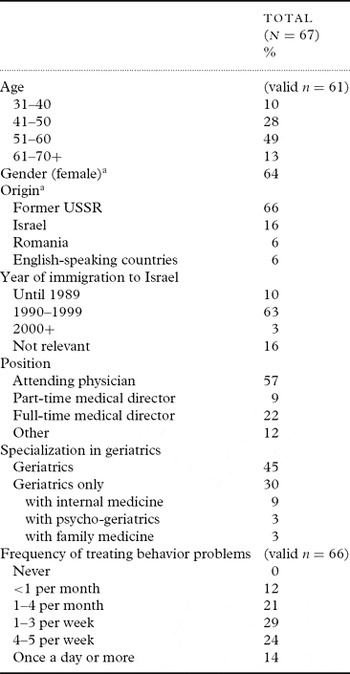
Participants’ characteristics are presented in Table 1. The 67 physicians interviewed were between 31 and over 70 years of age, and half of them were between 51 and 60 years old. As can be seen, 64% of the participants were female and 66% came from the former Soviet Union. Forty-five percent of the respondents had a specialty in geriatrics. Over half of the participants were attending physicians, while the remaining 43% consisted of part-time or full-time medical directors or geriatric consultants or a combination of these positions.
Sample characteristics

a Six percent missing.
Physicians’ actual practice in treating agitation
Treatment methods
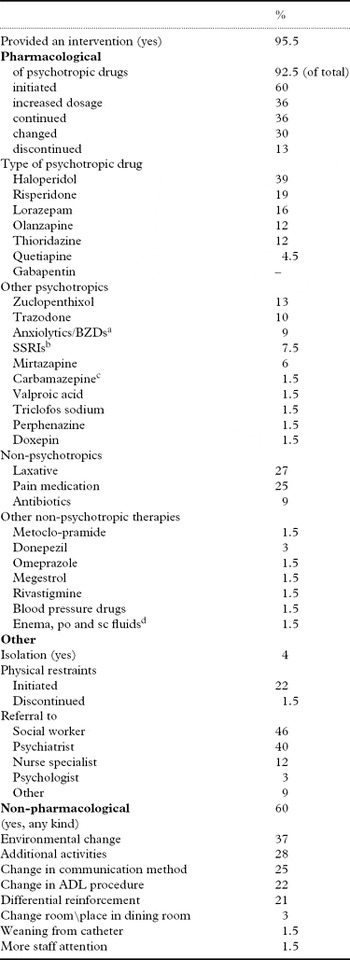
Self-reported intervention methods for agitation are presented in Table 2. Use of psychotropic medication (antipsychotic medications, sedatives, or hypnotics) as treatment for agitation was reported by 92.5% of physicians, while 60% of physicians reported using non-pharmacological treatment and 57% reported using both strategies. Two physicians (3%) used non-pharmacological treatment only and three physicians (4.5%) chose not to intervene at all.
Interventions

a benzodiazepines.
b selective serotonin reuptake inhibitors – antidepressants.
c tegretol was given to relieve diabetic neuropathy.
d po – postoperative; sc – subcutaneous.
Pharmacological interventions
Administration of neuroleptics was reported as the most common form of pharmacological treatment. Haloperidol was administered in 39% of cases. Atypical neuroleptics (risperidone, olanzapine, and quetiapine) were used in 35.5% of participants. Administration of laxatives was reported for 27% of the participants and pain medication for 25% of the participants.
Non-pharmacological interventions
Environmental change was reported as the most commonly employed non-pharmacological intervention (37%), followed by additional activities (28%), change in communication method used by staff member (25%), change in ADL procedure (22%), and differential reinforcement (21%). Other interventions were seldom applied. Those that were specified included change room/place in dining room (3%), weaning from catheter (1.5%), and more attention from staff (1.5%). Initiating physical restraints was reported by 22% of participants, whereas discontinuation of such use was stated by 1.5%.
Barriers to use of non-pharmacological interventions
Insufficient resources were considered the most important barrier to use of non-pharmacological interventions (mean (M) = 5.32, SD = 1.67 on a scale ranging from 1 (strongly disagree) to 7 (strongly agree)), followed by lack of government funding (M = 4.85, SD = 1.74). On average, physicians were undecided whether lack of knowledge about non-pharmacological interventions on their part (M = 4.00, SD = 1.94) or dependency on inappropriate professional staff (M = 3.57, SD = 1.71) constituted barriers for implementation of non-pharmacological interventions.
Treatment modality and physicians’ personal characteristics
Non-Israeli physicians used non-pharmacological interventions more frequently as compared with Israeli physicians (65.4% vs. 45.5%, respectively), however, the difference was not statistically significant (χ 2(1) = 1.529; p = 0.216, two-tailed).
Physicians’ familiarity with non-pharmacological interventions
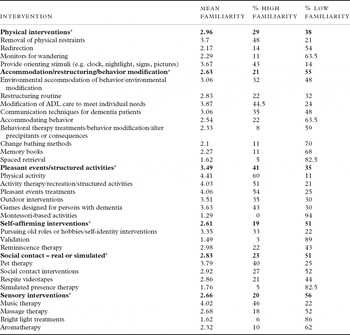
Familiarity levels by type of therapy are presented in Table 3. The most familiar non-pharmacological interventions were physical activity, pleasant events treatments, activity therapy/recreation/structured activities, and music therapy, in that order.
Familiarity with non-pharmacological therapies (n = 63)

Note. Familiarity was rated on a 1 (not at all familiar) to 6 (familiar and able to train others to use this intervention) scale.
aFamiliarity rated 5 or 6; bfamiliarity rated 1 or 2.
* Data are averages of the item means in each category.
Most participants (86%) demonstrated a low score on the familiarity index for non-pharmacological interventions (number of interventions with which the participant was familiar). As hypothesized, physicians with a specialty in geriatrics demonstrated a significantly higher familiarity score compared to those with no such specialty (M (SD) = 9.27 (7.04) vs. 6.45 (5.59), respectively; t (61) = 1.763; p = 0.042, one-tailed). Younger physicians tended to be more familiar than their older counterparts, though the difference was not statistically significant (9.14 (7.79) vs. 6.66 (4.94), respectively; t (30) = 1.344; p = 0.19, two-tailed); there was also a tendency for non-Israeli physicians to show higher familiarity with non-pharmacological treatments, compared to Israeli physicians (8.53 (6.67) vs. 5.09 (4.13), respectively) though again this difference was not statistically significant (t (30) = 1.638, p = 0.10, two-tailed).
Discussion
The current study assessed treatment practices in NH physicians in Israel. We found that the vast majority of physicians interviewed reported prescribing psychotropic medications for treating agitation, most notably, Haloperidol. Non-pharmacological treatment was also reported as common, though to a lesser extent, with environmental change being the most prevalent intervention. The bulk of physicians showed low familiarity levels of non-pharmacological interventions, with relatively higher levels noted for physicians with a specialty in geriatrics compared to non-specialized physicians; and potentially higher familiarity levels for non-Israeli and younger physicians compared to their respective counterparts (i.e. Israeli and older physicians).
The extremely high rates of psychotropic drug treatment for agitation in dementia reported by physicians in this study (92.5%) should raise concerns about the treatment of this frail population given the multiple adverse effects of these drugs. It is noteworthy that close to 40% prescribed haloperidol. These rates go beyond the high rates established in previous reports in the USA (Cohen-Mansfield and Jensen, Reference Cohen-Mansfield and Jensen2008a; Taipale et al., Reference Taipale, Bell, Soini and Pitkala2009; Olsson et al., Reference Olsson2010) and are particularly alarming considering the increased mortality and morbidity associated with the use of haloperidol, including in NH populations (Sink et al., Reference Sink, Holden and Yaffe2005; Huybrechts et al., Reference Huybrechts2012). The difference from a USA survey (Cohen-Mansfield and Jensen, Reference Cohen-Mansfield and Jensen2008a), which found 80% utilization of psychotropic drugs, may indicate differences in actual practice between the countries. Alternatively, these differences may be due to differing study methodology, which might have created a selection bias. Specifically, in the current Israeli study all physicians were personally approached whereas in the USA survey (Cohen-Mansfield and Jensen, Reference Cohen-Mansfield and Jensen2008a) physicians were notified of the survey by an email asking them to respond to a web-based survey. The latter method may be biased in that it requires computer access and familiarity, and a lesser degree of commitment/accuracy/attention. The Israeli sample may be more representative of the population of physicians treating NH residents because it approached all physicians in the facilities (rather than those belonging to a professional organization) and because it involved direct phone contact rather than a contact through email.
While reported use of pharmacological interventions was higher than that of the USA sample, use of non-pharmacological treatment was lower, reported by over half of the participants (60% in comparison with 75% in the USA sample) (Cohen-Mansfield and Jensen, Reference Cohen-Mansfield and Jensen2008a; note: given the differences in study procedures, these comparisons are examined as potential trends and were not checked for statistical significance). Environmental change was the most prevalent intervention followed by additional activities, change in communication method, and change in ADL procedure. In line with previous findings, in the USA survey, the same non-pharmacological interventions were most commonly applied (Cohen-Mansfield and Jensen, Reference Cohen-Mansfield and Jensen2008a). While rates of use for additional activities, communication change, and change in ADL procedure were somewhat higher in the USA sample (32%, 31%, and 34% vs. 28%, 25%, and 22% in the current study, respectively), environmental change was more often endorsed in the current study (37% vs. 31% in the USA; Cohen-Mansfield and Jensen, Reference Cohen-Mansfield and Jensen2008a). Regarding findings related to undesirable interventions, reported rates for isolation were lower in this study than in a USA study (Cohen-Mansfield and Jensen, Reference Cohen-Mansfield and Jensen2008a; 4% vs. 7%, respectively), however, findings relating to use of physical restraints raise concern. While in a USA study 86% of physicians reported having sufficient knowledge to have used removal of physical restraints (Cohen-Mansfield and Jensen, Reference Cohen-Mansfield and Jensen2008b), in the current study in Israel only 48% reported similar levels of knowledge, and moreover, only 1.5% of physicians reported actually removing physical restraints with the last resident they treated, compared to 4% in the USA study. Furthermore, 22% of physicians in this study reported initiating physical restraints, as compared to 4% in the USA study (Cohen-Mansfield and Jensen, Reference Cohen-Mansfield and Jensen2008a), thus, providing an alarming picture of care in Israel. Even when taking possible bias into account as described above, this picture is troublesome and underscores the need to improve the quality of care.
Most physicians reported low familiarity levels for non-pharmacological interventions. The most familiar of intervention was physical activity, with 60% of physicians reporting high familiarity, corroborating similar rates (73%) from a USA study (Cohen-Mansfield and Jensen, Reference Cohen-Mansfield and Jensen2008b). However, for 22 of the 30 non-pharmacological interventions listed in the questionnaire (i.e. all of the physical interventions, all the self-affirming interventions, and all but one of the accommodation/restructuring/behavior modifications interventions), the Israeli physicians demonstrated lower familiarity levels as compared to USA physicians, with differences as high as 70% for specific interventions. The results may reflect cultural differences among physicians in this study, with Israeli physicians tending to use less non-pharmacological interventions and to be less familiar with them while English-language trained physicians had the highest utilization and familiarity rates; however, these differences did not reach statistical significance.
Thus, current findings underscore the need for enhancing knowledge of non-pharmacological interventions for physicians in Israel employed in NHs. Cultural differences among physicians according to country of origin, with Israeli physicians tending to be less familiar with non-pharmacological interventions and to use them less frequently than non-Israeli physicians, suggest the need for a larger study, powered to examine whether this is indeed the case. In the case that such a difference materializes, it would require an examination of the study curriculum that Israeli-trained physicians receive regarding care of persons with dementia, as well as of the guidelines for treatment.
Finally, physicians cited insufficient resources as the most important barrier for use of non-pharmacological interventions. This is similar to findings in the USA, where inadequate resources (e.g. for staff and staff-training, reimbursement, activities, and management issues) and staff requests for medication (Cohen-Mansfield et al., Reference Cohen-Mansfield2005; Cohen-Mansfield and Jensen, Reference Cohen-Mansfield and Jensen2008b) were noted as barriers for non-pharmacological treatment of agitation. The consistency of these findings highlights the need to address barriers for effective implementation of non-pharmacological treatment.
The representativeness of the results may be limited due to NH response rate. The sample was small-sized and imbalanced in terms of origin which may affect the comparisons between Israeli and non-Israeli physicians. Additionally, we were not able to compare those who did not participate to the participants, so there may be an undetected selection bias, which could influence the results. Notwithstanding these limitations, current findings indicate that psychotropic medications are the treatment of choice among NH physicians in Israel, despite consensus statements rendering them second to non-pharmacological interventions (American Geriatrics and American Association for Geriatric, 2003). While rates of reported use of non-pharmacological interventions are substantial, their in-practice application may be hindered by both lack of familiarity and system barriers.
Conflict of interest
None.
Description of authors’ roles
Jiska Cohen-Mansfield, PhD, ABPP, conceptualized and designed the study, oversaw data collection, analyzed and interpreted data, and assisted with writing and editing the paper. Atarah Juravel-Jaffe, MD, did much of the data collection, analyzed and interpreted data, and assisted with writing and editing the paper. Aaron Cohen, MD, facilitated access to the NHs, and reviewed drafts of the paper. Iris Rasooly, MD, MPH, participated in the planning of the study, facilitated access to the NHs, reviewed and edited drafts of the paper. Hava Golander, PhD, RN, assisted with the write up of the paper and facilitated access to data and literature. All authors have contributed in a meaningful manner.
Acknowledgments
The authors would like to acknowledge Ms. Jenny Mandelson for her assistance with data collection in this study.