Introduction
Knowledge of spatial distribution is fundamental to ecological studies (Krebs Reference Krebs1972) and crucial for conservation and management of species and biodiversity (Pearce & Boyce Reference Pearce and Boyce2006). Common applications of spatial data in ecology and conservation include understanding species’ realized niches and related ecological drivers and requirements, identifying important sites for protection, predicting sites at risk from alien or invasive species, predicting unknown populations, and predicting future distributional change in response to a changing environment (Manel et al. Reference Manel, Williams and Ormerod2001, Peterson Reference Peterson2006). Despite the need for such information, detailed spatial data are lacking for most taxa, particularly at large scales (Tsoar et al. Reference Tsoar, Allouche, Steinitz, Rotem and Kadmon2007).
The Adélie penguin (Pygoscelis adeliae (Hombron & Jacquinot)) is an abundant, colonial-breeding seabird with a circumpolar distribution, breeding on ice-free continental land and offshore islands around the Antarctic continent (Ainley Reference Ainley2002). Although the Adélie penguin is one of the most intensively studied Antarctic vertebrates, spatial data that could aid in ecological study and conservation management are incomplete. While data on Adélie penguin breeding distribution are thought to be reasonably complete for the Antarctic Peninsula in West Antarctica where most Antarctic research has been focussed, research effort along the extensive coastline of East Antarctica has been more dispersed and knowledge of breeding distribution is uncertain along large sections of this coastline (Barbraud et al. Reference Barbraud, Delord, Micol and Jouventin1999, Southwell et al. Reference Southwell, Smith and Bender2009). Foraging and at-sea distribution data are also limited because logistical difficulties and equipment expense have restricted tracking studies, particularly during winter.
To improve the basis for ecological understanding and species’ conservation management in East Antarctica, we are investigating large-scale breeding and foraging distribution for a range of Antarctic seabirds, including the Adélie penguin. In this paper we report on large-scale surveys to map the current breeding distribution of Adélie penguins along the East Antarctic coastline. Results for two small sections of this coast have been reported in Low et al. (Reference Low, Meyer and Southwell2007) and Wilson et al. (Reference Wilson, Pike, Southwell and Southwell2009). This paper extends beyond these sections to cover survey efforts along 3800 km of coastline. We also review historical observations of Adélie penguin breeding distribution and assess whether any changes in distribution have occurred in recent decades in those regions where historical observations are accurately described and overlap with our observations.
Methods
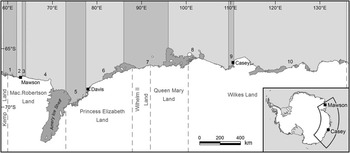
We surveyed approximately one fifth of the Antarctic coastline between 59.4 and 136.0°E (Fig. 1). The search effort extended along 3800 km of coastline and included islands up to 100 km north from the continental coast. We divided the survey region into 10 sub-regions to match the scale of earlier surveys and to facilitate comparison and discussion of results. To guide search effort over this large area, and to compare our observations to distribution data from previous surveys, we used the database and maps of potential Adélie penguin breeding sites developed by Southwell et al. (Reference Southwell, Smith and Bender2009) for a gap analysis of previous search effort. The scale of the maps allowed an observer on the ground or in an aircraft to identify individual islands by referring to their shape, size, configuration and location. Potential breeding sites were defined as discrete ice-free islands and continental rock features with area > 1000 m2 and within 1 km of the ocean. This simple definition, which is based on two physical criteria, does not aggregate islands and rock outcrops under a biological interpretation in the way that Ainley's (2002) definition of Adélie penguin colonies does, where breeding populations at closely adjacent islands (potential breeding sites) may be considered a single colony. The database and maps covered 2307 potential breeding sites in the survey region. All but four of the sites were searched over seven summer seasons from 2005/06–2011/12. The four unsearched sites were located off the Kemp Land coast at the extreme western end of the survey region (Wilson et al. Reference Wilson, Pike, Southwell and Southwell2009). Observers searched from the air or the ground according to available logistical support and at a time of year when penguins were present at their breeding sites (Table I). Aerial surveys were conducted from helicopters (Squirrel AS350BA) and fixed wing aircraft (CASA 212 and DC3 T Basler) at 750 m altitude and observations were made directly by eye or from photographs.
Map of the survey region. Sub-regions from west to east are: 1. Stefansson Bay to Low Tongue, Kemp and Mac. Robertson Land coasts. 2. Holme Bay, Mac. Robertson Land coast. 3. Robinson Group, Mac. Robertson Land coast. 4. Austskjera to Amery Ice Shelf, Mac. Robertson Land coast. 5. Amery Ice Shelf to Ranvik Glacier, Princess Elizabeth Land coast. 6. Ranvik Glacier to West Ice Shelf, Princess Elizabeth Land coast. 7. West Ice Shelf to Shackleton Ice Shelf, Wilhelm II and Queen Mary Land coasts. 8. Shackleton Ice Shelf to ANZAC Glacier, Queen Mary and Wilkes Land coasts. 9. ANZAC Glacier to Cape Folger, Wilkes Land coast. 10. Cape Folger to Pourquoi Pas? Glacier, Wilkes Land coast. The number of breeding sites in each sub-region is shown in Table I.

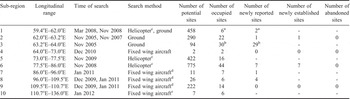
Details of search effort and breeding sites by sub-region. Potential breeding sites were identified and mapped using a coarse-scale, qualitative model of Adélie penguin breeding habitat in a GIS and were used to guide the search effort. Occupied breeding sites are those potential sites that were observed to have breeding populations in this survey. Newly reported breeding sites are those that have not been previously reported as occupied in search effort from earlier decades (because they were either previously searched and found to be unoccupied, or not previously searched) but were occupied in these surveys. Newly established sites are those newly reported sites that have evidence of being searched in previous surveys and were not reported to be occupied, but were occupied in this survey. Abandoned sites are those that have been reported as occupied in previous surveys but were unoccupied in this survey. “-” indicates that accurate identification of newly reported, newly established or abandoned sites was not possible because the description of sites previously reported in the literature was too imprecise.

aFrom Wilson et al. (Reference Wilson, Pike, Southwell and Southwell2009), bFrom Low et al. (Reference Low, Meyer and Southwell2007), cSquirrel AS350BA, dCASA 212, eDC3 T (Basler).
Results and discussion
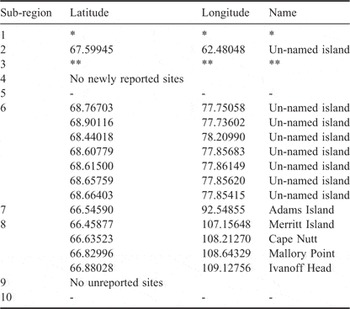
We found Adélie penguins breeding at 149 of the 2303 potential sites that were searched along the 3800 km length of coastline. Two large areas of discrete continental rock (Long Peninsula in Vestfold Hills and Clark Peninsula in the Windmill Islands) have breeding populations that have previously been considered as six colonies because they are separated from each other by a distance of several kilometres (Rookery Lake, Albino Rookery, Organic Lake and Northern Rookery (unofficial name) at Long Peninsula (Whitehead & Johnstone Reference Whitehead and Johnstone1990), and Whitney Point and Blakeney Point at Clark Peninsula (Woehler et al. Reference Woehler, Tierney and Burton1989b)). In keeping with this reporting convention, we present them here as six separate breeding sites even though they occurred on only two rock features, hence the total number of breeding sites in Table I is 153. Forty-four of the 153 breeding sites have not been reported in publications of previous search efforts from earlier decades. The locations of 31 of these 44 newly reported sites were identified in recent publications by Low et al. (Reference Low, Meyer and Southwell2007) and Wilson et al. (Reference Wilson, Pike, Southwell and Southwell2009), which presented initial results from restricted sections of the larger search effort. Locations of an additional 13 newly reported sites are presented in Table II.
Details of breeding sites that have not been reported in search effort from earlier decades.

*Two newly reported sites described in Wilson et al. (Reference Wilson, Pike, Southwell and Southwell2009).
**29 newly reported sites described in Low et al. (Reference Low, Meyer and Southwell2007).
- = identification of newly reported sites not possible because description of previously reported sites was too imprecise.
The documentation of search effort in previous surveys from earlier decades was complete and precise enough to assess change in breeding distribution for four of the ten sub-regions (Table I). Breeding distributions at Holme Bay and between the Ranvik Glacier and the West Ice Shelf (sub-regions 2 and 6, Fig. 1) have expanded from 58 to 66 breeding sites (eight newly established sites, no abandoned sites, Table I) since they were last surveyed by Woehler et al. (Reference Woehler, Johnstone and Burton1989a) and Whitehead & Johnstone (Reference Whitehead and Johnstone1990) respectively in the early 1980s. In contrast, breeding distributions between Austskjera and the Amery Ice Shelf (sub-region 4), documented in Alonso et al. (Reference Alonso, Johnstone, Hindell, Osborne and Guard1987) and Falla (Reference Falla1937), and between the ANZAC Glacier and Cape Folger (sub-region 9), reported in Orton (Reference Orton1963) and Woehler et al. (Reference Woehler, Slip, Robertson, Fullagar and Burton1991), are identical to our survey and indicate no change in the number (16) or location of breeding sites over the past several decades (Table I).
In reviewing the circumpolar breeding distribution of Adélie penguins, Ainley (Reference Ainley2002) considered most breeding populations were likely to be known and any undiscovered populations were likely to be small. A recent gap analysis of Adélie penguin breeding distribution in the Australian Antarctic Territory (AAT) in East Antarctica concluded that half of potential Adélie penguin breeding habitat in the AAT remained unsearched or unreported (Southwell et al. Reference Southwell, Smith and Bender2009), raising the possibility that a significant number of breeding locations, and therefore significant breeding populations, remained undetected or unreported in this region. Prior to our surveys, around 100 breeding sites had been collectively reported in the survey region through numerous separate survey efforts (Falla Reference Falla1937, Law Reference Law1958, Reference Law1962, Orton Reference Orton1963, Pryor Reference Pryor1968, Horne Reference Horne1983, Alonso et al. Reference Alonso, Johnstone, Hindell, Osborne and Guard1987, Woehler et al. Reference Woehler, Johnstone and Burton1989a, Reference Woehler, Tierney and Burton1989b, Whitehead & Johnstone Reference Whitehead and Johnstone1990, Robertson Reference Robertson1991, Woehler et al. Reference Woehler, Slip, Robertson, Fullagar and Burton1991, Melick et al. Reference Melick, Jackson and Petz1995). Our surveys increase the number of known sites by c. 50% and consequently raise the possibility that estimates of the breeding population may be significantly under-estimated. It is possible that many breeding sites remain undiscovered in other poorly surveyed regions of East Antarctica such as Enderby, Wilkes and George V lands (Woehler Reference Woehler1993, Barbraud et al. Reference Barbraud, Delord, Micol and Jouventin1999, Southwell et al. Reference Southwell, Smith and Bender2009). These regions should be a priority for any future survey work.
Some of the newly reported breeding sites are likely to have been occupied for at least the past several decades but remained unreported because the region had not been searched or observations had not been published. This is certainly true for many of the 29 newly reported sites in the Robinson Group of islands (sub-region 3), because rough, unpublished maps of a portion of the region drawn by ANARE personnel in 1972/73 show a similar distribution to the present (K. Kerry, unpublished data). It is also possible that some of the newly reported breeding sites were overlooked in previous survey efforts, as incomplete detection is known to be a common problem in occupancy studies (MacKenzie et al. Reference MacKenzie, Nichols, Hines, Knutson and Franklin2003). Although breeding Adélie penguins are relatively conspicuous when colonies are large, incomplete detection could have been an issue when assessing occupancy at sites from the air when populations were small. It was not possible to undertake multiple, independent searches of each potential breeding site in our surveys or previous surveys to increase detection probability as recommended by MacKenzie & Royle (Reference MacKenzie and Royle2005) because of the remoteness of the region and logistical expense. However, newly reported breeding sites occurred in some regions that had been described as thoroughly searched and where the search effort was well documented and illustrated with detailed maps, and we conclude that these newly reported sites are very likely to have been colonized in the three decades since previous surveys. We did not find any previously known breeding sites to have since been abandoned, so overall the breeding distribution of Adélie penguins has expanded in these regions over the past three decades.
Although the number of newly established colonies discovered in this survey is relatively small, our finding of an expanding breeding distribution may reflect underlying population dynamics of sustained population growth and resultant density dependent effect on dispersal and movement from established breeding sites to new sites. Adélie penguin population increases over recent decades have been reported at some sites elsewhere in East Antarctica (Woehler et al. Reference Woehler, Slip, Robertson, Fullagar and Burton1991, Jenouvrier et al. Reference Jenouvrier, Barbraud and Weimerskirch2006, Kato & Ropert-Coudert Reference Kato and Ropert-Coudert2006). Our results suggest that population growth could be more widespread than is currently accepted.
The impact of environmental change on species’ distributions is expected to be a major conservation issue in the future and there is an urgency to establish adequate baselines for detecting change. Because Adélie penguins have a broad geographic breeding distribution (Ainley Reference Ainley2002) and physical and environmental change is occurring differentially around Antarctica (Massom & Stammerjohn Reference Massom and Stammerjohn2010), future change in Adélie penguin breeding distribution is likely to vary regionally. Ainley et al. (Reference Ainley, Russell, Jenouvrier, Woehler, Lyver, Fraser and Kooyman2010) predicted that the number of Adélie penguin breeding colonies north of 70°S may decline by 75% when the earth's troposphere reaches 2°C above pre-industrial levels, but that breeding distribution might expand south of 73°S where concentrated pack ice diverges or disintegrating ice shelves expose coastline. The comprehensive, large-scale distribution data from this study provides a baseline against which future changes in Adélie penguin breeding distribution in the East Antarctic region can be compared, and also provides a basis for evaluating the utility of satellite technology for more cost-effective monitoring of broad-scale distribution in the future (e.g. Fretwell & Trathan (Reference Fretwell and Trathan2009) for emperor penguins). The data will also provide a sound basis for developing or improving regional spatial models for predicting future changes in breeding distribution under plausible scenarios of environmental change, and contribute to the development of metapopulation models by providing data to estimate local colonization and extinction probabilities under specific conditions of metapopulation change.
Acknowledgements
Matt Low, Lisa Meyer, Rhonda Pike, David Wilson, Darren Southwell, Barbara Wienecke, Tony Fleming and Chris Gallagher assisted in observations. Staff from Helicopter Resources and SkyTraders provided aerial support. Angela Bender and David Smith produced site maps. Staff from the Australian Antarctic Division, and Mawson, Davis and Casey stations provided co-ordination and support. This work was conducted as part of AAD ASAC project 2722 in accordance with permits issued under the Antarctic Treaty (Environmental Protection) Act 1980 and was approved by the Australian Antarctic Animal Ethics Committee. The manuscript was improved by the comments of two anonymous reviewers.