Introduction
Aggression is a behavioral disturbance of dementia that is distressing and challenging to manage. It is frequently associated with caregiver burden (Miyamoto et al., Reference Miyamoto, Tachimori and Ito2010), and current treatments have limited effectiveness (Sink et al., Reference Sink, Holden and Yaffe2005). With dementia prevalence expected to nearly double every 20 years to 115.4 million cases in 2050 (Alzheimer's Disease International, 2009), the number of cases of aggressive patients is projected to rise. There is a clear need for the implementation of more effective management plans for aggressive dementia patients and more effective support systems for clinical decision makers may aid this.
Clinical practice guidelines have the potential to assist the management of aggression in dementia by offering evidence-based recommendations for decisions regarding treatment plans. Guidelines can reduce variability in practice, improve patient outcomes, and reduce the cost of healthcare (Eddy et al., Reference Eddy, Adler, Patterson, Lucas, Smith and Morris2011). Practitioner adherence to guidelines however, is consistently low across health services (Grimshaw et al., Reference Grimshaw, Eccles, Walker and Thomas2002). Guidelines are often too narrow to assist with individual cases, too comprehensive to be useful to busy practitioners, and lack flexibility to assist with complex cases (Sniderman and Furberg, Reference Sniderman and Furberg2009). Formal procedures for updating the guidelines are also often missing, limiting usefulness as the evidence base of the field increases (Sniderman and Furberg, Reference Sniderman and Furberg2009). A challenge in contemporary healthcare is increasing the use of guidelines in everyday practice (Grimshaw et al., Reference Grimshaw, Eccles, Walker and Thomas2002).
This project aims to develop computer-assisted individualized clinical guidelines for the management of aggression in dementia that addresses some of the limitations of paper guidelines. As described in part one of this project, we devised a concept map of the primary dimensions and key concepts relating to the management of aggression (Vickland et al., Reference Vickland, Chilko, Draper, Low, O'Connor and Brodaty2012). The dimension of the patient was defined by three key concepts: the “patient's individual characteristics,” the “personal life story,” and the “patient's environment.” The dimension of the aggression and dementia disorder was defined by two key concepts: “presentation of symptoms” and “theory of causation.” The dimension of treatment was defined by five key concepts: “goals and expectations,” “non-pharmacological interventions,” “pharmacological interventions,” “ethics and restraint use” and “emergency treatment.” Aspects of guideline construction including support from evidence-based medicine, the commitment to updating the guidelines, usability, and disclosures were also found to be important (Vickland et al., Reference Vickland, Chilko, Draper, Low, O'Connor and Brodaty2012).
This paper evaluates current guidelines as to how well they represent the key concepts identified above. This study does not focus on evaluating the effectiveness of recommended treatment strategies as this has been done elsewhere (e.g. Ballard and Corbett, Reference Ballard and Corbett2010).
Methods
A systematic search was conducted for practice guidelines on the management of aggression in persons with dementia. Guideline databases such as the National Guideline Clearinghouse, Trip Database, National Institute of Clinical Excellence, Scottish Intercollegiate Guidelines Network, and the New Zealand Guidelines Group were searched for guidelines on dementia generally, behavioral disturbances of dementia, neuropsychiatric symptoms of dementia, and aggression in dementia. PubMed and CINAHL were also searched using the keywords “dementia,” “behavio(u)ral disturbances,” and “aggression” and limiting the publication type to guideline. The keywords “aggression,” “dementia,” and “guideline” were also used in a search of the Google website. The website of colleges of physicians and psychiatrists were hand searched where appropriate in Australia, New Zealand, the UK, and the USA. The reference lists of the relevant guidelines were also screened for other eligible sources. These guidelines were further supplemented with sources to which the research team had access.
Guidelines were reviewed if they had a focus on the management of aggression or behavioral disturbances in dementia and were in English. Articles that acknowledged the need to assess patients for behavioral disturbances but did not dedicate a section of the guideline to this particular symptom were excluded. Articles that failed to mention aggression in the assessment section of the guideline and only in the treatment section were further excluded. As there is considerable paucity of systematic studies on aggression in dementia, we also accepted expert consensus guidelines that draw on the advice of clinical experts in the absence of research. Position statements were also accepted as we felt they were covering much of the same ground of the documents labeled practice guidelines and in our view were likely to fulfill a similar role with clinicians. When the decision regarding inclusion of a document for review was unclear, there was a discussion between at least two members of the research team. Systematic clinical reviews were not evaluated as practice guidelines. In order to be up-to-date, only guidelines published between 2005 and 2010 were reviewed.
The guidelines were independently evaluated for their link to the key concepts by two reviewers. Criteria of evaluation divided the key concepts into four levels of representation: strong, moderate, weak, and absent. Generally, a grade of a strong link (3) corresponded to a detailed, comprehensive representation of that key concept, with definitions and rationales provided where appropriate. A moderate link (2) was judged when some examples, strategies, or reasons were provided for considering that key concept when managing aggression, without the level of detail provided for a strong grade. A weak link (1) corresponded to an acknowledgement of this concept in the guideline with very limited detail. Missing key concepts (0) were judged as absent (see Appendix A1 for evaluation criteria, available as supplementary material attached to the electronic version of this paper at www.journals.cambridge.org/jid_IPG). The two reviewers differed in level of experience, one a research assistant and the other an experienced geriatric psychiatrist. Consensus was achieved for different scores through discussion by the reviewers.
Results
Search results
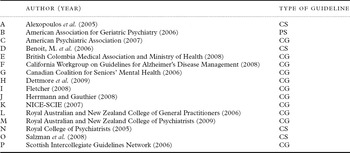
Sixteen publications were included in the review (see Table 1). Eleven publications were practice guidelines, four were consensus guidelines, and one was a position statement. Although all guidelines had a focus on behavioral disturbances, seven guidelines also focused on dementia (Alexopoulos et al., Reference Alexopoulos, Jeste, Chung, Carpenter, Ross and Docherty2005; Royal College of Psychiatrists, 2005; NICE-SCIE, 2006; Scottish Intercollegiate Guidelines Network, 2006; Royal Australian and New Zealand College of General Practitioners, 2006; American Psychiatric Association, 2007; Fletcher, Reference Fletcher, Capezuti, Zwicker, Mezey, Fulmer and Gray-Miceli2008), two on Alzheimer's disease (California Workgroup on Guidelines for Alzheimer's Disease Management, 2008; Herrmann and Gauthier, Reference Herrmann and Gauthier2008), one on cognitive impairment in the elderly (British Colombia Medical Association, 2008), one on mental health in care homes (Canadian Coalition for Seniors' Mental Health, 2006), one on care principles in Alzheimer's disease (American Association for Geriatric Psychiatry, 2006), and one on the pharmacological management of behavioral and psychological symptoms of dementia (BPSD) (Royal Australian and New Zealand College of Psychiatrists, 2009). Three guidelines focused specifically on aggression in dementia (Benoit et al., Reference Benoit2006; Salzman et al., Reference Salzman2008; Dettmore et al., Reference Dettmore, Kolanowski and Boustani2009). We refer to them collectively as guidelines.
The guidelines included in the review

Notes: CG – Clinical Guideline; PS – Position Statement; CS – Consensus Statement.
Consensus ratings
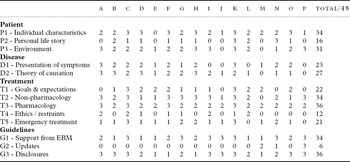
There was 54% agreement in ratings of the key concepts in the guidelines between the two raters. Consensus was reached on all differences, and final scores of the rating of each guideline for each concept are presented in Table 2. The more experienced rater in the field tended to give lower scores than the research assistant, correlation coefficient 0.72, p < 0.01.
Level of the representation of the key concepts in the 16 guidelines. 0 = absent, 1 = weak, 2 = moderate, 3 = strong. For more details on the criteria, see Appendix A1*

* Available as supplementary online material attached to the electronic version of this paper at www.journals.cambridge.org/jid_IPG.
Evaluation of the links to key concepts
Comparing the reviewed documents
There were only slight differences between the document types (guidelines, consensus guidelines, and others) in the representation of the key concepts. Consensus and position statements, as well as the less clear practice guidelines, tended to have a better representation of the individual characteristics of the patient, the presentation of symptoms, and the theory of the cause of aggressive behavior. In contrast, the practice guidelines provided greater detail of the goals of management, as well as pharmacological and non-pharmacological management. As these differences were minor, pooled results have been reported.
The patient (P)
P1. Individual characteristics of patients. Fifteen guidelines acknowledged that devising management plans for aggressive behavior requires consideration of the individual characteristics of the patient. This was the third most consistently represented concept in the guidelines. Two guidelines only acknowledged that treatment plans be devised on an individual basis, seven guidelines acknowledged the main areas of assessment for patients with dementia (cognitive, medical, functional), and six guidelines offered comprehensive details for the clinical and demographic characteristics that should be assessed with patients displaying aggressive behavior. These characteristics include comorbidities, dependency, severity of dementia, dementia type, pain, age, and gender when treating aggression.
P2. The personal life story of the individual with dementia. The second least represented concept in the concept map was the personal life story of the patients and their individual experience of dementia. Ten guidelines acknowledged that the personal history of the individual should be considered when devising management plans, but only two represented this strongly. The Royal College of Psychiatrists’ (2005) and the National Institute for Health and Clinical Excellence (NICE), Social Care Institute for Excellence (SCIE) (2006) guidelines strongly endorsed a social model of dementia that requires the history, likes, dislikes, culture, and family background to be considered in management plans. An acknowledgment of person-centered care management principles was present in another two guidelines.
P3. Patient's environment. Fourteen guidelines recommended assessing the environment of the patient with dementia for possible triggers of aggression, including excessive noise, overcrowding, and intrusion by others in the personal space of the patient. Five out of 14 guidelines were rated as strongly representing the role of the living situation and the caregiver in managing BPSD in dementia. These guidelines provided a rationale for considering the environment and recommended interventions for informal and formal caregivers in managing the environment and the aggression. Two guidelines did not address the environment of the patient.
The disease (D)
D1. Presentation of symptoms. The type, severity, and frequency of aggression may influence course of treatment. Nine guidelines acknowledged that treatment will depend on the presentation of symptoms, and only two of these offered detailed recommendations based on the type, severity, and frequency of the aggression. This concept was weak in three guidelines and missing in the other four.
D2. Theory of causation. Fourteen guidelines acknowledged that aggressive behavior could result from different causes. Four guidelines provided recommendations based on possible causes of aggression including neurobiological, environmental, and psychosocial causes. These guidelines also referenced theories of the cause of aggression, such as aggression as a need-driven compromised-behavior, or due to a progressively lowered threshold. Five guidelines acknowledged that there are multiple causes of aggression in dementia patients without providing theoretical perspectives.
The treatment (T)
T1. Goals and expectations. Twelve of 16 guidelines acknowledged that treatment plans should have a predetermined goal. Eight guidelines recommended conducting an assessment of the harms and risks of treatment options, and two of these gave more detail.
T2. Non-pharmacological interventions. Fifteen out of 16 guidelines recommended that non-pharmacological approaches to managing aggression be used prior to pharmacological approaches where appropriate. Four guidelines weakly acknowledged non-pharmacological interventions and listed a few examples, while eight guidelines gave detailed definitions of the types of non-pharmacological interventions for BPSD, with a discussion of the available evidence. Characteristics of non-pharmacological interventions were the second most well-represented concept in the main categories of patient, disease, and treatment, alongside individual characteristics.
T3. Pharmacological interventions. Pharmacological intervention was the best represented key concept in the guidelines, with all guidelines providing recommendations on pharmacological interventions to use when managing aggressive behavior. The four strongest scored guidelines specified recommendations of specific dosage and time periods of the pharmacological treatment, the review date of the medication and possible contraindications. They also included a rationale for these recommendations, including the use of pharmacological interventions in “situations in which needs cannot be identified, and the aggression poses a significant danger to the person or others” (Dettmore et al., Reference Dettmore, Kolanowski and Boustani2009, p 9). The other 12 guidelines made recommendations of what pharmacological interventions to use when managing aggressive behavior (e.g. antipsychotics, acetylcholinesterase inhibitors), with reference to possible adverse effects and management principles (e.g. start with low doses), without the detail provided for a strong score. All guidelines received a score of 2 or 3 for this concept.
T4. Ethics and restraint use. Ethics and restraint use was the second least represented concept in the guidelines. No guideline covered this topic in detail. There was no discussion of what is and is not permitted in using restraint in this population, or of the risks, long-term efficacy, pros and cons of restraint use, or the process of obtaining consent for treatment with antipsychotic medication in any guideline. Eight guidelines acknowledged restraint use as a management strategy, four of which specified alternative strategies and a few examples of when physical restraint can be ethically used. Four guidelines referenced the issue of consent with no detail. The other four guidelines only stated that restraint should be avoided or prohibited. Eight guidelines did not mention restraint use.
T5. Emergency treatment. Fourteen guidelines acknowledged that emergency treatment may be required for aggressive dementia patients. Only two guidelines defined emergency treatment and provided specific treatments to use in emergency situations. Another three guidelines were scored as moderately presenting this concept, providing examples when emergency treatment may be needed but in a non-systematic way. This concept overall was poorly represented.
Confidence in the guidelines (G)
G1. Support from evidence-based medicine. The guidelines differed in the method used to devise their recommendations. Eleven guidelines conducted a literature review and seven of these provided recommendations based on rules of evidence. Five guidelines did not report a literature search.
G2. Commitment to updating the guidelines. A commitment to updating the guidelines was the least represented concept with only three guidelines citing an intended review date. One guideline had passed the review date and a link to the website had been provided. The website identified that the authors had extended the review date as the guideline was judged as reflecting current best practice.
G3. Disclosures. Disclosure of potential biases, endorsements, and the purpose of the publication were provided in detail in eight out of 16 guidelines. Four guidelines provided some information on authors' backgrounds and potential conflicts of interest; four guidelines provided only minimal information on this.
G4. Usability and accessibility. The representation of this concept in the guidelines was not scored as it may be heavily influenced by the status of the clinician (e.g. accessibility to guidelines published by professional organizations may depend on membership). However, it was clear that there were significant differences in the format and style of the guidelines. Guidelines ranged between five and 392 pages, differing in focus and audience. Summaries accompanied eight guidelines, and five guidelines provided treatment algorithms. There were striking differences in comprehensiveness, usability, and development procedure.
Discussion
In this study, we appraised current clinical guidelines on the management of aggression in dementia for their comprehensiveness. We used criteria relating to 13 key concepts identified in our literature review (Vickland et al., Reference Vickland, Chilko, Draper, Low, O'Connor and Brodaty2012), with the aim of discerning the knowledge base of current guidelines in the field to direct the development of a computer model for individualized guidelines.
We found significant variability within and between guidelines in their focus on different key concepts in the aggression in dementia field. The guidelines were limited in their scope in providing recommendations for the management of distressing aggressive behavior in dementia. Overall, key concepts relating to aggression management in dementia were moderately to poorly represented, with the majority of concepts scoring below 70% of the total score of complete representation. The characteristics of the individual patient, their environment, and non-pharmacological and pharmacological interventions were the best represented, as guidelines generally detailed the procedures of assessment and treatment and specified general management principles. Recommendations for treatments considering the specific presentation of the behavioral symptoms, the theory of the cause of the behavior, and the goal of the treatment were less well represented. The representation of the personal life story of the person with dementia, ethics and restraint use, and emergency treatment were poor.
The results of this study cast doubt over the ability of current paper-based guidelines to guide clinicians in making better quality decisions when managing challenging behavior in dementia. It is surprising that concepts central to managing aggressive behavior received such low scores. The use of restraint in residential aged care facilities has been associated with infection, pressure sores (Lofgren et al., Reference Lofgren, MacPherson, Granieri, Myllenbeck and Sprafka1989), and death (Rubin et al., Reference Rubin, Dube and Mitchell1993), yet recommendations for when restraints can or should be used, what restraints to use, and who is responsible for administering them were generally absent from the guidelines. Similarly, specific recommendations for emergency treatment were under-represented, with many general approaches to management offered without specific protocols to follow. There was little consideration of the experience of the person with dementia and how their culture, history, and life story may affect the management of their aggressive behavior.
Guidelines were originally developed to assist clinicians achieve a more evidence-based practice, but issues with guideline construction have raised doubt over the confidence that clinicians can place in the recommendations (Sniderman and Furberg, Reference Sniderman and Furberg2009). Our work exists within other attempts to reform the construction of guidelines in order to increase their usability and implementation. Sniderman and Furberg (Reference Sniderman and Furberg2009) call for a reform to guideline development and argue for full disclosure of potential conflicts of interest by workgroup members, joint codes for both members and associations sponsoring guideline development, disclosure of discordance between group members on relevant recommendations, independent review of draft documents, and expiry dates of the guideline clearly labeled. Our own study found an overwhelming lack of commitment to updating the guidelines; however, in general disclosure of potential biases, conflicts of interests, and the purpose of the guideline were detailed.
New templates have been proposed to direct guideline construction that, like our work, focuses on understanding the broad situation of the individual patient. This is the primary strength of our paper. The FORM approach to guideline development considers the evidence base, consistency, clinical impact, generalizability, and applicability of recommendations (Hillier et al., Reference Hillier2011). Our guideline development aims to enhance the clinical impact, generalizability, and applicability of guidelines by creating individualized intervention plans. A systematic review of clinical decision support systems found 90% of systems that were computerized and offered automatic recommendations and not just assessments at the point of decision-making significantly improved clinical practice (Garg et al., Reference Garg2005). We are endeavoring to include provisions in our decision support system that will guide consideration of biomedical and contextual factors for individual patients. Guidelines that offer individualized recommendations for patients have been found to improve quality of care while reducing the cost compared to non-individualized guidelines in a study on the management of blood pressure (Eddy et al., Reference Eddy, Adler, Patterson, Lucas, Smith and Morris2011).
Usability and accessibility are important in establishing the effectiveness of clinical guidelines. It was generally difficult to locate guidelines for this study, and health services may have internal documents that were not included. It was also difficult to decide which documents to include in the review, such as guidelines, position statements, and consensus statements. Many organizations use different methods to construct tools that they label as guidelines, and conversely documents with a focus on guiding clinicians do not use the label “practice guideline”. We included 16 guidelines that significantly varied in detail and primary focus but had a focus on aggression or behavioral disturbances. This challenge to locate guidelines exposes fundamental difficulties in accessibility that clinicians may face when choosing which guideline to follow.
A possible limitation of the study was the difference in rater scores. Although consensus was reached for each evaluation, it became clear that the raters used different approaches in scoring, most probably due to the wide difference in experience. The first rater tended to score the aggression section within the context of the whole guideline and the general management principles, whereas the more experienced rater focused on the section on aggression. During consensus, it was agreed that the aggression section should be evaluated within the whole guideline as less experienced clinicians are more likely to use guidelines and may use the approach of the less experienced rater.
The relative importance of the individual concepts to clinical decision-making was also not addressed. This is a challenging task and will be the focus of our next paper. The importance of the concepts will be determined by the clinical profile of individual patients rather than determined generally. For example, the type of dementia may have a large bearing on the type of medication used, such as antipsychotic medication, which is contraindicated for those with dementia with Lewy bodies. The next stage in developing individualized guidelines will explain the construction of Bayesian networks that allow the relative importance of concepts for individual patients to be addressed. The concept map will inform the development of the Bayesian network, but the network is the tool to weigh/assign importance/probability tables.
Conclusions
Decision-making in the health setting is inescapable, and it is unreasonable to suppose that practitioners can make judgments for each clinical decision without assistance. Clinical guidelines can be a valuable support tool in routine practice and increasing their applicability and usability may increase implementation. Future guidelines on the management of aggression in dementia would benefit from an increased recognition of person-centered care principles in managing challenging behaviors in line with growing evidence. Guidelines also need to make recommendations regarding restraint use in this population, and how to deal with the issue of consent. There also needs to be recognition that guidelines may be referenced in times of emergency, and protocols and definitions of emergency treatment should be specified. It is also crucial that guidelines are easily accessible by clinicians and that review dates are specified and upheld to ensure currency. The next task in this project is to address these gaps by incorporating data from the guidelines, empirical papers, and experts to develop a model that allows calculation of probabilities of clinical outcomes depending on the intervention used. We hope to develop a user-friendly, accessible tool that will guide clinicians in creating individualized management plans.
Conflict of interest
Henry Brodaty is or has been an investigator for Pfizer, Novartis, Janssen, Lundbeck, Lilly, Medivation, Sanofi, and Voyager; a sponsored speaker for Pfizer, Novartis, and Janssen; and a member of the advisory boards for Pfizer, Novartis, Janssen, Lundbeck, Wyeth, Merck, and Servier.
Description of authors' roles
Victor Vickland conceived the study, oversaw its design and coordination, and assisted in drafting the paper. Natalie Chilko conducted the literature search, rated the guidelines, and drafted the paper. Brian Draper also rated the guidelines. Brian Draper, Lee-Fay Low, Daniel O'Connor and Henry Brodaty contributed to interpreting the results and revising the paper.
Acknowledgments
This project was funded by a National Health and Medical Research Grant #630596.