Introduction
Major depressive disorder (MDD) and cardiovascular disease (CVD) are leading causes of mortality and morbidity worldwideReference Ustun, Ayuso-Mateos, Chatterji, Mathers and Murray 1 , 2 with a prevalence of comorbidity of 15–20%,Reference Lett, Blumenthal and Babyak 3 , Reference Penninx, Beekman and Honig 4 thus representing a considerable global disease burden. The risk of CVD is 70% greater among depressed compared with non-depressed persons.Reference Ferketich, Schwartzbaum, Frid and Moeschberger 5 Furthermore, compared with CVD alone, the comorbidity between CVD and depression increases risk for cardiac mortality by threefold,Reference Penninx, Beekman and Honig 4 particularly in young women.Reference Mallik, Spertus and Reid 6 , Reference Vaccarino, Johnson and Sheps 7 Thus, there is a need to understand the reasons for the comorbidity. Recent research has demonstrated associations between fetal risk factors, MDD and CVD. Animal and human studies have suggested that the mechanisms involving fetal and maternal hormones and polypeptides underlying prenatal stress models may contribute to understanding these shared associations (e.g. Welberg and SecklReference Welberg and Seckl 8 ). Prenatal stress models implicate the disruption of the hypothalamic–pituitary–adrenal (HPA) axis in fetal development.Reference Welberg and Seckl 8 , Reference Phillips and Jones 9 Some of the major brain regions comprising HPA circuitry are also implicated in the regulation of affective functioning and MDD, inflammation and components of the autonomic nervous system (ANS) that control the heart's R-R interval variability (RRV) and blood pressure (BP).Reference Mesulam 10 , Reference Goncharuk, Van Heerikhuize, Swaab and Buijs 11 Thus, we believe that disruption of these shared brain regions during fetal development represent critical links between adult MDD and CVD risks.
Growth restriction (GR) and preeclampsia (PE) are associated, in part, with the disruption of immune activation in the pregnant womanReference DiGiulio, Gervasi and Romero 12 – Reference Neta, von Ehrenstein and Goldman 14 and later with both MDDReference Tuovinen, Raikkonen and Kajantie 15 , Reference Van Lieshout and Boylan 16 and CVDReference Quinkler and Stewart 17 , Reference Barker 18 in the exposed adult offspring. GR and PE are therefore not only associated with fetal health, but with vulnerability for these chronic disease in adulthood.Reference Barker 19 Further, there are substantial sex differences in incidence in MDD (higher among women)Reference Kessler 20 and CVDReference Lloyd-Jones, Adams and Brown 21 (higher among men), and importantly for this study, the comorbidity of MDD and CVD (higher among women than men).Reference Naqvi, Naqvi and Merz 22 , Reference Moller-Leimkuhler 23 Thus, we hypothesize that GR and PE will be associated with significant sex-specific incidences in the comorbidity of these disorders.
MDD and anxiety have been associated with the development and progression of coronary artery disease.Reference Penninx, Beekman and Honig 4 Prospective studies have demonstrated significantly elevated risks of coronary heart disease, myocardial infarction or cardiac death among participants with depression.Reference Golston and Bailllie 24 In addition to predicting survival among cardiac patients, depression may predict first cardiovascular events among otherwise healthy people.Reference Penninx, Beekman and Honig 4 Depressive symptoms at baseline conferred a 1.6-fold increase in risk of first myocardial infarction, and MDD conferred a larger risk.Reference Van der Kooy, van Hout and Marwijk 25 MDD has also been associated with metabolic syndrome,Reference Gil, Radziłłowicz and Zdrojewski 26 hypertensionReference Meyer, Armenian, Eaton and Ford 27 and cholesterol levels.Reference Shin, Suls and Martin 28 Furthermore, low RRV of the heart, reflecting impaired cardiac vagal control, associated with MDD may make depressed patients more prone to arrhythmias.Reference Rozanski, Blumenthal and Kaplan 29
A growing body of evidence indicates that there are fetal risk factors for adult affective disorders.Reference Tuovinen, Raikkonen and Kajantie 15 , Reference Ozanne, Fernandez-Twinn and Hales 30 , Reference Gale and Martyn 31 Fetal teratogens, general obstetric complications and low birth weight have been reported as significant risk factors for affective disorders, including maternal bleeding during pregnancy,Reference Preti, Cardascia and Zen 32 respiratory problems at birth,Reference Kinney, Yurgelun-Todd, Tohen and Tramer 33 , Reference Jacobsen, Eklund and Hamberger 34 increased labor length,Reference Kinney, Yurgelun-Todd, Tohen and Tramer 33 , Reference Sacker, Done, Crow and Golding 35 drug administration at labor,Reference Kinney, Yurgelun-Todd, Tohen and Tramer 33 , Reference Jacobsen, Eklund and Hamberger 34 general frequency of obstetric complicationsReference Preti, Cardascia and Zen 32 , Reference Kinney, Yurgelun-Todd, Tohen and Tramer 33 and low birth weight.Reference Räikkönen, Pesonen and Heinonen 36 In addition, childhood behaviors, such as later motor milestone attainment, twitching and grimacing, lower cognitive scores in adolescence and lack of motivation in childhood, have been related to adult onset of affective disorders,Reference van Os, Jones, Lewis, Wadsworth and Murray 37 underscoring the developmental nature of MDD and the importance of investigations of fetal and childhood antecedents.
There are a number of birth cohort studies that have demonstrated fetal conditions, including maternal immune responses and exposure to stressors, as significant risk factors for MDD. Second trimester maternal exposure to type A2/Singapore influenza significantly increased the risk for unipolar and bipolar disorders in a Finnish cohort of adults admitted to hospitals before 30 years of age,Reference Machon, Mednick and Huttunen 38 and within an exposed cohort of British adults with affective disorders.Reference van Os, Jones, Lewis, Wadsworth and Murray 37 Maternal exposure to earthquake (treated as a severe stressor) was reported to increase the risk for unipolar depression at 18 years, with second trimester exposure particularly in males.Reference Watson, Mednick, Huttunen and Wang 39 Maternal exposure to famine (also can be considered, in part, a severe stressor) during second and third trimesters was reported to increase risk levels for MDD at ages 26–52 years, particularly in males.Reference Brown, Susser, Lin, Neugebauer and Gorman 40 , Reference Brown, van Os, Driessens, Hoek and Susser 41 Although maternal infection, stress and undernutrition may have different effects on the developing fetus, there may be some shared mechanism, resulting in a vulnerability to MDD that implicates the stress response system (i.e. HPA axis and inflammatory mechanisms).
Numerous studies have documented inverse associations between birth weight and CVD risk in a variety of populations. Birth weight has been found to be inversely associated with coronary heart disease incidence and mortality.Reference Barker 18 Birth weight also appears to be negatively associated with CVD risk factors in adulthood, including BP and glucose intolerance.Reference Barker 18 , Reference Phillips 42 Associations of birth weight with CVD risk have been documented in young, middle-aged and elderly adults, adolescents and children.Reference Daly, Scragg, Schaaf and Metcalf 43 – Reference Rajaleid, Janszky and Hallqvist 47 These observations suggest the hypothesis of fetal programming by which early exposures give rise to permanent structural or functional changes that alter one's lifetime risk of CVD. This hypothesis was put forth in the 1990s by Barker and colleagues, work that implicated the disruption of HPA circuitry in development as key to understanding fetal risk for CVD in adulthood.Reference Kajantie, Feldt and Räikkönen 48
High frequency (HF; 0.15–0.40 Hz) oscillations in time series of R-R intervals from the electrocardiogram (ECG) have been used as noninvasive estimates of parasympathetic control of the cardiovascular system. Measures of RRV, derived from brief ECG recordings, have been associated with the incidence of new cardiac events and coronary disease,Reference Whitsel, Raghunathan and Pearce 49 progression of atherosclerosisReference Thayer and Lane 50 and all-cause mortality.Reference Dekker, Crow and Folsom 51 Lower RRV indices have also been associated with the metabolic syndrome in CVD.Reference Liao, Sloan and Cascio 52 Recent evidence suggests the possibility that HF-RRV also reflects a vagal anti-inflammatory reflex linking autonomic dysregulation to atherosclerosis.Reference Tracey 53 Studies have reported sex differences in RRV with females higher in parasympathetic responses (i.e. HF-RRV)Reference Mendonca, Heffernan and Rossow 54 and males higher in sympathetic response.Reference Chen, Yang, Kuo, Su and Chou 55 In fact, lower HF-RRV has been found in MDD.Reference Chen, Yang, Kuo, Su and Chou 55
Thus, this study tested the hypothesis that GR and PE are significant risk factors for MDD and ANS dysfunction (operationalized as very low HF component of RRV or parasympathetic dysregulation). Given the sex-specific incidences in these disorders, we predicted a higher risk for ANS dysfunction in men in general and the comorbidity of ANS dysfunction and MDD in women. We are suggesting a common fetal cause and underlying pathophysiology producing sex-specific outcomes, involving the inflammatory response system and HPA axis shared by cardiac function and affect.
Methods
Sample ascertainment
Participants in this study were accrued through the National Institute on Aging (NIA) P01 AG023028 Early Determinants of Adult Health (EDAH; 2003–2008) (described in Susser et al.,Reference Susser, Buka and Schaefer 56 this issue) and NIMH-NHLBI RO1 MH074679 (Goldstein, principal investigator (P.I.)) on Shared Fetal Antecedents to Major Depression and Risk for CVD. Briefly, for the core EDAH sample (see Susser et al.,Reference Susser, Buka and Schaefer 56 this issue) from the New England Family Study (NEFS), comprised of the Boston, MA and Providence, RI cohorts of the Collaborative Perinatal Project (CPP; see Susser et al.,Reference Susser, Buka and Schaefer 56 this issue), and from the parallel Child Health and Development Study (CHDS) in Oakland, California, we identified all same-sex sibling pairs who met the following criteria. Eligible sibling sets included those where two or more members were discordant on birth weight, adjusted for gestational age. In New England, the low-birthweight proband was in the lowest 20th percentile of the gender-specific birth weight for gestational age distribution and the higher-birthweight sibling was at or above the 20th percentile and at least 10 or more percentile points higher. These criteria applied to approximately half of the CHDS sibling sets; the remainder included sibling sets in which the two siblings differed by at least 10 percentile points on the birth weight for gestational age distribution, but where the lower-birthweight sibling was not in the lowest quintile of the birth weight for gestational age distribution. Further, both siblings had to be between 38 and 43 completed weeks of gestation. Siblings were required to live within commuting distance of the clinics in Boston or Oakland where the assessments were done.
In RO1 MH074679, we extended the size of the growth restricted (GR) sample and included sibling sets discordant on PE from the New England CPP cohort (defined below). (We also identified from the CHDS sample any additional subjects who had been exposed to PE as well.) As with GR, siblings were between gestational ages 38–43 weeks in order to eliminate prematurity confounds. From the NEFS cohort we identified 644 additional subjects, of which 371 (57.6%) were eligible for adult follow-up. Of these eligible subjects, 252 (67.9%) were located and 155 (61.5%) were recruited (146 completed, 9 pending interview). For the analyses presented here, the New England sample consists of these 146 in addition to 149 collected under NIA (NIA P01 AG023028).
Thus, the total sample for the current analyses consisted of 538 subjects, 295 from New England and 243 from the California sample. Of the 250 males, 61 (24.4%) were part of a same-sex sibling set discordant for GR and/or PE (29 sets total). Among the 288 women, 114 (40.0%) were part of a same-sex sibling set discordant for GR and/or PE (defined below, 57 sets total).
Fetal risk
Fetal risk was operationalized as prenatal exposure to either GR or PE among subjects delivered between 38 and 43 weeks. GR was defined as birth weight below the 20th percentile for gestational age by sex based on the 1999–2000 US Natality data sets,Reference Oken, Kleinman, Rich-Edwards and Gillman 57 as discussed above under ‘Sample ascertainment’. Adapted from the National High Blood Pressure Education Program Working Group Report on High Blood Pressure in Pregnancy, 58 PE was operationally defined as mild or severe. Mild PE was defined if after the 20th week of pregnancy there was evidence of systolic BP ⩾ 140 mmHg or diastolic BP ⩾ 90 mmHg, proteinuria 1+ in clean-voided/catheterized specimen in absence of urinary tract infection (UTI) (measured on at least two occasions) or persistent edema of hands and face. Severe PE was defined if BP ⩾ 160 mmHg systolic or ⩾110 mmHg diastolic on at least two occasions 6 h apart at bed rest, or proteinuria of 5 g in 24 h in absence of UTI in clean-voided/catherized specimen, or oliguria (=400 cc excreted in 24 h period), or cerebral or visual disturbances, retinopathy, headache, right upper quadrant or epigastric pain, pulmonary edema or cyanosis or laboratory abnormalities [increased liver function test (i.e. greater than doubling of upper limits of normal for that laboratory) or decreased platelets (<100,000)].
Diagnostic procedures
Lifetime mood and anxiety disorders and substance use were assessed during in-person adult follow-up assessments when the participants were 39–50 years of age. Relevant modules from the Structured Clinical Interview for Diagnoses (SCID DSM-IV version)Reference First, Spitzer, Gibbon and Williams 59 and additional substance use information was collected using a modified Alcohol Use Disorder and Associated Disabilities Interview Schedule-IV.Reference Ruan, Goldstein and Chou 60 Clinical interviewers were trained and quality control maintained by Goldstein's experienced diagnostic team. All diagnostic material was reviewed by J.G. and the clinical coordinator and diagnoses were assigned by consensus. For the few disagreements among the diagnostic team, a third experienced clinician reviewed the material as well. The Spielberger State-Trait Anxiety Interview was administered to assess current (state) and trait anxiety.
RRV assessment and analysis
ECG electrodes were placed on the right shoulder, on the left anterior axillary line at the 10th intercostal space and in the right lower quadrant. Respiration bands were applied around the chest and abdomen. Subjects were seated and received instructions for the Stroop color-word matching task and then were given the opportunity to practice. During the task, subjects were presented with color names (blue, green, yellow, red) in colors that were either congruent or incongruent with the names. The subjects’ task was to press the key that corresponded to the color of the letters. The task was paced by the computer and an incorrect response or failure to respond rapidly resulted in a message indicating ‘incorrect’ on the screen. ECG and respiration data were collected during a 3-min calibration period and then a 10-min resting baseline, followed by 5 min of the Stroop task and a 5-min recovery period. Subjects were tested in the seated position.
The ECG analog waveform was digitized at 500 Hz by a National Instruments 16XE50 16-bit A/D card and collected by a microcomputer. Specially written software was used to mark R waves and create files of relative risk (RR) intervals for analysis as described below. Artifacts in the RR interval series were defined as values below 0.4 s (heart rate >150 bpm) or above 1.5 s (heart rate <40 bpm). When artifacts were detected, the RR file was examined. Artifacts were rejected or corrected following established procedures.Reference Berntson, Quigley, Lang and Boysen 61 HF-RRV (0.15–0.40 Hz) was calculated on 300-s epochs using an interval method for computing Fourier transforms.Reference deBoer, Karemaker and Strackee 62 In this study, we investigated the HF component in response to a stress challenge or HF-RRV in response to stress. Before computing Fourier transforms, the mean of the RR interval series was subtracted from each value in the series. The residual series was filtered using a Hanning windowReference Harris 63 and the power, that is, variance (in ms2), over the low frequency and HF bands was summed. Estimates of spectral power were adjusted to account for attenuation produced by this filter.Reference Harris 63 Respiration was monitored using stretch bands placed around the subject's chest and abdomen. Signals generated by these bands were digitized at 20 samples/s by the National Instruments A/D converter and collected by the microcomputer. The signal was calibrated using an 800-ml Respibag. Respiratory rate and volume were computed by a custom-written software program.
Socioeconomic status (SES)
A measure of SES was developed using the methods outlined by Myrianthopoulos and FrenchReference Myrianthopoulos and French 64 to construct the socioeconomic index used in the CPP, operationalized as the combination of scores for education, occupation and family income to derive a composite numerical index. The same index was applied to the CHDS data. Low SES has been found to be significantly associated with modifying the risk for MDD by our group and othersReference Gilman, Kawachi, Fitzmaurice and Buka 65 and risk for CVD,Reference Rose and Marmot 66 , Reference Salomaa, Miettinen and Niemelä 67 and thus is important to examine as a modifier of the impact of fetal risk factors on our outcomes of interest. The low SES category was defined as SES values in the lowest tertile.
Statistical analyses
The association between fetal risk and adult HF-RRV response to a stress challenge, MDD and the comorbidity of MDD and HF-RRV was analyzed. HF-RRV response was first treated as a continuous outcome measure for which a mixed model approachReference Littell, Milliken, Stroup and Wolfinger 68 was used, including two-way interactions between fetal risk and sex, SES and MDD status. For those analyses in which we had insufficient power to test for two-way interactions, we stratified the sample to examine qualitatively if the effect estimates were similar by sex, SES and MDD status. We did not have adequate power to test three-way interactions. The continuous HF-RRV variable was log transformed before statistical analysis due to significant skewness of the continuous data (>|0.8|). The mixed models were adjusted for intrafamilial correlation as well as baseline HF-RRV, Caucasian ethnicity, sex and SES. Baseline HF-RRV was controlled in order to insure that our outcome was HF-RRV in response to the stressful challenge. Mean differences along with their F-values and corresponding P-values are presented. Interaction F-values and corresponding P-values are also reported. To compare the magnitude of the mean differences between groups we also calculated effect sizes. Effect sizes of the exposed and unexposed subjects by MDD status, sex and SES were calculated as mean differences divided by the standard deviations of the overall population, thus producing standard deviation differences from the population.
Dichotomous outcomes included MDD and low HF-RRV, operationalized as the lowest quartile of HF-RRV. Low HF-RRV and MDD were combined to investigate the comorbidity of MDD and CVD risk. RR for MDD in relation to fetal risk exposures was estimated, including stratification by sex and SES as suggested by the previous analyses. The χ 2 analyses were used for those analyses with less than 10 subjects per cell. Multivariate generalized estimating equation models were also used for the dichotomous outcomes analyses (i.e. MDD and comorbidity of MDD and CVD risk), adjusted for intrafamilial correlation (given sibling pairs), and sex, Caucasian ethnicity and SES. It was in these models that two-way interactions were examined.
Results
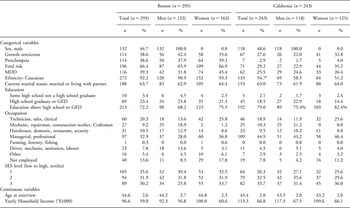
Table 1 describes the sample included in these analyses (New England: n = 295; California: n = 243). By adult self-report (self-reported adult ethnicity not always the same as that assigned at birth), the Boston sample was predominantly Caucasian (92.2%) comprised primarily of subjects in the middle and lower-middle SES, whereas in California, 54.7% were Caucasian and they had a somewhat higher SES population given that they are all insured through their employers (see Table 1). In addition, 66.4% of the Boston and 29.2% of the California sample were exposed to fetal risk. In all, 40.7% of the Boston and 25.5% of the California population were diagnosed as having MDD. Among the 538 subjects, 452 had both psychiatric interview and electrocardiogram data and did not meet exclusion criteria based on diagnosis of psychosis or bipolar disorder. This subsample was not significantly different demographically from the 538 and comprised the analytic sample for the study.
Description of the sample (n = 538)

MDD, major depressive disorder; GED, General Educational Development; SES, socioeconomic status.
aNote that ethnicity/race is categorized differently here than in Supplementary Table 5 of Susser et al.Reference Susser, Buka and Schaefer 56 (this issue).
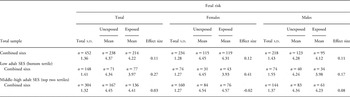
Table 2 shows the parameter estimates from the multivariate mixed model for the association between fetal risk and subsequent HF-RRV. In comparison with the unexposed, fetal risk was significantly associated with decreased HF-RRV (mean difference = 0.15, F = 3.64, P = 0.05), particularly in the lowest SES strata (Fetal risk × SES interaction: F = 4.31, P < 0.04). As seen in Table 2, the effect size in the lowest SES tertile was nine times than that of the middle and high SES group (0.27 v. 0.03, respectively). The impact of fetal risk on HF-RRV was not modified by sex [fetal risk × sex interaction: F = 0.02, P = 0.90, non-significant (NS)]. However, among those in the lowest SES tertile, the effect size for females (0.41) was more than double than that for males (0.17). In sex-specific models, the HF-RRV was significantly lower in the exposed compared with the unexposed among low SES females (P = 0.005), and a trend among the low SES males (P = 0.13).
Impact of fetal riskFootnote * on cardiac parasympathetic regulation in response to stress 40 years later

* Fetal risk defined as the presence of growth restriction (birth weight for gestational age) and/or preeclampsia (singleton pregnancies between 38 and 43 weeks of gestation).
Table shows parameter estimates based on combined Boston (n = 233) and California (n = 219) sample for log[high-frequency R-R interval variability (HF-RRV)] using a mixed model approach adjusted for intrafamilial correlation as well as for baseline HF-RRV, low SES (interaction of low SES and fetal risk on HF-RRV is significant; F = 4.3, P < 0.04), sex and Caucasian ethnicity.
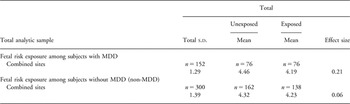
The second set of analyses asked the question whether the association between fetal risk and HF-RRV was the same among MDD and non-MDD subjects. Table 3 shows the mixed model parameter estimates from these analyses. The interaction between fetal risk and MDD did not meet statistical significance; however, when the sample was stratified by MDD status, the association between fetal risk and HF-RRV was significant only among those with MDD and not among those without (MDD: mean difference = 0.28, F = 3.82, P = 0.05; non-MDD: mean difference = 0.09, F = 0.84, P = 0.36). The effect size of fetal risk on HF-RRV among MDD subjects was more than three times than that among non-MDD subjects (0.21 v. 0.06), and it was not modified by SES.
Impact of fetal riskFootnote * and MDD on cardiac parasympathetic regulation in response to stress 40 years later

MDD, major depressive disorder; SES, socioeconomic status.
* Fetal risk defined as the presence of growth restriction (birth weight for gestational age) and/or preeclampsia (singleton pregnancies between 38 and 43 weeks of gestation).
Table shows parameter estimates based on combined Boston (n = 233) and California (n = 219) sample for log[high-frequency R-R interval variability (HF-RRV)] using a mixed model approach adjusted for intrafamilial correlation as well as for baseline HF-RRV, MDD status, low SES, sex and Caucasian ethnicity.
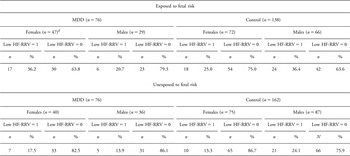
We then investigated the comorbidity of MDD and low HF-RRV (operationalized as the lowest quartile of HF-RRV) by fetal risk exposure and sex. Females were at significantly higher risk for the comorbidity of MDD and low HF-RRV (lowest quartile) than males: females: 10.3% (24/234); males: 5.0% (11/218); RR = 1.36, 95% CI: 1.07–1.73. The interaction between sex and MDD on low HF-RRV was significant (z = 2.26, P = 0.02). Investigating whether fetal risk was associated with this sex difference (shown in Table 4), the fetal risk-exposed females were significantly more likely to experience comorbid MDD and low HF-RRV than fetal risk-exposed males (female: 36.2% v. male: 20.7%; RR = 1.38, 95% CI: 1.04–1.83). This was not seen among participants unexposed to fetal risk (female: 17.5% v. male: 13.9%; RR = 1.22, 95% CI: 0.74–2.0). Further, the relationship between fetal risk and adult comorbidity was even stronger for fetal-risk exposed women compared with unexposed women (RR = 1.46, 95% CI: 1.09–1.95). The interaction between fetal risk and sex was not significant (z = 1.39, P = 0.16), although, likely, we lacked adequate statistical power.
Comorbidity of cardiac parasympathetic dysregulation (low HF-RRVFootnote a ) and MDDFootnote b by sexFootnote c and fetal riskFootnote d

HF-RRV, high-frequency R-R interval variability; MDD, major depressive disorder.
a Low HF-HRV was defined as the lowest quartile of HF-HRV among the control sample.
b Non-MDD males > non-MDD females (exposed, female: 25% v. male: 36.4%; unexposed, female: 13% v. male: 24%; relative risk (RR) = 1.30, 95% CI: 1.03–1.62).
c Comorbidity: females > males (z = 2.26, P = 0.02; RR = 1.36 95% CI: 1.07–1.73).
d Fetal risk-exposed females > fetal risk-exposed males (36.2% v. 20.7%, RR = 1.38, 95% CI: 1.04–1.83).
Table 4 also shows that among non-MDD subjects, males were at higher risk for being classified in the lowest quartile of HF-RRV than females, regardless of fetal risk status (RR = 1.30, 95% CI: 1.03–1.62; in the exposed, male: 36.4% v. female: 25%; in the unexposed, male: 24% v. female: 13%; see Table 4). However, among MDD subjects, a different pattern was evident (see Table 4). Within the MDD subjects exposed to fetal risk, females had a higher risk than males of being in the lowest quartile of HF-RRV (female: 36.2% v. male: 20.7%, χ 2 = 0.2, P = 0.03). Within the MDD subjects unexposed to fetal risk, the risks were similar for males and females (male: 13.9% v. female: 17.5%, χ 2 = 4.6, P = NS).
Regarding whether one of the fetal risk conditions was driving our results, we did not have sufficient statistical power to report the results by PE and GR separately. However, we conducted these analyses and the results, though stronger for PE, went in the same direction for both exposures.
Discussion
Findings in this study showed a significant association between exposure to GR or PE during pregnancy and cardiac parasympathetic regulation in response to stress 40 years later, particularly for individuals in the low SES strata. The association between these fetal risk factors on cardiac regulation was primarily observed among those who subsequently developed MDD compared with non-MDD subjects. When the comorbidity of very low HF-RRV and MDD were examined together, it was the females who experienced the higher risk for comorbidity than males (RR = 1.38), and specifically, among those exposed to fetal risk. Males were at risk for very low HF-RRV regardless of fetal exposure, but not for the comorbidity with MDD. These findings suggest that these fetal risk factors were more pronounced among female fetuses who were also at risk for MDD, whereas males in general were at risk for very low HF-RRV regardless of fetal exposure.
The results are consistent with population studies reporting the association between GR or PE on CVD,Reference Quinkler and Stewart 17 , Reference Barker 18 but extend these to outcomes 40 years later on a specific physiological indicator of ANS regulation (i.e. parasympathetic cardiac control), a known risk factor for CVD.Reference Whitsel, Raghunathan and Pearce 49 , Reference Liao, Sloan and Cascio 52 Findings are also consistent with studies showing a higher risk of CVD in the lower SES strata.Reference Clark, DesMeules, Luo, Duncan and Wielgosz 69 We further supported previous population studies reporting higher rates of the comorbidity of MDD and CVD in womenReference Naqvi, Naqvi and Merz 22 , Reference Moller-Leimkuhler 23 and sex-specific effects of fetal complications. However, we extended these findings to suggest potential shared fetal programming of the female risk for the comorbidity of these two disorders, and the male risk for severe ANS dysregulation regardless of psychiatric or exposure status.Reference Lloyd-Jones, Adams and Carnethon 70 Recent study on the impact of low birth weight on young adult (∼26 years of age) ANS and baroreceptor control of cardiac function showed that females, compared with males, showed greater sympathetic cardiac dysregulation and reduced baroreflex sensitivity in response to a psychological stressor.Reference Jones, Beda and Ward 71 In pre-pubertal children in another birth cohort, these authors found differing effects in boys (e.g. motor activity dysfunction under stress) and in girls suggesting developmental changes in both sexes due to pre- and perinatal factors affecting low birth weight.Reference Jones, Beda and Osmond 72 , Reference Schlotz, Jones, Phillips, Godfrey and Phillips 73 Further, findings in females in the study presented here are also consistent with our recent functional magnetic resonance imaging study in which we showed that, in adult women with recurrent MDD compared with healthy control women, brain activity deficits in specific regions in the stress response circuitry (i.e. HPA circuitry) in MDD were significantly associated with low parasympathetic control of the heart in response to a stress challenge.Reference Lee, Holsen and Spaeth 74
The fetal risk factor findings presented here are even more striking given that our definition of GR and PE did not include preterm births, which would have included the more severe GR or PE cases. Most studies of the association between birth weight and later health outcomes do not distinguish between low-birthweight term births compared with low-birthweight preterm babies. Preterm birth is associated with multiple deleterious outcomes across different disorders. In this study, we were interested in the association of factors associated with PE or GR, such as maternal immune activation, controlling for gestational age (i.e. full-term births). This might produce more subtle effects on the development of brain or heart tissue and thus may have attenuated their impact on depression in general 40 years later. This may be one reason why our fetal risk complications had a stronger association (half a standard deviation effect size) with recurrent MDD than on MDD in general, although not significant. Previous work from the New England CPP sample reported a non-significant association between GR on MDD.Reference Vasiliadis, Gilman and Buka 75 Although our methods and hypotheses were different from the earlier work, our findings are consistent but also suggest that PE and GR may be associated with some differences in outcomes by sex, a hypothesis we are currently testing.
Programming effects on the ANS have been shown in animal models, including rats, mice, guinea pigs, pigs and sheep.Reference Masuzaki, Yamamoto and Kenyon 76 – Reference Haussmann, Carroll and Weesner 81 Prenatal experimental perturbations causing irreversible consequences in the offspring have included altered maternal nutrition, directly modified endocrine pathways (e.g. administration of glucocorticoids), uterine artery ligation and induced anemia or hypoxia.Reference Seckl 77 , Reference Broberg, Giraud and Schultz 82 , Reference Simmons, Templeton and Gertz 83 Insults can occur in embryonic stages or later in fetal development, and adult health consequences have ranged from altered behavior (e.g. increased appetite) to anatomy (e.g. increased fat deposition), physiology (e.g. insulin resistance) and general morbid outcomes (e.g. shortened lifespan).Reference Breier, Vickers, Ikenasio, Chan and Wong 84 , Reference Ozanne and Hales 85
The underlying assumption in this study was that sustained maternal systemic inflammation is a stimulus for abnormal fetal programming in humans. Fetal cardiac function, including RRV, has been studied as an indicator of fetal development.Reference DiPietro, Bornstein, Hahn, Costigan and Achy-Brou 86 – Reference Dipietro, Irizarry, Hawkins, Costigan and Pressman 88 Evidence from animal and human studies suggest that a variety of stressors occurring during pregnancy have physiological consequences that are manifested by alterations in the growth of the fetal body and brain and fetal cardiac function and RRV.Reference Prechtl 89 , Reference de Weerth and Buitelaar 90 For example, patterns in the heart rate dynamics of uncomplicated GR fetuses were found to be significantly less complex, more chaotic and less periodic than the dynamic parameters observed in non-GR fetuses. Prenatal studies of fetuses born small-for-gestational-age (SGA) have repeatedly shown reduced RRV in SGA compared with appropriate-for-gestational age fetuses in a variety of conditions, including during sleep,Reference Spassov, Curzi-Dascalova and Clairambault 91 under periods of maternal stress and anxiety,Reference Monk, Fifer and Myers 92 and during Braxton–Hicks contractions.Reference Arduini, Rizzo and Rinaldo 93 These results suggest that, although GR fetuses are not severely compromised, the overall integrity of their cardiovascular control is impaired. SGA fetuses show a consistent change in the balance between sympathetic and parasympathetic control over cardiac function, with a diminished parasympathetic and increased sympathetic modulation.Reference Lee, Park, Hwang, Park and Yum 94
Studies have shown some stability of fetal effects on cardiac function and RRV into childhoodReference DiPietro, Bornstein, Hahn, Costigan and Achy-Brou 86 , Reference Lewis, Wilson, Ban and Baumel 95 , Reference Thomas, Haslum, MacGillivray and Golding 96 and adulthood.Reference Meyer and Zhang 97 – Reference Sherwood, Girdler and Bragdon 100 This is important for this study, as we showed that these fetal complications have implications for adult heart and brain function. Differences in autonomic system regulation and sympathetic activation have been significantly associated with distinct patterns of behavioral reactivity and emotional regulation in infants,Reference Dierckx, Tulen and Tharner 101 – Reference Calkins 103 implicating the ANS relationship with mood regulation. Longitudinal studies, although still rare, support the continuity of individual differences in autonomically modulated traits and behaviors over many years.Reference Bubier, Drabick and Breiner 104 – Reference Gillum, Taylor, Anderson and Blackburn 107 Physiological risk factors for CVD that are under autonomic regulation, such as BP, appear moderately stable over the life course in terms of their rank ordering between individuals.Reference Sherwood, Girdler and Bragdon 100 , Reference Gillum, Taylor, Anderson and Blackburn 107 , Reference Kim, Kiefe and Liu 108 Taken together, studies on fetal antecedents to RRV support the notion that adverse fetal exposures result in consequences for the stress response system, which may result in abnormalities in the autonomic regulation of the heart and mood dysregulation in adulthood, as we have suggested here.
Our findings have implications for understanding the fetal risk for potential CVD in adulthood, for which the rates are higher in menReference Lloyd-Jones, Adams and Carnethon 70 and the higher risk for the comorbidity of MDD and CVD in women,Reference Naqvi, Naqvi and Merz 22 , Reference Moller-Leimkuhler 23 which few studies have investigated. Our findings are consistent with the fact that women have higher rates of MDD than menReference Kessler, McGonagle, Swartz, Blazer and Nelson 109 and MDD is a risk factor for CVD.Reference Lett, Blumenthal and Babyak 3 The findings here suggest that sex differences in the MDD–CVD comorbidity begin, in part, during fetal development. This fits with our hypotheses about fetal antecedents to sex differences in other neurodevelopmental disorders that posit that prenatal complications that may disrupt the development of HPA circuitry and that occur during the hormonal regulation of the sexual differentiation of the brain (i.e. mid-to-late gestation) will have sex-specific consequences for the risk for disorders that are regulated, even in part, by this circuitry.Reference Goldstein, Seidman and O'Brien 110 – Reference Anastario, Salafia, Fitzmaurice and Goldstein 112
Acknowledgements
This study was supported by NIMH-NHLBI RO1 MH074679 [Goldstein, principal investigator (PI)] and NIA P01 AG023028 (Susser, overall PI) and, in part, by ORWH-NIMH P50 MH082679 (Goldstein, P.I.). The authors thank Harlin Aizley, Ed.M., for her clinical diagnostic interviewing expertise and collection of RRV data; Jo-Ann Donatelli, Ph.D. for her clinical expertise in training and quality control of psychiatric and cognitive data; Christiana Provencale, MA, for her efforts in managing the recruitment team at Brown; Howard Andrews, Ph.D., for his contribution to data management; Catherine Schaefer, Ph.D., for overseeing the original NIA work in California; and Kim Fader for her administrative help in maintaining connections between multiple sites involved in this study.