INTRODUCTION
Tuber crops are important staples for several people in tropical and sub-tropical areas in Africa, Asia and Latin America (El-Sharkawy, Reference El-Sharkawy2003; Enete, Reference Enete2009; Enete and Igbokwe, Reference Enete and Igbokwe2009; Lebot, Reference Lebot2009). This is the case of cassava (Manihot esculenta Crantz), a perennial shrub that adapts well to various environmental conditions and cropping systems. This species is grown by poor farmers, many of them women, often on marginal land. For those people and their families, cassava is vital for both food security and income generation (Enete, Reference Enete2009; Howeler et al., Reference Howeler, Lutaladio and Thomas2013). The plant requires little investment and provides a relatively high yield (Howeler et al., Reference Howeler, Lutaladio and Thomas2013). Planting and harvesting are not seasonal and tubers may remain buried in the soil for up to 24 months to be harvested as needed (Burns et al., Reference Burns, Gleadow and Cavagnaro2010).
Cassava fine root systems are sparse compared to those of some tropical grasses generally found in cassava plots as intercrop (Spear grass – Imperata cylindrica; running carpet grass – Axonopus compressus; Bahama grass – Cynodon dactylon; Guinea grass – Panicum maximum; Siam – Chromolaena odorata) (Agumagu et al., Reference Agumagu, Adesope and Matthews-Njoku2008; Iyagba, Reference Iyagba2010). Such condition enables root interaction between species and might lead to competition in exploring shared soils for nutrient and water (Tscherning et al., Reference Tscherning, Leihner, Hilger, Müller-Sämann and EL-Sharkawy1995). This competition is of paramount importance in intercropping systems of cassava involving other species with aggressive rooting systems (El-Sharkawy, Reference El-Sharkawy2003).
Although cassava has numerous agronomical advantages, its sustainable production faces many challenges among which pest and weed management (Chikoye et al., Reference Chikoye, Manyong, Carsky, Ekeleme, Gbehounou and Ahanchede2002), fertilization (Olasantan et al., Reference Olasantan, Lucas and Ezumah1994), breeding for yield quality and quantity (Ceballos et al., Reference Ceballos, Iglesias, Perez and Dixon2004; Nassar and Ortiz, Reference Nassar and Ortiz2010) and post-harvest conservation (El-Sharkawy, Reference El-Sharkawy2006) are of main concerns. Significant progress has been achieved in some topics but few high yield, multiple pest resistant and low cyanogenic potential clones are actually identified and diffused in rural zones (Cock, Reference Cock1976; Howeler et al., Reference Howeler, Lutaladio and Thomas2013; Mahungu et al., Reference Mahungu, Dixon and Kumbira1994; Tshiunza et al., Reference Tshiunza, Okechukwu and Dixon1999). In tropical Africa and Asia, cassava production generally requires 2–3 regular weeding during the phase of the canopy development and early tuberization to have optimum yields (Melifonwu, Reference Melifonwu1994). Then, the critical period of weed competition with cassava is between 60 and 120 days after planting, corresponding to the development phase (Doll and Piedrahita, Reference Doll and Piedrahita1976). In fact, weed competition with cassava during this phase can reduce the yield from 48 to 90% (Iyagba, Reference Iyagba2010).
Hand weeding is the most common approach to insure an acceptable yield (Dadari and Mani, Reference Dadari and Mani2005). The recommended hand weeding time for cassava is 3, 8 and 12 weeks after planting, with cassava varieties producing adequate canopy to suppress weed growth at a plant population of 10,000 plants ha–1 after three months (Melifonwu, Reference Melifonwu1994). However, hand weeding is a tedious process that can occupy 50–70% of the working time (Chikoye et al., Reference Chikoye, Schulz and Ekeleme2004) and represents 30–50% of the total budget for all plough operations (Akobundu, Reference Akobundu1991; Iyagba, Reference Iyagba2010). As an alternative, cassava varieties showing tolerance to weed would be used in farming systems. Genotypic variation in relation to weed tolerance was already reported (Silva et al., Reference Silva, Santos, Cury, Carvalho, Silva, Fernandes, Ferreira and Concenço2013). Although the use of herbicides is possible, it is still too expensive, especially for small farmers. In such context, this paper evaluated the weed tolerance in four of the most popular cassava varieties cropped in West Africa.
MATERIALS AND METHODS
Site description
The study was conducted at the experimental station of the Nangui Abrogoua University in Abidjan (Côte d'Ivoire) for two consecutive years (May 2008 to March 2009 and August 2009 to June 2010). The study site is located between 5°17′N and 5°31′N and 3°45′W and 4°22′W. The climate is a wet subequatorial, with the mean annual rainfall of 1350 mm, and an mean annual temperature of about 25 °C. The soil is ferrallitic, characterized by the forest land (Supplementary Table S1 available online at https://doi.org/S0014479717000151), and has a sand-clay texture and cluster structure (Yao-Kouamé and Allou, Reference Yao-Kouamé and Allou2008; Yao-Kouamé and Kane, Reference Yao-Kouamé and Kane2008).
Plant material
Four popular varieties of cassava were used, locally known as Bonoua blanc, Yassé, Tambou and Six mois. Bonoua Blanc and Tambou are early branching varieties and their branches are located near the soil surface. Yassé branch out over 50 cm distance away from the ground. These varieties have sylleptic axes, which emerge from the transformation of apical meristems into floral meristems. At each flowering, several branches (2–4) grow simultaneously on Yassé, Bonoua blanc and Tambou. However, the variety Six mois does not bloom during its crop cycle and has an upright habit. Vegetative material for propagation was selected from sufficiently lignified healthy mother plants (12 months after planting). The size of the cuttings was 25 cm long, bearing 5–6 nodes. Upright planting at 90° was adopted, which provided a circular section at the base of the cutting and uniform distribution of basal roots.
Experimental design
The experimental design was a complete randomized block with four varieties, six treatments and three replications implemented on a 1750 m2 (25 m × 70 m) plot. Each treatment consisted of a subplot of 6 m2 (2 m × 3 m). The spacing between one subplot and another was 2 m wide, and the plots were weeded regularly as required. The treatments were periods of grassing after planting: control (complete weeding from planting – T0), from the 2nd month to the harvest (T2), from the 4th month to the harvest (T4), from the 6th month to the harvest (T6), from the 8th month to the harvest (T8) and from 10 months of grassing after planting (T10). T0 corresponded to the cropping process in plots, where hoe weeding was practiced weekly to prevent any interaction between cassava varieties and weed from planting to harvest (10 months after). For the other treatments, the plots were regularly weeded until the end of the indicated periods. Each subplot received 12 cuttings sown on 3 lines of 4 holes, with 0.9 m between holes and lines. None fertilizer and insecticide were applied to enhance plant production or to control diseases and pests.
Crop traits
Seven agronomic traits selected from the descriptors of cassava (Fukuda et al., Reference Fukuda, Guevara, Kawuki and Ferguson2010) were examined in this study: number of stems from the same cutting (NSC), number of leaves per plant (NLP), diameter of the base of the stem (DSB), total stem length (TSL), average number of tuberous roots per plant (NTRP), weight of tuberous roots per plant (WTRP) and yield per hectare (YH). The evaluations were made on 10 randomly selected plants in each subplot. The harvest of these plants took place 10 months after planting according to Lenis et al. (Reference Lenis, Calle, Jaramillo, Perez, Ceballos and Cock2006). After determining NSC, NLP was estimated according to Daellenbach et al. (Reference Daellenbach, Kerridge, Wolfe, Frossard and Finckh2005) by multiplying the number of apex per plant by the average number of leaves per apex. At harvest, plants were uprooted and NTRP and WTRP were recorded on 10 plants per variety (Aniekwe et al., Reference Aniekwe, Okereke and Anikwe2004). YH was estimated by the product of WTRP and the number of plants per hectare. Finally, all the weed species noticed in the subplots were identified.
Statistical analysis
Mean values and standard deviations were calculated for each trait, considering varieties and exposure time to weeds. Combined multivariate analysis of variance (MANOVA) appropriate to two factors (variety and regular grassing period duration) and several independent variables was performed to compare varieties and weed effects, as well as their interaction. This allowed the identification of significant factors based on a vector of dependent variables. The General Linear Models (GLM) procedure of the SAS v.9.1 (SAS, 2004) was used to identify traits contributing to differences, when MANOVA revealed significant difference for a factor. Least Significant Difference (LSD) multiple range-tests were used to identify differences among mean values.
RESULTS
The main weed species identified in the trials were: Panicum maximum Jacq. – Poaceae, Eupatorium odoratum (L.) King & HE Robins – Asteraceae, Imperata cylindrica (L.) Beauv. – Poaceae, Axonopus compressus (Sw.) P. Beauv. – Poaceae, Ageratum conyzoides (L.) – Asteraceae and Cynodon dactylon (L.) – Poaceae.
Varieties, competition time and the interaction ‘varieties × period of grassing’ have a significant effect on crop growth and yield (Supplementary Table S2 available online at https://doi.org/S0014479717000151). As interaction is statistically significant for growth parameters, data analysis and interpretation will be done with the interaction table (ANOVA II).
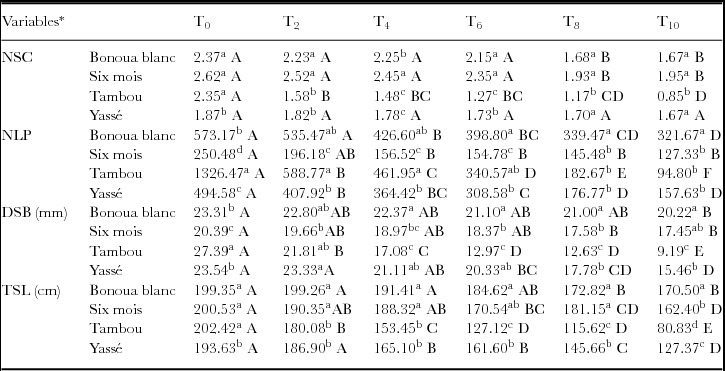
In weed absence (T0), the Tambou variety produced stronger stems (given by DSB and TSL) with many leaves (NLP) compared to Bonoua Blanc, Six mois and Yassé (Table 1). However, Tambou presented slow growth rate during the initial phase of development (first 4 months after planting), which turns it very sensitive to the competition with weeds. Under late competition (4–10 months), Bonoua Blanc had superior vegetative growth (given by NLP, DSB and TSL) as compared to Six mois and Yasse (Table 1). Considering growth parameters and regardless the duration of the competition, Bonoua Blanc was less sensitive and more competitive than the other varieties used.
Interaction effect of cassava varieties and different weed time on growth parameters: number of stems from the same cutting (NSC), number of leaves per plant (NLP), diameter of the base of the stem (DSB), total stem length (TSL). Weed times were: T0 = complete weeding from planting to harvest, T2 = from 2 months of grassing after planting, T4 = from 4 months of grassing after planting, T6 = from 6 months of grassing after planting, T8 = from 8 months of grassing after planting, T10 = from 10 months of grassing after planting.

* Values followed by the different letter in a line (capital letters) and in a column (tiny letters) are significantly different (p < 0.05) using LSD.
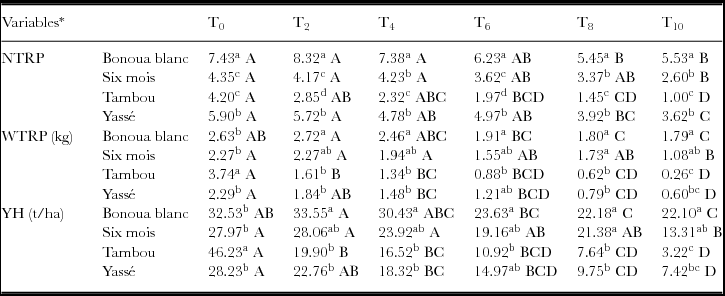
Plants produced more roots per plant in weed absence (T0) than those obtained on other plots with different grassing periods. The trend showed that all varieties presented reduction in tuber number after 2 months. However, the average number of roots per plant began to decrease significantly from eight months for Yassé, six months for Bonoua Blanc and Six mois, while it was two months for Tambou (Table 2). Based on the average number of tubers per plant, Yassé seems to withstand the most weed pressure than the other varieties, while Tambou was the most sensitive. The level of sensitivity of Yassé and Tambou were based on the average weight of tubers per plant, which commenced from two months of grassing. The sensitivity of Six mois and Bonoua blanc was observed after four and six months of grassing, respectively. Furthermore, the results showed that long competition period impaired tuber yield. The values of yield parameters linearly decreased with increasing grassing period of the each cassava variety. Thus, the highest yields were obtained with initial weed control (first months after planting). In such condition, Tambou had the highest yield (46.23 t/ha). However, Tambou yield was reduced in 57% (19.9 t/ha) without weed control during the first two months, showing the lowest yield. With absolute weed control (T0) and control until 2 months after planting, there were more tubers in all varieties, with exception of Tambou. In addition, the time of grassing influenced significantly the number and average weight of roots per plant of the four varieties. For a same period of grassing, NTRP, WTRP and YH values were higher in Bonoua blanc compared to those presented by Yassé and Six mois, and the lowest values were always found in Tambou.
Interaction effect of cassava varieties and different weed time on yield parameters: average number of tuberous roots per plant (NTRP), weight of tuberous roots per plant (WTRP), and yield per hectare (YH). Weed times were: T0 = complete weeding from planting to harvest, T2 = from 2 months of grassing after planting, T4 = from 4 months of grassing after planting, T6 = from 6 months of grassing after planting, T8 = from 8 months of grassing after planting, T10 = from 10 months of grassing after planting.

* Values followed by the different letter in a line (capital letters) and in a column (tiny letters) are significantly different (p < 0.05) using LSD.
DISCUSSION
The impact of weed depends on either the duration or type of weeds (Iyagba, Reference Iyagba2010). The main weeds identified in our study are among the weeds commonly listed in many fields of cassava in wet agro-ecological zones (Agumagu et al., Reference Agumagu, Adesope and Matthews-Njoku2008; Iyagba, Reference Iyagba2010). Both cassava growth and yield declined with increasing duration of weed presence. This is in agreement with Thakral et al. (Reference Thakral, Pandita, Khurana and Kaloo1989), who stated that in unweeded control plots the tuber yield of potato was reduced by 40–43%. Thus, the establishment of interspecific competition contributed to a reduction in resource allocation for better growth and yield of cassava. When comparing cassava cultivars, Tambou produced more vigorous stems bearing numerous leaves and had the highest yield under complete weeding (Table 2). In fact, this variety branches early and has a tetrachotomous appearance. It has the advantage of having a lot of nodes and therefore produce more leaves than other varieties. This induces protection of tuber against insolation for keeping them in high humidity conditions (Lahai et al., Reference Lahai, Ekanayake and George2003). According to Lenis et al. (Reference Lenis, Calle, Jaramillo, Perez, Ceballos and Cock2006), an optimum leaf area index is essential to ensure the best tuber yield. When competition is avoided by weed suppressing, soil resources are available for cassava, resulting in the increase of size and longevity of green leaves, thereby increasing the size and longevity of the leaf area available for light interception (Wolfe et al., Reference Wolfe, Henderson, Hsiao and Alvino1988).
Sensitivity to weed varies depending on the variety. The results showed that the average number of tubers per plant begins to decline significantly from 10 months for Bonoua blanc, eight months for Yassé, four months for Six mois and two months for Tambou. Based on the average number of tubers per plant, Bonoua blanc seemed to be the one that withstands the most weed while Tambou is the most sensitive variety (Table 2). Our data indicate that Bonoua blanc, a traditional and vigorous variety, requires a low frequency of hand weeding and is able to tolerate weed (Melifonwu, Reference Melifonwu1994). In addition, our data revealed that the two first months after planting are those ones of highest vulnerability, period in which weed must be controlled.
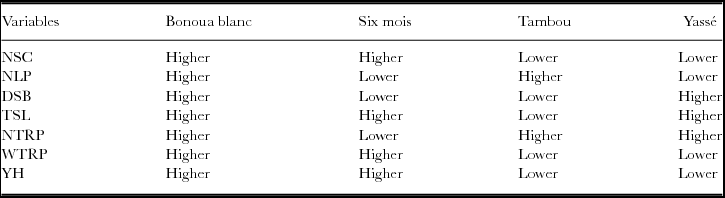
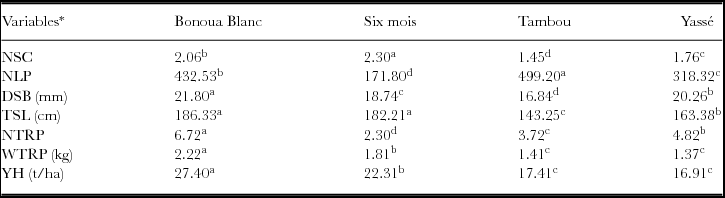
Varietal differences are noted in the durability of the sheet of cassava. Whatever the duration of weed, only Bonoua blanc was able to carry large number of leaves. According to Lenis et al. (Reference Lenis, Calle, Jaramillo, Perez, Ceballos and Cock2006), there are a high correlation between leaf retention and the yield of fresh roots. The simple visual assessment of leaf retention, namely the total number of leaves at harvest, could be used as a criterion selection of tolerant varieties. In this way, cassava plants impose a shading condition to weeds. Despite the presence of weeds, Bonoua Blanc has higher growth and yield than Tambou, Yasse and Six mois (Tables 3 and 4).
Synthetic description of the growth and yield traits of four popular varieties of cassava under weed competition: number of stems from the same cutting (NSC), number of leaves per plant (NLP), diameter of the base of the stem (DSB), total stem length (TSL), average number of tuberous roots per plant (NTRP), weight of tuberous roots per plant (WTRP) and yield per hectare (YH).

Comparison of the cassava varieties based on growth and yield average traits: number of stems from the same cutting (NSC), number of leaves per plant (NLP), diameter of the base of the stem (DSB), total stem length (TSL), average number of tuberous roots per plant (NTRP), weight of tuberous roots per plant (WTRP) and yield per hectare (YH).

* Values followed by the different letter in a line are significantly different (p < 0.05) using LSD.
Although Six mois had produced few tubers per plant, they grew better as compared to Yassé and Tambou (Tables 3 and 4). This inverse relationship between the number of tubers per plant and average weight can be explained by the availability of nutritional resources. When the amount of available food resources is fixed, the resource allocation to each tuber is high when the number of offspring is low (Zhang and Jiang, Reference Zhang and Jiang2000).
Our study suggests the existence of a trade-off between weed tolerance and yield. This analysis suggests that improving the competitiveness of weed while minimizing possible trade-offs with productivity would involve combining weed tolerance, growth and yield. This is due to the fact that individuals must distribute their resource among at least three functions (maintenance, reproduction and growth) and that there are many potential combinations. However, trade-offs between these functions are likely to limit the number of possible combinations of resource allocation. Here, our results suggest the existence of the trade-offs between weed tolerance and cassava growth and yield. Competitive cultivars would be relevant for integrated weed management and should contribute to delay the evolution of herbicide resistance (Pérez de Vida et al., Reference Pérez de Vida, Emilio, Laca, David, Mackill, Grisel, Fernández and Fischer2006).
The next step in our research will be to evaluate the usefulness of Yasse and Six mois varieties, whose low competitive ability and high harvest index could be advantageously used in association with early maturing plants, mainly Six mois which has a favourable canopy structure for association.
CONCLUSION
Cassava requires a period of four months without weeds after planting to avoid competition and yield losses. Among the four traditional varieties tested, Bonoua blanc had the most vigorous growth under weed competition, which likely reduced weed growth. Based on NLP, average number of tubers per plant and average weight of tubers per plant, a reasonable competitive ability during the crop establishment was also found in Bonoua blanc, being a feasible alternative to improve crop yield.
SUPPLEMENTARY MATERIAL
For supplementary material for this article, please visit https://doi.org/S0014479717000151.