Introduction
When Lassa Oppenheim, one of the most influential international lawyers of the twentieth century (Schmoeckel Reference Schmoeckel2000), first published his seminal treatise on international law in 1905, he argued that breaches of international legal obligations committed by states were “delinquencies,” violations of law that are not legally crimes. His was not an isolated opinion. It represented the conventional wisdom in legal thought at the time: the law of nations was a law between, not above, states. Violations of international law—including aggressive war and violations of the laws of war—could not constitute crimes because there was no power above states to determine or enforce criminal responsibility (Oppenheim 1905, I:201§151). The same argument could still be found in the third edition from 1920 (Oppenheim 1920, I:245§151).Footnote 1 In the 1952 edition, however, Oppenheim's treatment of aggressive war reflected a new consensus in the international legal field. It was now explicitly defined as an international crime punishable by the international community. More radically, states could commit crimes, and state representatives could be held accountable for them (Oppenheim 1952, II:192§52).
The emergence of “international crime” as a legal category in the first half of the twentieth century constituted a significant shift in how international lawyers understood the rights and obligations of states and their leaders under international law. This shift is reflected in the Nuremberg Charter (United Nations 1945), the Genocide Convention (United Nations General Assembly 1948), and the work of the International Law Commission on a Draft Code of Offenses Against the Peace and Security of Mankind (1950). These legal documents defined crimes against peace (aggressive war) and genocide, as well as war crimes and crimes against humanity as punishable offenses under international law, opening the door to active negotiations over institutionalized criminal prosecution that included the possibility of an international criminal court. In the span of the thirty years between Oppenheim's 1920 and 1952 editions, international crime had not only entered the legal vocabulary but also the realm of international politics. The legal norm protecting the immunity of state officials from criminal responsibility and accountability had weakened significantly.
There was nothing inevitable about this outcome. Means to address violations of international law already existed, and the very idea of international crime and prosecution challenged how states understood their legal obligations under international law. Moreover, the effect that the criminalization of certain transgressions would have on state behavior was uncertain at best, and whether and how international criminal prosecution should be institutionalized remained, even after the Nuremberg Trials, a hotly contested question.
The emergence of international crime as a legal category poses a puzzle. Scholars of international law and international relations trace the development of international criminal law to a growing interest among states and nonstate actors in the protection of vulnerable populations and the punishment of human rights abuses by state actors otherwise unaccountable for their actions (Leonard Reference Leonard2005; Schiff Reference Schiff2008; Simmons and Danner Reference Simmons and Danner2010; Borgwardt Reference Borgwardt, Iriye, Goedde and Hitchcock2012; Hitchcock Reference Hitchcock, Iriye, Goedde and Hitchcock2012; Martinez Reference Martinez2012). They point to the Nuremberg Tribunal after World War II, the first successful effort to prosecute state leaders for waging aggressive war, committing war crimes, and crimes against humanity, as the critical moment that, together with a growing global commitment to human rights norms, produced what Kathryn Sikkink (Reference Sikkink2011) has called a “justice cascade.” The justice-cascade logic powerfully captures the prevailing view among scholars that the development of international criminal prosecution is both progressive and tightly linked to the protection of human rights.
However, this reading of the origins of international criminal prosecution is misleading on three counts. First, the cascade logic infers causes from outcomes, missing the importance of state interests as a major driver of legal innovation in the area of international crime. Second, it obscures the central role that legal norm entrepreneurs, such as international lawyers and law associations, played in shaping the legal foundation of international criminal prosecution. Finally, the justice-cascade logic has the timing of the critical period of legal innovation for international crime wrong. As I will show, it was the period between the world wars during which key ideas gained acceptance both among states and international lawyers. By the time the Allies sought legal justification for the prosecution of Nazis for war crimes after World War II, their legal teams already had a legal vocabulary of international crime and international criminal responsibility on which to draw.
In this article I argue that the emergence of international crime as a legal category in the interwar period (1919–1939) had little to do with protecting human rights. Instead, it is best explained as the outcome of the interaction between states seeking to extend their domestic right to punish into the international realm and international lawyers who had a strong interest in strengthening the prescriptive and institutional force of international law. I theorize the process through which international legal experts shaped the set of tools that states had available to present and defend their rights claims, building on the literature on norm dynamics (Finnemore and Sikkink Reference Finnemore and Sikkink1998; Sandholtz Reference Sandholtz2008) and legalization (Goldstein et al. Reference Goldstein, Kahler and Slaughter2001; Brunnée and Toope Reference Brunnée and Toope2010; Abbott and Snidal Reference Abbott, Snidal, Dunoff and Pollack2012). While state interests were (and remain) a powerful influence on the development of international law, I argue that the relationship of states to international law is not a one-way street. Lawyers have an independent interest in the autonomy of law from politics and push for the development of international legal norms and institutions. Thus legal innovation is best understood in relation to the parameters of the legal field that both enable and constrain processes of legalization by prescribing acceptable methods, procedures, and precedents through which legal norm change can take place. In a nutshell, politics creates the space for legal and institutional innovation, and international lawyers fill this space with legal concepts available to state leaders to react to new problems and challenges. In this way, law not only matters in the immediate political context, but by expanding the legal vocabulary and precedent, meaningfully shapes the parameters of future state action.
The process by which new categories like international crime enter the legal vocabulary and influence state behavior is not causal but dialectical. Over time, states' increasing reliance on law to pursue their interests changes how they (and their representatives) understand the obligations they incur toward individuals and other sovereign actors. The effect of law and legalization is a subtle yet powerful one. Law works not by compelling states to act against their interests but by creating a commitment to legality itself. The commitment to law and legality, in turn, influences state interests and, ultimately, behavior.
The article proceeds as follows. First, I discuss the dynamic relationship of international law and politics to identify the process that leads to the emergence of a new legal category. In a second step I show how this process works in the case of international crime, which was first invoked by both states and international lawyers to describe violations of international law in the immediate aftermath of World War I. In building my case, I analyze primary sources, including debate transcripts, draft codes, contemporaneous books, journal articles, and personal correspondence, as well as political and legal histories of international criminal prosecution. I conclude by briefly discussing the long-term consequences of the interwar legal debate for attempts by international lawyers to strengthen the prescriptive force of international law with regard to the violation of fundamental community norms and to develop an independent court capable of adjudicating international crimes.
The Emergence of New Legal Categories and Norms
The introduction of international crime into the legal and political vocabulary in the early twentieth century signified an important normative shift not only because it challenged notions of sovereign equality, but also because it motivated the development of institutional responses, namely, an authority with the jurisdiction to impose penalties. The development of international crime as a distinct legal category demonstrates how international law is more than a framework that affirms behavioral prescriptions and proscriptions. It is a powerful discourse that, through shared understanding of acceptable and nonacceptable behavior, shapes how states and their representatives interpret their social interactions and present and evaluate their respective rights claims. How transgressions are characterized—as delinquencies or crimes—has important implications for the kinds of obligations and enforcement options (including institutional responses) that are associated with violations of international law. To be clear, the behavioral prescriptions captured by the category “international crime” in the interwar period were not radically new (many were covered by the laws of war and international humanitarian law), but the rights and obligations derived from them, specifically the notion that certain violations of international law entail a right to punish and require an international response, constituted a significant normative change.
Until the nineteenth century, norms regulating interstate relations were supposed to reflect rather than constrain customary state behavior. However, the rise of the nation-state and the consolidation of state power domestically and internationally were also accompanied by an increased reliance on legal norms to legitimize state practice and extend domestic and international rule. The demand for legalization in the nineteenth century went hand-in-hand with the emergence of international law as an academic discipline distinct in both theory and methods from politics and history (Nussbaum Reference Nussbaum1958; Koskenniemi Reference Koskenniemi2001; Coates Reference Coates2010). Professionalization of the legal field, in turn, fueled a growing concern with the legal character and foundation of positive international law in relation to politics on the one hand, and morality and natural law on the other.
The drive to professionalize international law and to establish its practitioners as “impartial” and “independent” representatives of the “legal conscience of the civilized world” (Sacriste and Vauchez Reference Sacriste and Vauchez2007, 102) coincided with an increased interest in peaceful conflict resolution and culminated in the unprecedented effort to codify the laws of war at The Hague conferences in 1899 and 1907. At these conferences, international lawyers pushed for the establishment of a system of international arbitration and courts to regulate interstate conflicts. Increasing codification and the search for formal mechanisms of conflict resolution reflected a shift in preferences among lawyers and state leaders from customary to positive international law (Nussbaum Reference Nussbaum1958, 232ff). The conference diplomacy of the nineteenth century had an important side effect. It bolstered social networks of legal experts who had a personal interest in strengthening international law. These networks were instrumental in shaping the growing institutional order in the international system (Sacriste and Vauchez Reference Sacriste and Vauchez2007).
Still, international law's communal character is what sets it apart from domestic law. International law regulates the interaction of sovereign equals that do not accept a higher authority of legal interpretation that can adjudicate between competing claims or enforce them. Scholars such as H. L. A. Hart (Reference Hart1961) and Posner and Goldsmith (Reference Posner and Goldsmith2005) have used international law's communal character to challenge its legal status, reducing it either to state interest or to a set of nonlegal normative aspirations.
The legalization of international relations operates in this tension between law and politics. It is an expression of the ongoing attempt to build and uphold a distinctively legal normative framework in the face of an increasing political interest in law as a tool of statecraft. Such a shared normative framework—to use Posner and Goldsmith's language—is a necessary focal point for cooperation and coordination among self-interested states (Posner and Goldsmith Reference Posner and Goldsmith2005, Reference Posner and Goldsmith2006; Guzman Reference Guzman2008). The relationship of state interest and international law, however, is not a one-way street, and law is not just a signaling device. That law reflects state interests is the outcome of a process of legal development in which rules and institutions enshrine “the collectively negotiated, socially sanctioned legitimate interest of states” (Reus-Smit Reference Reus‐Smit and Christian2004, 30). Indeed, I argue that this “negotiation” is necessary; without it, law is unlikely to be an expression of state interests or to serve as normative guidance for acceptable state behavior.
Practitioners of international law thus face a unique double constraint. Law, as Posner and Goldsmith rightfully point out, needs to reflect state interests and practice or it risks becoming irrelevant since it lacks independent enforcement power. States will only obey the law if the benefits outweigh the costs. At the same time, law has to be distinguishable from any one state's interest. To be a useful and legitimate tool for states to coordinate their actions and solve cooperation problems, law has to provide distinctive legal normative guidance. Lawyers need to demonstrate that it is possible to transcend particular political interests through the comparatively neutral and objective application of rules. In short, law requires adherence to the criteria and practices of legality (Brunnée and Toope Reference Brunnée and Toope2010).
Law shapes state behavior through iterative and interactive reinforcement of principles or criteria of legality. For Brunnée and Toope, this iterative process generates legal obligations when norm creation and application meet Fuller's criteria of legality (Brunnée and Toope Reference Brunnée and Toope2010, 7; Reference Brunnée, Toope, Dunoff and Pollack2013, 22): generality, promulgation, nonretroactivity, clarity, not asking the impossible, noncontradiction, constancy, and congruence between rules and actions. Adherence to these criteria of legality gives rise to a distinctive legal legitimacy that is derived from the “internal morality of the law” and results in “fidelity to law” (Fuller Reference Fuller1964, 64–90; Brunnée and Toope Reference Brunnée and Toope2010, 25–27). Mine is a narrower claim, in that I do not presume an inner morality of law as Brunnée and Toope (Reference Brunnée and Toope2010, 25–33) do, or a deep constitutional structure expressed as community norms as Reus-Smit (Reference Reus‐Smit1999) does. Rather, states commit to law because it is in their interest to do so. When states turn to law, however, they also commit to the rules by which law operates. This reinforces lawyers' interest in upholding the law and preserving it as institutionally distinct from politics. Empirically, this interaction between state interests and lawyers' efforts to strengthen the prescriptive force of international law is clearly observable in how international law is made. Lawyers do not simply rubber-stamp political interests of states, but struggle to reconcile the states' demand for law with principles of legality. For lawyers, adherence to principles of legality is crucial for maintaining law's status as above and autonomous from politics (Sacriste and Vauchez Reference Sacriste and Vauchez2007, 85).
Rather than claiming that international legal norms are inherently different from political interests or other norms, I argue that new legal norms arise out of the ongoing struggle to distinguish law from both politics and moral prescriptions. According to Martti Koskenniemi (2005, 167), this double constraint features prominently in the argumentative strategies lawyers employ when interpreting legal doctrine. International lawyers face the dilemma of having to prove their loyalty to state interests while preserving the universalist principles that form the basis of their professional community and law more generally (Sacriste and Vauchez Reference Sacriste and Vauchez2007, 102). Continuous effort by legal experts to specify, formalize, and codify prescriptive norms is at the heart of the transformation of (power) political interests and (utopian) morality into the ideal of neutral and objective law. Not only does the dynamic relationship of law and politics drive normative developments, but the legal profession's commitment to a specific kind of law—namely, positive law—also affects the directionality of legalization with a strong preference among international lawyers for formal and institutionalized rules.
International criminal law is a case in point. When international crime entered the legal debate after World War I, lawyers considered international crime and international criminal prosecution necessarily two sides of the same coin. This was in marked contrast to political actors, who saw the punishment of violations of international law as an extension of their domestic right to punish not subject to an independent court. More generally, the drive to legalization and institutionalization is not only motivated by states' demands, it is also driven by international lawyers' need to distance law from politics, to keep the law, as it were, legal.
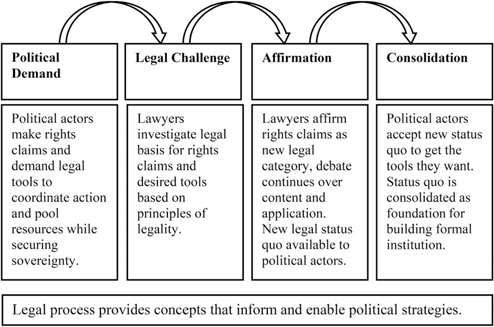
In short, I argue that the development of new legal categories and norms is the result of a dialectical process, the interaction between state interests in law and interests of lawyers in legality. This process has four distinct phases, illustrated in Figure 1.
The Dialectics of Politics and Law.
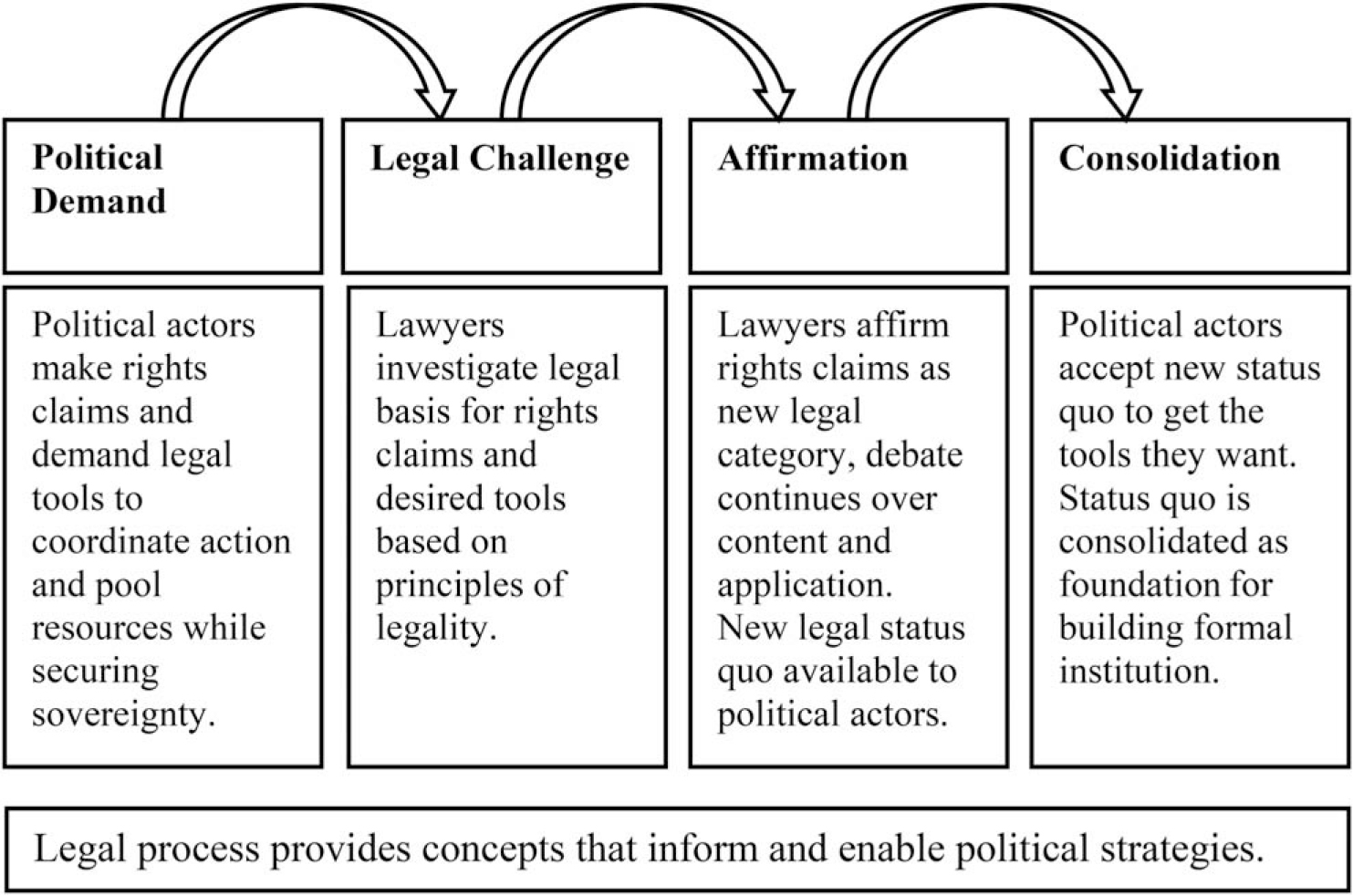
Development of new legal norms is triggered by a conflict over competing rights claims among political actors (states) and the absence of an agreed-upon legal vocabulary and/or institutional authority to adjudicate between these competing rights claim. When states invoke law to back their rights claims (political demand), they invite legal experts, lawyers, and scholars to engage in clarification and to provide argumentative strategies. This can entail formal delegation of authority to legal bodies to clarify or codify existing norms or even develop new ones. However, political demand can also motivate legal experts to push for legal development independently of a direct authorization from states. After all, international lawyers not only have a strong interest in demonstrating their relevance to states, they also have an interest in securing the autonomy of international law. Indeed, the influence of legal scholars on the development of law is often strongest in the most undeveloped areas of law (Peters Reference Peters2013, 536).
As members of a profession, lawyers share a belief system—what Judith Shklar (Reference Shklar1986) aptly calls an ideology—that guides their professional practices and maps their relationship within the legal professions, as well as their relationship to those outside of it. Lawyers evaluate, and at times challenge, political rights claims (legal challenge) based on these shared beliefs anchored in interpretations of principles of legality (Shklar Reference Shklar1986; Brunnée and Toope Reference Brunnée and Toope2010).
Principles of legality demarcate legal from nonlegal proscriptions by prescribing the consistent, neutral, and objective application of law. This requires, first, some level of determinacy (or precision) in the definition of existing legal norms; second, coherence of the overall legal order; and third, public knowledge of legal rules so that actors can reasonably infer the parameters of action that law circumscribes (Fuller Reference Fuller1964, 39–94; Franck Reference Franck1990; Abbott et al. Reference Abbott, Keohane, Moravcsik, Slaughter, Snidal, Goldstein, Kahler, Keohane and Slaughter2001; Brunnée and Toope Reference Brunnée and Toope2010). These criteria of legality inform all processes of legalization. Two principles are particularly important for criminal law: the principle nullum crimen sine lege, namely, that there can be no crime without law; and the principle nulla poena sine lege, that there can be no punishment or penalty without law. Put simply, legality demands that law cannot retroactively impose constraints.
The dialectic between political interests and principles of legality motivates lawyers to accommodate state interest through international law while at the same time defending the special status of legal obligations. Consensus among international lawyers leads to the affirmation of the legal category and shifts the debate toward questions of how and under what conditions the specific behavioral prescriptions apply to particular situations.
The dialectic process described above produces a new legal vocabulary available to states to justify the pursuit of interests in legal terms. However, whether states will use this new vocabulary, and in what context, is underdetermined. Consolidation of new legal categories and the related norms requires that states invoke them to describe, justify, or criticize an action. When a legal norm is taken for granted by states and the community of international lawyers, meaning its existence is no longer challenged even as its applicability in specific cases is disputed, it indicates a change in the normative status quo (Price Reference Price1995).
Indeed, the inherent indeterminacy of norms is a key factor in legal innovation. This indeterminacy is clearly evident in the vigorous interwar debate among legal experts over the existence of international crimes, the authority to punish, and the subject of legal obligation. Consensus among legal experts on the transgressions constituting international crimes and how these should be addressed within an international legal and institutional framework depends on retrospectively embedding diverse voices and positions in a larger narrative of international justice. The consolidation of an authoritative narrative of precedent is a crucial tool in the development of international law. Importantly, a new legal norm does not automatically translate into a change in state behavior. Rather, the consolidation of a new legal category and associated legal norms creates the condition of possibility for the kind of norm cascades and their effects on state behavior described in Finnemore and Sikkink's (1998) influential article.
My argument has clear implications for how we should understand the development of international crime as a legal category. The current literature on international crime and international criminal prosecution locates its origins in the increasing interest among states and nonstate actors in protecting vulnerable populations and greater recognition of rights of the individual after World War II. Authors have described the development of international criminal prosecution as a “swelling river of justice” (Schiff Reference Schiff2008) and see in the creation of the International Criminal Court “the onset of global governance” (Leonard Reference Leonard2005). Other scholars explicitly link the concept of international crime to the protection of human rights (Overy Reference Overy and Sands2003; Leonard Reference Leonard2005; Simmons Reference Simmons2009; Simmons and Danner Reference Simmons and Danner2010; Borgwardt Reference Borgwardt, Iriye, Goedde and Hitchcock2012; Hitchcock Reference Hitchcock, Iriye, Goedde and Hitchcock2012; Martinez Reference Martinez2012). They argue that in the decades that followed the prosecution at Nuremberg, a growing international concern with protecting the rights of the individual combined with a movement of domestic actors seeking to prevent and rectify violations of human rights culminated in calls for international justice and the eventual creation of the international criminal court.
This article challenges the conventional wisdom on the timing of the normative shift and, more importantly, on the underlying assumption that the increasing legalization of international relations was intended as a “justice cascade” to protect the rights of the individual. I caution against inferring intentions (the protection of human rights) from outcomes (increased legalizations of international relations) because it obscures the conditions under which the cause of international criminal justice suddenly became so appealing to state leaders and the opportunities that state leaders saw in defending their sovereign rights when they invoked the concept of international crime. To be clear, I am not challenging the different streams of the justice cascade (international prosecution, domestic and foreign prosecution, development of hard law) so central to Sikkink's (Reference Sikkink2011) powerful analysis of the rise of individual accountability. I do challenge the claim that these streams can be explained by a single normative goal: protection of human rights.
As I will show, the concept of international crime and demand for international criminal prosecution originated in the interwar period out of states' demand to secure their sovereign rights vis-à-vis perceived aggressors. It emerged out of attempts by states to extent their domestic right to punish into the international realm. Lawyers, responding to this political demand for law, sought the codification of international criminal law as a first step to strengthen legal enforcement mechanisms through which violations of international law could be addressed. While state leaders supported the legal process of codifying and institutionalizing international law to protect their sovereign rights, legal experts went further and called for an independent authority to represent the interests of international society and adjudicate violations of communal rights. In other words, states sought legal tools to pursue their interests; in response, lawyers catering to state demands sought to strengthen the special status of legal obligations through adherence to principles of legality. The interwar debate thus highlights how the productive tension between law and politics motivates lawyers to actively construct international law's integrity and coherence while catering to states' interests.
Constructing International Crime
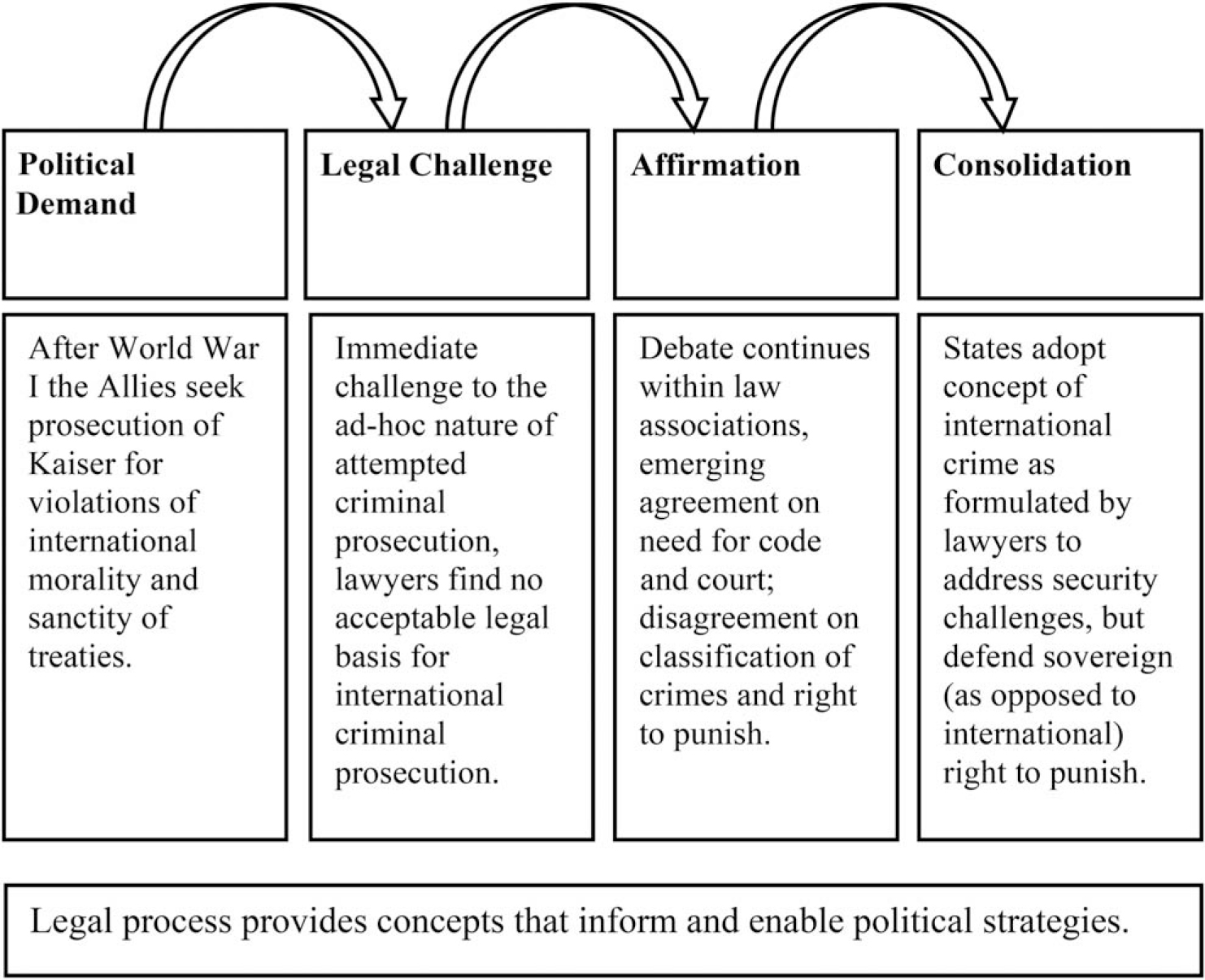
I begin my discussion of the case by substantiating my claim that international crime had no legal status in international legal discourse prior to World War I. Next, using the theoretical framework I developed in the previous section, I trace the four steps in the process by which that status changed in the years between 1919 and World War II. In my analysis I demonstrate the central role played by lawyers and their emphasis on principles of legality in this transformation. The four steps in the process are summarized in Figure 2 and briefly described below.
The Dialectics of Politics and Law Applied.
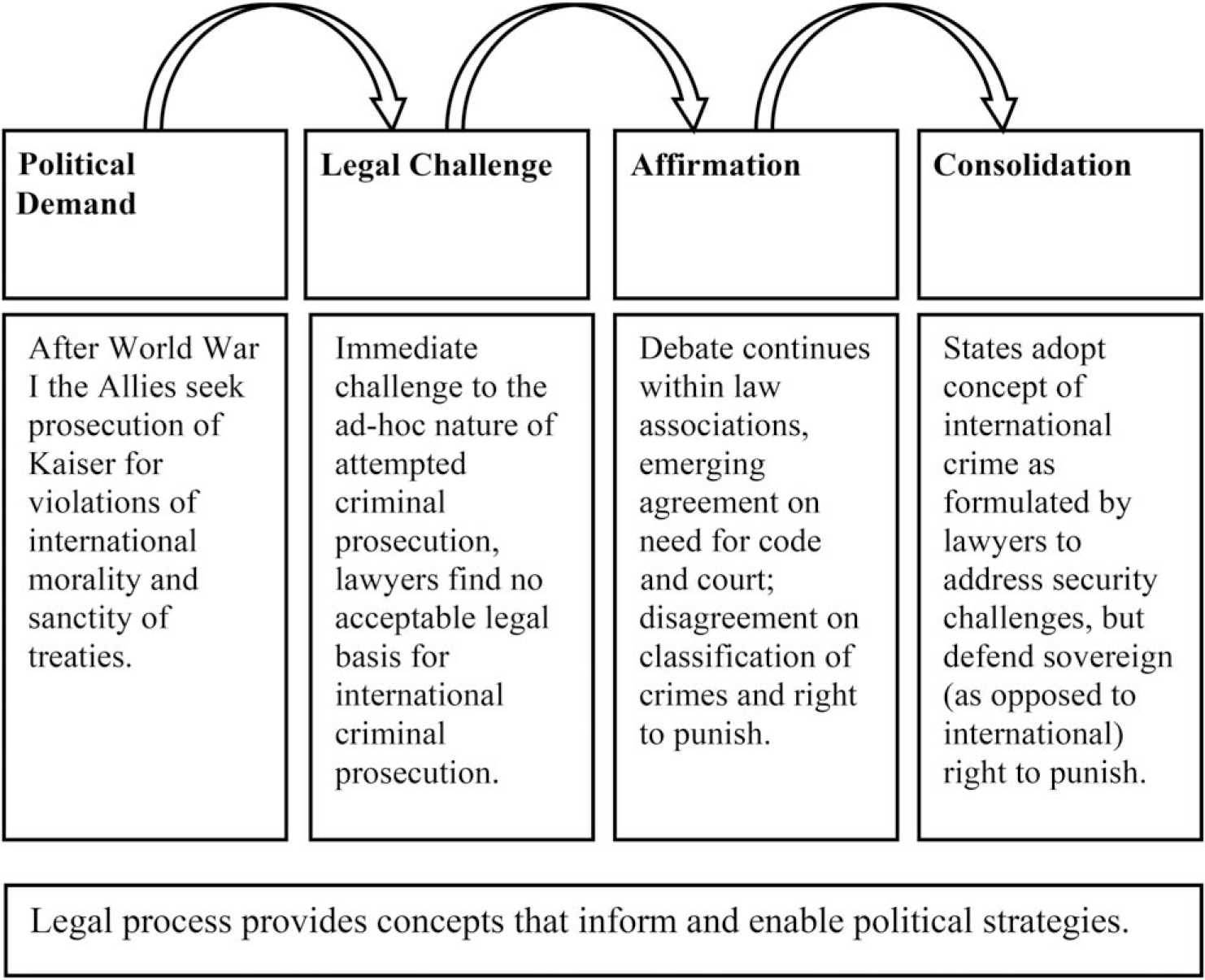
First, Allied political demand for an international tribunal to prosecute the German Emperor (Kaiser Wilhelm II) and German soldiers prompted international lawyers to investigate the possibility of international jurisdiction over violations of international law. This was largely an attempt by the Allies to pool resources and coordinate actions while securing their right to seek legal redress.
Second, lawyers challenged states' attempts to bend international law to political ends. They based their criticism on the ad hoc nature of proposed criminal prosecution of a foreign sovereign, noting the lack of applicable law and precedent.
Third, even though political demand eventually subsided, legal experts within international law associations such as the International Law Association and the International Association of Penal Law continued to debate the desirability of international criminal jurisdiction and how to distinguish international crime from other violations of international law. This resulted in the affirmation of international crime as a distinct legal category. Moreover, lawyers recommended the institutionalization of international criminal jurisdiction to remove it from the realm of political competition and ensure the consistent and impartial application of law.
Finally, states recognized the utility of the new normative status quo to address another political problem in the interwar period, political assassinations by transnational actors targeting state leaders, the transnational terrorism of its time. A consensus on international crime was thus consolidated, even though the specific content of the category remained contentious. In fact, it was ambiguity over the kind of legal obligations generated by international crime that made it attractive to states seeking to punish violations of their rights by accused terrorists.
The Status Quo in 1919: No Crime, No Law, No Punishment
Prior to World War I, international law did not recognize that states or their leaders could be held criminally responsible for violations of international law. When international legal obligations were breached, self-help was the recognized means for seeking redress. For example, violations of the laws of war could be enforced through the domestic legal system of the state in which the violations were committed. Direct offenders, should they be captured, could be prosecuted in the courts of plaintiff states. States and the officials under whose command the violations were committed remained immune.Footnote 2 Seeking redress through self-help was distinct from punishment, however. Punishment implied the existence of a legal authority higher than the sovereign state, but because international law was derived from the will of independent sovereign states, no such authority could exist (Oppenheim 1905, 201; 1920, 245). A commentator summarized the prewar position on the question of international crime as follows: “In international law, so strong is the theory that the dignity of national sovereignty should be upheld, and that the law of nations is a law ‘between not above sovereign states' that it is doubtful that the now termed ‘delinquencies' of nations will soon, if ever, be stigmatized with the term ‘international crimes'” (Peaslee Reference Peaslee1916, 335).
In the nineteenth century states recognized only two violations of international law (more precisely, of international maritime law) as creating something akin to a right to punish: slave trade and piracy. Contemporary scholars of international law sometimes portray these as archetypical international crimes, which, if true, would set the critical period for the emergence of international crime significantly earlier than the interwar period as I argue. This portrayal, however, is problematic. Piracy and slave trade are complicated and special cases insofar as jurisdiction over them was limited to the high seas—the only space communally owned by all states.
Martinez (Reference Martinez2012, 151), for example, makes a particularly strong case linking the prohibition of slave trade in the nineteenth century to modern human rights law and international criminal prosecution. The ban of slave trade and the establishment of courts of mixed commissions central to Martinez's argument were originally based on a series of bilateral treaties initiated by Britain in the nineteenth century. These treaties gave signatory states the reciprocal right to search each other's ships for slaves. If slaves were found onboard, the ships would be taken to designated courts, whose jurisdiction was limited to ships flying under the flag of participating countries, and then only in certain parts of the oceans. These so-called courts of mixed commissions entailed neither a shared understanding among signatories of collective harm nor an international right to enforce (Benton Reference Benton2011, 362), both central to the emerging norm of international crime in the interwar period. This was reflected in the jurisdiction of the courts, which did not extend to the slave traders themselves (Benton Reference Benton2011; Martinez Reference Martinez2012, 77), nor could they adjudicate individual rights violations of the slaves (Moyn Reference Moyn2014, 58). They could impose commercial penalties, usually by seizing and condemning the ship, but little else.
Britain did seek to obtain a firm legal commitment from other states to abolish the slave trade at the Berlin Conference (1885), and participating states reluctantly offered a statement of support to help suppress the slave trade. This was confirmed at the Brussels Conference (1890), which also established a mechanism to share information about antislavery efforts. However, the declarations at Berlin and Brussels were not legally binding on states (Miers Reference Miers1998) and did not establish an international right to punish (Hudson Reference Hudson1944, 183).
In contrast, efforts by states to combat piracy did invoke collective harm. States designated pirates as enemies of all mankind who threatened the common property of all states. But any collective international responsibility to enforce laws against piracy was muddled by the fact that piracy was a crime under domestic as well as international law. States thus could (and did) exercise their domestic right to suppress and punish piracy in the international realm (Cassese Reference Cassese2003, 24; Benton Reference Benton2005). As a result, it was unclear whether all pirates or only a subcategory (those targeting all commercial ships without discrimination) were true enemies of all mankind in any meaningful sense (Dickinson Reference Dickinson1925; Hudson Reference Hudson1944, 186).
Finally, if piracy and slave trade were indeed archetypical international crimes, we could expect that they would have been invoked as important precedent during the debate over international crime during the interwar period. This was, however, not the case (Hudson Reference Hudson1944, 181–82).Footnote 3
The absence of a concept of an international crime in the prewar legal canon makes the normative developments that took place in the interwar period (1919–1939) even more impressive. After World War I, the victorious Allies decided to pursue retribution against Germany through legal means. Their attempt to put the German Emperor Wilhelm II on trial for the “violation of international morality and the sanctity of treaties” turned into a legal and diplomatic nightmare and the most visible failure of Allies' ambitious plans for postwar “justice.” Legal precedents existed for the domestic prosecution of war crimes, and even the attribution of legal responsibility for the breach of treaty obligations to a sovereign (e.g., Napoleon) (see Wright Reference Wright1919, 127–28; Bass Reference Bass2000). However, the scope of the jurisdictional claims and the particular form (an international tribunal) through which the Allies attempted to hold the Kaiser accountable were entirely novel. Although the prosecution of the German Emperor was a political failure, it resulted in an intense debate among legal scholars over the possibility of punishment for violations of international law that proved pivotal to the establishment of international crime in the legal vocabulary and the legitimation of international criminal prosecution in subsequent years.
Political Demand for Legal Innovation: Prosecuting the German Emperor
French and British leaders started actively planning war crimes tribunals and the prosecution of the German Emperor during the last year of World War I (Foltz Reference Foltz1978; Willis Reference Willis1982). The punishment of Germany for war crimes played a prominent role in the British parliamentary elections of 1918, with the British public rallying around slogans like “Hang the Kaiser.” In preparation for the peace conference at Versailles, the French commissioned a study on the possible legal foundations for holding the German Emperor responsible (Larnaude and de Lapradelle Reference Larnaude and Lapradelle1918) that was distributed to the Allied delegations during the opening session.Footnote 4 This thoroughly researched and elegantly argued memorandum significantly shaped the discussion over the imposition of penalties on the Kaiser for violations of international law and morality. With public opinion favoring punishment of the Kaiser, Britain was happy to support the French position and push for the creation of new international law, disregarding the shaky legal foundations and scant precedent.Footnote 5
At the peace conference in Versailles, the Allies delegated the task of investigating violations of international law and the possibility of holding an international trial charging the German Kaiser with initiating a war of aggression to the Commission on the Responsibilities of the Authors of War and Enforcement of Penalties (“Commission” 1920). From the beginning, the Commission, which was composed of a group of prominent diplomats and lawyers representing the Allied nations and their varied legal traditions, was strongly divided on its task. French and British participants aggressively pushed for prosecution of the Kaiser as well as international war crimes tribunals to prosecute violations of the laws of war by German troops. The US members James Brown Scott and Robert Lansing maintained a vocal and influential opposition to such proposals (Lansing Reference Lansing1919, 13 ff.; Foltz Reference Foltz1978, 138 ff.). In line with established legal custom, Lansing believed that responsibility for the prosecution of war crimes was best left to the military authority of individual states. A strong proponent of positive international law, he rejected and indeed obstructed proposals that sought to revive natural law traditions to try Kaiser Wilhelm for an “unjust war,” citing political as well as legal reasons: first, US President Woodrow Wilson opposed such a trial; and second, Lansing believed there was no firm legal ground for such an undertaking anyway (Willis Reference Willis1982, 72).
The Americans presented a coherent though, as Willis points out, quite selective defense of the immunity of state leaders that allowed for political but not legal sanctions against the Kaiser. “It must be said that because there was no firm legal ground of any kind the Europeans made as good a case as the Americans” (Willis Reference Willis1982, 76). Neither treaty law nor state practice offered a legal vocabulary through which legitimate claims over the violation of international law could be made. The result was a weak and openly politically motivated compromise.
The disagreement among the members of the Commission deserves attention because it highlights the tensions between the understanding of international law as a communal law between sovereign equals that do not accept a higher law-enforcing authority and the idea that certain violations of international law are so fundamental that they should be punished. Moreover, in the years that followed, the work of the Commission (including the dissenting opinion of the US and Japanese delegations) continued to play a crucial role in defining the terms of the debate. Specifically, it influenced the development of international criminal law in three ways.
First, the Commission affirmed (if cautiously) the principle of legality that there can be no crime without a law. For example, it condemned the breach of neutrality and the act of aggression and attributed responsibility for the war to Germany and Austria and their allies Turkey and Bulgaria, but made clear that aggressive war was not punishable under existing positive international law. Nor did Germany's violation of the treaties guaranteeing the neutrality of Luxemburg and Belgium provide enough grounds for a criminal prosecution of Germany's political leader. The Commission suggested, though, that in the future, “penal sanctions should be provided for such grave outrages against the elementary principles of international law” (“Commission” 1920, 120).
Second, the Commission recommended that an international tribunal be established to prosecute violations of the laws and customs of war as well as violations against the laws of humanity committed by individuals regardless of rank, including heads of states. It argued that the failure to punish leaders who violated the laws and customs of war would “shock the conscience of civilized mankind,” emphasizing that “the public conscience insists upon a sanction” (“Commission” 1920, 116–17). Thus the Commission challenged the idea of sovereign immunity from criminal prosecution and suggested that international law inculcate obligations to an international community.
Third, the Commission also argued that state officials, by endorsing the conventions and declarations of The Hague Conference (Hague Convention 1907), had implicitly committed to respecting general principles of humanity and could thus be held responsible for their violation. In addition, it explicitly recommended that the superior orders defense be abolished, even though it deferred any investigation into the specific legal implications of this recommendation (“Commission” 1920, 113, 117).
The recommendation to prosecute the German Emperor was by far the most contentious issue arising out of the Commission report. The Commission report was strikingly ambiguous with regard to the legal status of the violations of international law in question. While it called for an international tribunal with the authority to order the punishment of offenses against the laws of war and the prosecution of the German Emperor for violating international norms of conduct, it did not actually invoke the term “international crime” or “international criminal jurisdiction.” Rather, it justified the tribunal as multilateral cooperation in cases of overlapping jurisdictions (“Commission” 1920, 118, Annex IV). The US delegation to the Commission recognized the implications of such a move and challenged the legal basis of some of the report's key recommendations in its vocal dissent.
Legal Challenges: Debating the Commission Report
Not only did the US and Japanese delegations voice their strong disagreement with the Commission's recommendations, but the uncertainty over the legal basis for international prosecution also affected the debate over the extradition of the German Emperor. Moreover, international crime and criminal responsibility quickly became hotly contested subjects among legal experts in the Advisory Committee of Jurists, tasked by the League of Nations with drafting the statute for the Permanent Court of International Justice (Advisory Committee of Jurists Reference Ferencz1980, 203–05).
The US Dissent to the Commission Report
The US delegation viewed the Commission's recommendation to prosecute violations of the “laws of humanity” as highly problematic and based its dissent on the distinction between legal and moral crimes. Legal crimes, according to Lansing and Brown Scott, were justiciable, could be brought before a tribunal, and could be punished. Moral crimes, however, posed an altogether different problem. No matter how heinous, they argued, moral crimes were beyond the reach of legal sanctions and could only be met with moral sanctions. They criticized attributing a legal status to the laws and principles of humanity, arguing that “[t]here is no fixed and universal standard of humanity” (Lansing and Brown Scott Reference Lansing and Brown Scott1920, 144). Laws of humanity were too vague to serve as the basis of a legal norm. Since laws of humanity were not codified in positive international law, state leaders could not be held accountable for violating them. In short, the US delegation's dissent rested on the principle that without law there was no crime, and no (legal) basis for punishment.
The US delegation contested the prosecution of the German Emperor for the crime of aggression on the same grounds. Lansing and Brown Scott found no existing legal prohibition of aggressive war. If no prohibition existed, they argued, the emperor could not be tried for “crimes against peace.” They also identified a second problem in the Commission's argument. According to Lansing and Scott, it was impossible to hold the Kaiser as the German sovereign responsible for breaches of international law. While the crime of aggression may have constituted a moral offense against humanity, they insisted that sovereignty meant that a sovereign could be held legally accountable only by his own people (Lansing and Brown Scott Reference Lansing and Brown Scott1920, 145). They objected to the politicized use of international law in the Commission report, arguing that the political demand to prosecute the German Kaiser for war crimes conflicted with principles of legality and the requirements of due legal process.
The debate over the final report of the Commission on the Authors of War exposed the complicated relationship of legal norms, moral principles, and political interests, as well as the different requirements for valid legal and political argument. Efforts by delegates to uphold the integrity of international law vis-à-vis politics were especially apparent with respect to the questions of war guilt. All members of the Commission unanimously condemned aggressive war and the violation of neutrality. At the same time, they confirmed that aggressive war was not a violation of positive international law because no explicit prohibition existed (“Commission” 1920, 120).Footnote 6
Of course, the different positions of the Americans and their European allies on war crimes tribunals can only partially be explained by differences in the interpretation of international legal norms. The British and French delegates faced much more immediate pressure from their respective publics for retribution and sought to achieve this through legal means. The “narrow legalism” to which Lansing and Scott retreated in their objection to international criminal prosecution of the Kaiser was politically unavailable to them (Bass Reference Bass2000, 101). However, the debate within the Commission also highlighted the sharp contrast between moral principles that should guide state action and the actual constraints (or absence thereof) that international law imposed. This disagreement over the scope and limits of international law dominated the subsequent debate over the legal basis for extraditing the German Emperor and shaped the discussion within the larger community of international lawyers over international crime in general.
The Failure of Politics Through Law
It is easy to ascribe the failure to prosecute the Kaiser for violations of international law to conflicting political agendas among the Allies, to strong opposition from Germany, or, more broadly, to “the folly of entrusting a political problem to legal methods” (Bass Reference Bass2000, 105). I want to highlight a different aspect of the problem, namely, the lack of legal and institutional instruments at the time through which legitimate claims (and counterclaims) over the violation of international law could be made.
There was no recognized authority capable of adjudicating competing rights claims between sovereign equals, nor was there an accepted understanding among diplomats or international lawyers of what international crime or criminal responsibility for violations of international law entailed. The attempt to hold a sovereign responsible for criminal transgressions of international law was truly novel. The lack of a firm legal basis for international criminal prosecution was particularly apparent in the exchange of written notes between French Prime Minster Clemenceau, British Prime Minister Lloyd George, and Dutch Foreign Minister Van Karnebeek, in which Clemenceau and Lloyd George sought to convince the Dutch to extradite the Kaiser from his exile on Dutch territory into the hands of the Allies. Their arguments were careful not to overstate the legality of their plan to punish the Kaiser for violations of international law. Instead, they oscillated between appeals to politics, security concerns, and moral norms.
In a letter to Van Karnebeek dated January 16, 1920, Clemenceau, justifying France's position on extradition, argued that Article 227 of the Treaty of Versailles gave the Allies the right to demand the extradition of the Kaiser as a matter of highest political importance, “un acte de haute politique international” (Clemenceau, January 16th Department van Buitenlandsche Zaken 1920, 12). The legal language in the treaty was merely included, Clemenceau claimed, in order to provide the emperor (and by extension Germany) with legal guarantees of his rights “in excess of anything known to public law” (Clemenceau, January 16th Department van Buitenlandsche Zaken 1920, 12). Van Karnebeek replied that the Dutch were not bound by demands of high politics, nor were they bound by the Treaty of Versailles to which they were not a party. They would, however, consider signing on to the project of a court within the League of Nations system that could adjudicate future violations of international law based on acts clearly defined in a statute (Van Karnebeek, January 23rd Department van Buitenlandsche Zaken 1920, 13).
Trying his hand at convincing Van Karnebeek, Lloyd George emphasized that the Dutch had a duty to help punish violations of law and principles of humanity (Lloyd George, 14th Department van Buitenlandsche Zaken 1920, 13–14). Such an immediate and pressing issue could not await the creation of a world court with the authority to try international crimes. He cautioned the Dutch against engaging in risky behavior by harboring the German Emperor and warned that they would have to bear the consequences and resulting security problems on their own. Seeking to mollify Dutch concerns, he suggested that the judgment of the Allied tribunal would surely advance the project of the kind of world court Van Karnebeek was calling for (Lloyd George, February 14th Department van Buitenlandsche Zaken 1920, 13–14).
This exchange of notes confirms that all parties were aware of the problems arising from claiming criminal jurisdiction over a (former) sovereign, and the shaky legal grounds of the Allied demands. Moreover, despite their disagreement over the appropriate treatment of the Kaiser, political leaders referenced a shared understanding of the difference between political, legal, and moral demands. The Dutch went so far as to invoke principles of legality in calling for a world court, claiming that international criminal jurisdiction needed to be based on clearly specified laws and, preferably, entrusted to an independent court (Van Karnebeek, January 23rd Department van Buitenlandsche Zaken 1920, 12–13).
With no clear legal precedents or agreed-upon legal norms, Allied efforts to prosecute the Kaiser (as well as related attempts to hold German soldiers accountable for violations of the laws of war in the so-called Leipzig Tribunals) were a practical and political failure. However, the decision of the Allies to invoke legal rights claims to solve political problems had important consequences. The political failure to rectify violations of international law prompted legal experts to subsequently clarify the nature of international crime and international obligations, as well as to explore avenues for future legal development. It is this legal debate over international crime and criminal responsibility that led to the first formal work on both an international criminal code and a criminal court, thus contributing to a significant shift in how lawyers conceived of and approached violations of international law.
League of Nations Advisory Committee of Jurists
The Commission on the Authors of War had built its argument for the prosecution of war crimes on a longstanding natural law tradition that condemned certain acts of war as unjust and against the moral self-understanding of civilized nations. However, there was no corresponding positive legal concept that captured what today is broadly known as international crime. The attempted prosecution of the German Emperor also raised the question of who had the authority to prosecute and punish offenses against international law and order. If no higher authority existed to adjudicate competing rights claims, who is to say whether or not a violation of rights had indeed occurred and how it should be addressed? It is easy to see how such an expansion of international law to include criminal responsibility and punishment could lead to more, rather than less, conflict over the question of individual guilt and obligations to prosecute. Thus it is not surprising that the debate among international lawyers first focused on the kind of institution that could ensure the consistent application of law and strengthen compliance.
A year after the publication of the Commission report, the newly established League of Nations appointed the Advisory Committee of Jurists (hereafter the Committee) to draft a statute for a permanent court of international justice that was envisioned in Article 14 of the Covenant of the League of Nations (“The Versailles Treaty: Covenant of the League of Nations” 1919).Footnote 7 The Committee started meeting in June 1920 and was dominated by veterans of The Hague Conferences who were strong advocates for a court that would be both permanent and independent. Still, the Committee was somewhat reluctant when the American Elihu Root and the Belgian Baron Descamps recommended they extend the proposed court's jurisdiction to “grave breaches of international public order or against the universal law of nations” (Advisory Committee of Jurists Reference Ferencz1980, 205). Some Committee members referred to a “universal desire for a criminal court to adjudicate future violations of international law that affect all states” (Mr. Fernandes, Advisory Committee of Jurists Reference Ferencz1980, 205), others voiced concerns that including provisions for criminal prosecution overstepped the political mandate of the Committee.
The ensuing debate quickly ran into the same problems that had stymied the Allied attempts to set up a tribunal to prosecute violations of the laws of war. Skeptics (especially Mr. Ricci-Busatti of Italy and Mr. Lodder of the Netherlands) highlighted the problematic nature of the concept of “crimes against the universal laws of nations” and, specifically, the lack of positive laws upon which a criminal court could ground its jurisdictional authority (Advisory Committee of Jurists Reference Ferencz1980, 203). In fact, Root and Descamps's court proposal mentioned international crimes without defining what would constitute such acts. Committee members worried that without establishing a criminal code that defined crimes and prescribed penalties, international criminal prosecution would be a political act that could threaten rather than protect international peace (Mr. Fernandes, Advisory Committee of Jurists Reference Ferencz1980, 205). In other words, without a clear definition of international crime and the codification of an international criminal code, there could be no court and no criminal prosecution.
Another recurring problem was the question of criminal responsibility. Mr. Ricci-Busatti questioned who—states or individuals—should be held responsible for international criminal transgressions. If states were to be held responsible, how could rules of penal law be applied to them? And how could an individual be held responsible for infractions of international law if international law is a law that deals with relations among states (Advisory Committee of Jurists Reference Ferencz1980, 203–4)? In short, determining state responsibility would create the juridical problem of demonstrating both harmful action and intent to harm independent of a natural person who carried out the specific act. Natural persons had limited subject status under international law, and there was scant precedent for individual responsibility, with states generally enforcing such infractions through their domestic penal system.
In its final report, the Advisory Committee of Jurists concluded that “there is not yet any international penal law recognized by all nations and that, if it were possible to refer certain crimes to any jurisdiction, it would be more practical to establish a special chamber in the Court of International Justice” (Advisory Committee of Jurists 1920, 329). The General Assembly of the League of Nations rejected this proposal as “premature,” and it was quickly and quietly dropped from the official agenda (Caloyanni Reference Caloyanni1928, 70).
The debate within the League of Nations was not only hampered by a lack of political interest in establishing permanent international criminal jurisdiction, but also by a lack of agreement on how to proceed without violating the notion that international law is a law of sovereign equals that recognize no higher authority. There was no consensus on the question of what acts a court could prosecute as criminal transgressions. Nor was there consensus on the question of who—states, their representatives, or other individuals—was protected by or, conversely, could be held responsible for violations of international law. Without a clear concept of international crime and criminal responsibility, the legal experts rightly worried that an international criminal court would remain a political instrument, not a means to ensure international peace and justice.
Affirmation: How, Not Whether, to Prosecute International Crime
Two years after the failed attempt to prosecute the German Emperor, the political urgency to institutionalize international criminal prosecution had largely faded away. This could have been the end of the story, a failed attempt to change legal norms. However, two influential organizations of legal experts, the International Law Association (ILA) and the International Association of Penal Law (IAPL), were intrigued and troubled by the general idea of international crime and international criminal prosecution. The ILA and the IAPL picked up where diplomats had left off, taking on the question of how international crime could be reconciled with state sovereignty on one hand and principles of legality on the other hand.Footnote 8 As a result, the period between 1921 and 1929 saw a true explosion of the literature on the topic, accompanied by several conferences that addressed the issue of international crime and prospects for international criminal jurisdiction.Footnote 9 These debates established international crime in the legal vocabulary and shifted the focus toward more practical questions of how and under what conditions international crimes should be prosecuted.
Legal experts were split along the line of the two major legal traditions, civil and common law, with members of each tradition dominating different institutional bodies. Jurists of the common law tradition in the ILA pushed for the establishment of a court with broad authority to define subject matter, jurisdiction, and procedure. Jurists of the civil law tradition in the IAPL linked the establishment of a court to the prior agreement on an international criminal code with clearly defined criteria for identifying criminal transgressions and criminal responsibilities.
Both ILA and the IAPL, however, left the subject and legal implications of obligations generated by the category of an international crime vague. First, international lawyers considered whether international crime was an offense against the sovereign rights of individual states, and whether punishment for violations could be justified as an extension of the sovereign state's domestic right to punish. Second, they debated whether international crime created an entirely new kind of obligation. They recognized that there were fundamental norms of behavior that, if violated, challenged the basis of the rule of law itself, and that those transgressions could generate a communal obligation to act. The violation of some international laws and norms affected not just an individual state's rights, but the rights of the society of states as such. This inevitably generated the question of who had the authority to punish such violations on behalf of the international community. Both interpretations persisted side by side during the interwar period. The possibility of extending the domestic right to punish made international crime an attractive tool for states to address the emerging problem of terrorism in the 1930s. In contrast, the idea that there were fundamental community norms that needed to be protected by an international authority strongly influenced the legal discourse over international crime in the wake of World War II.
International Law Association: Creating a Court First
The International Law Association (ILA) held conference meetings on international criminal prosecution in 1922 (Buenos Aires), 1924 (Stockholm), and 1926 (Vienna). At these conferences, two senior and highly respected members, Hugh Bellot and Lord Phillimore, used their position of authority to advocate for the progressive development of international law and the creation of an international criminal court. Both had a longstanding interest in peaceful conflict resolution and international adjudication, and both were firmly rooted in the common law tradition. Bellot had been a member of the British Committee of Enquiry into the Breaches of the Laws of War that in 1918 led the investigation of the possibility of war crimes tribunals. He had also been present at the negotiations in Paris and, based on this experience, was a strong advocate for permanent criminal jurisdiction at the international level (W. A. B. 1928a). Lord Phillimore, a highly regarded authority on international law, had prepared a British proposal for the League of Nations and as a member of the Juristic Advisory Committee shaped the negotiations over a draft statute for an international court of justice (W. A. B. 1928b). His support of Bellot's initiative and, in particular, Bellot's suggestions that a committee be delegated to investigate the issue of a criminal court, was crucial for moving the debate forward and insulating it from strong dissenting opinions.
At the 1922 ILA annual meeting in Buenos Aires, Bellot used his position as secretary general of the ILA to put the question of international criminal jurisdiction on the conference agenda by presenting a proposal for the establishment of an international criminal court. His proposal envisioned a court with very broad jurisdiction. Indeed, he argued the jurisdiction should be “as wide as possible, it should be competent to try criminal offenses against law and order during peace time and times of war” (Bellot 1922, 76–77). The specific nature of crimes and legal procedures were purposefully left unspecified. Authority over jurisdictional scope was to be exercised by the judges.
Members of the ILA were skeptical and pointed out both legal and political problems with the proposal, criticizing it in particular for the vague and expansive jurisdictional scope. In response to this criticism, Bellot revised his proposal to limit the proposed court's jurisdiction to breaches of the laws of war. Since during war domestic courts also had jurisdiction over war crimes, an international criminal court would only serve a limited function to hear appeals. Following these changes, the ILA voted 31–22 that the establishment of a permanent international criminal court was desirable and honored Bellot's request to prepare a draft statute (International Law Association 1922, 86).
When the ILA reconvened two years later in Stockholm to discuss Bellot's draft statute for an international criminal court (Bellot 1924, 75–87), several dissenters challenged the very idea of international criminal prosecution and tried to reopen the question of the desirability and political feasibility of an international criminal court (International Law Association 1924, 92). Sir Graham Bower, a British naval officer who had long worried about the effect that international criminal jurisdiction would have on the Armed Forces, two Americans, Charles Henry Butler and John Hinkley, and Nils Stjernberg from Stockholm were key dissenting figures in the renewed debate.
Stjernberg criticized the draft for leaving the exact jurisdiction of the court unspecified. He was particularly worried about extending the jurisdiction of the court to “laws of humanity and the dictates of public conscience” (International Law Association 1924, 107). Stjernberg's objections demonstrated a concern with practicality and a keen eye for the political effects of such a court. He argued that it “could only add a fresh sting to the humiliation of the vanquished …” and made clear that he did not believe an international criminal court would positively affect world peace (International Law Association 1924, 107).
Others worried that the proposed court violated basic principles of international law. They expressed concern about the provision that granted private individuals access to the court. They also complained about the missing legal basis for prosecution and the lack of legal determinacy. The draft statute was vague on specifics and did not clearly identify jurisdictional scope. Moreover, participants pointed out that there was a lack of existing international instruments to execute and enforce judgments, which could seriously undermine the effectiveness of a new court (International Law Association 1924, 94, 103, 107, comments by Sir Graham Bower, John Hinkley, Charles Henry Butler).
To broaden support for international criminal prosecution, Lord Phillimore suggested that a special committee be appointed to debate and revise Bellot's draft statute (International Law Association 1924, 106). When this committee presented its report at the 1926 conference in Vienna, it opened the discussion by arguing that the “creation of a Permanent International Criminal Court is not only highly expedient but also practicable” (International Law Association 1926, 109). The draft statute addressed some of the criticism but maintained Bellot's wide definition of subject jurisdiction to include all “violations of laws and customs of war generally accepted by civilized nations” (International Law Association 1926, 118). Although only states could bring forward complaints, they could do so on behalf of individual subjects. Complaints could be lodged against both states and individuals (International Law Association 1926, 120).
It was clear that Bellot's and Phillimore's background in the common law tradition influenced their court-centered approach to international criminal jurisdiction. The establishment of a court was to take precedence, with the actual development of what international crime entailed left to the judges. Indeed, Bellot argued that “[t]he Continentals have become so enamored of codes, … that they have forgotten that there is such a thing as a common law. It seems to me that there is already sufficient common law in International Law for a Court to make a beginning and to build up law …” (Bellot in response to Caloyanni Reference Caloyanni1928, 81). This did not sit well with jurists trained in the civil law tradition, who required a clear specification of the concept of “international crimes” as well as the elaboration of corresponding punishment based on the principle of nulla poena sine lege. With the content and boundaries of international crime in dispute, participants in the debate drew on their understanding of domestic penal law and requirements of legal justice to frame the issue.
International Association of Penal Law
Concurrent with the debates within the ILA, Professor Vespasien Pella of Romania, a specialist on criminal law, had started to work on an “International Legal Code for the Repression of International Crimes,” which recognized both state responsibility and individual responsibility (Pella Reference Pella1926, Reference Pella and Ferenzc1980). He presented his work at the meeting of the International Parliamentary Union (an important forum for information exchange and political mobilization among parliamentarians) and the International Association of Penal Law (IAPL). His work also left its mark on the 1926 Draft Statute of the ILA. Pella's work is of special importance because it sought to delineate international crime from both domestic criminal law and international private law in order to regulate conflicting jurisdictional claims while, at the same time, affirming the applicability of the fundamental proposition of penal law, namely, that there can be no crime without law.
Pella defined international criminal law as the set of legal rules that determine when the society of nations may punish states or individuals for disturbing the international public order, and proposed a formal penal code to specify transgressions qualifying as international crimes (Pella Reference Pella1926, 172). At the heart of this penal code, Pella envisioned the prohibition of aggression and war against other sovereign states (colonial wars were excluded from this prohibition) (Pella Reference Pella1926, Reference Pella and Ferenzc1980, 247).
Pella's push for an international criminal code was supported by other influential jurists in the IAPL, such as Henri Donnedieu de Vabres (France), Megalos Caloyanni (Greece), and Stanislaw Rappaport (Poland). These legal experts, despite individual disagreements over the precise nature of international crime, were committed to positive international law and sought to strengthen and expand its scope through codification. Caloyanni, for example, advocated for the international prosecution of domestic crimes and a unification of domestic criminal codes, while Donnedieu Vabres was interested in the definition of specific crimes against the international community (Caloyanni Reference Caloyanni1928, 74; Donnedieu 1922, Reference Donnedieu1928; Rappaport Reference Rappaport1932). They agreed that only an international criminal code could form the jurisdictional basis for international criminal prosecution and give teeth to the prohibition of aggressive war (Segesser and Gessler Reference Segesser and Gessler2005).
Remarkably, by 1926 the debate over whether international crime could be reconciled with an international law built on sovereign equality had been replaced with questions of how exactly a reconciliation of sovereignty and a simultaneous strengthening of the international legal order could be accomplished. The efforts of international lawyers had succeeded in introducing “international crime” into the legal vocabulary. This, in turn, fueled demand from international legal experts for some form of international criminal jurisdiction.
In contrast to the initiatives that came out of the ILA, which, after the death of Bellot in 1928 and Phillimore in 1929, turned its attention to other topics, the work of the IAPL continued to influence the debate over international crimes in the interwar period and beyond.Footnote 10 Indeed, by 1928, Caloyanni could declare that “the question of prematureness [of international criminal jurisdiction] lost its strength in juridical minds and also in general scientific opinion and I would also say among members of various Parliaments …” (Caloyanni Reference Caloyanni1928, 70). Most international legal experts now agreed that certain violations of international law were of a criminal nature, that those violations should be met with punishment, and that the preferable authority to adjudicate claims of criminal rights violations was an international court.
However, the specific form of a court, its subjects (states and/or individuals), definition of crimes, and scope of jurisdiction (crimes against international public order, war crime, or all international penal offenses) remained contentious. Additionally, core issues with regard to the nature of legal obligations at stake in criminal infractions of international law remained unresolved.
On one hand, legal experts argued that international crimes were violations of the rights of individual states. Crime gave rise to a right to punish as an extension of every sovereign state's right to protect itself against violations of domestic public order. This challenged states to consider how to coordinate their policies and how to resolve competing claims over jurisdictional authority. For lawyers, the preferred institutional response to these problems was an international court that allowed states to pool resources, solved problems of competing jurisdictional claims, and also guarded against political abuse.
On the other hand, lawyers also argued that the category of international crime extended legal obligations from particular states to the international community as a whole. This argument was innovative because it suggested a communal obligation to punish violations of the international public order. It reflected a developing sense, at least among legal scholars, of an international community—quite different from the community of states that existed in the nineteenth century (Sacriste and Vauchez Reference Sacriste and Vauchez2007). However, this raised the larger question of who had the right to speak, act, and punish on behalf of the international community. Here, too, legal experts preferred an independent international court to prevent the political exploitation of law and guarantee its consistent application. Only an independent court could prevent political interests from encroaching on legal proceedings, and only an independent court could ensure the consistent, neutral, and objective application of law—principles that were central to legal experts' self-understanding as members of a professional community.
Consolidation: A Legal Category Takes Shape
In this section I briefly discuss two separate instances during the interwar period where state leaders and diplomats used international crime to describe and criminalize behavior, thereby linking the academic debate to political problems and thus contributing to the consolidation of the legal concept. First, states relied on “international crime” to organize a legal response to the problems of aggressive war. Second, they sought a collective solution to prosecuting individuals from one state accused of assassinating a leader of another, the international terrorism of the time. In both cases, states referenced international crime to manage interstate relations without challenging the category itself. The fact that important questions regarding the specific definition of crimes and nature of obligations remained unsettled made the category a flexible tool in addressing these concrete political problems and contributed to the consolidation of the legal category.
Aggressive war was at the center of lawyers' initiatives to establish international criminal jurisdiction and states made two efforts in the 1920s to outlaw it: the Kellogg-Briand Pact (1929), together with the less well known “Protocol for the Pacific Settlement of International Disputes” (League of Nations 1924), became important legal precedent for so-called crimes against peace. The Protocol (voted on by the League of Nations General Assembly but not ratified) stated that a “war of aggression constitutes a violation of this solidarity [of the members of the international community] and an international crime” (League of Nations 1924). In their presentation of the declaration to the League Assembly, the authors made it clear that aggressive war was a legal and not a just a moral crime. They defined aggression as an international crime because it was the ultimate threat to international public order. As such, it necessitated a legal response, including the prosecution of perpetrators and the possibility of punishment (Pella Reference Pella1926, 172; Ferencz Reference Ferencz1980, I:415).
The “Treaty for the Renunciation of War as an Instrument of National Policy,” otherwise known as the Kellogg-Briand Pact, sought to regulate or outright ban the use of war as a legitimate means of politics in international relations. The sixty-one signatory states agreed to “condemn recourse to war … and renounce it, as an instrument of national policy in their relations with one another” (Kellogg-Briand Pact 1929, Article I). The Pact also called for the settlement of all disputes by pacific means, though it did not go much beyond this aspirational statement. Even as it formally defined aggressive war as illegal, it stopped short of invoking the language of international crime.
While the criminalization of aggressive war never moved beyond declarations, state leaders also used the category of international crime as a tool to deal with another problem. The 1934 assassination of the King of Yugoslavia and the French Foreign Minister Barthou in France by a Croatian nationalist working with an Italian terrorist cell generated a legal debate among states over the extradition and punishment of the offenders. In response to the complex jurisdictional issues arising from the transnational nature of these offenses, state leaders branded terrorism an international crime and called for an international institution to try such offenses. International legal experts in favor of strengthening the institutional status of international law (such as, e.g., Vespasien Pella) jumped at this opportunity to champion the creation of an international criminal court. This was an altogether different and much narrower attempt at establishing international criminal jurisdiction, built on the argument that international crime needed to be addressed as the violation of an individual state's legal rights.
The resulting negotiations within the League of Nations over the Convention for the Prevention and Punishment of Terrorism (League of Nations 1937) demonstrated that international crime had indeed consolidated its position within the legal and political discourse. First, there was no debate on whether a legal concept of an international crime existed. Indeed, both states and lawyers took the existence of such crimes for granted and invoked the concept of international crime as the basis for both political and legal action. They debated how, not whether, such crimes should be prosecuted and punished. Second, highlighting the ambiguity inherent in the concept of an international crime, the convention defined terrorism as a crime because it posed a threat to the domestic public order of states. To combat this threat, signatory states agreed to pool resources and coordinate their policy (by, e.g., defining terms of extradition). Finally, in line with the preferences of legal experts for a central enforcement mechanism, an international court to try offenses against the Terrorism Convention was added as an option separate from the Convention itself. The draft Convention, prepared by IPLA member Vespasien Pella, focused exclusively on the institutional features and operation of an international criminal court and left the jurisdictional scope of the court to be determined by the Terrorism Convention.
In 1937, after several years of work on the Terrorism Convention, negotiations stalled over questions of political asylum and extradition. The Terrorism Convention and the proposal to establish an international court to try terrorist acts against public officials or property as international crimes were never ratified. Political developments in Germany and the onset of World War II rapidly overtook efforts to strengthen the institutional framework of interstate cooperation at this time.
Although the attempts to outlaw aggressive war and to create an international instrument to combat terrorism were unsuccessful, the effect of these proposals has to be viewed over the long term. These legal initiatives, together with the proposals for an international criminal court and a penal code coming out of the ILA and IAPL, are now routinely included in the legal genealogy of the International Criminal Court as early support for international criminal jurisdiction. It is tempting to read into these developments a trajectory toward an international order built on the rule of law. Doing so, however, risks conflating visibility with influence and overstating the existing consensus on the issue of international crime. Scholars in the interwar period cautiously agreed that there was a class of violations of international law that called for punishment and viewed the issue of international crime and international criminal prosecution as two sides of the same coin. Defending the importance of the principles of legality, lawyers insisted that punishment needed to be decided by an independent judicial authority and based on the rule of law. They disagreed on the exact nature of obligations entailed by the concept of an international crime, the specific actors bound by international law (states, state leaders, individuals), and the appropriate framework for punishing violations of international law. However, the ambiguity surrounding the kinds of obligations attached to international crime, while certainly problematic from a legal perspective, proved to be a political advantage. It made it possible for states to draw on the concept of international crime when it was in their own interests to do so, further consolidating its status as a taken-for-granted legal category.
Even as international crime became established in the discourse of international law during the interwar period, there was little support among the Great Powers to codify international crimes or to establish an international criminal court. States still jealously guarded their sovereignty and did not see the benefits of submitting themselves to international criminal jurisdiction. Although the isolation of the debate among international lawyers in the interwar years from the concerns of states and their leaders facilitated establishment of international crime in the legal vocabulary, the actual institutionalization of this legal development required political action. It was not until after the atrocities of World War II and the Nazi regime shocked the international community with the extent of its violence and barbarity that state leaders revisited the question of international crime (what acts constituted international crimes and the actors—states and individuals—who could be held responsible) and the desirability of a permanent international court to try those accused of committing them.
After World War II, the interwar legal debates became important as legal precedent. They were employed to legitimize the legal basis for the Nuremberg and Tokyo tribunals that sought to prosecute aggressive war, violations of the laws of war, and crimes against humanity (Overy Reference Overy and Sands2003). The influence of the debates over international crime was manifest most directly in the preparatory work of the UN War Crimes Commission, established by the Allies in 1943 to lay the groundwork for post World War II war crimes trials. The War Crimes Commission report provided a meticulous record of both political and legal developments in the interwar period to justify the prosecution of German state leaders, politicians, and industrialists for war crimes and the crime of aggression (United Nations War Crimes Commission 1948). The US architects of the 1945 Nuremberg Charter used the interwar legal developments, especially the notion that aggressive war was a “crime against the international community” (Taylor Reference Taylor1992, 44, quoting Justice Robert Jackson), to construct a legal foundation for the trials. Building the prosecution of Nazi crimes on the planning and waging of an aggressive war was controversial, but in the absence of viable alternatives, prevailed (Taylor Reference Taylor1992).Footnote 11
But the interwar debates mattered beyond Nuremberg. The work of the ILA and IALP on international criminal jurisdiction formed the foundation for the work of the International Law Commission (ILC), established by the United Nations in 1948 to draft a code of international crimes. Indeed, the International Law Commission tried to carefully separate the codification of the Nuremberg Charter from the draft code of crimes in order to circumvent the complicated legal precedent set by the Nuremberg Trials (Spiropoulos Reference Spiropoulos1950, 263). Instead, it heavily relied on the legal developments of the interwar period, in particular the work of Vespasien Pella on an international penal code, to demonstrate that legal scholars had already recognized international crime and criminal responsibility as valid legal categories.
Special Rapporteur Alfaro, who was tasked by the ILC to investigate the creation of an international criminal court to facilitate the implementation of the draft code of crimes, used the interwar legal debates to argue that there existed “an imposing array of official and unofficial thought and action … in favour of the establishment of an international criminal jurisdiction.” He went even further to claim that “there has been a universal mobilization of public opinion on behalf of the establishment of an international criminal court in which had taken place over the last thirty years” (Alfaro Reference Alfaro1950, 15, 16–17). This was, of course, a skillful if calculated exaggeration to support the work of the ILC on an enforcement mechanism for its draft code of crimes. Here the scholarly work and advocacy of Descamps, Bellot, Pella, and their colleagues was deliberately used to create legal precedent and justify the demand for a permanent institution to adjudicate violations of the draft code.Footnote 12
Conclusion
This article develops a theory of legal norm creation and shows how it applies to the emergence of the category “international crime.” I argue that the preference of lawyers and legal experts for positive law and institutionalized enforcement mechanisms shaped the meaning of international crime and the appropriate institutional means through which it could be adjudicated. Empirically, I show how the need to solve a political problem—holding the German Emperor legally accountable for violations of international law—initiated a debate that gave rise to a new legal framework through which claims about the violation of international law could be articulated. This debate over the nature of international crimes, in turn, informed state leaders' choice of strategies to manage interstate relations, most prominently aggressive war and terrorism. The conflict over the development of legal norms and progressive institutionalization highlights the constant challenge international lawyers faced in negotiating the space between the political constraints imposed by states and their own aspirations to uphold principles of legality and justice.
Law is a function of conflicting imperatives: it must be concrete and rooted in state practice, while at the same time articulating community goals and principles. These imperatives are not only reflected in the process of legal change, but also a crucial force directing it by articulating demand for developing institutional tools to protect and enforce norms regarding the responsibilities of states vis-à-vis each other. Those who attempted to institutionalize international criminal law in the interwar years, legal experts in the League of Nations and in international law associations, fell short of their ambitious goals, but they paved the way for criminal prosecution in the wake of World War II. They thus contributed to the larger process of normative change that furthered the development of international criminal law, as well as an international criminal court.
With hindsight, it is tempting to impose a clear trajectory on this development of an increasingly complex set of legal norms to regulate state conduct and to use it to explain why states ultimately agreed to create a court to prosecute the violation of fundamental community norms. However, such a retrospective reading exaggerates the extent of agreement among international actors on the importance of human rights and the desirability of protecting individuals under international law. In reality, the discussion over international criminal prosecution was never purely motivated by concerns over human rights violations, but also by the concerns of states over transnational crimes, such as terrorism, that individual states could not control on their own. Studying the emergence of the concept of international crime also reveals the ongoing struggle among state leaders and legal experts to come to an agreement over the responsibilities of states to their populations and to each other, and how those responsibilities could be enforced.
The debate over international crime in the interwar period is important because it opened up both a political and intellectual space to rethink the nature of sovereignty, obligations arising from international law, and how to assign responsibility for violations. Statesmen invoking the language of international crime contributed to the progressive codification and institutionalization of international law. Legal experts, however, not only pushed for an understanding of international crime as a violation of communal rights, but actively lobbied for the creation of a permanent court to try such crimes.
What was groundbreaking about these attempts of legalization and institutionalization was the invocation of communal obligations and the push for the creation of an independent international court authorized to address these violations of communal rights. The resulting drafts for criminal courts and a criminal code, proposals to outlaw war, and negotiations over a terrorism convention left a legal legacy that proved important for post World War II attempts to hold state leaders accountable for their actions and directly informed the prosecutions of international crimes at the Nuremberg Tribunals in 1945. The interwar debate about international crimes established a legal category and thus enabled the development of a new set of institutional responses to violations of international law, namely, international criminal prosecution by an international criminal court.