1. Introduction
Palaeoscolecids are macroscopic, soft-bodied fossils that are relatively common in the Cambrian shales. They are defined by an elongate, annulated, cylindrical body with a cuticle consisting of numerous, tiny, individual button-shaped plates and platelets and often compose an important component of Burgess Shale-type biotas (Robison, Reference Robison1969; Conway Morris, Reference Conway Morris1977; Glaessner, Reference Glaessner1979; Hou & Bergström, Reference Hou and Bergström1994; Zhao et al. Reference Zhao, Yuan, Huang, Mao, Qian, Zhang and Gong1994; Ivantsov & Wrona, Reference Ivantsov and Wrona2004; Hu et al. Reference Hu, Li, Luo, Fu, You, Pang, Liu and Sterner2008, Reference Hu, Sterner, Zhu, Luo, Forchielli, Keupp, Zhao and Liu2012). Specimens are also known from phosphate deposits, where isolated button-shaped microfossils or three-dimensional trunk fragments occur (Müller, Reference Müller1973; Gedik, Reference Gedik1977; Müller & Hinz-Schallreuter, Reference Müller and Hinz-Schallreuter1993; Harvey, Dong & Donoghue, Reference Harvey, Dong and Donoghue2010; Topper et al. Reference Topper, Brock, Skovsted and Paterson2010; Butterfield & Harvey, Reference Butterfield and Harvey2012). This group's recognized range extends from the lower Cambrian to the Lower Silurian (Ulrich, Reference Ulrich1878; Whittard, Reference Whittard1953; Glaessner, Reference Glaessner1979; Mikulic, Briggs & Klussendorf, Reference Mikulic, Briggs and Klussendorf1985; Conway Morris & Robison, Reference Conway Morris and Robison1986; Conway Morris, Reference Conway Morris1977; Kraft & Mergl, Reference Kraft and Mergl1989; Hinz et al. Reference Hinz, Kraft, Mergl and Müller1990; Müller & Hinz-Schallreuter, Reference Müller and Hinz-Schallreuter1993; Zhang & Pratt, Reference Zhang and Pratt1996; Ivantsov & Wrona, Reference Ivantsov and Wrona2004). The phylogenetic placement of the palaeoscolecids has been a longstanding problem. Palaeoscolecids have been variously assigned to the Oligochaeta within the Annelida (Whittard, Reference Whittard1953; Robison, Reference Robison1969; Conway Morris, Reference Conway Morris1977; Glaessner, Reference Glaessner1979) or said to have an affinity with nematomorphs (Hou & Bergström, Reference Hou and Bergström1994; Ivantsov & Wrona, Reference Ivantsov and Wrona2004), as well as closer affinities with nematodes and priapulids (Kraft & Mergl, Reference Kraft and Mergl1989; Müller & Hinz-Schallreuter, Reference Müller and Hinz-Schallreuter1993). Although there are many controversies surrounding their taxonomy, most authors agree that palaeoscolecids fall within Cycloneuralia, which are most likely stem-group priapulids (Zhang & Pratt, Reference Zhang and Pratt1996; Conway Morris, Reference Conway Morris1997; Wills, Reference Wills1998; Huang, Vannier & Chen, Reference Huang, Vannier and Chen2004; Huang, Chen & Vannier, Reference Huang, Chen and Vannier2006; Harvey, Dong & Donoghue, Reference Harvey, Dong and Donoghue2010). Recently, this group has attracted more attention, with new finds contributing new taxonomic data and expanding the known geographic range of the group (Duan, Dong & Donoghue, Reference Duan, Dong and Donoghue2012; Hu et al. Reference Hu, Sterner, Zhu, Luo, Forchielli, Keupp, Zhao and Liu2012; Butterfield & Harvey, Reference Butterfield and Harvey2012; García-Bellido, Paterson & Edgecombe, Reference García-Bellido, Paterson and Edgecombe2013; Wang et al. Reference Wang, Muir, Botting, Feng, Servais and Li2014). The Balang Fauna, a Burgess Shale-type biota from the lower Cambrian of China (Peng et al. Reference Peng, Zhao, Wu, Yuan and Tai2005), also yields representatives of this group (Peng et al. Reference Peng, Feng, Fu, Zhao and Yao2010; Peng, Zhao & Sun, Reference Peng, Zhao and Sun2012). These fossils are primarily known from the very fossiliferous Geyi Section of the Balang Formation in Geyi Town, Taijiang County, where the section contains the best examples of the Balang Fauna (Peng, Zhao & Sun, Reference Peng, Zhao and Sun2012). These fossils display a cylindrical body with clear annulations densely separated by intersegment furrows and possessing a cuticle consisting of numerous, tiny, individual button-shaped plates on each annulation. Based on SEM (scanning electron microscope) micrographs of the button-shaped plates on the surface cuticle of the annulations (Figs 3, 4), the characters of the plates are similar to those of Wronascolex. These specimens represent a new species of Wronascolex, W. geyiensis sp. nov. Newly discovered articulated specimens expand the geographic and stratigraphic distribution of Wronascolex and provide additional evidence for understanding the genus's body configuration, ecology and taphonomy.
2. Geological setting and stratigraphy
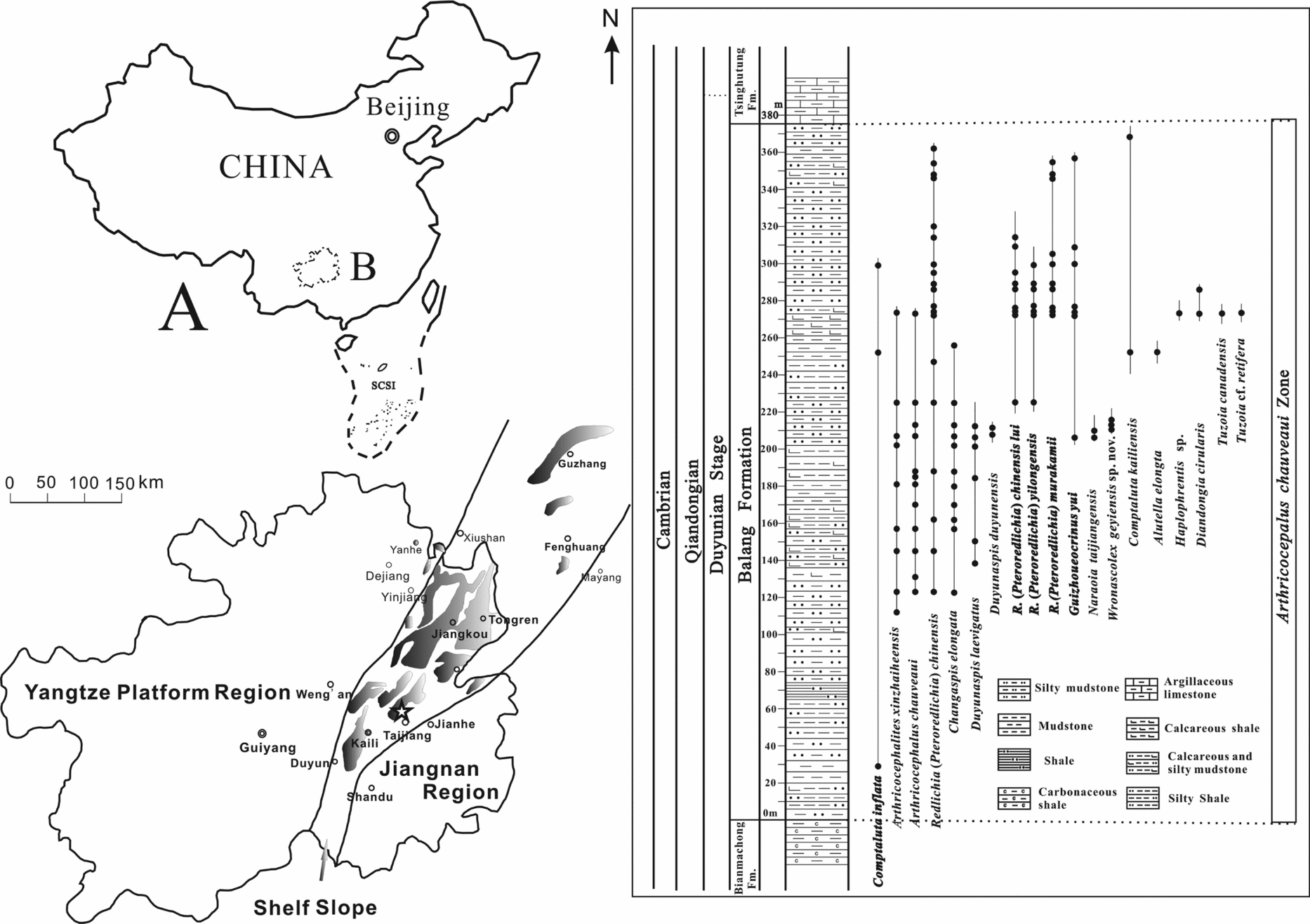
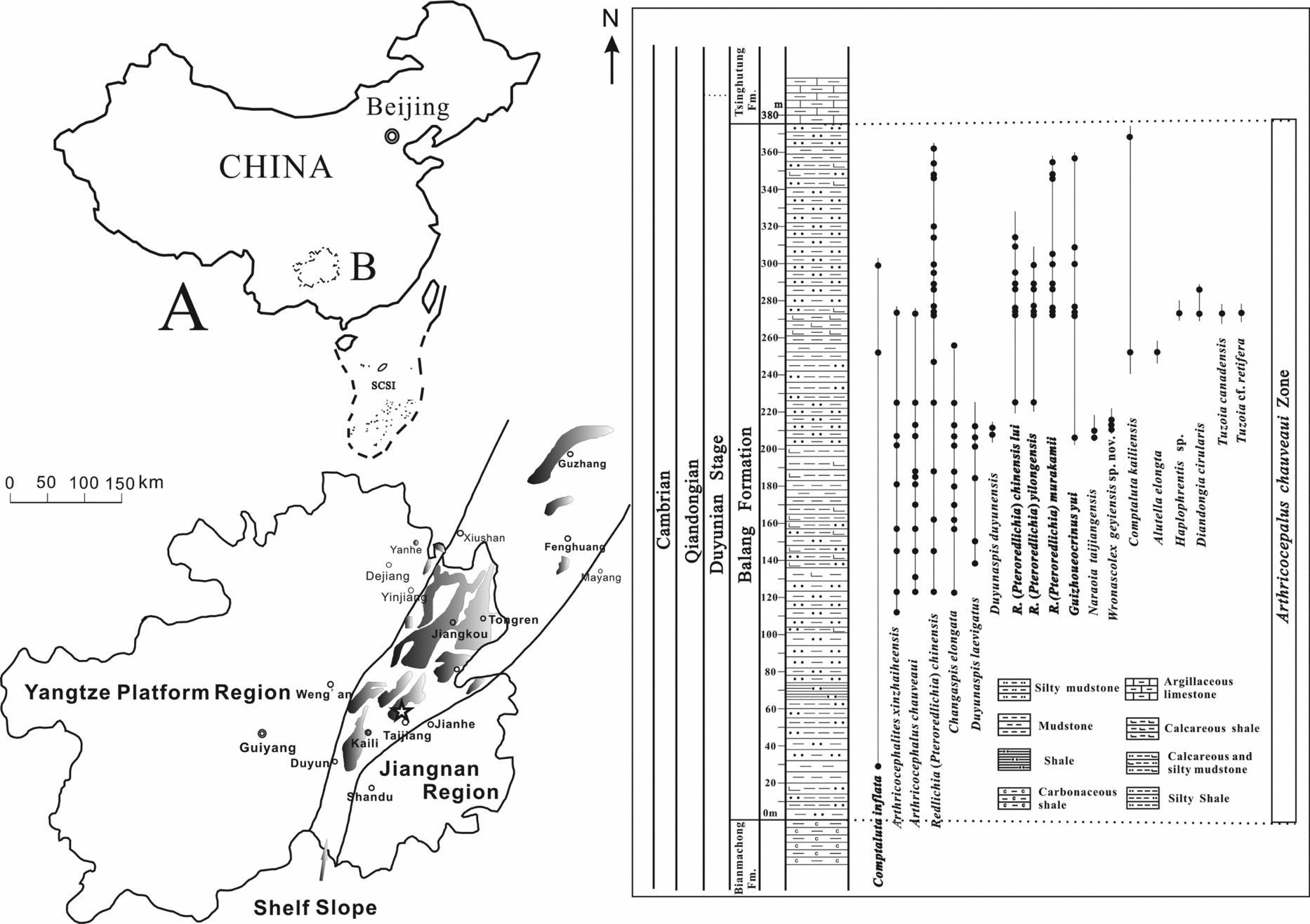
The Balang Formation is primarily limited to a Cambrian outcrop belt in eastern Guizhou Province and western Hunan Province (Zhou et al. Reference Zhou, Yuang, Zhang, Wu and Yin1979; Yin, Reference Yin1987, Reference Yin1996; see Fig. 1). The lower part of the Balang Formation is composed of grey-greenish to yellow-greenish clayey shale, while the upper part is composed of light grey calcareous shale and silty shale with intercalations of thin-bedded argillaceous carbonates. In general, the Balang Formation represents a shallowing-upwards sequence. The formation ranges widely in thickness from 100m to more than 658m (Yin, Reference Yin1987). Typically, the Balang Formation is more than 600m thick in central eastern Guizhou and more than 300m thick in northern Guizhou. In eastern Guizhou the overlying Tsinghsutung Formation is dominated by green-greyish thin-bedded limestone, while in Nangao, Danzhai area, the lithofacies of the overlying Wuxun Formation is dominated by green-greyish and silty calcareous shale. The underlying Bianmachong Formation is mainly composed of grey-black mudstone, but it changes to yellow-greyish shale southwards (Yin, Reference Yin1987). The previous biostratigraphic framework was described as a single genus-level assemblage zone (Zhou & Yuang, Reference Zhou and Yuang1980; Yin, Reference Yin1987), considered first to represent up to four species-level zones (Yuan, Zhao & Li, Reference Yuan, Zhao and Li2001; Yuan, Zhao & Yang, Reference Yuan, Zhao and Yang2006), but subsequent work recognized only one species-level assemblage zone (Peng, Reference Peng2009; Peng et al. Reference Peng, Feng, Fu, Zhao and Yao2010; Peng, Zhao & Sun, Reference Peng, Zhao and Sun2012). Most recently, a single species-level zone, that is the Arthricocephalus chauveaui Zone, has been proposed (Yan et al. Reference Yan, Peng, Zhao, Wen and Sun2014). A. chauveaui Bergeron, Reference Bergeron1889 and Changaspis elongata Lee in Chien, Reference Chien1961 are known from the lower Cambrian Henson Gletscher Formation of Greenland; the latter was described as Lancastria plana by Blaker & Peel (Reference Blaker and Peel1997, pp. 118–22, figs 69/2, 3, 70, 71/4, 5). In addition, A. (Arthricocephlites) jishouensis Zhou in Zhou et al. Reference Zhou, Liu, Meng, Sun, Wang and Jin1977, which is common in the Balang Formation, was assigned to Hailiplaktos jishouensis by Blaker & Peel (Reference Blaker and Peel1997, figs 64/5–7). However, according to correlation using three genera of corynexochid trilobites, the Balang Formation and part of the Henson Gletscher Formation are equivalent in age. The Balang Formation is early Cambrian to late Tsanglangpuan in age, equivalent to the Qiandongian early Duyunian of the Cambrian stratigraphic system in slope facies (Peng & Babcock, Reference Peng, Babcock, Peng, Babcock and Zhu2001). According to the criteria for correlation in South China, the Balang Formation is equivalent to the Wulongqing Formation of Yunnan Province in age (Luo et al. Reference Luo, Li, Hu, Fu, Hou, Liu, Chen, Li, Pang and Liu2008; Peng et al. Reference Peng, Feng, Fu, Zhao and Yao2010; Peng, Zhao & Sun, Reference Peng, Zhao and Sun2012). The Balang Formation contains abundant R. (Pteroredlichia) chinensis Walcott, Reference Walcott1905, and is correlative with the lower part of the Ordian of the Cambrian of Australia (Öpik, Reference Öpik1970; Nedin, Reference Nedin1995). The Balang Fauna occurs in the middle to upper part of the formation at seven newly identified localities (Peng, Zhao & Sun, Reference Peng, Zhao and Sun2012; Ma et al. Reference Ma, Peng, Zhao, Da and Sun2011). The Balang Formation at the very fossiliferous Geyi Section is 375.4m thick at exposures near Geyi Town, Taijiang County, Guizhou Province, where the Balang Fauna assemblage occurs in the middle and upper parts of the formation. Here, we describe the palaeoscolecid W. geyiensis sp. nov. so far known only from the Geyi Section, where it is associated with other components of the Balang Fauna, e.g. Guizhoueocrinus yui Zhao, Parsley & Peng, Reference Zhao, Parsley and Peng2007; Naoroia taijianensis Peng, Zhao & Sun, Reference Peng, Zhao and Sun2012; Tuzoia canadaensis Resser, Reference Resser1929; the trilobites R. (Pteroredlichia) chinensis, A. chauveaui, A. (Arthricocephlites) xinzhaiheensis Chien & Lin in Lu et al. Reference Lu, Zhang, Qian, Zhu, Lin, Zhou, Qian, Zhang and Wu1974 and C. elongata, etc. (Fig. 1).
Map of the geographic distribution of the Cambrian Balang Formation (shaded area; five-pointed star represents fossil locality), Guizhou Province, South China and distribution of key fossils within the Geyi Section of the Balang Formation.
3. Material and methods
More than 50 specimens were collected from grey-greenish mudstone of the Geyi Section of the Balang Formation. They often form tiles on slabs of shale or mudstone. Some specimens are preserved as moulds, but many possess a black, fine, linear intestinal tract. Specimens typically split uniformly between two sides of the cuticle. Thus, both sides (part and counterpart) of the specimens preserve the gross morphology of the body. The cuticular structures are apparent on the inside of the specimens; thus, the dark holes in the SEM observations indicate protuberate nodes (Fig. 4d–h). Fifteen nearly complete specimens (without introvert and pharynx) and some cuticular fragments were selected for SEM analysis; three specimens (counterparts) were coated with gold prior to imaging. Analysis was completed at the scanning electron microscope (SEM) laboratories of the Nanjing Institute of Geology and Palaeontology CAS (using a ZEISS-SUPRA 40VP). Further observation was conducted using a VHE photomicrographic system: specimens were photographed in natural light as well as in lamplight. The nomenclature applied in this study follows Conway Morris & Robison (Reference Conway Morris and Robison1986), Conway Morris (Reference Conway Morris1997), Kraft & Mergl (Reference Kraft and Mergl1989) and Müller & Hinz-Schallreuter (Reference Müller and Hinz-Schallreuter1993). All described specimens are deposited in the Palaeontological Museum of Guizhou University, Guiyang, China (GU); the prefix GY assigned to specimens indicates the Geyi Section.
3.a. Systematic palaeontology
Phylum PRIAPULIDA Delage & Hérouard, Reference Delage and Hérouard1897
Class PALAEOSCOLECIDA Conway Morris & Robison, Reference Conway Morris and Robison1986
Family Palaeoscolecidae Whittard, Reference Whittard1953
Genus Wronascolex Ivantsov & Zhuravlev, Reference Ivantsov, Zhuravlev and Ponomarenko2005
1969 Palaeoscolex Whittard; Robison, pp. 1171–2, pl. 138, figs 1, 2.
1979 Palaeoscolex Whittard; Glaessner, pp. 25–7, fig. 3.
1986 Palaeoscolex Whittard; Conway Morris & Robison, p. 14
1991 Palaeoscolex Whittard; Robison, fig. 6–5.
2004 Palaeoscolex Whittard; Ivantsov & Wrona, pp. 6–12, figs 3–8.
2005 Wronascolex Ivantsov & Zhuravlev, pp. 64–7, pl. XVI, fig. 5., pl. XVII, fig. 6, pl. XVIII, figs 1, 2, pl. XIX, figs 1, 2
2005 Palaeoscolex Whittard; García-Bellido & Aceñolaza, pp. 470–1, pl. 1, figs 3, 4
2011 Palaeoscolex Whittard; García-Bellido & Aceñolaza, pp. 534–6, fig. 3A–D.
2013 Wronascolex Ivantsov & Zhuravlev; García-Bellido, Paterson & Edgecombe, pp. 781–3, tables 1, 2.
Type species. Palaeoscolex lubovae (Ivantsov & Wrona, Reference Ivantsov and Wrona2004)
Diagnosis. Elongate and slender worm, trunk cylindrical, with fine annulations, each annulation armed with rows of circular to sub-circular sclerites, each small sclerite or plate ornamented by a single ring of 4–10 nodes and an occasional central node. Outer margins of plates armed with a ring-like sculptured band with radial lines. Introvert armed with scalids and posterior end with simple paired caudal hooks; intestine simple and straight.
Discussion. The typical character of Wronascolex is the possession of circular to sub-circular plates in additional rows alternately arranged on the annulations of the trunk. Previously, most palaeoscolecids from Burgess Shale-type biotas were recognized as Palaeoscolex (Robison, Reference Robison1969; Conway Morris, Reference Conway Morris1977; Glaessner, Reference Glaessner1979; Hou & Sun, Reference Hou and Sun1988; Ivantsov & Wrona, Reference Ivantsov and Wrona2004), such as the type species of Wronascolex, Palaeoscolex lubovae (Ivantsov & Wrona, Reference Ivantsov and Wrona2004) from the Siberian Platform, P. antiquus Glaessner, Reference Glaessner1979 from Australia, P. ratcliffei Robison, Reference Robison1969 from North America and P. sinensis Hou & Sun, Reference Hou and Sun1988 from China. According to the precise diagnosis of Palaeoscolex (see Whittard, Reference Whittard1953; Conway Morris, Reference Conway Morris1997), this genus, in addition to possessing a long, slender cylindrical body covered by an annulated cuticle, possesses two rows of plates on each annulation, respectively, near the intersegment furrow, and a space between the two plate rows filled by numerous microplates; per row of plates near the furrow, there are 1–2 rows of platelets; and in particular, a 7–12 node array is present on the upper surface of the plates forming a circular to slightly elongated single ring (Conway Morris, Reference Conway Morris1997). With reference to characters of the detailed configuration, Palaeoscolex, first described (P. lubovae; Ivantsov & Wrona, Reference Ivantsov and Wrona2004, p. 6, figs 3, 4) from the lower Cambrian Sinsk Formation of the Siberian Platform and placed in Nemathelminthes, was reassigned to Wronascolex lubovae within the cephalorhynchs by Ivantsov & Zhuravlev (Reference Ivantsov, Zhuravlev and Ponomarenko2005). P. sinensis from the lower Cambrian Yu’anshan Formation of Yunnan, China was reassigned to Mafangscolex sinensis by Hu (Reference Hu2005). Recently, P. antiquus Glaessner, Reference Glaessner1979 from Australia, P. ratcliffei Robison, Reference Robison1969 from North America and P. cf. P. ratcliffei Robison, Reference Robison1969 from Spain were reassigned to relative species under Wronascolex or Wronascolex? (García-Bellido, Paterson & Edgecombe, Reference García-Bellido, Paterson and Edgecombe2013). Palaeoscolex is presently recognized only from Ordovician strata (Whittard, Reference Whittard1953; Kraft & Mergl, Reference Kraft and Mergl1989; Conway Morris, Reference Conway Morris1997; García-Bellido, Paterson & Edgecombe, Reference García-Bellido, Paterson and Edgecombe2013). Based on detailed SEM photographs from fossil material (Ivantsov & Zhuravlev, Reference Ivantsov, Zhuravlev and Ponomarenko2005; Hu, Reference Hu2005; García-Bellido, Paterson & Edgecombe, Reference García-Bellido, Paterson and Edgecombe2013), we agree that the reassignment of these genera is valid. But morphologic characters, in particular, the plates on the annulations of the three genera Palaeoscolex, Wronascolex and Hadimopanella, are actually different (Gedik, Reference Gedik1977, pl. V5; Conway Morris, Reference Conway Morris1997; Ivantsov & Zhuravlev, Reference Ivantsov, Zhuravlev and Ponomarenko2005). We argue that both plate-types for Wronascolex and Palaeoscolex were separately defined as Hadimopanella-type plates and Milaculum-type plates (García-Bellido, Paterson & Edgecombe, Reference García-Bellido, Paterson and Edgecombe2013). Hadimopanella is only known from isolated small sclerite fossils as a form genus; the node array on the upper surfaces of its sclerites shows variation from no rings with 1–4 nodes to 7–30 nodes forming complicated node arrays (Gedik, Reference Gedik1977; Boogaard, Reference van den Boogaard1983, p. 337, fig. 3). Milaculum Müller, Reference Müller1973 is another isolated small sclerite fossil known from small sclerites described as slightly larger than those of Hadimopanella (Gedik, Reference Gedik1977; Boogaard, Reference van den Boogaard1983, p. 337, fig. 3). The sclerite form is described as elongate and oval with the node array variation on the upper surface (Müller, Reference Müller1973; Boogaard, Reference van den Boogaard1988) only somewhat similar to the plates of Palaeoscolex (Conway Morris, Reference Conway Morris1997). Wronascolex had been suggested to have a wide geographic distribution, being found in North America, Australia, Spain and China (García-Bellido, Paterson & Edgecombe, Reference García-Bellido, Paterson and Edgecombe2013). New fossil material from the Balang Formation confirms Wronascolex's occurrence in China. The type species of Yunnanoscolex, Y. magnus Hu et al. Reference Hu, Sterner, Zhu, Luo, Forchielli, Keupp, Zhao and Liu2012, also from China, was recognized to have plates similar to W. spinosus by García-Bellido, Paterson & Edgecombe (Reference García-Bellido, Paterson and Edgecombe2013). The placement of this genus, however, is not straightforward, although it was reassigned to Wronascolex. Before, only a single taxon, P. spinosus?, was reported from the Guanshan Biota of the Wulongqing Formation of Huize, Yunnan, China. The assignment of this taxon was based on two SEM photographs from one specimen (Liu et al. Reference Liu, Ou, Han, Zhang, He, Yao, Fu and Shu2012, p.128). The stratigraphic position of this taxon is equivalent to that of Y. magnus. In fact, the characters of the plates and the node array of P. spinosus? on the upper surface of the plates closely resemble those of Y. magnus. This indicates that Wronascolex does not occur in Yunnan, China. According to SEM micrographs of single button-shaped plates on the cuticle annulations of the Balang worm trunk (Figs 3, 4), the characters of the plates are similar to those of the type species of Wronascolex, W. lubovae. Specifically, each annulation on the trunk having c. 6–7 rows of alternating plates and a single ring with 4–7 nodes in a petal-shaped array and no central node on the upper surface of the plates distinguishes specimens from the Balang Formation from those of related species of Wronascolex, providing additional species-level taxonomic information for this genus.
Occurrence. North America, Spain, Russia, China; Cambrian Series 2 to Series 3.
Wronascolex geyiensis sp. nov.
Figures 2–4
Etymology. The name of the species derives from the name of the place where the fossil was first discovered in the Balang Formation of Geyi Town, Taijiang County, Guizhou Province, China.
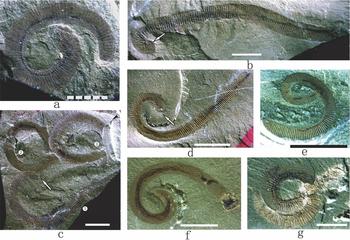
Wronascolex geyiensis sp. nov. Multiple individuals from the Cambrian Balang Fauna, Geyi Town, Taijiang County, eastern Guizhou. (a) A coiled specimen showing the general habitus and intestine (GY-203.4–3). (b) A nearly straight specimen, paratype (GY-208–3), with preserved posterior end and intestine; white arrow indicates caudal hooks. (c) A specimen with three coiled individuals (GY-203.4–6a), holotypes, type individual labelled with number 1 (GY-203.4–6a-1). (d) A nearly complete juvenile with posterior end preserved; white arrow indicates caudal hooks (GY-201–1). (e) A nearly complete juvenile, (GY-203.4–7). (f) A coiled nearly complete juvenile with complete posterior end (GY-203.4–1). (g) A coiled nearly complete juvenile with complete posterior end, paratype (GY-203.4–5b). Scale bars represent 2mm in (g), and 5mm in others.

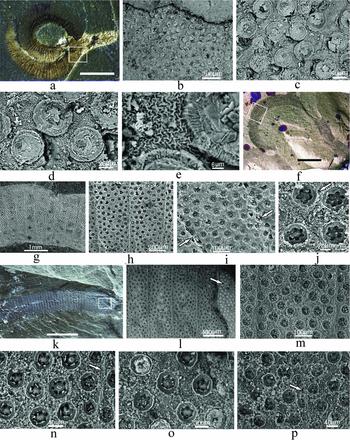
SEM micrographs of the cuticular characters of Wronascolex geyiensis sp. nov. from the Cambrian Balang Fauna, Geyi Town, Taijiang County, eastern Guizhou. (a) A coiled juvenile specimen with faint intestinal tract, paratype GY-203.4–5a. (b–e) Enlargement of square box in (a): (b) the fuzzy intersegment furrows and circular sclerites (plates); (c) the centre of the plates exhibit broken matrix caps; (d, e) the rimmed outer margin of the plate with a ring-like radially lined sculptured band; the space in between plates is occupied by fine wrinkles. (f) Partial fragment of a specimen of three associated individuals, the only counterpart specimen of the holotype (coated in gold), GY-203.4 -6. (g–j) Enlargement of the square box in (f): (g) trunk with clear annulations and intersegment furrows, with c. 3 annulations per millimetre; (h) detail of two annulations and intersegment furrows, each annulation with about 6–7 rows of plates in alternating arrangement; (i) an annulation separated by two intersegment furrows (arrow points to position) with c. 6–7 rows of alternating plates; (j) detail of plates with five to six nodes, showing a dark hole; adjacent plates vary in both plate diameter and distance from each other. (k) A trunk specimen with aboral terminate, GY-198–4. (1–p) Enlargement of square box in (k): (l) shows annulations, intersegment furrows and the plates’ irregular array arrangement in c. 6–7 rows; arrow points to part belonging to a different layer of the specimen to be split, where the plates take on a conical convex shape; detail to be seen in (o); (m) an annulus with c. 6–7 rows of alternating plates; adjacent rows of alternating plates, plate diameter and distance from each other vary; (n, p) detail of plates with different sizes and five to seven nodes; near the intersegment furrow (arrow points to position), small sized plates with four or five nodes occur.

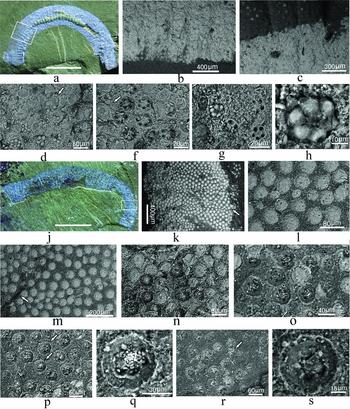
SEM photos showing the cuticular characters of Wronascolex geyiensis sp. nov. from the Cambrian Balang Fauna, Geyi Town, Taijiang County, eastern Guizhou. (a) A fragment of trunk with a whitish colour, with intestine filled with organic mud, paratype (GY-195–1); scale bar represents 5mm. (b–h) Details of cuticular structures within the square box in (a): (b, c) the trunk cuticle with annulations, correlated to small plates; (d–f) the rounded small plates distributed on an annulation showing two states: plates with thin matrix caps or plates completely exposed, the latter plates with surface ornamentation of five to six smooth and ovate nodes in a petal-like array; after the nodes have fallen out the nodes appear as dark holes; on (d) the small arrow points to a plate with half-fallen out nodes, and on (f) the arrow points to a plate with a thin matrix cap; below the cap can be seen a faint trace of six nodes. (g, h) Detail of a plate with six nodes forming a petal-like single ring, and the fine wrinkles among plates. (j) The trunk specimen of an adult individual, GY-198–1, scale bar is 5mm. (k–s) Enlargement of square box in (j). (k) Three annulations separated by intersegment furrows, with c. 6–7 rows of alternating plates per annulation with thin matrix caps; the arrow points to the intersegment furrow; (l–n) detail showing plates of two different sizes; adjacent plates vary considerably in size or inlaying arrangement; (o, p) detailed enlargement of partial plates, showing variation among plates in distance and in the inlaying arrangement of the plates; (q, s) enlargement of plates marked by the lower and upper arrows on (p), respectively; the two plates are in a convex position with a ring of nodes, forming a rim on the margin of the lower plate. On (q, r) the plates are in a convex position, with the arrow indicating a cluster of pyrite crystals in (r).

Holotype. A slab with three coiled individuals (GY-203.4–6a, b), type individual located below individual GY-203.4–6a-1 (see Fig. 2c), and detailed configuration of small sclerites (plates) on the surface of the body as seen by SEM photographs (Fig. 3f–j).
Paratypes. Paratype-1: a half-complete specimen with aboral terminate and dark straight intestinal tract, GY-208–3 (Fig. 2b); paratype-2: a coiled individual with aboral terminate, juvenile specimen (part and counterpart), GY-203.4–5a,b (Figs 2g, 3a), and detailed configuration of small plates on the surface of the body as seen in SEM photographs (Fig. 3b–e); paratype-3, an adult individual fragment, GY-195–1, and detailed configuration of small plates on the surface of the body as seen in SEM photographs (Fig. 4a–h).
Material. A total of 53 specimens preserved in slabs of shale, including juvenile and adult individuals, among which 20 specimens are nearly complete with trunk and aboral terminations, and five specimens are known from both parts and counterparts; others are fragments. All collected from the Geyi Section of the Balang Formation, near Geyi Town, Taijiang County.
Diagnosis. Body medium large, elongate, slender, about 14 times longer than wide; introvert poorly and incompletely preserved; cylindrical trunk densely covered with annulations, numbering approximately 128; each annulation with c. 6–7 rows of inlaying alternately arranged plates; single ring with petal-shaped array with 4–7 nodes (normally with six nodes); no central node on the surface of the plates, only one plate pattern. Number of plates and rows on each annulation unequal. Size of plates unequal; diameter of the plates ranges from 30–60μm. Plates are rounded, the outer margin armed with a ring-like sculptured band with radial lines. Terminal end armed with simple paired caudal hooks. Pharynx not preserved. Intestine is simple and straight, with an anal opening at posterior end.
Description. Body medium long, the longest individual being 46.7mm (Fig. 2b); unclear boundary between trunk and introvert. Bodies are straight, bent or coiled; adult body over 3.0mm in width, the widest individual is 3.3mm (Fig. 2a–c), juvenile 1–1.8mm wide (Fig. 2d–g). The length of the trunk in most specimens exceeds 40mm (Fig. 2a–e) excluding the unpreserved introvert section. Most specimens show a coiled shape, which may result from rapid burial after death (Huang et al. Reference Huang, Chen, Zhu and Zhao2014). Terminal end of the trunk armed with two simple caudal hooks (Fig. 2b–d). Bending of the straight trunk may result from burial of worms during locomotion (Huang et al. Reference Huang, Chen, Zhu and Zhao2014). Some specimens are preserved with a dark intestine with an anal opening at the posterior end. The intestine is preserved on the ventral side in the coiled specimens. A specimen, near the ventral side, contains a clear dark intestine parallel to the coiled trunk, and the width of dark intestine is uniform (Fig. 2a). The holotype is a nearly complete bent individual with preserved posterior end (Fig. 2c, individual labelled 1), 42mm long, with a trunk covered by dense annulations; c. 121 annulations may be discerned, c. 3 annulations per millimetre (Fig. 3g), with an estimated total number c. 126. Each annulation is separated by an intersegment furrow, and comprises a cuticle with c. 6–7 rows of alternately arranged circular plates; plates are tiny, button-shaped, in inlaying arrangement (Fig. 3h–j); rows of the array are irregular (Fig. 3h, i); spaces among plates are not equal and filled by fine wrinkles (Fig. 3i, j). Plates show an inlaying arrangement, adjacent rows varied in direction (Fig. 3h, i). The size of the plates mostly ranges from 30–60μm in diameter (Fig. 3j). There is only one plate pattern per annulation. Paratypes 2 and 3 also show similar characters. Four to seven prominent nodes compose a single ring in a petal-shaped array on the plates, with no central node (Figs 3n–p, 4n–p); six prominent nodes are common (Figs 3j, n, o, 4h, q), while plates with four and seven prominent nodes are rare. When prominent nodes are removed, the positions of the nodes appear as dark points or blank spaces (Figs 3j, n, 4d–h). On the outer margin of each plate, near the base, lies a ring-like radially lined sculptured band (Figs 3c–e, n–o, 4q, s). The boundary between the two succeeding annulations in some specimens is not discernible; plates on the annulation near the intersegment furrow are slightly smaller in diameter (Figs 3h, i, m, n, p, 4k–m). In addition, the surface of the plates in some specimens is covered by thin matrix caps (Fig. 4f, k–m), which result from diagenetic secondary infilling. Juvenile specimens (Figs 2d–g, 3a–e) have plates slightly smaller than those of adult individuals, mostly ranging from 30 to 50μm (Fig. 3c, d). They show the same morphologic characters as those of adult individuals in outline, differing only in that body diameter is less than 2mm; the number of rows on each annulation is less than six (Fig. 3b). Based on observation and research, the worm body is divided into two types: (1) a coiled type: the aspect of the opening aperture is anterior and that of the coiling is posterior; the internal ring side is ventral and the outer ring side is dorsal (Fig. 2); (2) a straight or bent type: the part where the diameter of the body is large is anterior and that which is slightly smaller composes the end part, with a slight arch prominent on the dorsal side; the size of the plates located on the dorsal and ventral sides is almost identical, as are the sizes of the plates at the anterior and posterior ends (Fig. 4k, l).
4. Comparison and discussion
García-Bellido, Paterson & Edgecombe (Reference García-Bellido, Paterson and Edgecombe2013, p. 784, table 2) compiled taxonomic data for seven species of Wronascolex in a table. These species possess plate rows on each annulation that vary from one to four in number. W. geyiensis sp. nov. is distinguished from other species of the genus by the presence of six to seven rows of alternating plates on each annulation, with c. 3 annulations per millimetre, only one plate pattern, and four to seven prominent nodes consisting of a single petal-shaped ring with no central node on the surface of the plates (Fig. 3d–h). The type species of Wronascolex, W. lubovae (Ivantsov & Wrona, Reference Ivantsov and Wrona2004, p. 6, figs 3, 4; Ivantsov & Zhuravlev, Reference Ivantsov, Zhuravlev and Ponomarenko2005), possesses 5.5–8.3 annulations per millimetre, with four plate rows per annulation; a cylindrical body with a maximum width of 1.2mm; and a single ring of 5–8 nodes in an array, and occasionally a central node, on the upper surface of each plate (García-Bellido, Paterson & Edgecombe, Reference García-Bellido, Paterson and Edgecombe2013, p. 784, table 2). The important disparity is the latter with the plates and platelets having two patterns. Both differences are obvious. Compared to W. antiquus (Glaessner, Reference Glaessner1979) and W. iacoborum García-Bellido, Paterson & Edgecombe, Reference García-Bellido, Paterson and Edgecombe2013 from the Emu Bay Shale of the Cambrian Series 2, Stage 4, Big Gully, Kangaroo Island, South Australia, W. antiquus is distinguished by plate morphology. Each plate on the upper promontory surface bears 3–6 nodes arranged in a single circle, occasionally with a central node, and each annulation contains only one row of large plates, with the diameter of the plates notably larger than that of the new species (García-Bellido, Paterson & Edgecombe, Reference García-Bellido, Paterson and Edgecombe2013, figs 3–5, p. 784, table 2); W. iacoborum is distinguished by the upper promontory surface of the plates having five nodes arranged in a single ring, each annulation possessing two plate rows with a regular arrangement, and platelets and microplates between rows (see García-Bellido, Paterson & Edgecombe, Reference García-Bellido, Paterson and Edgecombe2013, figs 3–5, p. 784, tables 1, 2); this differs from the new species, which possesses c. 6–7 plate rows on each annulation, and no platelets. Specimens of Wronascolex? spec. 1 and Wronascolex? spec. 2 from the Murero Formation, Rambla de Valdemiedes, Murero, Spain (García-Bellido, Paterson & Edgecombe, Reference García-Bellido, Paterson and Edgecombe2013, p. 784, table 2), are larger, with each annulation containing three to four rows of large plates, the diameter of the plates ranging from 800–100μm. Two species were described as Wronascolex?. The characters of Wronascolex? spec. 1 are a larger plate diameter, resulting in fewer plate rows on each annulated interval, and the number of nodes and the mode of arrangement on the upper surface of the plates being unclear (García-Bellido, Paterson & Edgecombe, Reference García-Bellido, Paterson and Edgecombe2013, p. 793, fig. 9). The characters of the plates and the arrangement of the nodes in Wronascolex? spec. 2 are similar to that of new species, but each annulation possesses three to four plate rows in regular arrangement, distinguishing it from the new species. P. ratcliffei Robison (Reference Robison1969) from the Spence Shale, Langston Formation, Utah, USA, has been reassigned to Wronascolex? ratcliffei by García-Bellido, Paterson & Edgecombe (Reference García-Bellido, Paterson and Edgecombe2013). The species not only has plates that are large in diameter, and four plate rows on each annulation, but also the space between the plates is filled by a tessellate pattern, a micro-net that is different from that of the new species. Another species, W. spinosus (Ivantsov & Wrona, Reference Ivantsov and Wrona2004, p. 6, figs 3–4; Ivantsov & Zhuravlev, Reference Ivantsov, Zhuravlev and Ponomarenko2005) from the Sinsk Formation of the lower Cambrian of the Siberian Platform, exhibits a number of plate rows on each annulated interval and nodes arranged on a convex conical plate, and microplates among the plates, which are different from those of the new species, in particular, nodes with a pointed spine unlike the smooth, small oval shapes of the nodes of the new species (Fig. 3g, h). However, Y. magnus resembles the new species, but has neighbouring plates on succeeding rows spaced alternately. The plates are arranged quincunxially, the trunk is large, the size of the plates is small, with a loose arrangement on the annulations, and there is a single ring with 2–6 nodes on the upper surface of the plates, commonly five nodes in a quincunx arrangement, and four nodes forming a square (Hu et al. Reference Hu, Sterner, Zhu, Luo, Forchielli, Keupp, Zhao and Liu2012). Large protuberances are irregularly present on the ventral side of the posterior segments, approximately 200–300μm in diameter, though its individual large plates are arranged loosely and quincunx-like on each annulation; the size of the plates is small and ranges from 40–45μm, with 2.5 annulations per 1mm; plates are arranged in rows of less than five per annulation (Hu et al. Reference Hu, Sterner, Zhu, Luo, Forchielli, Keupp, Zhao and Liu2012), resulting in poor preservation of the cuticle trunk, obviously different from the new species. Here, more than 30 specimens of Balang worm trunks are covered by dense and small sclerites. These sclerites or plates show different types of preservational states: one plate type has a thin matrix cap (Figs 3b–d, 4k–m), the other type is completely exposed, the latter bearing surface ornaments with a petal-like array of five to six nodes on the plates (Fig. 4d, g, h). Dark holes are present where nodes are degraded. We speculate that these specimens representing worms with plates lacking the matrix caps and having degraded nodes (Fig. 3g, h, l–p) had been transiently exposed, after the matrix cap was removed, resulting in erosion and degradation of the node ring. Adult individuals show c. 6–7 plate rows per annulation (Figs 3g–i, l, m, 4k), while this number is fewer than six for juvenile individuals (Fig. 3b). We speculate that this trend may be ontogenetic, with increasing numbers of plate rows on each annulation during growth. The disparity in the size of the plates on the body annulations is not distinct; plates of smaller diameter are rare, perhaps forming only during transitions in growth, or are lost owing to taphonomic bias. Among all the nearly complete specimens, the introvert or anterior end are not preserved. This is likely owing to the softer cuticle of the pharynx with the longitudinally regular and irregular arrangement of many scalids, so that non-mineralized sclerites are often not preserved. Some specimens are preserved with a dark line running the length of the trunk representing the intestine. This indicates that the worm ate organic mud that remained in the intestine. The dense small sclerites that covered the Balang worm not only protected the internal soft-body but also helped the worm to contract, facilitating locomotion and burrowing, while promontory nodes on the surface sclerites increased friction within the soft matrix. Future work may shed light on the ecology and taphonomy of this taxon. The new species not only expands the geographic and stratigraphic distribution of Wronascolex, but also provides additional evidence for understanding the genus's body configuration, ecology and taphonomy. Wronascolex is found globally in Cambrian strata ranging from Series 2 to Series 3.
Occurrence. Geyi Section of the Balang Formation, Taijiang County, Guizhou Province, China; Cambrian Series 2, Stage 4.
Acknowledgements
We are very grateful to Dr Robert R. Gaines (Pomona College, USA) for his constructive review and English correction in the manuscript and Dr Shixue Hu (Sichuan Institute of Geological Survey) for his significant discussion about the manuscript, and two anonymous reviewers for their comments and good suggestions. This research was supported partly by grants from the National Sciences Foundation of China (No. 41172005; 41222013; 40872010; 41330101; 41362002), the Major State Basic Research Development Programme of China (973 Programme) (No. 2013CB835002), the Chinese Academy of Sciences (KZZD-EW-02); the State Key Laboratory of Palaeobiology and Stratigraphy (Nanjing Institute of Geology and Palaeontology, CAS, No. 113111), the Science, Technology and Education Talents from the Governor of Guizhou Province (Gui. Sp. 2011–37), Research Central of Palaeontology of Guizhou (Gui, Sci. Z.[2014] 4003), and the Palaeontology Museum of the Shenzhen Xianhu Botanical Garden.