Bojale is a girls’ initiation ceremony among Bakgatla-baga-Kgafela (henceforth referred to as Bakgatla) in Botswana. I attended bojale in 2009, after Kgosi (chief) Kgafela II's call for its revival, ending an almost twenty-year gap since the last ceremony in 1990. The first reason for attending the ceremony was to take my place in my community through regiment membership;Footnote 1 the second was to be a participant observer and study the uses of the bojale drum in the ceremony, and its relationship with other bojale entities such as its custodian, drummers, initiates, elders and the music itself. As a researcher, I seek to understand material culture within its living contexts, which are defined by its relationships with its owners and users (Miller Reference Miller1987: 109–10). The bojale drum is part of a twin set that was rediscovered by Amos Kgamanyane and Sandy Grant in 1971 in Mochudi and loaned to the National Museum, Monuments and Art Gallery due to the absence at that time of a museum in Kgatleng District. After the establishment of Phuthadikobo Museum in Mochudi in 1976, the twin drums were separated. The one used in the 2009 ritual was the Phuthadikobo Museum one, and its twin was left at the National Museum as part of Bakgatla national culture (Information and Broadcasting 1971: 19–24). The drums have remained separated up to the present.
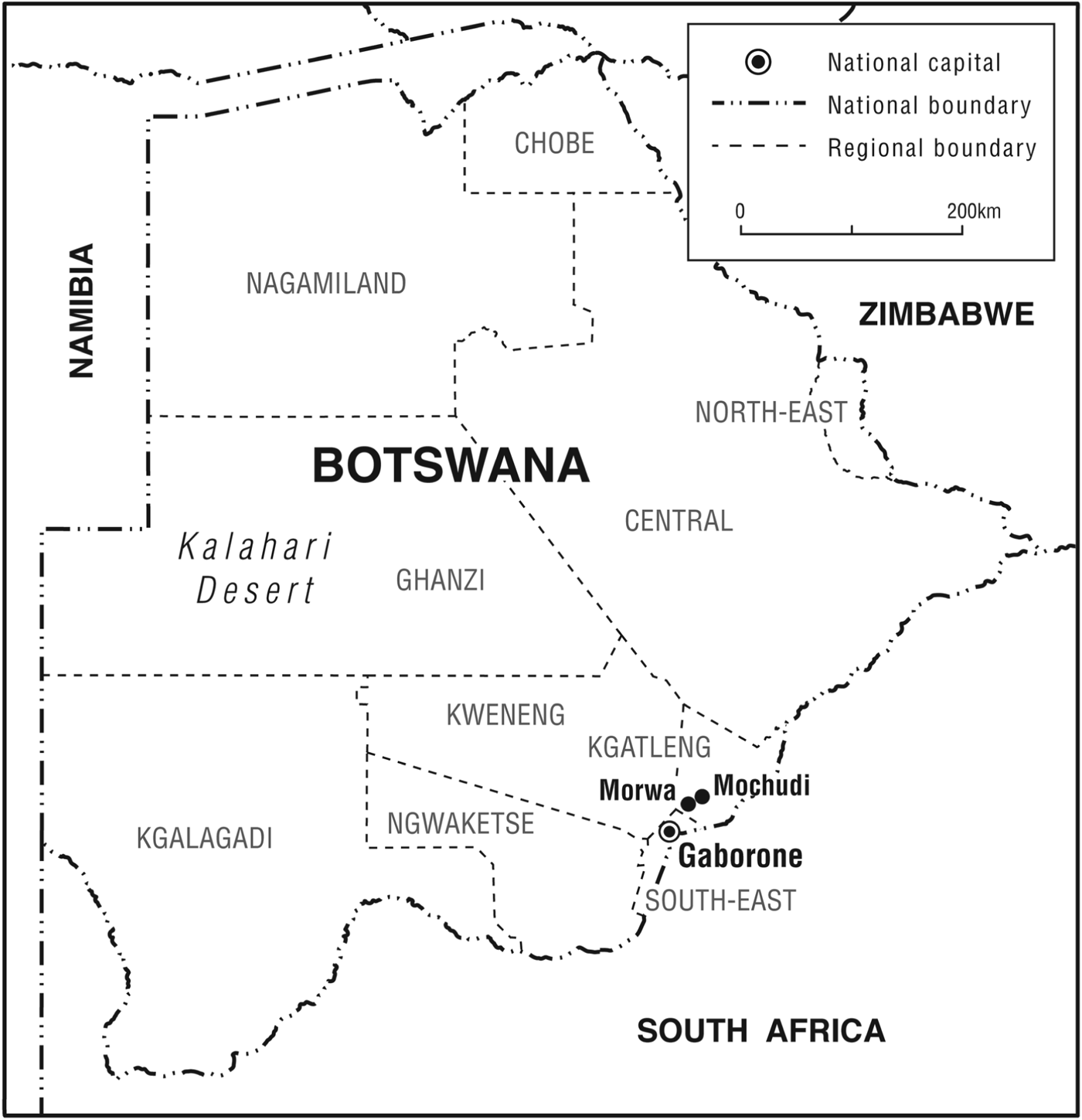
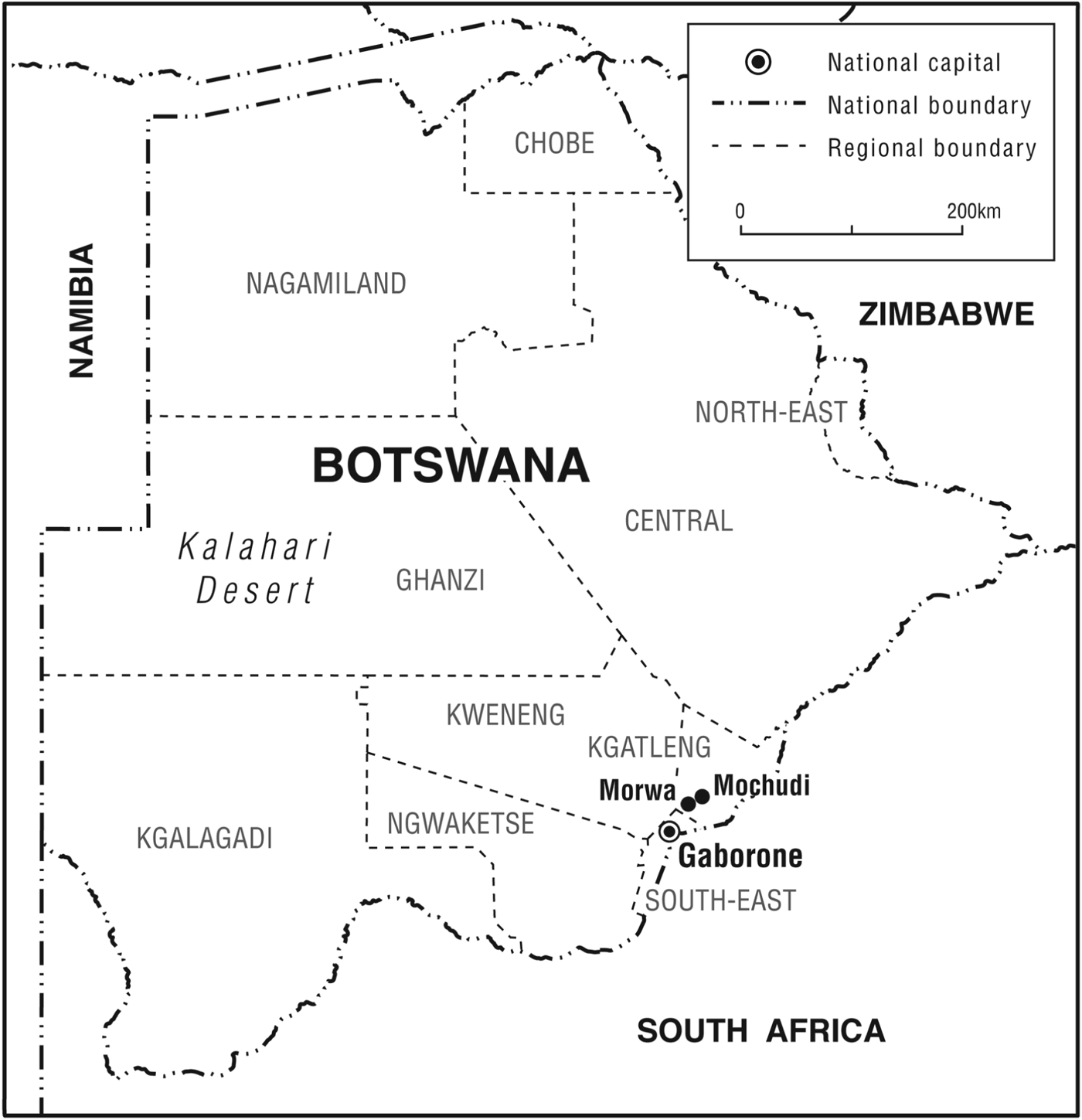
Bakgatla are part of a group that migrated into modern Botswana, then the Bechuanaland Protectorate, in 1871 from Saulspoort, South Africa under the leadership of Kgosi Kgamanyane (Schapera Reference Schapera1942: 54–5). The main reason for their migration is linked to Kgamanyane's public flogging by Paul Kruger in 1870 due to his refusal to provide labour for a dam project (Mbenga Reference Mbenga1997: 127–40). Upon their arrival in modern Botswana, they lived in Kweneng territory but later migrated into the present-day Mochudi, where they have since settled (Makgala Reference Makgala2009: 90–4). Mochudi is the capital of Kgatleng District in Botswana (see Figure 1), and the Phuthadikobo Museum in Mochudi is the oldest regional museum in Botswana (Grant Reference Grant, Gathercole and Lowenthal1990: 214–23).
Map of Botswana showing the positions of Mochudi and Morwa
2009 INITIATION REVIVALS
Bojale is a ritual that marks the transition of a girl into a woman among Bakgatla, after which she becomes a regiment member (Mosothwane Reference Mosothwane2001: 144–65). The last full traditional ceremony can be traced to the early 1900s; after that, short ceremonies continued, marking the installation of new chiefs and the naming of new regiments (Schapera Reference Schapera1978: 5–6). For example, short initiation ceremonies were conducted during Kgosi Isang's installation in 1922, Kgosi Molefi's in 1928, Kgosi Mmusi's in 1939, and Kgosi Linchwe II's in 1963. The main reason for the abandonment of the full initiation rites among Batswana (Setswana-speaking people) during the colonial period was the conversion of chiefs to Christianity. The missionaries harshly condemned the rituals, as they were perceived to be anti-Christian (Mafela Reference Mafela2007: 523–66). For example, initiation songs were condemned because some of them praised sexual organs and were therefore perceived to be promoting promiscuity and immorality (Brown Reference Brown1921: 419–27).
Revival of the initiation ceremony in a modern form began on the initiative of Kgosi Linchwe II in 1975 (Grant Reference Grant1984: 7–17) and continued until 1990 (Kollars Reference Kollars and Hughes1991: 73–6). However, the revival was opposed by influential figures, notably the first president of Botswana, Sir Seretse Khama, who labelled the rituals barbaric and tribalistic (Grant Reference Grant1984: 7–17). After Botswana's independence in 1966, the ruling party, the Botswana Democratic Party, had adopted a homogeneous one-nation philosophy as a form of nation building. Any form of event or organization that encouraged ethnic identity, such as initiation, was therefore seen as a threat (Werbner Reference Werbner2004: 36–8). After 1990, initiations were abandoned until 2009 for reasons that are not entirely clear. When quizzed, informants did not offer any explanation except that the chief did not call for initiation.
The 2009 initiation revival ceremonies were influenced by a number of cultural expectations. According to Bakgatla culture, a new chief is obliged to conduct initiation. Kgosi Kgafela II was enthroned in September 2008 after the passing of his father, Kgosi Linchwe II, in 2007. His coronation necessitated a call for initiation and for him to name his first regiment. The chief's first regiment is supposed to be that of women, because a chief is welcomed to his chieftainship by being culturally blessed by women. This is why bojale was conducted first in May and June 2009 before the bogwera (boys’ initiation) that followed in July and August. The chief also takes pride in the number of regiments he initiates that, in the past, served as his political and military wings (Morton Reference Morton2012: 385–6). This role has since been taken over by a national army in postcolonial Botswana. Initiation today centres on the chief, as it did traditionally. The position of the chief and other members of the royal family, such as the queen mother, queen and drummers, show that initiation and the regiments are royal-centred and serve and cement the power of the chief (Setlhabi Reference Setlhabi2014).
The other factor behind the 2009 revival ceremony was that, while Kgosi Kgafela II had been initiated in 1982 and graduated as a leader of Mangana regiment (Grant Reference Grant1984: 7–17), his wife Mohumagadi Mma (queen mother) Matshego was not initiated at the time of their marriage in 2001. In order to take the leadership role of Bakgatla women, it was crucial for her to be initiated and thus have her own regiment. A similar situation had led to the 1975 revival when Kgosi Kgafela II's mother, Mohumagadi Mma Seingwaeng, underwent initiation and graduated as a member of Maisakoma regiment (Setlhabi Reference Setlhabi2014). This was her husband Kgosi Linchwe II's first bojale and the first regiment created since his enthronement in 1963. Thus, bojale ceremonies had long been rare occurrences, taking place only when royal succession required them.
As was common during the colonial period in Africa, anthropological research in Botswana was first conducted by foreigners (Forster Reference Forster1994: 47–62; Schumaker Reference Schumaker2001: 14–22). Isaac Schapera, whose work was mainly on Bakgatla, published a book on the boys’ initiation, bogwera (Reference Schapera1978). He was allowed to witness some aspects of the initiation by Kgosi Linchwe II in the 1982 ceremony in which the young Kgosi Kgafela II was initiated (Grant Reference Grant1984: 7–17). The book still plays a significant role in bogwera literature and preservation. Other major writers on bogwera before Botswana's independence were Moffatt (Reference Moffat1842) and Brown (Reference Brown1921). In postcolonial Botswana, researchers such as Sandy Grant (Reference Grant1984) and Morton (Reference Morton2012) have also written about various aspects of bogwera. Unfortunately, bojale has fewer publications compared with bogwera. However, Kollars, a female foreigner who was socially close to the royal family and a resident of Mochudi, wrote a short account of the 1990 bojale ceremony (Reference Kollars and Hughes1991: 73–6). Her authority to write came from her relationship with the royal family. Mosothwane's (Reference Mosothwane2001) research was mainly geared towards material evidence on initiation sites of both the boys’ and girls’ initiation schools. She is a Mokgatla (member of Bakgatla) academic who obtained access to key people in initiation schools through consultation with Kgosi Linchwe II and his wife.
My addition to this body of knowledge began with my 2010 PhD thesis, which was a case study of the preservation of the bojale drum in museums and its use in bojale (Setlhabi Reference Setlhabi2010). The difference between my research on bojale and that of the other two authors was mainly my personal participatory observations in the ritual. It was hence expected to be ‘authentic’, as I would write about what I observed and experienced within my own culture. I was ‘at home’, and as Setswana (Botswana's national language), my first language, was used for instruction, I did not require translation. I was expected to undergo the initiation naturalistically (Albas and Albas Reference Albas, Albas and Grills1998: 121–42).
THE MODERN SOCIOCULTURAL ROLE OF BOJALE
The role of bojale in modern times is changing in interesting ways. I argue that what remains of initiation is regiment membership, contrary to what the elders described as occurring post-initiation in their time. They remembered raising funds for the weddings, funerals and other major events of their regiments’ members, on top of their other regimental tasks. Donations for royal activities were also regiment-based. Currently, apart from kgotla (community forum) meetings and other royal and initiation-related activities where the regiments often show their solidarity and support, collective solidarity post-initiation remains in the status of belonging to a regiment. It is the only aspect that regiments pride themselves on because it carries societal obligations. The elderly informants decried the lack of cohesion after the revivals, saying that the ‘modern’ generations lack values and cannot be transformed by initiation, even though its purpose is to instil morality and values. The main change in Bakgatla initiation schools over the years is their transformation from puberty rites in which initiates were expected to be virgins (Urban-Mead Reference Urban-Mead, Allman, Geiger and Musisi2002: 53–4) to initiation rites that can include married people and even mothers such as myself. The elderly are also now allowed to undergo the ritual at the same time as younger generations, but in the knowledge that they are making up for a past omission and will join their older regiments after graduating. Some of the elderly graduates can be seen in the back rows of Figure 3.
Another example of change in the modern initiation schools is in the venues for the early morning sessions. For example, in the 2009 ceremony, the sessions, which could begin as early as 5 a.m., were moved from the main ward to the smaller wards around the village for safety reasons. The rationale was that times had changed and it was unsafe for women to move around the village on their own, unlike in traditional times. The dress code was also different as we did not wear the traditional aprons, but were instead instructed to wear short skirts to allow swift movement. We were also allowed to keep long hair instead of completely shaving our heads or trimming the hair as was done traditionally. The hair was not combed during the sessions to symbolize the transitional status. However, only natural hair was allowed and plaited or artificial hair extensions were forbidden. Dreadlocks were also allowed because they do not have artificial components.
The traditional bojale seems to have practised a system of initiation at family compounds where the initiates were completely separated from the community during their entire initiation period (Mosothwane Reference Mosothwane2001). This is in contrast to modern initiation, where girls assemble for sessions and return home at the end of the sessions. The trend indicates the different societal gender constructions and expectations; in contrast, a boy initiate camped away from home for the whole duration of bogwera (Schapera Reference Schapera1978). The boys still camp outside the village for six weeks or more, as was the case with the 2009 and 2010 initiations. Nkomazana (Reference Nkomazana2005) argues that bogwera and bojale initiation schools created social imbalances among Batswana as the boys were instilled with superiority and girls with inferior roles. The rites of passage endorsed the traditional existing constructions that saw boys being celebrated from birth and trained for masculine jobs such as herding livestock and girls being homemakers, attending to fetching water and motherly roles such as minding their younger siblings (ibid.: 26–49).
In the past, certain behaviours, such as abstaining from sexual activity before marriage, were encouraged. In practical terms, this advice is irrelevant in modern rituals because, as already mentioned, the majority of the 2009 initiates were already adults and mothers. The number of pubescent initiates increased only in the 2010 and 2012 ceremonies. A more fitting rule was the prohibition from engaging in sexual intercourse during the entire duration of our initiation, regardless of marital status. Perhaps the significance of this moila (taboo) was that abstinence would symbolize the premarital sex status of the traditional puberty rite.
The last notable change is that traditionally regiments were expected to be continuously available to perform important regimental duties, for example the construction of the Bakgatla National School by regiments under Kgosi Isang in 1920 (Grant Reference Grant, Gathercole and Lowenthal1990) and the demolition of Kgosi Linchwe's old compound by Mafiri regiment in 1964 (Grant Reference Grant1985). Not all regiments remain in the village after their initiation in postmodern times. Work commitments and other factors necessitate the return to towns and other villages. Unlike before, it becomes a challenge for the regiments to fully participate in community errands. Kgosi Kgafela II also wished to revive regimental labour and instructed our regiment to build a school in Kgatleng, a task that is yet to be fulfilled due to changed societal roles.
Even though bojale has changed from its traditional form, it still remains a significant ritual among ethnic groups such as Bakgatla that conduct initiation, as demonstrated by the over 1,000 women who participated in the 2009, 2010 and 2012 ceremonies. The latest ceremonies encompassed women from various social backgrounds: students at all levels, including university ones, workers, and even senior people in government such as permanent secretaries and the former High Court Judge Unity Dow. A form of ethnic identity was being built as people wanted to use initiation as an assertion of belonging despite their differences in age and status. I was informed that the numbers were high as a result of the previous long periods during which initiation schools had been abandoned.
MY IDENTITY AS A RESEARCHER AMONG MY OWN
This study applied ethnographic research methods, specifically participant observation, in bojale. It is important to clarify that while my research could be classified as native anthropology, I choose not to adopt the term because the origins of native anthropology were specific to an anthropologist or researcher conducting ethnographic research among his or her own people, but mainly in reference to non-Westerners (Appadurai Reference Appadurai1988). I prefer to focus on the broader concept of insider research where the researcher is already familiar with the culture and settings (O'Reilly Reference O'Reilly2009: 109–11). This is in contrast to traditional anthropology in which anthropologists travelled to societies outside their own, usually those that seemed to be exotic – hence the title ‘anthropologists of the exotica’ (Okely Reference Okely, Okely and Callaway1996). Where ethnography ‘at home’ is used in this paper, it will not be in reference to its origin of Western anthropologists returning home (Messerschmidt Reference Messerschmidt and Messerschmidt1981) to conduct research among their own but in reference to a researcher among his or her own irrespective of geographical background. (Native anthropology deserves its own discussion in another paper as it is beyond the focus of this one.) The debate on the identity of a researcher conducting ethnographic research ‘at home’ is complex because of the multiple identities that researchers, even those from within, adopt (Narayan Reference Narayan1993). The argument is that even those from other cultures become insiders by their mere presence when studying a social setting (Cerroni-Long Reference Cerroni-Long and Cerroni-Long1995) and at times by spending long periods in the field (Narayan Reference Narayan1993), while, in my experience, those from within the culture become in a sense outsiders because of their positioning as researchers.
An initiate enters bojale through registration by an initiated woman from the community, often her mother. In some cases relatives and other female members of the community are allowed to register a participant. Family becomes the first point of contact when one conducts ethnography ‘at home’, especially when dealing with the secret aspects of the community. Intensive consultation between my family, ward, the queen mother, and the final authority of Bakgatla, Kgosi Kgafela II, was held prior to bojale because the nature of my research would divulge bojale proceedings. It is important to highlight at this stage that behind the chief's permission to allow research into and publication of a sacred ritual was his belief that only a Mokgatla could write the authentic story of the ceremony. This is a reflection of the accepted gospel that researchers from within a culture tend to write authentic texts because of their intimate association with the researched (ibid.) and because they are also representing themselves, and so their accounts cannot be distorted (Appadurai Reference Appadurai1988). After the consultations, I was registered for bojale on 19 May 2009 by my grandmother, Mmapula Sinah Setlhabi of Mafiri regiment, at the main kgotla ward in Morwa, my home village. My mother was not initiated and could not register me according to custom. The registration is done by a headman or chief, at either one of the various wards or the main ward in the village. The expectation was for every participant to be initiated in her home village where her family lived, but I had to join initiation in Mochudi because it was only there that the object of my research, the bojale drum, was going to be used and it was there that its custodian, the queen mother, was based. My base in Mochudi was Manamakgote ward, which the people of Morwa village also belong to (Schapera Reference Schapera1970: 101–2). My family, ward and entry background indicates my identity among my people and also as an insider researcher. I entered bojale without any prior knowledge of its proceedings. It was impossible to gather information through interviews with elderly informants. The failure to obtain information on bojale from informants necessitated the participatory observation in the ceremony upon its revival. In terms of knowledge, I was therefore like other initiates who were eager to learn about this ritual that was enveloped in secrecy.
BOJALE PROCEEDINGS
My participant observation covered the three-week period of the ceremony from 30 May to 20 June 2009 in Mochudi. I could not easily separate the dual roles of researcher and initiate throughout the ceremony and this paper is written within this dual context. As Okely (Reference Okely, Okely and Callaway1996) argues, anthropologists ‘at home’ have double lives and double knowledge, and conduct their research with a double vision. I mostly participated and observed during the sessions without taking notes, in order to comply with bojale rules. The transcription of notes was done outside the ceremony at the end of each day and full compilation was done at the end of the ceremony. A hidden portable camera with an audio capability captured the songs, instructions, drumbeats and selected bojale proceedings. It was mostly concealed from the other participants and only allowed in a few specific instances. All the field notes, pictures and sound and visual recordings were documented thematically for interpretation after the sessions.
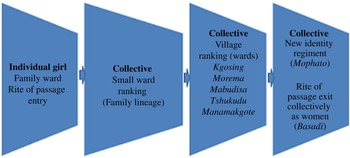
Bojale has strict entry and exit procedures that symbolize the continued change of status of a woman during the initiation period and that from an initiate to bosadi (womanhood) at the end of the rite of passage. During the ceremony, the initiate constantly enters and exits sites. Her passing through special places to pay homage to royalty, her attendance at sessions, and her return home at the end of each session to continue with her daily chores demonstrate the significance of the entry and exit passages (Setlhabi Reference Setlhabi2014). The ceremony is made up of several sessions daily that begin at the smaller wards and end up with the main one at the kgotla in the evening. I participated daily in all bojale morning and evening sessions. The morning sessions were held at the different wards in the village and initiates returned to their domestic chores until late afternoon, when they gathered at their family wards for family ranking. It was from here that the entourage proceeded to the main session of the day through assembly at Mmadikolo site, where ward ranking occurred. The ward assembly represented the five major wards of Kgatleng District: Kgosing, Morema, Mabudisa, Tshukudu and Manamakgote. During the main session each day of the ceremony, other significant sites such as those associated with royalty were often visited to pay homage to the royal family. Nature entities such as rivers and dams were also visited in order to sensitize the initiates to the importance of environmental preservation.
As already mentioned, initiates returned home at the end of the main session each night, except on the last day when an all-night session was held at Dikgalaopeng. An initiate's endurance and strength is tested to teach her to persevere and to be resilient in preparation for her womanhood. Traditionally, when initiation was conducted at puberty, initiates were being prepared for future hardships, and even nowadays all initiates are treated as girls and given messages about those things that girls should not engage in. The only all-night session was supposed to be the toughest part of bojale as it was held in the open air in the middle of winter when it was bitterly cold. All initiates are mandated to attend the all-night session and failure leads to automatic disqualification. This is worth noting because workers who are unable to take leave of absence are allowed to miss the weekly sessions and re-join the others on Friday and Saturday nights.
The pre-graduation session is held over the weekend to enable everyone to attend. Lineage ranking and other rituals are repeated and cemented during the all-night session. It is from this session that initiates proceed to the main kgotla in the morning for their rite of passage exit where they will be given a regiment name by the chief. Bojale focuses on collectiveness. The paramount chief always targets a group of women who will undergo bojale collectively. Even though they are registered individually by their mothers or other female family members, they graduate collectively; it is from their graduation that their regiment identity is formed and continued post-initiation. After initiation, the women are incorporated back into the village and the ceremony is marked with a graduation celebration at the main kgotla and at family wards and homes. Figure 2 portrays the single entry and collective exit in bojale.
Individual entry and collective exit in bojale

Music is the central learning mechanism in which elders and initiates participate during all sessions. The messages in bojale songs are conveyed through metaphor (Wood Reference Wood1985) and can be grouped according to the main themes of womanhood, morality and nature. The community's history, traditions and adult lifestyle are also taught through the songs. The initiates are expected to become responsible adults after their rite of passage exit and the revelations prepare them for adult activities. A woman is expected to uphold high morals, as was expressed in bojale songs that addressed issues of morality. The bojale drum is the only instrument that accompanies bojale songs. It is believed to be sacred, hence its use is limited to bojale and a few special royal-related events. Its three-tier relationship is that, firstly, it is kept by a custodian who is the wife of a current paramount chief on behalf of the community. The drum's custodian in the 2009 bojale was still the queen mother, Mohumagadi Mma Seingwaeng, who held the role after her initiation in 1975 because Mohumagadi Mma Matshego, the wife of the current chief, Kgosi Kgafela II, was undergoing initiation then as already indicated. Even a queen cannot touch or be the drum's custodian unless she has undergone bojale. Mohumagadi Mma Seingwaeng handed over the custodianship to her daughter-in-law on 8 August 2009 after her graduation from bojale on 20 June 2009. This was the formal symbolic transfer of Bakgatla women's leadership from the former queen to the current one.
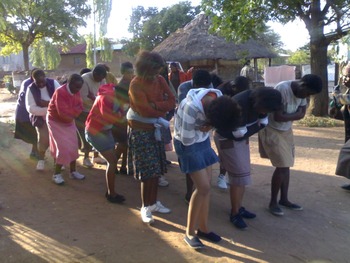
Secondly, the drum is also an instruction tool for initiates because they bend and hide their faces in order to hide from the public. We listened to the drum for the beginning and ending of songs and it was also used to get our attention because we could use only our sense of hearing for communication due to our hidden faces, as shown in Figure 3. The end of each song was signalled by a continuous loud beat. The same beat was also used to interrupt a song if it was not sung properly or to get our attention for announcements. We learned the meaning of each drumbeat because it was our only language during the singing. The drum's beats represented non-verbal yet comprehensible audible messages.
My fellow initiates at Manamakgote ward hiding their faces

The hidden face posture placed more pressure on me as I had to rely more on my sense of hearing. Such a way of collecting data meant that my ability to undertake visual observation was very limited and it also required intense concentration. My participatory observation therefore was also participatory listening (Forsey Reference Forsey2010: 559–60), as my observation during the sessions was more through hearing than seeing. An initiate loses her individual identity throughout the initiation period; this is symbolized by the facial concealment. Whenever the opportunity arose for me to use my sight for documentation, the transformation from hearing to seeing provided an immediate inward interpretation of some of the occurrences that I could not comprehend without sight, such as the handling of the bojale drum. I always had to make the most of the opportunity for visual observation when permitted, such as the only time that I was allowed to observe the collection of the queen from her residence to join the rest of the initiation entourage. The drummer and the ward closest to the royal family collected the queen from her home each day and returned her after the sessions. Initiation sessions and movements can be changed to accommodate the presence of a member of the royal family, as illustrated by the collection of the queen. The other two bojale ceremonies of 2010 and 2012 did not have these sessions due to the absence of an initiate close to the chief. During the queen's collection, I was at first afraid to leave the other initiates upon arrival at her residence because of the solemn atmosphere. Apart from the queen mother herself, the instructors from the queen's ward did not know me, which made me anxious. The experience flashed a reminder that I was human first with a ‘being status’ (Davies Reference Davies, Davies and Spencer2010: 1–3), as demonstrated by my fears as an initiate researcher. I realized that failure to step out of the lines to capture the scenes could result in missing opportunities such as observing the drum's use during the queen's collection. While I appreciated the permission to use my sight, I came to appreciate returning to the lines more, to be like the other initiates without sight, because I had mastered the art of listening. The other use of the bojale drum is to protect the initiates from danger and illness for the duration of bojale. A special healing rite is performed on the drum at the entrance of the main kgotla before initiation to bestow healing powers on the drum.
The last phase of the bojale drum is its preservation at Phuthadikobo Museum when not in use until its return to the custodian for use in the next bojale. My observations are that, once within the museum's walls, the drum's handling rules are not implemented, as I witnessed at Phuthadikobo Museum and at the National Museum.
MY RELATIONSHIPS IN BOJALE
Information obtained in the field is gained through relationships, whether the researcher is away or at home. The concern is often that the voices of the informants can be suppressed or misrepresented by the ethnographer. Fieldwork ‘at home’, no less than fieldwork ‘away’, faces the danger of ignoring the voices of the researched, and this was true even when I was also researching myself. The relationship with my fellow initiates was experienced through lineage and ranking, which enable the initiates to know their leaders. I became the leader at my ward because I was the eldest initiate from the senior family; two other women who were closest to the headman but younger in lineage became my assistants. I was shocked and totally unprepared for the leadership role because it added another layer to my identity in bojale. I had always to be positioned on the front row together with my two assistants. I was uncomfortable at first to document the sessions from the front row because moving in and out of the rows was very visible, but I eventually got accustomed to the process. The initiates from my ward also became used to the documentation as we regularly conversed about my role after the sessions, which resulted in a relationship of trust. The ‘author’ of their (our) culture was not only one of them but their immediate leader as well. The relationship with other initiates was going to be that of a lifetime because regiment membership is for life. We were expected to be united and perform community social tasks together after our graduation.
My interpretation of the post-initiation obligation was that I was an ethnographer who would never leave ‘home’ because I had a societal obligation that I expected to fulfil at the end of my ‘authorship’. This is an important factor that ethnographers ‘at home’ face.
The bestowal of the leadership role triggered some inner conflict which at times became burdensome. I doubted my leadership capability and the ability to carry out the expected tasks because I had my PhD research to complete when I returned to my base in the city, Gaborone. The role would conflict with my research itinerary. I also questioned my morality as I felt that I would let down my fellow initiates who looked up to me as their leader. This was because I was a ‘city woman’ who returned to the village to fulfil my societal obligation and to conduct my research. Any ritual that was performed on initiates, such as go loma tsetse (light beating on the back), had to be administered on the leader first. During these rituals, my elders did not see me as a researcher but as an initiate and leader with responsibilities. I finally took a decision to accept my new role and to be positive because it was part of my rite of passage. It could, after all, be advantageous as it could offer me closer access to informants.
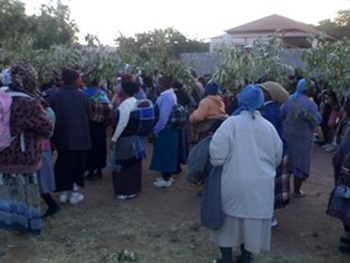
The second type of relationship that was vital in my research was between instructors and initiates. Instructors are elders who conduct initiation ceremonies (Sanyika Reference Sanyika, Mahdi, Christopher and Meade1996: 117–21). They are parents or guardians of the initiates whose role is to instruct, accompany and hide the initiates from the public by forming a thick wall around them during bojale sessions. Figure 4 depicts instructors surrounding initiates in one of the sessions.
Instructors holding branches and hiding initiates from the public

Manamakgote ward instructors were informed of my dual researcher and initiate roles during the pre-initiation negotiations to create an enabling research role. I was expected to adhere to all the rules except that I was allowed to carry a hidden audio-visual instrument during bojale sessions. I learned the role of the bojale instructor from them, which prepared me for my future role as an instructor. They were also the depositories of bojale memory because they had participated in earlier ceremonies either as initiates or instructors. The 2009 ceremony awakened a cultural revival in instructors who were aware of their significant role as the preservers of cultural heritage.
The relationship between the instructors and initiates during bojale sessions was that of authority on the part of the former and subjects on the latter. An initiate could only obey instructions given by her instructors and my dual roles of researcher and initiate resulted in a constant change of perception by the instructors depending on whether I was with other initiates or temporarily documenting a session.
In some instances this dual role was perceived differently by some instructors from other wards. For example, during the all-night assembly preparatory to departure, some instructors from other wards raised concerns that allowing an initiate to pass through them for visual documentation defeated the purpose of reviving bojale culture because it was a prohibition for initiates and instructors to pass through each other. Even though I appreciated a suggestion to request an instructor to document the event so that I could join the other initiates and uphold the tradition, the constraint was my fear that specific activities central to my research could be missed. My interpretation of such gestures was that, to these instructors, bojale remained sacred in modern times just as it had been in the past. There was resistance to the unknown preservation method of research and documentation that they were witnessing through my participatory role. To these latter instructors, traditional ceremonies such as bojale had to be revived and all its prohibitions upheld as in earlier times, but to someone conducting anthropological research such as myself, bojale, though significant, had changed through different eras because culture is dynamic (Harrison Reference Harrison and Corsane2005: 46–57); this was the reason for the need to document the 2009 ceremony, as I expected the next ceremony to have more modifications.
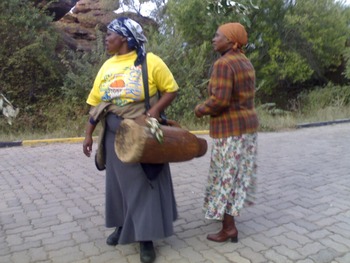
I established a special relationship with the drummers because the bojale drum was the focus of my participant observation. The drummers dictated my movements within bojale sessions. I knew the initial drummer, Olebeng Letsholo, from the 2008 non-participant observation of Kgosi Kgafela II's enthronement when the drum was played with the women's regiments’ songs. The drum can also be played during other royal ceremonies such as the paramount chief's enthronement. My relationship with Olebeng continued during my initiation, where she was aware of my research role. I met the second drummer, Mmapula Kgamanyane (pictured in Figure 5) during the 2009 bojale when Mohumagadi Mma Seingwaeng explained my participatory observation role to the drummers.
Mmapula Kgamanyane holding the bojale drum during the collection of the queen, 19 June 2009

The drummers had to be aware of my presence; I was overt to them (Macionis and Plummer Reference Macionis and Plummer1997: 16–22) because the audio-visual documentation centred on the drum. My position during bojale sessions was on the outer edges of the group to enable easier movement near the drummer, who moved continuously from the front to the back of the entourage in order to be heard by all 1,200 initiates. While it could have been better to use new technologies such as microphones to project the sound of the drum, it seems unlikely that the instructors would have been comfortable with modern gestures within a sacred ritual. Their discomfort could be due to the possibility of projecting the sound of a sacred object such as the drum to audiences beyond the initiates. The only electronic device allowed was my phone, which I used as a camera and video but very carefully and respectfully. My only choice was to always locate the drummer and invoke a non-verbal communication, such as holding onto her skirt, because initiates cannot speak during bojale. This was to make her aware of my presence, which she always responded to by slowing down her movement to allow the audio documentation.
The relationship between myself and the drummers continued outside the ceremony whenever I needed clarification about the drum. They were also interested in receiving feedback in the form of publications and their pictures after my fieldwork, as they expected us to meet after initiation because I was ‘at home’. The relationship with the drummers was bound to continue because of the ongoing social interactions and commitments within our community. Their requests were discussed comfortably, based on their knowledge of the permission I had received to conduct my research by the chief and his mother. This emphasis is vital because of the chief's authority among his people in Tswana-speaking communities, which can be traced to the precolonial period. Even though Botswana is a republic, in the postcolonial period the power of the chiefs is endorsed through the Chieftainship Act of 1987.Footnote 2
The final relationship to explore is the one with Mohumagadi Mma Seingwaeng, Kgosi Kgafela II's mother and hence the queen mother. She was my chief informant and guide before the initiation and during and after the ritual. Even though it was her son who was the reigning chief, culturally she was still the overall authority of Bakgatla during bojale because the chief's wife was undergoing the ritual to attain her womanhood with us and hence had no authority yet. The queen mother introduced me to my ward leaders and drummers as a researcher. However, she was careful not to break the rules and only began some of the interpretations during the interviews outside the sessions once initiation had begun. Her information supplemented my observations. Her perception of my research position was similar to her son's, because it would be one of ‘us’ writing about our culture, a pre-authentication of my research. Conducting ethnographic research ‘at home’ therefore tends to arouse expectations among authorities such as her and the chief, resulting in pressure. An educated royal family would read the research products, and such awareness can perhaps be viewed as a check on the integrity of my authorship on its own. ‘External’ researchers can escape the process, unlike those at home. Expectation of authenticity, however, does not necessarily authenticate my version; it means that I was always conscious of the royal authorities’ unwanted eye on me post-initiation.
For researchers at home, authenticity has an added layer: it is not solely based on truths derived from first-hand narration from sources without interference in the production or context of information (Burnham Reference Burnham1998: 470) but on selective writing-up based on knowing that ‘big brother’ will be watching most of the time. The authorities always have access to my family, so even in my absence any ‘misconduct’ on my part can be followed up. On the other hand, foreigners return home after their research, away from any obligation, and their ‘misconduct’ could easily be excused during and after their research (Ginkel Reference Ginkel1994: 10). Foreign anthropologists can therefore be ‘privileged strangers’ (ibid.: 10; Graham Reference Graham and Messerschmidt1981: 9) compared with my feelings of being ‘unprivileged at home’ that surfaced every time I realized that my being ‘at home’ at times seemed to work against me.
AUTOBIOGRAPHY, SECRECY AND ETHICS
Ethical dilemmas can arise due to the overt and covert roles, especially with sensitive research topics (Li Reference Li2008: 100–15) such as bojale in my case. Participant observation in the ceremony required high ethical adherence because of its secrecy. My initial research position at my ward, Manamakgote, was covert. However, I reverted to the overt position from the second week as the visual component of the documentation began – that is, photographing and filming selected sessions. This was the first instance of a formal participatory observation in bojale that allowed audio-visual documentation. My research role was explained to my fellow ward initiates; this was particularly important because we removed our tops and wore only skirts during most evening sessions. An ethical commitment of non-publication of such pictures was stated and adhered to. Adherence to ethics of conduct is highly important in research that involves people (David and Kramer Reference David and Kramer2001: 65–70) and sacred rituals such as bojale. The covert role was re-adopted during the main sessions in the evenings due to the large number of initiates, since it was easy to aurally and visually document them without the other initiates noticing the presence of a researcher. A covert position is currently discouraged in ethnographic research due to ethical implications, such as exploitation of the researched, misinterpretation, deception and lack of trust (O'Reilly Reference O'Reilly2009: 44–50). It is, however, still practised by ethnographers in extremely sensitive situations, for example the organ-trafficking research undertaken by Scheper-Hughes (Reference Scheper-Hughes2004). It is also allowed in instances where the overt position might alter findings (ESRC 2010: 29–30). The consent for my participatory observation was given only on condition that I would mainly be covert in the main sessions and overt at the smaller wards in order to respect the sacredness of bojale.
The full data interpretation, analysis and write-up processes began when I returned to my study base in Gaborone after the initiation period. It was during the submission of the data analysis chapter of my thesis that I was caught up in an ethical dilemma. I tried to detach myself from the familiar in order to be a researcher away from home. The attempt to create distance (Ginkel Reference Ginkel1994: 8) was a challenge. My thesis was going to reveal the unknown and unpublished contents of bojale to the public and I was also submitting it to my male supervisors. My research was contributing to the heritage preservation and anthropology of Bakgatla, hence my conviction of the necessity of the revelation. I took an allegiance to secrecy as an initiate and wondered if writing about my findings was breaking my vow. There is a prohibition on discussing bojale with men, and I perceived the chapter submission as breaking this rule. The reception of my male supervisors was from an academic perspective: they reminded me that my intention was not to break my vow of secrecy but rather to document the bojale within the context of a dying ritual. After all, the chief, the overall authority of the community, had authorized the research.
The most difficult questions during seminar presentations were always whether I was being secretive and hiding some bojale contents. My response was always confined to the purpose of my research and that what was excluded was irrelevant. This is where I purposefully used the power of being the ‘author’ (Strathern Reference Strathern and Jackson1987: 16–37), with ethnographic authority (Clifford Reference Clifford1983: 118–46) and the ability to choose what to divulge and publish. I often switched from my context of secrecy, allegiance and prohibition loaded with guilt (Smith and Kleinman Reference Smith, Kleinman, Davies and Spencer2010: 172–3) to that of an academic with another burden of preserving my culture, a phenomenon that would continue up to the present. The continuous change involved in acting like other initiates but also having privileges as a researcher, such as using my sight to observe and using audio-visual equipment, was my personal entry and exit procedure that other initiates did not experience. This individual experience in bojale validates Reily's (Reference Reily1998) argument that group identity and collective experiences that initiates are supposed to have are constructed, because an experience is individual.
REFLECTIONS OF AN INSIDER RESEARCHER: OBJECTIVITY VERSUS REALITY
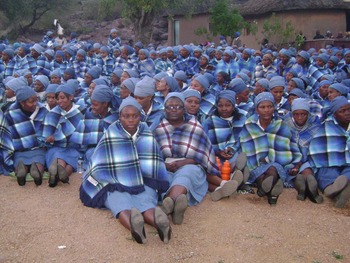
The exit from my rite of passage not only gave me a societal status of regiment membership but I was also a leader in my ward. I was therefore expected to be an example to my regiment. The inner conflict continued and I sought alternatives such as submitting my chapter to the women in my department as I perceived this as a lesser wrong. The inability to detach from emotions evoked by being part of the researched was an example of the difficulty of conducting ethnographic research among one's own. I finally reminded myself of the valuable bojale knowledge systems that were already lost because, as much as the oral transmission survived, it was still limited. Some of those who remembered the earlier ceremonies had passed on. I also remembered the objects without information in museum storerooms and that my participatory observation would fill the research gap. This was my middle ground, my balance for the submission and eventually publication. Our regiment graduated on 20 June 2009 and was named Madisakgosi by Kgosi Kgafela II. Figure 6 shows our regiment, Madisakgosi, a few weeks after our graduation, awaiting the arrival of boy initiates for their graduation.
Madisakgosi regiment at the main kgotla, Mochudi, 8 August 2009 (participant observer seated on the front row)

The ethnographic research is still ongoing though from a different angle. For example, I was a participant observer and an instructor in the 2010 ceremony, in which my elders remembered more than they had in the 2009 ceremony. Unlike in 2009, when my sight was limited, my status changed to that of a new instructor. This perspective demonstrates that, despite all the challenges of conducting ethnographic research ‘at home’, being ‘at home’ provides an opportunity to return to the research base as often as desired and engage with key people from any desired angle, hence enriching the research further. This is demonstrated by my post-initiation participation in the 2010 and 2012 bojale ceremonies and my continued interaction with the drummers and the queens. I have even visited the twin drum that I curated in the 1990s at the National Museum and proudly handled it differently, with full knowledge of its handling rituals. On the other hand, I witnessed the transformation of the drum at Phuthadikobo Museum from a passive museum object into a living object during its use in bojale. The ability to see this transformation in the use of the drum, initiates and fellow instructors brought in further new perspectives. I continue to write and to interrogate myself further about whether I am sincere and not biased. I ask myself whether my research output ‘at home’ is influenced by revealing only what is allowed or has more to do with my allegiance to secrecy. I try to convince myself that I have to be objective for the preservation of intangible cultural heritage and for the ethnographic record of bojale. Even though I was an inside researcher, this post-bojale reflection causes me to wonder whether I was also looking for the ‘exotic’ among my own. Bojale is sacred and it is also a secret ritual. It was more interesting to study than weddings, funerals or choirs. I had planned to study other Bakgatla artefacts before the 2009 revivals but my focus shifted to study bojale and the bojale drums because they were more interesting, perhaps ‘exotic’. I convince myself that they are unique, valuable objects as in fact they are the only two existing in the country and the only remaining artefacts brought by Bakgatla into modern Botswana in 1871 (Information and Broadcasting 1971: 21). I build my stance on this true historicity.
I ponder on the following questions: is something rare and uncommon necessarily exotic? Is it wrong to see something as exotic among your own even when you are among your own? Will the same attitudes influence my writing if I become a participant observer in another rite of passage, such as a wedding? Rituals tend to be exotic and initiation rituals tend to be more exotic because they are clouded in secrecy. The uninitiated girls and women always want to know about bojale proceedings and they tend to be afraid because of its secrecy. I and some of my initiates talked about the fear we had before initiation because those who had attended earlier sometimes quizzed us on whether we would endure and also keep the secrecy after bojale. In the end, the need to become basadi (women) and our collective identity as a regiment after our graduation were stronger than the fear. I have since admitted to myself that bojale is exotic, and hence my fascination with the research is too.
With reference to ‘our’ authorship, the truth is that I have chosen what to reveal, meaning that I am selective in our ‘autobiography’ because I took an allegiance to secrecy. I am subjective and I cannot help being biased because of my identity within my research. My post-initiation relationship with my ward regiment is not as demanding as I imagined. Perhaps this is because of societal changes more than because of my worries about ineffective leadership. There are occasions when all the ward leaders are called for meetings by the chief and other village elders. I often attend the meetings but the practicalities of regular meetings are a challenge because of our absence from the villages. However, there are regular monthly meetings that the chief calls and that I mostly attend. After initiation, our regiment's leader from Kgosing ward, Didimalang Linchwe, often organized meetings with ward leaders and a few activities such as fundraising with the general membership of our regiment post bojale, which, though successful, were not sustainable due to our absence from our villages. Contact with my regiment remains minimal. Occasionally I meet one of my assistants who often represents me in the meetings when I am unavailable. The other prominent member of my regiment with whom I keep in contact is the chief's wife, Mma Matshego. During the post-initiation interview, she reiterated her endorsement of initiation revivals and their social importance, especially now that she is the leader of Bakgatla women.
CONCLUSION
This paper discussed conducting ethnography among one's own within the context of bojale with the aim of revealing its challenges. It discussed a ritual that has changed, modified and been reinvented. The interpretation of the allegiance to secrecy is dependent on whether the reader has undergone bojale or not because it depends on the knowledge one has. The extent of revealing bojale proceedings also depends on whether the reader is an academic, a heritage practitioner or a Mokgatla woman. The interpretation will remain multi-layered as long as the need to preserve a changed and dying culture manifests itself through research such as this. An outsider researcher could have researched and written differently because their identity would be different from mine. My contribution to anthropological research in Botswana is that, through my insider research, bojale's ethnographic record has been created, although only by breaking my allegiance to secrecy and by non-adherence to some initiation rules that could not be avoided. I can also argue that the permission granted by the chief and queen mother also authorized me to divulge bojale proceedings respectfully. In other words, I had royal permission to break the secrecy only for bojale preservation. Ethnographic research at home, especially in a rite of passage, is complicated because of the researcher's individual identity and societal status after the research. Advantages such as easier access to informants and being around the familiar can result in expectations that may hinder the research output. My change of status from entering initiation as an individual and researcher, to exiting as a regiment member and a ward leader, and then to finally writing for knowledge dissemination and preservation will always add to my ongoing inner conflict and guilt.
ACKNOWLEDGEMENTS
The publication of this paper has been made possible through the Postdoctoral Fellowship Programme at the University of Botswana.
GLOSSARY OF SETSWANA WORDS AND EXPRESSIONS
Bosadi: Womanhood
Basadi: Women
Bogwera: Boys’ initiation school
Bojale: Girls’ initiation school
Kgosi: Chief
Kgotla: Ward/community meeting place
Mma: Mother of
Mohumagadi: Queen
Moila: Taboo
Mokgatla: Member of Bakgatla ethnic group
Setswana: National language of Botswana