1. INTRODUCTION
Analogy is a fundamental process of creativity (Boden, Reference Boden and Boden1994; Hofstadter, Reference Hofstadter1996). Polya (Reference Polya1954, p. 17) noted that “analogy seems to have a share in all discoveries, but in some it has the lion's share.” Boden (Reference Boden and Boden1994, p. 76) states that “a psychological theory of creativity needs to explain how analogical thinking works.” Hofstadter (Reference Hofstadter1979, Reference Hofstadter1996) views analogy as central not only to creativity but also to cognition itself.
We describe an inquiry into creative analogies in the context of biologically inspired design. Biologically inspired design by definition entails cross-domain analogies from biological systems to problems in engineering and other design domains (Benyus, Reference Benyus1997; Vincent & Mann, Reference Vincent and Mann2002). It has led to many innovative designs ranging from bioinspired clothing to biomimetic robots (Bar-Cohen, Reference Bar-Cohen2006; Bonser & Vincent, Reference Bonser and Vincent2007; Yen & Weissburg, Reference Yen and Weissburg2007). To take just one specific example, scientists affiliated with Georgia Tech's Center for Biologically Inspired Design have developed new materials for iridescent surfaces for computer screens based on optical properties of nanoscale structures on morpho butterfly wings (e.g., Srinivasarao & Padilla, Reference Srinivasarao and Padilla1997). The rapidly growing movement of biologically inspired design is driven in part by the increasingly critical need for sustainable development and in part by the recognition that nature could be an excellent source of innovation. Thus, biologically inspired design is an almost ideal domain to study creative analogies.
Despite the growing popularity of biologically inspired design, the practice of biologically inspired design at present typically is ad hoc, with little systemization of either biological knowledge for the purposes of engineering design or the processes of transferring knowledge of biological designs to engineering problems. Development of biologically inspired design as a principled design methodology requires understanding and organizing biological knowledge so that it is useful for engineering design as well as understanding the content and processes of analogical retrieval and transfer of biological knowledge to address design problems in engineering. We describe here an inquiry into the content of creative analogies in biologically inspired design.
1.1. Methodology of inquiry
One important issue related to our inquiry concerns the method of study. A traditional cognitive science method for studying processes like analogical reasoning involves studying human subjects in a laboratory setting. This method allows formal experiments with control and subject groups, and instrumentation of human subjects for collecting a wide variety of precise data such as verbal protocols, reaction times, and eye tracking data. A disadvantage is that the human subjects typically work individually and on rigid, static, small, and isolated problems. A second common method is to study human subjects as they go about making analogies in their “normal” activities in their “natural” settings. Although this method does not easily allow for formal, controlled experiments and does not permit collection of certain types of data, it does enable observation of problem solving by teams of people as well as problem solving over an extended period of time. Dunbar (Reference Dunbar, Sternberg and Davidson1995) calls the former method in vitro and the latter in vivo. He found that humans exhibit different problem-solving behaviors in the different settings in the two methods. In particular, humans appear to make more abundant analogies in their natural environments than in artificial settings (Dunbar, Reference Dunbar, Gentner, Holyoak and Kokinov2001). In the inquiry presented here, we adopted the in vivo approach in which the first author (Vattam) joined a team of biologists and engineers engaged in an extended biologically inspired design project.
1.2. Level of resolution of the analysis
Another important issue related to our inquiry pertains to the choice of the level of resolution of the analysis. Some accounts of analogy begin with a cognitive architecture such as the production system architecture (Anderson & Thompson, Reference Anderson, Thompson, Vosniadou and Ortony1989), and express the theory of analogy in terms of the constructs of the architecture such as production rules, short-term memory, and focus of attention. Other theories of analogy develop general-purpose information-processing mechanisms for realizing analogies (e.g., Gentner, Reference Gentner1983; Gick & Holyoak, Reference Gick and Holyoak1983; Holyoak & Thagard, Reference Holyoak and Thagard1989; Kokinov, Reference Kokinov, Holyoak, Gentner and Kokinov1998). The mechanism of structure mapping (Gentner, Reference Gentner1983; Falkenhainer et al., Reference Falkenhainer, Forbus and Gentner1989), for example, is largely independent of task or domain, size of problem or timing of problem solving, content of knowledge, or modality of knowledge representation. Yet other theories develop content accounts of analogies (e.g., Winston, Reference Winston1980; Darden, Reference Darden1983; Kedar-Cabelli, Reference Kedar-Cabelli1985; Clement, Reference Clement1988, Reference Clement2008; Nersessian, Reference Nersessian and Giere1992, Reference Nersessian2008; Hofstadter & Mitchell, Reference Hofstadter and Mitchell1996; Goel & Bhatta, Reference Goel and Bhatta2004; Christensen & Schunn, Reference Christensen and Schunn2008; Yaner & Goel, Reference Yaner and Goel2008). These content theories describe different types of analogies along the dimensions of why, what, how, and when (Goel, Reference Goel1997). The why question refers to the task (or the goal) for which an analogy is made. The what question pertains to the content of knowledge in the source case that is transferred from the source to the target problem. The how question is concerned with the methods for analogical retrieval, mapping, and transfer. The when question pertains to the stage of problem solving at which the analogy occurs. From the perspective of the content theories, the architectural and mechanism theories provide computational substrates for realizing the content theories. Our work here develops a content account of analogies in biologically inspired design.
1.3. Related research
In addition to research on analogical reasoning, this work is related to research on cognitive studies of biologically inspired design. Mak and Shu (Reference Mak and Shu2008), for example, report that designers engaged in biologically inspired design have design fixation problems as well as difficulties with analogical mapping during idea generation from biological phenomena. Both of these findings are similar to results of our own earlier work on cognitive studies of biologically inspired design (Helms et al., Reference Helms, Vattam and Goel2009). Mak and Shu also found that functional descriptions of biological systems in the form of flow of substances among components improve the quantity and quality of the generated design ideas. Similarly, Linsey et al. (Reference Linsey, Wood and Markman2008) found that learning about analogous products with more general linguistic representations that apply across the problem and target domains improves an engineer's ability to use the analogous product. They also found that functional annotations on diagrams increase the chances of successful biological analogies.
Because one of the practical goals of the cognitive analysis we describe here is to inform the design of interactive computational tools for supporting biologically inspired design in practice, our work is also related to interactive biologically inspired design tools (e.g., Chakrabarti et al., Reference Chakrabarti, Sarkar, Leelavathamma and Nataraju2005; Chiu & Shu, Reference Chiu and Shu2007; Nagle et al., Reference Nagle, Midha, Tinsley, Stone, McAdams and Shu2008; Sarkar & Chakrabarti, Reference Sarkar and Chakrabarti2008). For example, the Biomimicry Institute (2008) has developed a Web portal called AskNature for accessing a functionally indexed database of scholarly articles relevant to biologically inspired design. Chakrabarti et al. (Reference Chakrabarti, Sarkar, Leelavathamma and Nataraju2005) have developed an interactive tool called IDEA-INSPIRE for supporting biomimetic idea generation in product design. IDEA-INSPIRE represents function, behavior, and structure of biological and engineered systems and supports product designers with automated search for biological and engineering analogues. Sarkar and Chakrabarti (Reference Sarkar and Chakrabarti2008) report on experiments with IDEA-INSPIRE that show that the sources of inspiration suggested by IDEA-INSPIRE, which range from text and diagrams to audio and video, have a significant influence on the representations, number, and quality of the generated ideas. We are presently developing an interactive computational tool called DANE (Design by Analogy to Nature Engine) that is partly informed by the findings described here (Vattam et al., in press).
Several other researchers have investigated the content of analogies in design using in vivo methods similar to ours (e.g., Visser, Reference Visser1996; Bonnardel, Reference Bonnardel2000; Christensen & Schunn, Reference Christensen and Schunn2008). For example, Christensen and Schunn (Reference Christensen and Schunn2008) recently studied analogy in real-world engineering design. They found several uses of analogy design such as problem identification, problem solving, and explanation. They also found that problem-identifying analogies were mainly within domains; explanatory analogies were mainly between domains; and problem-solving analogies were a mixture of within and between domain analogies.
2. THE GENERAL CONTEXT OF OUR INQUIRY
Our current and previous studies of biologically inspired design were conducted in the context of ME/ISyE/MSE/PTFe/BIOL 4803, a project-based introductory course on biologically inspired design that is offered in the Fall semester of every year at Georgia Tech (Yen et al., in press). This course attracts 45 to 50 (mostly) undergraduate students every year. The class composition is interdisciplinary, comprised of students majoring in biology, biomedical, mechanical, and industrial engineering disciplines. Typically, the course is taught by faculty members from Georgia Tech's Schools of Biology; Chemistry; Mechanical Engineering; Industrial & Systems Engineering; and Polymer, Textile, and Fiber Engineering. Many external guest lectures by several prominent researchers in biologically inspired design are also included.
The course is structured into lectures, found object exercises, and a semester-long biologically inspired design project. Most lectures are focused on exposing student designers to specific case studies in biologically inspired design, whereas regular found object exercises require designers to bring in biological samples and to analyze the solutions employed by these samples. These exercises are intended to expand awareness of biology, provide hands on experience with biological systems, and encourage the designers to dig progressively deeper into the functions of biological systems.
The semester-long design projects, the primary focus of this analysis, group an interdisciplinary team of four to six designers together based on similar interests. Instructors ensure that each team has at least one designer with a biology background and a few from different engineering disciplines. Each team identifies a problem that can be addressed by a biologically inspired solution, explores a number of solution alternatives, and develops a final solution design based on one or more biological sources of inspiration. All teams present their problem and initial design concepts during the middle of the term, then submit final designs during the last 2 weeks of class along with a final design report.
One potential issue associated with the classroom context we have chosen to study is the accuracy of its reflection of a naturalistic setting of biologically inspired design. Although we acknowledge this issue, for two reasons we believe it is not unreasonable to assume that this classroom context represents a microcosm of a real biologically inspired design setting: the project-based nature of the class involves interdisciplinary students working on one serious problem of their own choosing for the duration of the term; and student designers are provided with expert biologists, engineers, and biologically inspired designers as mentors. As biologically inspired design continues to grow as a movement, extended studies of biologically inspired design in actual practice should become feasible.
3. A SUMMARY OF OUR INITIAL STUDY
We conducted our initial study of biologically inspired design in Fall 2006 in the aforementioned context. Although only an overview is presented here, additional details of this study can be found in other sources (Vattam et al., Reference Vattam, Helms and Goel2008; Helms et al., Reference Helms, Vattam and Goel2009). In 2006, this course attracted 45 students, 41 of whom were seniors (typically fourth and fifth year undergraduate students). The class was composed of 6 biologists, 25 biomedical engineers, 7 mechanical engineers, 3 industrial engineers, and 4 from other majors. Most students, although new to biologically inspired design, had previous design experience. Out of the 45 students, at least 32 had taken a course in design and/or participated in design projects as part of their undergraduate education. The students were grouped into nine design teams, with at least one biologist in every team, to work on their semester-long biologically inspired design project.
As external observers, we attended almost all of the classroom sessions, collected all of the course materials, documented lecture content, and observed teacher–designer and designer–designer interactions in the classroom. However, the focal point of our investigation was the design projects. A total of nine biologically inspired design projects were documented in this study. We attended the design meetings of selected teams many times to observe firsthand how the design process unfolded. We took field notes, collected all the design related documentation produced by the teams, and also collected their idea journals. We analyzed the gathered data focusing on the processes and the products of the designers. In terms of the practices, we observed and documented frequently occurring problem-solving and representational activities of designers. In terms of the design products, we observed and documented the “design trajectory,” which is the evolution of the conceptual design over time. Some of our major findings are described below.
3.1. Problem-driven and solution-driven analogies
We observed the existence of two high-level processes for biologically inspired design based on two different starting points: problem-driven and solution-driven processes (Helms et al., Reference Helms, Vattam and Goel2009). Kruger and Cross (Reference Kruger and Cross2006) observed a different type of problem-driven and solution-driven strategies in industrial design. As depicted in Figure 1a, in our problem-driven approach the designers identified a problem that formed the starting point for subsequent problem solving. They usually formulated their problem in functional terms (e.g., stopping a bullet). In order to find biological sources for inspiration, designers “biologized” the given problem; that is, they abstracted and reframed the function in more broadly applicable biological terms (e.g., what characteristics do organisms have that enable them to prevent, withstand, and heal damage due to impact?). They used a number of strategies for finding biological sources relevant to the design problem at hand, ranging from searching on functions to searching on champion adapters (see “Solution search heuristics” in table 1 in Helms et al., Reference Helms, Vattam and Goel2009). They then researched the biological sources in greater detail. Important principles and mechanisms that are applicable to the target problem were extracted to a solution-neutral abstraction, and then applied to arrive at a trial design solution.
Observed biologically inspired design processes: (a) a problem-driven process and (b) a solution-driven process. Adapted from “Biologically Inspired Design: Process and Products,” by M. Helms, S. Vattam, and A. Goel, 2009, Design Studies 30(5), 606–622. Copyright Elsevier 2009. Adapted with permission.

In contrast, in the solution-driven approach depicted in Figure 1b, designers began with a biological source of interest. They understood (or researched) this source to a sufficient depth to support extraction of deep principles from the source. This was followed by finding human problems to which the principle could be applied. Finally, they applied the principle to find a design solution to the identified problem.
3.2. Single and compound analogies
We found that biologically inspired design often (in 66% of the observed 2006 projects) involved compound analogies in which a new design concept was generated by composing the results of multiple cross-domain analogies (Vattam et al., Reference Vattam, Helms and Goel2008). This process of compound analogical design relies on an opportunistic interaction between two processes: problem decomposition and analogy. Nersessian (Reference Nersessian and Giere1992, Reference Nersessian, Magnani, Nersessian and Thagard1999) has described similar processes of compound analogies in her study of scientific discoveries. In case-based design, case composition is a basic process of creative case-based design (e.g., Wills & Kolodner Reference Wills and Kolodner1994a, Reference Wills and Kolodner1994b; Maher et al., Reference Maher, Balachandran and Zhang1995; Smith et al., Reference Smith, Lottaz and Faltings1995; Smyth et al., Reference Smyth, Keane and Cunningham2001). In engineering design, problem decomposition and solution composition are fundamental design processes (e.g., Pahl & Beitz, Reference Pahl, Beitz and Wallace1996).
As an example of compound analogy, the design goal in one of the projects in our study was to conceptualize surfboard technology that prevented the formation of the surfboard silhouette to prevent hit-and-run shark attacks. The final solution was a combination of the concept of ventral light glow (inspired by pony fish) that gives off light proportional to the ambient surface light for the purposes of counterillumination and the principle of photoreception from surrounding light in the brittle star (echinoderms that are closely related to starfishes) for providing the counterillumination rather than having to use energy to self-produce light.
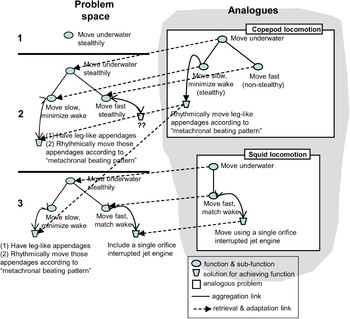
Figure 2 illustrates the design trajectory in a different project as yet another example of compound analogical design. The goal of this project was to design an underwater microbot with locomotion modality that would ensure stealth. The problem was “biologized” as: “how do marine animals stalk their prey or avoid predators without being detected?” The initial research for the underwater microbot focused on the copepod, small shrimplike crustaceans, as a source for understanding stealthy locomotion. In exploring this concept, designers became aware that the copepod used two rhythms (of leglike appendage movement) for achieving motion underwater. A slow and stealthy rhythm was used during foraging for food, and a quick but nonstealthy rhythm was used during escaping from predators. This understanding led the designers to decompose their original problem into two separate functions: one for slow and stealthy movement, and one for rapid, yet stealthy movement. Copepod locomotion provided a source for generating a solution to the former function (slow and stealthy motion). To address the latter (stealthy fast motion), they used squid locomotion as a source of inspiration, which uses jet propulsion to move forward and achieves stealth by wake matching.
Design trajectory of one of the projects that exemplify compound analogical design. Adapted from “Compound Analogical Design: Interaction Between Problem Decomposition and Analogical Transfer in Biologically Inspired Design,” by S. Vattam, M. Helms, and A. Goel. Proc. 3rd Int. Conf. Design Computing and Cognition, pp. 377–396, 2008. Berlin: Springer. Copyright Springer 2008. Adapted with permission. [A color version of this figure can be viewed online at journals.cambridge.org/aie]

3.3. Multimodal analogies
We observed that designers consistently used a combination of textual descriptions, pictures, graphs, and mathematical representations throughout the design process. These representations span not only multiple modalities (textual, diagrammatic, and pictorial) but also multiple levels of abstraction (pictures and diagrams of specific structures or parts of a biological system, to graphs and mathematical equations representing more abstract processes). Further, the use of multimodal representations extended across disciplinary and level of experience boundaries.
This suggests that the mental representations that designers use are rich and multimodal in nature and are organized at different levels of abstraction. The use of multimodal knowledge representations is common practice in interactive case-based design aids such as ARCHIE (Pearce et al., Reference Pearce, Goel, Kolodner, Zimring, Sentosa and Billington1992), AskJef (Barber et al., Reference Barber, Bhatta, Goel, Jacobson, Pearce, Penberthy, Shankar, Simpson, Stroulia and Gero1992), CADET (Sycara et al., Reference Sycara, Guttal, Koning, Narasimhan and Navinchandra1991), CASCAD (Maher et al., Reference Maher, Balachandran and Zhang1995), InteractiveKritik (Goel et al., Reference Goel, Gomez, Grue, Murdock, Recker, Govindaraj, Gero and Sudweeks1996), and FABEL (Gebhardt et al., Reference Gebhardt, Voß, Gräther and Schmidt-Belz1997).
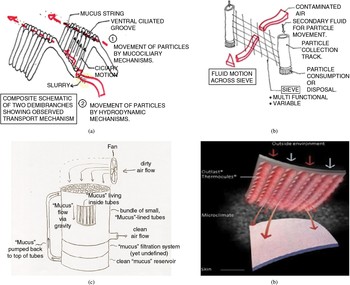
In our study, one instance of this could be seen in the BioFilter project. Figure 3a and 3b represents the filtering mechanism found in oysters and clams and a conceptual model inspired by that mechanism, respectively. Figure 3c is a conceptual model of a biofilter that was inspired by how human lungs work. As another example, Figure 3d represents a conceptual design of a fabric inspired by beeswax.
Examples of the use of multimodal representations obtained from design journals: (a) the filtering mechanism in oysters and clams, (b) a conceptual model of a filtering mechanism inspired by oysters and clams, (c) a model of a filter inspired by lungs, and (d) a conceptual model of a fabric inspired by beeswax. [A color version of this figure can be viewed online at journals.cambridge.org/aie]

These figures, which are reproduced from the designers' work, give us insight into some of the knowledge requirements for successful biologically inspired designing. The biological sources (on the left) and the design solutions (on the right) are both represented using a combination of textual and pictorial representations, and thus are multimodal. In addition, the representations are explicitly capturing the relationship between the biological function and the biological mechanisms that achieve that function and the engineered function and the engineered mechanisms for achieving that function, and the affordances and constraints posed by the physical structures for enabling the mechanisms in both biological and engineering designs. Designer's extensive use of multimodal representations also suggests that information represented in different modalities have their own unique advantages for analogy making during biologically inspired design. A cognitive model of biologically inspired design should account for how knowledge represented in different modalities affords and constrains analogical reasoning in the context of design.
4. THE CURRENT STUDY
Our second study was conducted in Fall 2008 in the similar context of the ME/ISyE/MSE/PTFe/BIOL 4803 course mentioned earlier. Our initial study provided an external perspective on the products and processes of biologically inspired design and suggested that analogy is one of the core processes of biologically inspired design. In this current study we were interested in gaining deeper insights into analogy making and use by the designers, which required a certain intimate level of engagement with the design process that simply was not available through external observations. Therefore, in this study, one of the researchers (S.V.) enrolled for this course and became part of a particular design team called Team FORO, which led to the researcher not only observing the design process but also gaining a firsthand experience of biologically inspired design. This study focuses on the design activities of Team FORO, which was composed of six team members including four undergraduates (two biology majors and two mechanical engineering majors) and two computer science graduate students.
One potential issue here is that the first author (S.V.) was both a participant in one of the design projects in the class and a research scientist. As a researcher, he most certainly introduced ideas to his team that might not have otherwise been present, for example, specific representations and formalisms of the design problem and specific relationships between the problem and biological to it. Although it is difficult to determine the author's influence on the team, because he studied this class and the design teams in the class for 4 years (e.g., Vattam et al., Reference Vattam, Helms and Goel2008; Helms et al., Reference Helms, Vattam and Goel2009), we believe that the findings of the study are representative of other successful design projects in the class.
Each team member maintained an idea journal and made journal entries throughout their design process. Their journal entries contained research on biological systems and documented their design ideas. The idea journal of the first author was used as part of the data for this study. Various other documents produced by the team at different stages of the design process like the problem definition documents, abstracts of biological systems researched, initial design document, and a final design report were also part of the data analyzed. This data was used to analyze the activities of the team, understand the evolution of their design ideas, and identify the sources of many of those ideas.
Numerous design researchers have analyzed complex design problem solving in terms of many design stages or phases such as problem understanding, preliminary design, geometric modeling, and detailed design (e.g., Finger & Dixon, Reference Finger and Dixon1989; Chandrasekaran, Reference Chandrasekaran1990; Suh, Reference Suh1990; Pahl & Beitz, Reference Pahl, Beitz and Wallace1996; Cagan & Vogel, Reference Cagan and Vogel2002). We elected to analyze Team FORO's design activities in terms of the following six tasks: problem definition and elaboration, search for biological analogues, initial design development, design evaluation, redesign, and design analysis. Note that these design tasks are similar but not identical to the ones we observed in our initial study (illustrated in Fig. 1). This is partly because the present study followed the design process through design evaluation and redesign, although our initial study stopped at the point of initial design generation. As usual, this analysis does not imply any linear ordering of the design tasks and includes iteration among them.
4.1. Problem definition and elaboration
All design teams in this course were responsible for choosing a problem meaningful to them. Team FORO decided to address the problem of increasing water shortage on a global scale by designing a novel water desalination technology that converted ocean water into a drinkable supply of fresh water. Initially, they surveyed five existing desalination technologies. Three among the five, multistage flash evaporation, multiple-effect distillation, and vapor compressed distillation, were thermal-based processes, and two, reverse osmosis and electrodialysis, were membrane-based processes. In the course of their survey they learned that current desalination technologies employed processes that were highly energy intensive, which prevented their widespread adoption. Therefore, the FORO team added a new constraint to their design problem: their solution should use significantly less energy compared to the existing technologies.
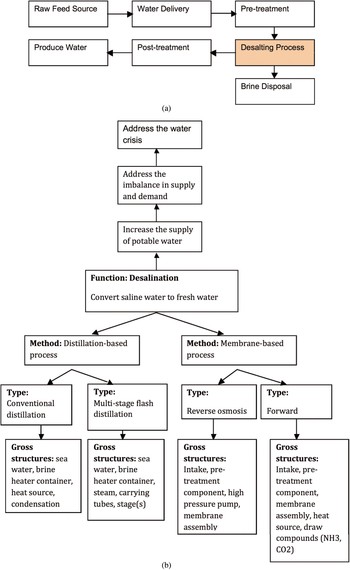
The process of analogy played a central role in the survey. The function of desalination was used as a cue to retrieve existing technologies. At other times, the retrieved sources led them to other similar technologies. This survey served two cognitive purposes. First, the different sources in their survey helped infer different mechanisms (or processes) for achieving the function of desalination. Second, the different sources helped designers to elaborate their problem by suggesting alternate problem decompositions, which were related to each other through a hierarchy of functions that would lead them toward their design goal, producing a problem elaboration schema. Problem decomposition requires knowledge of the form D → D 1, D 2, … , Dn, where D is a given design problem and Di are smaller subproblems. In many instances, this knowledge was inferred from the design patterns abstracted from the current technologies surveyed. By design patterns here we mean shared generic abstractions among a class of designed systems. For instance, all membrane-based desalination technologies share common functions, mechanisms and principles. Evidence for these design patterns come from diagrams, like the one shown in Figure 4(a), reproduced here from team FORO's design report. The evidence for the problem elaboration schema, a higher level knowledge structure that relates design patterns and other abstractions to each other, also comes from a diagram, shown in Figure 4b, which was reported in the team's problem definition document.
(a) A design pattern for membrane-based processes and (b) a problem elaboration schema. [A color version of this figure can be viewed online at journals.cambridge.org/aie]

4.2. Search for biological analogues
The FORO design team used its growing knowledge of the desalination problem to find biological analogues that were applicable to their problem. As can be expected, the problem elaboration schema from earlier activity provided the foundation for the search process. Paying attention to different aspects of the problem elaboration (e.g., function to be achieved, existing mechanisms for achieving the function) provided different cues for the retrieval process. A total of 24 biological systems were identified at various stages of this biological exploration activity that spanned almost one-third of the semester. Ten systems were given serious consideration: supraorbital salt glands in penguins, salt glands in marine reptiles, gills in salmons, the respiratory tract in camels, kidneys, root systems in mangroves, the esophagus in Gobius Niger fish, the esophagus in eels, aquaporins, and small intestines in humans and other animals.
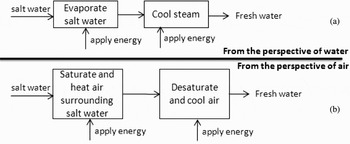
Three different methods of analogical retrieval were observed here. First, functional cues from the elaborated problem were directly used to retrieve biological sources. For instance, the function of desalination or the related “removal of salt” was used to retrieve sources like supraorbital salt glands in penguins, salt glands in marine reptiles, and gills in salmons. Second, the general abstractions in the problem elaboration, like the aforementioned design patterns, were used to retrieve biological sources. This explains how a certain source like the small intestine was retrieved when there was no reference to salt anywhere in the intestine process (the intestine source included sugar solutions and not salt solutions). Third, design patterns were sometimes transformed and those transformed patterns were used to retrieve biological sources. This explains the curious case of the camel nose analogy to the thermal desalination process. The function of camel's respiratory tract is to saturate and warm the inhaled air so that it is suitable for the lungs to process and desaturate and cool the exhaled air so that the moisture and heat are conserved and are not lost to the environment. This system, which had no relation to concepts like desalination, salt, solutions, or energy expenditure, was still suggested as an analogy to the thermal desalination process. This can be explained by the transformation of the design pattern for thermal process shown in Figure 5a (seen from the perspective of what is happening to the water) to a pattern shown in Figure 5b (seen from the perspective of what is happening to the air surrounding the water) and by comparing the camel's case to transformed pattern.
Pattern transformation to aid analogical retrieval.

4.3. Initial design development
Developing a biologically inspired design solution involves retrieving a suitable biological system, understanding how that system works to a sufficient degree of depth, extracting mechanisms and principles associated with that system into a solution-neutral form, and applying those mechanisms and principles in the target domain of engineering. Team FORO had identified a subset of promising biological analogues, understood by the designers to varying degrees of depth. Because the constraint of low-energy systems was added earlier, the team deemed any system that used external energy to be less favorable. Based on their understanding, systems were classified as using active transport (requiring external energy in the form of ATP) or not. Thus, biological systems that used active transport were considered (right or wrong) more energy intensive, and were eliminated. This eliminated all sources but the small intestine, camel nose, and mangrove roots. Not enough was understood about the mangrove roots, and it was not readily apparent how the camel nose mechanism could be implemented as a solution. Therefore, team FORO developed an initial design solution based on the mechanism of the small intestine.
The small intestine reabsorbs water using a conjunction of forward- and reverse-osmosis principles, called the three-chamber method. It is proposed that the wall of the gastrointestinal tract consists of three compartments separated by two membranes that differ in permeability, as shown diagrammatically in Figure 6a. In this situation, water will move against an osmotic gradient from compartment A to compartment C as long as three conditions are met: the osmolarity in compartment B is greater than in compartment A, the permeability of membrane 1 is less than that of membrane 2, and compartment B is a closed compartment. In such a case, the higher osmolarity in compartment B relative to A or C provides the driving force for movement of water from A to B. As water flows into compartment B, the hydrostatic pressure in that compartment increases, forcing water to flow through membrane B and into the lowest osmolarity compartment C. Moving water across osmotic gradient is one of the key requirements of membrane-based desalinations techniques and the small intestine has an interesting and novel way to achieve this. The three-chamber structure of the intestine model (Fig. 6a) was transferred to obtain the three-chamber structure in the engineered solution (Fig. 6b). In other words, the structure was mimicked (albeit, scaled up) with the assumption that mechanism of water movement across osmotic gradient would transfer from the intestine situation to the desalination situation. This mechanism was transferred to the target problem to produce an initial design solution. Figure 6a and b shows a side by side comparison of the biological source and the initial solution that was developed.
(a) A biological source (intestine), (b) the initial design solution, and (c) the redesigned solution. [A color version of this figure can be viewed online at journals.cambridge.org/aie]

4.4. Design evaluation
Team FORO now had produced a conceptual design of a desalination technology that was not only novel but also presumably eliminated the need for applying external energy (except for the energy required to feed the ocean water), which was too good to be true. They took their solution to an expert with several years of research experience in membrane technology for evaluation (who acted as a mentor to the design team when needed). The expert suggested that their initial design would not work. This was because the flow of fresh water in their design depended on maintaining the salt concentration gradients in the three chambers. However, their design worked in such a manner that the salt concentrations in each chamber would change, over time, to offset the gradient, reaching an equilibrium and stopping the flow of water.
The expert came to this conclusion with the help of an analogy of the initial design to a piston-pushing liquid from one end of a cylinder, which has a membrane attached to its other end. The flow is maintained as long as one is applying force on the piston. The reaching of the equilibrium in their design was akin to someone taking their hands off of the piston. The cognitive purpose of the expert's analogy was to evaluate the design and identify any potential problems.
4.5. Redesign
Now the challenge for the designers was to redesign their system so that it did not reach equilibrium. They redesigned their system by coupling two three-chamber systems and by configuring those two to work cyclically. When the first three-chamber system reached equilibrium, it would create nonequilibrium conditions in the second three-chamber system, ensuring that the water would flow from the second one, and vice versa. The redesigned system is depicted in Figure 6c, reproduced from the team's design report. The use of analogy in redesign process is not evident from the data collected and remains an open question.
4.6. Design analysis
Team FORO decided to do a quantitative analysis of their design in terms of estimating the flow rate of the fresh water produced. If the flow rate was on the order of cubic centimeters/hour, as was the case with the intestine, then their design was not viable. They had to determine how well the designed system scaled up compared to its biological counterpart. Because the biological model did not contain a flow analysis, the required equations had to be derived from first principles. None of the designers understood the deep physics underlying their design and had to rely on the expert to do so. However, the expert was traveling and thus was not available for consultation, so they put their analysis on hold till they could find another expert mentor.
A few days later one of the designers came across a paper by Popper et al. (Reference Popper, Merson and Camirand1968) by serendipity. This paper presented a novel mechanical system for desalination that was both similar to and different from their design. Popper's system was similar because it used forward osmosis in conjunction with reverse osmosis to achieve desalination. At the same time it was different because its structures were different and did not utilize a three-chamber method, it was prone to reaching a steady state resulting in the stoppage of flow, and it was not biologically inspired. However, Popper's paper had a flow analysis of that mechanical system. Recognizing that Popper's mechanical system was analogous to their design, designers transferred and adapted the flow equations from Popper's situation to their current design situation. Using the adapted flow equations they estimated that their technique would produce a peak flow performance within the acceptable range. Thus, designers improvised using analogy to derive the flow equations and perform a quantitative analysis of their design.
5. COGNITIVE ANALYSIS
We now turn to our analysis of the data we collected from Team FORO. As mentioned in the Introduction, our analysis is in terms of the why, what, how, and when questions of analogy in the context of biologically inspired design.
The when question refers to the stage of the design problem solving during which an analogy occurs. We already analyzed Team FORO's design process as composed of the six phases described above.
The why and what questions refer to the uses of analogy and the contents of knowledge transfer, respectively. We can identify at least three distinct uses of analogies in the above episode of biologically inspired design: solution generation, evaluation, and explanation. Further, we found that the analogies used for solution generation can entail transfer of knowledge of causal mechanisms or knowledge of problem decompositions. Accordingly, we have the following four classes of analogies based on the uses and the contents of analogical transfer: mechanism analogies, problem decomposition analogies, evaluative analogies, and explanatory analogies.
• Mechanism analogies are generative analogies in which a mechanism is transferred from the source to achieve a particular function in the target problem. Mechanism analogies can be within domain (e.g., analogies in the problem definition activity) or cross-domain (e.g., analogies in the biological solution search activity).
• Problem decomposition analogies are also generative analogies wherein the analogical transfer produces knowledge of how to break a complex problem into smaller subproblems. Different sources for the same problem can suggest different decompositions as we saw during the problem definition activity (thermal- and membrane-based systems produced different decompositions for the problem of water desalination).
• Evaluative analogies are used to infer if something works or not. During the evaluation phase, we saw the expert use the analogy of a piston to show that the team's design would not work.
• Explanatory analogies are important in the development and justification of explanatory hypotheses. We saw an example of this kind of analogy during the design analysis when the team was trying to develop flow equations. Their recognition that Popper's system was analogous to their design allowed them to derive the required equations. Their flow equations were hypotheses that need justification.
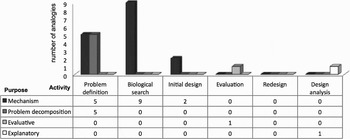
Figure 7 summarizes our analysis of the different uses of analogies that occurred in our study of biologically inspired design. We gathered a total of seventeen analogies used by team FORO from the data and classified them along the dimensions of activity and use. In some cases a single analogy had to be classified into more than one category. The columns in Figure 7 correspond to the six major design activities described above. The rows correspond to the three main uses: generation, evaluation, and explanation. The generative analogies are divided into mechanism and problem decomposition analogies as described above.
Uses of analogies distributed across different design phases.

Figure 7 shows that generative analogies that aid transfer of causal mechanisms are the most frequently occurring analogies in this project (16 across the 6 design activities). It also shows that in the initial stage of problem definition the number of mechanism and problem decomposition analogies were comparable (5 each). This indicates that the biological sources encountered in the initial stages of exploration, in addition to indicating specific mechanisms for given functions, were also helping designers better understand and elaborate their problem by suggesting different ways of decomposing the problem.
The how question relates to the methods of analogical transfer. The literature on analogy suggests many different methods of analogical transfer, five of which were observed in this design study.
• Direct transfer method: In this case-based method, a designer attempting to solve a target problem is reminded of a similar source problem for which the solution is known, and then the target problem is solved by transferring and adapting the solution of the source problem to provide a solution for the target problem (e.g., Goel & Chandrasekaran, Reference Goel and Chandrasekaran1988, Reference Goel, Chandrasekaran, Tong and Sriram1992; Maher et al., Reference Maher, Balachandran and Zhang1995; Smith et al., Reference Smith, Lottaz and Faltings1995; Hua et al., Reference Hua, Faltings and Smith1996; Gebhardt et al., Reference Gebhardt, Voß, Gräther and Schmidt-Belz1997; Maher & Pu, Reference Maher and Pu1997; Goel & Craw, Reference Goel and Craw2005). Most analogies we observed in our study of biologically inspired design conformed to this case-based method. For instance, in the earliest activities of survey and search of biological solutions, function cues from the target problem were used to infer mechanisms from many different sources.
• Schema-driven model: According to this cognitive model of analogy (Gick & Holyoak, Reference Gick and Holyoak1983), knowledge is transferred from a source analogue to a target problem by abstracting a solution schema from the source and a problem schema from the target. The abstract problem schema serves as retrieval cue for finding a solution schema that provides a solution to the target problem. In the design literature, design generation based on design patterns describes the same general method. In computational design, the IDeAL system (Bhatta & Goel, Reference Bhatta and Goel1997; Goel & Bhatta, Reference Goel and Bhatta2004) uses this method for conceptual design. In our study of biologically inspired design, we saw this method occur when the survey of existing technologies led to the development of the problem elaboration schema. The design patterns from this schema were used to retrieve biological sources that otherwise may have been inaccessible.
• Problem transformation model: In this model (e.g., Clement, Reference Clement1988, Reference Clement2008; Griffith et al., Reference Griffith, Nersessian and Goel1996, Reference Griffith, Nersessian and Goel2000), when an initial attempt to solve the target problem fails, the target problem is transformed, for example, by using a variety of limiting case strategies (Nersessian, Reference Nersessian2008). The transformed problem then allows the problem solver to recall a source analogue that provides a solution to the problem. In our study of biologically inspired design, during search for biological analogue, the transformed design pattern of the thermal process led to the camel nose analogy.
• Deferred goal model: In this model (Wills & Kolodner, Reference Wills and Kolodner1994a, Reference Wills and Kolodner1994b), reminding works in the opposite direction, from source to the target. When an attempt to solve a target problem has failed, the problem solver leaves it aside. Later, the problem solver serendipitously encounters a solved problem that can serve as a potential source, and this new source prompts recall of the unsolved target problem. We saw an instance of this during design analysis, when one of the designers encountered Popper's paper by chance and was reminded of the unresolved problem of deriving flow equations.
• Compositional analogy model: In this model (Yaner & Goel, Reference Yaner and Goel2007, Reference Yaner and Goel2008), knowledge of the source case not only is represented at many different levels of abstraction but also can be in different representational modalities. In our study the source of the small intestine, for example, may be represented at multiple levels of abstraction, ranging from the more abstract functional and causal knowledge in propositional form to information about shapes and spatial relations in visual form. In compositional analogy, mapping at one level of abstraction supports transfer at other levels. An example of this was seen in our study during the initial design development: the initial design not only works like the intestine but also looks like the intestine model (see Fig. 6), with the visual similarity apparently supporting the construction of a causal model of the generated design.
Of course, although we did not directly observe other methods of analogy (e.g., source construction method; Nersessian, Reference Nersessian and Giere1992) in this study, this does not imply that they did not occur or that we would not find them in other design episodes.
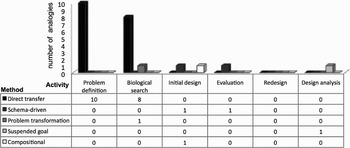
Figure 8 summarizes our analysis of the different models of analogies that occurred in our study of biologically inspired design. The results in Figure 8 indicate that the large frequency of analogies that occur during the first two stages of the design (problem definition and biological search) used the direct transfer method. This could be attributed to the exploratory nature of those activities where one is trying to be as inclusive as possible and there are fewer constraints on what to match. But further along in the design process, the knowledge needs become more specific and more constraints get introduced. Therefore, alternative methods of analogy that take into account these additional constraints and knowledge types are required to find the right analogue.
Models of analogies distributed across different design activities.

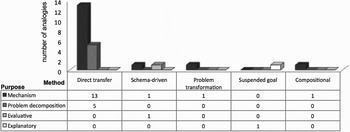
Finally, when we look at the distribution of models of analogies to purpose of analogies summarized in Figure 9, we note that an overwhelming majority of analogies are mechanism analogies, most of which employ the direct transfer method. These analogies correspond to the earlier activities of problem definition and biological solution search. However, analogical transfer of mechanisms may also require other methods in later stages of design activities. Finally, problem decomposition analogies almost exclusively employ the direct transfer method. One possible reason could be that other methods need generic abstractions (e.g., design patterns), which is bootstrapped by problem decomposition analogies.
Distribution of models of analogies for the purpose of analogies.

6. CONCLUDING REMARKS
This paper presents a study into one design team's effort to produce a biologically inspired, novel water desalination technology, followed by an analysis of the purposes and contents of analogies used in their design process. Several findings are suggested by our analysis. First, we found five different types of analogies in this episode of biologically inspired design: direct transfer, schema induction, problem transformation, deferred goal, and compositional analogy. It is possible, perhaps even likely, that additional types of analogy occur in biologically inspired design as well. Second, we found several different uses of analogies: solution generation, evaluation, and explanation, where generative analogies may transfer knowledge of causal mechanisms or problem decompositions. Third, we found that except for the redesign phase, analogies occurred in every major phase of the design process (problem definition, solution search, initial design, design evaluation, and design analysis). Fourth, we noted certain patterns of distribution of analogies, including most of the analogies that occur during the first two stages of the design (problem definition and initial search for biological solutions) used the direct transfer method, generative analogies that aid transfer of causal mechanisms are the most frequently occurring analogies, and majority of analogies used to infer a mechanism employ the direct transfer method. An interesting open question here is how do the patterns of creative analogies in biologically inspired design that we describe here compare with analogies in other design activities. Are there elements or aspects of analogy making and use that are unique to biologically inspired design?
In concluding, we return to our “big picture” goals and discuss the significance of the studies presented here with respect to the goals. One of our goals is to systematically understand analogical reasoning in biologically inspired design; the other goal is to use biologically inspired design to understand creative analogies in general. Contextually grounded cognitive theories provide both “kinematic” and “dynamic” accounts of the phenomena being studied (Nersessian, Reference Nersessian and Giere1992). Analogous to kinematics in physics (which describes motion without examining the causal forces that produce the motion), kinematics of design are descriptive accounts of designing without regard to the underlying causal cognitive processes. Conversely, dynamics of design are explanatory accounts of designing that take into consideration the cognitive processes or “mechanisms” that are causal to how the design unfolds. We can view our initial study and this most recent study as addressing both kinematic and dynamic aspects of biologically inspired design, respectively. Our initial study (briefly summarized in this paper) provides a descriptive account of biologically inspired designing and the sort of external representations that facilitate and constrain that process. Our current study, in contrast, tries to understand the causal role that analogy plays in biologically inspired design. By combining these two accounts, we hope to achieve a more comprehensive understanding of the cognitive basis of biologically inspired design as well as a deeper understanding of the contents of creative analogies.
ACKNOWLEDGMENTS
We thank Professor Jeannette Yen, Director of Georgia Tech's Center for Biologically Inspired Design, for her support of this research. Professor Yen was the coordinator and primary instructor of ME/ISyE/MSE/PTFe/BIOL 4803 course in Fall 2006 and Fall 2008. Other course instructors in Fall 2008 included Professors Craig Tovey and Marc Weissburg. We thank other members of the FORO design team in Fall 2008: Paul Anderson, Benjamin Hiller, Brandon McLarty, Saurav Sahay, and Song Seo. This paper evolved from an earlier conference paper (Vattam et al., Reference Vattam, Helms and Goel2009). Section 3 of this paper briefly summarizes earlier research described in Helms et al. (Reference Helms, Vattam and Goel2009). This paper has benefited from discussions with our colleagues in the Design & Intelligence Laboratory; we especially thank Bryan Wiltgen for his contributions to the development of the interactive DANE tool for supporting biologically inspired design. This research has been generously supported by the US National Science Foundation, more recently through a CreativeIT regular grant (0855916) entitled “MAJOR: Computational Tools for Enhancing Creativity in Biologically Inspired Engineering Design.”
Swaroop S. Vattam is a PhD candidate in computer science at the Georgia Institute of Technology, where he works in the Design & Intelligence Laboratory in the School of Interactive Computing. Swaroop is investigating analogical reasoning and creativity in the context of biologically inspired design. His forthcoming PhD thesis examines mediated analogy, which is analogical problem solving mediated by external information environments.
Michael Helms is a PhD student in computer science at the Georgia Institute of Technology, where he works in the Design & Intelligence Laboratory in the School of Interactive Computing. He has been an Instructor in biologically inspired design at Georgia Tech and at NASA and is the Graduate Student Coordinator at the Center for Biologically Inspired Design at Georgia Tech.
Ashok K. Goel is an Associate Professor of computer science and cognitive science in the School of Interactive Computing at the Georgia Institute of Technology. He is Director of the School's Design & Intelligence Laboratory and a Co-Director of Georgia Tech's Center for Biologically Inspired Design. Dr. Goel has been a technical consultant to NEC and NCR. He is an Associate Editor of IEEE Intelligent Systems and ASME Journal of Computing and Information Science in Engineering. His research has been supported by NSF, DARPA, ONR, DHS, and IES.