The morning of November 3, 2004, was an extremely difficult time for gay and lesbian Americans. The reelection of President George W. Bush, and the simultaneous passage of anti-gay marriage amendments in 11 states,1
States adopting same-sex marriage bans on Election Day included Arkansas, Georgia, Kentucky, Michigan, Mississippi, Montana, North Dakota, Oklahoma, Oregon, Ohio, and Utah. Earlier in the year, Louisiana and Missouri had also done so.
was as resounding a defeat as any social group is likely to experience in American politics. Worse, the emergence of the analytically vague phrase “moral values” from the exit polls and some arm-chair analysis by the pundits had already raised to the level of conventional wisdom the assertion that Senator John Kerry had lost because of the issue of same-sex marriage. Even Democrats, trying to extract some meaning and direction from the disappointing outcomes, appeared to conclude that the marriage issue had played an important and costly role. To gay and lesbian Americans, the headlines that morning might as well have read, “We lost. And it's
your fault!”
As the analyses in several of the subsequent articles suggest, same-sex marriage as an issue may not have been particularly instrumental to Bush's victory. In his contribution to this symposium, Greg Lewis analyzes both opinion and electoral data from 2004 and suggests that the same-sex marriage issue might have had an effect, but that this effect was smaller than several other notable factors. Sunshine Hillygus and Todd Shields, in their contribution, go further, suggesting that same-sex marriage played no role among Independents, in battleground states, and even in states where the issue was on the ballot. Rather, they suggest, the issue is important only in the South where the outcomes were hardly in doubt.
But, as is often the case, the perception of truth is infinitely more important in shaping political action than the actual reality. If Republican strategists and anti-gay activists believe that these ballot initiatives helped them at the ballot box, more are certain to follow. Same-sex marriage as an issue, then, represents a particularly crucial moment in American political history, and for gay Americans the stakes are extremely high.
First, the passage of state amendments banning same-sex marriage has had the additional effect of undoing a great deal of progress already achieved. The amendments in Mississippi, Montana, and Oregon only banned the formal recognition of same-sex marriages. But in the other eight states, the amendments prohibit the state from affording any form of recognition to same-sex relationships, including hard fought and dearly won domestic partner ordinances and partner benefits for state employees. There is considerable evidence that even supporters of same-sex marriage bans are unaware of, and even opposed to, the repeal of these less sweeping benefits.2
And, in fact, it is this compound nature of these amendments, and the lack of voter awareness, that are serving as the legal basis for several suits seeking to overturn the bans.
Nevertheless, the backlash against same-sex marriage may overwhelm any movement toward the granting of even limited partner benefits.
Second, we are likely witnessing the beginning of what may be a long period of defeat for gay and lesbian causes. If the perception that anti-gay marriage initiatives have large payoffs for GOP candidates, we are likely to see more of them popping up in other states. Currently Alabama, Arizona, Indiana, Kansas, South Dakota, Tennessee, and Virginia are moving at varying speeds toward placing a measure on their ballot. More ominously, in states where the marriage initiative is already passed, what comes next? For example, the GOP might believe that it rallied its voters in Arkansas, Ohio, or Kentucky through those states' votes on same-sex marriage. But, assuming those bans survive legal challenges, what would mobilize those voters in the next election, or the one after that? Conservative forces are unable repeatedly to place the same measure on a state's ballot. Rather, they will need to find a new provision to bring voters to the polls. It is a fairly safe bet that we shall shortly see the first of several anti-gay adoption or foster-parenting initiatives. In short, if gay bashing through the initiative process is seen as sufficiently beneficial to the electoral fortunes of Christian conservatives and the GOP, we have every reason to expect that these initiatives will be with us for some time to come.
An Evolving Message…
The rhetoric around the same-sex marriage debate has certainly changed over time. The opposition argument begins with two assertions at its core. First, homosexuality is fundamentally morally inferior to heterosexuality and represents the sinful outcome of perverse choices. Second, homosexual unions, by being inherently non-procreative, are fundamentally inferior to heterosexual unions. To grant legal status and recognition to inferior unions of immoral people undermines the importance of the institution, thereby eroding the foundation of civil society.
As Frederick Liu and Stephen Macedo point out in their contribution to this symposium, much of that debate has shifted away from the first argument—i.e., overt hostility to gays—to the second, a discussion of children and the preservation of heterosexual marriage as an institution. Liu and Macedo suggest that in the wake of Lawrence v. Texas3
Lawrence v. Texas struck down state laws criminalizing sodomy between consenting adults, thereby legalizing gay sexual contact in jurisdictions where it had remained illegal, albeit seldom enforced.
—and the utter absence of public outcry over that decision—same-sex marriage opponents deemed the public less receptive to outright attacks on gays and lesbians, and instead strategically chose to focus the debate over the Federal Marriage Amendment on child-rearing and preserving the sanctity of heterosexual unions.
This shift of strategy is problematic for gays and lesbians on two fronts. First, it raises the ominous possibility that gay child-rearing is the next focus of this anti-gay crusade. But, more importantly, this shift of emphasis, I would argue, is more a matter of window dressing than of substance. At its heart, the debate over same-sex marriage is about what it has always been about: anti-gay animus.
Consider the claim that opposition to same-sex marriage is about preserving the two-parent model of child rearing. The divorce rate in American society steadily rose for much of the latter half of the last century and remains high, though the oft-cited claim of a 50% failure rate is overblown.4
The National Center for Health Statistics does the measurement of this phenomenon, and the divorce rate appears to depend heavily on the age of bride and groom at the time of the marriage.
Spousal and child abuse is a national disgrace. Yet, prior to the Massachusetts action, not a single homosexual couple had been granted a marriage license in the United States. Logically, then, gay unions can have played no role in how straight marriage has evolved these last decades, and arguably will have little to do with their future. If there is a genuine interest in the reinvigoration of heterosexual unions in this society, “reformers” might look, first, to heterosexual behavior. I will return to this idea momentarily.
The argument with regard to children, then, is less convincing when these anti-gay initiatives are not accompanied by sincere efforts to improve the circumstances of heterosexual marriage. Whether or not children are better-raised in a two-parent environment, or an environment with a parent of each gender, is irrelevant if the proposed “fixes” do not address the identified problem. Evan Gerstmann, in his careful exploration of the recent jurisprudence of the issue, takes up the question of child-rearing and the same-sex marriage debate. He sums up this mismatch between issue and “solution” most clearly. Outlawing same-sex marriage, he suggests, has essentially no effect on the likelihood that children of heterosexuals are raised in a two-parent environment. Rather, and perversely, “The actual effect of the ban is to prevent children already being raised in same-sex households from the protection afforded by the benefits of marriage.” Without regard to one's preferences or arguments concerning same-sex marriage, it is difficult to take seriously the claim that the issue is about child rearing in the utter absence of any sincere efforts to redress the significant shortcomings of the family-type where most children live and are created, that is, heterosexual union.
Consider also the claim that same-sex marriage would undermine the sanctity of heterosexual unions by decoupling that institution from the role of procreation. This second claim takes two forms. First, we are told by natural law theorists that the family is the central unit in the society, and that marriage is therefore indelibly tied to the question of procreation. The obvious short-coming of this argument is that procreation (or at least efforts is this regard) is not required of heterosexual couples in order to marry, nor are infertile or post-menopausal individuals forbidden to marry. Nor would any of these folks extend marriage rights to gay couples with children (a circumstance which, of course, they find appalling in its own right). No, this is an argument of convenience.
The second version of this argument, carefully recounted in the Liu and Macedo piece, is that decoupling marriage from the commitments of family reduces marriage to an act of mutual emotion between the adults and, somehow, lessens heterosexual adults' collective interest in the institution, willingness to marry, and commitment to marriages already in place. What would such an effect look like?
I have shared this notion with non-political scientist gay friends, and to a man, each has found the notion incredibly funny. Imagine, if you will, that legal same-sex marriage becomes the law of the land. Are we to expect hundreds, thousands, even millions of otherwise committed husbands to immediately abandon their wives? Will they, perhaps, drive to the nearest gay ghetto or tavern and immediately begin looking for their first boyfriend? Will these freshly abandoned wives be driven into the arms of the woman next door?
This of course is nonsense. The effect that opponents of same-sex marriage describe is one with far more validity in the minds of a theologian or Straussian theorist than it would ever achieve in the world. Here is an experiment: Go forth and ask each of these opponents of same-sex marriage— evangelicals, conservatives, etc.—if, as a consequence of the adoption of that institution, they would be inclined to abandon their spouse, love them and their children any less, or be less committed to their family. To a person, they would say no, because the very idea is risible.
In the end, opposition to same-sex marriage is about moral judgment and bias. It is a collective refusal of one portion of society, who deem themselves morally and spiritually superior, to exclude another segment of society from a legal institution which, in a democracy of equal citizens, should be available to all. Endless sophistry about child-rearing and the sanctity of non-gay unions cannot forever cloud the reality that this is about prejudice and the preservation of heterosexual privilege at the expense of gays and lesbians.
Ironically, it is the frequent reference to Judeo-Christian scripture that best reveals the arbitrary nature of this judgment. Anti-gay activists are fond of quoting Leviticus as a justification of their claims of homosexual inferiority, immorality, and the like. However, Leviticus also includes prohibitions on handicapped/disabled people worshiping at the altar of God, requires God's followers to treat aliens in the same manner as natives,5
I am particularly fond of this one, which can be found in Leviticus 19: 33–35, and I have been breathlessly awaiting a biblically based surge of evangelical opposition to anti-immigrant policies and initiatives, such as California's Proposition 187. No word yet, but I remain hopeful.
prohibits the consumption of shellfish, and requires the execution of anyone found to commit adultery (Lev. 20: 10). Despite this plethora of condemnations and abominations, it is curiously only sodomy (and its practitioners) singled-out for special treatment in the political agenda of the day.
Same-Sex Marriage, the Debate, and Their Effects on the Lives of Lesbians and Gays
For gays and lesbians, the debate on this and other matters of civil equality is, frankly, exhausting. Same-sex couples function in a social environment where every act of togetherness may, and often does, prompt a variety of forms of social opprobrium, including stares, comments, discriminatory behavior in housing, employment, and education, anti-gay legislation, and even outright violence. With specific respect to the marriage issue, same-sex couples face obstacles to practices that all other Americans take for granted, including such “privileges” as hospital visitation, access to medical and legal information, and right to inheritance. What is accomplished for heterosexuals with the purchase of a $15 marriage license requires of same-sex partners the expenditure of hundreds, or even thousands, of dollars in legal fees for the drawing up of ownership agreements, wills, living wills, durable and medical powers of attorney, and countless other little details, none of which need be considered by married couples but all of which need spelling out in exacting detail for gays and lesbians. One should not be fooled by the presence of domestic partnership ordinances and benefits which, in no way, approximate the rights of marriage. In just one example, most heterosexuals have no idea that insurance premiums and other benefits paid by employers for the domestic partner and the partner's children are taxable income to unmarried persons under federal law. In short, life is not easy for lesbian and gay couples.
This cannot help but have significant effects on those whose lives are at issue. Ellen Riggle, Jerry Thomas, and Sharon Rostosky examine this social reality and its impact. They observe that significant social stress is likely to result from repeated denunciation and exclusionary legislation. Moreover, pair-bonding and stable relationships are generally found to improve the health and life-expectancy of those who enter them, when compared to singles. Riggle and her colleagues ask, what, if any, effect these debates over same-sex marriage, and the exclusion of gays and lesbians from marital recognition, have on the health and well-being of gay and lesbian Americans? They suggest that, like the experience of other minority populations, the “minority stress” resulting from exclusionary institutions and public denunciation have deleterious effects on the health and well-being of homosexual Americans.
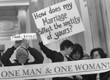
Different Views. George Bedford, left, holds up an anti-gay marriage bumper sticker as Wendy Becker, a lesbian with a partner for 15 years, holds up a pro-gay marriage sign during a rally at the Rhode Island Statehouse, March 16, 2004. Photo: AP/Victoria Arocho.
So What's a Gay Person to Do?
Should gays and lesbians opt for an exit strategy in meaningful numbers, it would be hard to blame them. In the days and weeks after the election, there was more than the usual discussion of emigration. A humorous map circulating on the Internet redrew the Canadian-American border to include “blue” states in a newly christened United States of Canada, reserving an alternate—uh, more “religious”—name for the remainder. A number of news reports suggested radically higher web traffic at the Canadian immigration web site. The online magazine Slate reported just after the election, “The Canadian immigration Web site had 179,000 visitors Wednesday [11/3/04]—six times its usual traffic—the vast majority of which came from the United States” (Lithwick and Lithwick 2004). Politically aware and active gays and lesbians wondered whether it was genuinely time to leave the U.S. (In case anyone is interested, there is an alarming lack of jobs in “Latino politics” at Canadian and British universities!)
Canada, of course, has addressed the question of same-sex marriage in a decidedly different way. Gays and lesbians can legally marry today in seven of Canada's provinces and territories, the federal government has introduced legislation to legalize the practice nationwide, and that legislation is expected to pass by the end of 2005. The roots of Canada's different approach may well be one of national character, though there is certainly outspoken opposition coming from the same sectors of Canadian society as is the case in the U.S. But, as Miriam Smith points out in her contribution to this symposium, an alternative explanation is rooted in the political opportunity structure faced by the largely religious opposition. Canada's institutions provide less points of access for vocal but determined factions, like the religious right, to use legislation to effectively stop social change.
The idea of a mass exodus of gays and lesbians is an amusing scenario, at some level. Canada only has about 30 million citizens, some of whom are already gay. Should the entire homosexual population of the U.S. emigrate to Canada, the number of gays and lesbians in Canada would come very close to being a national majority. “Our own country!” could be the organizing principle of such an exodus. In my mind's eye, I imagine Ellis Island-like scenes of huddled but generally well-dressed masses, queuing for immigration with all of their possessions—Pet Shop Boys CDs, hers-and-hers golden retrievers—searching for a place where they could be equal citizens. Gay and lesbian cowboys, Texans, and other “red” state residents could move to Alberta (where continued outspoken opposition to same-sex marriage by the provincial leadership would make them feel right at home), Californians to Vancouver, New Yorkers to Toronto, New Englanders to Montreal. Even gay Republicans could come (though they probably wouldn't want to). This could work!
This, of course, is not a realistic scenario. America's gay and lesbian people are, in the last analysis, Americans. They have families, friends, co-workers, professions, and businesses in the U.S. They have roots, histories, and a commitment to the national ideal. It is ironic in the extreme that the two most visible policy disputes over homosexual rights in the United States, today and for the last two decades, revolve around the right to marry and equal access to military service. These are hardly the radical actions of a people voluntarily disconnected from, and disinterested in, the society and national ideals. In fact, what is particularly striking about the “official” gay and lesbian movement today, as it has played out in the media and political institutions, is that it is, in the last analysis, a very conservative movement, focusing more on homosexual access to existing social institutions than to efforts at remaking, fundamentally altering, or destroying them.
It would be wrong, of course, to suggest that these arguably conservative goals are shared by all, or even most, gays and lesbians. Patrick Egan and Kenneth Sherrill argue in this symposium that the issue of same-sex marriage is not even high on the agendas of most self-identified homosexuals. Rather, this issue represents a subtle but important shift of the goals of the movement from liberty—the right to be left alone—to equality, or the demand for equal treatment. This shift, they suggest, has occurred as a product of organizational decision making within gay rights advocacy groups, reacting to the surprisingly successful litigation of a few adventurous souls, but without the enthusiastic support of the gay “rank and file” and without the necessary shift in public sentiment.
A second alternative strategy, one less drastic than assuming the life of a refugee, would be for gays and lesbians to take those opposed to same-sex marriages at their word and accept that heterosexual marriage needs saving. I, for one, am all for it. So how can we “morally inferior” folk make a contribution to helping preserve the institution of marriage, the two-parent family, and, by extension, the republic?
Easy! Lesbian and gay Americans can strike a blow for morality and equality, and brush up on their knowledge of Leviticus in the process, by working for the passage of statewide initiatives—and perhaps even a constitutional amendment—to criminalize adultery. Adultery is probably the single greatest cause of any of these social harms rhetorically used as the ominous impact of sanctioning same-sex unions. And while we are at it, let us also take the marriage enthusiasts at their word and eliminate—or at least drastically curtail—divorce in the absence of cause. In fact, if the harms of adultery and divorce could be substantially ameliorated, maybe the alleged harms of same-sex unions would be less fear-inspiring and present a weaker argument for folks to go to the polls and legislate inequality.
Ironically, such proposals would actually attract considerable support from some of the most conservative elements of American society, and at least one stab at these changes—the concept of “covenant marriages” from which exit is more difficult—is being widely championed by the evangelical movement. But I suspect such changes would be far less enticing to the rank and file voter who has supported initiatives banning same-sex marriage, in large measure because they would spread the blanket of moral judgment, and the legal impact of legislating Leviticus, far too close for comfort.
Thinking about the Future
Barring the exit option, and without regard to whether lesbian and gay Americans jump on the pro-marriage ban wagon, what future will gay and lesbian Americans face? On the one hand, my earlier logic regarding the pursuit of these anti-gay initiatives as an instrument of mobilization is disappointingly on-target and very likely to come to pass. But, more optimistically, opinion on homosexuals is evolving, and so too is opinion on various forms of gay unions. Such change can and will be driven by a variety of factors, not the least of which is opinions concerning the origin of homosexuality. Donald Haider-Markel and Mark Joslyn, for example, here offer an interesting comparison of evolving opinions on homosexuality and biology. As more respondents attribute homosexuality to nature, rather than nurture, opposition to same-sex marriage declines (and is least likely in those holding beliefs in the nature-based origin of homosexuality).
Not so long ago, in 2000 to be specific, the Democratic party lost control of the Vermont legislature for passing a bill it was ordered to pass by the state's highest court. The legislators opted for—and in a real sense, defined the concept of—civil unions, a legally recognized partnership designed to be identical to marriage in all but name. By the time of the 2004 election, and largely as a consequence of events in Massachusetts and elsewhere, civil unions enjoyed widespread support as the conservative alternative to same-sex marriage, with even President Bush expressing his endorsement of the concept during the 2004 campaign. And Democrats reclaimed the Vermont State House.
It would be fair to suggest that such an embrace by Bush and others is of dubious validity, occurring as it did under the duress of equal marriage rights as a reality in Massachusetts and, conceivably, elsewhere. Nevertheless, in an extremely short time span, the terms of debate surrounding same-sex unions shifted decidedly in the pro-gay direction. Other opinions have evolved as well. In Gallup surveys and elsewhere, there has been a substantial increase in tolerance of—and support for—homosexuals, including more Americans favoring equal employment protection for gays and lesbians, opposing attempts to criminalize same-sex sexual behavior, and favoring granting employment benefits to partners of same-sex employees.
All of which is to say that opinion change is possible.
SYMPOSIUM AUTHORS' BIOS
Patrick J. Egan is a Ph.D. candidate in political science at the University of California, Berkeley. He studies political behavior, public policy, and political regulation. His dissertation uses formal models and opinion data to examine the relationship between public opinion and policymaking in the United States.
Evan Gerstmann earned his Ph.D. in political science at the University of Wisconsin-Madison and his J.D. at the University of Michigan. He is the author of Same-Sex Marriage and the Constitution (Cambridge University Press, 2003) and The Constitutional Underclass: Gays, Lesbians, and the Failure of Class-Based Equal Protection (University of Chicago Press, 1999). He is associate professor of political science at Loyola Marymount University, and also teaches at Loyola Law School.
Donald P. Haider-Markel is associate professor of political science and director of the Survey Research Center at the University of Kansas. His research focuses on public policy and public opinion.
D. Sunshine Hillygus is assistant professor of government at Harvard University where she leads the Program on Survey Research at the Institute for Quantitative Social Science. She studies voting behavior, campaigns and elections, survey research, and information technology and society.
Mark R. Joslyn is associate professor of political science at the University of Kansas. His research focuses on public opinion, the media, and elections.
Gregory B. Lewis is professor of public administration and urban studies at Georgia State University and director of the joint Georgia Institute of Technology-Georgia State University doctoral program in public policy. His research focuses on the effects of race, sex, sexual orientation, and other personal and organizational characteristics on the careers of public employees and on public opinion of and toward lesbian and gay Americans.
Frederick Liu is an undergraduate student in the Woodrow Wilson School of Public and International Affairs at Princeton University. Last summer, he was an intern for the U.S. Senate Republican Policy Committee in Washington, D.C.
Stephen Macedo is Laurance S. Rockefeller Professor of Politics and the University Center for Human Values, and director of the University Center for Human Values. He has been vice President of the American Political Science Association, and his writings include the forthcoming co-authored report of the APSA's Committee on Civic Education and Engagement: Democracy at Risk: How Public Policy Choices Undermine Citizen Participation and What we Can Do About It (Washington, D.C.: Brookings, 2005).
Ellen D. B. Riggle is associate professor of political science and associate director of the Women's Studies Program at the University of Kentucky. She received her Ph.D. in political science from the University of Illinois in 1990. Recently, she has published articles on minority stress effects on same-sex couples in journals such as Psychology, Public Policy and Law, Professional Psychology: Research and Practice, and the Journal of Family Issues.
Sharon S. Rostosky is associate professor of counseling psychology at the University of Kentucky. She received her Ph.D. in counseling psychology from the University of Tennessee in 1998 and is a licensed counseling psychologist. She has published numerous articles on adolescent sexuality, sexual minority youth, and relational issues for same-sex couples in journals such as the Journal of Counseling Psychology, Journal of Adolescence, Family Process and the Journal of Sex Research.
Gary M. Segura is associate professor of American politics at the University of Iowa, and is moving this summer to the University of Washington. His research has been published in the American Political Science Review, the Journal of Politics, the Political Research Quarterly, and the Journal of Conflict Resolution, among other outlets.
Kenneth Sherrill is a professor of political science at Hunter College, CUNY. His books include Gays and the Military (Princeton University Press, 1993) and he most recently wrote “Neither an In-Law nor an Outlaw Be” with Patrick J. Egan (Public Opinion Pros, 2005). Sherrill and his spouse were married in Canada in August 2003.
Todd G. Shields is associate professor and chair of the department of political science at the University of Arkansas and director of the Diane D. Blair Center of Southern Politics and Society. He is co-author of Money Matters: The Effects of Campaign Finance Reform on Congressional Elections and co-editor of The Clinton Riddle: Interdisciplinary Perspectives of the 42nd President.
Miriam Smith is professor in the department of political studies, Trent University, Peterborough, Ontario, Canada. She specializes in comparative and Canadian politics, especially the politics of the Canadian lesbian and gay movement. She is the author of Lesbian and Gay Rights in Canada: Social Movements and Equality-Seeking, 1971–1995 (University of Toronto Press, 1999) and A Civil Society?: Collective Actors in Canadian Political Life (Broadview Press, 2005).
Jerry D. Thomas is visiting assistant professor of political science at Eastern Kentucky University and a doctoral candidate in political science at the University of Kentucky. He received a Masters of public administration from the University of South Carolina in 1994. His research interests include cross-national comparisons of morality policies and judicial politics.