1. Introduction
In a recent essay (Goddu Reference Goddu2016) I argued for reconsideration of Ludwik Antoni Birkenmajer's and Curtis Wilson's views on the origin of Copernicus's heliocentrism. Both authors took Copernicus at his word about the problem with Ptolemy's solution for the first anomaly and his implication that the hypothesis of Earth's annual motion was part of the solution. While conducting research at Uppsala University Library in 2001 and 2003 (Goddu Reference Goddu2004), I became aware of Birkenmajer's research at Uppsala and his major work on Copernicus (Birkenmajer Reference Birkenmajer1900). Under a grant from the Smithsonian Institution, Jerzy Dobrzycki and Owen Gingerich supervised a selective and partial translation (Smithsonian Translation 1976). With the aid of that translation, surrounded by two dictionaries and a grammar handbook, and with occasional assistance and advice from Robert Podkoński and Elżbieta Jung of the University of Łódź, I have been trying to produce a complete translation, largely to preserve Birkenmajer's footnotes, and to turn Birkenmajer's often long, complex, and cryptic sentences into readable English (Goddu Reference Goddu2015-).Footnote 1
Now, that a work from 1900 is outdated in many respects goes without saying. It is virtually inevitable that an early work will suffer neglect because of later corrections or advances, yet the fact that we still see references to Birkenmajer's work testifies to its relevance and usefulness. Indeed, those references are often a key to the very contributions that Birkenmajer made. Here I intend to offer only a few examples. My focus is, first, on historical context, by which I mean Birkenmajer's historical context and Copernicus's historical context. Second, I will focus on insights that somehow were either lost or underappreciated.
2. A Pioneer of Copernican Studies
In the nineteenth century, German-speaking scholars in parts of present-day Russia (the exclave centered on Kaliningrad) and Poland, namely Prussia, launched a renaissance of Copernican scholarship. Prussia enclosed and surrounded the Polish bishopric of Varmia, established in the thirteenth century. The city of Olsztyn (Allenstein in German), the episcopal residence at Lidzbark-Warmiński (Heilsberg), and the cathedral town of Frombork (Frauenburg), all in Varmia, are locations where Copernicus worked from about 1504 until his death in 1543. Toruń (Thorn), Copernicus's birthplace in 1473, was once a Hanseatic League city on the eastern border of Pomerania on the Vistula River. It fell into the hands of the Teutonic Knights (1411), formed the Prussian Confederation against the Knights (1440), and was recognized as part of the Polish kingdom (1454). All of which is to say that except for four years in Cracow and six-to-seven years in Italy, Copernicus spent his entire life in the area known as Prussia.
Leopold Prowe (1821-1887) from the same town as Copernicus published an important comprehensive biography of Copernicus (1883-1884). He was among the first to research local documents about Copernicus, and the books owned or used by Copernicus that were taken to Sweden in the seventeenth century. One of his colleagues, Maximilian Curtze (1837-1903), born in Saxony but worked and died in Toruń, also conducted research in Sweden, published many of Copernicus's annotations from those books, discovered and published the first transcription of a manuscript of Commentariolus (1878), and was one of the editors of the 1873 Thorn edition of De revolutionibus. Franz Hipler (1836-1898), born in Allenstein and died a Cathedral canon in Frauenburg, was a German Catholic historian and theologian who published many important documents, especially on the episcopal and cathedral libraries in Varmia (1873 and 1874) that constitute the basis for research on the books available to Copernicus while he was working on his treatises. For these scholars, Copernicus was a subject of both local and European history.
Aside from Prussian scholars, an important historian of astronomy, a Danish-Irish contemporary of Birkenmajer's, was J. L. E. Dreyer (1852-1926). Dreyer's work on Tycho Brahe was especially important, providing a new context for understanding Copernicus's place in the narrative that historians were developing at that time about the astronomical revolution of the seventeenth century. Birkenmajer knew and drew on Dreyer's work in German translations (Dreyer Reference Dreyer1894b).
Following upon their studies and taking advantage of their spade work, Birkenmajer corrected and surpassed the work of his predecessors, setting Copernican scholarship and editions on a path that would loom over Polish research until the 1970s. Birkenmajer's classical education in L'viv and his further education in mathematics prepared him almost uniquely – for his time – to plumb the depths of Copernicus's effort to reform ancient astronomy. As a historian of science, Birkenmajer was an amateur, to be sure. His enthusiasm, as one scholar has expressed it diplomatically (Markowski Reference Markowski and Kokowski2002, 41), strikes us today as unsophisticated. Much of the excessive rhetorical flourish of Birkenmajer's language can be attributed to his enthusiasm, but it is churlish to dismiss his entire work because he held a once fashionable belief in scientific progress.Footnote 2 The same can be said for his nationalism, which certainly motivated him to plan a Polish alternative to Leopold Prowe's German Copernicus. And yet, as he sensed that the sources had not been exhausted, he never did complete that project, testimony to his admirable discipline.Footnote 3
Whatever weaknesses his enthusiasm and nationalism betray, readers who defend the dismissal of Birkenmajer's work should look at the first chapter of Mikołaj Kopernik (Birkenmajer Reference Birkenmajer1900). Copernicus's debt to Peurbach and Regiomontanus, now universally accepted and even taken for granted, was Birkenmajer's first major contribution. By means of detailed comparison, Birkenmajer demonstrated the extent to which Copernicus's work relied on, developed from, and moved beyond the Epitome of Ptolemy's Almagest (Regiomontanus Reference Regiomontanus and Schmeidler1496). The Epitome brought together several problems in a way that Copernicus did not encounter in Cracow. The confluence of comments about details, sources, problems, and solutions (or their absence) constituted a turning point where Copernicus began to consider the problems critically and in mathematical detail.Footnote 4 Birkenmajer's chapter on the Epitome impressed me to such an extent that I became convinced that if one could filter his mistakes from the rest, genuine insights would emerge. His most original and still valuable analysis of the Uppsala Notebook proved that conviction to be correct. I will return to that point below.
In the period of the 1890s, however, Birkenmajer looked to Copernicus's earlier context in Cracow, and especially Albert of Brudzewo's commentary on Peurbach's theorics of the planets. While Birkenmajer believed that Copernicus knew the 1495 published version of Brudzewo's work, as do many historians today, he also assumed that Copernicus had attended lectures on Brudzewo's treatise (Albertus de Brudzewo Reference Birkenmajer1900).Footnote 5 Whatever his exact source, Copernicus encountered in Brudzewo's commentary a critique of Peurbach and Ptolemy that Birkenmajer believed attested to a shared recognition of fatal problems with Ptolemaic astronomy (Malpangotto Reference Malpangotto2016; Goddu Reference Goddu2016).Footnote 6 That was the beginning, and over the subsequent twenty years or so, Copernicus constructed his first version of heliocentrism. That discovery was also Birkenmajer's.
That may seem surprising, but consider the fact that the leading Copernican scholars of the day, Maximilian Curtze and Leopold Prowe, believed that Commentariolus represented a work, not of the early 1500s, but of the 1530s! (Curtze Reference Curtze1878, 2–4. 9, and 70; Prowe 1883–Reference Prowe1884, 2, 2: 286). Birkenmajer was among the first to recognize the crucial differences between the mechanisms of Copernicus's Commentariolus and De revolutionibus, and that the Commentariolus represented the earlier version (Birkenmajer Reference Birkenmajer1900, chap. 3; Dreyer Reference Dreyer1894a, 83; Reference Dreyer1894b, 87).Footnote 7
How did Birkenmajer achieve these results? Curtze and Prowe knew many of Copernicus's books, had discovered several of them, and had also tried to explicate Copernicus's annotations. Birkenmajer's enthusiasm often misled him, but he also often curbed his enthusiasm by a meticulous search for the aim of a table, exploring the problem that Copernicus was trying to solve, and verifying how his solution fit into the puzzle that he was trying to assemble. In other words, Birkenmajer's enthusiasm at times took the form of “thinking with Copernicus,” always trying to discover what lay behind every detail in Copernicus's treatises and annotations. Ad fontes, return to the sources, was the guiding principle of his scholarly activity, and by clinging to that motto he became an expert and an inspiration to others.
But imaginative reconstructions were only part of Birkenmajer's talents. His mathematical expertise served him well in his critiques of both Curtze and Prowe. Nowhere is this more evident than in his analysis of the Uppsala Notebook. Of course, it helped that he seemed to have a perfect memory of the content of both Commentariolus and De revolutionibus. Such a mastery of both mathematics and the content of Copernicus's work allowed him to ask relevant questions, and to provide solutions that clearly surpassed the work of his predecessors. His chapters on Averroes and other Arabic authors also reveal that Birkenmajer was sensitive to Copernicus's educational context in Cracow. Although Copernicus and others at Cracow were not sympathetic to Averroes's philosophy in every respect, Birkenmajer did perceive that Averroes's criticisms of Ptolemaic astronomy left an impression on Albert of Brudzewo and others that contributed to doubts about the coherence of Ptolemy's kinematic treatment of lunar and planetary motions.Footnote 8
It is, however, in his chapter 7 on the Uppsala Notebook, by far the longest chapter in the book, that Birkenmajer discovered what he believed to be the key to Copernicus's reformation of Ptolemaic astronomy, and the key also to the origin of Copernicus's heliocentrism. Perhaps because I was translating and reading with such painstaking effort, I absorbed Birkenmajer's enthusiasm, and despite the consensus of contemporary scholarship, saw what still seems to me to be an original insight by Birkenmajer. As he struggled with the relation between Commentariolus and De revolutionibus, Birkenmajer also saw a connection between Albert of Brudzewo's critique of Peurbach and Copernicus's critique of Ptolemy. On the one hand, the connections involved a technical feature of Copernicus's lunar and planetary models, and the stages through which they went.Footnote 9 These concern technical features that deal with the problem of uniform motion (Goddu Reference Goddu2016, 236–241). Copernicus eventually saw the annual motion of Earth as contributing to a solution of that problem as it relates to planetary motion. In both versions, Earth's annual motion allows for the reduction in the size of epicycles. Birkenmajer believed that the huge Ptolemaic epicycles struck Copernicus as incongruous or implausible. On the other hand, Birkenmajer also perceived a qualitative transformation from a concentric to an eccentric system, which he thought led Copernicus towards a goal that he could not achieve, namely, the elimination of epicycles.
As we know, because of Earth's annual motion, Copernicus could reduce the epicycles for the superior planets in De revolutionibus to epicyclets, and eliminate an epicycle altogether for Venus. For Mercury, one version retains an epicyclet, but the planet does not move on its circumference but rather along its diameter. Another version for Mercury does eliminate even the epicyclet (Copernic 2015, V, 25 and V, 32). All these facts taken together seem to have suggested to Birkenmajer that in the transition from a concentric to an eccentric system, Copernicus had clearly come to realize that Earth's annual motion made Ptolemy's large epicycles superfluous. Copernicus retained epicyclets to adjust motions in longitude and to account for deviations in latitude, but the direction of his efforts, Birkenmajer thought, was towards the elimination of epicycles. Earth's annual motion played the major role, and so it was, as Copernicus had asserted, one of the means for solving the problem of uniform motion in a way that did not entail the contradictions of Ptolemy's so-called equant model.
On proposals of an equivalent geocentric solution to save uniform motion, Birkenmajer said nothing, but he was evidently of the opinion that Copernicus had already concluded that geocentrism was incoherent and did not possess the resources to solve all the problems, and provide satisfactory explanations of the observed motions. In other words, even if a geocentric alternative had occurred to him, Copernicus, Birkenmajer seems to have thought, would have rejected it out of hand.
We should keep in mind here that the proposals about a geocentric alternative to save uniform motion and Copernicus's elimination of such an alternative are elegant but thoroughly speculative (Swerdlow Reference Swerdlow1973, 471 and 478; Wilson Reference Wilson and Westman1975, 32–39). There is no direct assertion by Copernicus that he saw or considered a geocentric alternative. In my view, Birkenmajer's intuition here is consistent with Copernicus's remarks and, above all, the direction that he sensed in the movement from a concentric to an eccentric system. In the first stage, Copernicus had attempted the replication of Ptolemy's eccentricities by means of a bi-epicyclic mechanism and a way of reducing epicycles, but the restoration of eccentrics opened the possibility for their further reduction and even elimination.
Here a pause is in order. Did Copernicus himself recognize the directionality of the transition from a concentric system with reduced epicycles to an eccentric system with fewer and smaller epicycles? If he did, then he might have begun to wonder about the axiom of uniform, circular motion. If he did not, then it seems that the axiom blocked his way. The second seems to fit with his depreciation of the departure from exactly perfect circular motion of the superior planets. He characterized the departure from perfect circularity as “insensibili,” that is, imperceptible, with the result that the model describes not a perfect circle, but a nearly perfect circle (Copernic Reference Copernic2015, V, 4). Even worse, Copernicus did not fail to notice that the shift in the solar apsides also produced an unwelcome consequence. While the eccentricity remained the same length, the center of Earth's annual motion shifted in a way that is not followed by the other appearances, which results in an irregularity that is slight but indeed perceptible in Mars and Venus (ibid., V, 4 and III, 20). These are further instances in which Copernicus's reliance on Ptolemy, both his models as well as his observations, constituted a fundamental stumbling-block. With his emphasis on Copernicus's critique of and departure from Ptolemy, Birkenmajer seems to have downplayed Copernicus's dependence. If Birkenmajer did tend to read Kepler back into Copernicus on the hoped-for elimination of epicycles, he also detected a transition in Copernicus's own development that is verifiably in Copernicus's texts, independent of Kepler's achievement. Copernicus clearly recognized some of his limitations, but he seems never to have doubted the axiom of uniform circularity, and readers must so qualify the “directionality” of his shift from concentrics to eccentrics accordingly. I will re-consider Birkenmajer's limitations in the concluding section.
3. Copernicus's Precursors
There are other details in Birkenmajer's works where simple justice demands acknowledgment of his contributions, even if they have since become commonplace. The new French edition of Copernicus's De revolutionibus has referred to Birkenmajer's work in many passages, and it provides a new and impressive textual standard for further research on Copernicus. There are also other foreign scholars who are working on the Copernican era, and some of them have turned to Birkenmajer for specific details and lost insights (Blumenthal Reference Blumenthal2013 and Reference Blumenthal2015; Ragep Reference Ragep2016, 407).
I conclude this section with two further examples of Birkenmajer's contribution to our understanding of Copernicus's achievement. The first emerges from a consideration of the new French edition and translation of De revolutionibus, dedicated in part to the memory of Paweł Czartoryski. The editors of the edition commended an interpretative principle that they call “methodological prudence” (Copernic Reference Copernic2015, 1: 270, n.1). In evaluating suggestions about sources that Copernicus supposedly used, the principle advises:
The kind of evidence that we need in such cases includes annotations in the books that we know Copernicus owned or read, expressions in De revolutionibus or in Commentariolus that parallel uniquely arguments or comments in sources that he consulted, or quotations and facts that we can show he borrowed from another author (for example, Copernicus's evident reliance on Regiomontanus's Epitome). Other than this quality of evidence, conjecture and speculation based on similarities can often be traced back to another text common to all possible intermediaries, such as one by Aristotle, Ptolemy, De sphera, or some version of Theorica planetarum. Such speculation leaves us with no way of knowing whether Copernicus responded to a suggestion in some commentary or reacted directly to the original text. (Goddu Reference Goddu2010, 187)
The principle of methodological prudence, I believe, is concordant with the motto Ad fontes and Birkenmajer's research on Copernicus. His extensive and detailed examination of Copernicus's annotations, his search for Copernicus's sources, and his confirmation of parallels confirm his adherence to that principle. Such discussions in the French edition and in Birkenmajer concern questions about Copernicus's precursors.
The French editors’ evaluation of the notion of “precursor” altogether (Copernic Reference Copernic2015, 1: 520–551) marks an important methodological contribution to discussion of the relation between Copernicus and his predecessors from epistemological and logical perspectives. The editors point out, however, that Copernicus himself mentioned authors who had put him on the path to heliocentrism. Indeed, Copernicus's reliance on his predecessors is evident from the sources that he owned and some (now lost) that he consulted. His dependence on authorities is undeniable. That said, we must also consider the extent to which his sources provided him with cover for his almost universally rejected proposals about Earth's motions. He was not a lone hero or completely original in his astronomical system, yet he was the first to propose a complete and detailed cosmological system based on Earth's motions and the Sun's stability. However much other authors may have suggested a heliocentric system with Earth in motion, none of them proposed the system that he advanced. For instance, the Pythagoreans as cited by Copernicus proposed that Earth is not the center of the universe and that it moves, but their proposal, as he himself suggests, was unmotivated, and none of them created a cosmological and astronomical system based on those ideas that could account for the observed celestial motions. No predecessor who held some part of an overall theory had put it all together in the way that Copernicus did. Copernicus's claims in this regard succeeded in fooling contemporaries and even some of his followers.
In other words, and to be clear as possible on the subject, yes, there were authors before Copernicus who had proposed the Earth's axial rotation, some who considered the possibility that Earth moves from its position, some who proposed that Earth moves around a central fire (not identified with the Sun), but there is no one prior to Copernicus who adopted all these ideas in the form of a heliocentric (strictly speaking, heliostatic) system with the Earth moving around the Sun with the Earth's axis tilted so as to account for the Sun's apparent motion on the ecliptic and for the change of seasons, and to account for the observed motions of the other planets, especially their variations in distance, bounded elongation, and retrograde motions. Beyond that, no one had proposed that Earth's annual motion could contribute to saving the axiom about the perfectly uniform and circular motions of the celestial spheres.
In support of the French editors’ view of Copernicus's predecessors, consider the comments of Dreyer (1894, 172–174):
That Copernicus had precursors among the ancients who taught that the earth was in motion, is well known, and he was well aware of this fact himself. But none of those precursors had done more than throw out their ideas for the consideration of philosophers; they had not drawn the scientific conclusions from those ideas, and had not worked them into a complete system by which the complicated motions of the planets could be accounted for and made subject to calculation. Neither had this been done by the philosophers who made the earth the centre of the universe, and let it be surrounded by numerous solid crystal spheres to which the heavenly bodies were attached. All this was only philosophical speculation, and was not founded on accurate observations; but the only two great astronomers of antiquity, Hipparchus and Ptolemy, have handed down to posterity a complete astronomical system, by which the intricate celestial motions could be explained and the positions of the planets calculated. . . . When astronomy towards the end of the fifteenth century again began to be cultivated in Europe, the inconvenience of the extremely complicated system became felt, and soon the great astronomer of Frauenburg conceived how a different system might be devised on the basis of the earth's motion round the sun. . . . And though he had but few and poor instruments, and did not observe systematically, he took from 1497 to 1529 occasional observations in order to get the materials for finding the variations of the elements of the orbits since the time of Ptolemy. He was therefore able to produce a complete new system of astronomy, the first since the days of the Alexandrian school, and the first of all which gave the means of determining the relative distances of the planets.Footnote 10
4. Maragha Precedents: Blueprint Copying, Independent Development, or a False Dichotomy?
I cannot leave the topic of Copernicus's precursors without discussing the hypothesis about Copernicus's acquaintance with and dependence on Maragha theory, specifically the Tusi-couple and bi-epicyclic geometrical models.
The French editors, reacting mostly to strong versions of what amounts to “blueprint copying” by Copernicus of Maragha models, cite several skeptics and questioners to reject the evidence of Copernicus's dependence on these models. The editors raise several issues, and point out weaknesses in the assertions of supporters.
Some discussions of hypotheses about Copernicus's acquaintance with Maragha precedents have taken a regrettable turn. Some proponents have over-reacted to those who have merely raised questions, resorting in the latest versions to, in effect, ad hominem arguments and ideological posturing (Barker and Heidarzadeh Reference Barker, Heidarzadeh, Granada, Boner and Tessicini2016, 21–22, 42, and 57). They indiscriminately accuse critics, some of whom have searched arduously for Copernicus's sources and have emphasized his debt to Islamic critiques of Ptolemy that we know with certainty were available to him, of clinging to an outdated ‘lone-genius’ view of history, of ignoring Copernicus's historical context, and of valorizing European exceptionalism.
F. Jamil Ragep's devastating, if somewhat inflammatory, criticism of my reliance on a reconstruction of Nicole Oresme's models by Garrett Droppers was entirely just, although embedded in comments that overlooked the inquiring nature of my suggestions (Ragep Reference Ragep2014 and Reference Ragep2017; Droppers Reference Droppers1966; Goddu Reference Goddu2010, 478–484). Be that as it may, we continue to disagree on the question of whether and to what extent Oresme was dependent on predecessors (Droppers Reference Droppers1966, 283–285).Footnote 11 As for Ragep's protestations about conflation of a Tusi-couple with a Eudoxan-couple (Ragep Reference Ragep2014, 32–33; Ragep Reference Ragep2017, 186–187), even he reported that Tusi himself had presented the curvilinear version of his couple as an outgrowth of al-Haytham's Eudoxan couple model, that is, that he used “it as a starting point with which to deal with the difficulties of Ptolemy's latitude theory” (Ragep Reference Ragep1993, vol. 2, 453).
On the other hand, some opponents have not considered all the arguments and evidence in a constructive fashion, adopting an excessively narrow view of transmission, albeit in reaction to versions that amount to “blueprint copying.” They have also, justly, raised pertinent questions about how a Copernicus, incapable on his own of constructing geometrical models and, in effect, mathematically incompetent, could have understood, however incompletely, the complex kinematic models that he supposedly saw and that he then adapted for his own ends (Blåsjö Reference Blåsjö2014). From such considerations, the French editors conclude, in effect, that none of the evidence provided to date prevents us from thinking that Copernicus produced his models independently (Copernic Reference Copernic2015, vol. 1, 554–555). I cannot disagree with that judgment, but it is also not entirely satisfactory. I proceed here with a brief discussion of the main strengths and weaknesses of both sides, and conclude with a suggestion about a middle ground between “blueprint copying” and “independent development.”
The French editors cite the literature, excluding items that appeared after the edition went to press, but do not consider adequately the strongest arguments made in support of Copernicus's acquaintance with Maragha precedents. Noel Swerdlow presented an argument that has the character of a “consilience of inductions” (Swerdlow Reference Swerdlow1973, 469). After raising questions about Copernicus's understanding of the fundamental properties of the first anomaly, and whether as a consequence his model was his own invention or something he learned from a still undiscovered transmission to the west of a description of Ibn al-Shatir's planetary theory, he argues as follows:
My own inclination is to suspect the latter, not because I think Copernicus incapable of carrying out such an analysis of the first anomaly in Ptolemy's model (he certainly shows considerable ingenuity in deriving the heliocentric representation of the second anomaly), but rather because the identity with the earlier planetary theory of Copernicus's models for the moon and the first anomaly of the planets and the variation of the radius of Mercury's orbit and the generation of rectilinear motion by two circular motions seems too remarkable a series of coincidences to admit the possibility of independent discovery. (Ibid.)
The strength of the argument rests on the convergence of four independent assertions and on the improbability of a coincidence. The second strong argument derives from Copernicus himself. In the autograph of De rev. III, 4 and III, 5, passages that were deleted in the final version, he indicates that others had called the model of reciprocal motion “motion along the diameter of the circle.” The editors discuss these passages (3: 257–259), but in questioning Copernicus's dependence on the Tusi-couple, perhaps preferring a dependence on Proclus, they are too hasty in dismissing the implication that versions of these mechanisms were known in Europe in the sixteenth century. I shall return to this issue below, but let us consider first Swerdlow's claim about the improbability of coincidence among four independent items.
Without addressing all of them, I consider some of the problems with especially two claims. First is the Tusi-couple, a version of which Copernicus used in De revolutionibus III, 4. Proponents describe Copernicus's version, sometimes explicitly but at least implicitly, as an example of “blueprint copying.” Some, referring to the Tusi-couple, also claim that he copied it from some unknown source. There is, however, no agreement even on the question of whether Copernicus's versions are identical with Islamic versions (Barker and Vesel Reference Barker and Vesel2012, 329; Goddu Reference Goddu2013; Blåsjö Reference Blåsjö2014). In fact, even allowing for the possibility that Copernicus saw the earlier version, he changed it. In the autograph version, routinely ignored by some proponents (Barker and Vesel; Barker and Heidarzadeh), Copernicus rotated the outer circle 45° clockwise, and added another circle. The differences may be trivial, but they require explanation. Instead, some proponents ignore it, almost always referring to the version that appears in the 1543 edition (also not completely identical with the earlier versions), which raises the additional question of why Copernicus and/or Rheticus altered the figure from the autograph. Were they relying on some more recent source, or was the reason itself a matter of conformity with the way other similar figures are presented in the edition? To my knowledge, there has been no examination of this matter.Footnote 12
The second issue concerns the double-epicycle model and Copernicus's reliance on Ibn al-Shatir for his version. Swerdlow (Reference Swerdlow1973, 456) says that Copernicus's lunar model, except for its parameters, is identical to the model of Ibn al-Shatir. Later, he says that he “copied” al-Shatir's model for Mercury without fully understanding it (ibid., 504). What in fact are compared are modern versions of the models, not the ones found in De revolutionibus IV, 3, V, 4 (where Earth's annual motion is included), V, 25 and V, 32. Of course, even more troubling is the fact that there are no figures at all in Commentariolus, so what exactly is it that Copernicus is supposed to have copied? The descriptions indeed show that he had in mind a bi-epicyclic model, but where are the versions that Copernicus supposedly copied? Now my questions do not touch on the apparent fact that there was acquaintance with, if not models, then at least descriptions of or, even more generally, ideas about reciprocation and bi-epicyclic models in the fifteenth and sixteenth centuries, and possibly even as early as the fourteenth century in Western Europe. In other words, among Latin authors there were some who were evidently either acquainted with the models or encountered descriptions of them.
Taken together, these problems argue against “blueprint copying,” but they are not proof of independent development. Here is where, in my view, some opponents have made a mistake. On the other hand, mere questioning of Copernicus's reliance on Maragha precedents has evoked a disproportionate response from supporters, especially Ragep and Barker and Vesel. For example, in reaction to my first effort in this regard, they either ignored the tone of questioning that I had clearly established, or they ignored my plea for additional archival research to discover the source that Copernicus used. I acknowledged that Ragep's critique of my reconstruction of the account by Oresme was flawed, but Ragep's interpretation rescued the suggestion (Goddu Reference Goddu2010, 478–484; Ragep Reference Ragep2014, 19–25; Ragep Reference Ragep2017, 177–181). My reconstruction was based to a large extent on the possibility that Oresme's version could have been transmitted indirectly to Copernicus, but that would clearly mean that Copernicus did rely on predecessors, and so his version could not have been a completely independent development on his part. That admission seems to have eluded Ragep and Barker and Vesel.
Further reflection on these circumstances has also led me to re-evaluate my criticism of the discovery by Jerzy Dobrzycki and Richard Kremer of a source that was available to Copernicus around 1510 (Dobrzycki and Kremer Reference Dobrzycki and Kremer1996; Goddu Reference Goddu2010, 484–485). Their focus was on the double-epicycle model. At first, I saw this as just another example of the same sort of argument advanced heretofore, but I overlooked their explicit assertions about a more widespread and diverse transmission of sources and models, which at the time I did not distinguish from the blueprint-copying versions. In his own inimitable and straightforward way, Owen Gingerich concluded that Copernicus may have learned of the double-epicycle model without any direct knowledge of Maragha precedents (Gingerich Reference Gingerich2004, 264). What is especially intriguing about Dobrzycki's and Kremer's argument and Gingerich's suggestion is that it leaves room open for a middle option between blueprint copying and independent development. Their version suggests the need for another category. Equally important is the possibility that Ragep might be open to the suggestion that follows (Ragep Reference Ragep2014, 46–47; Ragep Reference Ragep2017, 196–197).
Drawing on examples from the history of technology and anthropology, I suggest the introduction into this discussion of a middle category called “idea diffusion” (Diamond Reference Diamond1999, 224–256). “Idea diffusion” is more nebulous than blueprint copying, but it also undermines independent development. In the case of “idea diffusion,” the reception of only some information, a basic idea, or a sketchy description requires the re-invention of the details. In cases where the details may not have been transmitted, only the basic idea, confirming that a result has been achieved, may be known, inspiring others to devise their own routes to a similar result. Idea diffusion seems to account for the development of some writing systems where instead of borrowing a neighbor's system, a society was inspired by neighbors to develop their own. The transfer of Chinese porcelain technology to Europe is another example of idea diffusion. Invented around the seventh century C.E. in China, without any information about how it was produced, samples reached Europe in the fourteenth century. After many unsuccessful attempts to imitate it, a German alchemist hit upon a solution in 1707 that led to the establishment of the Meissen porcelain works, and later experiments led to other European porcelains. They re-invented the methods, but they had the advantage of successful and highly admired Chinese models before them.
In the case of Maragha models and Eudoxan-couple models derived from Ibn al-Haytham, Latin descriptions in sources (perhaps with sphere-type sketches and/or verbal kinematic descriptions) in the fifteenth century, derived from Georg Peurbach, were evidently transmitted to Albert of Brudzewo, Johannes Angelus, and probably others, and these are sources that we can at least place closer to Copernicus. With only the descriptions or only vague spherical versions of the sketches, Copernicus would have been left to figure out his own kinematic version. For instance, in Brudzewo's Commentariolum we find a Eudoxan-type spherical concentric version of a double-epicycle model. Barker has rejected this suggestion as too different from the kinematic version of the Tusi-couple described by Copernicus, but this objection clearly reveals the circularity of the argument (Barker Reference Barker2013, 137–139; Ragep Reference Ragep2014, 46–47; Ragep Reference Ragep2017, 196–197).Footnote 13 Barker implies, in effect, that Copernicus must have copied a version that he saw because the differences between Albert's lunar model and Copernicus's model are too great, suggesting that Copernicus was capable only of copying. Barker's reconstruction ignores the context of Copernicus's critique of Ptolemy's lunar model, namely, not only does the center of the lunar epicycle move non-uniformly on its own eccentric (recognized by Barker), but it also generates differences in parallaxes of the Moon at syzygies and at quadrature that are almost in the ratio of 1: 2. What I asserted is not a direct connection between Albert's model and Copernicus's, but rather the possibility that the idea of using a second epicycle to adjust the motion of the Moon relative to the primary epicycle may have suggested to Copernicus a way of saving uniform motion and that would agree with observation.
As for Copernicus's mathematical abilities, not even Swerdlow doubted his abilities; on the contrary, he believed that Copernicus could have developed the kinematic models (Swerdlow Reference Swerdlow1973, 469). He was rather persuaded by the convergence of what he took to be four independent models or uses, but the Latin sources known by Copernicus may have already provided precedents that brought them together, so the convergence in Copernicus would hardly have been remarkable, and would not justify the conclusion that he merely copied models that he had supposedly seen. On the contrary, the spherical, concentric solution to the problem of the lunar apogee by Brudzewo, and the reliance by Angelus on kinematic models may have given Copernicus sufficient information for him to see a connection and to develop his own version. He was, of course, original in applying the solution to the motions of the planets in a heliocentric framework in Commentariolus, and then adapting them for his mature version in De revolutionibus. In other words, he could have relied on suggestions or verbal descriptions that derived ultimately from Maragha and other Islamic sources without the slightest awareness of their origin.Footnote 14
Earlier I had referred to the principle of “methodological prudence.” Here again in the case of Copernicus's acquaintance with Maragha and other Islamic precedents, there are reasonable doubts and questions. It seems likely that Maragha and other Islamic models or, at least, their ideas were known in western Europe in the fifteenth and sixteenth centuries, in which case we would be talking about “idea diffusion” rather than “blueprint copying” or “independent development.” It seems to me that such a middle category fits better with the evidence provided by Dobrzycki and Kremer (Reference Dobrzycki and Kremer1996), Morrison (Reference Morrison2014 and Reference Morrison2017), Sally Ragep (Reference Ragep2017, 156–158), and even Barker and Heidarzadeh (Reference Barker, Heidarzadeh, Granada, Boner and Tessicini2016). The interpretation of the editors of the French edition, recognizing European sources available to Copernicus, also agrees better with “idea diffusion” than with “independent development.”
Finally, you may wonder, how is all of this related to Birkenmajer? No one was perhaps more zealous about Copernicus's achievement or in defending his originality than Birkenmajer, yet in his major works he did not reject the possibility out of hand that both Albert of Brudzewo and Copernicus had borrowed some of their models from elsewhere. When he made the comment, he was referring specifically to the bi-epicyclic lunar model (Birkenmajer Reference Birkenmajer1924, 95). He did not pursue that possibility, but it confirms what I earlier said about his enthusiasm being at times curbed by self-discipline. Aware as he was of the complexity and richness of the sources, that much more was still to be discovered, and that it would be premature to utter a definitive judgment, Birkenmajer left some problems open. On the whole, it seems to me that many of his intuitions were sound, and, above all, his account of Copernicus's formulation of heliocentrism may still be the best of the alternatives.
5. Swerdlow on U, the Refutation of Ragep, and Birkenmajer's Reconstruction
A codex with the shelf mark “Copernicana 4” located at the University of Uppsala contains the Alfonsine Tables (Venice 1492), Regiomontanus's Tabulae directionum et profectionum (Augsburg 1490) with a Table of Sines, and the Uppsala Notebook on fols. 270r-285v (Czartoryski 1973, 366; Goddu Reference Goddu2004, 221). The Uppsala Notebook (Copernicus ca. 1493–1532) is a handwritten quire of sixteen folios containing astronomical tables, calculations, and data assembled by Copernicus. In the Notebook is especially one folio, folio 284v of Copernicana 4 (fol. 15v of the Notebook itself) that Swerdlow (Reference Swerdlow1973, 425) called U, and that he argued provides evidence of how Copernicus derived his first heliocentric theory.Footnote 15
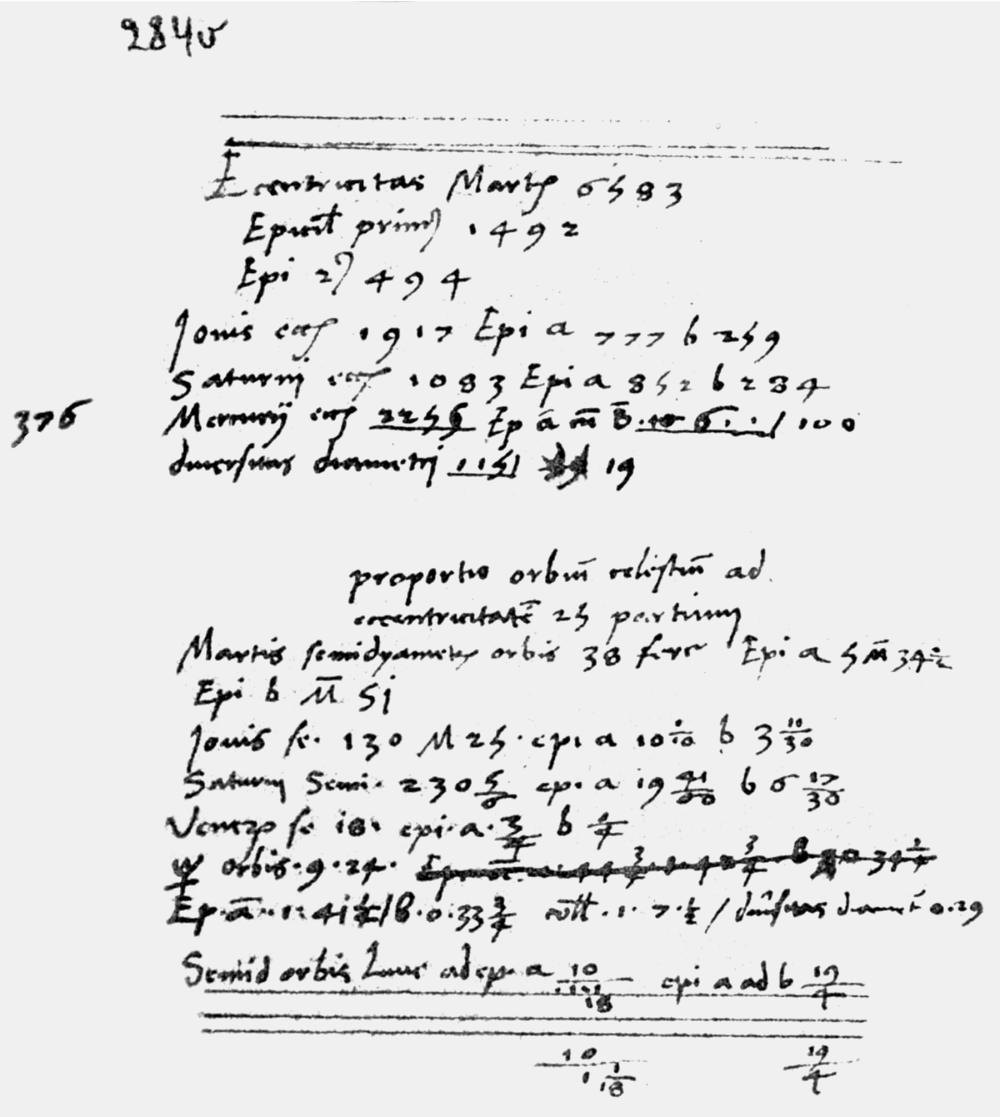
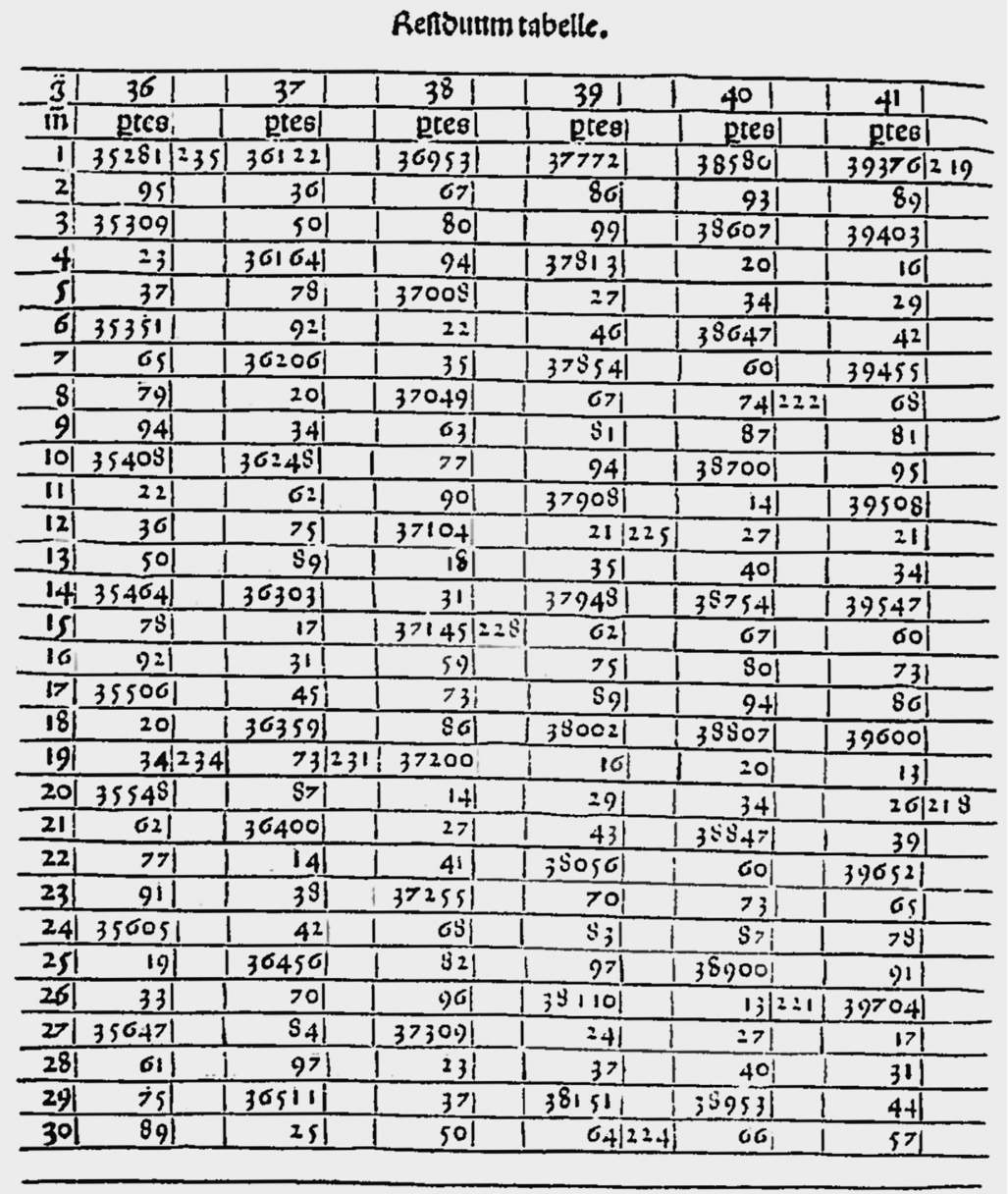
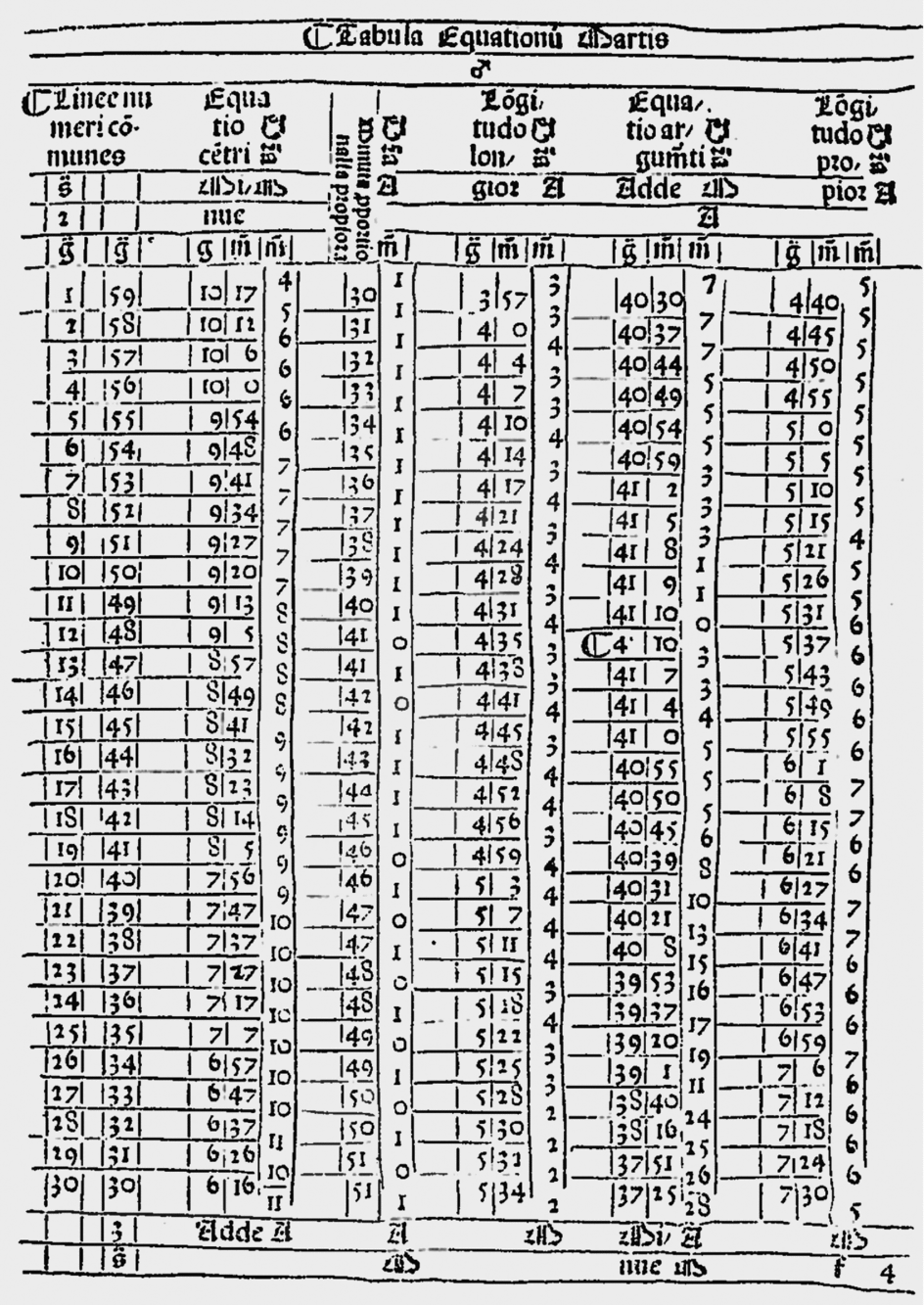
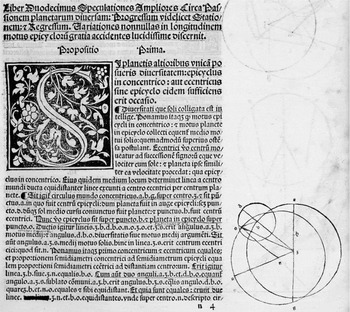
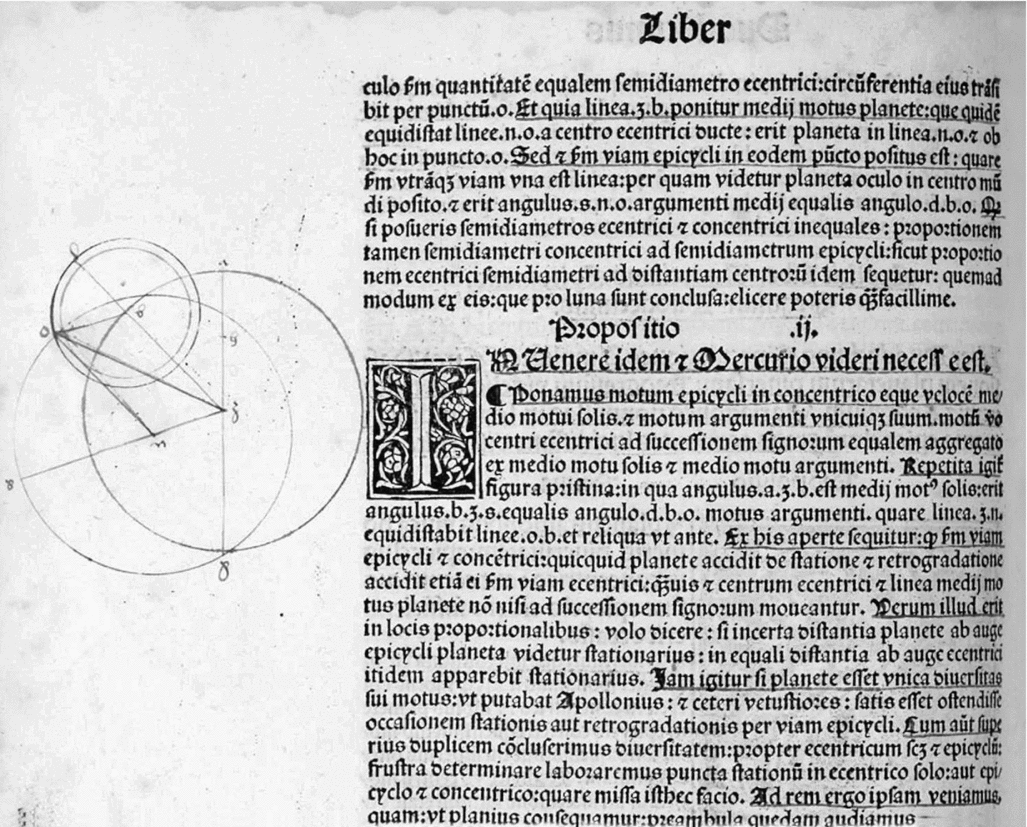
The numbers in the upper part of fol. 284v (see Plate 1) refer to the sine value of the maximum equations of the anomaly when the center of the epicycle is at mean distance from Earth, and are taken from the Alfonsine Tables (Swerdlow Reference Swerdlow1973, 471; see Plate 3) and from the Table of Sines in the Tabulae directionum of Copernicana 4 (see Plate 2). The numbers in the lower part were derived from those in the upper part, and they show their conversion to the parameters that Copernicus used in Commentariolus. The numbers in the upper part express the ratio between the radius of the epicycle to the deferent radius (the radius from Earth to the center of the epicycle), and when the center of the epicycle is at mean distance from Earth in Ptolemy's model and the deferent radius is equal to 10000, then the sine value of the angle for a given planet as measured from the center will be the radius of the epicycle and it will be equal to what Copernicus called the eccentricitas, the parallel line between the center of the world and the center of the eccentric (Swerdlow Reference Swerdlow1973, 472–473; Swerdlow Reference Swerdlow2017, 36–38; the line ‘Ʒn’ in Plate 4). According to Swerdlow (Reference Swerdlow1973, 471), the substitution of the eccentricitas for the epicycle radius refers to the eccentric model for the second anomaly, which Ptolemy discussed briefly in relation to the superior planets at the beginning of Almagest Book 12. Regiomontanus (1496, 12, 1–2) followed Ptolemy but also described an equivalent eccentric model for the inferior planets (see Plate 5). For example, the sine value for the Martian epicycle radius, equivalent to its eccentricitas, is 6583. To find what this number corresponds to in the Table of Sines from Copernicana 4, multiply 6583 x 6 = 39498, corresponding closely to 41° 10′ (Copernicana 4, Table of Sines, fol. 260v; see Plate 2), exactly the number for the mean distance of the epicycle in the equation of argument (Copernicana 4, Tabulae Alphonsae, fol. 81r; see Plate 3).Footnote 16 The upper part of the folio continues with the results calculated for a bi-epicyclic mechanism, and repeats the procedure for Jupiter and Saturn. Venus is missing from the upper part. For Mercury, Copernicus entered his calculation using the sexagesimal form 2256 (scaled to 6000), but added the decimal form 376 (scaled to 1000). I will consider some of the mistakes and cancellations later.
The original belongs to Uppsala University Library: Folio 284v from Copernicana 4. Uppsala University Library does not claim any copyright.

Copernicana 4, Uppsala University Library, Table of Sines, fol. 260v. The degrees are enumerated at the top (from 36 to 41), and the minutes along the left column. For 41° 10′, the sine value is 39495 parts. The original belongs to Uppsala University Library.

Copernicana 4, Uppsala University Library, Alfonsine Tables, fol. 81r. The first two columns are degrees, and the equation of argument for Mars with the epicycle at mean distance is given in column 6 as 41° 10′. The original belongs to Uppsala University Library.

Regiomontanus, Epytoma, fol. sig. n4, Book 12, Proposition 1. The center of the world is designated as ‘Ʒ‘’ in the center of the apsidal line with the letter ‘a’ at the top, and the letter ‘g’ at the bottom. The letter ‘s’ at the lower left of the eccentric circle centered on ‘n’ represents the direction of the mean Sun. The angle ‘aƷs’ is the mean motion of the Sun. The center of the epicycle ‘do’ is ‘b’. The epicycle radius ‘bo’ is parallel to the line from ‘Ʒ’ to the letter ‘n’, the center of the eccentric. So, epicycle radius ‘bo’ is parallel and equal to the line ‘Ʒn’, the eccentricitas. Folio available online at www.univie.ac.at/hwastro/books/1496_regioAlmg_BWMed.pdf.

Regiomontanus, Epytoma, fol. n4v, Book 12, Proposition 2. The application of the previous proposition to the inner planets. The figure on the left has been added by an annotator. In lines 4–5, Regiomontanus himself refers to the previous figure. The text indicates that the same figure can be used, but in this case the direction of the mean Sun will be from ‘Ʒ’ through the center of the epicycle ‘b’ to account for bounded elongation. The center of the eccentric ‘n’ moves through the sum of the mean motion of the Sun and the planet's mean anomaly.

The word eccentricitas led Swerdlow to the conclusion that Copernicus relied here on Regiomontanus's two propositions from the Epitome where he shows the equivalence between epicyclic and eccentric models (see Plates 4 and 5). This fact indicates that Copernicus began with geocentric models and parameters, from which Swerdlow inferred that Copernicus was still a geocentrist when he made these calculations. In comparing the deferent radius with planetary epicycle radii, Copernicus obtained his numbers from the mean distance of Ptolemy's epicycle from Earth. As we see above and will see further below, the numbers from U match Swerdlow's analysis and his citations from the Alfonsine Tables and the Table of Sines.
The system envisioned, then, is bi-epicyclic concentric around the mean Sun, the same system that Copernicus described in Commentariolus. It bears emphasizing that Copernicus provided no sketches or figures in either U or Commentariolus, or if he did make sketches, they have not been found. The figure as it appears in the 1496 edition (Plate 4) is what he would have seen.Footnote 17
I will elaborate on other details below, but for now the important point is that Swerdlow regarded the numbers in the upper part as a geocentric exploration of Regiomontanus's eccentric planetary models, which led Copernicus by way of rejecting a geo-heliocentric conversion (Swerdlow Reference Swerdlow1973, 474–478) to the heliocentric conversion and theory. Swerdlow's further inferences, arguments, and conclusions are subject to questions that I will pose after a brief look at Ragep's reconstruction.
Ragep (Reference Ragep2016) recently argued for another explanation of the origin of Copernicus's heliocentrism that belongs to the category of discovery by means of transformation of models.Footnote 18 Believing that Copernicus knew the models of Ibn al-Shatir and that Copernicus was influenced by homocentric ideas, Ragep re-interpreted U to accommodate a new narrative about the origin of Copernicus's discovery. Just as Swerdlow's interpretation hinges on the meaning of eccentricitas and its relation to the epicycle radii in the context of propositions from Ptolemy and Regiomontanus, Ragep's hinges on the interpretation of eccentricitas as the Earth-Sun distance in the upper part of U. In other words, the upper part is already heliocentric, and the lower part merely re-sets the Earth-Sun distance at a constant unit (25) and calculates the radii of planetary orbs accordingly.
Ragep is not the only historian to interpret the upper part of U in this way. Birkenmajer (Reference Birkenmajer1900, 202–207) took the numbers for the planets to represent the radius of the terrestrial orbit. In other words, Birkenmajer too assumed that the upper part of U was already heliocentric.Footnote 19
Ragep offers, in addition, an intriguing reconstruction based on Ibn al-Shatir's removal of eccentrics from his system and his use of epicycles to replicate Ptolemy's eccentricities (Ragep Reference Ragep2016, 396 and 408), and that seems to have been inspired in part by comments from Birkenmajer. There are, however, problems with the transformations for the inner planets, and the claim that Copernicus insisted on ‘homocentric deferents’ in Commentariolus. But by far the worst problem is Ragep's reading of U. Referring to the upper part of U, Ragep (403) takes eccentricitas literally to refer to the distance of Earth from the mean Sun, and conflates (n. 20) a comment by Swerdlow referring to the lower part of U to support his reading of the upper part. But the use of eccentricitas in the lower part clearly refers to the radius of Earth's orb centered on the mean Sun, while in the upper part Copernicus clearly refers to the eccentricitas of each planet, not the Earth-mean Sun distance. In other words, Ragep claims that the eccentricitas for each planet is the Earth-mean Sun distance and, hence, 10000 (or 1000 in the case of Mercury) is the eccentricitas for each planet. He maintains this in spite of the fact that U clearly designates the eccentricitas for Mars, for example, as 6583: “Eccentricitas Martis 6583” with the word ‘Mars’ in the genitive case clearly referring to “Eccentricitas.” Ragep acknowledges that Copernicus's parameters derive from the Alfonsine Tables, but it is painfully obvious that Ragep did not realize the extent to which all the tables in Copernicana 4 supplied the numbers for the upper part of U, and how they relate to epicycles and the equation of argument, thus confirming Swerdlow's interpretation.
Finally, Ragep's attribution of “homocentrism” or “quasi-homocentrism” to Copernicus is ambiguous, to say the least. It is true that Birkenmajer used the expression “homocentric,” but not in a technical sense. In discussing the Commentariolus, Birkenmajer refers to “concentric circles” and that Earth is exceptional in retaining an eccentric (Birkenmajer Reference Birkenmajer1900, 190–191; Goddu Reference Goddu2016, 241, n. 41 and 245–246).Footnote 20 Copernicus concluded early that a homocentric system could not account for the observations (Swerdlow Reference Swerdlow2017, 60). Furthermore, “homocentrism” clearly refers to a geocentric theory, and if Copernicus was motivated by problems with Ptolemy's equant model to reject geocentrism, then, surely, he never seriously considered “homocentrism” as a viable option. His questioning of equants, however, as Birkenmajer surmised, may have led him to question eccentrics as well.
To put the main point of this discussion in a basic way, under specified conditions the eccentric circle substitutes for the epicycle to reproduce the same observational results. What is odd about Copernicus's use of Regiomontanus's propositions is that he did not use them to substitute the eccentric for the epicycle, but rather used a bi-epicyclic mechanism as a substitute for the eccentric, proposing a concentric system centered on the mean Sun. Although Birkenmajer, to my knowledge, did not consider Copernicus's use of the propositions from Regiomontanus, he believed that Copernicus's objection to Ptolemy's equant model or the model for the lunar apogee led him also to object to eccentrics. This was Birkenmajer's insight, namely, if an equant model cannot correspond to the motion of an orb because it does not rotate uniformly relative to the center of the orb, then how can an eccentric correspond to the motion of an orb if its uniform motion is not relative to the center of the world? This reading could also suggest that Copernicus had already formulated his heliocentric hypothesis, and saw in Regiomontanus's propositions a way not to substitute eccentrics for epicycles but to substitute epicycles for eccentrics. In the upper part of U he began with the geocentric parameters of the superior planets, using the eccentricitas of each to calculate the numbers for the double-epicycle mechanism. As he turned to the inner planets, he may have already seen how he could use the eccentricitas of each to calculate the radii of the planetary orbs.
Swerdlow's critique (Reference Swerdlow2017) of Ragep is almost thoroughly convincing, but questions remain. A brief enumeration will suggest some logical problems with Swerdlow's further claims about Copernicus's path to heliocentrism.
I continue to doubt Copernicus's direct acquaintance with Maragha and other Islamic models, but, I also believe that he probably was acquainted with descriptions of those models.Footnote 21 If he relied on several accounts that discussed these problems, they might also explain the coincidences: the change in direction of the lunar apogee, objections to the solution for the first anomaly of the planets, the problem of the radius of Mercury's orb, and the generation of rectilinear motion by means of two circular motions. To construct his versions would have required some ingenuity on Copernicus's part, but in 1973 (469) Swerdlow seemed to think that Copernicus possessed the ability to carry out such an analysis.
Does not the bi-epicyclic mechanism in the upper part, however, indicate that Copernicus was considering a concentric arrangement, not one with two centers, thus excluding a geo-heliocentric arrangement? As he proceeded to the inner planets in the upper part, Copernicus seems to have been rushing, initially entering the number for Mercury from the Table of Sines (2256[0]) and subsequently normalizing it to 1000 (376), making some mistakes, and omitting the numbers and calculations for Venus. Could it be that while thinking about the numbers for the inner planets he was already anticipating a heliocentric transformation?
Swerdlow assumes that – because Regiomontanus himself shows the equivalence between the epicyclic and eccentric models, and because Copernicus begins with geocentric models and parameters – he was at that stage still a geocentrist. Curtis Wilson (Reference Wilson and Westman1975, 33–35) assumed that Copernicus would have seen in the geocentric models for the superior planets an incomplete solution to the problem of uniform motion, and in considering alternatives he would have seen both geocentric and heliocentric alternatives, and selected the heliocentric for reasons of simplicity and harmony. Wilson admitted forthrightly that his reconstruction was speculative.
There appear to me to be two logical flaws in Swerdlow's reasoning. First, Swerdlow assumes what needs to be proved. We have known at least since Kepler that Copernicus represented Ptolemy rather than nature, meaning that he transformed geocentric models into heliocentric ones, but that fact by itself does not prove that the models led him to the heliocentric theory. Swerdlow's belief about a geocentric stage is true if and only if Copernicus began with geocentric parameters and models because he was still a geocentricist. Swerdlow believes that the upper part is exclusively geocentric, but if Copernicus's intention was to transform geocentric models into heliocentric ones, then there is nothing odd or significant about his having started from Regiomontanus's propositions. According to Swerdlow, Copernicus discovered the heliocentric theory by relying on Regiomontanus's propositions, recognizing both a geo-heliocentric and heliocentric transformation, and selecting the heliocentric one because he saw or anticipated the problem with the intersection of the Martian and solar spheres. Swerdlow finds it impossible to believe that Copernicus would not have recognized the geo-heliocentric transformation.
Suppose, however, that Copernicus had already formulated a heliocentric hypothesis with Earth's annual motion around the Sun, and used the geocentric parameters and models because that was all he had to work with at the time, and he knew that he had to at least duplicate their results if he was to make progress over Ptolemy's models.
Second, Swerdlow's argument has the form of the post hoc, ergo propter hoc fallacy. The fact that the heliocentric transformation comes after seeing the equivalence between epicyclic and eccentric models in Regiomontanus's propositions does not prove that seeing those propositions caused Copernicus to see the geo-heliocentric and heliocentric transformations. Suppose, on the contrary, that Regiomontanus's propositions showed him a way to make the transformation after he had already interpreted the Earth-Sun distance as Earth's orbital radius, or had already formulated a hypothesis about Earth's annual motion.
Furthermore, Swerdlow argues that “if Copernicus had previously formulated the heliocentric theory, there would be no need to use the eccentric model at all, as he does in his notes” Swerdlow (Reference Swerdlow2017, 42). Swerdlow assumes that Copernicus would have seen as unnecessary what Swerdlow sees as unnecessary. It was, perhaps, not necessary from a mathematical point of view, but it may be that Regiomontanus's propositions showed Copernicus a way to make the transformation that matched his assumptions and critique. Here again, in short, Swerdlow assumes what needs to be proved, namely, that Copernicus himself would have seen either no need to use or no advantage in using Regiomontanus's propositions. The evidence suggests that he used the relation between the eccentric and epicycle models to propose a bi-epicyclic mechanism that substitutes for eccentrics and that replicates Ptolemy's eccentricities. In other words, his doubts about Ptolemy's equant provoked doubts about eccentrics, and he may have seen in Regiomontanus's propositions a way to substitute double-epicycle models for eccentrics.
The cancellations in the upper part of U suggest that Copernicus was making his first rough attempts, committing errors, and correcting them to the extent that he could. The absence of numbers for Venus in the upper part may have been the result of omission, meaning that he may have performed the calculations on a separate sheet, forgot to transfer them to U, but used them to generate the numbers for Venus in the lower part: 7190 x 6 = 43140 (Table of Sines, fol. 262r), corresponding approximately to 45° 58′, very close to 45° 59′ (Alfonsine Tables, fol. 73r). 7190 x 25 = 179750 ÷ 10000 = 17.98, or if he rounded off the number for Venus to 7200, then 7200 x 25 = 180000 ÷ 10000 = 18, the semidiameter for Venus in the lower part. To insert a point that I suggested above, suppose that as he reflected on the numbers for Mercury in the upper part, he realized that the sine function for Mercury's eccentricitas could be the radius of its orb, further suggesting that 10000 was not just the radius from the concentric's center to the center of the epicycle but could refer to the Sun-Earth distance with the orb for Mercury inside Earth's orb.
Earlier Swerdlow, in referring to Copernicus's possible objection to the intersection of the Martian and solar spheres, declared: “This last point, since there is no written evidence, is pure speculation” (Swerdlow Reference Swerdlow1973, 478). Over the years, however, he has convinced himself that it must be true. The belief that Copernicus even saw or anticipated an equivalent geo-heliocentric alternative is also speculative. If Regiomontanus failed to see or adopt the heliocentric transformation (Swerdlow Reference Swerdlow1973, 471–472 and 475–476, n. 8),Footnote 22 then why is it so difficult to believe that Copernicus passed over a geo-heliocentric transformation without comment, and one that did not agree with the concentric arrangement he was proposing? Alternatively, if Regiomontanus did see it but rejected it as contrary to physical theory, then why did Copernicus not reject it for the same reason, unless, of course, he had already adopted Earth's motions?
In either case, U represents his first efforts to transform geocentric parameters and Ptolemaic models into heliocentric ones. The first step was to work from a geocentrically-based consideration of parameters and models and from Regiomontanus's description of eccentric models of the second inequality, and use them in the second step to transform them into heliocentric ones. Just as nothing compels us to conclude that he was a heliocentrist only after the transformation, so nothing prevents us from concluding that he was a heliocentrist before he undertook that effort.
A secondary and significant piece of evidence is Kepler's testimony (Swerdlow, Reference Swerdlow2017, 42–43), an appeal to authority, and Kepler's authority must be taken seriously, yet Kepler does not offer evidence from Copernicus himself. Kepler's own context is relevant here. Notice that in the first quotation cited by Swerdlow, Kepler uses a conditional mood, “For if Copernicus had seen what Tycho (had seen) . . .” [emphasis added]. There is no evidence that Kepler knew U, so his remarks are an interpretation that serve to support his rejection of spheres and his inquiry about the forces moving the planets. It was also Kepler, a point rightly emphasized by Swerdlow (Reference Swerdlow1973, 486), who criticized Copernicus for having represented Ptolemy rather than nature. So, if Kepler had known U, he might have interpreted it either as Swerdlow does or as an explanation of the bi-epicylic mechanism. If we rely on Kepler, then the conclusion depends on which of Kepler's statements we choose, and so we are back to where we started. Swerdlow's interpretation, then, comes down to what he believes Copernicus must have known and must have seen, an argument that Swerdlow finds compelling but that many others continue to regard as speculative.Footnote 23
Swerdlow eliminates Ragep's alternative. Swerdlow's reconstruction is plausible, but remains speculative, yet he seems unwilling to acknowledge that anymore. The geometrical details, of course, are impressive, and it may be that Copernicus did follow the path proposed, but the reconstruction also tends to obscure the fact that we find none of this geometrical detail in Commentariolus itself.
Finally, to make my view clear, I do not assert with absolute certainty that Copernicus already formulated the heliocentric hypothesis before he began the calculations and transformation in U. Swerdlow's reconstruction is still possible, and its plausibility rests on the assumption that Copernicus thought he needed to use Regiomontanus's eccentric model, and on the likelihood that Copernicus would have recognized from a figure or model the geo-heliocentric arrangement. We have no direct testimony from Copernicus himself to support Swerdlow's assumption or his speculation. My suggestions agree with Copernicus's criticisms of Ptolemy's solution for the first anomaly, and they also explain his initial decision to conceive a bi-epicyclic, concentric system centered on the mean Sun. In short, I do argue for the greater probability of my chronology and reconstruction over Swerdlow's.
As I argued elsewhere (Goddu Reference Goddu2016), Birkenmajer's insights deserve respectful consideration, especially regarding Copernicus's doubts (or confusions) about equants, eccentrics, and epicycles in his first heliocentric system. Naturally, Swerdlow's explanation requires careful consideration, and the authority of his reconstruction has perhaps earned for his account the presumption of truth. But, for all that, questions with alternative narratives and explanations persist (Wilson Reference Wilson and Westman1975; Chen-Morris and Feldhay Reference Chen-Morris and Feldhay2017, 113–114; Shank Reference Shank2017b, 106–107, and 243, n. 11).
6. Birkenmajer's Interpretation Qualified and Corrected
We all know that Copernicus failed to achieve a revolution in astronomy. That achievement is properly and correctly assigned to Kepler. Copernicus, however, did initiate a revolution in cosmology, but that means that his contribution was to develop and formulate concepts of modern cosmology within the conceptual framework of pre-modern cosmology, which either did not possess those concepts or rejected some of them as physically impossible. To account, then, for Copernicus's conceptual change, Birkenmajer emphasized his recognition of problems with and inconsistencies in the existing conceptual systems. That was Birkenmajer's contribution, although Birkenmajer himself tended to assimilate Kepler's achievement to Copernicus's, and he accordingly exaggerated Copernicus's departures from Ptolemy. It is likewise not clear that Birkenmajer recognized the retention of spheres in the Copernican system. Birkenmajer may have been misled by the kinematic models in De revolutionibus, and/or he may have interpreted Copernicus's theory as agnostic on the existence of spheres, especially partial spheres (Albertus de Brudzewo Reference Birkenmajer1900, 22–27; Copernic Reference Copernic2015, 1: 295–303; 3: 85–86, 154–156; Lerner Reference Lerner2008, 2: 3–4 and 67–73). In fact, when we consider the approximations to circular motion and to uniform motion in Copernicus's planetary models, it seems that the Copernican system tolerated a degree of slippage, if you will. Copernicus resigned himself to allowing the kinematic models to approximate a heliocentric physical system. In other words, his system retained residues of the incoherence of Ptolemaic geocentrism. Again, it is not clear that Birkenmajer recognized or wanted to recognize the limited success of Copernicus's reformation of ancient astronomy.
If the exaggerations and anachronistic features in Birkenmajer's account are removed, we are left with Copernicus's critique of Ptolemaic astronomy, which Copernicus himself stressed and which Rheticus confirmed (Rheticus Reference Rheticus2015, [Section 8] fol. sig. Ciiir-Civv).Footnote 24
Copernicus's retention of the axiom of uniform, circular motion (a pre-modern concept) and his critique of what he perceived as an inconsistency in Ptolemy's preservation of that axiom motivated him, first, to seek an alternative solution, and, second, to question eccentrics. In the process of evaluating eccentrics, he also began, third, to investigate epicycles, and in this stage Copernicus became suspicious of Ptolemy's huge epicycles as an explanation of variations in distance. In his first version, as we know, he minimized the eccentrics, proposing concentric models centered on the mean Sun with a thoroughly bi-epicyclic mechanism (except for Earth), perhaps suggested by the solution of the lunar prosneusis problem, which with Earth in motion annually also entailed a reduction in the size of epicycles. Later, with eccentrics fully restored, he could reduce the epicycles even further in a heliostatic, approximately heliocentric, system. From an ancient cosmological concept, Copernicus developed and formulated a new cosmological concept.Footnote 25
The earliest testimony that we possess about Copernicus's reasoning is contained in Commentariolus, but that too has generated no consensus. The French editors (Copernic Reference Copernic2015, I: 235–237) criticize Noel Swerdlow for denying the coherence and logically deductive connections among the postulates of Commentariolus, and me (I: 235, n. 1) for agreeing with him. They then list the postulates in order, claiming that each proceeds from the one preceding it (I: 235: “un enchaînement logique dans la succession des petitiones du Commentariolus”). They fail to explain, however, what they mean by ‘logical’. How does the second postulate (Earth is not the center of the universe but only the center towards which heavy bodies fall and the center of the Moon) follow from the first, which contains no premise about heavy bodies or the Moon?
And, even if the first clause alone of the second postulate follows from the first, how does the third (the center of the universe is near the Sun) follow from the first two? If anything, the third appears to contradict the first and the second. What saves it from being a contradiction? The addition of facts not asserted in the first two, namely, that the motions of all celestial spheres are connected with the Sun, and Moon and Earth share a sphere.Footnote 26
The fourth (the Earth-Sun distance is so small in comparison with the distance of both from the fixed stars that Sun and Earth are as a single point) adds an additional fact not mentioned in the first three, so how can it follow from them?
The fifth (Earth's daily axial rotation) does seem to follow from the fourth, but again introduces a new fact not mentioned in the first four, the observation of daily motion, and it depends on the principle of relative motion, also not mentioned previously, so the fifth cannot be deduced from the fourth logically.Footnote 27
The sixth (Earth moves around the Sun, and therefore has two motions) relies on the second, third, fourth, and fifth to draw its conclusion, but it too appeals silently to the principle of relative motion, never mentioned explicitly among the previous postulates.
The seventh (the explanation of retrograde motion) does follow from the sixth, but also adds an observational fact not mentioned before, and, finally, brings us back to the problem of observed non-uniformities not all of which are specified in the previous postulates. In fact, the final postulate returns us to the sentences preceding the postulates, which provide the motivation behind the entire exercise, the explanation of apparent non-uniformities all based on the assumption that celestial motions are circular and uniform, also not listed as an axiom or postulate. The entire list has no chance of compelling assent without articulating, first, the assumption about uniform, circular motions and the principle of the relativity of motion, and, second, without the enumeration of further consequences, such as a unique principle for ordering the celestial spheres.
There is a connection between the postulates; it is not a logically deductive one, but logical in a dialectical fashion. If that is what the French editors meant by “un enchaînement logique dans la succession des petitiones du Commentariolus” (with emphasis on ‘succession’), then we are in agreement about the postulates. The sentences just before the postulates set out the principal condition that a true theory of the cosmos must meet. To satisfy that condition Copernicus must propose an astronomical system that will be adequate if it can, not just account for the observed motions, but also explain them. The most important condition of a true theory is that it satisfy the principle of perfect motion. An astronomical system that can explain the observed irregularities in accordance with the first condition may be considered adequate. The postulates are answers to questions about hypotheses; they arrange the hypotheses in a binary, either/or form, and adduce (sometimes silently) additional facts not mentioned in the previous postulates.
Relying on Birkenmajer's emphasis on Copernicus's critique of Ptolemy, the process of dialectical questioning that reflects Copernicus's own argumentative strategies, and an annotation by Copernicus in Marsilio Ficino's translation of Plato's Parmenides, I reframe the petitiones or questions and answers (sometimes framed as rhetorical questions) that he posed in the following way, and all intended to lead us to an explanation of the observed irregular motions of the celestial spheres (Copernicus Reference Copernicus and Dobrzycki2007, 10–11; Goddu Reference Goddu2004; Goddu Reference Goddu2010, 227–228, 243–257, and 285–291):
1. Do the celestial spheres have one center or many centers? If many (Postulate 1), then
2. Earth cannot be the center of the universe but only of gravity and of the lunar sphere (Postulate 2).
3. Why are the models for all planetary spheres related to the position of the Sun? If their motions are relative to the Sun, then let us suppose that the planetary spheres encircle the Sun approximately in the middle of their motions (Postulate 3).
4. If Earth's distance from the Sun is very small in comparison with the Sun's distance from the stars, then could we perceive Earth's motion relative to the Sun or the stars? (Postulate 4).
5. If not, then which motions are merely apparent and possibly due to Earth's motions, and which are the proper motions of the spheres? Do the stars and the entire universe rotate once a day around Earth east to west, or does Earth rotate on its axis west to east? (Postulate 5).
6. Does the Sun move around Earth once a year, or does Earth with its sphere move around the Sun as all the other planets do, thus moving with more than one motion? (Postulate 6).
7. Do the planets really move backwards and then forwards, or does Earth's annual motion account for these and other apparent irregularities? (Postulate 7).
The conclusions that natural philosophers reach about the immobility of Earth rest on appearances here on Earth, but Earth's immobility is itself an appearance (Copernicus's version of the principle of the relativity of motion). When confronted with two appearances that contradict one another, by what principles, standard, or criterion shall we remove the contradiction? Shall we begin with a stationary Earth that inevitably generates an uncertain and arbitrary arrangement of the spheres of Venus and Mercury, or begin with a vision of the whole cosmos that settles and determines the positions of the planets uniquely? Copernicus concluded that geocentrism led to the violation of uniform motion relative to the deferent center and epicycle center, did not lead to consensus on the ordering of the planets, and accounted for irregularities in motion and variations in distance by resorting to large epicycles and motions of spheres that were uniform but not relative to the centers of their spheres. By means of the seven postulates, Copernicus claimed that he could account for every apparent irregularity while keeping everything moving uniformly, and that the hypotheses about Earth's motions are part of the solution. As is clear later from his own words in De revolutionibus III, 20 and V, 4, Copernicus rather solved the problem of uniform motion approximately and, in his own view, more adequately than his geocentric predecessors had. Medieval developments in dialectical argumentation influenced him to depart from ancient and medieval conceptions in cosmography or what would later be called cosmology (Goddu Reference Goddu1996). Above all, by means of the postulates and the whole/part topos, from an integral whole, he could determine the order of the spheres between the fixed stars at the periphery and the stationary Sun near the center uniquely according to sidereal periods with the Moon going around Earth between the spheres of Mars and Venus (Goddu Reference Goddu2009).Footnote 28 He could claim, as Rheticus did, that he had established a perpetual and consistent connection and harmony of celestial phenomena where the order and motions of heavenly spheres agree in an absolute system (Rheticus Reference Rheticus2015, fol. sig. Civr).Footnote 29
For these reasons, it seems to me that Birkenmajer was right to take Copernicus at his word about Ptolemy's solution to the problems of uniform motion, and that the hypotheses about Earth's motions were part of the solution. He was also right to believe that Copernicus would have regarded equivalent geocentric versions as incapable of generating a uniquely ordered system of heavenly spheres.
Acknowledgments
My thanks to Jarosław Włodarczyk of the Polish Academy of Sciences and to Robert Szaj of the Nicholas Copernicus Foundation for invitations to give lectures on Birkenmajer, on which this essay is based. My thanks as well to two anonymous referees for their corrections and constructive criticisms.