INTRODUCTION
Recent work in sociolinguistics has highlighted the important role that phonetic iconicity (or sound symbolism) plays in governing patterns of linguistic variation (e.g. Podesva Reference Podesva2013; Eckert Reference Eckert2017; Pratt Reference Pratt2018; Esposito Reference Esposito2020). A subset of this work has shown how such phonetic features can become iconic of forms of embodiment through ideologies that sounds and bodies share some inherent quality (e.g. Mendoza-Denton & Jannedy Reference Mendoza-Denton and Jannedy2011; Podesva Reference Podesva2018; Pratt Reference Pratt2018; Calder Reference Calder2019). These semiotic links then become available for recruitment in stylistic practice. While much of this research has centered around the visual import of embodied practices like gesture (e.g. Mendoza-Denton & Jannedy Reference Mendoza-Denton and Jannedy2011), posture (e.g. Pratt Reference Pratt2018), and material aesthetics (Eckert Reference Eckert2000; Calder Reference Calder2019), we show that ideologies surrounding the body’s physical potential provide a site for new, meaningful iconic links with linguistic features to be forged. Our sociophonetic analysis of the linguistic styles of bodybuilding and yoga instructors on YouTube shows that bodybuilding instructors employ higher pitch (F0) and faster articulation rates than yoga instructors. Metapragmatic commentary on these phonetic features suggests that they are iconically linked with notions of embodied energy, which we define as ideologies of the level of bodily vigor. We suggest that each sport’s instructors deploy these links differentially as they invoke the characterological figures of the high-energy bodybuilder and the calm yoga practitioner, matching the energy of their speech to the energy typifying these characterological figures and their respective activities.
Iconicity and variation
As we just noted, phonetic iconicity is linked to patterns of meaningful stylistic variation. Eckert's (Reference Eckert2010) ethnographic study of pre-adolescent children in San Jose, California revealed vocalic variation rooted in iconic affective display. Elementary school girls stylistically employed the F2 dimension of the /o/ and /ay/ vowels to index affect: high F2 values indexed positive evaluative affect, and low F2 values indexed negative evaluative affect. Eckert suggested that these patterns can be explained by Ohala's frequency code (Reference Ohala, Hinton, Nichols and Ohala1994), which describes the sociobiological link between sound frequency and size (high with small, low with large). The girls may be drawing on fronter vocalic productions (i.e. higher frequency productions) to signal positive meanings because of sound symbolic associations between smallness and positive things (see Hamano Reference Hamano, Hinton, Nichols and Ohala1994 and Silverstein Reference Silverstein, Hinton, Nichols and Ohala1994 for more on these links). Linguistic features have also been said to be linked to iconic meanings through the phonetic processes of fortition/lenition (Eckert Reference Eckert2008). Calder's (Reference Calder2019) work on San Francisco drag queens showed the formation of iconic links between /s/ intensity and qualic notions of harshness and sharpness. The drag queens’ fortition of /s/ over the course of their drag transformations projects affective fierceness vis-à-vis iconic associations between loud frication and sensual intensity.
In addition to features at the segmental level, research has shown that phonation type (e.g. Irvine Reference Irvine1989; Mendoza-Denton Reference Mendoza-Denton2011; Podesva Reference Podesva2013, Reference Podesva2018; Levon Reference Levon, Levon and Mendes2016; Jeong Reference Jeong, Zirker, Bauer, Fischer and Ljungberg2017; Pratt Reference Pratt2017) is also well-suited to take on iconic meaning because it seems to reveal speakers’ emotional states (Eckert Reference Eckert2019).Footnote 1 Zimman (Reference Zimman2017b) and Podesva (Reference Podesva2018) have suggested that creaky voice is connected to disengaged stances and negative evaluative affect, and Zimman has linked creak's low acoustic energy and tendency to have low F0 values to negative affective meanings through iconic ties. Taken together, these studies show that the iconic links between a range of phonetic features and their social meanings are robust, and such meanings underlie patterns of linguistic variation. But it is important to point out that the way that iconic linguistic features map on to perceived natural and nonarbitrary meanings is a completely ideological and social process (Irvine Reference Irvine, Eckert and Rickford2001; Gal Reference Gal2013). Speakers pick out qualities believed to be shared by a linguistic feature and its social image, and iconic links are thus a wholly ideological project.
Embodiment and style
As is clear from the preceding discussion, much of the work on iconicity in variation highlights connections between affect and phonetics. And perhaps because affective expression is inherently embodied (Reeser & Gottzén Reference Reeser and Gottzén2018), a growing body of work is also beginning to explore how patterns of phonetic variation connect iconically to embodied forms. Mendoza-Denton & Jannedy (Reference Mendoza-Denton and Jannedy2011), for instance, showed that pitch accents co-occur temporally with a number of hand gestures, a finding that highlights the ideological mapping of linguistic and bodily prominence. Pratt (Reference Pratt2018) identified correlations between postural stillness and creaky voice among high schoolers in a San Francisco arts high school, suggesting that speakers may ideologically link creak's acoustic energy with the low physical energy associated with minimal postural transitions to index a ‘chill’ stance. And Podesva, Callier, Voigt, & Jurafsky (Reference Podesva, Callier, Voigt and Jurafsky2015) found a correlation between smiling and GOAT vowel fronting, which illustrates that the tendency for high F2 values to be linked to positive things (Silverstein Reference Silverstein, Hinton, Nichols and Ohala1994) may be further mapped to the bodily expression of this positivity: smiling.
But the theoretical import of these studies extends beyond their empirical identification of correlations between embodied and linguistic phenomena. They reaffirm that linguistic features and bodily practices are employed together as semiotic resources in the projection of social meaning. Following Eckert (Reference Eckert2012), we assume that social meaning is constructed though stylistic practice, and that stylistic practice is a process of bricolage (Lévi-Strauss Reference Lévi-Strauss1962; Hebdige Reference Hebdige1979), whereby speakers strategically select a cluster of resources and combine them into a cogent stylistic whole. These resources can be linguistic, but also, as the aforementioned studies show, embodied, and also material (e.g. Eckert Reference Eckert1989, Reference Eckert2000). Thus the meaning of linguistic styles (and individual linguistic features) cannot be divorced from the broader semiotic spaces they occur in or their context of use. Eckert's (Reference Eckert1989, Reference Eckert2000) ethnographic work in a Detroit high school showed that teenagers’ styles are constructed not only through variation in the local vowel system but also through the kinds of clothes they wear; both of these modalities are intertwined with group identity. As Bucholtz & Hall (Reference Bucholtz, Hall and Coupland2016) argue, such findings show that there is really no difference between linguistic and embodied (or material) resources insofar as their semiotic potential is concerned. Both sets of resources are always available for ideological (re)interpretation because of the nature of socio-indexical meaning (Silverstein Reference Silverstein2003), and thus individuals will draw upon them in tandem to project semiotically laden and coherent stylistic amalgamations.
Precisely how the meanings of linguistic and other semiotic resources in a style cohere to form a composite stylistic meaning is an open area of research. That is, is stylistic meaning calculated compositionally? Or do the meanings of some variables take precedence over others? Bucholtz & Hall (Reference Bucholtz, Hall and Coupland2016:180) have gone so far as to argue that embodied semiotic resources give meaning to linguistic variables, rather than the reverse, and so it is really the embodied variables that carry the semiotic weight. Whether this claim holds in all cases is an empirical question, but we certainly see this dynamic at play in Pratt’s (Reference Pratt2018) work. Creaky voice has been linked to a range of different meanings, including intimacy, disengagement, boredom, and so on (see Podesva & Callier Reference Podesva and Callier2015 for a review), but what imbues it with the ‘chill’ meaning that Pratt (Reference Pratt2018) argues for is the postural stillness of the body and the ideologies of what postural stillness means (e.g. not energetic, but relaxed and cool). In this way it is bodily hexis (an embodied practice), the ideologies that surround this practice, and no doubt the material aesthetics, like clothing choice and color, of the ‘chill’ group of students that instill creak with its precise meaning.
Our study offers another example of how ideologies surrounding embodied practices get iconically mapped onto linguistic features, imbuing them with social meaning. But while much past work on embodiment in sociolinguistics has tended to focus on the ideological import of visual and aesthetic bodily practices, little work has investigated how the body’s potential to be an active, physical force semiotically connects to linguistic features. For instance, the collection of studies on variation and embodiment in particular have explored bodily adornment (e.g. Eckert Reference Eckert1989, Reference Eckert2000; Calder Reference Calder2019), gesture (e.g. Mendoza-Denton & Jannedy Reference Mendoza-Denton and Jannedy2011; Duncan Reference Duncan2019), bodily positioning (e.g. Podesva et al. Reference Podesva, Callier, Voigt and Jurafsky2015; Voigt, Eckert, Jurafsky, & Podesva Reference Voigt, Eckert, Jurafsky and Podesva2016; Podesva Reference Podesva2018; Pratt Reference Pratt2018), jaw setting (Pratt & D’Onofrio Reference Pratt and D'Onofrio2017; Pratt Reference Pratt2019), and expression (e.g. Podesva Reference Podesva2018). But the body is more than a stylistic and visual resource, and it is physically capable of movements beyond flicks of the wrist and postural transitions. It does things. What kinds of ideologies surround the body as a mover and doer of things, and as a force with physical potential? And do these ideologies imbue linguistic features with meaning through iconic linkages, making them semiotically available as resources in stylistic practice? We address these questions through a sociophonetic analysis of the styles of physical fitness instructors on YouTube.
LANGUAGE, SPORT, AND CHARACTEROLOGICAL FIGURES
The social interplay of language and physical fitness (or sports) activities is understudied in sociolinguistics, but what is clear is that these activities, just like language and visual aspects of the body, are embedded in a web of social practices inextricably bound up in individual identities (e.g. Wheaton Reference Wheaton2004; Madsen Reference Madsen2015; Wilson Reference Wilson2017; Caldwell, Walsh, Vine, & Jureidini Reference Caldwell, Walsh, Vine and Jureidini2018). In reference to physical leisure activities in particular—such as surfing, rock climbing, snowboarding, and skateboarding—Lewis (Reference Lewis2004:71–72) has noted, ‘Leisure studies… can tell us a great deal about our fears and aspirations… even the sort of person we would like to be’. Indeed, people participate in both linguistic and physical practices in order to project meaningful and aspirational versions of the self. Just as a speaker might be a pervasive user of creaky voice in order to present themselves as ‘cool’ or ‘chill’ (Pratt Reference Pratt2018), they might also surf because of the ‘laid-back’ quality that the activity is semiotically imbued with. Wheaton (Reference Wheaton2004) classifies physical practices like surfing, rock climbing, weight lifting, and yoga as ‘lifestyle sports’ because of the style of life that practitioners attribute to them. People participate in these sports because of what the lifestyles associated with them, and the activities themselves, mean. Wheaton has noted in her own work on lifestyle sports that ‘participants sought out a lifestyle that was distinctive, often alternative, and gave them a particular and exclusive social identity’ (Reference Wheaton2004:4). It's clear that fitness activities, and the lifestyles they are embedded in, can index social meaning by virtue of the ideologies that surround the bodies engaged in them. And thus the body, in providing the physical access point to engage in these activities, might be viewed as their ideological core.
With these ideas in mind, for this linguistic analysis we selected two fitness activities that carry ideologically opposed orientations to the body: bodybuilding and yoga. We expected that these oppositions would help us identify potential stylistic differences most clearly, because as Irvine (Reference Irvine, Eckert and Rickford2001) has suggested, styles acquire meaning by contrasting with other styles. In bodybuilding, the body is ideologically believed to be a fast, aggressive force that engages in intense repetitions of resistance training exercises, while in yoga, the body is seen as slow and fluid, engaged in stretching and postural exercises. The goal in bodybuilding is primarily aesthetic, aiming to enhance the lean musculature of the body (Emery Reference Emery2014). Yoga is practiced to reap the benefits of ‘reduced stress, and increased relaxation and greater flexibility’ (Surrenda Reference Surrenda2012). The differences between the activities in terms of embodiment and purpose contribute to differences in the ideological energetic styles that the activities are imbued with. In popular conception, yoga is seen as ‘relaxing’ and ‘calming’,’while bodybuilding is viewed as ‘exhausting’ and ‘intense’. Illustrations of these ideologies are widespread, with popular internet memes pointing to these meanings. Memes are media pieces that circulate in online social spheres and are prime encapsulations of social ideology. As examples, Figure 1 contains two memes centered around body building, and Figure 2 contains two memes focused on yoga.Footnote 2 The bodybuilding memes emphasize the extremeness and intensity of the energy exertion required to participate in the activity. Conversely, the yoga memes focus on the calmness the activity is supposed to promote for the individual, and as the meme furthest right shows, the lack of energy exertion associated with the activity.
Bodybuilding memes.

Yoga memes.

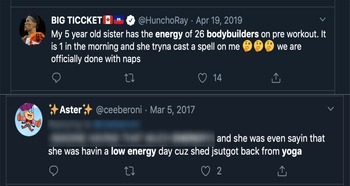
The dichotomy that these two activities represent in terms of energy and intensity levels is clear: high energy and intensity (extreme exertion) vs. low energy and intensity (minimal exertion). Bodybuilding is ideologically viewed as ‘intense’ because it is assumed to demand extreme exertion and high physical energy levels. Yoga, by contrast, is ideologically seen as ‘calming’ because it is assumed to demand minimal exertion and low physical energy levels. We thus suggest that energy-related ideologies are one kind of ideology that surround the body's physical potential. Such ideologies are not only present in illustrative cultural products, like memes, but also in discussion about these activities, as shown by the tweets in Figure 3. Shared on the social media platform Twitter, the tweets contain comments related to bodybuilding and yoga that convey similar ideological ties to energy.
Tweets about bodybuilding and yoga, in relation to energy levels.

But it is important to note that while we have been primarily focusing on ideologies surrounding the body and the activities themselves, these ideologies cannot be separated from the individual practitioners themselves. Just as one might not expect a 100 year old man to be a bodybuilder, because of the assumed decrease in energy and strength that accompanies old age, it is also difficult to imagine a six year old with the mental and physical restraint needed to participate in yoga. There are ideologies of the particular kinds of people who engage in bodybuilding and yoga, and so the qualities of high/low energy and intensity feed into, and are derived from, these ideologies as well. Thus, it is not just that bodybuilding and yoga as activities are distinguishable by energy, but that the practitioners and their bodies are as well. We might even suggest that the socially reified conceptualizations of bodybuilding and yoga practitioners are the primary source of the meanings attributed to the activities.
Indeed, the memes and tweets shown in Figures 1–3, in addition to revealing the energy-related meanings linked to the activities and their practitioners, suggest that the high-energy bodybuilder and low-energy yoga practitioner are characterological figures. For Agha (Reference Agha2007:177), a characterological figure is an ‘image of personhood that is performable through a semiotic display or enactment’. The bodybuilding memes perform the figure of ‘bodybuilder’ through muscles, tight clothing that exposes these muscles, scowling facial expressions, and lexical content parodying the kinds of things a bodybuilder might be expected to say. The yoga memes perform ‘yoga practitioner’ through particular poses, relaxation paraphernalia (e.g. candles, incense), and lexical content (i.e. namaste, a greeting sometimes uttered at the beginning of yoga classes).
Speakers orient to characterological figures in stylistic practice, deploying semiotic resources associated with them and combining these resources with meaningful resources from other sources to construct related, but ultimately new, styles (e.g. Zhang Reference Zhang2005). In this article, we argue that bodybuilders and yoga instructors do not just reproduce the characterological figures that exist in social ideology (i.e. those shown in the memes and tweets above), but create qualitatively distinct styles: the high-energy bodybuilder and the calm yoga instructor. As we suggest in the upcoming pages, our findings reveal how energy-related meanings are a new kind of social meaning that is constructed iconically through associations between the body’s physical capacity and linguistic forms. These meanings play a role in the social reification of characterological figures and processes of enregisterment (Agha Reference Agha2007), and they can structure group-level stylistic practice more broadly.
THE STUDY
As noted, this article explores semiotic and iconic connections between the body as a physical doer and sociolinguistic variables. We investigate if and how speakers draw on these connections in the construction of linguistic styles. This analysis focuses on two groups of fitness instructors, bodybuilders and yoga practitioners, and quantitatively compares their use of two phonetic features, articulation rate and vocal pitch. The data for the analysis comes from videos made by the instructors and uploaded to YouTube, a popular American video-sharing platform.
The data
YouTube is a useful source of data for researchers because it provides free and easy access to audio-visual media shared by creators and consumed by followers and fans. YouTube’s popularity can be attributed to its widespread circulation of social ideology (Aslan & Vásquez Reference Aslan and Vásquez2018). We expected that ideologies of what it means to be a bodybuilder and yoga practitioner to be especially pervasive in these videos and become part and parcel of the practitioners’ styles, amplifying any differences between them. To ensure that we were analyzing the speech of bodybuilders and yoga practitioners who were fully and socially entrenched in the bodybuilding and yoga lifestyles, and hence more likely to inject the meaning of this lifestyle into their linguistic styles, our sample consists of bodybuilding and yoga instructors. We expected instructors to be most dedicated to their activities and thus have the desire to present themselves as archetypal participants.
We created a corpus of bodybuilding and yoga instructional videos and filtered these videos by removing those with physical demonstrations, background music, and poor sound quality, since all of these factors could interfere with acoustic measurements. Due to the well-attested role of topic on patterns of stylistic variation (e.g. Rickford & McNair-Knox Reference Rickford, McNair-Knox, Biber and Finegan1994), we also restricted the analysis to a genre of video called ‘tips and tricks’. Videos of this genre were created by the widest selection of instructors. Additional genres (e.g. personal life, goal setting, diet, the ‘science’ behind muscle growth, clothing style, etc.) were not included because these were limited to one or two instructors, and it was thus not possible to construct a balanced sample from them. Finally, we limited our sample to those instructors who (perceptually) were speakers of Mainstream North American English.
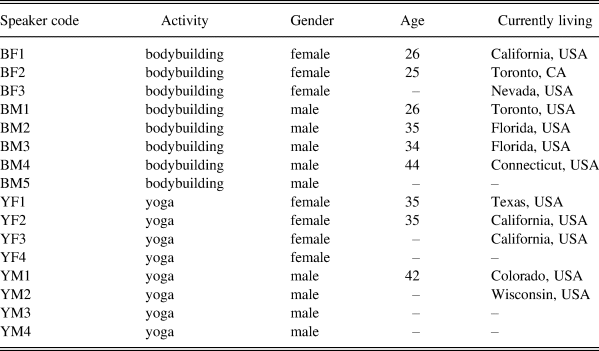
The exclusion criteria trimmed our corpus to sixteen videos from sixteen different instructors (one for each instructor). While we acknowledge the relatively small size of the sample, it became clear from numerous additional searches that it was exhaustive of the two instructor communities on YouTube at the time of data collection. Of the sixteen speakers, eight were bodybuilders and eight were yoga instructors. The gender/activity distribution is shown in Table 1. Speakers were racialized as white by the authors. We were unable to identify the places of birth or current residences for many of the instructors, but include this information in Table 1 where it was available.
Speaker demographic information (– denotes unavailable information).

Our interest in the ideological connection between phonetic features and the body as a physical doer limited our linguistic analysis to the level of sound. At the same time, however, we were cognizant of the potential for regional effects on the instructors’ phonetic patterns because they were not limited to a single geographic locale. Vocalic features, which tend to vary as a function of dialect region in the US, could thus not be considered. In the process of gathering the data and listening for usable sound quality, two features revealed themselves to be potentially relevant stylistic features: articulation rate (number of syllables/phonation time) and pitch (F0). These were also features we expected all instructors to have the potential to manipulate equally successfully in stylistic practice, regardless of their regional origins (more on this in the sections that follow). We sought to answer the following question: Do bodybuilding and yoga instructors differ in their use of articulation rate and pitch?
Articulation rate
Articulation rate captures the number of syllables spoken over a given voiced duration and differs from speech rate in that it excludes pauses. The social potential of articulation rate has been documented primarily in studies aiming to uncover its macro-social patterning. Jacewicz, Fox, O’Neill, & Salmons (Reference Jacewicz, Fox, O'Neill and Salmons2009) investigated effects of region and gender on articulation rate, finding that (i) speakers from North Carolina speak slower than those from Wisconsin, and (ii) women tend to speak slower than men. Other studies have not identified regional and gender variation. Clopper & Smiljanic (Reference Clopper and Smiljanic2011) find no significant speaking rate differences between Southern and Midland speakers and also no gender differences. Kendall (Reference Kendall2009) also finds no regional differences in articulation rate, but does find differences for gender and ethnicity, such that women tend to speak slower than men, and speakers of Lumbee ethnicity speak slower than White, African American, and Latinx speakers. Since most studies have failed to uncover regionally based variation in articulation rate, and because our speakers are balanced for region in gender and activity categories, we did not expect region to present a confounding variable in the analysis.
Crucially for our study, articulation rate has also been shown to be a powerful stylistic resource in the projection of situational and locally based social meanings. Kendall & Wolfram (Reference Kendall and Wolfram2009) find differences in articulation rate for the Roanoke Island Dare County commissioner between sociolinguistic interview speech and a public address. They suggest that the slower speech employed during the public address may constitute a more planned, steady, and formal style than that of the sociolinguistic interview speech. Pratt (Reference Pratt2018) also highlights the stylistic potential of articulation rate in her work in an arts high school, showing that students who are energetic and affectively engaged tend to draw on faster articulation rates than those who are ‘chill’.
Pitch (F0)
Sociophonetic research on pitch has primarily centered on its connections to gender and sexuality-based meanings. Much of this work has connected higher pitch to notions of femininity and male gayness in both perception (Gaudio Reference Gaudio1994; Levon Reference Levon2006; Campbell-Kibler Reference Campbell-Kibler2011) and production (specifically, F0 or fundamental frequency) (Podesva Reference Podesva2007; Levon Reference Levon2009), but pitch has also been shown to be a stylistic resource for cis female (e.g. Levon Reference Levon2011), nonbinary (e.g. Gratton Reference Gratton2017), and trans (e.g. Zimman Reference Zimman2017a) speakers in production. The prevalent gendering of pitch has been linked to the frequency code (Ohala Reference Ohala, Hinton, Nichols and Ohala1994), the association of high pitch with smallness and low pitch with largeness. That women tend to have smaller vocal tracts, bodies, and higher pitch than men underlies ideologies that higher pitch has as its core meaning smallness, while lower pitch becomes linked to largeness. Further ideological construals reinterpret the small/large meanings as feminine/masculine, gay/straight (for men), and so on through fractal recursivity (Irvine & Gal Reference Irvine, Gal and Kroskrity2000). Such gendered meaning potentials make it a feature of particular interest for the present study, given the stereotypically gendered practice of bodybuilding and yoga in the West. Bodybuilding is seen as ‘masculine’ and is predominantly practiced by men, while yoga is believed to be ‘feminine’ and has a largely female base (Tilin Reference Tilin2007). As we show in the coming pages, however, F0 is employed by the bodybuilding and yoga instructors in a surprising way against the backdrop of these stereotypes.
Methods
The sixteen videos were converted from .mp4 to .wav format, transcribed with ELAN (version 5.2), and force-aligned with the Montreal Forced Aligner (McAuliffe, Socolof, Mihuc, Wagner, & Sonderegger Reference McAuliffe, Socolof, Mihuc, Wagner and Sonderegger2017) using the DARLA web interface (Reddy & Stanford Reference Reddy and Stanford2015). Videos ranged from four to seven minutes in length. It was not possible to combine multiple videos for each instructor since most only had a single video that met our criteria. Four to seven minutes is nonetheless sufficient for prosodic analyses, where measurements can be extracted for each utterance, as we do here (cf. Calder & Popova Reference Calder and Popova2013; Voigt, Podesva, & Jurafsky Reference Voigt, Podesva and Jurafsky2014). This duration is also a good reflection of the typical duration of speech for the genre we are analyzing: YouTube instructional videos. The force-aligned audio and TextGrids output from DARLA were automatically segmented into utterances using Voigt and colleagues’ (Reference Voigt, Podesva and Jurafsky2014) Praat script. Utterances were defined as continuous stretches of speech surrounded by silent pauses (i.e. ‘phonetic utterances’: Kendall Reference Kendall2009:51). We define silent pauses as those greater than 200 milliseconds, following Campione & Véronis (Reference Campione, Véronis, Bel and Marlien2002). The automatic segmentation of utterances was hand-checked to ensure accuracy on behalf of the Praat script. For each of the 1,607 utterances, syllables were segmented and counted manually, since not every syllable in the orthographic transcription and alignment was present in the acoustic signal. As previously mentioned, the analysis presented here focuses on two linguistic features: articulation rate and pitch (more specifically, F0, the acoustic correlate of pitch). Articulation rate was calculated at the level of the utterance and is captured by the number of syllables divided by the duration (in seconds) of the utterance, following Kendall (Reference Kendall2009). Utterance durations and manually labeled syllable counts were extracted for each utterance with a Praat script. A second Praat script measured and extracted mean F0, maximum F0, minimum F0, F0 range, and F0 slope for each utterance,Footnote 3 although we focus on mean F0 here.Footnote 4 Pitch tracks were inspected visually to ensure accurate measures. For male speakers, the Praat pitch settings were set to 75–300 Hz, and for female speakers, the settings were set to 100–425 Hz.
Statistical analysis
Two mixed-effects linear regression models were constructed using the lme4 R package (Bates, Maechler, Bolker, & Walker Reference Bates, Maechler, Bolker and Walker2015) and the lmerTest R package for p-values (Kuznetsova, Brockhoff, & Christensen Reference Kuznetsova, Brockhoff and Christensen2017) to test the effects of activity on mean F0 and articulation rate. Fixed effects in all models were gender, activity (bodybuilding or yoga), and their interaction, and the dependent variable was the measure of interest. For the articulation rate model, we also included the fixed effect of number of syllables per utterance, since longer utterances tend to have faster articulation rates (Kendall Reference Kendall2009). All models also included by-speaker and by-utterance random intercepts.
Results
Our examination of the variable use of prosody by bodybuilding and yoga instructors found that both articulation rate and mean F0 form important points of difference between the two groups.
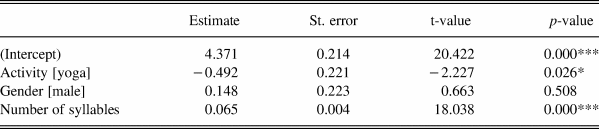
First, we found that bodybuilding instructors speak with a faster articulation rate than yoga instructors (p < 0.05*), as shown in Table 2. On average, the bodybuilders employed 0.5 more syllables per second than their yoga counterparts. While small, this amounts to roughly one additional sentence per minute. While gender was included in the model, it had no effect on articulation rate, and an interaction between gender and activity did not improve the regression model. The overall number of syllables in the utterance was also a predictor of articulation rate, such that more syllables in an utterance contributes to faster articulation rates (p < 0.001***), which we predicted given prior research (e.g. Kendall Reference Kendall2009).
Mixed-effects linear regression modeling of articulation rate. Response variable = syllables/sec, calculated for each utterance (N = 1,607).

Second, we examined the variation in mean F0 in the sample, results for which are shown in Table 3. Here, we found that the bodybuilding instructors, regardless of gender, speak with a higher mean F0 than yoga instructors (p < 0.05*). This increase, on average, was about 24 Hz. We also found, as might be expected, that the women in the sample also speak with a higher F0 than men (p < 0.001***), about 59 Hz. Again, an interaction between gender and activity was not significant and did not improve the regression model, so it is was not included in the final model.
Mixed-effects linear regression modeling of mean pitch (F0). Response variable = Mean F0 (Hz), extracted from each utterance (N = 1,607).

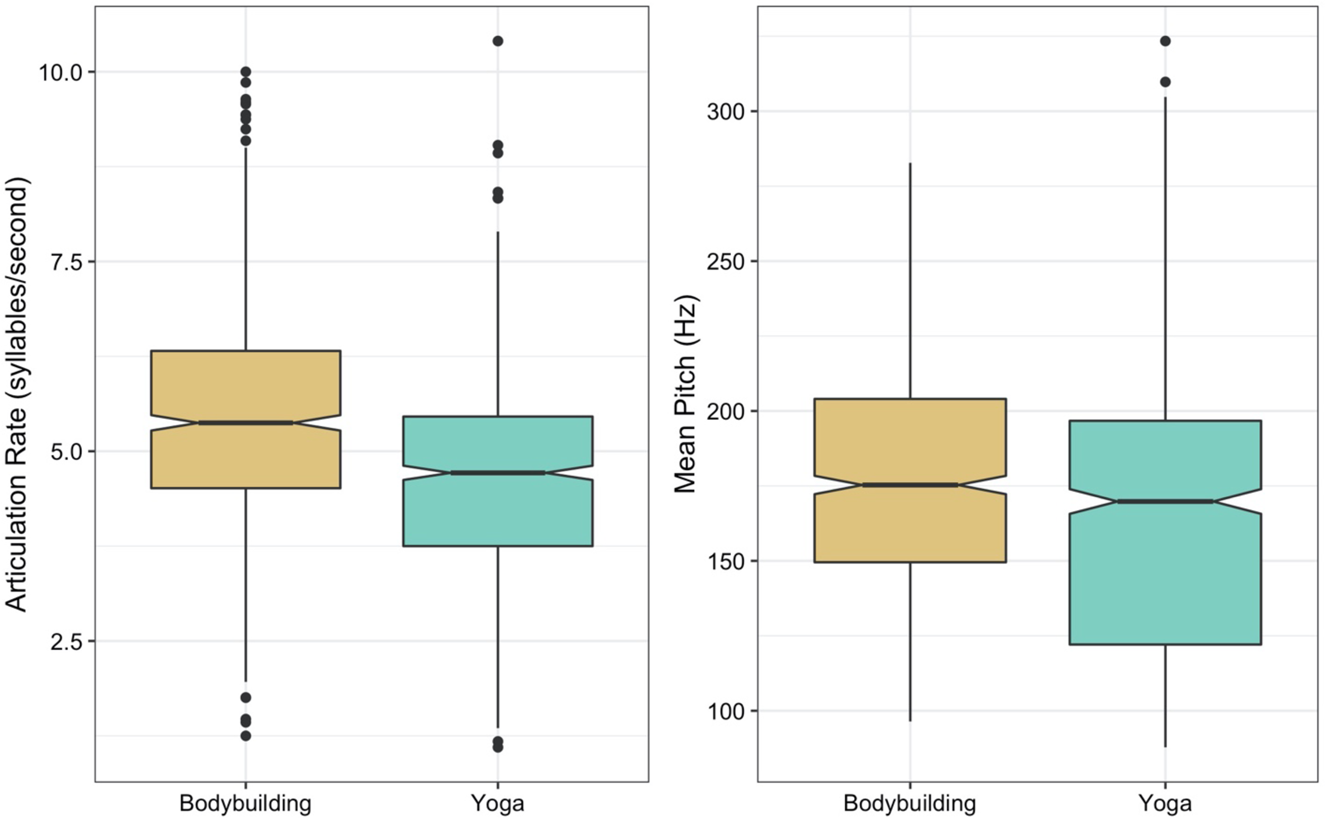
We thus found that bodybuilding instructors employ higher mean F0 and faster articulation rate than yoga instructors.Footnote 5 Importantly, these differences between the two activities hold regardless of speaker gender. These results are visualized in Figures 4–6. Figure 4 shows mean F0 and articulation rate by activity.
Articulation rate and mean pitch (F0) by activity.

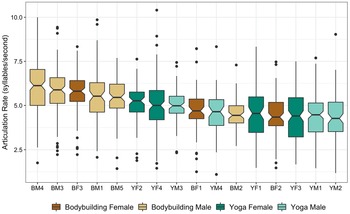
While the model emphasizes differences between the groups, we also want to note some intra-group variation. Remember, however, that this within group variation is accounted for within the model. Figure 5 shows a by-speaker plot of articulation rate, with the fastest-talking speakers on the left of the cline and the slowest-talking speakers on the right. As we can see, speakers from the two activities are not wholly grouped together, but nonetheless maintain the discovered pattern, with the five fastest-talking speakers being bodybuilders, and the three slowest-talking speakers being yoga instructors.
Articulation rate by activity and gender.

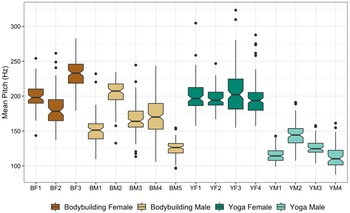
Similarly, we see intra-group variation with regard to F0 in Figure 6, a by-speaker plot of mean F0. For ease of reading, we have instead organized this plot by gender and activity, allowing a clearer understanding of the variation, or lack there-of, within each activity/gender group. While we make no claims with regards to the patterning of this intra-gender group variation, we can see that there is a notable consistency within, and divide between, the F0 values of the female and male yoga speakers. Comparatively, the female and male bodybuilders show what seems to be greater variability between speakers and a less distinct divide between the gender groups. While interesting to note, we focus primarily on the activity-based variation in the discussion, as this is where the statistical significance lies.
Mean pitch (F0) by activity and gender.

These results have shown that bodybuilding and yoga instructors differed in their use of mean F0 and articulation rate. In the discussion that follows, we suggest that these differences are stylistically meaningful, and the instructors employ these features variably to access different semiotic values.
THE MEANINGS OF ARTICULATION RATE AND PITCH
A primary ideological difference between bodybuilding and yoga as physical activities is the level of embodied energy that each is ideologically assumed to require: bodybuilding requires extreme exertion, and yoga minimal; the characterological figures of the bodybuilder and yoga practitioner are thus, also, differentiated by the same division in energy levels. The memes and tweets presented in the introduction suggest that this energy-based ideology circulates semiotic space widely for the activities and their practitioners. In this section, we consider metapragmatic discourses surrounding the variable use of articulation rate and pitch. As we show, both of these linguistic features are also connected to embodied energy levels through iconic links.
Regarding articulation rate, Toastmasters International (Reference International2011:12) notes the following in one of their brochures: ‘If you are a high-energy person, you probably will not be able to permanently slow down your rate of speech’. A self-help book for personal professionalization in the workplace makes a similar claim: ‘How rapidly or slowly you speak… reveals if you are high energy (fast talker) or lower energy (slow talker)’ (Reiman Reference Reiman2010). Such metapragmatic commentary suggests that the link between high-energy people and fast articulation rate (and low- energy people and slow articulation) is believed to be a natural one, biologically or emotionally motivated at its core, and uncontrollable, as if articulation rates mapped on to heart rates. This link likely derives in part from associations between fast articulation rate and excitement or nervousness (Peterson Reference Peterson2019), two emotional states linked to fast heart rates, which in turn arise from energy boosts driven by rushes of adrenaline. In other words, adrenaline rushes (i.e. energy boosts) seem to be matched to ‘rushes’ in the speech stream. Given these connections, we suggest that the link between articulation rate and embodied energy is forged through iconic associations between linguistic and bodily forms. Assumptions that people who use fast or slow articulation rates are inherently high or low energy suggest that this link is rhematized (Gal Reference Gal2013; Calder Reference Calder2019): the semiotic process by which linguistic features are bound to social meanings and groups through some quality they are believed to share.Footnote 6
Just as articulation rate has widely circulating ideological ties to energy-related meanings, vocal pitch does too. For example, a well-known online pop science website includes an article that claims that ‘high voices tend to communicate high energy’ (Wong Reference Wong2017). Twitter users also reference this ideology, with one noting ‘Everybody has that higher-pitch-high-energy voice they use with babies and puppies’ (@StarSumiaki 2016). Both of these examples show that pitch is also ideologically linked to energy, with higher pitch being associated with higher energy meanings. And as with articulation rate, we suggest that the link between pitch and energy is iconically forged. Sociopsychological work has shown that speakers associate high pitch with emotional states like anger, fear, and happiness in both production and perception (Pell & Kotz Reference Pell and Kotz2011). These emotions express different things, but what unites them is the high energy and intensity with which they are ideologically characterizable, especially in relation to sadness, boredom, and contentedness, which are seen as lower intensity states (Seppala Reference Seppala2017). Speakers thus iconically map the high acoustic frequency of high pitch voices to heightened emotions, making connections between a linguistic feature and embodied states that share a heightened and excessive quality—a kind of moreness. The assumed intrinsic nature of these connections allows for the formation of a rhematized link between high pitch and heightened emotional states. And these emotional states thus mediate the broader connection of pitch to notions of energy.
While we have seen that pitch and articulation rate are both independently linked to ideological notions of embodied energy, linguistic features take on their social values in concert with other linguistic features and are thus not stable across styles (Eckert Reference Eckert2008; Campbell-Kibler Reference Campbell-Kibler2011). Thus, it is important to also consider how the meanings of articulation rate and pitch interact. Metapragmatic commentary from a blog post by a voice coach and from a self-help website show how pitch and articulation rate function together. Consider the following excerpts.
Elevated pitch, or a voice that is ‘too high’, is a common complaint for both male and female clients. Why is the pitch high and what can be done about it? Why is it an issue? The high pitch is sometimes accompanied by a fast rate of speech. That last fact indicates difficulty balancing a need to have more ‘energy’ with a need to come across as grounded and confident. Projecting more energy too often gets translated into ‘louder, higher, and faster’. (Steck Reference Steck2017)
You may find that your voice is low and slow when you're speaking to yourself, but with your friends it rises because they increase your energy levels. (Edwards Reference Edwardsn.d.)
These excerpts show that pitch and articulation widely circulate as a stylistic cluster that can iconically signal different levels of embodied energy. And indeed, the fact that this cluster has received such metapragmatic attention suggests that articulation rate and pitch are enregistered as parts of energy-based styles (Agha Reference Agha2007). Enregisterment refers to the process by which semiotic resources, such as linguistic features, become widely attributed to contextually defined ways of speaking. High pitch and fast articulation rate are thus enregistered as components of a high-energy style, and low pitch and slow articulation rate are enregistered as components of a low-energy style.
We return to enregisterment shortly, but first, it is important to unpack the notion of ‘energy’ that we have been discussing thus far and that has emerged in the preceding metapragmatic discourse. That is, what exactly does it mean to be a high/low-energy person, and for fast articulation rate and high pitch to index ‘high-energy’ meanings? Some of the discourse surrounding the meanings of the linguistic features points to emotional and affective dimensions, with notions of energy being related to the assumed intensity of certain embodied affective states (excitement, fear, happiness). But to be a high-energy person is not only to be affectively high energy, and the memes and tweets presented earlier make this clear. Bodybuilders are assumed to be higher energy than yoga practitioners, and this has more to do with the high level of energy needed for extreme physical exertion. Thus ideologies of energy refer to at least two types: that which is more explicitly affective, and that which is more explicitly physical. But this is not to say that these two types are unconnected. Affect is itself inherently embodied expression (Reeser & Gottzén Reference Reeser and Gottzén2018). What connects both types ideologically then is the body, and perhaps more explicitly, bodily vigor. This vigor can be more clearly affective or emotional, as in the facial exuberance one might display when they are excited, or more explicitly physical, as with extreme physical exertion that comes along with weightlifting. Because it is not clear to us that the linguistic features signal only one of the notions of energy and not the other precisely because of these ideological imbrications, in the discussion that follows, we suggest that instructors ultimately index this more general notion of different levels of bodily vigor (encompassing both kinds of energy) through their use of mean F0 and articulation rate.
The stylistic use of pitch and articulation rate
Enregistered linguistic varieties are available as semiotic material for speakers to draw on in stylistic practice because of their wide social circulation (e.g. Zhang Reference Zhang2005; Johnstone Reference Johnstone2016; Pratt & D’Onofrio Reference Pratt and D'Onofrio2017). Given our claim that pitch and articulation rate are enregistered as components of energetic styles, we argue that the two groups of instructors exploit these features variably to access the contrasting semiotic values associated with these styles. The bodybuilding instructors employ faster articulation rates and higher mean pitch to index a high-energy style as a way of invoking the high-energy and intense exertion of the body when weightlifting. In contrast, the yoga instructors use slower articulation rates and lower pitch to match the calmness and slow pace of the body in yoga, thereby indexing a lower energy style. In this way the instructors draw ideological connections between the ‘energy’ that is indexed by pitch and articulation rate, and the energy associated with the body in bodybuilding and yoga. It is not surprising that the instructors differ in the use of two linguistic features that semiotically encapsulate the core ideological difference between their activities: the degree of embodied energy. It is in this way that they present themselves as embodied representations of their respective activities.
It is also important to note that in embodying the energy of their activities, they also inevitably embody the characterological figures of the stereotypical bodybuilder and yoga practitioner associated with them; the activities would not be imbued with energy-based meanings if the bodies of social actors, who themselves are also distinguished by their energy levels, did not participate in them. But this is not to say that the YouTube instructors are simply presenting themselves as the stereotypical bodybuilder and yoga practitioner. Numerous parodic performances on YouTube depict the stereotypical bodybuilder with low pitch and perceptually average-to-slow articulation rates. The yoga practitioner performances on the other hand employ perceptually high pitch. Asking lay people to perform figures of the bodybuilder and yoga instructor yields the same linguistic patterns as the videos, and Twitter is ripe with explicit discussion about bodybuilders and their ‘deep’ voices and yoga practitioners with their ‘high, soft’ voices. While the metapragmatic commentary we have presented previously shows that pitch and articulation rate are enregistered as indexing energy-based meanings, and the figures of the bodybuilder and yoga practitioner are also distinguished by their differential energy levels, the linguistic features do not seem to be enregistered to the characterological figures in the way we might predict. What this suggests is that the instructors included in the sample here are constructing new styles, rooted in the characterological figures depicted in the memes and tweets, but ultimately their own. By picking out a quality that characterizes their activities at their ideological core (notions of energy), they draw on linguistic features that index the same or ideological similar qualities to emphasize this quality further. Thus we might say that, as opposed to a stereotypical bodybuilder, the instructors here present themselves more specifically as ‘high-energy bodybuilding instructors’ and conversely, the yoga instructors project ‘low energy’ or ‘calm yoga instructors’.
These styles may be especially useful given the instructors’ status as YouTube contributors. For some YouTube contributors, posting videos is a primary source of income. More subscribers means more money, and gaining more subscribers is achieved by appealing to a wide audience. A way to attract more viewers is to style the self as the archetypal participant, and employing pitch and articulation rate differentially allows the instructors to do this perhaps even more successfully than performances of the typical bodybuilding and yoga figures would. Interestingly, an online yoga journal not only notes the importance of speaking in a particular way as an instructor, but it provides explicit support for our claims that instructors match the energy of their speech to the energy of their activities: ‘Your voice creates and transmits the energy of your practice. And when your sound is relaxed and rooted in your body, it helps your students feel at ease and grounded, too’ (Ginty Reference Ginty2017, emphasis added).
ENERGY IN STYLE
In the discussion above, we have described the meaning of the linguistic variation patterns observed among the instructors. In what follows, we discuss what these findings, and the argument just presented, bring to bear theoretically on concepts in sociolinguistics that we have discussed thus far: style and variation, embodiment, iconicity and rhematization, enregisterment, and the frequency code.
It is well known that patterns of variation correlate with macro-demographic categories, like gender, age, and class, and with more local categories, like ‘Vineyarder’ (Labov Reference Labov1969). But when we find group patterns, what do they actually mean? Eckert (Reference Eckert2012:93) has noted that linguistic variables ‘do not index categories, but characteristics’, which underscores the growing evidence that speakers do not only (or ever) use linguistic features to signal membership in a particular group, but rather qualities associated with a particular group or interactional function. Because a great deal of variationist work in the US focuses on vowels, the meanings that underlie group variation patterns (when they are probed) are often tied to different kinds of locality (e.g. Becker Reference Becker2014; D’Onofrio & Benheim Reference D'Onofrio and Benheim2020). But studies examining a wider range of linguistic features and how they are tied to group status are beginning to show that the range of meanings can be far broader, encompassing, for example, personality traits (Moore & Podesva Reference Moore and Podesva2009) and affective displays (Pratt Reference Pratt2018; Esposito Reference Esposito2020). The present study illuminates a new variety of meaning that can attach to linguistic features: one linked to embodied energy. While certainly close to affect, the meanings of high and low energy are intimately connected to the physically active capacity of the body and are thus qualitatively distinct in their stylistic potential. This point is important, because it suggests that ideologies of the body as a physical force may structure group-level sociolinguistic variation. Even more broadly, because these energy-related meanings are iconically forged, it becomes clear that iconic meanings, rather than purely indexical ones, as we often see with regional variables (e.g. Zhang Reference Zhang2005; Becker Reference Becker2014), may also mediate group variation.
Crucially, notions of energy enter the stylistic realm in part because of their ideological role in defining characterological figures. While characterological figures discussed in current sociolinguistic work have been shown to be emblematic of demographic categories like class (e.g. D’Onofrio Reference D'Onofrio2015; Johnstone Reference Johnstone2016; Slobe Reference Slobe2018), region (e.g. Zhang Reference Zhang2005; Becker Reference Becker2014; Pratt & D’Onofrio Reference Pratt and D'Onofrio2017), sexuality (Podesva Reference Podesva2007, Reference Podesva2011; Campbell-Kibler Reference Campbell-Kibler2011), and ethnicity (e.g. Mendoza-Denton Reference Mendoza-Denton2011), the high-energy bodybuilder and low-energy yoga practitioner are defined by their orientations to bodily energy, as we have discussed previously. So while bodybuilders might be typically said to be white and male, and yoga practitioners are white, female, and middle to upper-middle class, their ideological cores rest in their unique orientations to the body and embodied energy. This observation allows us to expand the concept of characterological figures, showing that they may be socially constructed through ideologies not only rooted in sociological categories, but physically embodied qualities.
Further, as we have seen, embodied energy meanings attach not only to characterological figures, but also to linguistic features. We have argued that the links between pitch and articulation rate and differential energy levels are forged iconically by the ideologies of the physicality of the body; assumptions that these links are inherent to these bodies suggests that they are rhematized. We also argued that the metapragmatic discourse surrounding the use of these features shows that they are enregistered as components of energy-based styles. Together, these points suggest that iconicity and rhematization can play a role in the process of enregisterment through the ideological mediation of the body. Most sociolinguistic research has focused on the enregisterment of linguistic forms associated with localities (Johnstone Reference Johnstone2016), but enregistered varieties can in theory be associated with a far wider range of contextual variation. Thus, this study not only shows that enregisterment can reify styles rooted in the energetic capacity of the body, but that iconicity and rhematization may assist in the enregisterment process vis-à-vis the construction of form-meaning links assumed to be intrinsic. It may be that assumptions that the links are natural gives them particular social currency, allowing them to circulate widely and become socially reified.
While this is an empirical matter, it appears to at least be the case that the meanings of certain iconic features like pitch and articulation rate circulate quite widely. The instructors come from different parts of North America, and presumably participate in different communities of practice in real life, but nonetheless pattern together in the use of the features. Past work further supports their wide circulation. Pratt (Reference Pratt2018), for instance, identified a qualitative cline in the use of articulation rate by teenagers in a California high school, whereby the students who identified as ‘chill’ tended to use slower articulation rates than those who identified as ‘loud’, mirroring our energy-based results here. And Irvine’s (Reference Irvine1989) work on Wolof showed that the griots (bards) are associated with a liveliness and excitement, and their speech is also characterized by high pitch and fast articulation rates. The circulation of similar cross-linguistic ideologies is understudied, but it may be a fruitful endeavor, particularly for those features that are iconically linked to the body—a physicality central to all humans.
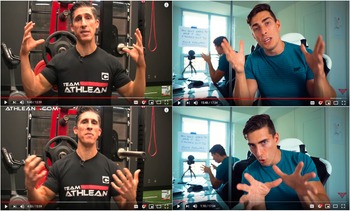
But this of course is not to say that the meanings of pitch and articulation rate are universal. Our finding that higher pitch is employed by the bodybuilders seems to challenge the frequency code (i.e. higher pitch indexes ‘smallness’). It is certainly not the case that the bodybuilders sound smaller or more feminine than the yoga instructors, and it also seems unlikely that they would project themselves as ‘small’ when the goal of bodybuilding is quite literally to make oneself bigger. Despite claims of its innateness (e.g. Ohala Reference Ohala, Hinton, Nichols and Ohala1994), the meaning of pitch is contextually mediated, just as is that of any other linguistic feature. The bodybuilders are able to successfully project themselves as high energy through the stylistic combination of pitch, fast articulation rate, the lexical content of their talk, and the strategic use of tight clothing to display their muscles, for instance. Perceptually, the bodybuilders also speak with higher intensity levels.Footnote 7 And although our main goal in this article is not to provide a quantitative or interactional analysis of embodied practice itself, the bodybuilders qualitatively appear to employ both exaggerated and faster gestures (a few examples are shown in Figure 7), which in concert with the other resources just mentioned, assist in the construction of the high-energy bodybuilding instructor style. It is the bigness, loudness, and intensity that these features index together that specifies the meaning of pitch in this context.
Snapshots of bodybuilders’ use of gesture.

CONCLUDING REMARKS
As Bucholtz & Hall (Reference Bucholtz, Hall and Coupland2016) note, a unified theoretical account of the relation between language and embodiment is lacking. The present article certainly cannot offer such a far-reaching account, but we nonetheless hope that the data and discussion we have offered will further our understanding of the connections between the body, phonetic variation, and iconicity.
While most research on embodiment and variation has focused on the visual import of embodied practices and their role in stylistic practice, our work has shown that the dynamic and physically active nature of the body is another site for the generation of social meaning. Indeed, meaning is not only derived from how the body is adorned (e.g. Calder Reference Calder2019), or positioned (Pratt Reference Pratt2018), but also by its potential for physical activity and the ways in which it participates in these activities, much of which is iconically linked to the type of energy that the body is believed to be imbued with. As we have shown, energy can be evaluated as a social attribute, and it thus becomes available as a socially meaningful resource for stylistic purposes, shaping group-level patterns of variation. While we have focused on the particular meanings of high and low energy, what other kinds of energy-related meanings are there? How are they connected to the body, how might they be employed stylistically, and are they also iconically constructed? These are all questions we hope future work will probe, and they are ones that we believe are crucially relevant for theorizations of linguistic variation and embodied practice more broadly.