Introduction
In America today, Elihu Yale (1649–1721) is primarily remembered as the man who gave his name and a relatively substantial gift of money, books, and art to a struggling school in New Haven, Connecticut, which was then renamed in his honor. While Yale did posthumously donate some books, paintings, and money to Connecticut College, the goods he gave in his will represented a small fraction of Yale’s net worth and a tiny portion of his collection of paintings. Indeed, a gift of three paintings from a collection surpassing ten thousand objects at the time of his death hardly seems extravagant on Yale’s side, although it was a boon to the College. Far more of his fortune was dispersed through auction sales and was the subject of a protracted probate battle carried on by his widow, Catherine Hymers Yale. One of the men soliciting Yale on behalf of Connecticut College even remarked ‘Mr. Yale has done something [for the College], tho very little considering his Estate’.Footnote 1 Nevertheless, although Yale’s original contribution to Connecticut College may have been small relative to his personal wealth, the role he played in stabilizing the institution expanded through history. As this article argues, object-actors helped to write that story.
Importantly, this posthumous donation, however one values it, resulted from a passing acquaintance between Yale and the minister Cotton Mather, a preacher in his hometown of New Haven. Mather wrote to ask Yale to help out the new and struggling Connecticut College, arguing that his donation to the college would prompt its renaming in his honor, which would be ‘better than a name of sons or daughters’.Footnote 2 Perhaps this opportunity to make his name in the town from which his parents had fled when he was a child fostered Yale’s donation to Connecticut College, but neither by size nor perceived significance (this is not an event mentioned in his epitaph nor commemorated by any portrait during his life) did this particular set of objects seem to mean a great deal to Elihu Yale. Indeed, his main objective in deeding some objects and £500 to Connecticut College may have had more to do with his interest in promoting Anglicanism in the colonies than any permanent memorial to himself. Conversely, Yale University now remembers Yale’s gift by a variety of means ranging from the student nickname ‘Eli’ to the continuous collecting of artefacts related to Yale.
During his lifetime, Yale was chiefly known for his role as Governor of the East India Company (EIC) in Madras (now Chennai), India, and for his extensive collecting activities. Indeed, one contemporary described him in London as sitting ‘in his choultry hid in tobacco smoak [sic] … a scurvy painter or two drawing him in for some choice pieces in which he is become a very great virtuoso or a bubble’.Footnote 3 In other words, in this man’s view, Yale was more of a wide-ranging than a discriminating collector. Artefacts that passed through his hands, ranging from ‘oriental’ tapestries to important books by leading thinkers of his day, help to illuminate a globe-spanning network with Yale at its centre. Objects, or material traces that mark Yale’s circulation in the world, are now found on at least three of the four continents on which he set foot.
During and well after Yale’s life, his acquisitions coalesced and were dispersed to form a global network in which art objects functioned and continue to function as actors, in Latour’s sense of ‘the moving target of a vast array of entities swarming toward it’.Footnote 4 Objects, then, become intermediaries in the networks described by Latour.Footnote 5 The lives of these non-human objects constellate into a network of identities, relationships, and meanings that mediate who ‘Elihu Yale’ was and is in various locations across the globe. With a wide-ranging and globally dispersed network of objects, Yale is an especially useful case study for how object-actors work and generate meaning in four dimensions: distance, location, relation, and time. Through time, object-actors associated with Yale demonstrate what Jane Bennet has called ‘Thing-Power: the curious ability of inanimate things to animate, to act, and to produce effects dramatic and subtle’.Footnote 6
In an essay on the complexities of locating identity for a transatlantic actor such as Yale, Rajani Sudan proposes that Yale was himself an intermediary (or an object-actor) much like the sought-after nutmeg and the other commodities that flowed through his hands as an EIC factor and a collector.Footnote 7 If we think of Yale himself as a commodity, as Sudan suggests, he is as consumable and ephemeral as any other perishable good, and his networks must therefore die with him. In examining object-actors through time, it is more useful to think of Yale as a time-bound origination point setting into motion network pathways through which object-actors move. In doing so, we allow for a four-dimensional network that includes time as well as place. If we use the idea of Elihu Yale as a central node, we can trace out networks of meaning from his era to the present day in ways that help us understand how object-actors carry and change meaning through time. Indeed we can see how weak ties, or object-actors, moving through time as well as space, function as makers of meaning, or how things have ‘the curious ability … to animate, to act’.Footnote 8
In America and in Britain, objects build up Yale’s posthumous reputation as the founder of Yale University, as they do Yale University’s pedigree as a centre of learning established by a distinguished, socially prominent, globally connected benefactor. Yale-associated objects can become ‘knowledge claims’ that fix a dominant narrative in physically durable form.Footnote 9 Indeed, the most often repeated fact or ‘knowledge claim’ about Yale, mediated by object-actors, is not true: Yale did not found Yale University. Over time, these objects accrue additional meanings which complicate these narratives. In India, Yale-associated objects generate a different narrative which is sometimes at odds with the Anglo-American story of Yale. In effect, object-actors function as global and temporal couriers of a changing story, written in the biography not just of human subjects but of object-actors. This article will examine the history of a range of artefacts from Yale’s collection, how they have been dispersed and re-collected, and how these objects have participated in a long-term actor network that has survived well beyond the death of the original collector.
Inanimate objects as agents and actors
Elihu Yale’s life was defined by networks, and the actor relationships in Yale’s networks were not only human but also material (in the form of object-actors). Objects – from curiosities to fine art to tapestry to sundials – mediated Yale’s relationships and identities both in his lifetime and posthumously; as influential, abiding, portable intermediaries, these object-actors in his networks are worth examining in some detail. Object-actors, unlike humans, have a physical durability that allows meaning to be carried across vast expanses of space and, crucially, time. Because object-actors are (ostensibly) mute and physically unchanging, ideas and values can be projected onto them, forming new connections that continue to develop centuries after Yale’s death. Meanings can be generated by the objects in specific times and places, driving and seducing collectors to acquire them as stand-ins, material evidence of intangible and varying social implications. The ever-evolving association of Yale with Yale University demonstrates how much meaning can accrue to inanimate things, and how much weighted meaning these items carry.
As meanings and contexts change, objects attain a sort of passive agency, seducing sentient beings into collecting, or in some cases, getting rid of them. Much like the synergistic agency of plants described by Michael Pollan in The botany of desire, object-actors drive and seduce human actors to collect, and those collections illuminate networked pathways of meaning and understanding between people and between time periods.Footnote 10 Or, as W. J. T. Mitchell puts it, in order to understand object-actors we must ‘assent to constitutive fiction of pictures [or objects] as “animated” beings, quasi agents, mock persons’.Footnote 11 To take the idea of the object-actor one step further, I suggest that they can be understood as a physical form of what social scientists looking at interpersonal relationships call ‘weak ties’, or bridges between disparate people, ideas, things, and times which have a strong effect on culture and the diffusion of ideas.Footnote 12
Yale’s global networks
Yale’s tomb, with an epitaph traditionally ascribed to Yale, provides the starting point for unravelling the complex networks of his life mediated in his own global circulation, presaging the global circulation of object-actors. The first stanza reads:
Born in America, in Europe bred,
In Africa travell’d, and in Asia wed,
Where long he lov’d and thriv’d; At London dead.
Much good, some ill he did; so hope all’s even
And that his soul thro’ mercy’s gone to heaven.Footnote 13
Each line in his brief autobiography describes Yale’s life in terms of action, social networks, and geography: travelled, wed, loved, thrived, did good, and did ill on four continents.
Like other high-ranking officials (or ‘nabobs’) of the EIC, Yale began his habits of acquisition and distribution of object-actors – fine arts and luxury goods such as tapestries, furniture, and jewels – early in his career at the Company, and these habits grew ever more encompassing as he grew richer over the years.Footnote 14 For Yale, objects served as arbitrators for building social connections and for self-fashioning. He could be considered typical of generations of EIC employees: young strivers who set out to make fortunes in faraway lands. As one of the first prominent EIC governors to return to Britain, he was a forerunner of what would later be considered a threat to the social order: the status-seeking ‘nabob’. In 1761, Horace Walpole would decry the by then large number of ‘nabobs’ in London as ‘our execrable banditti’, bent on gaining political advantage through the use of money rather than breeding and background, buying their way into Parliament by marrying into the landowning classes.Footnote 15 Walpole gave voice here to a widespread fear of such upstarts in the later eighteenth century, and Yale represents an early incarnation of the ‘banditti’ who became a controversial subject in British society.Footnote 16
By the end of his life, Yale’s collections would be so unusually large as to require the purchase of several London properties to house his accumulated material presence, and thirty estate sales after his death to disperse the items he had not specifically bequeathed to individuals. Just as Yale served as a factor for the EIC in his youth, facilitating the transaction of objects and money between entities in the London metropole and mercantile outposts in India, eventually, through dispersal, the objects he collected became brokers, factors, in the older sense of the word, of meanings between continents, cultures, and generations.
Temporal networks: a nutmeg, a jar of chutney, or an ‘oriental skreen’
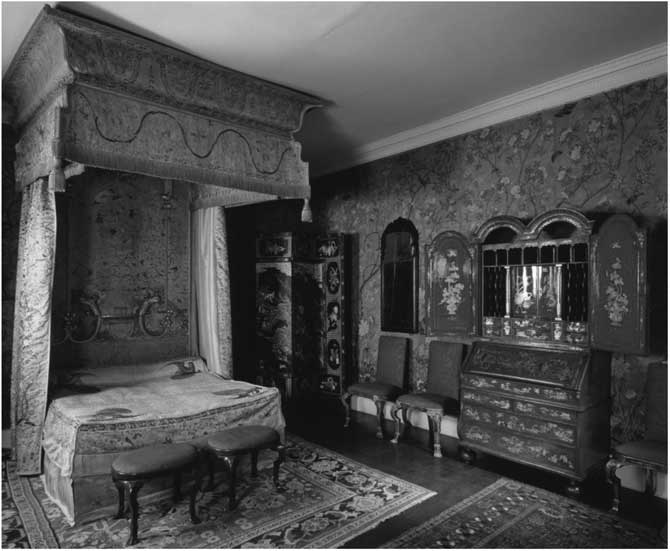
Objects that are originally exchanged as part of a gift network can outlive that network while creating new connections across time. Consider the case of a ‘Japan skreen’ which connected Yale to Joshua Edisbury, a weak tie in Yale’s network. In 1682, Edisbury, a neighbour of Yale’s father, David, in Wales, sent Yale a gift of 74 gallons of ‘Sandpatch Ale’ to congratulate the latter on his successes with the EIC. As Yale noted in his thank-you letter to Edisbury, this gift was ‘an honor I could noways [sic] expect, nor hope, knowing of no obligation to such or a lesser favor from you, and can be imputed to nothing by my good fortune and your boundless liberality’.Footnote 17 In return and acknowledgement of the useful gift of ale, Yale sent Edisbury a sample of Indian chutney, and a more permanent gift of a ‘Japan skreen’, which was meant for Edisbury’s wife (Figure 1).Footnote 18 In this context, the exchange was not a commodity exchange taking place in a mercantile world; rather the polite exchange of gifts between these two men helped to cement a sense of connection and was probably meant to shore up good will between them.Footnote 19
‘Japan skreen’, Erddig Hall, Wrexham, Wales, catalogued by the National Trust as Chinese. Source: National Trust, photograph by Susanne Gronnow.
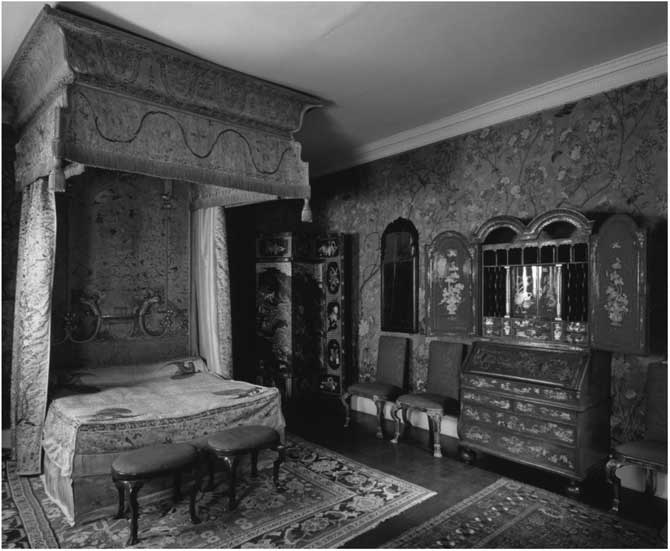
Twenty-four years after this first gift exchange, Edisbury found himself deeply in debt to Yale for the financing of his house, Erddig, an estate in Wales, near to Yale’s ancestral home, Plas Grono.Footnote 20 When Yale and other creditors tried to collect Edisbury’s debt in 1709, Edisbury defaulted and lost possession of the house and all its furnishings. Edisbury may have been using the gift of ale to create a more permanent tie of friendship with Yale, but it seems that the ‘weak’ (in other words, secondary or tertiary) connections between mutual acquaintances were as expendable as a nutmeg, gallons of ale, or chutney. What did not perish with Edisbury’s ownership of Erddig, or the ephemeral gifts of consumables, was the material connection between Yale and Edisbury, or, indeed, between Yale and the entire estate of Erddig. More durable than the perishable gifts exchanged between two men, as an object-actor the ‘Japan skreen’ continues to generate connections into the present century. One early twentieth-century author of a monograph on English country homes participated in the rewriting of the screen’s meanings: ‘Elihu Yale, Governor of Madras and founder of Yale University in America [sic], was brought up at a house in Erddig Park … [the screen] help[s] to place Erddig in the front rank of houses stored with examples of the decorative arts that have the combined merit of aesthetic value and family association.’Footnote 21 For this writer, nearly three centuries after Yale’s death, this screen still preserved important network connections between Edisbury, Erddig, and Yale, and re-inscribed the importance of Elihu Yale If the screen he gave to Edisbury helped to place ‘Erddig in the front rank of houses’, Yale must indeed have been an important figure in the early modern world.
The knowledge claim that constructs Yale’s identity as ‘founder’ of Yale still clings to these artefacts. To this day, the ‘Japan skreen’ is in situ at Erddig Hall in Wales, as part of the National Trust collection. The online collection notes that the screen originated as a gift ‘from Elihu Yale (in whose name the famous American University was founded)’, thus reifying both the importance of Yale to the university and also Yale connections as adding value to the object.Footnote 22
Social networks: marriages, money, and mobility
Object-actors proved central in cementing advantageous class associations for Yale’s own family. Moving from lowly colonial-cum-imperial factor for the EIC, in his later life, Yale was a powerful member of the merchant classes in London. In 1707, a friend described him as engrossed in material-based negotiations of marriage for his daughters: ‘sometimes you find him sett between two diamond cutters, sometimes a broker or two about matching his daughters’.Footnote 23 His trade in object-actors had made Yale rich, giving him a new sort of social advantage in London, and would ultimately help to launch his children into higher levels of British society. Here, the writer depicts Yale dealing in ‘objects’ which, arguably, included his own daughters, who essentially served as object-actors in fostering networks. Those networks were then carried forward through time by non-human object-actors such as paintings and sundials, which have generated meanings down the centuries, as will be discussed below.
Yale achieved successful and upwardly mobile matches for both his daughters. Sometime before 1707, the older daughter, Catherine, married Sir Dudley North of Glemham, an MP and landowner (the date is not known, although a surviving letter names her dowry as £20,000).Footnote 24 On 8 July 1708, Yale’s younger daughter, Anne, married Lord James Cavendish, MP, a member of the wealthy and influential Cavendish family. Both North and Cavendish were important political figures and members of the English aristocracy. Cavendish was the third son of the second Duke of Devonshire, one of the largest English landowners at the time. These matches gave Yale access to political power that he would never have had as a merchant – just the sort of connection that Walpole would later decry as upsetting the social order.
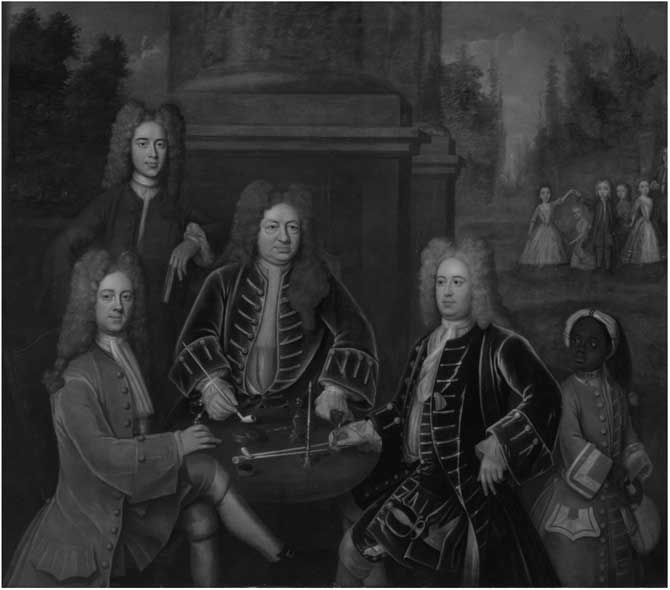
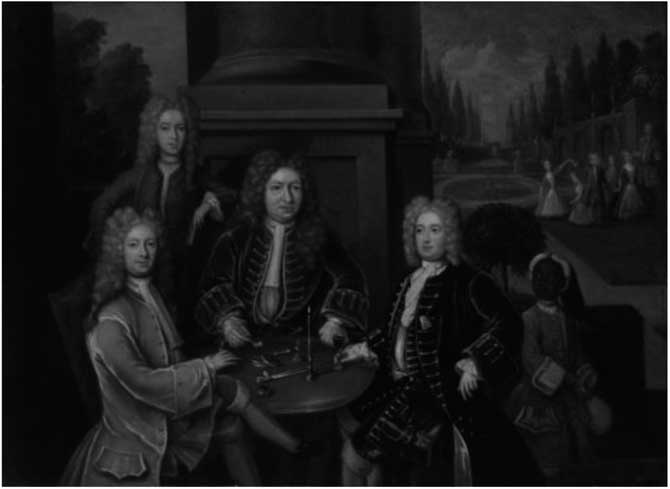
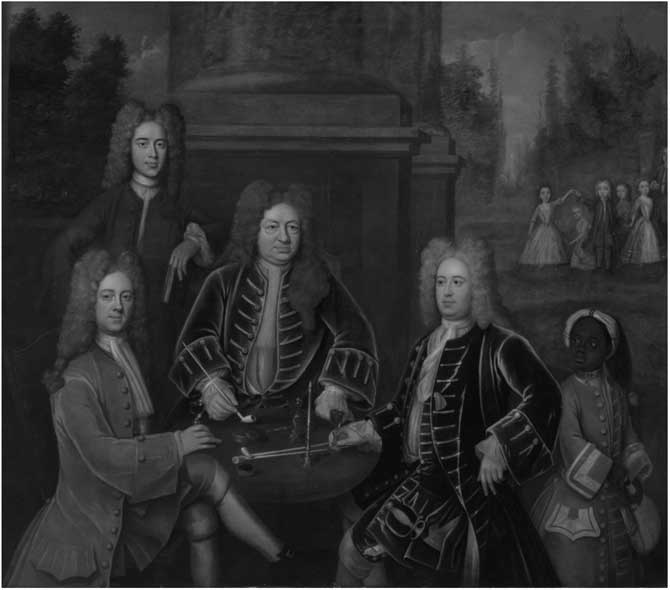
Two images directly related to the marriage of Yale’s daughter Anne to Lord Cavendish demonstrates how material objects can carry and mediate meaning and relationships over time and across space. They are nearly identical conversation-piece portraits paintings showing Elihu Yale with his son-in-law James Cavendish: a small painting (15½ by 21 inches) on copper (Figure 2), and a large canvas (nearly 6½ feet wide) (Figure 3). The compositions are virtually indistinguishable. The standing figure is Mr Tunstal, the lawyer who was brokering the settlement of Anne’s dowry. He is an appropriate part of a scene that is now commonly understood as a symbol of the marriage contract connecting the Yale and Cavendish families. At the time such marriage contracts between up-coming merchants and peerage families were becoming more common, reflecting the commingling of mercantile and colonial commercial interests. The gift of this painting to Anne’s husband, Lord Cavendish, facilitated and documented the formation of a network, in this case a real-time marriage connection between Yale’s family and the powerful Duke of Devonshire. With this matrimonial exchange, Yale’s progeny moved from the issue of colonial Puritan dissenters to members of the peerage. Wealth in the emerging global merchant economy allowed Yale, who essentially began his career as a common tradesman, to move up the rungs of a class system then in flux, and make connections to families who could be important patrons or clients for his trade in luxury items. Though today Yale has no direct descendants, his name remains listed in the peerage. During his lifetime, Yale would see his grandchildren born into a class status that he could never attain directly, that of landed gentry. His connection to the Duke of Devonshire, through Anne and recorded in the marriage treaty conversation-piece portrait, provided him with access to political power that would otherwise have been unavailable to a merchant.
Elihu Yale, William Cavendish, 2nd Duke of Devonshire, Lord James Cavendish, Mr. Tunstal, and an enslaved servant, unsigned, c.1708, oil on canvas. Source: Yale Center for British Art.
Elihu Yale seated at table with the 2nd Duke of Devonshire and Lord James Cavendish, unsigned, c.1708, oil on copper. Source: Yale University Art Gallery.
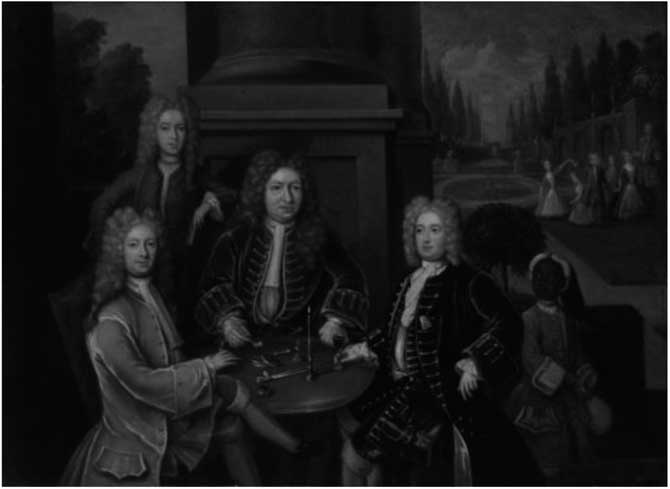
The focus of the composition in both paintings is the business at hand between three men, two soon to be fathers-in law and one soon to be a son-in-law: Yale sits at the centre with the older Cavendish, the Duke of Devonshire, at his left and the younger (James) at his right. The men enjoy a pipe and a glass of Madeira, while examining a small selection of the jewel collection for which Yale had become famous. Objects on the table include a fashionable snuff box, of which Yale owned dozens.
These twin images commemorate and even help constitute a network of kinship and advantageous business associations. Most directly, the jewels on the table speak to Yale’s prominent role as a broker, and to the wealth that provided leverage for his daughters’ connections and helped shore up the Cavendish estate, while the snuff box and the silver candlestick are appropriate markers of the fashionable set.Footnote 25 For both parties in this transaction, the Cavendishes and Yale, this would have been a fortunate match indeed, infusing a welcome liquidity into the Cavendish accounts and promoting the Yale family’s place in society.
The date of the paintings is traditionally given as 1708, the year that Cavendish married Yale’s daughter. Scholars once posited that this was a marriage portrait, but, given the absence of a bride, by 1899 a more appropriate interpretation was sustained in local Staveley Hall lore, as a Derbyshire guidebook writer reported: ‘There is a large painting in Ford Hall … which represents the treaty for this marriage [of Cavendish to Anne Yale]’.Footnote 26 As represented here, Anne Yale is yet another commodity in this network, depicted only in the abstract, an absent and passive object, a figure to be brokered over.
The painting also reveals information about colonial ties within Yale’s network. To the younger Cavendish’s left appears a figure who is quite clearly an enslaved page boy: the livery, the Turkish hat, and most importantly the silver collar and padlock are sure markers of his slave status. Such children are commonly found in portraits of the upper classes in Britain in the eighteenth century, serving as markers of the colonizing activity and the social status of the main subjects. A black enslaved child dressed in half-British, half-exotic dress became such a popular fashion by the middle of the century that the English painter William Hogarth would lampoon this motif in his satires of the upper classes, who appear awash in exotic pages in Marriage à la Mode (1743–45).Footnote 27 The slave child in this picture probably belonged not to Yale but to the Cavendish family, who were involved in the transatlantic slave trade; however, it is also possible that this slave is one of Yale’s ‘curiosities’.Footnote 28 Yale owned at least two household slaves, after the fashion of the day, and the inclusion of a slave here signifies the reach of his networks into the transatlantic world.
In its own day the larger of these two group portraits was a gift that helped both to convey and to constitute a network. Indeed, both the painting itself and the goods depicted in it serve as object-actors, each painting thus representing a network connection twice fortified. The large canvas portrait remained in Britain until 1970, when the eleventh Duke of Devonshire donated the painting to Yale’s Center for British Art.Footnote 29 Crucially, for our understanding of networked meaning through time, nearly three hundred years after the production of the portrait, at Yale University, Yale’s connections to both Devonshire and Dudley North turned into ‘the royal and noble heritage of Elihu Yale of Plas Grono, Denbigh, Wales’, according to a Yale-published document.Footnote 30 In turn, then, the university laid claim to its own noble heritage via its putative progenitor.
Like the larger image, the small copper-plate painting of the marriage negotiations also creates multiple networked meanings (Figure 3). In its own time, the small image was perhaps painted as a keepsake for Elihu Yale. It appears on the reverse of an engraved map of ancient Egypt, a convenient curiosity onto which a new meaning could be layered without destroying the map on the obverse.Footnote 31 In 1960, ten years before the larger version came to Connecticut, a patron of the university purchased the copper plate and donated it to the university’s library, which transferred ownership to the Yale University Art Gallery.
Yale University’s acquisition of these two eighteenth-century portraits re-contextualized their meanings in the twentieth and twenty-first centuries. Both became a part of Yale University’s material genealogy; as one writer exclaimed at the time of its acquisition in 1960, the copper-plate portrait was ‘a delightful and unusual representation of the University’s first important benefactor, a princely collector, and certainly man of the world, if there ever was one’.Footnote 32 Here we see new connections and meanings forming. That ‘the University’s first important benefactor’ was ‘certainly [a] man of the world’ added lustre to both the item and the university, as well as to Yale himself. Both images travelled in time as object-actors removed from their original meanings, now used to provide Yale University with more substance for its origin story – the child of an accomplished, cosmopolitan benefactor – carrying both original meanings and later, accreted ones.
Once these paintings entered the collection of Yale University they continued to generate connections, some positive and some more controversial, some far removed from the original purpose of the images. One art critic recoiled from the larger version of the marriage contract painting in 1981, calling it ‘a gross and nightmarish portrait group’. By the writer’s standard, the painting did not fit well into a show at the Yale University Art Gallery, ‘Arthur Devis and his contemporaries’. In this case the critic was rejecting the portrait on grounds of connoisseurship rather than social content.Footnote 33
As more attention was trained on the images and objects associated with Elihu Yale, the presence of the enslaved black child in this portrait became a real problem for the university. Divorced from its original context, carried forward through time, and viewed through a twenty-first-century lens, this painting of Yale as a possible slave owner was seen by more people, even those affiliated with the university, as ‘gross and nightmarish’. By the late twentieth century this object-actor had become truly difficult, carrying unwanted meanings that saw the two paintings banished from sight, in the Yale University Art Gallery’s store rooms, rather than as active objects in Yale University’s daily life.Footnote 34 As one Yale student noted of the larger painting,
every day as I head to the Berkeley serving line for a helping of the swordfish, just a few feet above me hangs a slave. Subtly painted in the foreground of one of the portraits gracing the dining hall walls is a young black girl [sic] sporting a silver collar around her neck. She is attending to a group of white men sitting around a table while white children play in the background … for a college dining hall to dish a heaping spoon of outdated social commentary to go with the roast beef au jus is wholly inappropriate.Footnote 35
Indeed, the servant figure has become so problematic in a larger Anglo-American context that the most recent biography of Yale, which focuses on his activities as a collector whose wealth ‘created’ Yale College, reproduces the image with the slave page cropped out.Footnote 36
Identity in networks: the ‘Governor of Ft. St. Georg’
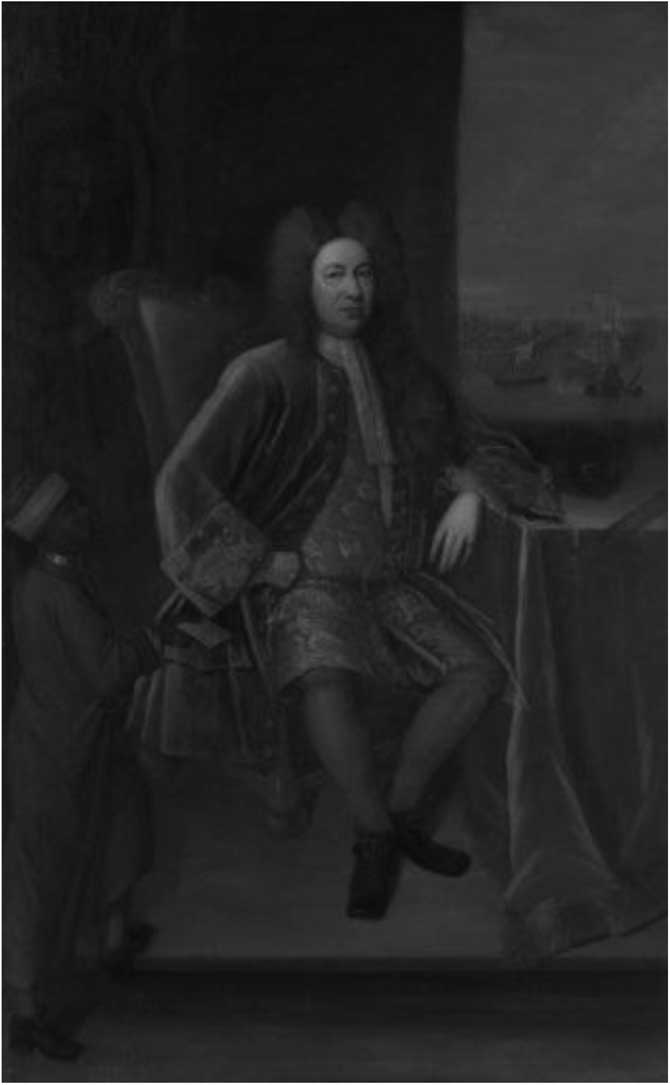
James Worsdale’s portrait of Yale (Figure 4), commissioned by the subject in 1715, is another important object-actor in Yale’s space–time matrix, in that it illustrates the ways in which an object-actor can create multiple identities across networks. Originally painted in London, this painting exists in two copies: one which, with one recent exception for a special exhibition, is now in storage at Yale University, and one at the former East India Company complex at Fort St George, Chennai. The portrait follows compositional formulae and conventions for conveying status that would have been understood by early eighteenth-century viewers. Yale occupies the centre of the canvas. Behind and to Yale’s left can be seen Fort St George in India, where he had lived for twenty-eight years. The fort is shown in battle condition, which is appropriate as Yale weathered several maritime conflicts during his time living in Madras, and oversaw some victorious skirmishes with rival European trading factions.Footnote 37 These victories are celebrated in the landscape of the fort behind Yale. Barely visible behind Yale’s head, to his right and our left, is a shield of Medusa in mid scream, a potent symbol of having achieved victory and turned an enemy to figurative stone. In the foreground, a servant in Indian dress steps up to Yale and hands him a letter addressed to Yale as ‘Governor of Ft. St. Georg [sic], Madras’.
James Worsdale, Elihu Yale with his servant, 1715, oil on canvas. Source: Yale University Art Gallery.
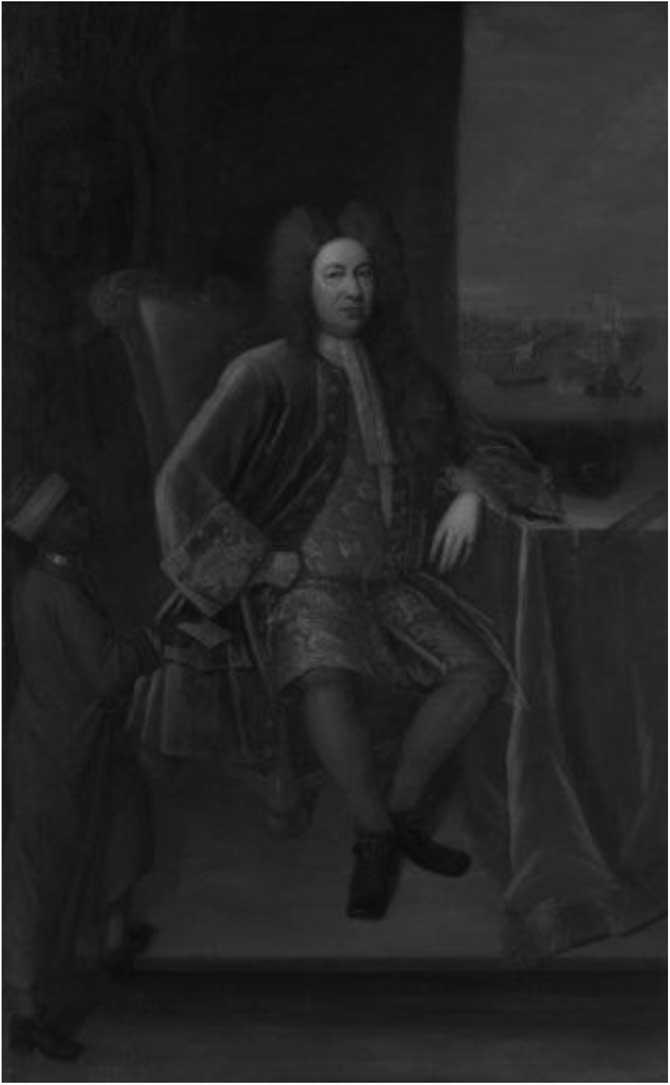
Worsdale was a student of Yale’s good friend Sir Godfrey Kneller and was well versed in making appropriately styled portraits for the upper classes.Footnote 38 The composition would have been entirely unsurprising to an eighteenth-century eye: a gentleman of means and status sits in front of the landscape that defines his life, and which he controls. A subordinate figure, placed literally in a lower physical position, signifies status and in this case also highlights that the subject of the painting is the seated figure. Apart from the Medusa shield, nothing is particularly unconventional about this portrait; it is filled with signs of status, wealth, security, and righteous vindication, appropriate for a once-disgraced governor reclaiming his title years after his fight with the EIC was over.
During Yale’s lifetime, and well after, it was quite common to depict Anglo individuals with Indian servants (most often with nursemaids or ayahs who tended to Anglo children).Footnote 39 Yale did have some contact with the slave trade and we know that he owned a slave nanny who travelled with his children to Britain and back to India.Footnote 40 Hiram Bingham suggests an identity for the figure: that of a body servant named Griffith. Griffith was an important enough figure in Yale’s life for his daughter Ursula to bequeath him £100 at her death.Footnote 41 Bingham suggests that Griffith may have been a Welshman, the son of a Wrexham innkeeper; however, the figure’s dark skin and silver slave collar would argue against this interpretation. Perhaps Yale simply gave his Indian slave a familiar Welsh name.Footnote 42 Like other portraits that Yale commissioned, his status is emphasized with symbolic accoutrements from slaves to jewels, as if he was writing his own importance through these commissions.
After consolidating his fortune and rescuing his reputation in Britain, Yale could afford to have a painting made that showed him not as a disgraced ex-EIC employee but as the former governor of Fort St George. Indeed it is this identity as governor that has clung to portraits of him through time. Since he spent only about a year as governor and then several years in Madras waiting for his case to be adjudicated before he could return to London, one can understand why he would desire a valedictory painting of himself in front of a naval battle, victory secured, a Medusa shield to turn his enemies to stone, and with a very powerful symbol of identity in the form of his relationship with the servant bringing him a letter with his title ‘Gov. Ft. St. Georg’ upon it. Through this portrait, painted in London and displayed at his home, Yale could rewrite his complicated history with the EIC into a simpler narrative of control and triumph.
As one slightly later painter’s manual put it, a portrait is created ‘in order to perpetuate their [subjects’] memories, as well as their virtues and glorious actions’.Footnote 43 This same painter’s manual advised that portraits of EIC governors should include ‘a landscape behind … of an Indian prospect, with palm and cocoa-trees, [and] some figures of Blacks’.Footnote 44 In this roughly contemporary text, one sees both the nascent idea of a painting as an object-actor, carrying a (fixed) identity forward through time, and a contemporary idea of the importance of servant figures in elucidating the status of their sitters.
Yet, despite the intentions of their creators, paintings, like other object-actors, have changeable meanings in different temporal and geographical contexts. The version of the Worsdale portrait that is now owned by Yale University was purchased and donated to the institution in 1910. In fact, it is one of many examples of Yale artefacts that have come into the university’s possession, starting with Yale’s own donations to Connecticut College in 1720–23. The Worsdale portrait hung in the Yale Corporation Boardroom for many years. In the 1990s, however, it was suddenly thrown into the spotlight when a factually inaccurate article about the painting appeared in the Yale student newspaper. Yale students were shocked to learn that Yale was permanently ensconced in the Yale Corporation Boardroom, the very heart of Yale’s administration, with ‘a dark skinned man kneeling before [him] with a silver collar and a long metal chain dangling from his neck’.Footnote 45
A cursory look at the actual painting reveals that the report was mistaken: the figure is not kneeling but stepping up to meet Yale, and there are no chains attached to his collar. On the subject of slavery, however, this portrait is, at best, neutral. Griffith is almost certainly enslaved, and he is included as an accessory, not a fully realized portrait of an individual. The salient point here is that the meaning of the portrait, and even assumptions about the content of the painting, divorced from careful observation, had changed significantly over time.
By the 1990s the Worsdale portrait had become the synecdoche for all the sins of American slave-based wealth that had benefited Yale University. The controversy over this portrait grew to such a degree that a group of Yale students created a website to document Yale University’s relationship with slavery.Footnote 46 Objections to the painting included its location in the Yale Corporation boardroom, which students felt perpetuated Yale’s connection to slavery. Calls were made to put the painting into a different context, in a museum, as part of the ‘past’ rather than the present of the university. Ultimately, the Worsdale portrait was removed from the Yale Corporation boardroom, and quietly put into storage at the Yale University Art Gallery, where it is today, along with several other uncomfortable Elihu Yale object-actors.
Griffith continues to be a source of befuddlement. If Yale was a just and righteous donor who created Yale University, what does it mean that he is depicted with a slave? For several decades writers have struggled with this question. The most common, and least probable, explanation is that the slave figure was painted in to the image long after Yale’s death as a sort of afterthought.Footnote 47 Yale’s most recent biographers claim that ‘The young coloured attendant was not his servant; indeed, the child’s image may have been added after the portrait was finished.’Footnote 48 Custom and convention of eighteenth-century portraits, the integration of the servant figure into the overall composition, and the explicit instructions of painting manuals all argue against such an interpretation. Others have tried to reconcile the servant figure, as did one Yale student in an editorial, with the view that Yale was a ‘documented abolitionist’ – an inaccurate and ahistorical assumption.Footnote 49 When the controversy over the Worsdale portrait first broke in 1995, a professor at the university decried the idea that Yale was involved with slavery, saying: ‘To say that Elihu Yale owned slaves is an absolute lie. During his time as governor of the East India Company he actually resisted slavery … this was a long, long time before the abolition of slavery. Elihu Yale was a man ahead of his time.’Footnote 50
One of the earliest documented groups who expressed an opposition to slavery were the Quakers, who were only beginning to consider the morality of the slave trade in 1657, as demonstrated in a letter by George Fox.Footnote 51 As this was written to fellow Quakers only five years before Yale left for India, he was unlikely to have even known of such a letter. As a mainstream Anglican, he was far removed from Quakerdom. Even more importantly, Yale is documented as owning a ‘faithful “black servant”’ who travelled with his wife and children to Britain as a nursemaid for their youngest child.Footnote 52 Finally, his role in overseeing the slave-trading activities in Fort St George is well documented in the EIC’s records in Chennai.Footnote 53
For a different interpretation of this portrait, we can turn to the second, apparently identical copy of the Worsdale portrait, housed in Chennai at Fort St George.Footnote 54 In an Indian context, quite different meanings have accrued to this image. Whereas at Yale, the Worsdale painting has become an awkward object-actor with objectionable associations, the Chennai version is still on display in St Mary’s church, as part of the Fort’s history. The painting is labelled with a paper insert: ‘ELIHU YALE (??–1721) GOVERNOR OF FORT ST GEORGE AND MEMBER OF THIS CHURCH’. At the time of writing I have not been able to establish when this portrait came to Chennai, but it seems plausible that it was among the many gifts that Yale sent to his successor in the post of EIC governor.Footnote 55 However important this painting may have been to Yale himself, and though the Fort Museum copy remains on display, textually connected only to his role as a member of the fort’s Anglican church, this version of the Worsdale portrait is virtually unknown outside Chennai. Indeed, the same image that is currently a source of discomfort in America is displayed in Chennai at the Fort Museum as a point of pride. In the narrative of the Fort St George museum, Yale is an important player in the story of the rise of Madras’ importance to the nation. His role as ‘founder’ of Yale University is not a subject of much concern here, nor is the figure of the servant an objectionable feature.
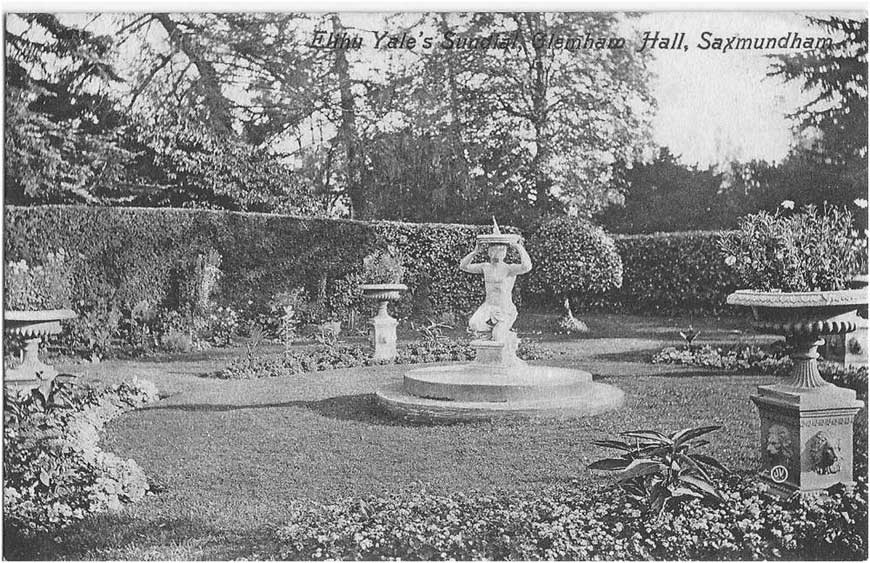
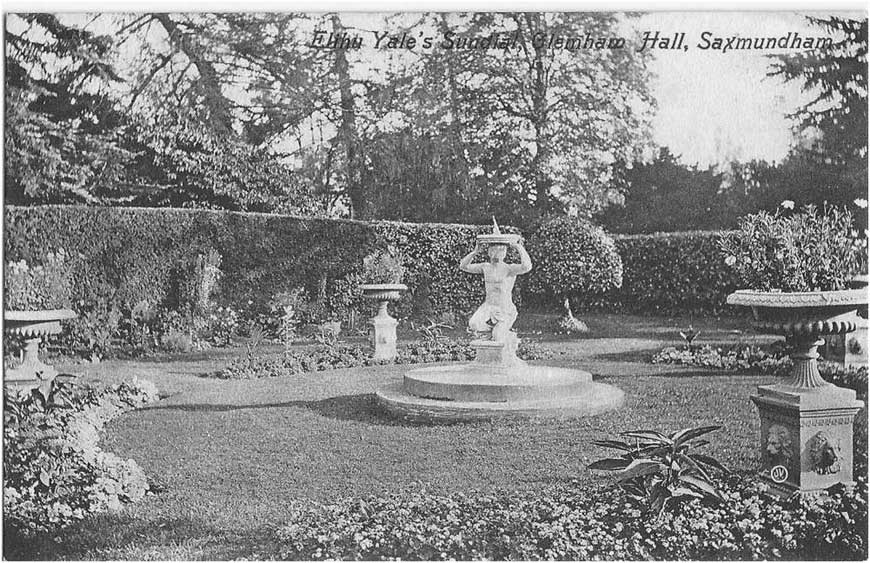
Similarly, among the now-difficult object-actors that have an ‘owned by Yale’ endorsement, we can add the statue of a kneeling black figure carrying a sundial on his back (Figure 5). Yale presented a fashionable pair of these garden ornaments to his daughter Catherine and her husband, Dudley North. These twin sundials remained in the gardens at Glemham Hall (the North family seat in Suffolk) until the early twentieth century. Until the 1910s, when one sundial was donated to the university by a group of alumni as a visible sign of Yale’s early modern pedigree, both sundials at Glemham were the subject of Yale ‘pilgrimages’. Yale graduates on tour in the British Isles could visit Glemham and purchase souvenir photographs of the two sundials. We know that by 1939 one of the sundials was on display on the campus at Yale; however, by the 1970s, it had become another awkward remnant, banished to storage at the Yale University Art Gallery, adorned with some 1970s graffiti.Footnote 56
Postcard showing the sundial given to Dudley and Catherine North by Elihu Yale. Photographer unknown. Source: Yale University.
Elihu Yale or ‘St Eli’: relics and relationships
Before such objects as Yale’s portraits that include slaves became objectionable and unruly, they helped create a meaning for Elihu Yale as ‘Saint Eli’, guardian angel and saviour of Connecticut College. In the early twentieth century, more and more Yale graduates made what I would call pilgrimages to Yale sites – but usually only to those sites easily reached in the British Isles, rather than Chennai, where Yale spent so many years accumulating the wealth which has been so important to the university.Footnote 57 Of the British Isles sites, Yale’s tomb at Wrexham in Wales was surely the most important, but the existence of souvenir postcards, such as those of the Glemham Hall sundials, demonstrates that other surviving places associated with Yale were also on the tour. The presence of many gift items from Yale helped to bolster the importance of this site to would-be pilgrims. As most of the places where he had lived had been destroyed by the twentieth century, so Glemham and other houses associated with his family served as substitute sites of pilgrimage.
A 1908 guidebook called American shrines in England includes a chapter on sites related to Yale. By its title the book unveils the inherent notion that Elihu Yale was a ‘patron saint’, while journeys to his lands would constitute pilgrimage. In a chapter devoted to ‘The Founder of Yale College’, the author discusses at length a ‘pilgrimage’ to the shrine of Plas yn Iâl, the last remnant of Yale’s property holdings in Wales. Yale seems not to have lived at the house, although he did own it. After his retirement he split his time between London and Wales, but chose the rather grander Plas Grono as his residence in Wrexham. Plas Grono had been demolished by the time that the guidebook was written, making Plas yn Iâl the substitute ‘shrine’ house. Plas yn Iâl remained connected to Yale by name, and by the ardent pilgrims building a relationship with the house well after his death. It is still possible to book holiday trips to the house, which is noted in a recent guidebook published by the Wrexham Area Civic Society as an important place connected to Yale. The aim of the guidebook is ‘to encourage the reader to visit the places associated with him [Yale]’.Footnote 58
For years, Portuguese silver from Yale’s collection was housed at Madryn Castle, near to Plas yn Iâl. The Portuguese silver at Madryn is an excellent example of an object-actor generating networks and meanings well beyond Yale’s death. An important instance of a later meaning being superimposed upon an object that was probably in origin a network-cementing gift, comes from the pages of a 1910 issue of the Connoisseur: ‘And now comes the interesting question, how came this rare and valuable piece of old Portuguese silver into the hands of the Madryn Family? … There is good reason for assuming that the dish was brought to England by the virtual founder of Yale university in America, Elihu Yale’.Footnote 59 The Connoisseur was an early twentieth-century periodical for collectors of fine art.Footnote 60 The above quotation comes from an article on the Portuguese silver collection of Mr. W. C. Yale-Jones-Perry, owner of Madryn Castle and Plas yn Iâl in the 1910s. It is particularly interesting for demonstrating the rhetorical strategies by which an inanimate, mute object (a silver rosewater dish) could become (or perhaps remained) an analogue for the familial connection between Yale’s family and a neighbouring family, the Madryns. Further, for the writer of the Connoisseur article, the presence of Yale’s silver at Madryn provided an illustrious past and present status for the castle as a site of cosmopolitan, worldly collections of goods from famous and influential actors. In this case, Yale – again cast as the ‘virtual founder’ of Yale University – is connected to Madryn by an object-actor, to the benefit of Yale, the university, and Madryn in 1910.
Despite the importance of this dish in a Yale network in the early twentieth century, such an object-actor can drift away from previous networks to generate new and different meanings. It is now in the collection of the Victoria and Albert Museum in a gallery of early modern silver objects; provenance notes indicate only that the dish is ‘traditionally associated with Elihu Yale’.Footnote 61 In the context of museum display, then, the meaning of this object-actor has migrated. The most prominent features of the dish for the museum’s purposes are the motifs represented on it and the history of silver production in Lisbon; Elihu Yale is merely a footnote.
Relics and reliquaries
Yale University has collected Elihu Yale-related objects since Connecticut College first inherited books and paintings from his estate in 1725. Accumulating such relics has continued almost unabated. Renaming the college to Yale, dedicating buildings in his name, and collecting mementoes closely related to the man are all expressions of the university’s gratitude for ‘the Munificience of Gov. Elihu Yale’ and as ‘Memorial(s) to its Principal Benefactor’.Footnote 62 Ezra Stiles, President of Yale from 1778 to 1795, only sixty years after Yale’s death, was an avid pursuer of Yale objects to shore up the university’s pedigree as the progeny of an illustrious patron. Stiles focused intently on finding object-actors that had a close, documentable proximity to Yale himself, preferring objects that the university’s patron had used (rather than collected) and paintings for which Yale had certainly sat, rather than copies.
Stiles noted in his diary on 1 May 1788 that
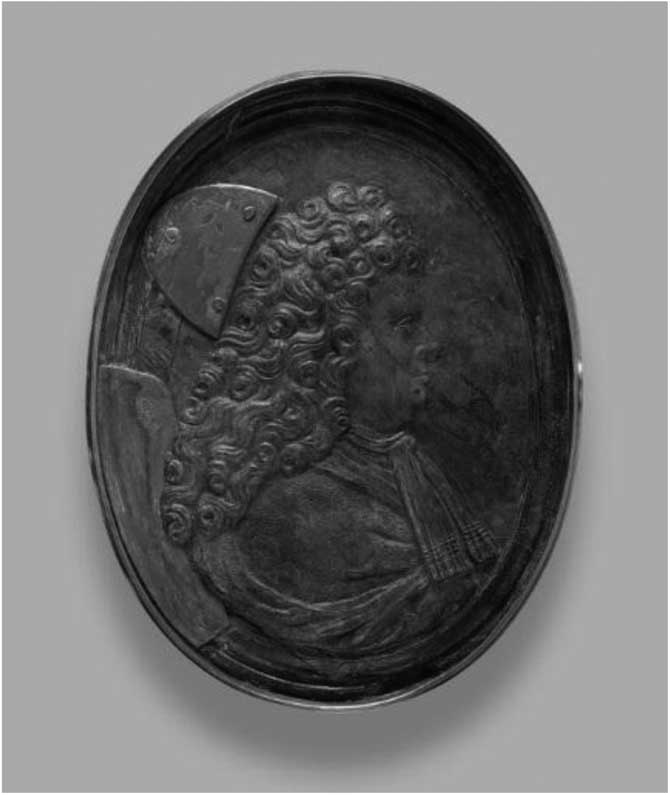
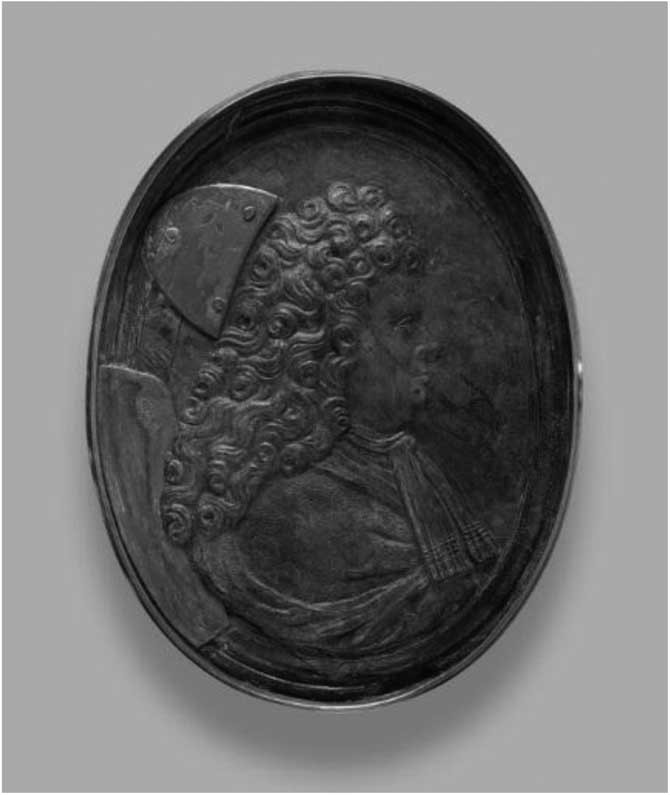
This day I bought of Caleb Cook Esq. of Wallingford an antique silver Snuff Box of the East India Governor Yale. The Turtle shell was neatly and elegantly charged with the Governors Head in alto relevio, and his Coat of Arms. I gave forty schillings for it; and do now deposit it in the archives of Yale as a Memorial of its principal Benefactor … In 1755 Major Elihu Hall of Wallingford bro’t from England this Snuff Box presented by the Governors family to Mr. Yale of Wallingford.Footnote 63
Stiles was impressed with the pedigree of the object (Figure 6), coming straight from the family of Yale through his descendants. The lineage of a Yale-related object was important to him, and those with the most direct connection to Yale were valued for their thoroughbred status. For Stiles, objects could, in this way, serve as direct, tangible networks back to the past and to Yale. At the same time, for the purposes of our understanding of Yale’s networks, this snuffbox embodies the global nature of Yale’s life: it was made of African or Caribbean tortoiseshell, and intended to hold American tobacco.Footnote 64
Silver and tortoiseshell snuff box with portrait of Elihu Yale, by John Obrisset (fl.1705–28). Source: Yale University Art Gallery.
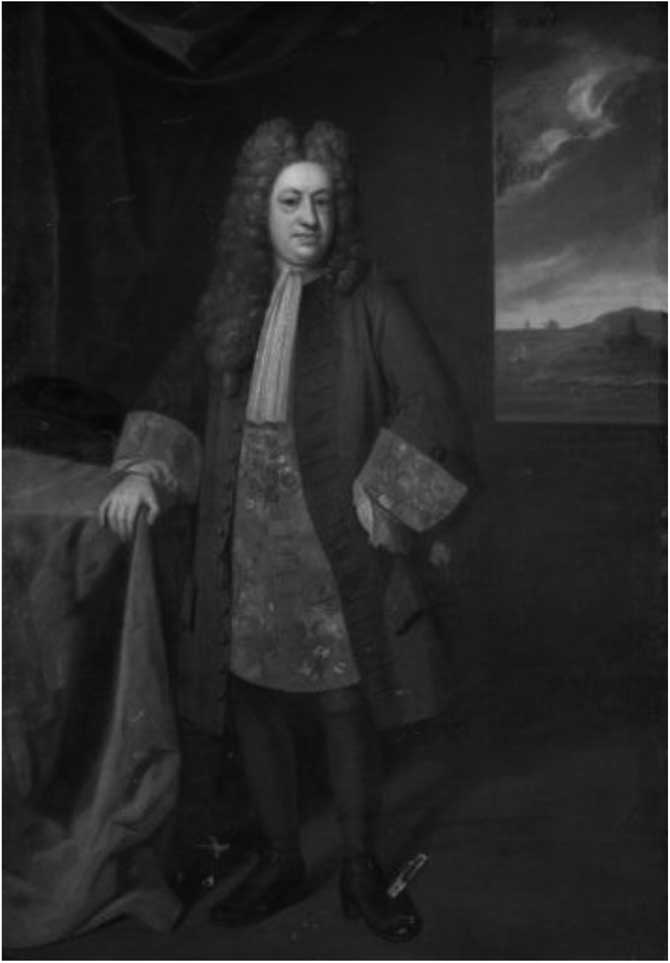
Stiles was particularly excited to acquire a large portrait of Yale by Enoch Seeman (or Zeeman), because it was an original, not a copy, and came directly from Yale’s family (Figure 7).Footnote 65 Stiles noted in his diary that the Seeman portrait was received by the University on 16 October 1789 from
the Hon. Dudley North Esq. [Yale’s son-in-law] of Glemham in Suffolk, Engld, Member of Parliament … The painting is Seven feet high and & the Governor at full Length. It was done in 1717 the Gov. then aet. [aged] 68. It is grand & elegant & in good Preservation, being not a recent Copy, but one of the original Pourtraits in the Family.Footnote 66
Enoch Seeman, Governor Elihu Yale, 1717, oil on canvas. Source: Yale University Art Gallery.
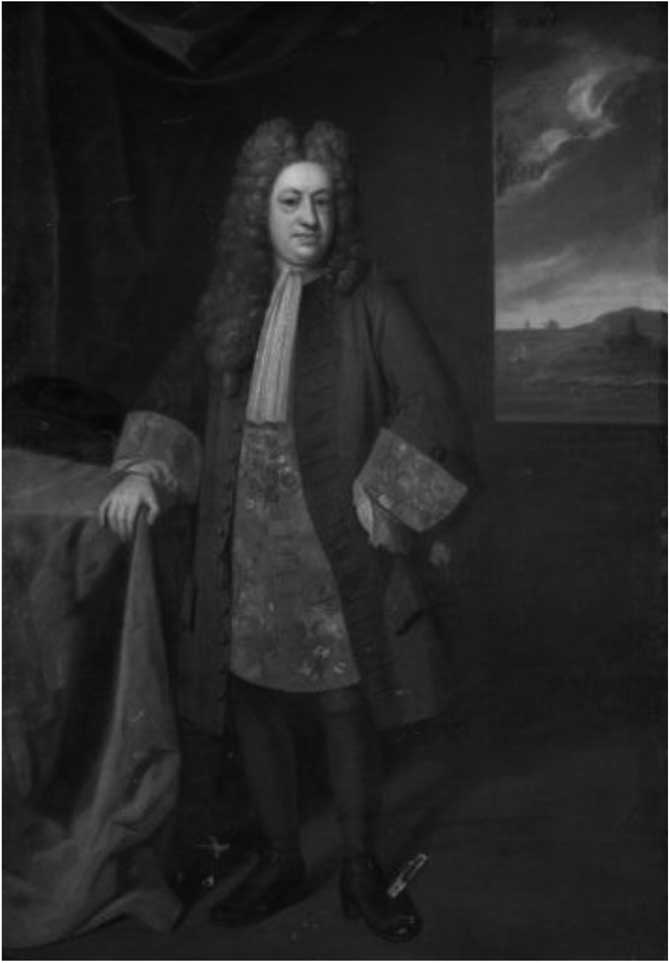
Clearly, for Stiles it was important that this picture, like the snuff box before it, was the original object obtained directly from the family. The picture was not only a representation but a remnant of time, connecting directly to Yale sitting for Seeman when he was painting that exact picture. For Stiles, traces of Yale’s actual presence clung to the picture, an ‘original Pourtrait in the family’. A copy of a picture would separate the object from its original, weakening an immediate connection to Yale the man. These object-actors take on such significance in Yale University’s story – namely, that it was founded by an illustrious, even noble, Englishman and is an exemplar of early modern institutions of learning – that in the 1920s one author, writing about one of Yale’s snuff boxes purchased by Stiles in the 1780s, again described Yale as the University’s ‘patron saint’, making objects into relics of the man.Footnote 67
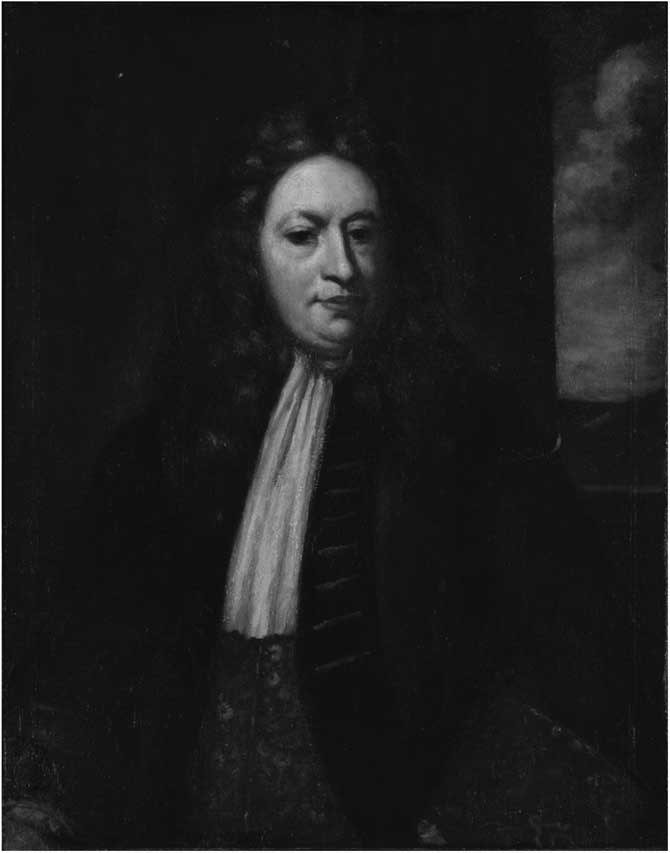
A half-length copy of Enoch Seeman’s full-length portrait of Yale (Figure 8), further illustrates the different ways a portrait can network across time with shifting meanings. This painting of middling quality must have been made in London sometime between 1717 and 1789 (perhaps it was one of the recent copies mentioned by Stiles of the portrait he had acquired), the years in which the original Seeman portrait remained in Britain. How it ended up in Madras – its location in the mid twentieth century – is not known. However, as there has been constant interest in Yale as an important figure in the history of Tamil Nadu, it is not surprising that the painting was still on display at the Government House in Madras in the 1930s.Footnote 68 From available sources it is not clear whether the ‘Madras art gallery’ mentioned in 1950s accounts of the painting is Government House; nevertheless, it had clearly remained visible in an Indian context for quite some time.Footnote 69
Copy of Enoch Seeman portrait, eighteenth century, oil on canvas. Given to Yale University by Dwight D. Eisenhower, 1960. Source: Yale University Art Gallery.
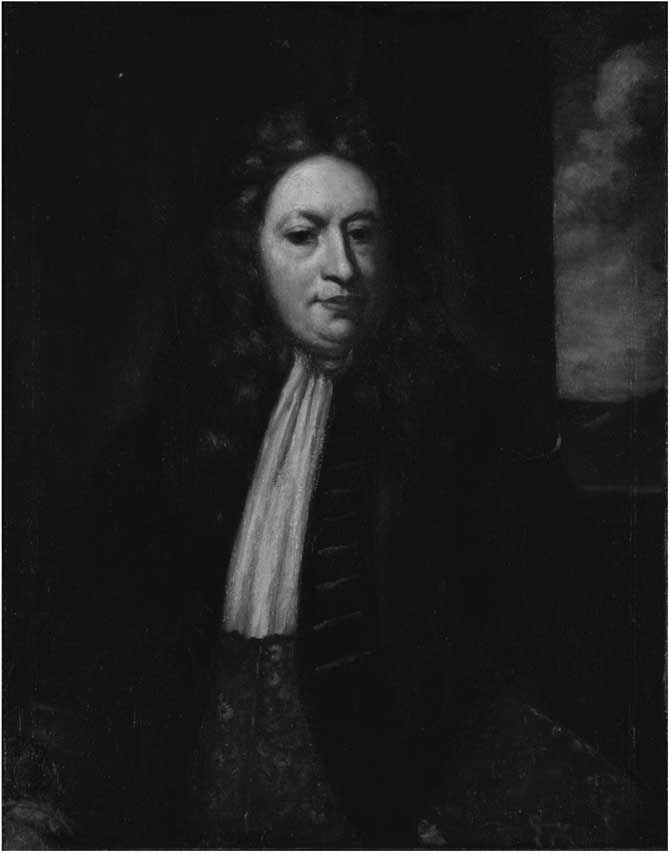
In 1959, this copy of the Seeman portrait would play an unexpected role in mediating tensions between the United States and India. In the wake of the United States’ decision to arm neighbouring Pakistan, Indian Prime Minister Nehru issued strong objections, citing concern for Indian security.Footnote 70 American foreign policy of the 1950s also pressured India to choose sides in the Cold War, rather than remaining neutral.Footnote 71 For India, and for Nehru, these developments were unacceptable. For damage control, President Eisenhower travelled to India to meet with Nehru in 1959 as tensions between the two nations continued. During this summit, meant to heal the ‘formerly friendly relationship’ between the countries, Nehru presented Eisenhower with the copy of Seeman’s portrait of Yale.Footnote 72 As part of a gift exchange between India and the United States, Yale’s portrait itself served as a weak tie, a reminder that, in the past, it had been wealth derived from India which had provided Yale University, one of the US’s oldest universities, with a crucial financial foundation.Footnote 73
A year later, Eisenhower donated the painting to Yale University, writing to the university president that ‘my suggestion meets with the approval, even the desire, of Prime Minister Nehru’.Footnote 74 In this way, the portrait as object-actor could serve as an intermediary between persons, institutions, and nations. When Indira Gandhi received the Howland Memorial Prize at Yale in 1960, one of the public events celebrating her visit was the official unveiling of the Seeman portrait, in which she participated.Footnote 75 Thus, in a complicated set of manoeuvres, this painting played a small role in defusing international tensions, a role far removed from the original use of the portrait as a reminder of one of Fort St George’s governors.
Global networks that were forged during Elihu Yale’s life have resonated through the years differently in India than at Yale University. On the subcontinent, object-actors sustain an Indian identity nearly entirely separate from Yale’s American (and English) status as ‘founder’ of Yale University. To generations of Indian schoolchildren, Yale is known as one of the pivotal players in the founding of Fort St George and the building up of what would eventually become Chennai, a major port city and capital of the state of Tamil Nadu.Footnote 76 As K. E. Supriya notes, the Fort Museum itself is a strange admixture of memorializing Britishness and celebrating the fort as an integral part of Indian history.Footnote 77 The material traces of Yale’s twenty-eight years in India are preserved in the Fort St George Museum and St Mary’s church, and objects associated with Yale occupy pride of place in both institutions.
Object-actors, even those that exist in identical versions in two places, have generated different meanings in India. One of the edifices in Chennai which continues to be a touchstone of Yale’s role in building up that city’s existence is St Mary’s church at Fort St George, the first Anglican church in India. As a newly arrived writer with the EIC, Yale pledged 60 per cent of his £10 per annum to the building of this mainstream Anglican church: an interesting choice for the descendant of Puritan Congregationalists, but one that would put him on a good footing with his superiors in the EIC and later was politically advantageous in London.
Yale would be married in this church to Catherine Hymners, the widow of another company official. For the Fort Museum, this was an important event: their wedding was the first to be held in the church; although the original register is not available, a copy remains on display in the church. This memorial was to be of interest to tourists and, importantly, to local residents. Yale’s chalice, donated to the church, and an alms dish of 17 inches in diameter also remain on display. As Supriya describes, ‘The fact that these objects are preserved in the museum building that was once a fort annex is a formidable and proud reminder that for Indians living in postcolonial India, the memory of British rule takes on complex and richly fortified meanings.’Footnote 78 Finally, Yale as triumphant governor remains to be seen in the copy of the Worsdale painting at the church.
Institutional networks: object-actors and Yale as a brand name
Subordinate black figures in portraits, home furnishings, and statuary were the fashion of Yale’s day and marked one as worldly and upper class. Because the meanings of these objects have changed over time, the collection of Elihu Yale memorabilia at Yale has sometimes been wrongly dismissed as insignificant. Perhaps because these object-actors carry embedded meanings of racial superiority, at the time of writing, almost none of the objects associated with Yale are on permanent display at Yale University. John Marciari, curator of early European art at the Yale University Art Gallery, said in an interview in 2007, at the height of the Worsdale portrait controversy, ‘No one else in the world wants these things [portraits of Elihu Yale], so they’ve all found their way here.’Footnote 79
Marciari’s statement is interesting for its denial of the popularity of Yale objects, because it is not true that ‘no one else in the world’ wants or wanted objects associated with Elihu Yale. As with the many other objects collected by generations of admirers of ‘St Eli’, the acquisition of unruly object-actors such as the Cavendish conversation piece, the Worsdale portrait, and the Glemham sundial was part of a much larger project of cementing an eternal relationship between Elihu Yale and his namesake institution. In India, Yale ‘relics’ take on a role as complex intermediaries of colonial and global history.Footnote 80 Although these objects may not have agency, we can think of them as actors in a transcontinental and trans-temporal network. In different periods these object-actors have been understood quite differently, entangling the network pathways to the past with layers of different meanings. In the case of Marciari’s disavowal of the importance of Yale artefacts, these object-actors have in essence generated a new meaning, less palatable to contemporary audiences.
Outside Yale University, an association with Yale adds interest and value to objects. Networks are not limited to a chronological Elihu Yale to Yale University one-way exchange. In fact, over time the attribute ‘once owned by Elihu Yale’ has appeared in several museum collections, magazines, and auction notices, presumably to add interest and value to the work. In placing provenance on objects, Yale’s name is a significant endorsement for collectors.
In part, Yale’s name provides the provenance of objects – a routine part of collecting and documenting objects – but, by the same token, these objects associated with Yale can carry additional weight when they themselves have an impressive pedigree. For example, in 1933 the Metropolitan Museum of Art acquired four ‘oriental’ tapestries once owned by Yale. While they were certainly significant to the collection for their Yale connection, these tapestries carried a further imprimatur that generated important meanings for the museum: they were by the esteemed tapestry master John Vanderbank, whose most prominent client was the royal household.Footnote 81 The tapestries’ connection to an illustrious maker further reflects upon the quality of the Metropolitan’s collection, Yale the man, and then Yale the university. Yale’s name could also be an indicator of quality for objects that he never actually owned, such as tapestries on offer in a 1950 auction. In a note for this sale, the tapestries were ‘a group of good English and French tapestries … Among them there will be a set of three Soho tapestries woven with Indo-Chinese scenes, some of the groups being identical to those in the Elihu Yale tapestry’.Footnote 82
Passing through Yale’s hands therefore remains an important part of an object-actor’s meaning. In 2014 ‘an extremely rare pair of George I side tables’ from Glemham Hall went up for online auction with the provenance note
Glemham Hall belonged to Dudley North, who had married Catherine Yale, a daughter of Elihu Yale, founder of the famous American university. Elihu was generous with the wealth he accumulated; as well as endowing Yale University, he was also lavish in his gifts to his family, resulting in Glemham Hall obtaining many treasures at this time, including these tables.Footnote 83
Here the side tables are endowed not only with their inherent quality as objects but with metaphorical quality by association with Elihu Yale. Similarly, in a 2004 auction of ‘Glemham Hall Screens’, the provenance report states that ‘the screens … originally belonged to Elihu Yale, the Founder of the American University’.Footnote 84
Conclusion: Yale’s object-actors creating the ‘Founder of Yale’ and governor of Fort St George
Object-actors serve a variety of functions over the course of their lifespan and continue to generate meanings, sometimes contradictory, across space and time, well after they have passed through a particular individual’s hands. As meanings accrete to an object-actor (and to the correlative individual), the desire to possess, promote, or hide an object changes. In the case of Elihu Yale, his network of friends, family, and acquaintances, and, finally, later generations redefined and laid claim to relationships and status based on Yale and his material goods. These networks are complex, including objects still in England, Wales, and India, as well as objects at Yale University. Though they physically do not change (apart from decay or damage), these object-actors move through temporal and spatial networks, and drive desire through their association with Elihu Yale. In different contexts, these objects generate different meanings, which in turn affects desire to display or disown an object. What is fashionable and prestigious in one century is shameful in another. What is embarrassing in one geographical location is celebrated elsewhere. While the objects do not change, their networks of meaning shift and are embedded in the writing and rewriting of history.
Coda
Nearly eighty years after Yale’s biographer Hiram Bingham’s travels to Madras, we may live in the most object-actor networked time of all, thanks to the Internet. On the web, one can order a hand-painted reproduction of the group portrait Elihu Yale, William Cavendish, 2nd Duke of Devonshire, Lord James Cavendish, Mr Tunstal and an enslaved servant direct from New Crafts International, Ltd in Xiamen, Fujian Province, China (on the south-eastern border, directly across from Taiwan).Footnote 85 A ‘museum quality’ canvas reproduction of 16 by 20 inches (roughly the size of this portrait’s copper-plate version) costs just US$99. In this setting, the Yale conversation piece is unmoored from its origins, reproducible in six sizes in a reasonably priced range of choices. According to the company, no one has yet bought a reproduction of this particular portrait, but it is interesting to see the possibility of nearly infinite reproduction, perhaps for anyone who wants to be connected to Elihu Yale in some way.Footnote 86
Elizabeth Kuebler-Wolf is Associate Professor of Art History and Program Director for Art History and Museum Studies at the University of Saint Francis. She specializes in the visual culture and rhetoric of slavery.