1. Introduction
There has long been a great interest in the representation and processing of words from the two languages in a bilingual's mind. Tokowicz and Tuninetti (Reference Tokowicz, Tuninetti and Chapelle2012) reviewed a number of models that have been proposed in regards to bilingual memory representation, word recognition, and word production, including the revised hierarchical model (Kroll & Stewart, Reference Kroll and Stewart1994), the distributed feature model (de Groot, Reference de Groot1992), the distributed representation model (van Hell & de Groot, Reference van Hell and de Groot1998), and the bilingual interactive model (BIA) (van Heuven, Dijkstra & Grainger, Reference van Heuven, Dijkstra and Grainger1998). One of the issues is whether there is concept mediation in translation from a second language (L2) word to a first language (L1) word. In plain terms, the question is whether a bilingual accesses a conceptual representation directly when going from the L2 to the L1 or whether the L2 has to go through the L1 lexical representation before accessing a concept. According to the revised hierarchical model proposed by Kroll and Stewart (Reference Kroll and Stewart1994), there are bidirectional lexical links between the L1 word and the L2 word, but the lexical link from L2 to L1 is stronger than that from L1 to L2. The model proposes that there is a strong bidirectional link between concept and the L1, but a weak bidirectional link between concept and the L2.
In an attempt to test for the lexical link between L2 and L1 and the conceptual link between L2 and concept, Kroll and Stewart compared translation from L1 to L2 (forward translation) and translation from L2 to L1 (backward translation) each in two list conditions: one categorized list condition in which items from the same semantic category were presented successively one after another (e.g., a sequence of items might be “horse, cow, sheep, goat”, etc, all belonging to the category “animals”); and one randomized list condition in which the items were randomly presented such that items from the same category were presented with items from other categories in between (e.g., a sequence of items might be “horse, truck, couch, strawberry, cow”, etc, belonging to different categories “animals”, “vehicles”, “furniture”, “fruit”, etc). They found a category interference effect such that forward translation was slower in the categorized list condition than in the randomized list condition, thus suggesting conceptual mediation for forward translation. They found no category interference effect for backward translation and thus argued that backward translation was lexically based, rather than conceptually mediated.
Kroll and Stewart's (Reference Kroll and Stewart1994) argument was partly based on their replication of a category interference effect in picture naming in both L1 and L2, such that picture naming was slower when the pictures were presented in a categorized list than in a randomized list. Because there was a category interference effect in picture naming in both L1 and L2, picture naming in both L1 and L2 must have been conceptually mediated. They therefore argued that since backward translation was immune to the category effect, backward translation could be accomplished only through the L2-to-L1 lexical links without concept mediation. If we assume that there was only the employment of the L2-to-L1 lexical link in backward translation, their results worked in favor of no concept mediation in backward translation. However, forward and backward translation might both occur via two steps (see Figure 1, which is an adapted version of the Revised Hierarchical Model with the original bidirectional conceptual links changed to two separate concept-to-word and word-to-concept link for both L1 and L2, for ease of explanation and argumentation). If we consider the alternative that, in backward translation, there is the L2-to-concept step – i.e., arrow (3) in Figure 1, and then the concept-to-L1 step, i.e., arrow (4) in Figure 1 – their claim did not readily follow their result; because, although there has been evidence from picture naming in L1 (picture-to-concept and then concept-to-L1) that there is in fact a category interference effect in concept-to-L1, i.e., arrow (4), we do not know whether the category effect for L1-to-concept, i.e., arrow (1), and L2-to-concept, i.e., arrow (3), is an interference effect or a facilitation effect. If L2-to-concept, i.e., arrow (3), showed a facilitation effect and concept-to-L1, i.e., arrow (4), showed an interference effect, the facilitation effect and the interference effect might have counterbalanced each other, with the overall backward translation showing a superficial lack of a category effect. For forward translation, however, the category facilitation effect for L1-to-concept, i.e., arrow (1), and the category interference effect for concept-to-L2, i.e., arrow (2), might have been unable to counterbalance each other, such that the overall forward translation showed a category interference effect. To test for the hypothesized category facilitation effect in the L1/L2-to-concept directions were the goals of the current study.
The revised hierarchical model adapted from Kroll and Stewart (Reference Kroll and Stewart1994).

Our hypothesis that the L1/L2-to-concept directions, i.e., arrows (1) and (3) in Figure 1, might show a category facilitation effect has not yet been supported directly from empirical research. However, experimental findings on other research questions have hinted at the probability of a category facilitation effect in the L1/L2-to-concept directions.
First, the category interference effect is clear in picture naming tasks involving a categorized as opposed to a randomized list (e.g., Kroll & Stewart, Reference Kroll and Stewart1994) as well as the semantic interference effect in picture-word interference tasks requiring naming of pictures with a distractor word presented simultaneously with the picture (e.g., Starreveld & La Heij, Reference Starreveld and La Heij1995). Two different accounts have been suggested for the category interference effect in picture naming: the lexical competition account (e.g., Costa, Alario & Caramazza, Reference Costa, Alario and Caramazza2005; Damian, Vigliocco & Levelt, Reference Damian, Vigliocco and Levelt2001; Kroll & Stewart, Reference Kroll and Stewart1994; Starreveld & La Heij, Reference Starreveld and La Heij1995) and the incremental learning models account (Damian & Als, Reference Damian and Als2005; Navarrete, del Prato & Mahon, Reference Navarrete, del Prato and Mahon2012; Oppenheim, Dell & Schwartz, Reference Oppenheim, Dell and Schwartz2010). The lexical competition account rests on the assumption that there is competition for retrieval among co-activated lexical entries because of their semantic relatedness (Costa et al., Reference Costa, Alario and Caramazza2005; Damian et al., Reference Damian, Vigliocco and Levelt2001; Starreveld & La Heij, Reference Starreveld and La Heij1995); this competition slows down reaction times. The incremental learning model argues against the necessity of competition during lexical selection in order to account for the semantic interference effect (Navarrete et al., Reference Navarrete, del Prato and Mahon2012; Oppenheim et al., Reference Oppenheim, Dell and Schwartz2010) but that instead the competitive nature of the learning process leads to semantic interference.
Despite the clear and consistent findings of a category interference effect in picture naming tasks, as well as the semantic interference effect in picture-word interference tasks, evidence exists for semantic facilitation in picture-word interference tasks when the picture is presented together with a semantically related context word or an unrelated word and participants are required to name the picture by its category-level name (e.g., “vehicle”), instead of its basic-level name (e.g., “car”) (Costa, Mahon, Savova & Caramazza, Reference Costa, Mahon, Savova and Caramazza2003), and when the picture is presented together with a semantically related word from a different category (Costa et al., Reference Costa, Alario and Caramazza2005) – e.g., a picture of a car presented together with a distractor word “bumper” that is semantically related to “car” but is from a different semantic category. Kuipers and La Heij (Reference Kuipers and La Heij2008) suggested a message-congruency account for this semantic facilitation effect. Blaxton and Neely (Reference Blaxton and Neely1983) tested the L1 category-specific inhibition phenomenon in two experiments where participants either read or generated primes and also responded to target trials by either generating targets following category names (e.g., generating BASS to B when following FISH), or reading them following category names (e.g., reading BASS when following FISH) and found the greatest category-specific inhibition from multiple related primes when both primes and targets had to be actively retrieved or generated. Extrapolating from this finding, it seems highly possible that a condition in which neither primes nor targets need to be actively generated (which was the experimental methodology employed in the current study) might be optimal for the detection of a category facilitation effect because lexical retrieval is not required and therefore no category-specific inhibition is assumed to occur.
Second, within- and cross-language priming experiments have revealed intra- and inter-lingual semantic facilitation of a prime on the lexical decision of the target word regardless of form (Chen & Ng, Reference Chen and Ng1989). Schwanenflugel and Rey (Reference Schwanenflugel and Rey1986) found similar semantic facilitation of a category cue prime on the lexical decision of a target word of either the same language as the prime or a different language, which suggested a connection of L1 and L2 words via conceptual links. Meyer and Schvaneveldt (Reference Meyer and Schvaneveldt1971) conducted two experiments in which participants were required to make lexical decisions on two strings of letters visually presented to them simultaneously and found faster “yes” responses (yes, they are both words) and faster “same” responses (yes, they are both words or both nonwords) when the two strings were commonly associated than when they were unassociated, arguing for a word retrieval model in which there was dependence between the two separate successive decisions of the wordhood of the two strings. They attributed this dependence either to “spreading-excitation”, such that retrieval of information of a particular word would passively spread and activate a nearby memory location and facilitate later retrieval from that location, or to “location-shifting”, such that the time needed to shift information retrieval location would increase with the distance between the locations. Similarly, both the “spreading-excitation” or “location-shifting” accounts would also predict a category effect if we consider words from the same category being represented closer together as compared to words from different categories and thus allowing faster spreading of excitation, and also requiring less time to shift information retrieval location.
Third, various studies testing conceptual mediation in backward translation have presented mixed results, with some arguing against conceptual mediation (Kroll & Stewart, Reference Kroll and Stewart1994; Sholl, Sankaranarayanan & Kroll, Reference Sholl, Sankaranarayanan and Kroll1995) and others favoring conceptual mediation in backward translation in forward (L1-to-L2) and backward (L2-to-L1) translation tasks (de Groot & Poot, Reference de Groot and Poot1997), translation recognition tasks (Altarriba & Mathis, Reference Altarriba and Mathis1997; Ferré, Sánchez-Casas & Guasch, Reference Ferré, Sánchez-Casas and Guasch2006; Guasch, Sánchez-Casas, Ferré & García-Albea, Reference Guasch, Sánchez-Casas, Ferré and García-Albea2008; Sunderman & Kroll, Reference Sunderman and Kroll2006), Stroop-like tasks (Altarriba & Mathis, Reference Altarriba and Mathis1997; La Heij, Hooglander, Kerling & van der Velden, Reference La Heij, Hooglander, Kerling and van der Velden1996), and categorization tasks (Dufour & Kroll, Reference Dufour and Kroll1995). Moreover, concept mediation has been attested not only in expert or more fluent bilinguals, but also novice or less fluent bilinguals (Altarriba & Mathis, Reference Altarriba and Mathis1997; de Groot & Poot, Reference de Groot and Poot1997; Dufour & Kroll, Reference Dufour and Kroll1995; Sunderman & Kroll, Reference Sunderman and Kroll2006), which poses a further challenge to Kroll and Stewart's (Reference Kroll and Stewart1994) conclusion of no conceptual mediation in backward translation. Participants in Kroll and Stewart's study were fluent Dutch–English bilinguals (although not balanced bilinguals) with an average self-rating of English reading and speaking ability of 7.0 and 6.79 on a 10-point scale (Kroll & Stewart, Reference Kroll and Stewart1994), respectively. Tokowicz and Kroll (Reference Tokowicz and Kroll2007) acknowledged in their footnote this debate of the component processes of the two directions of translation, especially whether backward translation undergoes concept mediation, which, because of the controversies in the previous literature, remains a problem for understanding the bilingual memory representation system.
1.1. The current study
The current study aimed to test the hypotheses of a category facilitation effect in the L2-to-concept and L1-to-concept directions. Based on the previous literature on picture naming in L1 and L2 and concept mediation in forward translation, we predicted that there was a category facilitation effect for both L2-to-concept and L1-to-concept directions, which could be demonstrated by higher accuracy rates and faster responses in the categorized list than in the randomized list conditions. If there is a category facilitation effect for both L2-to-concept and L1-to-concept, it would be evidence for concept mediation in backward translation and would also help explain why Kroll and Stewart (Reference Kroll and Stewart1994) did not find a category interference effect in the overall backward translation task because the category facilitation effect in L2-to-concept and the category interference effect in concept-to-L1 might simply have counterbalanced each other. If there is no category facilitation effect for L1/L2-to-concept or if there is instead category interference for L1/L2-to-concept, it would further add to our understanding of word access because it would suggest that the category interference effect in picture naming cannot be explained via lexical competition – since the task in the current study, to be explained in the method section, did not require retrieval of lexical form.
The current study was built on Kroll and Stewart's (Reference Kroll and Stewart1994) finding of a category interference effect in forward translation but not in backward translation and tried to explain the overall “null” category interference effect in backward translation. Therefore, the categorization method directly follows: the words were categorized in the same way (in semantic groups like “animals”, “fruits”, “furniture”, etc) as in Kroll and Stewart (Reference Kroll and Stewart1994). In a series of experiments, we examined the hypotheses of the L1/L2-to-concept category facilitation effect. Experiment 1 tested the L1-to-concept category effect with young English adults. Experiment 2 tested the L2-to-concept category effect with young Chinese adults. The same experiment materials were utilized in Experiments 1–2. In Experiment 3, a further group of young English adults were tested by increasing the number of experimental trials and by including less frequently occurring lexical items, in order to avoid possible ceiling effects that may occur in the young English adult group due to the easy nature of the experiment materials in Experiments 1–2.
2. Experiment 1
2.1. Method
Participants
Sixty-four native English speakers who were 18 years or older undergraduate students in the Psychology Research Pool at a large US university participated in the study for partial course credit for the Introduction to Psychology course.
Materials
Seventy-two pairs of English words from 6 categories (12 from each category) were used. The categories included “animals”, “body parts”, “clothing”, “fruits”, “furniture”, and “vehicles”. The 72 pairs of English words were divided into two lists, List1 and List2, each of which consisted of 36 pairs of words from 6 categories (6 from each category). The two lists were presented to each participant, one with each category presented in sequences, and the other generated through a Python script written by the first author such that word pairs from the same category appeared no more than once in three consecutive trials. Participants received the same order of trials in the categorized or the randomized versions of each list. The two words in one word pair were always of the same category, for example, “monkey vs. ant”, both belonging to the category “animals”. Each pair of English words was checked carefully by two native speakers of English for naturalness and agreement on size differences.
Procedure
A word-pair semantic comparison paradigm was specifically designed to test the hypothesized category facilitation effect. A fixation point was first shown briefly on the screen for a very short period of time (500ms) and was then replaced by a word pair. Participants were required to make a decision on which of the two referents (referent here meaning a single prototypical object, rather than a set of objects) of the two words was generally bigger in size, by pressing “1” if the left word's referent was bigger, and “2” if the right word. The correct answers for the decisions were equally divided, half of which generated a left word choice “1”and the other half of which generated a right word choice “2”. The word pair would remain on the screen for up to five seconds or until the participant made a decision. Participants were asked to practice with ten words that did not belong to the six categories included in the real experiment, and they were asked to repeat the practice until they reached an accuracy rate of or above 80%. Participants were allowed to take a short break after finishing half of the trials. After each trial, participants received feedback on whether they answered it correctly or not and how long it took. The experimental task was run electronically using E-Prime 2.0 software (Psychology Software Tools, 2012, Pittsburgh, PA), and the critical measures collected included the reaction time and accuracy on each trial.
2.2. Data analysis
One crucial methodological caveat is worthy of note prior to reporting our data analysis and results, which is the theoretical importance of explicitly modeling both longitudinal (position of the stimulus in the experimental list, i.e., TrialNum) and local (previous trial characteristics such as reaction time and accuracy, i.e., PrevRT and PrevACC) effects in statistical analyses (Kuperman, Schreuder, Bertram & Baayen, Reference Kuperman, Schreuder, Bertram and Baayen2009). Kuperman et al. (Reference Kuperman, Schreuder, Bertram and Baayen2009), for example, showed the statistical significances of the local effects of PrevRT and PrevACC, and the longitudinal effects of TrialNum. By including the local effects of PrevRT and PrevACC, we are able to statistically account for the possible local carryover effects (Baayen, Davidson & Bates, Reference Baayen, Davidson and Bates2008; de Vaan, Schreuder & Baayen, Reference de Vaan, Schreuder and Baayen2007; Kuperman et al., Reference Kuperman, Schreuder, Bertram and Baayen2009), i.e., the influence of the reaction time participants spent on the previous trial and whether they correctly responded to the previous trial on both the reaction time and accuracy of the current trial. TrialNum is also important to be included to partial out the longitudinal effect of the experimental task due to fatigue or habituation. Local and longitudinal effects have rarely been included in statistical analyses in the L2 processing literature. The current study therefore also aimed to test the hypotheses that local and longitudinal effects are also important factors to be included in statistical analyses in the L2 processing literature, just as in L1 processing (e.g., Kuperman et al., Reference Kuperman, Schreuder, Bertram and Baayen2009).
Before conducting statistical analyses for the research questions, calculations of the mean accuracy rate for each experimental item showed that a few of the items were not ideal. For example, the item “panda vs. horse” had only a 50.00% accuracy rate for native English participants. Items whose overall accuracy rates were below 2 standard deviations from the mean accuracy rate for all the items based on all the young English adult participants were excluded to ensure that the experimental items were sampled from the same population, which resulted in the exclusion of 4 items: “nightstand vs. bench” with an accuracy rate of 68.75%, “ship vs. boat” 67.19%, “panda vs. horse” 50.00%, and “desk vs. drawer” 71.88%. We included only the reaction times on the correct trials in the data analysis.
A linear mixed-effects analysis was conducted in R (R Core Team, 2014) using the lme4 package (Bates, Mächler, Bolker & Walker, Reference Bates, Mächler, Bolker and Walker2015) on reaction times and a generalized (logit) linear mixed effects analysis on accuracy. The dependent variables were (1) reaction time, which was later transformed into negative reciprocal reaction times, based on boxplots and the box-cox transformation procedure (Box & Cox, Reference Box and Cox1964), in order to achieve the best approximation to normal-distribution assumptions, and (2) accuracy (whether the participant made a correct choice or not). The negative reciprocal reaction time variable was treated as Gaussian/normal, and the accuracy variable was treated as binomial (either correct or incorrect).
The fixed effects in both models included BlockCondition (the condition of a block: randomized vs. categorized), BlockNum (the number of a block: the first block vs. the second block), Direction (the direction of a word pair: e.g., the direction for a word pair with two words A and B, reading from left to right on screen, can be either AB or BA), and their interactions (both two-way and three-way), as well as PrevRRT and PrevACC (the negative reciprocal reaction time and accuracy of the previous trial, respectively), and TrialNum (the number count of the current trial). BlockCondition was included because it was the variable of question, the test of which would directly inform the research question. BlockNum, Direction, PrevRRT (centered around the mean), PrevACC (sum-coded), and TrialNum were included as covariates. The reason for including BlockNum was that participants might perform differently in the first block (the list that they received before the break) as compared to the second block (the list that they received after the break). Direction was included to account for which side of the screen each word of a pair were on and could therefore incorporate the possible influence of the differences between the left-hand words and the right-hand words, e.g., in terms of length and frequency. BlockCondition, BlockNum, and Direction were all sum-coded as −.5 and .5. When the interaction between BlockCondition and BlockNum was tested to be significant, BlockNum was later dummy-coded so as to test the effect of BlockCondition in a particular block, either first or second. Following Kuperman et al. (Reference Kuperman, Schreuder, Bertram and Baayen2009), local effects of PrevRRT and PrevACC, and the longitudinal effect of TrialNum were included.
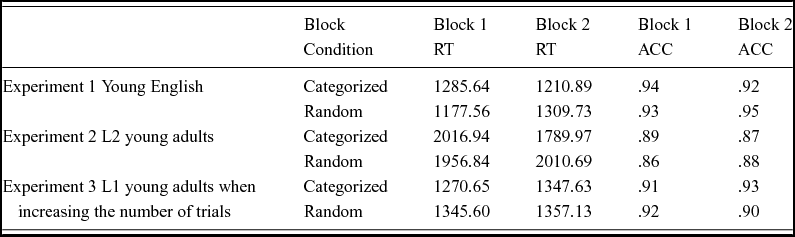
The random effects in the model for negative reciprocal reaction times for young English adults included the random intercepts for subjects and items, and since each participant only received one level of BlockCondition in one block and the other level of BlockCondition in the other block, and also only one level of Direction, only the random slopes of BlockCondition, PrevRRT, PrevACC, and TrialNum were included for subjects. The random effects in the model for accuracy for young English adults included only the random intercepts for subjects and items, based on the results of a sequence of model comparisons. The upper part of Table 1 shows the mean reaction time and accuracy across blocks for young English adults.
The mean reaction time (RT in ms) and accuracy (ACC in 0–1) across blocks and conditions for Experiments 1–3.

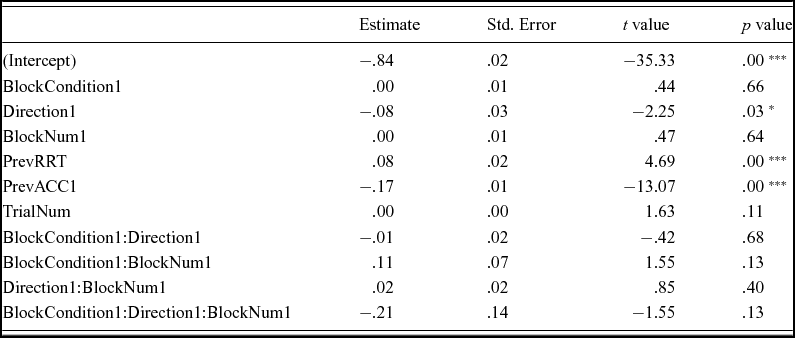
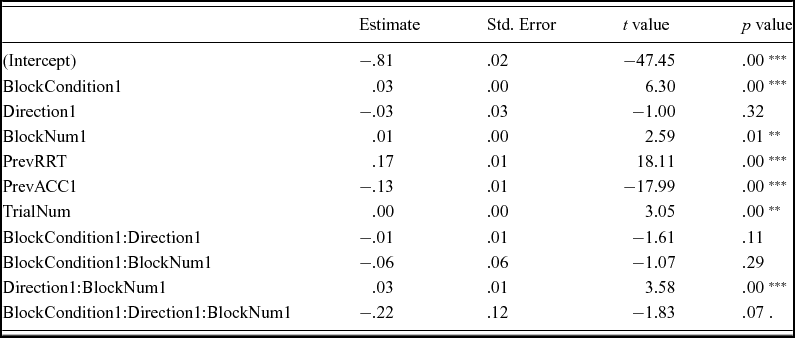
Table 2 shows the fixed effects results in the model summary for negative reciprocal reaction times for young English adults (p values were based on the lmerTest package (Kuznetsova, Brockhoff & Christensen, Reference Kuznetsova, Brockhoff and Christensen2017)). Results showed that there was no overall main effect of BlockCondition, such that young English adults did not respond significantly faster or slower in the categorized list as compared to the randomized list (mean RT for categorized was 1248.64ms, and mean RT for randomized was 1244.23ms), no main effect of BlockNum, such that young English adults did not respond significantly faster or slower in the first block as compared to the second block, which meant that they didn't wear down, and no interaction between BlockCondition and BlockNum.
The estimate, standard error, and t value for the fixed effects in the model summary of the lmer model for negative reciprocal reaction times for young English adults.

Note: Significance codes are 0 ‘***’ .001 ‘**’ .01 ‘*’ .05 ‘.’ .1 ‘ ’ 1.
The effects of PrevRRT and PrevACC were both found to be significant. Participants responded faster on a trial if the previous response was fast rather than slow, and they responded faster on a trial if the previous response was correct than incorrect. The effect of TrialNum was not significant, meaning that there was no significant fatigue effect.
Exclusion of the non-significant two- and three-way interactions in the model did not change the significance of the other effects, except for the variable TrialNum, which was non-significant with the interaction terms but significant after excluding the interaction terms. Nevertheless, the variable BlockCondition was still non-significant after the exclusion of the interaction terms.
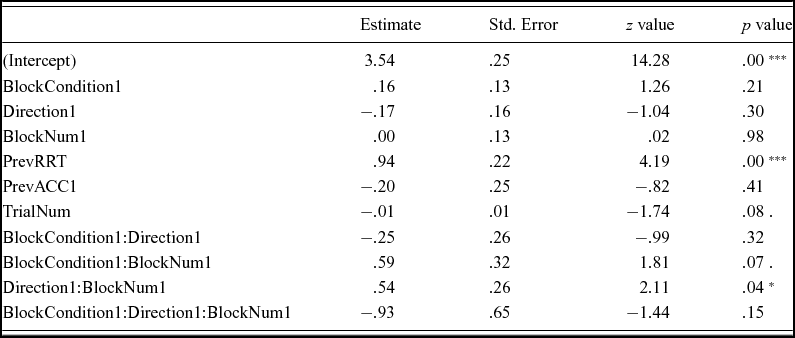
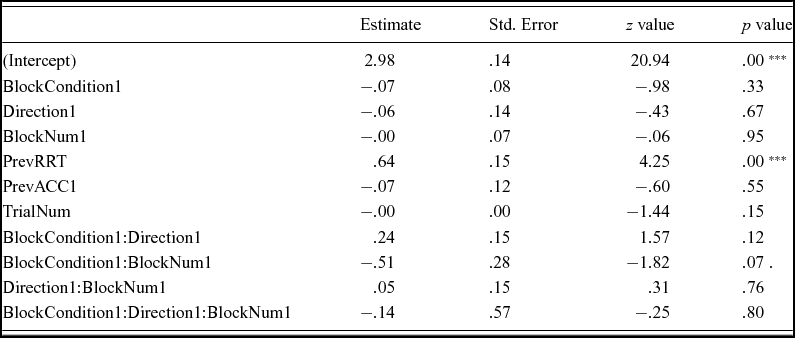
Table 3 shows the fixed effects results in the model summary for accuracy for young English adults. Results showed that there was no overall main effect of BlockCondition, such that young English adults did not respond significantly more or less accurately in the categorized list as compared to the randomized list, and no main effect of BlockNum, such that young English adults did not respond significantly more or less accurately in the first block as compared to the second block, but there was a marginally significant interaction between BlockCondition and BlockNum. Subsequent models fitted with dummy coding of BlockNum showed that there was no significant effect of BlockCondition (z = −.64, p = .52) in the first block, such that in the first block young English adults did not respond significantly more or less accurately in the categorized list as compared to the randomized list, but there was a significant effect of BlockCondition (z = 2.20, p = .03) in the second block, meaning that in the second block, young English adults responded significantly less accurately in the categorized list as compared to the randomized list (mean accuracy for the categorized list in the second block was .92, and mean accuracy for the randomized list in the second block was .95).
The estimate, standard error, z value, and p value for the fixed effects in the model summary of the glmer model for accuracy for young English adults.

Note: Significance codes are 0 ‘***’ .001 ‘**’ .01 ‘*’ .05 ‘.’ .1 ‘ ’ 1.
The effect of PrevRRT was significant such that participants were more likely to give a correct response if the previous response was slow than fast, but the effect of PrevACC was not significant such that the likelihood of participants’ giving a correct response on a trial was not affected by the correctness of the previous response. The effect of TrialNum on accuracy was again not significant meaning that there was no significant fatigue effect.
2.3. Discussion
For young English adults, the lack of significance of the main effect of BlockCondition and the lack of significance of the interaction between BlockCondition and BlockNum in the model for negative reciprocal reaction times meant that young English adults did not respond more or less quickly in the categorized condition as compared to the randomized condition, and this was consistent in both blocks. The insignificance of the main effect of BlockCondition and the significance of the interaction between BlockCondition and BlockNum in the model for accuracy for young English adults mean that young English adults did not respond more or less accurately in the categorized condition as compared to the randomized condition in the first block, but they did respond less accurately in the categorized condition as compared to the randomized condition in the second block.
Contrary to the original hypothesis, the results showed that, for the L1-to-concept direction, participants did not respond faster or more accurately in the categorized condition as compared to the randomized condition. In fact, L1 participants responded significantly less accurately in the categorized condition as compared to the randomized condition in the second block. One possible explanation of failing to find a facilitation effect in the L1-to-concept direction is most likely due to a ceiling effect. Native speakers responded quickly overall completing a very simple comparison task, such that the facilitation effect was not apparent and its effect size for reaction time might be too small for young native English adults.
The ceiling effects found in young L1 adults are directly related to the fundamental differences in task demands of the different tasks (i.e., the picture-naming, forward and backward translation, and word-pair semantic comparison tasks). The L1/L2 picture-naming task requires participants to access the concept and then actively retrieve the L1/L2 word. The forward translation task requires participants to decode the given L1 word, access the concept, and then actively retrieve the corresponding L2 word form. The word-pair semantic comparison task only needs participants to access the concepts of the two words in a pair, and compare their meaning (in terms of the sizes of their referents) at the conceptual level. As a result, both the picture naming and the translation tasks require active word retrieval and thereby induce lexical competition, whereas the word-pair semantic comparison task does not. Due to those differences in task demands across the tasks, the word-pair semantic comparison task is much simpler in this respect, and is therefore much more likely to lead to a ceiling effect in young native speakers.
3. Experiment 2
3.1. Method
Participants
Seventy-two English as a second language learners in a north-east US city, who were all 18 years or older native Mandarin Chinese speakers, participated in this experiment. Mandarin Chinese speakers were recruited as L2 participants in this study because Chinese and English are from different language families, do not share cognates, and also because the researchers wanted to strictly control language background for homogeneity considerations. Most of the participants were attending undergraduate or graduate school. The only exceptions were five participants from other institutions of Higher Education in the US. With regard to the TOEFL iBT test, with a total score of 120 and subscores of 30 for each test section, for most participants, their University required a minimum acceptable TOEFL score (iBT) of 94 (100 or higher, with subscores of 21 being considered competitive) for undergraduate admission and 80 for graduate admission. Other schools require higher scores. Carnegie Mellon University, e.g., requires a TOEFL (iBT) score of 102 or higher for undergraduate admission and graduate admission TOEFL requirement varies depending on the program but is generally about 102. The TOEFL requirements at other universities are similar. Thus, all participants were highly proficient in English and considered able to matriculate in degree programs that use English as the medium of instruction.
Materials
The same materials in Experiment 1 were used in Experiment 2.
Procedure
The procedure for Experiment 2 was the same as that in Experiment 1; except that, for the Chinese participants, the response key choices were “f” for the left word, “j” for the right word, and the space key if they did not know an English word in a pair. Participants did not receive research credit or compensation for completion of the study.
3.2. Data analysis
Consistent with Experiment 1, 4 items were excluded from the analysis: “nightstand vs. bench”, “ship vs. boat”, “panda vs. horse”, and “desk vs. drawer”. The same statistical analysis in Experiment 1 was conducted on the Experiment 2 data, except that the dependent variable of reaction time was transformed into log reaction times, based on boxplots and the box-cox transformation procedure (Box & Cox, Reference Box and Cox1964), in order to achieve the best approximation to normal-distribution assumptions. Log or negative reciprocal transformation led to the same results of significant tests. The middle part of Table 1 shows the mean reaction time and accuracy across blocks for young Chinese adults.
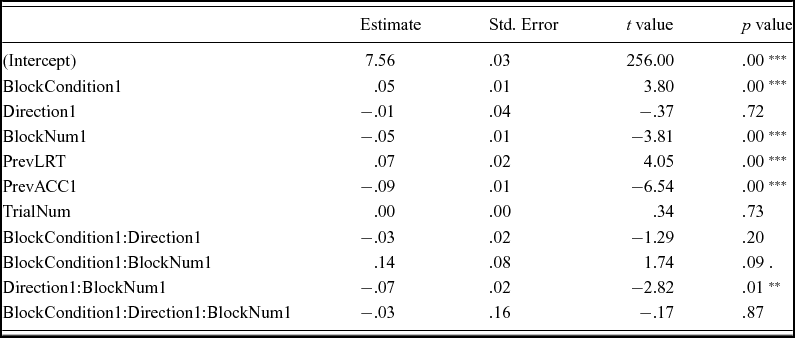
Table 4 shows the fixed effects results in the model summary for log-transformed reaction times for young Chinese adults (p values were based on the lmerTest package (Kuznetsova et al., Reference Kuznetsova, Brockhoff and Christensen2017)). Results showed that there was a significant overall main effect of BlockCondition, such that young Chinese adult learners of English as a second language responded significantly faster in the categorized list as compared to the randomized list (the mean reaction times for categorized and randomized were 1905.47ms and 1984.91ms, respectively), a significant main effect of BlockNum, such that young Chinese adults responded significantly faster in the second block as compared to the first block (mean RT for the first block was 1988.23ms, and mean RT for the second block was 1902.08ms), and a marginally significant interaction between BlockCondition and BlockNum. Subsequent models fitted with dummy coding of BlockNum showed that there was no significant effect of BlockCondition (t = −.53, p = .60) in the first block, such that in the first block young Chinese adults did not respond significantly faster or slower in the categorized list as compared to the randomized list, but there was a significant effect of BlockCondition (t = 2.80, p < .01) in the second block, such that young Chinese adults responded significantly faster in the categorized list as compared to the randomized list in the second block. That finding that young Chinese adults responded faster in the second block showed a training effect such that they were more familiar with the task in the second block.
The estimate, standard error, and t value for the fixed effects in the model summary of the lmer model for log-transformed reaction times for young Chinese adults.

Note: Significance codes are 0 ‘***’ .001 ‘**’ .01 ‘*’ .05 ‘.’ .1 ‘ ’ 1.
Similar to native young English participants in Experiment 1, for young Chinese adults, the effects of PrevLRT (log reaction time of the previous trial, centered around the mean) and PrevACC (sum-coded) were both found to be significant. Participants responded faster on a trial if the previous response was fast than slow, and they responded faster on a trial if the previous response was correct than incorrect. The effect of TrialNum was not significant, meaning that there was no significant fatigue effect.
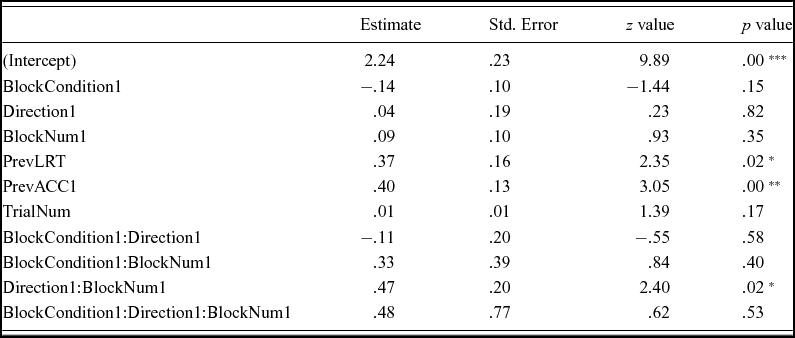
Table 5 shows the fixed effects results in the model summary for accuracy for young Chinese adults. Results showed that there was no overall main effect of BlockCondition such that young Chinese adults did not respond significantly more or less accurately in the categorized list as compared to the randomized list, and no main effect of BlockNum such that young Chinese adults did not respond significantly more or less accurately in the first block as compared to the second block, and there was no significant interaction between BlockCondition and BlockNum.
The estimate, standard error, z value, and p value for the fixed effects in the model summary of the glmer model for accuracy for young Chinese adults.

Note: Significance codes are 0 ‘***’ .001 ‘**’ .01 ‘*’ .05 ‘.’ .1 ‘ ’ 1.
The effect of PrevLRT was significant such that young Chinese participants were more likely to give a correct response if the previous response was slow than fast. The effect of PrevACC was also significant such that the likelihood of young Chinese participants’ giving a correct response on a trial was affected by their correctness in the previous trial. The effect of TrialNum on accuracy was again not significant, meaning that there was no significant fatigue effect.
3.3. Discussion
For young Chinese adult learners of English as a second language, the significance of the main effect of BlockCondition and marginal significance of the interaction between BlockCondition and BlockNum in the model for log-transformed reaction times mean that young Chinese adults responded more quickly in the categorized condition as compared to the randomized condition in only the second block. The insignificance of the overall main effect of BlockCondition and the insignificance of the interaction between BlockCondition and BlockNum in the model for accuracy mean that young Chinese adults did not respond more or less accurately in the categorized condition as compared to the randomized condition in either blocks. These results generally confirmed the research hypothesis that participants would respond faster and more accurately in the categorized condition as compared to the randomized condition in the L2-to-concept direction.
If there is category facilitation in the L2-to-concept direction, there is no reason to deny category facilitation in the L1-to-concept direction, even though native English speakers did not demonstrate a statistically significant category facilitation effect in Experiment 1. Native speakers of a language should theoretically have better lexical access than second language learners, and the fact that there is a category facilitation effect in L2-to-concept but no such effect in L1-to-concept may be explained by the ceiling effect of native English speakers such that the overall much faster responses obscured or disguised the facilitation effect.
In the subsequent experiment, we investigated whether increasing the task demands and cognitive effort of the word-pair semantic comparison task could eliminate the ceiling effect for young English adults found in Experiment 1. Experiment 3 doubled the number of the experimental materials, i.e., doubling the number of word pairs in each category, and added less frequently occurring nouns. By doubling the number of the experimental materials, the experiment is lengthened; and, by adding less frequently occurring nouns, the words would need more efforts and time to activate. Experiment 3 would thus be more likely to generate a larger effect size to counteract the ceiling effect in young English adults in Experiment 1.
4. Experiment 3
4.1. Method
Participants
Seventy-two native English young adults were recruited from a large US university, with an age range of 18–27 years old (mean = 19.38; SD = 2.02).
Materials
The number of experimental trials in each block was double the number of that in Experiment 1. One hundred and forty-four pairs of English words from 6 categories (24 form each category) were used. The categories included “animals”, “body parts”, “clothing”, “food”, “furniture”, and “vehicles”. The 144 pairs of English words were divided into two lists, List1 and List2, each of which consisted of 72 pairs of words from 6 categories (12 from each category). The two lists were presented to each participant, one in the categorized list condition, and the other in the randomized list condition. Participants received different orders of trials in the categorized or the randomized list conditions, the sequence of which were generated by a Python script such that for both the categorized and randomized list conditions there were no more than four consecutive “f” responses or “j” responses; and, for the randomized list condition, word pairs from the same category appeared no more than once in three consecutive trials. The two words in one word pair were always of the same category. Each pair of English words was checked carefully by three native speakers of English for naturalness and size differences.
Procedure
The procedure for Experiment 3 was the same as that in Experiment 1, except that for the young English adults when increasing the number of trials, the response key choices were “f” for the left word, and “j” for the right word.
4.2. Data analysis
Consistent with Experiment 1, 9 items were excluded from the analysis due to having an overall accuracy rate below 2 standard deviations from the mean accuracy rate for all the items: “cloak vs. tuxedo” 27.78%, “couch vs. television” 59.72%, “desk vs. nightstand” 55.56%, “flatbread vs. pancake” 59.72%, “motorcycle vs. boxcar” 58.33%, “recliner vs. ottoman” 59.72%, “stove vs. bookshelf” 61.11%, “stroller vs. settee” 25.00%, and “tamale vs. dumpling” 56.94%.
Similarly to Experiment 1, a linear mixed-effect analysis was performed on the reaction time data (negative reciprocal) and a generalized (logit) linear mixed effect analysis was conducted on accuracy. The fixed effects in both models included BlockCondition, BlockNum, Direction, and their interactions (both two-way and three-way), as well as PrevRRT, PrevACC, and TrialNum. We sum-coded BlockCondition, BlockNum, Direction, and PrevACC as −.5 and .5. Both the model for negative reciprocal reaction times and the model for accuracy included only the random intercepts for subjects and items as random effects, based on the results of a sequence of model comparisons. The bottom part of Table 1 shows the mean reaction times and accuracy across blocks for young English adults when increasing the number of trials.
Table 6 shows the fixed effects results in the model summary for negative reciprocal reaction times for young English adults when increasing the number of trials (p values were based on the lmerTest package (Kuznetsova et al., Reference Kuznetsova, Brockhoff and Christensen2017)). Results showed that there was a significant main effect of BlockCondition, such that, when increasing the number of trials, young English adults responded significantly faster in the categorized list as compared to the randomized list (mean RT for categorized was 1309.56ms, and mean RT for randomized was 1351.30ms), a main effect of BlockNum, such that, when increasing the number of trials, young English adults responded significantly slower in the second block as compared to the first block (mean RT for the first block was 1308.46ms, and mean RT for the second block was 1352.31ms), and no interaction between BlockCondition and BlockNum.
The estimate, standard error, and t value for the fixed effects in the model summary of the lmer model for negative reciprocal reaction times for young English adults when increasing the number of trials.

Note: Significance codes are 0 ‘***’ .001 ‘**’ .01 ‘*’ .05 ‘.’ .1 ‘ ’ 1.
The effects of PrevRRT and PrevACC were both found to be significant. This second group of young English participants responded faster on a trial if the previous response was fast than slow, and they responded faster on a trial if the previous response was correct than incorrect. The effect of TrialNum was not significant, meaning that there was no significant fatigue effect after accounting for the effect of BlockNum.
Table 7 shows the fixed effects results in the model summary for accuracy for young English adults when increasing the number of trials. Results showed that there was no overall main effect of BlockCondition, such that, when increasing the number of trials, young English adults did not respond significantly more or less accurately in the categorized list as compared to the randomized list, and no main effect of BlockNum, such that, when increasing the number of trials, young English adults did not respond significantly more or less accurately in the first block as compared to the second block, but there was a marginally significant interaction between BlockCondition and BlockNum. Subsequent models fitted with dummy coding of BlockNum showed that there was no significant effect of BlockCondition (z = 1.15, p = .25) in the first block, such that in the first block young English adults did not respond significantly more or less accurately in the categorized list as compared to the randomized list; but there was a significant effect of BlockCondition (z = −2.06, p = .04) in the second block – meaning that, in the second block, native English speakers responded significantly more accurately in the categorized list as compared to the randomized list (mean accuracy for the categorized list in the second block was .93, and mean accuracy for the randomized list in the second block was .90). A speed/accuracy trade-off was demonstrated in Block 1 (see the bottom of Table 1) where participants were faster but also less accurate in the categorized condition as compared to the randomized condition.
The estimate, standard error, z value, and p value for the fixed effects in the model summary of the glmer model for accuracy for young English adults when increasing the number of trials.

Note: Significance codes are 0 ‘***’ .001 ‘**’ .01 ‘*’ .05 ‘.’ .1 ‘ ’ 1.
The effect of PrevRRT was significant such that this second group of young English participants were more likely to give a correct response if the previous response was slow than fast, but the effect of PrevACC was not significant such that the likelihood of participants’ giving a correct response on a trial was not affected by the correctness of the previous response. The effect of TrialNum on accuracy was not significant, meaning that there was no significant fatigue effect on accuracy.
4.3. Discussion
When increasing the number of trials, for young English adults, the significance of the main effect of BlockCondition and insignificance of the interaction between BlockCondition and BlockNum in the model for negative reciprocal reaction times mean that young English adults responded more quickly in the categorized condition as compared to the randomized condition in both blocks. The insignificance of the overall main effect of BlockCondition and the marginal significance of the interaction between BlockCondition and BlockNum in the model for accuracy for young English adults when increasing the number of trials mean that young English adults did not respond more or less accurately in the categorized condition as compared to the randomized condition in the first block, but they did respond significantly more accurately in the categorized condition as compared to the randomized condition in the second block.
These results confirmed the research hypothesis that participants would respond faster and more accurately in the categorized condition as compared to the randomized condition in the L1-to-concept direction. Therefore, the claim that the null effect in young English adults in Experiment 1 may be due to a ceiling effect was supported in Experiment 3. By increasing the number of experimental materials, young English adults did show a significant L1-to-concept category facilitation effect.
5. General discussion
The previous literature on bilingual memory representation is controversial with regard to whether and to what extent backward translation is conceptually mediated. We hypothesized that Kroll and Stewart's (Reference Kroll and Stewart1994) finding of the null category effect in backward translation did not necessarily suggest no conceptual mediation in backward translation – because a possible L2-to-concept facilitation effect might have counterbalanced the concept-to-L1 category interference effect. With a word-pair semantic comparison paradigm in which participants were required to make semantic comparisons on English word pairs in either categorized or randomized list conditions, the hypothesized category facilitation effect in L2/L1-to-concept directions could be examined. The hypothesized category facilitation effect was indeed attested in both the L1-to-concept and the L2-to-concept directions in the current study, by asking native English participants and native Mandarin Chinese participants speaking English as an L2 to make semantic comparisons on the size of English words’ real-world referents in categorized vs. randomized list conditions. This study therefore explained why Kroll and Stewart (Reference Kroll and Stewart1994) did not find a category interference effect in the backward translation direction: because the category effect in the L2-to-concept direction is a facilitation effect, and the category effect in the concept-to-L1 direction is an interference effect (evidenced from L1 picture naming), the L2-to-concept category facilitation effect and the concept-to-L1 category interference effect cancelled each other out to reveal a superficial overall null category effect. Our findings, however, are consistent with the observation by Kroll, van Hell, Tokowicz, and Green (Reference Kroll, van Hell, Tokowicz and Green2010) that the weak link between concepts and L2 words appears to be most weak when going from concepts to L2 words, and not from L2 words to concepts. Moreover, there are sometimes L1 words that do not have an L2 translation equivalent, or vice versa. In those situations, it is only reasonable to assume direct L1-to-concept and L2-to-concept links, since the concepts associated with the L1 and L2 words are not exactly the same.
The finding of no category effect in the L1-to-concept direction in Experiment 1 is also consistent with Kroll and Stewart's finding of a category interference effect in forward translation because forward translation consists of two steps: a L1-to-concept step showing no category effect (as evidenced in Experiment 1) and then a concept-to-L2 step involving a category interference effect, resulting in an overall category interference effect in forward translation. There was a category facilitation effect in L2-to-concept in Experiment 2 but no such effect in L1-to-concept in Experiment 1, which was probably a ceiling effect of native English speakers such that the overall much faster responses obscured or disguised the category facilitation effect. This claim was supported by results in Experiment 3, where we did find a significant effect in young English adults when increasing the number of trials.
The finding of the category facilitation effect in the L2-to-concept direction may also help explain the disagreements in the previous literature regarding concept mediation in backward translation. The employment of different tasks, including forward and backward translation tasks, translation recognition tasks and Stroop-like experiments, has very likely resulted in the contradicting results and conclusions. Forward and backward translation tasks require participants to access the given L1 or L2 word, and then actively retrieve the L2 or L1 word; whereas translation recognition tasks only require L1 or L2 word access, but not word retrieval. Another source for contradicting results lies in the specific semantic features that were studied to test conceptual mediation, with some focusing on category information (e.g., Kroll & Stewart, Reference Kroll and Stewart1994; Sholl et al., Reference Sholl, Sankaranarayanan and Kroll1995), and others focusing on word imageability, frequency, cognate status (de Groot & Poot, Reference de Groot and Poot1997), meaning-relatedness (Ferré et al., Reference Ferré, Sánchez-Casas and Guasch2006; Guasch et al., Reference Guasch, Sánchez-Casas, Ferré and García-Albea2008), or grammatical class (Sunderman & Kroll, Reference Sunderman and Kroll2006). Tokowicz (Reference Tokowicz2015, p. 65) suggested that the differences in method of testing “may prove critical in reconciling the broader pattern of results”.
One counterargument to the interpretation of the L2-to-concept category facilitation effect as demonstration of concept mediation in backward translation might be that participants actively translate the L2 words into L1 words via the lexical link between the two and then make semantic comparisons based on the L1 words. However, this counterargument does not hold: if we assume that native Chinese participants actively translate L2 English words into L1 Chinese words via lexical links in the word-pair semantic comparison task, we would need to agree that this translation from L2 words to L1 words does not require concept mediation and is impervious to the category effect. If native English participants do not demonstrate a category effect in the word-pair semantic comparison task in English as demonstrated in Experiment 1, native Chinese participants should show parallel results of no category effect in the word-pair semantic comparison task in L1 Chinese in Experiment 2. The overall effect of aggregating the null category effect in backward translation via lexical links and the null category effect in L1-to-concept direction should still be an overall null category effect, which is inconsistent with the finding of a L2-to-concept category facilitation effect found in Experiment 2. We do not deny the activation of L1 words on encountering L2 words (Jiang, Reference Jiang2000). Nevertheless, as argued above, an account of merely relying on translation of L2 words into L1 words in the L2 English word-pair semantic comparison task would not correctly predict a category facilitation effect.
Another counterargument that we are able to refute is that L2 participants may perform more quickly and more accurately in the categorized list as compared to the randomized list because of a testing strategy, such that they can expect the occurrence of certain lexical items in the categorized list condition. Our two arguments against this strategy explanation are (1) if anything, L1 participants should be more effective with the expectation strategy than L2 participants because they have a larger L1 vocabulary and stronger conceptual links between concepts and L1 words, whereas L2 participants have a smaller L2 vocabulary and, according to Kroll and Stewart's (Reference Kroll and Stewart1994) revised hierarchical model, weaker conceptual links between concepts and L2 words; and (2) if participants indeed employ expectation strategies, the category effect in picture naming should really be facilitation, rather than interference (Damian & Als, Reference Damian and Als2005). The category interference effect in picture naming refutes the claim that participants employ expectation strategies in picture naming. There is no a priori reason to believe that participants would not employ expectation strategies in picture naming but would employ expectation strategies in the word-pair semantic comparison task in the current study.
The category facilitation effect in the L2-to-concept direction also adds to our knowledge of word access and processing. Repeated presentation of words within a category facilitated semantic processing of a target word within the same category. This facilitation effect cannot, however, be used to evaluate the lexical competition account as compared to the incremental learning account. Both the lexical competition and the incremental learning account would predict no category interference: since the word-pair semantic comparison task does not require lexical retrieval, no lexical competition will occur. Instead, because the task employed in the current study was a semantic categorization task, previous activation of a word within a category would have activated to a certain extent the current word of the same category, and would thus facilitate the semantic processing of the current word. The category facilitation effect in both L1- and L2-to-concept directions is theoretically a priming effect for categorically related rather than associatively related word pairs (Becker, Reference Becker1980; Plaut & Booth, Reference Plaut and Booth2000). Nevertheless, the category facilitation effect in the current study showed priming due to shared category characteristics between trials, whereas category priming in traditional studies has been due to a priming effect of a category-name prime on a category-member target in a single trial (Becker, Reference Becker1980). The category facilitation effect found in the current word-pair semantic comparison task is also consistent with Damian et al. (Reference Damian, Vigliocco and Levelt2001) in disproving “conceptual conflict due to overlapping representations” (p. 878) as a potential explanation for the category interference effect in picture naming, since, instead of potential conceptual conflicts among items within the same category, it has been demonstrated in the current study that category effect in a semantic comparison task is facilitative. Although Damian et al. (Reference Damian, Vigliocco and Levelt2001) did not report on the statistical analyses of their manual response task that similarly did not require lexical retrieval, the mean reaction time of their heterogeneous (randomized) condition was higher than that of the homogeneous (categorized) condition, which also pointed to a semantic facilitation effect. Moreover, a word-naming task (reading aloud printed words), which does not require lexical retrieval either, showed statistically significant facilitatory effects (Damian et al., Reference Damian, Vigliocco and Levelt2001).
Although the L2 participants recruited in the current study are all advanced learners of English who had met the matriculation requirements for pursing an academic career in English and were, at the time of testing, studying and living in an English-speaking country, we didn't collect the L2 group's AOA or fluency measures, so we could not give a more detailed description of the L2 group. Nevertheless, we do anticipate that the results of the paper are generalizable to other L2 speaker groups, even novice or less fluent bilinguals. As we have pointed out earlier, concept mediation can also be attested in novice or less fluent bilinguals (Altarriba & Mathis, Reference Altarriba and Mathis1997; de Groot & Poot, Reference de Groot and Poot1997; Dufour & Kroll, Reference Dufour and Kroll1995; Sunderman & Kroll, Reference Sunderman and Kroll2006). Of course, we cannot directly test novice or less fluent bilinguals empirically using the word-pair semantic comparison task, due to their much smaller vocabulary. But the previous literature finding concept mediation in novice or less fluent bilinguals indirectly suggests that the category facilitation effect found in the L2 adults are very likely to be generalizable to the other L2 speaker groups.
Our study highlights two important methodological caveats in second language processing research. First, in the L2 processing literature, carryover effects have rarely been included in statistical analyses. We replicated the significances of carryover effects of the previous trial on participants’ performance in the current trial (Kuperman et al., Reference Kuperman, Schreuder, Bertram and Baayen2009) not only in L1 participants, but also in L2 participants, and further confirmed the importance of inclusion of those factors in statistical analyses. Second, the current experiments on L1 participants highlight the issue of ceiling effects when comparing native speakers (NS) and non-native speakers (NNS). Oftentimes direct comparisons between NSs and NNSs can be problematic. On the one hand, there are problems of comparative fallacy when directly comparing NSs and NNSs (Bley-Vroman, Reference Bley-Vroman1983; Dekydtspotter, Schwartz & Sprouse, Reference Dekydtspotter, Schwartz, Sprouse, O'Brien, Shea and Archibald2006). On the other hand, if the task is too easy for NSs, as Experiment 1 was, an effect of interest could be disguised by the overall fast response of NSs, leading to a ceiling effect for NSs, which in turn makes a direct comparison not only unfair but also invalid. In order to compare L1 and L2 processing patterns, experimenters should take care to avoid possible ceiling effects and also floor effects in their task design.
6. Conclusion
To conclude, by means of a specifically designed word-pair semantic comparison task, the results of the current study have supported the view of concept mediation in backward translation and explained why Kroll and Stewart's (Reference Kroll and Stewart1994) finding of a null category interference effect did not suffice to prove that backward translation was lexically based. Instead, the category facilitation effect in the L2-to-concept direction found in our study adds further evidence to the previous literature of conceptual mediation in backward translation in more fluent bilinguals. The current study showed how conclusions based on a specific methodology might be misleading and was consistent with Tokowicz (Reference Tokowicz2015) on how reconciling results from the employment of different methods is crucial in order to approach the correct interpretations and conclusions.