




No CrossRef data available.
Article contents
- Abstract
- THE PARTISAN GENDER GAP OVER TIME
- A NEW DESIGN FOR EXPLAINING THE GENDER GAP
- EXPLAINING THE DYNAMICS OF THE GENDER GAP
- Theories of Political Climate and Gender Differences
- Theories of National Economic Conditions and Gender Differences
- Theories of Social Structure and Gender Differences: Economic Vulnerability and Economic Autonomy
- ANALYSES
- The Persistence of Gender Differences
- Multivariate Analysis
- CONCLUSION
- References
The Dynamics of the Partisan Gender Gap
Published online by Cambridge University Press: 01 August 2004
Article contents
- Abstract
- THE PARTISAN GENDER GAP OVER TIME
- A NEW DESIGN FOR EXPLAINING THE GENDER GAP
- EXPLAINING THE DYNAMICS OF THE GENDER GAP
- Theories of Political Climate and Gender Differences
- Theories of National Economic Conditions and Gender Differences
- Theories of Social Structure and Gender Differences: Economic Vulnerability and Economic Autonomy
- ANALYSES
- The Persistence of Gender Differences
- Multivariate Analysis
- CONCLUSION
- References
Abstract
Gender differences in vote choice, opinion, and party identification have become a common feature of the American political landscape. We examine the nature and causes of gender differences in partisanship using a time series approach. We show that gender differences are pervasive—existing outside of the context of specific elections or issues—and that they are a product of the interaction of societal conditions and politics. We find that from 1979 to 2000, the partisan gender gap has grown when the political climate moved in a conservative direction, the economy deteriorated, and the percentage of economically vulnerable, single women increased. The gender gap is likely to be a continual feature of the American political landscape: one that shapes everything from elite political behavior to election outcomes.
Information
- Type
- ARTICLES
- Information
- Copyright
- © 2004 by the American Political Science Association
The partisan preferences of men and women have both converged and diverged at different times in history. The late 1970s, for example, saw a period in which men and women shared similar levels of Democratic and Republican partisan support. Since the early 1980s, however, partisan preferences have diverged. The divergences are fundamentally political, often deciding election outcomes, helping structure policy debates and election campaigns, and also contributing to policy outcomes. Each of these may in turn either fuel or diminish the original differences in the partisanship of men and women and lead to a politics more or less divided on the basis of gender. Politicians, for example, may be well served by reaching out and supporting issues designed to minimize differences in support from men and women, especially when the parties find themselves in rough parity. Electoral motivations may also lead politicians to support policy that exacerbates gender differences when gaps work in their favor, further contributing to them. To the extent that partisan differences across genders are persistent, these implications become more profound, characterizing the political landscape for long periods of time. Convergence in the partisan preferences of men and women also has political consequences. It indicates a lack of polarization of the parties on issues relevant by gender, suggesting an equality of consideration and influence that are often associated with “good” democracy.
We know that the partisan gender gap matters for the conduct and outcomes of politics and that its potential for divisiveness is large. Media, politicians, and pundits have noted the differences, yet surprisingly the gender gap has not been systematically illustrated over time and little has been offered to explain the patterns of convergence and divergence in party identification by gender over time. Candidate- or election-based explanations alone cannot explain gender differences or their persistence outside of elections. And studies that focus on individual partisan and opinion differences within an election (or even a short panel) cannot address the sources of variation over time.
We examine the role of social and demographic trends as well as the economic and political roots of the partisan gender gap from 1979 to 2000. In doing so we address a set of related but also more general questions than are typically addressed in the literature on the gender gap. We begin with two descriptive questions. First, how general are gender differences: Do they exist outside of specific elections and policy issues? Second, how enduring a feature of the political landscape are gender differences? To answer these questions, we present over-time gender differences in partisanship on a quarterly basis using survey data from CBS News and The New York Times since the late 1970s and assess the persistence of gender differences over this period. Answers to these questions speak to the nature and significance of gender differences and their potential for affecting, perhaps structuring, the play of politics in the short and long run. Then we turn to explanations for these differences and ask: Why does the partisan gender gap fluctuate over time? We expand on existing explanations, specifically asking, What are their over-time implications? To test the hypotheses, we model the dynamics of the partisan gender gap and ask how the political, social, and economic environments affect the dynamics during periods of “routine” politics as well as during elections. An understanding of gender differences and their over-time dynamics alerts us to the factors that promote a politics more or less divided by gender. To the extent that politicians and society at large value convergence, answers to these questions can ultimately help us to build an environment in which political debates and outcomes are transparent with respect to gender.
THE PARTISAN GENDER GAP OVER TIME
The gender gap has been variously referred to as the differences between men and women in political opinions, voting behavior, and partisan identification. We know, for example, that women are less likely than men to support any form of aggression; they oppose capital punishment and support stricter gun control laws, and they are less likely to support involvement in foreign wars (Conover and Sapiro 1993). Women have also been more supportive of government involvement in the economy to ensure good jobs and a certain standard of living, to reduce income differences, and to increase government services in general (e.g., Chaney, Alvarez, and Nagler 1998, and Erie and Rein 1988). In contrast, there appear to be no significant differences in opinions on “women's issues”—issues related to the Equal Rights Amendment, abortion, and other feminist concerns (Cook and Wilcox 1991; Klein 1984; Seltzer, Newman, and Leighton 1997), nor are there differences in the electorate between gender-role attitudes by party (Sanbonmatsu 2002).
There are also well-documented differences in the voting behavior of men and women (e.g., Kaufmann and Petrocik 1999, Kenski 1988, and Miller 1991). Gender differences in the vote often headline election night news coverage and are analyzed by a score of journalists and political scientists. In the 1992 election, for example, 41% of the men, compared with 45% of the women, voted for Governor Bill Clinton. The media suggested that Clinton owed his victory to women, and in 1996, much was made of President Clinton's ability to maintain his support among women (“Year of the Soccer Mom”).
Finally, there are differences in the partisan identifications of men and women (e.g., Bendyna and Lake 1994, Kanthak and Norrander 2002, and Norrander 1997, 1999). Typically these differences are presented in parallel with vote differences in individual elections or using biennial NES data. Snapshot differences in partisan preferences for any given election illustrate the average differences between men and women at isolated points in time. Biennial data reveal changing preferences but belie the continuous nature of gender differences and their response to routine politics. They further focus efforts to explain the gender gap on the role of issues within elections.
We investigate the partisan gender gap over time. The partisan preferences of men and women, measured quarterly from 1977 to 2000, are presented in Figure 1.1
The data are from the CBS News and New York Times (CBS/NYT) surveys from 1977 through the fourth quarter of 2000. The surveys we use were all done by telephone and include samples from the population of adults 18 or older and living in the continental United States. The telephone numbers for each survey are selected by a variant of random digit dialing where random groups of area codes and exchanges are selected, from which the last four digits are then randomly selected. Contacted households are asked two questions whose answers are used to randomly select the adult interviewed. These are: How many adults live in the household? and How many of these are women? While CBS/NYT occasionally conduct panel surveys, only those contacted in the initial wave were included in the data. Thus the surveys are independent draws from the population.
CBS/NYT asks the traditional party identification question, “In general, do you usually consider yourself a Democrat, a Republican, an Independent, or what?” Macropartisanship is expressed as one group of Democratic identifiers' percentage of all those who identify with a party. This is the standard way of expressing the macropartisanship series. This definition does not take into account the movement of Independents (see Norrander 1997). Independents cannot be separated from “don't know” or “other” because of the way the responses are coded by CBS/NYT over the full period. Thus we leave consideration of the flows to and from the partisan to independence categories for future research. There are four quarters without surveys; we use Stimson's (1998) dimensional analysis algorithm to estimate the missing time points. For 1979–2000, the estimation sample of our multivariate analysis, on average, 3,241 adults (1,336 males and 1,905 females), responded Democrat or Republican to the party identification question in any quarter.
Kaufmann and Petrocik (1999), however, contend that women's overall identification did not change during 1952–1996. They base their argument on the NES surveys conducted in presidential election years.
Miller (1991) suggests that these differences are largely confined to the south. Disaggregation of the CBS/NYT data by region finds that partisan gender differences are no less prevalent among nonsouthern women; the gender gap exists in both the nonsouth and the south.

Democratic Partisanship by Gender
We present the gender gap itself—the difference between the partisanship of men and women—aggregated by quarter in Figure 2. The gender gap has ranged from nearly zero to just over 10% between 1977 and 2000. Women were about 5% more Republican than men in the late 1970s and were about 5%–10% more Democratic than were men by the late 1980s and through 2000. The gap does not appear to grow steadily but increases substantially in 1979 and keeps increasing at a slower rate. Since all surveys have a margin of error, we include 95% confidence intervals (i.e., estimate ± margin of error) in Figure 2.4
The margin of error on these observed values is not the sum of the sampling error in the two subsamples; it is smaller than this sum. The margin of error formula for the difference of two proportions is given by

where Nf and Nm are the numbers of female and male party identifiers interviewed in surveys conducted within a given quarter, and Pf and Pm are the percentage of Democrats in each group (i.e., female and male Democratic macropartisanship). Note that this margin of error is significantly smaller than the sum of the margins of error associated with each proportion. The reduction can be as large as 29% according to one of van Belle's (2002, p. 39) “statistical rules of thumb”: “Confidence intervals associated with statistics can overlap as much as 29% and the statistics can still be significantly different.” If we use this simple formula to place confidence intervals on the gender gap, we can see that the gender gap is nonzero over much of this time period. Note that if we take any four consecutive quarters and consider the joint probability that the gender gap is zero, the probability is very low. This is true even in quarters with small Ns and a small estimated gender gap. In 1980, a time when the gap is relatively small, the probability is 0.00000761! See the archived materials for further details.

The Partisan Gender Gap with 95% Confidence Intervals
While stark changes in the nature of the gender gap have stimulated individual level research explaining why men and women behave differently or have different preferences, the dynamics of the gender gap have gone largely unexplored.5
See Klein 1984 for an early effort at building a dynamic account. Recently Sapiro and Conover (1997) used the 1992 U.S. election as a case study to focus on how to understand the fact that the degree or even presence of gender differences varies across time and place, i.e., context. We focus on the dynamics of the gender gap rather than the inception of the gender gap. Some of the measures used in this paper are not available until the late 1970s or are only available annually prior to this time. Moving to annual data would reduce the number of time points for analysis, making reliable time series analysis impossible.
These are the questions we begin to answer with this analysis. We use time series data on the partisan gender gap to test implications drawn from theories offered to explain static gender differences. Specifically, we consider what theories about the differential experience and autonomy of men and women imply for the dynamics of the gender gap, with the goal of enhancing our understanding of the gender gap.
A NEW DESIGN FOR EXPLAINING THE GENDER GAP
Examining the dynamics of the partisan gender gap gives us a unique perspective on the causes of gender differences and offers several advantages over cross-sectional analysis. We explain our three design choices in this section: Why time series analysis? Why the partisan gender gap? Why the gap itself, rather than men's and women's individual partisanship?
We have argued that understanding changes in gender differences is important. The differences in partisanship illustrated above are not time bound. Time series analysis allows us to assess the role of the changing environment in determining gender differences in attitudes and behavior and to offer an explanation for this change. Specifically using time series data we can test the hypotheses that changes are due to the effects of changes in the political environment, changes in the conditions or experiences of men and women, and changes in the economy. In so doing, we can better understand gender differences more generally. In contrast, cross-sectional analysis is prone to several pitfalls. First, the persistence of the gender gap cannot be assesed cross-sectionally. Second, explanations for the gender gap in cross-sectional analysis focus on features that discriminate among individuals, which are inherently less political than macro-level factors (Erikson, MacKuen, and Stimson 2002); political conditions are constant within a cross section and cannot help us understand variations in gender differences at any one point in time. Third, the factors that help us explain variation in individual behavior do not work well over time; in fact, they are usually constant. We, however, want to understand the impact of slow-moving macro processes, e.g., economic, social, and political processes. For example, the percentage of women with a college education moves very slowly over time and is constant for all individuals if using a cross-sectional approach. Finally, one cannot consider the evolution of the gender gap and associated counterfactuals over time. We want to be able to talk about the effect of a shock on the trajectory and sustainability of the gender gap.
Why partisan differences? First, partisanship is both more enduring and more general than the vote, which is dependent on the particular candidates, issue positions, and campaign context of an election. Second, biennial examination of gender differences required by an analysis of the vote belies the continuous nature of the gap; dynamics exist outside of elections and the events of the campaigns and provide more information about the gender gap. Third, the partisan gap may drive the vote gap so that we need to explain the partisan gender gap as well as, and prior to, a vote gap if our goal is to explain gender differences more generally.
Consider a typical individual-level study of the gender gap that focuses on the presidential vote choice as the dependent variable. Party identification is the most important explanatory variable for vote choice, but the gender gap is intrinsic to both party identification and vote choice. Using the gender gap in party identification to explain the gender gap in vote choice is thus not a satisfactory explanation. There are at least three methodological and substantive issues here. First, the gender gap in party identification itself needs to be explained. Even though one might be content with looking into the gender differences in public opinion to explain the gender gap in both vote choice and party identification, one can hardly be satisfied treating the gender gap in party identification as an exogenous variable. Second, if party identification is endogenous, factors not included in the vote equation will affect both partisanship and the vote so that estimates of these effects on the vote will be biased. Time series analysis has an advantage over cross-sectional designs when there are endogenous variables. Third, even if one is willing to accept the exogeneity of party identification, it is doubtful how much of the gender gap in vote choice is left to be explained after controlling for this variable. Cook and Wilcox (1995) report that while partisanship did not fully account for the gender gap in vote choice in 1972, 1980, and 1984, it did so in both 1988 and 1992 (see also Kaufmann and Petrocik 1999). Thus, it is not clear whether the observed differences between men and women concerning the distribution and effects of other explanatory variables in the vote choice equation really explain the gender gap.
The natural solution to these problems, and the obvious method for assessing change in the gender gap over time, is an aggregate-level, longitudinal study of the gender gap. We consider the gender gap in macropartisanship, measured at each time point as the aggregate-level difference between the percentage of female and that of male party identifiers who claim to be Democrats. Thus our work follows the macropolitical focus that Erikson, MacKuen, and Stimson (2002) advocate.
Why focus on the gender gap itself, rather than separately analyzing the partisanship of men and women? We look at the gender gap itself foremost because the differences between men and women compose the theoretical concept at the heart of our inquiry. We are less interested, for example, in whether men and women both penalize the incumbent party for poor economic performance than whether women punish them disproportionately more severely than do men. An analysis of the gender gap focuses our attention on, indeed explicitly models, these differences. An analysis of the gender gap will thus allow us to draw conclusions not about men and women, but about the differences between them and about the implications of the different effects of the independent variables on men and women. There are other advantages to this approach as well. Analyzing the difference between female and male macropartisanship eliminates any nongender-specific trend, for example, the general trend of increased Republican support that occured during the eighties. The shared movement need not be explained. This is a distinct advantage over the separate analysis of each gender where we must explain this shared variation. This is particularly true because the general trend in Republican party support has proven difficult to explain. The fluctuation of the resulting gap series reflects only the differential responsiveness of men and women to the political, economic, and structural environment. By analyzing the path of such a time series, we can explore the dynamics in gender differences for a long period, of which only a few time points can be sampled in a cross-sectional study of the gender gap in vote choice or in a panel study of the gender gap in party identification. That is, change can be the focus of study.
EXPLAINING THE DYNAMICS OF THE GENDER GAP
While identifying the gender gap is easy, separating out causal mechanisms to explain the differences between men and women has proven difficult. Previous explanations for the gender gap have been cast largely in static terms, yet many of these explanations have clear aggregate dynamic implications for gender differences and we draw these out. We assess the persistence of the gender gap because of its importance for thinking about shifts in aggregate partisanship. If gender difference are persistent, an increase in the gender gap due to shocks in the political, economic, and structural environment may last for years even if the shocks are just transient phenomena. In addition, theory predicts that gender differences will be persistent because they are a function of features of the political system that change very slowly. For example, it is difficult to move people off of welfare or change education levels, so gender differences will be persistent. Another important part of our theoretical contribution is the recognition and discussion of the differential impact characteristics of men and women have on their partisanship as a result of the changing nature of the macro polity. We offer a set of hypotheses based on the theoretical literature that predict the aggregate dynamics of the gender gap, taking care to highlight the dynamic implications of these theories.
Theories of Political Climate and Gender Differences
Political explanations for gender differences in partisanship treat the political climate itself as static, but the political climate, specifically its ideological nature, has important implications for how citizens react to the political parties over time. As Abramowitz and Saunders (1988) note, ideological polarization can impact party loyalties in the electorate. We argue further that ideological distinctions may have a differential impact on men and women. We hypothesize that as the political climate becomes more conservative, the gender gap should increase. Drawing on theories that relate to both compassion and self-interest, gender roles, and economic vulnerability, we argue that as the political climate becomes more hostile to welfare (more conservative), women ought to react more negatively (less positively) than men, thus increasing the gap: Political swings to the right may (or may not) find support from both sexes, but women should be less supportive than men either if they are more compassionate or if they disproportionately bear the brunt of conservative social policy, i.e., cuts or proposed cuts that predominate in a conservative political climate.6
Measures of ideological self-placement based on CBS/NYT surveys show that women have consistently been less likely to identify as conservatives than have men since the late 1980s. See Rohde 1991 for a discussion of increasing party polarization and Wolbrecht 2000, an important work that provides a strong case for party polarization on gender issues.
Measuring the political climate is a difficult task. The political climate encompasses party priorities and rhetoric, public opinions, and political events and is often tied to a particular president, his administration, or party. We know that there was an atmosphere of fiscal conservatism and attacks on the welfare state by the Republican party during much of this time period (1979–98), which were given broad support. This contributed to Republican gains among both men and women. Popular ideology highlighted conservative preferences and these preferences were associated first with President Reagan and ultimately with the Republican party (Carroll 1988, 1999). This clear association highlighted the ideological divisions between the parties and gave voters opposed to the conservative environment a clear incentive to support the Democratic party (or declare themselves Independents). A delay in the effect of the political climate on the gender gap would not be unexpected because the effect must be mediated by elite perception and articulation.
We measure the degree of conservatism that characterizes the political environment using public support for conservatism in the electorate. Specifically, we aggregate the percentage of adults who identify themselves as conservative as opposed to moderate or liberal.7
Ideology is compiled from the CBS/NYT surveys. Respondents are regularly asked if they “consider themselves liberal, moderate, or conservative.” We used Stimson's (1998) dimensional analysis algorithm to estimate four missing quarters. An average of over 4000 respondents indicated that they were either liberal, moderate, or conservative in each quarter the question was asked.
Theories of National Economic Conditions and Gender Differences
National economic conditions should also affect the gender gap. We know that more women than men are economically vulnerable and reliant on welfare benefits (Erie and Rein 1988; Piven 1985; Stark 1996). We also know that women are more pessimistic than men about the state of the national economy (e.g., May and Stephenson 1994 and Seltzer, Newman, and Leighton 1997)—a pessimism that is certainly enhanced as the economy gets worse. Poor economic conditions thus hurt more women than men both financially and psychologically. In addition, if women are also more compassionate than men, a real or perceived bad economy may heighten feelings of compassion for the poor (Ruddick 1980; Schlozman et al. 1995; Welch and Hibbing 1992). Since the Democratic party is typically seen as the party for the “welfare state” and the party of the downtrodden, poor economic conditions should interact with the economic and psychological differences between the genders and motivate more women than men to turn toward (or stay with) the Democratic party. Thus we expect that, all else equal, the gender gap will increase when the economy is in decline, and it will decrease when the economy improves.
Chaney, Alvarez, and Nagler (1998) make an interesting argument that, because women have consistently more negative assessments of the economy than do men, a part of the partisan gender gap in favor of the Democratic party in the 1984, 1988, and 1992 presidential elections was actually a result of economic voting against the incumbent Republican party. This theory suggests that it is important to distinguish the variation in the partisan gender gap that is due to the two parties' long-standing cleavage in welfare policies and the variation that is due to economic voting aimed at the incumbent party. To incorporate economic voting in our model, we test whether national economic conditions, in addition to their main effects, also interact with the presidential party to affect the gender gap. These interaction effects should be of the same sign as their respective main effects. Thus, under a Republican administration, the main effects are reinforced: When the economy is in decline, the partisan gender gap increases not only because of the main effects but because of blame attribution, and when the economy is on the rise, the partisan gender gap decreases not only because of the main effects but because of credit attribution. Conversely, under a Democratic administration, the main effects of the economy on the partisan gender gap are offset by the attribution process characteristic of economic voting.
We consider three standard measures of national economic conditions: unemployment, inflation, and income growth.8
We want objective, not attitudinal measures of the economy because it is the effects of actual economic circumstances rather than perceptions that create economic inequalities.
Unemployment and CPI data are available at the Bureau of Labor Statistics Web site (http://www.bls.gov/home.htm). Income data are avaliable at the Bureau of Economic Analysis Web site (http://www. bea.gov/). Chained dollars is a measure used to express real prices that have been adjusted to remove the effect of changes in the purchasing power of the dollar, relative to a reference year (Energy Information Administration 1999). Chained dollars was introduced by the Department of Commerce and is the recommended measure because chained dollars capture the effect of changes in components of economic measures rather than only reflecting overall price inflation (see http://www.bts.gov/products/transportation_indicators/december_2002/Economy/html/Growth_In_Gross_Domestic_Product.html).
Theories of Social Structure and Gender Differences: Economic Vulnerability and Economic Autonomy
Social change is typically very slow, but marked change in attitudes and behaviors often follows social change. Consider the nature of social structure differences in the economic positions of men and women over the last several decades.10
Our discussion of “structural change” refers to the variation over time of what we call “structural variables,” i.e., variables measuring the various aspects of social structure. Our structural hypotheses refer to the possibility that such variation affects the gender gap, not that the hypothesized effects would undergo abrupt changes when such variation occurs.
Yet there are opposing trends, such as the increasing number of women with higher levels of education and better-paying jobs (though the level of women's salaries is still lower than that of men). These trends minimize the differences in the relative economic positions of men and women and emphasize the economic autonomy that these women may have from men. Socioeconomic changes such as these tend to evolve slowly, but they can have dramatic consequences for attitudes and behavior in the long run.
We consider two specific structural trends: the increasing percentage of well-educated women holding professional or managerial positions in the workforce and the increasing percentage of single women (including divorced, separated, and widowed women). These two trends capture two related but distinct phenomena. As the number of well-educated and well-employed women increases, more women find themselves in an economically privileged class. These women, “regardless of marital status, can be considered economically independent from men because their education and experience in relatively high-status occupations enable them to provide for themselves” (Carroll 1988, 243–44). This economic independence allows women to “become self-governing” (240) at the same time that their higher levels of education and experience in the workforce also allow them to see beyond tradition sex roles and to discern interests that may be different from those of men. This behavior translates into an expression of preferences, partisan or otherwise, that may not be shared by men. According to Carroll, as the percentage of women who are economically autonomous increases, the gender gap should increase. Manza and Brooks (1998) found that gender differences in voting were largely explained by women's increasing labor force participation, i.e., that the preferences of men and women diverged as women entered the workforce in increasing numbers. “Paid employment,” they argue, “directly exposes women to gender inequalities that they are less likely to experience as homemakers, while also providing them with a means of economic independence that may shape their political behavior.” (1243).
Independence or autonomy, however, is a two-way street. In particular, as this trend evolves, women view the world from a vantage point that increasingly finds them well educated and in professional occupations alongside men. This not only increases their independence, but also increases the number of shared experiences of men and women, potentially leading to shared or converging preferences. It is thus not clear that autonomy must produce distinct preferences.
Single women are by definition independent of men and thus are likely to exhibit independent preferences. “Unlike economically independent managerial and professional women, many of the unmarried women who are economically independent by virtue of their marital status are clustered near the bottom of the socioeconomic structure” (Carroll 1988, 244). If women are more needy than men, personal self-interest should drive them (relative to men) disproportionately to the Democratic party, the party of the welfare state (Erie and Rein 1988; Piven 1985; Stark 1996), resulting in an increase in the partisan gender gap.
Data on these two indicators of structural change are available from the Outgoing Rotations of the Current Population Surveys (available monthly since 1979).11
The Outgoing Rotations of the Current Population Surveys (CPS), conducted by the Bureau of the Census, is a survey of approximately 50,000 households conducted monthly. Each household is surveyed for four consecutive months, then dropped from the survey for eight months, then resurveyed for four consecutive months. In the outgoing rotation month for each household, 50,000/4 respondents are asked a battery of questions. The survey provides information as to the respondent's level of education, age, occupation, marital status, state of residence, and other demographic information.
In summary, as the political and economic environment changes, factors hypothesized to explain the static differences between men and women may be exacerbated with predictable consequences for the dynamics of the gender gap. As politics becomes more conservative, as party priorities or popular ideology move right, women—whether as a result of disproportionate reliance on social programs or compassion—tend to be less supportive than men. In addition, national economic conditions should also affect party preferences distinctly. A weak economy, we argue, will hurt women more than men for similar reasons and will trigger compassion as well. Further shifts in the structural positions of women may affect the gender gap. Here we expect that increases in the percentage of single female-headed households will increase the gender gap, as these women rely more on social programs supported by the Democrats. Increases in well-educated and well-employed women, however, lead us to expect both more autonomy (economic and otherwise) and more shared experiences so that we are agnostic about the effects of this trend. In short, we expect that the gender gap will increase when women as a group become more economically vulnerable, the economy gets worse, the political climate becomes more conservative, and government services are threatened.
ANALYSES
We begin our analysis by asking, How enduring or persistent are the gender differences in partisanship? and How does the gender gap respond to changes in the political, economic, and structural environment?
The Persistence of Gender Differences
Are gender differences in partisanship persistent? This is an important question because, substantively, if gender differences are persistent, an increase in the gender gap due to shocks in the political, economic, and structural environment may last for years even if the shocks are just transient phenomena; otherwise, the increase dissipates quickly once external shocks cease to exist. Methodologically, it is critical that we correctly estimate the persistence of the gender gap time series to ensure valid inferences about the dynamics of political processes in our multivariate analyses (e.g., Lebo, Walker, and Clarke 2000; Maddala and Kim 1998, and Parke 1999).
We expect gender differences in partisanship to be persistent. Granger and Joyeux (1980) show that aggregating heterogeneous dynamic microprocesses with autoregressive behaviour may result in a macroprocess that is fractionally integrated. While it is not substantively meaningful to speak of a micro-level “gender gap,” the gender gap macroprocess is the difference between female macropartisanship and male macropartisanship, which are macroprocesses aggregated from individual-level microprocesses. If these microprocesses are heterogeneous, then macropartisanship will be fractionally integrated, which Box-Steffensmeier and Smith (1996) have shown to be the case.
More formally, let xit be the party identification (1 for Democrat and 0 for Republican) of individual i at time t. A general autoregressive model of the micropartisanship process is

where zt represents systematic factors whose effects are taken to be common across individuals and εit are independent error terms. Granger and Joyeux's notion of heterogeneity entails that the autoregressive coefficient αi be different from individual to individual. Because the gender gap is a function of female and male macropartisanship, we expect that it is also fractionally integrated and, hence, persistent.
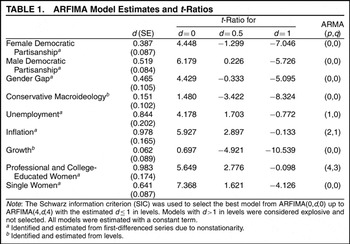
We can measure the persistence of the gender gap by estimating the order of integration (d). The order of integration tells us how quickly the effects of shocks to a process die out over time. A weakly stationary series, with d=0 has no long-term memory, meaning that an increase or decrease in the process due to external shocks dies out completely and quickly as soon as the shocks are over. Such series are mean reverting and covariance stationary with finite variance. Short-term memory can be characterized with combinations of stationary autoregressive and moving average terms [ARMA(p,q)]. In contrast, a series with d=1 is said to have permanent memory, i.e., an increase due to transient shocks will last forever. The first-order integrated series, i.e., the random walk, is characterized by mean nonstationarity (if there is a drift), variance nonstationarity, and covariance nonstationarity. These processes are typically integer differenced before analysis, leaving the possibility of short-term memory in the differenced series. A series with d falling between zero and one is “fractionally integrated” and exhibits various degrees of long-term memory or persistence. The closer d is to one, the longer the memory and the more persistent are the effects of shocks (Box-Steffensmeier and Smith 1998, 667).12
A series with d<0 is stationary with short and negative memory (meaning that its response to a positive unit input will be negative), and a series with d>1 is nonstationary with long and explosive memory.
We estimate the order of integration using the full information modified profile likelihood (MPL)(An and Bloomfield 1993).13
The modified profile likelihood has been shown to have superior small-sample properties over the exact maximum likelihood estimator derived by Hauser 1999 and Sowell 1992. In particular, bias in estimates of d are, on average, smaller using the MPL. We use OX 3.30 Console and ARFIMA 1.01 to estimate d. ARFIMA is a specialized package for OX; both software packages are available for free download at Jurgen A. Doornik's Web site at http://www.nuff.ox.ac.uk/Users/Doornik/index.html (October 2003).
The technical aspects of estimation of the ARFIMA models in Tables 1 proceed as follows. The estimation routines of the ARFIMA package for OX require that the series be made stationary before estimation, constraining the parameter space to (-5, 0.49999]. This means that if the order of integration for the levels process, d, is outside or near the upper bound of the parameter space, we must estimate on first differences whose order of integration, d-1, will lie in the parameter space. If we estimate on first differences, the estimate will be for d-1 rather than for d. Since what is of substantive interest is levels, not first differences, we must add one back to the estimated d-1 to get the estimate for d. This procedure, which takes advantage of a straightforward algebraic relationship, gives us the d values presented in Table 1. Among the nine series in Table 1, only conservative macroideology and income growth could be estimated from levels; the other seven series must be estimated from first differences. The steps required for estimation are purely technical and do not affect the final ARFIMA model selected or the substantive interpretation of the persistence that characterizes the process (Doornik and Ooms 2003; Lebo and Clarke 2000). We use the Schwarz information criterion (SIC) and assess whether the estimate implies an explosive process in determining the best ARFIMA model (e.g., Box-Steffensmeier and Smith 1998, Lebo 2000, and Mills 1992).

A time series' degree of persistence can be depicted more clearly by its impulse response function. The impulse response function of the partisan gender gap is provided in Figure 3. The aggregate gender gap exhibits persistence. Assume that there is a temporary, one-quarter downturn in the economy. Following this downturn, about 24% of the initial change in the gender gap remains one year after the shock, about 17% after two years, and about 12% after four years. The influence of the impulse input diminishes but has not vanished even years afterward. This finding is important because shocks can promote gender partisan differences that are not easily put aside—once differences are stimulated, they will disappear only over fairly long time periods or by a contrary stimulus. Thus if economic downturns affect the gender gap and are sustained for long periods or national preferences trend in one direction for any length of time, it will be hard to overcome their effects on the gender gap in the short term. If structural differences, which take decades to change, are the cause of the gender gap, the effect will be around even longer. We move now to a multivariate analysis of the gender gap.

Impulse Response Function for the Partisan Gender Gap
Multivariate Analysis
We begin by recognizing the need to address autocorrelation in our multivariate analysis to avoid spurious correlation and erroneous statistical inferences. We transform our series into the white noise residuals of their respective ARFIMA models, i.e., “prewhiten,” to purge autocorrelation and ensure stationarity before examining the relationship among the series (e.g., Haugh and Box 1977).15
The procedure can be considered a modification to the Box–Jenkins (1976) transfer function model, which is based on transforming both the input and the output series using the ARIMA model for the input series. See Appendix A (online) for more details.
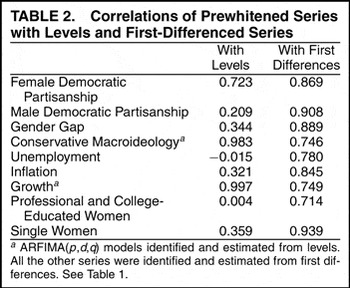
Table 1 presents the estimates of the univariate models. It also shows, via t-tests, that conservative macroideology and income growth are the only clearly stationary time series with 0 ≤ d<0.5. All other series are nonstationary because d=0 can be statistically rejected, while either d=0.5 or d=1 cannot be rejected. These models are used to transform the time series into stationary time series. Table 2 provides a heuristic guide to facilitate substantive interpretation of relationships based on the innovation or filtered series. The first column of numbers in Table 2 are correlations between innovation series and their respective levels series, and the second column shows correlations between innovation series and first differences of respective levels. For conservative macroideology and income growth, which are stationary in levels, the innovation series are highly correlated with levels. For the series that are nonstationary in levels, the innovation series are not even moderately correlated with levels but are moderately to highly correlated with first differences. Thus, for example, the inflation innovation series is much closer to the (quarterly) changes in inflation rates than to the levels of inflation rates. In contrast, the innovation income growth series is very close to income growth in levels. Depending on whether a levels series is stationary or nonstationary—whether d<0.5 or d[ges ]0.5—its innovation series is substantively proximate to either levels or changes. We discuss the results using levels and/or changes as reference points when a substantive interpretation is useful.16
While this is inexact, the direction of a relationship between prewhitened series will be consistent with that of the relationship between appropriate levels and/or changes because the correlations between a prewhitened series and its appropriate levels/changes are all positive.

Our multivariate analysis starts with the assumption that, in terms of prewhitened variables or innovations, both female and male Democratic partisanship are linear functions of a set of explanatory variables measuring political climate, national economic conditions, and changes in social structure. In matrix notation,

where matrix X contains observations of the explanatory variables. β and γ are vectors of coefficients, and u and v are vectors of disturbances. Subtracting the second equation from the first one gives:

We focus on estimating this equation because our theoretical hypotheses are about the differential effects of X on female and male Democratic partisanship. This equation allows us to test the set of null hypotheses H0: β-γ = 0. Estimating the gender-specific equations would not be sufficient because to test H0 from the separate estimates of β and γ one needs to know not only the estimates' respective variances but also their covariance, which cannot be computed when the gender-specific equations are estimated separately. In fact, it is quite possible that both β and γ are not statistically significant, while their difference, β-γ, is statistically significant, in which case to draw inference about β-γ from the estimates of the gender-specific equations would be misleading.
17Even with two independent statistics, the fact that their respective confidence intervals overlap does not imply that their difference is statistically insignificant. See van Belle (2002, 39).
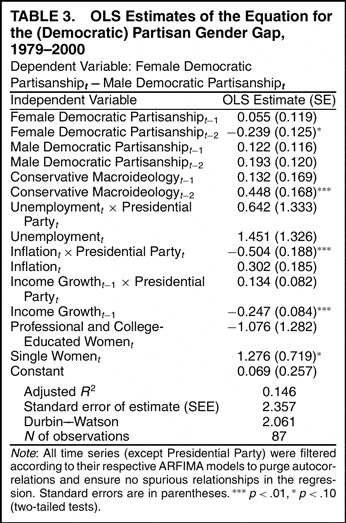
We present the results of our multivariate model of the partisan gender gap in Table 3. By modeling the innovations series, we do not expect strong statistical significance and results will err on the side of null findings. Overall, however, we find support for all hypotheses that were tested. For the sample period 1979–2000, the partisan gender gap is affected by changes in political, economic, and social structures. Specifically, the partisan gender gap increases with (a) increases in the percentage of adults who claim to be conservative, (b) economic deterioration, and (c) increases in the percentage of women who are single/unmarried.18
Since our dependent variable is the difference between female Democratic partisanship and male Democratic partisanship, we consider both components endogenous. Following Box-Steffensmeier and De Boef (2001), we also consider conservative macroideology endogenous. We include in our model two lags of the endogenous variables as in vector autoregression (Freeman, Williams, and Lin 1989), although our model is not strictly VAR. Here, lagged male and female partisanship capture gender-specific dynamics. We stop at two lags because additional lags do not improve the fit of the model. Our results show that female Democratic partisanship is somewhat significant at lag 2, with a negative coefficient. This means that, controlling for all other variables, the gender gap process has a negative feedback mechanism in itself: Increasing female partisanship will lead to a decrease in the gender gap two quarters later. This does not mean that the gender gap should not be persistent. It suggests that the persistency in the gender gap is not intrinsic to itself but due to the environmental variables that affect the gender gap.

Conservative macroideology appears to lead the partisan gender gap by two quarters. That is, when the political environment becomes more conservative, the gender gap increases about a half a year later. When conservative political rhetoric and policy enticed increasing numbers of citizens to claim conservative identification, they also polarized gender differences in partisan preferences. Whether because women felt more compassionate or were more likely to need services attacked in a politically conservative environment than men, this effect produced increases in the gender gap, supporting the political effects hypothesis. The two-quarter delay may reflect the time it takes for partisan changes to take place in response to movements in mass support for conservative policy and the ensuing elite perception and articulation.19
This finding is consistent with Stimson, MacKuen, and Erikson (1995), who demonstrate that policy outputs of government respond to public opinion.
As expected, income growth has a negative main effect on changes in the gender gap, but neither unemployment nor inflation has a statistically significant main effect.20
Our empirical analysis showed that income growth needed to be lagged once, while unemployment and inflation did not. This makes sense because the former is in levels, while the latter two variables are first differenced.
Our model allows us to test whether the effects of economic conditions on the partisan gender gap are different under different party administrations, a hypothesis inspired by Chaney, Alvarez, and Nagler 1998. By interacting the economic variables with a dummy variable representing the presidential party (1 for Republicans and −1 for Democrats), we separate administration-specific effects from their respective main effects.
21Party is not included as a “stand-alone” variable because our regression involves innovations, and any arbitrary origin in levels has already been filtered out. If we included party directly, we would have a stationary left-hand side and a nonstationary right-hand side.

The statistical significance of this total effect can be established by conducting a t-test (or an F-test for linear restrictions) after substituting Party with the appropriate value. (Friedrich 1982). Our tests show that the total effect of inflation is positive and statistically significant under Democratic administrations but not under Republican administrations. During our sample period (1979–2000), there were only two Democratic presidents: Carter and Clinton. While inflation was consistently low under the Clinton administration, it rose sharply under President Carter. Thus, the positive total effect of inflation under Democratic administrations appears to be specific to the Carter administration and the large economic slump at that time. This effect, however, was obviously not due to women's overly pessimistic reaction to the way the incumbent party handled the economy. If it was, the gender gap would have decreased rather than increased. The traditional partisan cleavage on welfare policies seems to be relevant as economic voting here. If so, the implication is that women will be more likely to tolerate inflation under Democratic presidents because of the party's position on social welfare. Thus, in times of rising inflation such as the late 1970s, women may have stuck with the Democratic Party while men turned to the Republicans, causing the gender gap to increase. Under Republican presidents, if men and women are equally likely to punish the administration for increasing inflation rates, inflation will exhibit no total effect on the gender gap.
The results show that not all social structure related trends work together. We find that as the percentage of women who head households (whether single, divorced, separated, or widowed) increased, the gap has also increased. As Carroll (1988) puts it, single women tend to be near the bottom of the socioeconomic structure, making them more reliant on social programs favored by the Democrats.22
Observers have noticed a dramatic “marriage gap” over the last few presidential elections. When the electorate is broken down by gender and marital status, it is clear that unmarried women provided the strongest support for the Democrats. For example, a New York Times/CBS News poll conducted shortly before the 2000 election shows that while married women preferred Bush over Gore by a margin of eight percentage points, unmarried women preferred Gore to Bush by an overwhelming margin of 35 percentage points (Seelye 2000).
These results indicate that the assumption that shedding stereotypical gender roles and becoming more independent will automatically lead to distinct preferences is not accurate. Specifically, it may be that shedding traditional gender roles, in which women are the nurturers and men the providers, frees women to develop preferences independently from men but to do so in ways that are sometime like men and others different from men. Further, given the economic independence that comes with increased participation in the labor force and higher levels of education on, this trend works against the role of need-based arguments for gender differences. More needs to be done (at the individual level) to disentangle these effects.
Taken together, these results suggest that economic vulnerability may best explain the effects of social changes on gender differences. Where women are most likely to be economically independent from men—holding better and, on average, higher-paying jobs—they find themselves more like men but also freer to develop their own perspectives, which may be similar to or different from those of men. At the same time, as women heading households are more likely to be economically vulnerable, they are likely to hold both different preferences than men and also more liberal preferences, leading them to support the Democratic party at higher rates than men and producing a larger Democratic gender gap.
In understanding these results it is important to recall that while innovation series are used in the multivariate analysis, the gender gap in levels is a persistent time series process. Thus movements in the gender gap stimulated by concerted significant shocks in the political, economic, and structural environment in the late 1970s and early 1980s have been sustained throughout the 1980s and into the 1990s. This does not mean that the partisan gender gap we observe today is nothing but a residual phenomenon. New shocks are constantly stimulating gender differences. It does suggest that even when the environment is relatively quiet, the gender gap will not necessarily vanish.
CONCLUSION
The gender gap is a pervasive feature of the political landscape, behaving in similar ways both between and within election years. The generality of partisan gender differences implies that their effects are felt outside of elections. They affect the kinds of issues on the political agenda, the nature of ensuing policy debates, and the nomination process, as well as elections themselves. The persistence of gender differences also implies that the differential voting behavior of men and women in a given election is not exclusively a product of the election itself. It grows out of something bigger and is, in the short term, an aspect of the political landscape that represents the “givens” of a campaign and, thus, must be directly grappled with by savvy politicians hoping to win elections. The persistence of gender differences means that they become a part of the features of the political landscape and that they imply a presence and a pervasiveness that politicians and policy makers need be wary to ignore.
Importantly, while gender differences in partisanship are persistent, they need not become a permanent feature of the social and political landscape. As our analysis demonstrates, they are created by a unique mix of social changes, economic opportunities, political actors, and government priorities. While these circumstances tend to change slowly, they do change in important ways even in the medium term. Further, changes are not random, nor do they inevitably move in a direction that exacerbates gender differences. In the last few decades of the twentieth century social changes ran a fast pace. In particular, traditional family structures evidenced disintegration, with the percentage of women who head households increasing drastically. Accompanying these trends were economic and political conditions that, while more variable, often interacted to produce more economic vulnerability among women in combination with less redress from government. These changes have acted to uniquely shape the experiences of men and women, producing a gender gap in partisanship characterized by disproportionately more support for the Democratic party among women and for the Republican party among men. The consequences for attitudes and for politics continue to evolve.
Much has been made of the gender gap in American politics. Politicians talk about it, the media point to its significance, and the sense is that it is important. Its salience, we argue, is warranted. It is warranted because the gender gap both is persistent and is a product of the interaction of societal conditions and politics. Whether the gender gap continues to grow or diminishes will depend greatly on the behavior of strategic politicians, on the continuation of trends in the nature of families, and on economic conditions. Either way, it is likely to be a continual feature of the American political landscape, one that shapes everything from elite political behavior to election outcomes and public policy.
Authors are listed alphabetically. A previous version of the paper was presented at the annual meeting of the American Political Science Association. This work is supported in part by the National Science Foundation under Grant 9753119 and by the Department of Women's Studies at Ohio State University and the Coca Cola Critical Difference for Women Research on Women Endowed Fund. We thank Lee Ann Banaszak, Frank Baumgartner, Paul Beck, Scott Bennett, Harold Clarke, Paul Kellstedt, David Jacobs, John Kessel, Dean Lacy, Matthew Lebo, Jessica Perez-Monforti, Jonathan Nagler, Eric Plutzer, Brian Roberts, Jim Stimson, Herb Weisberg, Susan Welch, Theresa Wong, the editor and anonymous reviewers, and, especially, Kira Sanbonmatsu for comments. We also thank Heather Ondercin and Jennifer Willette for assistance with the data collection.
References
Abramowitz Alan I., and
Kyl L. Sanders.
1998
“Ideological Realignment in the U.S. Electorate.”
Journal of Politics
60
(August):
634–
52.Google Scholar
An S., and
P. Bloomfield.
1993
“Cox and Reid's Modification in Regression Models with Correlated Errors.”
Department of Statistics, North Carolina State University,
Raleigh.
Andersen Kristi.
1999
“The Gender Gap and Experiences with the Welfare State,”
PS: Political Science and Politics
32
(March):
17–
19.Google Scholar
Bendyna Mary E., and
Belinda C. Lake.
1994
“Gender and Voting in the 1992 Election.”
In The Year of the Woman: Myths and Realities,
ed. Elizabeth Adell Cook,
Sue Thomas, and
Clyde Wilcox.
Boulder, CO:
Westview Press.
Box George E. P., and
Gwilym M. Jenkins.
1976
Time Series Analysis: Forecasting and Control.
Rev. ed. San Francisco:
Holden–Day.
Box-Steffensmeier Janet M., and
Suzanna De Boef.
2001
“Macro-partisanship and Macroideology in the Sophisticated Electorate.”
Journal of Politics
63
(1):
232–
48.Google Scholar
Box-Steffensmeier Janet M., and
Renée M. Smith.
1996
“The Dynamics of Aggregate Partisanship.”
American Political Science Review
90
(3):
567–
80.Google Scholar
Box-Steffensmeier Janet M., and
Renée M. Smith.
1998
“Investigating Political Dynamics Using Fractional Integration Methods.”
American Journal of Political Science
42
(2):
661–
89.Google Scholar
Carroll Susan.
1988.
“Women's Autonomy and the Gender Gap: 1980 and 1982.”
In The Politics of the Gender Gap: The Social Construction of Political Influence,
ed. Carol M. Mueller.
Newbury Park, CA:
Sage.
Carroll Susan.
1999
“The Disempowerment of the Gender Gap: Soccer Moms and the 1996 Election.”
PS: Political Science and Politics
32
(March):
7–
11.Google Scholar
Chaney Carole,
R. Michael Alvarez, and
Jonathan Nagler.
1998
“Explaining the Gender Gap in U.S. Presidential Elections, 1980–1992.”
Political Research Quarterly
51
(June):
311–
39.Google Scholar
Clark Cal, and
Janet Clark.
1996.
“The Gender Gap: A Manifestation of Women's Dissatisfaction with the American Polity?”
In Broken Contract?: Changing Relationships between Americans and Their Government,
ed. Stephen C. Craig.
Boulder, CO:
Westview Press.
Conover Pamela Johnston, and
Virginia Sapiro.
1993
“Gender, Feminist Consciousness, and War.”
American Journal of Political Science
37
(November):
1079–
99.Google Scholar
Cook Elizabeth Adell, and
Clyde Wilcox.
1991
“Feminism and the Gender Gap: A Second Look.”
Journal of Politics
53
(November):
1111–
22.Google Scholar
Cook Elizabeth Adell, and
Clyde Wilcox.
1995.
“Women Voters in the ‘Year of the Woman.”
In Democracy's Feast: Elections in America,
ed. Herbert F. Weisberg.
Chatham, NJ:
Chatham House.
Deitch Cynthia.
1988
“Sex Differences in Support for Government Spending.”
In The Politics of the Gender Gap,
ed. Carol Mueller.
Newbury Park, CA:
Sage,
192–
216.
Doornik Jurgen A., and
Marius Ooms.
2003
“Computational Aspects of Maximum Likelihood Estimation of Autoregressive Fractionally Integrated Moving Average Models.”
Computational Statistics and Data Analysis
42
(March):
333–
48.Google Scholar
1999
Energy Information Administration.
Annual Energy Review.
http://www.eia.doe.gov/emeu/consumptionbriefs/recs/heating_oil/chained_oil.html. Retrieved June 30, 2004.
Erie Steven P., and
Martin Rein.
1988.
“Women and the Welfare State.”
In The Politics of the Gender Gap: The Social Construction of Political Influence,
ed. Carol M. Mueller.
Newbury Park, CA:
Sage.
Erikson Robert S.,
Michael B. MacKuen, and
James A. Stimson
2002
The Macro Polity.
Cambridge, UK:
Cambridge University Press.
Fair Ray C.
1978
“The Effect of Economic Events on Votes for President.”
Review of Economics and Statistics
60
(May):
159–
73.Google Scholar
Fair Ray C.
1982
“The Effect of Economic Events on Votes for President: 1980 Results.”
Review of Economics and Statistics
64
(May):
322–
25.Google Scholar
Freeman John R.,
John T. Williams, and
Tse-min Lin.
1989
“Vector Autoregression and the Study of Politics.”
American Journal of Political Science
33
(November):
842–
77.Google Scholar
Friedrich Robert J.
1982
“In Defense of Multiplicative Terms in Multiple Regression Equations.”
American Journal of Political Science
26
(November):
797–
833.Google Scholar
Granger C. W. J., and
Roselyne Joyeux.
1980
“An Introduction to Long-Memory Time Series Models and Fractional Differencing.”
Journal of Time Series Analysis
1
(1):
15–
29.Google Scholar
Haugh Larry D., and
G. E. P. Box.
1977
“Identification of Dynamic Regression (Distributed Lag) Models Connecting Two Time Series.”
Journal of the American Statistical Association
72
(March):
121–
30.Google Scholar
Hauser Michael A.
1999
“Maximum Likelihood Estimators for ARMA and ARFIMA Models: A Monte Carlo Study.”
Journal of Statistical Planning and Inference
80
(August):
229–
55.Google Scholar
Kanthak Kris, and
Barbara Norrander.
2002
“Change and Continuity in the Gender Gap.”
Typescript.
University of Arizona.
Kaufmann Karen M., and
John R. Petrocik.
1999
“The Changing Politics of American Men: Understanding the Sources of the Gender Gap.”
American Journal of Political Science
43
(July):
864–
87.Google Scholar
Kenski Henry C.
1988.
“The Gender Factor in a Changing Electorate.”
In The Politics of the Gender Gap,
ed. Carol Mueller.
Newbury Park, CA:
Sage.
Klein Ethel.
1984
Gender Politics: From Consciousness to Mass Politics.
Cambridge, MA:
Harvard University Press.
Kramer Gerald H.
1971
“Short-Term Fluctuations in U.S. Voting Behavior, 1896–1964.”
American Political Science Review
65
(March):
131–
43.Google Scholar
Lebo Matthew J., special guest ed.
2000.
“Special Issue: Advances in the Analysis of Political Time Series.”
Electoral Studies
19
(1).Google Scholar
Lebo Matthew J., and
Harold D. Clarke.
2000
“Modeling Memory and Volatility: Recent Advances in the Analysis of Political Time Series.”
Electoral Studies
19
(1):
1–
7.Google Scholar
Lebo Matthew J.,
Robert W. Walker, and
Harold D. Clarke.
2000
“You Must Remember This: Dealing with Long Memory in Political Analysis.”
Electoral Studies
19
(1):
31–
48.Google Scholar
Maddala G. S., and
In-Moo Kim.
1998
Unit Roots, Cointegration, and Structural Change.
Cambridge, UK:
Cambridge University Press.
Manza Jeff and
Clem Brooks.
1998
“The Gender Gap in U.S. Presidential Elections: When? Why? Implications?”
American Journal of Sociology
103
(March):
1235–
66.Google Scholar
May Ann Mari, and
Kurt Stephenson.
1994
“Women and the Great Retrenchment: The Political Economy of Gender in the 1980s.”
Journal of Economic Issues
28
(June):
533–
42.Google Scholar
Miller Warren E.
1991
“Party Identification, Realignment, and Party Voting: Back to Basics.”
American Political Science Review
85:
557–
68.Google Scholar
Mills Terrence D.
1992
Time Series Techniques for Economists.
New York:
Cambridge University Press.
Norrander Barbara.
1997
“The Independence Gap and the Gender Gap.”
Public Opinion Quarterly
61
(Fall):
464–
76.Google Scholar
Norrander Barbara.
1999
“Evolution of the Gender Gap.”
Public Opinion Quarterly
63
(Winter):
464–
76.Google Scholar
Parke William R.
1999
“What Is Fractional Integration?”
Review of Economics and Statistics
81
(4):
632–
38.Google Scholar
Piven Frances F.
1985.
“Women and the State: Ideology, Power, and the Welfare State.”
In Gender and the Life Course,
ed. Alice S. Rossi.
New York:
Aldine.
Rohde David W.
1991
Parties and Leaders in the Postreform House.
Chicago:
University of Chicago Press.
Sanbonmatsu Kira.
2002
The Politics of Women's Place: Gender Roles, Public Opinion, and the American Party System.
Ann Arbor:
University of Michigan Press.
Sapiro Virginia, and
Conover.
1997
“The Variable Gender Basis of Electoral Politics—Gender and Content in the 1992 U.S. Election.”
British Journal of Political Science
27
(October):
497–
523.Google Scholar
Schlozman Kay Lehman,
Nancy Burns,
Sidney Verba, and
Jesse Donahue.
1995
“Gender and Citizen Participation: Is There a Different Voice?”
American Journal of Political Science
39
(May):
267–
93.Google Scholar
Seelye Katharine Q.
2000
“Marital Status Is Shaping Women's Leanings, Surveys Find.”
The New York Times,
September 20, Sec. A, p. 1.Google Scholar
Seltzer Richard A.,
Jody Newman, and
Melissa Voorhees Leighton.
1997
Sex as a Political Variable: Women as Candidates & Voters in U.S. Elections.
Boulder, CO:
Lynne Rienner.
Sowell Fallaw.
1992
“Maximum Likelihood Estimation of Stationary Univariate Fractionally Integrated Time Series Models.”
Journal of Econometrics
53
(July):
165–
88.Google Scholar
Stigler George J.
1973
“General Economic Conditions and National Elections.”
American Economic Review
63
(May):
160–
67.Google Scholar
Stimson James A.
1998
Public Opinion in America: Moods, Cycles, and Swings. 2nd ed.
Boulder, CO:
Westview Press.
Stimson James A.,
Michael B. MacKuen, and
Robert S. Erikson.
1995
“Dynamic Representation.”
American Political Science Review
89
(3):
543–
65.Google Scholar
van Belle Gerald.
2002
Statistical Rules of Thumb.
New York:
Wiley Interscience.
Welch Susan, and
John Hibbing.
1992
“Financial Conditions, Gender, and Voting in American National Elections.”
Journal of Politics
54
(February):
197–
213.Google Scholar
Wirls Daniel.
1986
“Reinterpreting the Gender Gap.”
Public Opinion Quarterly
50
(Autumn):
316–
30.Google Scholar
Wolbrecht Christina.
2000
The Politics of Women's Rights.
Princeton, NJ:
Princeton University Press.

Democratic Partisanship by Gender

The Partisan Gender Gap with 95% Confidence Intervals
ARFIMA Model Estimates and t-Ratios

Impulse Response Function for the Partisan Gender Gap
Correlations of Prewhitened Series with Levels and First-Differenced Series
OLS Estimates of the Equation for the (Democratic) Partisan Gender Gap, 1979–2000
 You have Access
- 237
- Cited by
Comments
No Comments have been published for this article.