INTRODUCTION
During the past two decades religion has become an increasingly visible topic in political science research (Gill Reference Gill2001; Wald and Wilcox Reference Wald and Wilcox2006; Grzymala-Busse Reference Grzymala-Busse2012). A particularly fruitful field of inquiry has been the research on regulation of religion. Several studies have focused on understanding the consequences of such regulation for topics as various as forced migration (Kolbe and Henne Reference Kolbe and Henne2014), religious persecution (Grim and Finke Reference Grim and Finke2007), women's rights (Ben-Nun Bloom Reference Ben-Nun Bloom2015), and the vote on defamation in the United Nations (Henne Reference Henne2013).
For political scientists, particularly the literature on the association between regulation of religion and democracy has been intriguing. Findings on the topic suggest that the level of democracy increases when the separation between religion and state increases (Brathwaite and Bramsen Reference Brathwaite and Bramsen2011; Brathwaite 2013; Kettell Reference Kettell2013), with the exception of government favoritism of religion which is found to have a neutral or positive impact on democracy (Driessen Reference Driessen2010). In support of the idea that government favoritism of religion is positively related to democracy, studies from the Western democratic countries indicate that privileges given to one group can even benefit the other groups (e.g., Carol and Koopmans Reference Carol and Koopmans2013). For example, Soper and Fetzer (Reference Soper and Fetzer2007) show how the existence of state church in the United Kingdom has made it easier for the Muslims to get their religious practices recognized than in France, where laïcité has been the leading principle of state-religion relationships. As for the negative impact of regulation on democracy, Kettell (Reference Kettell2013, 540) argues that given that state religion privileges one religion over the others it might “generate social divisions and tensions around religious issues, undermine ideals of civic equality and individual freedoms, and corrode democratic processes and mechanisms of accountability.”
However, when the consequences of regulation of religion are studied, it is important not to forget the determinants of such regulation. This is illustrated by Sarkissian (Reference Sarkissian2012), whose study on Muslim-majority countries shows how some types of regulation, such as restrictions on freedom of expression and association, may target the political opposition or religious groups which might give a voice to anti-government opinions. Thus, the regulation of religion is harmful for democracy, but it is not the religious nature of the regulations per se, but the fact that the regulations were strategically targeted toward potential anti-government movements.
Even though it is important to understand the determinants of regulation of religion, we still know very little about the topic (cf. Finke and Martin Reference Finke and Martin2014, 688). The current study aims to address this gap in the research. In particular, it approaches the topic from a comparative political science perspective and discusses the influence of the political environment on regulation. In previous studies on the topic which have mostly been guided by the theories on modernization, clash of civilizations, and economics of religion (see the section below on the state of the art), the influence of political context has been left with less attention.
In the current article, I argue that given the large differences in the political environment of the democratic and autocratic countries, and the consequences these differences have for the opportunity structures of the political actors, the determinants of government regulation of religion should be studied separately in democratic and autocratic countries. To describe the differences in regulation between and within the democratic and autocratic regimes, the study takes a look at ca. 150 countries with the emphasis on year 2000. Six different indicators on regulation of religion are employed: The existence of a state religion (Barro and McCleary Reference Barro and McCleary2005), the indexes on government regulation and favoritism of religion (Grim and Finke Reference Grim and Finke2006, made available through Association of Religion Data Archives 2014) and religious discrimination against minority religions, regulation of and restrictions on the majority religion or all religions (hereinafter called “restrictions”), and specific types of religious legislation from the second round of the Religion and State-project (Fox Reference Fox2012a).
At first the association between these indicators and the level of democracy (Marshall and Gurr Reference Marshall and Gurr2014) is investigated to demonstrate that the relationship between the degree of democracy and regulation of religion is not straightforward. In particular, there is more variation in the regulation of religion within the autocratic countries in comparison to the democratic countries. The findings support the idea that to better understand the determinants of regulation of religion, these should be studied separately in democratic and autocratic countries.
The descriptive results on the association of regulation and the different patterns of legitimation in the autocratic countries (based on data from Kailitz Reference Kailitz2015) show that particularly in monarchies, Islamist and communist ideocracies, as well as in military regimes the levels of regulation are high, whereas in personalist regimes and electoral autocracies the dictators are less likely to regulate religion. However, the results also partly depend on the employed indicator, which indicates that different types of regulation have different determinants. As for the democratic countries, data on three different power-sharing institutions (type of government, electoral system, and federalism) are employed. Even though there is some indication that the level of regulation is higher in consensus-oriented democracies, particularly when it comes to favoritism and legislation, for the most part the constitutional structure alone does not explain the differences between the democracies. Based on the findings future research on the determinants of regulation should take the broader political context into account when the influence of factors such as modernization and political actors is investigated.
STATE OF THE ART: DETERMINANTS OF THE REGULATION OF RELIGION
Previous research on the determinants of regulation of religion is heavily influenced by the theories of the clash of civilizations, modernization, and economics of religion. Inspired by Huntington's (Reference Huntington1993) discussion, several studies examine the influence of the different religious traditions on regulation and sometimes explicitly refer to Huntington to motivate the study of the religious traditions (e.g., Buckley and Mantilla Reference Buckley and Mantilla2013, 337f). A particularly controversial finding is related to the association between Islam and regulation. Whereas some studies show that Muslim majority countries have particularly high levels of government involvement in religion (Fox Reference Fox2007; Reference Fox2008), other studies find that the proportion of Muslim population does not influence regulation (Finke and Martin Reference Finke and Martin2014).
As for modernization, some of the theories on secularization suggest that modernization leads to a differentiation between religion and the other spheres of the society (for review, see Philpott Reference Philpott2009 as well as Gorski and Altinordu Reference Gorski and Altinordu2008). Economic development such as gross domestic product per capita is often treated as a proxy for modernization, and several authors make references to modernization when they select their variables or discuss the findings (e.g., Fox Reference Fox2007, 16). Contrary to the assumption that economic growth leads to lower levels of regulation, economic variables are often found to be positively associated with the regulation of religion (Fox Reference Fox2007: Reference Fox2008; Buckley and Mantilla Reference Buckley and Mantilla2013), or the findings are inconsistent (Barro and McCleary Reference Barro and McCleary2005; Finke and Martin Reference Finke and Martin2014).
Finally, the theory on the economics of religion (Stark and Iannaccone Reference Stark and Iannaccone1994) focuses on cost calculations and preferences of the different religious actors. For example, Gill (Reference Gill2008, 45) suggests that as majority religions prefer higher levels of regulation (over minority religions) and minority religions in turn prefer lower levels of regulation, the balance between minority and majority religions has an impact on the regulation. In line with these ideas, Barro and McCleary (Reference Barro and McCleary2005, 1367) conclude that a higher share of majority religion adherents increases the likelihood of a state religion, independently from the type of the religious tradition. Even other studies support the idea that religious homogeneity of the population increases government regulation (Fox Reference Fox2006), whereas religious fragmentation has a negative influence on regulation (Buckley and Mantilla Reference Buckley and Mantilla2013).
The best single example to illustrate the dominance of these three theories is the work by Fox, who is one of the leading researchers on regulation of religion. As stated by Fox,
I can assert that Huntington's theory can be found in the intellectual development of the Religion and State dataset, which was inspired by, among other things, my previous work in religion and conflict, which, in turn, was deeply intertwined with Huntington's theory (Fox Reference Fox and Jonathan2012b, 190).
Indeed, the first round of the Religion and State dataset (for details, see Fox Reference Fox2008) includes several variables on religious tradition. Further, in accordance with the economics of religion, the dataset contains variables such as the “number of minorities with 5% of population or more,” percentages of population with different religious affiliations, and population size. Seemingly inspired by the theories on modernization, there are also variables on infant mortality and per capita gross national product. Finally, there are several graded measures on democracy (Polity index, regime stability, Freedom House's Freedom Index, civil liberties and political rights). The empirical work by Fox (Reference Fox2007; Reference Fox2008) which utilizes the first round of the Religion and State (RAS)-data relies heavily on these variables as correlates of regulation of religion. Usually (with some exceptions such as “military expenditures” in Fox Reference Fox2006), he does not employ any additional variables in the studies on the determinants of regulation. Consequently, the important differences in the political environment and institutions of the different countries are, apart from democracy and regime stability, completely ignored.Footnote 1
Yet, comparative political science variables and theorizing are not entirely missing from the previous research. Several authors study the influence of democracy on regulation, and find that the democratic countries are less likely to have state religions (Barro and McCleary Reference Barro and McCleary2005), and a lower degree of government involvement in religion (Fox Reference Fox2006). Further, qualitative studies show that the roots of the current state-religion arrangements were laid for decades or even centuries ago (e.g., Gill Reference Gill2008, 75–91) and thus suggest that regulation of religion is influenced by path-dependent processes. Moreover, Barro and McCleary (Reference Barro and McCleary2005) show that those countries which had a state religion in 1900 were more likely to have a state religion also in 1970 and 2000, particularly if there had not been changes in the form of government. Further, Buckley and Mantilla (Reference Buckley and Mantilla2013) argue that state capacity is a crucial determinant of regulation of religion, that is, when the state has more resources to regulate religion it will do so.
There is also some indication that democratic power-sharing institutions matter. For example, Finke and Martin (Reference Finke and Martin2014) show that an independent judiciary decreases the regulation of religion. Further, Minkenberg's (Reference Minkenberg2012) study on church-state regimes and democratic institutions (measured as presidential and parliamentary democracies, as well as consensus and majoritarian democracies) in 19 Western democracies shows that there is only a “relatively loose relationship between democracy type and church-state relations” (Minkenberg Reference Minkenberg2012, 95). However, Minkenberg's study takes a look at a qualitative indicator on state-church separation (separation, partial establishment, full establishment) and does not employ the more detailed indicators on regulation of religion.
There is also some evidence that the political ideology of the governing elite influences the regulation of religion. For example, communist governments have a negative influence on the likelihood of a state religion (Barro and McCleary Reference Barro and McCleary2005), but a positive influence on regulation of religion (Finke and Martin Reference Finke and Martin2014). Further, Gustafsson's (Reference Gustafsson2003) study on the evolution of the state-church relationships in Sweden shows how the non-favorable attitude of the social democratic party concerning the church influenced the politics about regulation of religion.
Even though comparative political science variables are not completely excluded from previous studies, with some notable exceptions (the above mentioned Minkenberg Reference Minkenberg2012; Buckley and Mantilla Reference Buckley and Mantilla2013; Finke and Martin Reference Finke and Martin2014), these variables are included only as control variables without an extensive theoretical discussion, or as part of the qualitative narrative. However, to borrow the words of Buckley and Mantilla (Reference Buckley and Mantilla2013, 346):
While religious movements and the pronouncements of key clerics will remain doubtlessly remain [sic] important, scholars ought not to lose track of the broader political environment in which these actors mobilize. Social scientists can start this process by putting the state back into the study of religion-state relations.
Below I sketch an approach to the regulation of religion which takes a look at such a broader political environment within which the different actors work.
ARGUMENT OF THE PAPER
The central assumption of the current study is that both in democratic and autocratic countries the regulation of religion is dependent on the degree to which the different actors (e.g., political parties and religious organizations) are successful in advancing their preferences concerning the regulation. The success depends on the relative strength of these actors as well as on the opportunity structures within which they act. Given that the political environment in democracies and autocracies is fundamentally different, it is necessary to study the determinants of regulation separately within these two types.
Regulation of Religion in Autocratic Countries
In autocratic countries, the decisions on the regulation of religion are taken by leaders who are not politically accountable, and are thus likely to be motivated by the extent to which they assume that the taken measures enhance their chances to stay in power. For example, it might be strategically a good idea to regulate religion harshly in order to prevent the mobilization of the opposition through religious institutions and channels, or to co-opt the religious elites to ensure their co-operation. Consequently, we can expect autocratic countries in general to have higher levels of regulation than the democratic countries. However, as pointed out by Geddes (Reference Geddes1999, 121) “different kinds of authoritarianism differ from each other as much as they differ from democracy.” Thus, we can also expect the variation in regulation of religion among autocratic countries to be considerable.
According to Gerschewski (Reference Gerschewski2013), co-optation, repression, and legitimation are “the three pillars of stability” of the autocratic regimes. Co-optation can be understood as a tactic employed by the dictator to tie the strategically important groups to the regime with the hope that the tied groups will consequently have an interest in the survival of the dictator (cf. Gerschewski Reference Gerschewski2013, 22). As for the repression, it is customary to distinguish between empowerment rights repression (non-violent form of repression consisting of regulations and restrictions on different liberties) and personal/physical integrity rights repression (violent form of repression, consisting of measures such as torture and killings) (for discussion, see Davenport Reference Davenport2004).
The current conceptualization and measures of regulation of religion (see the data-section below) are not completely analogous to the conceptualizations of repression and co-optation. However, for the purposes of this preliminary examination, restrictions imposed on majority and minority religions are treated as empowerment rights repression, whereas government favoritism and religious legislation are understood as co-optation of religion. This treatment enables us to rely on the literature on autocracies and discuss how the patterns of religious co-optation and repression vary by the autocratic regime type.
There are three questions central to the study on autocracies, namely “who rules,” “why do they rule,” and “how do they rule” (Brooker Reference Brooker and Caramani2014). Several different classifications (Geddes Reference Geddes1999; Hadenius and Teorell Reference Hadenius and Teorell2007; Cheibub et al. Reference Cheibub, Gandhi and Vreeland2010; Geddes et al. Reference Geddes, Wright and Frantz2014) have been developed as an answer to the first question. Yet, when we want to understand the different approaches the dictators take toward religion, the second question on the legitimation of the rule is likely to be of particular importance. Indeed, several authors have already pointed out that legitimation and regulation of religion are associated. Gill (Reference Gill2008, 49) for example assumes that “Politicians will seek ideological compliance of the population when possible.” Finke (Reference Finke2013, 300) in turn argues that “when the state views religions as offering ideological or political alternatives, the state's restrictions of religious freedoms will increase” (emphasis in original). However, with the exception of communism which is shortly discussed, for example, by Finke and Martin (Reference Finke and Martin2014) and Buckley and Mantilla (Reference Buckley and Mantilla2013), the previous studies on the determinants of regulation of religion do not contain any systematic theorizing concerning the association between the different patterns of legitimation and the different types of regulation.
The current study employs the classification of the autocratic regimes by Kailitz (Reference Kailitz2013), who distinguishes between six different types of autocratic regimes based on their claims to legitimation. In monarchies, legitimation is claimed by referring to a God-given or historical right for rule. In ideocracies, legitimacy-claims are founded on a future utopia, which will be reached if the current rulers stay in power. Here Kailitz separates between social/communist regimes with a Marxist-Leninist ideology, national-socialist/fascist regimes and (revolutionary) Islamist regimes. In electoral autocracies pseudo-democratic institutions such as multi-party legislative elections and multi-candidate elections of the ruler are supposed to give legitimacy for the regime. In one-party autocracies all opposition parties are banned, and the ruling party legitimizes its rule by claiming that it acts for the common good of the people. Since no ideological claims to legitimacy are made, one-party autocracies are dependent on good policy performance. In military regimes the legitimacy-claims are in general vague, and based on the idea that the military protects the country from a conflict or crisis. Finally, personalist autocracies are reliant on one person's whims, and usually have no strong claims to legitimacy.
As for the patterns of regulation of religion, it can be argued that the monarchs have a strategic need to co-opt the religious elite of the majority religion. Indeed, to get the religious elite, organizations and believers to support the monarch's claims on God-given rights to rule, the believers need to be treated well. Consequently, we can expect to see high levels of favoritism and religious legislation in monarchies, but low levels of restrictions on the majority religion. Notice also that the important position of the majority religion might give the religious elite a possibility to advance their preferences on higher restrictions on the minority religions. Accordingly, the level of discrimination in monarchies is likely to be at high levels. Finally, given that the government regulation index measures restrictions on both minority and majority religions, it can likewise be expected to be at high levels.
In Islamist ideocracies, the same kind of logic applies and the patterns of outcome are thus likely to be similar to those in monarchies. However, as the ruling ideology is explicitly religiously motivated, the levels of regulation can be expected to be more extreme. That is, regulation, favoritism, discrimination, and legislation are likely to be at higher, and the restrictions on majority religion in turn at lower levels than in monarchies.
Given that communist countries depend on ideological legitimation, the ruling elite should be interested in repressing all the competing ideologies, including religion. Consequently, we expect government regulation, restrictions, and discrimination to be extensive, whereas government favoritism and religious legislation are assumed to be negatively influenced by communism.
In the remaining autocracies the claims to legitimation are not directly connected to ideology, which means that the regimes do not need to act for or against religion for reasons related to legitimation. Thus, in these regimes the level of regulation is expected to be low, and related to other factors (e.g., the type of leadership structure and the degree into which religious actors are intertwined with the opposition movement). In particular, following Gandhi and Przeworski (Reference Gandhi and Przeworski2007) who suggest that institutional co-optation in form of legislatures and political parties is often required and implemented by the leaders to distribute the spoils and make policy concessions, the existence of pseudo-democratic institutions can in itself be understood as an attempt for co-optation. Thus, co-optation of religion in electoral autocracies should be at particularly low levels, given that the dictators of these countries have already determined to employ a different strategy of co-optation.
Regulation of Religion in Democratic Countries
In democratic countries government regulation of religion is a decision taken by the parliament consisting of politicians who are politically accountable to their voters. If the regulation is increased to levels which are perceived as unfair by the voters, the citizens are likely to vote for a change in the next elections. Consequently, we would expect the level of regulation to be at relatively low levels in democracies. As for the similarities and differences between the democratic countries, we can draw from the comparative public policy research (for review, see Wenzelburger and Neumann Reference Wenzelburger, Neumann, Wagschal, Jäckle and Wenzelburger2015), which helps us to identify some important factors which require further investigation.
As suggested by the theory on the economics of religion, the relative strength of the different political actors such as religious organizations is likely to be consequential for the regulation of religion. To this it needs to be added that based on what we know about the influence of political parties on government activity in general (e.g., Schmidt Reference Schmidt, Castles, Leibfried, Lewis, Obinger and Pierson2010), and about the conflict lines between the parties in particular (Lipset and Rokkan Reference Lipset, Rokkan, Lipset and Rokkan1967), it is safe to assume that the governing parties have differing preferences concerning the regulation of religion, which is likely to have an impact on the regulation. Thus, without a doubt, future research on government regulation of religion in democratic countries should focus on understanding how the political actors who have an interest in regulation of religion are organized, in which way they aim to advance their preference, and how efficient they are in doing so.
Nevertheless, these actors do not act in a vacuum, and the argument of the current article is that the influence of any actor with a preference on regulation of religion is constrained or enhanced by institutions. Especially the influence of path dependence and constitutional structure is likely to be of importance. As for the path dependence, the new government always inherits the decisions made by previous governments. It is well known that it might be difficult for the new government to make changes to the already existing regulations and commitments (Rose Reference Rose1990). In addition, if the attitudes of the population are on the side of the status quo, change becomes even more difficult (for the argument in the context of welfare state retrenchment, see Pierson Reference Pierson1996). The path dependent dynamics of state-church separation are clearly demonstrated in the case of Sweden: even though the program of the Swedish social democrats in 1897 already explicitly stated that the party wanted to abolish the state church (SAP 1897), and despite the fact that the social democrats were governing the country almost continuously since the 1930s during 1932–1976, 1982–1991, and 1994–2006, the final decision to separate the state and church was not taken until 1995 (for details, see Gustafsson Reference Gustafsson2003).
Given the strong expected influence of path dependence, the study on regulation of religion in democratic countries should be seen in relation to the past state-religion arrangements. Indeed, in comparison to the past arrangements, the current governments can increase or decrease the regulation of religion, or leave it unchanged. Yet, the preferences of the governing parties on the matter do not necessarily lead to a decision according to these preferences, given that the decision-making is constrained by the constitutional structures of the country, and by the preferences and the number of the other government parties. For the purposes of the current study it is assumed, in accordance with the secularization theory that the levels of government regulation have previously been at higher levels.
The most famous classification of the democratic institutions is by Lijphart (Reference Lijphart2012), who distinguishes between consensus and majoritarian democracies. In consensus democracies the institutions are designed to facilitate compromise, whereas in majoritarian democracies the majority rules over the minority. Given that the power-sharing institutions promote inclusion, encourage cooperation, and increase the need to bargain, in Lijphartian spirit it can be argued that these institutions make it difficult to decrease the regulation of religion. Most importantly, the previously gained privileges in form of government favoritism and legislation of religion are likely to be defended by the organizations of the majority religion and any parties cooperating with them. Given that the governments during their term often face more pressing issues (e.g., fiscal balance, social security) than those related to the regulation of religion, the governing parties with preferences to decrease the privileges of religion might not challenge the existing arrangements in exchange for the support from the coalition partners on other bills. In other words, the power-sharing institutions are expected to slow down the de-regulation of religion as they give more influence to the pro-regulation parties and interest groups, church inclusive. Consequently, we expect the regulation of religion (except for the restrictions on majority religion) to currently be at higher levels in consensus-type of democracies.
At least three important power-sharing institutions can be identified. As for the electoral system,Footnote 2 proportional systems are considered to be more inclusive than the majoritarian ones, as they generate more parliamentary parties. Moreover, the electoral system influences the relative parliamentary power of the political parties with differing agendas concerning the regulation of religion (cf. e.g., Manow's Reference Manow2009 argument on the combined influence of electoral systems and political cleavages on the welfare state). As for the horizontal and vertical separation of powers, parliamentary systems, and federalism represent consensus-type of decision making in contrast to the presidential systems (where the president has considerable powers) and non-federal countries (where the central government can make decisions without the consent of the periphery).
DATA
The current descriptive study includes approximately 150 countries.Footnote 3 At first the relationship between democracy and regulation of religion is examined, and thereafter the regulation of religion in democratic and autocratic countries is studied separately. Data on democracy come from Polity IV (Marshall and Gurr Reference Marshall and Gurr2014). The Polity index score varies from −10 to + 10, and enables a classification of countries into full democracies (score 10), democracies (score 6 to 9), open anocracies (score 1 to 5), closed anocracies (score −5 to 0), and autocracies (−10 to −6). Democracies fall short on the fully institutionalized democracy by having “weaker checks on executive power, some restrictions on political participation, or shortcomings in the application of the rule of law to, or by, opposition groups” (Marshall and Cole Reference Marshall and Cole2014, 20). Anocracies in turn are countries with both democratic and autocratic characteristics, but are not fully democratic or autocratic (Marshall and Cole Reference Marshall and Cole2014, 21). In the current study, countries with score 6 or higher are classified as democracies and countries with score 5 or lower are classified as autocracies.
Data on state religion in 1970 and 2000 come from Barro and McCleary (Reference Barro and McCleary2005, 1336–1339). However, state religion is only a rough indicator of government regulation, and there are several datasets which take a more detailed look at the degree and the ways in which the government is involved in religion (for an evaluation of these indices, see Traunmüller Reference Traunmüller2012). With some exceptions such as Norris and Inglehart (Reference Norris and Inglehart2004) and Pew Forum's work on regulation of religion (e.g., Pew Forum on Religion & Public Life 2009), the current large n-studies make use of the datasets by Grim and Finke (Reference Grim and Finke2006) and Fox (Reference Fox2012a). These datasets are employed even in the current study.
Grim and Finke (Reference Grim and Finke2006) code data from the International Religious Freedom Report by the U.S. State Department. They separate between three different aspects of regulation and assign one index for each: (1) Governmental regulation of religion index measures the restrictions the government places, for example, by law or administrative practices, on various aspects of religious practice. (2) Government favoritism of religion index refers to the support, such as subsidies or other privileges, which the government grants for selected religions. (3) The social regulation of religion index draws our attention to the fact that even without government regulation other religious groups or society at large might restrict the practice of religion. As the focus of the current study is government activity, only indicators on government regulation and favoritism are included. Both variables can take values in the interval of 0–10 (lower value means less regulation). Association of Religion Data Archives (2014) has made data for these measures and their components available for years 2001, 2003, 2005, and 2008 (the International Religious Freedom Reports are produced annually since 1999).
In addition, data from the RAS project, which contains data for government involvement in religion for 175 states and 147 primary variables for 1990–2008 (Fox Reference Fox2012a), are included. In the current study, the following indicators from the RAS-project are investigated: composite measure of religious discrimination against minority religions, composite measure of religious regulation, and composite measure of religious legislation.
To understand the regulation of religion in the democratic countries by the type of government, data from Cheibub et al. (Reference Cheibub, Gandhi and Vreeland2010) were employed. Data on federalism come from Gerring and Thacker (Reference Gerring and Thacker2004). The authors give 5 points to non-federal, 4 points for semi-federal, and 3 points for federal countries, but subtract 1 point for weak and 2 points for strong bicameral countries. Based on the points the country receives in Gerring and Thacker (Reference Gerring and Thacker2004), the countries are here divided into three categories: federal (1–3 points), semi-federal (4 points), and non-federal (5 points). Data on electoral systems come from International Institute for Democracy and Electoral Assistance (1997), which classifies the existing systems into four main types: Plurality, proportional representation (PR), semi-PR, and majority. In this study, plurality and majority systems are combined into one group.
Finally, data on the type of legitimation in autocratic countries come from Kailitz (Reference Kailitz2015). The dataset provides annual data for independent countries (with the exception of some micro-states such as the Vatican) for the period 1946–2010.
REGULATION OF RELIGION IN AUTOCRACIES AND DEMOCRACIES
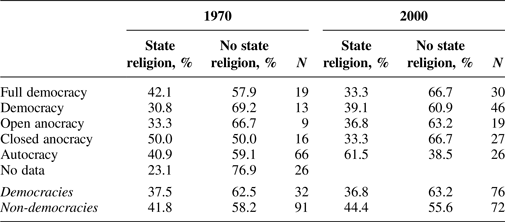
Does empirical evidence support the idea that democracies and autocracies need to be separated when we aim to understand the regulation of religion? As can be read in Table 1, both in 1970 and 2000 the democratic countries are less likely to have a state religion than the non-democratic ones. However, the relationship is not strictly linear: An equally large share of full democracies and autocracies had a state religion in 1970; in 2000 an equally large share of full-democracies and closed anocracies had a state religion; and in 1970 full democracies were more likely to have a state religion than democracies and open anocracies. Moreover, the relative share of autocracies with state religion has drastically increased between 1970 and 2000. More subtle increases have occurred among democracies and open anocracies. In full democracies and closed anocracies, the share of countries with state religion has declined. All in all, the findings indicate that even though democracies are less likely to have state religions, the association is not straightforwardly related to the levels of democracy.
State religion and degree of democracy in 1970 and 2000

Sources: Own calculations based on data on state religion in Barro and McCleary (Reference Barro and McCleary2005, 1336–1339), and Polity IV (Marshall and Gurr Reference Marshall and Gurr2014).
To further study the relationship between democracy and regulation of religion, Pearson's r for the five measures on regulation of religion and Polity was calculated for ca. year 2000. Interestingly, favoritism, and democracy are not linearly correlated (r = −0.03) and the linear association between religious legislation and democracy is relatively weak (r = −0.30). The association between democracy and the three other measures on religious regulation is moderately strong varying between r = −0.52 and r = −0.54. In other words, the level of democracy is associated with only some aspects of the regulation.
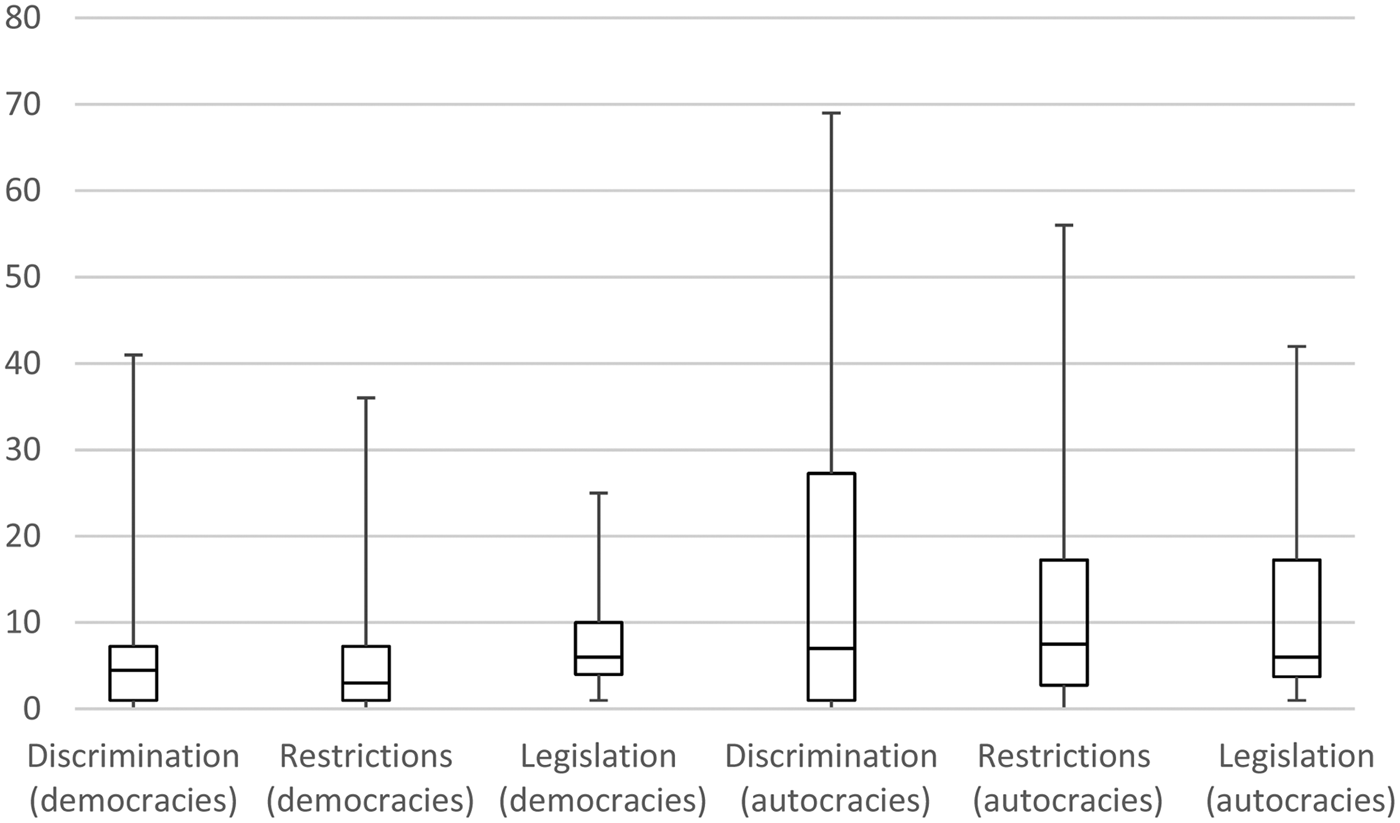
Further, as can be read from Figure 1, which shows the box plots for discrimination, restrictions, and religious legislation, both in democratic and autocratic countries the lowest values of regulation are similar. Further, even though the median of the restrictions is slightly higher in the autocratic countries, the differences are minimal. The biggest differences between autocratic and democratic countries can be observed in the third and fourth quartiles. The maximum values are much higher in the autocratic countries. Moreover, whereas in democratic countries the third quartile is quite narrow and close to the median, in autocratic countries the third quartile is much broader.
Discrimination against minorities, restrictions on religion and religious legislation in democratic and autocratic countries in 2000. Sources: Own calculations based on Fox (Reference Fox2012a) and Polity IV (Marshall and Gurr Reference Marshall and Gurr2014). Notes: N = 148.

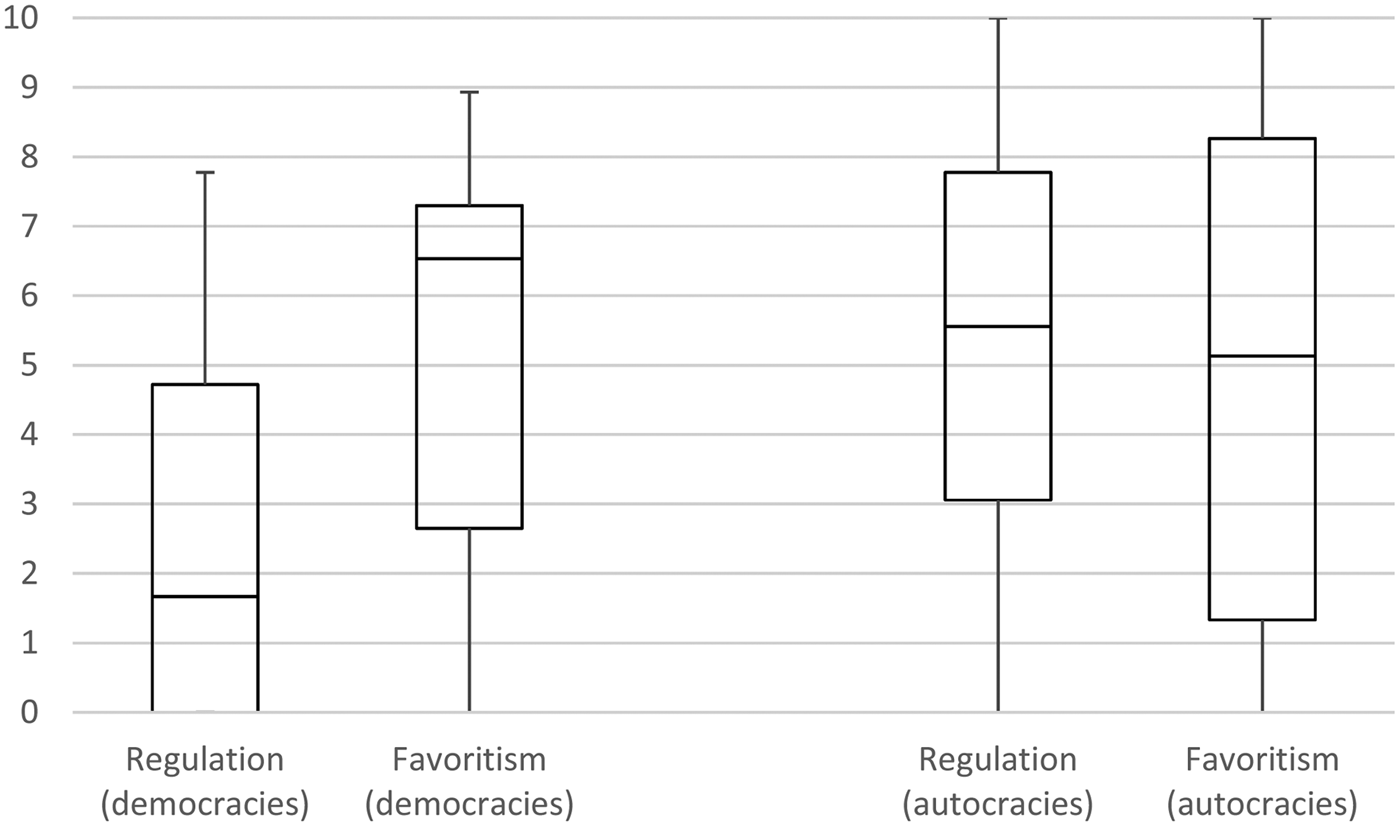
As for the government regulation and favoritism (Figure 2), we notice that the above description can be extended to government regulation, even though this measure indicates that democratic governments are somewhat more heterogeneous than what is suggested by the measures on discrimination, restrictions, and legislation. Interestingly, the median of the government favoritism is higher in democratic than in autocratic countries, which explains the weak Pearson's r between democracy and government favoritism. However, even the favoritism-variable indicates that the autocratic governments are more heterogeneous than the democratic ones. All in all, the results suggest that it is important to study the regulation of religion separately within the democratic and autocratic regimes.
Government regulation and government favoritism of religion in democratic and autocratic countries around year 2000. Source: Own calculations based on Association of Religion Data Archives (2014) and Polity IV (Marshall and Gurr Reference Marshall and Gurr2014). Notes: N = 147 (the USA is excluded due to data availability). Polity-data are for year 2000, data on government regulation and favoritism are for year 2001.

Regulation of Religion in Autocratic Countries
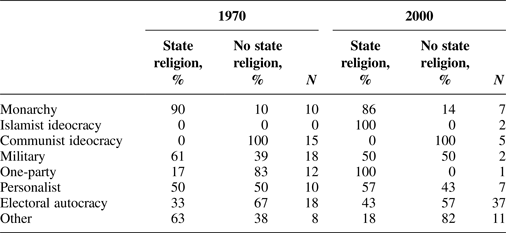
The study of state religion by patterns of legitimation substantially improves our understanding of the variation between the autocratic countries. All monarchies except for Swaziland have a state religion both in 1970 and 2000, and the two Islamist ideocracies in 2000, Afghanistan and Iran, likewise both have a state religion (Table 2). However, none of the communist ideocracies have a state religion in 1970 or in 2000. Further, electoral autocracies are somewhat less likely to have a state religion, and approximately half of the personalist regimes have a state religion in both years (the seemingly higher relative share of personalist countries with state religion in 2000 can be explained with the small number of such countries. The absolute difference is one country). The tendencies in military and one-party regimes are not equally clear. Among military regimes it is somewhat more common to have a state religion in 1970, but by 2000 there are only two military ruled countries (Pakistan and Burma), which makes it difficult to draw conclusions. Further, one-party regimes are less likely to have a state religion in 1970, but in 2000 only Uzbekistan (with state religion) is ruled by a one-party regime.
State religion in autocratic regimes by the type of legitimation, 1970 and 2000

Sources: For state religion, see Barro and McCleary (Reference Barro and McCleary2005, 1336–1339). For the type of legitimation, see Kailitz (Reference Kailitz2015). Notes: Only countries with a Polity score of 5 to −10 were included (N = 91 in 1970 and N = 72 in 2000). Kailitz (Reference Kailitz2015) considers some of these countries to be democracies, in transition, or under occupation, civil war or state failure. These countries are all found in the category “other.”
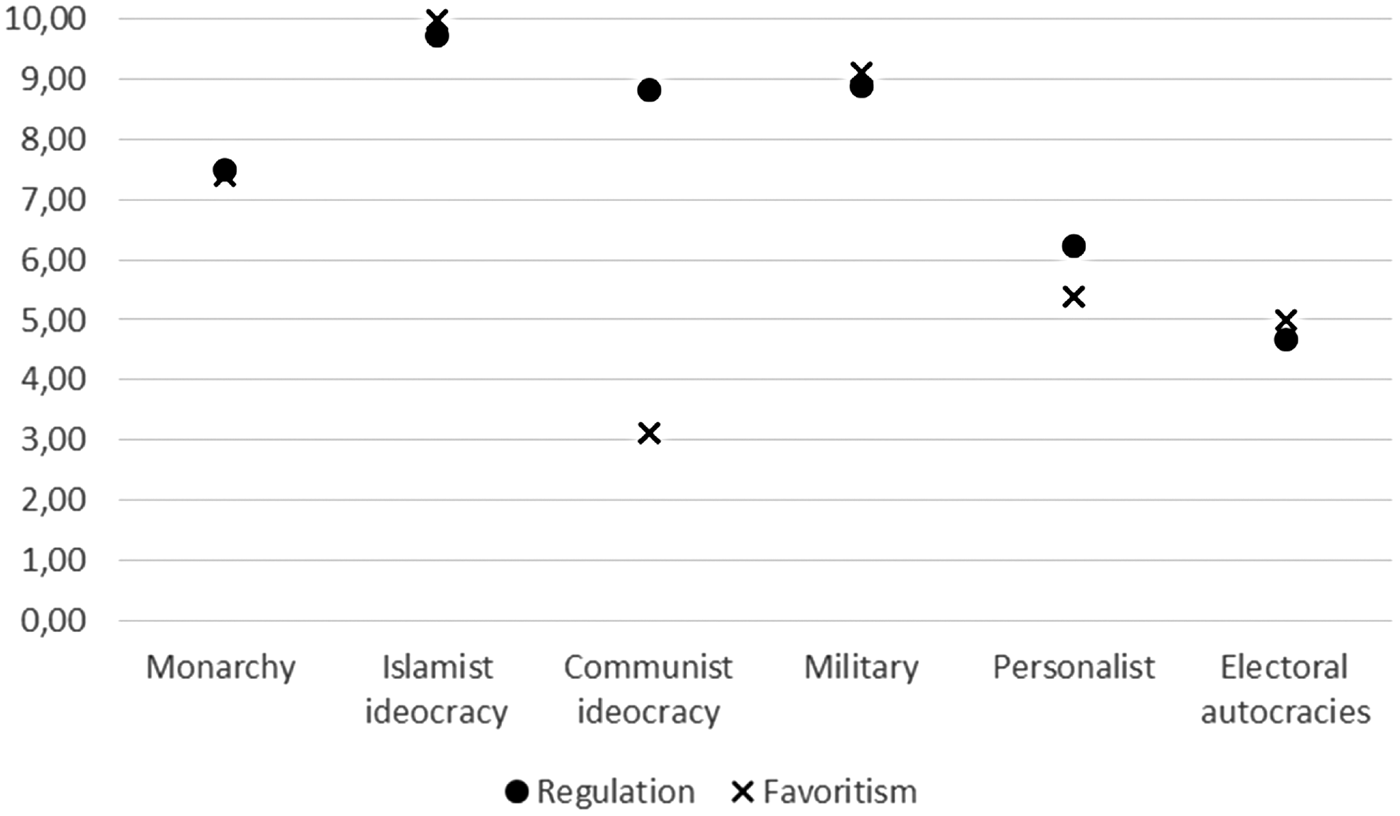
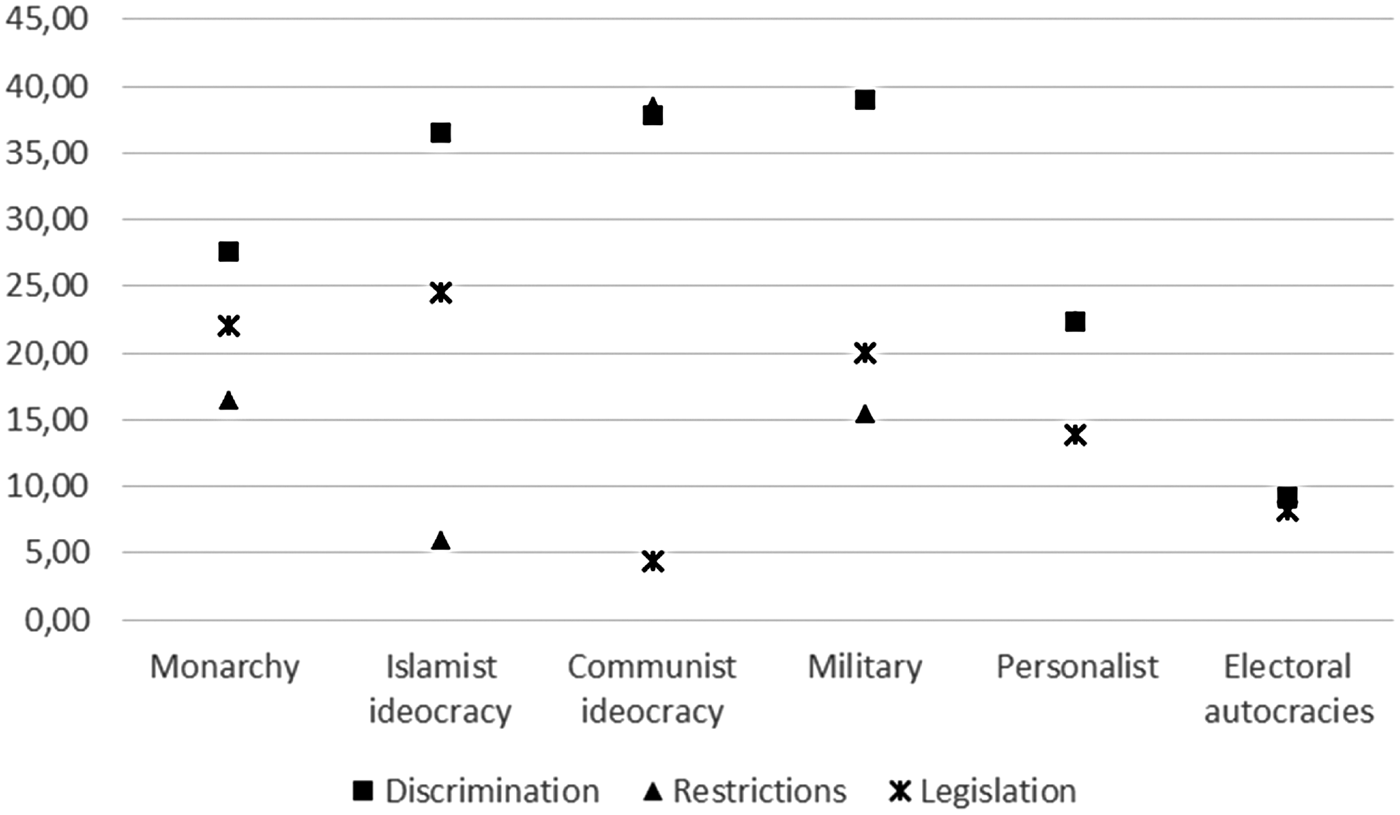
In Figures 3 and 4, the average levels of the different types of regulation by regime type are shown. In monarchies and particularly in Islamic ideocracies, the levels of government favoritism and religious legislation are high. These two types of regimes are also extremely repressive toward religious minorities, but restrictions on majority religion are rather low in Islamist ideocracies and at moderate levels in monarchies.
Government regulation and favoritism of religion, average scores in autocratic regimes in 2000 by the type of legitimation. Sources: For the type of legitimation, see Kailitz (Reference Kailitz2015). For regulation and favoritism, see Association of Religion Data Archives (2014). Notes: As Uzbekistan was the only country with one-party lead regime in 2000, one-party regimes were excluded from the figure. Moreover, the category “other” was omitted. For the number of countries in each category, see Table 2.

Discrimination against minorities, restrictions on religion and religious legislation, average scores in autocratic regimes in 2000 by the type of legitimation. Sources: For the type of legitimation, see Kailitz (Reference Kailitz2015). For discrimination, restrictions and legislation, see Fox (Reference Fox2012a).

In communist ideocracies, co-optation of religion is almost non-existent, but the levels of repression are high. Indeed, of all the observed countries, communist ideocracies have the lowest levels of both favoritism and legislation, highest levels of restrictions on majority religion and second highest levels of discrimination.
Interestingly, electoral autocracies have the lowest levels of regulation in all five measures, which gives support to the idea that regulation of religion is not high on the dictators’ agenda in these countries. A recent study by Frantz and Kendall-Taylor (Reference Frantz and Kendall-Taylor2014) suggests that when co-optation of the opposition occurs through political parties and legislative institutions, it is easier for the dictator to identify the key opponents and employ targeted repressive measures toward them. This, in turn, could mean that the need for broader repressive measures is lower. The logic would help us to explain the particularly low level of regulation of religion in these countries. Yet, it needs to be kept in mind that there are altogether 37 electoral autocracies in 2000, and despite the low average level of regulation, in some of these countries (e.g., Belarus, Egypt) the regulations imposed on religion are at extremely high levels.
Against expectations the levels of regulation in military regimes are very high. Indeed, the average level of discrimination is highest in this regime type, and government regulation of religion is at levels comparable to the communist ideocracies. A possible explanation is that the leadership type rather than the legitimation is consequential for the regulation. Indeed, based on the argument on “coercive expertise,” the literature on repression suggests that “repression is applied when those who specifically enact these policies either are directly in power (i.e., coercive agents) or wield significant influence over those in power” (Davenport Reference Davenport2007, 491). Yet, it is difficult to understand why government favoritism of religion is even higher in countries ruled by military than in monarchies, and why the religious legislation and discrimination are at comparable levels to monarchial countries.
Finally, in personalist regimes the levels of regulation are somewhat higher than in electoral autocracies.
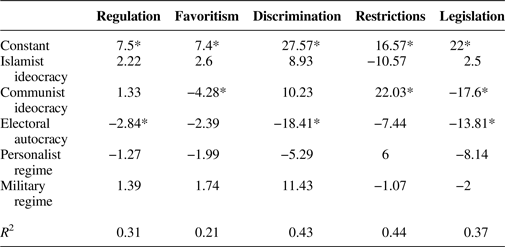
The same information is shown in Table 3 in regression format. The constant refers to the mean value of the monarchial regimes. Thus, the effect size of, for instance, 1.33 for communist ideocracies for regulation indicates that the average level of regulation in communist countries is 1.33 scores higher than the average level in monarchies. The relatively high R 2 of the regressions (except for the favoritism) further supports the idea that the different types of legitimation are important for the regulation of religion.
Regression on the association between regulation of religion and different patterns of legitimation in the autocratic countries

Notes: N = 60. All countries in category “other” in Table 2 were excluded. *p < 0.05.
Regulation of Religion in Democratic Countries
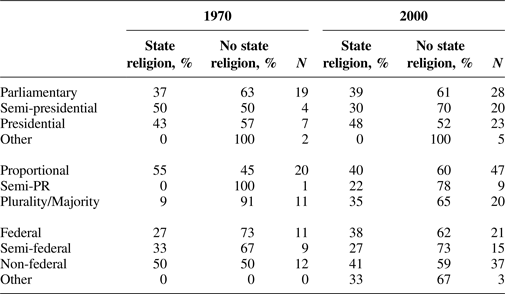
The findings on the association between regulation of religion and institutional variation of the democratic countries are ambiguous. The likelihood of having a state religion varies somewhat depending on the institutional characteristics of the country (Table 4). According to expectations, state religion is more common in countries with proportional electoral system in comparison to countries with plurality/majority system. Yet, contrary to expectations, state religion is more common in presidential than in parliamentary countries and in non-federal than in federal ones. A possible explanation is related to cultural and historical traditions: Both in 1970 and 2000 all presidential countries with a state religion are Latin American countries which had a (Catholic) state religion already in 1900. Moreover, it is possible that federalism as a constitutional structure in some countries (e.g., India) was chosen partly due to the religious divisions between the different parts of the country, which automatically means that it is not possible to agree on a common state religion.
State religion in democratic countries by the constitutional structure, 1970 and 2000

Sources: For state religion, see Barro and McCleary (Reference Barro and McCleary2005, 1336–1339). For the type of government, see Cheibub et al. (Reference Cheibub, Gandhi and Vreeland2010). For federalism, see Gerring and Thacker (Reference Gerring and Thacker2004). For electoral system (data for 1997), see IDEA (1997). Notes: Only countries with a Polity score of 6 to 10 were included (N = 32 in 1970 and N = 76 in 2000).
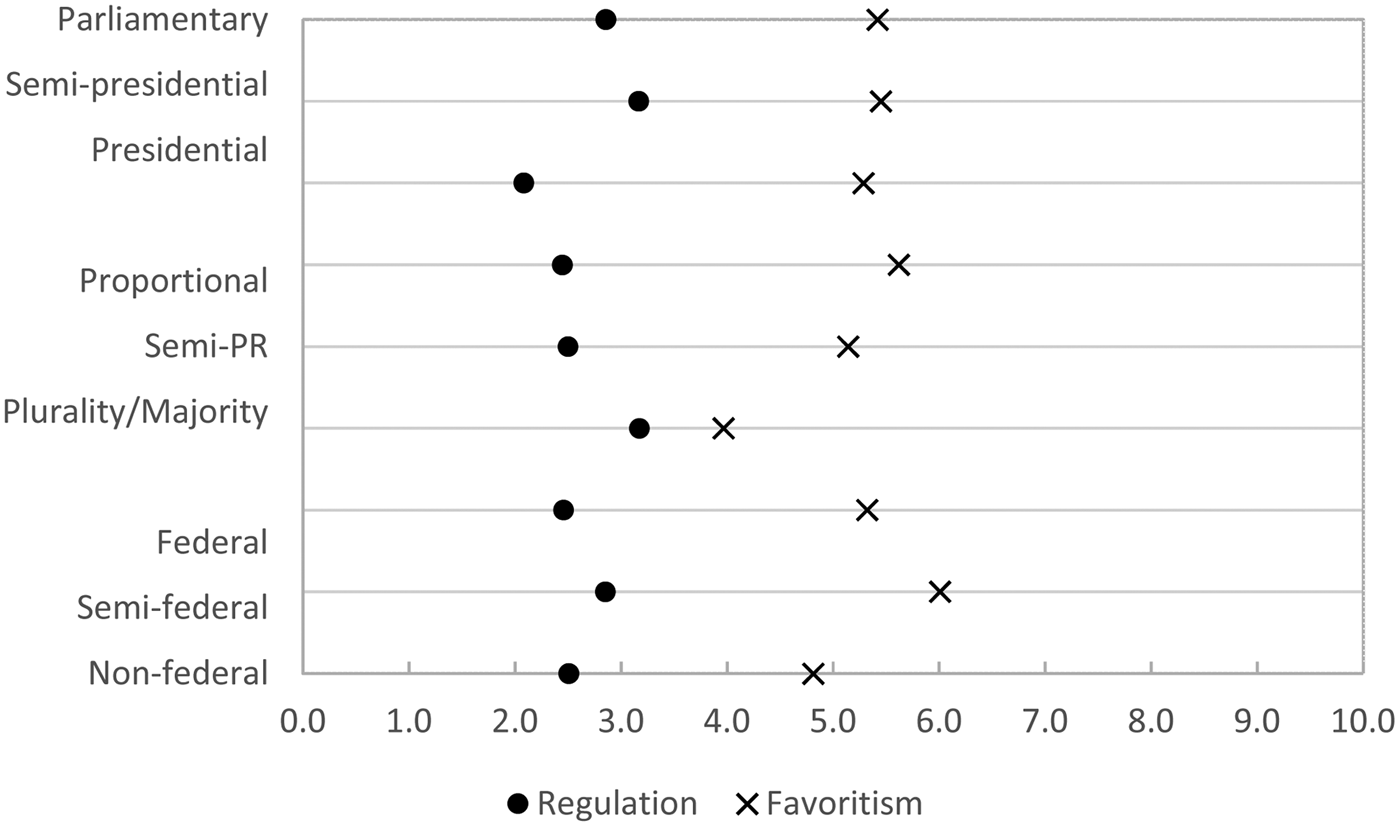
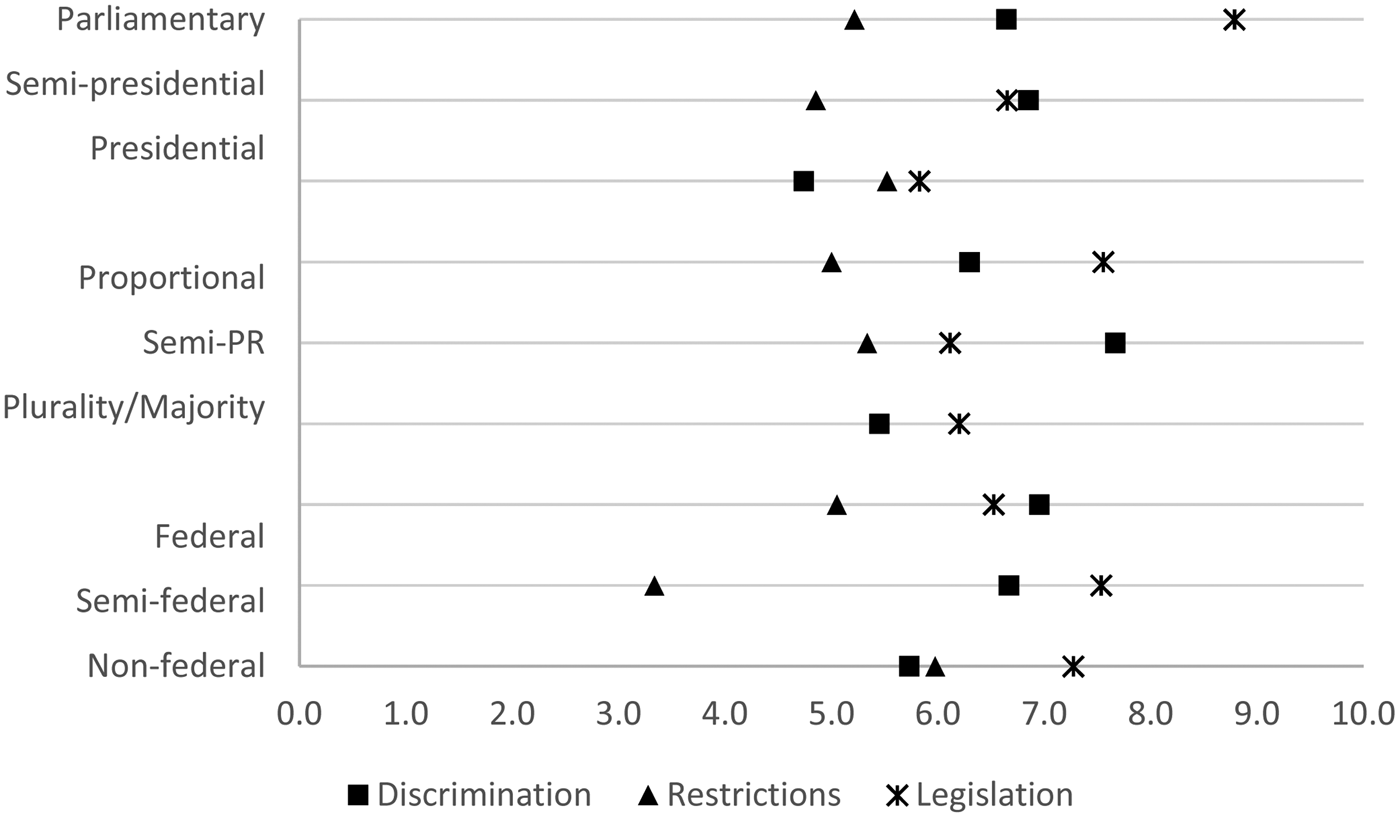
The averages for the different types of regulation in 2000 are shown in Figures 5 and 6. According to expectations, the level of regulation varies by the constitutional structure. The power-sharing institutions related to the type of government and electoral systems are in most cases associated with higher levels of regulation. Most notably, the level of legislation on religion increases when the type of government becomes more consensus-oriented. In a similar manner, the average levels of government favoritism are highest in the countries with proportional electoral system and lowest in countries with majoritarian/plurality system. Against expectations the level of government favoritism does not vary by the type of government. Moreover, the overall level of regulation is actually highest in the presidential countries. Also, some of the differences between the averages are minimal (most notably concerning the restrictions on the majority religion). As for federalism, favoritism and discrimination are at somewhat higher levels in federal countries than in non-federal ones. Yet, the restrictions and legislation are somewhat higher in non-federal countries. Finally, the semi-federal countries distinguish themselves from the others with higher levels of favoritism and lower levels of restrictions.
Government regulation and favoritism of religion. Average scores in democratic countries in 2000 by type of government, electoral system and degree of federalism. Source: For the data on constitutional structure, see Table 4. For regulation and favoritism, see Association of Religion Data Archives (2014). Notes: For the number of countries in each category, see Table 4.

Discrimination against minority religions, restrictions on religion and religious legislation. Average scores in democratic countries in 2000 by type of government, electoral system and degree of federalism. Source: For the data on constitutional structure, see Table 4. For discrimination, restrictions and legislation. see Fox (Reference Fox2012a).

When a regression analysis was conducted (not shown), the regressions with overall level of regulation, discrimination and restrictions as dependent variables resulted in an R 2 below 0.10, and the results concerning government favoritism and legislation had an R 2 around 0.10. The results indicate that the institutions are not important in explaining the variation between the democracies. A possible explanation is that the analysis of the impact of institutional structures needs to be done in combination with the influence of the political actors.
CONCLUDING REMARKS
The aim of the article was to show that the studies on the determinants of regulation of religion can benefit considerably from the integration of the political environment into the investigations. By no means does the study suggest that the previously studied factors related to modernization, economics of religion, and religious traditions are unimportant. However, the influence of these factors should be investigated and understood within the context of the different types of political environments. The current study showed some potentially fruitful avenues for future research in this respect, but should obviously be considered only as a rough start.
The findings concerning the variation between the autocratic regimes are promising, and indicate that the idea that regulation of religion in autocratic regimes is a strategic choice made by the rulers should be a valuable starting point for the studies which focus on the determinants and consequences of such regulation. At the same time it is important to keep in mind that regulation of religion is only one part of the dictators’ toolkit and should consequently not be studied in complete isolation from the other tools in that kit. Future research could for example investigate if there is an association between the co-optation of the workers (Kim and Gandhi Reference Kim and Gandhi2010) and co-optation of religion. Also, to better understand the approaches the authoritarian regimes take towards religion and religious actors, it might be rewarding to reconstruct the current measures on regulation to better correspond to the concepts of co-optation and different types of repression. Such re-conceptualization would enable the scholars engaged with the research on regulation of religion to more efficiently both draw from the current theories and studies on autocracies, and benefit the community of scholars who are engaged with the study on autocracies.
As for the democratic countries, the institutional differences were only weakly associated with the regulation of religion, which indicates that the constitutional structure alone cannot explain the variation in state-religion relationships. Thus, the priority of future research on the cross-country differences in democratic countries should be to identify the most consequential actors for religious regulation and to investigate the preferences and behavior of these actors. At minimum, the agendas of the different political parties concerning religion and its regulation should be investigated. Likewise, the largest religious institutions in general, and the state churches in particular need to be put under the spotlight. Studies on what Philpott (Reference Philpott2007) has called “political theology” are likely to be useful as well. The knowledge of the preferences of the different actors should be accompanied with studies which investigate the strategical behavior of the actors, and how they have attempted to influence political decision-making, for example, through lobbying or by building alliances with other actors, and how efficient they have been in doing so. Even these studies should however keep the constitutional structure in mind, as it is possible that future research will show that certain combinations of institutions and actors are consequential for the regulation of religion.