Introduction
Antimicrobial resistance (AMR) amongst companion animals, particularly household pets and horses, is a complex area that is of increasing importance because of both patient factors and public health issues. In this context, a unique and critical aspect of AMR in companion animals is their close contact with humans. This creates opportunities for interspecies transmission of bacteria, including multidrug resistant (MDR) bacteria, so that it is possible and likely that the increasing rates of MDR bacterial infection and colonization in humans may be reflected in their close contacts, including companion animals. Despite the close contact of many people with companion animals and concerns about the animal and human health risks associated with MDR infections, there has been surprisingly little investigation of many aspects of this field, so that current knowledge is limited.
Evaluation of the scope of AMR in companion animals is difficult, as there are few formal surveillance programs, particularly compared to the data available for food animal species. Much of the available data come from retrospective studies of clinical isolates, with the inherent potential bias for overestimation of resistance because clinical specimens could represent both the most serious infections and those that had failed to respond to antimicrobial therapy. Also, there can be geographical variation in pathogen and susceptibility patterns, as well as global differences in antimicrobial drug usage that can limit the applicability of results to other areas. Few prospective, population-based studies are available, and many are relatively small. It is an important area for future research, particularly because of the potential for bi-directional infection with humans, and of amplification of resistance in veterinary clinics with subsequent infection of humans.
AMR is a concern in a wide range of bacterial pathogens and commensals. Detailed examination of several aspects of the relevant concerns is beyond the scope of this review. Specific information on AMR in selected bacterial species is provided below.
Staphylococcus aureus and Staphylococcus pseudintermedius
AMR has been a problem historically with staphylococci, an important group of opportunistic pathogens. Penicillin resistance, associated with beta-lactamase production, is very common amongst clinical companion animal staphylococcal isolates, with resistance rates of up to 74% (Hoekstra and Paulton, Reference Hoekstra and Paulton2002). Although beta-lactamase producing staphylococci can be treated successfully with beta-lactam/beta-lactamase inhibitor combinations, beta-lactamase resistant beta-lactam antimicrobials, and other drug classes, much recent attention has been paid to the emergence of methicillin-resistance, particularly in S. aureus (MRSA) and S. pseudintermedius (MRSP). Methicillin-resistance is mediated by the mecA gene, which resides on a staphylococcal cassette in the chromosome (SCCmec). Expression of mecA results in production of an altered penicillin-binding protein, PBP2a, which has low affinity for all beta-lactam antimicrobials (penicillins, cephalosporins and carbapenems), rendering methicillin-resistant strains clinically resistant to this broad class of antimicrobials. Clinical MRSA infections have been reported in various species, including dogs, cats, rabbits and horses. MRSA can also be isolated from the nasal passages or intestinal tract of a small percentage (0–5%) of healthy individuals (Baptiste et al., Reference Baptiste, Williams, Willams, Wattret, Clegg, Dawson, Corkill, O'Neill and Hart2005; Weese et al., Reference Weese, Rousseau, Traub-Dargatz, Willey, Mcgeer and Low2005b; Kottler et al., Reference Kottler, Middleton, Weese and Cohn2008). MRSA isolates often possess a variety of other resistance genes, and some may even be resistant to most available antimicrobials. There have only been limited studies describing and characterizing other AMR genes amongst MRSA. Macrolide resistance is common and typically mediated by erm(C) (O'Mahony et al., Reference O'Mahony, Abbott, Leonard, Markey, Quinn, Pollock, Fanning and Rossney2005; Rich et al., Reference Rich, Deighton and Roberts2005; Bagcigil et al., Reference Bagcigil, Moodley, Baptiste, Jensen and Guardabassi2007). Inducible resistance to clindamycin is also a concern because of the inability to detect resistant strains using routine testing. For example, a British study reported inducible resistance in 71% of veterinary isolates (Rich et al., Reference Rich, Deighton and Roberts2005), whereas a North American study identified inducible resistance in 55% of erythromycin resistant isolates from dogs and cats (Faires and Weese, Reference Faires and Weese2008). Tetracycline resistance is common among canine and equine S. aureus (methicillin-sensitive S. aureus [MSSA] and MRSA) in most regions (Baptiste et al., Reference Baptiste, Williams, Willams, Wattret, Clegg, Dawson, Corkill, O'Neill and Hart2005; O'Mahony et al., Reference O'Mahony, Abbott, Leonard, Markey, Quinn, Pollock, Fanning and Rossney2005; Weese et al., Reference Weese, Archambault, Willey, Hearn, Kreiswirth, Said-Salim, Mcgeer, Likhoshvay, Prescott and Low2005a; Bagcigil et al., Reference Bagcigil, Moodley, Baptiste, Jensen and Guardabassi2007) and is most commonly mediated by the tet(K) gene (Schwarz et al., Reference Schwarz, Roberts, Werckenthin, Pang and Lange1998). Highly variable (3–79%) trimethoprim-sulfonamide resistance has been reported (Weese et al., Reference Weese, Archambault, Willey, Hearn, Kreiswirth, Said-Salim, Mcgeer, Likhoshvay, Prescott and Low2005a; Morris et al., Reference Morris, Mauldin, O'Shea, Shofer and Rankin2006; Rich and Roberts, Reference Rich and Roberts2006). There are also variable rates for aminoglycoside resistance, with some studies reporting very low rates (3–8%) (Morris et al., Reference Morris, Mauldin, O'Shea, Shofer and Rankin2006; Rich and Roberts, Reference Rich and Roberts2006) and others up to 100% (Baptiste et al., Reference Baptiste, Williams, Willams, Wattret, Clegg, Dawson, Corkill, O'Neill and Hart2005; Weese et al., Reference Weese, Archambault, Willey, Hearn, Kreiswirth, Said-Salim, Mcgeer, Likhoshvay, Prescott and Low2005a; O'Mahony et al., Reference O'Mahony, Abbott, Leonard, Markey, Quinn, Pollock, Fanning and Rossney2005). The highest rates have been reported for equine isolates, which could reflect the more common use of this drug class in horses. There are similarly variable (0–100%) rates for fluoroquinolone resistance, with higher rates in small animal studies (Morris et al., Reference Morris, Mauldin, O'Shea, Shofer and Rankin2006; O'Mahony et al., Reference O'Mahony, Abbott, Leonard, Markey, Quinn, Pollock, Fanning and Rossney2005; Weese et al., Reference Weese, Archambault, Willey, Hearn, Kreiswirth, Said-Salim, Mcgeer, Likhoshvay, Prescott and Low2005a; Rich and Roberts, Reference Rich and Roberts2006). Some of the variations in reported resistance rates likely involve the presence of different MRSA clones in different geographic regions and between different animal species.
Although MRSA receives the most attention, largely because of its significance in human medicine and the potential for zoonotic transmission, other staphylococci may be of equal or greater clinical concern in companion animals. S. pseudintermedius (previously misidentified as Staphylococcus intermedius), is an important pathogen, particularly in dogs and cats. Methicillin-resistant strains (MRSP) have been reported (Sasaki et al., Reference Sasaki, Kikuchi, Tanaka, Takahashi, Kamata and Hiramatsu2007; Schwarz et al., Reference Schwarz, Kadlec and Strommenger2007) and anecdotally there has been a dramatic increase in infections worldwide in recent years. Like MRSA, methicillin-resistance in MRSP is mediated by the mecA gene, and MRSP isolates are resistant to all beta-lactam antimicrobials. Multidrug resistance among MRSP may be very common. While data are limited, there is anecdotal information of highly drug resistant MRSP isolates, which are susceptible to few antimicrobials, and which are more resistant than most MRSA isolates. The largest most recent study, from a Japanese veterinary teaching hospital, reported 100% resistance to erythromycin, clindamycin, trimethoprim-sulfa (TMS) and levofloxacin (Sasaki et al., Reference Sasaki, Kikuchi, Tanaka, Takahashi, Kamata and Hiramatsu2007). In contrast to MRSA, inducible resistance to clindamycin is very rare in MRSP (unpublished data) and macrolide resistance tends to be mediated by erm(A) (Schwarz et al., Reference Schwarz, Kadlec and Strommenger2007). Tetracycline resistance is common (Sasaki et al., Reference Sasaki, Kikuchi, Tanaka, Takahashi, Kamata and Hiramatsu2007), as in MRSA, but is most often mediated by tet(M) (Schwarz et al., Reference Schwarz, Roberts, Werckenthin, Pang and Lange1998).
Enterococci
Enterococci are opportunistic Gram-positive pathogens that are commonly found in the gastrointestinal tract of many animal species. The two species most often involved in disease are Enterococcus faecium and Enterococcus faecalis. Enterococci are inherently resistant to a variety of antimicrobial classes, including cephalosporins, some penicillins, clindamycin and trimethoprim, which makes the implications of acquired resistance even greater.
In human medicine, vancomycin resistant enterococci (VRE) are a tremendous concern, particularly E. faecium and E. faecalis strains carrying the transferable vanA and vanB genes. Currently, VRE are rare in companion animals (Rice et al., Reference Rice, Boczek, Johnson and Messer2003; Damborg et al., Reference Damborg, Sørensen and Guardabassi2008; Ossiprandi et al., Reference Ossiprandi, Bottarelli, Cattabiani and Bianchi2008); however, there have been sporadic reports of infection or colonization in household pets (Devriese et al., Reference Devriese, Ieven, Goossens, Vandamme, Pot, Hommez and Haesebrouck1996; de Niederhäusern et al., Reference De Niederhäusern, Sabia, Messi, Guerrieri, Manicardi and Bondi2007). A link between VRE carriage in dogs and avoparcin use in food animals has been suggested as an explanation for high rates in some European studies, such as the 48% vancomycin resistance among canine enterococci in the Netherlands (van Belkun et al., Reference Van Belkun, Van Den Braak, Thomassen, Verbrugh and Endtz1996). While the link to avoparcin has not been proven, a subsequent Dutch study, performed 5 years after avoparcin use was banned, reported no VRE in 100 dogs, so that there was an apparent marked decline in canine fecal carriage (Wagenvoort et al., Reference Wagenvoort, Burgers, Wagenvoort and Burgers2003). VRE colonization has also been reported in horses, with a 6.7% colonization rate reported in a study of Italian horses (de Niederhäusern et al., Reference De Niederhäusern, Sabia, Messi, Guerrieri, Manicardi and Bondi2007).
Although VRE infections are rare in companion animals, other MDR enterococci are of greater importance. It is not unusual to encounter enterococci in clinical specimens that are resistant to most antimicrobials, except vancomycin. However, population-based studies provide conflicting reports of resistance to other antimicrobials. For example, studies of healthy dogs in Denmark and dogs with antimicrobial exposure in Finland reported low prevalences of resistance to various antimicrobials (Rantala et al., Reference Rantala, Lahti, Kuhalampi, Pesonen, Järvinen, Saijonmaa-Koulumies and Honkanen-Buzalski2004; Damborg et al., Reference Damborg, Sørensen and Guardabassi2008), whereas a study of healthy dogs in the community in Portugal reported higher rates of resistance to most antimicrobials (Poeta et al., Reference Poeta, Costa, Rodrigues and Torres2006) and a study of dogs presented to a veterinary hospital in Italy reported frequent resistance to fluoroquinolones, tetracyclines, macrolides, rifampin and tetracycline (Ossiprandi et al., Reference Ossiprandi, Bottarelli, Cattabiani and Bianchi2008). High rates of tetracycline and macrolide resistance in E. faecalis were also reported in dogs from private homes and kennels in Belgium (De Graef et al., Reference De Graef, Decostere, Devriese and Haesebrouck2004).
These examples highlight the need to consider the study population when evaluating resistance data. Recently, ampicillin-resistant CC17 E. faecium, an important strain in humans, was identified in a surveillance study of dogs in Denmark, a country with a relatively low prevalence of MDR enterococci in humans (Damborg et al., Reference Damborg, Sørensen and Guardabassi2008). This strain is of concern because of its role in human disease and typical resistance to ampicillin, potentiated penicillins, first generation cephalosporins, potentiated sulfonamides and fluoroquinolones, the main first line treatments for urinary tract and many other infections in pets.
Streptococci
Streptococcus zooepidemicus and Streptococcus equi are important pathogens in equine medicine and Streptococcus canis is an uncommon but potentially important pathogen in small animals. In general, AMR amongst equine streptococci is rare and streptococci are assumed to have relatively predictable patterns of susceptibility. Beta-lactam resistance is rare (Clark et al., Reference Clark, Greenwood, Boison, Chirino-Trejo and Dowling2008) despite widespread use of beta-lactam antimicrobials for streptococcal infections over many years. TMS resistance is a somewhat controversial area that requires further study. Feary et al. (Reference Feary, Hyatt, Traub-Dargatz, Roach, Jones, Wu and Morley2005) investigated a decrease in S. zooepidemicus susceptibility from close to 100% to 50% over a few years, and concluded that there was false reporting of resistance because of the use of an inappropriate culture medium and quality control strain. However, a recent study reported that only 55% of S. zooepidemicus isolates were susceptible despite the use of CLSI guidelines and appropriate control strains (Clark et al., Reference Clark, Greenwood, Boison, Chirino-Trejo and Dowling2008). This is potentially important, particularly in light of a study indicating that TMS administration was unable to prevent S. zooepidemicus infection and abscess formation following experimental inoculation (Ensink et al., Reference Ensink, Bosch and Van Duijkeren2005).
Resistance is uncommon in Streptococcus canis from dogs. Resistance rates of 0% have been reported for penicillin, ampicillin, amoxicillin/clavulanic acid, gentamicin and chloramphenicol, with low rates of resistance to erythromycin (12%) and clindamycin (12%) among isolates from the ears of dogs with and without otitis (Lyskova et al., Reference Lyskova, Vydrzalova and Mazurova2007). Another study reported no resistance to penicillin, cephalothin or trimethoprim/sulfonamides with 27% resistance to tetracycline, 14% to enrofloxacin, 14% to clindamycin and 11% to erythromycin (Pedersen et al., Reference Pedersen, Pedersen, Jensen, Finster, Jensen and Heuer2007). Macrolide resistance in canine isolates has been associated with erm(B) in two canine S. canis isolates, whereas mef(A) and msr(D) were identified in macrolide resistant Streptococcus dysgalactiae ssp. equisimilis from one dog (Lüthje and Schwarz, Reference Lüthje and Schwarz2007). There has been minimal investigation of other mechanisms of resistance amongst companion animal streptococci. While not related to resistance, there is an interesting association between fluoroquinolone administration and streptococcal toxic shock syndrome and necrotizing fasciitis in dogs (Ingrey et al., Reference Ingrey, Ren and Prescott2003). This occurs through enrofloxacin-mediated induction of a mitogen-encoding bacteriophage. The prevalence of this bacteriophage in S. canis strains is unknown; however, the severity of this potential complication indicates that fluoroquinolones should not be used when S. canis infection is known or likely.
Escherichia coli
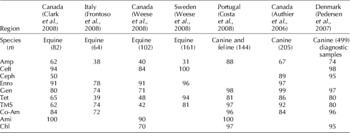
E. coli is an important pathogen and common component of the commensal intestinal microflora. The vast reservoir of E. coli in the intestinal tract is of potential concern as a pool of AMR. Various studies have evaluated susceptibility patterns amongst E. coli isolates from healthy animals and infected sites (Table 1). The marked diversity in E. coli and the inherent biases in clinical-specimen-based reporting complicate understanding of AMR in E. coli at the population level.
Susceptibility patterns of E. coli isolates from companion animals

Amp, ampicillin; Ceft, ceftiofur; Ceph, cephalothin; Enro, enrofloxacin; Ge, gentamicin; Tet, tetracycline; TMS, trimethoprim-sulfonamide; Co-Am, amoxicillin–clavulanic acid; Ami, amikacin; Chl, chloramphenicol.
The data are presented as percentage of isolates that are susceptible to the anti-microbial
The main area of focus regarding AMR in E. coli involves beta-lactamase production, because of the importance of beta-lactam antimicrobials in the treatment of infections of animals and humans and concerns about transmission of resistant strains between animals and humans. Of particular concern is extended spectrum beta-lactamases (ESBLs), which hydrolyze a broad range of beta-lactam antimicrobials. These include the plasmid-encoded AmpC-type CMY beta-lactamases and Class A ESBLs (mainly TEM and SHV derivatives, and CTX-M ESBLs) which are emerging animal and human health concerns (Li et al., Reference Li, Mehrotra, Ghimire and Adewoye2007). Studies of isolates from dogs and cats have identified bla CMY-2, bla CTX-M, bla TEM and bla SHV-12 (Teshager et al., Reference Teshager, Domínguez, Moreno, Saénz, Torres and Cardeñosa2000; Sanchez et al., Reference Sanchez, McCrackin Stevenson, Hudson, Maier, Buffington, Dam and Maurer2002; Carattoli et al., Reference Carattoli, Lovari, Franco, Cordaro, Di Matteo and Battisti2005; Costa et al., Reference Costa, Poeta, Sáenz, Coelho, Matos, Vinué, Rodrigues and Torres2008), whereas bla CMY-2, bla CTX-M, bla TEM and bla SHV-1 have been reported in horses (Vo et al., Reference Vo, Van Duijkeren, Fluit and Gaastra2007a; Dolejska et al., Reference Dolejska, Duskova, Machova, Kohoutova and Cizek2008).
Other studies have evaluated different molecular aspects of AMR. Studies of integrons and associated resistance genes reported identification of aac(3)-II, aadA1, aadA2, aadA4 and aadA5 (aminoglycoside resistance), dfrA1, dfrA12 and dfrA17 (trimethoprim resistance), estX, sat2 and sat12 (streptothricin resistance), catB3 (chloramphenicol resistance), and sul1 (sulfonamide resistance) from canine and feline isolates (Kadlec and Schwarz, Reference Kadlec and Schwarz2008; Costa et al., Reference Costa, Poeta, Sáenz, Coelho, Matos, Vinué, Rodrigues and Torres2008). tet(A) and/or tet(B), encoding tetracycline resistance, have been found in isolates from dogs and cats, with tet(A) being more common in dogs and tet(B) more common in cats (Costa et al., Reference Costa, Poeta, Sáenz, Coelho, Matos, Vinué, Rodrigues and Torres2008). Studies of resistance determinants have often focused on populations of isolates with specific phenotypes (i.e. cephalosporin resistance) so the population prevalence is not well understood. Regardless, it is clear that MDR E. coli, including various combinations of beta-lactamase and other resistance determinants, can be found in isolates from both healthy animals and clinical cases. Further, the topic of AMR in E. coli in household pets may be of considerable public health significance because of the potential for interspecies transmission as was highlighted by a study raising concern that dogs could be sources of uropathogenic E. coli in humans (Starcic et al., Reference Starcic, Johnson, Stell, Van Der Goot, Hendriks, Van Vorstenbosch, Van Dijk and Gaastra2002).
Salmonella
Salmonellosis is an important disease in many companion animals, and is also a zoonotic threat. MDR Salmonella have been widely reported in horses; these include serovars Infantis (Tillotson et al., Reference Tillotson, Savage, Salman, Gentry-Weeks, Rice, Fedorka-Cray, Hendrickson, Jones, Nelson and Traub-Dargatz1997), Anatum (Zhao et al., Reference Zhao, Mcdermott, White, Qaiyumi, Friedman, Abbott, Glenn, Ayers, Post, Fales, Wilson, Reggiardo and Walker2007), Heidelberg (Amavisit et al., Reference Amavisit, Markham, Lightfoot, Whithear and Browning2001), Krefeld (Ikeda and Hirsh, Reference Ikeda and Hirsh1985), Newport (Zhao et al., Reference Zhao, Mcdermott, White, Qaiyumi, Friedman, Abbott, Glenn, Ayers, Post, Fales, Wilson, Reggiardo and Walker2007), Saint Paul (Ikeda and Hirsh, Reference Ikeda and Hirsh1985), and Typhimurium (Ward et al., Reference Ward, Brady, Couëtil, Liljebjelke, Maurer and Wu2005) including Typhimurium DT104 (Weese et al., Reference Weese, Baird, Poppe and Archambault2001). Outbreaks of MDR Salmonella infections have been widely reported in horses in veterinary teaching hospitals (Ikeda and Hirsh, Reference Ikeda and Hirsh1985; Tillotson et al., Reference Tillotson, Savage, Salman, Gentry-Weeks, Rice, Fedorka-Cray, Hendrickson, Jones, Nelson and Traub-Dargatz1997; Ward et al., Reference Ward, Brady, Couëtil, Liljebjelke, Maurer and Wu2005). However, MDR Salmonella can also be found in horses in the general population, both in horses with salmonellosis and subclinical carriers. Risk factors for MDR Salmonella colonization or infection have been poorly defined.
MDR Salmonella can also be a problem in dogs and cats, with sporadic cases and outbreaks amongst animals and humans in veterinary clinics and households (Cherry et al., Reference Cherry, Burns, Johnson, Pfeiffer, Dumas, Barrett, Mcdonough and Eidson2004; Wright et al., Reference Wright, Tengelsen, Smith, Bender, Frank, Grendon, Rice, Thiessen, Gilbertson, Sivapalasingam, Barrett, Besser, Hancock and Angulo2005).
Various AMR genes have been identified in Salmonella from horses and household pets (Rankin et al., Reference Rankin, Aceto, Cassidy, Holt, Young, Love, Tewari, Munro and Benson2002; Gray et al., Reference Gray, Hungerford, Fedorka-Cray and Headrick2004; Vo et al., Reference Vo, Van Duijkeren, Fluit and Gaastra2007b; Zhao et al., Reference Zhao, Mcdermott, White, Qaiyumi, Friedman, Abbott, Glenn, Ayers, Post, Fales, Wilson, Reggiardo and Walker2007). As with E. coli, ESBL producing strains of Salmonella are of concern. Ceftiofur resistance was identified in 9.8% of feline and 20.8% of canine Salmonella isolates in one study (Frye and Fedorka-Cray, Reference Frye and Fedorka-Cray2007). Various resistance genes, including bla CMY-2, bla SHV, bla TEM and bla CTX-M, were identified. bla CMY-2, bla SHV, bla TEM and bla CTX-M have been identified in canine, feline and equine Salmonella in studies of cephalosporin resistant isolates (Rankin et al., Reference Rankin, Aceto, Cassidy, Holt, Young, Love, Tewari, Munro and Benson2002; Gray et al., Reference Gray, Hungerford, Fedorka-Cray and Headrick2004; Vo et al., Reference Vo, Van Duijkeren, Fluit and Gaastra2007b). Various integron-associated resistance genes have been identified in equine isolates, including aadA21, aadA1 and aadA2 (aminoglycoside resistance), dfrA1, dfrA7 and dhrfXII (trimethoprim resistance) and bla PSE-1 (ampicillin resistance) (Rankin et al., Reference Rankin, Aceto, Cassidy, Holt, Young, Love, Tewari, Munro and Benson2002; Vo et al., Reference Vo, Van Duijkeren, Fluit and Gaastra2007b; Zhao et al., Reference Zhao, Mcdermott, White, Qaiyumi, Friedman, Abbott, Glenn, Ayers, Post, Fales, Wilson, Reggiardo and Walker2007).
Pseudomonas
Multidrug resistance is a common problem in Pseudomonas spp. and MDR Pseudomonas infections can be encountered in companion animals in veterinary hospitals and in the community. They can be of particular concern in hospitals because of strong environmental persistence and innate resistance to many antiseptics (Deplano et al., Reference Deplano, Denis, Poirel, Hocquet, Nonhoff, Byl, Nordmann, Vincent and Struelens2005; Bonomo and Szabo, Reference Bonomo and Szabo2006).
AMR can be variable, with some isolates resistant to a large number of antimicrobials. A study of canine isolates reported resistance to from 8 to 28 of 32 tested antimicrobials (Rubin et al., Reference Rubin, Walker, Blickenstaff, Bodeis-Jones and Zhao2008). Pan-resistant Pseudomonas aeruginosa has been reported in humans (Deplano et al., Reference Deplano, Denis, Poirel, Hocquet, Nonhoff, Byl, Nordmann, Vincent and Struelens2005), but not yet in animals. Beta-lactam resistance, almost all of it innate resistance, is very common. A Canadian study of isolates from canine ear and skin infections reported 100% resistance to ampicillin, cefazolin, cefoxitin, cephalothin and cefpodoxime, 99% resistance to amoxicillin/clavulanic acid, and 97% resistance to ceftiofur, with lesser resistance to ceftriaxone (39%), cefotaxime (26%) and cefotaxime/clavulanic acid (20%) (Rubin et al., Reference Rubin, Walker, Blickenstaff, Bodeis-Jones and Zhao2008). Acquired resistance to gentamicin (7%) and amikacin (3%) was uncommon but there were high rates against chloramphenicol (100%), tetracycline (98%) and trimethoprim-sulfamethoxazole (57%). Resistance to fluoroquinolones was moderate with 16% resistant to ciprofloxacin, 31% resistant to enrofloxacin and 52% resistant to orbifloxacin. Twenty-two different alterations in gyrA sequences were identified among 102 naladixic acid resistant isolates, particularly mutations at Thr83 and Asp87. Alterations in gyrB and parC were also found amongst naladixic acid resistant isolates, but were less common. Similar resistance patterns were reported in a smaller study of clinical isolates from dogs in Denmark (Pedersen et al., Reference Pedersen, Pedersen, Jensen, Finster, Jensen and Heuer2007), whereas similar rates of resistance to enrofloxacin (53%) and ciprofloxacin (25%) were reported in an American study of ear and skin isolates (Wildermuth et al., Reference Wildermuth, Griffin, Rosenkrantz and Boord2007). Thirty-three percent resistance to marbofloxacin was also reported in the latter study. Less information is available regarding isolates from horses. A study of equine P. aeruginosa isolates reported 100% resistance to ampicillin, ceftiofur, penicillin, cephalothin, tetracycline and trimethoprim-sulfonamide, with 87% resistance to amoxicillin/clavulanic acid, 44% to gentamicin, 70% to enrofloxacin, and 8% to amikacin (Clark et al., Reference Clark, Greenwood, Boison, Chirino-Trejo and Dowling2008). Resistance to beta-lactams was less common in other Pseudomonas spp., with 76% resistance to ampicillin, 67% to ceftiofur and 84% to penicillin, however, there was 32% resistance to enrofloxacin, 44% to gentamicin, 60% to tetracycline, 48% to trimethoprim-sulfonamide and 0% to amikacin. An earlier study reported no resistance to gentamicin and amikacin, 36% resistance to enrofloxacin, 14% resistance to tetracycline, 71% resistance to chloramphenicol and 100% resistance to beta-lactams (Hariharan et al., Reference Hariharan, Mcphee, Heaney and Bryenton1995). Studies of isolates from pseudomonal keratitis have reported high rates of susceptibility to gentamicin, tobramycin and ciprofloxacin, with variable resistance to chloramphenicol (Moore et al., Reference Moore, Collins and Fales1995; Keller and Hendrix, Reference Keller and Hendrix2005).
Acinetobacter
Members of the Gram-negative genus Acinetobacter are potentially important and highly drug resistant pathogens, mainly in hospital environments. They are opportunistic pathogens that can cause a range of infections in various species, including dogs, cats and horses (Francey et al., Reference Francey, Gaschen, Nicolet and Burnens2000; Boerlin et al., Reference Boerlin, Eugster, Gaschen, Straub and Schawalder2001). Hospital-associated infections are probably most commonly based on the opportunistic nature of Acinetobacter spp. and the ability of this organism to persist in the hospital environment for prolonged periods of time.
Much attention has been paid recently to Acinetobacter baumanii infections in humans because of the increased incidence and very high level of AMR (Krcmery and Kalavsky, Reference Krcmery and Kalavsky2007; Naas et al., Reference Naas, Kernbaum, Allali and Nordmann2007; Perez et al., Reference Perez, Hujer, Hujer, Decker, Rather and Bonomo2007). Acinetobacter spp. tend to possess large collections of mobile resistance determinants and also have a high endogenous mutation rate that allows for de novo development of resistance (Fournier et al., Reference Fournier, Vallenet, Barbe, Audic, Ogata, Poirel, Richet, Robert, Mangenot, Abergel, Nordmann, Weissenbach, Raoult and Claverie2006). Emergence of resistance even during a single course of therapy has been reported (Reid et al., Reference Reid, Grim, Aldeza, Janda and Clark2007). Some Acinetobacter spp. strains from humans possess resistance mechanisms against all known antimicrobial classes (Perez et al., Reference Perez, Hujer, Hujer, Decker, Rather and Bonomo2007; Reid et al., Reference Reid, Grim, Aldeza, Janda and Clark2007). Little information has been published regarding antimicrobial susceptibility amongst companion animal isolates, however anecdotal information indicates that highly drug resistance isolates are being encountered in veterinary hospitals. Reports involving small numbers of isolates have indicated common susceptibility in vitro to amikacin, imipenem and enrofloxacin amongst equine and canine isolates (Francey et al., Reference Francey, Gaschen, Nicolet and Burnens2000; Boerlin et al., Reference Boerlin, Eugster, Gaschen, Straub and Schawalder2001).
Conclusion
Emergence and dissemination of AMR in companion animals will undoubtedly continue to be a challenge in veterinary medicine, from both patient health and public health standpoints. More organized surveillance is required to better understand the scope of the problem, and to identify measures that may be used to decrease the impact of this problem.