INTRODUCTION
As employees are considered valuable assets of a company, maintaining satisfied workforce can contribute significantly to superior organizational performance (Edwards, Bell, Arthur, & Decuir, Reference Edwards, Bell, Arthur and Decuir2008). However, today's intense business competition and increased hectic life style of people, especially in emerging economies have made employees more prone to stress (Hung, Fisher, Gapp, & Carter, Reference Hung, Fisher, Gapp and Carter2012). Higher workloads, longer work hours, and work−family conflict tend to be factors that create tremendous pressure for employees and can significantly reduce their work productivity and commitment to an organization (Perrone, Ægisdóttir, Webb, & Blalock, Reference Perrone, Ægisdóttir, Webb and Blalock2006). When experiencing stress, employees tend to come up with various strategies to help them alleviate the threat they encounter (Luria & Torjman, Reference Luria and Torjman2009). However, it has been suggested that a choice of inappropriate coping strategy may not lead to desirable outcomes (Lewin & Sager, Reference Lewin and Sager2008). Maladaptive coping not only makes it difficult for employees to eliminate stress, but can also lead to subsequent psychological problem. In particular, one serious consequence of prolonging stress exposure without a proper remedy or intervention is burnout (Haar, Reference Haar2006). Burnout can have negative impact on well-being and work performance of employees (Maslach, Leiter, & Jackson, Reference Maslach, Leiter and Jackson2012). It is also one of the key reasons that make employees become dissatisfied with their job and decide to leave an organization (Cullen, Silverstein, & Foley, Reference Cullen, Silverstein and Foley2008).
In literature, the topics about job burnout and how employees cope with stress have been in a spotlight for decades. Extant studies have examined various causes of burnout such as job characteristics and social and organizational supports, which are outside the control of employees. In this study, the author proposes that mindfulness meditation (MM) practice can be considered an intervention that can help employees themselves deal effectively with stress and burnout at work. Although the benefits of MM on stress reduction have received more attention in the area of psychology, its contribution to organizations has not been widely explored. Thus, the objective of this study is twofold. The first objective is to investigate the effect of burnout on job satisfaction, and whether different stress coping strategies can predict the level of burnout differently. Specifically, the current study was conducted using samples of employees in Thailand. The second objective is to investigate whether MM practice can determine the choice of stress coping strategies, the level of burnout, as well as job satisfaction.
LITERATURE REVIEW
Mindfulness Meditation
Mindfulness meditation is originally rooted in Buddhist traditional practice that has emerged for centuries (Wallace, Reference Wallace2006). Chavan (Reference Chavan2007: 248) defined this meditation as ‘the development of insight into the reality of mind and body.’ The heart of MM practice consists of two aspects: mindfulness and non-judgmental orientation (Kabat-Zinn, Reference Kabat-Zinn1990). First, MM practice requires maintaining moment-to-moment awareness. In training, practitioners are consistently mindful to their thought, emotion, body movement, as well as sensory and perceptual stimuli, that is salient at the present moment (Brown & Ryan, Reference Brown and Ryan2003). MM can be practiced in many ways. The most common practice is to observe the natural inhalation and exhalation of breath, while also repeating mantra silently in between breaths. MM can also be practiced with body movement. In walking, for example, practitioners are required to focus attention on the movement of their leg in each step.
Another key characteristic of MM is non-judgmental orientation toward the flow of one's experience (Kabat-Zinn, Reference Kabat-Zinn1990). MM does not require practitioners to ignore distractions during the practice. Rather, every sensation or emotion that practitioners are experiencing, whether it is favorable or unfavorable, must be acknowledged non-judgmentally (Kabat-Zinn, Reference Kabat-Zinn1990). This practice is based on Buddhism wisdom regarding the law of Annitya – everything is impermanent and unstable; it arises and eventually ceases by its own (Goenka, Reference Goenka2006). In training, practitioners are required to pay close attention to the transitory nature of their body, sensations, and emotions, without manipulation, interference, or elaboration. Sustaining the observation over prolonged periods of time allows practitioners to gain insight about the true nature of phenomena pertaining to the body and mind (Chavan, Reference Chavan2007).
Scholars have suggested that the major characteristic of MM that leads to various physical and mental benefits is the quality of mindfulness that practitioners have developed (Brown, Ryan, & Creswell, Reference Brown, Ryan and Creswell2007). In psychology, mindfulness has been theorized to produce many positive effects on human functioning and behavior (Cahn & Polich, Reference Cahn and Polich2006; Jha, Krompinger, & Baime, Reference Jha, Krompinger and Baime2007). Specifically, the clarity of mind is considered one of the major benefits of MM. When people observe their body and mind's operations passively without coloring them by judgments, they let go of habitual thought patterns and cognitive interpretations of life experience, which in turn allow them to see the reality as it is instead of as they think it should be (Brown & Ryan, Reference Brown and Ryan2003). For this reason, MM has been found to enhance cognitive flexibility (Moore & Malinowski, Reference Moore and Malinowski2009) and promote the development of other cognitive capabilities (Zeidan, Johnson, Diamond, David, & Goolkasian, Reference Zeidan, Johnson, Diamond, David and Goolkasian2010). The quality of mindfulness also leads to a better mood clarity and emotion control (Feldman, Hayes, Kumar, Greeson, & Laurenceau, Reference Feldman, Hayes, Kumar, Greeson and Laurenceau2007). Studies have also found that mindfulness training can help people improve physical and mental health (Majumdar, Grossman, Dietz-Waschkowski, Kersig, & Walach, Reference Majumdar, Grossman, Dietz-Waschkowski, Kersig and Walach2002).
MM and job satisfaction
To the knowledge of the author, no study has investigated the association between practicing MM and job satisfaction. Considering the contributions of mindfulness in terms of physical, psychological, and emotional well-being, these benefits can play the key role in helping employees develop optimistic attitude about their jobs. In psychology, studies have found that people who participated in the mindfulness-based stress reduction training tended to report improvement in overall life satisfaction measure (Brown & Ryan, Reference Brown and Ryan2003; Shapiro, Astin, Bishop, & Cordova, Reference Shapiro, Astin, Bishop and Cordova2005). Specifically, employees with better mental and physical health can be more satisfied with their job because well-being makes them more productive in their work (Drydakis, Reference Drydakis2011). Mindfulness training has also been found to enhance the quality of relationship with other people (Shapiro, Schwartz, & Bonner, Reference Shapiro, Schwartz and Bonner1998). For this reason, practicing MM can help employees develop better interpersonal relationship with co-workers, which subsequently results in higher job satisfaction (Pseekos, Bullock-Yowell, & Dahlen, Reference Pseekos, Bullock-Yowell and Dahlen2011). Giving all these supports, the first hypothesis is presented:
Hypothesis 1 : MM is positively associated with job satisfaction.
Job burnout
Job burnout is defined as ‘a state of exhaustion in which one is cynical about the value of one's occupation and doubtful of one's capacity to perform’ (Maslach, Jackson, & Leiter, Reference Maslach, Jackson and Leiter1996: 20). Two theoretical models of burnout that has been widely cited in the literature include the Conservation of Resources Theory (Hobfoll, Reference Hobfoll1989) and the Job Demands−Resources Model (Demerouti, Bakker, Nachreiner, & Schaufeli, Reference Demerouti, Bakker, Nachreiner and Schaufeli2001). These models emphasize the importance of job demands and resources in explaining stress in organizations (Schaufeli, Bakker, & Van Rhenen, Reference Schaufeli, Bakker and Van Rhenen2009). Job demands are factors related to work environments and job characteristics that require employees to exert physical or mental effort (Shepherd, Tashchian, & Ridnour, Reference Shepherd, Tashchian and Ridnour2011). Resources can be viewed in terms of tangible and intangible factors that are considered valuable for individual, as well as job-related factors that enable employees to accomplish goals or to address job demands. Hobfoll and Freedy (Reference Hobfoll and Freedy1993) suggested that job demands tend to diminish resources over time. Burnout usually occurs as employees feel that they do not have sufficient resources to deal with demands in their works (Thomas & Lankau, Reference Thomas and Lankau2009). As employees consistently expose to job demands without adequate resource replenishment, they are likely to suffer from emotional exhaustion (Hobfoll, Reference Hobfoll2001).
Job burnout and job satisfaction
Research has shown that job burnout can cause negative effect on various job outcomes, which can reduce job satisfaction (Bakker, van Emmerik, & Euwema, Reference Bakker, van Emmerik and Euwema2006; Lewin & Sager, Reference Lewin and Sager2008). For example, burnout has been found to reduce job motivation, commitment, and productivity (Maslach & Leiter, Reference Maslach and Leiter2008). Specifically, Thomas and Lankau (Reference Thomas and Lankau2009: 418−419) mentioned that ‘in response to depleted resources, individuals will conserve resources and may not invest as much in their job performance or be as committed to the organization.’ Burnout also affects interpersonal relationship with others within and outside an organization (Singh, Suar, & Leiter, Reference Singh, Suar and Leiter2012). Studies suggested that burnout causes employees to develop a negative attitude toward customers, co-workers, managers, and organization (Hollet-Haudebert, Mulki, & Fournier, Reference Hollet-Haudebert, Mulki and Fournier2011). It also deteriorates relationship with family members, which can lead to intensifying work−family conflict (Michel, Kotrba, Mitchelson, Clark, & Baltes, Reference Michel, Kotrba, Mitchelson, Clark and Baltes2011). Therefore, the following hypothesis is presented:
Hypothesis 2 : Job burnout is negatively associated with job satisfaction.
MM and job burnout
The regular practice of MM can help people alleviate burnout associated with their works. In research, a number of studies have found that people who practice MM tended to experienced less stress (Shapiro et al., Reference Shapiro, Astin, Bishop and Cordova2005; Zeidan et al., Reference Zeidan, Johnson, Diamond, David and Goolkasian2010). Specifically, the quality of being attentive to the present moment is the key benefit of MM that allows people to manage stress effectively (Brown & Ryan, Reference Brown and Ryan2003). It has been suggested that the majority of human's sufferings normally arise from fear of the unknown future and sorrow over the unchangeable past (Goenka, Reference Goenka2006). When human's mind is caught in this time travel trap, the controllable present is usually ignored. This prolonged uncontrollable thought can lead to rumination and subsequently creates stress (Michael, Halligan, Clark, & Ehlers, Reference Michael, Halligan, Clark and Ehlers2007). On the other hand, because practicing MM requires practitioners to stay focused on their moment-to-moment experience, people who have practiced MM for a long time are less likely to allow their mind to wander away from the present state. Therefore, they are able to focus effectively on tasks at hand without being distracted by stressful events at work (Brown & Ryan, Reference Brown and Ryan2004).
In addition, the non-judgmental aspect of MM is another factor that contributes positively to how employees perceive stress. According to the law of Annitya, MM is based on the wisdom that people tend to experience unnecessary suffering when they ‘attach to anything within the impermanent flux of human experience’ (Sole-Leris, Reference Sole-Leris1986; Emavardhana & Tori, Reference Emavardhana and Tori1997: 194). While practitioners are paying close attention to the self during the practice, they are encouraged to maintain equanimity despite experiencing uncomfortable feelings or unfavorable sensations. Experienced practitioners usually found that when their mind neither attached to nor elaborated on those unpleasant experiences, but acknowledged them as they are, at a certain point, these experiences appeared to attenuate and cease by their own (Pagis, Reference Pagis2010). In real-life application, this training can significantly help people remain calm whenever they encounter stressful situations (Goenka, Reference Goenka2006). In fact, practicing MM does not make people develop immunity against stress or unpleasant feelings (Kabat-Zinn, Reference Kabat-Zinn1990), but the trained mind that truly understands the impermanent nature of things allows them to let go of stressful events easily. Therefore, the author proposes:
Hypothesis 3 : MM is negatively associated with job burnout.
Coping strategy
Coping is defined as ‘an individual's response to stressful situations involving important, potentially negative, consequences’ (Lazarus & Folkman, Reference Lazarus and Folkman1984). Research usually focuses on two types of coping: problem-focused coping and emotional-focused coping. Problem-focused coping involves taking action to alter the source of a problem. People who employ problem-focused coping tend to confront and deal directly with stressors (Latack & Havlovic, Reference Latack and Havlovic1992: 491). They tend to select strategies such as planning, soliciting information, arguing, and increasing effort in order to reduce the intensity of stressor (Anshel, Sutarso, & Jubenville, Reference Anshel, Sutarso and Jubenville2009). On the other hand, people who employ emotion-focused coping tend to reduce or eliminate emotional distress associated with a problem instead of attempting to solve it. They also tend to avoid sources of a problem by choosing strategies such as distancing, isolation, wishful thinking, denial, withdrawal, or escapism (Lazarus, Reference Lazarus1999).
Coping strategies, burnout, and job satisfaction
Studies found that problem-focused coping tended to reduce psychological symptoms such as anxiety and depression, whereas emotion-focused coping tended to increase them (Penley, Tomaka, & Wiebe, Reference Penley, Tomaka and Wiebe2002). Accordingly, employees who harbor problem-focused coping are more likely to experience lower job burnout and higher job satisfaction than those who rely on emotion-focused coping. Although using emotion-focused coping can buffer employees from experiencing stress at work, it does not eliminate the underlying causes associated with a problem; they still have to experience stress once the problem resurfaces. On the other hand, the attempt to take constructive and direct approaches to solve the problem allows employees to develop problem-solving skills that can benefit them whenever future problems arise. Importantly, success in dealing with problems also enhances confidence that they can perform well under stressful situations (Hua & Cheng, Reference Hua and Cheng2010). Therefore, these hypotheses are presented:
Hypothesis 4 : Problem-focused coping will lead negatively to job burnout.
Hypothesis 5 : Emotion-focused coping will lead positively to job burnout.
Hypothesis 6 : Problem-focused coping will lead positively to job satisfaction.
Hypothesis 7 : Emotion-focused coping will lead negatively to job satisfaction.
In addition to the direct link, studies have shown that the effect of coping strategies on job satisfaction can also be mediated through job burnout. For example, a research by Boyd, Lewin, and Sager (Reference Boyd, Lewin and Sager2009) on professional salesperson found that the positive effect of problem-focused coping and the negative effect of problem-focused coping on job satisfaction were mediated by emotional exhaustion. Therefore:
Hypothesis 8 : Job burnout will mediate the positive relationship between problem-focused coping and job satisfaction.
Hypothesis 9 : Job burnout will mediate the negative relationship between emotion-focused coping and job satisfaction.
MM and coping strategies
This study proposes that people who regularly practice MM can have a higher tendency to select problem-focused coping instead of emotion-focused coping. In particular, the quality of mindfulness is considered a key factor that prevents individuals from using avoidance strategies. For example, a study by Feldman et al. (Reference Feldman, Hayes, Kumar, Greeson and Laurenceau2007) reported that people with a high level of mindfulness tended to engage more in problem analysis and plan rehearsal; they tended to engage less in stagnant deliberation, outcome fantasy, as well as other unhealthy efforts to escape or avoid thoughts and emotions. MM has also been showed to reduce the likelihood of using substances when experiencing stress (Bowen, Witkiewitz, Dillworth, & Marlatt, Reference Bowen, Witkiewitz, Dillworth and Marlatt2007). Regularly practicing MM also improves conscientiousness trait as mindfulness has been reported to reduce impulsive reaction. For example, a study by Agrawal and Bedi (Reference Agrawal and Bedi2002), conducted in the police department in India, found that MM training significantly improve police officers’ sense of responsibility, integrity, mental control, and a sense of duty. Therefore:
Hypothesis 10 : MM is positively associated with problem-focused coping.
Hypothesis 11 : MM is negatively associated with emotion-focused coping.
Scholars have suggested that the choice of coping strategy also depends on whether individuals believe that they have a potential to deal successfully with the situation (Ntoumanis, Edmunds, & Duda, Reference Ntoumanis, Edmunds and Duda2009). For this reason, the choice of coping can depend on the level of self-efficacy (Jenaro, Flores, & Arias, Reference Jenaro, Flores and Arias2007). General self-efficacy is defined as ‘individuals’ perception of their ability to perform across a variety of different situations’ (Judge, Erez, & Bono, Reference Judge, Erez and Bono1998: 170). When facing problems, people with high efficacy belief are more likely to try their best to deal with them because they believe that they have high potential to succeed (Trevelyan, Reference Trevelyan2011).
People who regularly practice MM can have a high tendency to develop general self-efficacy. The key contribution of MM that enhances the efficacy belief lies in the clarity of mind and emotions that practitioners have developed during the training (Feldman et al., Reference Feldman, Hayes, Kumar, Greeson and Laurenceau2007). Bandura (Reference Bandura1997) argued that the extent to which people effectively evaluate their self-efficacy can be influenced by the level of stress they are experiencing. Gundlach, Martinko, and Douglas (Reference Gundlach, Martinko and Douglas2003) also suggested that negative emotions can tamper with the ability of individuals to makes positive attribution between their potentials and performance. As a result, the benefits from MM training, which allow people to manage their thought processes and control their emotions, can subsequently facilitate the development of the efficacy belief that they can deal successfully with challenges and difficulties. This capability, in turn, motivate them to engage more in problem-focused coping and less in emotion-focused coping. Therefore, the following hypotheses are presented:
Hypothesis 12 : General self-efficacy mediates the positive relationship between MM and problem-focused coping.
Hypothesis 13 : General self-efficacy mediates the negative relationship between MM and emotion-focused coping.
METHODOLOGY
Research context, sample, and procedure
The data for this study were collected from respondents in Thailand. Thailand provides an appropriate research context since it is a Buddhist country where meditation is commonly known to many people. The data were collected using online self-administered questionnaire hosted by Survey Monkey. The announcements of the study were posted in several major Buddhist web sites in Thailand. This method of data collection was preferred as it offered the convenience to gain access to the communities of MM practitioners. These web sites offer discussion boards for members/visitors to discuss various topics, including meditation practices. The visitors of these web sites are diverse and not just limited to religious purposes. This provided the opportunity to collect data from both MM practitioners and non-practitioners. Visitors of the web sites were informed about the objectives and contributions of the study and were given the link to enter the online survey. The participation was conducted in a voluntary basis with no monetary compensation. However, the author promised 10 Thai Baht donation to the charity fund for each survey completed.
The total of 147 respondents completely filled the questionnaires. Because the author was unable to obtain the list of the respondents beforehand, the response rate could not be determined. The final samples included 99 female (67%) and 48 male (33%). All of them were Buddhists. The average age of the respondents was 37 years (SD = 8.64). For education background, 18 had below bachelor's degree (12%), 90 held bachelor's degree (61%), 32 held master's degree (22%), and seven held doctoral degree (5%). The average job experience was nine years (SD = 6.91). For work position, 33 of them were supervisors (22%). For MM practice, 93 reported that they had regularly practiced MM (63%) and 54 reported they did not practice at all (37%). On average, time spent on the practice was 1 hr (SD = 1.88); the average days per week was 3 days (SD = 3.03); and the average years was 3 years (SD = 3.51).
Measurements
MM was measured using three indicators: the number of hours per day, days per week, and years of MM practice. Respondents were asked if they had regularly practiced MM until the present time. Those who answered yes to this question were then asked to describe how they meditated. Finally, they were asked to estimate the length in hours, days, and years that they had meditated. These variables were coded in ordinal scale. The number of hours ranged from 1 = ‘less than 1 hr,’ 2 = ‘about 1 hr’ to 8 = ‘more than 6 hr.’ The number of days ranged from 1 to 7. The number of years ranged from 1 = ‘less than 1 year,’ 2 = ‘about 1 year’ to 11 = ‘more than 10 years.’ For those who did not practice MM, these three variables were coded as 0. These numbers were then used to construct a single reflective latent variable.
The measurements of coping strategy were adopted from Lazarus and Folkman (Reference Lazarus and Folkman1984). Problem-focused coping consists of six items. All items were scored on a 5-point rating scale ranging from 1 = ‘never’ to 5 = ‘always.’ Burnout was adopted from the Maslach Burnout Inventory-General Survey ( Maslach, Jackson, & Leiter, Reference Maslach, Jackson and Leiter1996). Only emotional exhaustion (4 items) and cynicism (5 items) were used. Items were scored on a 5-point rating scale ranging from 1 = ‘never’ to 5 = ‘always.’ Job satisfaction was adopted from Cammann, Fichman, Jenkins, and Klesh (Reference Cammann, Fichman, Jenkins and Klesh1983). Only one item ‘All in all, I am satisfied with my job.’ was selected. It was scored on a 5-point rating scale ranging from 1 = ‘very dissatisfied’ to 5 = ‘very satisfied.’
Control variables include job demands, age, gender, education, job experience, and supervisory position. Job demands was measured in terms of quantitative workload. The scale was adopted from Karasek, Brisson, Kawakami, Houtman, Bongers, and Amick (Reference Karasek, Brisson, Kawakami, Houtman, Bongers and Amick1998), which contains 5 items that represent demanding aspects of the job. Items were scored on a 4-point frequency scale, ranging from 1 = ‘strongly agree’ to 5 = ‘strongly disagree.’ Age was measured in years. Gender was measured as a dummy variable where female were coded 0 and male 1. Education ranged from 1 = ‘below bachelor's degree,’ 2 = ‘bachelor's degree,’ 3 = ‘master's degree’ to 4 = ‘doctoral degree.’ Job experience was measured in the number of years that respondents had worked for their organization. Finally, supervisory position was coded as a dummy variable; those who had subordinates directly reported to them were coded as 1, and 0 otherwise.
Estimation technique
Partial least squares (PLS) regression was used to analyze the data. PLS is a variance-based structural equation modeling and second-generation data analysis technique (Fornell & Larcker, Reference Fornell and Larcker1981). PLS offers more flexibility compared to covariance-based structural equation modeling techniques because it does not require data to be normally distributed (Fornell & Bookstein, Reference Fornell and Bookstein1982). Other advantage of PLS is that it allows smaller sample sizes compared to other structural equation modeling techniques (Chin & Newsted, Reference Chin and Newsted1999).
RESULTS
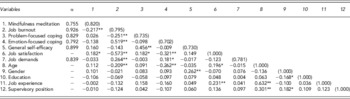
The analyses were performed in WarpPLS 3.0 beta (Kock, Reference Kock2012). First, the estimation model was evaluated. The results, as well as the correlations between variables, are shown in Table 1. Reliability was tested by internal consistency measuring by Cronbach's α. All variables had the values above the minimum requirement of 0.7 (Fornell & Larcker, Reference Fornell and Larcker1981). The convergent validity of each item was evaluated using factor loadings. The results indicated that all loadings were >0.5, which was recommended by Hair, Black, Babin, and Anderson (Reference Hair, Black, Babin and Anderson2009). Convergent validity was assessed by the average variance extracted. The average variance extracted for each construct was greater than correlations between the constructs, suggesting that the convergent validity was satisfactory (Fornell & Larcker, Reference Fornell and Larcker1981). Finally, the test for multicollinearity among the variables was performed using the variance inflation factor statistics. The variance inflation factors ranged from 1.12 to 2.05, which were below the critical value of 3.3, as suggested by Petter, Straub, and Rai (Reference Petter, Straub and Rai2007).
Correlation matrix between variables, internal consistency, and convergent validity

Note. Average variance extracted of latent variables are shown in the parentheses.
*p ≤ .05; **p ≤ .01.
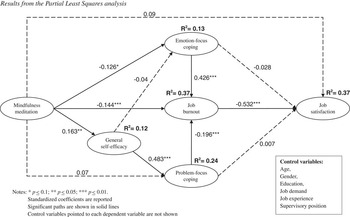
Analysis results from the structural model are presented in Figure 1. Control variables are pointed to each of the main variables. Only significant paths are shown in solid lines. The standardized coefficient and t-values were calculated using a bootstrap resampling procedure with 100 subsamples (Efron, Rogosa, & Tibshirani, Reference Efron, Rogosa and Tibshirani2004).
Results from the partial least squares analysis

Hypothesis 2 proposed the positive relationship between burnout and job satisfaction, which was strongly supported by the model. The relationship was also statistically significant at 1% level (β = −0.532; p ≤ .01). Hypothesis 3 suggested that people who regularly practiced MM reduced burnout. The result also strongly supported this hypothesis at 1% level (β = −0.144; p ≤ .01).
Hypothesis 4 proposed the negative relationship between problem-focused coping and burnout. The result strongly supported the hypothesis at 1% level (β = −0.196; p ≤ .01). Hypothesis 5 proposed the positive relationship between emotion-focused coping and burnout. This hypothesis was also strongly supported at 1% level (β = 0.426; p ≤ .01). Hypothesis 6 predicted the direct and positive relationship between problem-focused coping and job satisfaction, while Hypothesis 7 predicted the negative relationship for emotion-focused coping. Although the signs of the relationships came out as expected, they were not statistically significant at below 10% level. Therefore, Hypotheses 6 and 7 were not supported. To test the mediating effect of both problem-focused coping and emotion-focused coping on job satisfaction as predicted in Hypotheses 8 and 9 respectively, the method suggested by Preacher and Hayes (Reference Preacher and Hayes2004) was calculated in WarpPLS 3.0. The result suggested the positive indirect effect of problem-focused coping on job satisfaction at the 1% significant level (β = 0.104; p ≤ .01). The negative indirect effect between emotion-focused coping and job satisfaction was also confirmed at 1% significant level (β = −0.226; p ≤ .01). Therefore, Hypotheses 8 and 9 were supported.
Hypotheses 10 and 11 predicted that people who regularly practiced MM tended to employ more problem-focused coping strategies and less emotion-focused coping strategies, respectively. The results suggested that although regular practice of MM was positively associated with problem-focused coping, it was not statistically significant at 10% level (β = 0.07; p = .25). Therefore, Hypothesis 10 was not supported. However, the result suggested the negative relationship between regular practice of MM and emotion-focused coping at the 10% significant level (β = −0.126; p ≤ .1). Therefore, Hypothesis 11 was supported.
Hypotheses 12 and 13 tested the mediating effect of practicing MM and coping strategies through general self-efficacy. The result showed the significant relationship between MM practice and general self-efficacy at 5% level (β = 0.163; p ≤ .05). In addition, there was a significant and positive relationship between general self-efficacy and problem-focused coping (β = 0.483; p ≤ .01). In the tests of the indirect effect, the results revealed the positive indirect link from practicing MM to problem-focused coping at 10% significant level (β = 0.104; p ≤ .1). However, there was no indirect relationship between practicing MM and problem-focused coping (β = 0.07; p = .49). Therefore, Hypothesis 12 was supported while Hypothesis 13 was not.
Back to Hypothesis 1, which predicted the positive relationship between practicing meditation and job satisfaction. Although the results showed the positive relationship between the variables, the statistical significant level was marginally above 10% (β = 0.09; p = .11). To check for the possibility of the indirect relationship, the calculation of the total indirect effect from MM to job satisfaction was performed through every mediating links. According to Alwin and Hauser (Reference Alwin and Hauser1975), the sum of the direct and indirect effects represents the total effect of the focal variable on the dependent variable. The result, which was calculated in WarpPLS 3.0, revealed the positive total indirect relationship that was statistically significant at 1% level (β = 0.194; p ≤ .01). Therefore, Hypothesis 1 was supported in terms of the indirect link.
Finally, the significant relationships between control variables and key dependent variables were reported as the following: job demands was associated positively with burnout (β = 0.192; p ≤ .01) and emotion-focused coping (β = 0.178; p ≤ .01). For gender, male tended to have lower job satisfaction than female (β = −0.103; p ≤ .1). For age, younger respondents tended to engage more in emotion-focused coping than older respondents (β = −0.194; p ≤ .1). For education, highly educated respondents tended to engage less in problem-focused coping than lower educated respondents. Finally, job satisfaction tended to be determined positively by job experience (β = 0.19; p ≤ .05) and supervisory position (β = 0.091; p ≤ .01).
DISCUSSION
The results from this study provide extra contribution to research related to employees’ burnout, its outcome on job satisfaction, and how to deal effectively with it. The survey of employees in Thailand also provides additional evidence to existing research, which were largely conducted in Western countries. In particular, the author found a strong support that burnout significantly erode employees’ job satisfaction. Burnout, in turn, was experienced by employees as a result of high job demands. These results are in line with findings documented in previous studies ( Tourigny, Baba, & Xiaoyun, Reference Tourigny, Baba and Xiaoyun2010; Shepherd, Tashchian, & Ridnour, Reference Shepherd, Tashchian and Ridnour2011). Moreover, this study found extra evidence that the level of burnout was also determined by the choice of coping strategies that employees usually adopted. Results revealed a strong support that employees who usually used problem-focused coping to target and to alter the sources of problems tended to experience less burnout; on the other hand, employees who usually used emotion-focused coping to avoid facing the problem directly tended to experience more burnout. These results support the argument suggesting that emotion-focused coping may be considered a maladaptive coping strategy (Connor-Smith & Flachsbart, Reference Connor-Smith and Flachsbart2007; Lewin & Sager, Reference Lewin and Sager2008).
Importantly, this study has added to previous studies by proposing that regular MM practice can help employees alleviate burnout and enhance their productive coping style. First, the result strongly supported the prediction about the benefit of MM on reducing burnout. Despite being affected by high job demands, employees who reported that they had regularly practiced MM tended to report lower burnout compared to those who did not. For the contribution of MM on the choice of coping strategies, the author also found some supporting evidence that employees who had regularly practiced MM tended to adopt more problem-focused coping and less emotion-focused coping. In particular, the benefit of MM on the choice of problem-focused coping was mediated by general self-efficacy. This indirect link is in line with the argument that clear mind and emotions promote positive thinking, including a belief about one's own capability to deal with difficulties and challenges (Gundlach, Martinko, & Douglas, Reference Gundlach, Martinko and Douglas2003). Finally, this study found that regular MM practice also led indirectly to higher job satisfaction. Specifically, lower burnout and higher tendency to engage in effective stress coping styles accounted for this contribution in the model.
Overall, the results from this study are consistent with the job demand−resource perspective (Hobfoll, Reference Hobfoll1989; Demerouti et al., Reference Demerouti, Bakker, Nachreiner and Schaufeli2001). Based on the theory, the benefits gained from practicing MM can be considered another critical resource that allows employees to deal effectively with high job demands and workloads in the workplace. The trained mind that helps employees remain calm when facing with problems or unfavorable encounters at work and stay focused on their task is therefore an essential capability for the successful stress management in the organization.
Practical implication
As employees are considered valuable assets for an organization, maintaining a satisfied workforce can significantly make organization more competitive in business. However, it is difficult for employees to be satisfied with their job when they consistently experience stress at work. This situation can be severe, especially when they are unable to manage stress appropriately. The present study shed more light on one particular type of practice that can help employees deal effectively with stress and burnout. In particular, practicing MM is crucial for employees to overcome work-related stress as it can enhance the development of cognitive and emotional capabilities that are necessary for them to deal with problems and stressful events in the workplace. Considering the role of mindfulness on promoting various psychological outcomes and performance (Feldman et al., Reference Feldman, Hayes, Kumar, Greeson and Laurenceau2007), a policy to help employees improve the quality of mindfulness can be beneficial to both employees and organizations. In fact, Brown and Ryan (Reference Brown and Ryan2003) argued that although mindfulness is an ability commonly possessed by every human, people tend to differ in their propensity or willingness to develop or exercise this capability. As practicing MM aims to substantiate this capability, it can tremendously benefit organizations because it can enhance employees’ potential in various areas that are crucial for superior organizational performance.
Therefore, the author suggests that MM training should be considered one of employee development programs in organizations. MM is not limited to specific religion. Although the practice is rooted in Buddhism, it has been widely trained to people from various cultures and religions, without referring to the religion of origin or sectarianism (Goenka, Reference Goenka2006). In addition, MM training does not require substantial investment. Practice of MM is not limited to specific settings and can be performed even in daily activities. Importantly, the author also suggests that the MM training program should be conducted on a continuous basis since the benefits of MM practice can take time to develop.
Limitations and suggestions for future research
There are some limitations that the author needs to mention. First, the samples which were obtained on a voluntary and anonymous basis through religion web sites made it impossible for the author to identify other key characteristics of the respondents beforehand. There is also a possibility that the respondents obtained from this method of sampling may not truly represent the entire target population. Finally, the small sample size can also limit the generalized power of the results to the larger scope. In particular, these limitations happened owing to the difficulty to obtain the large number of respondents who have regularly practiced MM. Therefore, it is necessary for future studies to be conducted in a larger scale, if possible, to confirm the benefits of MM on workplace outcomes.
Second, because the survey data were collected in a cross-sectional basis, the author was unable to investigate whether lower burnout or the choice of coping strategies actually resulted from practicing MM or merely from other uncontrolled characteristics of the respondents such as certain personality traits. Therefore, future longitudinal studies that measure these outcome factors before and after MM practice is needed in order to provide evidence on its effects.
The third limitation is the use of subjective measurements of the key variables in the study. It can be possible that these subjective measurements may not be the accurate representations of the constructs. Furthermore, scholars have criticized that using subjective measurements could make the results susceptible to common method bias (van Beek, Hu, Schaufeli, Taris, & Schreurs, Reference van Beek, Hu, Schaufeli, Taris and Schreurs2012). Keeping the possibility of this problem in mind, however, the author carefully followed the methods suggested by Podsakoff, MacKenzie, Jeong-Yeon, and Podsakoff (Reference Podsakoff, MacKenzie, Jeong-Yeon and Podsakoff2003) and Spector (Reference Spector2006) to reduce the potential impacts of common method bias in the survey (such as separate presentation and introduction of distinct constructs in the questionnaire).
Acknowledgements
The author is very grateful to two anonymous reviewers for valuable comments and suggestions. All remaining errors and omissions are the author's responsibility.