Aerogels are highly open porous, nanostructured solid materials, and are produced via a sol–gel process. First inorganic silica aerogels were reported by Kistler.[Reference Kistler1] Pekala developed organic resorcinol–formaldehyde (RF) aerogels in 1989.[Reference Pekala2] These materials have many fascinating properties such as high porosity (80–99%), low bulk density (0.01–0.3 g/cm3), low thermal conductivity (0.01–0.05 W/mK), and high surface area (500–2000 m2/g).[Reference Mulik, Sotiriou-Leventis, Aegerter, Leventis and Koebel3] Owing to these properties they have many applications: thermal and sound insulation,[Reference Jin, Aegerter, Leventis and Koebel4] filler for vacuum isolation panels,[Reference Mendenhall, Aegerter, Leventis and Koebel5] pyrolyzed RF aerogels – so-called carbon aerogels – are used in foundries[Reference Ratke, Milow, Aegerter, Leventis and Koebel6] or for batteries or fuel cells.[Reference Shen, Guan, Aegerter, Leventis and Koebel7] Owing to their high porosity most aerogels are brittle and mechanically not resilient. Various methods have been developed to improve their mechanical properties and increase the flexibility of silica aerogels.[Reference Kanamori, Aizawa, Nakanishi and Hanada8] We reported recently the synthesis of flexible organic RF aerogels dried at ambient conditions.[Reference Schwan and Ratke9] We modified the route and obtained highly flexible aerogels by supercritical drying (SCD) of wet gels with CO2. These new type of RF aerogels are elastically deformable by more than 50% and are comparable with soft sponges or rubber. Owing to a high stiffness to weight ratio filled and unfilled aluminum, NomexTM (aramid), paper, or thermoplastic honeycombs are often used as sandwich panels and in structural applications as a secondary structure. Aircrafts, vehicles, buildings, and furnitures use honeycombs as a core, insulating, and protective material.[Reference Bitzer10] Several researches have studied structural and mechanical properties of honeycombs. Gibson and Ashby developed models to analyze them with respect to cell size and shape, loading kind, and directions.[Reference Gibson and Ashby11] Models for filled honeycombs were suggested by Abd El-Sayed et al.[Reference Abd El-Sayed, Jones and Burgess12] and Beblo et al.[Reference Beblo, Puttmann, DeLeon, Joo and Reich13] The great advantage of filled honeycombs is their improved properties. Syntactic foam-filled honeycombs show an increase in Young's modulus about 30% and in energy absorption about 48%.[Reference Jhaver and Tippur14] Polymer-filled aluminum honeycombs can achieve Young's modulus in the range of 2–7 GPa.[Reference Murray, Gandhi and Hayden15] Filling of honeycombs with polyimide foam leads to increased compression strength.[Reference Resewski and Buchgraber16] Not only mechanical properties can be improved, but the thermal and sound conductivity can also be decreased significantly by filling with appropriate materials. Joshi reported the filling of a sandwich structure with granular silica aerogel.[Reference Joshi17] The better handling of inherent brittle silica aerogels was solved by this method. Reducing of thermal conductivity was achieved by filling of glass panels and honeycomb structures with silica aerogel.[18, 19] The filling of honeycombs has not been reported yet in conjunction with flexible, organic aerogels. In the present work, we report on a novel insulation material produced by combining aramid honeycombs with newly developed superflexible (sf)-RF aerogels. The synthesis, properties and possible application are reported and discussed.
For the synthesis of RF aerogels following chemicals were used. Resorcinol (R) (98%) and sodium carbonate (C) anhydrous were supplied by Aldrich, formaldehyde (F) (37% in water, stabilized with 10% methanol) by Merck and 2.0 N nitric acid (standardized solution) was purchased by Alfa Aesar. In the synthesis, deionized water (W) was employed. Acetone (pure, technical grade) from Th. Geyer was used for washing the gels. As we already reported,[Reference Schwan and Ratke9] Resorcinol (R) was dissolved in water (W) with R/W molar ratio 0.008, then formaldehyde (F) and sodium carbonate as catalyst (C) were added (R/F = 0.5 and R/C = 50). After dissolving of catalyst (5 min) the pH of the solution was adjusted in close to 5.6. The whole solution was stirred 60 min. The aramid honeycombs being coated with a phenolic resin were placed in lockable PP container and filled with the RF solution prepared. After 7 days gelation and curing at 80 °C, washing with acetone 3 days, the gels were dried with supercritical CO2 at 100 bars and 45 °C.
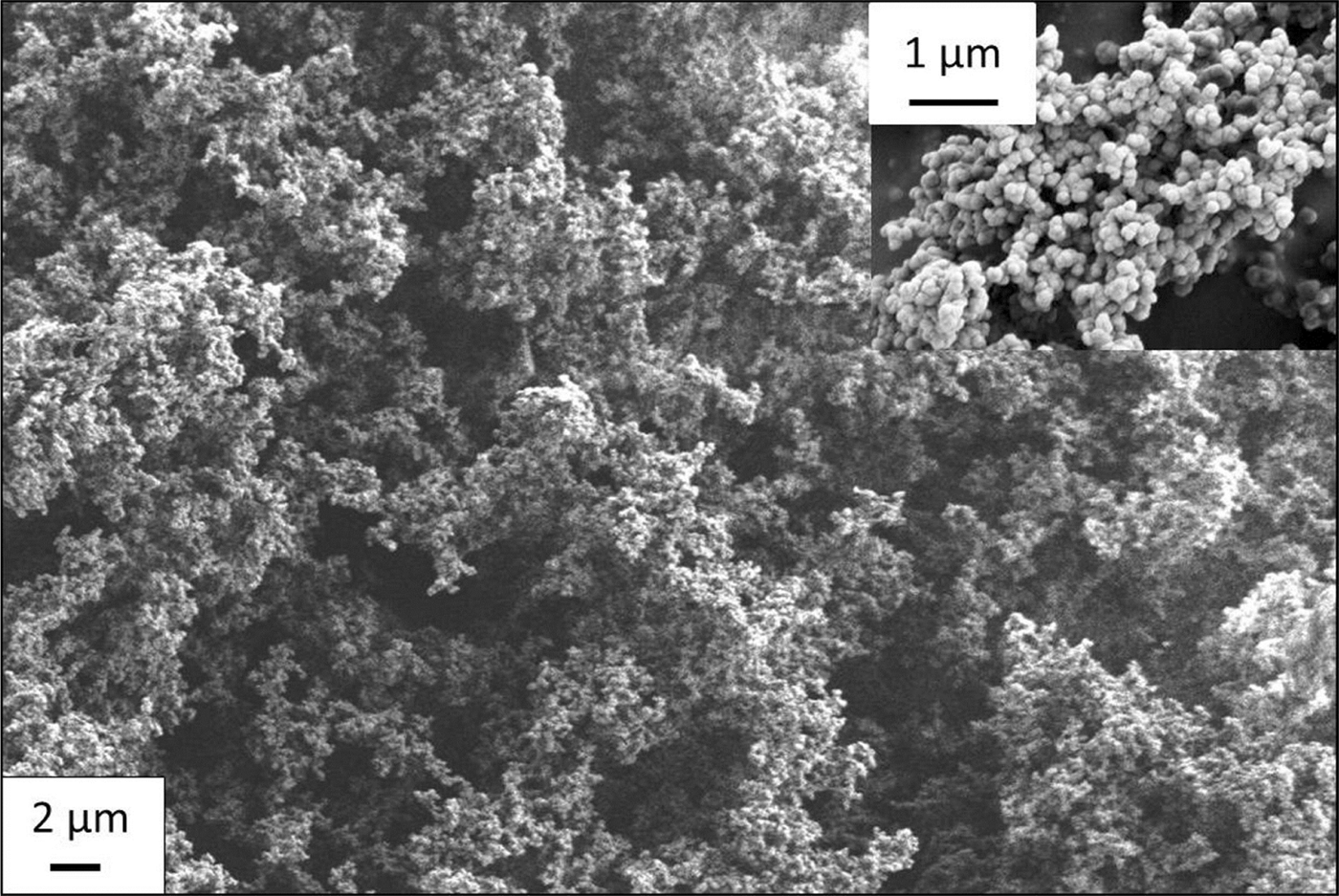
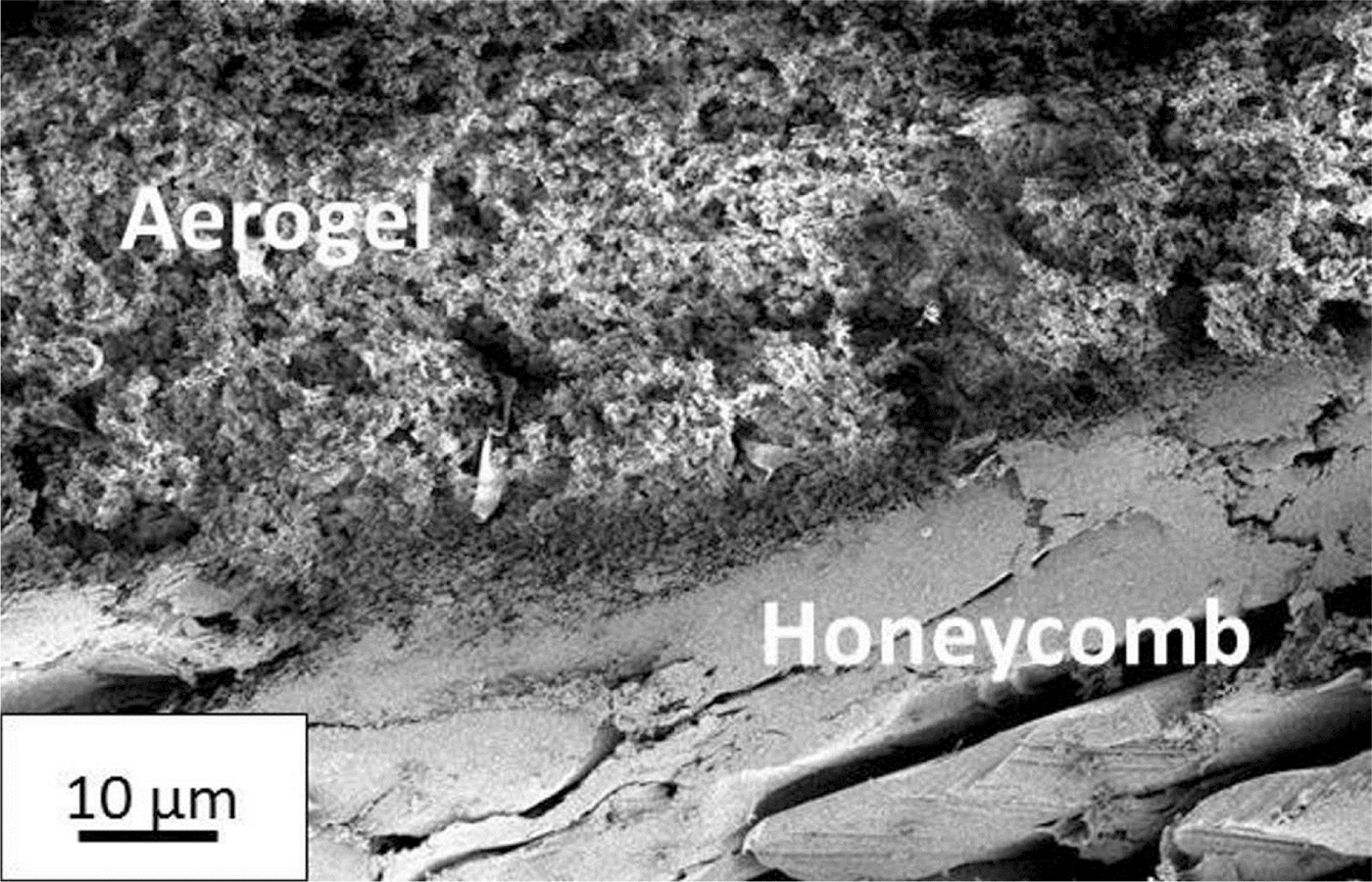
The thermal conductivity of the dried material was measured with the HotDisk machine (TPS 2500) using the Transient Plane Source technique. The microstructure of the aerogel and the composite was studied with scanning electron micrographs (SEM, Merlin, Zeiss). The bulk densities were calculated by their mass-to-volume ratio. The Young's modulus was determined in uniaxial compression tests using a material testing machine from Latzke (Germany). Pictures of the composites prepared are shown in Fig. 1. The honeycombs look well filled without any gaps at the interface between the aramid cell walls and the aerogel filler. Figure 2 shows the microstructure of a sf-RF aerogel. The particle size of the RF-particles building the three-dimensional (3D) network of the aerogel is about 100 nm (see the inset) and both small pores in the range of 50–500 nm and large pores 1–2 µm are observable, especially at lower magnifications. This structure is crucial for reaching high flexibility. The existence of nanoparticles and macropores increases the flexibility of aerogel. The thin connected particle structures of about 100 nm thickness are mobile because there is sufficient room for deforming. They are not impeded by other particles or their structures during compression and consequently do not break but go back to their initial position. The SEM image of the composite is shown in Fig. 3. A well-adhering aerogel part on the aramid cell wall is shown, which indicates the existence of a good interface bond. This was expected because the phenolic resin coating of the aramid cell walls and the RF aerogel are chemically similar.[Reference Knop and Pilato20] The sufficient, continuous contact between both materials plays an important role to achieve the best properties of the composite. The composite material produced consists of 92.7 vol% of aerogel Φ A and 7.3 vol% of aramid honeycomb Φ H. Owing to the high porosity of the aerogel its density is very low, e.g. 0.05 g/cm3. The density of the composite is 0.083 g/cm3. Since no capillary forces act during SCD a measurable shrinkage, which amounts 39–49% under conditions of ambient drying, is avoided. The thermal conductivity of the aerogel, λ A amounts 0.037 W/mK and of the pure honeycomb, λ H 0.06 W/mK.[21] The measured thermal conductivity of filled honeycomb was reduced by 31%. The deviation compared with a calculated value with the rule of mixtures (ROMs) is negligible and only 5%.
 $${\lambda _{{\rm eff}}} = {\lambda _{\rm A}} \cdot {\phi _{\rm A}} + \; {\lambda _{\rm H}} \cdot {\phi _{\rm H}}$$
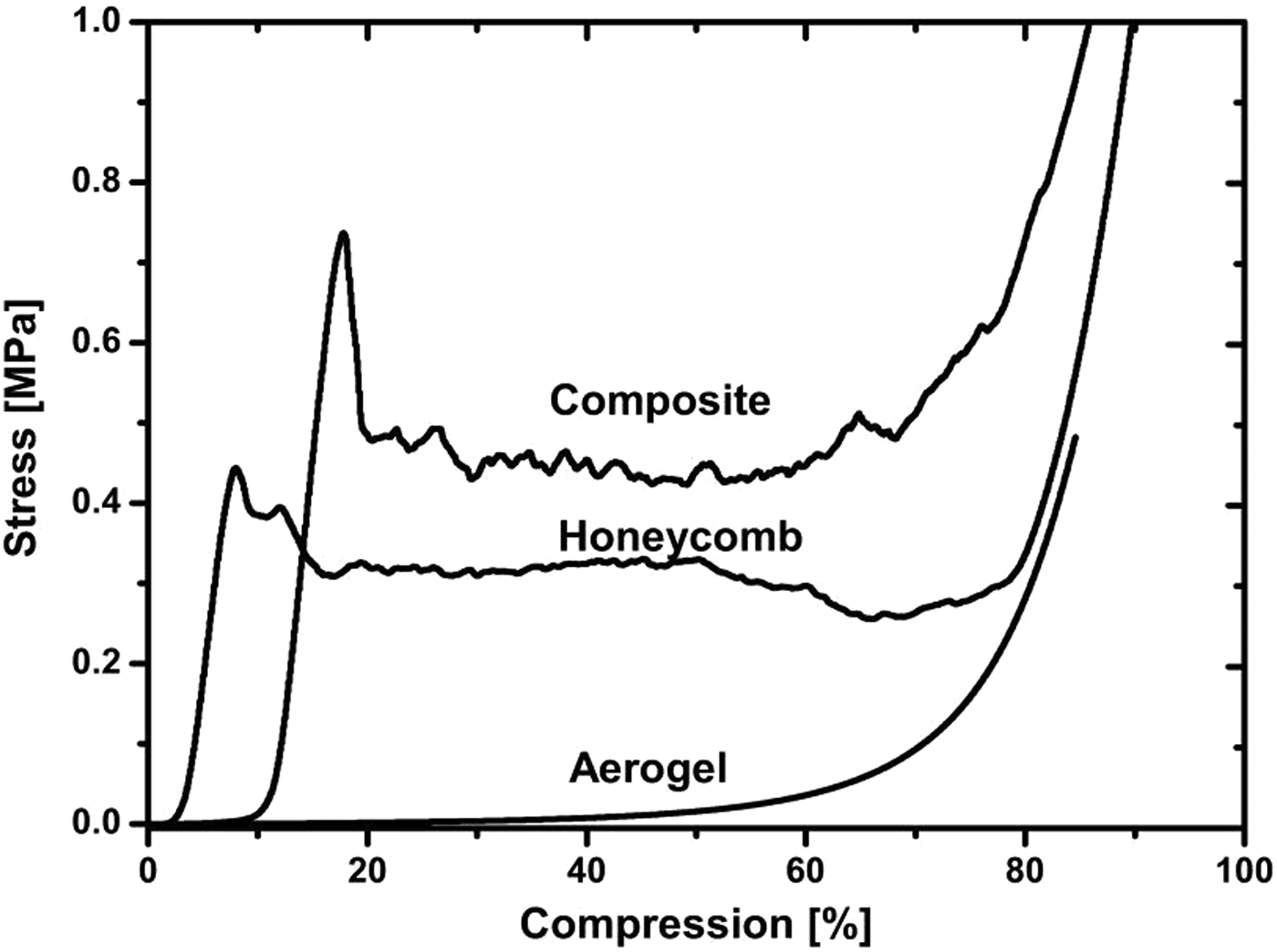
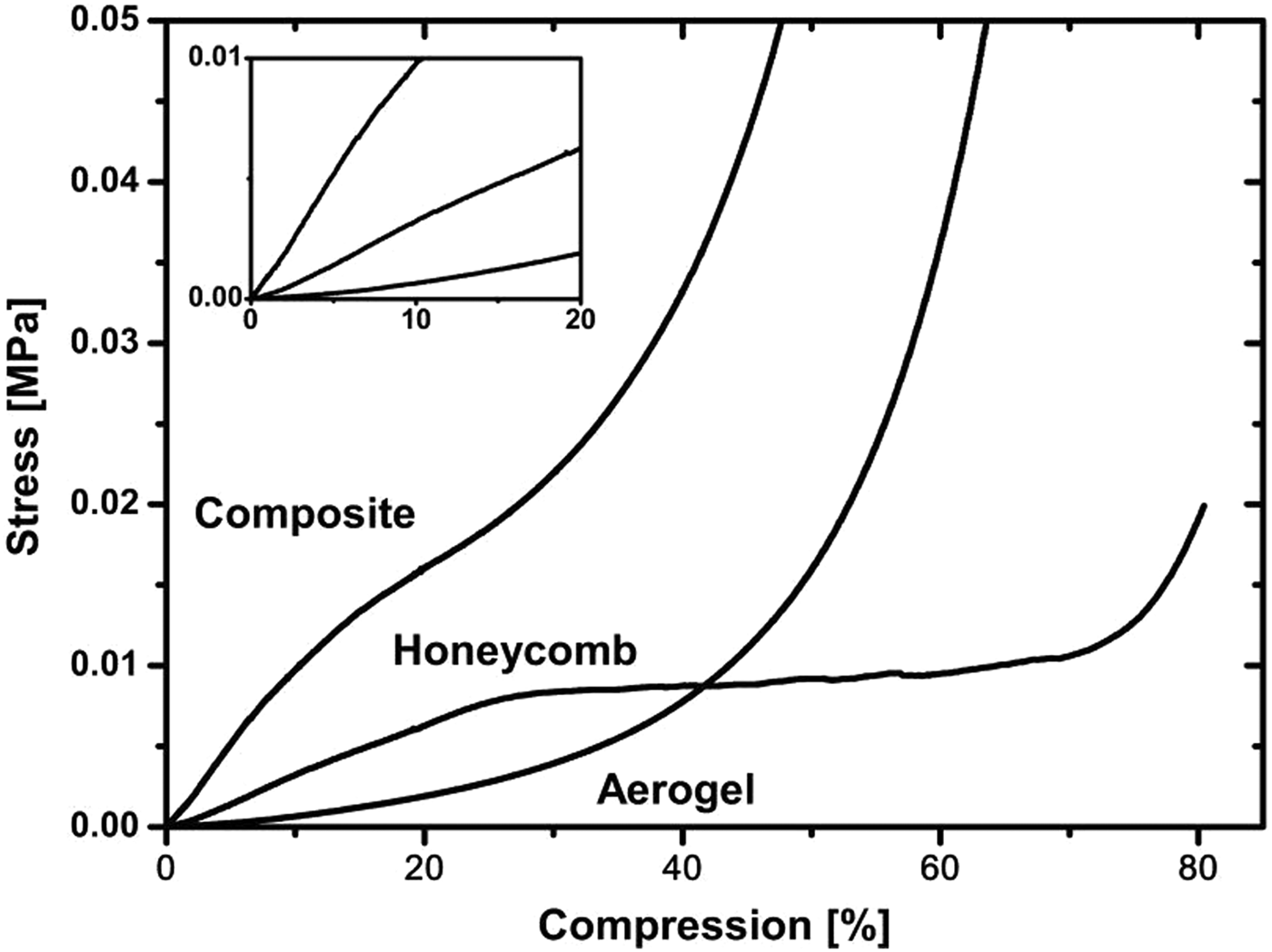
The filling with aerogels eliminates the air convection and radiation effects and reduces in this way the thermal conductivity of the composite. The heat transfer occurs through the honeycomb cells and the highly porous network of aerogel. The Young's modulus of sf-RF aerogel, unfilled and filled honeycomb was determined by uniaxial compression tests with out-of-plane and in-plane loading. The curves are shown in Figs. 4 and 5. The compressive stress-compression curve of the aerogel has all the characteristics we expect for a flexible aerogel and is equal in both directions due to its isotropy. Note the different scaling of the ordinate in both figures. The elastic behavior of the pure aerogel is hard to see in both curves and therefore we put an inset into Fig. 5, showing a magnification of the elastic region of the aerogel. The short linear-elastic region at the beginning is followed by an almost horizontal plateau up to 50% compression. In this region, the nanoparticle structures collapse and the pores are compressed. On further deformation the cell walls touch each other, the material is densified and the curve rises steeply. Figure 4 shows the curve of unfilled honeycomb in an out-of-plane compression test. The Young's modulus was determined from the slope in the linear elastic region and is three times higher than that of the aerogel. The steep rise in stress ends at about 0.45 MPa, which we attribute to buckling of the aramid cell walls. Beyond the point at about 8% total deformation, the curve shows a serrated stress plateau extending to compressions up to 70%. The yielding and cracking of aramid fibers are reflected in small cracks on the plateau. We observed the loading in this direction causes more compression of honeycomb walls than bending. After the material is almost completely densified the stress rises drastically. Compared with unfilled honeycombs the stress of the composite rises very slowly up to compression of 10% and after higher compression it starts to increase rapidly up to a stress level of 0.8 MPa, again indicating buckling of the cells walls. The slope in the linear-elastic regime is nearly twice higher and is an evidence of an increased Young's modulus. The improving is 27%. The soft aerogel in the cells causes a higher serrated plateau.
Aerogel-filled NomexTM honeycomb.

SEM image of sf-RF aerogel with an inset of a higher magnified area showing the nanostructure of the material.
Cross-section of aerogel–honeycomb composite.
Stress–compression curve for out-of-plane loading of filled, unfilled honeycombs, and sf-RF aerogel.
Stress–compression curve for in-plane loading of filled, unfilled honeycombs, and sf-RF aerogel. The inset shows a higher magnification of the elastic regime. The assignment of the lines to the materials is identical to the larger image: the bottom line is the sf-RF aerogel, the next line is that of the empty honeycomb, and the upper line belongs to the composite material.
The Young's modulus of the composite was additionally calculated with ROM of composites and with the model of El-Sayed et al.[Reference Abd El-Sayed, Jones and Burgess12] For cells connected in parallel, which corresponds to out-of-plane compression, the ROM would lead to
 $${E_{{\rm eff}}} = {E_{\rm A}} \cdot {\phi _{\rm A}} +\; {E_{\rm H}} \cdot {\phi _{\rm H}}\comma \;$$
where E A and E H are the Young's moduli of aerogel and honeycombs, respectively. As showed in Table 1 the experimental and measured values are different. The Young's modulus calculated with model of El-Sayed et al. deviates by 23% from the experimental value, the ROM value by 91%. These strong deviations are an evidence to suggest that the models used are not suitable for the material manufactured. The origin could be that these and other models presume equal deformation of the honeycomb and the infill. Figure 5 shows the in-plane stress–compression curves. The mechanism of deformation in this direction is different to that of out-of-plane which is reflected in the shape of curves. The linear-elastic region of unfilled honeycombs extends up to almost 20% at relative low stress below 0.01 MPa. The Young's modulus in-plane is 33% higher than that of the aerogel. After a critical stress is reached the walls begin to buckle and to dent – this region accords the plateau in the graph – until they touch each other. From this point densification begins. As we can see that the stress–compression curve of the composite is completely different. The sharp increase in Hookes region followed by a slight shoulder and drastic rises of stress after reaching 40% compression. The absence of plateau points out to a modified deformation behavior. The filling of cells with aerogel changes the yielding of the honeycombs.
Properties of the pure sf-RF, the aramid honeycomb, and the sf-RF–honeycomb composite.
aThe experimental values.
bCalculated values according to the model of El-Sayed et al.[Reference Abd El-Sayed, Jones and Burgess12]
An additional force is needed for buckling and denting of filled cells. The deformation of soft, flexible aerogel in the cells causes the small shoulder. This effect results in 34% higher Young's modulus of the composite. During compression test, we have observed that at approximately 20% compression small cracks in the middle of cells are visible. Further compression leads to more and larger cracks. The fact that the cracking of aerogel occurs in the middle of cells and not at the cell walls indicates and proves sufficient bonding between aerogel and honeycomb. After compression of 80% the sample is deformed unrecoverable. The calculated Young's moduli are presented in Table 1. Equation (3) shows the ROMs for a series combination taking into account the Poisson's ratios.
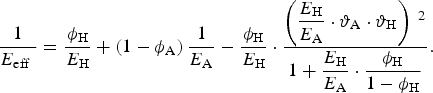 $$\displaystyle{1 \over {{E_{{\rm eff}}}\; }} = \displaystyle{{{\phi _{\rm H}}} \over {{E_{\rm H}}}} + \left({1 - {\phi _{\rm A}}} \right)\displaystyle{1 \over {{E_{\rm A}}}} - \displaystyle{{{\phi _{\rm H}}} \over {{E_{\rm H}}}} \cdot \displaystyle{{\left({\displaystyle{{{E_{\rm H}}} \over {{E_{\rm A}}}} \cdot {\vartheta _{\rm A}} \cdot {\vartheta _{\rm H}}} \right){\; ^2}} \over {1 + \displaystyle{{{E_{\rm H}}} \over {{E_{\rm A}}}} \cdot \displaystyle{{{\phi _{\rm H}}} \over {1 - {\phi _{\rm H}}}}}}.$$
Here ϑ A and ϑ H are the Poisson's ratios of aerogel and aramid honeycomb. For the sf-RF aerogel we measured a Poisson ratio of ϑ A = 0.11 and for the aramid we used a literature value ϑ H = 0.36.[22] The calculated Young's moduli are equal and are 10% lower than the measured. The correlation of in-plane compression is better than out-of-plane. Additionally to the above-discussed problems of the models there are some uncertainties in the experimental data, so that we think a 10% deviation between a simple calculation as in Eq. (3), is acceptable, especially, since the sample of the unfilled honeycombs has bulged during the tests and lead to non-uniaxial compression.
Novel sf-RF aerogel has been produced via a sol–gel process followed by SCD with CO2. Highly flexible RF aerogels are nanostructured, have a low-density and low thermal conductivity. The NomexTM (aramid) honeycombs were filled with the sol solution, gelled at 80 °C, washed, and dried supercritically. We observed a good contact between aerogel and honeycomb walls. Combining of both materials leads to a resilient and light composite. To our knowledge this kind of composite material has been not reported before. The thermal conductivity of the composite produced could be decreased to 31% compared with unfilled honeycombs. The filling of honeycomb with a flexible RF aerogel leads to improved mechanical properties of about 30% with the flexibility kept. The sufficient flexibility of the material is important and ensures always a good contact with the surface, which should be isolated. Additionally are both materials used fire resistant, non-toxic, and non-fuming. Additional benefit of RF aerogel-filled aramid honeycombs could therefore be their utilization in fire protection. First flammability tests (not shown here) showed positive results. Research along this line is in progress.